Internet of Things-Based Multi-Agent System for the Control of Smart Street Lighting

 , ,
, , 
Abstract
1. Introduction
1.1. Context, Motivation, and Objectives
- Significant reduction in energy consumption and maintenance costs.
- Enhanced public safety through improved lighting and visibility of hazards.
- A platform for various smart city services, including mobile broadband connectivity, traffic light control, smart parking, traffic management, environmental monitoring, public safety through video cameras, and electric vehicle charging stations.
1.2. Contribution and Inspiration
- Smart street lighting information is gathered from multiple sensors and transmitted through various IoT connectivity modules. As a result, imprecision and uncertainty could disturb such data; thus, it should be controlled. For dealing with imprecision, ambiguity, and uncertainty, several classical logic extensions could be utilized, such as fuzzy logic [17,18] and probability logic [19]. Given that we require modeling imprecision in lighting control, we can adopt fuzzy logic instead of probability logic [20,21]. Although fuzzy logic deals with imprecise information, the information is handled in sound mathematical theory. To be more precise, “Fuzzy logic is not fuzzy”; essentially, fuzzy logic is a precise logic of imprecision and approximate reasoning [22,23].
- Regarding MAS, their properties go hand in hand with smart street lighting system characteristics, which is a class of IoT applications. Thus, MAS presents an adequate paradigm for their modeling and development. It models the smart street lighting control system as a set of autonomous, intelligent, and cooperative entities called agents. These agents communicate with one another by means of sophisticated Agent Communication Languages (ACL) and protocols. Accordingly, the solution opts for providing a smart pattern-based approach that utilizes fuzzy logic and MAS paradigms as reasoning mechanisms.
1.3. Paper Structure
2. Background
2.1. Internet of Things
2.2. Fuzzy Logic
2.3. Multiagent Systems
3. Literature Review
- automatically adjusts streetlamps’ intensity by dimming according to the time of day.
- remote control of streetlamps by turning on/off lamps via an android application.
- automatically detects streetlamps’ failures and informs the maintainer by sending a report to their smartphone via GSM protocol, avoiding potential internet network interferences.
- Defining several control scenarios with respect to users’ requirements.
- It can be applied in both indoor and outdoor Smart Lighting.
- It ensures energy management and demand-side management by considering requirements of Smart grids, Smart Cities, and unregulated energy markets.
- It is based on IoT technology and Advanced Metering Infrastructure.
- It provides a suitable control over the energy-consumption and related costs of LED light sources.
- The proposed method is based on a linear model that provides practical and economical solutions that are easy to implement, predictable, and efficient.
4. Methodology
4.1. Smart Lighting Patterns
4.1.1. Pattern 1: Advanced Smart Lighting Pattern
4.1.2. Pattern 2: Basic Smart Lighting Pattern
- It is important to note that an intermediate pattern could be distinguished, which is placed midway among the two patterns, thereby amalgamating their characteristics as well as cost, efficiency, and energy consumption.
- Regarding the implementation of Smart Lighting Patterns, various approaches can be adopted depending on the choice of materials, particularly the microcontrollers (e.g., Raspberry Pi, Arduino, ESP32, etc.), each associated with its own platform (IDE). Moreover, different communication protocols (e.g., MQTT, CoAP, Http, etc.) can be used, as well as the underlying architectures and management rules (e.g., Personne detection, lighting level, weather parameters, etc.).
- Actuators play crucial role in enhancing the functionality and adaptability of smart street lighting systems, enabling dynamic and responsive illumination strategies tailored to specific needs. For instance, buzzers can emit warning sounds to alert drivers when pedestrians approach crosswalks at night. RGB LEDs offer color-changing capabilities for visual signaling, such as red for emergencies and green or blue for special events. Servo motors allow precise adjustment of streetlight angles to illuminate specific areas or reduce glare. Relays manage power distribution by switching streetlights on or off based on ambient light sensors or schedules.
4.2. Remote Intelligent Control Architecture for Smart Street Lighting
- It enables the independent description of each dimension of a MAS.
- It is grounded in purely multi-agent principles.
- It does not mandate the use of specific models for each dimension: agent, environment, interaction, and organization. Consequently, designers are free to utilize the formalisms, notations, or languages of their choice to specify each dimension of the system.
- : is the set of agents, representing the internal architectures of the agents.
- : is the set of interactions, representing the means by which the agents interact.
- : is the organizational structure, representing the means used to structure the system’s entities, taking into account the social relationships that may exist among the elements of the MAS.
- : is the environment in which the agents operate.
4.2.1. MAS Component Identification
Agent Identification
- -
- , a set of Agent of Things.
- -
- {, a set of Fuzzy Agents.
- -
- , a set of Local Controller Agents.
- -
- , a singleton set that includes the Global Controller Agent.
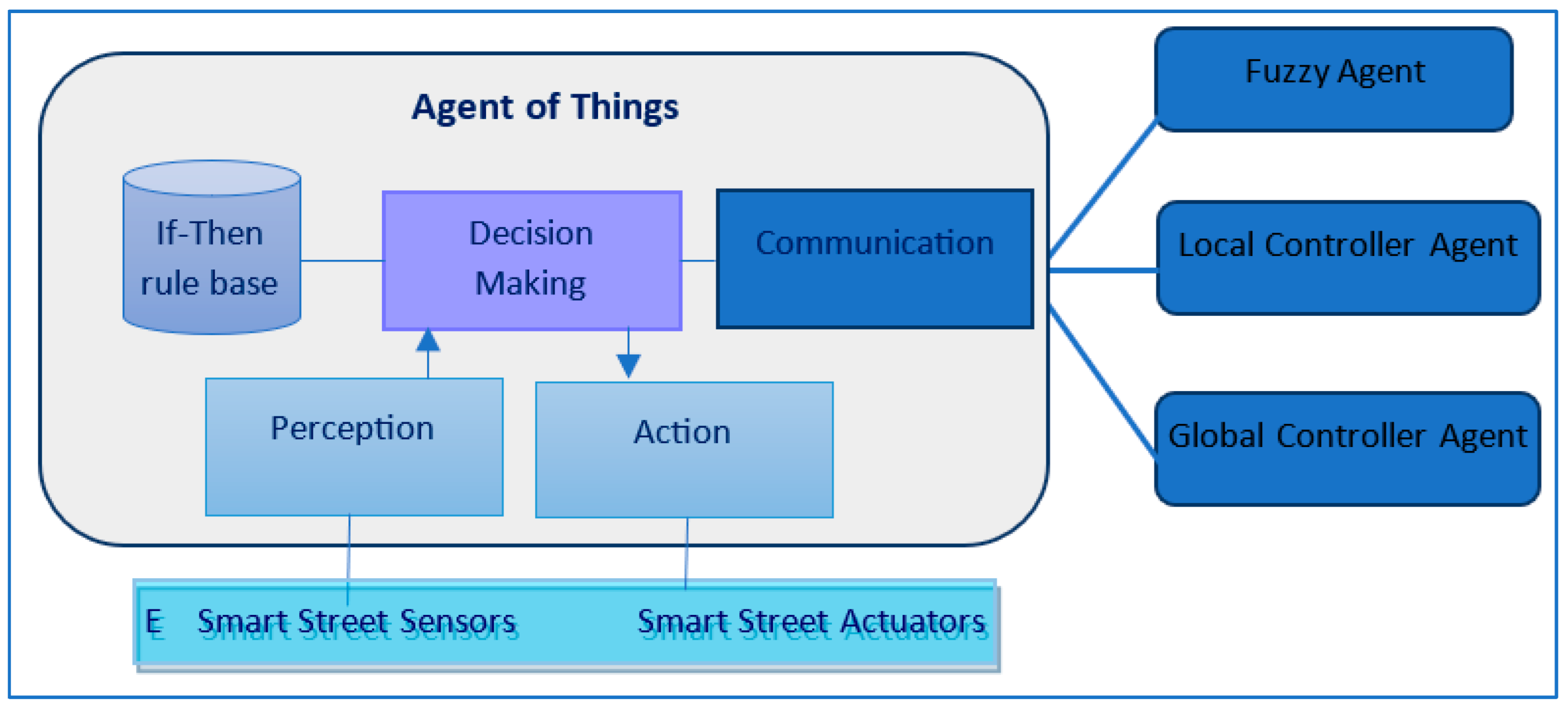
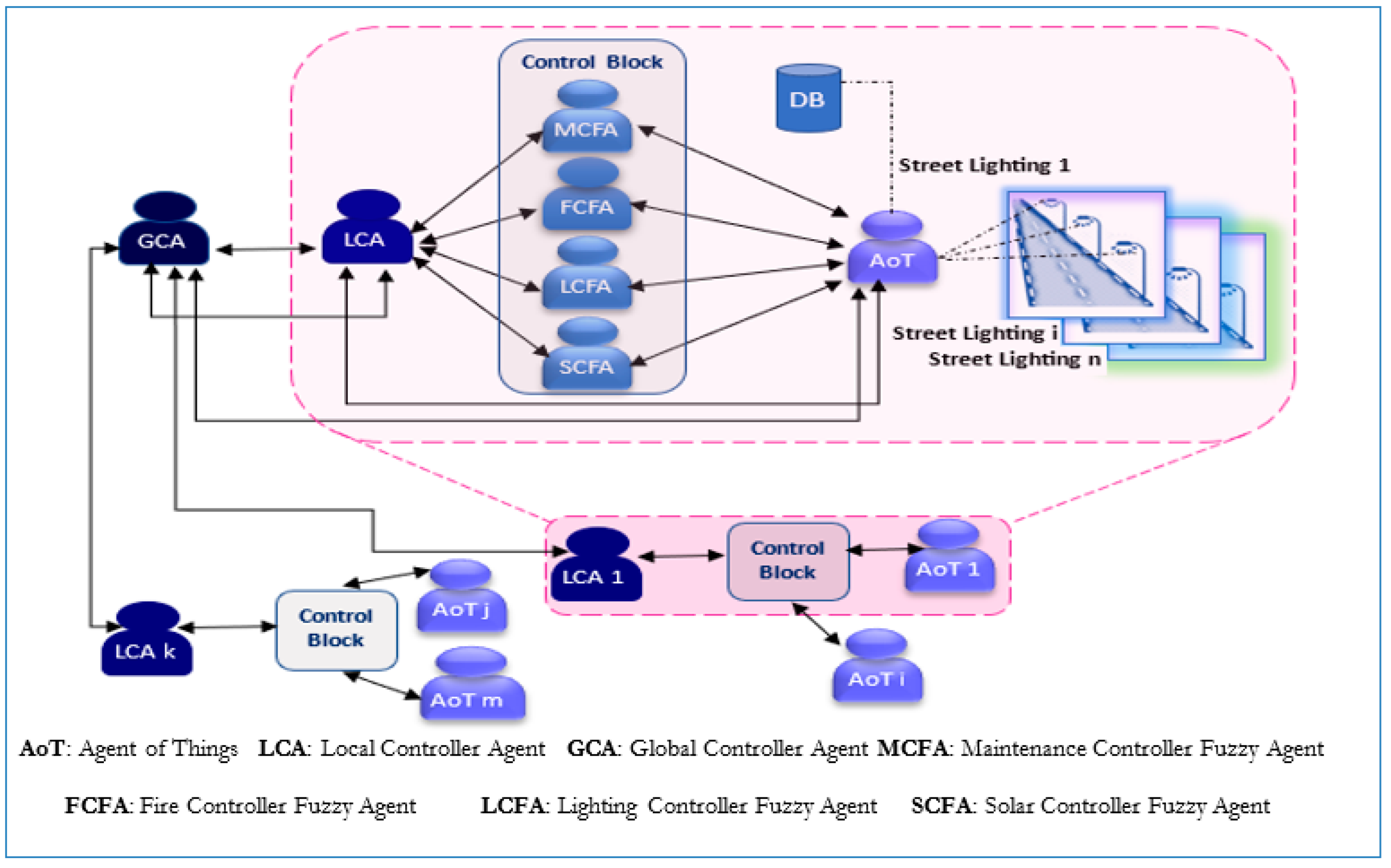
- Agent of Things: is responsible for monitoring multiple smart street lighting units. It is directly connected to the connected things and can acquire measured data from the different sensors. These data are collected from sensors through a communication connection, which can be Bluetooth, Zigbee, GSM, Wi-Fi, or other connection means. The choice of connectivity module impacts the power-consumption level. Upon data arrival, AoT should deal with analyzing, filtering, and forwarding these data to the respective appropriate FAs with respect to their functionality (i.e., role). AoT is a reactive agent with a cyclic behavior whose main architecture is represented by Figure 4. It communicates with FAs, LCA, and GCA.
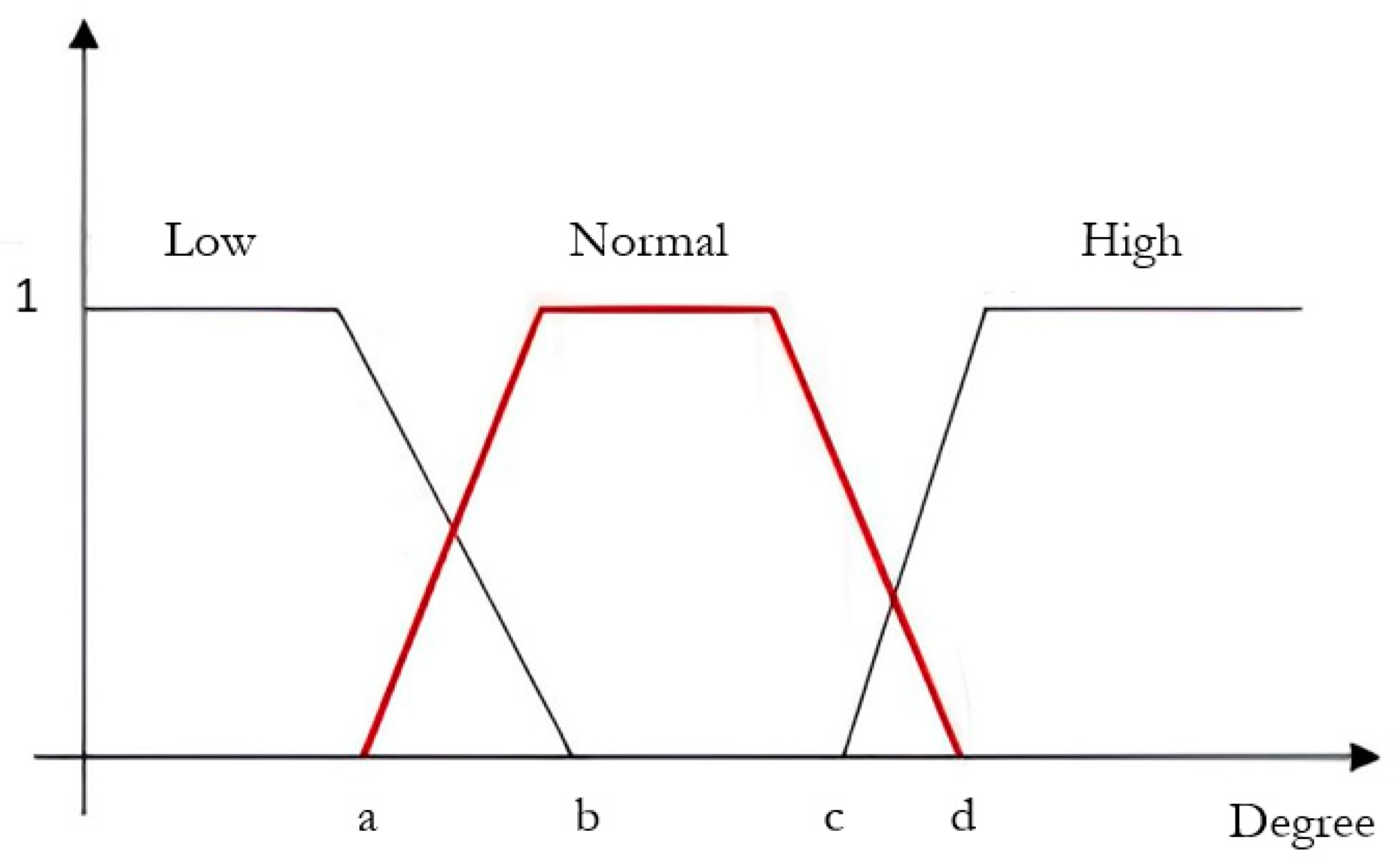
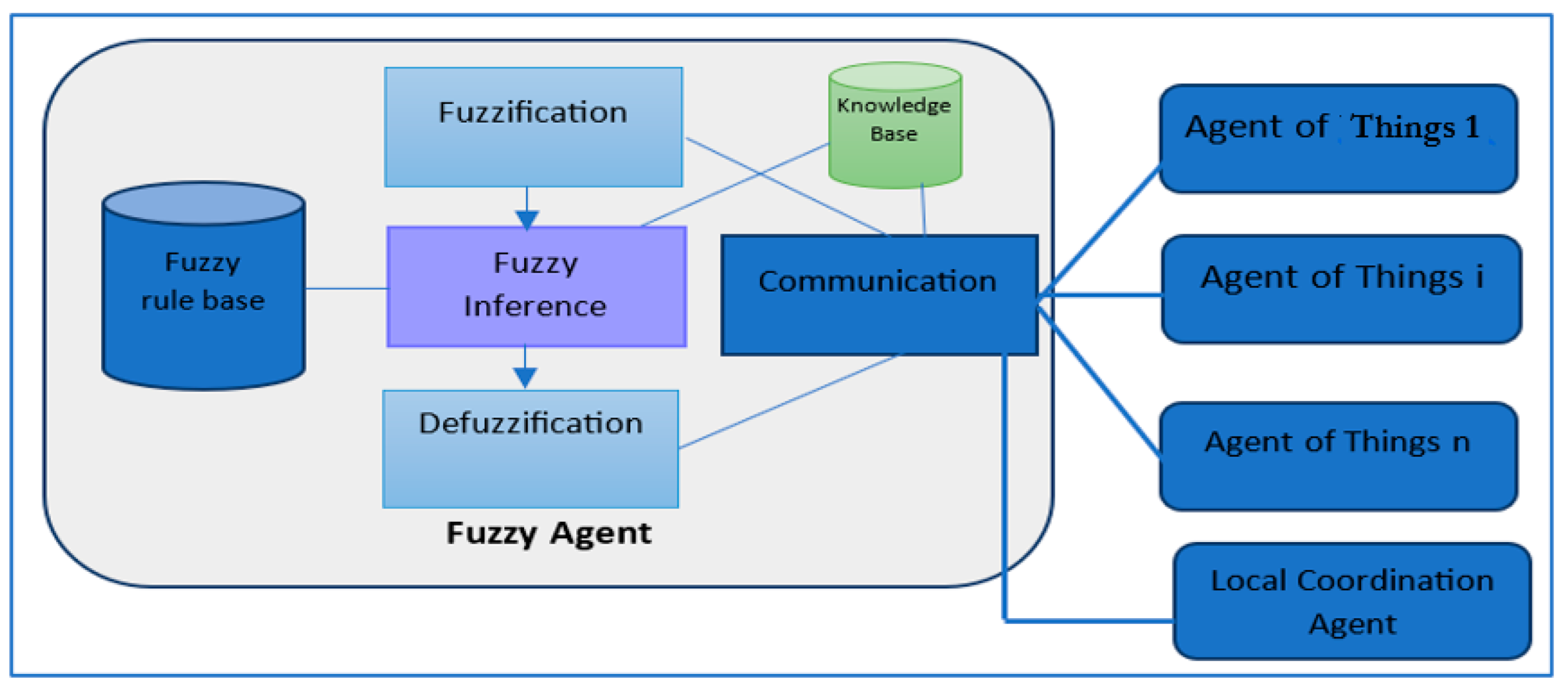
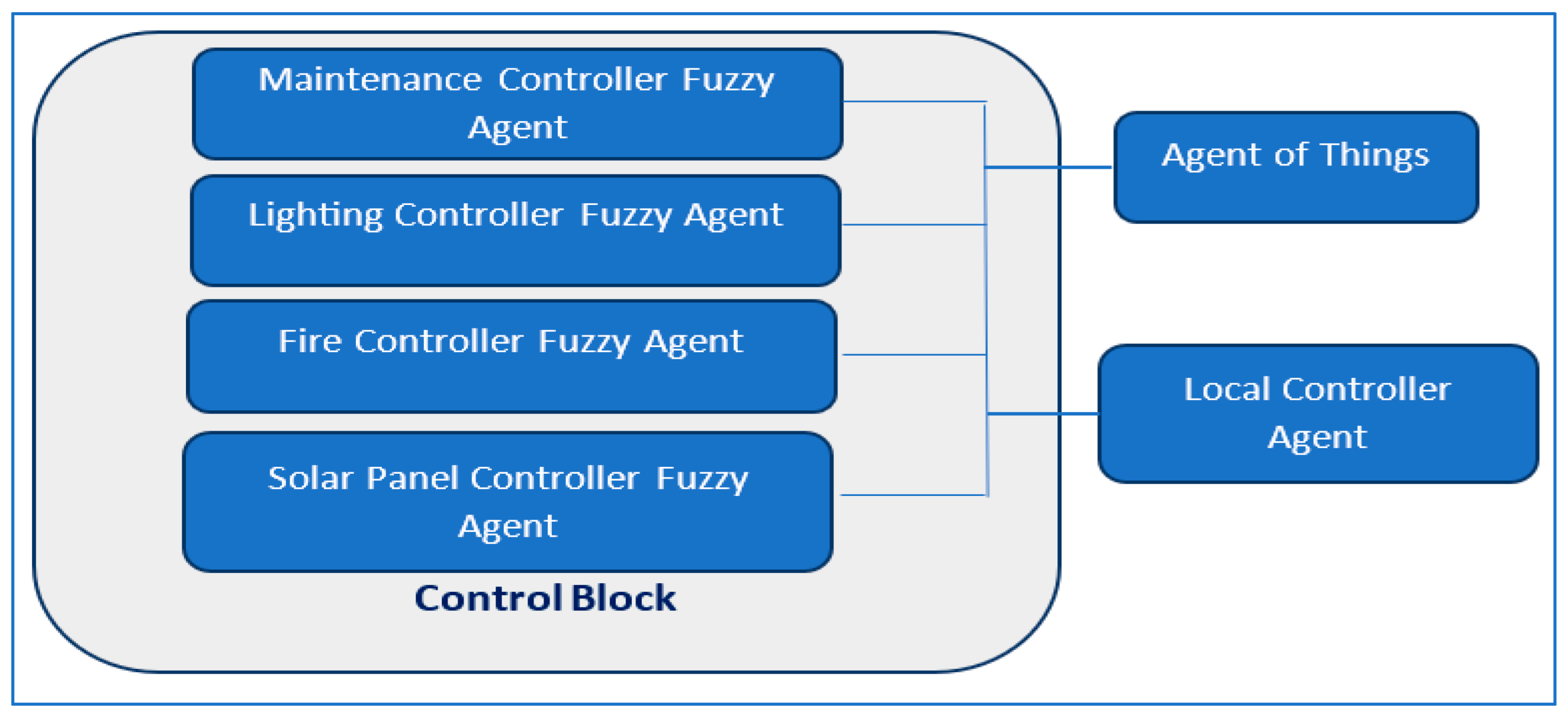
- Fuzzy Agent: Is a fuzzy logic-based agent that uses this fuzzy logic as a reasoning mechanism to manage and supervise specific aspects of smart street lighting. It follows the standard fuzzy reasoning steps described above. The FA communicates with the AoT and the associated LCA. The general architecture of the FA is depicted in Figure 5.
- ○
- Maintenance Controller Fuzzy Agent: Responsible for real-time monitoring of the correct functioning of lampposts.
- ○
- Lighting Controller Fuzzy Agent: Responsible for adjusting the brightness level of streetlamps according to various parameters, such as weather conditions and motion state.
- ○
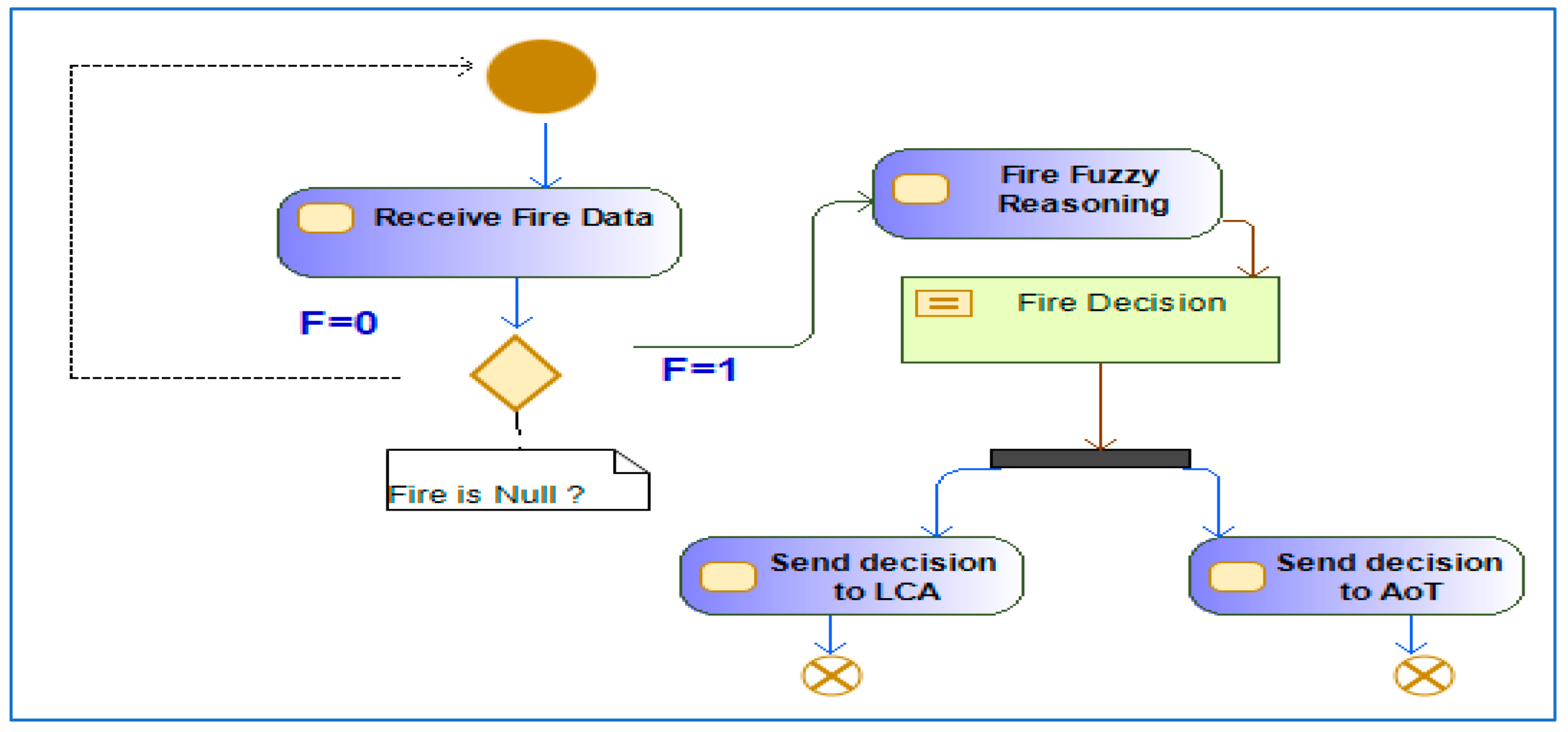
- Fire Controller Fuzzy Agent: Responsible for the intelligent fire control of lampposts.
- ○
- Solar Panel Controller Fuzzy Agent: Responsible for managing the switch (on/off) between lighting using photovoltaic solar energy and ordinary current from the electric grid.
- -
- The necessity to provide rapid and relevant decisions regarding lamppost reactions (cognitive behavior) while reacting proactively (reactive behavior). Cognitive behavior is modeled by Fuzzy Agents, whereas the reactive behavior is ensured by Agent of Things.
- -
- Adopting the principle of separation of concerns and modularity (e.g., Agents of Things are responsible for physical layer management, local and global control responsibilities are divided, and decision-making features are separated and delegated to specialized agent, each having its own related reasoning engine). This approach ensures and facilitates several system properties, such as scalability and adaptability.
- -
- Workload balancing to enhance system performance.
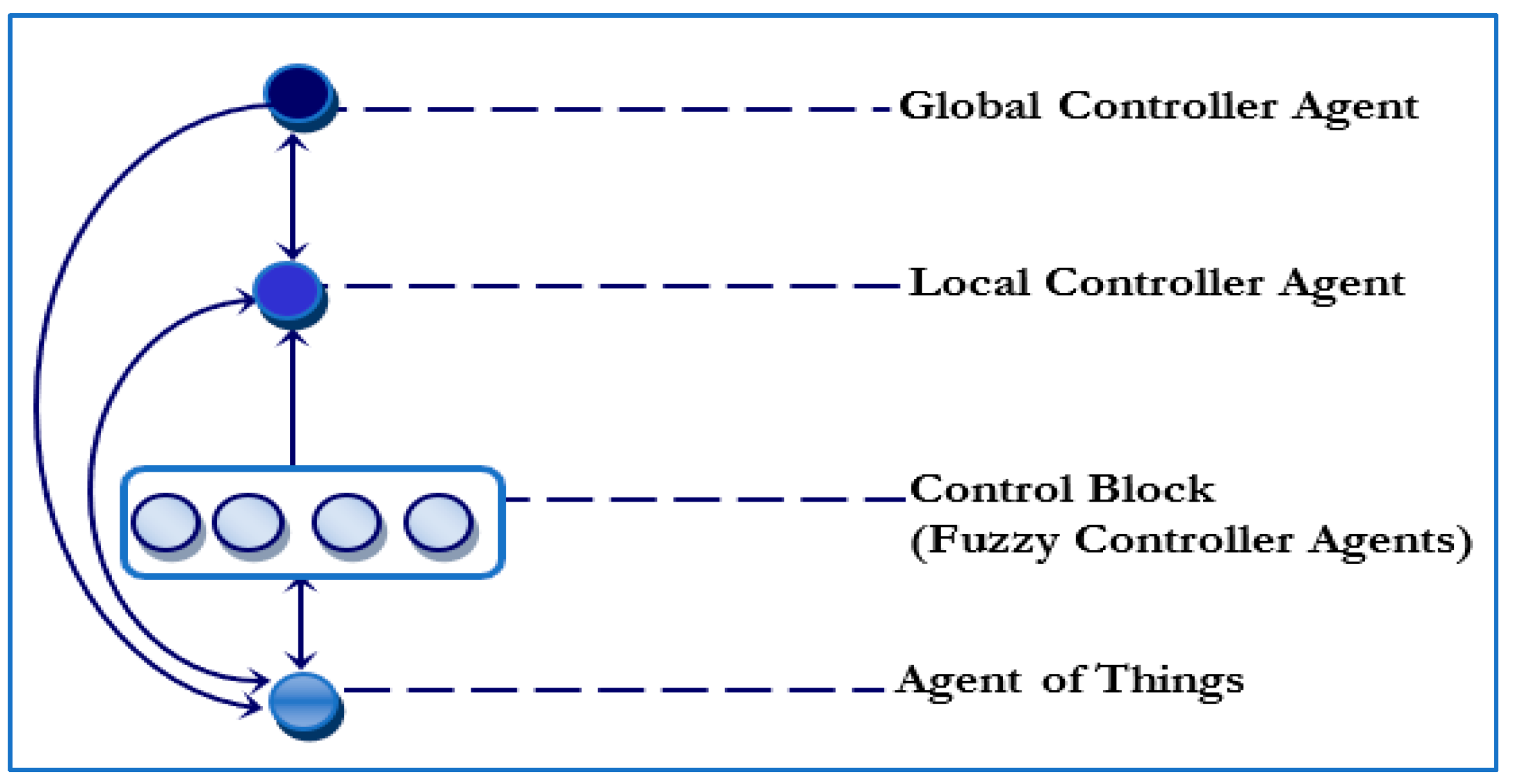
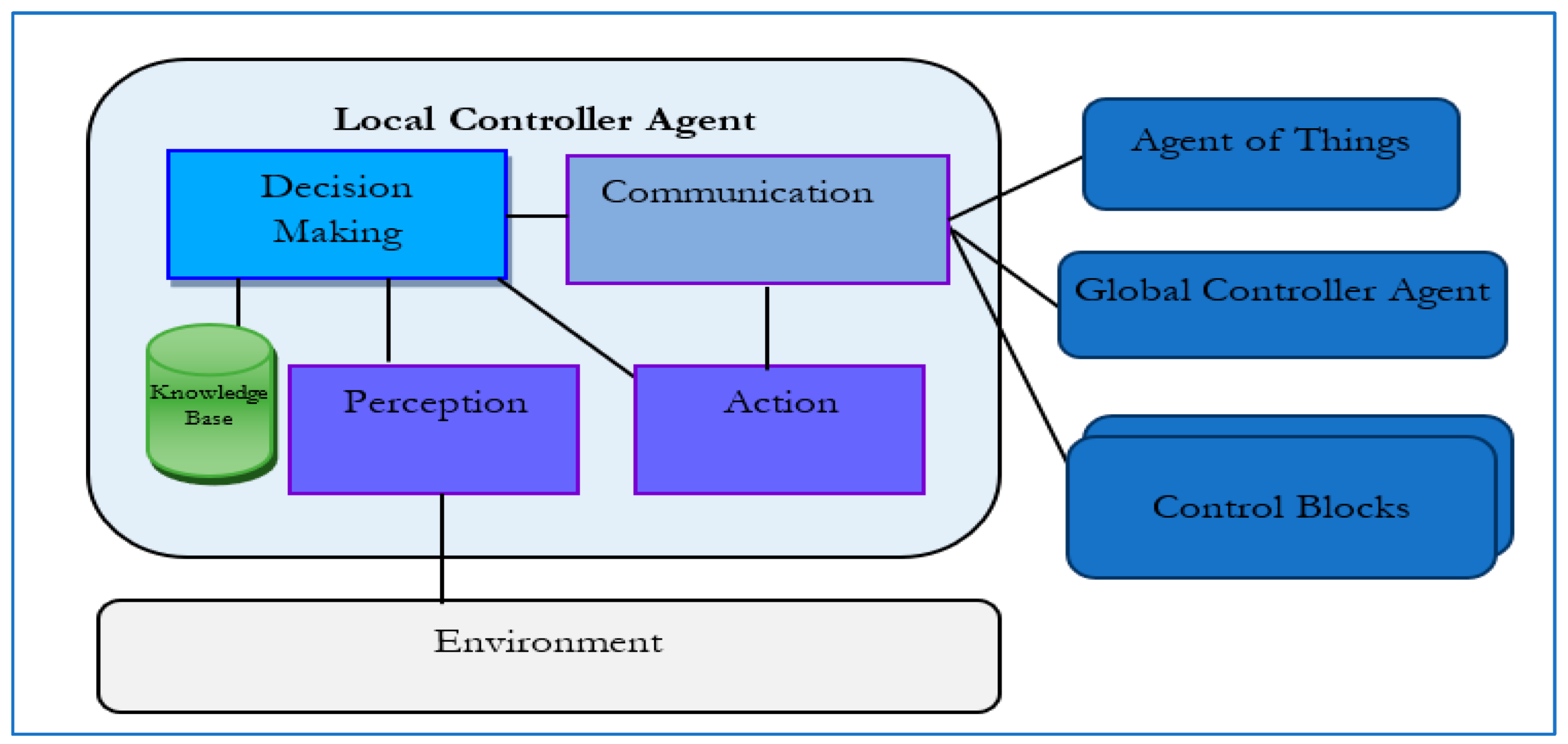
- Local Controller Agent. Responsible for controlling a set of street lighting. Additionally, it assists users in making appropriate real-time decisions corresponding to the supervised region. It communicates with GCA, AoT, and Control Blocks (Fuzzy Agents), as shown in Figure 7.
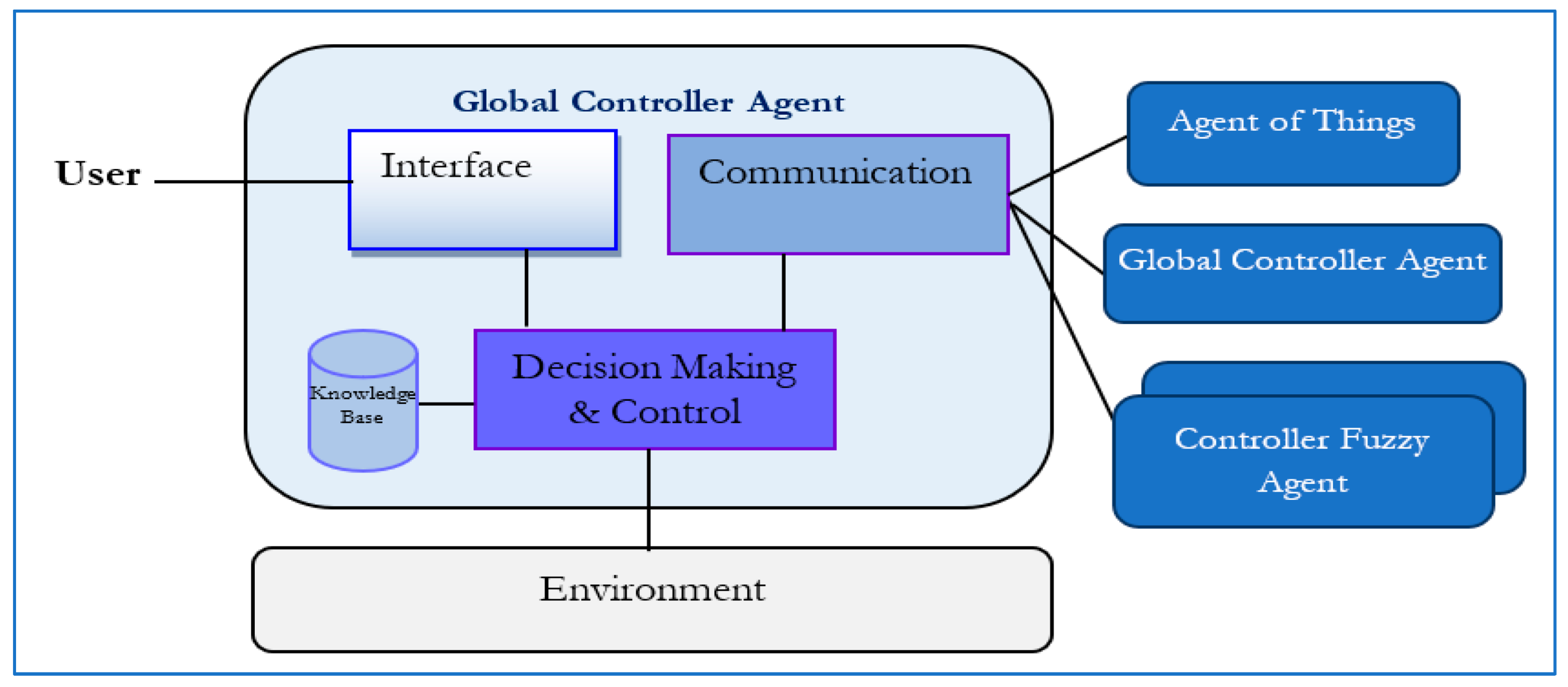
- Global Controller Agent: Responsible for controlling all streets within a given geographic area. This interface agent assists users in making real-time decisions within the supervised area. It communicates with both LCA and AoT (see Figure 8).
Interactions
Organization and Environment
4.2.2. Agents Behaviors
- Severe weather conditions: In the event of a hurricane, tornado, or severe storm, power lines and electrical equipment can become damaged, leading to widespread power outages. In some cases, electricity providers may choose to proactively turn off power to minimize damage to the electrical system and reduce the risk of electrical fires.
- Power grid overload: In instances of high demand for electricity, the power grid can become overloaded, leading to a risk of blackouts. To prevent this, electricity providers may temporarily cut off power to some areas in order to prevent a widespread outage.
- Electrical maintenance and upgrades: Electricity providers may temporarily shut off power to perform maintenance on electrical equipment or to upgrade their systems.
- Gas leaks: If a gas leak is detected near power lines, electricity providers may turn off power to the area as a safety precaution until the gas leak is repaired.
5. Implementation Feasibility
5.1. Prototype Development: Proof of Concept
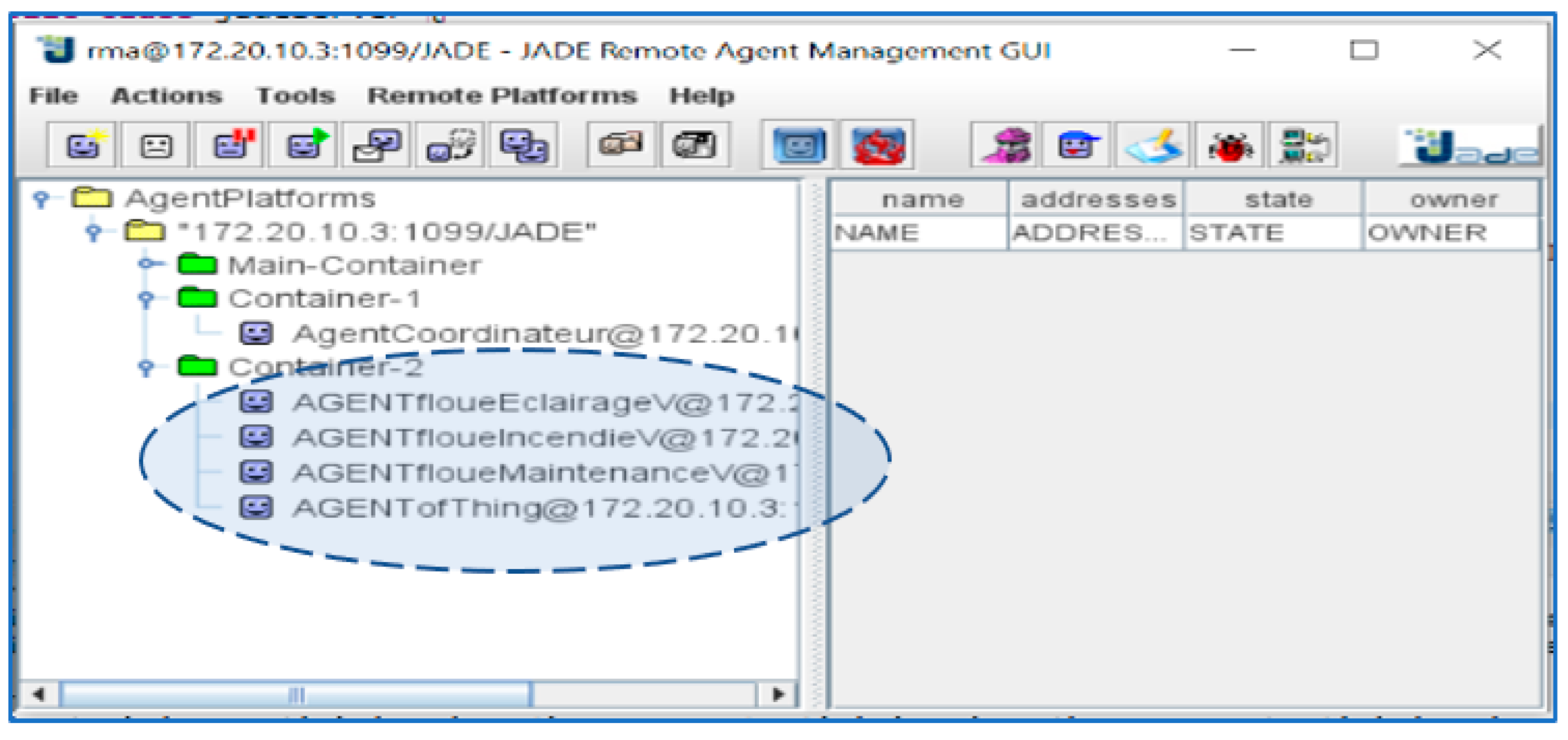
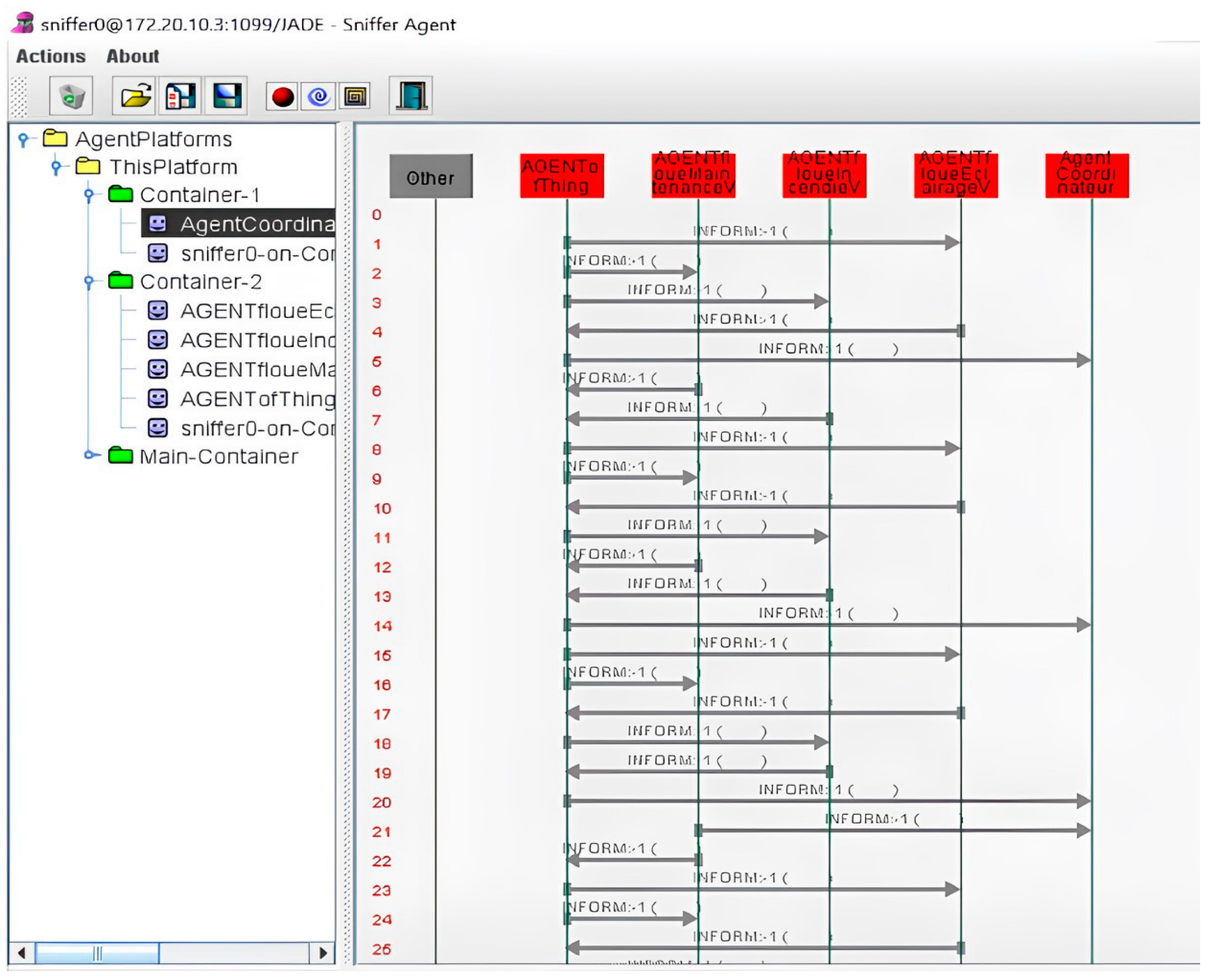
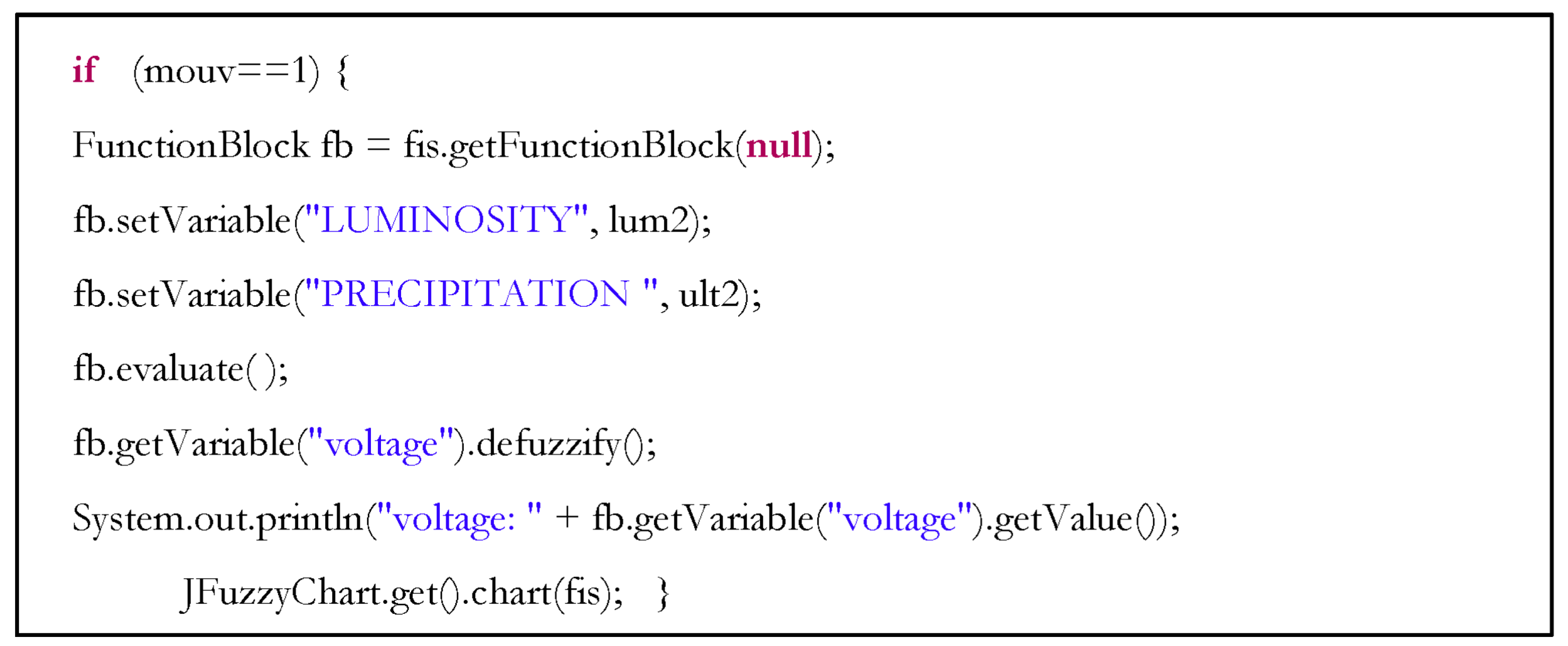
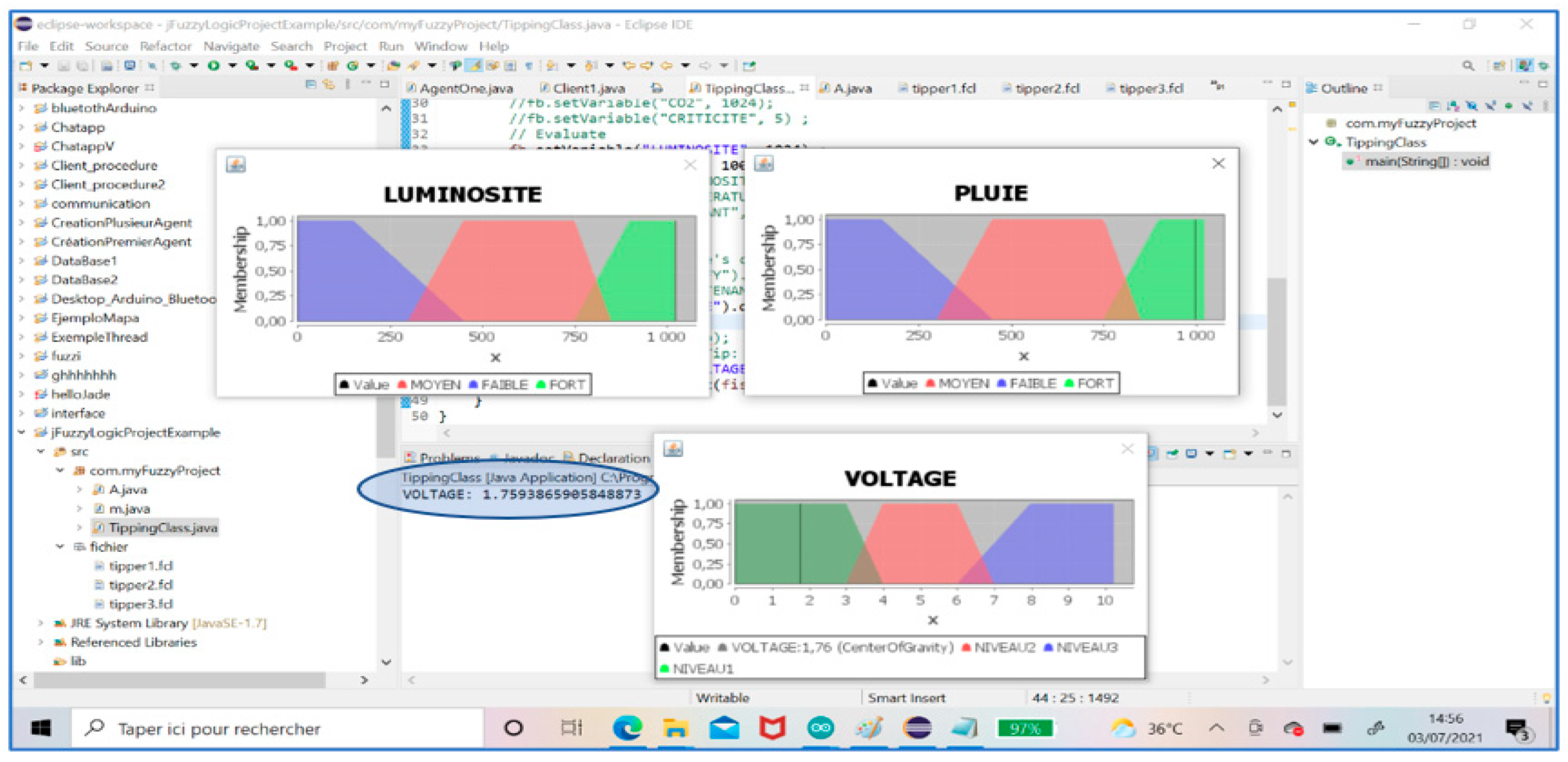
5.2. MAS Implementation on JADE Platform Using JFuzzyLogic
- An Agent of Things, directly connected to the various Smart Street sensors
- A Maintenance Controller Fuzzy Agent
- A Fire Controller Fuzzy Agent
- A Lighting Controller Fuzzy Agent
- A Local Controller Agent
5.2.1. Fuzzy Agents Implementation
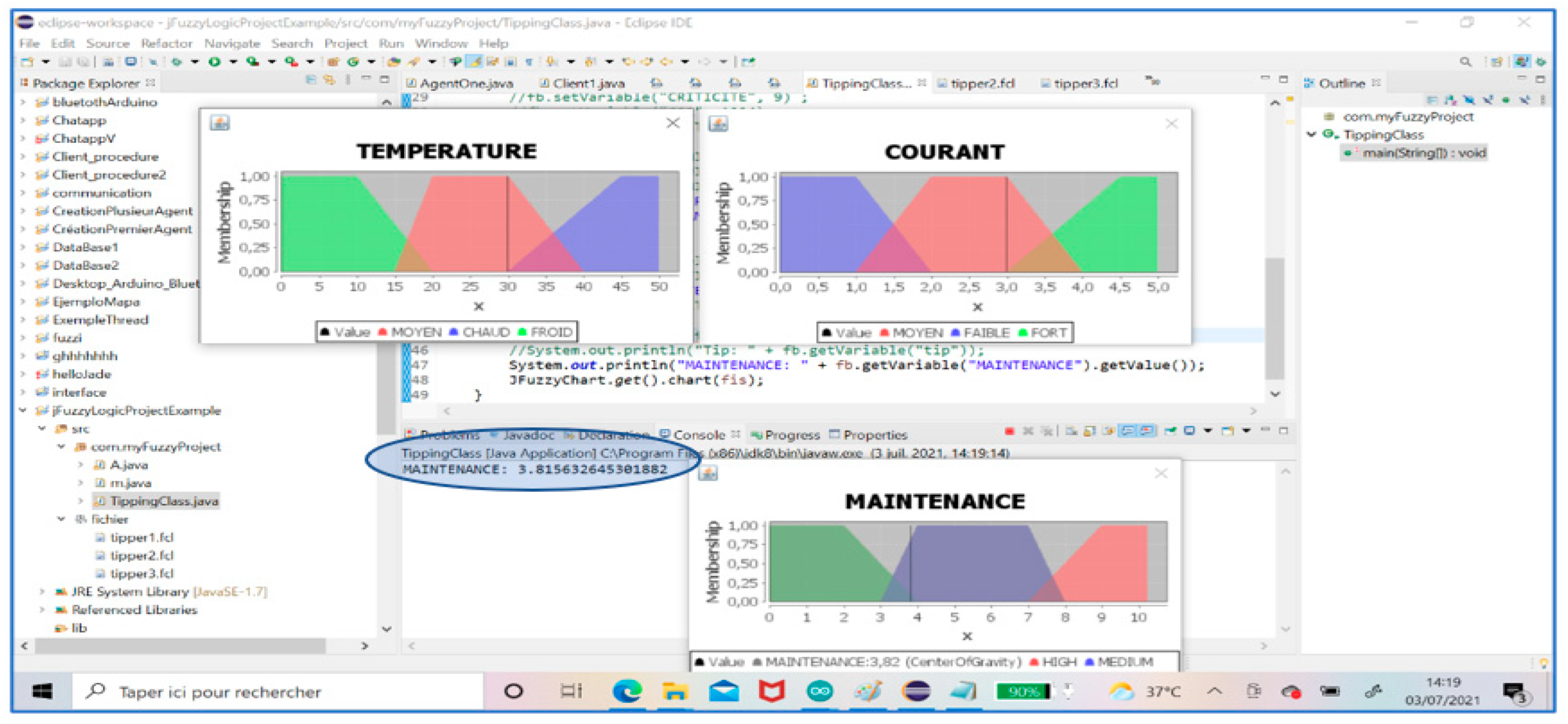
- Fuzzy maintenance reasoning: The detection of LED failures is accomplished by analyzing temperature and current values.Input Linguistic variables: Lamp temperature and current.
- -
- Temperature: Universe of discourse [0, 50].
- -
- Current: Universe of discourse [0, 5].
Output linguistic variable: Maintenance (lamp status).- -
- Maintenance: universe of discourse [0, 10].
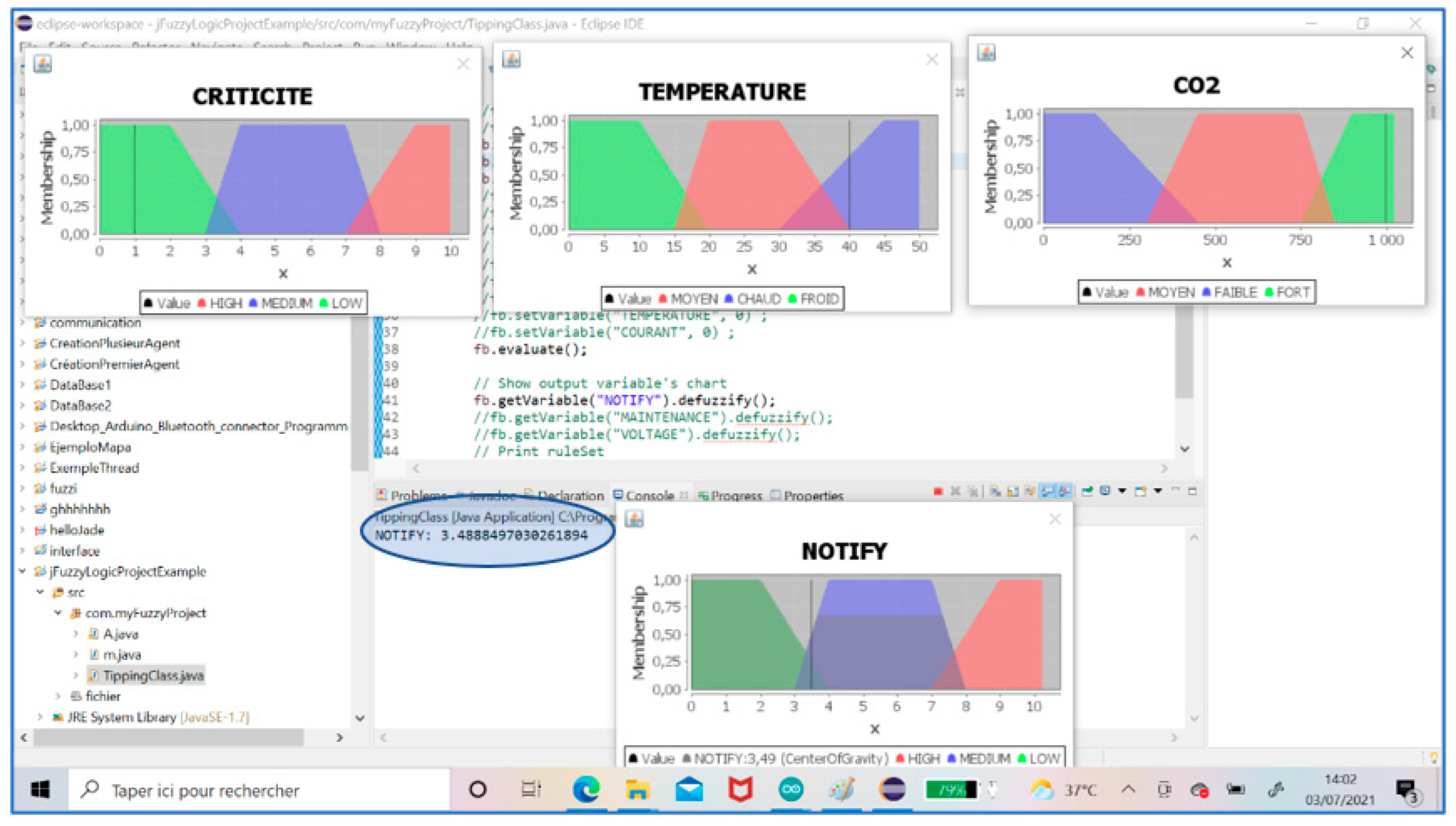
- Fuzzy fire reasoning:Input Linguistic variables: CO2 level, street criticality and temperature.
- -
- CO2: Universe of discourse [0, 1024].
- -
- Criticality: Universe of discourse [1, 10].
- -
- Temperature: Universe of discourse [0, 50].
Output linguistic variable: Notify (fire status).- -
- Notify: discourse universe [0, 10].
- Fuzzy light reasoning:Input linguistic variables: Precipitation and Brightness (ambient light level).
- -
- Precipitation: Universe of discourse [0, 1024].
- -
- Luminosity: Universe of discourse [1, 1024].
Output linguistic variable: Voltage (Intensity of the lamp).- -
- Voltage: Universe of discourse [1, 100].
5.2.2. Presentation of MAS Application
- Processor: Intel(R) Core (TM) i5-8250U CPU @ 1.60 GHz 1.80 GHz
- Installed RAM: 8.00 GB
- Device ID: A195133F-F912-43CD-BA63-ED770FCA71BF
- Product ID 00325-96466-15304-AAOEM
- Operating System: Windows 10, 64-bit, x64 processor
- Pen and touch function: Support pen and touch function with 10 touch points.
- Processor: Intel(R) Core (TM) i5-4250U CPU @ 2.60 GHz 2.60 GHz
- Installed RAM: 8.00 GB
- Device ID: 6B8F9130-40E8-4966-B521-071533058464
- Product ID: 00331-90000-00001-AAO84
- Operating System: Windows 10, 64-bit, x64 processor
6. Critical Analysis and Comparative Study
- The patterns are adaptable to various street lighting requirements and constraints, making the solution applicable to different types of street lighting, regardless of location (pedestrian street with limited or no vehicular traffic, residential street with low traffic volume and speed limits, etc.).
- Using LED technology provides a range of benefits that make it an excellent choice for street lighting. It is energy-efficient, consumes less electricity, and reduces both carbon emissions and costs. This advantage is especially significant for large-scale lighting projects. Additionally, LED lights have a longer lifespan than traditional lamps, resulting in lower maintenance costs and less frequent replacement. Moreover, LED lights provide superior visibility, which is essential for public safety at night. Therefore, we assert that LED lighting is an ideal solution for smart street lighting projects. Table 5 summarizes LEDs properties compared with traditional lighting according to relevant criteria. Furthermore, as revealed in [69], LED lighting can achieve energy savings of 50–70% compared to the traditional technology.
- Our system, built upon IoT technology, is equipped with an array of sensors that can detect pedestrians and vehicles, adjust the lighting level based on ambient brightness and traffic density, and monitor environmental parameters such as temperature, humidity, and precipitation in real time. By analyzing this data, our solution optimizes energy consumption, improves safety, and reduces costs. For example, smart lighting systems can adjust light intensity based on the presence of users and the time of day. Clearly, IoT technology offers numerous opportunities that transform our interaction with the environment.
- Considering weather conditions is an important aspect that affects both safety and energy efficiency of lighting systems. For safety, rain and snow can reduce visibility on the street, necessitating increased brightness to ensure clear perception for pedestrians and drivers. This is achieved by detecting precipitations and applying the corresponding fuzzy rules on the collected values. Regarding energy efficiency, variations in ambient brightness levels due to the cloud cover or seasonal changes can influence the required lighting levels. Thus, monitoring brightness and adjusting lighting level accordingly is a promising strategy to conserve energy and reduce costs.
- Incorporating current and temperature sensors into smart street lighting allows for the monitoring of light performance and the early detection of potential problems before they escalate. This approach reduces maintenance costs and minimizes the need for human intervention by enabling technicians to be alerted and respond quickly and efficiently. In addition, monitoring temperature values allows the ability to identify when lights are at risk of overheating or other damage, enabling preventive maintenance to be scheduled before failures occur. We believe that integrating current and temperature sensors into smart lighting systems can provide a more reliable and efficient system as well as reduce costs and minimize manual intervention.
- Integrating fire sensors into smart street lighting offers several advantages, including enhanced safety, efficiency, and overall quality of life for citizens. These sensors ensure early fire detection; accordingly, the system alerts fuzzy controllers to prevent the spread of the fire. Therefore, reducing infrastructure damage risk, improves community safety and reducing maintenance costs.
- The combination of MAS and fuzzy logic effectively addresses the challenges of smart street lighting by leveraging the strengths of both paradigms and responding to needed requirements. It allows for an adaptive control for municipalities to manage and control public street lighting lampposts, as well as easy integration with other systems. The system consists of distributed autonomous agents that provide the required functionalities by exchanging data, collaborating, and coordinating their activities. These agents use fuzzy logic-based reasoning to manage the smart street lighting according to the relevant parameters discussed earlier.
- In this work, we have adopted a hybrid control architecture to optimize coordination of the distributed street lighting system while ensuring local adaptability, reliability, and scalability. A complete centralized control poses a single point of failure vulnerability and constitutes a bottleneck as the system scales. Conversely, fully decentralized control lacks overall coordination. Therefore, a purely centralized control is inadequate to meet the fault tolerance, distributed decision-making, and autonomy abilities. Accordingly, the hybrid mode can leverage decentralized coordination for autonomous, real-time adaptative control of streetlights through local agents with centralized coordination for high-level optimization through global agents. This approach addresses performance challenges as follows:
- ○
- The decentralized feature of the hybrid architecture increases reliability. For instance, if the global controller agent becomes unavailable, local controller agents and fuzzy agents can continue making autonomous local decisions to maintain smart streetlights functioning, until recovery.
- ○
- The hierarchical hybrid structure enables smooth scaling to large IoT-enabled infrastructure through a layered control. Lower layers, including local controller agents, fuzzy agents together with Agents of Things, provide real-time adaptive and autonomous local decisions. However, the upper layer, including global controller agents, optimizes coordination and risk management.
- Regarding security, access control mechanisms for both local and global controller agents, implemented as interface agents, protect against unauthorized access and data alteration. Additionally, each smart light has a unique identifier, which further enhance security.
- The proposed architecture is generic and supports integration of several local and global control points at various levels. Thus, it can be adapted to several scenarios and management structures, depending on the authority’s governance, lighting infrastructure, and pattern preferences.
- Cloud based system: A cloud-based system can significantly improve scalability and flexibility by scaling up (down) storage and operational requirements without investigating new infrastructure. Furthermore, it can enhance cost-effectiveness, accessibility, automatic updates, and reliable disaster recovery. Indeed, adopting a cloud-based system requires a careful attention to security concerns, data portability, internet connectivity reliance, customization limitations, and potential downtime.
- Security: Street Lighting systems are critical public services that cannot afford any downtime. Therefore, security is a crucial issue that should be addressed in our architecture, especially when street lighting systems are governed by sensitive subdivisions. To address security concerns, the following mechanisms can be utilized, including:Authentication: Agents should authenticate to the system to verify their identity.
- ○
- Authorization: Agents should have authorization to perform specific tasks.
- ○
- Intrusion Detection: System should able to detect potential cyberattacks.
- ○
- Intrusion prevention: System should prevent cyberattacks.
- Scalability: The main features and factors that impact or enhance scalability, in the proposed architecture, are summarized as follows:
- ○
- Decentralized control helps improve system scalability by reducing information exchange overhead. This factor is already supported by the proposed architecture, even though agents are not totally distributed (hybrid structure, See Figure 9), they are deployed in several locations according to the physical electric infrastructure, governance policy and geographical expansion. The control is distributed across various global controller agents and local controller agents, thus, reducing the need for a centralized coordination.
- ○
- Hierarchical organization: as the proposed architecture supports hierarchical structure, this helps reduce communication overhead. Additionally, scaling up and scaling down can be facilitated horizontally or vertically, depending on the intended objectives.
- ○
- Load balancing: in the proposed architecture, each kind of agent is responsible for a reasonable number of tasks that define its role and the corresponding behavior. This fact helps more consistent workload distribution across all agents Additionally, associating streets to Agents of Things should take consider load-balancing criteria.
- ○
- Using lightweight protocols, such as MQTT and COAP, especially that the proposed architecture is based on constrained environment/resource applications (i.e., IoT).
- ○
- Using Cloud to ensure distributed database storage.
- ○
- Using publish/subscribe based protocols and mobile applications.
- ○
- Using broker agents as intermediates when scaling up.
- Adaptability: The system can be integrated with other IoT-based systems within a smart city to establish a comprehensive ecosystem that enhances energy savings and promotes citizens’ safety and well-being. It is applicable for indoor environments (Smart Building, Smart Home, Smart Hospital, Smart University, etc.), as well as outdoor lighting systems (Street lighting, Airports, Transport stations, etc.). Furthermore, other MAS applications can leverage the measured data to their specific domain, such as traffic control, pedestrian behavior analysis, environmental monitoring, and data analysis. These integrations contribute to the development of sustainable and intelligent urban environments.
7. Conclusions
Author Contributions
Funding
Data Availability Statement
Acknowledgments
Conflicts of Interest
Appendix A
- Fuzzy Maintenance reasoning
|
- Fuzzy Fire reasoning
|
- Fuzzy Lighting reasoning
|
References
- Houssein, E.H.; Othman, M.A.; Mohamed, W.M.; Younan, M. Internet of Things in Smart Cities: Comprehensive Review, Open Issues and Challenges. IEEE Internet Things J. 2024, 2327–2466. [Google Scholar] [CrossRef]
- Malik, P.K.; Sharma, R.; Singh, R.; Gehlot, A.; Satapathy, S.C.; Alnumay, W.S.; Pelusi, D.; Ghosh, U.; Nayak, J. Industrial Internet of Things and its applications in industry 4.0: State of the art. Comput. Commun. 2021, 166, 125–139. [Google Scholar] [CrossRef]
- Choi, W.; Kim, J.; Lee, S.; Park, E. Smart home and internet of things: A bibliometric study. J. Clean. Prod. 2021, 301, 126908. [Google Scholar] [CrossRef]
- Balaji, S.; Nathani, K.; Santhakumar, R. IoT technology, applications and challenges: A contemporary survey. Wirel. Pers. Commun. 2019, 108, 363–388. [Google Scholar] [CrossRef]
- Zhang, H.; Lu, X. Vehicle communication network in intelligent transportation system based on Internet of Things. Comput. Commun. 2020, 160, 799–806. [Google Scholar] [CrossRef]
- Hajjaji, Y.; Boulila, W.; Farah, I.R.; Romdhani, I.; Hussain, A. Big data and IoT-based applications in smart environments: A systematic review. Comput. Sci. Rev. 2021, 39, 100318. [Google Scholar] [CrossRef]
- Silva, B.N.; Khan, M.; Han, K. Integration of Big Data analytics embedded smart city architecture with RESTful web of things for efficient service provision and energy management. Future Gener. Comput. Syst. 2020, 107, 975–987. [Google Scholar] [CrossRef]
- Talavera, J.M.; Tobón, L.E.; Gómez, J.A.; Culman, M.A.; Aranda, J.M.; Parra, D.T.; Quiroz, L.A.; Hoyos, A.; Garreta, L.E. Review of IoT applications in agro-industrial and environmental fields. Comput. Electron. Agric. 2017, 142, 283–297. [Google Scholar] [CrossRef]
- Elsaiti, H.F.; Frgane, M.F.; Elrashdi, A.S. The Potential of using ZigBee Technology to Improve the Effectiveness of Smart Street Lighting Systems (SSLS). In Proceedings of the 2022 International Conference on Engineering & MIS (ICEMIS), Istanbul, Turkey, 4–6 July 2022; pp. 1–6. [Google Scholar]
- Dian, F.J.; Vahidnia, R.; Rahmati, A. Wearables and the Internet of Things (IoT), applications, opportunities, and challenges: A Survey. IEEE Access 2020, 8, 69200–69211. [Google Scholar] [CrossRef]
- Smys, S.; Basar, A.; Wang, H. Artificial neural network-based power management for smart street lighting systems. J. Artif. Intell. 2020, 2, 42–52. [Google Scholar]
- Akindipe, D.; Olawale, O.W.; Bujko, R. Techno-economic and social aspects of smart street lighting for small cities—A case study. Sustain. Cities Soc. 2022, 84, 103989. [Google Scholar] [CrossRef]
- Mohammadi, Y.; Shakouri, H.; Kazemi, A. A Multi-Objective Fuzzy Optimization Model for Electricity Generation and Consumption Management in a Micro Smart Grid. Sustain. Cities Soc. 2022, 86, 104119. [Google Scholar] [CrossRef]
- Varlamis, I.; Sardianos, C.; Chronis, C.; Dimitrakopoulos, G.; Himeur, Y.; Alsalemi, A.; Bensaali, F.; Amira, A. Smart fusion of sensor data and human feedback for personalized energy-saving recommendations. Appl. Energy 2022, 305, 117775. [Google Scholar] [CrossRef]
- Beccali, M.; Bonomolo, M.; Brano, V.L.; Ciulla, G.; Di Dio, V.; Massaro, F.; Favuzza, S. Energy saving and user satisfaction for a new advanced public lighting system. Energy Convers. Manag. 2019, 195, 943–957. [Google Scholar] [CrossRef]
- Che, E.; Olsen, M.J.; Jung, J. Efficient segment-based ground filtering and adaptive road detection from mobile light detection and ranging (LiDAR) data. Int. J. Remote Sens. 2021, 42, 3633–3659. [Google Scholar] [CrossRef]
- Ahmed, T.I.; Bhola, J.; Shabaz, M.; Singla, J.; Rakhra, M.; More, S.; Samori, I.A. Fuzzy logic-based systems for the diagnosis of chronic kidney disease. BioMed Res. Int. 2022, 2022, 2653665. [Google Scholar]
- Nguyen, H.T.; Walker, C.; Walker, E.A. A First Course in Fuzzy Logic; Chapman and Hall/CRC: Boca Raton, FL, USA, 2018. [Google Scholar]
- De Finetti, B. Theory of Probability: A Critical Introductory Treatment; John Wiley & Sons: Hoboken, NJ, USA, 2017; Volume 6. [Google Scholar]
- Kouah, S.; Saidouni, D.E. Fuzzy labeled transition refinement tree: Application to stepwise designing multi agent systems. In Fuzzy Systems: Concepts, Methodologies, Tools, and Applications; IGI Global: Hershey, PA, USA, 2017; pp. 873–905. [Google Scholar]
- Bělohlávek, R.; Dauben, J.W.; Klir, G.J. Fuzzy Logic and Mathematics: A Historical Perspective; Oxford University Press: Oxford, UK, 2017. [Google Scholar]
- Gilchrist, A.; Gilchrist, A. Introducing Industry 4.0. In Industry 4.0: The Industrial Internet of Things; Apress: Berkeley, CA, USA, 2016; pp. 195–215. [Google Scholar]
- Margaret, R. Internet of Things (IoT); IOT Agenda: Clovis, CA, USA, 2019. [Google Scholar]
- Kouah, S.; Kitouni, I. Internet of Things Agents Diagnosis Architecture: Application to Healtcare IoT System. In Proceedings of the 3rd Edition of the International Conference on Advanced Aspects of Software Engineering (ICAASE18), Constantine, Algeria, 1–2 December 2018; pp. 62–69. [Google Scholar]
- Kouah, S.; Kitouni, I. Multi-layer agent-based architecture for internet of things systems. J. Inf. Technol. Res. (JITR) 2018, 11, 32–52. [Google Scholar]
- Chen, Z.; Sivaparthipan, C.B.; Muthu, B. IoT based smart and intelligent smart city energy optimization. Sustain. Energy Technol. Assess. 2022, 49, 101724. [Google Scholar] [CrossRef]
- Anguraj, D.K.; Balasubramaniyan, S.; Saravana Kumar, E.; Vakula Rani, J.; Ashwin, M. Internet of things (IoT)-based unmanned intelligent street light using renewable energy. Int. J. Intell. Unmanned Syst. 2022, 10, 34–47. [Google Scholar] [CrossRef]
- Reddy KR, S.; Satwika, C.; Jaffino, G.; Singh, M.K. Monitoring of infrastructure and development for smart cities supported by IoT method. In Proceedings of the Second International Conference in Mechanical and Energy Technology: ICMET 2021, India, 27 June 2022; Springer Nature: Singapore, 2022; pp. 21–28. [Google Scholar]
- Leung, R.W.; Lau, H.C.; Kwong, C.K. An expert system to support the optimization of ion plating process: An OLAP-based fuzzy-cum-GA approach. Expert Syst. Appl. 2003, 25, 313–330. [Google Scholar] [CrossRef]
- Wang, K.; Jiang, X.; Wang, S.; Han, Z. Power switch open circuit fault diagnosis strategy for novel fault-tolerant electric drive system based on fuzzy logic. Energy Rep. 2022, 8, 914–921. [Google Scholar] [CrossRef]
- Kambalimath, S.; Deka, P.C. A basic review of fuzzy logic applications in hydrology and water resources. Appl. Water Sci. 2020, 10, 191. [Google Scholar] [CrossRef]
- Kouah, S.; Saïdouni, D.E.; Ilié, J.M. Synchronized Petri net: A formal specification model for multi agent systems. J. Softw. 2013, 8, 587–602. [Google Scholar] [CrossRef]
- Kouah, S.; Saïdouni, D.E. Application of Fuzzy Labeled Transition System to Contract Net Protocol. Int. J. Serv. Sci. Manag. Eng. Technol. (IJSSMET) 2015, 6, 27–46. [Google Scholar] [CrossRef]
- Kouah, S.; Saïdouni, D.E.; Kitouni, I. Open fuzzy synchronized petri net: Formal specification model for multi-agent systems. Int. J. Intell. Inf. Technol. (IJIIT) 2016, 12, 63–94. [Google Scholar] [CrossRef]
- Finin, T.; Fritzson, R.; McKay, D.; McEntire, R. KQML as an agent communication language. In Proceedings of the Third International Conference on Information and Knowledge Management, Gaithersburg, MD, USA, 29 November–2 December 1994; pp. 456–463. [Google Scholar]
- Fipa, A.C.L. Fipa acl Message Structure Specification. Foundation for Intelligent Physical Agents. 2002. Available online: http://www.fipa.org/specs/fipa00061/SC00061G.html (accessed on 30 June 2004).
- Smith, R.G. The contract net protocol: High-level communication and control in a distributed problem solver. IEEE Trans. Comput. 1980, 29, 1104–1113. [Google Scholar] [CrossRef]
- Yuan, J.; Liu, H.; Zhang, W. Formation control for discrete-time multi-agent system with input and output delays under network attacks. Sci. Rep. 2022, 12, 8533. [Google Scholar] [CrossRef]
- Bhanu Sridhar, M. Applications of Multi-agent Systems in Intelligent Health Care. In Multi Agent Systems: Technologies and Applications towards Human-Centered; Springer Nature: Singapore, 2022; pp. 173–195. [Google Scholar]
- Julian, V.; Botti, V. Multi-agent systems. Appl. Sci. 2019, 9, 1402. [Google Scholar] [CrossRef]
- Costa, Â.; Novais, P.; Corchado, J.M.; Neves, J. Increased performance and better patient attendance in an hospital with the use of smart agendas. Logic J. IGPL 2012, 20, 689–698. [Google Scholar] [CrossRef]
- Costa, Â.; Novais, P. An intelligent multi-agent memory assistant. In Handbook of Digital Homecare: Successes and Failures; Springer: Berlin/Heidelberg, Germany, 2011; pp. 197–221. [Google Scholar]
- Tapia, D.I.; Corchado, J.M. An ambient intelligence based multi-agent system for alzheimer health care. Int. J. Ambient. Comput. Intell. (IJACI) 2009, 1, 15–26. [Google Scholar] [CrossRef]
- Siskandar, R.; Jenie, R.P.; Syafutra, H.; Iqbal, M.; Yuliarto, B.; Fahmi, M.Z. Ferroelectric sensor BaxSr1−xTiO3 integrated with android smartphone for controlling and monitoring smart street lighting. J. King Saud Univ.-Sci. 2022, 34, 102180. [Google Scholar]
- Sanchez-Sutil, F.; Cano-Ortega, A. Smart regulation and efficiency energy system for street lighting with LoRa LPWAN. Sustain. Cities Soc. 2021, 70, 102912. [Google Scholar] [CrossRef]
- Mohandas, P.; Dhanaraj, J.S.A.; Gao, X.Z. Artificial neural network based smart and energy efficient street lighting system: A case study for residential area in Hosur. Sustain. Cities Soc. 2019, 48, 101499. [Google Scholar] [CrossRef]
- Lau, S.P.; Merrett, G.V.; Weddell, A.S.; White, N.M. A traffic-aware street lighting scheme for Smart Cities using autonomous networked sensors. Comput. Electr. Eng. 2015, 45, 192–207. [Google Scholar] [CrossRef]
- Jin, D.; Hannon, C.; Li, Z.; Cortes, P.; Ramaraju, S.; Burgess, P.; Buch, N.; Shahidehpour, M. Smart street lighting system: A platform for innovative smart city applications and a new frontier for cyber-security. Electr. J. 2016, 29, 28–35. [Google Scholar] [CrossRef]
- Casavola, A.; Franzè, G.; Gagliardi, G.; Tedesco, F. A Multi-Agent Trust and Reputation Mechanisms for the Management of Smart Urban Lighting Systems. IFAC-PapersOnLine 2022, 55, 545–550. [Google Scholar] [CrossRef]
- Kalani, M.J.; Kalani, M. Energy cost control of LEDs considering the price of electricity and the desired lighting levels to meet the requirements of smart grids, smart cities, and unregulated energy markets. Optik 2022, 258, 168926. [Google Scholar] [CrossRef]
- Kalani, M.J.; Kalani, M.; Naderi, M.S.; Gharehpetian, G.B. Lighting control of LEDs considering ambient sound variations to meet the requirements of smart cities. Comput. Electr. Eng. 2022, 102, 108240. [Google Scholar] [CrossRef]
- Sifakis, N.; Kalaitzakis, K.; Tsoutsos, T. Integrating a novel smart control system for outdoor lighting infrastructures in ports. Energy Convers. Manag. 2021, 246, 114684. [Google Scholar]
- Ikidid, A.; Abdelaziz, E.F.; Sadgal, M. Multi-Agent and Fuzzy Inference-Based Framework for Traffic Light Optimization. 2023. Available online: https://reunir.unir.net/handle/123456789/14325 (accessed on 3 September 2024).
- Chiradeja, P.; Yoomak, S. Development of public lighting system with smart lighting control systems and internet of thing (IoT) technologies for smart city. Energy Rep. 2023, 10, 3355–3372. [Google Scholar] [CrossRef]
- Biundini, I.Z.; Pinto, M.F.; Honório, L.M.; Capretz, M.A.; Timotheo, A.O.; Dantas, M.A.; Villela, P.C. LoRaCELL-Driven IoT Smart Lighting Systems: Sustainability in Urban Infrastructure. Sensors 2024, 24, 574. [Google Scholar] [CrossRef]
- Dizon, E.; Pranggono, B. Smart streetlights in Smart City: A case study of Sheffield. J. Ambient. Intell. Humaniz. Comput. 2022, 13, 2045–2060. [Google Scholar] [CrossRef]
- Müllner, R.; Riener, A. An energy efficient pedestrian aware Smart Street Lighting system. Int. J. Pervasive Comput. Commun. 2011, 7, 147–161. [Google Scholar] [CrossRef]
- Leccese, F. Remote-control system of high efficiency and intelligent street lighting using a ZigBee network of devices and sensors. IEEE Trans. Power Deliv. 2012, 28, 21–28. [Google Scholar] [CrossRef]
- Elejoste, P.; Angulo, I.; Perallos, A.; Chertudi, A.; Zuazola, I.J.G.; Moreno, A.; Azpilicueta, L.; Astrain, J.J.; Falcone, F.; Villadangos, J. An easy to deploy street light control system based on wireless communication and LED technology. Sensors 2013, 13, 6492–6523. [Google Scholar] [CrossRef] [PubMed]
- Leccese, F.; Cagnetti, M.; Trinca, D. A smart city application: A fully controlled street lighting isle based on Raspberry-Pi card, a ZigBee sensor network and WiMAX. Sensors 2014, 14, 24408–24424. [Google Scholar] [CrossRef]
- Kaleem, Z.; Ahmad, I.; Lee, C. Smart and energy efficient led street light control system using ZigBee network. In Proceedings of the 2014 12th International Conference on Frontiers of Information Technology, Islamabad, Pakistan, 17–19 December 2014; pp. 361–365. [Google Scholar]
- Shahzad, G.; Yang, H.; Ahmad, A.W.; Lee, C. Energy-efficient intelligent street lighting system using traffic-adaptive control. IEEE Sens. J. 2016, 16, 5397–5405. [Google Scholar] [CrossRef]
- Bellido-Outeiriño, F.J.; Quiles-Latorre, F.J.; Moreno-Moreno, C.D.; Flores-Arias, J.M.; Moreno-García, I.; Ortiz-López, M. Streetlight control system based on wireless communication over DALI protocol. Sensors 2016, 16, 597. [Google Scholar] [CrossRef]
- Huang, R.; Nie, Z.; Duan, C.; Liu, Y.; Jia, L.; Wang, L. Analysis and comparison of the IEEE 802.15. 4 and 802.15. 6 wireless standards based on MAC layer. In Proceedings of the Health Information Science: 4th International Conference, HIS 2015, Melbourne, Australia, 28–30 May 2015; Proceedings 4. Springer International Publishing: Berlin/Heidelberg, Germany, 2015; pp. 7–16. [Google Scholar]
- Daely, P.T.; Reda, H.T.; Satrya, G.B.; Kim, J.W.; Shin, S.Y. Design of smart LED streetlight system for smart city with web-based management system. IEEE Sens. J. 2017, 17, 6100–6110. [Google Scholar] [CrossRef]
- Bingöl, E.; Kuzlu, M.; Pipattanasompom, M. A LoRa-based smart streetlighting system for smart cities. In Proceedings of the 2019 7th international Istanbul smart grids and cities congress and fair (ICSG), Istanbul, Turkey, 25–26 April 2019; pp. 66–70. [Google Scholar]
- Ricordel, P.M.; Demazeau, Y. Volcano, a vowels-oriented multi-agent platform. In From Theory to Practice in Multi-Agent Systems, Proceedings of the Second International Workshop of Central and Eastern Europe on Multi-Agent Systems, CEEMAS 2001 Cracow, Poland, 26–29 September 2001; Revised Papers 2; Springer: Berlin/Heidelberg, Germany, 2002; pp. 253–262. [Google Scholar]
- Di Stefano, B.N. On the Need of a Standard Language for Designing Fuzzy Systems. In On the Power of Fuzzy Markup Language; Studies in Fuzziness and Soft Computing; Acampora, G., Loia, V., Lee, C.S., Wang, M.H., Eds.; Springer: Berlin/Heidelberg, Germany, 2013; Volume 296, pp. 3–15. [Google Scholar]
- Bachanek, K.H.; Tundys, B.; Wiśniewski, T.; Puzio, E.; Maroušková, A. Intelligent Street Lighting in a Smart City Concepts—A Direction to Energy Saving in Cities: An Overview and Case Study. Energies 2021, 14, 3018. [Google Scholar] [CrossRef]


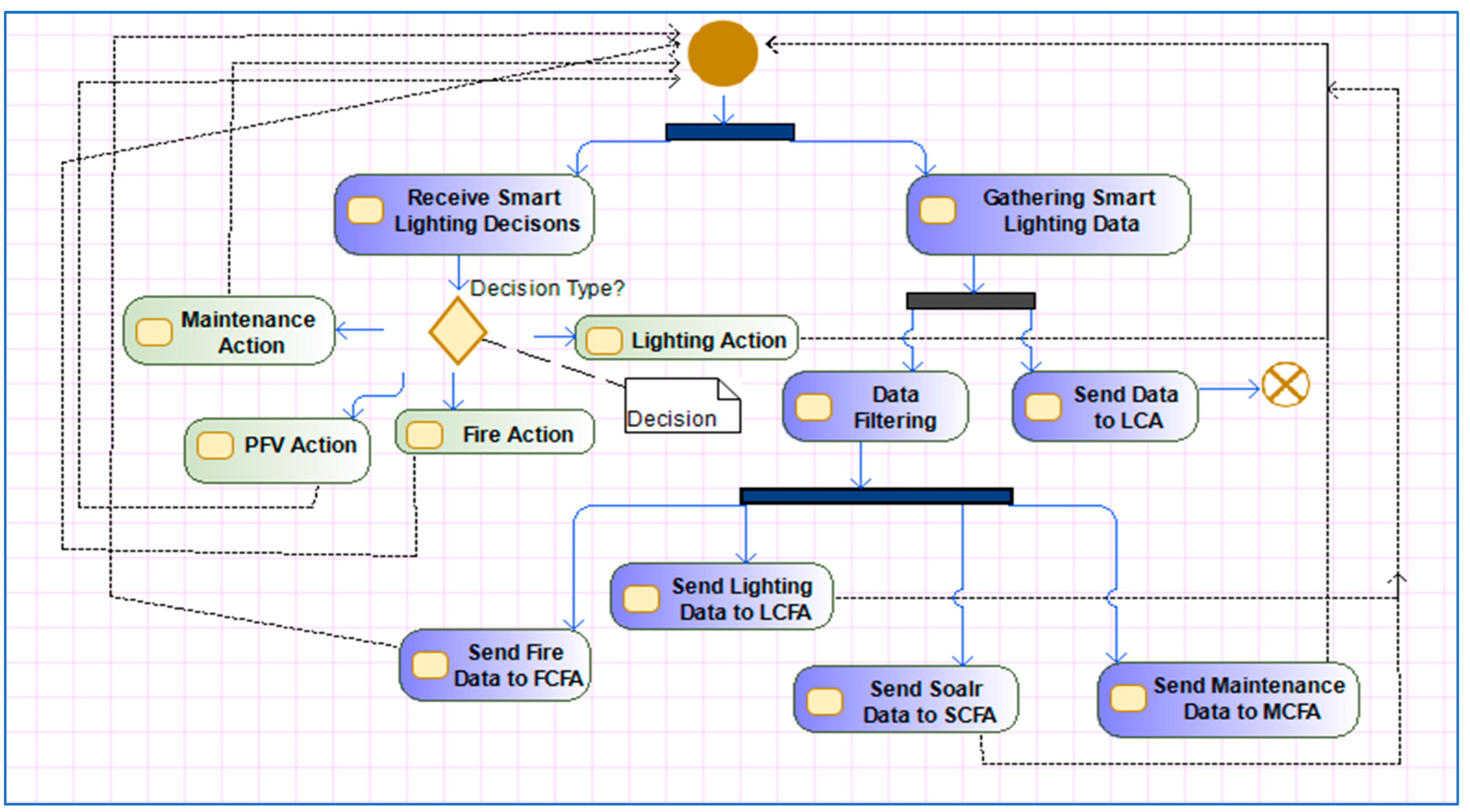
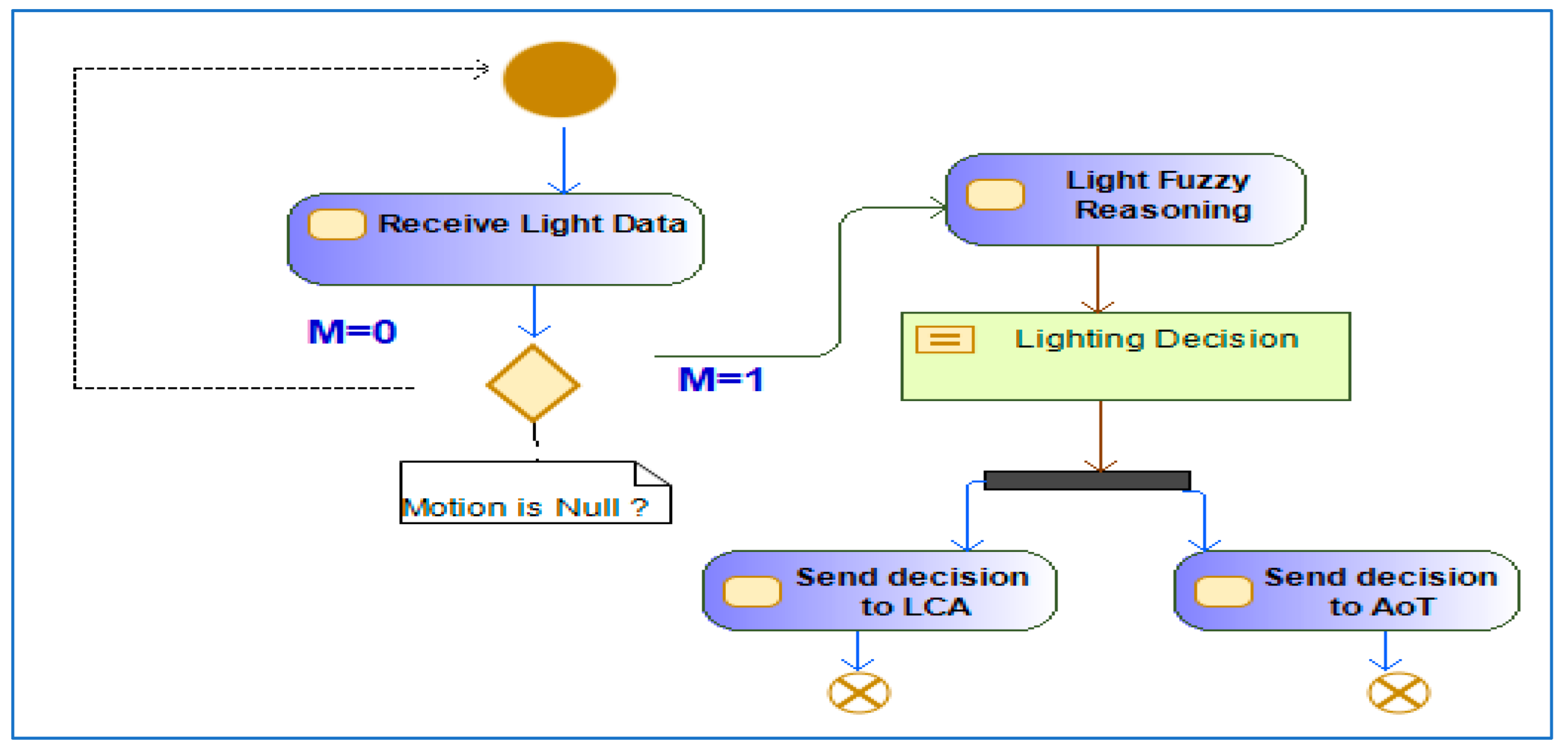

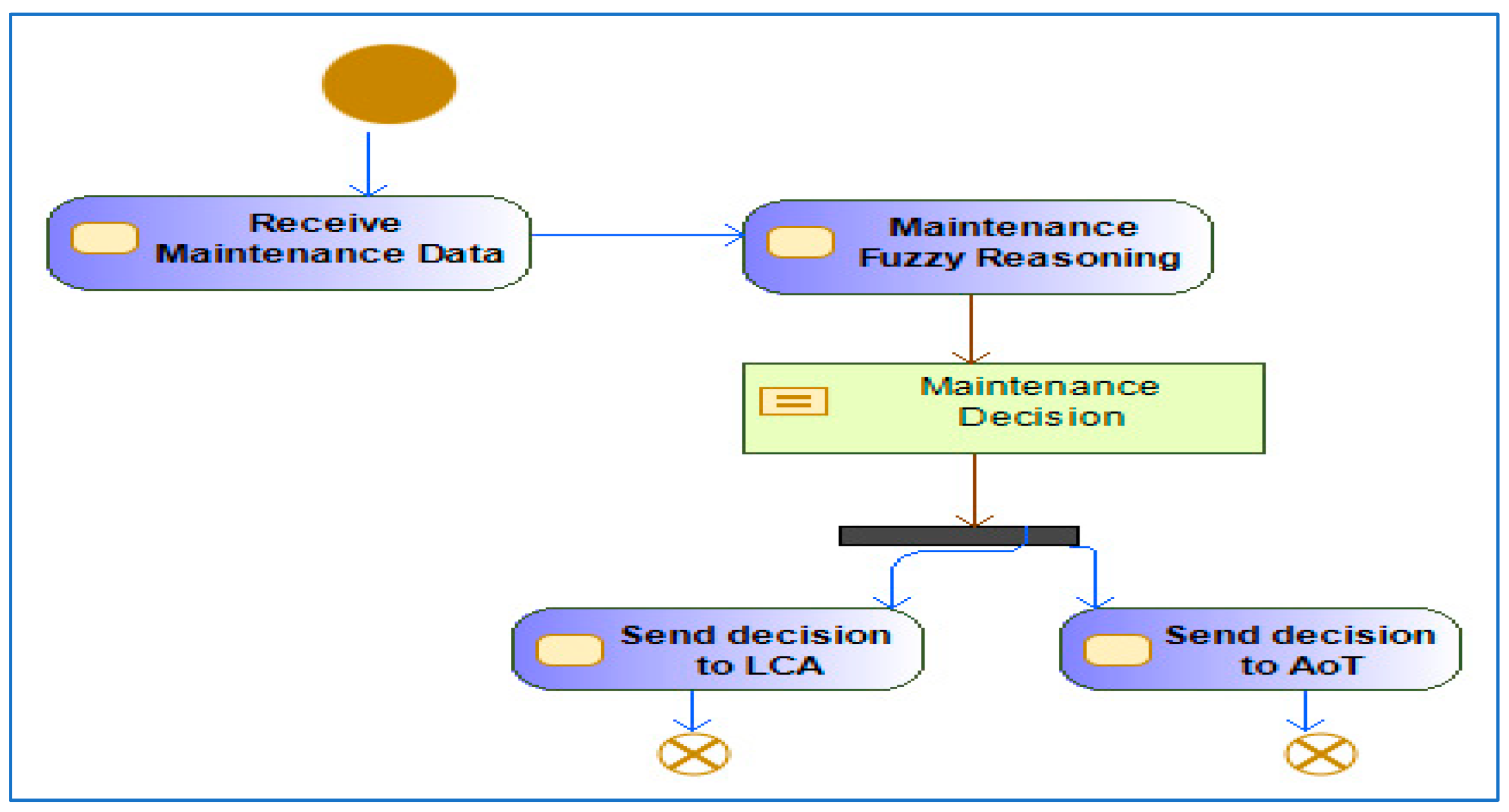
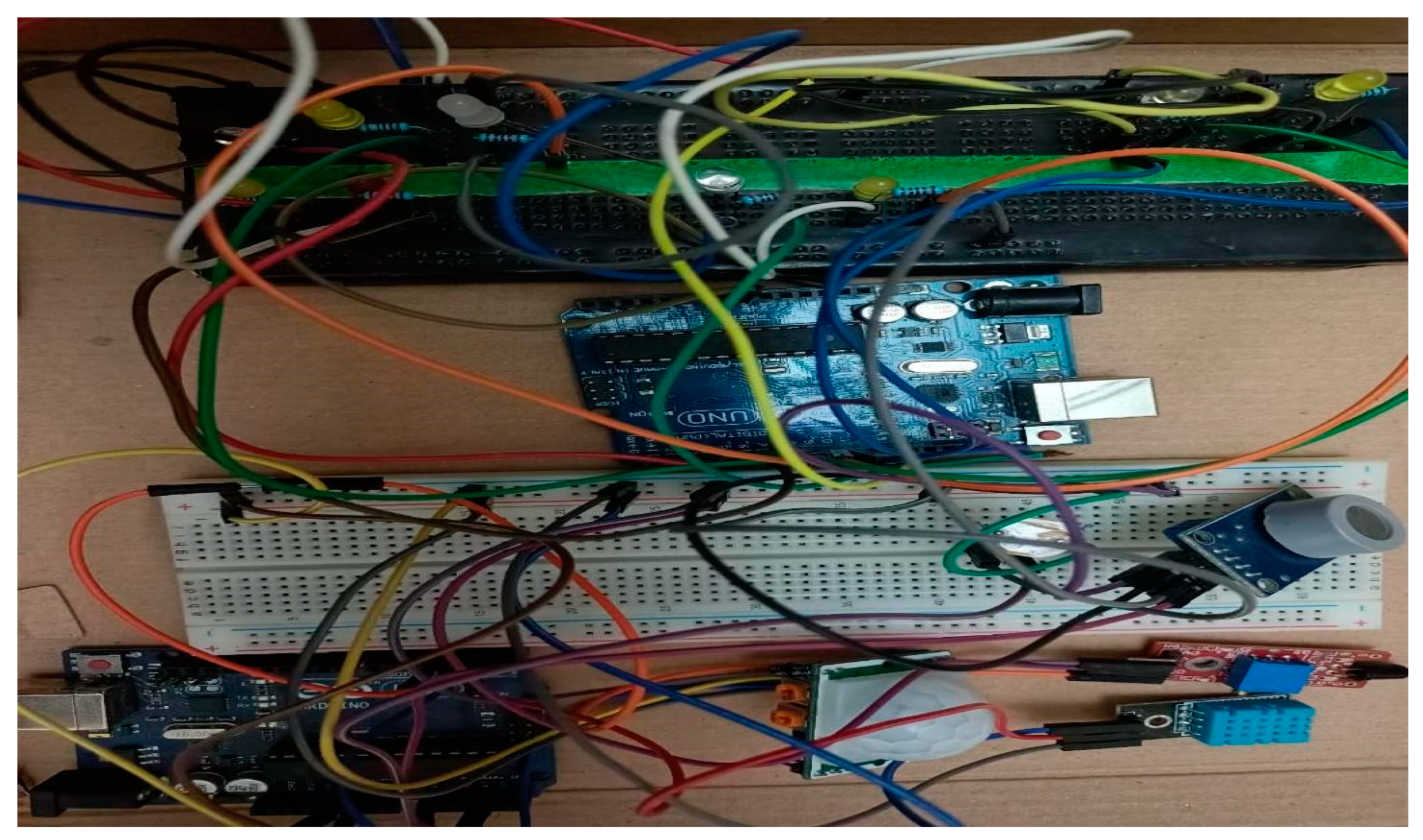






| Work | Key Points | Energy Savings Percentage | Materials & Control |
|---|---|---|---|
| [11] | ANN-based smart street lighting system for a residential area in Hosur to reduce power consumption using sensors and fuzzy logic controllers. | 34% reduction in unnecessary usage and a 13.5% decrease in overall power consumption | LED, Sensors: lighting, motion, and PIR sensors Decentralized control system. |
| [9] | Energy-efficient and smart street lighting system that reduces power consumption and enhances the control and monitoring of streetlights using IoT, focusing on the integration of ZigBee technology. | Not specified | ZigBee Technology, LED Bulbs, Motion and Light Sensors, and Weather Sensors Decentralized control. |
| [12] | Framework for smart street lighting in small cities, integrating technical design, economic evaluation, and public stakeholder engagement. | Not specified | LED luminaires, IoT-compatible LED drivers, Microcontrollers, Photo sensors, Additional sensors (air quality, motion, temperature, parking, etc.), Network gateways, Central control server. Hybrid control. |
| [13] | Optimize the management of electricity generation and consumption in a micro smart grid (MSG) to enhance user comfort, maximize renewable energy utilization, minimize costs, and ensure reliability under uncertain conditions. | Not specified | Sensors for measuring energy production from solar cells, wind turbines, and diesel generators, as well as sensors for monitoring battery storage levels and energy consumption in smart buildings. Intelligent controllers, such as fuzzy logic controllers. Decentralized control. |
| [14] | Online recommender system integrated into the EM3 platform, which aims to enhance energy efficiency through personalized recommendations. | Not specified | The sensors include temperature, humidity, and light sensors. Decentralized control. |
| [15] | Optimizing urban lighting systems by combining technical measurements and user preferences to achieve significant energy savings and improve light quality. | 70% | LED lamps and luminaires, control systems, wiring, switchboards, hard disk (HD), and software (SW) for the control system, and a monitoring system. |
| [44] | Application of BST thin film as a light sensor integrated with an Android smartphone for smart street lighting. | 69.23% | BST thin film fabricated using chemical solution deposition and spin coating. Android smartphone, GSM communication protocol for reporting, Node MCU V3 microprocessor for control. Centralized control. |
| [45] | Public lighting installations using smart meters (SM) and Long Range (LoRa) protocol. | Not specified | LoRa protocol for communication, GWSLS, OMDSL, ILD devices. Cloud data management using Firebase. ABC optimization algorithm for dynamic lighting control. Decentralized control. |
| [46] | Smart street lighting system using artificial neural networks and fuzzy logic, utilizing LED lamps in Hosur, Tamil Nadu | Reduced unwanted utilization: 34% Reduced power consumption rate: 13.5% | Lighting sensor, motion sensor, PIR sensor. ANN and fuzzy logic controller for demand-based utilization. Centralized control. |
| [47] | TALiSMaN: a distributed and adaptive street-lighting algorithm that operates autonomously over a short-range mesh network of decentralized and distributed streetlights. | 45–98% | LED lamps for streetlights. Each streetlight is equipped with a wireless sensor node and a short-range wireless communication module, forming a multi-hop wireless sensor network (WSN). Decentralized control. |
| [48] | Wireless networked LED street- lighting system with centralized and remote-control technology. | Not Specified | LED lights. Mesh network components. Sensors for monitoring usage statistics. PI System Historian for data collection. Access points located in the CSMART lab. Silver Spring Networks cloud-based control server. Centralized and remote control. |
| [49] | Trust-based distributed sensor-selection architecture for urban road networks to maintain streetlamp brightness at the lowest acceptable level through an adaptive reputation mechanism. | 78.31 [%] w.r.t., a standard lighting system 56.62 [%] w.r.t., a LED lighting system. | Group of Sensors and LED. Hybrid traffic model, multi-agent reputation mechanism. Trust-based distributed sensor selection. Decentralized control. |
| [50] | Manage the energy cost of LED considering the simultaneous effects of electricity prices and desired lighting levels. | Not Specified | LED and semiconductor-based lighting industry. Centralized control. |
| [51] | Energy management of LED lighting systems by including ambient sound levels as a factor. | More than 40% | Sound Sensors, LED Light Sources, Pulse Width Modulation (PWM). Centralized control. |
| [52] | Typology for resizing and controlling port lighting. Three-stage process tested on a medium-sized Mediterranean | 56.8% annually. Up to 90% in some months. | Sensor (photodetector and occupancy), LED Luminaires, and Digital Addressable Lighting Interface (DALI). |
| [53] | Traffic-simulation framework using multi-agent systems and fuzzy logic for real-time optimization of traffic signal control to enhance traffic at isolated and multi-intersection networks. | Not specified | Agents and fuzzy logic sensors. ANYLOGIC simulator. |
| [54] | Lighting control for public lighting systems is presented and investigated in terms of lighting and power quality to save energy consumption. A function of IoT technologies is integrated into the public lighting system. | Not specified | Motion sensor, light intensity sensor, An internet protocol (IP) camera is a surveillance camera, dust sensor. Control box of the smart public lighting system is installed on a light pole. LED indicator. Magnetic float switch used to detect the water level. Centralized control. |
| [55] | IoT Smart Lighting Systems in Urban Infrastructure. Lora CELL is designed to integrate with existing Lora WAN servers. Multiple gateways per region. | Not specified | Central LoRa device. Amazon Web Services. MongoDB, Spark Apache framework, Power BI. TSL2561, MQ-135, DHT22, Bmp280, MAX4466, ZMPT101B, UV ML8511, ACS712 5A sensors. Decentralized control. |
| [57] | Energy-efficient pedestrian-aware smart street lighting system. GPS and Internet-enabled mobile phone. | Not specified | ZigBee-based radio device, Photo sensor, GPS sensor. Location and safety awareness. LED, Web/Mobile application. Centralized control. |
| [58] | Intelligent LED streetlights. Remote control using solar panels and ZigBee. | Not specified | Presence, light, emergency, and Hall sensors, LED. Solar panels, ZigBee wireless communication protocol. Centralized control. |
| [59] | Autonomous intelligent LED streetlight system. Three-level hierarchical model. | 40% | Wireless communication technologies, LED. Three-level hierarchical model. Temperature, humidity, lighting, and infrared sensors. Context-aware system. Geographical Information System-based approach. Fuzzy logic as a perspective. Decentralized control. |
| [60] | Smart street lighting in a smart city ZigBee sensor network and WiMAX, with Raspberry Pi. | Not specified | Low-power communication protocol ZigBee. LCD, temperature, light sensors, MCU module. Raspberry-Pi control card, LED power metering IC (ADE7753). Centralized control. |
| [61] | Smart and energy-efficient LED street light system. ZigBee mesh network. | Not specified | Presence sensor, photovoltaic panel, LED. ZigBee-based wireless communication, WiMAX module, Raspberry-Pi. Three-layer architecture. Hybrid control. |
| [47] | WSN-based Distributed Traffic-Aware Lighting Scheme Management Network system | Up to 45% (depending on traffic volume) | Microphones & PIR sensors, GPS, LED Traffic-aware control. IEEE 802.15.4 mesh network. Decentralized control. |
| [62] | Energy-efficient intelligent LED street lighting system. Low power ZigBee mesh network. Adjusts LED intensity of streetlights based on the density of people. | 68–82% (depending on daylight hours between summer and winter) | ZigBee wireless mesh network, LED. Light sensor, temperature sensor, power metering sensor. TCP/IP protocol. |
| [63] | Smart streetlights system. Digital Addressable Lighting Interface protocol and IEEE 802.15.4 [64] for communications and control. | 30–40% | Tele-management. Three-level hierarchical model. Mobile devices. IEEE 802.15.4 based Wireless communication. DALI protocol. Temperature, light, and motion sensors, LED. Hybrid control. |
| [65] | Smart LED Street light system for smart city with web-based management system. | Not specified | Public weather data awareness. Humidity, Temperature, Particle concentration, Voltage, Current, Brightness, and Motion sensors. LED, ATmega microcontroller. ZigBee-based wireless sensor. XBee modules, TCP/IP Protocol. Centralized control. |
| [66] | Adaptive LoRa-based smart street lighting system for smart cities Gathering data and providing commands using a central unit. | Not specified | LoRa based network. Artificial Intelligence, Infrared, LDR, PIR sensors, LED ZigBee, IEEE 802.15.4, DALI. Decentralized control. |
| Name | Advanced Smart Lighting (ASL) |
|---|---|
| Goal | Recommended in critical areas where:
|
| Description | ASL uses suitable sensors that ensure optimal Smart Lighting management. It can:
On the other hand, it is relatively expensive in terms of involved physical materials and realization effort. This cost can be rewarded later during utilization and maintenance phases. |
| Components | ASL makes effective use of LED lamps. It uses sensors, connectivity modules, and actuators such as Buzzers, RGB LED lights, and relays. The components list is provided as follows:
|
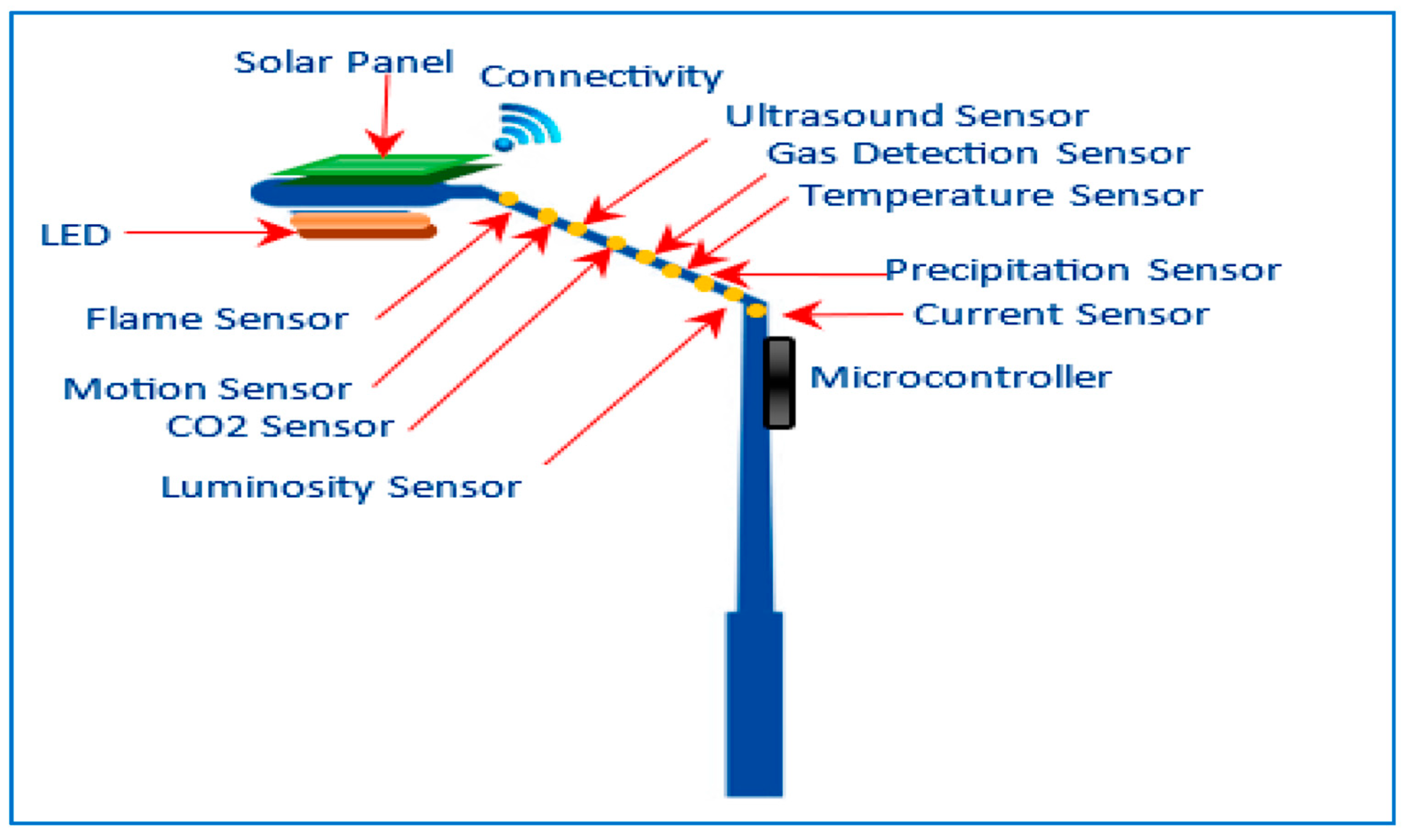
| Components Justifications & Functionality | Temperature Sensor: measures lamp temperature in order to detect its failure in real time. Also contributes to fire detection at streetlights while measuring the ambient temperature. Motion sensor: detects motion that corresponds to the presence of an object that approaches the lampposts. It is used to adjust the light according to the brightness level during vehicle or pedestrian passage with respect to ambient light. CO2 sensor: measures air CO2 concentration; it is used to analyze air pollution and contributes to fire detection. Flame sensor: used to detect fire in lampposts. Luminosity sensor: adjusts the light level according to day (sunrise) and night (sunset) conditions. It consists of an LDR (Light Dependent Resistor), an electronic component whose resistance varies according to the ambient light. Current sensor: measures a current up to 30 amperes and is used to detect lamp failures. Precipitation sensor: is a module composed of an electric board and a detection board. It can be used for all kinds of climate monitoring and can be translated into digital and analog output signals. It is used to detect precipitation and adjust lighting accordingly. Ultrasound sensor: measures the distance between the sensor and the first object located on its path. It allows knowing a distance ranging from 2 cm to 400 cm with an accuracy of 3 mm. It is the most widely used and cheapest distance sensor. It is used on its own or in conjunction with a motion sensor. Solar panel: is equipped with a solar panel and a battery. During the day, energy is accumulated and stored in the battery. Once the brightness fades, energy is generated to create light. Note that a relay can be used to switch between a solar panel power supply and an ordinary power supply in the case of battery discharge. Gas detection sensor: detects the presence of gas that poses a threat to citizens and the environment. Microcontroller: is a compact integrated circuit designed to control particular treatment in an embedded system. It includes, typically, a processor and memory and input/output peripherals on a single chip. Connectivity modules and Protocols: several standard protocols could be used, such as MQTT, CoAP, Http, TCP/IP, UDP, Bluetooth, WIFI, Zigbee, etc. These protocols could be combined with one another according to designer preferences and used technologies. |
| Name | Basic Smart Lighting (BSL) |
|---|---|
| Goal | BSL pattern is recommended in:
|
| Description | BSL is a little less sophisticated and cheaper than ASL. It uses less sensors to ensure a good cost/quality ratio. It is suitable for areas with limited traffic. |
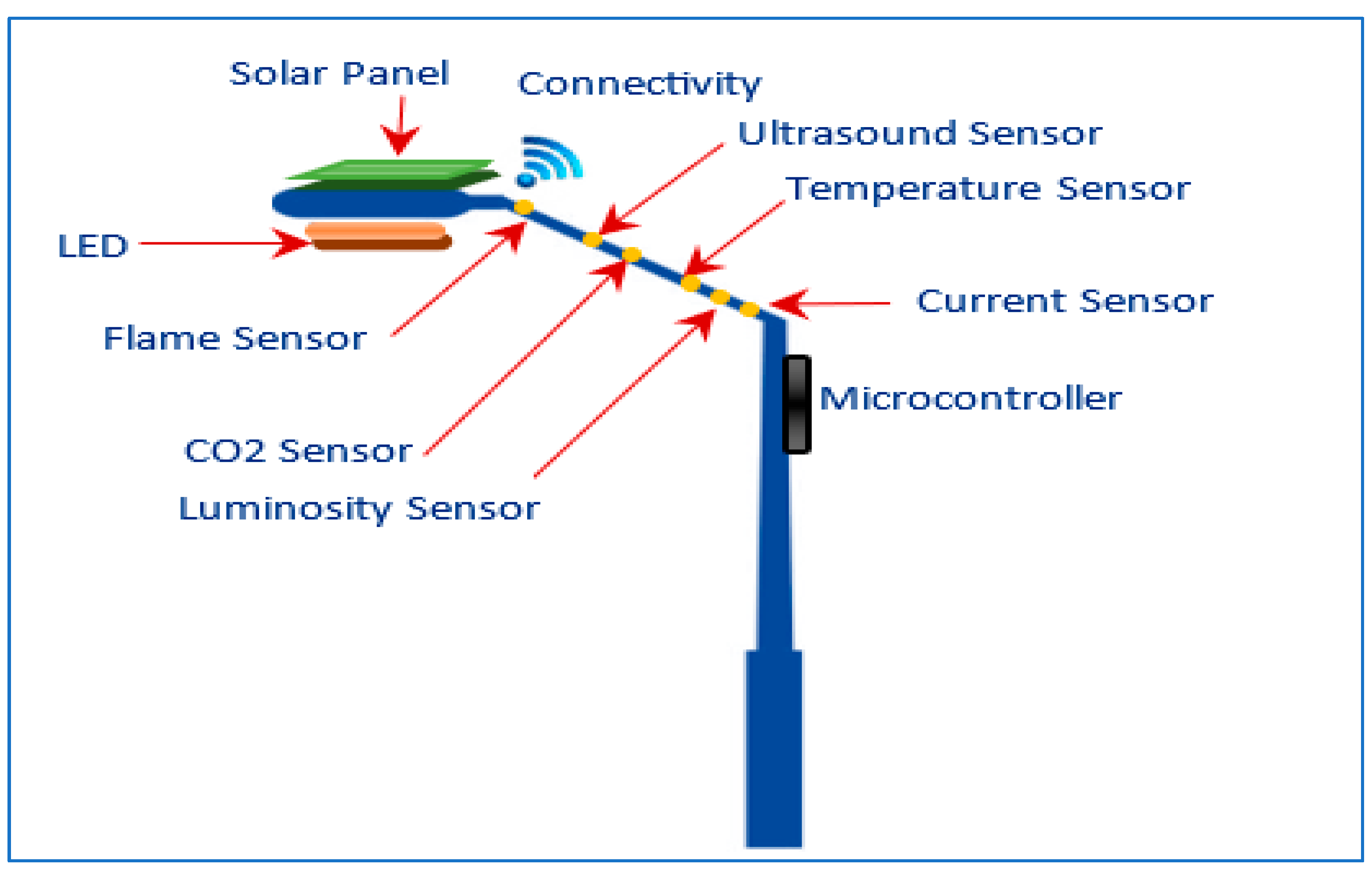
| Components | Similar to the ASL Pattern, it uses:
|
| Components Justifications & Functionality | The use of sensors reflects their usage in the first pattern with respect to the restricted list of sensors. |
| AoT | FA | LCA | GCA | |
| AoT | / | C | C | C |
| FA | C | / | C | C |
| LCA | C-S | C-S | / | C |
| GCA | C-S | C | C-S | / |
| LED Lighting | Traditional Lighting | |
|---|---|---|
| Energy Efficiency | Uses less electricity, reducing costs and carbon emissions | Uses more electricity, increasing costs and carbon emissions |
| Lifespan | Lasts longer, reducing maintenance costs | Shorter lifespan, increasing maintenance costs |
| Visibility | Provides better visibility, improving public safety | Provides lower visibility, decreasing public safety |
| Cost | Initially more expensive, but long-term savings | Cheaper initially, but more expensive long-term |
| Work/Year | IoT Integration | Use of MAS | Use of Fuzzy Logic | Use of LED Technology | Public Safety Enhancement | Real-Time Monitoring | CO2 Emissions Reduction |
|---|---|---|---|---|---|---|---|
| [57] 2011 | X | X | X | √ | √ | X | √ |
| [58] 2012 | X | X | X | √ | X | X | √ |
| [59] 2013 | X | X | √ | √ | √ | X | √ |
| [60] 2014 | X | X | X | √ | √ | X | √ |
| [61] 2014 | X | X | X | √ | X | √ | √ |
| [47] 2015 | X | X | X | √ | √ | √ | √ |
| [47] 2015 | X | X | X | X | √ | √ | X |
| [48] 2016 | X | X | X | √ | √ | √ | √ |
| [63] 2016 | X | X | X | √ | √ | √ | √ |
| [62] 2016 | X | X | X | √ | √ | X | √ |
| [65] 2017 | X | X | X | √ | √ | √ | √ |
| [66] 2019 | √ | X | X | √ | X | X | √ |
| [15] 2019 | X | X | X | √ | √ | X | √ |
| [46] 2019 | X | X | √ | √ | √ | √ | √ |
| [11] 2020 | X | X | √ | √ | X | √ | √ |
| [45] 2021 | √ | X | X | X | √ | √ | X |
| [52] 2021 | X | X | X | √ | √ | √ | √ |
| [9] 2022 | √ | X | X | √ | √ | √ | √ |
| [12] 2022 | √ | X | X | √ | X | X | √ |
| [13] 2022 | X | X | √ | X | X | X | X |
| [14] 2022 | X | X | X | X | √ | √ | X |
| [44] 2022 | X | X | X | X | √ | √ | X |
| [49] 2022 | X | √ | X | √ | √ | √ | √ |
| [50] 2022 | √ | X | X | √ | X | √ | √ |
| [51] 2022 | √ | X | X | √ | √ | √ | √ |
| [56] 2022 | √ | X | X | √ | √ | √ | √ |
| [53] 2023 | X | √ | √ | X | X | √ | X |
| [54] 2023 | √ | X | X | √ | √ | √ | √ |
| [55] 2024 | √ | X | X | X | √ | √ | X |
| Our Solution | √ | √ | √ | √ | √ | √ | √ |
Disclaimer/Publisher’s Note: The statements, opinions and data contained in all publications are solely those of the individual author(s) and contributor(s) and not of MDPI and/or the editor(s). MDPI and/or the editor(s) disclaim responsibility for any injury to people or property resulting from any ideas, methods, instructions or products referred to in the content. |
© 2024 by the authors. Licensee MDPI, Basel, Switzerland. This article is an open access article distributed under the terms and conditions of the Creative Commons Attribution (CC BY) license (https://creativecommons.org/licenses/by/4.0/).
Share and Cite
Kouah, S.; Saighi, A.; Ammi, M.; Naït Si Mohand, A.; Kouah, M.I.; Megías, D. Internet of Things-Based Multi-Agent System for the Control of Smart Street Lighting. Electronics 2024, 13, 3673. https://doi.org/10.3390/electronics13183673
Kouah S, Saighi A, Ammi M, Naït Si Mohand A, Kouah MI, Megías D. Internet of Things-Based Multi-Agent System for the Control of Smart Street Lighting. Electronics. 2024; 13(18):3673. https://doi.org/10.3390/electronics13183673
Chicago/Turabian StyleKouah, Sofia, Asma Saighi, Maryem Ammi, Aymen Naït Si Mohand, Marwa Ines Kouah, and David Megías. 2024. "Internet of Things-Based Multi-Agent System for the Control of Smart Street Lighting" Electronics 13, no. 18: 3673. https://doi.org/10.3390/electronics13183673
APA StyleKouah, S., Saighi, A., Ammi, M., Naït Si Mohand, A., Kouah, M. I., & Megías, D. (2024). Internet of Things-Based Multi-Agent System for the Control of Smart Street Lighting. Electronics, 13(18), 3673. https://doi.org/10.3390/electronics13183673