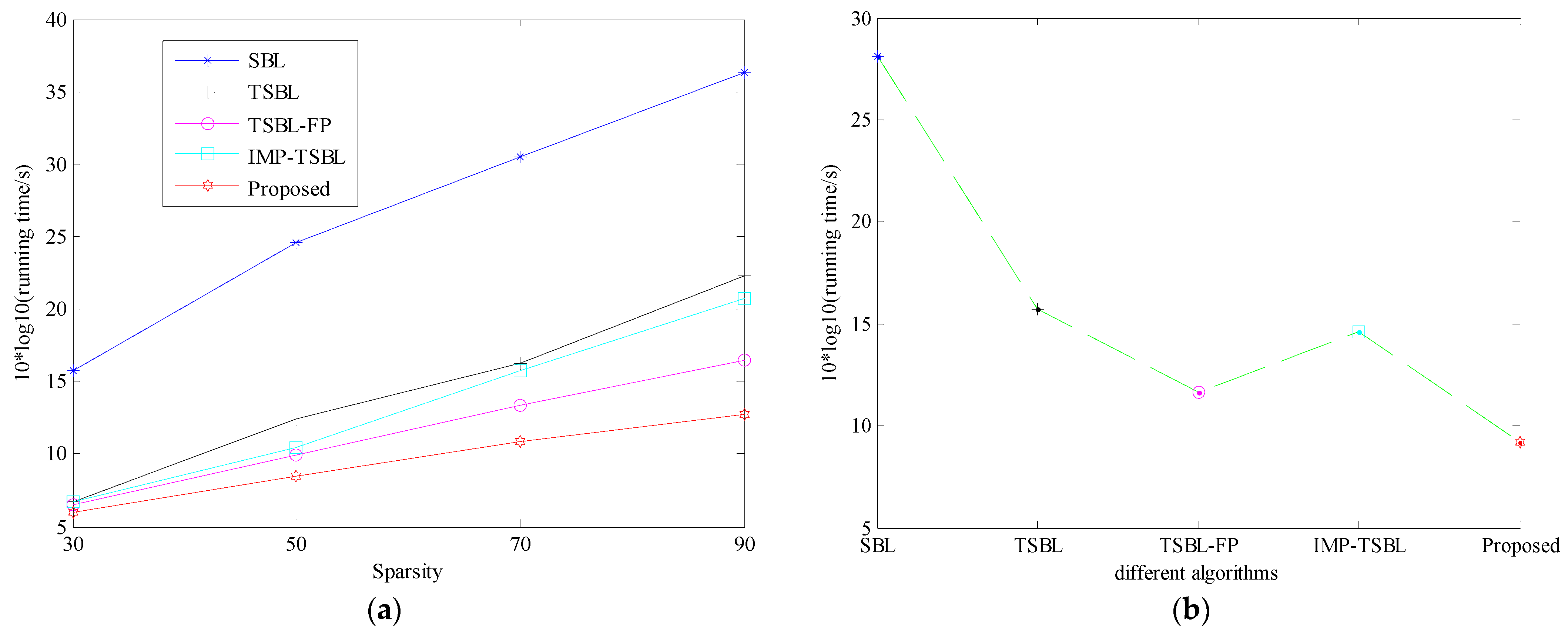
Fast Heterogeneous Clutter Suppression Method Based on Improved Sparse Bayesian Learning


Abstract
1. Introduction
- Obtaining the single CUT data. Since only CUT is directly analyzed and utilized in the proposed method, the initial step is to realize the sparse representation of data to be used in the subsequent handling of SR-STAP.
- Calculating the sparse solution. In view of the space-time relevance of the inner structure on clutter data, a fast SBL method attempts to be applied to sparse solution calculation. This stage can also be regarded as the iteration of hyper-parameters. In order to alleviate the conflict between computational complexity and sparse solution accuracy, three hyper-parameters are compared and analyzed. By finding the main hyper-parameter affecting the calculating burden, a kind of piecewise processing is put forward in the approach. Overall, different iteration formulas are reasonably utilized in the initial stage with a higher parameter dimension and the late stage with a lower parameter dimension.
- Estimating CCM based on rough prior knowledge. With the aid of approximate prior information of CUT, the target component is removed and CCM is estimated.
2. Signal Model with SR-STAP
3. Improved DDD Method Based on SBL
4. Simulation Analyses
5. Conclusions
Author Contributions
Funding
Conflicts of Interest
References
- Brennan, L.E.; Reed, L.S. Theory of adaptive radar. IEEE Trans. Aerosp. Electron. Syst. 1973, 9, 237–252. [Google Scholar] [CrossRef] [Scilit]
- Wu, D.; Zhu, D.Y.; Shen, M.W.; Li, N.; Zhou, H.Y. Clutter suppression for wideband radar STAP. IEEE Trans. Geosci. Remote Sens. 2022, 60, 1–18. [Google Scholar] [CrossRef] [Scilit]
- Li, X.Z.; Xie, W.C.; Wang, Y.L. A training sample selection method based on united generalized inner product statistics for STAP. IET Radar Sonar Navig. 2021, 15, 1565–1572. [Google Scholar] [CrossRef] [Scilit]
- Yang, Z.C.; Wang, X.Y. Reduced-rank space-time adaptive processing algorithm based on multistage selection of angle-Doppler filters. IET Radar Sonar Navig. 2022, 16, 327–345. [Google Scholar] [CrossRef] [Scilit]
- Huang, P.H.; Zou, Z.H.; Xia, X.G.; Liu, X.Z.; Liao, G.S. A novel dimension-reduced space-time adaptive processing algorithm for space-borne multichannel surveillance radar systems based on spatial-temporal 2-D sliding window. IEEE Trans. Geosci. Remote Sens. 2022, 60, 1–21. [Google Scholar]
- Zhao, K.; Liu, Z.W.; Shi, S.L.; Huang, Y.L.; Xu, Y.G. Augmented joint domain localized method for polarimetric space-time adaptive processing. Circ. Syst. Signal Process. 2021, 40, 3592–3608. [Google Scholar] [CrossRef] [Scilit]
- Klintberg, J.; Mckelvey, T.; Dammert, P. A parametric approach to space-time adaptive processing in bistatic radar systems. IEEE Trans. Aerosp. Electron. Syst. 2022, 58, 1149–1160. [Google Scholar] [CrossRef] [Scilit]
- Chen, H.M.; Liu, J.; Sun, H.W.; Yi, X.L.; Mu, H.Q.; Lu, Y.B. Knowledge-aided space time adaptive processing for airborne radar in heterogeneous environments. In Proceedings of the 2019 IEEE International Conference on Signal, Information and Data Processing (ICSIDP), Chongqing, China, 11–13 December 2019; pp. 1–5. [Google Scholar]
- Gao, Z.Q.; Tao, H.H. Knowledge-aided direct data domain STAP algorithm for forward-looking airborne radar. In Proceedings of the 2019 IEEE International Conference on Signal, Information and Data Processing (ICSIDP), Chongqing, China, 11–13 December 2019; pp. 1–6. [Google Scholar]
- Wen, F.Q.; Gui, G.; Gacanin, H.; Sari, H. Compressive sampling framework for 2D-DOA and polarization estimation in mmwave polarized massive MIMO systems. IEEE Trans. Wirel. Commun. 2022. [Google Scholar] [CrossRef] [Scilit]
- Wen, F.Q.; Shi, J.P.; Gui, G.; Gacanin, H.; Dobre, O.A. 3-D positioning method for anonymous UAV based on bistatic polarized MIMO radar. IEEE Internet Things J. 2023, 10, 815–827. [Google Scholar] [CrossRef] [Scilit]
- Xu, G.; Zhang, B.J.; Yu, H.W.; Chen, J.L.; Xing, M.D.; Hong, W. Sparse synthetic aperture radar imaging form compressed sensing and machine learning: Theories, applications, and trends. IEEE Geosci. Remote Sens. M. 2022, 2–40. [Google Scholar] [CrossRef] [Scilit]
- Cui, N.; Xing, K.; Yu, Z.J.; Duan, K.Q. Tensor-based sparse recovery space-time adaptive processing for large size data clutter suppression in airborne radar. IEEE Trans. Aerosp. Electron. Syst. 2022, 1–17. [Google Scholar] [CrossRef] [Scilit]
- Xia, D.P.; Zhang, L.; Wu, T.; Meng, X.D. A clutter suppression method for airborne bistatic polarization radar based on polarization space-time adaptive processing. Multidim. Syst. Signal Process. 2022, 33, 899–916. [Google Scholar] [CrossRef] [Scilit]
- Tipping, M.E. Sparse Bayesian learning and the relevance vector machine. J. Mach. Learn. Res. 2001, 1, 211–244. [Google Scholar]
- Wipf, D.P.; Rao, B.D. Sparse Bayesian learning for basis selection. IEEE Trans. Signal Process. 2004, 52, 2153–2164. [Google Scholar] [CrossRef] [Scilit]
- Zhang, W.; An, R.X.; He, N.Y.; He, Z.S.; Li, H.Y. Reduced dimension STAP based on sparse recovery in heterogeneous clutter environments. IEEE Trans. Aerosp. Electron. Syst. 2020, 56, 785–795. [Google Scholar] [CrossRef] [Scilit]
- Cui, W.C.; Wang, T.; Wang, D.G.; Liu, K. An efficient sparse Bayesian learning STAP algorithm with adaptive Laplace prior. Remote Sens. 2022, 14, 3520. [Google Scholar] [CrossRef] [Scilit]
- Zhang, Z.L.; Rao, B.D. Sparse signal recovery with temporally correlated source vectors using sparse Bayesian learning. IEEE J. Sel. Top. Signal Process. 2011, 5, 912–926. [Google Scholar] [CrossRef] [Scilit]
- Qiao, G.; Song, Q.J.; Ma, L.; Sun, Z.X.; Zhang, J.R. Channel prediction based temporal multiple sparse Bayesian learning for channel estimation in fast time-varying underwater acoustic OFDM communications. Signal Process. 2020, 175, 107668. [Google Scholar] [CrossRef] [Scilit]
- Cui, N.; Xing, K.; Duan, K.Q.; Yu, Z.J. Fast tensor-based three-dimensional sparse Bayesian learning space-time adaptive processing method. J. Radar 2021, 10, 919–928. [Google Scholar]
- Wang, G.S.; Wang, Y.Q.; Huang, G.C.; Ren, Q.H.; Ren, T.T. Simultaneous sparse learning algorithm of structured approximation with transformation analysis embedded in Bayesian framework. J. Electron. Imaging 2021, 30, 053006. [Google Scholar] [CrossRef] [Scilit]
- Xu, X.W.; Zhang, S.; Gao, F.F.; Wang, J.Z. Sparse Bayesian learning based channel extrapolation for RIS assisted MIMO-OFDM. IEEE Trans. Commun. 2022, 70, 5498–5513. [Google Scholar] [CrossRef] [Scilit]
- Li, H.R.; Dai, J.S.; Pan, T.H.; Chang, C.Q.; So, H.C. Sparse Bayesian learning approach for baseline correction. Chemometr. Intell. Lab. Syst. 2020, 204, 104088. [Google Scholar] [CrossRef] [Scilit]
- Zhang, Z.L.; Rao, B.D. Extension of SBL algorithms for the recovery of block sparse signals with intra-block correlation. IEEE Trans. Signal Process. 2013, 61, 2009–2015. [Google Scholar] [CrossRef] [Scilit]
- Wang, Q.S.; Yu, H.; Li, J.; Ji, F.; Chen, F.J. Sparse Bayesian learning using generalized double pareto prior for DOA estimation. IEEE Signal Process. Lett. 2021, 28, 1744–1748. [Google Scholar] [CrossRef] [Scilit]
- Cui, N.; Xing, K.; Duan, K.Q.; Yu, Z.J. Knowledge-aided block sparse Bayesian learning STAP for phased-array MIMO airborne radar. IET Radar Sonar Navig. 2021, 15, 1628–1642. [Google Scholar] [CrossRef] [Scilit]
- Moon, T.K. The expectation-maximization algorithm. IEEE Signal Process. Mag. 1996, 13, 47–60. [Google Scholar] [CrossRef] [Scilit]
- Zhou, W.; Zhang, H.T.; Wang, J. Sparse Bayesian learning based on collaborative neurodynamic optimization. IEEE Trans. Cybernetics 2022, 52, 13669–13683. [Google Scholar] [CrossRef] [Scilit]
- Wang, B.; Zhu, Z.; Dai, Y. A fast underwater acoustic target direction of arrival estimation method based on sparse Bayesian learning. Acta Acust. 2016, 41, 81–86. [Google Scholar]
- MacKay, D.J.C. Bayesian interpolation. Neural Comput. 1992, 4, 131–134. [Google Scholar] [CrossRef] [Scilit]
- Song, Q.J. Research on Sparse Bayesian Learning Based Sparse Channel Estimation in Underwater Acoustic OFDM Communication. Ph.D. Thesis, Harbin Engineering University, Harbin, China, November 2020. [Google Scholar]
- Liu, S.; Tang, L.; Bai, Y.C.; Zhang, X.G. A sparse Bayesian learning-based DOA estimation method with the Kalman filter in MIMO radar. Electronics 2020, 9, 347. [Google Scholar] [CrossRef] [Scilit]
- Cao, Z.; Dai, J.S.; Xu, W.C.; Chang, C.Q. Fast variational Bayesian inference for temporally correlated sparse signal recovery. IEEE Signal Process. Lett. 2021, 28, 214–218. [Google Scholar] [CrossRef] [Scilit]
- Wang, B.; Zhu, Z.H.; Dai, Y.W. On fast estimation of direction of arrival for underwater acoustic target based on sparse Bayesian learning. Chin. J. Acoust. 2017, 36, 102–112. [Google Scholar]
- Hong, D.Y.; Wang, W.; Yin, L.; Pu, Z.Q.; Zhou, C.Y.; Huang, H.N. An improved temporal multiple sparse Bayesian learning under-ice acoustic channel estimation method. Acta Acust. 2022, 47, 591–602. [Google Scholar]
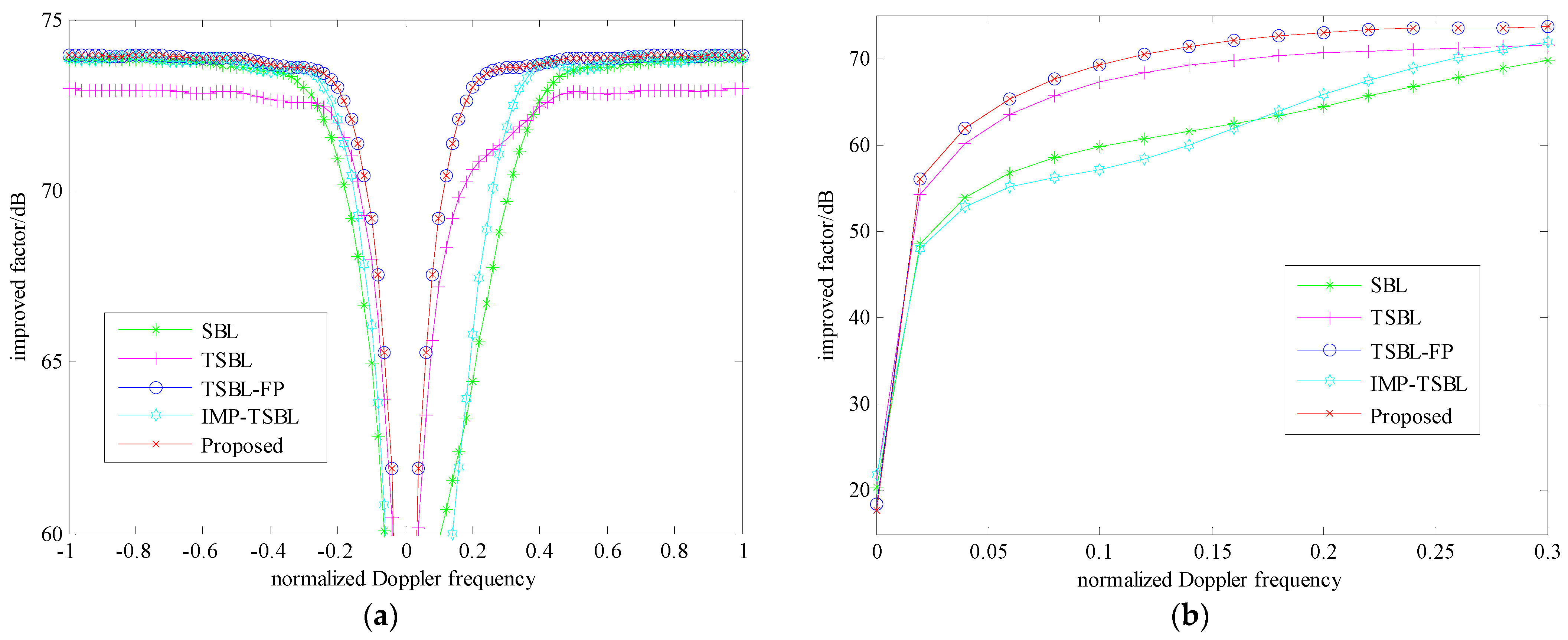
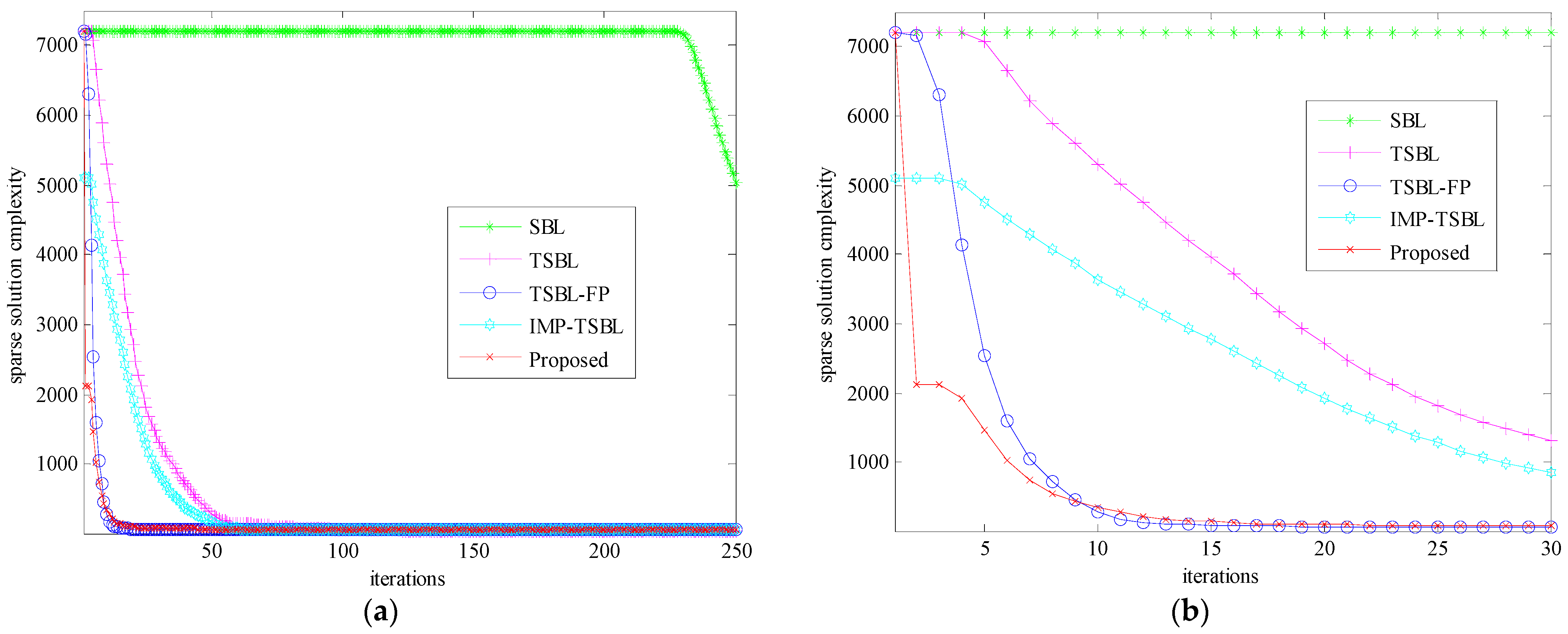

Disclaimer/Publisher’s Note: The statements, opinions and data contained in all publications are solely those of the individual author(s) and contributor(s) and not of MDPI and/or the editor(s). MDPI and/or the editor(s) disclaim responsibility for any injury to people or property resulting from any ideas, methods, instructions or products referred to in the content. |
© 2023 by the authors. Licensee MDPI, Basel, Switzerland. This article is an open access article distributed under the terms and conditions of the Creative Commons Attribution (CC BY) license (https://creativecommons.org/licenses/by/4.0/).
Share and Cite
Wang, Q.; Zhang, Y.; Li, Z.; Zhao, W. Fast Heterogeneous Clutter Suppression Method Based on Improved Sparse Bayesian Learning. Electronics 2023, 12, 343. https://doi.org/10.3390/electronics12020343
Wang Q, Zhang Y, Li Z, Zhao W. Fast Heterogeneous Clutter Suppression Method Based on Improved Sparse Bayesian Learning. Electronics. 2023; 12(2):343. https://doi.org/10.3390/electronics12020343
Chicago/Turabian StyleWang, Qiang, Yani Zhang, Zhihui Li, and Weihu Zhao. 2023. "Fast Heterogeneous Clutter Suppression Method Based on Improved Sparse Bayesian Learning" Electronics 12, no. 2: 343. https://doi.org/10.3390/electronics12020343
APA StyleWang, Q., Zhang, Y., Li, Z., & Zhao, W. (2023). Fast Heterogeneous Clutter Suppression Method Based on Improved Sparse Bayesian Learning. Electronics, 12(2), 343. https://doi.org/10.3390/electronics12020343