Article

Assessing the Intention to Adopt Cloud Accounting during COVID-19

by
Mohamed Saad
1,
Abdalwali Lutfi
1,2,*,
Mohammed Amin Almaiah
3,4,5,
Ahmad Farhan Alshira’h
6,
Malek Hamed Alshirah
7,*,
Hamza Alqudah
6,
Akif Lutfi Alkhassawneh
8,
Adi Alsyouf
9,
Mahmaod Alrawad
10,11 and
Osama Abdelmaksoud
1
1
Department of Accounting, College of Business, King Faisal University, Al-Ahsa 31982, Saudi Arabia
2
Applied Science Research Center, Applied Science Private University, Amman 11931, Jordan
3
Department of Computer Networks, College of Computer Sciences and Information Technology, King Faisal University, Al-Ahsa 31982, Saudi Arabia
4
Faculty of Information Technology, Applied Science Private University, Amman 11931, Jordan
5
Department of Computer Science, King Abdullah the II IT School, The University of Jordan, Amman 11942, Jordan
6
Accounting Department, Faculty of Administrative and Financial Sciences, Irbid National University, Irbid 21110, Jordan
7
Department of Accounting, Faculty of Economics and Administrative Sciences, Al al-Bayt University, Al-Mafraq 130040, Jordan
8
Financial and Administrative Sciences Department, AL-Balqa’ Applied University, Irbid University College, Irbid 1293, Jordan
9
Department of Managing Health Services and Hospitals, Faculty of Business Rabigh, College of Business (COB), King Abdulaziz University, Jeddah 21991, Saudi Arabia
10
Quantitative Method Department, College of Business Administration, King Faisal University, Al-Ahsa 31982, Saudi Arabia
11
College of Business Administration and Economics, Al-Hussein Bin Talal University, Ma’an 71111, Jordan
*
Authors to whom correspondence should be addressed.
Electronics 2022, 11(24), 4092; https://doi.org/10.3390/electronics11244092

Submission received: 6 November 2022 / Revised: 2 December 2022 / Accepted: 4 December 2022 / Published: 8 December 2022

Abstract

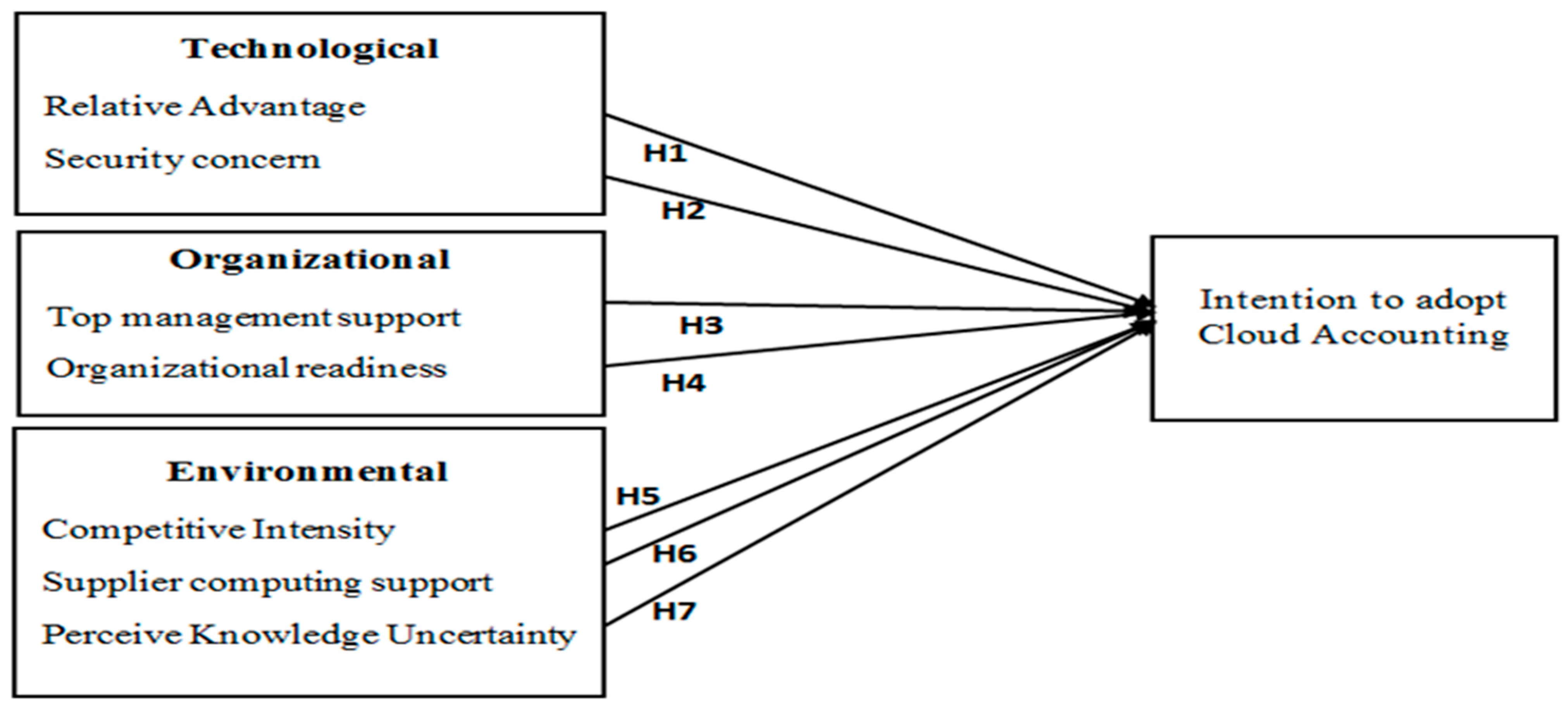
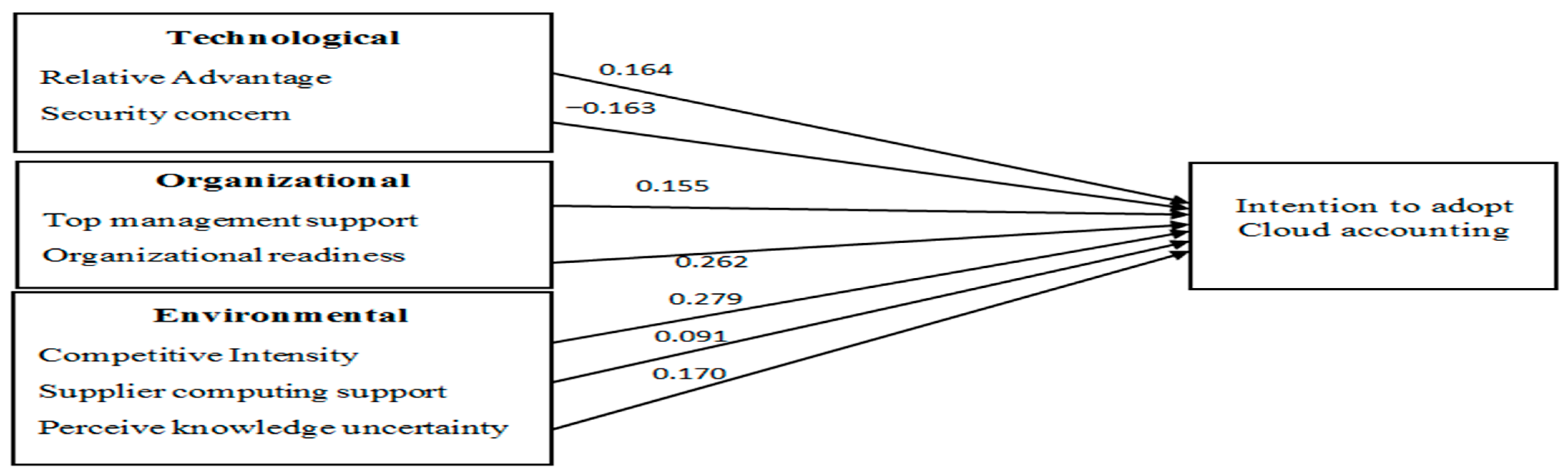
The information technology (IT) revolutionization aside with the emergence of COVID-19 have catalyzed cloud-computing services and systems with multiple end-user benefits for online business management, specifically in the accounting discipline. For example, cloud accounting enables the significant reduction of organisational IT investment with flexible access to a large group of scalable resources. The cloud accounting enables small and medium size enterprises (SMEs) to independently engage in fundamental bookkeeping responsibilities rather than hiring external auditors for the same services. As cloud-based accounting adoption remains in the preliminary stage within Jordanian businesses, this study applied the technology, organisation, and environment model to explore cloud accounting among Jordanian SMEs. The study data were gathered from 156 Jordanian SME owners or managers with a structured online survey questionnaire. The recommended study framework encompassed seven determinants that influenced the cloud accounting adoption intention. Resultantly, except Perceived knowledge uncertainty factor, the proposed hypotheses were supported as the aforementioned factors (relative advantages, security concerns, top management support, organizational readiness, competitor’s intensity and suppliers computing support) positively and significantly influenced the cloud accounting of Jordanian SMEs. The study outcomes could facilitate IT field decision-makers and practitioners by investigating an actual cloud accounting case based on the essentiality of its application.
Keywords: cloud accounting; adoption; TOE; SME; COVID-19 cloud accounting; adoption; TOE; SME; COVID-19