Fault Diagnosis Method of Planetary Gearbox Based on Compressed Sensing and Transfer Learning
Abstract
:1. Introduction
- When the vibration signal acquisition process is run, many redundant observations are generated, which is incompatible with wireless transmission and data storage. As a result, advanced sensing technology must be used to compress and rebuild the original signal;
- The vibration signal is nonstationary, and the extracted characteristic parameters include random noise. As a result, it is sufficient to use noise reduction technology to preprocess the signal before extracting the characteristic parameters from the weak signal;
- The extracted time domain and frequency domain feature parameters rely on expert, prior knowledge. When the feature parameters are incorrectly set, the precision of the fault diagnosis outcomes suffers;
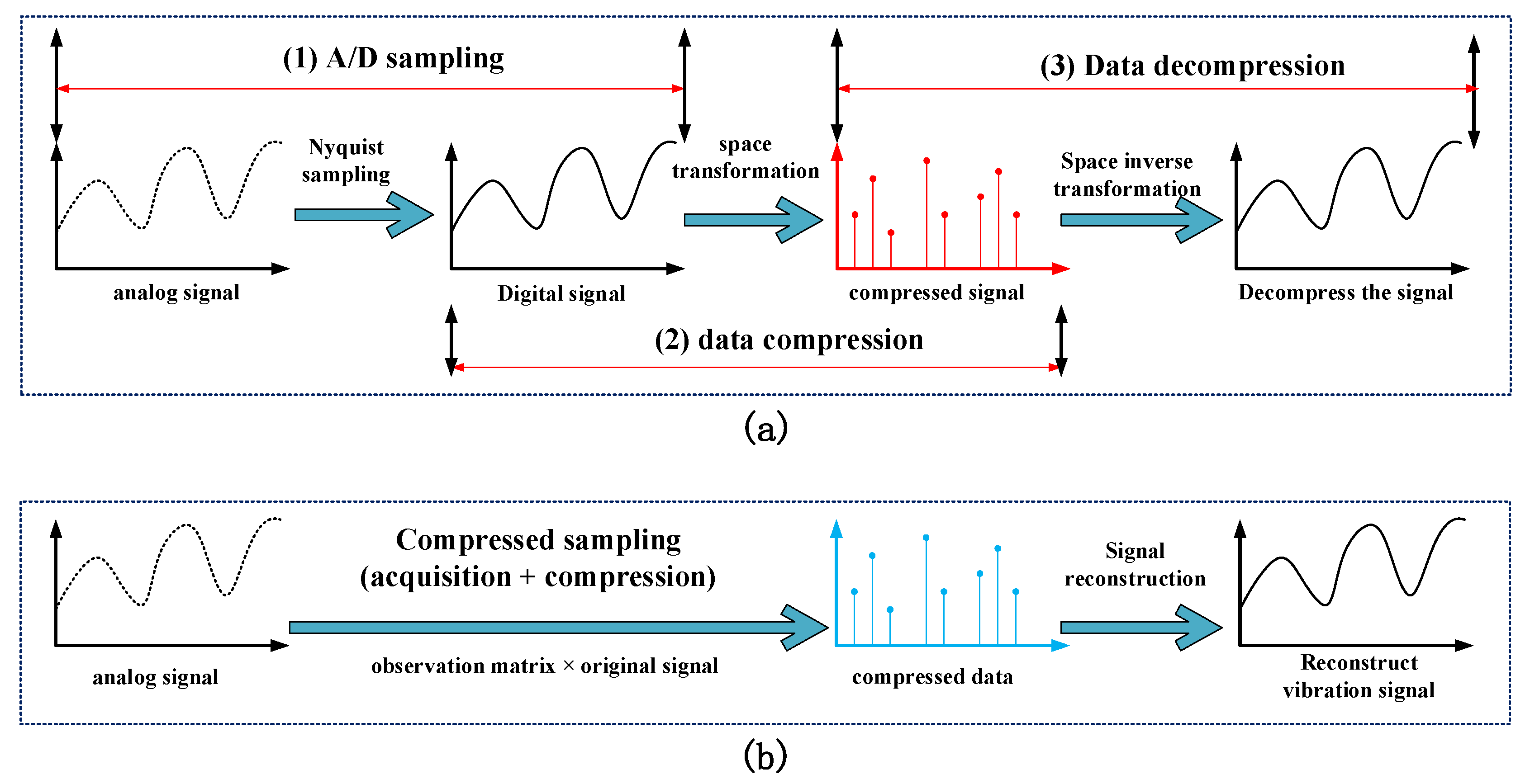
- Using the Compressive Sampling Orthogonal Matching Pursuit algorithm, the optimal global solution is gradually approximated by finding the optimal local solution in each iteration. The most relevant one is seen from the absolute value of the inner product: the residuals. Compared with other traditional compression algorithm methods, this method can effectively improve data network transmission’s work efficiency and show a better compression effect and reconstruction accuracy.
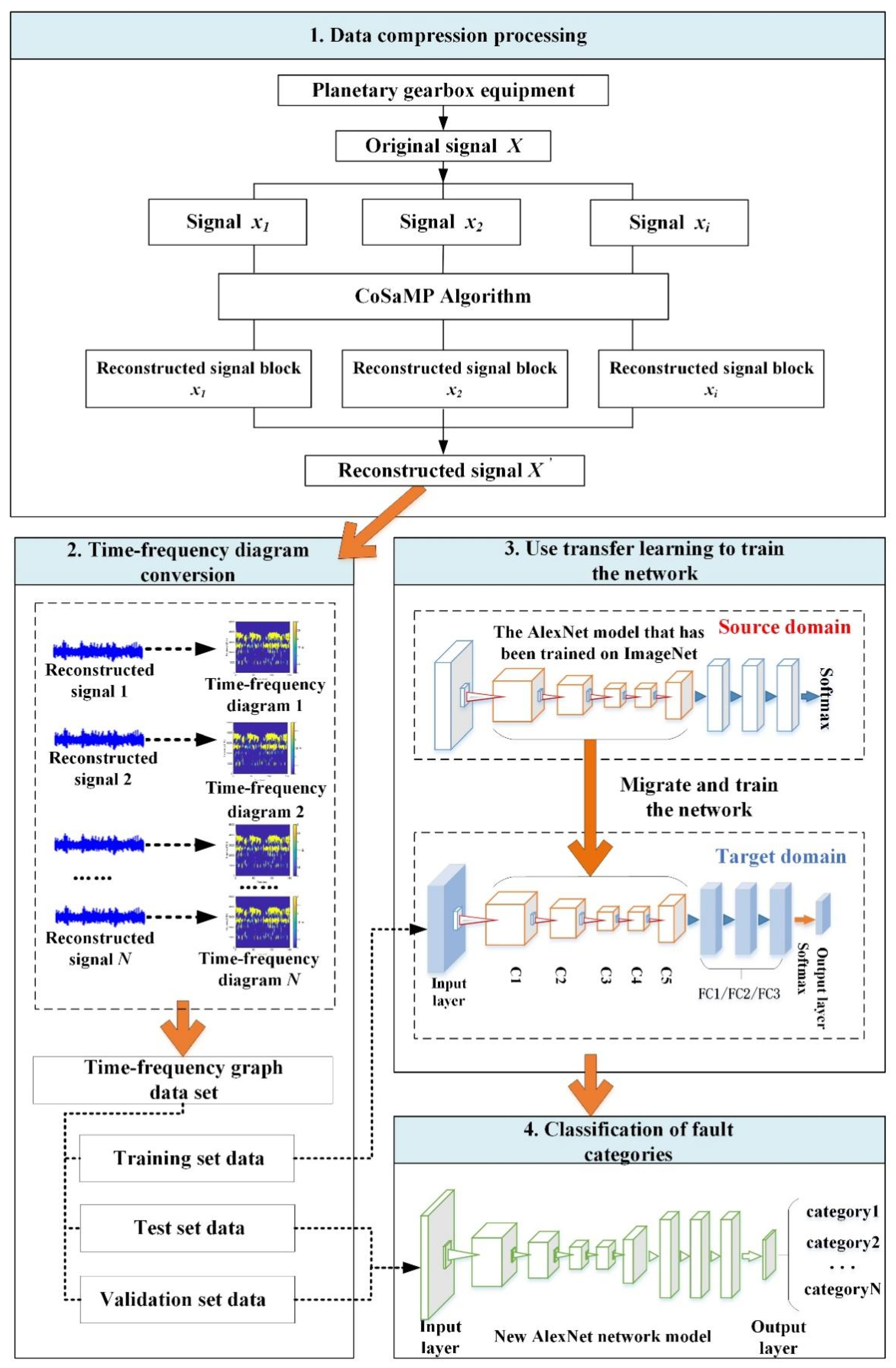
- A fault diagnosis method is proposed based on the combination of compressed sensing technology and transfer learning. Compared with other deep understanding and traditional machine learning methods, under a high compression rate, this method has the advantages of a simple network model structure, strong fault–feature extraction ability, high classification accuracy, small calculation amount, and short running time. In addition, the method has good portability and can be applied to embedded systems based on edge computing.
2. Continue Wavelet Transform and Compressed Sensing
2.1. Continue Wavelet Transform
2.2. Compressed Sensing
2.3. Compressed Sampling Orthogonal Matching Pursuit Reconstruction Algorithm
3. Deep Convolutional Neural Networks and Transfer Learning
3.1. Deep Convolutional Neural Network based on AlexNet
3.1.1. Convolutional Layer (CL)
3.1.2. Pooling Layer (PL)
3.1.3. Softmax classifier
3.2. Transfer Learning (TL)
4. Process of Fault Diagnosis Method Based on Deep Transfer Learning and Compressed Sensing
5. The Verification of The Experimental Data
5.1. The Preparation of The Experiment
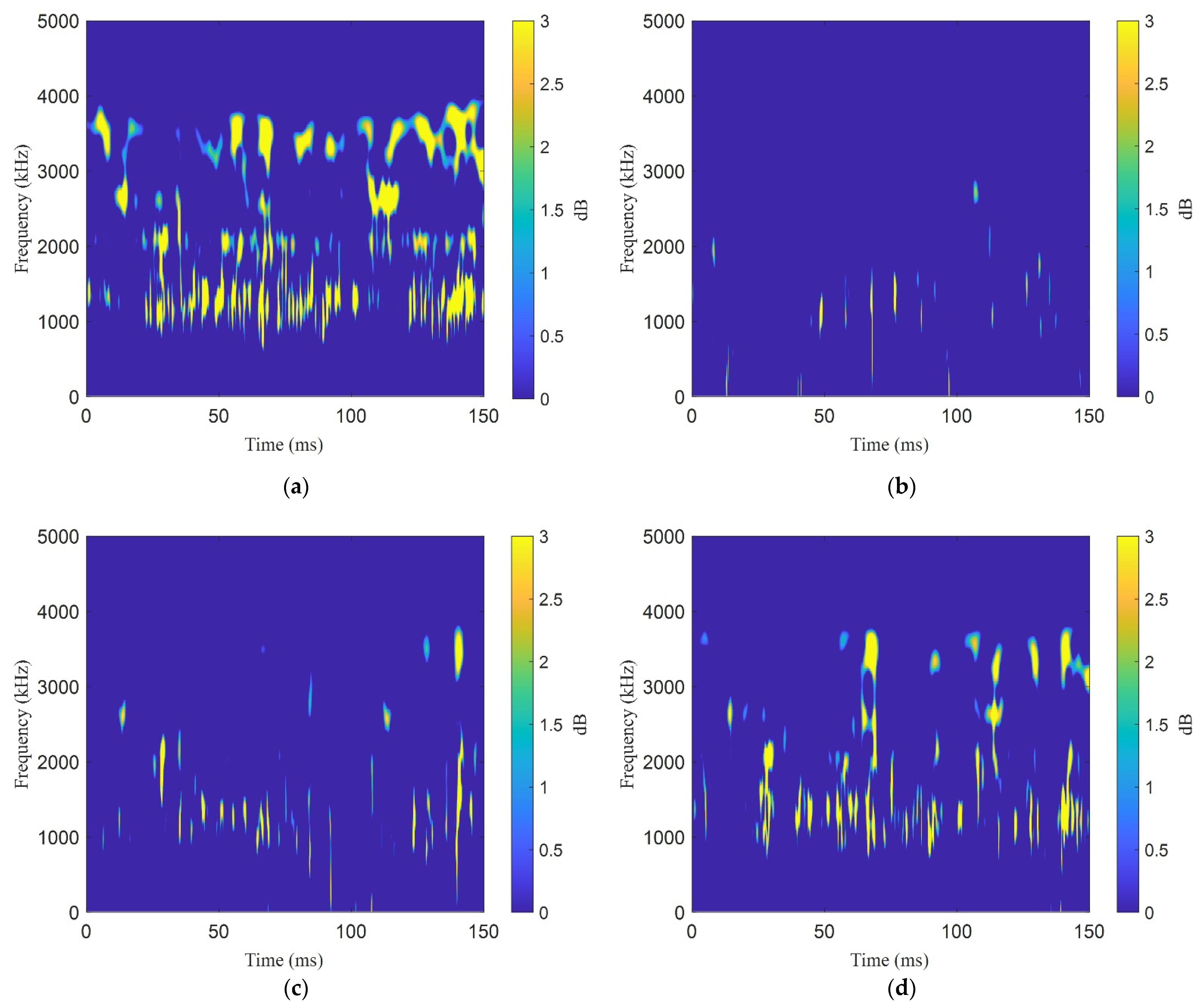
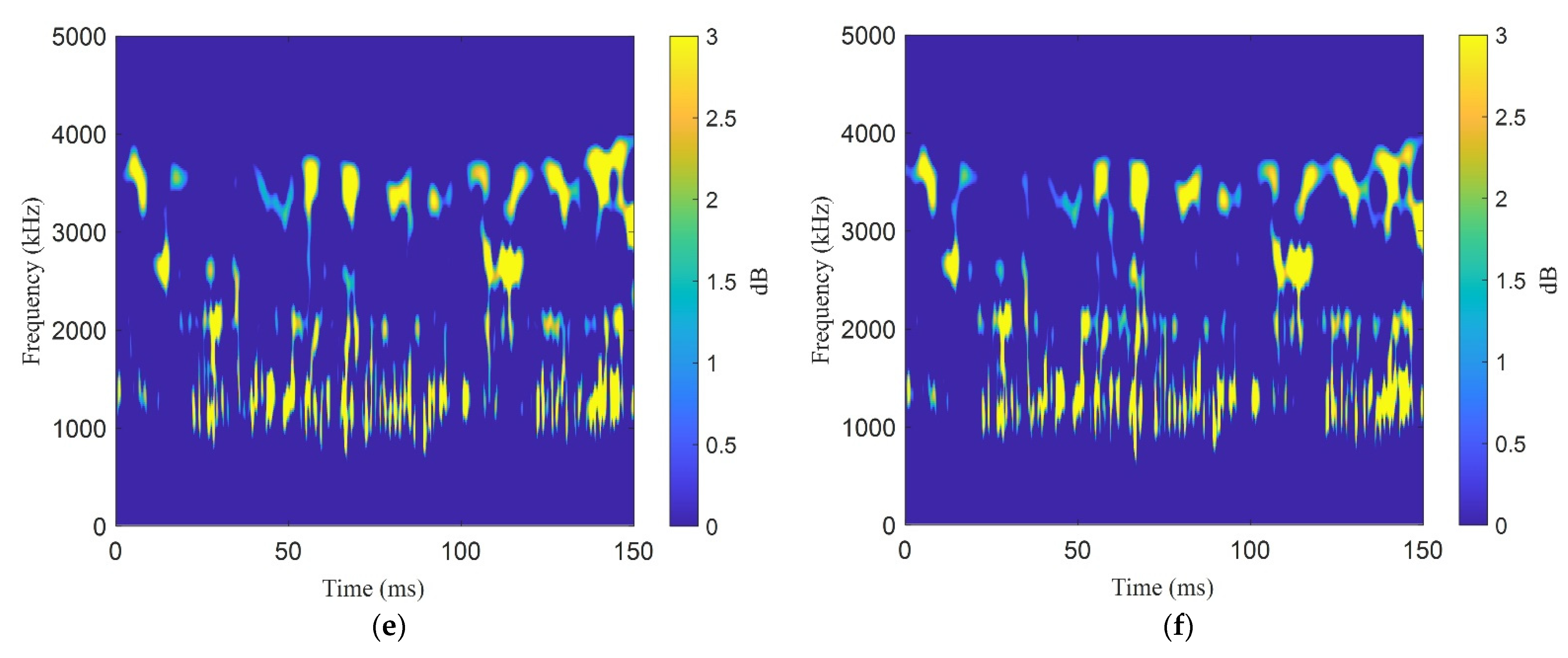
5.2. Data Preprocessing
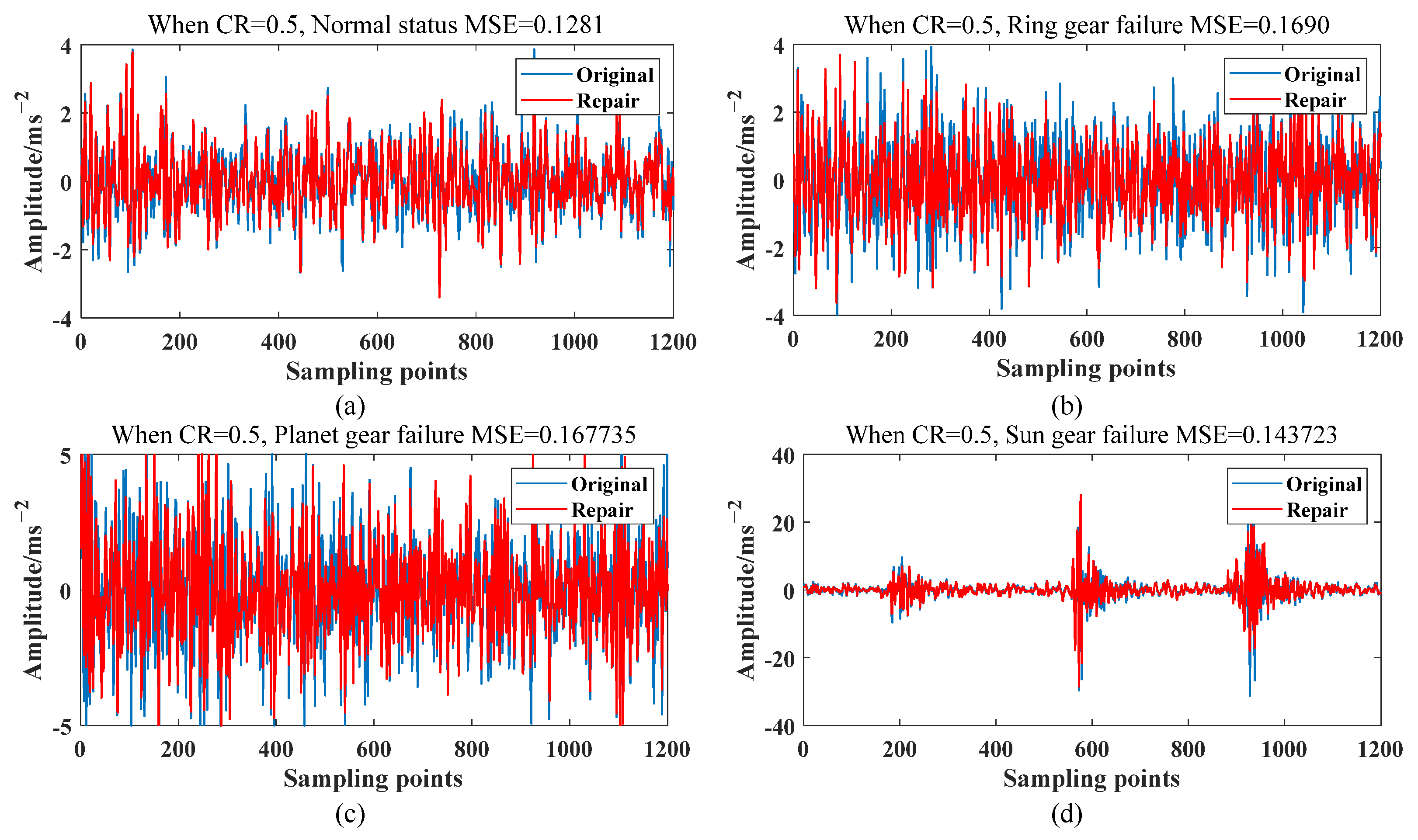
5.3. Comparison and Analysis of Compression and Reconstruction Algorithms
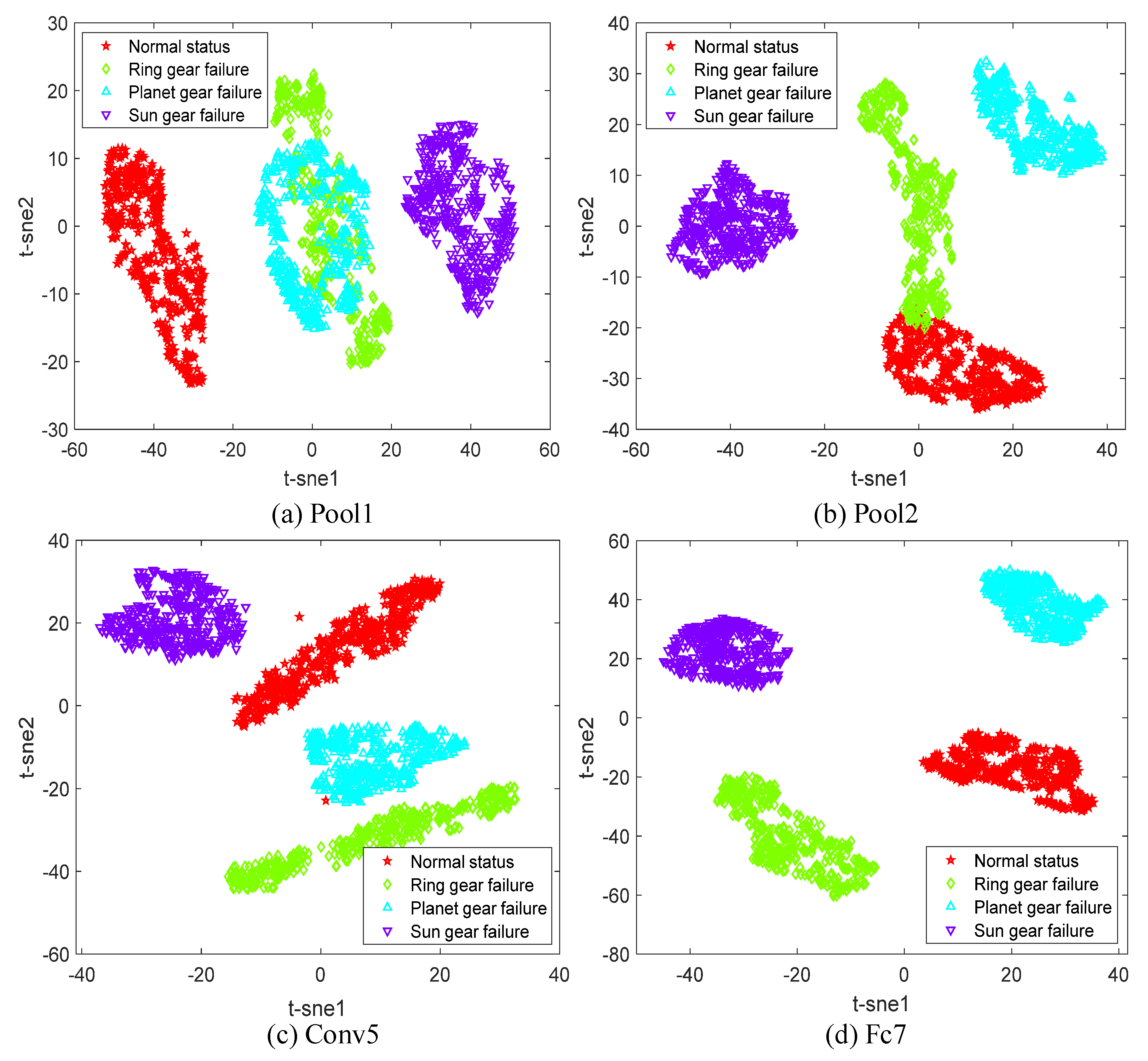
5.4. Comparative Analysis of Training Network and Diagnosis Results
5.5. Comparative Analysis of Different Network Models
6. Conclusions
Author Contributions
Funding
Data Availability Statement
Conflicts of Interest
References
- Ye, S.; Zhang, J.; Xu, B.; Zhu, S.; Xiang, J.; Tang, H. Theoretical investigation of the contributions of the excitation forces to the vibration of an axial piston pump. Mech. Syst. Signal Process. 2019, 129, 201–217. [Google Scholar] [CrossRef]
- Pei, X.; Zheng, X.; Wu, J. Intelligent bearing fault diagnosis based on Teager energy operator demodulation and multiscale compressed sensing deep autoencoder. Measurement 2021, 179, 109452. [Google Scholar] [CrossRef]
- Xia, M.; Shao, H.; Williams, D.; Lu, S.; Shu, L.; de Silva, C.W. Intelligent fault diagnosis of machinery using digital twin-assisted deep transfer learning. Reliab. Eng. Syst. Saf. 2021, 215, 107938. [Google Scholar] [CrossRef]
- Liang, J.; Xiao, D.; Wang, M.; Li, M.; Liu, R. Low-complexity privacy preserving scheme based on compressed sensing and non-negative matrix factorization for image data. Opt. Lasers Eng. 2020, 129, 106056. [Google Scholar] [CrossRef]
- Saufi, S.R.; Ahmad, Z.A.B.; Leong, M.S.; Lim, M.H. Gearbox fault diagnosis using a deep learning model with limited data sample. IEEE Trans. Ind. Inform. 2020, 16, 6263–6271. [Google Scholar] [CrossRef]
- Lu, F.; Cao, Z.; Xie, Y.; Xu, L. Precise wide-band electrical impedance spectroscopy measurement via an ADC operated below the Nyquist sampling rate. Measurement 2021, 174, 108995. [Google Scholar] [CrossRef]
- Chen, J.; Xu, B.; Zhang, X. A Vibration Feature Extraction Method Based on Time-Domain Dimensional Parameters and Mahalanobis Distance. Math. Probl. Eng. 2021, 2021, 2498178. [Google Scholar] [CrossRef]
- Ke, W.; Hao, C. Research on radar main lobe false target jamming feature extraction based on time-frequency domain and fluctuation characteristics. J. Phys. Conf. Ser. 2021, 1871, 012079. [Google Scholar]
- Rigatos, G.; Siano, P. Power transformers’ condition monitoring using neural modeling and the local statistical approach to fault diagnosis. Int. J. Electr. Power Energy Syst. 2016, 80, 150–159. [Google Scholar] [CrossRef]
- Du, W.-T.; Zeng, Q.; Shao, Y.-M.; Wang, L.-M.; Ding, X.-X. Multi-Scale Demodulation for Fault Diagnosis Based on a Weighted-EMD De-Noising Technique and Time—Frequency Envelope Analysis. Appl. Sci. 2020, 10, 7796. [Google Scholar] [CrossRef]
- Zhao, X.; Bao, H.; Tian, L.; Yuan, Y.; Dai, J. Research on the Application of Rolling Bearing Fault Diagnosis Based on Order Cepstrum Analysis. In Proceedings of the 2016 7th International Conference on Mechatronics, Control and Materials (ICMCM 2016), Changsha, China, 29–30 October 2016; Atlantis Press: Changsha, China, 2016; pp. 93–96. [Google Scholar]
- Fei, S.-W. The Hybrid Method of VMD-PSR-SVD and Improved Binary PSO-KNN for Fault Diagnosis of Bearing. Shock Vib. 2019, 2019, 4954920. [Google Scholar] [CrossRef] [Green Version]
- Lei, Y.; Jiang, W.; Niu, H.; Shi, X.; Yang, X. Fault Diagnosis of Axial Piston Pump Based on Extreme-Point Symmetric Mode Decomposition and Random Forests. Shock. Vib. 2021, 2021, 6649603. [Google Scholar]
- Lv, X.; Wang, H.; Zhang, X.; Liu, Y.; Jiang, D.; Wei, B. An evolutional SVM method based on incremental algorithm and simulated indicator diagrams for fault diagnosis in sucker rod pumping systems. J. Pet. Sci. Eng. 2021, 203, 108806. [Google Scholar] [CrossRef]
- Shao, K.; Fu, W.; Tan, J.; Wang, K. Coordinated approach fusing time-shift multiscale dispersion entropy and vibrational Harris hawks optimization-based SVM for fault diagnosis of rolling bearing. Measurement 2020, 173, 108580. [Google Scholar] [CrossRef]
- Zhang, X.; Li, C.; Wang, X.; Wu, H. A novel fault diagnosis procedure based on improved symplectic geometry mode decomposition and optimized SVM. Measurement 2021, 173, 108644. [Google Scholar] [CrossRef]
- Liu, Y.; Ding, K.; Zhang, J.; Li, Y.; Yang, Z.; Zheng, W.; Chen, X. Fault diagnosis approach for photovoltaic array based on the stacked auto-encoder and clustering with IV curves. Energy Convers. Manag. 2021, 245, 114603. [Google Scholar] [CrossRef]
- Huang, T.; Fu, S.; Feng, H.; Kuang, J. Bearing fault diagnosis based on shallow multi-scale convolutional neural network with attention. Energies 2019, 12, 3937. [Google Scholar] [CrossRef] [Green Version]
- Xing, T.; Shen, J.; Meng, Z. Fault Diagnosis of Marine Wind Turbine Gearbox Based on New Technology of Compressed Sensing. J. Coast. Res. 2020, 104, 406–409. [Google Scholar] [CrossRef]
- Shi, P.; Guo, X.; Han, D.; Fu, R. A sparse auto-encoder method based on compressed sensing and wavelet packet energy entropy for rolling bearing intelligent fault diagnosis. J. Mech. Sci. Technol. 2020, 34, 1445–1458. [Google Scholar] [CrossRef]
- Shao, H.; Jiang, H.; Zhang, H.; Duan, W.; Liang, T.; Wu, S. Rolling bearing fault feature learning using improved convolutional deep belief network with compressed sensing. Mech. Syst. Signal Process. 2018, 100, 743–765. [Google Scholar] [CrossRef]
- Shi, P.; Ma, X.; Han, D. A weak fault diagnosis method for rotating machinery based on compressed sensing and stochastic resonance. J. Vibroeng. 2019, 21, 654–664. [Google Scholar] [CrossRef]
- Liu, C.; Cheng, G.; Chen, X.; Pang, Y. Planetary gears feature extraction and fault diagnosis method based on VMD and CNN. Sensors 2018, 18, 1523. [Google Scholar] [CrossRef] [PubMed] [Green Version]
- Li, H.P.; Qi, Z.L.; Hu, J.P.; Zhang, X.Y. Research on the Method of Rotary Machinery Fault Diagnosis based on PCA and DBN. IOP Conf. Ser. Mater. Sci. Eng. 2021, 1043, 022044. [Google Scholar] [CrossRef]
- Tang, Z.; Bo, L.; Liu, X.; Wei, D. A semi-supervised transferable LSTM with feature evaluation for fault diagnosis of rotating machinery. Appl. Intell. 2021, 52, 1703–1717. [Google Scholar] [CrossRef]
- Wang, H.; Liu, C.; Jiang, D.; Jiang, Z. Collaborative deep learning framework for fault diagnosis in distributed complex systems. Mech. Syst. Signal Process. 2021, 156, 107650. [Google Scholar] [CrossRef]
- Ahmadi, A.; Kashefi, M.; Shahrokhi, H.; Nazari, M.A. Computer aided diagnosis system using deep convolutional neural networks for ADHD subtypes. Biomed. Signal Process. Control 2020, 63, 102227. [Google Scholar] [CrossRef]
- Barcelos, A.S.; Cardoso, A.J.M. Current-based bearing fault diagnosis using deep learning algorithms. Energies 2021, 14, 2509. [Google Scholar] [CrossRef]
- He, J.; Li, X.; Chen, Y.; Chen, D.; Guo, J.; Zhou, Y. Deep Transfer Learning Method Based on 1D-CNN for Bearing Fault Diagnosis. Shock Vib. 2021, 2021, 6687331. [Google Scholar] [CrossRef]
- Xu, Y.; Li, Z.; Wang, S.; Li, W.; Sarkodie-Gyan, T.; Feng, S. A hybrid deep-learning model for fault diagnosis of rolling bearings. Measurement 2020, 169, 108502. [Google Scholar] [CrossRef]
- Xin, Y.; Li, S.; Wang, J.; An, Z.; Zhang, W. Intelligent fault diagnosis method for rotating machinery based on vibration signal analysis and hybrid multi-object deep CNN. IET Sci. Meas. Technol. 2020, 14, 407–415. [Google Scholar] [CrossRef]
- Zhao, B.; Zhang, X.; Li, H.; Yang, Z. Intelligent fault diagnosis of rolling bearings based on normalized CNN considering data imbalance and variable working conditions. Knowl. Based Syst. 2020, 199, 105971. [Google Scholar] [CrossRef]
- Ramteke, D.S.; Pachori, R.B.; Parey, A. Automated Gearbox Fault Diagnosis Using Entropy-Based Features in Flexible Analytic Wavelet Transform (FAWT) Domain. J. Vib. Eng. Technol. 2021, 9, 1703–1713. [Google Scholar] [CrossRef]
- Donoho, D.L. Compressed sensing. IEEE Trans. Inf. Theory 2006, 52, 1289–1306. [Google Scholar] [CrossRef]
- Needell, D.; Troppb, J.A. CoSaMP: Iterative signal recovery from incomplete and inaccurate samples—ScienceDirect. Appl. Comput. Harmon. Anal. 2009, 26, 301–321. [Google Scholar] [CrossRef] [Green Version]
- Jin, T.; Yan, C.; Chen, C.; Yang, Z.; Tian, H.; Wang, S. Light neural network with fewer parameters based on CNN for fault diagnosis of rotating machinery. Measurement 2021, 181, 109639. [Google Scholar] [CrossRef]
- Yu, Y.; Guo, L.; Tan, Y.; Gao, H.; Zhang, J. Multi-source Partial Transfer Network for Machinery Fault Diagnostics. IEEE Trans. Ind. Electron. 2021, 69, 10585–10594. [Google Scholar] [CrossRef]
- Liu, Y.Z.; Shi, K.M.; Li, Z.X.; Ding, G.F.; Zou, Y.S. Transfer learning method for bearing fault diagnosis based on fully convolutional conditional Wasserstein adversarial Networks. Measurement 2021, 180, 109553. [Google Scholar] [CrossRef]
- Ullah, I.; Khan, R.U.; Yang, F.; Wuttisittikulkij, L. Deep learning image-based defect detection in high voltage electrical equipment. Energies 2020, 13, 392. [Google Scholar] [CrossRef] [Green Version]
- Samuel, P.D.; Pines, D.J. A review of vibration-based techniques for helicopter transmission diagnostics. J. Sound Vib. 2005, 282, 475–508. [Google Scholar] [CrossRef]
- Liu, Z.; Qu, J.; Zuo, M.J.; Xu, H.-B. Fault level diagnosis for planetary gearboxes using hybrid kernel feature selection and kernel Fisher discriminant analysis. Int. J. Adv. Manuf. Technol. 2012, 67, 1217–1230. [Google Scholar] [CrossRef]
- Jiang, W.; Zhou, J.; Liu, H.; Shan, Y. A multi-step progressive fault diagnosis method for rolling element bearing based on energy entropy theory and hybrid ensemble auto-encoder. ISA Trans. 2019, 87, 235–250. [Google Scholar] [CrossRef] [PubMed]



| Signal State | Speed (rmp) | Load (Nm) | Sampling Frequency | Sampling Time | Number of Samples |
|---|---|---|---|---|---|
| Normal status | 400 | 0 | 20 kHz | 12 s | 30 groups |
| 800 | 0.4 | 20 kHz | 12 s | 30 groups | |
| 1200 | 0.8 | 20 kHz | 12 s | 30 groups | |
| Ring gear failure | 400 | 0 | 20 kHz | 12 s | 30 groups |
| 800 | 0.4 | 20 kHz | 12 s | 30 groups | |
| 1200 | 0.8 | 20 kHz | 12 s | 30 groups | |
| Planet gear failure | 400 | 0 | 20 kHz | 12 s | 30 groups |
| 800 | 0.4 | 20 kHz | 12 s | 30 groups | |
| 1200 | 0.8 | 20 kHz | 12 s | 30 groups | |
| Sun gear failure | 400 | 0 | 20 kHz | 12 s | 30 groups |
| 800 | 0.4 | 20 kHz | 12 s | 30 groups | |
| 1200 | 0.8 | 20 kHz | 12 s | 30 groups |
| Signal State | Total Sample | Training Samples | Test Sample | Validation Sample |
|---|---|---|---|---|
| Normal status | 800 | 600 | 150 | 50 |
| Ring gear failure | 800 | 600 | 150 | 50 |
| Planet gear failure | 800 | 600 | 150 | 50 |
| Sun gear failure | 800 | 600 | 150 | 50 |
| Total | 3200 | 2400 | 600 | 200 |
| Signal State | Total Sample | Training Samples | Test Sample | Validation Sample |
|---|---|---|---|---|
| Normal status | 800 | 20 × 600 | 20 × 150 | 20 × 50 |
| Ring gear failure | 800 | 20 × 600 | 20 × 150 | 20 × 50 |
| Planet gear failure | 800 | 20 × 600 | 20 × 150 | 20 × 50 |
| Sun gear failure | 800 | 20 × 600 | 20 × 150 | 20 × 50 |
| Total | 3200 | 2400 | 600 | 200 |
| Network Layer | Enter | Output | Activation Function |
|---|---|---|---|
| Input layer | 227 × 227 × 3 | / | / |
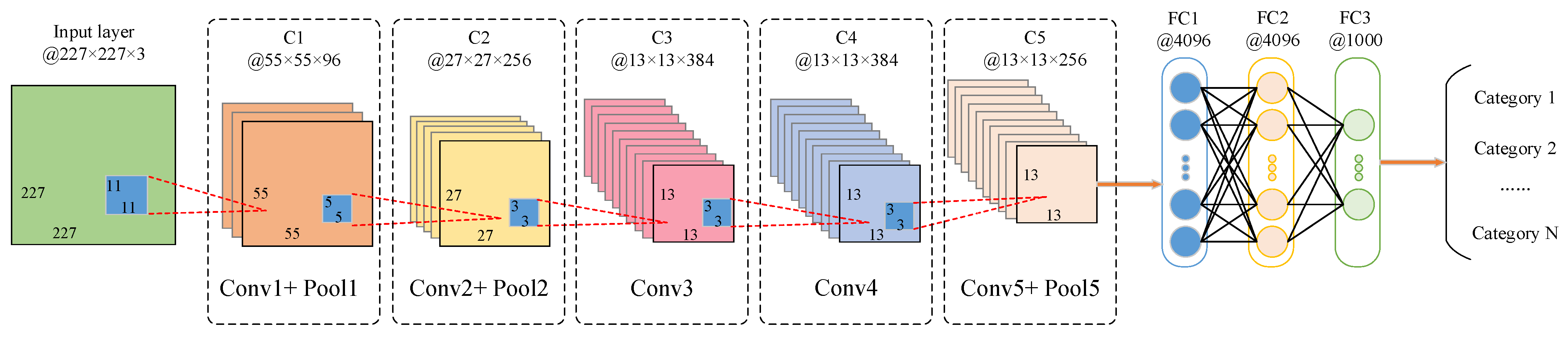
| Convolutional layer 1 | 227 × 227 × 3 | 55 × 55 × 96 | ReLU |
| Pooling layer 1 | 55 × 55 × 96 | 27 × 27 × 96 | / |
| Convolutional layer 2 | 27 × 27 × 96 | 27 × 27 × 256 | ReLU |
| Pooling layer 2 | 27 × 27 × 256 | 13 × 13 × 256 | / |
| Convolutional layer 3 | 13 × 13 × 256 | 13 × 13 × 384 | ReLU |
| Convolutional layer 4 | 13 × 13 × 384 | 13 × 13 × 384 | ReLU |
| Convolutional layer 5 | 13 × 13 × 384 | 13 × 13 × 256 | ReLU |
| Pooling layer 5 | 13 × 13 × 256 | 6 × 6 × 256 | / |
| Fully connected layer 1 | 6 × 6 × 256 | 512 | ReLU |
| Fully connected layer 2 | 512 | 256 | ReLU |
| Fully connected layer 3 | 256 | 4 | / |
| Output layer | / | 4 | / |
| Compression Ratio | Fault State | Total Accuracy | Execution Time | |||
|---|---|---|---|---|---|---|
| Normal Status | Ring Gear Failure | Planet Gear Failure | Sun Gear Failure | |||
| Original data | 100.0% | 100.0% | 100.0% | 100.0% | 100.0% | 1.256 s |
| CR = 0.3 | 100.0% | 100.0% | 100.0% | 100.0% | 100.0% | 1.201 s |
| CR = 0.4 | 100.0% | 94.40% | 100.0% | 100.0% | 98.60% | 1.238 s |
| CR = 0.5 | 100.0% | 91.10% | 100.0% | 100.0% | 97.78% | 1.263 s |
| CR = 0.6 | 94.40% | 47.20% | 77.80% | 100.0% | 79.85% | 1.226 s |
| CR = 0.7 | 66.70% | 13.90% | 0.00% | 100.0% | 45.15% | 1.669 s |
| CR = 0.8 | 2.80% | 0.00% | 0.00% | 100.0% | 25.70% | 1.773 s |
| Fault State | Different Network Models | Traditional Machine Learning | ||||
|---|---|---|---|---|---|---|
| Alexnet | SqueezeNet | ResNet−18 | GoogLeNet | SVM | RF | |
| Normal status | 100.0% | 94.40% | 100.0% | 97.20% | 95.50% | 93.00% |
| Ring gear failure | 91.10% | 91.70% | 8.30% | 55.60% | 86.20% | 82.10% |
| Planet gear failure | 100.0% | 97.20% | 97.20% | 100.0% | 91.70% | 95.50% |
| Sun gear failure | 100.0% | 100.0% | 100.0% | 100.0% | 95.50% | 92.60% |
| Total accuracy | 97.78% | 95.83% | 76.38% | 88.20% | 92.23% | 90.80% |
| Execution time | 1.359 s | 2.265 s | 3.406 s | 2.744 s | 11.037 s | 9.523 s |
| Fault State | Different Network Models | Traditional Machine Learning | ||||
|---|---|---|---|---|---|---|
| Alexnet | SqueezeNet | ResNet−18 | GoogLeNet | SVM | RF | |
| Normal status | 94.40% | 82.10% | 82.10% | 71.40% | 73.50% | 70.20% |
| Ring gear failure | 47.20% | 82.10% | 0.00% | 35.70% | 57.00% | 56.50% |
| Planet gear failure | 77.80% | 39.30% | 75.0% | 96.40% | 52.70% | 64.60% |
| Sun gear failure | 100.0% | 100.0% | 100.0% | 100.0% | 78.20% | 53.00% |
| Total accuracy | 79.85% | 75.89% | 64.28% | 75.89% | 65.35% | 61.08% |
| Execution time | 1.226 s | 2.089 s | 2.452 s | 2.348 s | 10.514 s | 10.171 s |
| Fault State | Different Network Models | Traditional Machine Learning | ||||
|---|---|---|---|---|---|---|
| AlexNet | SqueezeNet | ResNet−18 | GoogLeNet | SVM | RF | |
| Normal status | 28.00% | 69.40% | 35.70% | 82.10% | 33.30% | 28.50% |
| Ring gear failure | 0.00% | 33.30% | 0.00% | 10.70% | 26.50% | 22.00% |
| Planet gear failure | 0.00% | 0.00% | 0.00% | 28.60% | 31.00% | 26.40% |
| Sun gear failure | 100.0% | 100.0% | 100.0% | 100.0% | 24.20% | 21.70% |
| Total accuracy | 25.70% | 50.69% | 33.92% | 55.35% | 28.75% | 24.65% |
| Execution time | 1.773 s | 2.329 s | 4.262 s | 2.634 s | 10.832 s | 9.851 s |
Publisher’s Note: MDPI stays neutral with regard to jurisdictional claims in published maps and institutional affiliations. |
© 2022 by the authors. Licensee MDPI, Basel, Switzerland. This article is an open access article distributed under the terms and conditions of the Creative Commons Attribution (CC BY) license (https://creativecommons.org/licenses/by/4.0/).
Share and Cite
Bai, H.; Yan, H.; Zhan, X.; Wen, L.; Jia, X. Fault Diagnosis Method of Planetary Gearbox Based on Compressed Sensing and Transfer Learning. Electronics 2022, 11, 1708. https://doi.org/10.3390/electronics11111708
Bai H, Yan H, Zhan X, Wen L, Jia X. Fault Diagnosis Method of Planetary Gearbox Based on Compressed Sensing and Transfer Learning. Electronics. 2022; 11(11):1708. https://doi.org/10.3390/electronics11111708
Chicago/Turabian StyleBai, Huajun, Hao Yan, Xianbiao Zhan, Liang Wen, and Xisheng Jia. 2022. "Fault Diagnosis Method of Planetary Gearbox Based on Compressed Sensing and Transfer Learning" Electronics 11, no. 11: 1708. https://doi.org/10.3390/electronics11111708
APA StyleBai, H., Yan, H., Zhan, X., Wen, L., & Jia, X. (2022). Fault Diagnosis Method of Planetary Gearbox Based on Compressed Sensing and Transfer Learning. Electronics, 11(11), 1708. https://doi.org/10.3390/electronics11111708