Article

Clinical and Instrumental Evaluation of a Topical Cream Containing 4% Aliophen® in Women with Facial Skin Aging: A 56-Day Exploratory Open-Label Study


1
Department of Drug Science and Technology, University of Turin, 10125 Turin, Italy
2
Italian Society of Nutraceutical Formulators (SIFNut), 31033 Treviso, Italy
3
National Research Council, Institute of Food Sciences, 83100 Avellino, Italy
4
Clinical Trial Department, Complife Italia S.r.l., 27028 San Martino Siccomario, Italy
*
Authors to whom correspondence should be addressed.
Cosmetics 2026, 13(3), 110; https://doi.org/10.3390/cosmetics13030110
Submission received: 21 March 2026 / Revised: 28 April 2026 / Accepted: 29 April 2026 / Published: 3 May 2026
(This article belongs to the Section Cosmetic Formulations)

Abstract

Background: Facial skin aging is a multifactorial process characterized by wrinkles, pigmentary alterations, reduced elasticity, and dermal structural changes, in which oxidative stress and low-grade inflammation play key roles. Polyphenols have gained interest in cosmetic science due to their antioxidant and skin-protective properties. Objective: We evaluated the antioxidant activity, clinical–instrumental performance, and tolerability of a topical cream containing 4% w/w Aliophen®, a polyphenol-rich malt–hop extract, after 56 days of twice-daily application. Methods: Antioxidant activity was assessed in HaCaT keratinocytes exposed to tert-butyl hydroperoxide (tBHP, 500 μM), with intracellular reactive oxygen species (ROS) measured by DCFH-DA assay after Aliophen® treatment (4–16 mg/mL). A prospective, single-center, open-label study included 20 women aged 45–65 years with facial aging signs. Instrumental assessments included wrinkle depth (PrimosCR SF), pigmentation (ITA°), skin biomechanics (Cutometer® R0, R2), and dermal echogenicity (50 MHz ultrasound) at baseline, Day 28, and Day 56. A small subgroup with mild-to-moderate atopic skin (N = 5) was descriptively monitored using SCORAD. Results: Aliophen® significantly reduced ROS in a dose-dependent manner. Wrinkle depth decreased at Day 28 (−8.1%; p = 0.003) and Day 56 (−15.9%; p < 0.001). ITA° increased (+11.5% and +18.2%; p ≤ 0.003). Skin biomechanics improved (R0 −5.3%; R2 +5.5%; p ≤ 0.004). Dermal echogenicity increased at Day 56 (+1.38; p = 0.002). SCORAD showed descriptive improvement. No serious adverse events occurred. Conclusions: A topical cream containing 4% Aliophen® improved instrumental markers of facial aging with good tolerability, supporting further randomized, vehicle-controlled studies.

1. Introduction

Skin aging represents a complex, multifactorial biological process driven by the interplay of intrinsic factors (chronological aging, hormonal changes, genomic instability, and cellular senescence) and extrinsic stimuli, among which ultraviolet (UV) radiation remains the most relevant and extensively documented environmental determinant of premature skin aging (“photoaging”) [1,2]. Clinically, facial aging is characterized by the progressive development of fine lines and wrinkles, loss of firmness and elasticity, textural irregularities, and pigmentary alterations such as lentigines and uneven skin tone, which collectively compromise perceived facial youthfulness and overall skin quality [3].
At the histological level, these visible changes reflect progressive alterations in the dermal extracellular matrix (ECM), including collagen fragmentation, elastin disorganization, and impaired epidermal–dermal communication [4]. Chronic UV exposure plays a central role in this process by promoting oxidative stress and activating stress-responsive pathways such as AP-1 and NF-κB, which in turn increase matrix metalloproteinase (MMP) expression and accelerate dermal structural deterioration. In parallel, senescent keratinocytes and fibroblasts contribute to a chronic low-grade inflammatory microenvironment through the senescence-associated secretory phenotype (SASP), further amplifying ECM degradation and functional decline [4].
Because skin aging is a multifactorial process that involves not only wrinkle formation and pigmentary alterations, but also biomechanical decline, dermal remodeling, and low-grade inflammatory dysregulation, the efficacy of cosmetic products should ideally be assessed through objective and complementary instrumental methods, rather than relying on subjective evaluation alone [5,6]. In this context, three-dimensional optical profilometry enables quantitative characterization of wrinkle morphology, reflectance colorimetry provides reproducible assessment of pigmentation changes, cutometry captures treatment-related modifications in skin biomechanical behavior, and high-frequency ultrasound provides additional insight into deeper dermal structural features. The combined use of these non-invasive techniques allows a more robust, mechanistically informative, and clinically meaningful evaluation of treatment-related changes in aging and inflammation-prone skin phenotypes [7].
Polyphenols have attracted increasing interest in dermocosmetic research because of their antioxidant, anti-inflammatory, and photoprotective properties [8]. Experimental studies have shown that several polyphenols can reduce reactive oxygen species (ROS) generation, modulate inflammatory signalling, inhibit MMP activity, support collagen homeostasis, and interfere with melanogenesis-related pathways [9,10]. Consistent with these mechanisms, recent clinical studies have reported beneficial effects of topical polyphenol-based formulations on wrinkles, elasticity, pigmentation-related parameters, and dermal ultrasound features [11,12]. However, the available evidence remains heterogeneous, and limited clinical–instrumental data are available for topical formulations based on malt–hop-derived polyphenol complexes evaluated through a multidimensional instrumental approach.
Aliophen® is a proprietary polyphenol-rich formulation obtained from unfermented malts and hops through a patented process designed to preserve the native phenolic fraction of the raw materials. Its chemical characterization confirms the presence of various phenolic acids and flavonoid-related compounds, supporting its biological plausibility as an antioxidant and redox-modulating formulation [13]. Oxidative stress and chronic low-grade inflammation are central, interconnected mechanisms underlying both intrinsic aging and photoaging, leading to extracellular matrix degradation, impaired barrier function, loss of elasticity, wrinkle formation, and pigmentary changes. Within this framework, preclinical evidence indicates that Aliophen® can enhance antioxidant defenses and modulate redox-sensitive pathways [13].
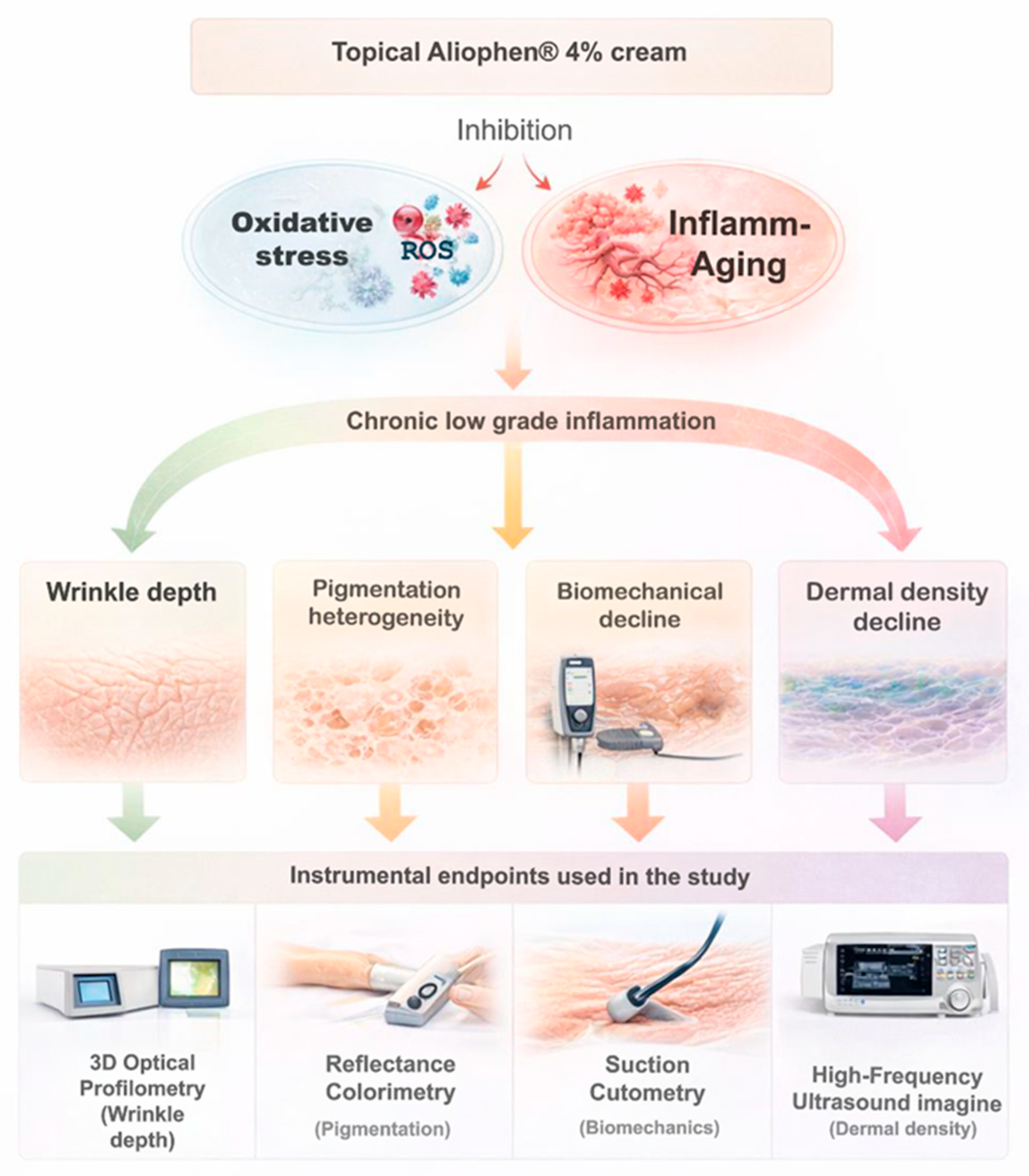
On this basis, a topical cosmetic formulation containing 4% w/w Aliophen®, namely MěiLùx Intensive Restoring Cream, was hypothesized to foster a more favorable cutaneous microenvironment and to improve multiple aspects of facial skin aging and overall skin quality. Accordingly, a 56-day prospective home-use study was conducted to assess the clinical–instrumental performance and tolerability of MěiLùx Intensive Restoring Cream. A standardized panel of non-invasive techniques was employed, including wrinkle profilometry, reflectance colorimetry, cutometric biomechanical analysis, and high-frequency ultrasound imaging, to quantify changes in crow’s feet wrinkle depth, pigmentary spot appearance, skin viscoelastic properties, and dermal density (Figure 1). To our knowledge, this represents one of the few exploratory investigations of a malt–hop polyphenol-based topical formulation integrating assessments of both surface and deeper skin aging parameters.

2. Materials and Methods

2.1. Materials

Aliophen® was kindly provided by Aliopharm Srl (Milan, Italy). The investigational product, MěiLùx Intensive Restoring Cream (Body, Face, Hand), containing 4% w/w Aliophen®, was supplied as a finished formulation and used without modifications. Unless otherwise stated, all reagents employed in the present study were of pure analytical grade.

2.2. Polyphenols Content and Antioxidant Capacity

The total polyphenols content of the fraction was determined using the Folin–Ciocâlteu [14] procedure. Briefly, 1 μL of the sample was mixed with an aqueous solution containing Folin–Ciocâlteu phenol reagent (5%) (Merck-Sigma/Aldrich, Milan, Italy) and sodium carbonate 20% in water (10%). The mixture was incubated for 2 h at room temperature. Absorbance was measured at 760 nm using a microplate reader (Synergy HT BioTek Milan, Italy) and results were expressed as quercetin equivalents (EqQ). All measurements were performed in quadruplicate and normalized as milligrams of EqQ per gram of dry weight.
To evaluate the antioxidant power, a FRAP (Ferric Reducing Antioxidant Power) assay was performed as described by Benzie and Strain [15]. Two microlitres of the sample were added to a mixture of acetate buffer pH 3.5, 10% ferric chloride (20 mM) (Merck-Sigma/Aldrich) and 10% 2,4,6-Tris(2-pyridyl)-s-triazine (TPTZ) (20 mM) (Merck-Sigma/Aldrich). The multiwell plate is then incubated at 37 °C for 6 min and the absorbances read at 593 nm using a microplate reader. After the kinetics have been determined, the absorbance values obtained were normalised to the equivalent ferrous (II) ion concentration, which is obtained using a ferrous (II) sulphate standard curve. All measurements were carried out in quadruplicate and normalised as milligram equivalents of Fe++ per gram of dry weight.

2.3. Cell Culture and Cell Viability

The HaCaT human keratinocyte cell line [16] was cultured in Dulbecco’s Modified Eagle’s Medium (DMEM) supplemented with 10% foetal bovine serum (FBS), 1% L-glutamine, 1% penicillin, 1% streptomycin and 1% non-essential amino acids (Euroclone, Pero, MI, Italy) at 37 °C in a humidified atmosphere containing 5% CO2.
Cells were plated in 96-well plates at the density of 2 × 10⁴ and incubated for 24 h to allow adhesion. Treatments were performed by incubating the HaCaT cells for 24 h in a medium in the presence of the indicate concentrations of Aliophen®. Cell viability was assessed by the Crystal Violet method [17]. Briefly, cell culture medium was eliminated followed by a washing in PBS (Phosphate Buffer Saline solution; Euroclone). Cell was fixed by the addition of 10% formalin in PBS for 15 min. Finally, Crystal Violet 0.02% (w/v) (Merck-Sigma/Aldrich) in an aqueous solution was incubated for 30 min before dye removal. Quantification was carried out by adding a 10% (v/v) acetic acid solution to solubilize the dye incorporated within the cells followed by a spectrophotometric reading at a wavelength of 595 nm using a microplate reader (Synergy HT BioTek). The results were expressed as a percentage of the absorbance relative to the untreated control.

2.4. Intracellular Oxidative Stress Measurement

HaCaT cells [16] were plated at a density of 2 × 10⁴ cells per well in 96-well plates. The cells were then incubated with 10 µM of 2′,7′-dichlorofluorescein diacetate (DCFH-DA) (Invitrogen/Thermo Fisher Scientific, Milan, Italy), a ROS-sensitive probe, for 30 min. Cells were subsequently stimulated with Aliophen® at the indicated concentrations for additional 30 min. After incubation, the cells were treated with tBHP (tert-butyl hydroperoxide) (Merck-Sigma/Aldrich), which induces an oxidative insult. The fluorescence was then determined by a multiplate reader (Synergy HT BioTek) using an excitation and emission setting of 485 nm and 530 nm and expressed as a percentage of fluorescence relative to the untreated control.

2.5. Product Testing and Quality Control

MěiLùx Intensive Restoring Cream was supplied as a finished formulation and used without modification. According to the available pre-study documentation, the finished product had successfully undergone comprehensive standard physicochemical, microbiological, stability, and skin compatibility testing conducted by the manufacturer prior to its clinical use. These assessments were intended to confirm product conformity with predefined quality and safety specifications under conditions relevant to cosmetic use. Documentation of these pre-study evaluations was reviewed before study initiation.

2.6. Study Design and Procedures

2.6.1. Study Design and Participants

This prospective, single-centre, open-label home-use study was designed to investigate the clinical and instrumental efficacy, as well as the tolerability, of a topical restorative cream (MěiLùx) applied over 56 consecutive days. The study was conducted in accordance with the principles of the Declaration of Helsinki, and written informed consent was obtained from all participants prior to enrolment.
A total of 25 female Caucasian subjects were enrolled and assigned to two groups according to predefined inclusion criteria:
(i) Antiaging group (Group 1, N = 20): women aged 45–65 years showing visible signs of facial aging, including crow’s feet wrinkles and reduced skin firmness/elasticity, and presenting at least one hyperpigmented spot suitable for objective colorimetric evaluation.
(ii) Inflammation-prone skin group (Group 2, N = 5): women aged ≥18 years with mild-to-moderate atopic dermatitis, defined by a baseline SCORAD score between 15 and 40.
Exclusion criteria included pregnancy or lactation, known hypersensitivity to product ingredients, active dermatological conditions potentially interfering with study endpoints (except atopic dermatitis in Group 2), use of topical/systemic treatments affecting skin inflammation or appearance within a predefined wash-out period, and excessive UV exposure or use of tanning devices during the study period.
Clinical and instrumental assessments were scheduled at baseline (T0), Day 28 (T28), and Day 56 (T56), according to endpoint-specific procedures.

2.6.2. Treatment

All participants were instructed to apply MěiLùx Intensive Restoring Cream (Body, Face, Hand) formulated with 4% w/w Aliophen® to the designated skin areas under real-life conditions for 56 consecutive days. Product application was performed on clean, dry skin, gently massaging until full absorption, according to manufacturer instructions. Participants applied the product twice daily (morning and evening) using a standardized dosing scheme based on the airless pump dispenser (one pump per application for the face; additional pumps were allowed for hands and body areas as needed to ensure uniform coverage; 1 pump ≈ 0.15 mL).
Participants were asked to avoid introducing new topical products with potential antiaging, depigmenting, anti-inflammatory, or barrier-enhancing activity on the treated areas throughout the study. Compliance was assessed by subject interview and diary review at follow-up visits.

2.6.3. Assessment of Efficacy

Efficacy of MěiLùx Intensive Restoring Cream was evaluated through a predefined panel of objective clinical–instrumental endpoints designed to capture the multidimensional nature of skin aging and skin quality changes over time. In the antiaging group, periocular wrinkle morphology was quantified on the crow’s feet region by three-dimensional optical profilometry using a structured-light projection system (PrimosCR SF, Canfield Scientific Europe, Utrecht, The Netherlands), which provides non-contact in vivo reconstruction of skin microrelief and enables standardized longitudinal assessment of wrinkle depth under controlled acquisition conditions [18]. In parallel, pigmentary alterations were objectively assessed on predefined hyperpigmented spots by reflectance colorimetry (CM-700d, Konica Minolta, Tokyo, Japan), with color coordinates acquired in the CIE Lab* color space and converted into Individual Typology Angle (ITA°) values, a validated and operator-independent metric to quantify pigmentation intensity and its modulation over time [19]. Skin biomechanical behaviour was further evaluated at baseline (T0), day 28 (T28), and day 56 (T56) by suction-based cutometry (Cutometer® Dual MPA 580, Courage + Khazaka Electronic GmbH, Cologne, Germany), recording R0 (skin distensibility/firmness-related parameter) and R2 (overall elasticity; Ua/Uf), which are widely adopted for quantifying treatment-related changes in viscoelastic performance in aging skin [7,20]. To complement surface and biomechanical measurements with deeper structural information, dermal density (epidermis + dermis) was assessed by high-frequency ultrasound imaging (DUB® SkinScanner, 50 MHz) at baseline and end of study (T0 and T56), providing a non-invasive proxy of dermal echogenicity potentially reflecting changes in tissue architecture and age-related structural alterations [21,22]. Finally, in the exploratory inflammation-prone subgroup, atopic dermatitis severity was monitored using the SCORAD index (European Task Force on Atopic Dermatitis) at T0, T28, and T56; given the limited sample size, these outcomes were predefined as descriptive only and were not intended for confirmatory efficacy inference [23].

2.6.4. Assessment of Safety and Tolerability

Safety and local tolerability were evaluated throughout the study period by combining investigator-led clinical assessments with participant-reported symptoms, in order to capture both objective and subjective manifestations potentially associated with topical product use. At each scheduled visit (T0, T28, and T56), the treated skin areas were examined by trained personnel for the occurrence of any visible signs of local intolerance, including erythema, oedema, dryness, desquamation, and other clinically relevant reactions. In parallel, participants were specifically interviewed regarding the presence of unpleasant cutaneous sensations such as burning, stinging, itching, tightness, or discomfort occurring during daily application, and the intensity of these symptoms was documented using standardized grading scales when applicable. All adverse events (AEs), whether spontaneously reported by the subject or observed by the investigator, were recorded and classified in terms of onset, duration, severity, and relationship to the MěiLùx Intensive Restoring Cream. Participants were instructed to promptly report any unexpected reactions between visits, and appropriate clinical management was provided whenever required. In case of clinically significant intolerance or worsening of skin condition, temporary interruption or discontinuation of treatment was allowed at the investigator’s discretion in order to ensure participant safety. Finally, overall product acceptability and perceived tolerability were collected at study end to provide a complementary, patient-centered perspective on real-life product use.

2.7. Statistical Analysis

The clinical study was conceived as an exploratory, proof-of-concept cosmetic investigation primarily aimed at detecting within-subject changes over time rather than estimating population-level effects. Accordingly, no formal sample size calculation was performed. The sample size was selected on a feasibility basis, taking into account the exploratory design and the use of instrumental endpoints commonly adopted in pilot cosmetic studies [24].
Statistical analyses for the clinical study were performed using GraphPad Prism version 8.0. Continuous variables were expressed as mean ± standard deviation (SD). Normality of within-subject changes versus baseline was assessed using the Shapiro–Wilk test. Wrinkle depth, ITA°, R0, R2, and dermal density were analyzed by paired Student’s t-test versus baseline, as normality assumptions were considered acceptable for these comparisons. All tests were two-sided, and a p-value < 0.05 was considered statistically significant. Percentage changes were expressed as mean relative differences versus baseline values. For the main repeated instrumental outcomes, 95% confidence intervals (CI) were calculated for the mean change versus baseline; for wrinkle depth, ITA°, R0, and R2 these are presented as mean relative changes, whereas for dermal density the 95% CI refers to the absolute mean change from T0 to T56. Given the exploratory nature of the inflammation-prone subgroup and its very limited sample size, SCORAD outcomes were summarized descriptively only. No formal correction for multiple comparisons was applied.
For the in vitro experiments, results are presented as mean ± SD from three independent experiments. Statistical analyses were performed using GraphPad Prism version 9.5.1 (GraphPad Software, San Diego, CA, USA). Differences among groups were evaluated by one-way analysis of variance (ANOVA), followed by Tukey’s multiple comparisons test. A p-value < 0.05 was considered statistically significant. Significance levels are indicated in the figure legends as follows: * p < 0.05, ** p < 0.01, *** p < 0.001, and **** p < 0.0001.

3. Results

3.1. Polyphenolic Content and Antioxidant Capacity of Aliophen®

The total phenolic content of the Aliophen® formulation, quantified using the Folin–Ciocalteu method, was measured at 3.6 ± 0.15 mg EqQ/g dry weight, a value consistent with the original characterization reported by Tedesco et al. [13]. As expected, this phenolic profile aligned with the antioxidant performance of the formulation. In vitro antioxidant capacity, assessed through the FRAP assay, yielded a value of 6.79 ± 0.55 mg Fe++/g dry weight, which falls within the same range observed across multiple Aliophen® batches produced over recent years. These findings confirm the chemical stability of the formulation and reinforce the relationship between its polyphenol content and its overall antioxidant efficacy.

3.2. Aliophen® Exerts Antioxidant Activity on HaCaT Cells

To investigate the potential effects of Aliophen® on skin cells, the immortalized human keratinocyte cell line HaCaT was employed. This cell line is widely recognized as a robust and reliable in vitro model for investigating epidermal biology and for the screening of dermo-cosmetic active ingredients [16,25]. Keratinocytes represent the predominant cell type of epidermis and play a pivotal role in maintaining cutaneous homeostasis, epidermal barrier integrity, and cellular responses to environmental stressors.
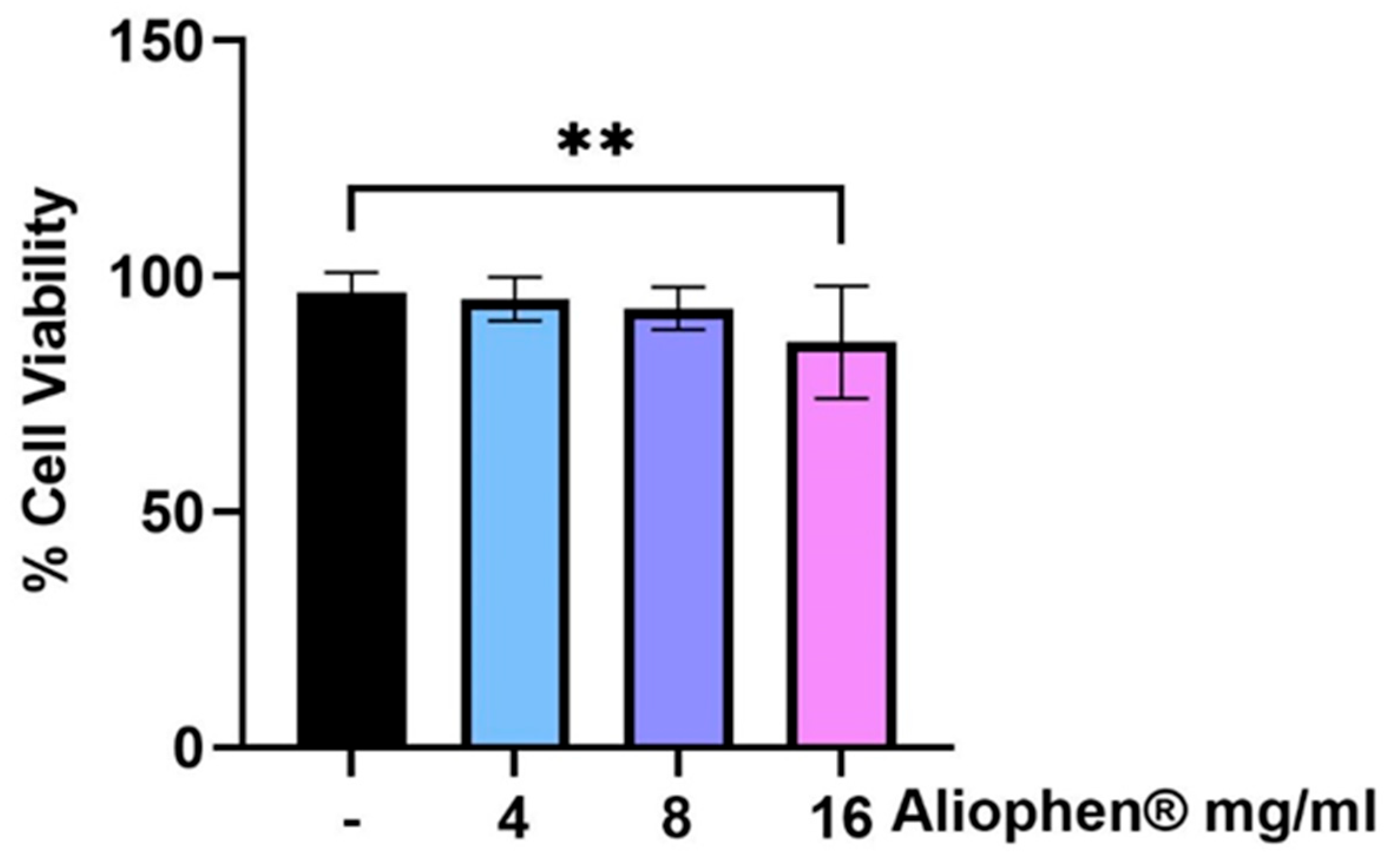
As an initial step, the cytocompatibility of Aliophen® was evaluated in HaCaT cells. As shown in Figure 2, treatment with Aliophen® did not induce cytotoxic effects at the tested concentrations of 4–8 mg/mL. Cell viability, assessed by Crystal Violet staining after 24 h of treatment, remained comparable to that of untreated controls, indicating that the formulation is well tolerated by epidermal cells. Only at the highest concentration applied, 16 mg/mL, a slight reduction in cell viability, lower than 18%, was measured.
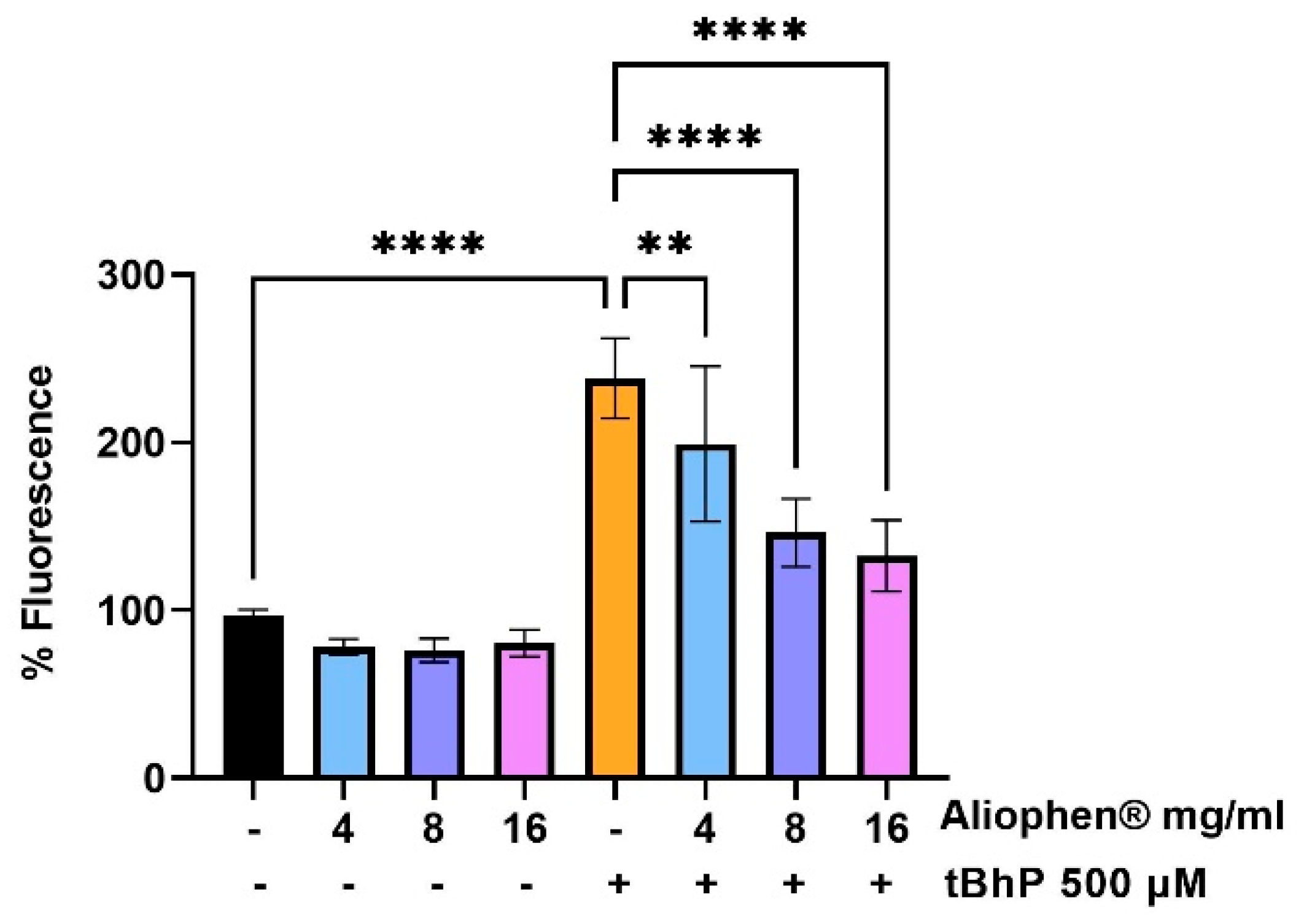
To assess the antioxidant potential of Aliophen®, cells were pre-incubated with the formulation at a concentration of 4–16 mg/mL and subsequently with the pro-oxidant tBHP. Intracellular ROS production was quantified using the DCF-DA fluorescent probe. The indicated concentrations were selected considering that, in the final MěiLùx cream, Aliophen® represents 4% w/w, and that a standard 100 mL body cream weighs approximately 96 g [26]. Therefore, the Aliophen® concentrations applied in our cellular assays remained within the range of those employed in the clinical test. The results demonstrated that Aliophen® markedly and dose dependently attenuated the tBHP-induced oxidative burst (Figure 3), leading to a significant reduction in intracellular peroxide levels. These findings indicate that Aliophen® enhances the redox resilience of keratinocytes and contributes to cellular protection against oxidative stress.

3.3. Results from In Vivo Study

A total of 25 female Caucasian subjects were enrolled and completed the study procedures according to endpoint-specific schedules. Participants were allocated to two predefined groups (Table 1): the antiaging group (Group 1; N = 20, age range 45–65 years) and an exploratory inflammation-prone subgroup with mild-to-moderate atopic dermatitis (Group 2; N = 5, age ≥18 years; baseline SCORAD 15–40). Instrumental efficacy analyses were performed in Group 1, while outcomes in Group 2 were interpreted descriptively due to limited sample size.

3.3.1. Antiaging Group

As shown in Table 2, statistically significant improvements versus baseline were observed across all instrumental endpoints, with progressive effects over the 56-day treatment period.
Periocular Wrinkle Depth (Crow’s Feet)
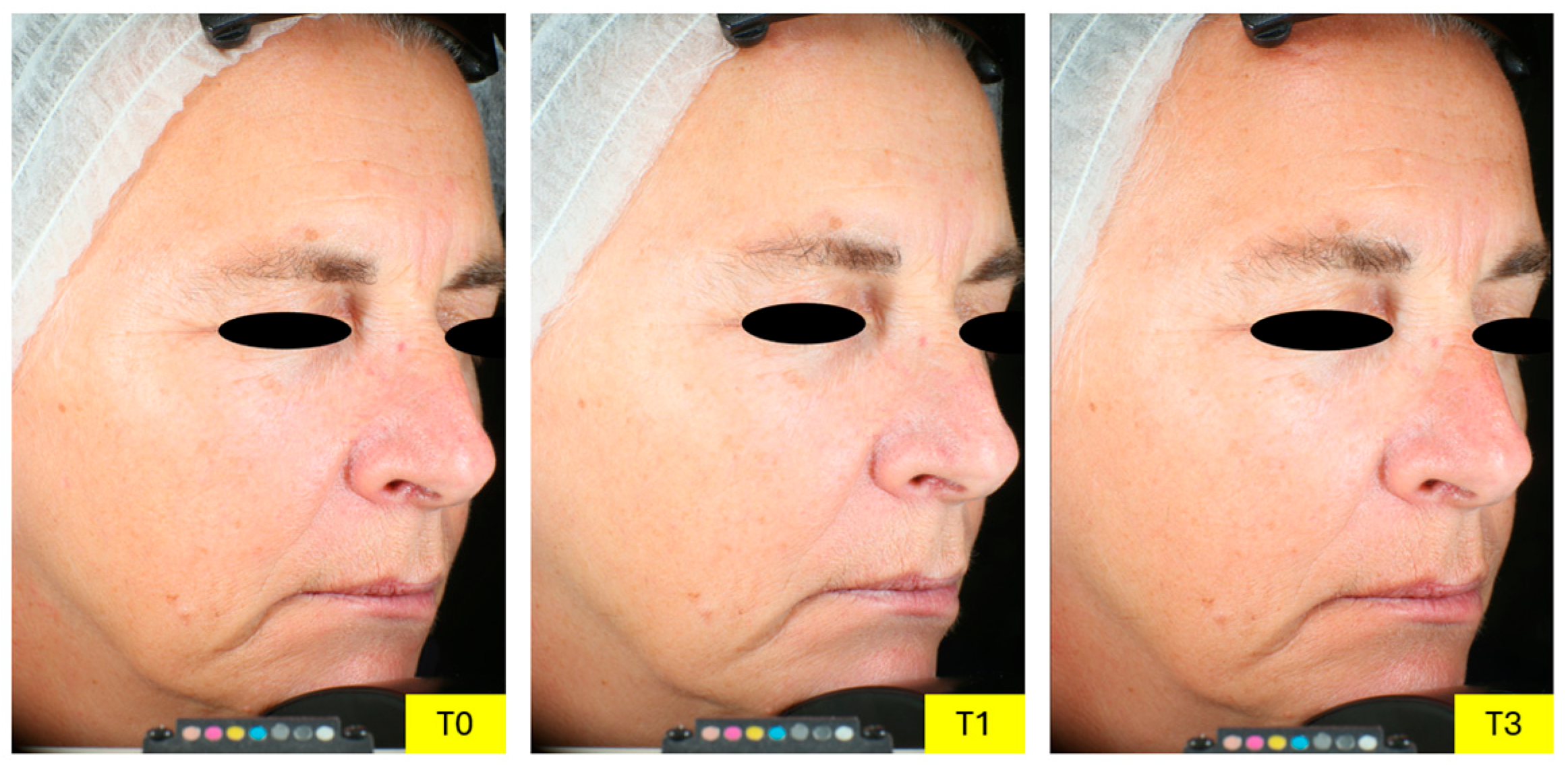
Three-dimensional optical profilometry demonstrated a progressive reduction in crow’s feet wrinkle depth over the 56-day period. Mean wrinkle depth decreased from 322.3 ± 88.7 µm at baseline to 295.6 ± 83.7 µm at day 28 (−8.1% vs. baseline; p = 0.003) and further improved to 272.6 ± 84.7 µm at day 56 (−15.9% vs. baseline; p < 0.001), indicating a time-dependent improvement in periocular wrinkle severity with sustained topical use. Consistent with instrumental profilometry, representative clinical photographs showed a visible reduction in periocular wrinkle appearance over time (Figure 4).
Hyperpigmented Spots (ITA°)
Reflectance colorimetry revealed a significant improvement in the pigmentation profile of predefined hyperpigmented spots, expressed as ITA° values. ITA° increased from 21.29 ± 9.72° at baseline to 22.99 ± 9.09° at Day 28 (+11.5%; p = 0.003) and further increased to 23.87 ± 8.66° at Day 56 (+18.2%; p < 0.001), indicating a progressive lightening of dark spots over time.
Skin Biomechanical Properties (R0/R2)
Cutometric assessment documented significant improvements in biomechanical parameters during treatment. The firmness-related parameter R0 decreased from 0.453 ± 0.041 at baseline to 0.438 ± 0.040 at Day 28 (−3.1%; p = 0.038) and to 0.428 ± 0.041 at Day 56 (−5.3%; p = 0.004), suggesting a measurable increase in skin firmness. In parallel, global elasticity (R2) increased from 0.607 ± 0.039 at baseline to 0.636 ± 0.049 at Day 28 (+5.0%; p = 0.001) and to 0.640 ± 0.045 at Day 56 (+5.5%; p < 0.001), supporting a consistent improvement in viscoelastic recovery.
Dermal Density (High-Frequency Ultrasound)
High-frequency ultrasound imaging showed a statistically significant increase in dermal density at study end. Dermal density increased from 17.01 ± 2.64 at baseline to 18.40 ± 2.58 at Day 56, corresponding to an absolute change of +1.38 from baseline (p = 0.002).

3.3.2. Exploratory Inflammation-Prone Subgroup

In the atopic dermatitis subgroup, SCORAD showed a modest numerical reduction from baseline to follow-up (24.1 at baseline to 23.0 at day 28 and 21.3 at day 56). Due to the small sample size and exploratory design, these findings were summarized descriptively and should be interpreted as a preliminary signal rather than confirmatory evidence of clinical efficacy.

3.3.3. Safety and Tolerability

Topical use of the investigational product was overall well tolerated (Table 3). No serious adverse events were reported, and no clinically meaningful treatment-related intolerance was observed, supporting a favourable skin compatibility profile under real-life home-use conditions.

4. Discussion

This prospective clinical–instrumental study suggests that twice-daily application of a topical restorative cream formulated with 4% w/w Aliophen® may provide measurable benefits across multiple dimensions of facial skin aging and skin quality, as quantified by objective endpoints. Over the 56-day period, significant improvements were observed in periocular wrinkle depth, pigmentation of hyperpigmented spots, biomechanical properties including firmness and elasticity, as well as ultrasound-derived dermal density. Collectively, these findings support the concept that a nutraceutical-based topical strategy may exert pleiotropic effects relevant to both surface microrelief and deeper structural/functional features of aging skin.
A key aspect of the present results is the progressive time-dependent trajectory, with early improvements detected at Day 28 and further enhancement by Day 56, which is consistent with the kinetics typically observed in topical antiaging interventions where cumulative barrier reinforcement, oxidative stress attenuation, and gradual modulation of dermal microenvironment may contribute to sustained clinical–instrumental changes. Similar effects have been reported in clinical cosmetic studies testing polyphenol-rich botanical formulations, where instrumental assessments documented concurrent improvements in wrinkle-related parameters, pigmentation indices, and skin biomechanical properties [27]. More specifically, the present findings are consistent with previous human studies investigating topical polyphenol-based skin care interventions. In a 12-week clinical study, a nighttime antioxidant formulation containing resveratrol, baicalin, and vitamin E significantly improved fine lines and wrinkles, skin firmness, elasticity, laxity, hyperpigmentation, radiance, and roughness, while ultrasound measurements showed an average 18.9% increase in periorbital dermal thickness, suggesting remodeling of deeper skin compartments [12]. Likewise, an 8-week clinical–instrumental study of a 2% resveratrol emulsion documented significant reductions in skin roughness together with improvements in Cutometer-derived firmness/elasticity parameters and a trend toward increased ultrasound skin density [11]. These observations are relevant because they are consistent with the pattern observed in the present trial, in which wrinkle depth, pigmentation, biomechanical performance, and ultrasound-derived dermal density changed in parallel, suggesting that topical polyphenols may affect both superficial and deeper features of skin aging.
Comparable, although not identical, trajectories have also been described with other phenolic antioxidants. In a clinical study of ferulic acid combined with vitamins C and E, significant improvements in skin texture, firmness, and smoothness were already evident after 4 weeks, whereas improvement in fine lines became apparent by 8 weeks and profilometric wrinkle changes were confirmed later during follow-up [28]. This progressive pattern is coherent with the time-dependent kinetics observed in our study. At the same time, not all polyphenol-based interventions produce rapid visible changes: in a double-blind placebo-controlled trial, combined topical and oral green tea extracts improved histologic elastic tissue content but did not yield clearly detectable short-term clinical superiority after 8 weeks, indicating that efficacy may depend substantially on formulation strategy, active concentration, skin penetration, and treatment duration [29]. More broadly, a recent systematic review and meta-analysis of topical plant-based anti-aging products found overall improvements in elasticity, hydration, melanin, and erythema, supporting the biological plausibility of the present results while also underscoring the persistent heterogeneity of the available evidence base [30].
In our study, the improvement in hyperpigmented spots (ITA°) is particularly relevant because pigmentary heterogeneity is a major contributor to perceived age and overall facial “skin quality”. From a mechanistic standpoint, hops-derived polyphenols have been associated with pathways potentially relevant to dyschromia, including anti-oxidative and melanogenesis-modulating effects. Notably, flavonoids from Humulus lupulus have been shown to interfere with pigmentation biology in cellular models, supporting its conceptual relevance for cosmetic lightening strategies [31]. Although the effects observed in the current study cannot be directly attributed to a single compound, the present colorimetric signal is consistent with the hypothesis that malt- and hop-derived phenolic compounds may contribute to the modulation of pigmentation intensity through multiple biological pathways.
In parallel, biomechanical outcomes (R0 and R2) suggest that the treatment not only improved the appearance of wrinkles but also influenced functional the mechanical properties of the skin. This is coherent with contemporary models in which the visible phenotype of aging reflects not only extracellular matrix fragmentation but also barrier impairment, oxidative stress, and chronic low-grade inflammatory tone. Recent literature emphasizes the role of polyphenols as multi-target modulators in skin disorders and aging phenotypes, supporting effects on oxidative stress and inflammation-linked pathways that can secondarily influence texture, firmness, and resilience [8].
A major strength of this study is the inclusion of high-frequency ultrasound imaging, which provides insight into deeper tissue parameters beyond surface profilometry. Although ultrasound-derived “density” cannot be considered a direct surrogate of collagen synthesis, it is increasingly used as a non-invasive proxy for dermal echogenicity and structural organization. Changes in this parameter may therefore complement surface microrelief and biomechanical findings. This coherence across multiple endpoints strengthens the overall biological plausibility of the observed effects and reduces the likelihood that results are driven by a single measurement domain.
An exploratory component of the study included a small inflammation-prone subgroup with mild-to-moderate atopic skin. In this exploratory subgroup, SCORAD values showed a modest numerical improvement over time, although the limited sample size and variability preclude any definitive inference on clinical efficacy. While these findings should be interpreted as exploratory, they may be consistent with a potential supportive effect on inflammation-related skin manifestations and warrant further investigation in adequately powered controlled studies.
From an ingredient-science perspective, a critical point is that Aliophen® is not a single isolated molecule, but a complex botanical-derived formulation originating from malts and hops. This has implications for interpretation: rather than attributing efficacy to one “hero ingredient”, it is plausible that the entire phytocomplex contributes through additive and/or synergistic interactions among multiple phenolic acids and flavonoid compounds with complementary redox-modulating activities, as suggested by data presented in Figure 3. This “phytocomplex effect” is consistent with modern pharmacognosy and cosmetic science, where complex extracts may exhibit broader activity profiles than isolated constituents, particularly for multifactorial phenotypes such as photoaging. Within this framework, Aliophen® may be regarded as a multi-target ingredient with the potential to act on oxidative stress-related pathways involved in extracellular matrix integrity, pigmentation signalling, and barrier homeostasis [13]. To support this view, it is worthwhile to note that some of the compounds identified in Aliophen® [13], such as protocatechuic acid, vanillic acid, catechin, chlorogenic acid, caffeic acid, p-coumaric acid, sinapic acid, ferulic acid show meaningful skin anti-aging activity. More in details, protocatechuic acid is one of the best-documented: it increases type I collagen, inhibits MMP-1, and reduces wrinkle severity in vivo, confirming its anti-wrinkle and antioxidant efficacy. Protocatechuic acid derivatives further contribute antioxidant and skin-brightening effects by reducing oxidative stress and melanogenesis in skin cells [32,33]. Vanillic acid supports anti-aging mainly through antioxidant protection, helping defend skin from UV-induced oxidative damage and improving overall skin texture and resilience. Its presence in vanilla essential oil is also linked to decreased wrinkle depth and improved skin appearance in clinical observations [34]. Among flavonoids, catechins (including catechin and epicatechin) show strong antioxidant, anti-inflammatory, and UV-protective benefits, helping preserve collagen and reduce signs of aging. Epicatechin specifically boosts COL1A1 and FGF-2 while reducing MMP-1 and oxidative damage in UV-induced fibroblasts, underscoring its anti-aging potential [35]. Chlorogenic acid demonstrates robust anti-photoaging activity by increasing collagen I, reducing MMP-1/MMP-3, lowering ROS, and protecting fibroblasts from UVA-induced DNA damage and apoptosis. It also reduces UV-induced inflammation and supports extracellular matrix integrity [36]. Caffeic acid acts as a powerful antioxidant that protects collagen and elastin, stimulates collagen synthesis, suppresses MMP activity, calms inflammation, and brightens skin, contributing meaningfully to anti-aging effects [37,38]. p-Coumaric acid offers antioxidant and anti-inflammatory benefits and demonstrates clear protective action in human skin, where it significantly reduces UV-induced erythema and pigmentation, mechanisms closely tied to photoaging reduction [39]. Sinapic acid also exhibits notable anti-aging promise: it protects against UV-induced damage, reduces ROS, and decreases pro-inflammatory cytokines in keratinocytes, confirming both antioxidant and anti-inflammatory activity relevant to wrinkle prevention [40]. Finally, ferulic acid, especially when delivered through optimized nanocarriers, penetrates the skin effectively and provides strong antioxidant and anti-wrinkle benefits, making it a well-established anti-aging ingredient in modern skincare [41]. Overall, the phenolic acids and flavonoid-related compounds identified in Aliophen® provide a strong biological rationale for the observed clinical–instrumental improvements, supporting the potential of the finished topical formulation containing 4% w/w Aliophen® as a multi-target cosmetic approach capable of improving wrinkles, pigmentation heterogeneity, biomechanical performance, and ultrasound-derived dermal features. The overall phytocomplex of malt- and hop-derived compounds may plausibly contribute to these effects through convergent antioxidant, anti-inflammatory, extracellular matrix-protective, and pigmentation-modulating pathways. However, further studies are required to establish a definitive cause–effect relationship between the active concentrations of these compounds in MěiLùx Intensive Restoring Cream and the anti-aging effects observed in the present study.

Study Limitations

Several limitations should be acknowledged. First, this was a single-centre, open-label exploratory study with a relatively small sample size, which limits the strength of causal inference and may introduce observer- or participant-related bias. The absence of a randomized, double-blind, vehicle-controlled comparator also prevents definitive attribution of the observed effects specifically to Aliophen® 4%, since improvements may have been partially influenced by the vehicle, emollient effects, regular skincare application, or contextual factors. Second, the study population was restricted to female Caucasian participants, mainly within a defined age range for the antiaging cohort, thereby limiting the generalizability of the findings to other sexes, ethnicities, skin phototypes, age groups, and clinical phenotypes. Third, although the instrumental panel provided objective and complementary assessments of skin aging, each apparatus has inherent methodological constraints. Three-dimensional profilometry, colorimetry, cutometry, and high-frequency ultrasound are sensitive to acquisition conditions, anatomical repositioning, hydration status, environmental parameters, and operator-dependent standardization. In particular, ultrasound-derived dermal density or echogenicity should be interpreted as an indirect structural proxy rather than a direct measure of collagen synthesis or dermal remodeling. Finally, mechanistic biomarkers of oxidative stress, inflammation, barrier function, melanogenesis, or extracellular matrix turnover were not assessed in vivo, and the inflammation-prone subgroup was very small and descriptive only. Therefore, the present findings should be considered hypothesis-generating and require confirmation in larger, randomized, double-blind, vehicle-controlled studies with longer follow-up and integrated biomarker analyses.

5. Conclusions

In this 56-day exploratory open-label study, twice-daily application of MěiLùx Intensive Restoring Cream formulated with 4% w/w Aliophen® was associated with significant improvements in objective instrumental markers of facial skin aging in the anti-aging group. Specifically, treatment was associated with progressive reductions in crow’s feet wrinkle depth, improvement in pigmentation-related colorimetric parameters, enhanced skin biomechanical properties, and increased ultrasound-derived dermal echogenicity/density, with overall favourable local tolerability. These findings suggest that a topical formulation containing Aliophen® may exert beneficial effects on multiple and interconnected features of facial skin aging. However, the results should be interpreted in light of the exploratory design, the absence of a vehicle-controlled comparator, and the limited sample size. Future studies should include randomized, double-blind, vehicle-controlled designs, larger and more diverse populations, longer follow-up, and mechanistic assessments aimed at clarifying the contribution of the active formulation to the observed clinical–instrumental effects.

Author Contributions

Conceptualization, A.C. and G.C.; methodology, G.R., E.A., C.S. and G.L.R.; investigation, G.R., E.A., C.S. and G.L.R.; formal analysis, A.C. and G.R.; data curation, G.R.; writing—original draft preparation, A.C.; writing—review and editing, A.C., G.C. and M.P.; supervision, A.C. and G.C.; project administration, A.C. and G.R. All authors have read and agreed to the published version of the manuscript.

Funding

Part of this research was funded by Aliopharm Srl, Milan, Italy, under a contract with the National Research Council, Institute of Food Sciences, 83100 Avellino, Italy.

Institutional Review Board Statement

The study was conducted in accordance with the ethical principles of the Declaration of Helsinki. The investigation involved healthy volunteers and non-invasive procedures using a cosmetic product compliant with Regulation (EC) No 1223/2009. According to applicable regulations for cosmetic product testing, formal Ethics Committee approval was not required.

Informed Consent Statement

Informed consent was obtained from all subjects involved in the study. Written informed consent has been obtained from the patients to publish this paper.

Data Availability Statement

The original contributions presented in this study are included in the article. Further inquiries can be directed to the corresponding authors.

Acknowledgments

G.L.R. and C.S. acknowledge Aliopharm Srl for the financial support. The authors have reviewed and edited the output and take full responsibility for the content of this publication.

Conflicts of Interest

G.L.R. is co-inventor of the patent PCT/IB2018/056283. G.R. is the employee of Complife Italia S.r.l. The funding source from Aliopharm S.r.l. The authors declare that the research was conducted in the absence of any commercial or financial relationships that could be construed as a potential conflict of interest. The funders had no role in the design of the study; in the collection, analyses or interpretation of data; in the writing of the manuscript; or in the decision to publish the results.

References

  1. Naharro-Rodriguez, J.; Bacci, S.; Hernandez-Bule, M.L.; Perez-Gonzalez, A.; Fernandez-Guarino, M. Decoding Skin Aging: A Review of Mechanisms, Markers, and Modern Therapies. Cosmetics 2025, 12, 144. [Google Scholar] [CrossRef]
  2. Shin, S.H.; Lee, Y.H.; Rho, N.K.; Park, K.Y. Skin aging from mechanisms to interventions: Focusing on dermal aging. Front. Physiol. 2023, 14, 1195272. [Google Scholar] [CrossRef]
  3. Chaudhary, M.; Khan, A.; Gupta, M. Skin Ageing: Pathophysiology and Current Market Treatment Approaches. Curr. Aging Sci. 2020, 13, 22–30. [Google Scholar] [CrossRef]
  4. Feng, C.; Chen, X.; Yin, X.; Jiang, Y.; Zhao, C. Matrix Metalloproteinases on Skin Photoaging. J. Cosmet. Dermatol. 2024, 23, 3847–3862. [Google Scholar] [CrossRef] [PubMed]
  5. Fitsiou, E.; Pulido, T.; Campisi, J.; Alimirah, F.; Demaria, M. Cellular Senescence and the Senescence-Associated Secretory Phenotype as Drivers of Skin Photoaging. J. Investig. Dermatol. 2021, 141, 1119–1126. [Google Scholar] [CrossRef]
  6. Salminen, A.; Kaarniranta, K.; Kauppinen, A. Photoaging: UV radiation-induced inflammation and immunosuppression accelerate the aging process in the skin. Inflamm. Res. 2022, 71, 817–831. [Google Scholar] [CrossRef]
  7. Abbas, D.B.; Lavin, C.V.; Fahy, E.J.; Griffin, M.; Guardino, N.; King, M.; Chen, K.; Lorenz, P.H.; Gurtner, G.C.; Longaker, M.T.; et al. Standardizing Dimensionless Cutometer Parameters to Determine In Vivo Elasticity of Human Skin. Adv. Wound Care 2022, 11, 297–310. [Google Scholar] [CrossRef]
  8. Farhan, M. The Promising Role of Polyphenols in Skin Disorders. Molecules 2024, 29, 865. [Google Scholar] [CrossRef]
  9. Bharadvaja, N.; Gautam, S.; Singh, H. Natural polyphenols: A promising bioactive compounds for skin care and cosmetics. Mol. Biol. Rep. 2023, 50, 1817–1828. [Google Scholar] [CrossRef] [PubMed]
  10. Dwevedi, D.; Srivastava, A. Molecular Mechanisms of Polyphenols in Management of Skin Aging. Curr. Aging Sci. 2024, 17, 180–188. [Google Scholar] [CrossRef]
  11. Brinke, A.S.T.; Janssens-Böcker, C.; Kerscher, M. Skin Anti-Aging Benefits of a 2% Resveratrol Emulsion. Cosmet. Dermatol. Sci. Appl. 2021, 11, 155–168. [Google Scholar] [CrossRef]
  12. Farris, P.; Yatskayer, M.; Chen, N.; Krol, Y.; Oresajo, C. Evaluation of efficacy and tolerance of a nighttime topical antioxidant containing resveratrol, baicalin, and vitamin e for treatment of mild to moderately photodamaged skin. J. Drugs Dermatol. 2014, 13, 1467–1472. [Google Scholar]
  13. Tedesco, I.; Spagnuolo, C.; Bilotto, S.; Izzo, A.A.; Borrelli, F.; Rigano, D.; Russo, M.; Tarricone, F.; Russo, G.L. Antioxidant and Chemopreventive Effect of Aliophen® Formulation Based on Malts and Hops. Antioxidants 2020, 10, 29. [Google Scholar] [CrossRef] [PubMed]
  14. Singleton, V.L.; Orthofer, R.; Lamuela-Raventós, R.M. Analysis of Total Phenols and Other Oxidation Substrates and Antioxidants by Means of Folin-Ciocalteu Reagent. Methods Enzymol. 1999, 299, 152–178. [Google Scholar] [CrossRef]
  15. Benzie, I.F.F.; Strain, J.J. The Ferric Reducing Ability of Plasma (FRAP) as a Measure of “Antioxidant Power”: The FRAP Assay. Anal. Biochem. 1996, 239, 70–76. [Google Scholar] [CrossRef]
  16. Boukamp, P.; Petrussevska, R.T.; Breitkreutz, D.; Hornung, J.; Markham, A.; Fusenig, N.E. Normal keratinization in a spontaneously immortalized aneuploid human keratinocyte cell line. J. Cell Biol. 1988, 106, 761–771. [Google Scholar] [CrossRef]
  17. Feoktistova, M.; Geserick, P.; Leverkus, M. Crystal Violet Assay for Determining Viability of Cultured Cells. Cold Spring Harb. Protoc. 2016, 2016, 087379. [Google Scholar] [CrossRef]
  18. Friedman, P.M.; Skover, G.R.; Payonk, G.; Kauvar, A.N.; Geronemus, R.G. 3D in-vivo optical skin imaging for topographical quantitative assessment of non-ablative laser technology. Dermatol. Surg. 2002, 28, 199–204. [Google Scholar] [CrossRef]
  19. Ly, B.C.K.; Dyer, E.B.; Feig, J.L.; Chien, A.L.; Del Bino, S. Research Techniques Made Simple: Cutaneous Colorimetry: A Reliable Technique for Objective Skin Color Measurement. J. Investig. Dermatol. 2020, 140, 3–12.e1. [Google Scholar] [CrossRef]
  20. Kawalkiewicz, W.; Matthews-Kozanecka, M.; Janus-Kubiak, M.; Kubisz, L.; Hojan-Jezierska, D. Instrumental diagnosis of facial skin—A necessity or a pretreatment recommendation in esthetic medicine. J. Cosmet. Dermatol. 2021, 20, 875–883. [Google Scholar] [CrossRef] [PubMed]
  21. Argalia, G.; Reginelli, A.; Molinelli, E.; Russo, A.; Michelucci, A.; Sechi, A.; Marzano, A.V.; Desyatnikova, S.; Fogante, M.; Patanè, V.; et al. High-Frequency and Ultra-High-Frequency Ultrasound in Dermatologic Diseases and Aesthetic Medicine. Medicina 2025, 61, 220. [Google Scholar] [CrossRef]
  22. Czajkowska, J.; Juszczyk, J.; Bugdol, M.N.; Glenc-Ambrozy, M.; Polak, A.; Piejko, L.; Pietka, E. High-frequency ultrasound in anti-aging skin therapy monitoring. Sci. Rep. 2023, 13, 17799. [Google Scholar] [CrossRef]
  23. Schallreuter, K.; Levenig, C.; Berger, J.; Umbert, J.; Winkelmann, R.; Wegener, L.; Correia, O.; Chosidow, O.; Saiag, P.; Bastuji-Garin, S.; et al. Severity scoring of atopic dermatitis: The SCORAD index: Consensus Report of the European Task Force on Atopic Dermatitis. Dermatology 1993, 186, 23–31. [Google Scholar] [CrossRef]
  24. Vitale, M.; Truchuelo, M.T.; Nobile, V.; Gómez-Sánchez, M.J. Clinical Tolerability and Efficacy Establishment of a New Cosmetic Treatment Regimen Intended for Sensitive Skin. Appl. Sci. 2024, 14, 6252. [Google Scholar] [CrossRef]
  25. Jahn, M.; Lang, V.; Diehl, S.; Back, R.; Kaufmann, R.; Fauth, T.; Buerger, C. Different immortalized keratinocyte cell lines display distinct capabilities to differentiate and reconstitute an epidermis in vitro. Exp. Dermatol. 2024, 33, e14985. [Google Scholar] [CrossRef]
  26. AOAC. Official Methods of Analysis, 15th ed.; AOAC: Arlington, VA, USA, 1990. [Google Scholar]
  27. Binic, I.; Lazarevic, V.; Ljubenovic, M.; Mojsa, J.; Sokolovic, D. Skin ageing: Natural weapons and strategies. Evid. Based Complement. Altern. Med. 2013, 2013, 827248. [Google Scholar] [CrossRef]
  28. Draelos, Z.D.; Yatskayer, M.; Oresajo, C.; Fares, H.; Hansenne, I. Efficacy of Ferulic Acid in Improving the Appearance of Photoaged Skin. Cosmet. Dermatol. 2008, 21, 195–198. [Google Scholar]
  29. Chiu, A.E.; Chan, J.L.; Kern, D.G.; Kohler, S.; Rehmus, W.E.; Kimball, A.B. Double-blinded, placebo-controlled trial of green tea extracts in the clinical and histologic appearance of photoaging skin. Dermatol. Surg. 2005, 31, 855–860; discussion 860. [Google Scholar] [CrossRef]
  30. Cheng, F.; Feng, J.; Cao, Z.; Duan, Q.; Li, H. Efficacy and Safety of Topical Application of Plant-Based Products on Skin Aging in Healthy Individuals: A Systematic Review and Meta-Analysis of Randomized Controlled Trials. J. Cosmet. Dermatol. 2025, 24, e16710. [Google Scholar] [CrossRef]
  31. Goenka, S.; Simon, S.R. Depigmenting effect of Xanthohumol from hop extract in MNT-1 human melanoma cells and normal human melanocytes. Biochem. Biophys. Rep. 2021, 26, 100955. [Google Scholar] [CrossRef] [PubMed]
  32. Cho, J.; Jung, H.; Kang, D.Y.; Sp, N.; Shin, W.; Lee, J.; Park, B.G.; Kang, Y.A.; Jang, K.J.; Bae, S.W. The Skin-Whitening and Antioxidant Effects of Protocatechuic Acid (PCA) Derivatives in Melanoma and Fibroblast Cell Lines. Curr. Issues Mol. Biol. 2023, 45, 2157–2169. [Google Scholar] [CrossRef]
  33. Shin, S.; Cho, S.H.; Park, D.; Jung, E. Anti-skin aging properties of protocatechuic acid in vitro and in vivo. J. Cosmet. Dermatol. 2020, 19, 977–984. [Google Scholar] [CrossRef] [PubMed]
  34. Mutlu Sonat, G.; Caglar, E.S.; Guresci, D.; Aydin, A.; Sipahi, H.; Ustundag Okur, N. Novel vanillic acid-loaded in situ gels: Development, characterization, in vitro evaluation for enhanced wound healing and skin irritation test. Pharm. Dev. Technol. 2025, 30, 905–922. [Google Scholar] [CrossRef]
  35. Mita, S.R.; Husni, P.; Putriana, N.A.; Maharani, R.; Hendrawan, R.P.; Dewi, D.A. A Recent Update on the Potential Use of Catechins in Cosmeceuticals. Cosmetics 2024, 11, 23. [Google Scholar] [CrossRef]
  36. Xue, N.; Liu, Y.; Jin, J.; Ji, M.; Chen, X. Chlorogenic Acid Prevents UVA-Induced Skin Photoaging through Regulating Collagen Metabolism and Apoptosis in Human Dermal Fibroblasts. Int. J. Mol. Sci. 2022, 23, 6941. [Google Scholar] [CrossRef]
  37. Hong, J.; Mu, T.; Sun, H.; Blecker, C.; Richel, A. Photoprotective effects of sweet potato leaf polyphenols and caffeic acid against UV-induced skin-damage in BALB/C nude mice. Food Funct. 2022, 13, 7075–7087. [Google Scholar] [CrossRef]
  38. Shin, E.J.; Jo, S.; Choi, H.K.; Choi, S.; Byun, S.; Lim, T.G. Caffeic Acid Phenethyl Ester Inhibits UV-Induced MMP-1 Expression by Targeting Histone Acetyltransferases in Human Skin. Int. J. Mol. Sci. 2019, 20, 3055. [Google Scholar] [CrossRef]
  39. Seo, Y.K.; Kim, S.J.; Boo, Y.C.; Baek, J.H.; Lee, S.H.; Koh, J.S. Effects of p-coumaric acid on erythema and pigmentation of human skin exposed to ultraviolet radiation. Clin. Exp. Dermatol. 2011, 36, 260–266. [Google Scholar] [CrossRef]
  40. Lim, K.H.; Ku, J.-E.; Rhie, S.-J.; Ryu, J.Y.; Bae, S.; Kim, Y.-S. Anti-oxidant and Anti-inflammatory Effects of Sinapic Acid in UVB Irradiation-Damaged HaCaT Keratinocytes. Asian J. Beauty Cosmetol. 2017, 15, 513–522. [Google Scholar] [CrossRef]
  41. Jiamphun, S.; Chaiyana, W. Enhancing Skin Delivery and Stability of Vanillic and Ferulic Acids in Aqueous Enzymatically Extracted Glutinous Rice Husk by Nanostructured Lipid Carriers. Pharmaceutics 2023, 15, 1961. [Google Scholar] [CrossRef] [PubMed]
Figure 1. Conceptual framework of the study. Oxidative stress and inflammaging contribute to key age-related skin alterations. The topical formulation evaluated in this study (MěiLùx Intensive Restoring Cream formulated with 4% w/w Aliophen®) was assessed using an integrated non-invasive instrumental panel, including profilometry-based wrinkle analysis, reflectance colorimetry, cutometric biomechanical assessment, and high-frequency ultrasound imaging.
Cosmetics 13 00110 g001
Figure 2. Aliophen® does not significantly affect HaCaT keratinocyte viability at concentrations up to 8 mg/mL. Cells were treated with Aliophen® (4, 8, and 16 mg/mL) for 24 h, and cell viability was assessed by Crystal Violet assay. Bars represent mean ± SD from N = 3 independent experiments. Statistical analysis was performed by one-way ANOVA followed by Tukey’s multiple comparisons test. ** p < 0.01 vs. control.
Cosmetics 13 00110 g002
Figure 3. Aliophen® reduces oxidative stress in HaCaT keratinocytes. Cells were pretreated with Aliophen® (4–16 mg/mL) for 30 min and then exposed to tert-butyl hydroperoxide (tBHP, 500 μM). Intracellular reactive oxygen species levels were measured using the DCF-DA fluorescent probe. Bars represent mean ± SD from N = 3 independent experiments. Statistical analysis was performed by one-way ANOVA followed by Tukey’s multiple comparisons test. ** p < 0.01; **** p < 0.0001 vs. tBHP-treated condition.
Cosmetics 13 00110 g003
Figure 4. Representative clinical photographs of the periocular region from one participant in the antiaging group (N = 20) at baseline (T0), Day 28 (T28), and Day 56 (T56) after twice-daily application of MěiLùx Intensive Restoring Cream formulated with 4% w/w Aliophen®. Images were acquired under standardized lighting and positioning conditions.
Cosmetics 13 00110 g004
Table 1. Study population and group allocation.
GroupsPopulationNMain Eligibility CriteriaEndpoints
Group 1Antiaging20Female (45–65 y), crow’s feet wrinkles and/or reduced firmness/elasticity; ≥1 hyperpigmented spot suitable for instrumental assessmentPRIMOS 3D, ITA°, Cutometer (R0, R2), HF ultrasound density
Group 2Inflammation-prone5Female ≥ 18 y, mild-to-moderate atopic dermatitis (baseline SCORAD 15–40)SCORAD (descriptive)
TotalOverall population25
Table 2. Instrumental efficacy outcomes in the antiaging group (Group 1; N = 20). Data are expressed as mean ± SD; 95% confidence intervals (CI) are reported in parentheses. Changes for wrinkle depth, dark-spot color, skin firmness, and skin elasticity are expressed as mean relative variation versus baseline. Dermal density is reported as absolute mean change versus baseline because assessment was performed only at T0 and T56.
EndpointT0T28T56Change at T28 vs. T0 (95% CI)p-ValueChange at T56 vs. T0 (95% CI)p-Value
Wrinkle depth (crow’s feet, µm)322.3 ± 88.7295.6 ± 83.7272.6 ± 84.7−8.1% (−12.9 to −3.3)0.003−15.9% (−20.1 to −11.6)<0.001
Dark-spot color (ITA°, °)21.29 ± 9.7222.99 ± 9.0923.87 ± 8.66+11.5% (+4.1 to +18.9)0.003+18.2% (+10.7 to +25.8)<0.001
Skin firmness (R0, Uf)0.453 ± 0.0410.438 ± 0.0400.428 ± 0.041−3.1% (−5.9 to −0.3)0.038−5.3% (−7.9 to −2.8)0.004
Skin elasticity (R2, Ua/Uf)0.607 ± 0.0390.636 ± 0.0490.640 ± 0.045+5.0% (+2.3 to +7.6)0.001+5.5% (+2.9 to +8.0)<0.001
Dermal density (ultrasound signal, %)17.01 ± 2.6418.40 ± 2.58+1.38 (+0.57 to +2.19)0.002
Table 3. Safety and local tolerability summary (Overall population; N = 25).
CategoryFinding
Serious adverse eventsNone reported
Discontinuations due to intoleranceNone reported
Local reactions (investigator-assessed)No clinically meaningful intolerance pattern observed
Subject-reported symptomsNo consistent treatment-limiting discomfort reported
Overall tolerabilityFavourable under real-life home-use conditions
Disclaimer/Publisher’s Note: The statements, opinions and data contained in all publications are solely those of the individual author(s) and contributor(s) and not of MDPI and/or the editor(s). MDPI and/or the editor(s) disclaim responsibility for any injury to people or property resulting from any ideas, methods, instructions or products referred to in the content.