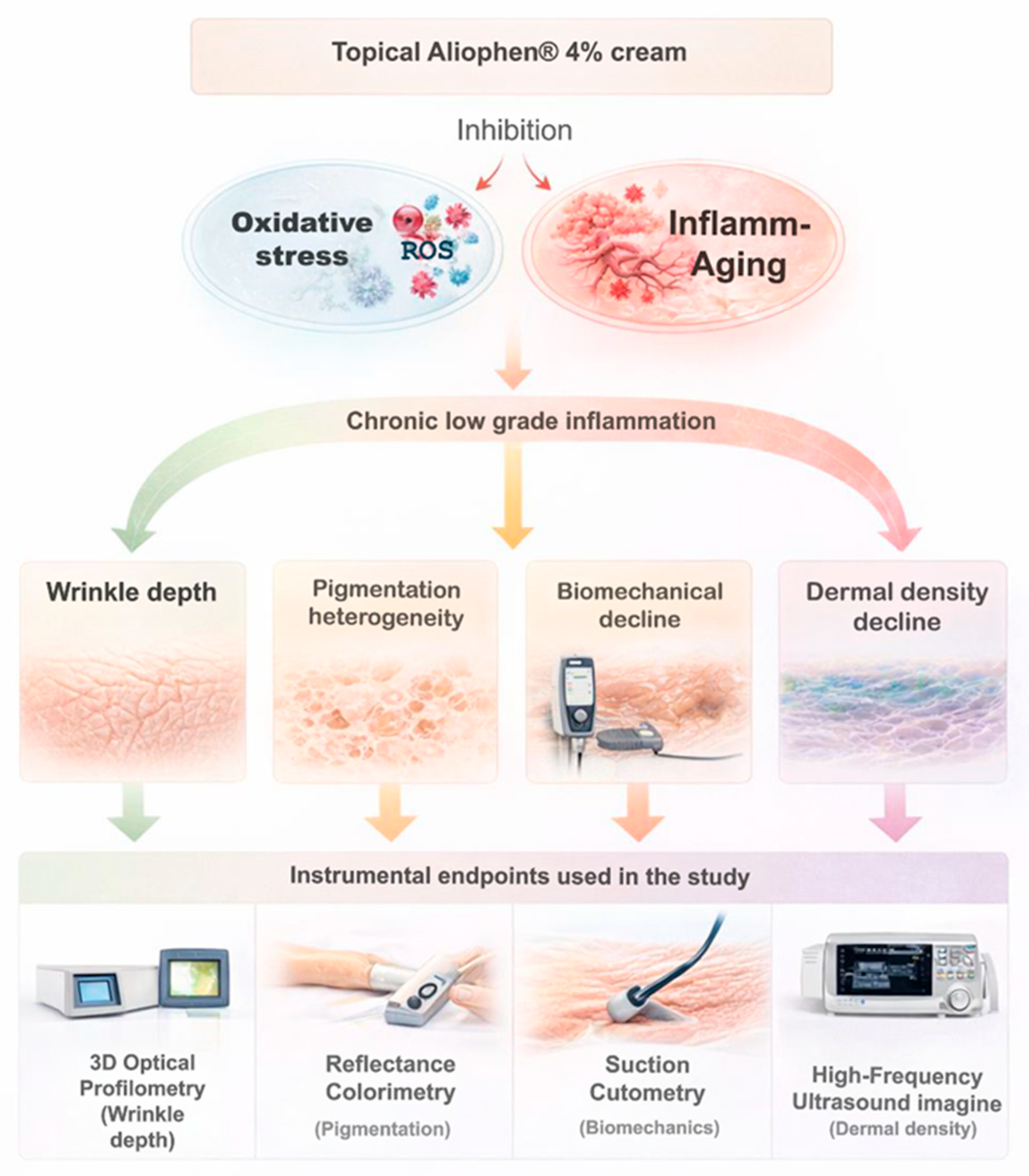

Clinical and Instrumental Evaluation of a Topical Cream Containing 4% Aliophen® in Women with Facial Skin Aging: A 56-Day Exploratory Open-Label Study

 ,
,  ,
, 
 and
and 
Abstract
1. Introduction
2. Materials and Methods
2.1. Materials
2.2. Polyphenols Content and Antioxidant Capacity
2.3. Cell Culture and Cell Viability
2.4. Intracellular Oxidative Stress Measurement
2.5. Product Testing and Quality Control
2.6. Study Design and Procedures
2.6.1. Study Design and Participants
2.6.2. Treatment
2.6.3. Assessment of Efficacy
2.6.4. Assessment of Safety and Tolerability
2.7. Statistical Analysis
3. Results
3.1. Polyphenolic Content and Antioxidant Capacity of Aliophen®
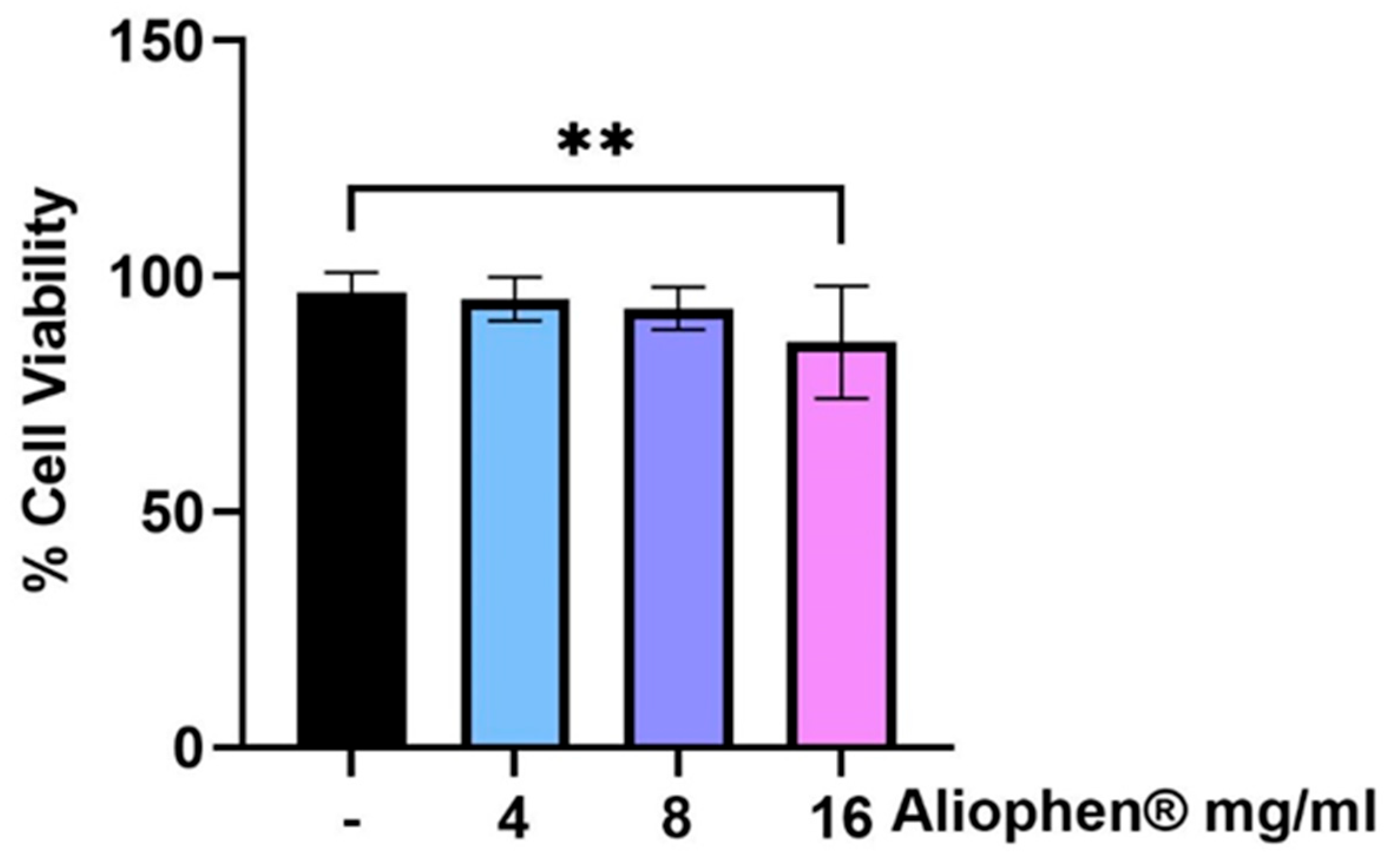
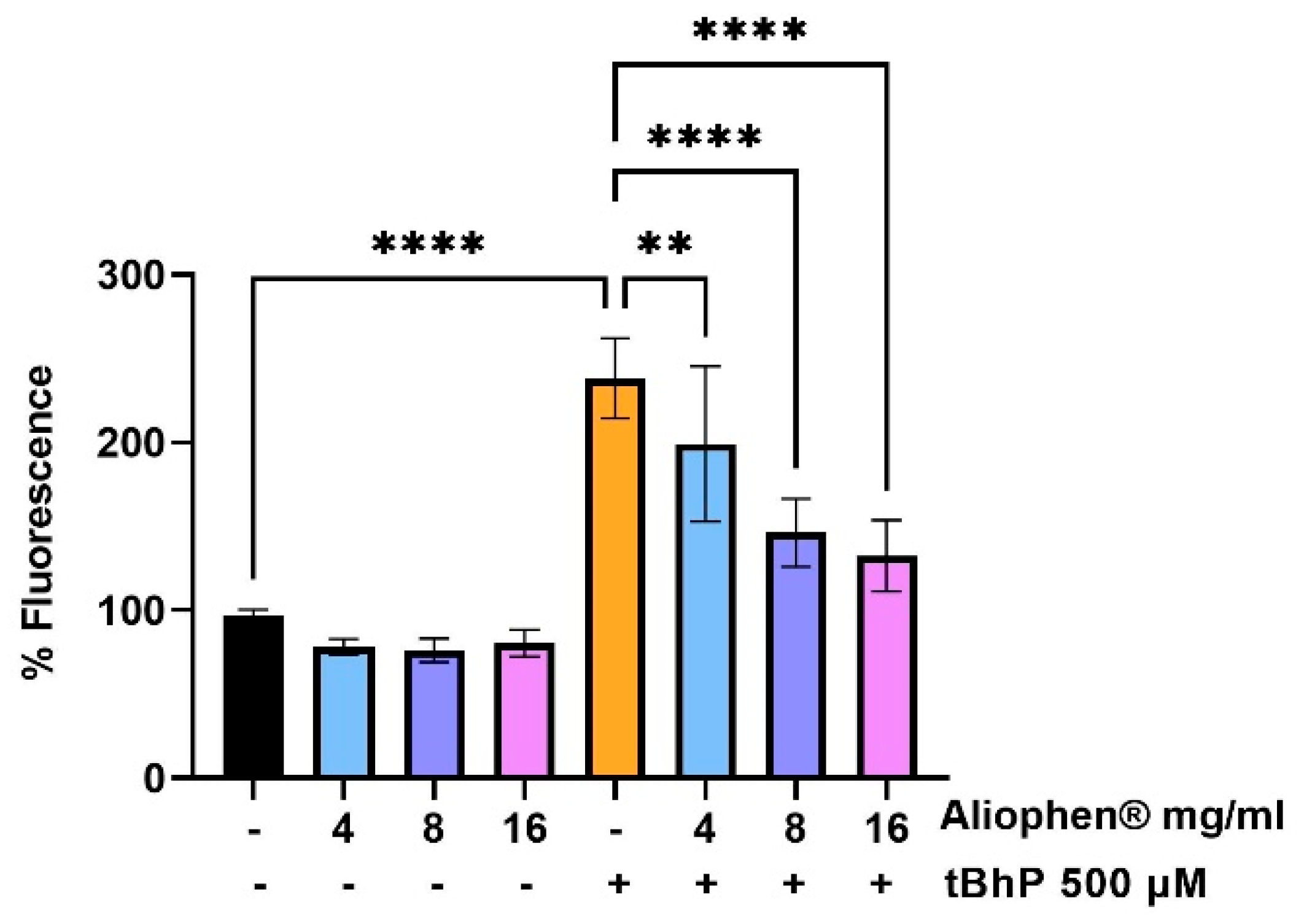
3.2. Aliophen® Exerts Antioxidant Activity on HaCaT Cells
3.3. Results from In Vivo Study
3.3.1. Antiaging Group
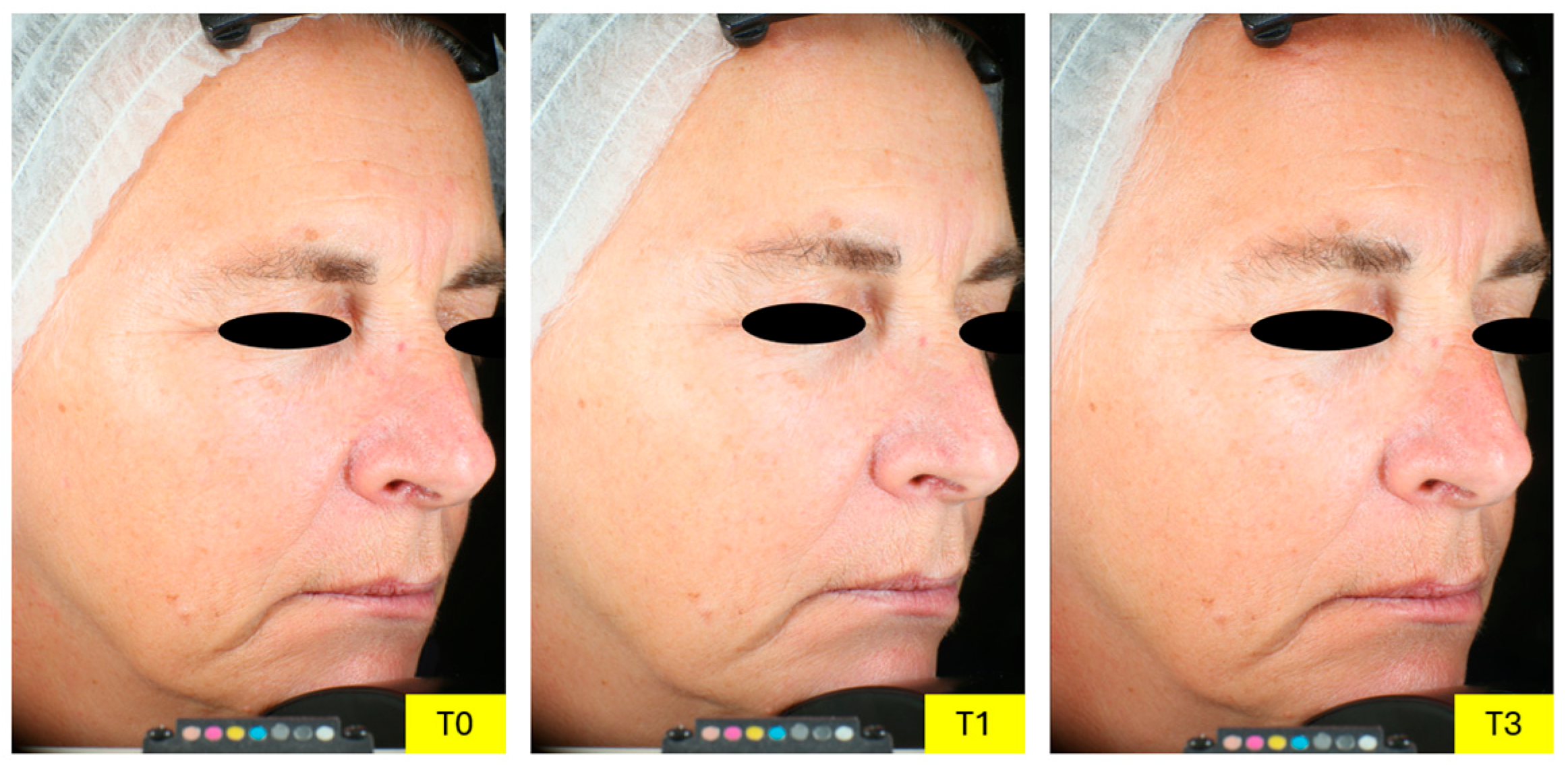
Periocular Wrinkle Depth (Crow’s Feet)
Hyperpigmented Spots (ITA°)
Skin Biomechanical Properties (R0/R2)
Dermal Density (High-Frequency Ultrasound)
3.3.2. Exploratory Inflammation-Prone Subgroup
3.3.3. Safety and Tolerability
4. Discussion
Study Limitations
5. Conclusions
Author Contributions
Funding
Institutional Review Board Statement
Informed Consent Statement
Data Availability Statement
Acknowledgments
Conflicts of Interest
References
- Naharro-Rodriguez, J.; Bacci, S.; Hernandez-Bule, M.L.; Perez-Gonzalez, A.; Fernandez-Guarino, M. Decoding Skin Aging: A Review of Mechanisms, Markers, and Modern Therapies. Cosmetics 2025, 12, 144. [Google Scholar] [CrossRef]
- Shin, S.H.; Lee, Y.H.; Rho, N.K.; Park, K.Y. Skin aging from mechanisms to interventions: Focusing on dermal aging. Front. Physiol. 2023, 14, 1195272. [Google Scholar] [CrossRef]
- Chaudhary, M.; Khan, A.; Gupta, M. Skin Ageing: Pathophysiology and Current Market Treatment Approaches. Curr. Aging Sci. 2020, 13, 22–30. [Google Scholar] [CrossRef]
- Feng, C.; Chen, X.; Yin, X.; Jiang, Y.; Zhao, C. Matrix Metalloproteinases on Skin Photoaging. J. Cosmet. Dermatol. 2024, 23, 3847–3862. [Google Scholar] [CrossRef] [PubMed]
- Fitsiou, E.; Pulido, T.; Campisi, J.; Alimirah, F.; Demaria, M. Cellular Senescence and the Senescence-Associated Secretory Phenotype as Drivers of Skin Photoaging. J. Investig. Dermatol. 2021, 141, 1119–1126. [Google Scholar] [CrossRef]
- Salminen, A.; Kaarniranta, K.; Kauppinen, A. Photoaging: UV radiation-induced inflammation and immunosuppression accelerate the aging process in the skin. Inflamm. Res. 2022, 71, 817–831. [Google Scholar] [CrossRef]
- Abbas, D.B.; Lavin, C.V.; Fahy, E.J.; Griffin, M.; Guardino, N.; King, M.; Chen, K.; Lorenz, P.H.; Gurtner, G.C.; Longaker, M.T.; et al. Standardizing Dimensionless Cutometer Parameters to Determine In Vivo Elasticity of Human Skin. Adv. Wound Care 2022, 11, 297–310. [Google Scholar] [CrossRef]
- Farhan, M. The Promising Role of Polyphenols in Skin Disorders. Molecules 2024, 29, 865. [Google Scholar] [CrossRef]
- Bharadvaja, N.; Gautam, S.; Singh, H. Natural polyphenols: A promising bioactive compounds for skin care and cosmetics. Mol. Biol. Rep. 2023, 50, 1817–1828. [Google Scholar] [CrossRef] [PubMed]
- Dwevedi, D.; Srivastava, A. Molecular Mechanisms of Polyphenols in Management of Skin Aging. Curr. Aging Sci. 2024, 17, 180–188. [Google Scholar] [CrossRef]
- Brinke, A.S.T.; Janssens-Böcker, C.; Kerscher, M. Skin Anti-Aging Benefits of a 2% Resveratrol Emulsion. Cosmet. Dermatol. Sci. Appl. 2021, 11, 155–168. [Google Scholar] [CrossRef]
- Farris, P.; Yatskayer, M.; Chen, N.; Krol, Y.; Oresajo, C. Evaluation of efficacy and tolerance of a nighttime topical antioxidant containing resveratrol, baicalin, and vitamin e for treatment of mild to moderately photodamaged skin. J. Drugs Dermatol. 2014, 13, 1467–1472. [Google Scholar]
- Tedesco, I.; Spagnuolo, C.; Bilotto, S.; Izzo, A.A.; Borrelli, F.; Rigano, D.; Russo, M.; Tarricone, F.; Russo, G.L. Antioxidant and Chemopreventive Effect of Aliophen® Formulation Based on Malts and Hops. Antioxidants 2020, 10, 29. [Google Scholar] [CrossRef] [PubMed]
- Singleton, V.L.; Orthofer, R.; Lamuela-Raventós, R.M. Analysis of Total Phenols and Other Oxidation Substrates and Antioxidants by Means of Folin-Ciocalteu Reagent. Methods Enzymol. 1999, 299, 152–178. [Google Scholar] [CrossRef]
- Benzie, I.F.F.; Strain, J.J. The Ferric Reducing Ability of Plasma (FRAP) as a Measure of “Antioxidant Power”: The FRAP Assay. Anal. Biochem. 1996, 239, 70–76. [Google Scholar] [CrossRef]
- Boukamp, P.; Petrussevska, R.T.; Breitkreutz, D.; Hornung, J.; Markham, A.; Fusenig, N.E. Normal keratinization in a spontaneously immortalized aneuploid human keratinocyte cell line. J. Cell Biol. 1988, 106, 761–771. [Google Scholar] [CrossRef]
- Feoktistova, M.; Geserick, P.; Leverkus, M. Crystal Violet Assay for Determining Viability of Cultured Cells. Cold Spring Harb. Protoc. 2016, 2016, 087379. [Google Scholar] [CrossRef]
- Friedman, P.M.; Skover, G.R.; Payonk, G.; Kauvar, A.N.; Geronemus, R.G. 3D in-vivo optical skin imaging for topographical quantitative assessment of non-ablative laser technology. Dermatol. Surg. 2002, 28, 199–204. [Google Scholar] [CrossRef]
- Ly, B.C.K.; Dyer, E.B.; Feig, J.L.; Chien, A.L.; Del Bino, S. Research Techniques Made Simple: Cutaneous Colorimetry: A Reliable Technique for Objective Skin Color Measurement. J. Investig. Dermatol. 2020, 140, 3–12.e1. [Google Scholar] [CrossRef]
- Kawalkiewicz, W.; Matthews-Kozanecka, M.; Janus-Kubiak, M.; Kubisz, L.; Hojan-Jezierska, D. Instrumental diagnosis of facial skin—A necessity or a pretreatment recommendation in esthetic medicine. J. Cosmet. Dermatol. 2021, 20, 875–883. [Google Scholar] [CrossRef] [PubMed]
- Argalia, G.; Reginelli, A.; Molinelli, E.; Russo, A.; Michelucci, A.; Sechi, A.; Marzano, A.V.; Desyatnikova, S.; Fogante, M.; Patanè, V.; et al. High-Frequency and Ultra-High-Frequency Ultrasound in Dermatologic Diseases and Aesthetic Medicine. Medicina 2025, 61, 220. [Google Scholar] [CrossRef]
- Czajkowska, J.; Juszczyk, J.; Bugdol, M.N.; Glenc-Ambrozy, M.; Polak, A.; Piejko, L.; Pietka, E. High-frequency ultrasound in anti-aging skin therapy monitoring. Sci. Rep. 2023, 13, 17799. [Google Scholar] [CrossRef]
- Schallreuter, K.; Levenig, C.; Berger, J.; Umbert, J.; Winkelmann, R.; Wegener, L.; Correia, O.; Chosidow, O.; Saiag, P.; Bastuji-Garin, S.; et al. Severity scoring of atopic dermatitis: The SCORAD index: Consensus Report of the European Task Force on Atopic Dermatitis. Dermatology 1993, 186, 23–31. [Google Scholar] [CrossRef]
- Vitale, M.; Truchuelo, M.T.; Nobile, V.; Gómez-Sánchez, M.J. Clinical Tolerability and Efficacy Establishment of a New Cosmetic Treatment Regimen Intended for Sensitive Skin. Appl. Sci. 2024, 14, 6252. [Google Scholar] [CrossRef]
- Jahn, M.; Lang, V.; Diehl, S.; Back, R.; Kaufmann, R.; Fauth, T.; Buerger, C. Different immortalized keratinocyte cell lines display distinct capabilities to differentiate and reconstitute an epidermis in vitro. Exp. Dermatol. 2024, 33, e14985. [Google Scholar] [CrossRef]
- AOAC. Official Methods of Analysis, 15th ed.; AOAC: Arlington, VA, USA, 1990. [Google Scholar]
- Binic, I.; Lazarevic, V.; Ljubenovic, M.; Mojsa, J.; Sokolovic, D. Skin ageing: Natural weapons and strategies. Evid. Based Complement. Altern. Med. 2013, 2013, 827248. [Google Scholar] [CrossRef]
- Draelos, Z.D.; Yatskayer, M.; Oresajo, C.; Fares, H.; Hansenne, I. Efficacy of Ferulic Acid in Improving the Appearance of Photoaged Skin. Cosmet. Dermatol. 2008, 21, 195–198. [Google Scholar]
- Chiu, A.E.; Chan, J.L.; Kern, D.G.; Kohler, S.; Rehmus, W.E.; Kimball, A.B. Double-blinded, placebo-controlled trial of green tea extracts in the clinical and histologic appearance of photoaging skin. Dermatol. Surg. 2005, 31, 855–860; discussion 860. [Google Scholar] [CrossRef]
- Cheng, F.; Feng, J.; Cao, Z.; Duan, Q.; Li, H. Efficacy and Safety of Topical Application of Plant-Based Products on Skin Aging in Healthy Individuals: A Systematic Review and Meta-Analysis of Randomized Controlled Trials. J. Cosmet. Dermatol. 2025, 24, e16710. [Google Scholar] [CrossRef]
- Goenka, S.; Simon, S.R. Depigmenting effect of Xanthohumol from hop extract in MNT-1 human melanoma cells and normal human melanocytes. Biochem. Biophys. Rep. 2021, 26, 100955. [Google Scholar] [CrossRef] [PubMed]
- Cho, J.; Jung, H.; Kang, D.Y.; Sp, N.; Shin, W.; Lee, J.; Park, B.G.; Kang, Y.A.; Jang, K.J.; Bae, S.W. The Skin-Whitening and Antioxidant Effects of Protocatechuic Acid (PCA) Derivatives in Melanoma and Fibroblast Cell Lines. Curr. Issues Mol. Biol. 2023, 45, 2157–2169. [Google Scholar] [CrossRef]
- Shin, S.; Cho, S.H.; Park, D.; Jung, E. Anti-skin aging properties of protocatechuic acid in vitro and in vivo. J. Cosmet. Dermatol. 2020, 19, 977–984. [Google Scholar] [CrossRef] [PubMed]
- Mutlu Sonat, G.; Caglar, E.S.; Guresci, D.; Aydin, A.; Sipahi, H.; Ustundag Okur, N. Novel vanillic acid-loaded in situ gels: Development, characterization, in vitro evaluation for enhanced wound healing and skin irritation test. Pharm. Dev. Technol. 2025, 30, 905–922. [Google Scholar] [CrossRef]
- Mita, S.R.; Husni, P.; Putriana, N.A.; Maharani, R.; Hendrawan, R.P.; Dewi, D.A. A Recent Update on the Potential Use of Catechins in Cosmeceuticals. Cosmetics 2024, 11, 23. [Google Scholar] [CrossRef]
- Xue, N.; Liu, Y.; Jin, J.; Ji, M.; Chen, X. Chlorogenic Acid Prevents UVA-Induced Skin Photoaging through Regulating Collagen Metabolism and Apoptosis in Human Dermal Fibroblasts. Int. J. Mol. Sci. 2022, 23, 6941. [Google Scholar] [CrossRef]
- Hong, J.; Mu, T.; Sun, H.; Blecker, C.; Richel, A. Photoprotective effects of sweet potato leaf polyphenols and caffeic acid against UV-induced skin-damage in BALB/C nude mice. Food Funct. 2022, 13, 7075–7087. [Google Scholar] [CrossRef]
- Shin, E.J.; Jo, S.; Choi, H.K.; Choi, S.; Byun, S.; Lim, T.G. Caffeic Acid Phenethyl Ester Inhibits UV-Induced MMP-1 Expression by Targeting Histone Acetyltransferases in Human Skin. Int. J. Mol. Sci. 2019, 20, 3055. [Google Scholar] [CrossRef]
- Seo, Y.K.; Kim, S.J.; Boo, Y.C.; Baek, J.H.; Lee, S.H.; Koh, J.S. Effects of p-coumaric acid on erythema and pigmentation of human skin exposed to ultraviolet radiation. Clin. Exp. Dermatol. 2011, 36, 260–266. [Google Scholar] [CrossRef]
- Lim, K.H.; Ku, J.-E.; Rhie, S.-J.; Ryu, J.Y.; Bae, S.; Kim, Y.-S. Anti-oxidant and Anti-inflammatory Effects of Sinapic Acid in UVB Irradiation-Damaged HaCaT Keratinocytes. Asian J. Beauty Cosmetol. 2017, 15, 513–522. [Google Scholar] [CrossRef]
- Jiamphun, S.; Chaiyana, W. Enhancing Skin Delivery and Stability of Vanillic and Ferulic Acids in Aqueous Enzymatically Extracted Glutinous Rice Husk by Nanostructured Lipid Carriers. Pharmaceutics 2023, 15, 1961. [Google Scholar] [CrossRef] [PubMed]



| Groups | Population | N | Main Eligibility Criteria | Endpoints |
|---|---|---|---|---|
| Group 1 | Antiaging | 20 | Female (45–65 y), crow’s feet wrinkles and/or reduced firmness/elasticity; ≥1 hyperpigmented spot suitable for instrumental assessment | PRIMOS 3D, ITA°, Cutometer (R0, R2), HF ultrasound density |
| Group 2 | Inflammation-prone | 5 | Female ≥ 18 y, mild-to-moderate atopic dermatitis (baseline SCORAD 15–40) | SCORAD (descriptive) |
| Total | Overall population | 25 | — | — |
| Endpoint | T0 | T28 | T56 | Change at T28 vs. T0 (95% CI) | p-Value | Change at T56 vs. T0 (95% CI) | p-Value |
|---|---|---|---|---|---|---|---|
| Wrinkle depth (crow’s feet, µm) | 322.3 ± 88.7 | 295.6 ± 83.7 | 272.6 ± 84.7 | −8.1% (−12.9 to −3.3) | 0.003 | −15.9% (−20.1 to −11.6) | <0.001 |
| Dark-spot color (ITA°, °) | 21.29 ± 9.72 | 22.99 ± 9.09 | 23.87 ± 8.66 | +11.5% (+4.1 to +18.9) | 0.003 | +18.2% (+10.7 to +25.8) | <0.001 |
| Skin firmness (R0, Uf) | 0.453 ± 0.041 | 0.438 ± 0.040 | 0.428 ± 0.041 | −3.1% (−5.9 to −0.3) | 0.038 | −5.3% (−7.9 to −2.8) | 0.004 |
| Skin elasticity (R2, Ua/Uf) | 0.607 ± 0.039 | 0.636 ± 0.049 | 0.640 ± 0.045 | +5.0% (+2.3 to +7.6) | 0.001 | +5.5% (+2.9 to +8.0) | <0.001 |
| Dermal density (ultrasound signal, %) | 17.01 ± 2.64 | — | 18.40 ± 2.58 | — | — | +1.38 (+0.57 to +2.19) | 0.002 |
| Category | Finding |
|---|---|
| Serious adverse events | None reported |
| Discontinuations due to intolerance | None reported |
| Local reactions (investigator-assessed) | No clinically meaningful intolerance pattern observed |
| Subject-reported symptoms | No consistent treatment-limiting discomfort reported |
| Overall tolerability | Favourable under real-life home-use conditions |
Disclaimer/Publisher’s Note: The statements, opinions and data contained in all publications are solely those of the individual author(s) and contributor(s) and not of MDPI and/or the editor(s). MDPI and/or the editor(s) disclaim responsibility for any injury to people or property resulting from any ideas, methods, instructions or products referred to in the content. |
© 2026 by the authors. Licensee MDPI, Basel, Switzerland. This article is an open access article distributed under the terms and conditions of the Creative Commons Attribution (CC BY) license.
Share and Cite
Colletti, A.; Spagnuolo, C.; Roveda, G.; Pellizzato, M.; Adabbo, E.; Russo, G.L.; Cravotto, G. Clinical and Instrumental Evaluation of a Topical Cream Containing 4% Aliophen® in Women with Facial Skin Aging: A 56-Day Exploratory Open-Label Study. Cosmetics 2026, 13, 110. https://doi.org/10.3390/cosmetics13030110
Colletti A, Spagnuolo C, Roveda G, Pellizzato M, Adabbo E, Russo GL, Cravotto G. Clinical and Instrumental Evaluation of a Topical Cream Containing 4% Aliophen® in Women with Facial Skin Aging: A 56-Day Exploratory Open-Label Study. Cosmetics. 2026; 13(3):110. https://doi.org/10.3390/cosmetics13030110
Chicago/Turabian StyleColletti, Alessandro, Carmela Spagnuolo, Gloria Roveda, Marzia Pellizzato, Eva Adabbo, Gian Luigi Russo, and Giancarlo Cravotto. 2026. "Clinical and Instrumental Evaluation of a Topical Cream Containing 4% Aliophen® in Women with Facial Skin Aging: A 56-Day Exploratory Open-Label Study" Cosmetics 13, no. 3: 110. https://doi.org/10.3390/cosmetics13030110
APA StyleColletti, A., Spagnuolo, C., Roveda, G., Pellizzato, M., Adabbo, E., Russo, G. L., & Cravotto, G. (2026). Clinical and Instrumental Evaluation of a Topical Cream Containing 4% Aliophen® in Women with Facial Skin Aging: A 56-Day Exploratory Open-Label Study. Cosmetics, 13(3), 110. https://doi.org/10.3390/cosmetics13030110