Article

Investigation of Microwave-Assisted Extraction Method on Chemical Profiling and Anti-Tyrosinase Activities of Equisetum ramosissimum Desf. subsp. debile (Roxb. ex Vaucher) Hauk for Potential Cosmetic Applications by LC-MS/MS and Molecular Docking Analysis


by
Natapornchanok Kanbut
1,
Kamonpan Sanachai
2,
Jirada Pluemjai
2,
Sarunya Tuntiyasawasdikul
3,
Sakda Daduang
3,
Bodee Nutho
4 and
Jringjai Areemit
1,*
1
Department of Pharmaceutical Technology, Faculty of Pharmaceutical Sciences, Khon Kaen University, Khon Kaen 40002, Thailand
2
Department of Biochemistry, Faculty of Science, Khon Kaen University, Khon Kaen 40002, Thailand
3
Department of Pharmacognosy and Toxicology, Faculty of Pharmaceutical Sciences, Khon Kaen University, Khon Kaen 40002, Thailand
4
Department of Pharmacology, Faculty of Science, Mahidol University, Bangkok 10400, Thailand
*
Author to whom correspondence should be addressed.
Cosmetics 2026, 13(3), 107; https://doi.org/10.3390/cosmetics13030107
Submission received: 20 March 2026 / Revised: 22 April 2026 / Accepted: 22 April 2026 / Published: 28 April 2026
(This article belongs to the Section Cosmetic Formulations)

Abstract

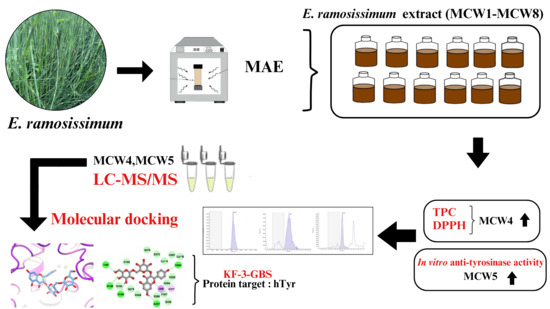
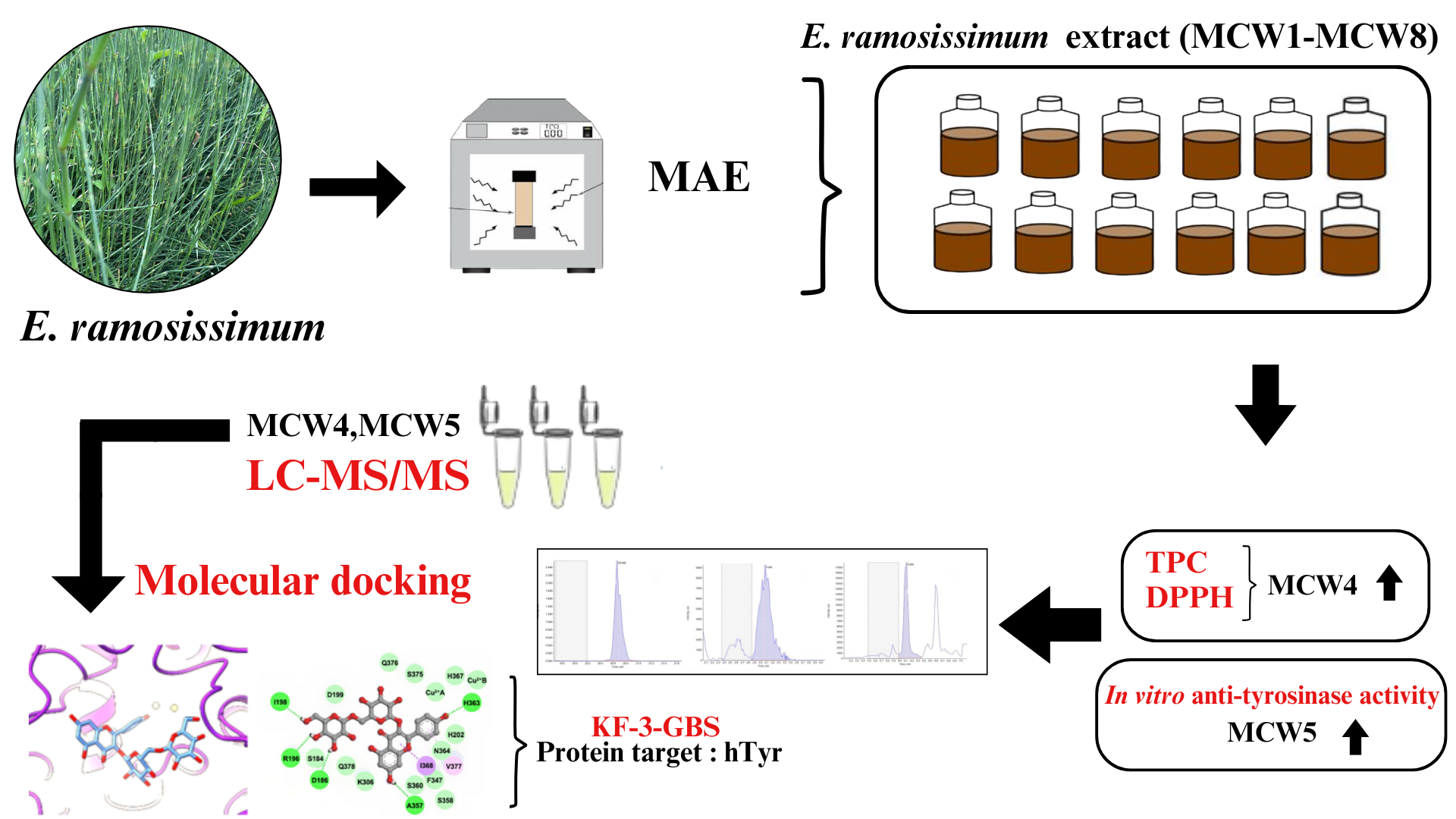
Equisetum ramosissimum Desf. Subsp. debile (Roxb. ex Vaucher) Hauk (E. ramosissimum), exhibits anti-tyrosinase and antioxidant activities. However, identifying the key compounds exhibiting anti-tyrosinase effects and establishing effective protocols for their extraction have not been accomplished. Herein, we investigate and establish an effective extraction method and identify the key bioactive compounds responsible for tyrosinase inhibition. E. ramosissimum was extracted using the microwave-assisted extraction (MAE) method. The MCW4 extract exhibited the highest antioxidant activity (IC50: 90.96 ± 0.515 µg/mL) and TPC (27.23 ± 1.180 mg of GAE/g-crude extract), while the MCW5 extract showed the strongest anti-tyrosinase activity (IC50: 126.48 ± 6.668 µg/mL). LC-MS/MS analysis identified resveratrol isomers, protocatechuic acid, cis-ETRA acid, KF-3-GBS, 1-16:0-lysoPC, and 1-16:0-lysoPE as potential anti-tyrosinase compounds, detected only in MCW4 and MCW5 under the applied extraction and analytical conditions. Molecular docking indicated favorable predicted binding toward human tyrosinase (hTyr) for resveratrol isomers, KF-3-GBS, and 1-16:0-lysoPE. KF-3-GBS was uniquely detected in MCW5. These results suggest that MAE using a solid-to-solvent ratio of 1:16 at 40 °C for 15 min produced an E. ramosissimum extract that exhibited strong tyrosinase inhibitory activity. Kaempferol-3-gentiobioside (KF-3-GBS) demonstrated favorable binding to hTyr in molecular docking analysis, supporting its potential role as a direct tyrosinase inhibitor.

Graphical Abstract

1. Introduction

Human skin color is naturally determined by a mix of internal factors, such as ethnicity and genetics, and external factors, including UV radiation, and thermal exposure. Melanin is the primary pigment responsible for skin color. This pigment is produced by cells called melanocytes located in the epidermis [1], which transfers the synthesized pigment to keratinocytes. The production of melanin occurs through a multi-step pathway called melanogenesis [2].
In this process, the enzyme tyrosinase catalyzes the oxidation of tyrosine into L-DOPA and dopaquinone [3]. Currently, natural bioactive compounds from plants have gained significant attention as bioactive alternatives that enhance skin to reduce hyperpigmentation and increase long-term skin health and safety. A notable medicinal herb in this context is Equisetum, which provides an avenue for further study.
Equisetum, or horsetail, is a member of the Equisetaceae family and is considered a type of fern. This genus comprises more than 30 recognized species distributed worldwide [4,5]. Equisetum species have long been used in traditional medicine, primarily for health-related purposes. For example, Equisetum diffusum D. Don has demonstrated antimicrobial activity against Escherichia coli, Bacillus pumilus, and Streptococcus [6]. Equisetum arvense L. is administered in capsule form, containing 900 mg of a dry extract with 0.026% total flavonoids per day. It is mainly used as a diuretic and for the treatment of inflammation, ulcers, hemorrhage, and musculoskeletal disorders [7]. Similarly, capsules containing 0.75 g of Equisetum giganteum L. extract are also traditionally used as a diuretic [8]. Moreover, Equisetum telmateia Ehrh. extract has been used to treat broken bones, prostatitis, inflammation, and hypertension [9]. Another notable species, Equisetum ramosissimum Desf. Subsp. debile (Roxb. ex Vaucher) Hauk [10] (E. ramosissimum), is particularly abundant in Thailand and rich in key phytochemical compounds, including quercetin, kaempferol, kaempferol-3-O-glucoside, luteolin, myricetin, and rutin [11]. These compounds are characterized by hydroxyl (-OH) functional groups, which can act as electron donors to neutralize free radicals [12]. E. ramosissimum is commonly used as a wound-healing agent, muscle relaxant, hair-growth stimulant, and for anti-hair loss [9]. In addition, the ethyl acetate extract of E. ramosissimum was reported to exhibit the strongest tyrosinase inhibitory activity among extracts obtained using hexane, dichloromethane, methanol, and the methanol-insoluble residue [13]. Therefore, E. ramosissimum is regarded as a valuable ingredient for cosmetic formulations targeting hyperpigmentation and skin brightening. Many studies have shown that methanol extracts of E. ramosissimum exhibit significant antioxidant activity [14,15]. However, with respect to anti-tyrosinase activity, only a single study has compared extracts using reflux extraction followed by sequential partitioning with solvents of varying polarity, including hexane, dichloromethane, ethyl acetate, methanol, and distilled water. In that study, the ethyl acetate extract demonstrated the most effective tyrosinase inhibition, showing higher efficacy than kojic acid [16]. Nevertheless, this investigation did not identify the specific chemical compounds responsible for tyrosinase inhibition. Subsequently, Mustafa Al-Bayati et al. (2023) analyzed E. ramosissimum extracts obtained by maceration using LC–MS/MS and identified eight major compounds with tyrosinase inhibitory activity: catechin, caffeic acid, 3-hydroxy-4-methoxycinnamic acid (isoferulic acid), kaempferol-3-O-rutinoside, 2,4-dihydroxyacetophenone, kaempferol 3-O-neohesperidoside, kaempferol-3-O-glucoside, and kaempferol [17]. These findings further suggest that E. ramosissimum has potential applications in skin-whitening products and the reduction of dark spots.
Although previous research has indicated that E. ramosissimum extract possesses tyrosinase inhibitory activity, most studies have relied on extraction methods that require large quantities of solvents. The use of such solvents poses a risk of residual contamination, which may be harmful to the skin upon application, and some solvents are inherently toxic to the skin. Constant exposure to these solvents can impair central nervous system (CNS) function and may cause acute effects such as headaches, dizziness, and fatigue [18]. In contrast, ethanol has minimal impact on the skin and causes only mild irritation; when tested on irritated skin, transepidermal water loss (TEWL) was decreased, and skin hydration was increased [19]. Consequently, the selection of advanced extraction techniques through green technology has become a focus. One such method is Microwave-Assisted Extraction (MAE), an efficient approach that optimizes the recovery of bioactive compounds [20]. MAE reduces both extraction time and solvent consumption, thereby safter environment impact and human exposure to hazardous chemicals [21]. Furthermore, protecting heat-sensitive compounds better than conventional extraction methods [22]. Moreover, no studies have examined the molecular interactions of the active constituents to confirm their tyrosinase inhibitory mechanisms. Therefore, in this study, ethanol was selected as the extraction solvent and Microwave-Assisted Extraction (MAE) was employed to reduce solvent consumption. The optimal extraction condition of E. ramosissimum was investigated to obtain active compounds with effective tyrosinase inhibitory activity. In addition, molecular docking simulations were conducted to study the interactions between the main active compounds obtained from E. ramosissimum and the tyrosinase enzyme. This approach aims to elucidate the mechanism of action and confirm the inhibitory efficacy of the extracts. It is anticipated that this study will contribute to the development of environmentally friendly extraction methods, minimize the risks of solvent residues in final products, and provide further insight into the potential of E. ramosissimum as a natural raw material for future health and cosmetic product development.

2. Materials and Methods

2.1. Plant Preparation

Fresh E. ramosissimum samples were collected from Nan province (the northern region of Thailand). A voucher specimen (No. HN3746) has been deposited at the Faculty of Pharmaceutical Sciences, Khon Kaen University for future reference. E. ramosissimum is not a protected plant in Thailand and samples were not collected from private or protected areas requiring permits. The species is commonly found in gardens, fields, and forests. The whole plant was air-dried at room temperature or dried in an oven at 45 °C. The dried plant material was ground and sieved through a No. 30 mesh, and after that it was kept in a well-closed container under low humidity until further use.

2.2. Plant Extraction by Microwave-Assised Extraction (MAE) Method

One part of ground E. ramosissimum powder was mixed with 8 or 16 parts of 95% v/v of ethanol. The sample was subjected to Microwave-Assisted Extraction (Ethos X, MILESTONE Srl, Sorisole, Bergamo, Italy) for 15 and 45 min at 40 °C and 90 °C. The extract was filtered using Whatman No.1 filter paper and the residual solvent was removed using a rotary evaporator (Hei-VAP Precision ML/G3, Heidolph, Schwabach, Germany) before the extract was lyophilized for 24 h using a freeze dryer (Gamma 2-16 LSCplus, Christ, Osterode am Harz, Germany). The crude extract was stored in a well-closed glass container at −20 °C until further use. The code for each sample’s extraction method is shown in Table 1.

2.3. Determination of Extraction Yield

The extraction yields of the E. ramosissimum crude extract were calculated using the following equation:
Yield   ( % )   = Crude   extract   weight   ( g )   × 100 Ground   powder   weight   ( g )

2.4. Total Phenolic Content (TPC) by Folin–Ciocalteu Assay

The TPC was determined by a previously published method with some modifications [23]. Briefly, a 1 mg/mL solution of sample in extraction solvent was prepared. Then, 10 µL of sample was added to a 96-well plate, and deionized water was added to make 100 µL/well. Then, 100 µL of 10% Folin & Ciocalteu’s phenol reagent (Sigma-Aldrich, St. Louis, MO, USA) was added to each well. After that, 80 µL of 7% w/v of sodium carbonate (Na2CO3) was added into each well. Then, the sample was mixed and incubated for 30 min in the dark. The absorbances were measured at 760 nm by a microplate reader (Ensight Multimode, Perkin Elmer, MA, USA). The standard calibration curve was performed using gallic acid (Sigma-Aldrich, St. Louis, MO, USA). Results are expressed in milligrams of gallic acid equivalents per gram of crude extract (mg of GAE/g crude extract).

2.5. Antioxidant Activity by DPPH Radical Scavenging Assay

The antioxidant activity of E. ramosissimum crude extract was determined by a previously published method with some modifications [23]. Briefly, a 1 mg/mL solution of sample in extraction solvent was prepared. Then, 10 µL of sample was added to a 96-well plate and methanol was added to make 100 µL/well. Distilled water was used instead of sample as a control. After that, 100 µL of 0.2 mM DPPH in methanol was added and mixed for a while. The sample was kept for 30 min in a dark place. The absorbances were measured at 517 nm by a microplate reader (Ensight Multimode, Perkin Elmer, MA, USA). The percentage of free radical scavenging activity was calculated according to the following equation:
DPPH   scavenging   activity   ( % )   = A b s c t r l     A b s s a m A b s c t r l × 100
where
  • Absctrl = Absorbance of control
  • Abssam = Absorbance of sample
Antioxidant activity is expressed as IC50DPPH, which defines the concentration as providing 50% free radical inhibition. Vitamin C (L-Ascorbic acid, Sigma-Aldrich, St. Louis, MO, USA) and vitamin E (Merck, Damstadt, Germany) were used as standards.

2.6. In Vitro Tyrosinase Inhibitory Assay

The tyrosinase inhibitory assay was performed as previously described with some modification [24]. Briefly, the mixture of 40 μL of a specified concentration of each sample prepared in dimethyl sulfoxide (DMSO), 10 μL of mushroom tyrosinase (400 IU/mL) and 50 μL of 3.6 mM of L-Dopa in 100 mM potassium phosphate buffer (pH 6.8) were added into each well of 96-well plate. Then the mixtures were incubated at 37 °C in the dark for 30 min. After that, the amount of dopachrome produced in each well was measured by a microplate reader (Ensight Multimode, Perkin Elmer, MA, USA) at 475 nm (OD475). Kojic acid (Sigma-Aldrich, St. Louis, MO, USA) was used as a positive control and distilled water was used as the negative control. The percentage of anti-tyrosinase activity was calculated according to the following equation:
%   Anti tyrosinase   activity = A b s c t r l A b s s a m A b s c t r l × 100
The concentration providing 50% tyrosinase inhibition is expressed as IC50Antityro.

2.7. Liquid Chromatography-Tandem Mass Spectrometry (LC-MS/MS)

LC-MS/MS analysis was performed by Mahidol University Frontier Research Facility (MU-FRF), Mahidol University, Thailand, using a validated in-house method (with established parameters for specificity, linearity, and precision) based on reversed-phase UHPLC coupled to a high-resolution QTOF mass spectrometer. Quality control was ensured through the analysis of solvent blanks and pooled QC samples. The LC system consisted of a Dionex Ultimate 3000 (Thermo Scientific, Waltham, MA, USA) equipped with an automatic degasser, a quaternary pump, and an autosampler. The Acclaim® RSLC120 C18 column (100 × 2.1 mm, 2.2 µm 120 Å, Thermo Scientific, Waltham, MA, USA) was used. The column temperature was maintained at 40 °C and the sample injection volume was 20 μL. The mobile phase consisted of 0.1% formic acid in water and 0.1% formic acid in acetonitrile using gradient elution (0–2 min, 5% acetonitrile; 2–25 min, 95% acetonitrile; 25–25.5 min, 95–5% acetonitrile; 25.5–30 min, 5% acetonitrile). The sample was delivered at a flow rate 0.3 mL/min. Mass spectrometric detection was performed with TripleTOF® 6600+ system (SCIEX™, Framingham, MA, USA). Data were acquired in both negative and positive ionization mode with a full-scan MS range of 100–1500 m/z. For MS/MS acquisition, precursor ions exceeding an intensity threshold of 100 counts per second (cps) were selected, with a maximum of 25 precursors per cycle.

2.8. Molecular Docking

Molecular docking simulations were performed using AutoDock Vina version 1.2.7 [25]. The three-dimensional (3D) structure of tyrosinase from Agaricus bisporus (PDB ID: 2Y9X [26]) was retrieved from the RCSB Protein Data Bank (https://www.rcsb.org/, accessed on 5 December 2025). The 3D structure of human tyrosinase (GenBank: AAB60319.1) was generated through homology modeling using the SWISS-MODEL web server [27], with the crystal structure of human tyrosinase-related protein 1 (TRP1), co-crystallized with kojic acid (PDB ID: 5M8Q [28]), serving as the template. Chemical structures of the selected compounds were obtained from the PubChem database (https://pubchem.ncbi.nlm.nih.gov, accessed on 5 December 2025). The PDBQT files for both the proteins and ligands were prepared using MGLTools version 1.5.6 (https://ccsb.scripps.edu/mgltools/, accessed on 5 December 2025). Grid box coordinates were defined to specify the binding regions for docking simulations. For mushroom tyrosinase (mTyr), the grid center was set at x: −10.03, y: −28.88, z: −43.95; for human tyrosinase (hTyr), the center was x: −27.04, y: 29.00, z: 24.75. Protein–ligand interactions were visualized and analyzed using ChimeraX [29] and Discovery Studio Visualizer (BIOVIA, San Diego, CA, USA).

2.9. Statistical Analysis

The statistical analysis of all results was conducted using the one-way analysis of variance method in the SPSS version 29 program for MS Windows (SPSS (Thailand) Co. Ltd., Bangkok, Thailand). The statistical significance of the mean differences was assessed using Duncan’s multiple range test. The level of statistical significance was set at 95% (p < 0.05).

3. Results and Discussion

3.1. Determination of the Extraction Yields

The physical characteristics of E. ramosissimum crude extracts obtained from the MAE method were dark green color, distinct odor, and clumped together. Among the MAE methods, MCW2 gave the highest yield (2.53%) as shown in Table 2.
In the MAE principle, plant material absorbs energy through the water inside its cells, leading to internal superheating [30]. The water then vaporizes, generating high pressure within the cell walls and causing their disruption, which enhances the migration of extracted compounds [31,32]. Therefore, higher temperatures may promote greater cell rupture, resulting in increased extraction yield. However, extraction yield alone does not reflect the number of active compounds obtained; therefore, further analyses are necessary.

3.2. Total Phenolic Content (TPC), Antioxidant Activity and Tyrosinase Inhibitory Activity

For MAE, the E. ramosissimum extract from MCW4 displayed the highest TPC (27.23 ± 1.18 mg of GAE/g-crude extract) and antioxidant activity, IC50 of 90.96 ± 0.515 µg/mL; however, it did not show a correspondingly high anti-tyrosinase activity. This difference may be attributed to the higher extraction temperature (~90 °C) used in MAE, which despite the short contact time may degrade phenolic compounds with tyrosinase inhibitory activity. J. Felipe Osorio-Tobón (2020) reported that MAE can reduce phenolic content and consequently diminish the interaction of phenolic compounds with copper ions at the enzyme’s active site, resulting in a 2.3-fold decrease in tyrosinase inhibition efficacy compared to the soaking method [33]. This may explain why the MCW4 extract exhibited high Total Phenolic Content (TPC) and antioxidant activity but low anti-tyrosinase activity.
Another notable case is the E. ramosissimum extract from MCW5, which had the second highest TPC after MCW4, but showed lower antioxidant activity, while recording the highest anti-tyrosinase activity. This observation is consistent with the previous study [16]. They demonstrated that an ethyl acetate fraction of E. ramosissimum stem extract obtained by reflux with methanol at 50 °C, a temperature similar to that used for MCW5, exhibited potent tyrosinase inhibitory activity (IC50 = 15.23 µg/mL). Fractionation separates crude extracts into polarity-based sub-fractions, concentrating specific compounds and thereby enhancing biological activity. This process commonly employs solvents such as methanol and ethyl acetate [34]. In contrast, MCW5 utilized a crude extract of the whole plant prepared using 95% ethanol in a single extraction step, which may contain additional components such as chlorophylls and sugars. These substances may interfere with the activity of major bioactive compounds [35], resulting in a higher IC50 value compared with fractionated extracts.
However, 95% ethanol is characterized very low residual solvent levels, as it is a volatile organic compound that can be effectively removed during processing. Furthermore, it exhibits lower toxicity and reduced human health risks compared with solvents such as ethyl acetate, benzene, methanol, and hexane, and is considered more environmentally friendly [36]. Therefore, biological activity depends on multiple factors including extraction temperature and time, solvent type, and pressure [37].
The experimental results indicate that all eight extraction conditions impacted the biological properties of the Equisetum ramosissimum extracts. Notably, conditions employing higher temperatures with shorter extraction times (e.g., MCW2 and MCW6) achieved the highest extraction yield but did not correspond to the highest Total Phenolic Content (TPC) or antioxidant activity. In contrast, a higher temperature coupled with a longer extraction time (e.g., MCW4) yielded a moderate extract weight while producing the highest TPC and antioxidant activity. Meanwhile, MCW5, which used a milder temperature and shorter time, exhibited the strongest anti-tyrosinase activity, despite its moderate yield, TPC, and antioxidant levels [38,39,40].
These observations demonstrate that Microwave-Assisted Extraction (MAE) parameters critically influence the selective extraction of specific bioactive compounds. Consequently, optimizing MAE conditions should be tailored primarily to the target compounds and the intended biological activity.

3.3. Liquid Chromatography-Tandem Mass Spectrometry (LC-MS/MS)

Analysis of the two extract samples using the NIST 2017 database (13,800 compounds) and the Natural Products HR-MS/MS library (1000 compounds) identified a total of 945 compounds present in E. ramosissimum, according to the established research criteria. Key compounds were selected based on the following parameters: inclusion among the top 10 peak areas, a library score greater than 80% based on the reference database, a high relative peak area compared with total compound abundance, and reported biological activities relevant to the study objectives [41,42].
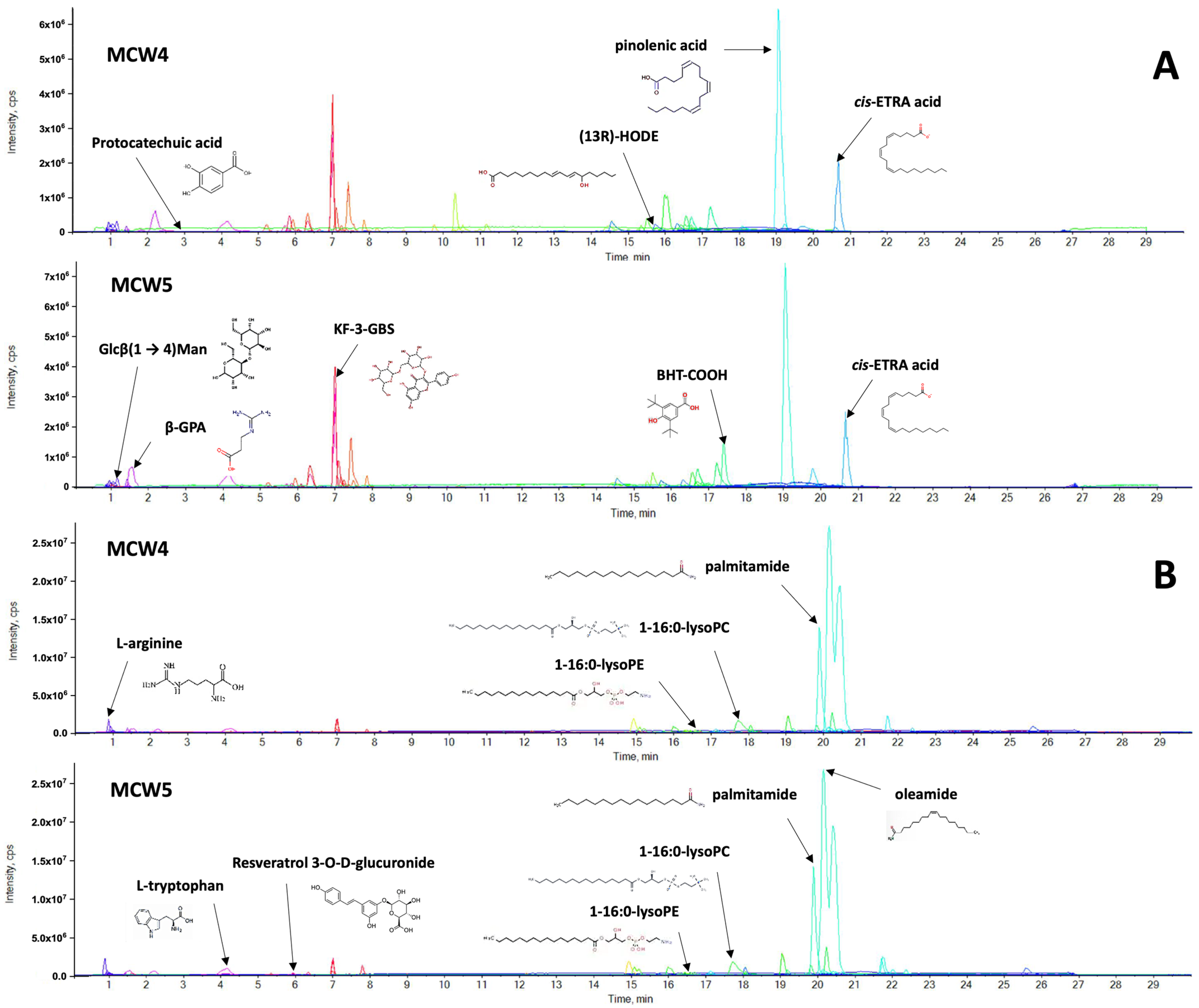
A total of 15 key compounds were selected, namely resveratrol 3-O-D-glucuronide; cis-5,8,11-eicosatrienoic acid (cis-ETRA acid); protocatechuic acid; 1-palmitoyl-2-hydroxy-sn-glycero-3-phosphoethanolamine (1-16:0-lysoPE); 1-palmitoyl-sn-glycero-3-phosphocholine(1-16:0-lysoPC); 3,5-di-tert-butyl-4-hydroxybenzoic acid (BHT-COOH); 4-O-β-galactopyranosyl-D-mannopyranose (Glcβ(1 → 4)Man); 13R-hydroxy-9Z,11E-octadecadienoic acid ((13R)-HODE); guanidinopropionic acid (β-GPA); kaempferol-3-gentiobioside (KF-3-GBS); L-arginine; L-tryptophan; oleamide; palmitamide; and pinolenic acid, as shown in Table 3. The chromatograms of the identified key compounds from the two extract samples are shown in Figure 1.
In comparison with the study of Al-Bayati et al. (2023) [17], which employed 24 h ethanol maceration to extract E. ramosissimum and identified compounds using UHPLC-MS/MS, three kaempferol derivatives—namely kaempferol-3-O-rutinoside, kaempferol-3-O-neohesperidoside, and kaempferol-3-O-glucoside—were detected; however, kaempferol-3-gentiobioside (KF-3-GBS) was not reported. In contrast, KF-3-GBS was found in the MCW5 extract obtained by MAE (1:16 ratio, 40 °C for 15 min), while the derivatives reported in the previous study were not detected. These findings suggest that variations in extraction conditions significantly influence the profile of detected bioactive compounds and may affect the resulting biological efficacy. However, for one of the selected compounds—resveratrol 3-O-D-glucuronide—reports on tyrosinase activity remain limited. Therefore, its efficacy may depend on the structural configuration of its precursor compounds, namely cis-resveratrol and trans-resveratrol, which are proposed as candidates for further investigation.

3.4. Molecular Docking

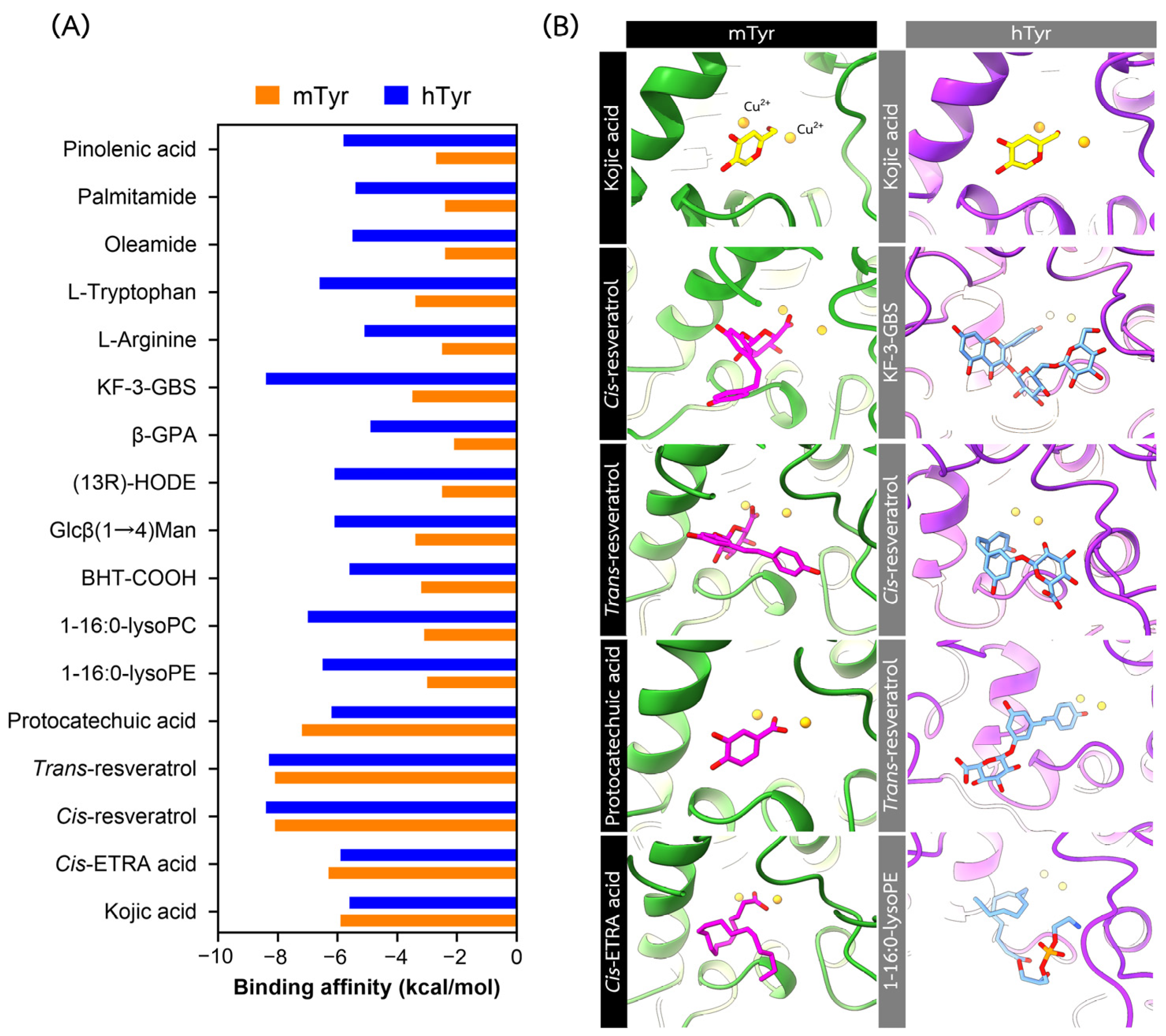
Molecular docking simulations were conducted to assess the binding characteristics of 15 key compounds isolated from E. ramosissimum against mTyr and hTyr. The predicted binding affinities, expressed in kcal/mol, are visually represented in Figure 2. These compounds exhibited a wide spectrum of binding strengths, suggesting diverse interaction capabilities with the tyrosinase active site. As depicted in Figure 2A, cis- and trans-resveratrol consistently demonstrated the most favorable binding affinities for both mTyr and hTyr, with docking scores around –8 kcal/mol. This finding aligns with previous research highlighting the potential of resveratrol analogs to inhibit mTyr activity [43]. Furthermore, protocatechuic acid, cis-5,8,11-eicosatrienoic acid (cis-ETRA acid), and the positive control kojic acid also exhibited strong predicted binding affinities, ranging from approximately −6 to −8 kcal/mol across both enzyme orthologs. Some compounds demonstrated ortholog-specific binding preferences. For example, L-arginine, kaempferol-3-gentiobioside (KF-3-GBS), 1-palmitoyl-sn-glycero-3-phosphocholine (1-16:0-lysoPC), and 1-palmitoyl-2-hydroxy-sn-glycero-3-phosphoethanolamine (1-16:0-lysoPE) showed stronger predicted affinities for hTyr, whereas protocatechuic acid exhibited a slightly more favorable interaction with mTyr. In contrast, several compounds, including pinolenic acid, palmitamide, oleamide, L-tryptophan, β-GPA, (13R)-HODE, Glcβ(1 → 4)Man, and BHT-COOH, displayed relatively weaker binding affinities, typically less negative than −4 kcal/mol, suggesting a lower likelihood of strong interaction with the active site of mTyr.
Figure 2B illustrates the predicted binding poses of selected high-affinity compounds within the active sites of mTyr and hTyr. The predicted binding conformations of these compounds were compared to that of kojic acid, providing insights into their relative binding mechanisms. Kojic acid was positioned in close proximity to the binuclear copper center in both enzymes, consistent with its established chelating inhibitory mechanism [44]. The cis- and trans-resveratrol isomers adopted distinct yet energetically favorable orientations within the active site, with their geometric differences likely influencing spatial alignment. Similar orientation specificity was observed for protocatechuic acid and cis-ETRA acid in mTyr. For compounds exhibiting hTyr ortholog selectivity, such as KF-3-GBS and 1-16:0-lysoPE, their unique binding poses are hypothesized to underlie their differential affinities.
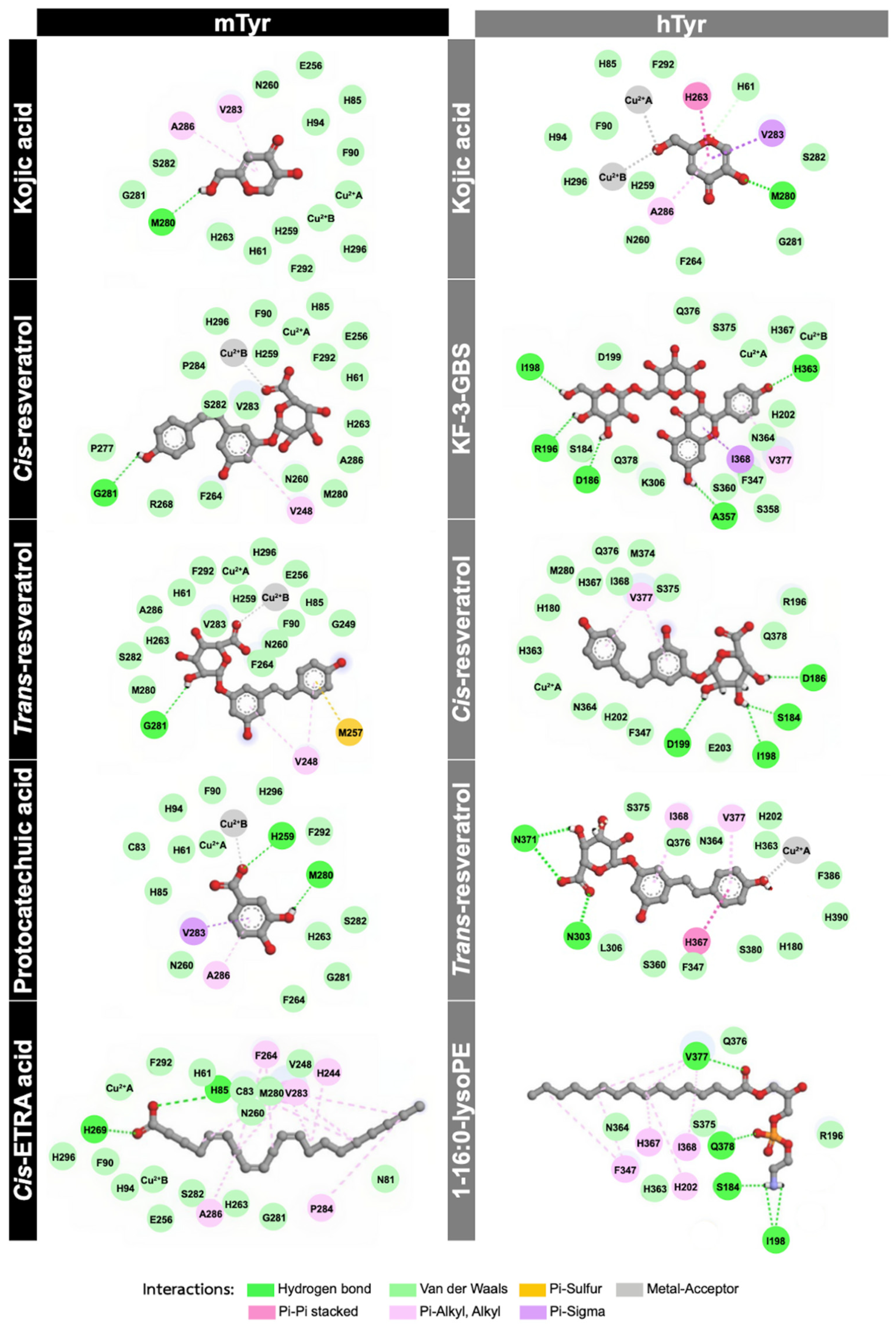
Figure 3 provides a 2D representation of the molecular interactions between selected compounds and key residues within the tyrosinase active site, with the corresponding interaction details summarized in Table 4. For kojic acid, notable interactions included coordination with copper ions and van der Waals interactions with surrounding residues in both mTyr and hTyr. Both cis- and trans-resveratrol exhibited extensive van der Waals interactions with key catalytic residues in mTyr, including H259 and H263. In hTyr, both isomers were stabilized primarily through van der Waals interactions with the catalytic residue H363. In addition, trans-resveratrol formed pi–pi stacking interactions with H367 and directly coordinated with the Cu2+A ion in the hTyr active site. These histidine residues coordinate the two copper ions and are essential for the catalytic function of the enzyme, including the hydroxylation of monophenols and the oxidation of diphenols to quinones [26]. Furthermore, the carbonyl groups of both cis- and trans-resveratrol directly interacted with the Cu2+B ion within the mTyr active site. Direct binding of inhibitors to copper ions prevents their participation in the catalytic redox cycle. Such interactions imply a copper-chelation mechanism, which is a characteristic mode of action for many potent tyrosinase inhibitors [45]. Similarly, protocatechuic acid and cis-ETRA acid formed hydrophobic interactions with key active site residues of mTyr, including H61, C83, H94, H263, G281, and H296. Protocatechuic acid additionally formed hydrogen bonds with H259 and M280, whereas cis-ETRA acid established hydrogen bond interactions with H85 and H269. Moreover, protocatechuic acid directly interacted with Cu2+B ions in the active site. Both KF-3-GBS and 1-16:0-lysoPE exhibited comparable interaction profiles with hTyr, characterized by hydrogen bonding, alkyl contacts, and van der Waals interactions with key active site residues, including R196, F347, N364, S375, Q376, and V377. This molecular docking study identified several promising compounds derived from E. ramosissimum, including resveratrol isomers, KF-3-GBS, and 1-16:0-lysoPE, as potential binders to hTyr. The observed binding behavior of these compounds highlights opportunities for the development of targeted tyrosinase inhibitors.

4. Conclusions

This study identifies the optimal, green Microwave-Assisted Extraction (MAE) condition for Equisetum ramosissimum Desf. Subsp. debile (Roxb. ex Vaucher) Hauk as a low-temperature (40 °C), short-duration (15 min) treatment, which yields an extract with potent anti-tyrosinase activity. This key bioactivity is directly linked to the effective preservation of kaempferol-3-gentiobioside (KF-3-GBS), as confirmed by LC-MS/MS, with molecular docking simulations supporting its role as a direct human tyrosinase inhibitor.
Given its strong tyrosinase inhibition, this extract holds significant promise as a natural active ingredient for skin-brightening cosmetics. The low-temperature MAE protocol further underscores its value as an energy-efficient and sustainable extraction strategy. To translate this finding into practical applications, future work should focus on validating its efficacy in cellular models and assessing its stability in cosmetic formulations.

Author Contributions

Conceived the idea, collected data, performed experimental analysis and wrote the initial manuscript, N.K. and J.A.; Analyze and validate the data in the molecular docking section, N.K., K.S. and J.P.; Assistance in phytochemical analysis, S.T. and S.D.; Assistance in analyzing the molecular docking program, B.N.; Reviewed and revised the manuscript and supervised the project, J.A. All authors have read and agreed to the published version of the manuscript.

Funding

This study was supported by the Graduate Scholarship of the Faculty of Pharmaceutical Sciences, Khon Kaen University for the academic years 2022 [grant number 65-3(9)/2566] and 2023 [grant number 66-2(5)/2566].

Institutional Review Board Statement

Not applicable.

Informed Consent Statement

Not applicable.

Data Availability Statement

The original contributions presented in this study are included in the article material.

Acknowledgments

The authors express gratitude to Suppachai Tiyaworanant at the Department of Pharmacognosy and Toxicology, Faculty of Pharmaceutical Sciences, Khon Kaen University, for support in identifying and verifying the plant materials in this study. The authors also thank Glenn Borlace for assisting in checking the English language via the Publication Clinic of Khon Kaen University.

Conflicts of Interest

The authors declare no conflicts of interest.

Abbreviations

E. ramosissimumEquisetum ramosissimum Desf. Subsp. debile (Roxb. ex Vaucher) Hauk
TPCTotal Phenolic Compound
MAEMicrowave-Assisted Extraction
DMSOdimethyl sulfoxide
DPPH2,2-Diphenyl-1-picrylhydrazyl
IUInternational Unit
mlmilliliter
UHPLCUltra-high performance liquid chromatography
µgmicrogram
TRP1tyrosinase-related protein 1
mTyrmushroom tyrosinase
hTyrhuman tyrosinase
cis-ETRA acidcis-5,8,11-eicosatrienoic acid
1-16:0-lysoPE1-palmitoyl-2-hydroxy-sn-glycero-3- phosphoethanolamine
1-16:0-lysoPC1-palmitoyl-sn-glycero-3-phosphocholine
BHT-COOH3,5-di-tert-butyl-4-hydroxybenzoic acid
Glcβ(1→4)Man4-O-β-Galactopyranosyl-D-mannopyranose
(13R)-HODE13R-hydroxy-9Z,11E-octadecadienoic acid
β-GPAguanidinopropionic acid
KF-3-GBSkaempferol-3-gentiobioside

References

  1. Solano, F. Melanins: Skin Pigments and Much More—Types, Structural Models, Biological Functions, and Formation Routes. New J. Sci. 2014, 2014, 498276. [Google Scholar] [CrossRef]
  2. Pillaiyar, T.; Manickam, M.; Namasivayam, V. Skin Whitening Agents: Medicinal Chemistry Perspective of Tyrosinase Inhibitors. J. Enzyme Inhib. Med. Chem. 2017, 32, 403–425. [Google Scholar] [CrossRef] [PubMed]
  3. Seiberg, M. Keratinocyte-Melanocyte Interactions during Melanosome Transfer. Pigment. Cell Res. 2001, 14, 236–242. [Google Scholar] [CrossRef]
  4. Boeing, T.; Tafarelo Moreno, K.G.; Gasparotto Junior, A.; Mota da Silva, L.; de Souza, P. Phytochemistry and Pharmacology of the Genus Equisetum (Equisetaceae): A Narrative Review of the Species with Therapeutic Potential for Kidney Diseases. Evid. Based Complement. Altern. Med. 2021, 2021, 6658434. [Google Scholar] [CrossRef]
  5. Calvo, M.I.; Cavero, R.Y. Medicinal Plants Used for Cardiovascular Diseases in Navarra and Their Validation from Official Sources. J. Ethnopharmacol. 2014, 157, 268–273. [Google Scholar] [CrossRef] [PubMed]
  6. Mir, M.A.; Ashraf, M.W. Equisetum diffusum Its Phytochemistry, Antimicrobial and Antifungal Activity. Psychol. Educ. J. 2021, 58, 5599–5604. [Google Scholar] [CrossRef]
  7. Schmeda-Hirschmann, G.; Loyola, J.I.; Sierra, J.; Retamal, R.; Rodriguez, J. Hypotensive Effect and Enzyme Inhibition Activity of Mapuche Medicinal Plant Extracts. Phytother. Res. 1992, 6, 184–188. [Google Scholar] [CrossRef]
  8. Correia, H.; González-Paramás, A.; Amaral, M.T.; Santos-Buelga, C.; Batista, M.T. Characterisation of Polyphenols by HPLC-PAD-ESI/MS and Antioxidant Activity in Equisetum telmateia. Phytochem. Anal. 2005, 16, 380–387. [Google Scholar] [CrossRef]
  9. Chaiyana, W.; Punyoyai, C.; Somwongin, S.; Leelapornpisid, P.; Ingkaninan, K.; Waranuch, N.; Srivilai, J.; Thitipramote, N.; Wisuitiprot, W.; Schuster, R.; et al. Inhibition of 5α-Reductase, IL-6 Secretion, and Oxidation Process of Equisetum debile Roxb. Ex Vaucher Extract as Functional Food and Nutraceuticals Ingredients. Nutrients 2017, 9, 1105. [Google Scholar] [CrossRef] [PubMed]
  10. Husby, C. Biology and Functional Ecology of Equisetum with Emphasis on the Giant Horsetails. Bot. Rev. 2013, 79, 147–177. [Google Scholar] [CrossRef]
  11. Ismail, A.M.; Ouaid, T.; Al-Amery, M.; Maulood, B.; Serson, W. A Preliminary Study of Phytochemicals in Equisetum arvense & E. ramosissimum (Equisetaceae) Extracts from Northern Iraq. Fern. Gaz. 2020, 21, 115–121. [Google Scholar]
  12. Singh, G.; Passsari, A.K.; Leo, V.V.; Mishra, V.K.; Subbarayan, S.; Singh, B.P.; Kumar, B.; Kumar, S.; Gupta, V.K.; Lalhlenmawia, H.; et al. Evaluation of Phenolic Content Variability along with Antioxidant, Antimicrobial, and Cytotoxic Potential of Selected Traditional Medicinal Plants from India. Front. Plant Sci. 2016, 7, 407. [Google Scholar] [CrossRef] [PubMed]
  13. Thammarat, P.; Jiaranaikulwanitch, J.; Phongpradist, R.; Raiwa, A.; Pandith, H.; Sawangrat, K.; Sirilun, S. Cosmeceutical Potentials of Equisetum debile Roxb. Ex Vaucher Extracts. Appl. Sci. 2023, 13, 1336. [Google Scholar] [CrossRef]
  14. Paulsamy, S.; Moorthy, D.; Nandakumar, K.; Saradha, M. Evaluation of In Vitro Antioxidant Potential of Methanolic Extracts of The Ferns, Actiniopteris radiata (Sw) Link. and Equisetum ramosissimum Desf. Int. J. Res. Dev. Pharm. Life Sci. 2013, 2, 451–455. [Google Scholar]
  15. Sureshkumar, J.; Amalraj, S.; Murugan, R.; Tamilselvan, A.; Krupa, J.; Sriramavaratharajan, V.; Gurav, S.S.; Ayyanar, M. Chemical Profiling and Antioxidant Activity of Equisetum ramosissimum Desf. Stem Extract, a Potential Traditional Medicinal Plant for Urinary Tract Infections. Futur. J. Pharm. Sci. 2021, 7, 192. [Google Scholar] [CrossRef]
  16. Li, P.-H.; Chiu, Y.-P.; Shih, C.-C.; Wen, Z.-H.; Ibeto, L.K.; Huang, S.-H.; Chiu, C.C.; Ma, D.-L.; Leung, C.-H.; Chang, Y.-N.; et al. Biofunctional Activities of Equisetum ramosissimum Extract: Protective Effects against Oxidation, Melanoma, and Melanogenesis. Oxid. Med. Cell Longev. 2016, 2016, 2853543. [Google Scholar] [CrossRef]
  17. Al-Bayati, M.; Issa, R.; Abu-Samak, M.; Alnsour, L.; Awwad, S. Phytochemical Analysis and Evaluation of Anti-Hyperlipidaemic Effect for Ethanolic Leaf Extract of Equisetum ramosissimum L.: In Vivo Study on Rats’ Models. Pharmacia 2023, 70, 557–568. [Google Scholar] [CrossRef]
  18. Joshi, D.R.; Adhikari, N. An Overview on Common Organic Solvents and Their Toxicity. J. Pharm. Res. Int. 2019, 28, 1–18. [Google Scholar] [CrossRef]
  19. Raab, C.; Do, T.T.; Keck, C.M. Influence of Ethanol as a Preservative in Topical Formulation on the Dermal Penetration Efficacy of Active Compounds in Healthy and Barrier-Disrupted Skin. Pharmaceutics 2025, 17, 196. [Google Scholar] [CrossRef]
  20. Pinto, D.; Silva, A.M.; Freitas, V.; Vallverdú-Queralt, A.; Delerue-Matos, C.; Rodrigues, F. Microwave-Assisted Extraction as a Green Technology Approach to Recover Polyphenols from Castanea sativa Shells. ACS Food Sci. Technol. 2021, 1, 229–241. [Google Scholar] [CrossRef]
  21. Jurić, M.; Golub, N.; Galić, E.; Radić, K.; Bandić, L.M.; Čepo, D.V. Microwave-Assisted Extraction of Bioactive Compounds from Mandarin Peel: A Comprehensive Biorefinery Strategy. Antioxidants 2025, 14, 722. [Google Scholar] [CrossRef]
  22. Esteves, E.A.; Oliveira, L.G.; Pires, S.T.; Batista, Â.G.; Dessimoni-Pinto, N.A.V.; Santana, R.C. Nutritional Composition of Copaifera langsdorffii Desf. Aril Flour and Its Effect on Serum Lipids and Glucose in Rats. Food Res. Int. 2011, 44, 2357–2361. [Google Scholar] [CrossRef]
  23. Kohoude, M.J.; Gbaguidi, F.; Agbani, P.; Ayedoun, M.-A.; Cazaux, S.; Bouajila, J. Chemical Composition and Biological Activities of Extracts and Essential Oil of Boswellia dalzielii Leaves. Pharm. Biol. 2017, 55, 33–42. [Google Scholar] [CrossRef]
  24. Jung, H.J.; Noh, S.G.; Park, Y.; Kang, D.; Chun, P.; Chung, H.Y.; Moon, H.R. In Vitro and In Silico Insights into Tyrosinase Inhibitors with (E)-Benzylidene-1-Indanone Derivatives. Comput. Struct. Biotechnol. J. 2019, 17, 1255–1264. [Google Scholar] [CrossRef] [PubMed]
  25. Eberhardt, J.; Santos-Martins, D.; Tillack, A.F.; Forli, S. AutoDock Vina 1.2.0: New Docking Methods, Expanded Force Field, and Python Bindings. J. Chem. Inf. Model. 2021, 61, 3891–3898. [Google Scholar] [CrossRef]
  26. Ismaya, W.T.; Rozeboom, H.J.; Weijn, A.; Mes, J.J.; Fusetti, F.; Wichers, H.J.; Dijkstra, B.W. Crystal Structure of Agaricus Bisporus Mushroom Tyrosinase: Identity of the Tetramer Subunits and Interaction with Tropolone. Biochemistry 2011, 50, 5477–5486. [Google Scholar] [CrossRef]
  27. Waterhouse, A.; Bertoni, M.; Bienert, S.; Studer, G.; Tauriello, G.; Gumienny, R.; Heer, F.T.; de Beer, T.A.P.; Rempfer, C.; Bordoli, L.; et al. SWISS-MODEL: Homology Modelling of Protein Structures and Complexes. Nucleic Acids Res. 2018, 46, W296–W303. [Google Scholar] [CrossRef]
  28. Lai, X.; Wichers, H.J.; Soler-Lopez, M.; Dijkstra, B.W. Structure of Human Tyrosinase Related Protein 1 Reveals a Binuclear Zinc Active Site Important for Melanogenesis. Angew. Chem. Int. Ed. Engl. 2017, 56, 9812–9815. [Google Scholar] [CrossRef]
  29. Meng, E.C.; Goddard, T.D.; Pettersen, E.F.; Couch, G.S.; Pearson, Z.J.; Morris, J.H.; Ferrin, T.E. UCSF ChimeraX: Tools for Structure Building and Analysis. Protein Sci. 2023, 32, e4792. [Google Scholar] [CrossRef] [PubMed]
  30. Liberal, Â.; Fernandes, Â.; Polyzos, N.; Petropoulos, S.A.; Dias, M.I.; Pinela, J.; Petrović, J.; Soković, M.; Ferreira, I.C.F.R.; Barros, L. Bioactive Properties and Phenolic Compound Profiles of Turnip-Rooted, Plain-Leafed and Curly-Leafed Parsley cultivars. Molecules 2020, 25, 5606. [Google Scholar] [CrossRef]
  31. Wang, Z.; Ding, L.; Li, T.; Zhou, X.; Wang, L.; Zhang, H.; Liu, L.; Li, Y.; Liu, Z.; Wang, H.; et al. Improved Solvent-Free Microwave Extraction of Essential Oil from Dried Cuminum cyminum L. and Zanthoxylum bungeanum Maxim. J. Chromatogr. A 2006, 1102, 11–17. [Google Scholar] [CrossRef] [PubMed]
  32. Tartian, A.C.; Cotea, V.V.; Niculaua, M.; Zamfir, C.-I.; Colibaba, C.L.; Morosanu, A.-M. The Influence of the Different Techniques of Maceration on the Aromatic and Phenolic Profile of the Busuioacă de Bohotin Wine. In Proceedings of the 40th World Congress of Vine and Wine, Sofia, Bulgaria, 29 May–2 June 2017; Volume 9, p. 02032. [Google Scholar] [CrossRef]
  33. Osorio-Tobo’n, J.F. Recent Advances and Comparisons of Conventional and Alternative Extraction Techniques of Phenolic Compounds. Available online: https://link.springer.com/article/10.1007/s13197-020-04433-2 (accessed on 7 April 2026).
  34. Pham, D.-C.; Truong, D.-H.; Tran, Q.H.; Ho, Q.T.; Nguyen, T.A.D.; Nguyen, T.N.H.; Nguyen, T.V.; Nguyen, T.T.V.; Cao, T.S.; Barrow, C.J.; et al. Fractionation, Identification of Chemical Constituents, and Biological Properties of Cashew (Anacardium occidentale L.) Leaf Extracts. Food Sci. Nutr. 2023, 11, 7996–8008. [Google Scholar] [CrossRef] [PubMed]
  35. Rasheed, I.; Gruber, R. Crude Plant Extracts and Their Anti-Inflammatory Potential in Oral Inflammatory Cell Models: A Systematic Review of In Vitro Studies. Int. J. Mol. Sci. 2025, 26, 11253. [Google Scholar] [CrossRef]
  36. Carré, P.; Piofczyk, T.; Bothe, S. Solvent Solutions: Comparing Extraction Methods for Edible Oils and Proteins in a Changing Regulatory Landscape. Part 7: Overall Comparison between Solvent Solutions. Oilseeds Fats Crops Lipids 2025, 32, 17. [Google Scholar] [CrossRef]
  37. Sun, S.; Yu, Y.; Jo, Y.; Han, J.H.; Xue, Y.; Cho, M.; Bae, S.-J.; Ryu, D.; Park, W.; Ha, K.-T.; et al. Impact of Extraction Techniques on Phytochemical Composition and Bioactivity of Natural Product Mixtures. Front. Pharmacol. 2025, 16, 1615338. [Google Scholar] [CrossRef]
  38. Samanta, D.R.; Chatterjee, A.N.; Kumar, A.; Mishra, D.R.; Sahoo, S.; Kumari, M.P. Comparative Analysis of Microwave-Assisted Extraction (MAE) and Traditional Extraction Techniques for Phytochemicals from Plants. Int. J. Environ. Sci. 2025, 11, 3390–3404. [Google Scholar] [CrossRef]
  39. Sparr Eskilsson, C.; Björklund, E. Analytical-Scale Microwave-Assisted Extraction. J. Chromatogr. A 2000, 902, 227–250. [Google Scholar] [CrossRef]
  40. Sharma, M.; Kohli, D.; Soni, N.; Mitra, J. Microwave Assisted Extraction of Bioactive Compounds: A Review. Octa J. Biosci. 2022, 9, 113–117. [Google Scholar]
  41. Zhao, S.; Li, L. Chemical Derivatization in LC-MS-Based Metabolomics Study. TrAC Trends Anal. Chem. 2020, 131, 115988. [Google Scholar] [CrossRef]
  42. Martínez, S.; Fernández-García, M.; Londoño-Osorio, S.; Barbas, C.; Gradillas, A. Highly Reliable LC-MS Lipidomics Database for Efficient Human Plasma Profiling Based on NIST SRM 1950. J. Lipid Res. 2024, 65, 100671. [Google Scholar] [CrossRef] [PubMed]
  43. Sripadung, P.; Rajchakom, C.; Nunthaboot, N.; Jiang, X.; Sungthong, B. Computational and Experimental Insights into Tyrosinase and Antioxidant Activities of Resveratrol and Its Derivatives: Molecular Docking, Molecular Dynamics Simulation, DFT Calculation, and In Vitro Evaluation. Int. J. Mol. Sci. 2025, 26, 8827. [Google Scholar] [CrossRef]
  44. Chen, W.-C.; Tseng, T.-S.; Hsiao, N.-W.; Lin, Y.-L.; Wen, Z.-H.; Tsai, C.-C.; Lee, Y.-C.; Lin, H.-H.; Tsai, K.-C. Discovery of Highly Potent Tyrosinase Inhibitor, T1, with Significant Anti-Melanogenesis Ability by Zebrafish in Vivo Assay and Computational Molecular Modeling. Sci. Rep. 2015, 5, 7995. [Google Scholar] [CrossRef]
  45. Zolghadri, S.; Bahrami, A.; Hassan Khan, M.T.; Munoz-Munoz, J.; Garcia-Molina, F.; Garcia-Canovas, F.; Saboury, A.A. A Comprehensive Review on Tyrosinase Inhibitors. J. Enzyme Inhib. Med. Chem. 2019, 34, 279–309. [Google Scholar] [CrossRef] [PubMed]
Figure 1. The key compounds chromatograms of E. ramosissimum crude extracts (MCW4 and MCW5). (A) negative ion mode and (B) positive ion mode.
Cosmetics 13 00107 g001
Figure 2. Comparative binding of selected compounds isolated from E. ramosissimum to mTyr and hTyr. (A) Binding affinities (kcal/mol) for mTyr (blue) and hTyr (orange) demonstrate a range from low to high relative to kojic acid. (B) Representative docking poses of selected compounds bound to mTyr (green ribbon) and hTyr (purple ribbon). Copper ions at the active sites are shown as yellow spheres. The displayed complexes correspond to the top four docking-ranked poses, with kojic acid included as a reference inhibitor.
Cosmetics 13 00107 g002
Figure 3. 2D interaction diagrams of selected compounds bound to mTyr and hTyr, derived from the top four docking-ranked poses and compared with kojic acid.
Cosmetics 13 00107 g003
Table 1. Codes of samples extracted by MAE under various extraction conditions.
Sample CodeSolid to Solvent RatioTemperature (°C)Time
MCW11:840 °C15 min
MCW21:890 °C15 min
MCW31:840 °C45 min
MCW41:890 °C45 min
MCW51:1640 °C15 min
MCW61:1690 °C15 min
MCW71:1640 °C45 min
MCW81:1690 °C45 min
Table 2. % Yield, TPC, antioxidant activity and anti-tyrosinase activity of E. ramosissimum crude extracts under various extraction conditions.
Sample% YieldTPCIC50DPPHIC50Antityro
(mg of GAE/g-Crude Extract)(µg/mL)(µg/mL)
Vitamin CND.ND.6.01 ± 0.138 aND.
Vitamin END.ND.13.67 ± 0.088 aND.
Kojic acidND.ND.ND.12.75 ± 1.073 a
MCW10.7519.45 ± 1.10 a95.18 ± 4.530 c160.31 ± 2.821 d
MCW22.5320.17 ± 1.24 ab104.91 ± 1.069 e179.73 ± 4.433 e
MCW30.5619.58 ± 0.84 a117.96 ± 1.367 f180.03 ± 4.701 f
MCW41.7627.23 ± 1.18 e90.96 ± 0.515 b147.23 ± 5.541 c
MCW50.8322.53 ± 1.20 de108.23 ± 1.890 e126.48 ± 6.668 b
MCW62.3920.25 ± 1.23 abc95.72 ± 3.523 c225.85 ± 5.104 g
MCW71.521.43 ± 1.44 bcd107.10 ± 0.423 e331.56 ± 9.171 i
MCW82.3321.7 ± 1.34 cd101.23 ± 0.797 d251.73 ± 7.481 h
ND.: Not determined. Data represent mean ± SD from three independent runs. a–i Means with the same letter in a column are not significant p value (p < 0.05, n = 3).
Table 3. Identification of the principal compounds in two E. ramosissimum crude extracts by LC-MS/MS.
No.RT [min]Compound NameMolecular FormulaMassAreaRelative Peak Area (%)
MCW4
117.751-Palmitoyl-sn-glycero-3-phosphocholineC24H50NO7P496.3432.374 × 1073.952
216.581-Palmitoyl-2-hydroxy-sn-glycero-3-phosphoethanolamineC21H44NO7P454.2922.135 × 1060.355
30.89L-ArginineC6H14N4O2175.1236.127 × 1061.02
420.68cis-5,8,11-Eicosatrienoic acidC21H36O2305.2591.482 × 1076.876
519.07Pinolenic AcidC18H30O2277.2295.719 × 10726.533
615.8813R-Hydroxy-9Z,11E-octadecadienoic acidC18H32O3294.8912.653 × 1050.123
73.08Protocatechuic acidC7H6O4153.0211.217 × 1050.056
819.90PalmitamideC16H33NO256.2699.336 × 10715.544
MCW5
91.174-O-beta-Galactopyranosyl-D-mannopyranoseC12H22O11387.1183.033 × 1064.42
1017.403,5-Di-tert-butyl-4-hydroxybenzoic acidC15H22O3249.1921.074 × 10715.66
1117.751-Palmitoyl-sn-glycero-3-phosphocholineC24H50NO7P496.3432.531 × 1074.068
1216.581-Palmitoyl-2-hydroxy-sn-glycero-3-phosphoethanolamineC21H44NO7P454.2922.564 × 1060.412
136.10Resveratrol 3-O-D-glucuronideC20H20O9427.1729.265 × 1040.015
1420.16OleamideC18H35NO282.2862.562 × 10841.175
154.13L-tryptophanC11H12N2O2205.09673.393 × 1060.545
161.55Guanidinopropionic acidC4H9N3O2130.0937.410 × 10610.804
177.00Kaempferol-3-gentiobiosideC27H30O16609.1612.197 × 10732.034
1819.89PalmitamideC16H33NO256.2699.334 × 10715.001
1920.66cis-5,8,11-Eicosatrienoic acidC21H36O2307.2642.554 × 10625.385
RT: Retention time.
Table 4. Predicted interactions of the top four docked compounds with mTyr and hTyr, with kojic acid as a control.
CompoundAmino Acid InteractingType of Interaction
mTyr
Kojic acidCu2+A, Cu2+B, H61, H85, F90, H94, G256, H259, N260, H263, G281, S282, F292, H296Van der Waals
V283, A286Pi-Alkyl
M280Hydrogen bond
Cis-resveratrolCu2+A, H61, H85, F90, E256, H259, N260, H263, F264, R268, P277, M280, S282, V283, P284 A286, F292, H296 Van der Waals
Cu2+BMetal-Acceptor
V248Pi-Alkyl
G281Hydrogen bond
Trans-resveratrolCu2+A, H61, H85, F90, G249, E256, H259, N260, H263, F264, M280, S282, V283, A286, F292, H296Van der Waals
Cu2+BMetal-Acceptor
V248Pi-Alkyl
M257Pi-Sulfur
G281Hydrogen bond
Protocatechuic acidCu2+A, H61, C83, H85, F90, H94, N260, H263, F264, G281, S282, F292, H296 Van der Waals
Cu2+B Metal-Acceptor
V283Pi-Sigma
A286Pi-Alkyl
H259, M280Hydrogen bond
Cis-ETRA acidCu2+A, Cu2+B, H61, N81, C83, F90, H94, V248, E256, N260, H263, M280, G281, S282, F292, H296Van der Waals
H244, F264Pi-Alkyl
V283, P284, A286Alkyl
H85, H269Hydrogen bond
hTyr
Kojic acidH61, H85, F90, H94, H259, N260, F264, G281, S282, F292, H296Van der Waals
Cu2+A, Cu2+BMetal-Acceptor
M280Hydrogen bond
A286Pi-Alkyl
H263Pi-Pi stacked
V283Pi-Sigma
KF-3-GBSCu2+A, Cu2+B, S184, D199, H202, K306, F347, S358, S360, N364, H367, S375, Q376, Q378Van der Waals
I368Pi-Sigma
V377Pi-Alkyl
D186, R196, I198, A357, H363Hydrogen bond
Cis-resveratrolCu2+A, H180, R196, H202, E203, S280, F347, H363, N364, H367, I368, M374, S375, Q376, Q378Van der Waals
V377Pi-Alkyl
S184, D186, I198, D199Hydrogen bond
Trans-resveratrolH180, H202, L306, F347, S360, H363, N364, S375, Q376, S380, F386, H390Van der Waals
H367Pi-Pi stacked
I368, V377Alkyl
Cu2+AMetal-Acceptor
N303, N371Hydrogen bond
1-16:0-lysoPER196, H363, N364, S375, Q376Van der Waals
I368Alkyl
H202, F347, H367Pi-Alkyl
S184, I198, V377, Q378Hydrogen bond
The protein–inhibitor interactions were generated using the default interaction parameters implemented in Discovery Studio Visualizer. Nonbonded interactions were classified based on defined distance criteria. Hydrophobic interactions included van der Waals contacts (≤0.70 Å), alkyl interactions (≤5.50 Å), pi–alkyl interactions (≤4.0 Å), and pi–sigma interactions (≤4.0 Å). Hydrogen bond (donor–acceptor), Pi–sulfur, and metal-acceptor involving Cu2+ were defined by distance cutoffs of ≤3.40 Å, ≤1.00 Å and ≤3.50 Å, respectively.
Disclaimer/Publisher’s Note: The statements, opinions and data contained in all publications are solely those of the individual author(s) and contributor(s) and not of MDPI and/or the editor(s). MDPI and/or the editor(s) disclaim responsibility for any injury to people or property resulting from any ideas, methods, instructions or products referred to in the content.