
Article

Heat-Treated Strains of Lactiplantibacillus Plantarum Skinbac™ SB01 and Bifidobacterium animalis spp. Lactis Skinbac™ SB05 Visibly Fight Aging Signs Both In Vitro and In Vivo

Probiotical Research Srl, 28100 Novara, Italy
*
Author to whom correspondence should be addressed.
Cosmetics 2026, 13(2), 76; https://doi.org/10.3390/cosmetics13020076
Submission received: 7 January 2026 / Revised: 6 March 2026 / Accepted: 14 March 2026 / Published: 20 March 2026
(This article belongs to the Special Issue Skin Aging and Dermatosis)

Abstract

Background: The skin microbiome plays a crucial role in maintaining barrier function and preventing inflammaging. Heat-treated probiotics offer stability advantages for topical formulations while potentially maintaining bioactive properties. Objective: To evaluate the safety, molecular mechanisms, and clinical efficacy of heat-treated Lactiplantibacillus plantarum Skinbac™ SB01 and Bifidobacterium animalis spp. lactis Skinbac™ SB05 in reducing visible signs of skin aging. Methods: In vitro studies assessed cytotoxicity (MTT/LDH assays), Aquaporin-3 (AQP3) expression, and reactive oxygen species (ROS) production in Normal Human Epidermal Keratinocytes (NHEK). A 30-day open-label clinical study (n = 20 females, 18–70 years) evaluated three formulations (face cream, serum, and eye contour) using instrumental measurements of hydration, elasticity, density, and roughness parameters. Results: In vitro testing showed a significant increase in AQP3 expression (+22% ± 3%, p = 0.03) and a non-significant reduction in ROS levels (−33% ± 9%, p = 0.06) at 107 TFU/well, with no cytotoxicity observed. Clinical evaluation demonstrated statistically significant improvements: eye contour formulation achieved +10.5% deep skin hydration (p < 0.0001) and −11% average roughness (p < 0.0001); serum showed +28.7% immediate hydration (p < 0.0001); and face cream improved gross skin elasticity by +6.3% (p < 0.01). No adverse events were reported. An independent and methodologically distinct placebo-controlled study was included for contextual support and was not directly compared with the present trial; this study evaluated a related 1% postbiotic formulation and reported statistically significant improvements over placebo in roughness, wrinkle depth, hydration, and biomechanical parameters. Conclusions: This pilot study provides preliminary evidence that heat-treated L. plantarum SB01 and B. animalis spp. lactis SB05 formulations could safely improve skin hydration and reduce roughness parameters. While in vitro results show a significant increase in AQP3 expression and an exploratory (non-significant) reduction in ROS levels, larger controlled trials are warranted to confirm clinical efficacy.

1. Introduction

The skin serves as a vital barrier against the external environment, defending against chemical and physical assaults while maintaining physiological homeostasis. It plays crucial roles in regulating transcutaneous water loss, conducting immune surveillance, preventing pathogen invasion, and maintaining body temperature [1,2]. This multilayered, stratified epithelium comprises several keratinocyte layers with distinct characteristics, deriving structural integrity from cytoskeletal components and intercellular adhesion molecules [3]. Key indicators of skin barrier status include stratum corneum hydration, trans-epidermal water loss (TEWL), and sebum content [4,5]. The skin’s protective functions are supported by its microbiome, a complex ecosystem of bacteria, fungi, viruses, archaea, and mites that provide essential functions and metabolites to the host defense system [6]. A balanced skin microbiome is essential for proper barrier function, immune regulation, and preventing pathogen colonization [7,8,9]. Skin aging results from constant exposure to intrinsic and extrinsic factors. This natural process is accelerated by atmospheric pollution, UV radiation, inadequate nutrition, and other environmental stressors, manifesting as premature wrinkles, hyperpigmentation, and loss of elasticity [10,11,12]. Intrinsically aged skin typically becomes thin, atrophic, finely wrinkled, and dry, whereas photoaged skin exhibits epidermal thickening, mottled discoloration, deep wrinkles, laxity, dullness, and increased roughness [13]. A hallmark of skin aging is the reduction in extracellular matrix (ECM) proteins, particularly collagen [11]. Current cosmetic approaches increasingly focus on stimulating the skin’s natural properties through microbiome modulation [14,15]. Similar to observations in gut microbiota research [16], the relationship between skin health and the cutaneous microbiome has been consistently demonstrated, emphasizing its role in skin aging pathophysiology [5,17]. Aging skin exhibits reduced microbial diversity and compositional shifts that compromise barrier integrity and promote low-grade chronic inflammation, a process termed “inflammaging”. This is characterized by senescent cell accumulation, elevated cytokine levels, and impaired immune regulation [18,19]. These microbial alterations both result from and drive inflammaging, perpetuating a cycle of barrier dysfunction, oxidative stress, and structural decline [5,20]. Additionally, barrier dysfunction increases susceptibility to environmental irritants and exacerbates sensitive skin symptoms [10].
While probiotics were initially developed for gastrointestinal health [19], research has expanded to cutaneous microbiomes. Studies on prebiotics, probiotics, synbiotics, and postbiotics for skin health are rapidly advancing [20,21]. Oral probiotics positively impact skin by modulating the cutaneous microbiota, while topical applications influence skin flora, demonstrating promising outcomes in wound healing, inflammatory skin conditions, and skin cancer management [22,23]. Strategies targeting ECM protein preservation, inflammation reduction, and oxidative stress mitigation have proven vital for controlling skin function decline [24]. Interventions targeting this skin “interactome” represent promising approaches to modulate microbial composition, enhance hydrolipid balance, reduce oxidative damage, improve hydration, and diminish wrinkle severity [5,17,22]. Formulating probiotics for topical applications is particularly attractive as a minimally invasive approach with no systemic effects and minimal side effects [22]. Lactobacillus plantarum has demonstrated the ability to boost hyaluronic acid synthesis and protect against UV-induced erythema, while Bifidobacterium lactis exerts anti-photoaging effects through matrix metalloproteinase (MMP) downregulation, inflammation reduction, and barrier strengthening [17,18]. This study aimed to evaluate the efficacy of Skinbac™ Beauty in volunteers with self-reported sensitive skin characteristics and visible aging signs. Previous work from our group identified its potential for upregulating the expression of critical TJ proteins, including Claudin-1, Claudin-4, and Occludin [25]. In addition, Aquaporin-3 (AQP3) plays a crucial role in membrane stability, barrier repair, and cellular proliferation [26]. Its overexpression contributes to reducing oxidative stress by limiting reactive oxygen species (ROS) production, thereby alleviating xerosis, inflammation, and wrinkle formation [27]. We hypothesized that heat-treated L. plantarum SB01 and B. animalis spp. lactis SB05 would maintain bioactive properties post-inactivation, specifically enhancing AQP3 expression and reducing oxidative stress markers.
Beyond viable probiotics, increasing attention has been directed toward postbiotics, non-viable microbial cells or their components that retain biological activity [22,28,29]. Heat treatment allows preservation of structural components while improving formulation stability and safety for topical use [30]. In the context of skin aging, postbiotics may influence hydration, barrier function, and oxidative stress responses through microbiome–skin interactions, without the challenges associated with live microorganism delivery. Our primary objectives were to: (I) establish safety profiles through cytotoxicity assays, (II) quantify molecular mechanisms via AQP3/ROS modulation, and (III) validate clinical efficacy through instrumental measurements of hydration, elasticity, and roughness parameters.

2. Materials and Methods

2.1. Cell Culture

Normal Human Epidermal Keratinocytes (NHEK-Ad Cat. No. 00192627) were obtained from Lonza (Basel, Switzerland). Cells were cultured in supplier-recommended media (Lonza Keratinocyte Growth Medium Cat. No. 00192060) at 37 °C/5% CO2. Cells were seeded in 24-well plates (NHEK-Ad) at 5 × 10⁴ cells/well and allowed to adhere overnight before treatment.

2.2. Preparation of Heat-Treated Probiotic Strains

Probiotic strains Lactiplantibacillus plantarum SB01 and Bifidobacterium animalis spp. lactis SB05 were subjected to thermal inactivation at temperatures exceeding 75 °C for 30–90 min, spray-dried, and quantified by flow cytometry using Thiazole Orange/Propidium Iodide (TO/PI Cat. No. 349483, BD Biosciences) staining to determine total fluorescent units (TFU). Each strain was standardized to 109 TFU/g. The resulting powders were combined in equal proportions to create Skinbac™ Beauty and stored at 4 °C until use. Properties were evaluated in vitro using NHEK (107 TFU/well) and in vivo as the active ingredient mix in face cream, serum, and eye contour formulations (107 TFU/mL).

2.3. In Vitro Testing

2.3.1. Safety Assessment

Cytotoxicity was evaluated using MTT tetrazolium reduction and Lactate Dehydrogenase (LDH) release assays. NHEK cells were treated with 107 TFU/mL of Skinbac™ Beauty and incubated at 37 °C for 24 h. For LDH assay, supernatants were collected and analyzed following the manufacturer’s instructions (CytoTox 96® Non-Radioactive Cytotoxicity Assay, Promega, Madison, WI, USA, Cat. No. G7891). For MTT assay, cells were incubated with 0.5 mg/mL MTT solution (Sigma-Aldrich, St. Louis, MO, USA, Cat. No. M-5655) for 4 h at 37 °C. Formazan crystals were dissolved in DMSO (Sigma-Aldrich, Cat. No. D5879), and absorbance was measured at 570 nm using a VarioskanLUX microplate reader (Thermo Fisher Scientific, Waltham, MA, USA). All experiments were performed in triplicate.

2.3.2. Molecular Mechanism Assessment

Antioxidant and hydration effects were evaluated in NHEK cells. Cells were stimulated with 2 × 10⁷ TFUs/well (1 × 10⁷ TFUs/well for each strain) and incubated at 37 °C for 24 h. Supernatants were collected for ROS quantification via cytochrome C reduction assay (550 nm, Sigma-Aldrich, Cat. No. C3131). Cell lysates were analyzed for AQP3 levels using ELISA (Human AQP3 ELISA Kit, Assay Genie, Dublin, Ireland, Cat. No. HUFI00733). Results are expressed as a percentage relative to untreated controls for AQP3 and as a reduction percentage for ROS. All experiments were performed in triplicate.

2.4. Clinical Study

2.4.1. Study Design and Population

An open-label, single-arm pilot study was conducted on 20 female volunteers (age range: 18–70 years, mean age: 45.3 ± 12.7 years) according to specific inclusion and exclusion criteria and in conformity with the Declaration of Helsinki. Inclusion criteria included Caucasian race, female sex, age 18–70 years, general good health, ability to attend all study visits, and agreement to avoid UV radiation and tanning bed exposure throughout the study. Exclusion criteria included pregnancy or nursing, history of hypersensitivity to cosmetic products, concurrent topical or systemic pharmacological treatment potentially affecting skin parameters, presence of skin disorders or systemic diseases, use of anti-age treatments within 30 days prior to enrollment, and participation in a comparable clinical investigation within the preceding 30 days. According to applicable national regulations governing non-invasive cosmetic product testing in adult volunteers and in compliance with EU Regulation (EC) No 1223/2009 on cosmetic products, formal Ethics Committee approval was not required, as no invasive procedures or medical interventions were performed.
Participant characteristics are summarized in Table 1. The same cohort of 20 volunteers applied all three formulations simultaneously to distinct facial areas: face cream to the cheek, serum to the forehead, and eye contour cream to the crow’s feet area. Fitzpatrick skin type and BMI were not recorded in the study protocol; all participants self-reported as Caucasian race, which corresponds to the validated operating range of the biophysical instruments employed.

2.4.2. Product Application and Assessment

Three formulations containing Skinbac™ Beauty as the active ingredient were prepared: face cream, serum, and eye contour (each containing 107 TFU/mL). Products were applied twice daily for 30 days. Volunteers were instructed to avoid washing their faces 2 h before measurements and not to apply any products for 12 h before assessments.
Instrumental measurements were performed at baseline (T0) and after 30 days (T30) in a temperature-controlled room (24 ± 2 °C):
Deep skin hydration (MoistureMeterEpiD, Delfin Technologies Ltd., Kuopio, Finland)
Skin elasticity (Cutometer MPA 580, Courage & Khazaka, Cologne, Germany)
Surface roughness (Visioline® VL650, Courage & Khazaka; Quantilines Version 1.1.7.0, Monaderm, Monaco)
Skin density (Dermascan C® Ver. 3, Cortex Technology, Hadsund, Denmark)
Measurements were performed on the cheek for face cream, forehead for serum, and crow’s feet area for eye contour [31,32]. No additional cosmetic actives with known anti-aging or barrier-enhancing claims were included beyond the postbiotic ingredient. Vehicles were standard cosmetic emulsions/serum bases primarily composed of common emollients/humectants/emulsifiers. Participants were instructed to maintain their usual lifestyle, to avoid introducing new skincare products on the tested areas, and to refrain from using other topical anti-aging treatments during the study. Product application instructions (frequency and application area) were standardized and explained at baseline. Compliance was monitored using subject diaries and product return checks. The full INCI composition was as follows: Aqua (Water), Isoamyl Laurate, Sodium Polyacrylate, Dicaprylyl Carbonate, Polyglyceryl-3 Caprate, Sodium Benzoate, Potassium Sorbate, and Citric Acid.

2.5. Statistical Analysis

Data are presented as mean ± standard deviation (SD). Normality was assessed using the Kolmogorov–Smirnov test. For normally distributed data, paired t-tests were used for comparisons between T0 and T30. In a paired within-subject design, each volunteer serves as her own control; statistical significance is therefore determined by the distribution of intra-individual differences (ΔT30–T0 per subject) rather than by the marginal variance at each timepoint. Visual overlap of standard error of the mean (SEM) bars between timepoints does not indicate lack of statistical significance in this design, as the paired test eliminates the inter-subject variance component from the error term. Statistical significance was set at p < 0.05. Given the exploratory nature of this pilot study, borderline p-values are discussed qualitatively where relevant. No adjustment for multiple comparisons was applied; results should therefore be interpreted as hypothesis-generating. All analyses were performed using GraphPad Prism 9.0 for independent verification and figure preparation (GraphPad Software, San Diego, CA, USA). Statistical analyses were originally performed by LabAnalysis S.r.l. using their certified laboratory software; p-values reported in the text and in Figure 3 correspond to these certified analyses.

3. Results

3.1. In Vitro Safety Assessment

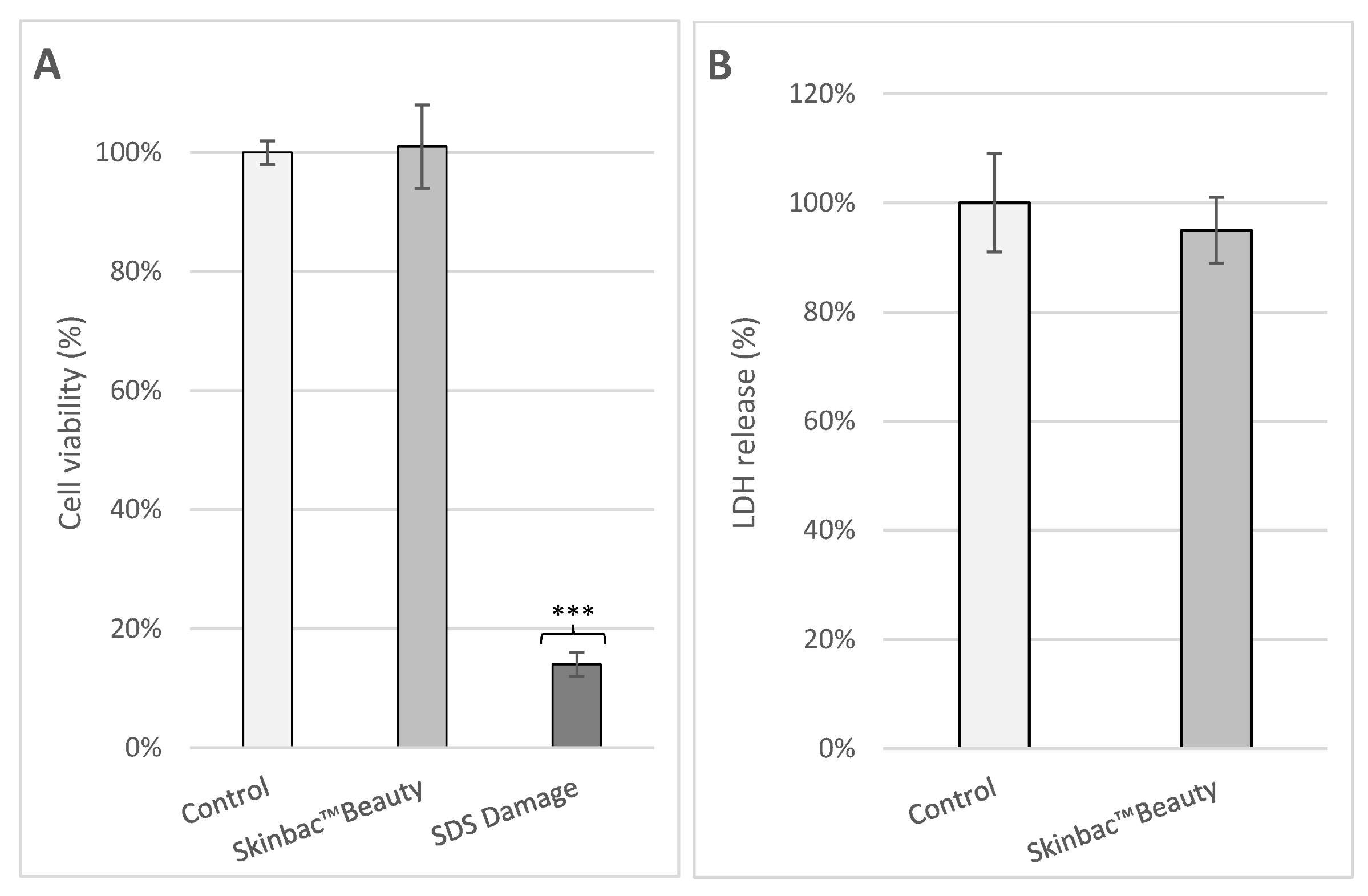
The safety profile of Skinbac™ Beauty was evaluated in NHEK cells through complementary cytotoxicity assays (Figure 1). MTT assay demonstrated maintained metabolic activity (100% ± 7% relative to control) after 24 h treatment with Skinbac™ Beauty, indicating no mitochondrial dysfunction. Similarly, LDH release assay showed comparable levels between treated (95% ± 6%) and untreated cells (100% ± 9%), confirming membrane integrity preservation. These results establish the safety of Skinbac™ Beauty at the tested concentration.

3.2. Molecular Mechanism Analysis

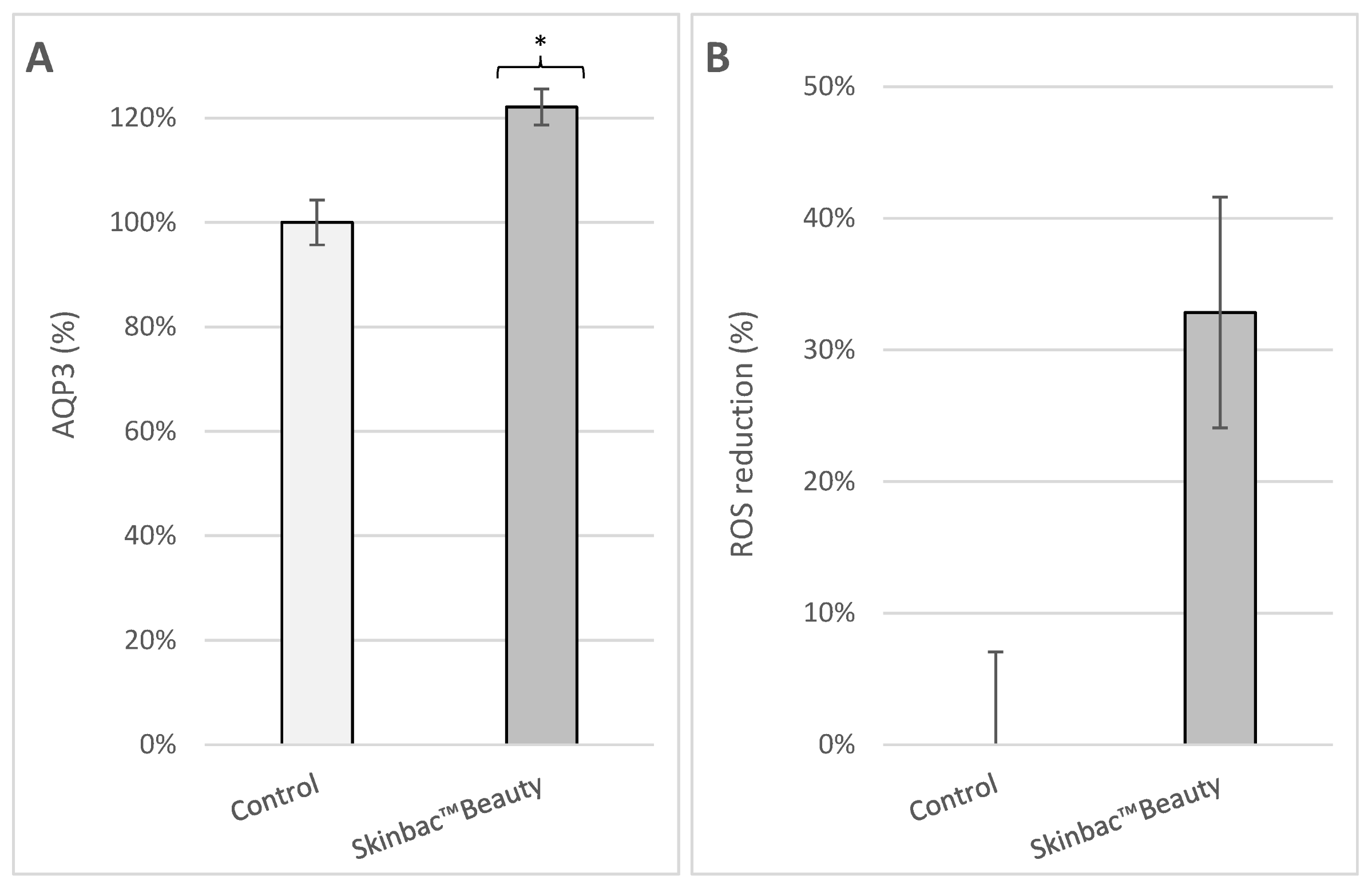
Treatment with Skinbac™ Beauty resulted in a statistically significant increase in AQP3 expression in keratinocytes (+22% ± 3% relative to control, p = 0.03), suggesting modulation of epidermal water transport pathways. In parallel, a reduction in intracellular ROS levels was observed (−33% ± 9%, p = 0.06) as shown in Figure 2; however, this change did not reach statistical significance (p = 0.06) and should be interpreted as an exploratory finding.

3.3. Clinical Efficacy Assessment

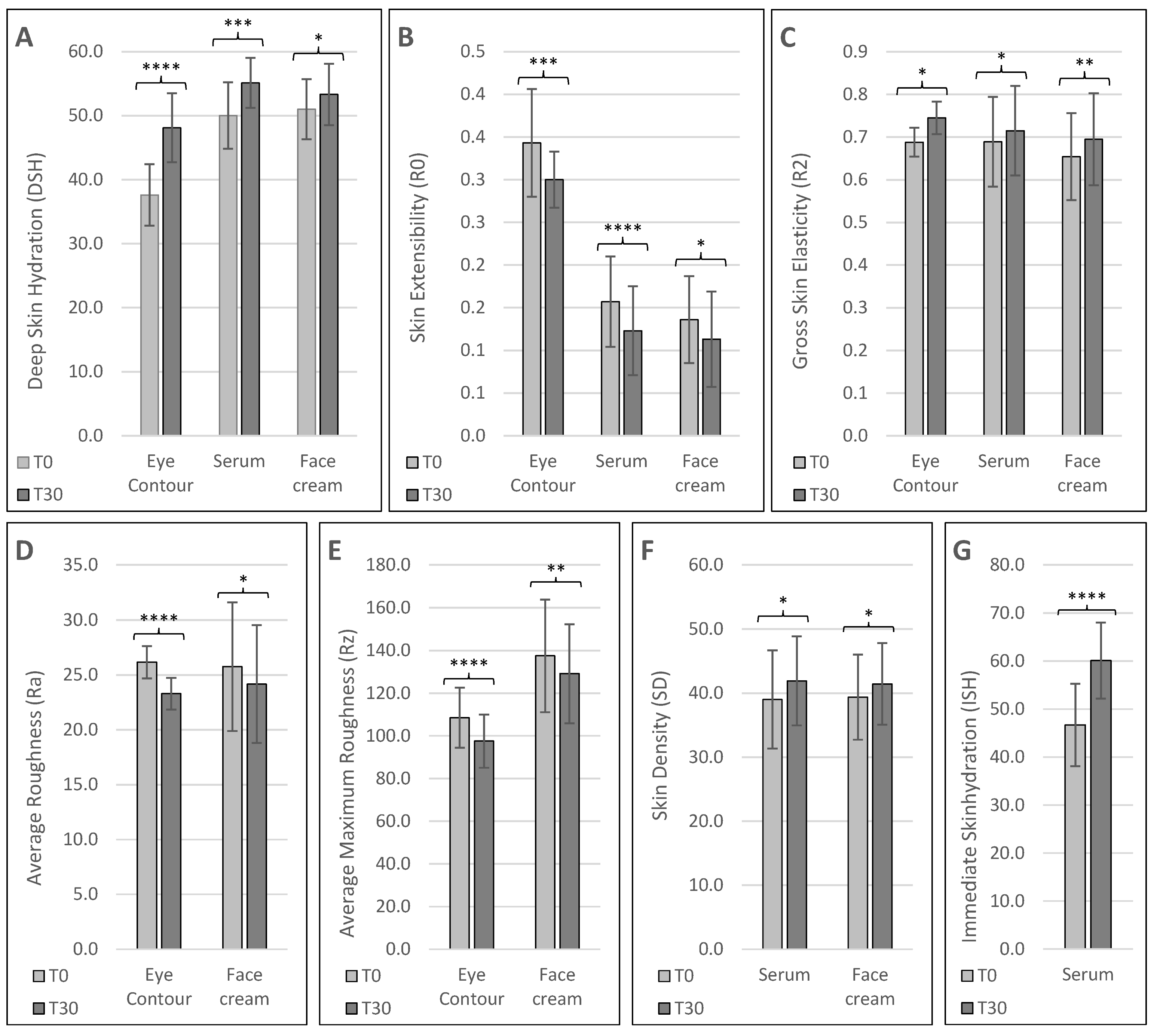
Building upon the in vitro safety profile and exploratory mechanistic observations, clinical evaluation assessed whether measurable improvements in skin parameters occurred after 30 days. All 20 participants completed the 30-day study without adverse events. Instrumental measurements revealed formulation-dependent improvements in multiple skin parameters (Figure 3). The eye contour formulation demonstrated the most pronounced effects, with statistically significant improvements in deep skin hydration (+10.5%, p < 0.0001), skin extensibility (−12.5%, p < 0.0001), and surface roughness parameters (Ra: −11.0%, Rz: −10.1%, both p < 0.0001). A statistically significant improvement in gross skin elasticity was also observed (+8.3%, p < 0.0001). The serum formulation significantly enhanced immediate skin hydration (+28.7%, p < 0.0001), deep skin hydration (+5.1%, p < 0.001), and skin extensibility (−21.7%, p < 0.0001), with significantly improved elasticity (+3.8%, p < 0.05) and density (+2.9%, p < 0.05). The face cream showed significant improvements in gross skin elasticity (+6.3%, p < 0.01), average maximum roughness (−6.1%, p < 0.01), deep skin hydration (+2.3%, p < 0.05), skin extensibility (−16.9%, p < 0.05), average roughness (−6.1%, p < 0.05), and skin density (+2.1%, p < 0.05). Given the formulation-dependent differences observed in our single-arm pilot study, additional external evidence was examined to contextualize these findings within a broader clinical framework.

Additional Placebo-Controlled Clinical Evidence

To strengthen the interpretation of these clinical outcomes, we incorporated findings from an independent placebo-controlled, split-face study conducted by ABICH S.r.l. (Verbania, Italy), an accredited cosmetic contract research organization, which evaluated a cosmetic emulsion containing 1% Skinbac™ Beauty in 20 healthy volunteers over 28 days. As this investigation was not designed, conducted, or analyzed by the present authors, its statistical methods are not described in Section 2.5; the analytical approach employed by ABICH S.r.l. included paired comparisons between treated and placebo sides, with a significance threshold set at p < 0.05. Because its methodology differs substantially from our open-label single-arm design, outcomes are reported narratively for contextual purposes only and were not included in the graphical summaries of this manuscript; direct quantitative comparison with the present results is not appropriate. Across 20 healthy volunteers over 28 days, the active formulation demonstrated statistically significant improvements relative to placebo in multiple parameters. Skin roughness (Ra) decreased by 9.8% with the active treatment compared with a slight increase on the placebo side (+3.8%), with significant intra-group (p = 0.0041) and inter-group effects (p = 0.0093). Mean wrinkle depth showed a 22.5% reduction (p = 0.0057), while placebo produced a non-significant increase (+6.8%). Deep hydration increased by 4.3% on the treated side and decreased on the placebo side (−2.6%), yielding a statistically significant group difference (p < 0.0001). TEWL decreased by 5.0% with the active product, contrasting with a +6.9% increase for the placebo (p = 0.0008). Skin biomechanical parameters also improved, with a 22.2% decrease in R0 (firmness index) and a 3.7% increase in R2 (elasticity), both statistically superior to placebo.
Although conducted independently, the presence of a placebo supports the mechanistic rationale and clinical improvements observed in the current pilot trial. This external evidence provides contextual background consistent with the observed results; however, it does not validate or confirm the present uncontrolled findings.

4. Discussion

This study provides preliminary evidence for the safety and potential efficacy of heat-treated L. plantarum SB01 and B. animalis spp. lactis SB05 in improving skin parameters associated with aging. The use of heat-treated probiotics (postbiotics) offers practical advantages for cosmetic formulations, including enhanced stability, extended shelf life, and elimination of concerns regarding viable organism colonization [28,30,33]. Our in vitro findings demonstrate excellent biocompatibility, with no cytotoxic effects observed in keratinocytes. The dual-assay approach using MTT and LDH provides complementary information about cellular health, confirming both mitochondrial function preservation and membrane integrity maintenance [34,35]. These safety data are essential prerequisites for topical application development. The observed significant increase in AQP3 expression and a non-significant reduction in ROS levels suggest biological activity consistent with the proposed mechanisms of postbiotic action. The differential statistical behavior of ROS outcomes is consistent with the exploratory nature of the in vitro analysis and highlights the need for further mechanistic studies to clarify the contribution of oxidative stress modulation. AQP3 plays crucial roles in epidermal hydration, glycerol transport, and barrier homeostasis [26,27,36]. Even modest upregulation could have physiological relevance, as AQP3 expression naturally decreases with aging and is implicated in various dermatological conditions [26]. The concurrent non-significant directional trend toward ROS reduction aligns with documented antioxidant properties of probiotic-derived metabolites, which can scavenge free radicals and activate endogenous antioxidant pathways [22,37,38]. The lack of statistical significance in the in vitro assays may reflect the limited sensitivity of simplified cellular models and the small number of experimental replicates. In contrast, clinical outcomes integrate multiple biological processes, including barrier function, hydration dynamics, and tissue biomechanics, which may amplify subtle molecular effects. Therefore, the in vitro findings should be interpreted as exploratory signals rather than direct predictors of clinical efficacy. The clinical results demonstrate formulation-dependent efficacy profiles, with the eye contour preparation showing the most robust improvements. The statistically significant improvements in deep skin hydration and surface roughness in the eye contour cohort are consistent with a measurable cosmetic benefit, particularly in the periorbital area, where skin is thinner and more susceptible to visible aging signs. Whether these changes translate to clinically perceptible outcomes warrants confirmation in larger, placebo-controlled trials. These improvements align with previous studies showing the benefits of topical L. plantarum and B. lactis preparations [19]. The differential efficacy between formulations may reflect variations in vehicle composition, application area characteristics, or concentration effects. The superior performance of the eye contour formulation could relate to enhanced penetration in the thinner periorbital skin or optimized vehicle properties for this anatomical region. The serum’s pronounced effect on immediate hydration suggests rapid surface hydration, while the face cream’s statistically significant improvement in gross elasticity (R2: +6.3%, p < 0.01) is consistent with possible effects on dermal viscoelastic properties, which remain to be confirmed in adequately powered controlled studies. Our findings align with growing evidence supporting the gut-skin axis concept extended to topical applications. Heat treatment of probiotics can release bioactive cell wall components, metabolites, and other molecules that retain biological activity [30,39]. These postbiotic components can modulate inflammation, enhance barrier function, and provide antioxidant benefits without requiring viable organisms [40,41]. These clinical improvements are consistent with external placebo-controlled evidence on a related 1% postbiotic formulation, which demonstrated performance to placebo for wrinkle depth, roughness, hydration, barrier function, and biomechanical parameters. This external evidence provides contextual background consistent with the observed results; however, it does not validate or confirm the present uncontrolled findings (ABICH S.r.l., data on file, 2022). The external placebo-controlled study cannot replace a properly controlled design within the present investigation and is therefore used exclusively to contextualize, not validate, the observed clinical findings.

Study Limitations

This pilot study has several limitations that should be acknowledged. The small sample size (n = 20) limits statistical power, particularly for detecting modest effect sizes in in vitro experiments. The open-label, single-arm design without placebo control prevents definitive efficacy conclusions, as improvements could partially reflect placebo effects or natural temporal variations. The homogeneous study population (Caucasian females) limits generalizability to other demographics. Additionally, Fitzpatrick skin type and BMI were not systematically recorded, precluding subgroup analyses based on phototype or body composition. Future studies should prospectively collect these variables to characterize potential responder profiles. For several parameters in the face cream cohort, the absolute magnitude of improvement was numerically modest relative to baseline variability (e.g., deep skin hydration: +2.3% versus SD 4.7%; average roughness Ra: −6.1% versus SD 5.9%). Although these changes reached statistical significance, their clinical relevance should be interpreted cautiously and requires replication in larger, controlled trials. The 30-day duration may be insufficient to capture long-term effects or potential tolerance development. The borderline/non-significant in vitro finding for ROS (p = 0.06) should be interpreted cautiously. While consistent directional changes suggest biological activity, these trends require confirmation in adequately powered studies. Future research should employ dose–response designs, include mechanistic validation, and extend observation periods. The absence of a placebo arm in the present study partially limits causal inference; however, the consistent superiority of a comparable formulation over placebo in an independent split-face trial provides supportive external validation that formulations containing comparable postbiotic actives can outperform placebo under controlled conditions. Given the exploratory nature of this pilot study, no correction for multiple testing was applied, and the results should be interpreted as hypothesis-generating rather than confirmatory. The assessment of multiple outcome parameters without adjustment for multiple testing increases the risk of type I error and further supports the exploratory nature of the findings. Although the three formulations were applied to anatomically distinct facial areas, the simultaneous within-subject application of the same postbiotic active across multiple sites may introduce systemic or diffusion-related carryover effects that cannot be fully excluded in this design.

5. Conclusions

This pilot study provides preliminary evidence that heat-treated L. plantarum SB01 and B. animalis spp. lactis SB05 formulations are safe and potentially effective for improving skin hydration and reducing roughness parameters. The clinical improvements, particularly with the eye contour formulation (+10.5% hydration, −11% roughness, both p < 0.0001), may suggest cosmetic benefits. While in vitro results show significant increase in AQP3 expression and non-significant reduction in ROS levels, these findings require validation in larger studies. The use of heat-treated probiotics represents a practical approach for cosmetic applications, combining stability advantages with maintained bioactivity. Our findings support further development of postbiotic-based formulations for skin aging management. Additional randomized, double-blind, placebo-controlled studies involving larger and geographically diverse populations will help expand the current findings and establish optimal formulation strategies tailored to different skin types.

Author Contributions

Conceptualization: M.P.; methodology, A.V. and A.A.; investigation, G.D. and A.V.; data curation, A.A.; writing, original draft preparation, G.D.; writing, review and editing, M.P.; supervision, M.P.; project administration, M.P. All authors have read and agreed to the published version of the manuscript.

Funding

This research was supported by Probiotical S.p.A.

Institutional Review Board Statement

The study was conducted in accordance with the Declaration of Helsinki. Ethical review and approval were waived/not required for this study due to the non-invasive nature of the procedures and because it was conducted in accordance with applicable local regulations for cosmetic product testing.

Informed Consent Statement

Informed consent was obtained from all subjects involved in the study.

Data Availability Statement

The original contributions presented in this study are included in the article. Further inquiries can be directed to the corresponding author.

Acknowledgments

This research was carried out as part of internal activities. The in vivo analyses were performed by LabAnalysis S.r.l. The authors would like to thank Clémence Robert for professional assistance in the preparation and editing of the manuscript. The authors also acknowledge Paolo Saronni for technical support and valuable input during the project. Additional external clinical data used for contextualization was generated by ABICH S.r.l., whose contribution to data acquisition is gratefully acknowledged.

Conflicts of Interest

G.D., A.V., A.A., and M.P. are employees of Probiotical Research Srl. The authors declare that, despite these financial and commercial relationships, the research was conducted with complete scientific autonomy and independence. The funders had no role in the design of the study; in the collection, analyses, or interpretation of data; in the writing of the manuscript; or in the decision to publish the results. All scientific decisions were made independently by the research team, and the study protocol, methodology, and conclusions reflect solely the scientific judgment of the authors.

References

  1. Proksch, E.; Brandner, J.M.; Jensen, J.M. The Skin: An Indispensable Barrier. Exp. Dermatol. 2008, 17, 1063–1072. [Google Scholar] [CrossRef] [PubMed]
  2. Farage, M.A.; Miller, K.W.; Elsner, P.; Maibach, H.I. Characteristics of the Aging Skin. Adv. Wound Care 2013, 2, 5–10. [Google Scholar] [CrossRef] [PubMed]
  3. Günzel, D.; Yu, A.S.L. Claudins and the Modulation of Tight Junction Permeability. Physiol. Rev. 2013, 93, 525–569. [Google Scholar] [CrossRef] [PubMed]
  4. Honari, G.; Maibach, H. Chapter 1—Skin Structure and Function. In Applied Dermatotoxicology; Maibach, H., Honari, G., Eds.; Academic Press: Boston, MA, USA, 2014; pp. 1–10. [Google Scholar]
  5. Fluhr, J.W.; Moore, D.J.; Lane, M.E.; Lachmann, N.; Rawlings, A.V. Epidermal Barrier Function in Dry, Flaky and Sensitive Skin: A Narrative Review. J. Eur. Acad. Dermatol. Venereol. 2024, 38, 812–820. [Google Scholar] [CrossRef]
  6. Schuetz, R.; Claypool, J.; Sfriso, R.; Vollhardt, J.H. Sunscreens Can Preserve Human Skin Microbiome upon Erythemal UV Exposure. Int. J. Cosmet. Sci. 2024, 46, 71–84. [Google Scholar] [CrossRef]
  7. Lee, H.-J.; Kim, M. Skin Barrier Function and the Microbiome. Int. J. Mol. Sci. 2022, 23, 13071. [Google Scholar] [CrossRef]
  8. Knackstedt, R.; Knackstedt, T.; Gatherwright, J. The role of topical probiotics in skin conditions: A systematic review of animal and human studies and implications for future therapies. Exp. Dermatol. 2020, 29, 15–21. [Google Scholar] [CrossRef]
  9. Ashkanani, A.; Ashkanani, G.; Yousef, M.; Rob, M.; Al-Marri, M.; Naseem, N.; Laws, S.; Chaari, A. Microbiome and Skin Health: A Systematic Review of Nutraceutical Interventions, Disease Severity, Inflammation, and Gut Microbiota. Microorganisms 2025, 14, 63. [Google Scholar] [CrossRef]
  10. Farage, M.A.; Miller, K.W.; Elsner, P.; Maibach, H.I. Intrinsic and Extrinsic Factors in Skin Ageing: A Review. Int. J. Cosmet. Sci. 2008, 30, 87–95. [Google Scholar] [CrossRef]
  11. Kohl, E.; Steinbauer, J.; Landthaler, M.; Szeimies, R.M. Skin Ageing. J. Eur. Acad. Dermatol. Venereol. 2011, 25, 873–884. [Google Scholar] [CrossRef]
  12. Dreno, B.; Shourick, J.; Kerob, D.; Bouloc, A.; Taïeb, C. The role of exposome in acne: Results from an international patient survey. J. Eur. Acad. Dermatol. Venereol. 2020, 34, 1057–1064. [Google Scholar] [CrossRef]
  13. El-Domyati, M.; Attia, S.; Saleh, F.; Brown, D.; Birk, D.E.; Gasparro, F.; Ahmad, H.; Uitto, J. Intrinsic Aging vs. Photoaging: A Comparative Histopathological, Immunohistochemical, and Ultrastructural Study of Skin. Exp. Dermatol. 2002, 11, 398–405. [Google Scholar] [CrossRef]
  14. Han, J.H.; Kim, H.S. Skin Deep: The potential of Microbiome Cosmetics. J. Microbiol. 2024, 62, 181–199. [Google Scholar] [CrossRef] [PubMed]
  15. Santos, Y.R.; Andréo-Filho, N.; Lopes, P.S.; Leite-Silva, V.R. A review of skin microbiome and new challenges to cosmetic microbiome-friendly formulations. Int. J. Cosmet. Sci. 2026; Epub ahead of printing. [Google Scholar] [CrossRef] [PubMed]
  16. Lozupone, C.A.; Stombaugh, J.I.; Gordon, J.I.; Jansson, J.K.; Knight, R. Diversity, Stability and Resilience of the Human Gut Microbiota. Nature 2012, 489, 220–230. [Google Scholar] [CrossRef] [PubMed]
  17. Woo, Y.R.; Kim, H.S. Interaction between the Microbiota and the Skin Barrier in Aging Skin: A Comprehensive Review. Front. Physiol. 2024, 15, 1322205. [Google Scholar] [CrossRef]
  18. Ratanapokasatit, Y.; Laisuan, W.; Rattananukrom, T.; Petchlorlian, A.; Thaipisuttikul, I.; Sompornrattanaphan, M. How Microbiomes Affect Skin Aging: The Updated Evidence and Current Perspectives. Life 2022, 12, 936. [Google Scholar] [CrossRef]
  19. Gruber, J.V.; Holtz, R. Living, Quiescent Lactobacillus Plantarum Lp90 Probiotic, Delivered Topically to Full Thickness Tissues in Vitro via a Just-Add-Water Cream Delivery System, Stimulates the Expression of Elastin Protein. J. Cosmet. Dermatol. 2023, 22, 2852–2860. [Google Scholar] [CrossRef]
  20. Chilicka, K.; Dzieńdziora-Urbińska, I.; Szyguła, R.; Asanova, B.; Nowicka, D. Microbiome and Probiotics in Acne Vulgaris—A Narrative Review. Life 2022, 12, 422. [Google Scholar] [CrossRef]
  21. Hashemi, S.S.; Rafati, A.; Roohinejad, S.; Yaghoobi, F.; Salehi, A. Postbiotics as Emerging Therapeutics for Skin Wound Healing and Dermatological Care: Clinical Trends and Mechanistic Insights. Int. Wound J. 2025, 22, e70799. [Google Scholar] [CrossRef]
  22. Habeebuddin, M.; Karnati, R.K.; Shiroorkar, P.N.; Nagaraja, S.; Asdaq, S.M.B.; Anwer, K.; Fattepur, S. Topical Probiotics: More Than a Skin Deep. Pharmaceutics 2022, 14, 557. [Google Scholar] [CrossRef] [PubMed]
  23. Yu, Y.; Dunaway, S.; Champer, J.; Kim, J.; Alikhan, A. Changing our microbiome: Probiotics in dermatology. Br. J. Dermatol. 2020, 182, 39–46. [Google Scholar] [CrossRef] [PubMed]
  24. Ganceviciene, R.; Liakou, A.I.; Theodoridis, A.; Makrantonaki, E.; Zouboulis, C.C. Skin anti-aging strategies. Derm.-Endocrinol. 2012, 4, 308–319. [Google Scholar] [CrossRef] [PubMed]
  25. Mondadori, G.; Amoruso, A.; Visciglia, A.; Deusebio, G.; Pinto, D.; Pane, M.; Rinaldi, F. Heat-Treated Probiotics’ Role in Counteraction of Skin UVs-Induced Damage In Vitro. Cosmetics 2025, 12, 121. [Google Scholar] [CrossRef]
  26. Bollag, W.B.; Aitkens, L.; White, J.; Hyndman, K.A. Aquaporin-3 in the Epidermis: More than Skin Deep. Am. J. Physiol.-Cell Physiol. 2020, 318, C1144–C1153. [Google Scholar] [CrossRef]
  27. Qin, H.; Zheng, X.; Zhong, X.; Shetty, A.K.; Elias, P.M.; Bollag, W.B. Aquaporin-3 in Keratinocytes and Skin: Its Role and Interaction with Phospholipase D2. Arch. Biochem. Biophys. 2011, 508, 138–143. [Google Scholar] [CrossRef]
  28. Salminen, S.; Collado, M.C.; Endo, A.; Hill, C.; Lebeer, S.; Quigley, E.M.; Sanders, M.E.; Shamir, R.; Swann, J.R.; Szajewska, H.; et al. The International Scientific Association of Probiotics and Prebiotics (ISAPP) consensus statement on the definition and scope of postbiotics. Nat. Rev. Gastroenterol. Hepatol. 2021, 18, 649–667. [Google Scholar] [CrossRef]
  29. Aguilar-Toalá, J.E.; Garcia-Varela, R.; Garcia, H.S.; Mata-Haro, V.; González-Córdova, A.F.; Vallejo-Cordoba, B.; Hernández-Mendoza, A. Postbiotics: An Evolving Term within the Functional Foods Field. Trends Food Sci. Technol. 2018, 75, 105–114. [Google Scholar] [CrossRef]
  30. Piqué, N.; Berlanga, M.; Miñana-Galbis, D. Health Benefits of Heat-Killed (Tyndallized) Probiotics: An Overview. Int. J. Mol. Sci. 2019, 20, 2534. [Google Scholar] [CrossRef]
  31. Ferrillo, M.; Vastarella, M.; Cantelli, M.; Mazzella, C.; Fabbrocini, G. Instrumental, clinical and subjective evaluation of the efficacy of a cosmetic treatment for home use. J. Cosmet. Laser Ther. 2019, 21, 190–195. [Google Scholar] [CrossRef]
  32. Draelos, Z.D. (Ed.) Cosmetic Dermatology: Products and Procedures; John Wiley & Sons: Hoboken, NJ, USA, 2021. [Google Scholar]
  33. Lopes, E.G.; Moreira, D.A.; Gullón, P.; Gullón, B.; Cardelle-Cobas, A.; Tavaria, F.K. Topical application of probiotics in skin: Adhesion, antimicrobial and antibiofilm in vitro assays. J. Appl. Microbiol. 2017, 122, 450–461. [Google Scholar] [CrossRef]
  34. Mosmann, T. Rapid colorimetric assay for cellular growth and survival: Application to proliferation and cytotoxicity assays. J. Immunol. Methods 1983, 65, 55–63. [Google Scholar] [CrossRef] [PubMed]
  35. Decker, T.; Lohmann-Matthes, M.L. A quick and simple method for the quantitation of lactate dehydrogenase release in measurements of cellular cytotoxicity and tumor necrosis factor (TNF) activity. J. Immunol. Methods 1988, 115, 61–69. [Google Scholar] [CrossRef] [PubMed]
  36. Karimi, N.; Ahmadi, V. Aquaporin Channels in Skin Physiology and Aging Pathophysiology: Investigating Their Role in Skin Function and the Hallmarks of Aging. Biology 2024, 13, 862. [Google Scholar] [CrossRef] [PubMed]
  37. Papaccio, F.; Caputo, S.; Bellei, B. Focus on the Contribution of Oxidative Stress in Skin Aging. Antioxidants 2022, 11, 1121. [Google Scholar] [CrossRef]
  38. Pourzand, C.; Albieri-Borges, A.; Raczek, N.N. Shedding a New Light on Skin Aging, Iron- and Redox-Homeostasis and Emerging Natural Antioxidants. Antioxidants 2022, 11, 471. [Google Scholar] [CrossRef]
  39. Mehta, J.P.; Ayakar, S.; Singhal, R.S. The potential of paraprobiotics and postbiotics to modulate the immune system: A Review. Microbiol. Res. 2023, 275, 127449. [Google Scholar] [CrossRef]
  40. Żółkiewicz, J.; Marzec, A.; Ruszczyński, M.; Feleszko, W. Postbiotics-A Step Beyond Pre- and Probiotics. Nutrients 2020, 12, 2189. [Google Scholar] [CrossRef]
  41. Liang, B.; Xing, D. The Current and Future Perspectives of Postbiotics. Probiotics Antimicrob. Proteins 2023, 15, 1626–1643. [Google Scholar] [CrossRef]
Figure 1. Safety assessment of Skinbac™ Beauty in NHEK cells. (A) Cell viability measured by MTT assay after 24 h treatment (107 TFU/mL). Sodium dodecyl sulfate (SDS) was used as a positive control to induce viability damage. (B) Cytotoxicity evaluated by LDH release assay under identical conditions. Data represent mean ± SD of three independent experiments. *** Statistical significance of the SDS Damage compared to Control. Provide for a damage example.
Cosmetics 13 00076 g001
Figure 2. Molecular effects of Skinbac™ Beauty on NHEK cells. (A) AQP3 protein expression measured by ELISA after 24 h of treatment. (B) Intracellular ROS levels quantified by cytochrome C reduction assay. Data are expressed as mean ± SD of three independent experiments. AQP3 expression was significantly increased versus control (p = 0.03), whereas the reduction in ROS levels did not reach statistical significance (p = 0.06). Statistical significance: * p < 0.05.
Cosmetics 13 00076 g002
Figure 3. Clinical efficacy parameters after 30 days of treatment. (A) Deep Skin Hydration expressed as water percentage calculated from the measured dielectric constant using the formula Water% = [(ε − 1)/(εw − 1)] × 100%, where εw = 79.0 at 25 °C and 1 MHz. (B) Skin Extensibility (R0) indicates the passive response of the skin to mechanical force, expressed in millimeters; lower values correspond to higher skin firmness. (C) Gross Skin Elasticity (R2) is a dimensionless ratio (Ua/Uf; range 0–1) representing the relationship between recovery ability and extensibility—the closer to 1, the higher the elasticity. (D) Average Roughness (Ra) calculated from optical surface profiles and expressed in gray levels (0–255). (E) Average Maximum Roughness (Rz) represents the mean difference between the highest and lowest points across five profile sections, expressed in gray levels (0–255). (F) Skin Density (SD) measured by high-frequency ultrasound scanning (20 MHz), enabling tissue visualization up to 15 mm in depth with 60 µm axial and 200 µm lateral resolution. (G) Immediate Skin Hydration (ISH) derived from dielectric constant measurements using the MoistureMeterEpiD (300 MHz). Statistical significance: * p < 0.05, ** p < 0.01, *** p < 0.001, **** p < 0.0001 versus baseline (T0). All statistical comparisons were performed by paired-samples t-test (within-subject design). In this design, significance is determined by intra-individual change; apparent overlap of SEM bars between timepoints does not preclude statistical significance.
Cosmetics 13 00076 g003
Table 1. Participants Characteristics and Study Design.
CharacteristicValue
Study designOpen-label, single-arm, within-subject
Sample size (n)20
SexFemale
Age—mean ± SD (years)45.3 ± 12.7
Age range (years)18–70
RaceCaucasian (self-reported)
Fitzpatrick skin typeNot recorded
BMINot recorded
Formulations applied (all participants)Face cream (cheek), Serum (forehead), Eye contour (crow’s feet)
Study duration30 days
Application frequencyTwice daily (morning and evening)
Adverse events/drop-outsNone/0
Fitzpatrick skin type and BMI were not systematically recorded in the study protocol. See the Study Limitations Section for discussion.
Disclaimer/Publisher’s Note: The statements, opinions and data contained in all publications are solely those of the individual author(s) and contributor(s) and not of MDPI and/or the editor(s). MDPI and/or the editor(s) disclaim responsibility for any injury to people or property resulting from any ideas, methods, instructions or products referred to in the content.