
Ex Vivo Human Skin as a Platform to Study Cosmetic Modulation of Specialized Pro-Resolving Mediators
 , , ,
, , ,
Abstract
1. Introduction
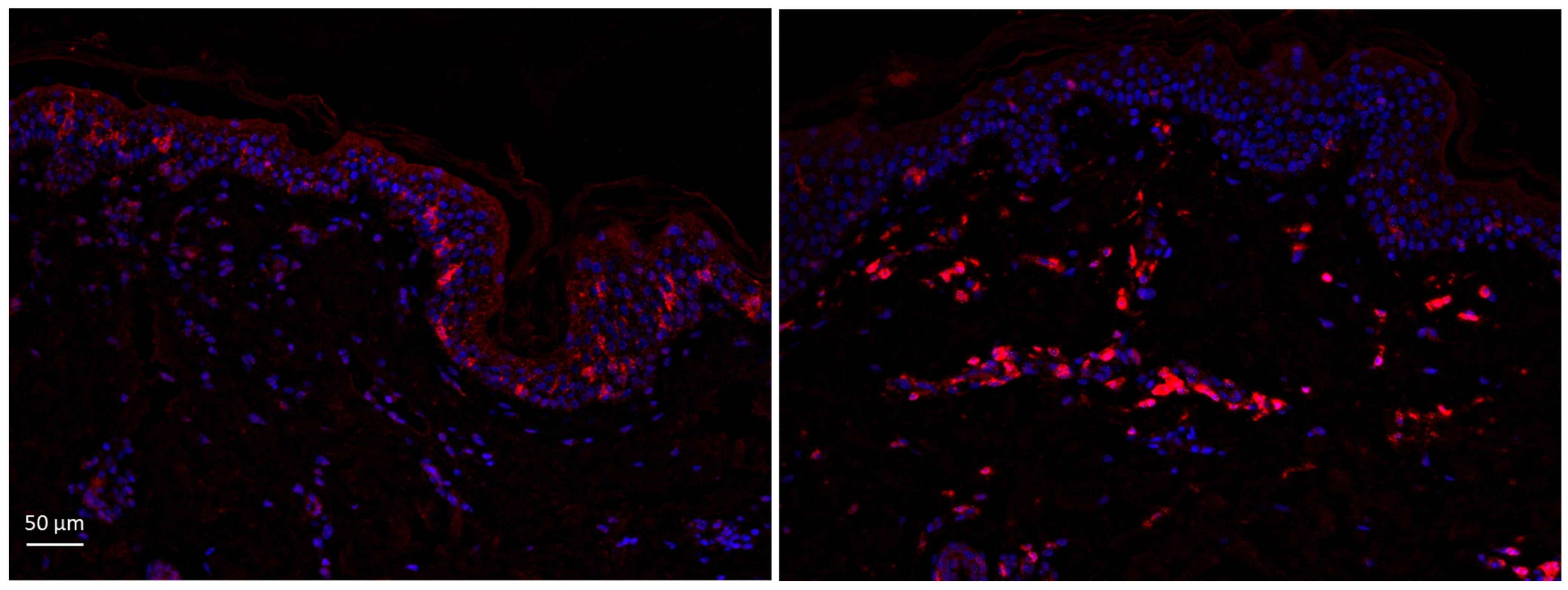
- Since immune cells (primarily neutrophils and macrophages) are the main producers of SPMs, we estimated the LCs in the epidermis and leukocytes in the dermis to assess the model’s ability to generate detectable amounts of SPMs.
- The survival and retention of these cells during the first 3 days of culture were studied to rule out potential adaptation issues or migration out of the tissue.
- It was demonstrated that MaR1 is produced at detectable levels and released into the culture medium, where it was quantified using an ELISA assay.
- The findings confirmed that the model can effectively modulate MaR1 production in response to DHA treatment.
2. Materials and Methods
2.1. Ex Vivo Skin Culture
2.2. Methodological Approach for Immune Cell Quantification in Ex Vivo Skin Samples
- CD1α, a marker specifically expressed in LCs, the most abundant immune cell population within the epidermal layer [37], and
- CD18, also known as integrin β chain-2 (β2), an integrin β chain protein shared among all leukocytes. It pairs with one of several variants of α chains (CD11), depending on the immune cell subtype, forming various heterodimers.
2.3. Experimental Design and Estimation of MaR1 Production in Ex Vivo Skin Cultures
2.3.1. Effect of Tissue-to-Medium Ratio and Culture Time: Preliminary Study
2.3.2. Response to Stimulatory Treatments and Final Protocol with Optimized Biopsy-to-Medium Ratio
2.4. Methodological Considerations and Data Limitations
3. Results
3.1. Quantification of the Immune Cells in Ex Vivo Skin Samples
3.2. Estimation of MaR1 Synthesis in Ex Vivo Skin Cultures
4. Discussion
Author Contributions
Funding
Institutional Review Board Statement
Informed Consent Statement
Data Availability Statement
Conflicts of Interest
Abbreviations
| d.f. | Dilution factor |
| DHA | Docosahexaenoic acid |
| ELISA | Enzyme-linked immunosorbent assay |
| EPA | Eicosapentaenoic acid |
| 15-LOX-1 | 15-Lipoxygenase type 1 |
| LC | Langerhans cell |
| MaR | Maresin |
| SPM | Specialized pro-resolving mediator |
| t.r. | Technical replicate |
| w.w. | Wet weight |
References
- Wild, C.P. Complementing the Genome with an “Exposome”: The Outstanding Challenge of Environmental Exposure Measurement in Molecular Epidemiology. Cancer Epidemiol. Biomark. Prev. 2005, 14, 1847–1850. [Google Scholar] [CrossRef] [PubMed]
- Khmaladze, I.; Leonardi, M.; Fabre, S.; Messaraa, C.; Mavon, A. The Skin Interactome: A Holistic “Genome-Microbiome-Exposome” Approach to Understand and Modulate Skin Health and Aging. Clin. Cosmet. Investig. Dermatol. 2020, 13, 1021–1040. [Google Scholar] [CrossRef]
- Kalia, V.; Belsky, D.W.; Baccarelli, A.A.; Miller, G.W. An Exposomic Framework to Uncover Environmental Drivers of Aging. Exposome 2022, 2, osac002. [Google Scholar] [CrossRef]
- Shiels, P.G.; Painer, J.; Natterson-Horowitz, B.; Johnson, R.J.; Miranda, J.J.; Stenvinkel, P. Manipulating the Exposome to Enable Better Ageing. Biochem. J. 2021, 478, 2889–2898. [Google Scholar] [CrossRef]
- Papaccio, F.; D′Arino, A.; Caputo, S.; Bellei, B. Focus on the Contribution of Oxidative Stress in Skin Aging. Antioxidants 2022, 11, 1121. [Google Scholar] [CrossRef] [PubMed]
- Liguori, I.; Russo, G.; Curcio, F.; Bulli, G.; Aran, L.; Della-Morte, D.; Gargiulo, G.; Testa, G.; Cacciatore, F.; Bonaduce, D.; et al. Oxidative Stress, Aging, and Diseases. Clin. Interv. Aging 2018, 13, 757–772. [Google Scholar] [CrossRef] [PubMed]
- Calder, P.C.; Bosco, N.; Bourdet-Sicard, R.; Capuron, L.; Delzenne, N.; Doré, J.; Franceschi, C.; Lehtinen, M.J.; Recker, T.; Salvioli, S. Health Relevance of the Modification of Low Grade Inflammation in Ageing (Inflammageing) and the Role of Nutrition. Ageing Res. Rev. 2017, 40, 95–119. [Google Scholar] [CrossRef]
- Wang, F.; Huang, S.; Xia, H.; Yao, S. Specialized Pro-Resolving Mediators: It’s Anti-Oxidant Stress Role in Multiple Disease Models. Mol. Immunol. 2020, 126, 40–45. [Google Scholar] [CrossRef]
- Chene, G.; Baillif, V.; Goethem, E.V.; Branka, J.-E.; Ionescu, T.; Robert, G.; Lefeuvre, L. In Vitro and in Vivo Anti-Inflammatory Effect of a Biotechnologically Modified Borage Seed Extract: Evidence for Lipid Pro-Resolving Mediators’ Implication in the Enhancement of Psoriatic and Atopic Dermatitis Lesions. J. Cosmet. Dermatol. Sci. Appl. 2015, 5, 151. [Google Scholar] [CrossRef]
- Duroux, R.; Baillif, V.; Havas, F.; Farge, M.; Maurin, A.; Suere, T.; VanGoethem, E.; Attia, J. Targeting Inflammation and Pro-Resolving Mediators with Anetholea anisita Extract to Improve Scalp Condition. Int. J. Cosmet. Sci. 2022, 44, 614–624. [Google Scholar] [CrossRef] [PubMed]
- Nip, J.; Hermanson, K.; Lee, J. N-3 PUFAs Docosahexaenoic Acid and Eicosapentaenoic Acid Are Effective Natural Pro-resolution Ingredients for Topical Skin Applications. Int. J. Cosmet. Sci. 2025, 47, 820–826. [Google Scholar] [CrossRef]
- Serhan, C.N. Pro-Resolving Lipid Mediators Are Leads for Resolution Physiology. Nature 2014, 510, 92–101. [Google Scholar] [CrossRef] [PubMed]
- Hellmann, J.; Sansbury, B.E.; Wong, B.; Li, X.; Singh, M.; Nuutila, K.; Chiang, N.; Eriksson, E.; Serhan, C.N.; Spite, M. Biosynthesis of D-Series Resolvins in Skin Provides Insights into Their Role in Tissue Repair. J. Invest. Dermatol. 2018, 138, 2051–2060. [Google Scholar] [CrossRef] [PubMed]
- Balta, M.G.; Schreurs, O.; Hansen, T.V.; Tungen, J.E.; Vik, A.; Glaab, E.; Küntziger, T.M.; Schenck, K.; Baekkevold, E.S.; Blix, I.J.S. Expression and Function of Resolvin RvD1n-3 DPA Receptors in Oral Epithelial Cells. Eur. J. Oral Sci. 2022, 130, e12883. [Google Scholar] [CrossRef] [PubMed]
- Herrera, B.S.; Kantarci, A.; Zarrough, A.; Hasturk, H.; Leung, K.P.; Van Dyke, T.E. LXA4 Actions Direct Fibroblast Function and Wound Closure. Biochem. Biophys. Res. Commun. 2015, 464, 1072–1077. [Google Scholar] [CrossRef]
- Dai, J.; Brooks, Y.; Lefort, K.; Getsios, S.; Dotto, G.P. The Retinoid-Related Orphan Receptor RORα Promotes Keratinocyte Differentiation via FOXN1. PLoS ONE 2013, 8, e70392. [Google Scholar] [CrossRef]
- Shahbakhti, H.; Watson, R.E.B.; Azurdia, R.M.; Ferreira, C.Z.; Garmyn, M.; Rhodes, L.E. Influence of Eicosapentaenoic Acid, an Omega-3 Fatty Acid, on Ultraviolet-B Generation of Prostaglandin-E2 and Proinflammatory Cytokines Interleukin-1β, Tumor Necrosis Factor-α, Interleukin-6 and Interleukin-8 in Human Skin In Vivo. Photochem. Photobiol. 2004, 80, 231–235. [Google Scholar] [CrossRef]
- Sorokin, A.V.; Arnardottir, H.; Svirydava, M.; Ng, Q.; Baumer, Y.; Berg, A.; Pantoja, C.J.; Florida, E.M.; Teague, H.L.; Yang, Z.-H.; et al. Comparison of the Dietary Omega-3 Fatty Acids Impact on Murine Psoriasis-like Skin Inflammation and Associated Lipid Dysfunction. J. Nutr. Biochem. 2023, 117, 109348. [Google Scholar] [CrossRef]
- Ontoria-Oviedo, I.; Amaro-Prellezo, E.; Castellano, D.; Venegas-Venegas, E.; González-Santos, F.; Ruiz-Saurí, A.; Pelacho, B.; Prósper, F.; Pérez del Caz, M.D.; Sepúlveda, P. Topical Administration of a Marine Oil Rich in Pro-Resolving Lipid Mediators Accelerates Wound Healing in Diabetic Db/Db Mice through Angiogenesis and Macrophage Polarization. Int. J. Mol. Sci. 2022, 23, 9918. [Google Scholar] [CrossRef]
- Ringheim-Bakka, T.A.; Saliani, A.; Østbye, T.-K.K.; Mildenberger, J.; Dooley, M.; Busygina, M.; Pedersen, M.E.; Solberg, N.T.; Dalli, J.; Gammelsæter, R. Phospholipid Esters from Herring Roe Promotes SPM Biosynthesis in Human Monocyte-Derived Macrophages and a Keratinocyte/Fibroblast Co-Culture with Implications for the Treatment of Psoriasis. bioRxiv 2025. [Google Scholar] [CrossRef]
- McCusker, M.M.; Grant-Kels, J.M. Healing Fats of the Skin: The Structural and Immunologic Roles of the ω-6 and ω-3 Fatty Acids. Clin. Dermatol. 2010, 28, 440–451. [Google Scholar] [CrossRef] [PubMed]
- Bannenberg, G.L.; Serhan, C.N.; Egea, F.M. Oils with Anti-Inflammatory Activity Containing Natural Specialized Proresolving Mediators and Their Precursors. Patent US 10,568,858 B2, 25 February 2020. [Google Scholar]
- Neacșu, S.M.; Hîncu, L.; Vlaia, L.L.; Lupuliasa, D.; Scafa-Udriște, A.; Mihai, S.; Olteanu, G.; Grumezescu, A.M.; Ene, R.; Marin, R.C.; et al. Eco-Friendly Extraction and Formulation of Black Sea Shark Liver Oil-Based Emulgel for Anti-Inflammatory and Healing Dermatocosmetic Applications. Gels 2025, 11, 222. [Google Scholar] [CrossRef] [PubMed]
- Park, K.C.; Kim, J.; Lee, A.; Lim, J.-S.; Kim, K.I. Alleviation of Imiquimod-Induced Psoriasis-like Symptoms in Rorα -Deficient Mouse Skin. BMB Rep. 2023, 56, 296–301. [Google Scholar] [CrossRef]
- Kim, T.-H.; Kim, G.-D.; Jin, Y.-H.; Park, Y.S.; Park, C.-S. Omega-3 Fatty Acid-Derived Mediator, Resolvin E1, Ameliorates 2, 4-Dinitrofluorobenzene-Induced Atopic Dermatitis in NC/Nga Mice. Int. Immunopharmacol. 2012, 14, 384–391. [Google Scholar] [CrossRef]
- Pagac, M.P.; Gempeler, M.; Campiche, R. A New Generation of Postbiotics for Skin and Scalp: In Situ Production of Lipid Metabolites by Malassezia. Microorganisms 2024, 12, 1711. [Google Scholar] [CrossRef]
- Martinez, R.M.; Fattori, V.; Saito, P.; Pinto, I.C.; Rodrigues, C.C.A.; Melo, C.P.B.; Bussmann, A.J.C.; Staurengo-Ferrari, L.; Bezerra, J.R.; Vignoli, J.A.; et al. The Lipoxin Receptor/FPR2 Agonist BML-111 Protects Mouse Skin Against Ultraviolet B Radiation. Molecules 2020, 25, 2953. [Google Scholar] [CrossRef]
- Cezar, T.L.C.; Martinez, R.M.; da Rocha, C.; Melo, C.P.B.; Vale, D.L.; Borghi, S.M.; Fattori, V.; Vignoli, J.A.; Camilios-Neto, D.; Baracat, M.M.; et al. Treatment with Maresin 1, a Docosahexaenoic Acid-Derived pro-Resolution Lipid, Protects Skin from Inflammation and Oxidative Stress Caused by UVB Irradiation. Sci. Rep. 2019, 9, 3062. [Google Scholar] [CrossRef] [PubMed]
- Melo, C.P.B.; Saito, P.; Martinez, R.M.; Staurengo-Ferrari, L.; Pinto, I.C.; Rodrigues, C.C.A.; Badaro-Garcia, S.; Vignoli, J.A.; Baracat, M.M.; Bussmann, A.J.C.; et al. Aspirin-Triggered Resolvin D1 (AT-RvD1) Protects Mouse Skin against UVB-Induced Inflammation and Oxidative Stress. Molecules 2023, 28, 2417. [Google Scholar] [CrossRef]
- Saito, P.; Pinto, I.C.; Rodrigues, C.C.A.; De Matos, R.L.N.; Vale, D.L.; Melo, C.P.B.; Fattori, V.; Saraiva-Santos, T.; Mendes-Pierotti, S.; Bertozzi, M.M.; et al. Resolvin D5 Protects Female Hairless Mouse Skin from Pathological Alterations Caused by UVB Irradiation. Antioxidants 2024, 13, 1008. [Google Scholar] [CrossRef]
- Jardet, C.; David, A.; Braun, E.; Descargues, P.; Grolleau, J.; Hebsgaard, J.; Norsgaard, H.; Lovato, P. Development and Characterization of a Human Th17-driven Ex Vivo Skin Inflammation Model. Exp. Dermatol. 2020, 29, 993–1003. [Google Scholar] [CrossRef]
- Neil, J.E.; Brown, M.B.; Lenn, J.D.; Williams, A.C. Accelerating Topical Formulation Development for Inflammatory Dermatoses; an Ex Vivo Human Skin Culture Model Consistent with Clinical Therapeutics. Int. J. Pharm. 2022, 618, 121648. [Google Scholar] [CrossRef]
- Pérez-Salas, J.L.; Moreno-Jiménez, M.R.; Rocha-Guzmán, N.E.; González-Laredo, R.F.; Medina-Torres, L.; Gallegos-Infante, J.A. In Vitro and Ex Vivo Models for Screening Topical Anti-Inflammatory Drugs. Sci. Pharm. 2023, 91, 20. [Google Scholar] [CrossRef]
- Wang, E.H.C.; Barresi-Thornton, R.; Chen, L.-C.; Senna, M.M.; Liao, I.-C.; Chen, Y.; Zheng, Q.; Bouez, C. The Development of Human Ex Vivo Models of Inflammatory Skin Conditions. Int. J. Mol. Sci. 2023, 24, 17255. [Google Scholar] [CrossRef]
- Rakita, A.; Nikolić, N.; Mildner, M.; Matiasek, J.; Elbe-Bürger, A. Re-Epithelialization and Immune Cell Behaviour in an Ex Vivo Human Skin Model. Sci. Rep. 2020, 10, 1. [Google Scholar] [CrossRef]
- Del Bino, S.; Sok, J.; Bessac, E.; Bernerd, F. Relationship between Skin Response to Ultraviolet Exposure and Skin Color Type. Pigment Cell Res. 2006, 19, 606–614. [Google Scholar] [CrossRef]
- Mizumoto, N.; Takashima, A. CD1a and Langerin: Acting as More than Langerhans Cell Markers. J. Clin. Invest. 2004, 113, 658–660. [Google Scholar] [CrossRef] [PubMed]
- Thome, S.; Begandt, D.; Pick, R.; Salvermoser, M.; Walzog, B. Intracellular Β2 Integrin (CD11/CD18) Interacting Partners in Neutrophil Trafficking. Eur. J. Clin. Invest. 2018, 48, e12966. [Google Scholar] [CrossRef] [PubMed]
- Bauer, J.; Bahmer, F.A.; Wörl, J.; Neuhuber, W.; Schuler, G.; Fartasch, M. A Strikingly Constant Ratio Exists Between Langerhans Cells and Other Epidermal Cells in Human Skin. A Stereologic Study Using the Optical Disector Method and the Confocal Laser Scanning Microscope. J. Invest. Dermatol. 2001, 116, 313–318. [Google Scholar] [CrossRef] [PubMed]
- Guillery, R.W. On Counting and Counting Errors. J. Comp. Neurol. 2002, 447, 1–7. [Google Scholar] [CrossRef]
- Melvin, N.R.; Sutherland, R.J. Quantitative Caveats of Standard Immunohistochemical Procedures: Implications for Optical Disector–Based Designs. J. Histochem. Cytochem. 2010, 58, 577–584. [Google Scholar] [CrossRef]
- Emmanuel, T.; Brent, M.B.; Iversen, L.; Johansen, C. Quantification of Immunohistochemically Stained Cells in Skin Biopsies. Dermatopathology 2022, 9, 82–93. [Google Scholar] [CrossRef] [PubMed]
- Companjen, A.R.; van der Wel, L.I.; Wei, L.; Laman, J.D.; Prens, E.P. A Modified Ex Vivo Skin Organ Culture System for Functional Studies. Arch. Dermatol. Res. 2001, 293, 184–190. [Google Scholar] [CrossRef] [PubMed]
- Zhou, L.; Zhang, X.; Paus, R.; Lu, Z. The Renaissance of Human Skin Organ Culture: A Critical Reappraisal. Differentiation 2018, 104, 22–35. [Google Scholar] [CrossRef]
- Ng, K.W.; Pearton, M.; Coulman, S.; Anstey, A.; Gateley, C.; Morrissey, A.; Allender, C.; Birchall, J. Development of an Ex Vivo Human Skin Model for Intradermal Vaccination: Tissue Viability and Langerhans Cell Behaviour. Vaccine 2009, 27, 5948–5955. [Google Scholar] [CrossRef]
- Ouwehand, K.; Oosterhoff, D.; Breetveld, M.; Scheper, R.J.; de Gruijl, T.D.; Gibbs, S. Irritant-Induced Migration of Langerhans Cells Coincides with an IL-10-Dependent Switch to a Macrophage-Like Phenotype. J. Invest. Dermatol. 2011, 131, 418–425. [Google Scholar] [CrossRef]
- Deckers, J.; Hammad, H.; Hoste, E. Langerhans Cells: Sensing the Environment in Health and Disease. Front. Immunol. 2018, 9, 93. [Google Scholar] [CrossRef]
- Pogorzelska-Dyrbuś, J.; Szepietowski, J.C. Density of Langerhans Cells in Nonmelanoma Skin Cancers: A Systematic Review. Mediat. Inflamm. 2020, 2020, 8745863. [Google Scholar] [CrossRef]
- Pace, S.; Zhang, K.; Jordan, P.M.; Bilancia, R.; Wang, W.; Börner, F.; Hofstetter, R.K.; Potenza, M.; Kretzer, C.; Gerstmeier, J.; et al. Anti-Inflammatory Celastrol Promotes a Switch from Leukotriene Biosynthesis to Formation of Specialized pro-Resolving Lipid Mediators. Pharmacol. Res. 2021, 167, 105556. [Google Scholar] [CrossRef]
- Singh, N.K.; Rao, G.N. Emerging Role of 12/15-Lipoxygenase (ALOX15) in Human Pathologies. Prog. Lipid Res. 2019, 73, 28–45. [Google Scholar] [CrossRef]
- Kim, S.-N.; Akindehin, S.; Kwon, H.-J.; Son, Y.-H.; Saha, A.; Jung, Y.-S.; Seong, J.-K.; Lim, K.-M.; Sung, J.-H.; Maddipati, K.R.; et al. Anti-Inflammatory Role of 15-Lipoxygenase Contributes to the Maintenance of Skin Integrity in Mice. Sci. Rep. 2018, 8, 8856. [Google Scholar] [CrossRef] [PubMed]
- Han, H.; Liang, X.; Ekberg, M.; Kritikou, J.S.; Brunnström, Å.; Pelcman, B.; Matl, M.; Miao, X.; Andersson, M.; Yuan, X.; et al. Human 15-lipoxygenase-1 Is a Regulator of Dendritic-cell Spreading and Podosome Formation. FASEB J. 2017, 31, 491–504. [Google Scholar] [CrossRef] [PubMed]
- Doebel, T.; Voisin, B.; Nagao, K. Langerhans Cells—The Macrophage in Dendritic Cell Clothing. Trends Immunol. 2017, 38, 817–828. [Google Scholar] [CrossRef]
- Rijken, F.; Kiekens, R.C.; Bruijnzeel, P.L. Skin-Infiltrating Neutrophils Following Exposure to Solar-Simulated Radiation Could Play an Important Role in Photoageing of Human Skin. Br. J. Dermatol. 2005, 152, 321–328. [Google Scholar] [CrossRef]
- Bos, J.D.; De Boer, O.J.; Tibosch, E.; Das, P.K.; Pals, S.T. Skin-Homing T Lymphocytes: Detection of Cutaneous Lymphocyteassociated Antigen (CLA) by HECA-452 in Normal Human Skin. Arch. Dermatol. Res. 1993, 285, 179–183. [Google Scholar] [CrossRef]
- Amandine, L.-G.; Vincent, B.; Cindy, B.; Emeline, V.G.; Frédéric, D.; Marc, D.; Nicolas, B. Differential Profile of Proinflammatory/Proresolving Lipid Mediators in Acute Inflammation Model Using Young and Old Skin Biopsies. Dermatol. Res. 2019, 1, 1–2. [Google Scholar] [CrossRef]
- Dooley, M.; Saliani, A.; Dalli, J. Development and Validation of Methodologies for the Identification of Specialized Pro-Resolving Lipid Mediators and Classic Eicosanoids in Biological Matrices. J. Am. Soc. Mass Spectrom. 2024, 35, 2331–2343. [Google Scholar] [CrossRef]
- Kendall, A.C.; Pilkington, S.M.; Massey, K.A.; Sassano, G.; Rhodes, L.E.; Nicolaou, A. Distribution of Bioactive Lipid Mediators in Human Skin. J. Invest. Dermatol. 2015, 135, 1510–1520. [Google Scholar] [CrossRef]
- Metherel, A.H.; Bazinet, R.P. Updates to the N-3 Polyunsaturated Fatty Acid Biosynthesis Pathway: DHA Synthesis Rates, Tetracosahexaenoic Acid and (Minimal) Retroconversion. Prog. Lipid Res. 2019, 76, 101008. [Google Scholar] [CrossRef] [PubMed]
- Barceló-Coblijn, G.; Murphy, E.J. Alpha-Linolenic Acid and Its Conversion to Longer Chain n−3 Fatty Acids: Benefits for Human Health and a Role in Maintaining Tissue n−3 Fatty Acid Levels. Prog. Lipid Res. 2009, 48, 355–374. [Google Scholar] [CrossRef] [PubMed]


| N. | Sex | Age | Phototype (ITA°) | Body Region | Analysis Performed |
|---|---|---|---|---|---|
| 1 | Female | 36 | 48—Light | Abdomen | Immune cells estimation |
| 2 | Female | 70 | 49—Light | Abdomen | Immune cells estimation |
| 3 | Female | 48 | 22—Tanned | Abdomen | Immune cells estimation |
| 4 | Female | 43 | 39—Intermediate | Abdomen | Immune cells estimation |
| 5 | Male | 71 | 39—Intermediate | Abdomen | Immune cells estimation |
| 6 | Male | 54 | 26—Tanned | Abdomen | MaR1 quantification |
| 7 | Female | 37 | 39—Intermediate | Abdomen | MaR1 quantification |
| 8 | Female | 55 | 46—Light | Abdomen | MaR1 quantification |
| 9 | Male | 48 | 48—Light | Abdomen | MaR1 quantification |
| 10 | Female | 59 | 30—Intermediate | Breast | MaR1 quantification |
| 11 | Female | 61 | 47—Light | Abdomen | MaR1 quantification |
| 12 | Female | 50 | 25—Tanned | Abdomen | MaR1 quantification |
| 13 | Female | 42 | 38—Intermediate | Breast | MaR1 quantification |
| 14 | Female | 56 | 19—Tanned | Abdomen | MaR1 quantification |
| Donor 1 | Donor 2 | Donor 3 | Donor 4 | Pooled Data | ||||||
|---|---|---|---|---|---|---|---|---|---|---|
| Variable | Mean | Std. Dev. | Mean | Std. Dev. | Mean | Std. Dev. | Mean | Std. Dev. | Mean | Std. Dev. |
| CD1α+ cells (n) | 8.33 | 2.08 | 6.33 | 0.58 | 6.67 | 2.08 | 6.67 | 3.06 | 7.00 | 2.00 |
| Other cells (n) | 253.00 | 39.69 | 213.33 | 19.22 | 262.67 | 62.69 | 253.00 | 47.44 | 245.50 | 43.25 |
| CD1α+/total cells (%) | 3.30 | 1.15 | 2.90 | 0.37 | 2.45 | 0.27 | 2.49 | 0.68 | 2.78 | 0.70 |
| CD18 cells (n) | 27.0 | 4.36 | 37.7 | 19.6 | 61.7 | 21.2 | 81.3 | 7.5 | 51.92 | 25.54 |
| Area (mm2) | 0.095 | 0.01 | 0.30 | 0.01 | 0.32 | 0.01 | 0.34 | 0.02 | 0.26 | 0.10 |
| CD18+ cells/mm2 | 285.21 | 39.43 | 128.4 | 71.4 | 194.5 | 76.2 | 240.5 | 16.4 | 212.31 | 77.55 |
| Culture Time | Epidermis | Dermis | ||||||
|---|---|---|---|---|---|---|---|---|
| Variable | Mean | Std. Dev. | Δ vs. Day 0 (%) | Variable | Mean | Std. Dev. | Δ vs. Day 0 (%) | |
| Day 0 | CD1α+ cells (n) | 10.1 | 2.6 | CD18+ cells (n) | 35.3 | 8.5 | ||
| Other cells (n) | 271.6 | 30.9 | Area (mm2) | 0.2 | 0.0 | |||
| % CD1α+ cells | 3.6 | 1.0 | 0 | CD18+ cells/mm2 | 170.8 | 45.0 | 0 | |
| Day 1 | CD1α+ cells (n) | 8.4 | 1.6 | CD18+ cells (n) | 34.2 | 14.6 | ||
| Other cells (n) | 293.5 | 78.6 | Area (mm2) | 17.0 | 58.3 | |||
| % CD1α+ cells | 2.9 | 0.7 | −19.5 | CD18+ cells/mm2 | 164.4 | 87.5 | −3.7 | |
| Day 2 | CD1α+ cells (n) | 7.3 | 2.1 | CD18+ cells (n) | 21.3 | 8.2 | ||
| Other cells (n) | 293.6 | 59.0 | Area (mm2) | 0.2 | 0.0 | |||
| % CD1α+ cells | 2.5 | 0.6 | −31.6 | CD18+ cells/mm2 | 107.3 | 42.8 | −37.2 | |
| Day 3 | CD1α+ cells (n) | 4.5 | 1.7 | CD18+ cells (n) | 19.5 | 11.8 | ||
| Other cells (n) | 278.8 | 48.0 | Area (mm2) | 34.5 | 80.1 | |||
| % CD1α+ | 1.6 | 0.5 | −55.8 | CD18+ cells/mm2 | 84.2 | 65.9 | −50.7 | |
| Experimental Group | Medium (mL) | Culture Duration (Days) | t.r. | MaR1 Conc. (pg/mL) | Std. Dev. (pg/mL) | Skin w.w. (g) | MaR1 Normalized on the Skin w.w. (pg/g) |
|---|---|---|---|---|---|---|---|
| 4 biopsies | 2.5 | 1 | 3 | 137.05 | 10.03 | 0.699 | 490.15 |
| 2 biopsies | 2.5 | 2 | 3 | 48.86 | 5.15 | 0.307 | 398.14 |
| Donor | Group | MaR1 (pg/mL) | ||
|---|---|---|---|---|
| t.r. | Mean | Std. Dev | ||
| N. 7 | Control | 2 | 25.98 | 4.01 |
| DHA 0.5 mg/biopsy (d.f. 1:70) | 2 | 10,245.78 | 352.65 | |
| N. 8 | Control | 2 | 10.37 | 0.16 |
| DHA 0.5 mg/biopsy (d.f. 1:50) | 2 | 2161.97 | 137.29 | |
| DHA 0.07 µg/biopsy | 2 | 59.03 | 0.48 | |
| IGE 1 µg/biopsy | 1 | 24.76 | single value | |
| IGE 0.5 µg/biopsy | 2 | 18.81 | 0.50 | |
| Donor | Experimental Group | Medium (mL) | t.r. | MaR1 (pg/mL) | Std. Dev. (pg/mL) | Skin w.w. (g) | MaR1 Normalized on Skin w.w. (pg/g) |
|---|---|---|---|---|---|---|---|
| N. 9 | Control (d.f. 1:2) | 2.5 | 2 | B.D.L. | 0.3239 | Unquantifiable | |
| DHA 0.5 mg/biopsy (d.f. 1:50) | 2.5 | 2 | 4519.41 | 351.65 | 0.3491 | 32,364.72 | |
| N. 7 | Control | 2.5 | 2 | 25.98 | 4.01 | 0.2878 | 225.71 |
| DHA 0.5 mg/biopsy (d.f. 1:50) | 2.5 | 2 | 10,245.78 | 352.65 | 0.3064 | 83,598.07 | |
| N. 10 | Control | 2.5 | 2 | 15.80 | 0 | 0.3142 | 125.75 |
| DHA 0.5 mg/biopsy (d.f. 1:50) | 2.5 | 2 | 3211.16 | 397.60 | 0.3161 | 25,396.70 | |
| DHA 0.75 µg/biopsy | 2.5 | 2 | 36.58 | 0.72 | 0.2835 | 322.60 | |
| DHA 0.072 µg/biopsy | 2.5 | 2 | 23.26 | 2.25 | 0.3065 | 189.72 | |
| N. 8 | Control | 2.5 | 2 | 10.37 | 0.16 | 0.2627 | 98.67 |
| DHA 0.5mg/biopsy (d.f. 1:50) | 2.5 | 2 | 2161.96 | 137.29 | 0.2707 | 19,966.40 | |
| DHA 0.072 µg/biopsies | 2.5 | 2 | 59.03 | 0.48 | 0.2735 | 539.61 | |
| IGE 1 µg/biopsy | 2.5 | 1 | 24.76 | - | 0.2302 | 268.87 | |
| IGE 0.5 µg/biopsy | 2.5 | 2 | 18.81 | 0.50 | 0.24 | 195.96 | |
| N. 11 | Control | 2.5 | 2 | B.D.L. | 0.2273 | Unquantifiable | |
| DHA 0.5 mg/biopsy (d.f. 1:50) | 2.5 | 2 | 815.84 | 288.57 | 0.2603 | 7835.56 | |
| DHA 0.14 µg/biopsy | 2.5 | 2 | B.D.L. | 0.2339 | Unquantifiable | ||
| DHA 0.028 µg/biopsy | 2.5 | 2 | B.D.L. | 0.2634 | Unquantifiable | ||
| DHA 0.0056 µg/biopsy | 2.5 | 2 | 16.57 | 0.81 | 0.1968 | 210.46 | |
| IGE 2 µg/biopsy | 2.5 | 2 | 20.22 | 4.17 | 0.285 | 177.34 | |
| IGE 0.4 µg/biopsy | 2.5 | 2 | B.D.L. | 0.2665 | Unquantifiable | ||
| IGE 0.08 µg/biopsy | 2.5 | 2 | B.D.L. | 0.2139 | Unquantifiable | ||
| N. 12 | Control | 2 | 3 | B.D.L. | 0.1931 | Unquantifiable | |
| DHA 0.5 mg/biopsy (d.f. 1:50) | 2 | 3 | B.D.L. | 0.1881 | Unquantifiable | ||
| DHA 0.7 µg/biopsy | 2 | 3 | B.D.L. | 0.2257 | Unquantifiable | ||
| DHA 0.14 µg/biopsy | 2 | 3 | B.D.L. | 0.2131 | Unquantifiable | ||
| DHA 0.028 µg/biopsy | 2 | 3 | B.D.L. | 0.2219 | Unquantifiable | ||
| DHA 0.0056 µg/biopsy | 2 | 3 | B.D.L. | 0.2223 | Unquantifiable | ||
| IGE 10 µg/biopsy | 2 | 3 | 38.42 | 3.36 | 0.1899 | 404.64 | |
| IGE 2 µg/biopsy | 2 | 3 | 16.04 | 5.45 | 0.2198 | 145.96 | |
| IGE 0.4 µg/biopsy | 2 | 3 | B.D.L. | 0.2211 | Unquantifiable | ||
| IGE 0.08 µg/biopsy | 2 | 3 | B.D.L. | 0.2729 | Unquantifiable |
| Donor | Experimental Group | Medium (mL) | Dil. Factor | t.r. | MaR1 (pg/mL) | Std. Dev. (pg/mL) | Skin w.w. (g) | MaR1 (pg/g Skin) | Variation vs. Control (%) |
|---|---|---|---|---|---|---|---|---|---|
| N. 13 | Control | 2.5 | 1 | 2 | 33.30 | 0.51 | 0.4271 | 194.90 | 0.00 |
| DHA 0.5mg/biopsy | 2.5 | 140 | 2 | 23,942.27 | 472.90 | 0.4650 | 128,721.89 | 65,945.93 | |
| DHA 0.7 µg/biopsy | 2.5 | 1 | 2 | 51.49 | 10.14 | 0.4117 | 312.65 | 60.42 | |
| DHA 0.14 µg/biopsy | 2.5 | 1 | 2 | 29.90 | 2.83 | 0.4042 | 184.94 | −5.11 | |
| DHA 0.028 µg/biopsy | 2.5 | 1 | 2 | 36.60 | 0.53 | 0.3444 | 265.64 | 36.30 | |
| IGE 10 µg/biopsy | 2.5 | 1 | 2 | 44.95 | 3.13 | 0.4647 | 241.81 | 24.07 | |
| IGE 2 µg/biopsy | 2.5 | 1 | 2 | 27.54 | 1.35 | 0.3436 | 200.36 | 2.80 | |
| IGE 0.4 µg/biopsy | 2.5 | 1 | 2 | 20.45 | 1.37 | 0.4191 | 122.00 | −37.40 | |
| N. 14 | Control | 2.5 | 1 | 2 | 35.31 | 1.53 | 0.4650 | 189.84 | 0.00 |
| DHA 0.5mg/biopsy | 2.5 | 200 | 2 | 25,853.00 | 1871.05 | 0.5151 | 125,475.62 | 65,995.27 | |
| DHA 0.7 µg/biopsy | 2.5 | 1 | 2 | 73.86 | 2.66 | 0.4706 | 392.37 | 106.68 | |
| DHA 0.14 µg/biopsy | 2.5 | 1 | 2 | 38.81 | 2.65 | 0.4711 | 205.95 | 8.49 | |
| DHA 0.028 µg/biopsy | 2.5 | 1 | 2 | 42.50 | 2.59 | 0.4467 | 237.87 | 25.30 | |
| IGE 10 µg/biopsy | 2.5 | 1 | 2 | 100.35 | 6.25 | 0.4416 | 568.12 | 199.26 | |
| IGE 2 µg/biopsy | 2.5 | 1 | 2 | 44.12 | 4.24 | 0.4879 | 226.06 | 19.08 | |
| IGE 0.4 µg/biopsy | 2.5 | 1 | 2 | 25.89 | 1.21 | 0.5078 | 127.47 | −32.86 |
Disclaimer/Publisher’s Note: The statements, opinions and data contained in all publications are solely those of the individual author(s) and contributor(s) and not of MDPI and/or the editor(s). MDPI and/or the editor(s) disclaim responsibility for any injury to people or property resulting from any ideas, methods, instructions or products referred to in the content. |
© 2025 by the authors. Licensee MDPI, Basel, Switzerland. This article is an open access article distributed under the terms and conditions of the Creative Commons Attribution (CC BY) license (https://creativecommons.org/licenses/by/4.0/).
Share and Cite
Massironi, M.; Zanella, L.; Benato, F.; Quezada Meza, C.P.; Rompietti, C.; Rosa, S.; Stuhlmann, D.; Herrmann, M.; Massironi, M. Ex Vivo Human Skin as a Platform to Study Cosmetic Modulation of Specialized Pro-Resolving Mediators. Cosmetics 2025, 12, 279. https://doi.org/10.3390/cosmetics12060279
Massironi M, Zanella L, Benato F, Quezada Meza CP, Rompietti C, Rosa S, Stuhlmann D, Herrmann M, Massironi M. Ex Vivo Human Skin as a Platform to Study Cosmetic Modulation of Specialized Pro-Resolving Mediators. Cosmetics. 2025; 12(6):279. https://doi.org/10.3390/cosmetics12060279
Chicago/Turabian StyleMassironi, Michele, Lorenzo Zanella, Francesca Benato, Camila Paz Quezada Meza, Chiara Rompietti, Sandro Rosa, Dominik Stuhlmann, Martina Herrmann, and Marco Massironi. 2025. "Ex Vivo Human Skin as a Platform to Study Cosmetic Modulation of Specialized Pro-Resolving Mediators" Cosmetics 12, no. 6: 279. https://doi.org/10.3390/cosmetics12060279
APA StyleMassironi, M., Zanella, L., Benato, F., Quezada Meza, C. P., Rompietti, C., Rosa, S., Stuhlmann, D., Herrmann, M., & Massironi, M. (2025). Ex Vivo Human Skin as a Platform to Study Cosmetic Modulation of Specialized Pro-Resolving Mediators. Cosmetics, 12(6), 279. https://doi.org/10.3390/cosmetics12060279