Article

Efficacy of a Mesotherapy-Inspired Cosmetic Serum vs. Meso-Injections: Proteomic Insights and Clinical Results


1
Laboratoires Filorga, 75008 Paris, France
2
Skin Research and Innovation, Global Personal Care and Skin Health R&D, Colgate-Palmolive Company, Piscataway, NJ 08854, USA
3
CP Skin Health, 75008 Paris, France
*
Authors to whom correspondence should be addressed.
Cosmetics 2025, 12(6), 278; https://doi.org/10.3390/cosmetics12060278
Submission received: 3 November 2025 / Revised: 28 November 2025 / Accepted: 9 December 2025 / Published: 10 December 2025
(This article belongs to the Section Cosmetic Dermatology)

Abstract

Aesthetic mesotherapy—the subcutaneous injection of key ingredients for cellular function—has gained popularity as a skin rejuvenation treatment. We developed a cosmetic serum, incorporating 11 ingredients frequently used in meso-injections that are partially encapsulated in multilamellar vesicles. We evaluated the ingredients, and their formulation into a topical serum and in mesotherapy injections, for their efficacy at modulating skin rejuvenation in vitro, ex vivo and in vivo. Proteomic profiling of skin explants subjected to a meso-injection identified 47 differentially regulated proteins, whereas topical ingredient applications modulated 149 proteins, predominantly by upregulating them. These proteins mapped to gene ontology pathways relating to ER-Golgi transport, protein trafficking, energy metabolism, integrin signalling, extracellular matrix organisation, and regulation of cell proliferation. The impact of some ingredient classes appeared pathway-specific, while broader responses possibly reflected synergistic interactions. Consistently, topical ingredient application increased ATP levels in reconstructed skin, suggesting enhanced metabolic activity. Clinically, twice-daily serum applications over 63 days yielded improvements in skin smoothness, complexion radiance and complexion homogeneity comparable to those observed after three meso-injections. However, results appeared to vary with age, and the combination of serum application with meso-injection may offer benefits, particularly for skin firmness, acting in combination with mesotherapy to improve skin quality.

1. Introduction

Skin ageing is an inevitable and complex process driven by the interplay between the passage of time and exposure to environmental stressors [1,2]. The former, known as intrinsic ageing, refers to the genetically programmed, gradual decline in cellular processes. As the body’s outermost organ, the skin is also continuously exposed to environmental stressors such as UV radiation and pollutants. These stressors directly impact cellular components in a process known as extrinsic ageing. On a microscopic level, the epidermis thins, and its barrier function becomes compromised. The dermo-epidermal junction flattens, and the dermis undergoes atrophy, presenting notable degradations of the extracellular matrix. While intrinsic and extrinsic ageing lead to distinct alterations of the skin, they collectively contribute to the development of wrinkles, fine lines, uneven pigmentation, dryness, ptosis, and reduced elasticity.
Facial skin, constantly exposed to the environment, is prone to the early appearance of ageing signs. The significant social importance of facial appearance has driven an increasing demand for aesthetic interventions [3]. Advances in our comprehension of ageing mechanisms have paved the way for innovative treatments, enhanced skincare practices, and improved outcomes. Beyond topical cosmetics, minimally invasive procedures have emerged and gained popularity. Several alternatives exist, each tailored to address specific conditions [4]. Chemical peels, microneedling, and laser treatments primarily target surface irregularities, pigmentation disorders, and wrinkles by inducing controlled micro-injuries that stimulate the skin’s natural repair mechanisms. Injectables are used to address age-related facial signs such as wrinkles, volume loss, and fat excesses [4,5]. Among injectables, neurotoxin treatments enable correcting fine lines and expression wrinkles. Dermal filler injections, predominantly hyaluronic acid-based, help smooth static rhytids and restore facial volume. Deoxycholic acid injections provide a solution for dissolving age-related fat deposits to achieve facial recontouring.
An alternative is mesotherapy. Developed by Pistor in 1952, it involves the subcutaneous injections of small quantities of active compounds that are gradually released into the surrounding tissues, thereby exerting their intended effects [6,7]. The technique has demonstrated its efficacy in treating musculoskeletal pain or oedema. It has since gained popularity in aesthetic medicine with the injection of hyaluronic acid and blends of bioactive compounds, as well as the various bio-stimulating injections (skinbooster, biostim, etc.). It aims at optimising the skin’s physiological environment to promote fibroblast fitness and stimulate collagen, elastin, and hyaluronic acid synthesis [7,8]. While mesotherapy initially faced scepticism and controversy [9], recent studies have demonstrated its effectiveness in rejuvenating the skin and restoring a youthful appearance by improving skin quality [10,11,12], especially when combined with interventions such as radiofrequency, hyaluronic acid fillers, and botulinum toxin [13,14].
Unlike minimally invasive procedures that deliver active ingredients directly into the skin, most bioactive compounds in topical cosmetics must traverse the epidermal barrier to exert their effects. This is true for many free radical scavengers and antioxidant defence enhancers, which are core active ingredients in anti-ageing formulations [15]. While mitigating oxidative damage—a central factor in skin ageing—is essential, enhancing cellular fitness is equally important for maintaining cutaneous homeostasis and delaying the onset of visible ageing signs. Therefore, drawing inspiration from mesotherapy, we formulated a blend of 11 ingredients, whose concentration and ratio were carefully determined. To ensure efficient delivery of this blend into the skin, we embedded it in multilamellar vesicles that are the core constituents of a new formulation of an anti-ageing serum. To elucidate the serum’s mode of action, we evaluated it using ex vivo skin explants and reconstituted human epidermis, especially focusing on the proteomic analysis of the effects of the mesotherapy-inspired ingredients. We also conducted a single-blind clinical evaluation, comparing the serum’s effects with those of mesotherapy.

2. Materials and Methods

2.1. Interventions

The test product is the new formulation of a poly-revitalising cosmetic serum (NCEF-Revitalize Serum, Laboratoires Filorga Cosmétiques, Paris, France), containing a proprietary blend of 11 ingredients commonly used in meso-injections, including sodium hyaluronic acid, four amino acids, two vitamins, an antioxidant, a coenzyme, and two minerals. This blend is partially dissolved in the serum and partially encapsulated in vesicles made of polyglyceryl-10 dioleate and polyglyceryl-10 dipalmitate, two polyglyceryl diesters that spontaneously form multilamellar vesicles, enabling optimised delivery of their content within the skin. The composition of the serum is detailed in Supplementary Table S1.
For the proteomic analysis, a neutral serum comprising water, glycerin, a pH regulator, and a preservative was used. This neutral serum served as a control to evaluate the effects of another formulation using the same serum base and containing the 11 mesotherapy-inspired ingredients in their unencapsulated form. Since the goal of this experimental series was to test the ingredient blend itself rather than the finished serum, the ingredients were assessed at ten times the concentration present in the cosmetic formulation. In addition, the antioxidants, amino acids, minerals, vitamins, coenzymes, and hyaluronic acid were individually tested at ten times the concentration present in the cosmetic formulation.
Meso-injections were performed using a commercially available formulation comprising non-crosslinked sodium hyaluronate/hyaluronic acid, 12 vitamins, 24 amino acids, six coenzymes, five nucleosides, and six minerals (Supplementary Table S1).

2.2. Proteomic Analysis of the Effects of Meso-Injection and Topical Application of Mesotherapy-Inspired Ingredients

Full-thickness skin explants were obtained from three Caucasian women (aged 46, 52, and 55) undergoing elective abdominoplasty procedures. The procurement of explants strictly adhered to the French Public Health Code articles L.1245-2 and L.1211-1, with all donors providing written informed consent.
Explants were maintained in culture medium with the epidermis exposed to air. One explant from each donor was left untreated. The other explants received once-daily topical applications of the mesotherapy-inspired ingredients formulated in a neutral serum or applications of the neutral serum. A final explant from each donor received a 10 µL meso-injection on day 0. After seven days, ensuring a good viability of the explants, they were harvested, and their proteins were extracted. Extraction quality was verified using high-resolution SDS-PAGE. Proteins were trypsin-digested and desalted by anion-exchange liquid chromatography.
Mass spectrometry analyses were performed using an UltiMate™ 3000 RSLCnano System coupled with an Orbitrap Eclipse mass spectrometer (Thermo Fisher Scientific, Waltham, MA, USA). Digested proteins, solubilised in trifluoroacetic acid and acetonitrile, were separated on a C18 HPLC column (Thermo Fisher Scientific) using a 2-h 2–38% gradient. The mass spectrometer was operated in a data-dependent mode with full scans, followed by higher-energy collisional dissociation fragmentation of the most abundant ions detected in the ion trap.
Mass spectrometry spectra were analysed using the DIANN 1.8 software against the SwissProt human database. Relative protein expression changes were calculated using data from control serum-treated explants as a reference to assess the serum’s effects. The effects of the meso-injection were analysed by comparing to untreated skin explants. Biological pathways were explored using the Generic GO Term Mapper software, which leverages the GOA and Ensemble ontology taxonomy restricted to the human taxon and skin-related functions.

2.3. Quantification of ATP

ATP concentration was evaluated in reconstituted human skin epidermal models (EpiDerm™, MatTek, Ashland, MA, USA), consisting of keratinocytes. The skin models (n = 5 per condition) received 10 µL of a neutral serum (consisting of water, glycereth-26, glycerin, methylpropanediol, PPG26-buteth-26, PEG40 hydrogenated castor oil, phenoxyethanol, xanthan gum, disodium EDTA, octadecyl-di-T-butyl-4-hydroxyhydrocinnamate, and citric acid) containing, or not (control), the mesotherapy-inspired ingredients, which, similarly to the anti-ageing cosmetic serum, were partially dissolved and partially encapsulated in multilamellar vesicles. After 24 h, ATP was quantified from the supernatant of homogenised skin models, using the Highly Stable ATP Assay Kit (ab287863, Abcam, Cambridge, UK) according to the manufacturer’s protocol.

2.4. Clinical and Instrumental Assessment of the Effects of Serum Applications and Mesotherapy Injections

The effects of serum applications were compared to those induced by full-face meso-injections, as well as to those of the combination of both interventions. This monocentric, single-blind, comparative study involved 79 healthy Caucasian women aged 36 to 65 (mean age: 47.6) presenting dull complexion, dry skin, fine lines, and wrinkles. The study was conducted in Georgia under the supervision of a dermatologist. It was conducted in the spirit of the French and European Guidelines for Good Clinical Practice, the recommendations of the ICH (International Conference on Harmonization, EMA/CHMP/ICH/135/1995, and followed the principles of the Declaration of Helsinki. Conducted in Georgia, the study was granted ethical approval by the Local Ethics Commission from LTD Health (Batumi, Georgia) under the reference I/N 445 492 690. Before participation, all volunteers provided written informed consent.
Subjects allocated to serum applications (n = 26) applied it twice-daily (morning and evening) to the entire face for 63 days. Subjects who underwent mesotherapy (n = 26) received three injections spaced 21 days apart (on days 0, 21, and 42), following the current practice of one injection every three weeks over a nine-week course. Injections were performed by a qualified medical doctor specialised in aesthetic medicine. After the injections, subjects applied a healing cream for two days. The third group (n = 27) received both interventions, ceasing serum application only during the two days when the healing cream was used following the meso-injections.
Evaluations were conducted on days 0, 21, 42, and 63, with meso-injections conducted after assessments when applicable. A trained assessor scored skin smoothness, complexion radiance, and complexion homogeneity across the entire face using a scale of 0 (poor) to 9 (excellent), resulting in a quasi-continuous grading. Skin firmness and elasticity were measured at the level of the cheekbone using a Cutometer® MPA 850 (Courage+Khazaka Electronic GmbH, Cologne, Germany), focusing on skin firmness (R0 parameter in millimetres corresponding to the maximum deformation of the skin upon suction) and skin elasticity (R5 dimensionless parameter, which is the ratio of the distance the skin retracts in the first 0.1 seconds of relaxation to the distance the skin stretches in the initial 0.1 seconds of suction). On days 7/9, 21, 28, 42, and 63, subjects completed a Global Aesthetic Improvement Scale (GAIS) to self-rate their skin radiance [16], smoothness and complexion homogeneity according to a 1 (very much improved) to 4 (no change) scale. Adverse events were monitored throughout the study.
Adverse events, whether relating to serum applications or to meso-injections were monitored throughout the study.

2.5. Statistical Analysis

For the proteomic analysis, results are expressed as mean relative expression changes, which were compared using unpaired, two-tailed Student’s t-tests.
All other results are expressed as the mean ± standard deviation (SD). Data distribution was evaluated using Shapiro–Wilk tests (α = 0.01). Normally distributed data were analysed using paired t-tests and multiple comparisons of the clinical study results were conducted using ANOVA followed by pairwise comparisons with Tukey’s HSD tests. For non-normally distributed data, multiple comparisons were analysed using Kruskal–Wallis tests followed by post hoc Dunn’s tests.

3. Results

3.1. Analysis of Proteins Differentially Expressed Following Meso-Injection or Topical Application of Mesotherapy-Inspired Ingredients

As a first approach, we assessed the impact of mesotherapy ingredients using proteomics. We analysed proteins differentially expressed in skin explants subjected to a meso-injection compared to those expressed in untreated skin explants. We also compared protein expression in skin explants that received topical applications of the mesotherapy-inspired ingredients dissolved in a neutral serum against those from skin explants treated with the neutral serum.
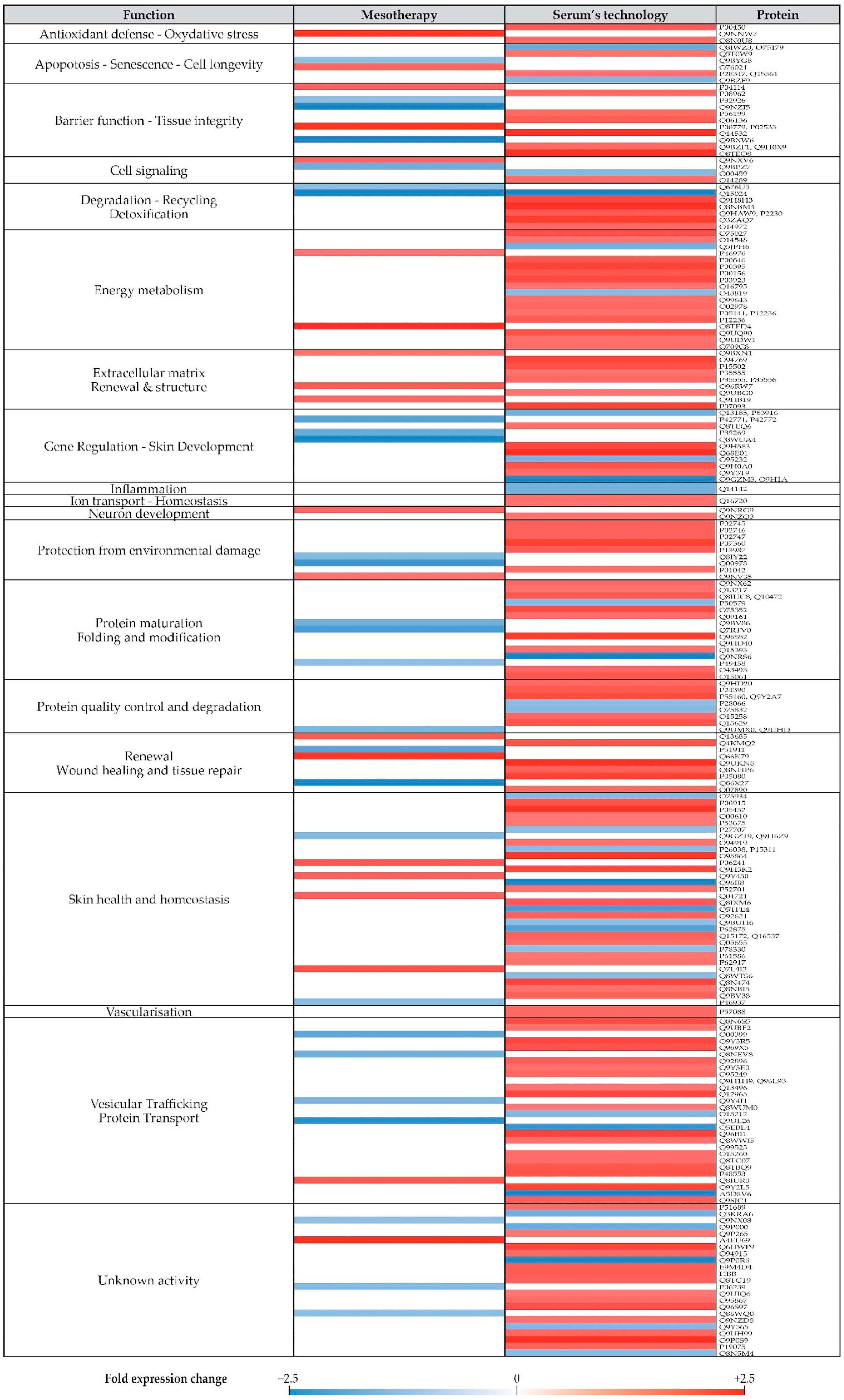
High-Performance Liquid Chromatography (HPLC) separation and mass spectrometry analysis enabled the identification of 5664 proteins. Only a subset was differentially expressed under the different conditions analysed (Figure 1, Supplementary Table S2).
Compared to the topical application of the neutral serum, applications of the serum containing the mesotherapy-inspired ingredients resulted in modulation of the expression of 149 proteins, with 118 proteins upregulated (fold changes: +1.30 to +5.04) and 31 downregulated (fold changes: −1.31 to −5.66). Their analysis indicated the modulation of several gene ontology pathways relating to endoplasmic reticulum (ER) and Golgi transport, intracellular protein trafficking, energy metabolism, integrin signalling, extracellular matrix organisation, and cell proliferation regulation, all these pathways being associated with significant z-scores (Table 1). In contrast, when comparing untreated skin explant controls to those that were subjected to a single meso-injection, the number of proteins differentially expressed after seven days was 47, comprising 20 upregulated (fold changes: +1.33 to +3.16) and 27 downregulated proteins (fold changes: −1.30 to +3.10). Their analysis revealed no major impact on any specific biological pathway, apart from a slight upregulation of three proteins involved in the renewal and structure of the extracellular matrix. No significant z-score was achieved for any of the pathways that were modulated upon topical applications of the mesotherapy-inspired ingredient blend.
It should also be noted that, when evaluating the impact of individual classes of compounds from the mesotherapy-inspired ingredients (Supplementary Table S2), amino acids were the constituents exerting the most pronounced effects on protein expression. According to z-score analyses (Table 1), they may largely account for the activation of proteins related to energy metabolism. Together with hyaluronic acid, they may also contribute to the upregulation of proteins involved in ER-Golgi transport, as well as intracellular protein trafficking. Further, hyaluronic acid and antioxidants appear to upregulate proteins associated with extracellular matrix organisation. Lastly, no specific ingredient(s) seem to modulate proteins from the integrin signalling and cell proliferation regulation pathways.

3.2. Effects of Mesotherapy-Inspired Ingredients on ATP Levels

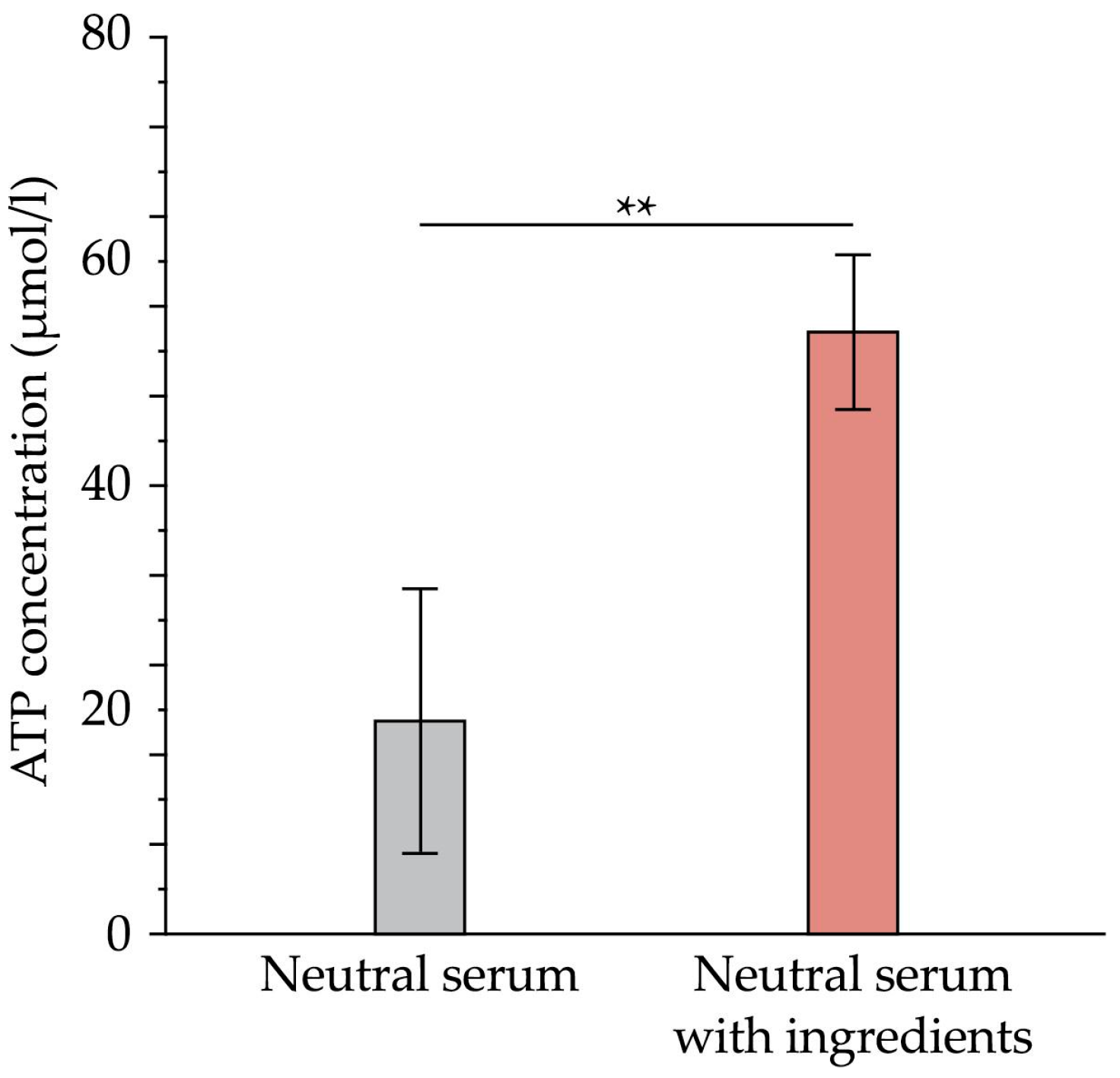
Since several proteins from the respiration electron chain were upregulated, we assessed the effect of topically applied mesotherapy-inspired ingredients on the ATP levels of a reconstituted human skin model. The effect of the topical application of the mesotherapy-inspired ingredients dissolved in a neutral serum were compared to that of the neutral serum (Figure 2). As the aim was to monitor the potential effects of serum use, which is intended for once- or twice-daily application, ATP levels were quantified after 24 h.
Reconstructed skin models treated with one application of mesotherapy-inspired ingredients dissolved in a neutral serum base, showed a 2.8-fold higher level of ATP (p = 0.003), compared to models treated with the neutral serum base alone.

3.3. Comparative Clinical and Instrumental Assessments of the Effects of Serum Applications and Meso-Injections

After having observed that topically applied mesotherapy-inspired ingredients have significant effects on protein expression and ATP production, we evaluated the serum, comparing the outcomes of twice-daily serum applications with those induced by three meso-injections administered 21 days apart. We assessed results at baseline and on days 21, 42, and 63. We also evaluated the effects of the combination of both interventions.
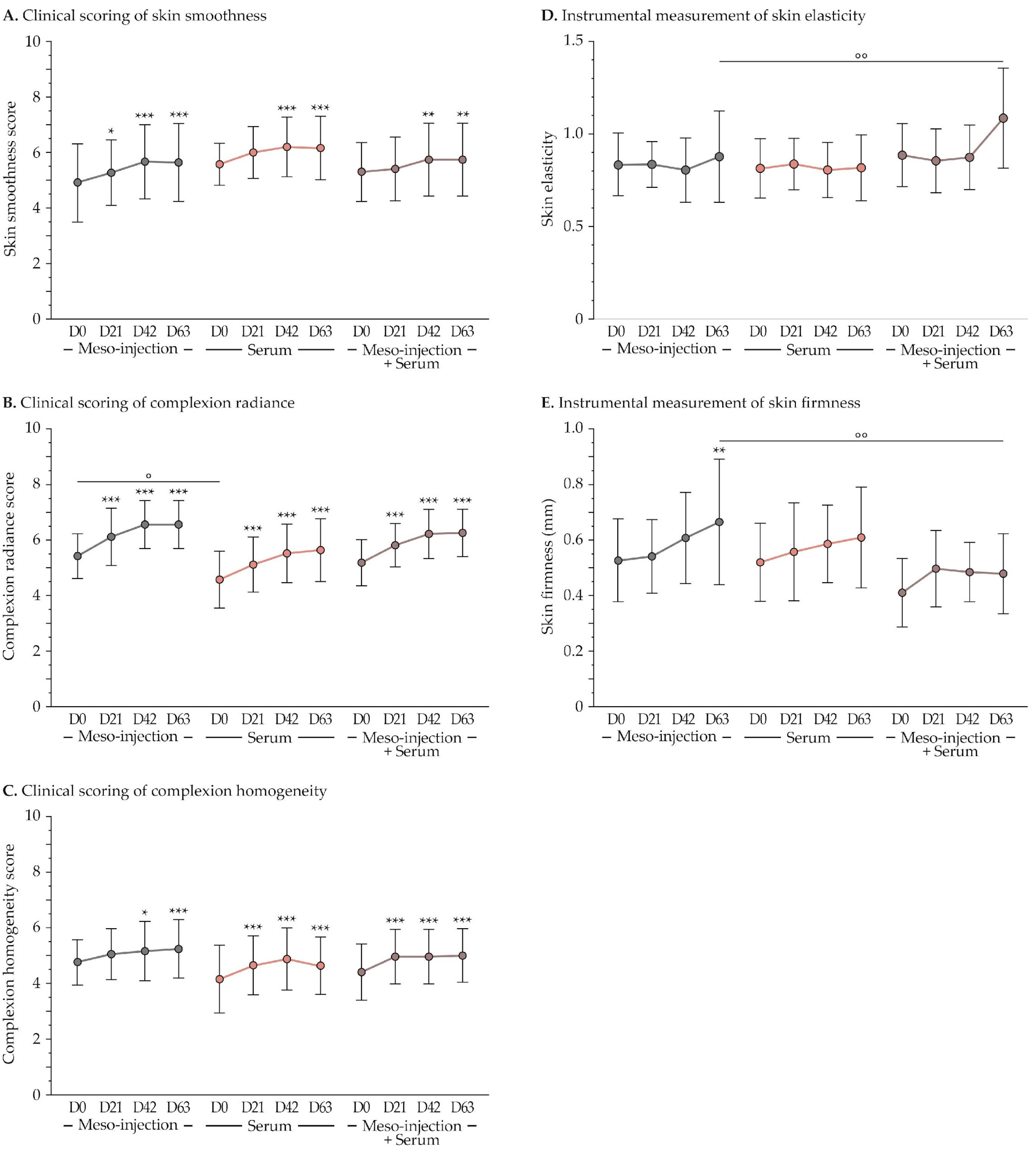
Clinical evaluations indicated that, relative to baseline, mesotherapy improved skin smoothness (Figure 3A). This improvement was significant as early as 21 days after the first injection (+8%, p = 0.017), reaching a maximum after the second injection (day 42, +11%, p < 0.001) that plateaued thereafter (day 63, +11%, p < 0.001). Improvements were also evidenced with serum application after day 42 (+17%, p < 0.001) and plateaued on day 63 (+16%, p < 0.001). When meso-injections were combined with serum applications, results were similar to serum applications alone (+8%, p = 0.007 on days 42 and 63). At identical time points, no significant differences were identified between meso-injections and serum applications, or between meso-injections and the combination of both treatments.
Regarding complexion radiance (Figure 3B), all interventions—mesotherapy injections, serum applications, and their combination—produced significant improvements after 21 days (+13% regardless of treatment; p < 0.001 for all). By day 42, radiance tended to improve (meso-injection: +21%; serum application: +19%; combined treatments: +21%; p < 0.001 for all) with only marginal gains by day 63 (serum application: +23%; meso-injection: −21%; combined treatments: +22%; p < 0.001 for all). Although baseline differences were noted between the mesotherapy group and the group receiving serum applications, no other significant differences were identified between treatments at identical time points.
In terms of complexion homogeneity (Figure 3C), meso-injections required 42 days to yield significant improvements (+7%, p = 0.016), reaching maximum effects on day 63 (+9%, p < 0.001). A more homogeneous complexion was already observed on day 21 upon serum application or with combined treatments (serum applications: +15%, combined treatments: +14%; p < 0.001 for both). These effects evolved only slightly at later time points (serum applications: +20% on day 42 and +14% on day 63; combined treatments: +14% on day 42 and +16% on day 63; p < 0.001 for all). No significant differences could be highlighted between meso-injections and serum applications or between meso-injections and the combination of both treatments at identical time points.
Results from instrumental measurements revealed that none of the interventions significantly improved skin elasticity compared to baseline (Figure 3D). However, on day 63, combining meso-injections with serum applications improved elasticity compared to meso-injections alone (+30%, p = 0.003). Furthermore, firmer skin was only observed on day 63, after three meso-injections (+29%, p = 0.004).
Subject self-assessments (Table 2) revealed that 81% to 100% of them perceived improvements in skin smoothness, complexion radiance, and complexion homogeneity. There were no substantial intra-treatment differences across the three time points or inter-treatment differences at identical time points.
Finally, none of the subjects reported any adverse reactions to serum applications. Considering mesotherapy, one subject presented an allergic reaction to the anaesthesia patch applied before injections. Injections were not performed, treatment was discontinued, and the subject was excluded from the study. Other adverse events were standard for meso-injections, with some cases of minor discomfort resolving within hours.

3.4. Descriptive Analysis of the Age-Dependent Clinical Effects of Serum Applications and Meso-Injections

To further investigate the effects of serum applications and meso-injections, we analysed whether the age of the subjects could influence the outcomes. To select the most suitable parameters for this analysis, we calculated the coefficients of correlation between the age of the subjects and their clinical scores or instrumental measures. Only skin smoothness demonstrated a strong average correlation with age across all three interventions and the four time points (−0.77 ± 0.04). Complexion radiance also exhibited a reasonable average correlation coefficient (−0.64 ± 0.20). All other parameters resulted in coefficients of correlation that were too low to be considered meaningful (−0.38 ± 0.02 for complexion homogeneity, −0.28 ± 0.05 for elasticity, and −0.02 ± 0.05 for firmness).
Focusing on the age-correlated parameters—skin smoothness and complexion radiance—we, then, divided each treatment group into two equal-sized subgroups of younger and older subjects (Table 3). As expected, the comparison of clinical scores between the younger and older subgroups at an identical time point revealed significant variations, reflecting the age-dependent skin alterations. Importantly, the analysis showed that mesotherapy improved skin smoothness with the number of injections only in the younger group of subjects (p = 0.011 on days 42 and 63 compared to day 0), while no significant changes were observed in the older subjects. The combination of mesotherapy with serum effectively addressed the lack of improvement in skin smoothness in older subjects, leading to significant time-dependent improvements on days 42 and 63 (p = 0.020 and p = 0.010, respectively, compared to day 0). For complexion radiance, differences were less pronounced and confined to a significant increase induced by mesotherapy alone in the group of younger subjects on day 21 (p = 0.026 versus day 0) and serum alone in the group of younger subjects on day 42 (p = 0.011 versus day 0). All other time-dependent significant variations were similar in both subgroups.

4. Discussion

Inspired by mesotherapy, we have developed an anti-ageing serum comprising 11 ingredients generally found in meso-injections. These were selected and formulated based on an extensive ex vivo evaluation process (including antioxidant activity, dose–response analyses of individual ingredients, optimal concentration of combined ingredients: Patents EP3383504/US11,026,873 and EP4257112/US11,938,212 B2; skin delivery efficiency. Proteomic profiling of skin explants revealed that the topical application of each of the six ingredient classes—antioxidants, amino acids, minerals, vitamins, coenzymes, and hyaluronic acid—modulated protein expression in a selective way, and to different extents. Similarly, the topical applications of the blend of the 11 ingredients led to the differential regulation of 149 proteins, accounting for 2.6% of all identified proteins. The majority of these proteins were upregulated by factors averaging just below two-fold (ranging from 1.3 to 5.04). Although these changes may appear modest, they are nonetheless meaningful, as they concern proteins involved in essential cellular functions, including endoplasmic reticulum (ER) and Golgi transport, intracellular protein trafficking, respiratory electron transport, integrin signalling, extracellular matrix organisation, and cell regulation.
Some ingredient classes have been shown to play a major role in upregulating proteins of specific pathways. For instance, the amino acid valine upregulates the expression of several mitochondrial genes, increasing oxygen consumption and ATP generation by raising mitochondrial density [17]. While a positive effect of amino-acid supplementation on energy metabolism is documented [18], their direct implication on the expression of proteins involved in the mitochondrial respiratory chain and mitochondrial activity has not been documented so far. Similarly, there is, to date, no publication reporting an effect of amino acids, antioxidants, and/or hyaluronic acid on the other pathways we identified. Nevertheless, we can speculate that increased amino acid levels may support general cellular metabolism, and supplementation with antioxidants may reduce respiration-induced cellular stress, thereby benefiting the cells. The mechanisms by which these ingredients could influence specific pathways remain to be elucidated. Furthermore, protein expression changes associated with integrin signalling and cell proliferation regulation pathways could not be linked to any single ingredient class, suggesting that the ingredient blend probably result in combined effects.
Proteomic profiling primarily indicated upregulation, pointing to the activation of various pathways. However, functional consequences remain to be fully established, as only ATP quantification confirmed enhanced energy metabolism, in line with the increased levels of proteins such as cytochrome C oxidase subunit 1 (fold changes: +1.98), NADH-ubiquinone oxidoreductase chain 6 (fold changes: +1.86), cytochrome B (fold changes: +1.70), and ATP synthase subunit A (fold changes: +1.69) we evidenced. While a higher energy metabolism is essential to fuel cellular metabolism, the upregulation of the pathways identified also indicates potential structural and functional benefits to the skin. Upregulated proteins include components of the extracellular matrix such as elastin (fold changes: +1.76) and fibrillins (fold changes for FBN1: +1.36; for FBN2: +1.48), while improvements in ER-Golgi function could support the proper folding, hydroxylation, and glycosylation of collagen, elastin, fibronectin, and proteoglycans [19], which could contribute to improved skin biomechanical properties [20]. Additionally, the upregulation of proteins from the integrin signalling pathway may imply improved epidermal homeostasis and a possible influence on the balance between stem cell renewal and differentiation [21].
All these results contrast with those observed following proteome profiling of meso-injected skin explants, which yielded only 47 differentially expressed proteins, 43% of which were upregulated. Without prior comparable analyses, it is unclear whether this limited effect reflects the genuine biological response to a meso-injection or is attributable to our experimental conditions. Nonetheless, the 63-day clinical comparison between three meso-injection sessions and twice-daily application of the serum—in which ingredients were partially encapsulated—revealed broadly similar outcome profiles. Meso-injections improved skin smoothness and radiance after a single session, with benefits in complexion homogeneity and firmness appearing after subsequent injections. Twice-daily serum application closely mirrored these outcomes, eliciting faster improvements in complexion radiance, albeit without measurable impact on firmness. These results were largely corroborated by subject self-assessments, even though replies did not enable capturing the small differences existing between time points and treatments.
Age-stratified analyses revealed a more complex response for skin smoothness and complexion radiance. Only younger subjects exhibited enhanced smoothness following meso-injection, while older subjects responded only when meso-injection was combined with serum application. Moreover, improvements in radiance appeared earlier in younger participants, regardless of intervention. These findings suggest that younger subjects are overall better responders, most likely because they retain a greater capacity to activate or reactivate cellular processes, and metabolise the ingredients, consistent with evidence showing that ageing is accompanied by a progressive decline in all cellular functions [22]. However, these observations should be interpreted with caution due to the small cohort size and uneven age distribution. Additionally, variability in skin elasticity and firmness at day 63 suggests heterogeneity in responses, likely contributing to the absence of statistically significant time-dependent effects of meso-injection or serum application for these parameters.
The near-equivalent efficacy of meso-injections and topical serum applications highlights the potential of a blend of 11 carefully selected and precisely balanced ingredients to match the performance of a mesotherapy injectable cocktail comprising over 50 compounds. This result strongly suggests that the ingredients can enter the skin, possibly due to their partial encapsulation within multilamellar vesicles composed of polyglyceryl-10 dioleate and polyglyceryl-10 dipalmitate. These polyglycerol fatty acids form highly stable microemulsions [23] and have demonstrated skin delivery efficacy owing to their surfactant properties, droplet dynamics, and thermodynamic stability [24]. Regardless of the delivery route, the improvements observed after topical serum application can only be attributed to the ingredients, as neither needle-induced micro-wounding nor injection-induced mechanical effects occur in this context. While these factors are widely considered to contribute to the efficacy of mesotherapy [4,25,26], our findings suggest that the role of the ingredients themselves may be more substantial than previously assumed.
Finally, it is also noteworthy that the combination of meso-injections and serum applications did not significantly enhance smoothness, radiance, or homogeneity beyond that of individual treatments, suggesting a possible saturating effect of the ingredients. Whether such a saturating effect really exists will require performing a longer clinical study with additional mesotherapy sessions. However, meso-injections may influence biomechanical properties compared to serum applications, resulting in a possible positive effect on elasticity at the latest time point. Yet, the already mentioned variability and limited statistical power might have precluded highlighting any significant effect compared to baseline, despite a clear trend in the data. Nonetheless, the combination of meso-injections and serum applications enhanced skin smoothness in older subjects, suggesting that this combined approach may offer additional benefits over either intervention alone.

5. Conclusions

This study demonstrates that a carefully formulated blend of 11 mesotherapy-inspired ingredients induces significant proteomic changes in skin explants, upregulating several important pathways. While certain ingredient classes appear responsible for the upregulation of specific pathways, the effects evidenced on others are possibly resulting from combined effects among ingredients. When partially encapsulated in multilamellar vesicles and applied topically as a cosmetic serum, the blend produced results comparable to a typical course of meso-injections, improving skin smoothness, radiance, and homogeneity. Despite variability and limited statistical power, age-stratified analysis suggests that older participants may derive greater benefit from the combined treatment, especially for skin smoothness, while younger subjects may experience a faster response, thus providing professionals with an adjunctive approach to enhance dermatological outcomes.
Further studies are required to clarify the functional implications of the observed proteomic changes and to confirm clinical outcomes in larger, age-balanced cohorts. Understanding the underlying causes underpinning the age-related variable response is crucial, particularly given that age-associated cellular senescence may limit the efficacy of active ingredient uptake and utilisation [27]. Elucidating these mechanisms will be essential for optimising future skin rejuvenation strategies.

6. Patents

The amino acid complex contained in the product evaluated in this study is covered by the Patents EP3383504 and US11,026,873. The antioxidant complex is covered by the Patent EP4257112/US11,938,212 B2. The formula of the product evaluated (NCEF-Revitalize Serum) is covered by the French Patent FR2403557.

Supplementary Materials

The following supporting information can be downloaded at: https://www.mdpi.com/article/10.3390/cosmetics12060278/s1, Table S1: Composition of the serum and meso-injection used in the study; Table S2: List of proteins which expression is significantly modified by a meso-injection (versus untreated control), by mesotherapy-inspired ingredients dissolved in the control serum (versus control serum), and by the different classes of mesotherapy-inspired ingredients dissolved in the control serum (versus control serum).

Author Contributions

Conceptualization, N.D., S.G., R.H., A.C. and J.N.; methodology, N.D., S.G., A.C. and J.N.; validation, J.N., J.W. and L.S.-M.; formal analysis, N.D. and K.B.; resources, J.W. and L.S.-M.; data curation, N.D., S.G., R.H., A.C. and K.B.; writing—original draft preparation, N.D., S.G., R.H. and K.B.; writing—review and editing, N.D., S.G., R.H., A.C. and K.B.; supervision, J.N., J.W. and L.S.-M.; project administration, J.W. and L.S.-M. All authors have read and agreed to the published version of the manuscript.

Funding

This research received no external funding.

Institutional Review Board Statement

The study was conducted in accordance with the Declaration of Helsinki, in the spirit of the French and European Guidelines for Good Clinical Practice, the recommendations of the ICH (International Conference on Harmonization). It was approved by the Local Ethics Commission from LTD Health (Batumi, Georgia) under the reference I/N 445 492 690 on 27 September 2023.

Informed Consent Statement

Informed consent was obtained from all subjects involved in the study.

Data Availability Statement

The data that support the findings of this study are available from the corresponding authors upon reasonable request.

Acknowledgments

The authors wish to thank Synthivia (Toulouse, France) for conducting the proteomic analyses and for their assistance in data processing. They are also thankful to Philippe Crouzet for providing scientific writing services.

Conflicts of Interest

Authors Sayantani Goswamis, Aaron Cohen and Jin Namkoong are the inventors of Patents EP4257112/US11,938,212 B2. Authors Nadège Dura, Roxane Henry and Jin Namkoong are the inventors of Patent FR2403557. Nadège Durand, Lysianne Sanchez-Manoilov and Roxane Henry, the authors are employees of Laboratoires Filorga. Sayantani Goswami, Aaron Cohen, Jin Namkoong, Joanna Wu the authors are employees of Colgate-Palmolive Company. Karima Bourougaa is employee of CP Skin Health. The authors declare that the research was conducted in the absence of any commercial or financial relationships that could be construed as a potential conflict of interest. The funders had no role in the design of the study; in the collection, analyses or interpretation of data; in the writing of the manuscript; or in the decision to publish the results.

References

  1. Farage, M.A.; Miller, K.W.; Elsner, P.; Maibach, H.I. Characteristics of the Aging Skin. Adv. Wound Care 2013, 2, 5–10. [Google Scholar] [CrossRef]
  2. Shin, S.H.; Lee, Y.H.; Rho, N.K.; Park, K.Y. Skin aging from mechanisms to interventions: Focusing on dermal aging. Front. Physiol. 2023, 14, 1195272. [Google Scholar] [CrossRef]
  3. Gupta, M.A.; Gilchrest, B.A. Psychosocial aspects of aging skin. Dermatol. Clin. 2005, 23, 643–648. [Google Scholar] [CrossRef]
  4. Devgan, L.; Singh, P.; Durairaj, K. Minimally Invasive Facial Cosmetic Procedures. Otolaryngol. Clin. N. Am. 2019, 52, 443–459. [Google Scholar] [CrossRef]
  5. Hoffman, L.; Fabi, S. Look Better, Feel Better, Live Better? The Impact of Minimally Invasive Aesthetic Procedures on Satisfaction with Appearance and Psychosocial Wellbeing. J. Clin. Aesthet. Dermatol. 2022, 15, 47–58. [Google Scholar]
  6. Pistor, M. Qu’est-ce que la mésothérapie? [What is mesotherapy?]. Chir. Dent. Fr. 1976, 46, 59–60. [Google Scholar] [PubMed]
  7. Mammucari, M.; Gatti, A.; Maggiori, S.; Bartoletti, C.A.; Sabato, A.F. Mesotherapy, definition, rationale and clinical role: A consensus report from the Italian Society of Mesotherapy. Eur. Rev. Med. Pharmacol. Sci. 2011, 15, 682–694. [Google Scholar] [PubMed]
  8. Iorizzo, M.; De Padova, M.P.; Tosti, A. Biorejuvenation: Theory and practice. Clin. Dermatol. 2008, 26, 177–181. [Google Scholar] [CrossRef]
  9. Sarkar, R.; Garg, V.K.; Mysore, V. Position paper on mesotherapy. Indian J. Dermatol. Venereol. Leprol. 2011, 77, 232–237. [Google Scholar] [CrossRef] [PubMed]
  10. Grand-Vincent, A.; Boisnic, S.; Salomon, C.; Prinderre, P.; Piccerelle, P. Clinical Assessment of a Mesotherapy Formulation for Skin Rejuvenation in Healthy Volunteers. J. Cosmet. Dermatol. Sci. Appl. 2017, 7, 291–305. [Google Scholar] [CrossRef]
  11. Jung, G.S.; Eom, J.R.; Jeon, H.J.; Chu, S.G.; Oh, E.; Lee, J.W. Facial Rejuvenating Effects of Mesotherapy Using a New Polycomponent Formulation. Med. Lasers 2018, 7, 69–73. [Google Scholar] [CrossRef]
  12. Iranmanesh, B.; Khalili, M.; Mohammadi, S.; Amiri, R.; Aflatoonian, M. Employing hyaluronic acid-based mesotherapy for facial rejuvenation. J. Cosmet. Dermatol. 2022, 21, 6605–6618. [Google Scholar] [CrossRef]
  13. Braccini, F.; Dohan Ehrenfest, D.M. Advantages of combined therapies in cosmetic medicine for the treatment of face aging: Botulinum toxin, fillers and mesotherapy. Rev. Laryngol. Otol. Rhinol. 2010, 131, 89–95. [Google Scholar]
  14. Płatkowska, A.; Korzekwa, S.; Łukasik, B.; Zerbinati, N. Combined Bipolar Radiofrequency and Non-Crosslinked Hyaluronic Acid Mesotherapy Protocol to Improve Skin Appearance and Epidermal Barrier Function: A Pilot Study. Pharmaceuticals 2023, 16, 1145. [Google Scholar] [CrossRef]
  15. He, X.; Wan, F.; Su, W.; Xie, W. Research Progress on Skin Aging and Active Ingredients. Molecules 2023, 28, 5556. [Google Scholar] [CrossRef]
  16. Fagien, S.; Carruthers, J.D.A. A comprehensive review of patient-reported satisfaction with botulinum toxin type A for aesthetic procedures. Plast. Reconstr. Surg. 2008, 122, 1915–1925. [Google Scholar] [CrossRef]
  17. Sharma, S.; Zhang, X.; Azhar, G.; Patyal, P.; Verma, A.; Kc, G.; Wei, J.Y. Valine improves mitochondrial function and protects against oxidative stress. Biosci. Biotechnol. Biochem. 2024, 88, 168–176. [Google Scholar] [CrossRef]
  18. Li, Q.; Hoppe, T. Role of amino acid metabolism in mitochondrial homeostasis. Front. Cell Dev. Biol. 2023, 11, 1127618. [Google Scholar] [CrossRef] [PubMed]
  19. Hellicar, J.; Stevenson, N.L.; Stephens, D.J.; Lowe, M. Supply chain logistics—The role of the Golgi complex in extracellular matrix production and maintenance. J. Cell Sci. 2022, 135, 258879. [Google Scholar] [CrossRef] [PubMed]
  20. Franchi, M.; Piperigkou, Z.; Mastronikolis, N.S.; Karamanos, N. Extracellular matrix biomechanical roles and adaptation in health and disease. FEBS J. 2024, 291, 430–440. [Google Scholar] [CrossRef] [PubMed]
  21. Watt, F.M. Role of integrins in regulating epidermal adhesion, growth and differentiation. EMBO J. 2002, 21, 3919–3926. [Google Scholar] [CrossRef]
  22. da Silva, P.F.L.; Schumacher, B. Principles of the Molecular and Cellular Mechanisms of Aging. J. Investig. Dermatol. 2021, 141, 951–960. [Google Scholar] [CrossRef] [PubMed]
  23. Ita, K. Progress in the use of microemulsions for transdermal and dermal drug delivery. Pharm. Dev. Technol. 2017, 22, 467–475. [Google Scholar] [CrossRef] [PubMed]
  24. Sahle, F.F.; Metz, H.; Wohlrab, J.; Neubert, R.H. Polyglycerol fatty acid ester surfactant-based microemulsions for targeted delivery of ceramide AP into the stratum corneum: Formulation, characterisation, in vitro release and penetration investigation. Eur. J. Pharm. Biopharm. 2012, 82, 139–150. [Google Scholar] [CrossRef]
  25. Hou, A.; Cohen, B.; Haimovic, A.; Elbuluk, N. Microneedling: A Comprehensive Review. Dermatol. Surg. 2017, 43, 321–339. [Google Scholar] [CrossRef] [PubMed]
  26. Kandhari, R.; Kaur, I.; Sharma, D. Mesococktails and mesoproducts in aesthetic dermatology. Dermatol. Ther. 2020, 33, e14218. [Google Scholar] [CrossRef]
  27. Dorf, N.; Maciejczyk, M. Skin senescence-from basic research to clinical practice. Front. Med. 2024, 11, 1484345. [Google Scholar] [CrossRef]
Figure 1. Heat map of proteins differentially expressed by a meso-injection (versus untreated control) and by topical applications of mesotherapy-inspired ingredients dissolved in the control serum (versus control serum).
Cosmetics 12 00278 g001
Figure 2. ATP concentration in the supernatant of homogenized reconstituted human skin models 24 h after they received one topical application of a neutral serum or the neutral serum with the mesotherapy-inspired ingredients. Statistical significance is reported with: **: p < 0.01.
Cosmetics 12 00278 g002
Figure 3. Evaluation of subjects following meso-injection, serum applications, and the combination of both treatments on days 0, 21, 42 and 63. Clinical scoring of (A) skin smoothness, (B) complexion radiance, and (C) complexion homogeneity. Instrumental measurements of (D) skin elasticity and (E) skin firmness. Statistical analysis includes intra-treatment significance versus day 0 (*) and inter-treatment significance at an identical time point (°). *, °: p < 0.05, **, °°: p < 0.01, and ***: p < 0.001.
Cosmetics 12 00278 g003
Table 1. Z-scores of the mesotherapy-inspired ingredient blend and the various ingredient classes (versus the control serum) for the most relevant pathways.
Ingredient
Blend
AntioxidantsAmino AcidsMineralsVitaminsCoenzymesHyaluronic
Acid
Energy metabolism4.50-6.33----
ER-Golgi transport3.78-1.82---1.90
Intracellular protein trafficking1.89-2.50---2.00
Extracellular matrix organisation1.891.70----2.00
Integrin signalling1.34------
Cell proliferation regulation1.29------
For the individual ingredient classes, only z-scores greater than 1.5 are presented.
Table 2. Self-rating using a Global Aesthetic Improvement Scale (GAIS) of skin smoothness, complexion radiance, and complexion homogeneity by subjects on days 21, 42, and 63.
Average Score
(Mean ± SEM)
Score—Number of Subjects (%)
1
(Very Much Improved)
2
(Much
Improved)
3
(Improved)
4
(No Change)
Skin smoothness
Meso-injection
D212.8 ± 0.10 (0%)7 (26.9%)16 (61.5%)3 (11.5%)
D422.9 ± 0.10 (0%)3 (12.0%)22 (88.0%)0 (0%)
D633.0 ± 0.00 (0%)1 (4.0%)24 (96.0%)0 (0%)
Serum
D212.5 ± 0.13 (11.5%)8 (30.8%)14 (53.8%)1 (3.8%)
D422.7 ± 0.22 (8.3%)5 (20.8%)15 (62.5%)2 (8.3%)
D632.9 ± 0.10 (0%)2 (8.0%)23 (92.0%)0 (0%)
Meso-injection and serum
D212.6 ± 0.11 (3.8%)9 (34.6%)16 (61.5%)0 (0%)
D422.7 ± 0.11 (3.8%)5 (19.2%)20 (76.9%)0 (0%)
D632.8 ± 0.10 (0%)6 (23.1%)20 (76.9%)0 (0%)
Skin complexion radiance
Meso-injection
D212.6 ± 0.10 (0%)4 (15.4%)20 (76.9%)2 (7.7%)
D422.9 ± 0.10 (0%)9 (36.0%)16 (64.0%)0 (0%)
D632.9 ± 0.10 (0%)0 (0%)25 (100.0%)0 (0%)
Serum
D212.9 ± 0.13 (11.5%)5 (19.2%)17 (65.4%)1 (3.8%)
D422.6 ± 0.11 (4.2%)3 (12.5%)18 (75.0%)2 (8.3%)
D633.0 ± 0.00 (0%)2 (8.0%)23 (92.0%)0 (0%)
Meso-injection and serum
D212.6 ± 0.11 (3.8%)8 (30.8%)17 (65.4%)0 (0%)
D422.7 ± 0.11 (3.8%)5 (19.2%)20 (76.9%)0 (0%)
D633.0 ± 0.10 (0%)6 (23.1%)20 (76.9%)0 (0%)
Skin complexion homogeneity
Meso-injection
D212.8 ± 0.10 (0%)4 (15.4%)17 (65.4%)5 (19.2%)
D422.8 ± 0.10 (0%)6 (24.0%)19 (76.0%)0 (0%)
D632.9 ± 0.10 (0%)0 (0%)25 (100.0%)0 (0%)
Serum
D213.0 ± 0.11 (3.8%)5 (19.2%)19 (73.1%)1 (3.8%)
D422.8 ± 0.11 (4.2%)4 (16.7%)17 (70.8%)2 (8.3%)
D633.0 ± 0.00 (0%)2 (8.0%)23 (92.0%)0 (0%)
Meso-injection and serum
D212.6 ± 0.11 (3.8%)8 (30.8%)17 (65.4%)0 (0%)
D422.9 ± 0.11 (3.8%)1 (3.8%)23 (88.5%)1 (3.8%)
D632.9 ± 0.10 (0%)3 (11.5%)23 (88.5%)0 (0%)
Table 3. Clinical scoring of skin smoothness and complexion radiance in subgroups of younger and older subjects on days 21, 42, and 63.
MesotherapySerumMesotherapy and Serum
Younger GroupOlder GroupYounger GroupOlder GroupYounger GroupOlder Group
Nbr. of subjects131313131314
Min–Max age36–4549–6536–4646–6037–4849–64
Skin smoothness
D06.0 ± 0.25.2 ± 0.26.0 ± 0.23.8 ± 0.36.2 ± 0.24.6 ± 0.2
D216.4 ± 0.15.6 ± 0.16.2 ± 0.14.3 ± 0.26.2 ± 0.25.4 ± 0.2
D426.9 ± 0.2 *5.4 ± 0.26.7 ± 0.14.5 ± 0.36.8 ± 0.25.6 ± 0.2 *
D636.9 ± 0.2 *5.3 ± 0.26.7 ± 0.14.5 ± 0.36.8 ± 0.25.6 ± 0.2 *
Complexion radiance
D05.8 ± 0.25.0 ± 0.25.2 ± 0.24.0 ± 0.35.8 ± 0.14.6 ± 0.2
D216.6 ± 0.2 *5.6 ± 0.35.8 ± 0.24.5 ± 0.26.3 ± 0.15.4 ± 0.2
D426.8 ± 0.2 **6.3 ± 0.3 **6.2 ± 0.2 *4.6 ± 0.26.9 ± 0.1 ***5.6 ± 0.2 *
D636.8 ± 0.2 **6.3 ± 0.3 **6.2 ± 0.2 **5.0 ± 0.3 *6.9 ± 0.1 ***5.6 ± 0.2 *
*: p < 0.05, ** p < 0.01, and *** p < 0.001 versus D0.
Disclaimer/Publisher’s Note: The statements, opinions and data contained in all publications are solely those of the individual author(s) and contributor(s) and not of MDPI and/or the editor(s). MDPI and/or the editor(s) disclaim responsibility for any injury to people or property resulting from any ideas, methods, instructions or products referred to in the content.