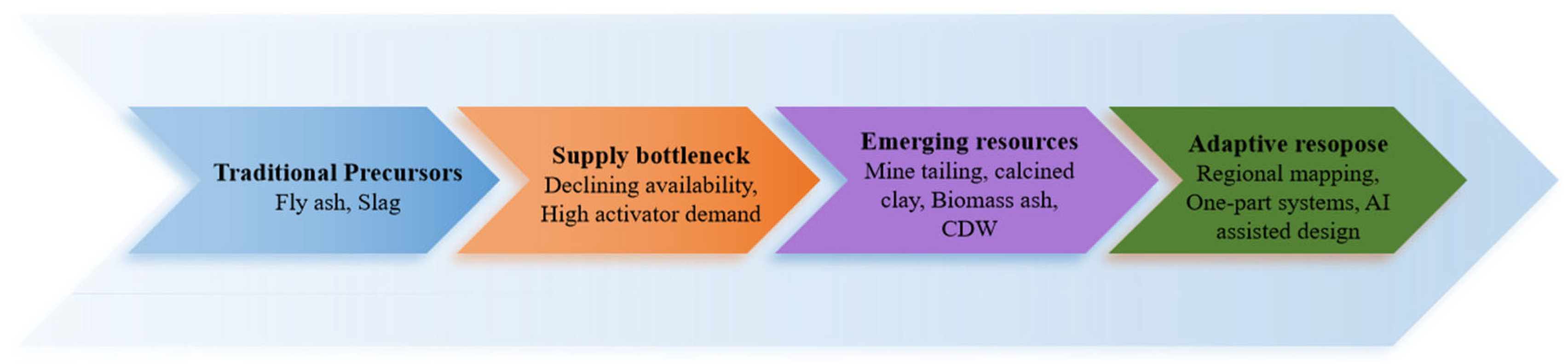
Alkali-Activated and Geopolymer Systems Through the Lens of Resource Efficiency


Abstract
1. Introduction
2. Materials and Methods
3. Principles of a Resource-Centric Perspective
3.1. Limitations of Purely Chemistry or Performance-Based Classifications
3.2. Circular Economy, Waste Valorization, and Regional Resource Contexts
3.3. Reframing Alkali-Activated Geopolymer Systems as Resource-Management Technologies
4. Precursor Resources
5. Resource Availability, Logistics, and Regionalization
6. Environmental and Circularity Assessment of Resource Pathways
7. Resource-Sensitive Performance and Adaptive Design Strategies
7.1. Mechanical Performance
7.1.1. Mechanical Performance by Precursor Class
7.1.2. Role of Blending on Mechanical Properties
7.1.3. Processability, Curing, and Application Modes
7.2. Resource-Sensitive Durability Issues
7.2.1. Carbonation Resistance
7.2.2. Alkali-Silica Reaction and Leaching
7.2.3. Chemical Resistance and Long-Term Stability
7.3. Processability and Applications
7.3.1. In Situ Versus Precast Applications
7.3.2. 3D Printing and Rheological Control
7.3.3. Repair Mortars and Curing Requirements
7.4. Strategic Blending and Hybrid Gel Approach
7.4.1. Strategic Blending and Hybrid Gel
7.4.2. Contaminant Encapsulation
7.4.3. Co-Precursors for Low-Alumina or Low-Reactivity Wastes
7.5. Pre-Treatment: Performance vs. Environmental Cost
7.5.1. Thermal Treatment
7.5.2. Chemical Treatment
7.5.3. Mechanical Grinding and Combined Activation Strategies
7.6. Adaptive Design Frameworks: AI and Machine Learning
7.6.1. Artificial Neural Networks and Predictive Models
7.6.2. Thermodynamic Modeling Tools
7.6.3. Multi-Objective Optimization and LCA Integration
7.6.4. Data Limitations and Intellectual Property Barriers
7.7. Standardization, Policy, and Market Framing Around Resources
8. Future Directions in Resource-Centric Alkali-Activated Geopolymer Research
- •
- Systematic mapping of resources (precursors): In order to solve the temporal mismatch caused by a decreasing supply of conventional materials such as coal fly ash and blast furnace slag, research has to give the highest priority to the systematic mapping of global and regional precursor inventories. Researchers can develop dynamic databases that monitor the availability and quality by region and season by mapping a variety of materials, including biomass ash, mining tailings, and volcanic rock [17,22,30].
- •
- •
- Digital tools and AI infrastructure: Artificial neural networks (ANNs) are identified as a main tool for modeling the complex nonlinear relationships in diverse waste materials. By simulating phase assemblages, thermodynamic modeling tools like GEMS and FactSage help maximize precursor reactivity and reduce the need for trial-and-error tests. ANNs and deep neural networks are examples of advanced models used to forecast a mix’s durability and mechanical qualities based on chemical inputs. In order to improve performance prediction, hybrid predictive platforms combine data-driven artificial intelligence with physics-based thermodynamic modeling. By integrating Building Information Modeling (BIM) with life cycle assessment (LCA) methods, sustainability and structural durability may be monitored in real time during a project’s life cycle [22,24,63].
- •
- Circular Economy Integration: Alkali-activated and geopolymer materials play an important role in advancing industrial symbiosis, enabling the transformation of waste from sectors such as glass manufacturing, energy production, and agriculture into valuable building materials. This role extends into broader frameworks of territorial metabolism and urban mining, where construction and demolition wastes are repurposed to create high-performance products. Such valorization processes can significantly reduce raw material consumption by up to 50%, while simultaneously mitigating waste generation and environmental impact [1,8,9,69].
9. Conclusions
Author Contributions
Funding
Data Availability Statement
Acknowledgments
Conflicts of Interest
References
- Pacheco-Torgal, F.; Chindaprasirt, P.; Ozbakkaloglu, T. (Eds.) 1—Introduction. In Handbook of Advances in Alkali-Activated Concrete; Woodhead Publishing: New Delhi, India, 2022; pp. 1–12. [Google Scholar]
- Cong, P.; Du, R.; Gao, H.; Chen, Z. Comparison and assessment of carbon dioxide emissions between alkali-activated materials and OPC cement concrete. J. Traffic Transp. Eng. (Engl. Ed.) 2024, 11, 918–938. [Google Scholar] [CrossRef]
- Sambucci, M.; Sibai, A.; Valente, M. Recent Advances in Geopolymer Technology. A Potential Eco-Friendly Solution in the Construction Materials Industry: A Review. J. Compos. Sci. 2021, 5, 109. [Google Scholar] [CrossRef]
- Amran, Y.H.M.; Alyousef, R.; Alabduljabbar, H.; El-Zeadani, M. Clean production and properties of geopolymer concrete; A review. J. Clean. Prod. 2020, 251, 119679. [Google Scholar] [CrossRef]
- Singh, N.B.; Middendorf, B. Geopolymers as an alternative to Portland cement: An overview. Constr. Build. Mater. 2020, 237, 117455. [Google Scholar] [CrossRef]
- Kekez, S.; Nováková, I.; Lach, M.; Setlak, K.; Fiala, L.; Přikryl, J.; Furtos, G.; Petean, I.; Alexandersson, K.F.; Baronins, J.; et al. Waste valorization for fabrication of geopolymers. Case Stud. Constr. Mater. 2025, 22, e04388. [Google Scholar] [CrossRef]
- Marathe, S.; Sadowski, Ł.; Shree, N. Geopolymer and alkali-activated permeable concrete pavements: Bibliometrics and systematic current state of the art review, applications, and perspectives. Constr. Build. Mater. 2024, 421, 135586. [Google Scholar] [CrossRef]
- ElSebai, M.M. A Comprehensive review of geopolymer products as sustainable materials for leed certification compliance. J. Al-Azhar Univ. Eng. Sect. 2025, 20, 1360–1372. [Google Scholar] [CrossRef]
- Kolade, A.S.; Ikotun, B.D.; Oyejobi, D.O. A Review of the Chemistry, Waste Utilization, Mix Design and Performance Evaluation of Geopolymer Concrete. Iran. J. Sci. Technol. Trans. Civ. Eng. 2025, 49, 5421–5454. [Google Scholar] [CrossRef]
- Farooq, F.; Jin, X.; Faisal Javed, M.; Akbar, A.; Izhar Shah, M.; Aslam, F.; Alyousef, R. Geopolymer concrete as sustainable material: A state of the art review. Constr. Build. Mater. 2021, 306, 124762. [Google Scholar] [CrossRef]
- Rakhimova, N.R.; Rakhimov, R.Z. Literature Review of Advances in Materials Used in Development of Alkali-Activated Mortars, Concretes, and Composites. J. Mater. Civ. Eng. 2019, 31, 03119002. [Google Scholar] [CrossRef]
- Madirisha, M.M.; Dada, O.R.; Ikotun, B.D. Chemical fundamentals of geopolymers in sustainable construction. Mater. Today Sustain. 2024, 27, 100842. [Google Scholar] [CrossRef]
- Wang, Y.-S.; Alrefaei, Y.; Dai, J.-G. Silico-Aluminophosphate and Alkali-Aluminosilicate Geopolymers: A Comparative Review. Front. Mater. 2019, 6, 106. [Google Scholar] [CrossRef]
- Asim, N.; Badiei, M.; Samsudin, N.A.; Mohammad, M.; Razali, H.; Hui, D. Clean technology option development for smart and multifunctional construction materials: Sustainable geopolymer composites. J. Build. Eng. 2024, 94, 109932. [Google Scholar] [CrossRef]
- Asim, N.; Badiei, M.; Shakeri, M.; Emdadi, Z.; Samsudin, N.A.; Soltani, S.; Mohammad, M.; Amin, N. Development of green photocatalytic geopolymers for dye removal. Mater. Chem. Phys. 2022, 283, 126020. [Google Scholar] [CrossRef]
- Adewuyi, Y.G. Recent Advances in Fly-Ash-Based Geopolymers: Potential on the Utilization for Sustainable Environmental Remediation. ACS Omega 2021, 6, 15532–15542. [Google Scholar] [CrossRef]
- Kriven, W.M.; Leonelli, C.; Provis, J.L.; Boccaccini, A.R.; Attwell, C.; Ducman, V.S.; Ferone, C.; Rossignol, S.; Luukkonen, T.; van Deventer, J.S.J.; et al. Why geopolymers and alkali-activated materials are key components of a sustainable world: A perspective contribution. J. Am. Ceram. Soc. 2024, 107, 5159–5177. [Google Scholar] [CrossRef]
- Melikoglu, M. Quantitative review of waste-based geopolymers: Analysis of progress, performance metrics, and circular economy pathways. Phys. Chem. Earth Parts A/B/C 2026, 143, 104359. [Google Scholar] [CrossRef]
- Lan, X.; Zhang, X.; Yin, Y.; Liu, Z.; Li, M.; Shi, J.; Luo, Z. Advancements in the properties of industrial solid waste-based cementitious materials: A comprehensive review. J. Build. Eng. 2025, 111, 113334. [Google Scholar] [CrossRef]
- Khalifa, A.Z.; Cizer, Ö.; Pontikes, Y.; Heath, A.; Patureau, P.; Bernal, S.A.; Marsh, A.T.M. Advances in alkali-activation of clay minerals. Cem. Concr. Res. 2020, 132, 106050. [Google Scholar] [CrossRef]
- Umer, M.; Ahmad, J.; Mukhtar, H. Innovative valorization of biomass waste-derived sodium silicate for geopolymer concrete synthesis: Sustainability assessment and circular economy potential. J. Clean. Prod. 2024, 452, 142181. [Google Scholar] [CrossRef]
- Mohan Kumar, S.G.K.; Kinuthia, J.M.; Oti, J.; Adeleke, B.O. Geopolymer Chemistry and Composition: A Comprehensive Review of Synthesis, Reaction Mechanisms, and Material Properties—Oriented with Sustainable Construction. Materials 2025, 18, 3823. [Google Scholar] [CrossRef]
- Zheng, S.; Liu, Z.; Huang, J.; Liu, L.; Jin, Q.; Zhang, Q.; Liu, Z.; Tang, G. A review of machine learning methods for geopolymer performance prediction: Linking data-driven models with physical insights. J. Build. Eng. 2025, 114, 114227. [Google Scholar] [CrossRef]
- Nguyen, H.A.T.; Pham, D.H.; Ahn, Y.; Oo, B.L.; Lim, B.T.H. Machine learning and sustainable geopolymer materials: A systematic review. Mater. Today Sustain. 2025, 30, 101095. [Google Scholar] [CrossRef]
- Kehinde, O.; Hughes, D.J.; Amalu, E.H. Critical methods of geopolymer feedstocks activation for suitable industrial applications. Heliyon 2024, 10, e29771. [Google Scholar] [CrossRef] [PubMed]
- Alrawashdeh, A.A.; Zamorano, M.; Alshaaer, M.; Martín-Morales, M. Promoting the use of geopolymer and alkali-activated materials through the identification of critical factors and strategies. J. Build. Eng. 2024, 98, 111078. [Google Scholar] [CrossRef]
- Jalal, P.S.; Srivastava, V.; Tiwari, A.K. A Critical Review of Geopolymer Concrete: Mechanisms, Mix Design Methodologies, and Circular Economy Potentials. J. Archit. Civ. Eng. 2025, 10, 84–95. [Google Scholar] [CrossRef]
- Ma, Z.; Sun, X.; Wan, X.; Sun, Y.; Zheng, Y.; Zhang, X.; Qiu, J.; Zhao, Y. Towards eco-friendly mining: Alkali-activated materials from mine waste for pollution mitigation. Green Smart Min. Eng. 2026, 3, 107–132. [Google Scholar] [CrossRef]
- Nodehi, M.; Taghvaee, V.M. Alkali-Activated Materials and Geopolymer: A Review of Common Precursors and Activators Addressing Circular Economy. Circ. Econ. Sustain. 2022, 2, 165–196. [Google Scholar] [CrossRef]
- Ionescu, B.A.; Lӑzӑrescu, A. A Review Regarding the Use of Natural and Industrial by-products in the Production of Geopolymer Binders. IOP Conf. Ser. Mater. Sci. Eng. 2020, 877, 012033. [Google Scholar] [CrossRef]
- Hertel, T.; Pontikes, Y. Geopolymers, inorganic polymers, alkali-activated materials and hybrid binders from bauxite residue (red mud)—Putting things in perspective. J. Clean. Prod. 2020, 258, 120610. [Google Scholar] [CrossRef]
- Lancellotti, I.; Barbieri, L.; Leonelli, C. 20—Use of alkali-activated concrete binders for toxic waste immobilization. In Handbook of Alkali-Activated Cements, Mortars and Concretes; Pacheco-Torgal, F., Labrincha, J.A., Leonelli, C., Palomo, A., Chindaprasirt, P., Eds.; Woodhead Publishing: Oxford, UK, 2015; pp. 539–554. [Google Scholar]
- Taki, K.; Mukherjee, S.; Patel, A.K.; Kumar, M. Reappraisal review on geopolymer: A new era of aluminosilicate binder for metal immobilization. Environ. Nanotechnol. Monit. Manag. 2020, 14, 100345. [Google Scholar] [CrossRef]
- El-eswed, B.I. Chemical evaluation of immobilization of wastes containing Pb, Cd, Cu and Zn in alkali-activated materials: A critical review. J. Environ. Chem. Eng. 2020, 8, 104194. [Google Scholar] [CrossRef]
- Lazorenko, G.; Kasprzhitskii, A.; Yatsenko, E.A.; Wensheng, L.; Chaudhary, S. Towards coal mining waste valorization: Gangue as resource for the production of geopolymer and related alkali-activated materials. Green Technol. Sustain. 2025, 3, 100205. [Google Scholar] [CrossRef]
- Mukiza, E.; Phung, Q.T.; Seetharam, S.C.; Nguyen, T.N.; Bruggeman, C.; De Schutter, G. Recent advances in immobilization of radioactive cesium and strontium-bearing wastes in alkali activated materials—A review. J. Environ. Manag. 2024, 370, 122746. [Google Scholar] [CrossRef]
- Samarina, T.; Takaluoma, E.; Laatikainen, O. Geopolymers and Alkali-Activated Materials for Wastewater Treatment Applications and Valorization of Industrial Side Streams. In Advances in Geopolymer-Zeolite Composites—Synthesis and Characterization; Vizureanu, P., Kryvenko, P., Eds.; IntechOpen: London, UK, 2021. [Google Scholar]
- Provis, J.L.; Bernal, S.A. Geopolymers and Related Alkali-Activated Materials. Annu. Rev. Mater. Res. 2014, 44, 299–327. [Google Scholar] [CrossRef]
- Provis, J.L.; Bernal, S.A. Milestones in the analysis of alkali-activated binders. J. Sustain. Cem.-Based Mater. 2015, 4, 74–84. [Google Scholar] [CrossRef]
- Font, A.; Soriano, L.; de Moraes Pinheiro, S.M.; Tashima, M.M.; Monzó, J.; Borrachero, M.V.; Payá, J. Design and properties of 100% waste-based ternary alkali-activated mortars: Blast furnace slag, olive-stone biomass ash and rice husk ash. J. Clean. Prod. 2020, 243, 118568. [Google Scholar] [CrossRef]
- Jiang, J.; Cai, X.; Ou, X.; Zhao, X.; Wei, D.; Wang, S.; Luo, Q.; Huang, Y. Study on the heavy metal immobilization mechanism in the alkali-activated red mud-ground granulated blast furnace slag-based geopolymer. Matéria 2025, 30, e20240776. [Google Scholar] [CrossRef]
- Tchakouté, H.K.; Rüscher, C.H.; Kong, S.; Kamseu, E.; Leonelli, C. Geopolymer binders from metakaolin using sodium waterglass from waste glass and rice husk ash as alternative activators: A comparative study. Constr. Build. Mater. 2016, 114, 276–289. [Google Scholar] [CrossRef]
- Sui, H.; Wang, B.; Chen, Z.; Liu, Y.; Sagoe-Crentsil, K.; Duan, W. Optimizing calcination for low-grade calcined kaolinite clay: Reactivity and energy consumption. Case Stud. Constr. Mater. 2024, 21, e04056. [Google Scholar] [CrossRef]
- Nanda, B.; Mishra, J.; Patro, S.K. Synthesis of rice husk ash based alkaline activators for geopolymer binder systems: A review. J. Build. Eng. 2024, 91, 109694. [Google Scholar] [CrossRef]
- Fernando, S.; Gunasekara, C.; Law, D.W.; Nasvi, M.C.M.; Setunge, S.; Dissanayake, R. Engineering properties of waste-based alkali activated concrete brick containing low calcium fly ash and rice husk ash: A comparison with traditional Portland cement concrete brick. J. Build. Eng. 2022, 46, 103810. [Google Scholar] [CrossRef]
- Ali, M. Valorization of sewage sludge ash in alkali-activated materials: A comprehensive review of material properties, reactivity, and future sustainable applications. Chemosphere 2025, 391, 144724. [Google Scholar] [CrossRef]
- Habert, G.; Ouellet-Plamondon, C. Recent update on the environmental impact of geopolymers. RILEM Tech. Lett. 2016, 1, 17–23. [Google Scholar] [CrossRef]
- Kumar, A.; Saravanan, T.J.; Bisht, K.; Kabeer, K.I.S.A. A review on the utilization of red mud for the production of geopolymer and alkali activated concrete. Constr. Build. Mater. 2021, 302, 124170. [Google Scholar] [CrossRef]
- Xu, B.; Li, H.; Zhang, X.; Chen, L.; Yang, Y.; Zhao, Y.; Huo, F.; Zhou, T.; Liu, Z.; Li, B. From waste to resource: Upcycling red mud as eco-friendly geopolymer for the circular economy. J. Environ. Chem. Eng. 2025, 13, 119847. [Google Scholar] [CrossRef]
- Fořt, J.; Mildner, M.; Keppert, M.; Abed, M.; Černý, R. Potential of industrial waste as alternative alkaline activator for development of eco-efficient mortars. Case Stud. Constr. Mater. 2023, 18, e01716. [Google Scholar] [CrossRef]
- Nanthini, M.; Ganesan, R.; Jaganathan, V. Studies on Alkaline Activator, Manufacturing Methods and Mechanical Properties of Geopolymer Concrete—A Review. J. Environ. Nanotechnol. 2024, 13, 52–72. [Google Scholar] [CrossRef]
- Rakhimova, N.; Shi, C. Upcycling of concrete wastes as precursors in alkali-activated materials: A review. Constr. Build. Mater. 2024, 436, 136978. [Google Scholar] [CrossRef]
- Duxson, P.; Provis, J.L. Designing Precursors for Geopolymer Cements. J. Am. Ceram. Soc. 2008, 91, 3864–3869. [Google Scholar] [CrossRef]
- Mohapatra, S.S.; Mishra, J.; Nanda, B.; Patro, S.K. A review on waste-derived alkali activators for preparation of geopolymer composite. Mater. Today Proc. 2022, 56, 440–446. [Google Scholar] [CrossRef]
- Rathod, N.; Chippagiri, R.; Ralegaonkar, R.V. Cleaner production of geopolymer materials: A critical review of waste-derived activators. Mater. Today Proc. 2023. [Google Scholar] [CrossRef]
- Weil, M.; Dombrowski, K.; Buchwald, A. 10—Life-cycle analysis of geopolymers. In Geopolymers; Provis, J.L., van Deventer, J.S.J., Eds.; Woodhead Publishing: New Delhi, India, 2009; pp. 194–210. [Google Scholar]
- Mahmoodi, O.; Siad, H.; Lachemi, M.; Şahmaran, M. Comparative life cycle assessment analysis of mono, binary and ternary construction and demolition wastes-based geopolymer binders. Mater. Today Proc. 2023. [Google Scholar] [CrossRef]
- Garces, J.I.T.; Dollente, I.J.; Beltran, A.B.; Tan, R.R.; Promentilla, M.A.B. Life cycle assessment of self-healing geopolymer concrete. Clean. Eng. Technol. 2021, 4, 100147. [Google Scholar] [CrossRef]
- Robayo-Salazar, R.; Mejía-Arcila, J.; Mejía de Gutiérrez, R.; Martínez, E. Life cycle assessment (LCA) of an alkali-activated binary concrete based on natural volcanic pozzolan: A comparative analysis to OPC concrete. Constr. Build. Mater. 2018, 176, 103–111. [Google Scholar] [CrossRef]
- Ozcelikci, E.; Hu, M.; Meide, M.v.d.; Sahmaran, M. Life cycle assessment of SCM substitution in various CDW-based geopolymer concretes and sensitivity analyses on allocation methods. Waste Manag. 2025, 205, 115034. [Google Scholar] [CrossRef]
- Gao, H.; Zhao, Q.; Zuo, L.; Guo, W. Low-carbon alkali-activated geopolymer of industrial byproducts: Parameter optimization and life-cycle advantages for the green construction material. Environ. Res. 2025, 287, 123044. [Google Scholar] [CrossRef]
- Assi, L.N.; Carter, K.; Deaver, E.; Ziehl, P. Review of availability of source materials for geopolymer/sustainable concrete. J. Clean. Prod. 2020, 263, 121477. [Google Scholar] [CrossRef]
- Ricciotti, L.; Frettoloso, C.; Franchino, R.; Pisacane, N.; Aversa, R. Geopolymer Materials: Cutting-Edge Solutions for Sustainable Design Building. Sustainability 2025, 17, 7483. [Google Scholar] [CrossRef]
- Li, Y.; Shen, J.; Lin, H. An innovative intelligent design method of alkali-activated foamed geopolymer: Mixture optimization and performance prediction. J. Build. Eng. 2024, 89, 109344. [Google Scholar] [CrossRef]
- Fan, M.; Li, Y.; Shen, J.; Jin, K.; Shi, J. Multi-objective optimization design of recycled aggregate concrete mixture proportions based on machine learning and NSGA-II algorithm. Adv. Eng. Softw. 2024, 192, 103631. [Google Scholar] [CrossRef]
- Dong, W.; Huang, Y.; Cui, A.; Ma, G. Mix design optimization for fly ash-based geopolymer with mechanical, environmental, and economic objectives using soft computing technology. J. Build. Eng. 2023, 72, 106577. [Google Scholar] [CrossRef]
- Zuo, Y.; Chen, Y.; Liu, C.; Gan, Y.; Göbel, L.; Ye, G.; Provis, J.L. Modeling and simulation of alkali-activated materials (AAMs): A critical review. Cem. Concr. Res. 2025, 189, 107769. [Google Scholar] [CrossRef]
- Xu, Y.; Zhuge, W.; Wang, J.; Yu, X.; Wu, K. Review of the Mechanical Performance Prediction of Concrete Based on Artificial Neural Networks. SDHM Struct. Durab. Health Monit. 2025, 19, 1507–1527. [Google Scholar] [CrossRef]
- Kravchenko, E.; Lazorenko, G.; Jiang, X.; Leng, Z. Alkali-activated materials made of construction and demolition waste as precursors: A review. Sustain. Mater. Technol. 2024, 39, e00829. [Google Scholar] [CrossRef]


| Precursor Category | Specific Material Examples | Availability and Supply Context | Performance and Durability Characteristics | Environmental Impact and LCA Findings | Processing and Strategic Trade-Offs | Reference |
|---|---|---|---|---|---|---|
| Industrial Byproducts | Coal fly ash (low/high Ca), ground granulated blast-furnace slag (GGBFS), red mud (bauxite residue), silica fume, ferro-nickel slag, marble dust. | Decreasing availability in regions transitioning from coal/blast furnaces; geographically concentrated slag production. | Mechanical Strength: 30–80 MPa; slag achieves 30% higher early strength than fly ash. Risks: carbonation and alkali-silica reaction (ASR). | Superior performance: 80–90% CO2 reduction; 60–70% energy reduction (up to 97% GWP reduction in specific cases). | Requires grinding and milling for particle-size optimization; high heterogeneity requires source-specific study. | [8,17,29,30,31,38,39,40,41,42] |
| Natural and Thermally Treated Resources | Metakaolin, calcined clays, natural pozzolans, volcanic tuffs, diatomite, volcanic rock/ash. | Abundant in clay-rich or volcanic regions; generally not a waste stream; higher cost ($550/ton vs. $100/ton for slag). | Mechanical Strength: 30–80 MPa; noted for high reactive alumina. Durability: high thermal stability (up to 1000 °C); lower ASR risk. | Mixed profile: 40–60% CO2 reduction; can occasionally exceed Portland cement GWP due to calcination energy. | Requires high-intensity thermal treatment (~700 °C) and grinding; sensitive to Al/P ratios. | [17,22,30,43] |
| Emerging and Challenging Wastes | Mine tailings, biomass ashes (rice husk ash, almond shell ash), dredged sediments, sewage sludge ash, CDW (recycled concrete/brick/glass). | Widely available globally but underutilized; highly variable by location and seasonal cycles. | Specialized performance: over 90% strength retention at 250 °C; often requires co-precursors (FA/MK) to form a stable framework. | High circularity: upgrades waste from a negative value (−100€/ton) to market value; 35–50% reduction in abiotic resource consumption. | Complex pre-treatment; potential leaching of hazardous/radioactive materials; requires ML-optimized mix designs. | [1,8,17,21,22,30,31,44,45,46,47,48,49] |
| Alkaline Activators | NaOH, KOH, sodium silicate (water glass). | Global supply bottleneck: Current supply only allows for replacing ~7% of Portland cement. | Critical for dissolution-polycondensation; concentrations must be adjusted to control reaction kinetics and rheology. | High impact: major contributors to the system’s total GWP and embodied energy; sodium silicate is the primary GWP source. | Research is shifting toward one-part “just-add-water” solid activators and waste-derived alkalis from biomass. | [6,9,10,12,13,14,15,16,17,18,21,22,23,24,41,42,47,50,51,52] |
| System Type | Primary Gel Phase | Chemistry and Precursors | Performance Characteristics |
|---|---|---|---|
| Low-calcium | N-A-S-H or K-A-S-H | Aluminosilicate framework (e.g., metakaolin, Class F fly ash). | Superior fire resistance, chemical stability, and durability in aggressive environments. |
| High-calcium | C-(A)-S-H or hybrid gels | Calcium-rich (e.g., Slag/GGBFS). | Accelerates early-age strength development; similar to Portland cement hydration products. |
| Blended systems | Hybrid N-A-S-H/C-A-S-H | Combinations of various precursors (e.g., fly ash + slag). | Allows for precise tuning of reaction kinetics, workability, and final property envelopes. |
| Activator Topic | Resource and Sustainability Implications |
|---|---|
| Environmental impact | Activators (especially sodium silicate/water glass) are the largest contributors to GWP and embodied energy in the life cycle of these materials. |
| Supply constraints | Global supply of sodium hydroxide is a major bottleneck; currently, only about 7% of Portland cement could be replaced by geopolymers due to limited activator supply. |
| One-part systems | Development of solid just-add-water activators is seen as essential for mainstream adoption, as it improves safety, logistics, and shelf life. |
| Alternative Concepts | Research is shifting toward waste-derived alkalis (e.g., from biomass ashes such as rice husk) and carbonate-based activators to reduce costs and carbon footprints. |
| Technology | Primary Role | Key Algorithms/Tools | Main Limitation |
|---|---|---|---|
| Artificial Neural Networks (ANN) | Property prediction (strength, durability) | MLP, LSTM, CNN, DNN, ANFIS | Small datasets (<200 points); needs transfer learning |
| Thermodynamic Modeling | Chemical Phase Simulation | GEMS, FactSage | Complex Input Requirements |
| Multi-Objective AI | LCA + durability optimization | GA, PSO, NSGA-II | IP conflicts with proprietary formulations |
| Feature | Ordinary Portland Cement (OPC) | Alkali-Activated/Geopolymer |
|---|---|---|
| Primary Standard | Harmonized Standards (hEN/ASTM): Broadly recognized and an industry standard. | Individual Assessments (ETA/EAD): Requires specific, often costly, case-by-case approval. |
| Basis of design | Prescriptive: Mandates specific ingredients (e.g., minimum clinker content). | Performance-Based: Relies on measurable outcomes (e.g., strength, durability). |
| Market Entry | Direct: Instant CE marking or ASTM compliance for established grades. | Delayed: Lengthy approval processes due to the lack of harmonized codes. |
| Waste Integration | Limited: Restricted to specific approved SCMs (e.g., specific fly ash classes). | High Potential: Can valorize diverse, non-standardized industrial waste streams. |
| Risk Liability | Outsourced: Compliance with prescriptive standards provides a legal defense. | Internalized: Liability is often managed through vertical integration and custom testing. |
| Sustainability Credit | Incremental: Focuses on modest clinker reduction. | Radical: Enables 80–90% $CO2 reduction and high waste diversion. |
Disclaimer/Publisher’s Note: The statements, opinions and data contained in all publications are solely those of the individual author(s) and contributor(s) and not of MDPI and/or the editor(s). MDPI and/or the editor(s) disclaim responsibility for any injury to people or property resulting from any ideas, methods, instructions or products referred to in the content. |
© 2026 by the authors. Licensee MDPI, Basel, Switzerland. This article is an open access article distributed under the terms and conditions of the Creative Commons Attribution (CC BY) license.
Share and Cite
Asim, N.; Badiei, M.; Ghoreishi, K. Alkali-Activated and Geopolymer Systems Through the Lens of Resource Efficiency. Resources 2026, 15, 66. https://doi.org/10.3390/resources15050066
Asim N, Badiei M, Ghoreishi K. Alkali-Activated and Geopolymer Systems Through the Lens of Resource Efficiency. Resources. 2026; 15(5):66. https://doi.org/10.3390/resources15050066
Chicago/Turabian StyleAsim, Nilofar, Marzieh Badiei, and Khadijehbeigom Ghoreishi. 2026. "Alkali-Activated and Geopolymer Systems Through the Lens of Resource Efficiency" Resources 15, no. 5: 66. https://doi.org/10.3390/resources15050066
APA StyleAsim, N., Badiei, M., & Ghoreishi, K. (2026). Alkali-Activated and Geopolymer Systems Through the Lens of Resource Efficiency. Resources, 15(5), 66. https://doi.org/10.3390/resources15050066