1. Introduction
Leadership plays a critical yet complex role in shaping organizational outcomes in tourism and hospitality, particularly in relation to innovation, knowledge processes, and adaptive capabilities. Effective leaders in this industry inspire and motivate their teams to provide outstanding customer experiences, foster innovation, and adapt to evolving market conditions. Such leadership boosts employee engagement, promotes teamwork, and supports continuous improvement, all essential elements in a competitive and dynamic sector [
1,
2]. For instance, Transformational leadership motivates and inspires teams by presenting a compelling vision [
3]. Entrepreneurial leadership encourages innovation and risk-taking to stay ahead of market trends [
4]. Also, participative leadership involves employees in decision-making, fostering collaboration and a sense of ownership [
5]. Empowering leadership delegates authority, granting employees the autonomy to take initiative and drive change [
6]. Together, these leadership styles create a strong foundation for sustained success in the tourism and hospitality industry [
1].
Transformational leadership improves knowledge sharing by cultivating trust, openness, and collaboration, dismantling silos, and encouraging cross-functional communication. This approach promotes continuous improvement and collective problem-solving. Additionally, it enhances organizational agility by motivating teams to embrace change, adapt swiftly, and remain flexible, thereby maintaining a competitive edge [
3]. Transformational leaders foster innovation by promoting creativity, experimentation, and risk-taking, while offering support and recognizing innovative efforts. This approach leads to the development of new products, services, and processes, thereby improving overall performance and competitive positioning [
7,
8].
Furthermore, entrepreneurial leadership cultivates a culture of knowledge sharing by encouraging teams to exchange insights, experiment, and share information, thereby driving innovation through cross-pollination. This leadership style boosts organizational agility by prioritizing adaptability and resilience, facilitating swift responses to market changes and opportunities [
9,
10,
11]. Entrepreneurial leaders encourage proactive behavior, experimentation, and strategic adjustments, ensuring the organization remains agile and competitive. They foster a culture of creativity and risk-taking by providing resources, support, and autonomy, empowering teams to develop and implement innovative solutions, thus giving the organization a competitive advantage [
12,
13].
Similarly, participative leadership improves knowledge sharing by engaging employees in decision-making, encouraging open dialogue, and appreciating everyone’s contributions. This collaborative setting expands the organization’s knowledge base and promotes the exchange of expertise, leading to better performance and a wider range of ideas [
14,
15]. It enhances organizational agility by cultivating a sense of ownership and commitment to goals, which makes employees more responsive and adaptable [
16]. In terms of innovation, participative leadership utilizes diverse perspectives to foster a creative culture and encourage the contribution of ideas, leading to a more robust pool of potential innovations [
17].
Likewise, Empowering leadership significantly enhances knowledge sharing within organizations by instilling a sense of ownership and accountability in employees, motivating them to share their expertise and insights by granting them greater decision-making authority. This approach encourages the development of innovative solutions and informed decision-making [
18]. Empowering leadership boosts organizational agility by allowing employees to quickly react to market changes and new opportunities, facilitating efficient problem-solving and adaptation without needing top-down directives [
19]. By providing autonomy to experiment, take risks, and question existing practices, empowering leaders foster a culture of innovation, enhancing the organization’s capacity to adapt and succeed in a dynamic business environment [
20].
When employees openly share their knowledge and expertise, the organization gains from a wide range of ideas and solutions, which boosts innovation, problem-solving, and strategy implementation [
21]. This collaborative culture emphasizes continuous learning and improvement, thereby fostering innovation [
22,
23]. Organizational agility enhances innovative performance by fostering flexibility, responsiveness, and a proactive stance toward change. Agile organizations can swiftly adapt to market shifts and trends. When coupled with effective knowledge-sharing practices, organizations can rapidly transform innovative ideas into tangible plans and products, thereby sustaining competitiveness and fostering continuous growth and success [
24,
25].
To contextualize the research setting, this study focuses on the tourism and hospitality industry in Egypt, specifically examining employees working in five-star hotels and licensed travel agencies. These two sectors differ in their operational structure, service delivery patterns, customer interaction intensity, and environmental dynamism. While five-star hotels typically operate within more formalized and standardized service systems, travel agencies often function in more flexible and market-driven environments that require faster responsiveness to changing customer demands and market conditions. Such contextual differences are important because leadership behaviors may be enacted differently depending on organizational setting, task structure, and service environment [
26]. Moreover, the Egyptian context represents an emerging economy characterized by a service-intensive tourism sector and culturally embedded organizational practices, where relational dynamics and leader–employee interactions may differ from those observed in more developed or individualistic contexts. This highlights the importance of examining leadership and exchange mechanisms within context-specific settings to better understand their applicability and boundary conditions [
27]. As an Arab emerging economy, Egypt is also characterized by relatively stronger hierarchical norms, relationship-oriented workplace interactions, and institutionally evolving service structures. These contextual conditions may strengthen the relevance of exchange-based explanations, particularly in comparison with lower power-distance or more individualistic contexts, where leader–employee reciprocity may operate differently. Accordingly, the present study not only contributes to tourism and hospitality research in Egypt but also provides context-sensitive insight into how leadership-related exchange mechanisms may vary across cultural and institutional environments.
However, existing research has largely treated these leadership styles as independent constructs, with limited attention to the underlying mechanisms through which they jointly influence organizational outcomes. In particular, prior studies have predominantly focused on single leadership styles in isolation, e.g., [
28,
29], which limits the understanding of how multiple leadership behaviors coexist and interact in practice. Addressing this gap requires adopting an integrative perspective that captures the complementary and simultaneous influence of different leadership styles within complex service environments.
According to SET, leadership behaviors influence organizational outcomes through differentiated exchange mechanisms rather than uniform relational processes, reflecting the diversity of relational dynamics across leadership styles. In this context, transformational leadership primarily operates through trust-based exchanges and reciprocity norms, as leaders cultivate supportive and inspiring environments that motivate employees to reciprocate through knowledge sharing and adaptive behaviors [
30,
31,
32]. Entrepreneurial leadership, in contrast, aligns with cost–benefit exchange logic, where leaders encourage risk-taking and opportunity-seeking by creating perceived benefits that outweigh potential costs [
33]. Participative leadership reflects fairness-based and obligation-driven exchanges, as employees who are involved in decision-making processes develop a stronger sense of responsibility to contribute and share knowledge. Meanwhile, empowering leadership is associated with autonomy-driven reciprocity and psychological ownership, where increased discretion enhances employees’ willingness to engage in proactive and innovative behaviors [
26].
While alternative theoretical perspectives such as Social Learning Theory and the Resource-Based View provide valuable insights into leadership and organizational outcomes, they primarily focus on observational learning processes or resource accumulation mechanisms. In contrast, SET is particularly well-suited for this study, as it captures the relational and reciprocal dynamics through which leadership behaviors translate into employee responses such as knowledge sharing and adaptive behaviors.
Within this framework, knowledge sharing and organizational agility are conceptualized as exchange-based outcomes emerging from these distinct yet interrelated mechanisms. Knowledge sharing reflects trust-based and reciprocal interactions, while organizational agility represents the organization’s adaptive response to dynamic exchange relationships shaped by leadership behaviors [
15,
34]. Consequently, innovative performance can be understood as a higher-order outcome resulting from the effective alignment of these exchange processes, particularly within the fast-changing and interaction-intensive context of tourism and hospitality organizations [
35].
While prior research has extensively examined the relationships between individual leadership styles, knowledge sharing, and innovation outcomes, the existing body of literature remains largely fragmented, with most studies focusing on isolated leadership approaches rather than capturing their combined and complementary influence, e.g., [
36,
37,
38]. In particular, studies linking transformational leadership with knowledge sharing and innovation are well established; however, limited attention has been given to how multiple leadership styles jointly shape organizational processes through integrated mechanisms. This fragmentation restricts a deeper understanding of how diverse leadership behaviors operate simultaneously within complex service environments such as tourism and hospitality.
Furthermore, the simultaneous inclusion of transformational, entrepreneurial, participative, and empowering leadership styles is not merely additive but reflects a multidimensional leadership configuration, where each style represents a distinct yet interrelated behavioral domain. Accordingly, although these leadership styles may appear overlapping in practice, they are treated as theoretically distinct constructs, as each captures a specific behavioral domain and activates different social exchange mechanisms. Transformational leadership provides strategic vision and inspiration, entrepreneurial leadership drives opportunity recognition and risk-taking, participative leadership enhances collective involvement and shared decision-making, while empowering leadership strengthens autonomy and capability development. Examining these styles within a unified framework enables a more nuanced understanding of how leadership configurations, rather than single styles, influence organizational processes.
The selection of these four leadership styles is theoretically grounded in their collective representation of contemporary leadership approaches that are particularly relevant to innovation-driven and knowledge-intensive environments. Unlike traditional leadership models, these styles capture complementary dimensions of leadership behavior, including vision articulation, opportunity orientation, collaborative engagement, and employee empowerment. Moreover, prior studies have predominantly examined these styles in isolation, despite their frequent co-existence in real organizational settings. Therefore, integrating these specific leadership styles within a single model allows for a more realistic and comprehensive examination of leadership dynamics, particularly in service-based industries such as tourism and hospitality, where adaptability, knowledge exchange, and employee involvement are critical for sustaining innovation. Importantly, examining these leadership styles jointly is theoretically justified, as their combined influence shapes distinct yet interdependent social exchange processes that cannot be fully captured when each style is studied in isolation, particularly in complex and interaction-intensive service contexts.
From a theoretical perspective, this study advances SET by proposing that different leadership styles generate distinct forms of social exchange relationships, which collectively foster knowledge sharing and organizational agility. Rather than treating exchange processes as uniform, this research conceptualizes them as multi-layered interactions shaped by varied leadership behaviors, thereby offering a more comprehensive explanation of how leadership influences innovative performance through intermediate organizational mechanisms. Accordingly, this study addresses these limitations and contributes to the literature by developing and empirically testing an integrative model that captures the combined effects of multiple leadership styles on innovative performance through the dual mediating roles of knowledge sharing and organizational agility. This integrative approach provides incremental theoretical value by moving beyond single leadership style paradigms and offering a configurational perspective that reflects the simultaneous and complementary nature of leadership behaviors in complex service environments. By moving beyond isolated examinations of leadership styles, the study provides a holistic framework that reflects the complexity of leadership dynamics in tourism and hospitality organizations. In addition, it extends SET by conceptualizing leadership-driven exchange processes as multi-layered mechanisms shaped by diverse leadership behaviors.
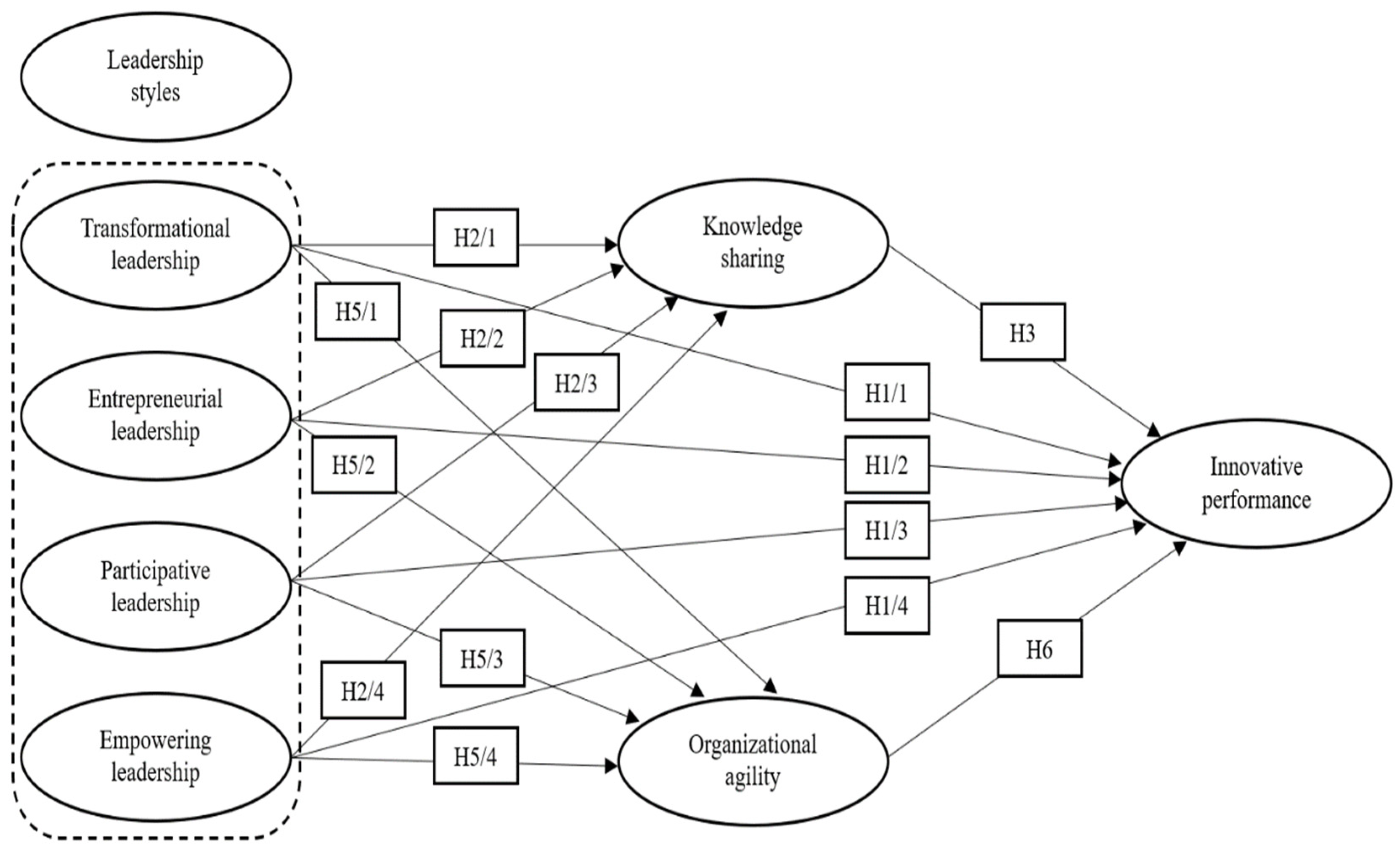
In the proposed model, transformational, entrepreneurial, participative, and empowering leadership styles are examined as independent variables. Knowledge sharing and organizational agility are conceptualized as mediating variables, while innovative performance represents the dependent variable. More specifically, the model assumes that knowledge sharing and organizational agility represent parallel but functionally distinct mediating mechanisms. Knowledge sharing reflects a relational and micro-level exchange process that facilitates idea generation, exchange, and recombination, whereas organizational agility captures a higher-level adaptive capability concerned with implementation, responsiveness, and execution. Accordingly, the model assumes complementary rather than redundant mediation effects. In theoretical terms, this also implies that the effects of leadership styles on innovative performance are expected to remain partly direct while also operating indirectly through these two mediators, making partial rather than full mediation more theoretically plausible.
Building on this theoretical positioning, the present study aims to achieve several key objectives. First, it examines the direct effects of transformational, entrepreneurial, participative, and empowering leadership styles on innovative performance, knowledge sharing, and organizational agility. Second, it investigates the influence of knowledge sharing and organizational agility on innovative performance. Third, it analyzes the mediating roles of knowledge sharing and organizational agility in the relationship between the four leadership styles and innovative performance. Taken together, these objectives reflect a parallel mediation perspective in which the two mediators are expected to explain distinct but complementary pathways linking leadership styles to innovation. Through these objectives, the study seeks to provide a more comprehensive and context-sensitive understanding of how leadership configurations drive innovation in tourism and hospitality organizations.
5. Conclusions
5.1. Discussion
This study aims to investigate the impact of four leadership styles (transformational, entrepreneurial, participative, and empowering) on innovative performance, knowledge sharing, and organizational agility. It also examines whether knowledge sharing and organizational agility mediate the relationship between these leadership styles and innovative performance. Beyond confirming the proposed hypotheses, the findings of this study offer an important analytical contribution to the literature. Specifically, the study moves beyond the dominant tendency to examine leadership styles in isolation by demonstrating how multiple leadership approaches operate simultaneously through differentiated social exchange mechanisms. In addition, the findings show that knowledge sharing and organizational agility function as complementary mediating pathways through which leadership-driven exchange relationships are translated into innovative performance. This integrative perspective provides a more nuanced understanding of leadership dynamics in tourism and hospitality organizations. Importantly, the findings should not be interpreted as merely confirming well-established relationships in the literature. Rather, they provide a deeper explanatory layer by demonstrating how multiple leadership styles jointly operate through distinct yet interconnected exchange mechanisms. This shifts the focus from simple effect validation to understanding the underlying processes through which leadership configurations influence innovation.
The findings supported the significant and positive effect of transformational leadership on innovative performance. Alwali [
112] found that transformational leadership empowers employees by delegating authority and promoting autonomy, resulting in innovative outcomes. This leadership style cultivates a culture of collaboration, trust, and open communication, making team members feel secure in sharing ideas and experimenting. Such a supportive environment lowers innovation barriers and encourages a steady stream of new ideas, thereby boosting the organization’s innovative performance, as noted by Bagga et al. [
113] and Orieno et al. [
114]. This suggests that transformational leadership functions as a relational mechanism that enhances innovation by strengthening trust-based exchanges and encouraging employees to reciprocate through creative engagement. Importantly, the findings should not be interpreted as merely confirming well-established relationships in the literature. Rather, they provide a deeper explanatory layer by demonstrating how multiple leadership styles jointly operate through distinct yet interconnected exchange mechanisms. This shifts the focus from simple effect validation to understanding the underlying processes through which leadership configurations influence innovation.
The results also demonstrated that entrepreneurial leadership has a significant and positive impact on innovative performance. Joel and Oguanobi [
4] and Marquez et al. [
115] noted that entrepreneurial leadership offers a clear vision and strategic direction, steering the organization towards shared innovation objectives. It nurtures a culture that values and rewards innovation, celebrates achievements, acknowledges creative contributions, and learns from failures. They further explained that this culture of continuous improvement motivates employees to find better ways of operating, thereby sustaining innovative performance. This suggests that entrepreneurial leadership drives innovation through a value-based exchange logic, where employees are motivated to engage in innovation when the perceived benefits of experimentation outweigh potential risks.
Similarly, the results showed a significant and positive impact of participative leadership on innovative performance. Mata et al. [
5] suggested that participative leadership promotes organizational learning through employee involvement in discussions about challenges and opportunities, aiding in the identification of patterns and trends for innovative strategies. This collaborative learning enhances the organization’s ability to innovate and adjust. Elsetouhi et al. [
28] argued that participative leaders cultivate a shared vision that aligns everyone toward collective goals, fostering a sense of purpose and encouraging collaborative efforts to achieve innovative outcomes. This reflects that participative leadership generates obligation-based exchanges, where employees reciprocate inclusion and involvement through active contribution to innovation.
The results indicated that empowering leadership significantly affects innovative performance. According to Holbeche [
89], empowering leadership strengthens teams by promoting resilience and adaptability, enabling them to thrive in dynamic environments. By cultivating a sense of autonomy and resilience, employees effectively manage challenges and respond to changes, thereby fostering sustained innovation. Khatoon et al. [
62] and Ma et al. [
116] noted that this leadership approach enhances employees’ confidence and self-efficacy through trust in their abilities and encouragement of challenging tasks. This increased confidence promotes innovation, as employees feel empowered to take risks and pursue creative ideas without fear of failure. This indicates that empowering leadership promotes innovation through autonomy-driven reciprocity, where employees internalize responsibility and initiate innovative behaviors independently.
The findings confirmed the substantial and positive impact of transformational leadership on knowledge sharing. According to Al-Romeedy [
26], transformational leadership promotes teamwork and collaboration by establishing frameworks like cross-functional teams and regular meetings. This approach cultivates a culture centered on continuous learning and growth, motivating employees to actively seek and exchange new knowledge, thereby integrating knowledge sharing into the organizational fabric [
117,
118]. This suggests that knowledge sharing emerges as a trust-based exchange response driven by relational leadership dynamics.
Furthermore, the results indicated a significant and positive impact of entrepreneurial leadership on knowledge sharing. As highlighted by Adegbola et al. [
119] and Chaudhuri et al. [
120], entrepreneurial leaders invest in knowledge management systems and collaborative platforms to streamline information exchange, thereby improving organizational efficiency. Riana et al. [
121] and Ajayi and Udeh [
94] pointed out that entrepreneurial leaders foster a flexible and adaptive environment where knowledge is constantly refreshed and exchanged. This adaptability promotes a culture where employees readily share current information and insights, enhancing organizational agility and responsiveness. This indicates that knowledge sharing in this context is shaped by strategic exchange considerations, where knowledge is treated as a valuable resource aligned with opportunity-seeking behavior.
In addition, the results indicated that participative leadership has a substantial and beneficial impact on knowledge sharing. According to Kumar et al. [
122] and Sarioguz and Miser [
85], participative leadership actively solicits input from a diverse range of employees, enriching decision-making and problem-solving with varied insights and expertise. Additionally, Sarioguz and Miser [
85] and Mata et al. [
5] highlighted its promotion of cross-functional teams to tackle intricate challenges, fostering the exchange of knowledge and collaboration across different departments. This approach harnesses diverse expertise to generate more comprehensive and innovative solutions, thereby enhancing organizational outcomes. This reflects that knowledge sharing is reinforced through social obligation, where employees reciprocate participation through active knowledge contribution.
Based on the findings, empowering leadership has a significant and positive impact on knowledge sharing. Al-Romeedy [
26] observed that empowering leadership delegates authority and responsibility to employees, motivating them to take ownership of their responsibilities and decisions. This delegation cultivates knowledge sharing and collaboration, fostering a sense of accountability among employees for their work. Singh [
123] and Cho et al. [
124] further illustrated that empowering leaders demonstrate adaptability and responsiveness to change, encouraging ongoing and pertinent knowledge sharing to address evolving circumstances. This adaptability supports organizational agility, enabling swift responses to emerging challenges and opportunities. This indicates that knowledge sharing becomes a self-initiated exchange behavior driven by autonomy and psychological ownership.
Importantly, the findings illustrated that knowledge sharing has a significant and positive impact on innovative performance. Chin et al. [
125] and Devi [
68] supported this conclusion, noting that knowledge sharing promotes collaboration and synergy among employees, leveraging their combined strengths and expertise to foster innovation. This collaborative environment harnesses the organization’s collective potential. Deng et al. [
126] and Santhose and Lawrence [
127] emphasized that the rapid dissemination of information facilitated by knowledge sharing accelerates the innovation process, enabling quicker, well-informed decision-making. In dynamic markets, this accelerated pace offers a notable competitive advantage by reducing the time required to develop and implement new ideas. This suggests that innovation emerges as a cumulative outcome of continuous knowledge exchange processes rather than isolated individual efforts. However, it is important to note that knowledge sharing alone does not guarantee innovation unless it is supported by organizational conditions that enable the transformation of knowledge into actionable outcomes. This finding highlights a critical limitation in prior studies that tend to overemphasize knowledge exchange without adequately considering its conversion into organizational capabilities.
The findings underscored the significant and positive impact of transformational leadership on organizational agility. According to Nuraini [
128] and Dimple [
129], transformational leadership emphasizes continuous learning and development, equipping employees with adaptive skills and knowledge. This focus ensures that the organization can swiftly acquire new competencies, adjust strategies, and leverage emerging trends, thereby enhancing overall agility. Additionally, Chauhan and Thangavelu [
130] and Pawar and Dhumal [
131] highlighted that transformational leadership enhances decision-making processes by fostering collaboration, transparency, and information sharing. By decentralizing decision-making and encouraging diverse input, transformational leaders facilitate prompt, well-informed decisions that effectively seize opportunities or manage risks. This indicates that organizational agility reflects an adaptive response to leadership-driven exchange relationships.
Also, the findings revealed that entrepreneurial leadership significantly and positively influences organizational agility. According to Yang and Bentein [
132] and D’Souza [
133], entrepreneurial leadership cultivates a robust entrepreneurial mindset among employees through autonomy, resources, and support, enhancing the organization’s capacity to recognize and capitalize on market shifts, thereby bolstering agility. Additionally, Khairy et al. [
25] noted that entrepreneurial leaders foster a collaborative, knowledge-sharing culture by dismantling silos and promoting cross-functional collaboration. This rapid exchange of information and ideas facilitates organizational learning and enables swift adaptation to evolving customer preferences, technological advancements, and competitive landscapes. This indicates that agility reflects an adaptive response to leadership-driven exchange relationships.
Furthermore, the findings highlighted that participative leadership significantly and positively impacts organizational agility. According to Elsetouhi et al. [
28], participative leadership enhances decision-making flexibility through collaborative processes, incorporating diverse perspectives, and swiftly adapting strategies to capitalize on opportunities. Sharief [
134] and Mata et al. [
5] emphasized that participative leadership cultivates resilience by proactively managing risks and preparing for unforeseen challenges, promoting a culture of flexibility and adaptability. This approach equips organizations to navigate complexities effectively and thrive in competitive environments. This reflects that agility is strengthened through collective exchange and shared responsibility.
The findings also revealed that empowering leadership has a significant and positive impact on organizational agility. Hermawan et al. [
29] and Amoroso et al. [
135] demonstrated that empowering leadership enhances organizational agility by fostering autonomy, trust, and continuous improvement. This leadership style empowers employees at all levels, making organizations more responsive, innovative, and adaptable. Pahi et al. [
136] and Al-Romeedy [
26] further noted that empowering leaders promote proactive problem-solving, quick issue resolution, and swift adaptation to market changes by delegating authority and valuing employee decision-making. This approach enables organizations to anticipate and respond to changes quickly, maintaining agility and a competitive edge. This reflects that agility is strengthened through collective exchange and shared responsibility.
Meanwhile, the findings indicated that organizational agility positively influences innovative performance. According to Holbeche [
89], agile organizations possess the capability to swiftly redirect financial and human resources to support emerging open innovation initiatives, ensuring timely and effective implementation. This adaptability not only mitigates risks but also enhances the probability of successful outcomes. Ajayi and Udeh [
94], Ciampi et al. [
137], and Mao et al. [
138] also emphasized that agile organizations cultivate a culture of continuous organizational learning, which is crucial for open innovation. These organizations excel in assimilating external knowledge swiftly and efficiently transferring internal knowledge to external partners, thereby bolstering their overall innovation capabilities through a seamless exchange of insights. This indicates that agility emerges from decentralized and autonomy-driven exchange processes. This suggests that organizational agility plays a pivotal role in bridging the gap between knowledge availability and innovation realization, addressing a key limitation in prior research that often treats these constructs independently rather than as interdependent mechanisms.
The mediation results provide deeper insight into how leadership influences innovative performance. This suggests that organizational agility plays a pivotal role in bridging the gap between knowledge availability and innovation realization, addressing a key limitation in prior research that often treats these constructs independently rather than as interdependent mechanisms. Specifically, knowledge sharing and organizational agility operate as complementary rather than redundant mediating mechanisms. Knowledge sharing reflects a relational exchange pathway through which employees contribute, integrate, and recombine knowledge in response to leadership behaviors. In contrast, organizational agility represents an adaptive capability that enables the organization to transform this shared knowledge into actionable and innovative outcomes. This distinction highlights that while knowledge sharing supports idea generation, organizational agility enables effective implementation. Accordingly, the findings extend prior research by demonstrating that innovation emerges through a multi-layered process involving both relational and adaptive mechanisms, rather than direct leadership effects alone. The mediation results go beyond merely confirming indirect effects and instead provide a more nuanced understanding of the mechanisms through which leadership influences innovation.
It is also noteworthy that the relatively similar magnitudes of the path coefficients across the four leadership styles may reflect the integrated nature of leadership practices within organizational settings. Rather than functioning in isolation, these leadership styles tend to co-occur and reinforce one another, shaping a holistic leadership environment that supports innovation. This pattern suggests that innovative performance is not driven by a single dominant leadership style, but rather emerges from the combined influence of multiple leadership behaviors. From a SET perspective, this indicates that different exchange mechanisms may operate simultaneously, collectively enhancing employees’ adaptive and innovative responses. Accordingly, the findings highlight the importance of viewing leadership as a multidimensional and synergistic construct rather than a set of independent or competing styles. This finding challenges the traditional linear perspective of leadership–innovation relationships and instead supports a more complex, process-based view in which multiple mediating mechanisms operate simultaneously.
Taken together, these findings move beyond descriptive confirmation and offer a theoretically grounded explanation of how leadership operates as a multidimensional and interaction-based phenomenon. The study, therefore, contributes to the literature not by reiterating known relationships but by demonstrating that innovation emerges from the interplay of multiple leadership styles operating through integrated social exchange mechanisms, particularly within complex and dynamic service contexts such as tourism and hospitality.
5.2. Theoretical Implications
The present study offers several important theoretical contributions by extending and refining SET within the context of tourism and hospitality organizations. Specifically, the study advances SET by demonstrating that exchange relationships are not uniform but multi-layered and differentiated processes activated by distinct leadership styles. The findings show that transformational, entrepreneurial, participative, and empowering leadership behaviors generate different forms of exchange relationships—ranging from trust-based reciprocity and obligation-driven exchanges to autonomy-oriented and value-based interactions. This moves SET beyond its traditional monolithic interpretation and positions it as a more dynamic and context-sensitive theoretical framework.
Second, the study reconceptualizes knowledge sharing as an exchange-based relational mechanism rather than a simple behavioral outcome. Drawing on the empirical findings, knowledge sharing is framed as a reciprocal response embedded in trust, perceived support, and mutual benefit. This perspective extends prior research by demonstrating that knowledge sharing operates as an intermediate social exchange process through which leadership effects are transmitted, rather than merely being a direct outcome of leadership influence.
Third, the study extends SET by introducing organizational agility as a higher-order adaptive outcome of exchange processes, thereby linking micro-level interactions to macro-level organizational capabilities. The results suggest that leadership-driven exchanges at the individual level (e.g., trust, participation, and empowerment) accumulate and transform into collective adaptive capabilities, offering a novel explanation of how exchange dynamics scale from individuals to organizations.
Fourth, the study makes a significant contribution by proposing a dual mediation (parallel) model, demonstrating that innovative performance emerges through two complementary mechanisms: a relational pathway (knowledge sharing) and an adaptive pathway (organizational agility). This finding advances the existing literature by moving beyond single-mediator models and providing a more comprehensive explanation of how leadership effects unfold across multiple levels of analysis.
Finally, the study contributes to leadership theory by advancing a configurational perspective of leadership within SET, where multiple leadership styles operate simultaneously rather than independently. The findings suggest that leadership behaviors interact and reinforce one another, creating complex exchange environments that shape employee responses and organizational outcomes. This challenges the dominant assumption of isolated leadership effects and offers a more realistic and theoretically grounded understanding of leadership dynamics, particularly in service-intensive and interaction-driven contexts such as tourism and hospitality.
5.3. Practical Implications
This study provides a set of actionable implications for tourism and hospitality organizations seeking to enhance innovative performance through leadership development, knowledge sharing, and organizational agility. While prior research has emphasized the importance of these factors, the present study translates these relationships into more operational and context-sensitive recommendations.
First, the findings suggest that organizations should prioritize the development of empowering and transformational leadership styles, as they demonstrated relatively stronger direct and indirect effects on innovative performance. Empowering leadership enhances employees’ autonomy, engagement, and willingness to participate in knowledge-sharing processes, while transformational leadership plays a central role in shaping a shared vision, motivating employees, and fostering a collaborative organizational climate. In contrast, participative and entrepreneurial leadership styles remain important but are more context-dependent, being particularly effective in situations requiring collective decision-making or opportunity exploration. Accordingly, managers should adopt a contingency-based leadership approach, selecting and combining leadership styles based on organizational needs rather than relying on a single dominant style.
Second, to operationalize leadership development, organizations are encouraged to adopt a structured leadership development toolkit that links each leadership style to observable behavioral indicators, targeted training interventions, and performance evaluation mechanisms. For example, transformational leadership can be developed through visioning workshops, inspirational communication training, and change management programs. Empowering leadership can be strengthened through delegation practices, autonomy-supportive management training, and employee involvement initiatives. Participative leadership may be enhanced through collaborative decision-making frameworks and team facilitation training, while entrepreneurial leadership can be fostered through innovation labs, opportunity recognition training, and risk-taking simulations. The effectiveness of these interventions should be evaluated using multi-source feedback mechanisms (e.g., 360-degree assessments), innovation-related KPIs, and employee engagement indicators.
To further support implementation,
Table 8 presents a leadership development toolkit that integrates behavioral indicators, training modules, evaluation methods, and implementation priorities for each leadership style.
In line with these priorities, organizations should allocate greater resources and investment toward empowering and transformational leadership development initiatives, given their stronger impact on innovation outcomes, while selectively investing in participative and entrepreneurial leadership based on contextual needs and strategic objectives.
Third, the results highlight the importance of a context–leadership style matching approach, where leadership priorities vary according to organizational conditions. For instance, start-up and high-growth organizations operating in dynamic environments benefit more from entrepreneurial and empowering leadership styles, which facilitate rapid adaptation, experimentation, and opportunity recognition. In contrast, mature organizations in relatively stable environments are more likely to benefit from transformational and participative leadership styles that support knowledge integration, alignment, and incremental innovation. Similarly, small and medium-sized enterprises (SMEs) may require flexible and entrepreneurial leadership approaches, whereas large organizations may benefit more from structured participative and transformational leadership systems. In decline or crisis contexts, organizations may rely more heavily on transformational and empowering leadership styles to support organizational renewal, restructuring, and recovery.
To guide managerial decision-making,
Table 9 presents a simplified context–leadership style matching matrix.
Fourth, this study proposes a synergistic cultivation pathway between knowledge sharing and organizational agility, emphasizing that these mechanisms should be developed in an integrated manner rather than independently. At the organizational design level, firms should establish flexible structures, cross-functional teams, and decentralized decision-making processes to facilitate knowledge flows and responsiveness. At the human resource level, organizations should embed knowledge-sharing behaviors into performance appraisal systems, training programs, and reward mechanisms, while also promoting learning-oriented cultures that support experimentation and continuous improvement. At the technological level, implementing digital knowledge management systems, collaborative platforms, and AI-supported analytics can enhance both knowledge accessibility and organizational responsiveness. This integrated approach ensures that knowledge is not only created and shared but also effectively translated into adaptive actions and innovation outcomes.
Finally, organizations are encouraged to develop a leadership diagnostic tool based on the findings of this study to assess the presence and effectiveness of different leadership styles within the organization. Such a tool may take the form of a structured questionnaire or a 360-degree assessment instrument that evaluates leadership behaviors related to vision, empowerment, participation, and innovation support. The results of this assessment can guide targeted leadership development initiatives and help organizations align leadership capabilities with strategic innovation objectives.
5.4. Limitations and Future Research
The study acknowledges several limitations, each of which presents opportunities for future research to enhance understanding and validate findings. Given the cross-sectional nature of the data, the study is limited in its ability to establish causal relationships among the examined variables. Conducted within a specific cultural context (Egypt), the study’s findings were not readily applicable to other regions or cultural settings. Future research could replicate the study in diverse cultural contexts such as Saudi Arabia, the UAE, or Turkey to explore and contrast the outcomes. This involves conducting similar studies across different countries and regions to ascertain whether the relationships between leadership styles, knowledge sharing, organizational agility, and innovative performance remain consistent across varied cultural contexts. Further, the use of convenience sampling may limit the generalizability of the findings beyond the studied sample. Although efforts were made to include a large and diverse group of respondents, the non-probability sampling approach may introduce selection bias. Future research is encouraged to employ probability sampling techniques to enhance external validity.
In addition, although procedural and statistical remedies were applied to reduce common method variance (CMV), including Harman’s single-factor test and full collinearity assessment, it is acknowledged that these techniques may not completely eliminate common method bias. Future research is encouraged to apply more advanced approaches, such as marker variable techniques or unmeasured latent method factor methods, to further validate the robustness of the findings.
Likewise, the study concentrates on two specific sectors within the tourism and hospitality industry (travel agencies and five-star hotels), potentially restricting the generalizability of its findings to other sectors. Future research could investigate how knowledge sharing and organizational agility mediate the relationship between leadership styles and innovative performance across various sectors. Comparative studies spanning different sectors, like airlines and destination management companies, would enable the identification of industry-specific dynamics and assess the broader applicability of the study’s conclusions.
The study analyzed each leadership style individually without exploring potential interactions or combinations that could influence knowledge sharing and organizational agility. Future research could delve into these interactions and combinations of different leadership styles. Investigating how these leadership styles, along with others like transactional, charismatic, authentic, strategic, and digital, complement or oppose each other could offer insights into the most effective leadership strategies. In addition, while the study examined how knowledge sharing and organizational agility mediate the effects, it may not fully encompass all possible mediating mechanisms or conditions. Future research could explore more deeply the specific pathways through which leadership styles affect these mediating variables and, consequently, influence innovative performance. For instance, investigating how leadership behaviors cultivate organizational cultures of learning, experimentation, and adaptability could offer insights into the fundamental processes driving innovation outcomes.
Moreover, the study did not extensively investigate potential moderating factors that could impact the relationships between leadership styles, knowledge sharing, organizational agility, and innovative performance. Future research is encouraged to incorporate moderating variables such as perceived organizational support, task complexity, and organizational culture (e.g., collectivism vs. individualism) to examine the boundary conditions under which leadership styles exert their influence through mediating mechanisms. Such an approach would enable a deeper understanding of when and for whom these relationships are strengthened or weakened.
In addition, control variables such as organizational size, employee tenure, and enterprise type (e.g., travel agencies vs. five-star hotels) were not explicitly incorporated into the structural model. Future research should include such variables to test the robustness of the main effects and provide more precise estimates of the relationships under investigation.
Lastly, although the study collected data from a large number of organizations, the analysis was conducted at the individual level without explicitly accounting for potential organizational clustering (nesting effects). This may influence the independence of observations. Future research is encouraged to adopt multi-level analytical approaches to better capture both individual- and organizational-level effects. Furthermore, although the present study adopts a parallel mediation structure, alternative model specifications were not empirically compared. Future research is encouraged to test competing models, such as full mediation, partial mediation, and sequential (chain) mediation models, and to compare their explanatory power using model fit indices (e.g., AIC, BIC), thereby providing stronger validation of the proposed theoretical structure. In addition, longitudinal research designs are recommended to better capture the temporal dynamics of these relationships and to verify the causal ordering between leadership behaviors, mediating processes, and innovation outcomes over time. Also, future research may examine whether the relative strength of knowledge sharing versus organizational agility as mediators varies across different service contexts, particularly in high-contact versus low-contact environments.




 ,
,