1. Introduction
The manufacturing industry is rapidly evolving from conventional automation toward Artificial Intelligence (AI)-driven autonomous manufacturing, which requires tightly coupling between real-time perception, decision-making, and actuation. To support these capabilities, the traditional cloud-centric AI paradigm is being replaced by distributed Edge AI architectures that process sensor and process data directly at production equipment [
1]. By executing inference and control at the edge, Edge AI significantly reduces communication latency, decreases dependence on cloud infrastructure, and improves security and reliability by limiting the external transmission of sensitive manufacturing data [
2,
3]. As a result, Edge AI has emerged as a core enabling technology for low-latency, closed-loop smart manufacturing applications.
Despite this progress, the practical deployment of Edge AI in industrial environments remains challenging. Modern shop floors involve heterogeneous assets, including vision-based inspection systems, mobile units such as automated guided vehicles (AGVs) and autonomous mobile robots (AMRs), collaborative robots, and diverse industrial sensors. These devices typically operate under different hardware platforms, software stacks, and communication protocols, making interoperability, coordinated operation, and unified management difficult to achieve. Although existing studies have extensively explored Edge AI algorithms and edge–cloud collaborative architectures, relatively little attention has been paid to standardized, asset-level standardization and interoperable integration of Edge AI functions across heterogeneous manufacturing devices [
4].
Existing Edge AI deployments without standardized asset models often suffer from high cross-vendor integration costs, complex lifecycle management, and semantic inconsistencies arising from fragmented communication protocols. These limitations hinder reliable inter-edge coordination and system scalability in industrial environments. The proposed framework addresses these bottlenecks by adopting Asset Administration Shell (AAS) for standardized asset modeling and OPC UA as a unified communication backbone, thereby simplifying system integration and ensuring semantic consistency across heterogeneous devices.
This study proposes an AAS-based Edge AI framework that enables asset-centric orchestration and interoperable inter-edge collaboration. The AAS, introduced in the Industry 4.0 framework, provides a standardized digital representation of physical assets and supports semantic interoperability through structured submodels [
5]. By modeling each Edge device as a standardized AAS asset, the proposed framework allows both static specifications and dynamic operational states to be uniformly described, exchanged, and managed, even in highly distributed manufacturing environments.
Within the proposed framework, each Edge device is registered as a digital asset compliant with the AAS standard and exchanges real-time information with other assets and the AAS server via the OPC UA protocol. OPC UA provides not only secure and reliable communication but also information modeling capabilities that enable seamless binding between operational data and AAS submodels [
6]. This combination of AAS and OPC UA establishes a unified digital infrastructure in which Edge devices can coordinate autonomously while remaining visible and manageable at the system level.
To validate the proposed approach, this study implements a framework-driven prototype system consisting of a Raspberry Pi-based Vision Inspector, an autonomous mobile robot (AMR), and an AAS-based monitoring server. The Vision Inspector performs real-time defect detection, such as milling tool breakage, and immediately transmits event information to the AMR and the AAS server. Based on this information, the AMR autonomously navigates to the detected fault location and executes predefined actions, while all system states and events are recorded and monitored through the AAS server and its user interface. This prototype demonstrates AAS-based asset modeling and OPC UA-based coordination enable closed-loop, real-time collaboration among heterogeneous Edge AI devices.
Implementing a functional digital twin requires integrating real-time data from heterogeneous assets into the digital model. By utilizing the AAS-based standardization proposed in this framework, an asset-centric digital twin for each Edge AI device can be effectively realized. This is achieved by providing a standardized semantic structure for distributed assets through AAS submodels and supporting real-time data synchronization via the OPC UA protocol.
The contributions of this study are twofold:
Standard-compliant edge intelligence: This study presents a general design principle for representing heterogeneous Edge AI functions as standardized AAS assets, enabling semantic interoperability and reusable integration across diverse platforms and manufacturing environments.
Event-driven inter-edge orchestration: A decentralized coordination mechanism is proposed based on AAS-aligned OPC UA, which enables real-time, event-driven collaboration among Edge devices while supporting system-level monitoring and traceability.
The remainder of this paper is organized as follows.
Section 2 reviews related work on Edge AI and AAS-enabled manufacturing systems.
Section 3 proposes the AAS-based Edge AI framework.
Section 4 describes the OPC UA-based communication under the AAS standard, and
Section 5 presents the implementation of the prototype system to validate the proposed framework. Finally,
Section 6 concludes the paper and outlines directions for future research.
2. Related Work
2.1. Edge AI Architecture and Systems for Manufacturing
The manufacturing industry is increasingly shifting from cloud-centric computing paradigms to distributed Edge AI architectures to address the stringent latency, bandwidth, security, and reliability requirements of modern production systems. By executing data processing, inference, and control functions close to sensors and equipment, Edge AI enables low-latency decision-making and greater operational autonomy, which are essential for real-time manufacturing applications such as quality inspection, anomaly detection, and condition monitoring [
7].
Shi et al. [
8] characterized edge computing as a distributed computing paradigm that complements cloud computing by supporting latency-sensitive and bandwidth-intensive applications. In manufacturing environments, this paradigm has been widely adopted for applications requiring immediate feedback and local control, including defect detection, predictive maintenance, and process monitoring. Consequently, Edge AI has become a fundamental building block of smart factory architectures in which local intelligence and fast control loops are critical [
9].
From an architectural perspective, most manufacturing-oriented Edge AI architectures follow a hierarchical structure consisting of sensor/actuator layers, edge layers, and cloud or enterprise layers. The edge layer hosts lightweight deep learning models or rule-based intelligence for real-time inference and control, while the cloud layer supports model training, historical data analytics, and enterprise-level optimization [
10]. This layered design alleviates network congestion and improves system scalability, while still allowing centralized coordination and optimization.
Recent research has increasingly focused on applying Edge AI to manufacturing-specific scenarios. Nguyen et al. [
11] introduced a human-centered Edge AI framework aligned with the Industry 5.0 vision, emphasizing collaborative intelligence between humans and machines. Wan et al. [
12] proposed an industrial IoT-based manufacturing architecture leveraging Edge AI for distributed processing and real-time process analytics. Similarly, Lee et al. [
13] developed an edge–cloud cooperative framework for equipment failure prediction and process optimization. These studies demonstrate the potential of Edge AI to overcome the limitations of centralized cloud-based analytics in dynamic production environments.
However, despite these advances, practical deployment of Edge AI in manufacturing still faces fundamental challenges. In particular, interoperability among heterogeneous equipment, standardized representation of device data and functions, and asset-level deployment of intelligence remain insufficiently addressed. Most existing studies focus on algorithmic performance or system-level architecture, while relatively little attention has been given to standardized, asset-centric information modeling and systematic integration of AI-enabled devices [
14]. As a result, current Edge AI architectures are often difficult to scale, reuse, and integrate across different manufacturing environments.
To address these limitations, there is a growing demand for Edge AI architectures that are both asset-centric and standard-compliant. This study responds to this need by structuring the Edge AI systems around the AAS standard, enabling manufacturing assets to be represented, managed, and coordinated as interoperable digital entities while simultaneously supporting real-time Edge intelligence.
2.2. AAS-Enabled Manufacturing Systems
AAS is a core building block of digital twin implementations introduced in the Industry 4.0 framework, providing a standardized and semantically rich digital representation of physical manufacturing assets [
5]. An AAS consists of a header that contains asset identification and metadata, and a body that describes the asset’s characteristics, states, and functions. The body is composed of multiple submodels, each representing a specific aspect of the asset, such as identification, technical data, operational status, communication interfaces, or maintenance information. This submodel-based structure allows not only data but also functions and service interfaces to be represented in a unified and machine-interpretable manner, thereby significantly enhancing asset reusability and interoperability across systems [
15].
Waseem et al. [
16] characterized the AAS as a standardized digital representation of cyber–physical systems that enables consistent description and management of both structural information and functional capabilities of manufacturing assets. Through this abstraction, heterogeneous physical devices can be exposed as interoperable digital entities, forming the foundation for asset-level integration in Industry 4.0 and beyond.
In practical AAS deployments, OPC UA plays a critical role as the underlying communication and information modeling infrastructure. OPC UA is an industrial-grade standard protocol that supports secure, reliable, and structured communication among manufacturing equipment and information systems. In AAS-based systems, OPC UA enables real-time data exchange between edge devices and higher-level platforms while preserving semantic consistency through its information modeling mechanisms [
17]. Compared with lightweight protocols such as MQTT or HTTP, OPC UA provides superior scalability, security, and tight coupling with AAS submodels, making it particularly suitable for asset-centric manufacturing systems.
Recent research has demonstrated the feasibility of AAS-based manufacturing systems in various industrial contexts. Sief et al. [
18] implemented AAS-based data management and asset tracking in small-scale factories by defining AAS variables and linking them to physical equipment. Ye et al. [
19] proposed a systematic methodology for implementing AAS and designed an AAS-based manufacturing architecture aligned with Industry 4.0 principles. Brito et al. [
11] further demonstrated the potential of AAS for integrating heterogeneous industrial systems through digital asset representations.
While these studies demonstrate the effectiveness of AAS in standardized asset representation and information interoperability, most existing AAS-based manufacturing systems and Edge AI frameworks still rely primarily on centralized or cloud-oriented architectures for coordination and management. While studies such as Arm et al. [
20] have demonstrated the feasibility of applying AAS in distributed manufacturing environments, they mainly focus on task negotiation and system-level interoperability rather than on integrating AAS with decentralized Edge AI devices performing real-time inference and control. As a result, direct applications of AAS to Edge AI architectures remain limited, and asset-level autonomy is not fully supported in existing systems.
In contrast, the proposed framework integrates AAS with decentralized Edge AI devices, enabling independent inference, event-driven collaboration, and direct coordination without relying on server-mediated control. This architecture provides enhanced responsiveness and supports asset-centric, autonomous operation in distributed manufacturing environments.
3. An AAS-Based Edge AI Framework
This study proposes an AAS-based Edge AI framework for autonomous manufacturing. The objective of the framework is to achieve asset-level interoperability and scalable coordination among heterogeneous manufacturing assets by representing edge-layer devices—responsible for real-time perception, decision-making, and execution—as standardized digital assets using the AAS and interconnecting them through industrial communication standards. The proposed framework consists of three core components: Edge AI Devices, an AAS Server, and an AAS Monitor.
3.1. Overall Framework
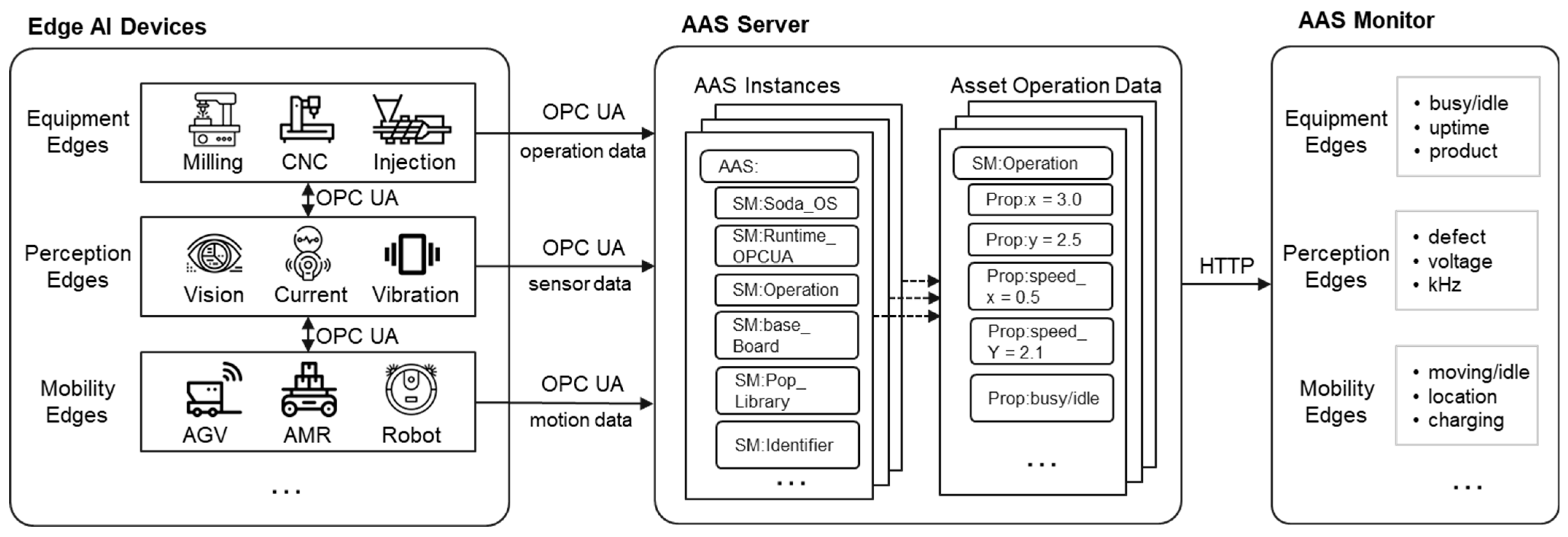
Figure 1 illustrates the overall architecture of the proposed AAS-based Edge AI framework.
Edge AI Devices constitute the distributed asset-intelligence layer of the system. This layer includes Equipment Edge devices such as milling machines, CNC machines, and injection molding equipment; Perception Edge devices for vision, current, and vibration sensing; and Mobility Edge devices such as AMRs, AGVs, and robots. Each device is implemented as an Edge AI asset equipped with its own computation and communication capabilities. From an AAS perspective, every Edge device is modeled as an independent digital asset and registered as a distinct AAS instance. This asset-centric abstraction enables not only identification and monitoring but also coordinated autonomous operation across devices, regardless of physical location or process role.
The AAS Server functions as the system’s digital asset integration and coordination hub. It maintains and manages the AAS instances of all Edge devices and receives real-time operational data from each asset through OPC UA communication. The collected information is exposed to external systems and users via the AAS Monitor and is simultaneously stored as structured logs, ensuring manufacturing history management and process traceability. This architecture provides the basis for supervisory control, analytics, and closed-loop optimization.
The AAS Monitor provides a unified visualization and monitoring interface for the Edge AI framework, accessible from both PC and mobile environments. Based on data collected by the AAS Server, it presents intuitive views of asset metadata, sensor readings, and motion states of edge devices. This enables operators to observe system behavior in real time and supervise distributed autonomous operations within a standardized asset framework.
This framework leverages a hybrid architecture where Edge AI devices directly orchestrate for real-time autonomy, while all operational state is synchronized to the AAS server, providing a centralized digital twin for system-level management and traceability.
3.2. AAS Design for Edge Assets
In the proposed framework, manufacturing assets at the Edge AI Device layer are modeled using standardized AAS submodels defined by the SMTs published by the Industrial Digital Twin Association (IDTA) [
21]. SMTs provide a normative and machine-interpretable specification of AAS structures by defining the required submodels, their constituent elements, and their semantic meanings for specific asset types and application contexts. This template-driven approach ensures structural consistency, semantic interoperability, and reusability across heterogeneous industrial systems.
The IDTA provides a set of reference SMTs that are broadly applicable to industrial assets. Typical examples of SMTs include the Digital Nameplate, which encodes identification information such as manufacturer, serial number, and product designation, and Technical Data, which captures hardware specifications, rated values, and model parameters. Handover Documentation enables the attachment of manuals, drawings, and other technical documents, while Time Series Data supports the representation of operational states such as alarms, vibration, and temperature. Additional SMTs are defined for domain-specific data, including energy consumption and operational efficiency indicators.
For mobile industrial assets, the IDTA defines specialized templates such as Technical Data for AGV [
22], which standardize both static specification data and dynamic operational and kinematic attributes of AGVs. For example, to model the AMR used in the presented scenario as an AAS asset, we adopted the IDTA-defined SMT for AGVs, enabling a standardized representation of its configuration and real-time behavior. This modeling approach is part of the generic framework-level mechanism and can be applied to other mobile assets.
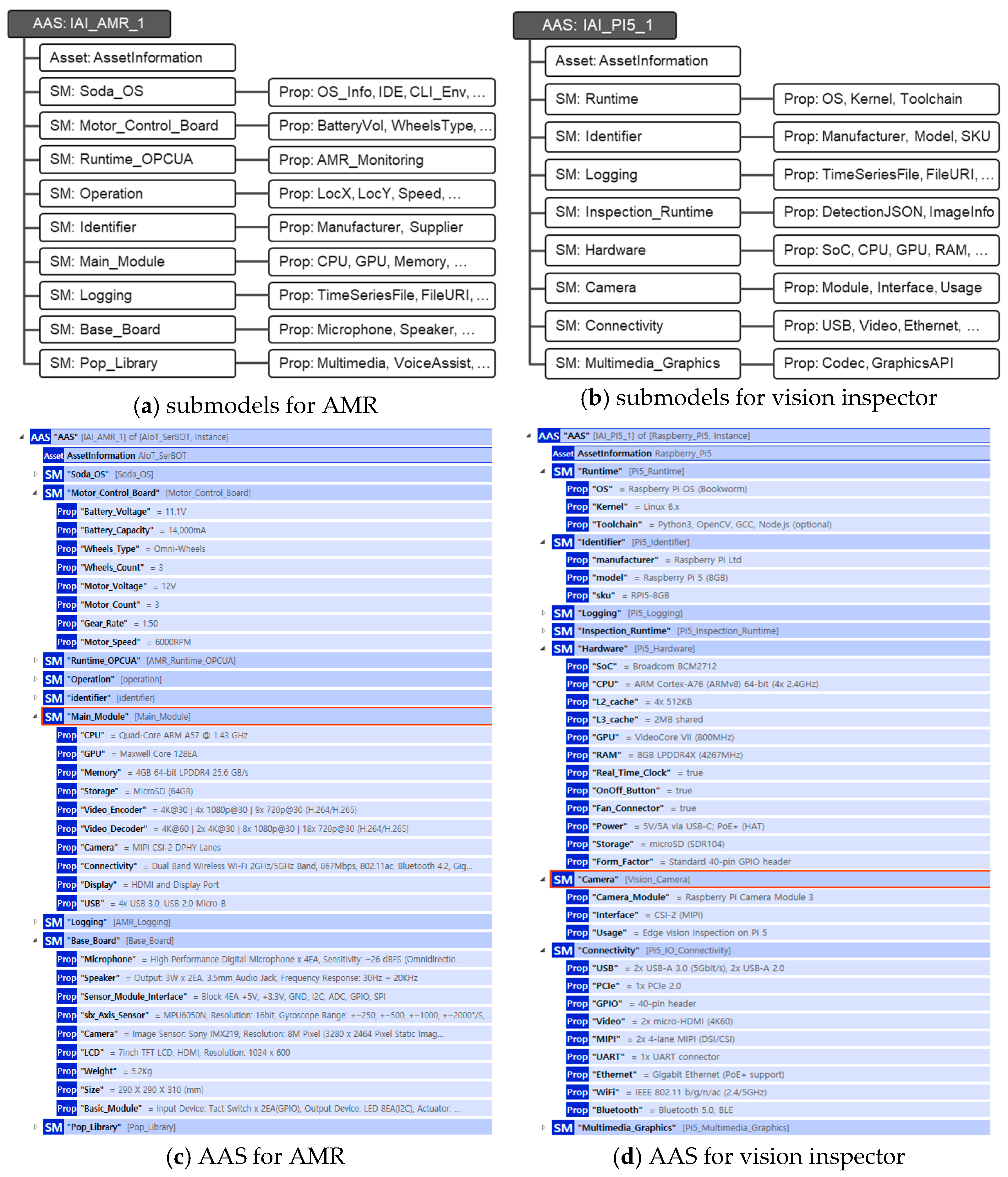
As shown in
Figure 2a, the AMR was instantiated as an AAS asset with the identification IAI_AMR_1. Its structural and configuration information was represented using submodels including Soda_OS, Motor_Control_Board, Runtime_OPC_UA, Identifier, Main_Module, Logging, Base_Board, and Pop_Library, which collectively describe the AMR’s hardware, software, and system setup. In addition, the Operation submodel was used to capture dynamic operational states, including real-time motion, navigation status, and task execution, thereby providing a live digital representation of the AMR’s behavior within the AAS framework.
Unfortunately, IDTA does not yet provide SMTs for Perception Edge devices such as vision and sensor systems. Therefore, for the specific use case presented in this study, a customized submodel was designed for machine vision to support defect detection and event triggering. They are tailored to the Inspection–AMR scenario in accordance with IDTA modeling guidelines to preserve semantic compatibility and future extensibility with the AAS ecosystem.
As shown in
Figure 2b, a vision inspector is instantiated as an AAS asset with the identification IAI_Pi5_1, and its static characteristics were represented using submodels including Runtime, Identifier, Logging, Hardware, Camera, Connectivity, and Multimedia_Graphics. In addition, a dynamic submodel, namely Inspection_Runtime, was defined to capture real-time inference outputs, defect flags, and spatial coordinates generated by the Perception Edge.
3.3. Implementation of AAS-Based Asset Models
The implementation of AAS representations can be realized using the Eclipse BaSyx framework, which provides a reference-grade implementation of the AAS meta-model and associated APIs. The AAS modeling and deployment process is structured into five systematic steps.
First, an AAS instance and its header were created. Using the AssetInformation class, the asset type and global identifier were specified, and the AssetAdministrationShell class was used to instantiate the corresponding AAS object, thereby binding the physical device to its digital twin.
Second, the required submodels were defined. Each submodel corresponds to a specific functional or informational aspect of the asset (e.g., Identifier, Runtime, or Operation) and was created using the Submodel class of BaSyx.
Third, the individual properties of each submodel were specified. Each submodel contains multiple Property elements, which represent atomic data items. For example, in the AMR’s Motor_Control_Board submodel, a property named battery capacity was defined and assigned a value such as “11.1 V/14,000 mA,” enabling structured representation of hardware characteristics.
Fourth, the linkage between the AAS and its submodels was established using the ModelReference class. This step enables the AAS to centrally reference, expose, and manage all associated submodels, ensuring semantic consistency and runtime accessibility of asset information.
Finally, the AAS was serialized and deployed. The complete AAS model was serialized into JSON format using BaSyx’s serialization utilities and stored on the AAS Server. Dynamic submodel data, such as real-time Operation values, were continuously updated via OPC UA communication, allowing the AAS Server to maintain an up-to-date asset-centric digital twin of each edge device while supporting interoperability with external systems.
4. OPC UA-Based Communication and AAS Integration
The proposed framework adopts OPC UA as the communication backbone to enable reliable and interoperable interaction among Edge AI devices and between the edge layer and the AAS Server. OPC UA provides a unified architecture for addressing, structured data exchange, and information modeling, which aligns naturally with the AAS-based asset representation. Unlike lightweight messaging protocols such as MQTT [
23] and CoAP [
24], OPC UA can directly represent the structure and semantics of AAS submodels through its built-in information modeling capabilities, making it particularly suitable for asset-centric integration within this framework.
The overall control and data flow among Edge assets, OPC UA communication, and AAS submodels is illustrated in
Figure 3. The figure summarizes the step-by-step workflow, including event generation at Edge devices, transmission via OPC UA, synchronization with AAS submodels, and autonomous responses among distributed assets.
4.1. OPC UA Server for Edge–AAS Integration
The OPC UA server acts as the communication hub of the system, bridging distributed Edge AI devices and the AAS infrastructure. Each Edge device exposes its operational data through OPC UA endpoints, which are collected and aggregated by the server.
Incoming data streams, including defect detection results from the Vision Inspector and motion and task states from the AMR, are continuously received. These data are then mapped to the dynamic submodels of the corresponding AAS instances, such as the Operation and Inspection_Runtime submodels. Through this process, the OPC UA server ensures that the digital representations of assets remain synchronized with their physical counterparts.
By serving as a unified access point, the OPC UA server enables both inter-edge data exchange and system-level integration with the AAS Server, while preserving industrial-grade reliability and scalability.
4.2. OPC UA Clients on Edge AI Devices
Each Edge AI device operates as an OPC UA client that publishes its real-time operational state to the OPC UA server. Perception Edges such as vision and sensors transmits perception events, including defect flags and spatial coordinates, while Mobility Edges such as AGV and AMR reports navigation status, motion variables, and task execution states.
These data are transmitted periodically and event-driven, allowing the system to maintain a consistent and up-to-date view of each device’s runtime condition. Through OPC UA-based communication, Edge devices can coordinate autonomously while remaining synchronized with the global AAS-based digital infrastructure.
This client–server interaction enables fast, low-latency information exchange without reliance on cloud platforms, which is critical for real-time autonomous manufacturing scenarios.
4.3. AAS-Based Monitoring and Digital Synchronization
The AAS Server continuously maps OPC UA data streams to the corresponding AAS instances, creating synchronized digital twins of all Edge AI devices. Each AAS instance integrates static asset metadata with dynamic operational states, allowing comprehensive asset-level visibility.
The AAS Monitor provides a unified interface for visualizing these digital twins, exposing both structural asset information and real-time operational data, such as defect detection events and AMR motion status. Shop-floor operators can therefore supervise distributed Edge AI devices in real time while maintaining system-wide traceability and control.
By combining OPC UA-based communication with AAS-based asset modeling, the proposed framework establishes a hybrid architecture in which local autonomy at the edge is complemented by centralized, asset-centric monitoring and management.
5. System Implementation
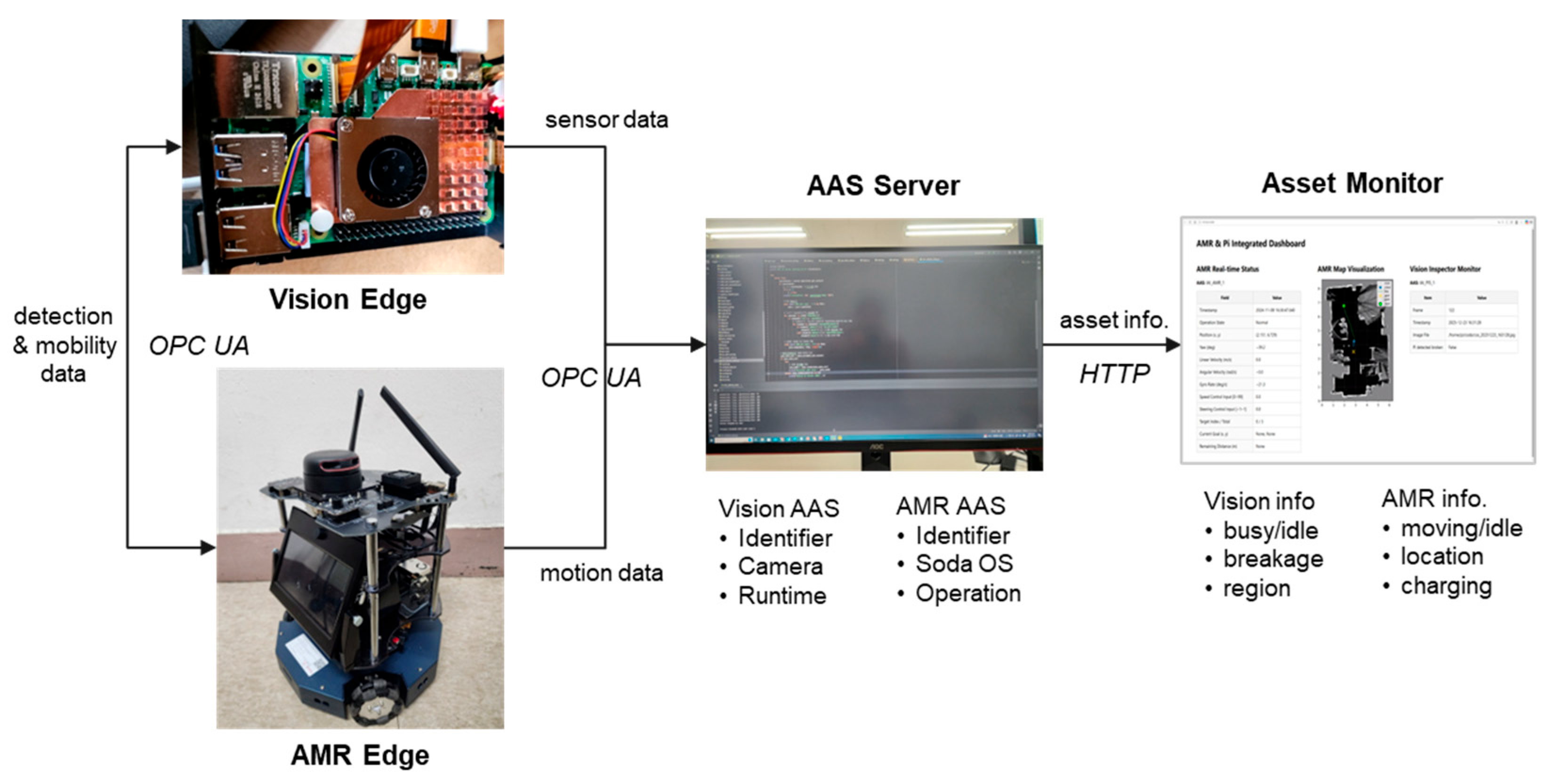
To validate the proposed framework, a prototype-based autonomous manufacturing scenario was implemented. A Vision Inspector and AMR were deployed as representative Edge AI devices. Each device was modeled as an independent AAS instance, with both static specifications and dynamic operational states represented through corresponding AAS submodels. Communication between the Edge AI devices and the AAS Server was established using the OPC UA protocol, and real-time system states were monitored through the AAS Monitor. The summary of system configuration and implementation environment is presented in
Table 1. Although the prototype presented in this study illustrates a scenario consisting of a single Perception Edge and a single Mobility Edge, as shown in
Figure 4, the proposed framework is scalable to multi-asset Edge AI environments in which multiple assets operate concurrently.
5.1. Perception Edge
The Vision Inspector operates as a Perception Edge node that detects machining anomalies and generates event notifications within the proposed framework. This module captures images at one-second intervals and performs real-time inference using a lightweight deep learning model. When a fault is detected, the detection result, together with the spatial coordinates of the defect, is immediately transmitted to the AMR and the AAS Server via OPC UA. This mechanism enables direct asset-to-asset event propagation while preserving system-level visibility through the AAS Server and AAS Monitor.
To evaluate the proposed approach, a tool breakage inspection task for a milling machine was implemented using computer vision-based Edge AI. The dataset [
25] consists of 144 milling head images labeled into two classes, Broken and Unbroken, according to damage status.
The YOLO11n model was adopted for defect detection, and the dataset was split into 100 training samples, 20 validation samples, and 24 test samples. The dataset exhibits a class imbalance typical of manufacturing environments, comprising 61 broken and 809 unbroken instances. For fine-tuning, the YOLO11n model was trained for 300 epochs with a batch size of 16 and an input resolution of 640 × 640, while the remaining hyperparameters followed the default values of the library. Model training was conducted on an NVIDIA Tesla T4 GPU (16GB VRAM) via Google Colab. The trained YOLO model achieved an mAP@50 of 99.4% on the training set (99.3% for the unbroken class and 99.5% for the broken class), 91.2% on the validation set (97.3% and 85.1%), and 84.5% on the test set (88.2% and 80.8%), respectively.
The Vision Inspector was implemented on a Raspberry Pi 5 equipped with a Raspberry Pi Camera Module 3. The original fine-tuned YOLO11n model required 449.3 MB of memory and exhibited an end-to-end inference latency of 337.1 ms. To enable real-time execution on resource-constrained hardware, the model was further optimized and converted to TensorFlow Lite (FP32). With an input resolution of 320 × 320, the optimized model achieved the best trade-off between accuracy and speed, reducing memory usage to 75.8 MB and achieving an inference latency of 59.2 ms.
5.2. Mobility Edge: AMR
The AMR operates as a Mobility Edge node that executes autonomous response actions based on fault events generated by the Vision Inspector. Upon receiving fault detection results via OPC UA, the AMR analyzes the incoming event and, if a fault is confirmed, autonomously navigates to the corresponding location to perform predefined tasks. In parallel, the AMR continuously reports its operational state to the AAS Server, including dynamic variables such as task execution status, current position, linear velocity, heading, and angular velocity.
For autonomous navigation, a digital map of the laboratory environment was constructed using LiDAR-based simultaneous localization and mapping (SLAM) as the AMR explored the experimental area. When a fault event is triggered, the A-star algorithm is used to compute an optimal path to the target location, and the Pure Pursuit path-tracking algorithm is employed to ensure accurate trajectory following during motion execution.
5.3. AAS-Based Integration of Edge AI Systems
The implemented prototype demonstrates tightly coupled integration among the Vision Inspector, the AMR, and the AAS Server. When a milling head breakage is detected by the Vision Inspector, the corresponding event is immediately transmitted to the AMR Edge and the AAS Server via OPC UA. Based on this event, the AMR autonomously navigates to the specified target location and initiates predefined response actions, while the AAS Server continuously maintains synchronized AAS-based digital twin of both devices.
All operational states and events are persistently recorded in the AAS Server as structured logs, ensuring manufacturing history management and end-to-end process traceability. These logs provide a foundation for post hoc analysis, fault diagnosis, and system performance evaluation, which are essential for autonomous and data-driven manufacturing environments.
During experimental validation, the Vision Inspector achieved an end-to-end cycle time of 294.2 ms for image acquisition, inference, and event transmission. To quantitatively assess system-level performance, we evaluated the end-to-end OPC UA communication overhead in terms of both latency and payload size between devices. The overall overhead was decomposed into three segments: Pi to AMR (301 ms, 102 bytes), Pi to Server (24 ms, 116 bytes), and AMR to Server (17 ms, 358 bytes).
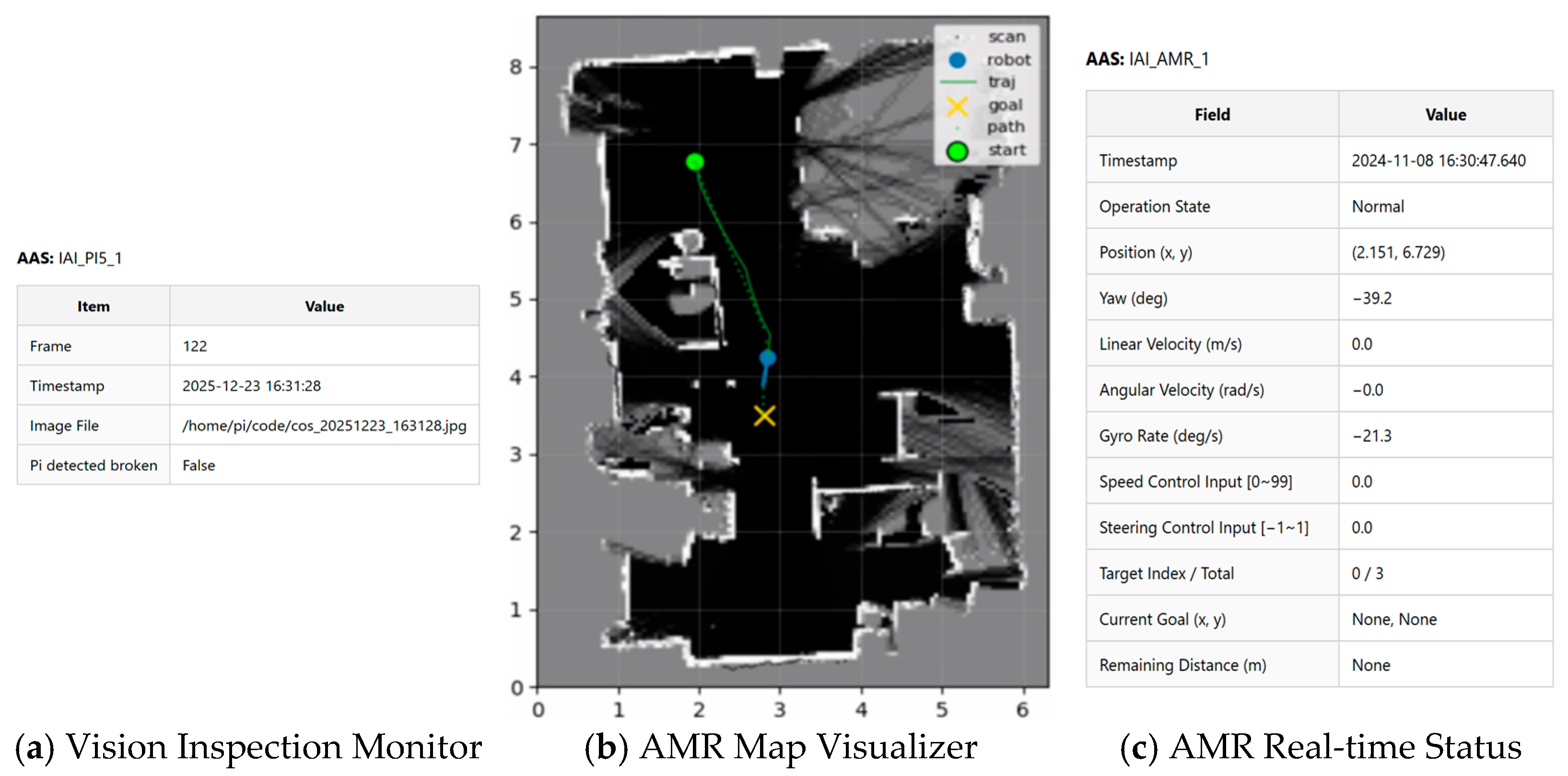
Upon fault detection, the AMR successfully navigated to the target coordinates as expected. As illustrated in
Figure 5, the AAS Monitor presents not only the static AAS models of the Vision Inspector and AMR but also their dynamic submodel states, including real-time fault events and AMR motion states. For the AMR, its current location is visualized on a digital map, enabling intuitive supervision of autonomous asset behavior.
Overall, the system demonstrated stable operation under the experimental conditions. However, occasional vision detection errors and temporary communication disconnections were observed during the experiments, potentially affecting system responsiveness. These limitations can be mitigated through model optimization and AAS-based event logging.
6. Conclusions and Future Work
This study presented an AAS-based Edge AI framework for autonomous manufacturing and validated it through a functional prototype implementation integrating a Vision Inspector, an AMR, and an AAS server. The proposed system demonstrated that event-driven real-time fault detection and response can be achieved on resource-constrained Edge devices while maintaining standardized communication and asset management through the AAS and OPC UA.
A key contribution of this work is the asset-centric orchestration of Edge AI devices. Unlike conventional approaches that deploy AI independently on each device, the proposed framework represents each Edge device as a standardized AAS asset and enables semantically interoperable, event-driven coordination between heterogeneous devices. This allows both static specifications and dynamic operational states to be consistently managed within a unified digital asset layer, supporting system-level autonomy, traceability, and interoperability.
Despite the functional validity of the proposed framework, several limitations remain to be addressed for industrial-scale deployment. First, the experiments were conducted in a relatively stable wireless environment, whereas real manufacturing floors are subject to severe radio-frequency interference, which may cause communication dead zones, packet loss, and latency variations, potentially affecting real-time event propagation and asset-to-asset synchronization. Second, the current system relies on OPC UA infrastructure and manual mapping between Edge device data and AAS submodels, leading to increased engineering costs and limited scalability as the number of devices grows, particularly in heterogeneous industrial environments. Third, the current implementation primarily supports edge inference and basic event-driven coordination, while advanced capabilities such as distributed learning, collaborative intelligence, and sophisticated event semantics remain unaddressed. Furthermore, security aspects, including authentication, authorization, and access control for asset-to-asset communication and remote monitoring, require further investigation.
Future work will focus on large-scale industrial deployment and validation in diverse and unpredictable real-world environments. This includes integrating multiple Perception, Mobility, and Equipment Edge devices for multi-vendor interoperability, conducting large-scale analysis based on operational logs, and developing adaptive policy learning and closed-loop optimization mechanisms. While the proposed framework supports basic event-driven coordination, advanced event semantics such as priority handling, queuing, and acknowledgment for concurrent detections are not yet implemented. Future work will explore more sophisticated event-handling strategies to ensure robust performance and timing guarantees in high-density, multi-asset industrial environments.