Article

Unlocking Digital Transformation in Industrial Enterprises: Evidence from Technology Finance
Business School, Shandong University of Technology, Zibo 255049, China
*
Author to whom correspondence should be addressed.
Systems 2026, 14(2), 207; https://doi.org/10.3390/systems14020207

Submission received: 9 January 2026 / Revised: 7 February 2026 / Accepted: 13 February 2026 / Published: 15 February 2026
(This article belongs to the Section Systems Practice in Social Science)

Abstract

In the process of the accelerated evolution of the modern economic system, technology finance is constantly injecting momentum into the digital transformation of industrial enterprises. Using the panel data of Chinese industrial firms listed between 2013 and 2022, this paper examines the impact of technology finance on digital transformation and analyzes the mechanism of their influence. The empirical result shows that technology finance drives digital transformation by reducing corporate equity concentration, enhancing risk-bearing capacity, and reducing internal management costs. Among these factors, equity concentration has the most significant mediating effect, while the role of financing constraints is relatively limited, mainly manifesting as basic support conditions. Commercial credit can promote the enabling effect of technology finance to accelerate the digital transformation of industrial enterprises. In addition, the empowering effect of technology finance is more pronounced in the eastern coastal and central regions, as well as in pilot areas that combine technology and finance. Nonstate-owned enterprises, small and medium-sized enterprises and labor-intensive enterprises all benefit more from technology financing than their counterparts do. These findings have important implications for accelerating the digital transformation of industrial enterprises and promoting the development of technology finance services.

1. Introduction

In the context of the global technological revolution, digital transformation has emerged as a key force for reshaping the competitive landscape of industrial enterprises. The 2024 Government Work Report mentions promoting digital transformation in manufacturing and the large-scale application of the Industrial internet. “Digital transformation” is an important means for traditional industries to “break the development bottleneck” and for enterprises to seek high-end, intelligent and green upgrading [1,2]. However, the digital transformation of enterprises is still constrained by many short-term bottlenecks, such as funding shortages, insufficient digital talent, weak infrastructure, and long transition periods. Many firms look bewilderedly on as the world speeds ahead with the digitalization of business. The Digital Cooperation Organization (DCO) expects the global digital economy to be approximately USD 24 trillion in 2025. China is currently the world’s largest manufacturing country; however, the penetration of the digital economy in the industrial sector remains substantially lower than that in consumer services, and pronounced disparities persist in the level of digital development across industrial enterprises. Under the constraints imposed by the goals of new industrialization and high-quality development, the digital transformation of industrial enterprises has become a critical bottleneck in the upgrading of China’s real economy. Its effectiveness not only shapes the optimization of the macroeconomic structure but also determines the transformation of growth drivers. Therefore, a systematic examination of the conditions enabling digital transformation and its key influencing factors from the perspective of industrial enterprises is both necessary and timely.
Against the backdrop of multiple constraints confronting industrial enterprises in their digital transformation, financial factors have become increasingly pivotal in alleviating transformation bottlenecks and optimizing the allocation of innovative resources. The integration of finance and technology meets the needs of the times and promotes the formation of a new financial system, i.e., technology finance, injecting a new impetus for enterprise transformation and upgrading. Driven by cutting-edge technologies, technology finance overcomes the limitations of traditional financial services in terms of service methods and operational boundaries and provides enterprises with rack assistance that overcomes the space–time constraints of traditional financial services. The enterprise provides accurate scenario-based financial support and effectively increases enterprise financing capacity [3]. However, the existing literature has primarily concentrated on the effects of technology finance on macroeconomic growth and firms’ innovation performance, while offering limited systematic evidence on how technology finance influences the digital transformation of industrial enterprises at the micro level, particularly with respect to its internal mechanisms and transmission pathways. Therefore, clarifying how technology financing internally promotes the digital transformation of industrial enterprises is of considerable practical significance.

2. Literature Review

As the primary sector of resource consumption and environmental pressures in China, the digital transformation of industrial enterprises is not only an inherent requirement for achieving sustainable development but also a critical pathway for promoting high-quality economic growth. Through digital transformation, enterprises can improve their overall operational efficiency and innovation capabilities, thereby significantly increasing energy utilization, reducing carbon emissions, and contributing to the realization of national dual-carbon targets [4]. The existing research has generally explored the driving factors of enterprise digital transformation in two dimensions: internal conditions and the external environment. From the internal perspective, the characteristics of top management teams have a significant effect on the corporate transformation process. For example, a chairperson with an IT background can leverage technological expertise to strengthen strategic investment and resource allocation in digital domains [5]. Conversely, managerial overconfidence has a dual effect on strategic transformation and innovation: while it may stimulate risk-taking and innovation, it can also lead to biased decision-making and strategic misjudgment [6,7]. Moreover, factors such as management power [8], gender diversity within the top management team [9], and executives’ cognitive structures [10] have been shown to significantly influence both the direction and effectiveness of digital transformation strategies. From the perspective of the external environment, high customer concentration tends to bias resource allocation toward maintaining existing customer relationships rather than pursuing long-term innovation, thereby reducing firms’ strategic flexibility in adapting to market changes and hindering digital transformation [11]. In addition, media exposure serves as both an external oversight mechanism and an information intermediary, enhancing transparency between businesses and financial institutions. This, in turn, expands financing channels, strengthens debt financing capacity, and provides necessary financial support for digital advancement [12]. Furthermore, broadband infrastructure construction offers essential technological underpinnings for digital transformation [13]. Government policies also play an instrumental role by accelerating the digital transformation process through fiscal subsidies, tax incentives, and pilot initiatives. For example, monetary policy [14] and digital policy [15] have contributed significantly to advancing enterprise digital transformation.
Technology finance has been recognized as an important driver of high-quality development [16]. The research that has been carried out is divided into two main levels: macroeconomics and microenterprises. Relying on technology finance, the development of the real economy [17] and the enhancement of the resilience of the urban economy [18] are achieved; promoting the uptake and use of renewable energy [19] reduces energy consumption intensity [20] and supports carbon reduction [21]. Improving the quality of urban entrepreneurship [22] through the optimal allocation of fiscal resources and encouraging the agglomeration of innovative talent, at the micro level, alleviates financing constraints, facilitates green innovation [23], and improves overall innovation capacity [24]. Furthermore, technology finance facilitates the continuous accumulation, diffusion, and application of digital technologies within firms, thereby laying a solid technological foundation for digital transformation [25]. At the same time, by relying on data-driven risk identification and more precise credit allocation mechanisms, technology finance enhances firms’ financing efficiency and capital allocation effectiveness, providing sustained and stable financial support for digital transformation initiatives [25,26]. In addition, recent studies have extended the analysis to firm-level governance structures and human capital characteristics. For example, Zhou et al. show that senior executives with academic or R&D backgrounds significantly strengthen the positive effect of technology finance on firms’ digital transformation, suggesting that managerial cognition and technological absorptive capacity play an important moderating role in the transmission process of technology finance [27].
Overall, although existing studies examining the relationship between technology finance and firms’ digital transformation are often based on relatively limited samples, their theoretical contribution lies in uncovering the underlying mechanisms through which financial development shapes firms’ digital upgrading capabilities, particularly from the perspectives of emerging financial business models and policy-driven financial instruments. In the context of emerging financial formats, scholars have explored several frontier domains, such as green finance [28], digital finance [29], digital inclusive finance [30] and financial technology [31,32]. Green finance can ease the negative impact of economic policy uncertainty and provide a benign external environment to facilitate enterprises’ digital transformation [28]. Digital finance improves corporate financing conditions through intelligent and accurate service and enhances financial support for digital transformation [29]. Digital inclusive finance can expand the coverage of financial services and the reach of enterprises with greater inclusiveness and enhance the financing force of SMEs [30]. In addition, fintech is changing the model of financial service and urges enterprises to achieve digital transformation and upgrading through comprehensive technology and financial assistance [21,32]. From the perspective of financial policy, scholars have shown that instruments such as green finance [33], green credit [34] and technology finance [35] promote enterprise transformation and upgrading, establishing an important foundation for study in related fields.
Academic research on technology finance, digital transformation and their relationships constitutes a theoretical basis for this study, but there are some limitations in the existing research. First, in the study of the relationship between technology finance and enterprise digital transformation, there are few specific quantitative measurements of fintech. Second, most studies have not selected samples from different industries, ignoring the need for a differentiated understanding of the effect of industry characteristics on the value transformation process of technology finance. Third, the intrinsic link between the two systems of technology finance and the digital transformation of industrial enterprises is not clear. In view of the above points, the contributions of this study could be as follows: first, to measure provincial-level technology finance development comprehensively and better capture its driving effect; second, to address the relationship between technology finance and industrial enterprises’ digital transformation and guide the sustainable development of industrial enterprises; and third, some mechanisms through which technology finance allows industrial enterprises to obtain digital transformation to be developed and empirically tested: easing financing constraints, reducing equity concentration, enhancing risk-bearing capacity and lowering internal management costs. Furthermore, it also demonstrates that commercial credit plays a reinforcing role in the enabling effect of fintech.

3. Theoretical Analysis and Research Hypotheses

As a new type of financial model that meets the needs of the times, technology finance focuses mainly on promoting scientific research and development, facilitating the effective transformation of scientific and technological achievements into productive forces, and promoting the development of high-tech industries. Improving the infrastructure of financial services, strengthening the strength of technology, and optimizing the regional industrial environment provide a continuous impetus for the sustained and stable development of enterprises [16,32]. The innovative development of technology finance can provide comprehensive support such as financial support, technical support, and human support for the digital transformation of industrial enterprises, which is conducive to innovation-driven and sustainable enterprise growth [16,28]. Furthermore, the application of digital technologies such as artificial intelligence and blockchain can help strengthen enterprises’ ESG governance, promote green innovation and development, and facilitate enterprises’ digital transformation in the process, thereby having a positive impact on the global climate governance process [36,37].
First, development technology finance effectively reduces financial institutions and determines asymmetry, thus improving the efficiency of financial resource factor allocation. In the traditional financing model, the types of information asymmetry easily lead to shyness. Including financing costs increases financing constraints. With the help of digital technology and intelligent interactive platforms, technology finance promotes the transmission of clear information, such as the frontier of efficiency, such as the market division of labor clear point one, between banks and enterprises, as digital upgrading provides powerful financial support [16]. At the same time, strengthening the ability to obtain information allows enterprises to discover fault information in a timely manner, and risk arises on the road of digital transformation, thus overcoming weaknesses and effectively curtailing risk in the transformation process. Second, technology finance can promote the spread of the digital technology economy through the spillover effect and supporting enterprise upgrades. Third, the development of new technologies improves market regulation, improves financial institutions’ credit risk, and strengthens cooperation between financial institutions and enterprise credit guarantees [38]. Fourth, enterprises effectively integrate digital core competitiveness through financial service platforms and outside digital technology, funds and market resources. In addition, the application of artificial intelligence technologies contributes to improvements in customer relationship management. By enabling more accurate identification, segmentation, and maintenance of customer resources, artificial intelligence enhances customer loyalty and firms’ responsiveness to market changes, thereby supporting the sustainable development of enterprises [39]. Thus, based on the above, we propose Hypothesis 1:
H1. 
Technology finance can significantly promote the digital transformation of industrial enterprises.
To further analyze the mechanisms by which fintech assists industrial enterprises in achieving digital transformation, the analysis will focus on the following four aspects:
First, in terms of fundraising, financing constraints not only limit firms’ investment capacity for their own use but also weaken firms’ incentive factors for technological innovation, often resulting in superficial digital transformation initiatives without substantial breakthroughs [16,40]. Technology finance compensates for these shortcomings of traditional financial services through digital and intelligent financial service models, which help mitigate the external financing constraints faced by firms in their digital transformation [16]. More specifically, the use of digital technologies in financial services optimizes both the efficiency and quality of financial intermediation, enabling financial institutions to innovate and transform their service capabilities, thus providing firms with additional and enriched financing channels and enhancing capital allocation efficiency [22,35]. The continuous development of technology finance reduces the operating cost of financial institutions and lowers the threshold for them to undertake services, allowing financial services to “reach” long-tail enterprises and “detressurized” segments of the market, which can enhance the inclusiveness and accessibility of financial services and systems to meet the needs of firms participating in digital upgrading in a general way. In addition, technology finance can mobilize social capital and attract private and foreign capital to inject into technological innovation, thus broadening the overall supply of innovation-oriented supply resources, and this influx of external capital can relieve the liquidity pressure of participating firms while enhancing their ability to transform, changing or enhancing their own incremental transformation ability. Thus, based on the above, we propose Hypothesis 2a:
H2a. 
Technology finance promotes the digital transformation of industrial enterprises by reducing equity concentration.
Second, at the institutional and corporate governance level, a more dispersed ownership structure helps mitigate excessive control by controlling shareholders over corporate resources and strategic decisions. This dispersion reduces the incentives of major shareholders to suppress high-risk, long-term digital investments driven by short-term performance considerations or private benefits [41]. Meanwhile, ownership dispersion enhances firms’ innovation vitality by encouraging the participation of multiple stakeholders in corporate governance and by improving decision-making constraint mechanisms, thereby providing endogenous momentum for the sustained advancement of digital transformation [41,42]. Through the combined use of innovative financial products, institutional arrangements, and policy instruments, technology finance can effectively reduce corporate equity concentration, enhance firms’ adaptability to organizational change, and support sustainable development throughout the digital transformation process. First, technology finance broadens corporate financing channels and alleviates firms’ reliance on funding from a single controlling shareholder or a small group of dominant shareholders. This facilitates the introduction of external investors and promotes the transition of ownership structures from highly concentrated to relatively dispersed forms [22,23]. Second, by fostering the development of multi-tier capital markets and digital financing platforms, technology finance lowers the threshold for equity investment, enabling broader participation by small and medium-sized investors as well as institutional investors. This expansion of the shareholder base helps dilute the ownership share of incumbent major shareholders. Finally, digital financial instruments enhance the timeliness and transparency of corporate information disclosure, strengthen capital market supervision mechanisms [16,43], and increase firms’ attractiveness to long-term institutional and strategic investors, thereby contributing to an overall decline in equity concentration. Based on these arguments, this study proposes Hypothesis 2b:
H2b. 
Technology finance promotes the digital transformation of industrial enterprises by enhancing their organizational change capabilities.
Third, at the behavioral and decision-making level, risk-bearing capacity improvement: Companies with stronger capacity are more willing to take on high-risk high-return transformation programs [44,45]. By building a complete risk system, technology finance enables the enterprise’s risk-bearing capacity and thus developers’ willingness for digital transformation. Specifically, first, technology finance brings deeper and more precise risks and references to enterprises through big data risk control, blockchain applications, smart investment advisors, etc., optimizing the access of information both inside and outside and effectively identifying potential risks in the digital transformation process [43]. The second is the multiple financing channels and multilateral risk sharing partnership of technology finance, thus significantly reducing risk exposure for enterprises. Third, technology finance platforms ensure that enterprises seize the latest market trends in time, mitigate managers’ opportunism inclination and short-term consideration in investment decisions, and aid scientific decision-making and long-term development [46]. Thus, based on the above, Hypothesis 2c is proposed:
H2c. 
Technology finance promotes the digital transformation of industrial enterprises by improving their risk-bearing capacity.
Fourth, at the execution and efficiency level, reducing internal management costs unlock internal resources for enterprises, thereby empowering them to increase their financial fortitude and flexibility in service of digital transformation [47]. As a technology-enabled financial model, technology finance embodies intelligent management and operational efficiency-enhancing capability made possible through the implementation of digital technologies and data analytics. First, technology finance platforms enhance firms’ ability to acquire, integrate and process information. By increasing timely information flows and transparency, platforms decrease information collection costs and minimize management “friction” caused by information asymmetry [16,48]. Second, by leveraging powerful digital technology, technology finance helps enterprises build comprehensive, multilayer and data-driven management systems that enhance managerial coordination and optimize sequencing, allowing managers to focus on core operations and leading to significant reductions in administrative and operational costs [48]. Finally, reducing human resource allocation is made possible through the adoption of more digital and automated management tools. “Lifting” employees by removing repetitive administrative work allows enterprises to focus their core talent on innovation and more valuable strategic projects and “anchors” the organizational bedrock for “digital transformation”. For the above reasons, Hypothesis 2d is proposed as follows:
H2d. 
Technology finance promotes the digital transformation of industrial enterprises by reducing internal management costs.
Finally, at the level of external support, commercial credit constitutes a critical channel through which firms obtain informal financing and represents the most prevalent transaction arrangement within China’s supply chain system [49]. Through deferred payment mechanisms and accounts receivable and payable arrangements, commercial credit not only provides firms with flexible liquidity support but also facilitates trust accumulation and collaborative interactions among supply chain partners, thereby improving overall supply chain efficiency [49,50]. Within a sustainable development-oriented supply chain governance framework, stable commercial credit relationships promote information sharing, risk sharing, and long-term value co-creation. These relational mechanisms provide an institutional foundation for cross-firm data collaboration and business process reconfiguration during digital transformation [50]. Moreover, as firms confront heightened uncertainty, prolonged investment payback periods, and intensified external financing constraints during digital transformation, commercial credit can alleviate short-term funding pressures through its relational governance attributes. At the same time, it helps stabilize supply chain expectations and strengthens cooperation incentives, thereby reducing institutional friction costs associated with digital upgrading initiatives. Importantly, commercial credit financing has emerged as a key complementary financing channel bridging technology finance and the traditional financial system [49,51]. In contexts where the technology finance system remains underdeveloped and the business environment is imperfect, commercial credit serves as a vital source of funding for firms’ digital transformation and plays a supportive role in sustaining transformation momentum. On the basis of the above reasoning, Hypothesis 3 is proposed:
H3. 
Commercial credit strengthens the positive influence of technology finance on the digital transformation of industrial enterprises.

4. Data and Model

4.1. Data

This study investigates the impact of technology finance on the digital transformation of Chinese listed industrial enterprises, using China’s listed industrial enterprises from 2013 to 2022 as a sample. Data for the technology finance index were obtained from the National Bureau of Statistics, the Wind database, and the China Science and Technology Statistical Yearbook, whereas other data were sourced from the Guotai An database. The initial sample was processed as follows: non-normally traded listed companies (including STs, STs*, and PTs) were excluded; companies listed for fewer than three years were removed; and all continuous variables were winsorized at the 1% level. After this screening, the final dataset comprised 20,941 observations from 2712 companies.

4.1.1. Explained Variables

Enterprise Digital Transformation Level (DTI). The extent of enterprise digital transformation has commonly been assessed in previous research through text analysis and word frequency statistics of relevant terms [5]. Some studies characterize a company’s degree of digital transformation by measuring the proportion of digital technology-related assets in its intangible assets [52]. However, these methodologies have certain limitations in accurately reflecting the actual digital transformation level. To better evaluate how technology finance affects the digital transformation of industrial enterprises, we use the digital transformation index jointly built by the Guotai An team and East China Normal University. Compared with alternative measures, this index captures the penetration of digital technologies across multiple organizational layers—including strategic planning, organizational management, production operations, and business applications—thereby providing a more nuanced and systematic depiction of both the depth and breadth of firms’ digital transformation.

4.1.2. Explanatory Variables

Technology Finance Index (TF). Where feasible, this paper adopts the method proposed by Zou et al. [53] to construct a provincial technology finance evaluation system using two-dimensional evaluation indices: public technology finance and market-oriented technology finance. Referring to the objective and subjective geometric order weighting method, we first calculate the public and market technology finance index and then combine the two to obtain the full technology finance index. The comprehensive indicator system for technology finance development is shown in Table 1; indicators up to the second level are quantified in the table, and owing to space constraints, detailed indicators can be found in Appendix A.
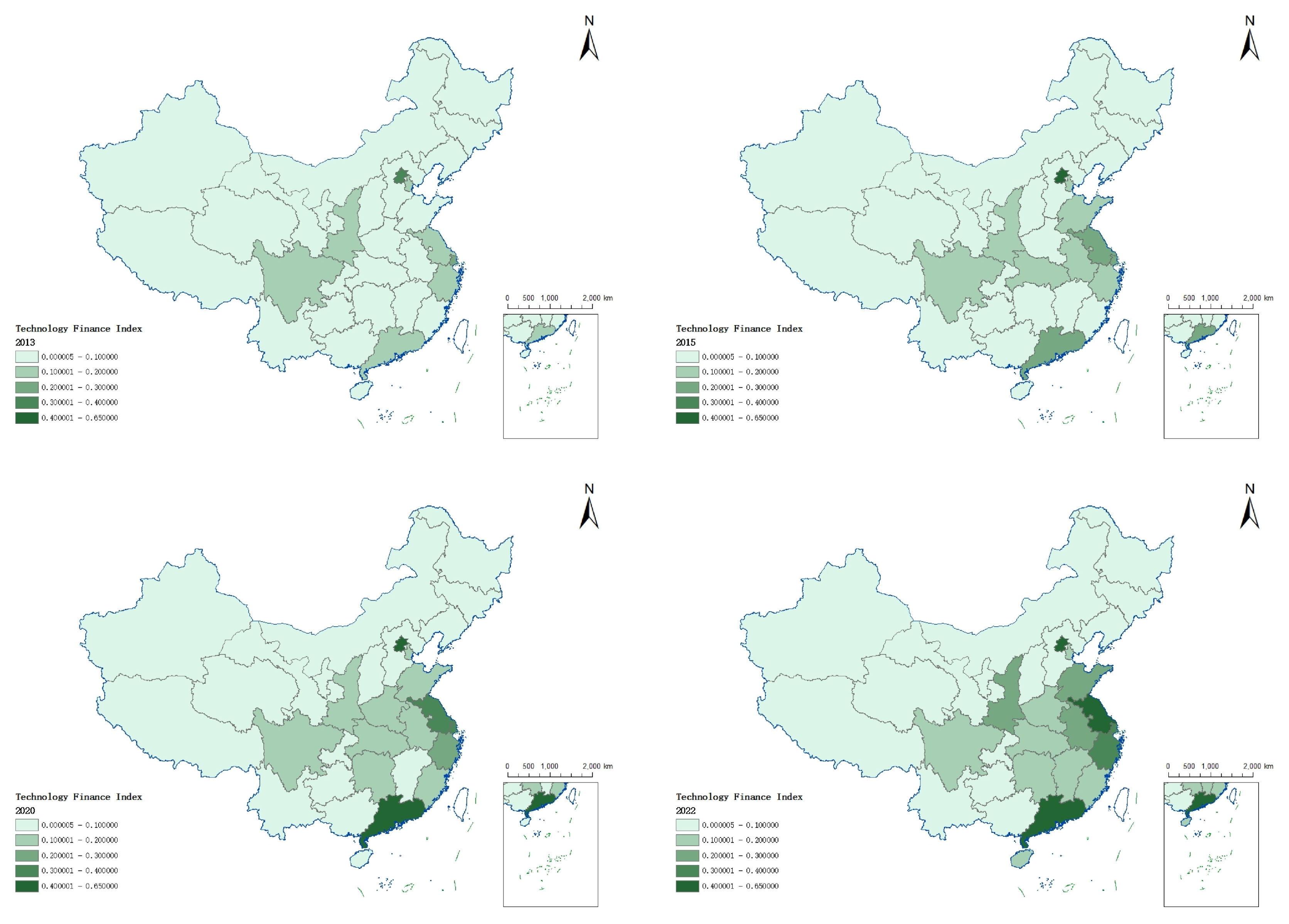
On the basis of the computed results, this study presents the evolutionary trend of technology finance development from 2013 to 2022, as shown in Figure 1. In general, the level of technology finance development in all 31 provinces in China has shown a steady upward trend during this period, especially in the southeastern and central regions of China. Differences at the regional level are due to factor endowments and institutional advantages. The provinces in the southeast and central regions have a good industrial foundation and perfect industrial chain, whereas those in the northwest and northeast regions have a weaker industrial base and are less attractive to the scientific and technological population. Moreover, in addition to a good industrial structure, the local government also set up industrial funds, talent programs and talent risk compensation mechanisms in the southeast and central provinces to promote the foundation for technology finance. Since the second batch of pilot zones for technology finance was promulgated by the national government in 2016, the national development level accelerated significantly, indicating that wherever the market is guided by strong policy support, the technology finance market has developed well.

4.1.3. Mediating Variables

(1) Financing constraints (FC). In this research, the FC index serves as an evaluative metric for evaluating how extensive financing constraints are faced by businesses through the FC index’s numerical value being positively correlated with how strongly constrained (i.e., impacted) businesses are in regard to financing access.
(2) Shareholding Concentration (SC). In this study, we measure corporate shareholding concentration by the total shareholding of the top five shareholders. The higher the value, the higher the corporate shareholding concentration, and vice versa.
(3) Risk-bearing capacity (EAR). According to Liu & Tian [54], a company’s ability to handle financial risk can be evaluated by examining its earnings volatility (EV). Businesses with high EV are able to tolerate greater amounts of financial volatility than those with low EV.
(4) Internal Management Cost (IC). Following Shi [55] and Bao [56], internal management cost is captured by the proportion of management expenses to total assets; the lower the cost is, the better.

4.1.4. Moderating Variable

Commercial credit (TC). Following Chen [51], Liu and Wang [52] and Huang et al. [57], commercial credit is measured by the ratio of accounts receivable to total assets.

4.1.5. Control Variables

Adapting existing studies, we introduce variables such as Quick, Size, Mfee, Super, Ave, Tangibility, Dc, and Staff. Quick is defined as current assets minus inventories/current liabilities; Size is equal to net fixed assets/total assets. Mfee is defined as management expenses/operating income. Super is defined as the total number of members on the supervisory board. Ave is equal to the average age of management. Tangibility is defined as tangible assets/total assets. Dc is defined as Financial Expenses/total liabilities. Staff is equal to the ratio of year-end employees to annual operating revenue.

4.2. Model

To test the association between technology finance and the digital transformation of industrial enterprises, we employ the following simple baseline regression equation:
D T I i t = α 0 + α 1 F T i t + α 2 X i t + μ i + η i + ε i t
To clarify, DTI pertains to the degree of enterprise digital transformation and the supplementary indicators referenced above, as FT implies the technology finance index. X refers to a host of multidimensional control variables. μ i captures enterprise fixed effects, η i captures year fixed effects, and the idiosyncratic error term is ε i t . All regressions are estimated clustered at the enterprise level to make statistical inference more reliable to the maximum extent possible.
Based on existing research, we build an intermediary mechanism model to further investigate the pathways by which technology finance affects the digital transformation of industrial enterprises.
M i t = β 0 + β 1 F T i t + β 2 X i t + μ i + η i + ε i t
D T I i t = γ 0 + γ 1 F T i t + γ 3 M i t + γ 4 X i t + μ i + η i + ε i t
Here, M refers to the mediating variables, which include financing constraints, organizational change capabilities, risk-bearing capacity, and internal management costs.
In addition to the intermediary mechanisms, we investigate the moderating effect that may influence the relationship between technology finance and the digital transformation of industrial enterprises and accordingly build a moderating effect model as follows:
D T I i t = τ 0 + τ 1 F T i t + τ 2 R i t + τ 3 F T i t × R i t + τ 4 X i t + μ i + η i + ε i t
where commercial credit is R and is the moderating variable. A significant coefficient of the interaction term would denote the presence of a moderating effect or absence if it was insignificant.

4.3. Descriptive Statistics

Table 2 shows that the digital transformation index (DTI) ranges from a maximum value of 63.5062 to a minimum of 23.1924, revealing significant heterogeneity in digitalization levels across Chinese industrial enterprises. The mean DTI is 35.9496, which is slightly greater than the median of 33.8098, suggesting that nearly half of the enterprises fall below the average level of digital transformation and that further improvement is needed. Correlation analysis reveals a coefficient of 0.225 between the digital transformation index (DTI) and the technology finance index (FT), which is significant at the 1% level, offering initial evidence in favor of Hypothesis H1. The correlation values for the control variables fall within acceptable limits. In addition, collinearity tests indicate that the variance inflation factor (VIF) values vary between 1.05 and 1.72, suggesting that multicollinearity is not an issue in this study.

5. Regression Results

5.1. Baseline Regression

Table 3 reports the results of the baseline regressions. With the control variables included and both year and firm fixed effects considered, the coefficients for technology finance continue to be significantly positive. This finding that technology finance promotes the digital transformation of industrial enterprises provides support for Hypothesis 1. This result not only supports the theoretical assertion that operates at the micro level and that technology finance promotes enterprise digitalization but also provides some empirical evidence on the relationship between them. The reason for this is that technology finance promotes the breaking of data barriers through digital technology, reducing information asymmetry and making it easier for banks to lend to innovative enterprises. Furthermore, the growth of the technology finance market itself may have a demonstration effect and a leadership effect on encouraging firms to embark more quickly on digital transformation. Overall, technology finance, as a major force driving digital economic development, substantially facilitates the digital transformation and advancement of industrial enterprises.

5.2. Robustness Test

5.2.1. Replacing the Explained Variable

Referring to the methodology of Cai et al. [5] and Zhang et al. [8], the enterprise digital transformation index (DTII) was recomputed. After substituting the recalculated index into the model for regression, we find that our regression results are robust.

5.2.2. Replacing Explanatory Variables

Because both the digital transformation index (DTI) and the technology finance index (FT) are composite measures, their causal relationships are not immediately intuitive. To address this, the natural logarithm of fiscal science and technology expenditure (stf), which is strongly correlated with FT (the correlation coefficient is 0.8556), is employed as a proxy variable in the regression. The results in column (2) of Table 4 show that the research results have strong robustness.

5.2.3. Add Province Fixed Effects and Change Clustering Methods

Assuming that provinces are correlated in their behavior toward enterprises and that their degrees of digitalization also depend on common factors, we conduct two separate robustness checks. First, we include province fixed effects to account for this unobserved heterogeneity. In the second step, we change the clustering level to the province level. The results in column (3) and (4) of Table 4 show that the research results have strong robustness.

5.2.4. Changing the Sample Interval

There are exogenous events such as COVID-19 that may have affected corporate performance in the sample. To rule out this impact, we drop the data from 2020 onward and re-estimate them. The basic resource concentration that we put down is so strong in the four major cities in China (Beijing, Shanghai, Shenzhen and Guangzhou) that we omit observations related to those regions and then perform some further regressions. Columns (5) and (6) in Table 4 confirm that all the main takeaways are in place.

5.2.5. Add Macro-Control Variables

To account for the influence of broader macroeconomic conditions on firms’ digital transformation, we incorporate a set of macro-level control variables into the regression analysis, including government intervention, the urbanization rate, per capita road area, and the degree of economic openness. The estimation results are reported in column (7) of Table 4 and remain fully consistent with the baseline findings, indicating that the main conclusions are robust to the inclusion of these additional controls.

5.2.6. Instrumental Variable Method

There may be potential endogeneity between technology finance and the digital transformation of industrial enterprises. To address this concern, this study employs an instrumental variable approach and constructs two instruments. The first instrumental variable (IV1) is the provincial average technology finance index for the eastern, central, western, and northeastern regions of China [58]. This instrument is justified on two grounds. First, the regional level of technology finance development reflects the local digital financial infrastructure and application environment, which directly affects firms’ access to technology finance resources, thereby satisfying the relevance condition. Second, after controlling for regional fixed effects and firm-level characteristics, the provincial average technology finance index influences firms’ digital transformation primarily through the external financial environment rather than through firms’ individual strategic choices, thus meeting the exogeneity requirement. Following related literature, the second instrumental variable (IV2) is the per capita postal and telecommunications business volume of each province in 1984 [59]. This variable captures cross-regional differences in early communication infrastructure and information transmission capacity. On the one hand, historical development in postal and telecommunications services reflects a region’s long-term accumulation of communication networks and information infrastructure, which has a persistent influence on subsequent technology finance development and therefore exhibits strong relevance. On the other hand, in 1984, China’s financial markets and enterprise digitalization were still at an early stage, making it unlikely that this historical indicator directly affects firms’ current digital transformation. Its influence operates mainly through long-term information environments and technology diffusion paths, thereby satisfying the exogeneity condition. Table 5 reports the first- and second-stage estimation results as well as the corresponding diagnostic tests. The first-stage results indicate that both instrumental variables are significantly and positively correlated with the technology finance index, confirming their relevance. Moreover, the underidentification test, weak instrument test, and overidentification test all support the validity of the instruments. The second-stage results further show that technology finance continues to exert a significantly positive effect on the digital transformation of industrial enterprises. These findings suggest that the baseline conclusions remain robust after accounting for potential endogeneity.

6. Further Analysis

6.1. Mediation Effect Analysis

6.1.1. Financing Constraint Mechanism

The digital transformation of enterprises must be supported by adequate financial resources, and financing constraints reduce financing capacity and diminish the availability of capital for digital transformation. Effectively relieving enterprises’ financing constraints promotes their access to financing and strongly supports their capital needs in digital transformation [16,40]. Table 6 shows the results of the three-step test. Technology finance reduces financing barriers for industrial enterprises during transformation by optimizing financing channels and improving the financing management system, thus facilitating digital transformation, which verifies Hypothesis 2a. However, the Sobel test p-value is 0.057, failing the significance test, so the results are not robust.

6.1.2. Shareholding Concentration Mechanism

Dispersed shareholding strengthens diversified governance constraints, improves corporate decision-making mechanisms, and increases firms’ tolerance for and incentives toward digital innovation, thereby reinforcing the endogenous momentum of digital transformation [41,42]. As reported in Table 6, technology finance mitigates the inhibitory effect of equity concentration on long-term digital investment by reducing firms’ reliance on controlling shareholders for financial support and by optimizing ownership structures, ultimately facilitating the digital transformation of industrial enterprises. This is also statistically significant according to the Sobel test, which verifies Hypothesis 2b.

6.1.3. Risk-Bearing Mechanism

Enhancing an enterprise’s risk burden capacity alleviates management’s risk aversion and reduces resistance to digital transformation [30,38,47]. Moreover, a stronger risk burden capacity increases a company’s optimistic anticipation of future prospects and encourages the input of innovation [33,44,45]. Table 6 shows that the coefficient of earnings volatility is significantly positive, so technology finance can increase corporate risk-bearing capacity, provide protection against risk for transformation and upgrading, and increase innovation motivation. This is also statistically significant according to the Sobel test, which verifies Hypothesis 2c.

6.1.4. Internal Management Cost Mechanism

By reducing internal management costs, enterprises can reduce their consumption of resources in noncore activities, empowering the release of more resources to digital transformation projects and effectively supporting sustainable development [48]. Table 6 shows that technology finance can effectively lower the internal management costs of industrial enterprises and offer more financial power for transformation and upgrading. This is also statistically significant according to the Sobel test, which verifies Hypothesis 2d.
Table 6 indicates that financing constraints, equity concentration, risk-taking, and internal management costs do not operate as independent and parallel mechanisms. Instead, they constitute a sequential transmission pathway through which technology finance influences firms’ digital transformation. In terms of mediating effect magnitude, equity concentration exhibits the strongest explanatory power, followed by risk-taking capacity and internal management costs, whereas financing constraints account for a relatively smaller share and display weaker robustness. This pattern suggests that, within the sample of listed industrial enterprises, financing constraints function primarily as a foundational enabling condition rather than a core binding constraint. Specifically, technology finance initially improves the external financing environment and reduces firms’ dependence on controlling shareholders’ capital, thereby facilitating the optimization of corporate governance structures. Building on this governance improvement, technology finance further enhances managerial risk-taking incentives and releases transformation-related resources by lowering internal management costs, ultimately leading to stronger digital transformation performance.

6.2. Moderating Effect Analysis

Commercial credit is another major source of financing guarantees for the production and operation of enterprises. It affects not only the liquidity and operational efficiency of enterprises but also the degree of trust and cooperation among enterprises [49,51]. Column (1) of Table 7 presents evidence that the coefficient of the interaction term between TC and FT is significantly positive, indicating that commercial credit reinforces the positive role of technology finance in promoting the digital transformation of industrial enterprises, thus providing support for Hypothesis 3. When technology finance has not yet established a mature system, commercial credit makes up for the shortcomings of traditional financial service systems, is an important component of the diverse financing strategies of enterprises, and plays a persistent financial guarantee role in the innovation driver development mode [49,51]. By enhancing the degree of trust and cooperation between enterprises and their supply chain enterprise partners, commercial credit helps create a better external environment for enterprise digital transformation.

6.3. Heterogeneity Analysis

Considering the potential heterogeneity in the enabling effects of technology finance, this paper further conducts heterogeneity analyses at both the regional and firm levels.

6.3.1. Regional Heterogeneity Test

Regions differ in terms of locational advantages, factor endowments, and economic development, which affect the enabling effect of technology finance. To investigate the enabling effect of regional differences, enterprises are subdivided into eastern, central, western and northeastern enterprises according to their degree of economic and social development and coastal and inland enterprises in terms of their locational characteristics. As shown in Table 8, technology finance has a very significant promoting effect on the digital transformation of industrial enterprises in the eastern coastal and central regions, whereas the effect in other regions is not significant. The positive impact in the eastern coastal region is significantly stronger, which may be due to the relatively high degree of marketization, the developed financial system and digital supporting infrastructure, and the high demand of enterprises for innovation; these factors all require heavy support from financing. The relatively greater effect in the central region may result from its less developed financial markets, which benefit from technology finance supplementation, and the relatively slower pace of enterprise digital transformation, which yields greater marginal gains from fintech. For the western and inland regions, the impact fails to demonstrate statistical significance, likely because of lower marketization, underdeveloped digital infrastructure, and less mature science and technology service industries. In addition, insufficient digital technology reserves, a shortage of professional talent, and limited digital awareness among management all weaken the efficiency of technology finance in transmitting digital transformation.
Furthermore, to examine whether differences in policy and institutional environments condition the empowering effect of technology finance, this study conducts grouped regressions based on whether firms are located in pilot cities promoting the integration of technology and finance. The results show that technology finance exerts a significantly positive effect on the digital transformation of industrial enterprises in pilot cities, whereas this effect is insignificant and economically small in non-pilot cities. This finding indicates that the effectiveness of technology finance is highly contingent on the institutional environment. Although the technology finance index is constructed at the provincial level, the allocation of financial resources and the implementation of related policies are largely realized through the institutional channel of pilot cities. Compared with non-pilot cities, pilot cities are characterized by a more comprehensive policy framework for technology finance, a higher concentration of financial and technological service providers, and more efficient information-matching mechanisms. These advantages enhance the transmission efficiency of provincial-level technology finance to the firm level. In contrast, deficiencies in institutional arrangements and supporting infrastructure in non-pilot cities constrain the role of technology finance in promoting firms’ digital transformation.

6.3.2. Enterprise Heterogeneity Test

Variations in enterprise characteristics can lead to heterogeneous impacts of technology finance on digital transformation. Therefore, enterprise-level heterogeneity analysis is conducted from three perspectives: enterprise ownership, enterprise size, and factor intensity.
Enterprises with different ownership characteristics have varying business objectives, which may influence their digital transformation processes. To investigate how enterprise ownership influences the effect of technology finance on digital transformation, the sample is categorized into state-owned enterprises (SOEs) and nonstate-owned enterprises (NSOEs). Columns (1) and (2) of Table 9 show that technology finance has a stronger positive effect on digital transformation in nonstate-owned enterprises. Because of their generally more efficient decision-making processes, managers in nonstate-owned enterprises are more willing to pursue digital innovation. Compared with state-owned enterprises, nonstate-owned enterprises typically suffer from tighter financing constraints and are thus more responsive to the benefits of technology finance.
Enterprises of different sizes may vary widely in their willingness to innovate and their decisions on digital transformation and upgrades, which may affect the effect of technology finance. On the basis of the natural logarithm of total assets used to represent enterprise size, this paper divides samples into large enterprises (LE) and small and medium-sized enterprises (SME) on the basis of the median. mainframe regressed in columns (3) and (4) of Table 9. We find that the effect of technology finance on digital transformation is relatively strong for SMEs. This may be because SMEs have relatively serious financing constraints due to scarce capital and incomplete information disclosure, and it is difficult to obtain support from large financial institutions. The development of technology finance provides timely support for such enterprises, so the empowerment effect is stronger.
As enterprises vary in their capital and labor requirements, the effects of digital transformation on industrial enterprises may vary. To measure production factor intensity, this study follows the approach of Chen et al. [60] and constructs the indicator as the natural logarithm of the ratio of net fixed assets to the year-end number of employees. This measure captures the amount of capital allocated per unit of labor, thereby reflecting cross-firm differences in production technology characteristics and factor substitution patterns. Owing to its clear economic interpretation and strong empirical operability, this indicator is widely used in firm-level analyses. On the basis of the median, enterprises are classified as capital-intensive (CIE) or labor-intensive (LIE). As shown in columns (5) and (6) of Table 9, technology finance has a significant positive effect on the digital transformation of labor-intensive enterprises. This may be because capital-intensive enterprises generally have strong financial capacity and financing capabilities, making them less dependent on external capital. In contrast, labor-intensive enterprises are often concentrated in traditional manufacturing sectors with relatively low value added and weaker digital foundations, so technology finance has a greater marginal effect in promoting their digital transformation.

7. Conclusions and Recommendations

Technology finance, through its dual mechanism of technological empowerment and financial support, has become a key driver of the digital transformation of industrial enterprises. On the basis of panel data of Chinese listed industrial enterprises from 2013 to 2022, this paper uses a two-way fixed effects model to study how technology finance empowers enterprise digital transformation and the reasons for this empowerment. The conclusions of the paper are as follows: First, technology finance can significantly promote the digital transformation of industrial enterprises, and the conclusion is robust. Second, technology finance primarily functions by reducing corporate equity concentration, enhancing corporate risk-bearing capacity, and lowering internal management costs. Among these, the intermediary effect of reducing equity concentration is the most significant. The intermediary role of financing constraints is relatively limited, and it is more reflected in basic support conditions. Commercial credit plays a reinforcing role in the enabling effect of fintech, acting as an alternative financial channel to the enabling effect of fintech to finance innovation-driven transformation. Third, the enabling effect of technology finance also shows heterogeneity, is more obvious in the eastern coastal region, central region, and pilot areas combining technology and finance, and is more obvious in nonstate-owned and state-owned enterprises, SMEs, and labor-intensive enterprises.
On the basis of the above findings, this paper has the following policy and managerial implications:
First, from the government’s perspective, it is essential to further improve the pilot system for science and technology finance by strengthening its institutional functions in equity financing, information disclosure, and long-term capital guidance. Doing so can enhance the spillover effects of science and technology finance on corporate governance optimization. At the same time, governments should accelerate the improvement of institutional frameworks and financial infrastructure in non-pilot regions to avoid the spatial “policy-dependent concentration” of science and technology financial resources, thereby narrowing regional disparities in firms’ digital transformation capabilities. Moreover, by optimizing financial products, markets, and service systems, policymakers should guide capital flows from eastern coastal regions toward central, western, and inland areas, fully leveraging the innovation-leading role of the eastern coastal regions and promoting more balanced regional development.
Second, from the perspective of financial institutions, science and technology financial services should be upgraded from a purely “financing-oriented” model to a “governance- and risk-sharing-oriented” approach. Financial institutions are encouraged to incorporate dynamic risk control mechanisms and long-term performance evaluation systems, supported by digital technologies, into product design and service provision. This shift can help guide enterprises to allocate financial resources toward the development of digital capabilities. Meanwhile, financial institutions should explore integrated models combining equity financing, debt financing, and supply chain finance to diversify risks while strengthening incentives for firms’ long-term transformation, thereby achieving a more balanced trade-off between risk control and innovation support.
Finally, from the corporate perspective, when utilizing science and technology finance, firms should proactively coordinate external financial support with adjustments in ownership structure and the reengineering of internal management processes. Such coordination can transform external financing into an internal driving force that improves decision-making efficiency, reduces management costs, and enhances risk tolerance. In the early stages of digital transformation, relationship-based financing instruments, such as trade credit, may be appropriately used as a supplementary channel to science and technology finance to ease short-term financial constraints and stabilize transformation expectations. However, firms should remain cautious about the potential risks associated with excessive reliance on short-term credit instruments.

Author Contributions

Conceptualization, X.S. and H.Z.; methodology, X.Z.; software, H.Z.; validation, X.S., H.Z. and X.Z.; formal analysis, X.Z.; investigation, H.Z.; resources, X.S.; data curation, X.Z.; writing—original draft preparation, X.S., H.Z. and X.Z.; writing—review and editing, X.S., H.Z. and X.Z.; visualization, X.S.; supervision, H.Z.; project administration, H.Z.; funding acquisition, X.S. All authors have read and agreed to the published version of the manuscript.

Funding

The funding of this study was supported by the Natural Science Foundation of Shandong Province (ZR2025MS1156).

Data Availability Statement

The original contributions presented in this study are included in the article. Further inquiries can be directed to the corresponding author.

Acknowledgments

The authors would like to thank the anonymous referees for their valuable comments and suggestions. At the same time, we ensured the originality of this research in the dimensions of data acquisition, analysis ideas and the writing of the text.

Conflicts of Interest

The authors declare no conflicts of interest.

Appendix A

Table A1. Comprehensive Indicator System for Technology Finance Development.
First-Level Subdimension (Weight)Second-Level SubdimensionOriginal Indicators
Public Science and Technology Finance (0.385)Fiscal Science and Technology Investment (0.478)Local government expenditure on science and technology (0.205)
R&D internal funding and government funding (0.212)
Local government science and technology expenditure/GDP (0.159)
Local government expenditure on science and technology/Local government general budget expenditure (0.166)
R&D internal funding and government funding/GDP (0.258)
Science and Technology Finance Policy (0.179)Was it a pilot area for the integration of science and technology with finance or a science and technology (innovation) finance reform experimental zone in those years? (0.340)
Science and technology finance policy strength (0.322)
Tax breaks for listed technology companies (0.338)
Public Financial Services (0.343)Number of science and technology business incubators (0.244)
Total amount of incubation fund (0.445)
Total amount of incubation funds/Number of technology incubators (0.311)
Market-Based Science and Technology Finance (0.615)Venture Capital(0.322)Venture capital amount (0.257)
Number of venture capital investments (0.165)
The amount of venture capital received by incubated companies in the same year (0.221)
Venture capital amount/GDP (0.224)
On average, incubated companies receive venture capital investment of [amount missing] (0.133)
Science and Technology Credit (0.232)Number of technology branches (0.245)
Technology loan amount (0.407)
Technology Loan Amount/GDP (0.348)
Number of Science and Technology Innovation Listed Companies (0.183)
Science and Technology Capital (0.275)Market capitalization of high-tech enterprises (0.219)
Market capitalization of science and technology innovation listed companies (0.230)
Market capitalization of high-tech enterprises/GDP (0.180)
Market capitalization/GDP of science and technology innovation listed companies (0.188)
Technology Market (0.171)Expenses for technology acquisition and technological upgrading of large-scale industrial enterprises (0.207)
Technology market transaction volume (0.322)
Expenditure on technology acquisition and technological upgrading by large-scale industrial enterprises/industrial added value (0.183)
Technology market transaction volume/GDP (0.238)

References

  1. Yang, Q.; Kong, C.; Jin, S.; Yang, Q.; Kong, C.; Jin, S. Digital Transformation and Corporate Carbon Emissions: The Moderating Role of Corporate Governance. Systems 2025, 13, 217. [Google Scholar] [CrossRef]
  2. Meng, M.; Fan, S.; Lei, J.; Feng, Y.; Meng, M.; Fan, S.; Lei, J.; Feng, Y. Breaking Down the Barriers to Innovation Quality: The Impact of Digital Transformation. Systems 2025, 13, 295. [Google Scholar] [CrossRef]
  3. Zhang, Y.; Zhou, C.; Zhang, Y.; Zhou, C. Can Blockchain Technology Promote Green Transformation? Evidence from Chinese Listed Enterprises. Systems 2025, 13, 258. [Google Scholar] [CrossRef]
  4. Wang, J.; Wang, J. “Booster” or “Obstacle”: Can Digital Transformation Improve Energy Efficiency? Firm-Level Evidence from China. Energy 2024, 296, 131101. [Google Scholar] [CrossRef]
  5. Cai, Y.; Luo, N.; Xie, X.; Gong, Y. Chairman’s IT Background and Enterprise Digital Transformation: Evidence from China. Pac.-Basin Financ. J. 2024, 83, 102220. [Google Scholar] [CrossRef]
  6. Zhang, L.; Song, X. Managerial Overconfidence and Corporate Digital Transformation. Financ. Res. Lett. 2025, 75, 106828. [Google Scholar] [CrossRef]
  7. Jin, Y.; Chen, C.; Liu, B. Benefits of managerial overconfidence for corporate digital transformation: Evidence from China. PLoS ONE 2024, 19, e0314231. [Google Scholar] [CrossRef] [PubMed]
  8. Zhang, Z.; Lu, Y.; Wang, H. The impact of management power on digital transformation. Asia Pac. J. Manag. 2025, 42, 2. [Google Scholar] [CrossRef]
  9. Wu, X.; Liu, S. Gender Diversity in Top Management and Its Impact on Firm-Level Digital Transformation: Evidence from China. Econ. Model. 2025, 145, 107009. [Google Scholar] [CrossRef]
  10. Zhu, Z.; Song, T.; Huang, J.; Zhong, X. Executive Cognitive Structure, Digital Policy, and Firms’ Digital Transformation. IEEE Trans. Eng. Manag. 2024, 71, 2579–2592. [Google Scholar] [CrossRef]
  11. Li, M.; Liu, N.; Kou, A.; Chen, W. Customer Concentration and Digital Transformation. Int. Rev. Financ. Anal. 2023, 89, 102788. [Google Scholar] [CrossRef]
  12. Chen, D.; Zhang, Q. Media Attention and Corporate Digital Transformation. Int. Rev. Econ. Financ. 2025, 102, 104288. [Google Scholar] [CrossRef]
  13. Li, M.; Wang, Z.; Shu, L.; Gao, H. Broadband Infrastructure and Enterprise Digital Transformation: Evidence from China. Res. Int. Bus. Financ. 2025, 73, 102645. [Google Scholar] [CrossRef]
  14. Jiang, R.; Ruan, J.; Long, K.; Ni, J. Monetary Policy, Corporate Credit and Digital Transformation. Financ. Res. Lett. 2024, 67, 105738. [Google Scholar] [CrossRef]
  15. Yu, F.; Gao, X.; Li, X.; Jiang, D. Digitalization Policy and Enterprise Digital Transformation: The Role of Big Data Capability. Econ. Anal. Policy 2025, 86, 2095–2113. [Google Scholar] [CrossRef]
  16. Zhong, Y.; Jin, X. How Does Technology Finance Promote the High-Quality Development of Firms? Evidence from China. Financ. Res. Lett. 2024, 69, 106186. [Google Scholar] [CrossRef]
  17. Song, N.; Appiah-Otoo, I. The Impact of Fintech on Economic Growth: Evidence from China. Sustainability 2022, 14, 6211. [Google Scholar] [CrossRef]
  18. Hu, C.; Zhao, Q.; Yin, Y. Can science and technology finance enhance urban economic resilience? Evidence from China’s pilot policies. Appl. Econ. 2025, 1–17. [Google Scholar] [CrossRef]
  19. Zhang, Z.; Khan, A.A.; Wang, Z. How Does Science and Technology Finance Affect the Renewable Energy Development? Evidence from China. Renew. Energy 2025, 243, 122605. [Google Scholar] [CrossRef]
  20. Ding, R.; Chen, S.; Zhang, B.; Shen, S.; Zhou, T. The Reduce of Energy Consumption Intensity: Does the Development of Science and Technology Finance Matter? Evidence from China. Energy Rep. 2022, 8, 11206–11220. [Google Scholar] [CrossRef]
  21. Chen, X.; An, T.; Liu, Y.; Hao, J. Exploring the role of science and technology finance in carbon emissions reduction: Evidence from China. Clim. Change 2025, 178, 157. [Google Scholar] [CrossRef]
  22. Du, Y.; Liang, S.; Ma, Z.; Xu, Z. The Impact of Technology Finance Pilot Policies on the Quality of Urban Entrepreneurship in China. Pac.-Basin Financ. J. 2025, 92, 102785. [Google Scholar] [CrossRef]
  23. Liang, T.; Zhang, L.; Fabuš, M.; Zhou, C.; Ailikamujiang, A. The Impact of Technology Finance on Corporate Green Innovation. Financ. Res. Lett. 2025, 86, 108553. [Google Scholar] [CrossRef]
  24. Cao, Y. Sci-Tech Finance Pilot Policies, Property Rights Protection and Enterprise Innovation. Financ. Res. Lett. 2025, 83, 107756. [Google Scholar] [CrossRef]
  25. Chen, H.; Hu, S.; Cai, Y. Driving Effect of Fintech on Firm Green Innovation in China’s Strategic Emerging Industries: The Mediating Role of Digital Transformation. Int. Rev. Econ. Financ. 2024, 96, 103613. [Google Scholar] [CrossRef]
  26. Gomber, P.; Kauffman, R.J.; Parker, C.; Weber, B.W. On the fintech revolution: Interpreting the forces of innovation, disruption, and transformation in financial services. J. Manag. Inf. Syst. 2018, 35, 220–265. [Google Scholar] [CrossRef]
  27. Rong, Y.; Hu, J. How does FinTech influence enterprises’ digital transformation?—A perspective based on executive backgrounds. Appl. Econ. 2025, 57, 10850–10863. [Google Scholar] [CrossRef]
  28. Zhang, M.; Dong, X.; Yin, X.; Wang, C. Research on the Game of Green Finance Driving Corporate Digital Transformation under the Carbon Trading Mechanism. Financ. Res. Lett. 2025, 85, 108151. [Google Scholar] [CrossRef]
  29. Ni, Y.; Gu, H.; Ou, C.; Wu, L.; Song, X. The Impact of Digital Finance on the Digital Transformation of Cultural Industry Enterprises. Financ. Res. Lett. 2025, 85, 107849. [Google Scholar] [CrossRef]
  30. Guo, B.; Feng, Y.; Lin, J. Digital Inclusive Finance and Digital Transformation of Enterprises. Financ. Res. Lett. 2023, 57, 104270. [Google Scholar] [CrossRef]
  31. Zhu, Y. Enterprise life cycle, financial technology and digital transformation of banks—Evidence from China. Aust. Econ. Pap. 2023, 62, 486–500. [Google Scholar] [CrossRef]
  32. Liu, X.; Tian, H.; Leng, Z.; Ma, Y. Financial Technology, Financing Constraints, and Future Industrial Development. Financ. Res. Lett. 2025, 73, 106671. [Google Scholar] [CrossRef]
  33. Li, S.; Wang, Q. Green Finance Policy and Digital Transformation of Heavily Polluting Firms: Evidence from China. Financ. Res. Lett. 2023, 55, 103876. [Google Scholar] [CrossRef]
  34. Lu, H.; Pan, Y.; Fan, R.; Guan, W. Green Credit Policy and Heavily Polluting Enterprises’ Green Transition. Int. Rev. Financ. Anal. 2025, 103, 104162. [Google Scholar] [CrossRef]
  35. Huang, J.; Guo, C.; Yan, S. The Integration of Technology and Finance and Corporate Innovation Boundary. Financ. Res. Lett. 2025, 78, 107135. [Google Scholar] [CrossRef]
  36. Yi, J.; Shiji, L.; Ren, M.; Yang, X.; Dhar, B. Green Innovation, ESG Governance, and Digital Transformation: Evidence from China’s High-End Manufacturing Sector. Oeconomia Copernic. 2025, 16, 977–1020. [Google Scholar] [CrossRef]
  37. Dhar, B.K.; Sarkar, S.M. Sustainability Singularity Theory for AI Green Innovation Climate Governance and Future Generations. Discov. Sustain. 2025, 6, 1261. [Google Scholar] [CrossRef]
  38. Chen, Y.; Che, Z.; Wan, D. How Does the Financial Technology Innovation Regulatory Pilot Influence Financial Regulation? Financ. Res. Lett. 2024, 69, 106255. [Google Scholar] [CrossRef]
  39. Ozay, D.; Jahanbakth, M.; Wang, S. Exploring the Intersection of Big Data and AI With CRM Through Descriptive, Network, and Contextual Methods. IEEE Access 2025, 13, 57223–57240. [Google Scholar] [CrossRef]
  40. Li, S.; Xie, N. The Impact of Digital Finance on Firms’ Digital Transformation: Mechanism Analysis Based on Enterprise Financing. Int. Rev. Econ. Financ. 2025, 101, 104223. [Google Scholar] [CrossRef]
  41. Yao, S.; Guo, X.; Sensoy, A.; Goodell, J.W.; Cheng, F. Collusion or governance? Common ownership and corporate risk-taking. Corp. Gov. Int. Rev. 2024, 32, 645–669. [Google Scholar] [CrossRef]
  42. Nguyen, D.N.; Tran, Q.N.; Truong, Q.T. The ownership concentration− Innovation nexus: Evidence from SMEs around the world. Emerg. Mark. Financ. Trade 2022, 58, 1288–1307. [Google Scholar] [CrossRef]
  43. Bollaert, H.; Lopez-de-Silanes, F.; Schwienbacher, A. Fintech and Access to Finance. J. Corp. Financ. 2021, 68, 101941. [Google Scholar] [CrossRef]
  44. Zhu, X.; Ge, S.; Wang, N. Digital Transformation: A Systematic Literature Review. Comput. Ind. Eng. 2021, 162, 107774. [Google Scholar] [CrossRef]
  45. Qin, T.; Gong, S. Corporate Credit Mismatch, Financial Leverage and Corporate Investment Efficiency. Financ. Res. Lett. 2024, 68, 105978. [Google Scholar] [CrossRef]
  46. Mingqiang, X.; Lili, Q.; Dan, H.; Mingwei, G. Management Short-Sighted Behavior and Enterprise ESG Performance—Evidence from Listed Companies in China. Financ. Res. Lett. 2024, 68, 106002. [Google Scholar] [CrossRef]
  47. Chen, Y.; Peng, C. Confucianism and corporate digital transformation: Evidence from China. Int. J. Emerg. Mark. 2024, 21, 67–90. [Google Scholar] [CrossRef]
  48. Tang, W.; Yang, S.; Tang, W.; Yang, S. Enterprise Digital Management Efficiency under Cloud Computing and Big Data. Sustainability 2023, 15, 13063. [Google Scholar] [CrossRef]
  49. Yang, X.; Shira, R.K.; Dang, L.P.; Hao, P. Unforeseen Benefits: Can ESG Enhance Corporate Access to Commercial Credit Financing? Res. Int. Bus. Financ. 2025, 75, 102735. [Google Scholar] [CrossRef]
  50. Wu, Y.; Hu, H.; Wang, X. Commercial Credit Financing and Corporate Risk-Taking: Inhibiting or Facilitative? Sustainability 2024, 16, 6813. [Google Scholar] [CrossRef]
  51. Chen, Y.; Huang, Y.; Wen, M. Accounts receivable reform and financing constraints: Evidence from china’s a-share market. Emerg. Mark. Financ. Trade 2024, 60, 2000–2025. [Google Scholar] [CrossRef]
  52. Liu, X.; Wang, L. Digital transformation, ESG performance and enterprise innovation. Sci. Rep. 2025, 15, 23874. [Google Scholar] [CrossRef]
  53. Zou, K.; Liu, X.; Ni, Q.; Zhang, G. China’s technology finance Development Index: Coordinated Promotion, Regional Differentiation and Development in Accordance with Local Conditions. Financ. Econ. Res. 2025, 40, 3–23. (In Chinese) [Google Scholar]
  54. Liu, Z.; Tian, Y. The impact of corruption governance on enterprise ambidextrous innovation: Evidence from a quasi-natural experiment in China. Eurasian Bus. Rev. 2025, 15, 349–384. [Google Scholar] [CrossRef]
  55. Shi, J. Human Capital Mobility and Corporate Management Cost. Financ. Res. Lett. 2025, 82, 107597. [Google Scholar] [CrossRef]
  56. Bao, T. Does industrial collaborative agglomeration help reduce pollution emissions from the perspective of environmental regulation?—Evidence from China’s microenterprises. Ind. Econ. Res. 2022, 5, 86–100. (In Chinese) [Google Scholar]
  57. Huang, Y.; Bai, F.; Shang, M.; Ahmad, M. On the fast track: The benefits of ESG performance on the commercial credit financing. Environ. Sci. Pollut. Res. 2023, 30, 83961–83974. [Google Scholar] [CrossRef]
  58. Tian, X.; Zhang, Z. Fintech, resource allocation efficiency and economic growth: An analysis based on the role of fintech threshold in China. Stat. Inf. Forum 2020, 35, 25–34. (In Chinese) [Google Scholar]
  59. Qian, H.; Tao, Y.; Cao, S.; Cao, Y. Theory and empirical study on the development of digital finance and economic growth in China. Quant. Econ. Technol. Econ. Res. 2020, 37, 26–46. (In Chinese) [Google Scholar]
  60. Chen, Y.; Xin, Y.; Luo, Z.; Han, M. The Impact of Stable Customer Relationships on Enterprises’ Technological Innovation Based on the Mediating Effect of the Competitive Advantage of Enterprises. Sustainability 2021, 13, 3610. [Google Scholar] [CrossRef]
Figure 1. Evolution of Technology Finance Development.
Systems 14 00207 g001
Table 1. Comprehensive Indicator System for Technology Finance Development.
First-Level Subdimension (Weight)Second-Level SubdimensionWeightFirst-Level Subdimension (Weight)Second-Level SubdimensionWeight
Public Science and Technology Finance (0.385)Fiscal Science and Technology Investment0.478Market-Based Science and Technology Finance (0.615)Venture Capital0.322
Science and Technology Finance Policy0.179Science and Technology Credit0.275
Public Financial Services0.343Science and Technology Capital0.275
Technology Market0.171
Table 2. Descriptive statistics.
Var NameObsMeanSdMinimumMedianMax
DTI20,94135.94969.858723.192433.809863.5062
FT20,9410.22560.14480.02700.19900.6100
Quick20,9412.07782.16180.23751.342813.1137
Size20,9410.23110.14220.01730.20360.6726
Mfee20,9410.08080.05550.00930.06810.3318
Super20,9413.44971.00900312
Ave20,94149.59733.126641.920049.597356.8800
Tangibility20,9410.93020.07240.60890.95410.9980
Dc20,9410.00600.0325−0.15120.11080.0650
Staff20,9411.26550.83540.12751.09544.4387
Table 3. Benchmark regression results.
Variables(1)(2)(3)(4)
DTIDTIDTIDTI
FT15.2908 ***
(13.06)
12.6539 ***
(11.07)
11.4423 ***
(8.84)
4. 2433 ***
(3.04)
Quick −0.8962 ***
(−12.54)
−0.9520 ***
(−13.12)
−0.0521
(−1.50)
Size −19.7246 ***
(−17.51)
−19.2505 ***
(−16.99)
−1.0998 *
(−1.68)
Mfee 8.1646 **
(2.43)
12.4708 ***
(3.51)
1.6421
(0.97)
Super 0.0509
(0.30)
0.1027
(0.61)
0.1375
(1.13)
Ave 0.0305
(0.64)
0.0127
(0.26)
0.0444
(1.47)
Tangibility 1.7853
(0.81)
2.1258
(0.96)
−4.7327 ***
(−4.55)
Dc −17.5304 ***
(−4.36)
−21.7054 ***
(−5.10)
−1.3687
(−0.88)
Staff 0.5311 **
(2.46)
0.5211 **
(2.38)
−0.2548 *
(−1.84)
Year FENNYY
Firm FENNNY
_cons32.4995 ***
(108.55)
34.9380 ***
(10.88)
35.2966 ***
(10.81)
37.2784 ***
(19.89)
N20,94120,94120,94120,941
Adj.R20.05040.13630.14720.8696
Note: ***, **, and * represent significance levels of 1%, 5%, and 10%, respectively; the values in brackets are t-statistics.
Table 4. Robustness test results.
Variables(1)(2)(3)(4)(5)(6)(7)
DTIIDTIDTIDTIDTIDTIDTI
FT0.5949 ***
(3.63)
3.5360 **
(2.50)
3.5360 **
(2.59)
10.3644 ***
(5.04)
4.7016 ***
(2.91)
4.7975 ***
(3.29)
STF 0.3712 ***
(4.55)
ControlsYYYYYYY
Year FEYYYYYYY
Firm FEYYYYYYY
Province FENNYYNNN
Firm CYYYNNYY
Province CNNNYYNN
Macro control variablesNNNNNNY
_cons1.0693 ***
(5.01)
36.8664 ***
(19.73)
37.3878 ***
(20.09)
37.3878 ***
(21.23)
33.9726 ***
(14.51)
35.0920 ***
(17.13)
33.4996 ***
(10.09)
N20,52520,94120,94120,94112,82816,36920,941
Adj.R20.78270.86970.86990.86990.88020.86160.8697
Note: ***, **, and * represent significance levels of 1%, 5%, and 10%, respectively; the values in brackets are t-statistics.
Table 5. Endogeneity test results.
VariablesPhase 1Phase II
(1)(2)
FTDTI
FT 5.2933 **
(2.37)
IV11.3959 ***
(50.89)
IV20.0115 ***
(11.85)
ControlsYY
Year FEYY
Firm FEYY
Kleibergen–Paap rk LM503.350 ***
Kleibergen–Paap rk Wald F1482.326
[16.38]
Hansen J statistic0.370 (p = 0.5428)
Note: ***, **, and * represent significance levels of 1%, 5%, and 10%, respectively; the values in brackets are t-statistics.
Table 6. Results of the mediation effect analysis.
Variables(1)(2)(3)(4)(5)(6)(7)(8)
FCDTISCDTIEARDTIICDTI
FT−0.2989 ***
(−5.75)
2.9791 **
(2.17)
−15.2216 ***
(−5.79)
4.0113 ***
(2.87)
0.0380 ***
(4.60)
3.7916 ***
(2.69)
−0.0279 ***
(−6.65)
3.7390 ***
(2.68)
FC −2.4282 ***
(−8.42)
SC −0.0152 *
(−1.92)
EAR 3.0577 **
(2.12)
IC 18.0667 ***
(−4.10)
ControlsYYYYYYYY
Year FEYYYYYYYY
Firm FEYYYYYYYY
Adj.R20.80310.87200.84830.86960.32760.87080.80340.8699
Sobelp = 0.057Significant at 5% levelSignificant at 5% levelSignificant at 5% level
Mediation effect2.60%12.80%8.00%7.10%
Note: ***, **, and * represent significance levels of 1%, 5%, and 10%, respectively; the values in brackets are t-statistics.
Table 7. Results of the moderating effect analysis.
Variables(1)(2)
DTIDTI
FT3.5491 **
(2.57)
4.2433 ***
(3.04)
TC2.7644 **
(2.42)
FT×TC17.1439 ***
(2.85)
ControlsYY
Year FEYY
Firm FEYY
_cons37.5740 ***
(20.03)
37.2784 ***
(19.89)
N20,78520,941
Adj.R20.86970.8696
Note: ***, **, and * represent significance levels of 1%, 5%, and 10%, respectively; the values in brackets are t-statistics.
Table 8. Heterogeneity test results (I).
VariablesRegional Heterogeneity
EastCentralWestNortheastCoastalInlandYTFPNTFP
(1)(2)(3)(4)(5)(6)(7)(8)
FT3.8018 **
(2.05)
20.2461 ***
(2.62)
−10.9830
(−1.34)
21.4396
(1.08)
3.9558 **
(2.27)
3.1310
(0.89)
3.8728 **
(2.03)
3.3985
(1.54)
ControlsYYYYYYYY
Year FEYYYYYYYY
Firm FEYYYYYYYY
_cons38.9783 ***
(16.78)
41.6855 ***
(8.34)
25.8521 ***
(5.90)
28.8078 ***
(4.21)
37.3800 ***
(16.04)
36.4674 ***
(11.65)
39.1135 ***
(15.54)
34.3347 ***
(12.41)
N14,3423066275177613,587734812,3848565
Adj.R20.87240.85840.84620.88280.87090.86670.87590.8406
Note: ***, **, and * represent significance levels of 1%, 5%, and 10%, respectively; the values in brackets are t-statistics.
Table 9. Heterogeneity test results (II).
VariablesEnterprise Heterogeneity
SOENSOELESMECIELIE
(1)(2)(3)(4)(5)(6)
FT3.0472
(1.13)
4.7935 ***
(2.80)
0.2273
(0.12)
6.7888 ***
(2.92)
−0.9919
(−0.55)
6.6224 ***
(2.95)
ControlsYYYYYY
Year FEYYYYYY
Firm FEYYYYYY
_cons29.0899 ***
(7.03)
37.2704 ***
(17.57)
39.8964 ***
(14.59)
37.4485 ***
(14.90)
31.0647 ***
(12.26)
45.2126 ***
(16.60)
N584815,05110,33210,31510,26310,286
Adj.R20.87990.86970.88560.87290.86230.8795
Note: ***, **, and * represent significance levels of 1%, 5%, and 10%, respectively; the values in brackets are t-statistics.
Disclaimer/Publisher’s Note: The statements, opinions and data contained in all publications are solely those of the individual author(s) and contributor(s) and not of MDPI and/or the editor(s). MDPI and/or the editor(s) disclaim responsibility for any injury to people or property resulting from any ideas, methods, instructions or products referred to in the content.