1. Introduction
In the new era characterized by the synergistic development of the digital economy and green transition, computing power has emerged as a crucial production factor that drives economic growth and facilitates environmental governance [
1,
2]. According to the “White Paper on China’s Computing Power Development Index (2023)” released by the China Academy of Information and Communications Technology, the scale of China’s intelligent computing power has experienced rapid growth. In 2022, intelligent computing power accounted for over 59% of the total computing power, with a growth rate of 72%. As a new type of digital infrastructure providing concentrated intelligent computing power services, the strategic nationwide layout of intelligent computing centers (ICCs) is not only a core measure to implement the “Eastern Data and Western Computing” project and consolidate the digital economy, but also exerts a profound impact on regional environmental governance and sustainable development. Meanwhile, China’s proposed “dual carbon” (carbon peaking and carbon neutrality) strategic goals have placed higher demands on urban environmental performance, making it of great practical significance to explore how to leverage digital technology to empower green and low-carbon development [
3]. Against this backdrop, clarifying the environmental effects of ICCs—an infrastructure intensive in technology—is crucial for the coordinated advancement of building a Digital China and a Beautiful China.
Existing studies have initially confirmed the positive role of ICCs in promoting industrial agglomeration and enhancing total factor productivity. However, research on their impact on environmental performance is still in its infancy [
4,
5]. A small number of cutting-edge studies have begun to focus on the emission reduction potential of the digital economy and artificial intelligence (AI) [
6,
7], yet the existing literature has obvious limitations: Most studies focus on the macro-provincial level or the micro-enterprise perspective, lacking a systematic analysis of prefecture-level cities—a key unit for policy implementation and environmental pollution control. This makes it difficult to reveal regional heterogeneity. Although some studies have discussed the impact of generalized digital technologies, research on the environmental performance of ICCs—a specific type of new infrastructure—remains a gap. Their unique attributes of public computing power services, high energy consumption characteristics, and potential role in empowering green technologies make their environmental externalities in urgent need of special examination. Under the “Eastern Data and Western Computing” project, ICCs exhibit typical cross-regional layout characteristics, and their environmental effects are bound to have spatial correlations. However, the existing literature seriously lacks the identification and mechanism discussion of such spatial spillover effects.
To address the aforementioned research gaps, this study adopts a progressive research design that combines ordinary panel data analysis and spatial econometric modeling. It is worth emphasizing that the logical relationship between the ordinary panel data analysis and the spatial econometric model employed in this study is one of “foundation-extension” rather than “contradiction”. First, a core prerequisite for exploring spatial spillover effects lies in clarifying the fundamental causal link between the construction of ICCs and the environmental performance of local cities. By utilizing the difference-in-differences (DID) model and a series of robustness tests, this study first rules out confounding factors such as endogeneity, confirming that the establishment of ICCs can significantly enhance local environmental performance. This finding lays a solid causal foundation for further investigating whether such effects exhibit cross-regional spillover characteristics. Second, the spatial Durbin model (SDM) is not a substitute for the ordinary panel data model but rather an in-depth extension built upon it. While revalidating the local direct effect, the SDM further decomposes the spatial spillover effect and total effect, facilitating a comprehensive understanding of the multi-dimensional impacts of ICCs—ranging from “local governance optimization” to “regional collaborative improvement”. Thus, the sequential application of these two types of models represents a progressive logical design, which aligns with the research paradigm of “first verifying the existence of effects, then exploring the scope of effects”.
This study precisely anchors the analytical unit at the prefecture-level city scale, thereby offering a pivotal and innovative perspective for elucidating the environmental planning effects of digital infrastructure. Unlike macro-provincial analyses, which are prone to aggregation bias, and micro-enterprise studies, which are constrained by their localized scope, prefecture-level cities serve as the core administrative entities tasked with implementing national top-tier strategies such as the Eastern Data and Western Computing initiative, as well as formulating and executing localized environmental regulations and industrial policies. By conducting empirical tests at this spatial scale, the study can more sensitively capture the intricate interactions between ICC layout, regional resource endowments, industrial foundations, and environmental policy frameworks. In turn, this enables the identification of the fundamental drivers underlying the regional heterogeneity in ICCs’ environmental effects, while providing direct empirical support for designing differentiated and targeted regional environmental planning policies.
Furthermore, this study pioneers the expansion of digital infrastructure research beyond the realm of economic benefits to encompass environmental outcomes, with a focused examination of ICCs as a distinct category of new infrastructure. On one hand, it empirically unravels the dual internal mechanisms—green technological innovation and industrial structure upgrading—through which ICCs enhance urban environmental performance. On the other hand, by constructing a Spatial Durbin Model (SDM), the study for the first time explicitly quantifies both the direct local effect and the positive spatial spillover effect of ICCs on the environmental performance of adjacent cities. This finding verifies the potential value of ICCs in facilitating cross-regional coordinated environmental governance, elevating the discourse on the environmental externalities of digital infrastructure from a narrow focus on local effects to a more comprehensive analysis of regional network effects, and furnishing new empirical evidence for advancing the construction of a nationwide integrated ecological community. In addition, the study undertakes an in-depth multi-dimensional analysis of effect heterogeneity, considering factors including regional resource endowments, environmental regulation intensity, and computing power hub clustering. The results indicate that the environmental performance improvement effect of ICCs is more pronounced in non-resource-based cities, regions with stringent environmental regulations, and western Chinese cities. These nuanced findings can assist policymakers in circumventing the policy pitfalls of blind ICC deployment or one-size-fits-all planning, while providing robust academic underpinnings and practical guidance for optimizing the nationwide layout of ICCs and deeply integrating them into regional green development strategic frameworks.
2. Literature Review
To precisely delineate research gaps and underscore the academic contributions of this study, this section reviews relevant literature around three interrelated thematic clusters: urban environmental performance, the environmental impacts of digital infrastructure, and the spatial spillover effects of digital technology in environmental governance. The specific review rationale is structured as follows:
2.1. Measurement and Influencing Factors of Urban Environmental Performance
Accurately understanding and measuring urban environmental performance is a fundamental prerequisite for evaluating the environmental effects of various policies. By definition, urban environmental performance refers to the comprehensive outcomes generated by a city in the process of managing and regulating natural resource consumption, pollution emissions, and ecological impacts amid its economic activities. Unlike single-dimensional pollutant control, urban environmental performance is a multi-faceted concept that integrates resource utilization efficiency, ecological system health, and environmental governance capacity [
8,
9].
Improving urban environmental performance is directly linked to residents’ quality of life and public health security, and it also has a profound impact on the long-term competitiveness and sustainable development potential of regional economies. On the one hand, superior environmental performance can stimulate urban development: it helps reduce public health expenditures by mitigating environmental health risks, enhances the attractiveness of high-quality human capital through a healthy ecological environment, and facilitates the acquisition of green investment resources to drive low-carbon industrial development [
10]. On the other hand, environmental degradation may trigger a series of negative constraints, including escalating ecological restoration costs, resource supply bottlenecks, and policy uncertainties, all of which can significantly limit economic growth and destabilize social operations [
11]. Against this backdrop, the scientific evaluation and continuous optimization of urban environmental performance have become central to achieving the coordinated development of the social economy and ecological environment, and are essential pathways to resolving the trade-off between economic growth and environmental protection.
In terms of measurement methods, relevant research has evolved from single-indicator assessments to more comprehensive evaluation frameworks. Early studies primarily used standalone metrics to gauge environmental pressure, such as the discharge volumes of industrial wastewater, waste gas, and solid waste—collectively referred to as industrial “three wastes”—as well as carbon emission intensity. While these approaches are straightforward and intuitive, they fail to fully capture the multi-dimensional nature of urban environmental governance efforts. As the paradigm of sustainable development has progressed, scholars have developed more holistic evaluation systems, which primarily include three main methodologies: the Meta-frontier Malmquist–Luenberger index model, which incorporates undesirable outputs and has been applied to dynamically evaluate the environmental performance of Chinese cities by grouping them according to energy intensity levels, thereby quantifying the synergy between economic growth and environmental protection [
12]; remote sensing and geographic information system technologies, which are used to extract key ecological indicators (e.g., greenness, wetness, dryness, and heat) and construct the Remote Sensing Ecological Index, allowing for rapid and objective large-scale ecological quality assessments [
13]; and some studies that directly align their indicator systems with the United Nations Sustainable Development Goals, ensuring consistency with global sustainability benchmarks [
14].
Building on these methodological advances, this study develops a comprehensive evaluation system for urban environmental performance spanning seven dimensions, including environmental facility construction, resource utilization efficiency, urban greening levels, waste treatment capacity, and pollutant discharge control. The entropy weight method is adopted for objective weight assignment, providing a rigorous scientific foundation for accurately evaluating the environmental impacts of ICCs.
Regarding influencing factors, the academic community has identified several critical drivers of urban environmental performance from diverse perspectives: the economic development stage, as the Environmental Kuznets Curve hypothesis posits an inverted U-shaped relationship between economic growth and environmental quality, with environmental performance initially declining and then improving as the economy develops. Empirical studies have confirmed this relationship in the context of Chinese cities [
15,
16]; the characteristics of industrial structure, where the share of high-energy-consuming industries and the development level of the tertiary sector are key determinants of environmental performance. Specifically, the upgrading of industrial structures towards low-carbonization is conducive to reducing pollutant emissions [
17,
18]; technological progress, where green technological innovation serves as a core driver, enabling pollution reduction at the source and improving resource utilization efficiency [
19,
20]; and environmental regulation intensity, where stringent environmental regulations can incentivize enterprises to adopt cleaner production technologies, thus facilitating improvements in urban environmental performance [
21,
22]. However, the existing literature rarely explores explicit linkages between digital infrastructure, particularly ICCs, and these influencing factors. Moreover, there is a notable lack of in-depth analysis on whether digital technologies can shape urban environmental performance via these pathways.
2.2. The Environmental Impacts of Digital Infrastructure: A Focus on ICCs
As a key component of new-type digital infrastructure, the economic and social effects of ICCs have garnered widespread attention in the academic community. However, research on their environmental effects remains in its early stages.
From an international perspective, existing studies primarily focus on the economic benefits of AI and computing infrastructure. For instance, an empirical analysis based on data from several Asian countries found that AI technology positively impacts GDP [
23]. Another study confirmed that AI contributes to economic growth by improving production efficiency, optimizing resource allocation, and fostering innovative business models, such as personalized customization and intelligent supply chain management [
24]. In the realm of environmental-related research, a small number of studies have explored the emission reduction potential of the digital economy and AI. However, most of these studies remain at the macro level and lack in-depth analysis of specific infrastructure entities [
6,
7].
In the domestic research landscape, micro-level enterprise-based evidence has preliminarily unpacked the mechanisms through which information technology elevate production efficiency. As a flagship category of computing infrastructure, information technology underpins enterprise digital transformation by catalyzing the iteration of innovative production paradigms and industrial organization models [
25]. At the macro urban scale, scholarly inquiries have further extended the analytical boundary of ICC impacts, anchoring such investigations in the theoretical framework of new-quality productive forces. On the one hand, ICCs function as a core carrier of new-quality productive forces, where their high-performance computing capabilities optimize resource allocation efficiency and mitigate the environmental externalities incurred by conventional production methods. On the other hand, the green operation practices of ICCs—encompassing green electricity procurement, liquid cooling technology deployment, and waste heat recovery systems—epitomize the low-carbon orientation inherent in new-quality productive forces, thereby directly curbing the direct carbon footprint of digital infrastructure. By clarifying this hierarchical relationship—that is, ICCs constitute a key component of new-quality productive forces, and their environmental benefits represent a tangible manifestation of how new-quality productive forces drive green development—prior studies have empirically validated that digital infrastructure acts as a catalyst for new-quality productive forces, with its impacts channeled through three pathways: advancing technological innovation, enhancing factor allocation efficiency, and facilitating industrial structure upgrading [
4]. Complementing this line of inquiry, another body of research has demonstrated that new-generation digital infrastructure can boost eco-total factor productivity, solidifying its role as a pivotal engine propelling the high-quality development of the digital economy [
5].
In practice, the potential of ICCs to enhance urban environmental performance has already been demonstrated in a variety of scenarios. In environmental monitoring, the ICC deployed in Guiyang integrates heterogeneous multi-source datasets—including satellite remote sensing imagery, ground-based monitoring station data, and enterprise pollution emission reports—to develop a real-time air quality prediction model with an accuracy rate exceeding 90%. This model enables precise source apportionment of PM2.5 pollution, providing actionable insights for targeted environmental governance. In energy optimization, the ICC in Qinghai has developed a unified scheduling platform for integrated wind, solar, and hydropower systems, increasing the grid absorption rate of clean energy by 15 percentage points, thereby reducing the carbon footprint associated with energy consumption. In industrial pollution control, a chemical manufacturing enterprise in Yunnan utilized high-performance computing to optimize its production reaction kinetics and process parameters, achieving a 20% reduction in pollutant emissions while simultaneously improving production efficiency.
Despite these pioneering applications, these initiatives remain fragmented and lack systematic empirical validation and theoretical generalization. Critical gaps persist in understanding both the internal transmission mechanisms through which ICCs exert environmental effects and the spatial–temporal scope of these impacts. This highlights the urgent need for rigorous academic research to formalize these preliminary practical insights and extend them into a coherent theoretical framework.
2.3. Research Gaps Related to Spatial Spillover Effects
Against the backdrop of China’s “Eastern Data and Western Computing” national strategy, ICCs exhibit a distinctive cross-regional spatial layout, which inherently implies that their environmental impacts may be spatially correlated. However, existing studies display notable limitations in addressing this critical dimension, as detailed below.
First, research on the spatial spillover effects of ICCs’ environmental impacts remains scarce. Most studies on digital infrastructure primarily emphasize local effects, largely overlooking the cross-regional diffusion of technology, knowledge spillovers, and industrial linkage effects induced by ICC deployment [
4,
5]. Although a limited body of literature has examined the spatial spillover effects of the digital economy on economic growth [
26,
27], few studies have extended this analytical framework to the environmental domain. In particular, there is still a lack of systematic identification and mechanism-based analysis of how ICCs generate spatial spillover effects on urban environmental performance.
Second, the choice of analytical units constrains the accurate identification of spatial heterogeneity. Existing studies predominantly adopt either a macro provincial perspective or a micro enterprise-level perspective. Provincial-level analyses are prone to aggregation bias and thus fail to capture intra-provincial heterogeneity in the spatial distribution of ICCs across cities, while enterprise-level data are inherently localized and unable to reflect cross-regional interactions [
4,
5]. As the primary units of policy implementation and environmental governance, prefecture-level cities have rarely been employed as analytical units, which has limited the in-depth examination of ICC-related spatial spillover effects.
Third, there is insufficient empirical validation of the mediating mechanisms underlying spatial effects. Although some studies have explored the mediating roles of green innovation and industrial structure upgrading in the relationship between digital technologies and environmental performance [
17,
28], they have not explicitly linked these mechanisms to ICC development, nor have they examined whether such mediating effects exhibit spatial characteristics, such as cross-regional technology diffusion or inter-city industrial coordination.
In summary, although existing research has established a preliminary understanding of the relationship between digital infrastructure and environmental performance, substantial gaps remain in three aspects: the environmental effects of ICCs particularly their spatial spillover effects, the selection of appropriate analytical units, and the empirical testing of mediating mechanisms. To address these gaps, this study adopts prefecture-level cities as the unit of analysis, constructs multi-period DID and spatial Durbin models, and systematically examines the direct effects, mediating mechanisms, and spatial spillover effects of ICC construction on urban environmental performance.
3. Theoretical Foundations and Action Mechanisms
Drawing on the aforementioned literature review and theoretical deductions, this study formulates a set of research hypotheses from four interconnected dimensions: the direct effect, mediating mechanisms (encompassing green innovation and industrial structure upgrading), and spatial spillover effect of ICCs.
3.1. The Impact of Intelligent Computing Center Establishment on the Environmental Performance of Prefecture-Level Cities
Based on externality theory and cost–benefit theory, the environmental governance effects of ICCs—a pivotal form of computing infrastructure in the digital economy era—can be explicated through two interrelated dimensions, namely externality internalization and governance cost optimization [
29,
30]. From the perspective of externality theory, traditional environmental governance is plagued by the dilemma of inefficient internalization of pollution-induced negative externalities [
31]. In contrast, the integration of artificial intelligence, the Internet of Things, and blockchain technologies facilitates the deployment of high-precision monitoring techniques and intelligent algorithms, which in turn convert spatiotemporal pollution emission data into quantifiable and traceable digital information [
32]. This technological advancement lays a robust technical foundation for market-oriented environmental governance tools such as environmental taxes and emission rights trading, thereby enabling the rational pricing and effective internalization of environmental pollution externalities.
Beyond facilitating externality internalization, ICCs directly drive environmental governance enhancement through their high-performance computing capabilities, which are well suited for application in refined governance scenarios such as real-time environmental monitoring, pollution diffusion simulation, and energy scheduling optimization. For instance, by running atmospheric chemical transport models, ICCs can perform real-time simulation and tracking of the cross-regional transmission paths of typical pollutants such as PM
2.5 and ozone, accurately identify key pollution sources, and provide targeted decision support for haze mitigation initiatives. This approach not only markedly elevates the precision of environmental supervision but also consolidates the scientific underpinnings of governance decisions, thereby directly improving urban resource utilization efficiency and pollution abatement capacity [
33,
34].
From the perspective of cost–benefit theory, ICCs further optimize environmental governance outcomes by substantially cutting the full-cycle costs of governance practices [
35,
36]. On the one hand, their real-time sensing and intelligent early warning functions drastically reduce the labor and time costs associated with manual environmental supervision. On the other hand, relying on data-driven simulation and scenario deduction, ICCs optimize the layout of pollution control facilities and refine policy implementation pathways [
37], thus effectively curbing resource waste stemming from inefficient investment and erroneous decision-making [
38]. Meanwhile, the precision governance empowered by ICCs boosts enterprises’ expectations of compliance benefits, incentivizing them to proactively adopt clean production technologies and achieve the synergy of environmental and economic gains [
39]. Collectively, through the dual mechanisms of externality internalization and governance cost–benefit structure optimization, ICCs reshape the incentive framework and implementation pathways of urban environmental governance, ultimately driving systematic improvements in urban environmental performance.
Based on this, this study proposes Hypothesis H1: The establishment of ICCs exerts a direct and positive impact on the environmental performance of their host cities.
3.2. ICCs Indirectly Drive the Improvement of Urban Environmental Performance by Promoting Green Technological Innovation
Drawing on technological innovation theory, green innovation serves as the fundamental driver for addressing resource and environmental constraints and advancing sustainable development [
19]. However, green technology R&D is typically characterized by high capital intensity, long gestation periods, and elevated risk profiles [
40], which pose significant barriers to its advancement. By furnishing inclusive high-performance computing power, ICCs substantially lower the entry barriers for green innovation, laying a solid foundation for its widespread development.
In the R&D phase, ICC-supported technologies—such as molecular simulation and AI-enabled material screening—can shorten the R&D cycle of new materials and catalysts from several years to merely months. For instance, in the development of new energy battery materials, researchers leverage ICC computing power to conduct high-throughput simulated screening of thousands of electrode material combinations, thereby rapidly identifying optimal solutions [
41]. This not only drastically enhances R&D efficiency [
42,
43] but also mitigates the uncertainty and resource waste associated with traditional trial-and-error approaches. In the subsequent technology diffusion phase, open innovation platforms built on ICCs facilitate the seamless flow and sharing of green technological knowledge across diverse innovation entities, generating significant knowledge spillover effects. This “computing-power-driven innovation” paradigm not only accelerates the output of green patents [
44] but also expedites the translation of green technologies from laboratory research to industrial application, thereby providing sustained technological underpinnings for source-oriented pollution reduction and energy efficiency improvement.
Furthermore, as public platforms for green technology R&D, ICCs markedly reduce the entry barriers for research in environmental simulation and clean technology development. By facilitating green knowledge spillovers and technological innovation, ICCs drive a paradigmatic shift in environmental governance, from end-of-pipe treatment to source prevention. For example, in the AI domain, ICCs are employed to train more sophisticated energy consumption prediction models and intelligent waste sorting models, spawning the emerging “environmental AI” paradigm and propelling the intelligent upgrading of the environmental protection industry itself.
Collectively, by acting as a critical “accelerator” for green technological innovation, ICCs exert an indirect yet substantial positive effect on urban environmental performance.
Based on this, this study proposes Hypothesis H2: ICCs indirectly improve urban environmental performance by promoting green technological innovation.
3.3. Intelligent Computing Centres Indirectly Drive the Development of Urban Environmental Performance by Promoting Industrial Structure Upgrading
According to the Environmental Kuznets Curve (EKC) hypothesis [
42], industrial structure upgrading is the key to achieving “decoupling” between economic growth and environmental pollution [
43]. As a general-purpose technology, intelligent computing centres drive the transformation of industrial structures toward greening and upgrading through two mechanisms.
On one hand, they promote the optimization of existing industries by enabling the green transformation of traditional industries [
44]. In the manufacturing sector, industrial Internet platforms supported by intelligent computing centres can conduct refined management of energy and material consumption throughout the production process, achieving energy conservation and consumption reduction [
45]; in the energy sector, smart grids rely on computing power and algorithms to achieve efficient absorption and scheduling of renewable energe. On the other hand, they enhance the quality of new industries by fostering green emerging industries. Intelligent computing centres directly spawn new business formats such as environmental big data services, carbon management SaaS platforms, and smart water services—industries that inherently feature low pollution and high added value [
25].
It is worth noting that intelligent computing centres are not isolated technical entities but regional innovation hubs that attract and connect governments, enterprises, universities, and research institutes. They reduce transaction costs for previously isolated enterprises in searching for green technology partners and verifying technical feasibility, greatly promoting cross-organizational knowledge integration and collaborative innovation. This dynamic inter-organizational collaboration accelerates the penetration and application of green technology solutions along industrial chains, fosters the formation of green-oriented industrial innovation clusters and ecosystems, and fundamentally drives industrial structures toward high-end and green development [
24,
25].
This industrial structure transformation, characterized by "reducing outdated capacity and increasing new green capacity," significantly reduces the resource and environmental costs of unit economic output, fundamentally improving urban environmental performance from a structural perspective. Therefore, by acting as a "catalyst" for industrial structure upgrading, intelligent computing centres lay a solid industrial foundation for the improvement of environmental performance.
Based on this, this study proposes Hypothesis H3: Intelligent computing centres indirectly improve urban environmental performance by promoting industrial structure upgrading.
3.4. Spatial Spillover Effects of Intelligent Computing Center Establishment on the Development of Environmental Benefits of Prefecture-Level Cities
Spatial economics theory emphasizes that economic activities are unevenly distributed across space, and that the mobility of factors such as technology and knowledge transcends administrative boundaries, thereby generating spatial externalities [
26]. In this context, the environmental impacts of ICCs exhibit a pronounced spatial dimension, which is primarily manifested through three interrelated mechanisms. First, the technology demonstration and imitation effect. Advanced environmental governance algorithms, models, and application scenarios developed by early adopters of ICCs, such as the real-time air quality prediction model in Guiyang and the integrated energy scheduling platform in Qinghai, can diffuse to neighboring cities through academic exchanges, personnel mobility, and experience sharing. This diffusion reduces the trial-and-error costs of environmental governance in surrounding regions and accelerates the adoption and diffusion of green digital technologies [
27]. Second, the industrial linkage and spillover effect. As core cities achieve ICC-driven industrial upgrading, they extend their industrial chains upstream to green suppliers and downstream to green service providers, thereby promoting the green transformation of related industries in neighboring cities. At the same time, the shared allocation of computing resources helps avoid redundant investment in energy-intensive projects across regions, contributing to a reduction in aggregate regional pollution emissions [
46]. Third, the spatial sharing effect of computing resources. Under national initiatives such as the “Eastern Data and Western Computing” strategy, ICCs located in western hub cities can directly provide green computing services to eastern demand-side cities. This optimized spatial allocation of computing resources enables the cross-regional transmission of environmental benefits [
47].
From an extended theoretical perspective, the environmental governance dividends generated by ICCs are not confined to their host cities. Instead, facilitated by geographic proximity, inter-regional economic networks, and factor mobility, the technological advances, governance experience, and green industrial clusters associated with ICC development generate knowledge spillovers, technology diffusion, and cross-regional industrial collaboration in adjacent areas. Through this transmission process, ICCs exert positive spatial spillover effects on the environmental performance of neighboring regions, thereby providing both theoretical support and practical impetus for the construction of a regional collaborative environmental governance framework. At the same time, the remote scheduling and collaborative sharing of computing resources enabled by ICCs help alleviate inter-regional disparities in digital infrastructure, which in turn supports the formation of a coordinated cross-regional development pattern characterized by complementary computing advantages and more balanced environmental governance capacities [
29].
These three mechanisms operate synergistically, enabling the environmental impacts of ICCs to transcend local administrative boundaries and construct a regional network for coordinated environmental governance, thereby expanding the spatial scope of ICCs’ environmental governance effects.
Accordingly, this study proposes Hypothesis H4: The promoting effect of ICCs on urban environmental performance exhibits positive spatial spillover effects, which can benefit neighboring cities.
4. Sample Selection and Data Sources
4.1. Sample Selection, Data Sources, and Data Preprocessing
With the successive introduction of policy initiatives in the field of urban environmental governance, the “green orientation” of China’s urban development has become increasingly prominent. Considering the research objectives and data availability, this study uses data from prefecture-level and above cities in China spanning 14 years from 2010 to 2023, covering a sample of 292 cities. The original data are mainly sourced from statistical materials such as the China Construction Statistical Yearbook and the China City Statistical Yearbook. For individual missing values, linear interpolation is adopted to supplement the data in this study. The spatial weight matrix is calculated based on the administrative division vector boundary data provided by the National Geomatics Center of China.
4.2. Variable Selection and Explanation
(1) To measure urban environmental performance, this study primarily draws on the evaluation frameworks proposed by Liu et al. [
48], Zhang et al. [
49], and Cui [
50] to construct a comprehensive index system. This system encompasses 22 specific indicators across seven dimensions, with detailed information presented in
Table 1. The entropy weight method, which calculates indicator weights based on the intrinsic variability and characteristics of data, offers distinct advantages: it not only mitigates biases in weight assignment arising from subjective human factors but also ensures that each indicator receives a more rational weight in the comprehensive evaluation process. Consequently, this study adopts the entropy weight method for objective weight assignment to determine the weight of each indicator, and further computes the urban environmental performance of the research samples. To enhance the readability of regression results and avoid excessively small coefficient values, the urban environmental performance index derived from the entropy weight method is multiplied by 10 for subsequent empirical analysis.
(2) Independent Variable: Completion Status of ICCs (did). This study used the interaction term of the experimental group dummy variable (Treat) and the time dummy variable (Post) as the variable for “Completion Status of ICCs”. For prefecture-level city i, if it has completed the construction of an intelligent computing center and put it into operation in year t, the variable takes a value of 1 for year t and subsequent years; otherwise, it takes a value of 0. This variable is manually compiled based on the completion status of ICCs, which is recorded in the Monthly Report on Computing Power Center Construction and official government reports of various cities.
(3) Control Variables: Based on a systematic review of existing literature, this study incorporates six categories of control variables to mitigate potential endogeneity issues and improve the robustness of empirical results, with detailed information presented in
Table 2. The specific definitions and measurement methods are as follows: ① Economic development level (Ggdp), measured by the natural logarithm of urban per capita gross domestic product (GDP); ② population density (Pop), calculated as the ratio of the total urban population to the administrative land area; ③ human capital stock (Hum), proxied by the average number of on-the-job employees; ④ financial development level (Fin), measured by the ratio of the year-end balance of various loans of financial institutions to GDP; ⑤ infrastructure investment intensity (Fix), represented by the ratio of the fixed asset investment scale to GDP; and ⑥ foreign capital dependence (FDI), quantified as the ratio of the actually utilized foreign capital in the current year to GDP.
The descriptive statistics of each variable are presented in
Table 3. Due to differences in data sources and indicator selection, this study may have limitations in fully reflecting the impact of ICCs on the environmental performance of various cities. For instance, the data of this study are mainly sourced from official statistical yearbooks, which may fail to capture the application of ICCs in emerging enterprises. In addition, the data used in this study still have certain limitations: the research time span is from 2010 to 2023. Since the large-scale development of China’s computing power began after 2022, among the 48 prefecture-level cities in the treatment group, 17 had ICCs built only after 2023. This subset of samples cannot fully demonstrate long-term trends and dynamic changes. Given the rapid development of the contemporary digital economy and the dynamic evolution of relevant data, the panel data adopted in this study may not promptly reflect the latest development trends. Future research could attempt to follow up continuously, integrate more industry-level data, and further optimize the indicator system to more comprehensively reflect the role of ICCs in improving urban environmental performance. At the same time, it is advisable to consider extending the research time span to enhance the robustness of the conclusions.
5. Model
5.1. Calculation of Environmental Performance Weights
The raw data used to calculate urban environmental performance were subjected to normalization processing, with the specific operations as follows.
Negative Indicator:
where
is the evaluation index,
is the evaluation year,
denotes the original indicator value, and
represents the standardized value. The contribution degree of this indicator to Index
in the
-th year is calculated using the following formula:
The entropy value of the
j-th indicator is calculated as follows:
where
is the product of the number of indicators and the number of cities.
The coefficient of variation for the j-th indicator is calculated as follows:
The weight of the
j-th indicator is calculated as follows:
The calculation method for urban environmental performance is as follows:
5.2. DID Model
Given the inconsistent timing of intelligent computing center establishment across prefecture-level cities, this study employs a multi-period DID model for analysis, with the model specification as follows:
Here, the subscripts and denote city and year, respectively. The dependent variable represents the annual environmental performance of the prefecture-level city, while indicates the establishment status of ICCs. stands for control variables. and denote city fixed effects and time fixed effects, respectively. refers to the random error term. In the model, α1 represents the average policy effect of intelligent computing center establishment.
5.3. Mechanism Effect Model
Based on the hypotheses established earlier, the establishment of ICCs can improve urban environmental performance by promoting green innovation and industrial structure upgrading (Hypotheses H2 and H3). This study uses linear regression equations to explore whether the establishment of ICCs may drive the development environmental performance by facilitating green innovation and industrial structure upgrading. The mechanism effect model is specified as follows:
5.4. Spatial Econometric Model
To test Hypothesis H4 (ICCs exhibit a positive spatial spillover effect on urban environmental performance), this study employs the following spatial spillover model:
In this model, the variable
represents the spatial autoregressive coefficient, and
denotes the spatial weight matrix, with the definitions of other variables remaining consistent with those mentioned earlier. This study adopts a standardized geographic distance matrix as the spatial weight matrix. The geographic distance matrix provides a precise method for quantifying the spatial spillover effect of intelligent computing center establishment on urban environmental performance. This study uses the following economic distance calculation formula:
Additionally, the calculation formula of the economic geography nested matrix is expressed as follows:
Among these variables, represents the geographic distance between prefecture-level city and prefecture-level city ; represents the geographic distance between prefecture-level city and prefecture-level city .
6. Empirical Results
6.1. Benchmark Regression Analysis
This study employs a two-way fixed effects model for baseline regression, with the regression results presented in
Table 4. Column (1) reports the regression results without including control variables, while Column (2) incorporates the aforementioned city-level control variables. The results indicate that the regression coefficient of the core explanatory variable—”intelligent computing center establishment status”—on the dependent variable “urban environmental performance” is significantly positive. After incorporating the control variables, the coefficient estimate slightly fluctuates from 0.242 to 0.230, and remains statistically significant at the 1% level. This finding confirms that the establishment of ICCs exerts a significant positive impact on the improvement of urban environmental performance, thereby verifying Hypothesis 1 proposed in this study.
Beyond the core explanatory variable, the regression results also reveal heterogeneous impacts of control variables on urban environmental performance, which further validate the reliability of the baseline model. Specifically, economic development level (Ggdp), human capital stock (Hum), financial development level (Fin), and foreign capital dependence (FDI) all exert significantly positive effects on environmental performance, while population density (Pop) demonstrates a significantly negative effect. In contrast, the impact of infrastructure investment intensity (Fix) is statistically insignificant. Overall, the estimated coefficients of the control variables are consistent with theoretical expectations and existing literature conclusions, which further enhances the credibility of the baseline regression results. To further interpret the economic and theoretical implications of the control variable results, we analyze each variable as follows: The significantly positive coefficient of Ggdp suggests that the improvement of economic conditions provides solid material and technical support for environmental governance, thereby contributing to the enhancement of urban environmental quality [
51,
52]. The negative effect of Pop is attributable to the fact that population agglomeration intensifies demands for resources and energy, increases waste emissions, and exacerbates traffic congestion, ultimately imposing greater pressure on the urban ecological environment [
53]. Human capital (Hum) can effectively improve the efficiency of environmental governance and drive the innovation and application of green technologies by virtue of its knowledge and skill advantages, thereby promoting environmental performance improvement [
54]. A well-developed financial system (Fin) is capable of allocating more resources to green investment and technological upgrading, while providing strong financial support for the development of the energy industry, which in turn facilitates the improvement of environmental quality [
55]. Although the impact of Fix is insignificant, theoretically, infrastructure construction in fields such as low-carbon transportation, renewable energy, and energy-efficient buildings can enhance urban environmental management capabilities and contribute to ecological improvement [
56,
57]. Additionally, foreign capital may bring advanced clean production technologies and efficient environmental management practices to the host region through technology spillover effects, thereby promoting the improvement of local environmental performance [
58].
6.2. Robustness Tests
6.2.1. Parallel Trend Test
This study uses a multi-period DID model to assess the impact of intelligent computing center establishment on urban environmental performance. However, the validity of this method relies on a prerequisite: the urban performance of samples in the treatment group and control group must follow the same trend before the policy implementation, i.e., satisfying the parallel trend assumption. To this end, this study constructs the following econometric model based on the event study methodology to conduct the parallel trend test:
Among these variables, did is a dummy variable indicating whether a sample city established an intelligent computing center in the current year.
z < 0 represents the period before policy implementation,
z = 0 denotes the current period of policy implementation, and
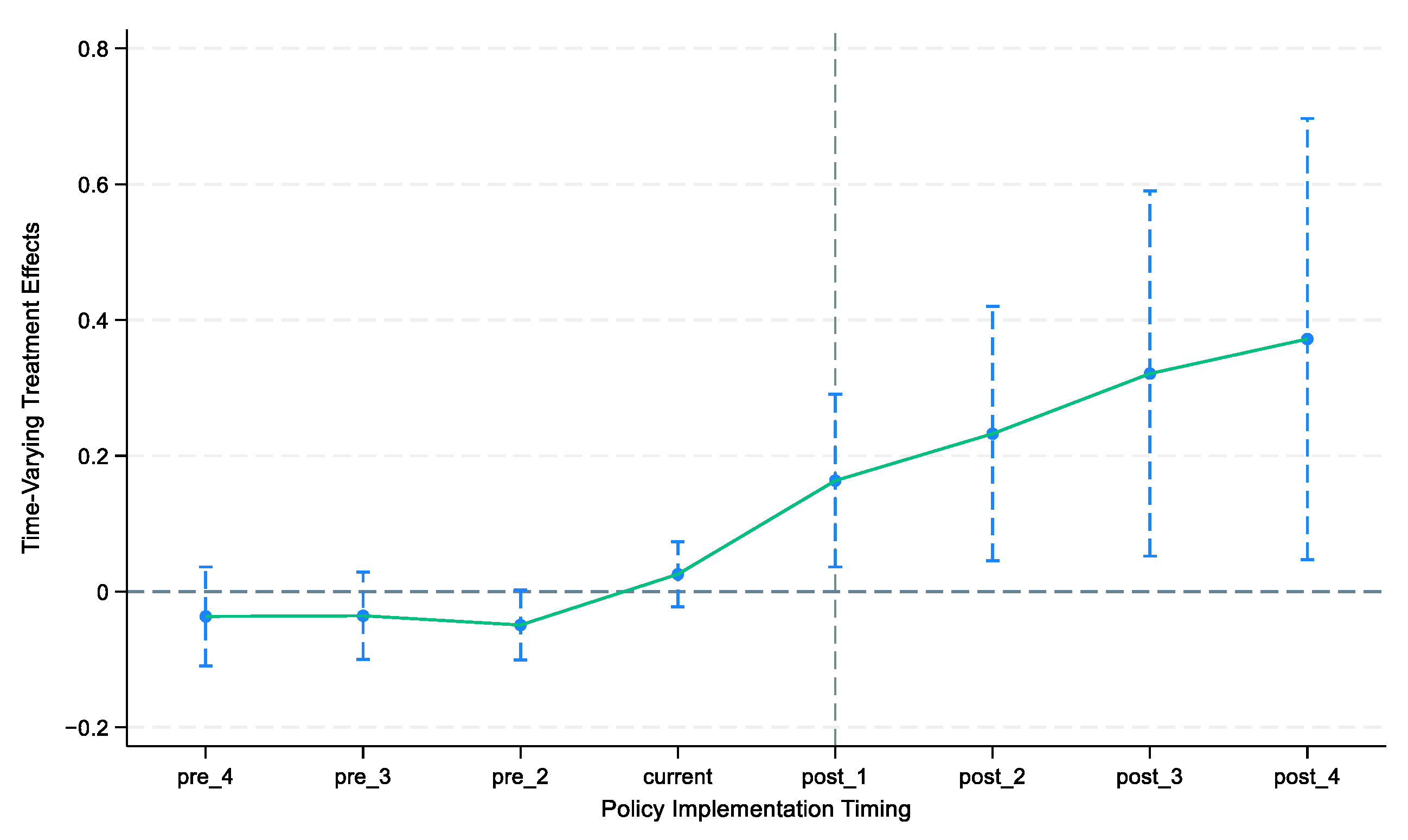
z > 0 stands for the period after policy implementation. To avoid multicollinearity, the sample from the first pre-policy period is excluded. If the regression coefficient αz of did is insignificant when
z < 0, the parallel trend assumption can be deemed satisfied. As shown in the test results in
Figure 1, there is no significant difference in the changing trends between the treatment group and control group samples before the establishment of ICCs. The effect difference after policy implementation can be attributed to the policy itself, indicating that the parallel trend assumption is satisfied. After policy implementation, the policy not only exerts a significant positive impact on the outcome but also this impact continues to strengthen over time.
6.2.2. Placebo Test
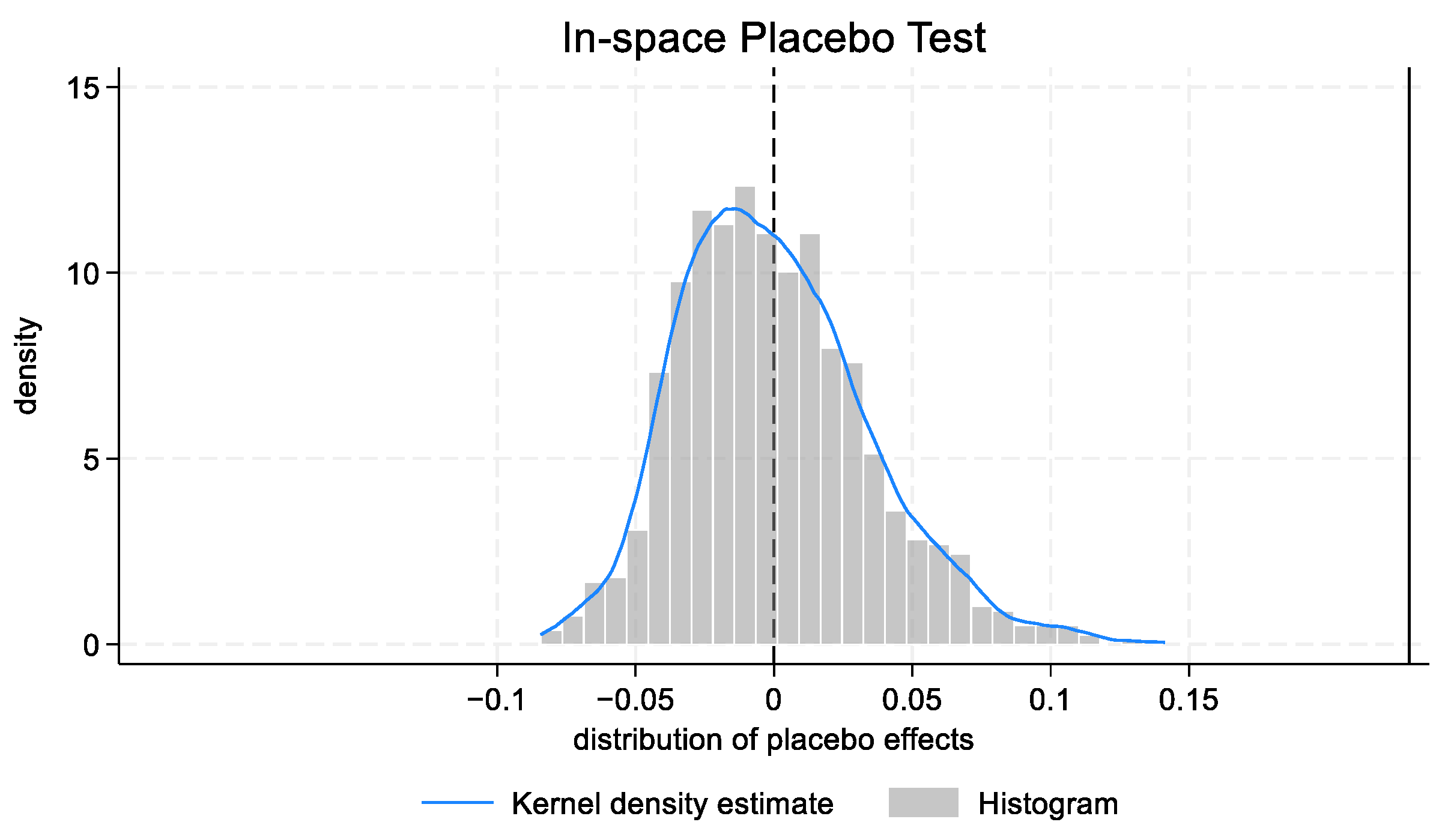
To further verify the robustness of the baseline regression results and rule out the possibility that the estimated effect is driven by random factors or unobservable confounding variables, this study adopts two placebo test methods for verification. The first placebo test employs the method of randomly generating the treatment group. The identifiers for “whether a sample belongs to the treatment group” (treat) are randomly permuted, and the timing of the policy shock is set randomly. Each city in the sample is randomly selected as the treatment group for the placebo test, and the model test is re-conducted. This process is repeated 1000 times, yielding a distribution chart of test coefficients and
p-values (see
Figure 2).
The estimated coefficients of the counterfactual treatment group randomly generated in
Figure 2 are all around zero, and both the two-tailed and right-tailed
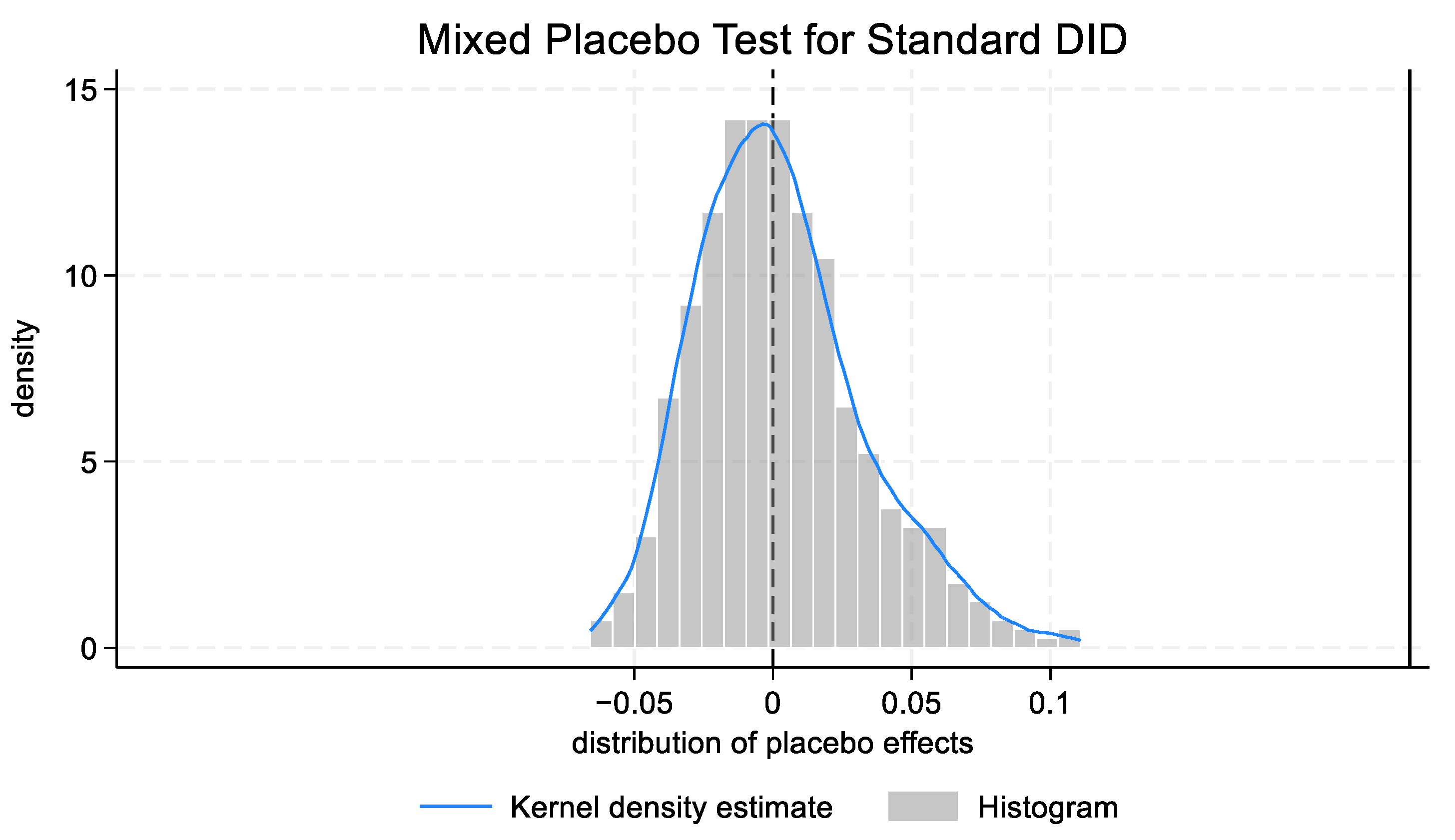
p-values are less than 1%, indicating that the average treatment effect is significant at the 1% level. The estimated treatment effect lies in the right tail of the placebo effect distribution and is an extreme value. Therefore, the effect of ICCs on urban environmental performance is a real causal impact, rather than a spurious result driven by random spatial factors. Next, an unconstrained mixed placebo test is conducted, using both pseudo-treatment units and pseudo-treatment times. Specifically, based on the earliest and latest establishment times of ICCs in the sample, pseudo-treatment times for each city are randomly drawn from a uniform distribution within this interval. TWFE estimation is then performed, and this process is repeated 500 times to obtain the distribution of placebo effects. The results are as follows: Both the two-tailed
p-value and left-tailed
p-value are 0.000, so the null hypothesis that “the treatment effect is zero” can be strongly rejected. Among the results, the estimated treatment effect (represented by the vertical solid line in
Figure 3) lies at the far right of the placebo effect distribution, making it an unusually extreme value.
6.2.3. Propensity Score Matching Double-Difference Model Estimation
For the robustness test of baseline regression results using the Propensity Score Matching-DID model, radius matching is applied first, followed by DID estimation based on the matching results.
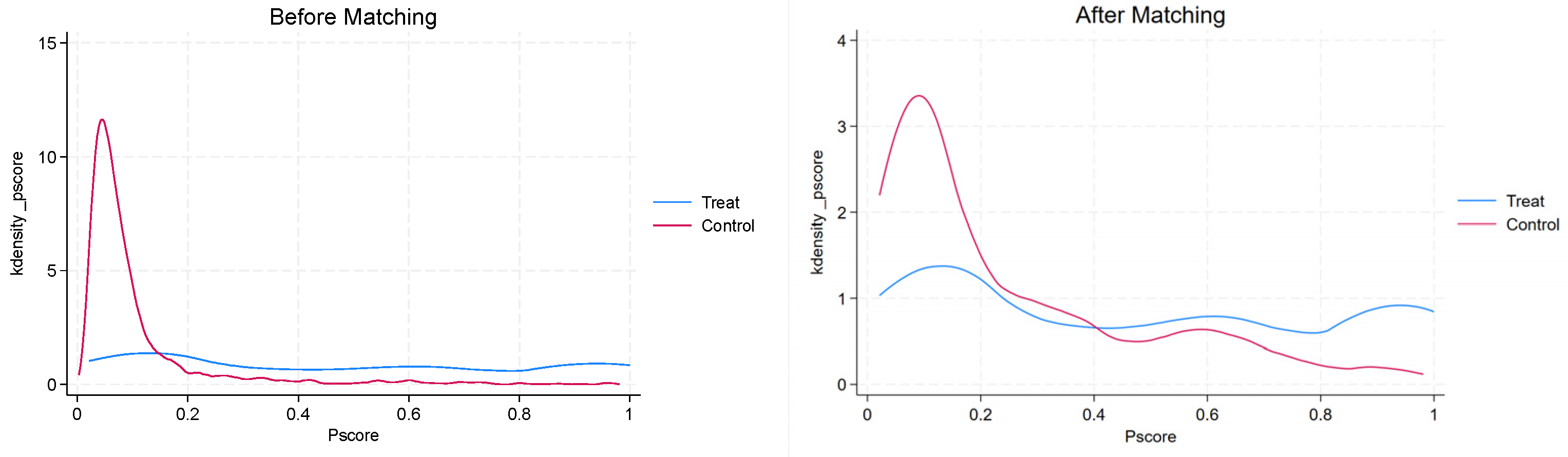
Figure 4 presents the kernel density plots before and after matching.
6.2.4. Discussion on Model Specification Error
As noted by Goodman-Bacon (2021) [
59], in the estimation process of the DID model, the two-way fixed effects estimator is equivalent to the weighted average of all possible two-period DID estimators in the sample. This estimator is likely to be non-robust due to heterogeneous treatment effects, such as issues caused by negative weights. Since prefecture-level cities in this study established ICCs at different time points, multiple types of comparisons emerge: comparisons between prefecture-level cities that have established ICCs (treatment group) and those that never established such centres (never-treated group), as well as comparisons between prefecture-level cities that established ICCs earlier (earlier-treated group) and those that had not yet established them (later-treated group). Obviously, the existence of the “Later T vs. Earlier C” (later-treated units as treatment group vs. earlier-treated units as control group) scenario will lead to bias in the estimation of the staggered DID estimator.
Therefore, this study adopts the Bacon decomposition method to test for heterogeneous treatment effects in the model, with the corresponding results reported in
Table 5. It can be observed that the overall DID estimation result of this study is predominantly derived from the comparison between the treatment group and the never-treated group, with a weight as high as 92%. By contrast, the weight of the comparison category that may induce estimation bias—namely, using units treated earlier as the control group—accounts for merely 1.7%, exerting negligible interference on the overall estimation result. Based on the above analyses, this study concludes that the staggered DID estimation results employed herein are reliable.
6.2.5. Endogeneity Issue
To address potential endogeneity issues that may bias the baseline regression results—even after incorporating a series of control variables—this study conducts instrumental variable analysis, which constitutes a critical robustness check for the core findings. The primary endogeneity concern stems from reverse causality: the relationship between ICCs and urban environmental performance is not unidirectional. Specifically, urban environmental performance is not merely a dependent variable affected by ICC deployment; instead, cities with superior environmental performance typically possess stronger ecological carrying capacity and more favorable development conditions, which render them more inclined to prioritize ICC deployment. Additionally, unobserved city-level heterogeneities (e.g., inherent institutional or geographical advantages) may simultaneously influence both the location selection and construction of ICCs and urban environmental performance. Failure to adequately account for these unobservable factors could introduce estimation biases, undermining the credibility of the baseline conclusions.
To mitigate the aforementioned endogeneity issues, this study selects the interaction term of “number of fixed-line telephones per 100 people in 1984” and “previous year’s national internet investment” as the instrumental variable for the core explanatory variable—ICC establishment status (did). Notably, the design of “number of fixed-line telephones per 100 people in 1984 × previous year’s internet user count” is adjusted to align with the need for dynamic time-varying characteristics and compatibility with city fixed effects. Given that this study controls for city fixed effects, we follow the methodological practices of Manacorda et al. [
60] and Guriev et al. [
61] to construct the IV as the product of a time-invariant historical variable (1984 fixed-line telephone number) and a time-varying macro variable (previous year’s national internet investment), thereby endowing the IV with dynamic attributes and avoiding collinearity with fixed effects.
In terms of instrumental variable validity, the exclusion restriction is largely satisfied: compared with the rapid advancement of internet technology and information technology transformation, the impact of historical fixed-line telephone penetration on economic growth and other socioeconomic outcomes has gradually faded [
62], minimizing its direct effect on contemporary urban environmental performance. For the relevance condition, as a high-computing-power digital infrastructure, ICC construction heavily relies on foundational prerequisites such as mature communication networks and a sound digital user base. The selected IV, which integrates historical communication infrastructure endowment and contemporary internet development dynamics, naturally maintains a significant correlation with ICC establishment status, satisfying the relevance requirement.
This study further conducts a series of validity tests to verify the reliability of the IV. The p-value of the Anderson LM test is far less than 0.01, indicating no under-identification issue. The Cragg–Donald Wald F-statistic reaches 304.76, which strongly rejects the null hypothesis of weak instrumental variables. The AR Wald F-statistic is 865.71, further reinforcing the robustness of the core conclusions and ruling out the possibility of spurious significance arising from IV-related issues.
Columns (1) and (2) of
Table 6 report the first-stage and second-stage estimation results of the IV method, respectively. The first-stage results confirm that the instrumental variable is significantly positively correlated with ICC establishment status (did), further validating the relevance of the IV. After addressing endogeneity through the IV method, the significant positive impact of ICC establishment on urban environmental performance is further strengthened. This finding indicates that the baseline conclusion—that ICCs significantly promote urban environmental performance improvement—is robust and not distorted by endogeneity issues.
6.2.6. Other Robustness Tests
To further verify the robustness of the baseline conclusion that ICC establishment improves urban environmental performance, this study conducts a series of supplementary robustness tests, including sample data screening, independent variable replacement, dependent variable replacement, and subsample regression. The results are reported in
Table 7, with detailed designs and findings as follows.
First, sample data screening. To mitigate the interference of extreme values in non-random sample data on model estimation accuracy, this study performs 1% and 5% two-tailed winsorization on the dependent variable (urban environmental performance) and excludes samples of municipalities directly under the central government to eliminate potential structural heterogeneity. The estimation results are presented in Columns (1), (2), and (3) of
Table 7. Second, independent variable replacement. This study replaces the original core explanatory variable—”intelligent computing center establishment status”—with “broadband policy implementation,” a quasi-natural experiment proxy variable reflecting digital infrastructure development. This replacement helps rule out the impact of unobserved factors specific to ICCs, with the results reported in Column (4) of
Table 7. Third, dependent variable replacement. The measurement method of the dependent variable (urban environmental performance) is adjusted. Following the approach of Liu (2020) [
48], urban environmental performance is re-measured primarily from the perspective of pollutant emissions. The results are presented in Column (5) of
Table 7. Due to the relative simplicity of this single-dimensional pollutant emission indicator compared with the comprehensive index, the R
2 of the regression model increases accordingly. Fourth, subsample regression. Two sets of subsample regressions are conducted to examine the heterogeneity of ICCs’ environmental effects. On the one hand, the full sample is divided into high environmental performance and low environmental performance groups based on the median of urban environmental performance, and empirical tests are performed separately for the two subsamples, with results reported in Columns (6) and (7) of
Table 7. On the other hand, considering that most ICCs have been established only in the past three years, the sample is split by the year 2020 to explore the time-varying characteristics of ICCs’ effects, with the regression results presented in Columns (8) and (9) of
Table 7.
The results of all aforementioned robustness tests consistently confirm a significantly positive impact of ICC establishment on urban environmental performance. This indicates that the core conclusion of this study is robust and not affected by extreme values, variable measurement methods, sample selection, or time periods, further enhancing the credibility of the research findings.
6.3. Heterogeneity Analysis
6.3.1. Regional Heterogeneity
While this study incorporates a set of city-level control variables, substantial regional disparities in China remain salient with respect to economic fundamentals, industrial structure, and resource endowment. Historically, the eastern and central regions have been characterized by higher levels of economic development, concomitantly accompanied by more acute environmental pollution challenges. Against this backdrop, exploring the heterogeneous environmental performance effects of ICCs across different regions is of considerable theoretical and practical significance. In line with the regional classification criteria formulated by the National Bureau of Statistics of China, this study categorizes all prefecture-level and above cities into four major regions: the eastern, central, western, and northeastern regions. To conduct a geography-based heterogeneity analysis, a subsample regression strategy is adopted to systematically evaluate the impacts of ICC construction and operation on urban environmental performance across these four regional divisions. The empirical results are reported in
Table 8.
It is evident from the regression estimates that ICC establishment exerts a positive influence on urban environmental performance across all four regions, albeit with notable variations in the magnitude and statistical significance of this effect. Specifically, the promoting effect is the most pronounced in the western region, followed sequentially by the central and northeastern regions, whereas the eastern region demonstrates the weakest effect magnitude. In terms of statistical significance, the environmental benefits of ICCs are more robust in the northeastern and western regions, whereas the significance levels are relatively modest in the central and eastern regions. Collectively, these findings corroborate the presence of distinct geographical heterogeneity in the environmental performance implications of ICCs.
Compared with the eastern and central regions, most cities in western China exhibit lower completeness of environmental protection facilities and lower adoption rates of green technologies, leading to significant technical gaps in environmental governance. Consequently, each additional ICC established in this region generates a more pronounced incremental improvement in environmental performance. Leveraging the policy preference of the “Eastern Data and Western Computing” initiative, the layout of ICCs in western China is deeply integrated with green development, often coupled with supporting new energy projects. Furthermore, the digital transformation of traditional high-energy-consuming industries driven by ICCs can rapidly reduce pollutant emissions per unit of output value, thereby amplifying the environmental improvement effect.
Although the coefficient of ICCs’ impact in the northeastern region is smaller than that in the central and western regions, cities in this traditional old industrial base share highly homogeneous industrial structures, dominated by heavy chemical industries, which creates strong demand for pollution reduction and ensures a high goodness of fit for the regression results. Moreover, as a critical ecological security barrier, the northeastern region enforces environmental policies with high rigidity, yielding higher efficiency in green technology transformation—once relevant technologies are adopted, emission reduction effects become immediately tangible, hence the highest statistical significance of ICCs’ impact in this region. Nevertheless, the layout of ICCs in the northeastern region started relatively late, with a small quantity and limited computing power scale. In addition, long-standing historical legacies from heavy industry development have resulted in prolonged cycles and high costs for environmental governance. As such, the establishment of ICCs can hardly directly tackle structural pollution issues, leading to a relatively limited improvement in overall environmental performance.
In the eastern and central regions, the basic pollution governance systems have been initially established, so the incremental effect of ICC establishment on environmental performance is lower than that in the western region. The eastern region boasts a developed economy, a large-scale digital economy, and a high concentration of high-tech industries and modern service industries. While it has strong demand for ICC computing power and abundant application scenarios, the region prioritizes the economic value of ICCs in enhancing productivity. The insufficient allocation of computing power to environmental governance fields dilutes the environmental improvement effect of ICCs. Additionally, the eastern region encompasses both megacities and small-to-medium-sized cities, with substantial disparities in industrial structure, environmental protection needs, and intelligent computing application scenarios across cities—this heterogeneity further reduces the goodness of fit of ICCs in promoting environmental performance. For the central region, its scattered industrial structure poses dual challenges: supporting industrial emission reduction while controlling agricultural non-point source pollution. The excessively high proportion of traditional industrial enterprises also restricts the effectiveness of ICCs to a certain extent. However, with the advancement of industrial digital transformation and the improvement of coordinated development mechanisms in the central region, ICCs hold significant potential for driving green development, exerting a statistically significant effect on improving environmental performance.
In summary, the promoting effect of ICCs on urban environmental performance varies remarkably across different regions. In environmental governance practices, the principles of adapting to local conditions and implementing targeted policies must be adhered to. Specifically, policy guidance should be utilized to deeply integrate ICC layout with regional environmental governance needs and industrial characteristics, foster synergy between industrial transformation and intelligent computing, mitigate constraints imposed by traditional industries, and maximize the green empowerment value of ICCs. Looking ahead, on the basis of differentiated regional policies, further efforts should be made to break down regional barriers and strengthen cross-regional collaboration, thereby enabling ICCs to play a more comprehensive role in advancing national ecological civilization construction.
6.3.2. Resource Heterogeneity
A city’s development model depends on its inherent resource endowment. Resource-based cities rely excessively on natural resource inputs for economic growth, which may lead to numerous difficulties in green transformation and potentially affect the effectiveness of ICCs on urban environmental performance. This study follows the definition from the National Plan for the Sustainable Development of Resource-Based Cities (2013–2020) issued by the National Development and Reform Commission. Resource-based cities are primarily those whose leading industries involve the extraction and primary processing of resources such as coal, petroleum, and metallic minerals. Based on the National Plan for the Sustainable Development of Resource-Based Cities (2013–2020), this study classifies sample cities into resource-based cities and non-resource-based cities according to their resource endowments, and conducts grouped regression. Results in
Table 9 show that the establishment of ICCs has a significant negative effect on environmental performance in resource-based cities, while it exerts a significant promoting effect in non-resource-based cities.
Non-resource-based cities, which primarily specialize in the service industry, high-tech industries, and light industries, manifest three core traits: a lightweight industrial structure, a low pollution baseline, and strong flexible transformation capacity. These traits are highly congruent with the green technology upgrading and industrial transformation effects brought about by ICCs, enabling non-resource-based cities to fully leverage computing resources in supporting environmental governance practices and thereby realizing a significant improvement in environmental performance.
By comparison, resource-based cities rely heavily on resource-intensive industries with high energy consumption, high pollution, and high emissions for economic growth, and are afflicted by severe industrial path dependence and a single industrial structure. These are deep-rooted systemic issues that cannot be fundamentally mitigated merely through the data processing and algorithm optimization capabilities of ICCs. As a result, the establishment of ICCs does not contribute to urban environmental performance improvement via promoting green production technology application or driving low-carbon-oriented industrial structure adjustment. Instead, the production efficiency improvements derived from ICCs may aggravate industrial pollution, because resource-based cities are inclined to expand the output of resource-intensive industries rather than promote industrial layout transformation.
To explore the underlying mechanisms of this negative outcome, sub-index regression analysis is conducted on the sample of resource-based cities. The results indicate that, apart from exerting a positive impact on environmental performance in the dimension of pollutant emissions, the establishment of ICCs exerts negative effects on all other environmental performance dimensions—among which the impacts on environmental facility construction level and waste disposal capacity are statistically significant, with regression coefficients of −0.041 (p < 0.05) and −0.042 (p < 0.01), respectively. Based on this finding, it is conjectured that due to the common predicaments of resource-based cities, such as fiscal dependence on resource industries and insufficient transformation funds, the large upfront investment required for ICC construction squeezes short-term investments in environmental governance and green technological R&D to a certain extent. This crowding-out effect ultimately leads to the negative impact of ICC establishment on the environmental performance of resource-based cities.
This reasoning is further verified through preliminary empirical tests using the constructed dataset. The results show that in the sample of resource-based cities, the promotional effect of ICC establishment on the output of the secondary industry is significantly higher than that on the tertiary industry, while it exerts a significant inhibitory effect on scientific and technological expenditure. In contrast, in the sample of non-resource-based cities, ICC establishment exerts a significantly positive impact on scientific and technological expenditure. This contrast initially confirms the conjecture regarding the crowding-out effect and industrial path dependence mechanism.
Although numerous studies have demonstrated the facilitating role of digital economy development in urban green transformation [
1,
7], the potential negative environmental impacts of digital infrastructure represented by ICCs should not be ignored and warrant further in-depth research. From a policy perspective, for non-resource-based cities, efforts should be made to further improve the application level of computing resources in environmental governance and amplify their positive spillover effects on green development. For resource-based cities, targeted supportive policies and special funds should be formulated to actively encourage the integration of intelligent computing technology with environmental protection fields, thereby helping resource-intensive cities break free from path dependence and transition toward technology-intensive development models.
It should be noted that the distinction between resource-based and non-resource-based cities in this study is based on China’s official policy classification standards. Different countries may adopt divergent criteria for identifying resource-dependent cities, which could lead to heterogeneous impacts of ICCs. Specifically, in countries dominated by resource industries or suffering from the “resource curse,” the negative impact of ICCs on the environmental performance of resource-based cities may be more pronounced. In contrast, in countries with well-established resource governance mechanisms and diversified industrial structures, the environmental effect of ICCs might differ significantly. Therefore, when translating the policy implications of this study across borders, careful consideration must be given to the specific definition of resource-based cities and their current developmental stage in the local context to ensure the adaptability and effectiveness of policy recommendations.
6.3.3. Environmental Regulation Heterogeneity
The level of attention to environmental regulation is measured by the frequency of environmental regulation-related terms in government reports. A higher frequency of such terms in government reports indicates a city’s greater policy of attention to environmental protection. These cities will leverage policy guidance, coordination mechanisms, and resource support to translate the green empowerment value of ICCs into practical outcomes. Conversely, in cities with low environmental regulation attention, weak policy constraints and insufficient supporting facilities naturally weaken the environmental effect of ICCs. Results in
Table 9 show that the coefficient for the effect of intelligent computing center establishment on improving environmental performance is 0.238 in cities with high attention to environmental regulation, which is significantly stronger than that in cities with low attention.
The impact of ICCs on environmental performance depends not only on the technology itself but also on whether the city has an institutional environment to facilitate the implementation of the technology. Governments can implement differentiated and refined environmental protection policies in connection with computing resources, and formulate targeted governance measures for different regions and different pollution sources to ensure policy effectiveness.
6.3.4. Cluster Heterogeneity
Currently, there are eight major computing hubs in China, namely the Beijing–Tianjin–Hebei Hub (covering Beijing, Tianjin, and Hebei), the Yangtze River Delta Hub (covering Shanghai, Anhui, Jiangsu, and Zhejiang), the Guangdong–Hong Kong–Macao Greater Bay Area Hub (covering Guangdong), the Chengdu–Chongqing Hub (covering Chongqing and Sichuan), the Inner Mongolia Hub (covering Inner Mongolia), the Guizhou Hub (covering Guizhou), the Gansu Hub (covering Gansu), and the Ningxia Hub (covering Ningxia). Cities included in all the above computing hubs are classified into one group, while other cities are classified into another group. Subsample regression for heterogeneity analysis was conducted based on whether a city is a computing hub, examining the impact of intelligent computing center establishment and operation on environmental performance in computing hub cities and non-computing hub cities, respectively. The results are presented in
Table 9, and show that computing hub cities have a collaborative effect on computing power scheduling, along with the agglomeration of talent and technological resources. This makes the promoting effect of ICCs on environmental performance stronger in these cities than in non-hub cities. When ICCs are located in cities covered by the eight major computing hubs (such as the Beijing–Tianjin–Hebei, Yangtze River Delta, and Guangdong–Hong Kong–Macao Greater Bay Area hubs), they can drive a greater improvement in local environmental performance, which is significant at the 5% significance level.
The Chow test results (
Table 10) indicate that the
p-values for all four heterogeneity dimensions are 0.000, rejecting the null hypothesis of no structural differences between subgroups at the 1% significance level. This confirms that the impact of ICCs on environmental performance exhibits significant heterogeneity across different subgroups.
In future practice, the synergistic strengths of computing power scheduling and the talent-technology agglomeration effects of hub cities can be harnessed to drive ICCs to deeply serve cross-regional environmental protection scenarios, such as air pollution joint prevention and control and watershed pollution simulation. This will further amplify ICCs’ effectiveness in boosting environmental performance. Additionally, through the implementation of the “Eastern Data and Western Computing” project, non-hub cities can be steered to form a computing power complementary framework with hub clusters. This will address the shortcomings of non-hub cities in computing power infrastructure and technology adaptation, creating favorable conditions for ICCs to fully exert their environmental empowerment functions across both hub and non-hub cities.
6.4. Analysis of Mediating Effects
The establishment of ICCs may enhance urban environmental performance through two primary channels, namely the promotion of green innovation and the advancement of industrial structure upgrading. In this study, the total number of authorized green patents, following Dian et al. (2024) [
54], is used as a proxy for the level of green innovation, while the ratio of output value between the tertiary and secondary industries is adopted to capture changes in industrial structure. The empirical results are reported in
Table 11.
As shown in Column (1) of
Table 11, the establishment of ICCs exerts a statistically significant positive effect on urban environmental performance. Column (2) indicates that the DID coefficient is significantly positive, suggesting that ICC construction effectively promotes the transformation and upgrading of the industrial structure toward cleaner, smarter, and greener modes of development, thereby contributing to improvements in urban environmental performance. Furthermore, the results in Column (3) demonstrate that ICC establishment significantly enhances green innovation. This finding implies that ICCs facilitate the dissemination and diffusion of green technological knowledge among innovation agents through knowledge and technology spillovers, while also lowering technological entry barriers and thereby stimulating urban green technological innovation.
Since the 13th Five-Year Plan period, China has imposed more stringent requirements on both economic development and environmental protection, with increasing emphasis placed on green innovation. Peng et al. [
63], using spatial pattern analysis, found that green innovation exhibits significant regional agglomeration and is positively associated with the quality of economic development through strong spatial autocorrelation. At the micro level, Ye et al. [
28], based on a sample of 273 listed pollution-intensive firms, demonstrated that digital investment can enhance environmental performance through the mediating role of green innovation. Green innovation, encompassing clean production technologies, pollution control technologies, and waste recycling technologies, can directly reduce pollutant emissions at the production source and improve energy-use efficiency, thereby enhancing the effectiveness of environmental governance [
20]. Moreover, green innovation contributes to improvements in regional green productivity and facilitates the realization of green development goals [
64]. From an urban perspective, environmental performance reflects both the control of pollutant emissions and the level of green economic development. Accordingly, green innovation can improve urban environmental performance through two primary channels, namely emission reduction and efficiency enhancement.
Industrial structure upgrading represents another critical pathway through which ICCs influence environmental performance. A central feature of industrial upgrading is the deep integration of digital technologies into the industrial system, which fosters the emergence of new digital industries and drives their evolution toward higher-end, greener, and more intelligent development. This process enhances resource allocation efficiency and promotes green production. Chang et al. [
17] observed that China’s historically secondary-industry-dominated structure, while supporting rapid economic growth, also resulted in extensive fossil energy consumption. Xie [
18] argued that under the green development paradigm, industrial upgrading should embody environmental friendliness by transforming high-pollution production modes into cleaner alternatives. Empirical studies based on China’s provincial panel data from 2010 to 2019 further confirm that the digital economy can significantly reduce carbon emission intensity through industrial structure upgrading. Using a DID framework, Liu et al. [
21] showed that enhanced transparency in pollution information disclosure facilitates the ecological transformation of local industrial structures and proposed policies to promote the development of the tertiary sector. Similarly, Feng et al. [
22] demonstrated that industrial structure upgrading serves as an important mediating channel through which informal environmental regulation reduces carbon emissions. By shifting economic activity toward the tertiary industry, industrial upgrading effectively lowers energy consumption and pollutant emissions, thereby supporting cleaner production.
Taken together, these findings provide strong empirical and theoretical support for the mediation results reported above and confirm Hypotheses 2 and 3 of this study. Specifically, the establishment of ICCs can indirectly enhance urban environmental performance by stimulating green innovation and promoting industrial structure upgrading, thereby reinforcing the mechanism-based interpretation of the empirical results.
6.5. Sub-Index Regression
Considering that the establishment of ICCs may have varying impacts on the respective components of urban environmental performance, this study conducts a further test on the heterogeneous effects of intelligent computing center establishment on each environmental performance indicator to identify which specific aspect of the environment has actually been improved, as shown in
Table 12.
Empirical findings reveal that ICCs exert a statistically significant and positive impact on urban environmental performance across four core dimensions: environmental infrastructure construction, resource utilization efficiency, waste treatment capacity, and pollutant emission reduction. Notably, this facilitating effect permeates all facets of environmental performance with the sole exception of the composition of environmental protection personnel. The underlying mechanisms driving the adverse impact of ICCs on the structure of environmental protection personnel can be elaborated as follows: ICCs tend to substitute labor-intensive manual operations with advanced intelligent technologies; leveraging computing power-enabled real-time monitoring systems and intelligent scheduling platforms, ICCs significantly reduce the demand for traditional environmental protection roles. Moreover, constrained by the inherent attributes of high energy consumption and high carbon emissions of ICCs themselves, their positive contribution to the allocation efficiency of environmental resources remains statistically insignificant.
7. Spatial Spillover Effects
Against the backdrop of the coordinated advancement of China’s “dual carbon” goals and the Digital China strategy, ICCs, as a new form of digital infrastructure integrating computing power, algorithms, and data, have become a critical foundation for promoting urban green transformation. On the one hand, ICCs enable application scenarios such as environmental monitoring and early warning, pollution control simulation, and optimization of new energy dispatch through high-performance computing capabilities. They provide essential computational support for green technology research and development, thereby accelerating the generation and diffusion of green patents. On the other hand, ICCs facilitate the deep integration of the digital economy with green industries, inducing industrial structure upgrading toward low-carbon development and consequently reducing pollutant emissions. Meanwhile, due to factors such as geographic proximity and regional economic linkages, the technology diffusion and industrial synergy effects generated by ICCs may transcend administrative boundaries and produce spatial spillover effects on the environmental performance of neighboring cities. This feature is closely aligned with the inherent spatial dependence of urban environmental performance itself, which is characterized by cross-regional pollution transmission and collaborative ecological governance. Consequently, the relationship between ICC development and environmental performance must be examined within a spatial analytical framework.
Based on this premise, this study constructs a standardized geographic weight matrix for prefecture-level cities and applies Moran’s I index to test the spatial autocorrelation of urban environmental performance, which serves as the explained variable. The corresponding results are reported in
Table 13.
Results of the Moran’s I test indicate that the Moran’s I indices for both urban environmental performance and ICC establishment are statistically significant and positive over the sample period. This finding implies that urban environmental performance is substantially influenced by the environmental governance spillovers of neighboring regions, and a robust positive spatial correlation exists among the environmental performance levels of different cities, thus verifying the presence of spatial spillover effects. Furthermore, the global Moran’s I index exhibits an overall fluctuating downward trend from 2010 to 2023, signifying a gradual attenuation of spatial dependence across cities. This phenomenon may be attributed to the narrowing gap in urban environmental governance capacities and the cross-regional diffusion of digital technologies. To further identify the spatial agglomeration characteristics of urban environmental performance across specific regions, a series of Moran scatter plots of urban environmental performance covering the period 2010–2023 were constructed (
Figure 5), with 2023 taken as a typical example for illustration (
Figure 6). The results show that scatter points are predominantly concentrated in the first quadrant.
To verify the rationality of the model specification, this study conducted a series of tests. As shown in
Table 14, Results of the LM test all show that the
p-value is less than 0.01, which significantly rejects the null hypothesis of no spatial correlation, confirming the rationality of using a spatial econometric model for analysis. Results of the LR test and Wald test for the Spatial Error Model (SEM) and Spatial Lag Model (SLM) indicate that the SDM is the optimal choice. Results of the Hausman test and LR test for fixed effects suggest that the model should be specified as a two-way fixed effects model, so this study initially decided to use this model for analysis. However, subsequent regressions revealed that the
p-value of the roh statistic for the two-way fixed effects SDM was 0.703, which does not support the use of this model. Therefore, this study ultimately chose the time-fixed SDM for analysis.
This study further decomposes the spatial impacts of ICC establishment on urban environmental performance into three components: direct effects, indirect effects, and total effects. As reported in
Table 15, the estimated direct-effect coefficient of ICC establishment is 1.79 and is statistically significant at the 1 percent level, indicating that ICC development plays a substantial role in enhancing the environmental performance of host cities.
The estimated indirect effect of ICC establishment is also positive and statistically significant, providing robust evidence of positive spatial spillover effects on the environmental performance of neighboring cities. In other words, while ICCs improve environmental performance locally, they also generate beneficial externalities for surrounding regions. This spillover effect can be explained by two main mechanisms. First, advances in environmental governance technologies enabled by local ICCs are highly replicable and can be readily diffused to nearby cities, facilitating the widespread adoption of effective governance practices. Second, neighboring cities may participate in ICC-related green industrial chains and engage in collaborative pollution control initiatives, leveraging data-sharing and intelligent computing capabilities to improve cross-regional environmental governance efficiency. The total effect, which combines both direct and indirect effects, is also significantly positive, suggesting that ICC establishment contributes to overall improvements in regional urban environmental performance.
To assess the robustness of the estimated spatial spillover effects, this study further re-estimates the direct, indirect, and total effects using an SDM with an economic–geographic nested weight matrix. The corresponding results are presented in Column (2) of
Table 14. Across both spatial weight matrices, the direct effects of ICC establishment remain significantly positive at the 1 percent level, with highly consistent coefficient magnitudes. The primary difference lies in the estimated magnitude of the indirect effects, which likely reflects variations in the strength of inter-city economic linkages embedded in the alternative spatial weight structures.
In summary, this study confirms that the establishment of ICCs not only exerts a significant direct promotional effect on local environmental performance but also generates positive spillover impacts on the environmental performance of surrounding cities, thereby amplifying the overall improvement effect on regional environmental performance. This conclusion provides practical insights for optimizing the spatial layout of ICCs and advancing collaborative regional environmental governance. Specifically, it suggests that the formulation of relevant policies should not only prioritize the construction of local digital economic infrastructure but also emphasize the importance of computing power collaboration and resource sharing among adjacent regions, so as to fully unlock the spatial spillover dividends of ICCs. Moving forward, efforts should be directed towards enhancing the green operation of ICCs, including optimizing energy structures through the adoption of green electricity and waste heat recovery, applying innovative technologies such as liquid cooling, and allocating computing power to support critical tasks such as environmental monitoring, pollution simulation, and carbon footprint tracing. Concurrently, guidance should be provided to surrounding cities to develop supporting industries, such as environmental protection AI and green data services, to consolidate and expand the environmental benefits of ICCs.
8. Conclusions and Policy Implications
Based on the comprehensive connotation of environmental performance, this study constructs a multi-dimensional evaluation indicator system. Taking the construction of ICCs as a quasi-natural experiment, it systematically investigates the impact mechanisms and spatial spillover effects of ICC establishment on urban environmental performance using panel data from 292 prefecture-level cities in China over the period 2010–2023. The main findings are summarized as follows:
First, from 2010 to 2023, Chinese cities sequentially constructed and commissioned ICCs, which have driven a steady improvement in urban environmental performance. Second, the conclusion that ICC establishment promotes environmental performance remains robust after a series of rigorous robustness tests, including parallel trend test, placebo test, propensity score matching-difference-in-differences, and instrumental variable method. Third, mechanism tests reveal that ICCs indirectly optimize urban environmental performance primarily through two pathways—facilitating green technological innovation and advancing industrial structure upgrading—highlighting their core role as a dual driver of technological empowerment and structural transformation. These two pathways are well validated by specific practical cases:
In terms of environmental monitoring and pollution control, for instance, the ICC in Guiyang, a national computing hub city, integrates multi-source data (e.g., satellite remote sensing, ground monitoring stations, and enterprise emission reports) and leverages high-performance computing power to develop a real-time air quality prediction model with an accuracy exceeding 90%. This model enables precise tracing of PM2.5 pollution sources and provides targeted control recommendations for environmental law enforcement departments, thereby effectively reducing regional air pollution incidents. In the field of energy optimization, Qinghai’s ICC, capitalizing on local clean energy advantages, has built an integrated energy scheduling platform for wind, solar, and hydropower. By real-time simulating and optimizing the output of various new energy sources, it has increased the consumption rate of clean energy by 15 percentage points and significantly reduced the carbon emission intensity of the power system. Additionally, in industrial pollution control, numerous non-resource-based cities in western China have applied ICCs to conduct digital simulation and process optimization for high-energy-consuming enterprises. For example, a chemical enterprise in Yunnan utilized computing power to optimize chemical production reaction processes, reducing pollutant emissions by 20% while improving production efficiency—an empirical illustration of ICCs’ role in boosting green technological innovation and industrial structure upgrading. Fourth, heterogeneity analysis indicates that the environmental performance improvement effect of ICCs is more pronounced in western regions, non-resource-based cities, cities with high environmental protection attention, and national computing hub cities. This suggests that the enabling effect of ICCs is comprehensively shaped by regional endowments, industrial foundations, and policy environments. Fifth, results from the SDM demonstrate that while enhancing local environmental performance, ICCs generate significant positive spatial spillover effects on neighboring cities, reflecting the cross-regional radiating characteristics of their environmental governance benefits. For example, Chengdu’s ICC has established a cross-regional ecological environment monitoring network covering the Chengdu–Chongqing region, realizing shared early warning of water pollution in the Jialing River and Yangtze River basins and driving joint ecological governance among surrounding cities.
Regarding theoretical contributions, this study transcends the existing literature’s singular focus on the economic benefits of digital infrastructure by constructing and empirically testing an integrated analytical framework of “digital infrastructure—technological empowerment & structural transformation—environmental performance.” This framework organically integrates empowerment theory, innovation paradigm transformation, and spatial economic restructuring, revealing that the uniqueness and complexity of ICCs’ environmental effects—as a new type of digital infrastructure—lie in their dual attributes of “local technological empowerment” and “cross-regional network synergy.” Specifically, the key theoretical insights are as follows:
First, it extends empowerment theory by demonstrating that digital elements can not only enhance production efficiency but also become a core technological variable reshaping the incentive system of urban environmental governance by lowering the threshold for green innovation and optimizing the cost–benefit structure of environmental governance. Second, it supplements the geography of innovation literature by revealing that under the guidance of national strategies such as the “Eastern Data, Western Computing” project, the spatial layout of digital infrastructure itself becomes a key geographical process driving cross-regional green knowledge spillovers and facilitating the formation of collaborative environmental governance networks, thus elevating the discussion on environmental externalities from “local effects” to “regional network effects.” Third, it refines the “digital-green synergy” theory by empirically identifying two parallel mediating pathways (green technological innovation and industrial structure upgrading). This clarifies that ICCs improve environmental performance through the synergistic operation of “computing-power-driven innovation” and “digital-enabled industrial transformation” mechanisms, providing a more granular explanation of the causal chain for research in this field.
Based on the above research conclusions, this study puts forward the following policy recommendations:
First, a comprehensive governance framework for ICCs oriented toward environmental performance should be established to consolidate the digital foundation for green development. To systematically guide and regulate ICC development, while maximizing positive environmental externalities and minimizing negative ones, priority should be given to building an integrated governance system covering data management, algorithm regulation, energy use, and accountability. At the data and privacy level, hierarchical classification standards and data sharing rules should be formulated for environmental governance, industrial production, and related fields. On the premise of ensuring data security and privacy protection, cross departmental and cross regional data integration should be promoted to provide essential support for precise pollution control and collaborative environmental governance. At the algorithm and accountability level, filing and impact assessment mechanisms should be introduced for algorithms applied in key scenarios such as environmental monitoring, energy dispatching, and pollution source tracing. This will help ensure transparency, interpretability, and auditability of decision-making processes, prevent algorithmic bias, and strengthen technical accountability. At the energy and efficiency level, mandatory full life cycle energy efficiency and environmental standards should be implemented across the stages of design, construction, and operation. Core indicators such as power usage effectiveness, carbon footprint, and water resource utilization efficiency should be incorporated into access and evaluation systems, thereby guiding the adoption of green technologies and reducing the environmental burden of ICCs at the source.
Second, top level design and strategic coordination should be strengthened to deeply integrate ICC construction into urban green development planning. Governments at all levels should fully recognize that ICCs are not only infrastructure supporting the digital economy, but also key technological engines driving green transformation. In the formulation of digital economy development plans and environmental protection strategies, stronger alignment between these objectives is required, with improvements in environmental performance explicitly incorporated as a core evaluation criterion for ICC construction and operation. Local governments are encouraged to embed environmental benefit indicators such as green technological innovation capacity, carbon emission intensity, and the level of industrial ecological development into the approval, review, and assessment processes of ICC projects. This approach will guide computing resources toward green application scenarios including environmental governance, energy optimization, and ecological monitoring, and promote coordinated progress between computing capacity expansion and green transformation.
Third, differentiated and targeted regional guidance policies should be implemented to maximize the green enabling efficiency of ICCs. In light of the significant regional heterogeneity identified in this study, policy design should avoid uniform approaches. For western and northeastern regions, where ICCs exert stronger effects on environmental performance, continued reliance on national strategies such as the Eastern Data and Western Computing initiative is recommended. On the basis of ensuring stable energy supply, the development of green computing clusters should be encouraged, and computing capacity advantages should be closely aligned with local priorities such as ecological restoration and the green transformation of traditional industries. For eastern and central regions, ICC development should move beyond basic computing services and focus on advancing high precision environmental governance algorithms and solution systems, thereby providing intelligent environmental protection technologies for broader regional application. For resource-based cities, dedicated transformation funds should be established alongside stringent environmental standards to promote the integration of intelligent computing technologies with the upgrading of high-energy-consuming industries and to overcome obstacles to green transformation.
Fourth, cultivation and incentive mechanisms for intermediary pathways should be strengthened to smooth the value conversion chain linking computing power, innovation, industry, and environmental outcomes. Governments should actively assume a catalytic role by supporting initiatives such as the establishment of joint laboratories integrating intelligent computing and environmental protection, providing enhanced deductions for research and development expenditures, and subsidizing the procurement of green technologies. These measures can directly encourage enterprises and research institutions to apply computing resources to green technological innovation. At the same time, industrial policies and green financial instruments should be leveraged to promote cooperation between computing service providers and manufacturing enterprises in digital transformation and clean production. Targeted incentives should be granted to projects that achieve substantial energy conservation and emission reduction through intelligent computing applications, thereby accelerating the upgrading of industrial structures toward greener and lower carbon development trajectories.
Fifth, a cross regional collaborative governance network integrating computing capacity and environmental management should be established to fully realize the spatial spillover benefits of ICCs. In view of the pronounced spatial spillover effects identified in this study, it is advisable to take the lead in building a regional environmental computing alliance among national computing hub cities. This alliance would facilitate the harmonization of interregional data standards and sharing mechanisms and support the development of integrated environmental big data platforms and simulation systems to address cross regional governance challenges, including air pollution control, river basin water environment management, and biodiversity conservation. Through coordinated computing power allocation, cities with stronger environmental performance can be encouraged to disseminate intelligent environmental governance solutions and operational experience to neighboring regions, thereby fostering a pattern of regional green development characterized by coordinated advancement and shared progress. Ultimately, this approach will promote high level synergy between digital economy development and ecological civilization construction.
9. Research Limitations and Prospects for Future Studies
This study acknowledges several limitations that also delineate promising avenues for future research.
First, at the analytical level, the empirical analysis relies primarily on city-level panel data. Despite the adoption of multiple identification strategies—including a multi-period DID model and instrumental variable approaches—to mitigate potential endogeneity issues, the micro-level behavioral mechanisms and heterogeneous responses underlying the influence of ICCs on environmental performance remain unobserved. Specifically, how firms with divergent industrial attributes and scales allocate computing resources to facilitate green innovation, along with the resultant disparities in their decision-making processes and outcomes, has not been adequately explored.
Second, the impact of ICCs on environmental performance may follow nonlinear patterns and dynamic evolutionary trajectories. Future research could incorporate dynamic threshold models or machine learning techniques to identify critical thresholds, structural breakpoints, and long-term impact pathways, thereby unpacking the contingent and time-varying nature of such effects.
Third, constrained by data availability, the measurement of green innovation and industrial structure upgrading calls for further refinement. Subsequent studies may integrate firm-level patent data and inter-industry input–output tables to construct more precise and context-specific indicators, which would enable rigorous testing of the proposed transmission mechanisms.
Fourth, the energy consumption and carbon emissions generated during ICC operations themselves may impose considerable environmental pressure, yet the potential “green paradox” effect associated with this phenomenon has not been fully examined in the present study. Future research should conduct comprehensive full-life-cycle environmental impact assessments of ICCs, with the dual objectives of promoting their internal low-carbon operation and enhancing their external green empowerment capacity. Such endeavors would also contribute China-specific empirical insights to the global academic discourse on the green transformation of digital infrastructure.
Fifth, given that the conclusions of this study are derived from city-level data in China, they are inevitably shaped by the country’s unique institutional arrangements, development stage, and spatial layout of digital infrastructure. This context dependency limits the direct generalizability of the findings to other national contexts. Future research could adopt a cross-country or transnational comparative perspective to investigate the environmental effects of ICCs, thereby improving the external validity of related research conclusions.
It is also worth noting that this study captures the spatial spillover of ICC-induced environmental benefits primarily through a spatial econometric analysis incorporating the nested matrix of economic geography. While this method verifies the existence of cross-regional radiation effects, it falls short of unraveling the complex heterogeneity embedded in spillover mechanisms. In fact, spillover effects may vary substantially depending on factors such as the intensity of inter-city economic linkages, the similarity of institutional environments, the gap in regional knowledge absorption capacity, and the nature of specific inter-industry collaboration relationships. Future research could further construct multi-dimensional composite spatial weight matrices that integrate economic, social, and institutional dimensions, or employ social network analysis methods. These improved analytical frameworks would facilitate a more nuanced characterization and differentiation of the intensity and boundaries of spillover effects through diverse channels, including technology demonstration, industrial linkage effects, and factor mobility. In doing so, they would provide a more comprehensive explanation of the micro-level formation mechanisms of collaborative environmental governance networks driven by digital infrastructure.