1. Introduction
Foreign direct investment (FDI) has long been regarded as an important source of capital, technology, and managerial expertise for economies undergoing structural transformation. In Central and Eastern Europe (CEE), where transition from centrally planned to market-based systems has unfolded over the past three decades, FDI has facilitated industrial modernisation, integration into global value chains, and a gradual convergence with Western European production standards [
1,
2]. Yet, despite its recognised significance, the developmental contribution of FDI remains the subject of continued empirical and conceptual debate. Rather than treating FDI as a linear input into growth, this study frames it as a subsystem within a wider socio-economic architecture, where outcomes are shaped by feedback loops, regime shifts, and institutional frictions.
On one hand, a considerable body of research suggests that the benefits of FDI are far from automatic. Positive effects on productivity and long-term growth tend to be observed in countries where appropriate institutional arrangements, financial systems, and human capital foundations are already in place [
3,
4]. In contrast, economies characterised by governance shortcomings or limited absorptive capacity often record modest or inconsistent gains from foreign investment inflows [
5,
6]. These divergent findings point to the path-dependent nature of FDI’s impact, where early inflows may trigger contractionary adjustment, while later waves can reinforce virtuous circles of innovation and integration.
Human capital and institutional quality occupy a central position in this discussion. Countries with higher levels of educational attainment are generally better equipped to absorb and adapt advanced technologies, thereby enabling more substantial productivity spillovers from foreign enterprises [
7,
8]. Strong governance frameworks, in turn, tend to reduce uncertainty, safeguard property rights, and support an environment in which both domestic and foreign firms can operate more efficiently [
9,
10]. In systems terms, education and governance act as conditioning variables that tilt feedback structures either towards reinforcing spillovers or towards dampening effects. Their interaction, rather than their isolated presence, determines whether FDI becomes a driver of resilience or a source of vulnerability. However, recent evidence indicates that these factors rarely operate independently. Rather, it is their interaction that appears to determine whether foreign investment generates sustained and broad-based gains [
11,
12]. Beyond these considerations, absorptive capacity more broadly—encompassing technological readiness, infrastructure quality, and the wider innovation system—also shapes the extent to which foreign capital contributes to wider structural change [
13,
14]. In fact, absorptive capacity may be thought of as the system’s ability to convert external shocks into adaptive change. Where technological readiness and institutional quality are weak, FDI stalls in balancing loops; where they are strong, it sets off reinforcing dynamics that sustain growth. Further, several studies emphasise marked sectoral differences, with knowledge-intensive industries displaying stronger spillovers than low-skill or resource-intensive activities [
15,
16]. When such differences are overlooked, aggregate models can either overstate or obscure the influence of FDI, particularly in the short run [
17,
18].
Moreover, recent work has also drawn attention to the environmental and innovation-related dimensions of foreign investment. In some CEE economies, technology-oriented FDI has been associated with lower carbon intensity and progress towards green-growth objectives, provided that domestic institutions are capable of supporting technological adoption [
9,
19]. At the same time, investment concentrated in extractive regulation, contributed to environmental degradation [
10,
16]. These developments reinforce the importance of viewing FDI within its broader institutional and policy context.
Despite these contributions, the available literature on CEE economies still exhibits several limitations. Comparative work that jointly considers FDI, human capital, and governance over extended periods remains relatively scarce, and studies focusing specifically on Romania have tended to examine isolated determinants or relatively short time spans [
2,
20]. Notwithstanding, Romania’s trajectory illustrates how emergent properties can arise within a regional system since its growth response diverges markedly in spite of similar inflow volumes, thereby suggesting that local feedback structures and institutional legacies matter as much as aggregate capital inflows. Given Romania’s substantial inflows of foreign investment since the early 2000s and its mixed record in terms of productivity and institutional reform, a more systematic examination is warranted.
Hence, this paper contributes to the literature by analysing the relationship between FDI, economic growth, human capital, and governance in eleven CEE economies between 2000 and 2023, with Romania receiving particular attention, and by reframing FDI as part of a complex adaptive system whose effects are mediated through feedbacks, regime shifts, and systemic conditions. Additionally, by incorporating tertiary education enrolment and governance indicators as measures of absorptive capacity, the analysis seeks to identify the conditions under which FDI supports long-term growth. Consequently, the approach adopted here puts emphasis on the importance of domestic structural factors rather than assuming that foreign investment exerts uniform or unconditional effects.
Overall, this study makes three contributions. First, it reframes the FDI–growth relationship through a systems-thinking lens, treating foreign investment as a flow embedded within feedback structures, regime shifts, and absorptive capacity dynamics rather than as a linear determinant. Secondly, it offers a long-run comparative assessment of eleven CEE economies across distinct systemic periods, allowing the analysis to capture path-dependent behaviour that shorter or single-country studies cannot detect. Thirdly, it identifies Romania’s distinct FDI premium as an emergent property of its internal subsystem—shaped by the co-evolution of tertiary education, governance, and sectoral upgrading—thereby illustrating how similar inflow volumes can yield divergent outcomes once domestic feedback structures are taken into account.
3. Materials and Methods
In line with the systems-thinking perspective outlined in the introduction, we treat Central and Eastern Europe as a socio-economic system composed of interacting national subsystems. In this setting, inward foreign direct investment (FDI) is an external financial and technological flow whose impact on real GDP per capita growth depends on the internal state of each subsystem, defined by its human capital, governance, and macroeconomic conditions. To operationalise this view, we develop a panel-data framework in which the marginal effect of FDI on growth is allowed to vary across time regimes, across countries (Romania versus the average CEE economy), and across levels of absorptive capacity.
The design is guided by one research question and three hypotheses:
Research question (RQ): To what extent has inward foreign direct investment contributed to real GDP per capita growth in Central and Eastern Europe since 2000, and under which macro-institutional conditions, in particular in Romania, is this contribution positive and economically significant?
H1. The marginal effect of inward foreign direct investment on real GDP per capita growth in Central and Eastern Europe is more favourable in 2008–2019 than in 2000–2007.
H2. The marginal effect of inward foreign direct investment on real GDP per capita growth in Romania is more positive than in the average Central and Eastern European economy.
H3. The marginal effect of inward foreign direct investment on real GDP per capita growth increases with higher tertiary enrolment and stronger governance.
These hypotheses account for alternative regimes of the CEE socio-economic system via a systems approach. H1 contrasts an early transition regime that is characterised by restructuring and adjustment costs with later regimes that are characterised by more stable macroeconomic and institutional conditions. H2 can consider the difference, to the extent that the Romanian subsystem has a unique profile from those in the rest of the region in terms of FDI, human capital, and governance, and thus responds differently systemically to FDI compared to the regional average. H3 centres on absorptive capacity as a core internal property of the system, suggesting that the return to growth from FDI is state-dependent and depends on human capital and institutional quality factors rather than being universally positive across countries and over time [
39].
The empirical evaluation is based on Bulgaria, Croatia, Czechia, Estonia, Hungary, Latvia, Lithuania, Poland, Romania, Slovakia, and Slovenia. We do not aggregate very different groups of countries at the global level, but treat as the centre an economic context such as this region, in which economies have a roughly identical transition history and integration path but differ in their internal patterns. The panel consists of annual observations from 2000 to 2023, leading to an unbalanced country–year panel of up to twenty-four observations per country. Real GDP per capita growth comes from the World Bank World Development Indicators (WDIs) and represents the percentage change in constant-price GDP per capita every year. The main explanatory variable of interest is derived from inward FDI inflows as a share of GDP, also derived from WDIs. There are other major macroeconomic controls: trade openness, or trade openness as exports and imports as a share of GDP, gross fixed capital formation as a share of GDP, consumer price inflation. The inflation series is compared to the Eurostat harmonised index of consumer prices at annual intervals.
Human capital and institutional quality are introduced to capture absorptive capacity, consistent with the notion that FDI inflows raise growth only when the recipient economy is able to absorb and apply the accompanying technologies. The tertiary school enrolment rate from WDIs serves as a proxy for high-level skills. Institutional quality is measured using data from the Worldwide Governance Indicators (WGIs), which aggregate six dimensions of governance; three dimensions that are directly relevant for the investment climate are used here: control of corruption, rule of law, and government effectiveness.
Let
denote the standardised scores for these governance indicators for country
in year
. A composite governance index is constructed by principal component analysis. The first principal component is extracted from the covariance matrix of
with associated eigenvector
, and the governance index is defined as
The index is standardised to have mean zero and unit variance across the panel. The same standardisation is applied to tertiary enrolment, yielding and , which represent deviations from the regional mean and facilitate the interpretation of interaction terms as changes in the system’s response under different internal states.
The baseline econometric specification is a fixed effects panel model with country and time effects. For country
and year
, the growth equation is written as
where
collects the control variables. The parameter
represents the marginal effect of foreign direct investment on growth on the representative Central and Eastern European economy, and
represents the corresponding effect for Romania. Time variation in the foreign direct investment effect is captured by interacting
with three period indicators covering 2008–2013, 2014–2019, and 2020–2023, with 2000–2007 as the reference period, so that the marginal effect can differ across the early transition expansion, the post-global financial crisis, and the period that includes the pandemic. Beyond its econometric form, this specification is interpreted through a systems lens, where interaction terms proxy feedback loops and regime dummies capture systemic shifts. To clarify these mechanisms, we define a reinforcing loop as a self-strengthening cycle where an initial change, such as an FDI inflow, triggers a sequence of effects that amplify that change (e.g., FDI stimulating higher tertiary enrolment, which attracts more knowledge-intensive capital). Conversely, a balancing loop is a self-correcting process where internal frictions, such as institutional rigidities, act to offset the stimulus, resulting in growth-neutral outcomes.
Moreover, our econometric design is embedded within a systems-thinking perspective. Rather than treating FDI as a linear determinant of growth, we model its effects as state-dependent, conditional on human capital and governance subsystems. Interaction terms serve as econometric proxies for feedback loops: higher tertiary enrolment and stronger governance amplify FDI’s impact, reflecting reinforcing dynamics, while weaker absorptive capacity dampens effects, reflecting balancing loops. Additionally, regime dummies capture systemic shifts across transition, post-crisis, and pandemic periods, aligning with the systems view of path dependence and regime change.
Hypothesis H3 is examined by making the foreign direct investment effect explicitly conditional on human capital and governance. In the continuous specification, the growth equation is extended to
The marginal effect of foreign direct investment on growth is
From a systems viewpoint, and characterise the internal state of the national subsystem in terms of human capital and governance quality. Positive and significant coefficients and would indicate that higher human capital and stronger governance amplify the growth impact of foreign direct investment. Binary indicators for high education and high governance, defined as observations above the sample median, are also interacted with foreign direct investment to provide a discrete threshold representation that contrasts low-capacity and high-capacity regimes.
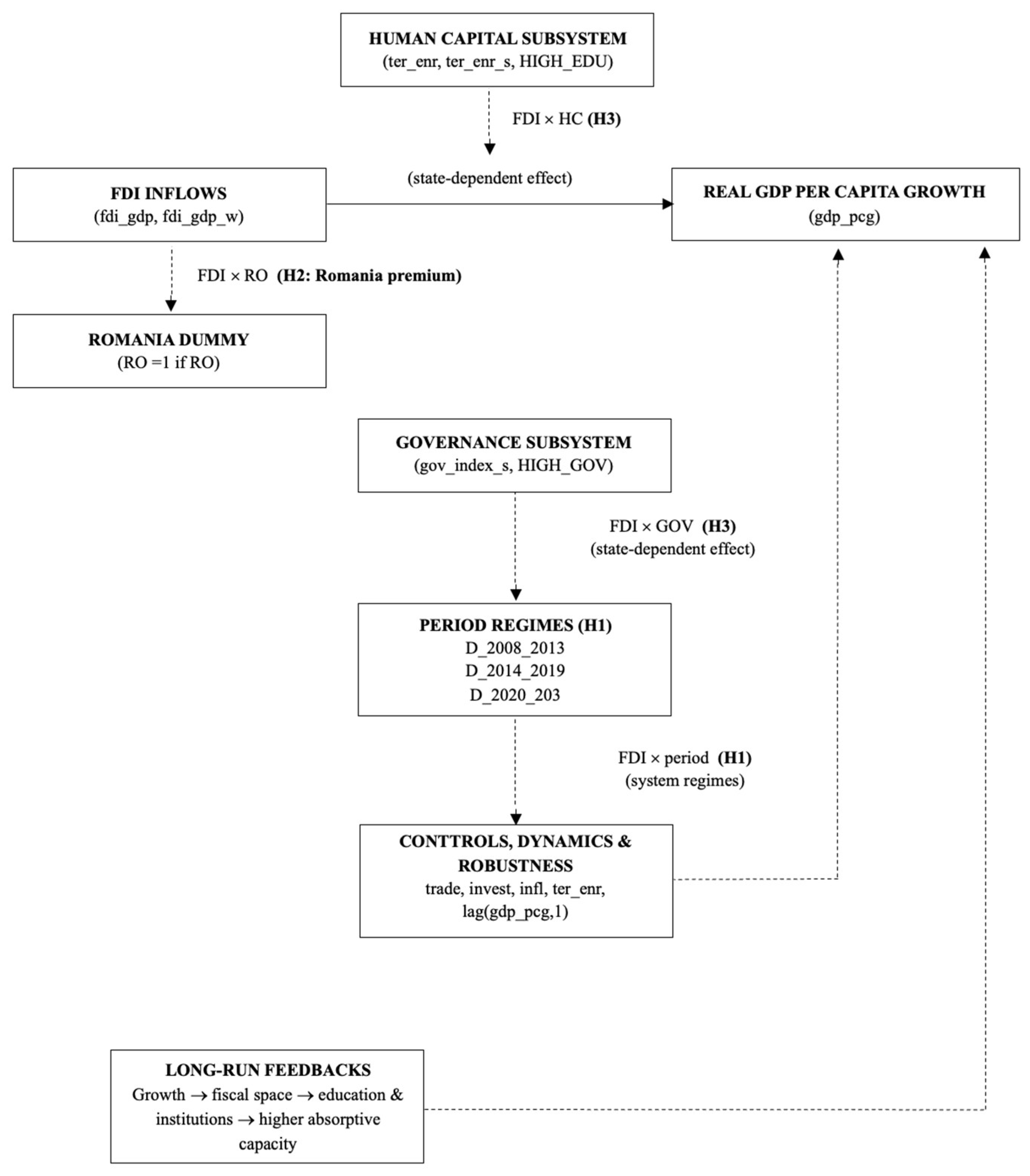
Dynamic aspects and robustness checks complement these core specifications. A lagged dependent variable is therefore included in a fixed effects model to capture persistence in growth and to verify whether the conditional FDI effects remain when past growth is taken into account. Additional sensitivity analyses include winsorisation of extreme FDI inflows, re-estimation on a sample that excludes the years 2020–2023, and a jackknife exercise whereby the FDI–Romania interaction model is re-estimated by excluding one CEE economy at a time. These steps bring the empirical strategy closer to best practice in the FDI–growth literature, which emphasises institutional context, sample design, and the role of influential observations, while also ensuring that our findings about systemic regimes and state-dependent effects are not driven by outliers or exceptional years. The hypothesised relationships between FDI, growth, and the conditioning variables, interpreted as interactions between subsystems and regimes, are summarised in
Figure 1.
This framework links the research question and the three hypotheses directly to the specification of the growth equation from a systems perspective. Human capital and governance form the absorptive capacity subsystem, influencing how FDI inflows are processed within each national economy. FDI enters both as a direct regressor affecting real GDP per capita growth and through interaction terms with the Romania dummy, the period indicators, and the absorptive capacity measures, thereby capturing state-dependent systemic responses. Standard macroeconomic controls, dynamic extensions, and robustness checks are attached to the growth block, representing additional features of the socio-economic system that shape its overall behaviour.
Data and Variables
An unbalanced annual panel of eleven Central and Eastern European economies, Bulgaria, Croatia, Czechia, Estonia, Hungary, Latvia, Lithuania, Poland, Romania, Slovakia and Slovenia, is used for the period 2000 to 2023. Real GDP per capita growth is measured by the annual percent change in constant-price GDP per capita, and this will be the dependent variable. Inward FDI inflows as a share of GDP will be taken as the main explanatory variable of interest together with standard macroeconomic controls. A summary list of all variables including units, transformations and derived indicators is provided in
Table 1.
The macroeconomic series are drawn mainly from the World Bank World Development Indicators, which provide consistent statistics on growth, FDI, trade openness, gross fixed capital formation, consumer price inflation, and tertiary enrolment. Where WDI inflation data are not available—this occurs for Croatia in 2000–2005 and Romania in 2000—the series is completed using annual values from the Eurostat harmonised index of consumer prices. Institutional quality is proxied by governance indicators from WGIs, out of which three dimensions directly relevant for the investment climate are retained. These governance scores and the tertiary enrolment rate are first standardised and then used to construct the continuous measures and which enter the interaction terms and define different systemic states of human capital and governance in the econometric specifications.
To reflect heterogeneity across space and time within the regional system, the main variables are complemented by a small number of author-constructed indicators. A dummy for Romania allows us to identify a country-specific FDI effect relative to the average CEE economy. Period dummies split the sample into early-2000s years, the post-global financial crisis period, and the period that includes the COVID-19 pandemic, capturing different systemic regimes over time. Binary markers for high education and high governance, defined using sample medians, distinguish low-capacity and high-capacity configurations of the national subsystems.
A winsorised version of the FDI inflows series and a one-year lag of real GDP per capita growth are used for robustness and dynamic specifications, without altering country or year coverage of the panel.
Table 2 reports the PCA loadings and explained variance for the Governance Index (PC1), which is used as the composite governance measure in the interaction specifications.
4. Results
The inward foreign direct investment and real GDP per capita growth nexus in Central and Eastern Europe is complex. For the average economy of that region, once standard macroeconomic controls are put into place, there is no systematically positive association between FDI inflows and growth. Growth has a better and stronger association with domestic investment, trade openness, and to some extent inflation dynamics. In addition, when we split our sample into subperiods, the marginal effect of FDI is clearly unfavourable in the early 2000s and becomes less negative and in some cases mildly positive, only after the global financial crisis. This temporal pattern suggests that the regional growth return to FDI is not constant but improves as the macroeconomic-cum-institutional environment stabilises together with EU integration advance.
It also brings out very important heterogeneity, both by countries and by institutional conditions. The case of Romania is striking: it develops a sizeable and statistically significant FDI premium. While in most parts of the country FDI remains broadly neutral toward growth, more inflows are associated with higher growth in Romania. This premium stays robust when individual neighbours are removed from the sample. Results from interaction models further show that the marginal effect of FDI becomes more positive as tertiary enrolment increases. The relationship with the composite governance index is rather intricate and does not follow any simple monotonic pattern. Along with the robustness checks that are based on dynamic specifications, winsorised FDI, and alternative samples, this finding supports the main argument of this paper that says FDI contributes to growth in Central and Eastern Europe conditionally. Other countries may also prove how higher human capital and specific country characteristics can convert similar volumes of FDI into stronger growth outcomes; however, Romania is the most explicit example.
4.1. FDI Inflows and Growth Patterns in Central and Eastern Europe and Romania
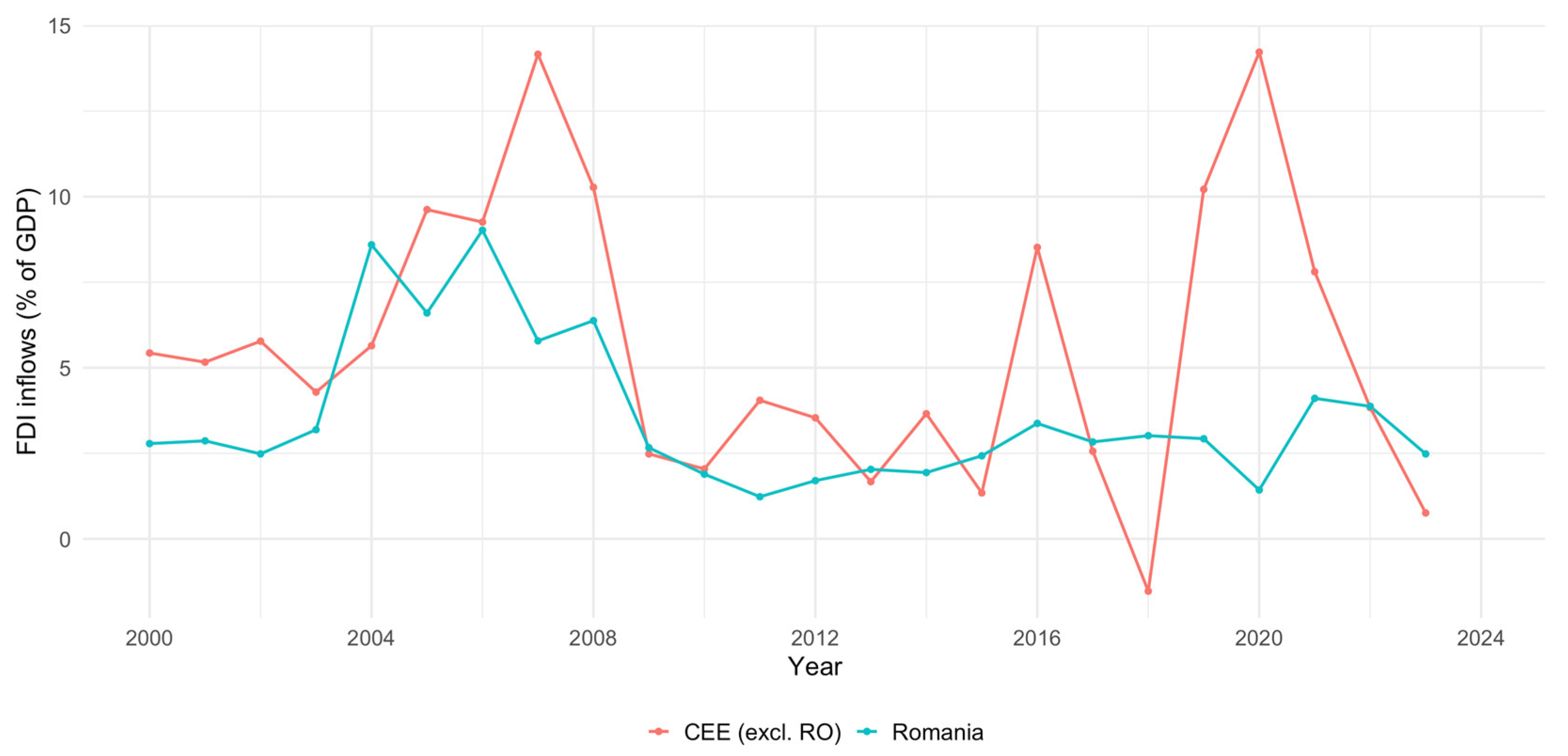
Inward flows of FDI follow broadly the same cycle in Romania as they do in the rest of Central and Eastern Europe, but with profiles far from being identical. In the early 2000s, Romania received more modest inflows compared to the regional aggregate. There is an increase for both series prior to European Union accession, with a peak just before the global financial crisis—highly pronounced spikes in the regional line compared to that in Romanian one (
Figure 2). After 2008 across-the-board collapses in FDI, it settles into a lower plateau. The regional series henceforth displays sharp episodes from the early 2010s onwards, including a very large surge around 2019 to 2020; by contrast, the Romanian series fluctuates within a narrower band and does not mirror most extreme regional movements.
This pattern shows that Romania does take part in the broader regional FDI cycle, though it is less associated with the episodic surges that are a feature of the region as a whole. There are more muted and persistent inflows into Romania, and the rest of the region’s inflows are volatile since they are concentrated within only a few years of a boom. These trajectories taken together may hint that even though relatively stable inflows have interacted with domestic conditions, they have motivated the subsequent focus on country-specific responses and absorptive capacity in the econometric analysis.
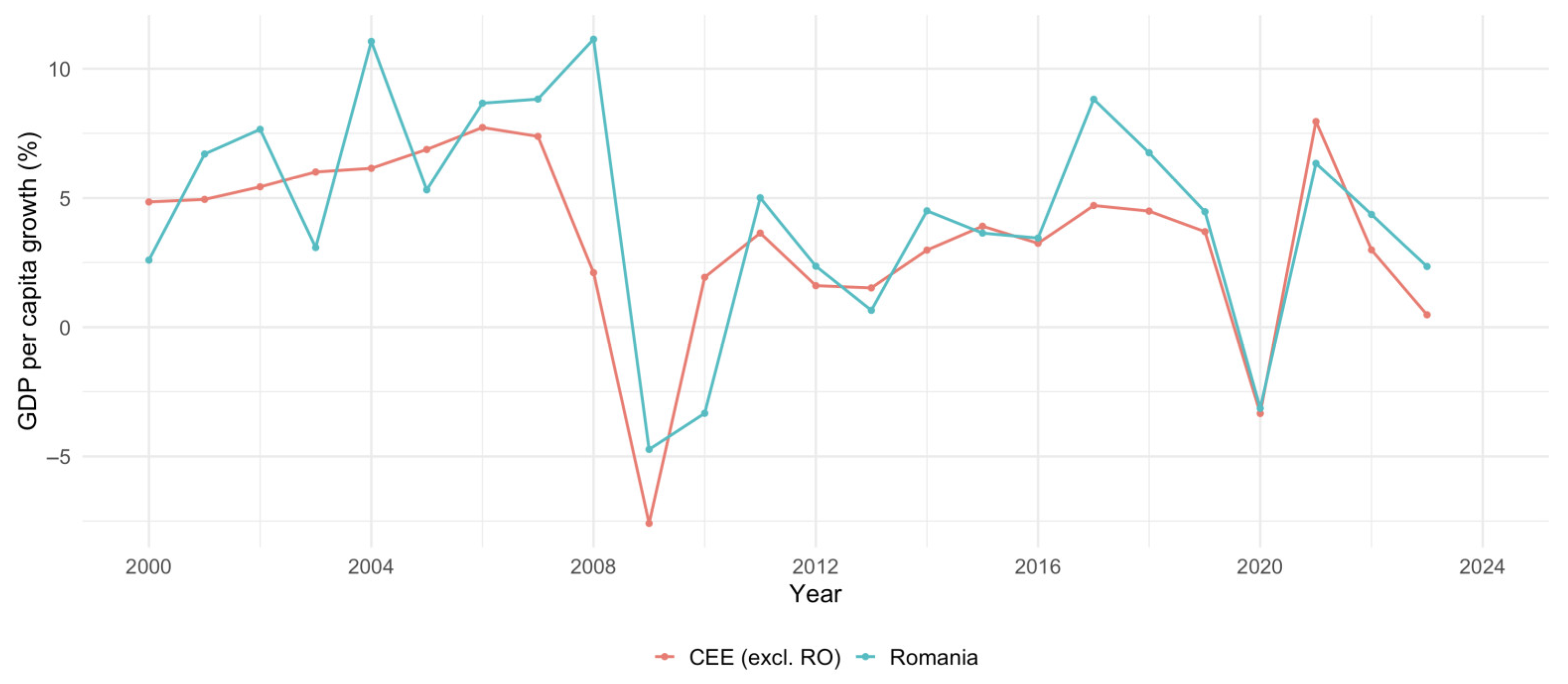
Growth of per capita output also displays a distinctive Romanian profile relative to the rest of Central and Eastern Europe. In the early 2000s, Romania records a sequence of very high growth rates, exceeding the regional average by a wide margin in several years, before suffering a deeper contraction during the 2009 crisis episode (
Figure 3). The collapse and rebound around the global financial crisis are shared across the region, but the amplitude is larger in Romania, consistent with an economy that is catching up and more sensitive to external shocks and domestic adjustment.
From the mid-2010s onwards, Romania once again grows somewhat faster than the regional aggregate in the period of time before the expansion that precedes the COVID-19 pandemic. There is a sharp contraction from the shock of the pandemic for both Romania and the rest of that region with rapid recovery afterward as Romanian growth remains close to or slightly above that region. The relatively strong, sometimes more volatile growth in Romania juxtaposed with only moderately higher and stabler inflows raises this very central question—whether, structurally, growth return to a given unit of FDI is different in Romania than it is in an immediately surrounding region, and how this return moves as macroeconomic and institutional conditions change.
4.2. Baseline Growth Regressions and the Romania FDI Growth Premium
In the baseline fixed effects model, inward FDI inflows basically turn out growth-neutral for the representative Central and Eastern European economy when standard macro controls are added. The coefficient on FDI as a share of GDP is small, about −0.014 with a robust standard error of 0.010, and does not attain conventional levels of statistical significance. However, trade openness and gross fixed capital formation have clear and robust associations with growth; a one percentage point increase in trade over GDP is associated with about 0.09 percentage points higher real GDP per capita growth, while an additional percentage point of investment over GDP is associated with roughly 0.32 percentage points higher growth. Inflation enters negatively and just misses significance; tertiary enrolment enters positively but is very weakly significant. These results, reported in
Table 3, prove that within this region it is domestic capital formation and external integration that actually have to do with the short-run variation in growth for the most part. FDI inflows do not have a distinctly average effect when these other factors are not taken into consideration.
Allowing a Romania-specific response changes this picture substantially. When FDI is interacted with the Romania dummy, the coefficient on FDI for the rest of the region remains small and statistically insignificant, about −0.015, but the additional term for Romania is large and positive, approximately 0.70, with a robust standard error of 0.28 and a p value close to 0.01. The implied marginal effect of FDI on growth in Romania, therefore, is close to 0.69 percentage points of extra real GDP per capita growth for a one percentage point increase in FDI inflows over GDP, holding other variables constant. A change in FDI inflows of five percentage points of GDP, which is well within the range observed for Romania over the sample period, would correspond to an increase in annual growth of around three and a half percentage points according to this estimate. The difference between a growth-neutral coefficient in the rest of Central and Eastern Europe and a large positive coefficient for Romania no doubt underscores some structural difference in the way foreign capital gets transmitted into output gains.
The behaviour of the other variables supports this reading. The introduction of the Romania interaction leaves the magnitudes and significance levels for trade openness and gross fixed capital formation very much the same, showing that the stronger FDI effect in Romania is not a function of an alternative relationship between growth and either trade or domestic investment. In both specifications, inflation remains negatively related to growth; tertiary enrolment changes by only a small amount. The relative stability of these coefficients indicates that the Romania premium is not simply assumed macro trends left out that might correlate with FDI in that country but rather reflects an actual difference in the slope of the FDI growth relation once common macroeconomic determinants plus unobserved heterogeneity across countries and years are absorbed.
The magnitude of the Romania coefficient also informs in relation to the descriptive evidence on inflows. In no years does Romania systematically record higher FDI inflows as a share of GDP than the rest of the region; indeed, in some episodes, the regional aggregate exceeds that of Romania. Therefore, this strong positive elasticity of growth with respect to FDI in Romania cannot be attributed to a mere volume effect. Rather, it points toward differences in the way FDI interacts with domestic conditions, perhaps through sectoral allocation, linkages to local firms, or complementarities with human capital and institutional reforms, which are further explored in the absorptive capacity analysis.
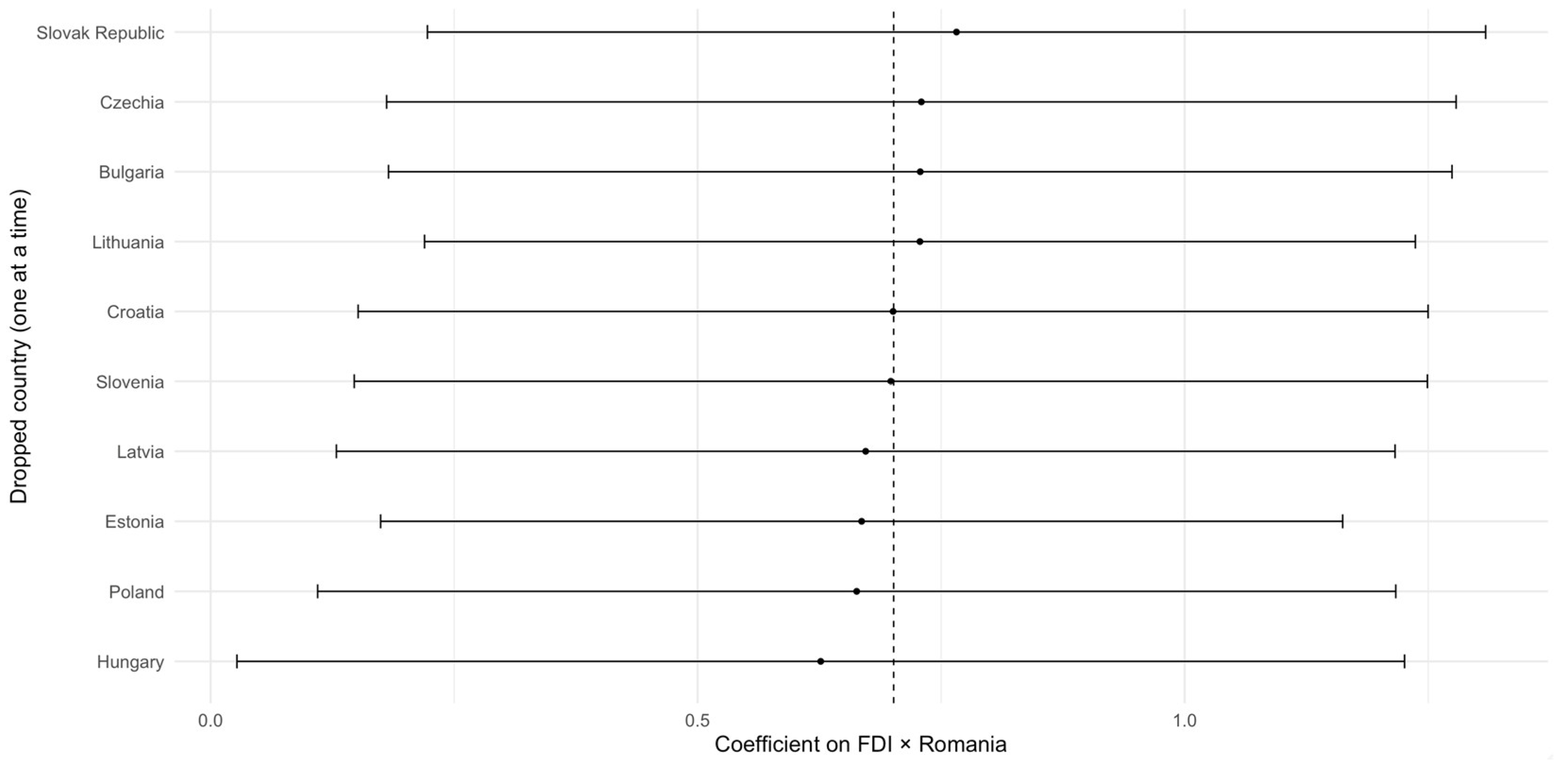
The jackknife exercise is performed by dropping, in turn, every other Central and Eastern European economy besides Romania from the panel. In all ten reduced samples, the coefficient remains positive and large for Romania FDI interaction; in fact, it varies between about 0.63 and 0.77 with no individual exclusion reversing the sign or materially reducing the estimate. Results are set out in
Figure 4 by plotting the estimated coefficient for Romania from each jackknife sample against a vertical line—the entire sample estimate. The cluster happens to fall very much on the right side of zero and near our full sample benchmark, which means that this result is not at all due to some individual comparator country being an effect such as perhaps a large neighbour with atypical dynamics.
These findings abundantly confirm the second hypothesis. Inward FDI has a more positive marginal effect on growth in Romania than it does in the average Central and Eastern European economy. At the regional level, FDI inflows are mildly neutral to growth. They come with strong positive effects on real GDP per capita in Romania, even when controlling for trade and investment as well as inflation and education plus unobserved country and time effects. This is what motivates differences in responsiveness in subsequent sections that test if the growth return to FDI differs across subperiods and levels of human capital and governance, and whether or not the Romanian experience should be deemed an example of stronger absorptive capacity within a shared regional setting.
4.3. Time Variation in the Growth Impact of FDI Across Subperiods
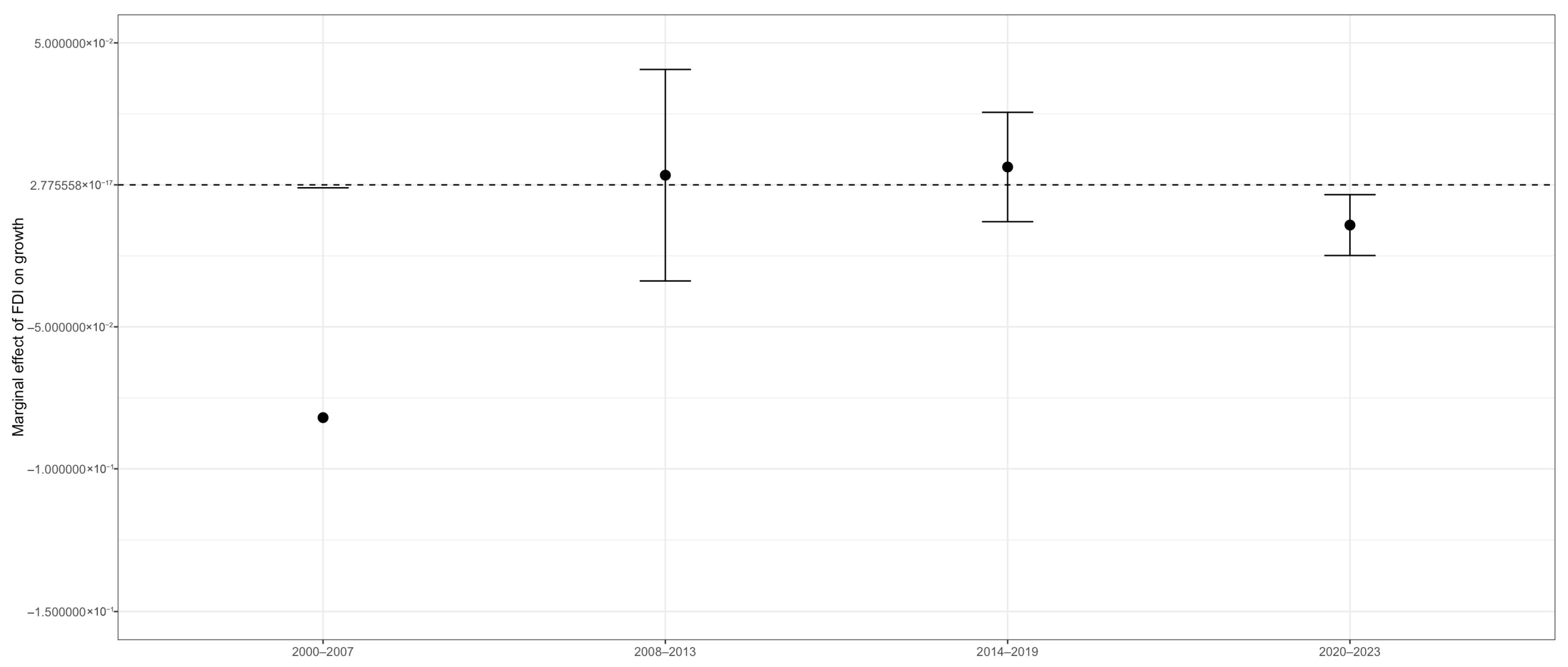
The time-varying specification signals a significant shift in the relationship between FDI and growth across subperiods. In the pre-crisis years 2000 to 2007, the coefficient on FDI inflows as a share of GDP is decidedly negative, around −0.08 with a robust standard error of 0.04, and statistically significant. This means that in the early 2000s, higher FDI inflows were associated with lower contemporaneous real GDP per capita growth once trade, investment, inflation, tertiary enrolment, and fixed effects are controlled for. In quantitative terms, a five percentage point increase in FDI over GDP in this phase is associated with a reduction in annual growth of about 0.4 percentage points.
Table 4 also indicates that this adverse association is progressively offset by the interaction terms for later periods.
From 2008 to 2013, the interaction between FDI and the period dummy is about 0.09, significant at the 10 percent level, hence almost exactly offsetting the negative baseline effect. Therefore, the implied marginal effect of FDI on growth within this period is approximately zero. A similar pattern applies for 2014 to 2019 because, again here, the interaction coefficient falls around 0.09 and happens to be statistically significant; hence, when combined with the baseline effect, it results in a mildly positive FDI effect that is small in an absolute sense. On the other hand, for 2020 to 2023, interaction is positive yet slightly less than about 0.07 and insignificant, basically making the overall FDI effect modestly negative yet imprecisely estimated over recent years.
Implied marginal effects of FDI on growth for every subperiod with their confidence intervals are plotted to bring out graphically these changes in the FDI coefficient over time.
Figure 5 shows that confidence has a clearly negative estimate for 2000 to 2007 followed by estimates that are tightly clustered around zero for both 2008 to 2013 and 2014 to 2019 and one somewhat lower, though statistically indeterminate, value for 2020 to 2023. Visually, the pattern thus seems to confirm that the regimes shifted, such that FDI entered from an unfavourable regime early on into a more benign regime, where it was broadly growth-neutral in the decade after the global financial crisis, with higher uncertainty in short windows dominated by pandemic shocks.
It tallies with a reading in which the first wave of FDI had much to do with restructuring, privatisation, and closing unproductive activities, thus generating short-term adjustment costs that could be recovered through long-term output increases. As reform takes a deeper stride inside European Union integration and macroeconomic stability is achieved, foreign investments may flow into less disruptive projects that better reflect host countries’ comparative advantages. Under such an environment, the domestic production that was being displaced by FDI would take back its place; hence, the negative coefficient found for early 2000 will reduce its magnitude.
The way the control variables behave gives more comfort that it is not changes in the roles of other macro drivers that are causing the FDI coefficient to vary. Trade openness has a positive relationship with growth at coefficients near 0.09 per percentage point of trade over GDP, while gross fixed capital formation also maintains a very strong positive relationship at about 0.31 per percentage point of investment over GDP, and inflation remains negative and, in baseline specification and tertiary enrolment, it retains its small positive but barely significant coefficient. The fact that these estimates have been stable across subperiods suggests that this is mainly an evolving story about the marginal contribution of FDI itself rather than a reweighting of other determinants of growth.
In light of these results, the first hypothesis receives clear support in its weaker form. The marginal effect of FDI on growth is more favourable in 2008 to 2019 than in 2000 to 2007, in the sense that a strongly negative coefficient in the early period is replaced by coefficients that are close to zero and in some cases slightly positive once the crisis years are incorporated. The analysis therefore suggests that FDI in Central and Eastern Europe has not been a uniformly positive driver of growth over the past two decades, but that its adverse association with growth in the early transition years has largely faded as the regional macroeconomic and institutional environment has matured.
4.4. Absorptive Capacity, Human Capital, and Governance
The interaction models with human capital and governance demonstrate that the growth return to FDI is strongly conditioned by absorptive capacity rather than being uniform across country years. In the continuous specification, the coefficient on FDI at the regional mean of tertiary enrolment and governance is modest and not significant, around 0.04, which is broadly consistent with the growth-neutral effect found in the baseline models. What changes is the slope of this coefficient as human capital and governance deviate from their averages. The interaction between FDI and standardised tertiary enrolment is positive and significant, about 0.15, while the interaction with the standardised governance index is negative and significant, about −0.11. The implied FDI effect on growth becomes obviously positive in high-education environments but turns negative in high-governance environments. This is so even though the direct effects of education and governance on growth are not themselves significant in these regressions, as reported in
Table 5.
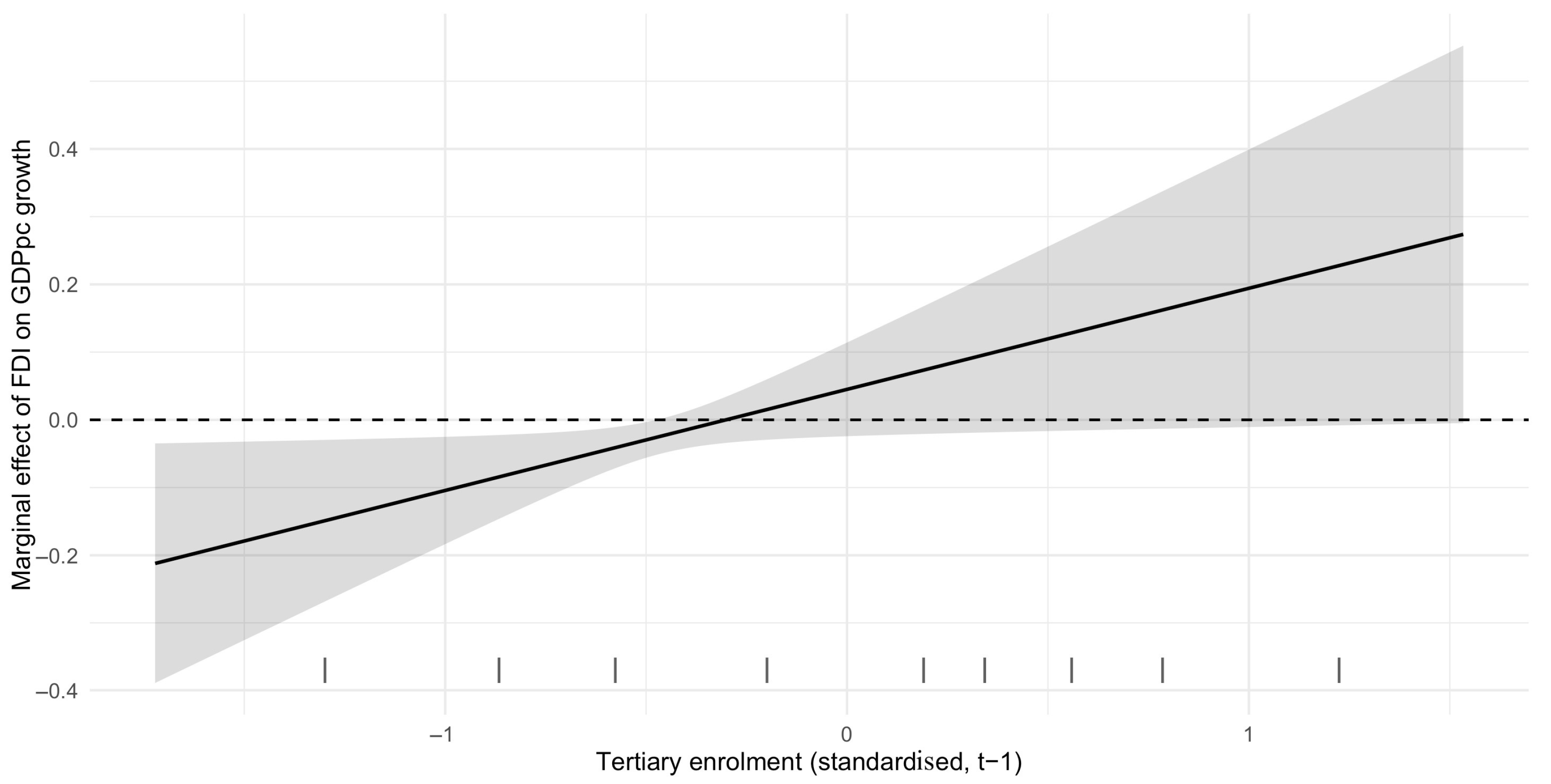
At one standard deviation above the regional mean of tertiary enrolment, the marginal effect of FDI on growth is about 0.19 compared to about −0.10 at one standard deviation below the mean when both interaction terms have been considered. Thus, a change in tertiary enrolment from relatively low to relatively high changes the FDI coefficient by approximately 0.3 points, which translates to about a 1.5 percentage point increase in annual growth for a five-point increase in FDI over GDP. On the other hand, changing governance from one standard deviation below to one standard deviation above its mean shifts the FDI coefficient from around 0.16 to about −0.07. The same five-point increase in FDI over GDP would then be associated with a gain of close to 0.8 percentage points of growth in a low-governance setting, but a loss of about 0.3 points in a high-governance setting.
Plot the implied marginal effect of FDI on growth over the distribution of tertiary enrolment (
Figure 6). The shaded area denotes a 95% confidence interval; tick marks indicate deciles of tertiary enrolment distribution. The line has an upward tilt crossing zero near the regional mean, which means it attains clearly positive values at higher levels of tertiary enrolment but stays below zero at the lower end of the distribution. The confidence band is narrow enough over most of the support to assure that such an upward tilt is not due to extreme observations. This places, in simple language, FDI and growth in relation in Central and Eastern Europe where country years with low tertiary enrolment have a negative relationship and increasingly positive relationships as tertiary enrolment increases.
The threshold models narrate a somewhat similar story for human capital but decidedly different. When the sample is split at the median tertiary enrolment rate, the coefficient on FDI in the low-education regime is negative and small—about −0.02—and not significant, while the additional term for the high-education regime is positive—around 0.18—with a p value slightly above the five percent threshold. The implied coefficient on FDI in the high-education regime is therefore close to about 0.16, identical to continuous estimates. This would mean that FDI has been largely neutral to growth in country years when tertiary enrolment has stayed below the regional median but seems to have been associated with higher growth when the share of population in tertiary education has moved into the upper half of the distribution.
The model of the governance threshold reveals a pattern that is not only more nuanced but also less straightforward. In the low-governance regime, the FDI coefficient is nearly zero and insignificant whereas in high governance it turns negative and significant at about −0.06. That means for country years with governance below the regional median, there is little measurable association between FDI and contemporaneous growth, while for those with above-median governance scores, the conditional FDI effect appears to be adverse. One possible explanation could be that higher governance scores within this regional context relate to more stringent enforcement and tighter regulatory frameworks as well as a concentration of FDI into sectors characterised by slower short-run growth dynamics; hence, the benefits of better institutions are reflected more in stability and income levels rather than in contemporaneous growth rates.
This suggests that human capital and governance do not play symmetric roles in shaping the growth return to FDI in Central and Eastern Europe. Higher tertiary enrolment is consistently associated with a more favourable FDI and growth relation, both in the continuous and the threshold specifications, which shows clear support for the human capital component of the third hypothesis. The governance findings are more nuanced: firstly, the composite index used here does not amplify the positive effect of FDI on growth and may even coincide with weaker short-run gains from foreign investment, even if governance remains desirable for many other reasons. Results for the Romania case, which happens to have increasing tertiary enrolment and improving governance over the sample period, suggest that it is most likely the strong FDI premium documented earlier that relates very closely with the widening of human capital. The governance dimension requires a more cautious interpretation separated between aspects of growth effects and wider issues of welfare and stability.
4.5. Dynamic Specification and Robustness Checks
The dynamic specification proves that the main results are not caused by short-run persistence in growth. When a one-year lag of real GDP per capita growth is introduced, a coefficient of about 0.23 with a robust standard error of 0.06 is obtained, significant at the 1 percent level. This shows that there is moderate persistence: higher growth in one year will be followed by higher growth in the next year. After taking this persistence into consideration, the coefficient on FDI inflows remains small and not significant, about −0.01; trade openness and gross fixed capital formation still have positive and statistically significant effects on growth; inflation still has a negative but imprecisely estimated association as reported in
Table 6. The addition of lagged growth helps to fine-tune the dynamics of the model, but it does not change the fact that for an average Central and Eastern European economy, FDI inflows do not have a strong independent effect on growth.
The winsorised specification is meant to lay to rest fears that extreme FDI episodes may be the actual drivers of the results. Specifically, trimming FDI inflows at the first and ninety-ninth percentiles does not change the FDI coefficient very much qualitatively: it remains negative, around −0.02, and not significant. Coefficients on trade, investment, inflation, and tertiary enrolment are almost identical with those from a baseline fixed effects model. What has been described as an artefact of a few very large inflow spikes—that is, probably some countries during privatisation waves or around large individual projects—is not in fact the absence of a strong average FDI effect. By limiting such outliers’ influence and finding similar estimates, this version comes closer to showing that, indeed, when the usual macro controls and FE are picked up by the dataset, the regional FDI–growth relation is genuinely mild.
Table 7 presents a set of dynamic and robustness estimations meant to ensure that the central conclusion of the paper remains stable under alternative specifications, namely that inward FDI inflows are broadly growth-neutral for the average CEE economy once standard controls and two-way fixed effects are included. The dynamic specification indicates moderate persistence in real GDP per capita growth through a positive and statistically significant lagged dependent variable, while the contemporaneous FDI coefficient remains small and statistically insignificant, which suggests that the baseline inference is not an artefact of serial dependence on growth outcomes. The winsorised FDI model, obtained by trimming extreme inflow observations, preserves the qualitative result of an insignificant average FDI effect, providing evidence that the baseline finding is not driven by episodic spikes in FDI inflows. The specification that excludes the years 2020–2023 yields a similarly muted and imprecisely estimated FDI coefficient, indicating that the pandemic period and its immediate aftermath do not dominate the regional relationship. Across these variants, trade openness and gross fixed capital formation consistently retain positive and statistically significant associations with growth, reinforcing the interpretation that domestic capital accumulation and external integration account for a substantial portion of short-run growth variation in the region. Consistent with these robustness checks,
Appendix A Table A1,
Table A2 and
Table A3 report the lagged controls and interaction specifications that address simultaneity concerns and allow the FDI effect to vary across Romania versus the regional average, across systemic subperiods, and across absorptive capacity states, and they confirm that the main conclusions remain stable under these complementary approaches.
The sample restriction that excludes the years 2020 to 2023 is an attempt to check if the results are driven by the COVID-19 shock and its ensuing aftermath. Baseline fixed effects specification estimated on data up to 2019 returns coefficients on FDI, trade, investment, inflation, and tertiary enrolment very close to those obtained from the full sample. The FDI coefficient is still small and not significant; however, trade openness and gross fixed capital formation retain their positive and statistically significant relationship with growth. The robustness exercises based on dynamic specifications, winsorised FDI, and excluding the pandemic period show that persistence in growth, extreme FDI observations, and exceptional conditions post-2020 do not overturn the baseline patterns established above: at the regional level, inward FDI is broadly growth-neutral, while more pronounced growth effects emerge in particular countries and absorptive capacity dimensions rather than in the regional average.
5. Discussion
This study carried out an investigation that revealed a pattern that becomes clearer once FDI is placed within a systems-thinking frame. These findings illustrate the value of embedding FDI analysis within a systems-thinking framework, a perspective largely absent from existing CEE research. Rather than behaving as a uniformly expansionary force, FDI interacts with the internal architecture of each national economy, activating either reinforcing or balancing feedback loops. In the early transition years, much of the CEE region was still contending with restructuring pressures, institutional volatility, and uneven technological readiness. Under such conditions, FDI often entered balancing loops: adjustment costs, labour displacement, and governance frictions offset the potential gains from foreign capital. As macro-institutional conditions stabilised after 2008, these balancing dynamics weakened, allowing reinforcing loops to emerge in several economies—loops through which foreign knowledge, supplier upgrading, and managerial practices could circulate more freely. This behaviour resonates with the broader literature showing that absorptive capacity must reach a certain threshold before FDI can meaningfully enhance productivity or complexity [
34,
36], and that the alignment of formal and informal institutions shapes the extent to which external knowledge is successfully assimilated [
35]. The pandemic years, however, reintroduced systemic strain, reminding us that reinforcing loops remain contingent on the stability of the wider socio-economic environment.
Within this regional configuration, Romania stands out as a subsystem whose internal evolution has produced a distinct response to foreign investment. The econometric evidence points to a persistent FDI premium, suggesting that Romania’s feedback structures have gradually tilted toward reinforcing rather than balancing dynamics. The steady rise in tertiary enrolment strengthened the human capital subsystem, enabling more effective absorption of foreign technologies and managerial practices. At the same time, improvements in governance—though uneven—reduced behavioural uncertainty and created a more predictable environment for knowledge diffusion. These developments echo findings from other contexts where institutional consolidation and network connectivity enhance the system’s ability to translate external inflows into productive upgrading [
37,
38]. This nuanced role of governance, which occasionally presents as a negative short-run interaction with growth, does not imply a failure of institutional quality. Rather, viewed through a systems lens, higher governance scores within this regional context likely coincide with more stringent enforcement and tighter regulatory frameworks. This environment may tilt FDI inflows toward high-compliance, stable, but slower-growing sectors, such as utilities, financial services, or infrastructure, rather than the volatile manufacturing booms seen in less regulated regimes. Consequently, the negative interaction reflects a systemic shift toward quality, resilience, and long-term income stability at the expense of contemporaneous growth spikes. In this sense, the national subsystem trades rapid, unsustainable expansion for a more predictable and robust socio-economic architecture.
Romania’s sectoral composition also played a role: the growing presence of medium- and high-technology manufacturing created a fertile ground for spillovers, allowing foreign firms to anchor themselves within domestic production networks. The divergence between Romania and some of its regional peers thus reflects not differences in inflow volumes but differences in subsystem organisation, differences in how skills, institutions, and inter-firm linkages co-evolved over time. Romania, by contrast, consistently exhibits a substantial FDI growth premium (
Table 2,
Figure 4), indicating that foreign investment translates into output gains when domestic absorptive capacity is sufficient. Further, interaction models confirm that higher tertiary-level education amplifies the FDI effect, whilst governance plays a more nuanced role, potentially constraining short-term growth despite fostering long-term stability (
Table 4,
Figure 6). Thus, the documented Romania FDI premium is not merely a product of capital volume, but an emergent property of the country’s specific sectoral evolution. While regional peers often concentrated on low-skill manufacturing, Romania’s internal architecture has increasingly shifted toward knowledge-intensive sectors, most notably the IT services and automotive industries. These sectors function as powerful engines for productivity spillovers, as foreign firms in these fields establish deeper vertical and horizontal linkages with domestic production networks. When combined with the steady rise in tertiary enrolment, this sectoral upgrading allows the national subsystem to absorb and multiply the impact of foreign capital, making the estimated growth elasticity of 0.7 plausible within a context of rapid structural transformation.
Our findings carry both theoretical and policy implications. Theoretically, they reinforce that FDI is not inherently growth-enhancing; in fact, its impact depends critically on human capital, institutional environment, and the alignment of investment with local capabilities. For policymakers, they suggest that strengthening tertiary education, fostering firm linkages, and maintaining a flexible yet stable regulatory framework can maximise the developmental potential of FDI. Overall, this article emphasises the capability of policy measures aimed at strengthening tertiary education [
7], fostering domestic linkages, and maintaining flexible yet stable regulatory frameworks to convert FDI into tangible developmental gains. Particularly, Romania serves as a clear example of how such conditions allow foreign investment to contribute meaningfully to economic growth, even when regional effects remain muted.
Notwithstanding, these findings carry implications for policy, but they call for a shift in how policy is conceived. A systems-thinking perspective treats policy not as a set of isolated interventions but as the design of feedback structures that shape how the system processes external shocks. The literature on absorptive capacity consistently shows that FDI yields sustained benefits only when embedded within a coherent architecture of human capital, institutional quality, and network connectivity [
33,
34]. Policies that focus narrowly on attracting foreign investors without attending to the configuration of domestic subsystems risk reinforcing balancing loops or generating substitution effects that weaken long-term adaptability. Conversely, policies that cultivate complementarities—between education and firm linkages, between governance reforms and technological readiness, between formal and informal institutions—shape the system in ways that allow reinforcing loops to emerge organically. In this sense, the question is not how to maximise FDI, but how to design a system in which foreign capital becomes a catalyst for learning, resilience, and adaptive upgrading. The results of this study, interpreted through this lens, suggest that the developmental impact of FDI depends less on inflow volumes and more on the systemic conditions into which those inflows are introduced.
Furthermore, the systemic framing of FDI points to several policy lessons. Education emerges as the most powerful leverage point because sustained investment in tertiary education strengthens reinforcing feedbacks, enabling economies to convert foreign capital into productivity gains rather than short-lived surges. Meanwhile, governance must be kept nimble since institutions that reduce uncertainty without creating rigidities are better placed to channel FDI into virtuous circles of innovation. Similarly, equally important are the networks that tie multinational enterprises to local suppliers and universities, for it is through these linkages that spillovers become embedded in domestic systems. Policymakers should therefore focus less on the sheer volume of inflows and more on the architecture of feedbacks that determines whether FDI amplifies resilience or exposes vulnerabilities. Early-warning indicators, such as volatility in FDI/GDP ratios, skill mismatches, or weak linkage density, can help anticipate systemic strain and guide timely interventions. Taken together, these measures allow foreign capital to be harnessed not as a blunt instrument but as part of a resilient and adaptive growth trajectory for the region.
6. Conclusions
This study carried out an investigation on the conditions under which inward FDI contributes to real GDP per capita growth in CEE, with Romania as a focal case. Beyond seeking to determine whether FDI boosts growth, the main aim of this paper was to explore under which macroeconomic and institutional circumstances these effects materialise. The novelty of our research resides in treating FDI as a subsystem shaped by feedback loops and absorptive capacity, thereby offering a conceptual and empirical contribution that extends beyond conventional linear models.
To this end, the analysis demonstrates that for the region as a whole FDI inflows are largely neutral once standard macroeconomic determinants are controlled for (
Table 2 and
Table 3). Notably, growth is more strongly associated with domestic capital accumulation, trade openness, and to a lesser extent inflation dynamics. Additionally, temporal analysis reveals that early 2000s inflows were sometimes associated with lower growth, reflecting restructuring and adjustment costs, whereas the post-crisis and pre-pandemic periods show a shift towards neutral or mildly positive effects (
Table 3,
Figure 5). However, Romania consistently displays a distinct pattern: a marked FDI growth premium that emerges when domestic absorptive capacity—particularly tertiary education—reaches sufficient levels. Governance exerts a more nuanced influence, moderating short-term dynamics while contributing to loner-term stability. Hence, these results emphasise that FDI’s contribution is state-dependent, varying across regimes and across the internal conditions of each national subsystem.
Taken together, the results indicate that the developmental role of FDI cannot be separated from the wider system into which it is introduced. Whether foreign investment translates into sustained productivity gains depends on the coherence of the host economy’s internal architecture—its skills base, institutional quality, and the network structures through which knowledge circulates. This systems-oriented reading helps clarify why economies receiving comparable inflow volumes may nonetheless diverge in their growth trajectories, and why Romania’s experience departs from that of several regional counterparts.
Nonetheless, our analysis is subject to limitations. For instance, data availability constrains the granularity of sectoral and firm-level dynamics, whilst the relatively short post-pandemic period limits inference on the most recent shocks. Hence, future research could explore micro-level channels of FDI transmission, investigate sectoral heterogeneity, and assess long-term structural effects, thereby deepening understanding of how foreign capital interacts with domestic capacities across differing institutional contexts [
10,
18].
Overall, our paper demonstrates that FDI’s influence is neither automatic nor uniform. Its effects are shaped by the evolving structure of the host economy, by the feedback loops through which external impulses are processed, and by the capacity of domestic systems to adapt and learn. Appreciating these dynamics is essential for understanding past developments and for anticipating how foreign investment may shape the region’s future pathways of economic transformation.



 ,
,