Article

Trajectory Generation of Ultra-Low-Frequency Travel Routes in Large-Scale Complex Road Networks

School of Intelligent Systems Engineering, Sun Yat-sen University, Shenzhen 518107, China
*
Author to whom correspondence should be addressed.
Systems 2023, 11(2), 61; https://doi.org/10.3390/systems11020061

Submission received: 19 December 2022 / Revised: 19 January 2023 / Accepted: 20 January 2023 / Published: 23 January 2023

Abstract

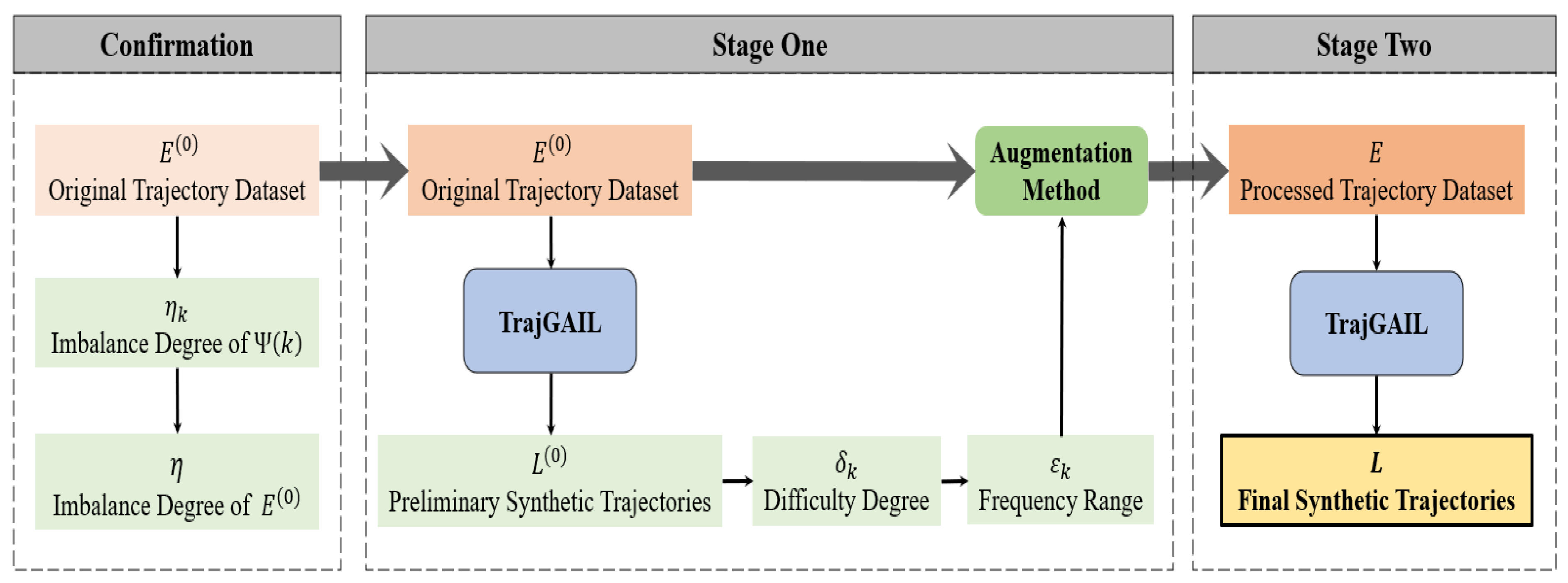
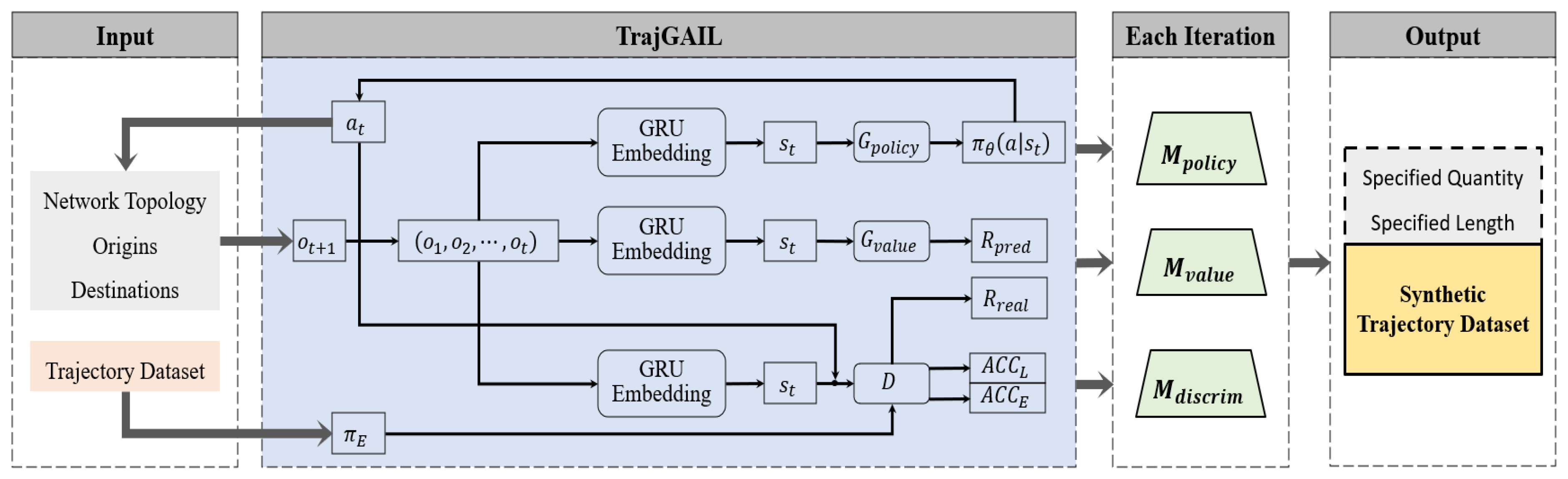
Trajectory generation can help predict the future road network state and properly deal with the privacy issues of trajectory data usage. To solve the problem that routes with very few journeys (ultra-low-frequency journey routes) are difficult to generate in the large-scale complex road network scenarios, the study designs a framework focusing on ultra-low-frequency route generation, ULF-TrajGAIL, and proposes an original trajectory-augmentation method called the combined expansion method. The specific original trajectory-augmentation method is determined by the pre-trajectory-generation experiment, and high-quality synthetic trajectories with higher diversity and similarity are output based on the final generation experiments which take the augmented trajectories as references. Based on the real trajectories of a complex road network in a region of Guangzhou, the quality of synthetic trajectories under different original trajectory-augmentation methods from the route, link and origin and destination pairs levels has been compared. The results show that the method can generate more ultra-low-frequency routes and help improve the overall diversity of routes and the similarity between routes and the number of journeys as well.
Keywords: vehicle trajectory generation; generative model; imbalance learning; data augmentation vehicle trajectory generation; generative model; imbalance learning; data augmentation