Prediction of Potential Suitable Habitats of Cupressus duclouxiana Under Climate Change Based on Biomod2 Ensemble Models

Simple Summary
Abstract
1. Introduction
2. Materials and Methods
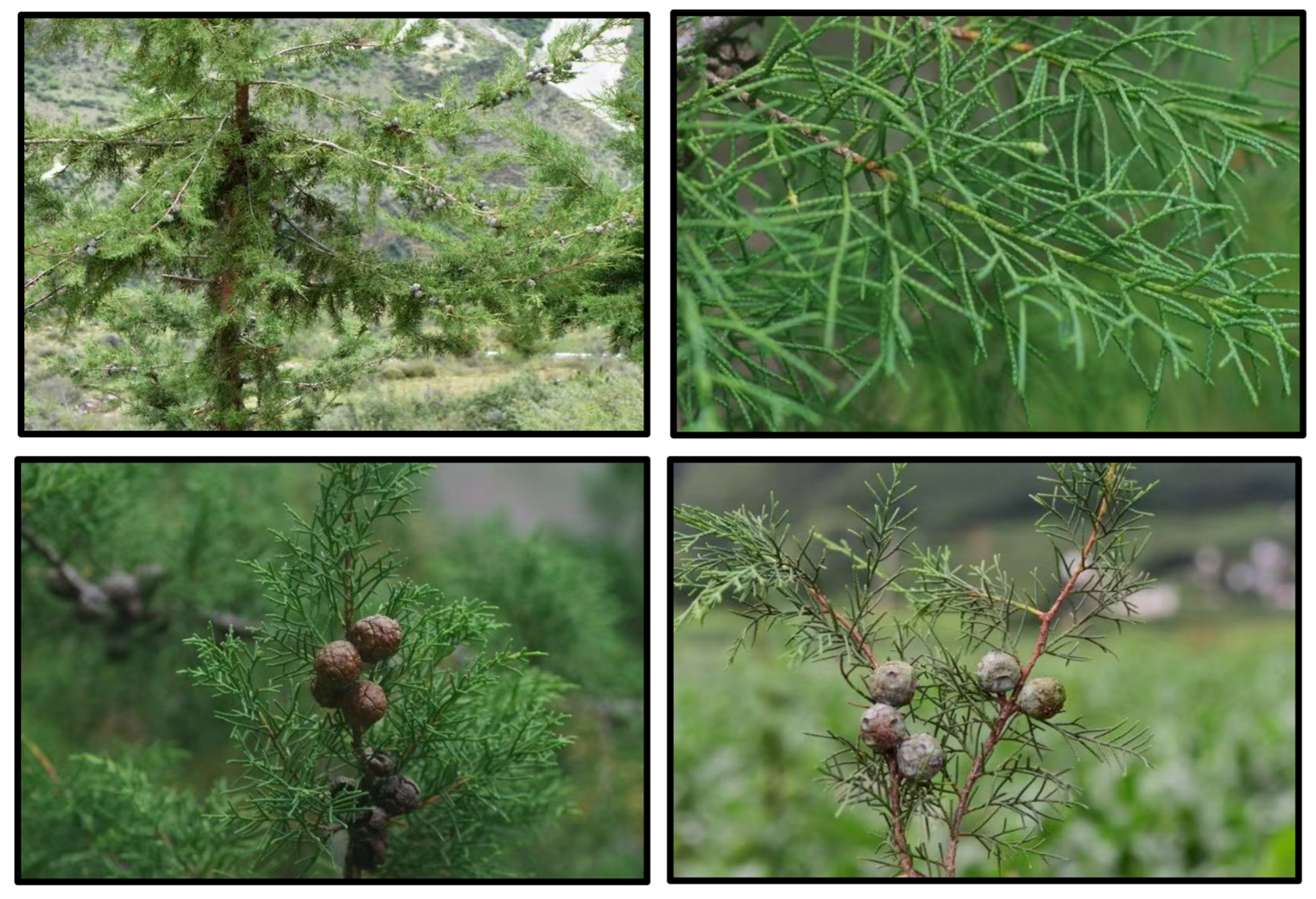
2.1. Ecological Characteristics and Economic Value of C. duclouxiana
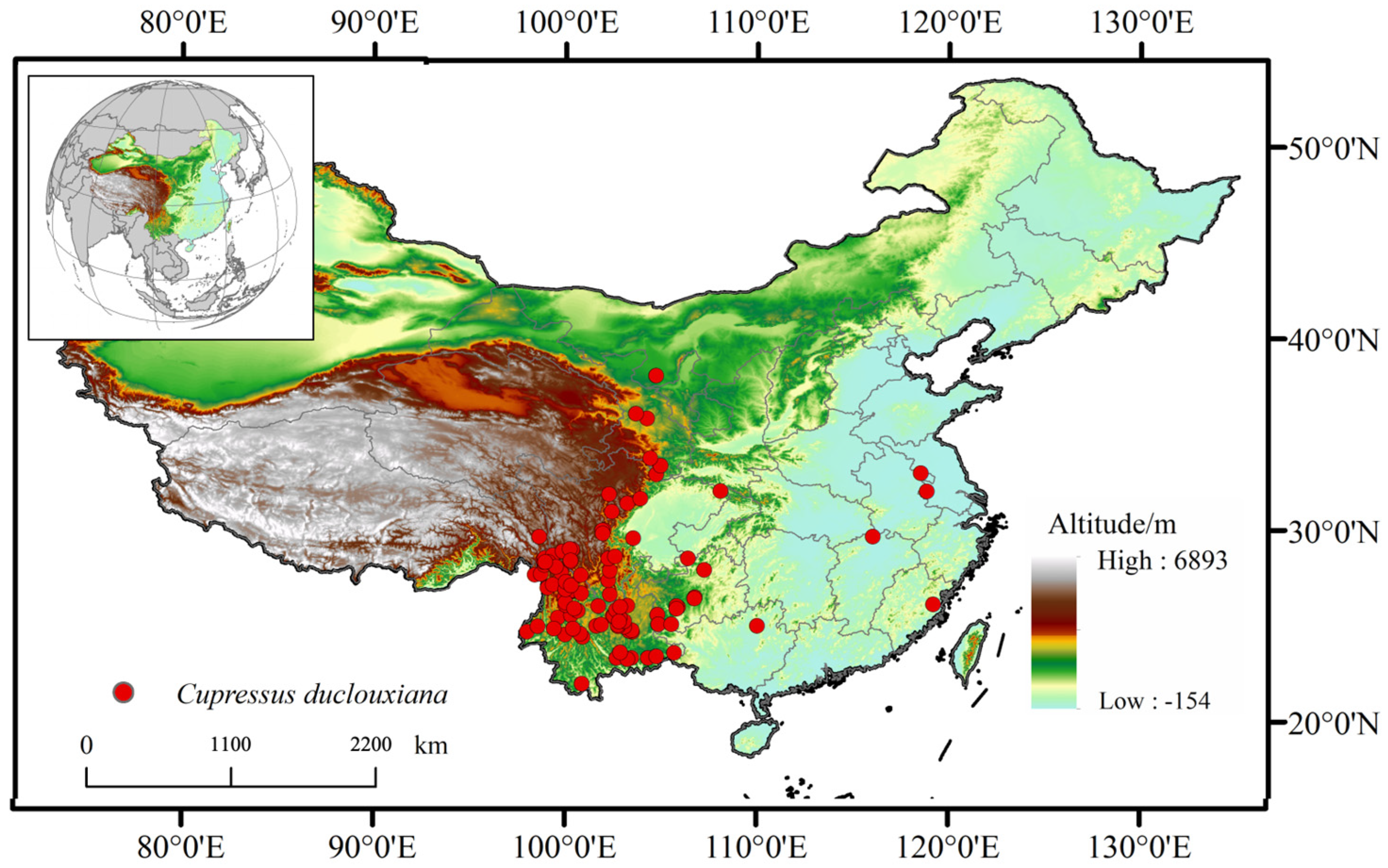
2.2. Distribution Data Collection and Processing
2.3. Environmental Variables and Preprocessing
2.4. Model Construction and Evaluation
2.5. Centroid Migration
3. Results
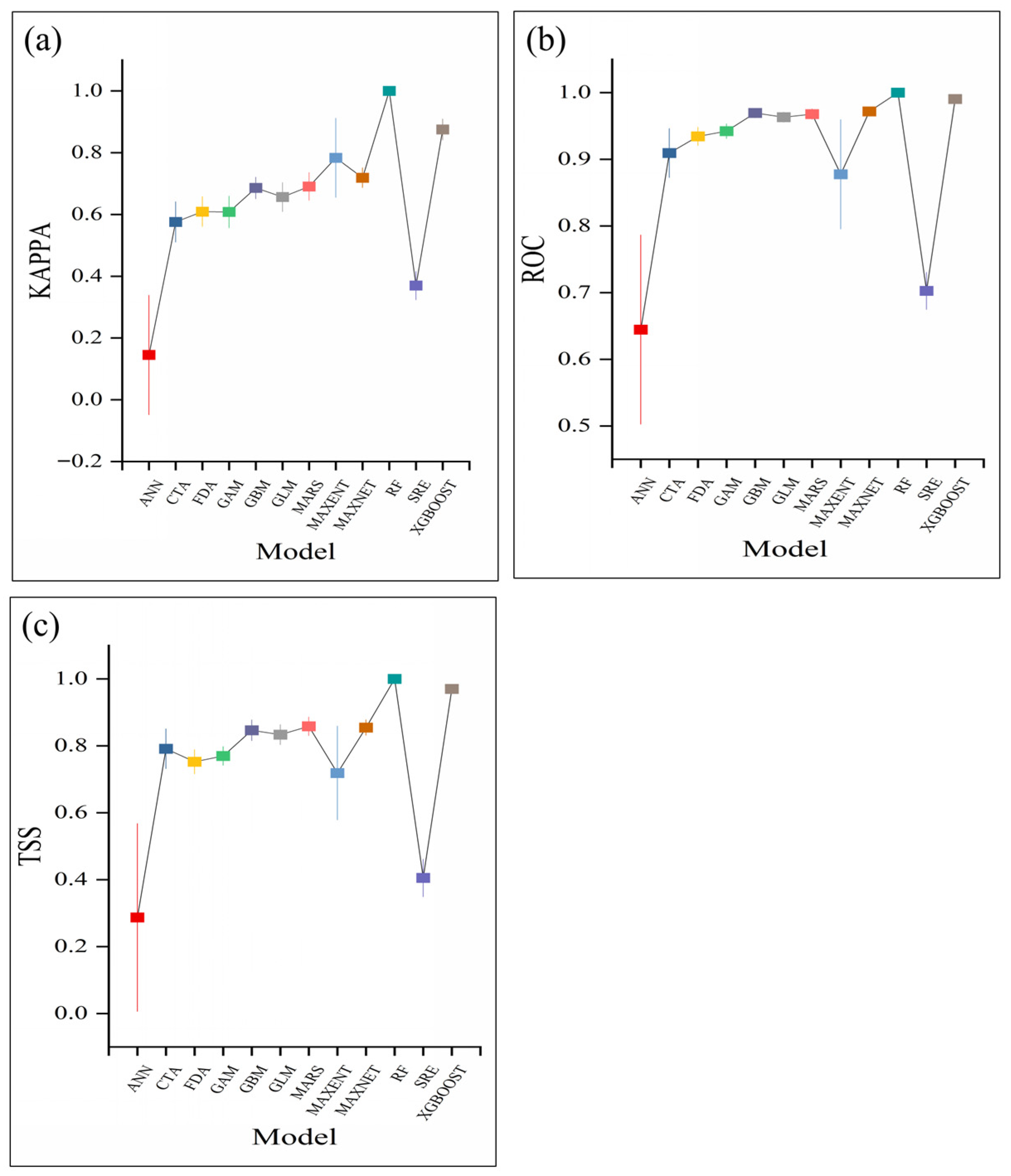
3.1. Model Performance Evaluation
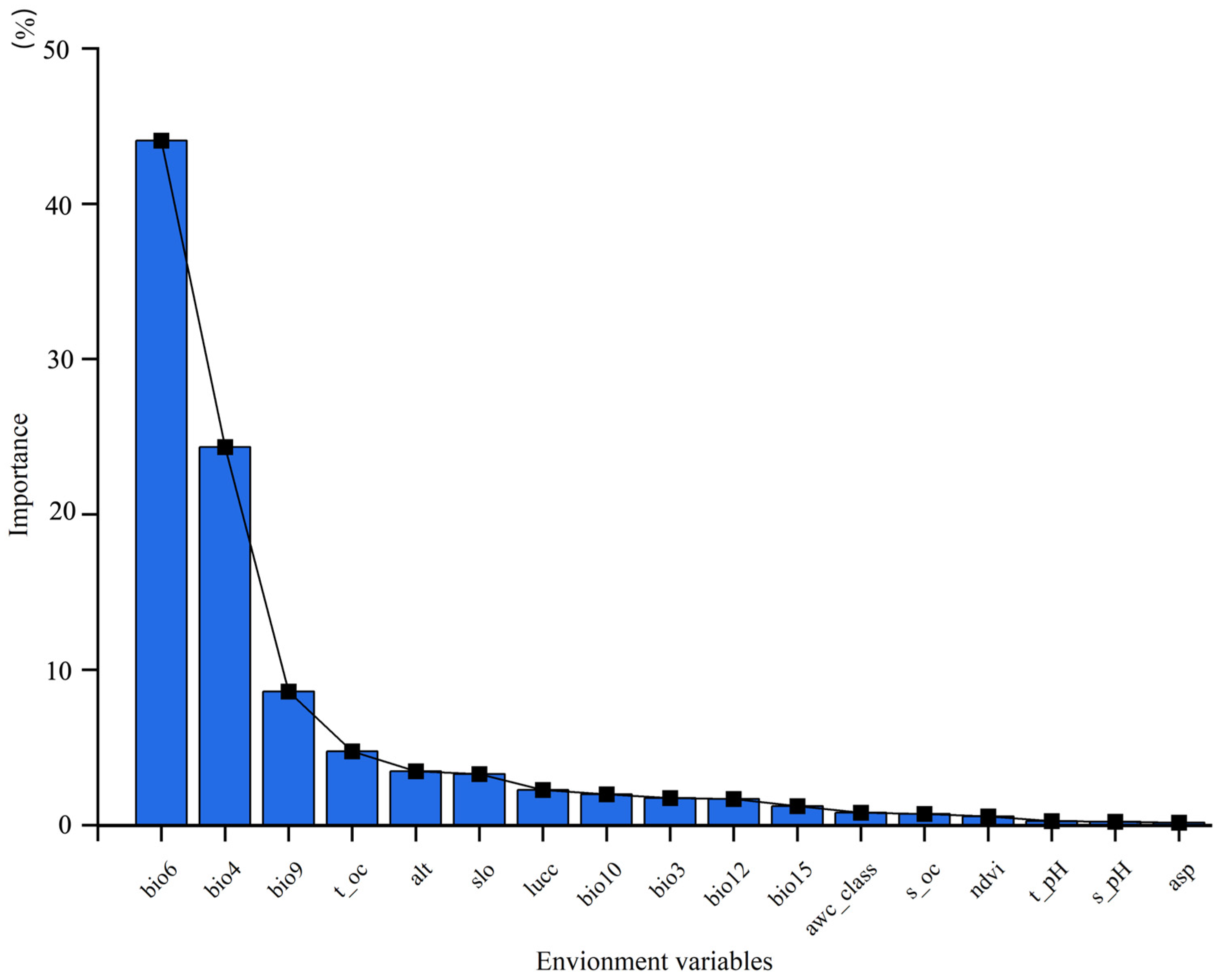
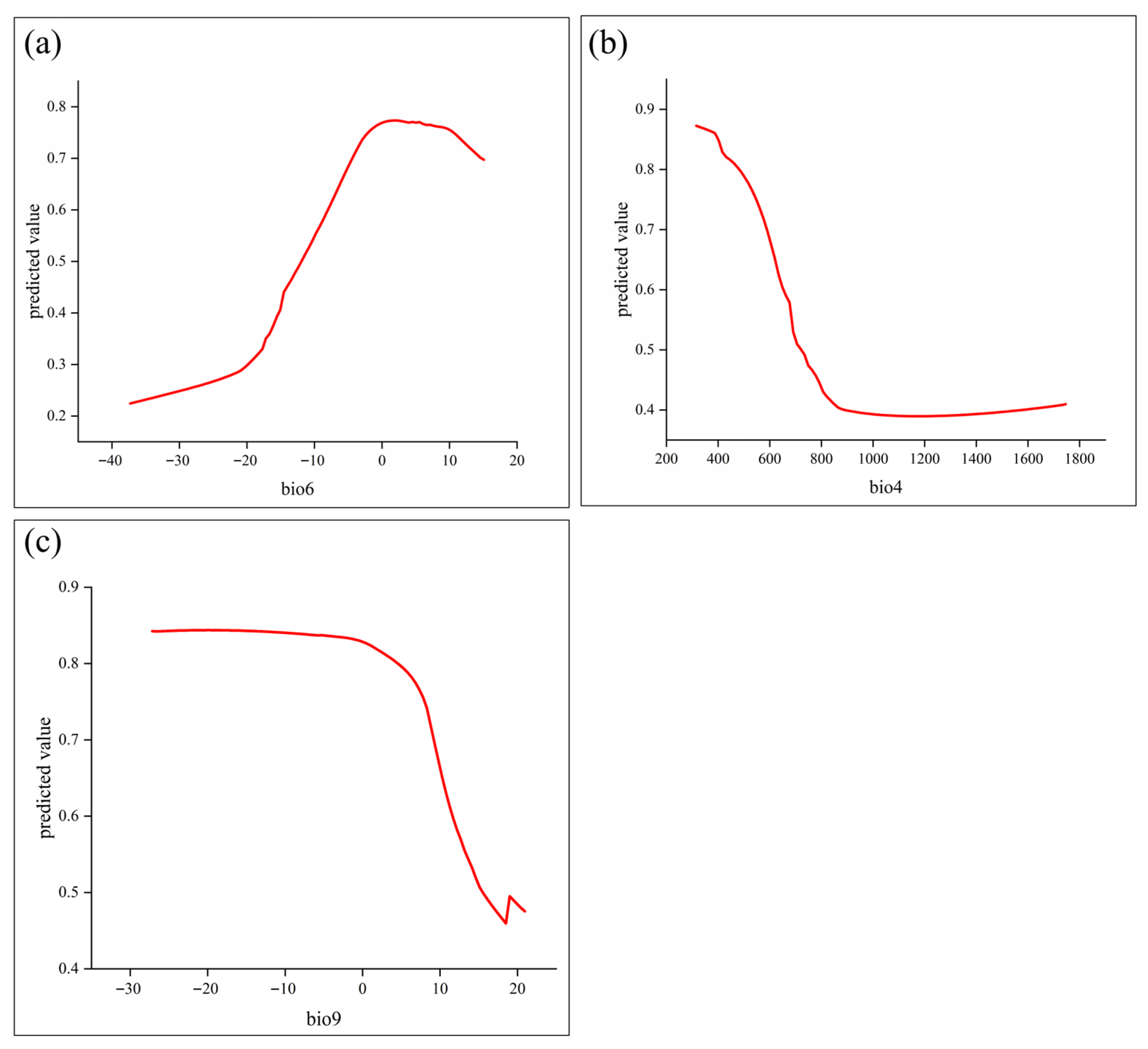
3.2. Environmental Variables Influencing the Potential Geographic Distribution of C. duclouxiana
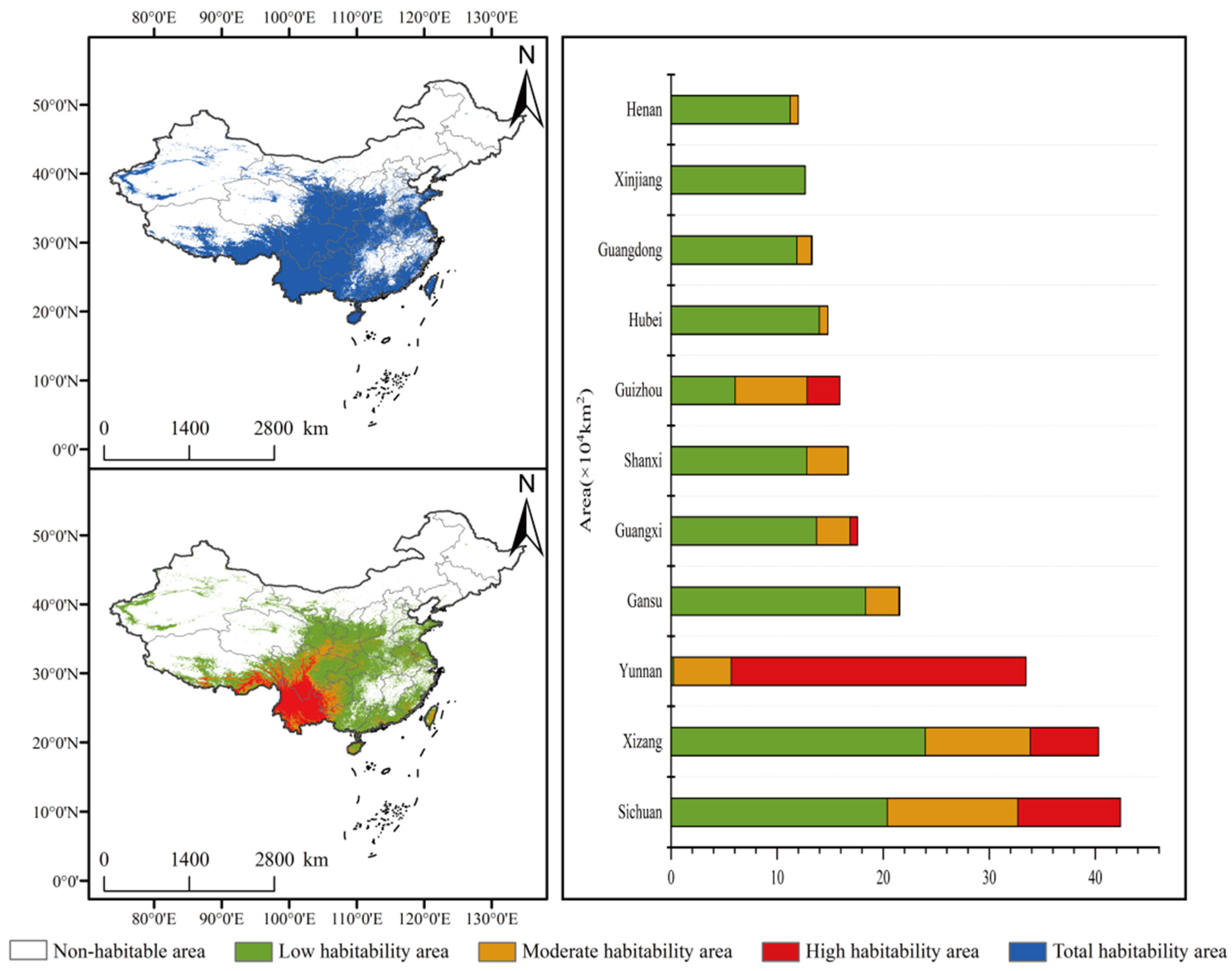
3.3. Suitable Habitat Under the Current Climate
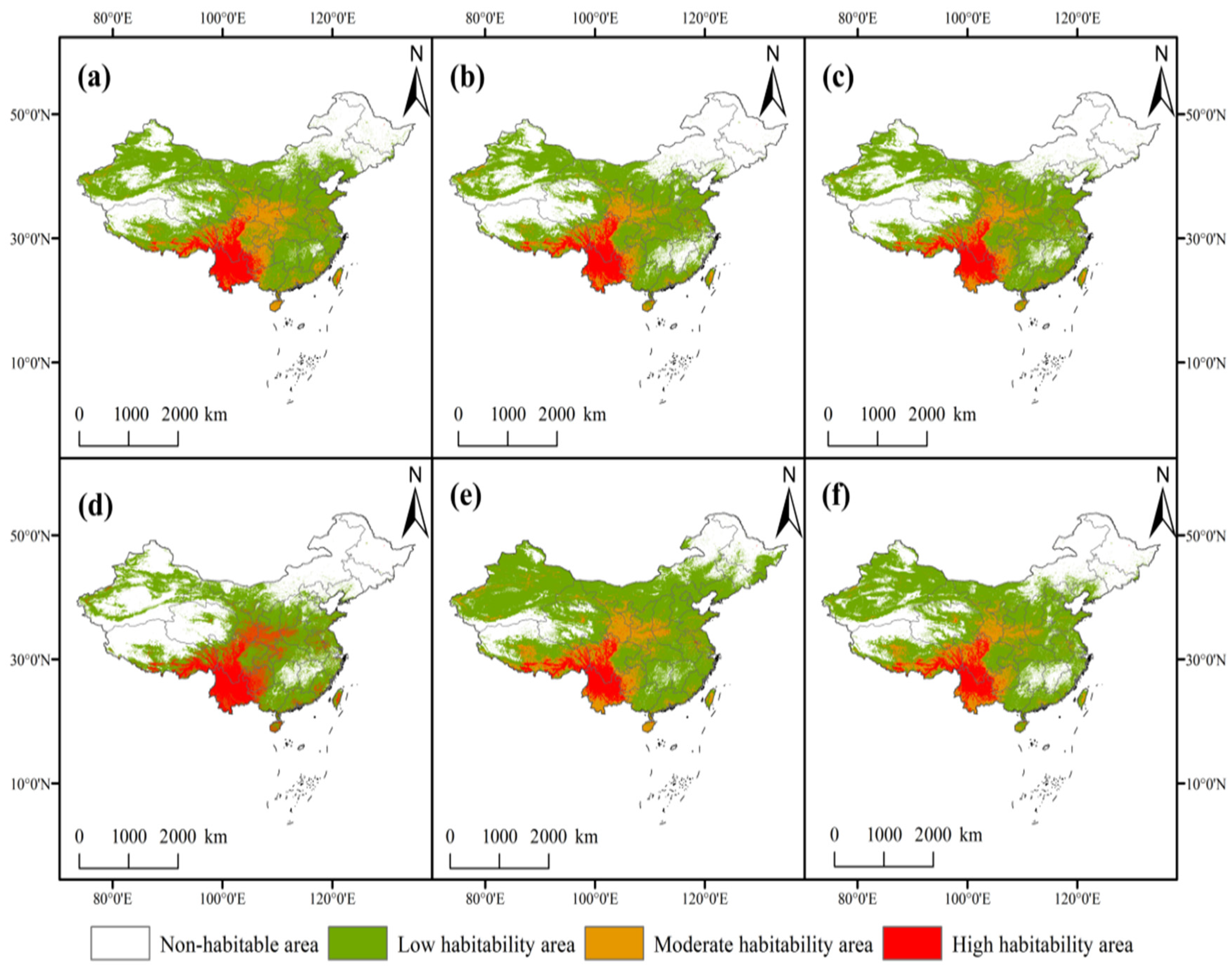
3.4. Projected Potential Distribution Under Future Climate Scenarios
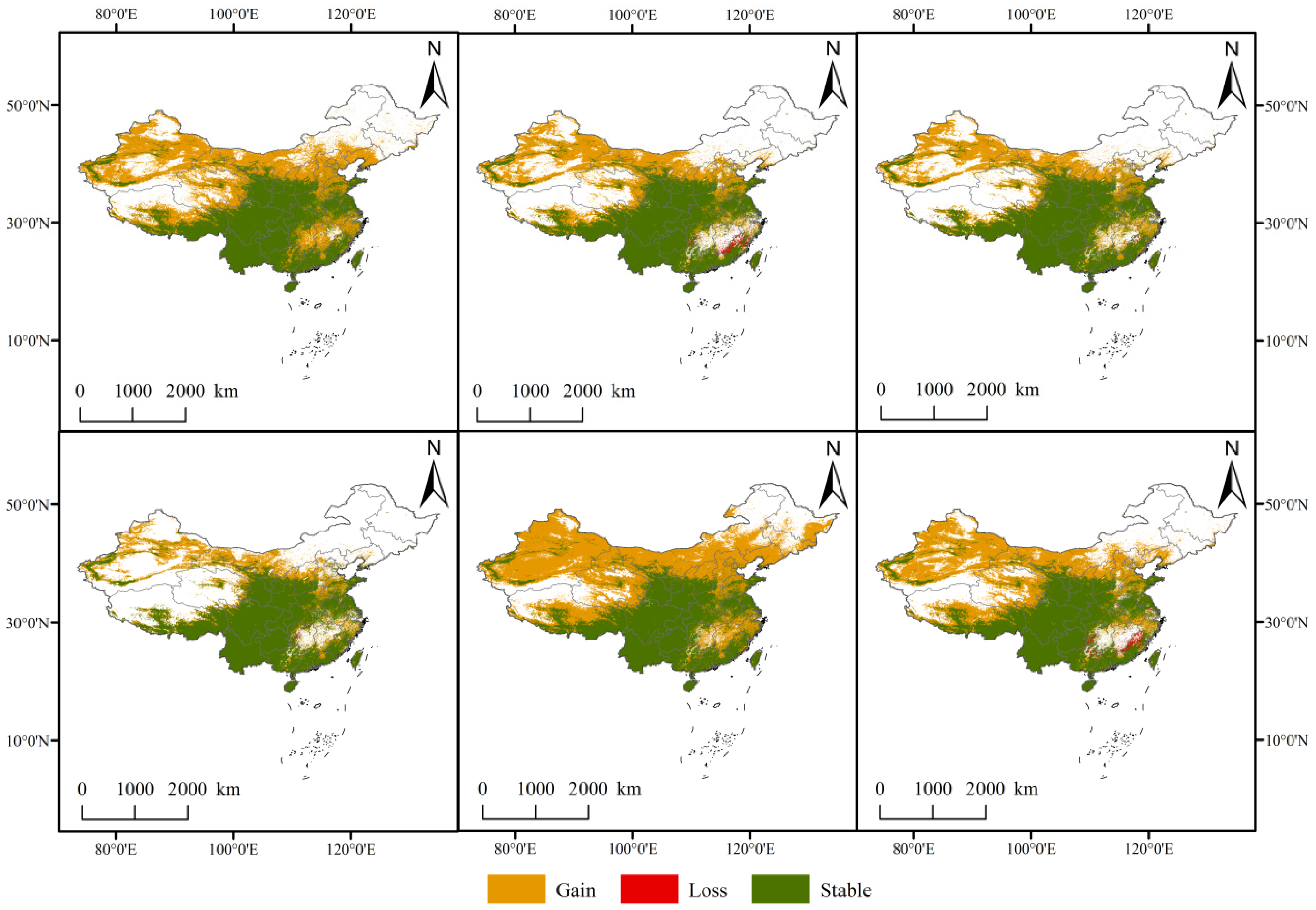
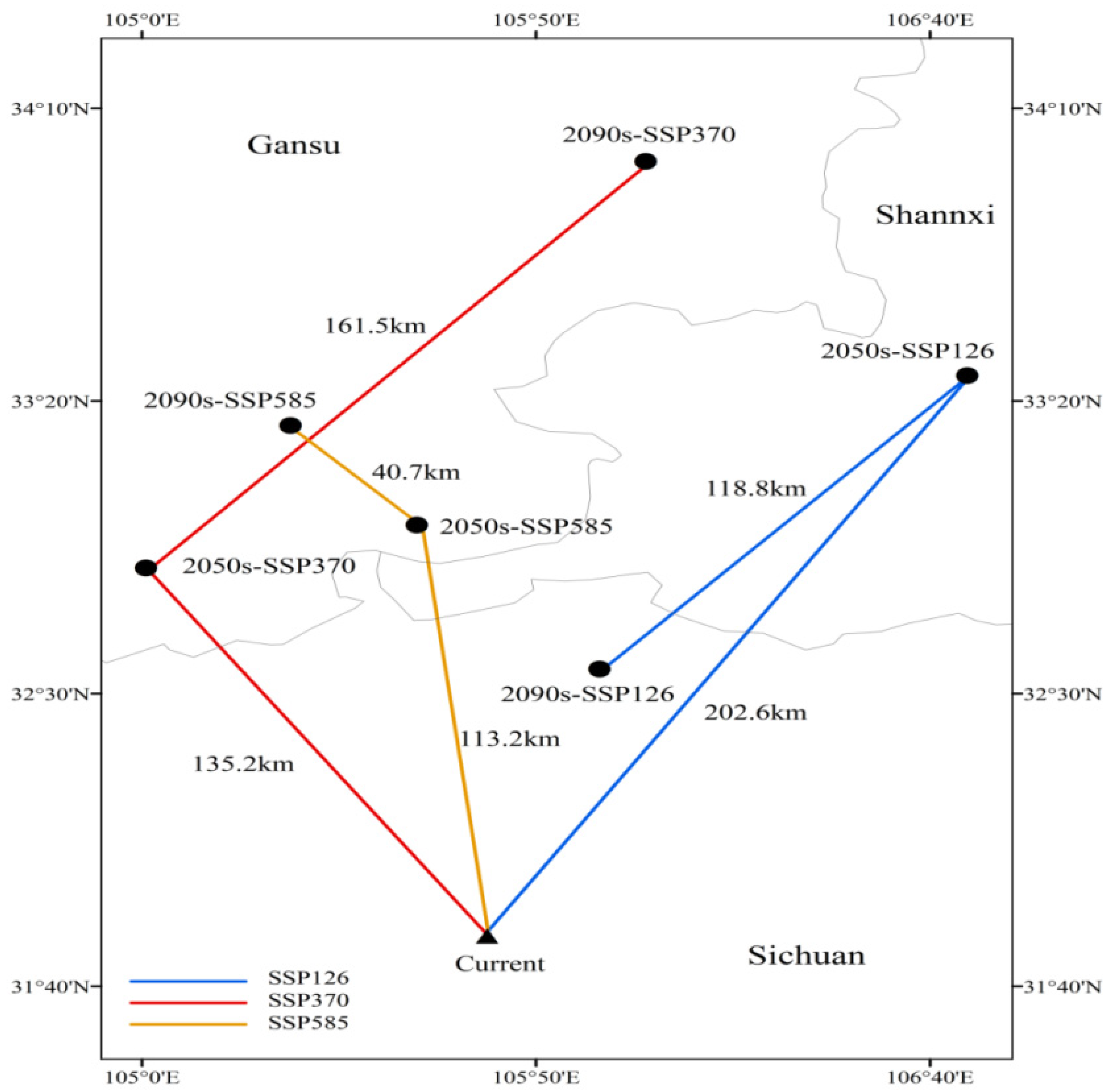
3.5. Overlap of Suitable Areas and Centroid Migration in Future Periods
4. Discussion
4.1. Model Predictive Performance
4.2. Environmental Drivers of the Geographic Distribution of C. duclouxiana
4.3. Relationship Between Habitat Area Changes and Environmental Factors Under Different Climate Scenarios
4.4. Spatial Distribution Shifts in C. duclouxiana Under Climate Change
4.5. Limitations and Future Perspectives
5. Conclusions
Author Contributions
Funding
Institutional Review Board Statement
Informed Consent Statement
Data Availability Statement
Acknowledgments
Conflicts of Interest
References
- Amat, M.E.; Vargas, P.; Gómez, J.M. Effects of Human Activity on the Distribution and Abundance of an Endangered Mediterranean High-Mountain Plant (Erysimum penyalarense). J. Nat. Conserv. 2013, 21, 262–271. [Google Scholar] [CrossRef]
- Li, M.; Wang, L.; Liu, H.; Sun, Y.; Li, N.; Geng, M. Spatiotemporal Distribution Shifts of Zelkova schneideriana Under Climate Change: A Biomod2-Driven Modeling Framework. Biology 2025, 14, 1221. [Google Scholar] [CrossRef] [PubMed]
- Admiraal, J.F.; Musters, C.J.M.; de Snoo, G.R. The Loss of Biodiversity Conservation in EU Research Programmes: Thematic Shifts in Biodiversity Wording in the Environment Themes of EU Research Programmes FP7 and Horizon 2020. J. Nat. Conserv. 2016, 30, 12–18. [Google Scholar] [CrossRef]
- Sarma, K.; Roy, S.J.; Kalita, B.; Baruah, P.S.; Bawri, A.; Nath, M.J.; Baruah, U.D.; Sahariah, D.; Saikia, A.; Tanti, B. Habitat Suitability of Gymnocladus assamicus—A Critically Endangered Plant of Arunachal Pradesh, India Using Machine Learning and Statistical Modeling. Acta Ecol. Sin. 2022, 42, 398–406. [Google Scholar] [CrossRef]
- Randin, C.F.; Engler, R.; Normand, S.; Zappa, M.; Zimmermann, N.E.; Pearman, P.B.; Vittoz, P.; Thuiller, W.; Guisan, A. Climate Change and Plant Distribution: Local Models Predict High-Elevation Persistence. Glob. Change Biol. 2009, 15, 1557–1569. [Google Scholar] [CrossRef]
- Cong, Y.; Gu, Y.; Wang, W.J.; Wang, L.; Xue, Z.; Chen, Y.; Jin, Y.; Xu, J.; Li, M.-H.; He, H.S.; et al. The interaction between temperature and precipitation on the potential distribution range of Betula ermanii in the alpine treeline ecotone on the Changbai Mountain. For. Ecosyst. 2024, 11, 42–51. [Google Scholar] [CrossRef]
- Medina-Villar, S.; Pérez-Corona, M.E.; Herrero, A.; Cruz-Alonso, V.; Carro-Martinez, N.; Andivia, E. The Alien Conifer cupressus Arizonica Can Outcompete Native Pines in Mediterranean Mixed Forests under Climate Change. NeoBiota 2024, 92, 211–231. [Google Scholar] [CrossRef]
- Ma, Y.; Wang, J.; Hu, Q.; Li, J.; Sun, Y.; Zhang, L.; Abbott, R.J.; Liu, J.; Mao, K. Ancient introgression drives adaptation to cooler and drier mountain habitats in a cypress species complex. Commun. Biol. 2019, 2, 213. [Google Scholar] [CrossRef]
- Zhang, H.; Wei, Y.; Yue, J.; Wang, Z.; Zou, H.; Ji, X.; Zhang, S.; Liu, Z. Prediction of Potential Suitable Areas and Priority Protection for Cupressus Gigantea on the Tibetan Plateau. Plants 2024, 13, 896. [Google Scholar] [CrossRef]
- Dakhil, M.A.; Xiong, Q.; Farahat, E.A.; Zhang, L.; Pan, K.; Pandey, B.; Olatunji, O.A.; Tariq, A.; Wu, X.; Zhang, A.; et al. Past and Future Climatic Indicators for Distribution Patterns and Conservation Planning of Temperate Coniferous Forests in Southwestern China. Ecol. Indic. 2019, 107, 105559. [Google Scholar] [CrossRef]
- Koli, V.K.; Jangid, A.K.; Singh, C.P. Habitat Suitability Mapping of the Indian Giant Flying Squirrel (Petaurista philippensis Elliot, 1839) in India with Ensemble Modeling. Acta Ecol. Sin. 2023, 43, 644–652. [Google Scholar] [CrossRef]
- Zhao, Y.; Deng, X.; Xiang, W.; Chen, L.; Ouyang, S. Predicting Potential Suitable Habitats of Chinese Fir under Current and Future Climatic Scenarios Based on Maxent Model. Ecol. Inform. 2021, 64, 101393. [Google Scholar] [CrossRef]
- Subedi, S.C.; Drake, S.; Adhikari, B.; Coggeshall, M.V. Climate-Change Habitat Shifts for the Vulnerable Endemic Oak Species (Quercus arkansana Sarg.). J. For. Res. 2024, 35, 23. [Google Scholar] [CrossRef]
- Anderson, R.P. A Framework for Using Niche Models to Estimate Impacts of Climate Change on Species Distributions. Ann. N. Y. Acad. Sci. 2013, 1297, 8–28. [Google Scholar] [CrossRef]
- Chukwuma, E.C.; Oyebanji, O.O.; Chukwuma, D.M.; Ayodele, A.E.; Tiamiyu, B.B.; Bolarinwa, K.A.; Adeyemi, S.B.; Sagaya, A. Predicting the Potential Impact of Environmental Factors on the Distribution of Triplochiton scleroxylon (Malvaceae): An Economically Important Tree Species in Nigeria. Acta Ecol. Sin. 2023, 43, 1101–1111. [Google Scholar] [CrossRef]
- Zhang, H.; Zhu, Y.; Ma, Z.; He, J.; Guo, C.; Zhou, Q.; Song, L. Simulating the Impact of Climate Change on the Suitable Area for Cotton in Xinjiang Based on SDMs Model. Ind. Crops Prod. 2025, 227, 120750. [Google Scholar] [CrossRef]
- He, Y.; Ma, J.; Chen, G. Potential Geographical Distribution and Its Multi-Factor Analysis of Pinus massoniana in China Based on the Maxent Model. Ecol. Indic. 2023, 154, 110790. [Google Scholar] [CrossRef]
- Rashid, A.; Sofi, I.I.; Kaloo, Z.A.; Zargar, M.A.; Shah, M.A. Predicting the Impact of Climate Change and Human Footprint on Distribution of Angelica glauca Edgew., an Endemic Medicinal Plant Species to Himalaya. J. Nat. Conserv. 2025, 87, 126968. [Google Scholar] [CrossRef]
- Mendoza-González, G.; Martínez, M.L.; Rojas-Soto, O.; Téllez-Valdés, O.; Arias-Del Razo, I. Priority Areas for Conservation of Beach and Dune Vegetation of the Mexican Atlantic Coast. J. Nat. Conserv. 2016, 33, 25–34. [Google Scholar] [CrossRef]
- Gu, R.; Wei, S.; Li, J.; Zheng, S.; Li, Z.; Liu, G.; Fan, S. Predicting the Impacts of Climate Change on the Geographic Distribution of Moso Bamboo in China Based on Biomod2 Model. Eur. J. For. Res. 2024, 143, 1499–1512. [Google Scholar] [CrossRef]
- Shafiezadeh, M.; Moradi, H.; Fakheran, S.; Pourmanafi, S.; Senn, J. Integrated Coastal-Terrestrial Conservation Planning for Landscape-Scale Reserve Design in Southeastern Iran. Ecol. Indic. 2019, 103, 756–765. [Google Scholar] [CrossRef]
- Assefa, A.; Tibebu, A.; Bihon, A.; Dagnachew, A.; Muktar, Y. Ecological niche modeling predicting the potential distribution of African horse sickness virus from 2020 to 2060. Sci. Rep. 2022, 12, 1748. [Google Scholar] [CrossRef]
- Shabani, F.; Ahmadi, M.; Kumar, L.; Solhjouy-fard, S.; Shafapour Tehrany, M.; Shabani, F.; Kalantar, B.; Esmaeili, A. Invasive Weed Species’ Threats to Global Biodiversity: Future Scenarios of Changes in the Number of Invasive Species in a Changing Climate. Ecol. Indic. 2020, 116, 106436. [Google Scholar] [CrossRef]
- Chinese Virtual Herbarium (CVH). Available online: https://www.cvh.ac.cn/ (accessed on 20 November 2025).
- Teaching Specimen Resource Sharing Platform of the National Science and Technology Resources. Available online: http://mnh.scu.edu.cn/ (accessed on 20 November 2025).
- Chinese Field Herbarium (CFH). Available online: http://www.cfh.ac.cn/ (accessed on 20 November 2025).
- National Specimen Information Infrastructure (NSII). Available online: http://www.nsii.org.cn/ (accessed on 20 November 2025).
- Plant Photo Bank of China (PPBC). Available online: http://ppbc.iplant.cn/ (accessed on 20 November 2025).
- Yang, X.-Q.; Kushwaha, S.P.S.; Saran, S.; Xu, J.; Roy, P.S. Maxent Modeling for Predicting the Potential Distribution of Medicinal Plant, Justicia adhatoda L. in Lesser Himalayan Foothills. Ecol. Eng. 2013, 51, 83–87. [Google Scholar] [CrossRef]
- WorldClim Database. Available online: http://www.worldclim.org/ (accessed on 20 November 2025).
- Wu, T.; Lu, Y.; Fang, Y.; Xin, X.; Li, L.; Li, W.; Jie, W.; Zhang, J.; Liu, Y.; Zhang, L.; et al. The Beijing Climate Center Climate System Model (BCC-CSM): The Main Progress from CMIP5 to CMIP6. Geosci. Model Dev. 2019, 12, 1573–1600. [Google Scholar] [CrossRef]
- Harmonized World Soil Database (HWSD). Available online: https://iiasa.ac.at/models-tools-data (accessed on 20 November 2025).
- Bushi, D.; Mahato, R.; Nimasow, O.D.; Nimasow, G. MaxEnt-Based Prediction of the Potential Invasion of Lantana camara L. under Climate Change Scenarios in Arunachal Pradesh, India. Acta Ecol. Sin. 2023, 43, 674–683. [Google Scholar] [CrossRef]
- Sharma, R.; Khan, S.; Kaul, V. Predicting the Potential Habitat Suitability and Distribution of “Weed-Onion” (Asphodelus tenuifolius Cavan.) in India under Predicted Climate Change Scenarios. J. Agric. Food Res. 2023, 14, 100697. [Google Scholar] [CrossRef]
- Wang, R.; Wu, N.; Shi, Z.; Li, C.; Jiang, N.; Fu, C.; Wang, M. Biomod2 for Evaluating the Changes in the Spatiotemporal Distribution of Locusta migratoria tibetensis Chen in the Qinghai-Tibet Plateau under Climate Change. Glob. Ecol. Conserv. 2025, 58, e03508. [Google Scholar] [CrossRef]
- Pan, Y.; Guan, Y.; Lv, S.; Huang, X.; Lin, Y.; Wei, C.; Xu, D. Assessing the Potential Distribution of Lonicera japonica in China Under Climate Change: A Biomod2 Ensemble Model-Based Study. Agriculture 2025, 15, 393. [Google Scholar] [CrossRef]
- Khalatbari Limaki, M.; Es-hagh Nimvari, M.; Alavi, S.J.; Mataji, A.; Kazemnezhad, F. Potential Elevation Shift of Oriental Beech (Fagus orientalis L.) in Hyrcanian Mixed Forest Ecoregion under Future Global Warming. Ecol. Model. 2021, 455, 109637. [Google Scholar] [CrossRef]
- Borborah, K.; Deka, K.; Saikia, D.; Borthakur, S.K.; Tanti, B. Habitat Distribution Mapping of Musa flaviflora Simmonds—A Wild Banana in Assam, India. Acta Ecol. Sin. 2020, 40, 122–127. [Google Scholar] [CrossRef]
- Chukwuma, E.C.; Mankga, L.T. A MaxEnt Model for Estimating Suitable Habitats for Some Important Pelargonium Species in South Africa. J. Nat. Conserv. 2025, 84, 126845. [Google Scholar] [CrossRef]
- BakhshiGanje, M.; Mahmoodi, S.; Ahmadi, K.; Mirabolfathy, M. Potential distribution of Biscogniauxia mediterranea and Obolarina persica causal agents of oak charcoal disease in Iran’s Zagros forests. Sci. Rep. 2024, 14, 7784. [Google Scholar] [CrossRef] [PubMed]
- Liu, Y.; Zeng, B.; Han, W.; Su, X.; Chen, L.; Zhang, M.; Li, C.; Shi, S.; Liu, G. Predicting Distributions of Toxic Weed Species in Alpine Grasslands under Climate Change Using MaxEnt Model. Ecol. Front. 2025, 45, 1823–1833. [Google Scholar] [CrossRef]
- Gao, Y.; Liu, W.; Chen, T.; Li, Y.; Xiong, Z.; Ji, M. Predicting Eriochloa villosa (Thunb.) Kunth Invasion in Northeast China Using an R-Optimized MaxEnt Model. Eur. J. Agron. 2026, 172, 127829. [Google Scholar] [CrossRef]
- Cao, G.; Yuan, X.; Shu, Q.; Gao, Y.; Wu, T.; Xiao, C.; Xu, J.; Zhang, Y. Prediction of the Potentially Suitable Areas of Eucommia ulmoides Oliver in China under Climate Change Based on Optimized Biomod2 and MaxEnt Models. Front. Plant Sci. 2024, 15, 1359271. [Google Scholar] [CrossRef]
- Yang, Y.; Wu, Y.; Chen, Q.; Liu, C.; Liu, G.; Cheng, S.; Wang, L. Potential Spatiotemporal Distribution Changes and Conservation Recommendations of Two Connected Endangered Tree Peony Species (Paeonia decomposita & P. rotundiloba). Flora 2022, 294, 152131. [Google Scholar] [CrossRef]
- Liu, M.; Qin, Y.; Yang, J.; Li, X.; Zhu, F.; Ma, Z.; Zhao, C.; Su, R.; Chen, Y. Climate Change Enhances the Cultivation Potential of Ficus tikoua Bur. in China: Insights from Ensemble Modeling and Niche Analysis. Biology 2025, 14, 1473. [Google Scholar] [CrossRef]
- Arslan, G.; Ertürk, A.; Candan, O. Predicting the Distribution of Green Turtle Nesting Sites over the Mediterranean with Outcoming Climate Driven Changes. J. Nat. Conserv. 2023, 71, 126320. [Google Scholar] [CrossRef]
- Qin, J.; Wang, Y.; Wang, X.; Ma, Y.; Liu, Y.; Ma, Y. Prediction of Potential Distribution of Seven Plant Species of Aster (Asteraceae) Based on MaxEnt Model. Ecol. Evol. 2025, 15, e71931. [Google Scholar] [CrossRef]
- Wani, I.A.; Khan, S.; Verma, S.; Al-Misned, F.A.; Shafik, H.M.; El-Serehy, H.A. Predicting habitat suitability and niche dynamics of Dactylorhiza hatagirea and Rheum webbianum in the Himalaya under projected climate change. Sci. Rep. 2022, 12, 13205. [Google Scholar] [CrossRef]
- Wang, Y.; Liu, Z.; Wu, K.; Peng, J.; Mao, Y.; Zhao, G.; Zhang, F. Predicting Suitable Habitats and Conservation Areas for Suaeda salsa Using MaxEnt and Marxan Models. iScience 2025, 28, 112933. [Google Scholar] [CrossRef] [PubMed]
- Pecchi, M.; Marchi, M.; Burton, V.; Giannetti, F.; Moriondo, M.; Bernetti, I.; Bindi, M.; Chirici, G. Species distribution modelling to support forest management. A literature review. Ecol. Model. 2019, 411, 108817. [Google Scholar] [CrossRef]
- Duan, R.-Y.; Kong, X.-Q.; Huang, M.-Y.; Fan, W.-Y.; Wang, Z.-G. The predictive performance and stability of six species distribution models. PLoS ONE 2014, 9, e112764. [Google Scholar] [CrossRef] [PubMed]
- Naimi, B.; Hamm, N.A.S.; Groen, T.A.; Skidmore, A.K.; Toxopeus, A.G. Where is positional uncertainty a problem for species distribution modelling? Ecography 2014, 37, 191–203. [Google Scholar] [CrossRef]
- Wisz, M.S.; Hijmans, R.J.; Li, J.; Peterson, A.T.; Graham, C.H.; Guisan, A.; Group, N.P.S.D.W. Effects of sample size on the performance of species distribution models. Divers. Distrib. 2008, 14, 763–773. [Google Scholar] [CrossRef]
- Austin, M.P. Spatial prediction of species distribution: An interface between ecological theory and statistical modelling. Ecol. Model. 2002, 157, 101–118. [Google Scholar] [CrossRef]
- Natale, E.; Zalba, S.M.; Reinoso, H. Presence—Absence versus invasive status data for modelling potential distribution of invasive plants: Saltcedar in Argentina. Écoscience 2013, 20, 161–171. [Google Scholar] [CrossRef]
- iPlant—Chinese Plant Species Information System. Available online: https://www.iplant.cn (accessed on 20 November 2025).
- Zhao, S.; Zhang, Z.; Gao, C.; Dong, Y.; Jing, Z.; Du, L.; Hou, X. MaxEnt-Based Predictions of Suitable Potential Distribution of Leymus secalinus under Current and Future Climate Change. Plants 2025, 14, 293. [Google Scholar] [CrossRef]
- Wan, J.-N.; Wang, S.-W.; Leitch, A.R.; Leitch, I.J.; Jian, J.-B.; Wu, Z.-Y.; Xin, H.-P.; Rakotoarinivo, M.; Onjalalaina, G.E.; Gituru, R.W.; et al. The Rise of Baobab Trees in Madagascar. Nature 2024, 629, 1091–1099. [Google Scholar] [CrossRef]
- Lin, N.; Wang, Y.; Landis, J.B.; Wang, X.; He, Y.; Wang, H.; Huang, X.; Liu, Q.; Yang, J.; Shang, F.; et al. Genome Sequencing and Population Genomics Provide Insights into the Demographic History, Genetic Load, and Local Adaptation of an Endangered Tertiary Relict. Plant J. 2025, 123, e70425. [Google Scholar] [CrossRef] [PubMed]
- Li, J.; Milne, R.I.; Ru, D.; Miao, J.; Tao, W.; Zhang, L.; Xu, J.; Liu, J.; Mao, K. Allopatric Divergence and Hybridization within Cupressus Chengiana (Cupressaceae), a Threatened Conifer in the Northern Hengduan Mountains of Western China. Mol. Ecol. 2020, 29, 1250–1266. [Google Scholar] [CrossRef]
- Wos, G.; Bohutínská, M.; Nosková, J.; Mandáková, T.; Kolář, F. Parallelism in Gene Expression between Foothill and Alpine Ecotypes in Arabidopsis arenosa. Plant J. 2021, 105, 1211–1224. [Google Scholar] [CrossRef] [PubMed]
- Zhang, Y.; Hu, J.; Wang, C.; Wan, Y.; Ji, M.; Ma, F.; Lu, Y. Estimating Global Geographical Distribution and Ecological Niche Dynamics of Ammannia coccinea under Climate Change Based on Biomod2. Sci. Rep. 2024, 14, 30579. [Google Scholar] [CrossRef] [PubMed]
- Zhao, G.; Cui, X.; Sun, J.; Li, T.; Wang, Q.; Ye, X.; Fan, B. Analysis of the Distribution Pattern of Chinese Ziziphus Jujuba under Climate Change Based on Optimized Biomod2 and MaxEnt Models. Ecol. Indic. 2021, 132, 108256. [Google Scholar] [CrossRef]
- Sunkur, R.; Kantamaneni, K.; Bokhoree, C.; Rathnayake, U.; Fernando, M. Modelling Mangrove Dynamics in Mauritius: Implications for Conservation and Climate Resilience. J. Nat. Conserv. 2025, 85, 126864. [Google Scholar] [CrossRef]
- Baruah, P.S.; Deka, K.; Lahkar, L.; Sarma, B.; Borthakur, S.K.; Tanti, B. Habitat Distribution Modelling and Reinforcement of Elaeocarpus serratus L.—A Threatened Tree Species of Assam, India for Improvement of Its Conservation Status. Acta Ecol. Sin. 2019, 39, 42–49. [Google Scholar] [CrossRef]
- Tatsumoto, M.; Hirata, K.; Nakayama, T.; Yamato, K.; Sano, H.; Inuyama, L. Seasonal Variations in Triptan Prescription in Japan: A Nationwide Time-Series Analysis. Brain Behav. 2024, 14, e70184. [Google Scholar] [CrossRef]
- Huang, Y.; Zeng, Y.; Jiang, P.; Chen, H.; Yang, J. Prediction of potential geographic distribution of endangered and relict tree species Dipteronia sinensis in China based on MaxEnt and GIS. Pol. J. Environ. Stud. 2022, 31, 3597–3609. [Google Scholar] [CrossRef]
- Huang, Y.; Zhao, G.; Yang, Y.; Yang, J.; Zhi, J.B.W. Distribution and Cultivation Area Dynamics of Aralia elata (Miq.) Seem. in the Upper Reaches of the Dadu-Minjiang River under Climate Change. BMC Plant Biol. 2025, 25, 1244. [Google Scholar] [CrossRef]
- Huang, Y.; Yang, J.; Zhao, G.; Yang, Y. Potential Distribution and Cultivation Areas of Argentina anserina (Rosaceae) in the Upper Reaches of the Dadu River and Minjiang River Basin Under Climate Change: Applications of Ensemble and Productivity Dynamic Models. Biology 2025, 14, 668. [Google Scholar] [CrossRef] [PubMed]



| Environment Variable | Abbreviation | Unit | Contribution Rate |
|---|---|---|---|
| Minimum Temperature of Coldest Month | bio6 | °C | 44.06% |
| Temperature Seasonality | bio4 | °C | 24.33% |
| Mean Temperature of Driest Quarter | bio9 | °C | 8.58% |
| Mean Temperature of Warmest Quarter | bio10 | °C | 1.98% |
| Isothermality | bio3 | % | 1.75% |
| Land-Use and Land-Cover Change | lucc | / | 2.25% |
| Annual Precipitation | bio12 | mm | 1.67% |
| Precipitation Seasonality | bio15 | % | 1.21% |
| Elevation | alt | m | 3.46% |
| Slope | slo | % | 3.28% |
| Aspect | asp | ◦ | 0.15% |
| Available Water Capacity | awc_class | % | 0.79% |
| Topsoil Organic Carbon | t_oc | weight | 4.75% |
| Topsoil pH | t_pH | −log(H+) | 0.26% |
| Subsoil Organic Carbon | s_oc | % | 0.72% |
| Subsoil pH | s_pH | / | 0.22% |
| Normalized Difference Vegetation Index | ndvi | / | 0.55% |
| Evaluation Metric | Poor | Fair | Moderate | Good | Excellent |
|---|---|---|---|---|---|
| ROC | 0.50–0.60 | 0.60–0.70 | 0.70–0.80 | 0.80–0.90 | 0.90–1.00 |
| TSS | 0.00–0.40 | 0.40–0.55 | 0.55–0.70 | 0.70–0.85 | 0.85–1.00 |
| Kappa | 0.00–0.40 | 0.40–0.55 | 0.55–0.70 | 0.70–0.85 | 0.85–1.00 |
| Climate Scenarios | Low Suitability Area | Moderately Suitability Area | Highly Suitability Area | Total Suitability Area | ||||
|---|---|---|---|---|---|---|---|---|
| Area (104 km2) | Range Expansion (%) | Area (104 km2) | Range Expansion (%) | Area (104 km2) | Range Expansion (%) | Area (104 km2) | Range Expansion (%) | |
| Current | 226.0 | - | 54.1 | - | 48.3 | - | 328.4 | - |
| 2050s SSP1-2.6 | 466.5 | 106.41% | 116.8 | 115.97% | 67.1 | 38.90% | 650.4 | 98.74% |
| 2050s SSP3-7.0 | 400.0 | 76.98% | 89.4 | 65.27% | 60.2 | 24.72% | 549.6 | 67.80% |
| 2050s SSP5-8.5 | 393.5 | 74.12% | 91.4 | 69.03% | 53.4 | 10.57% | 538.4 | 64.37% |
| 2090s SSP1-2.6 | 333.6 | 47.59% | 84.9 | 57.01% | 55.1 | 14.04% | 473.6 | 44.53% |
| 2090s SSP3-7.0 | 554.3 | 145.25% | 133.3 | 146.40% | 58.0 | 19.99% | 745.5 | 127.91% |
| 2090s SSP5-8.5 | 457.5 | 102.44% | 102.1 | 88.80% | 53.9 | 11.63% | 613.6 | 87.42% |
| Climate Scenarios | Total Suitability Area (104 km2) | Contraction Area (104 km2) | Contraction Rate (%) | Unchanged Area (104 km2) | Unchanged Rate (%) | Expansion Area (104 km2) | Expansion Rate (%) |
|---|---|---|---|---|---|---|---|
| Current | 328.4 | - | - | - | - | - | - |
| 2050s SSP1-2.6 | 650.4 | 0.0 | 0.0% | 328.4 | 50.5% | 322.1 | 49.5% |
| 2050s SSP3-7.0 | 549.6 | 5.2 | 1.0% | 323.1 | 58.8% | 226.5 | 41.2% |
| 2050s SSP5-8.5 | 538.4 | 0.6 | 0.1% | 327.8 | 60.9% | 210.6 | 39.1% |
| 2090s SSP1-2.6 | 473.6 | 1.2 | 0.3% | 327.2 | 69.1% | 146.4 | 30.9% |
| 2090s SSP3-7.0 | 745.5 | 0.0 | 0.0% | 328.3 | 44.0% | 417.2 | 56.0% |
| 2090s SSP5-8.5 | 613.6 | 6.4 | 1.0% | 321.9 | 52.5% | 291.6 | 47.5% |
Disclaimer/Publisher’s Note: The statements, opinions and data contained in all publications are solely those of the individual author(s) and contributor(s) and not of MDPI and/or the editor(s). MDPI and/or the editor(s) disclaim responsibility for any injury to people or property resulting from any ideas, methods, instructions or products referred to in the content. |
© 2026 by the authors. Licensee MDPI, Basel, Switzerland. This article is an open access article distributed under the terms and conditions of the Creative Commons Attribution (CC BY) license.
Share and Cite
Li, J.; Huang, Y.; Pan, Y.; Zhao, C.; Yang, Y.; Yang, J. Prediction of Potential Suitable Habitats of Cupressus duclouxiana Under Climate Change Based on Biomod2 Ensemble Models. Biology 2026, 15, 165. https://doi.org/10.3390/biology15020165
Li J, Huang Y, Pan Y, Zhao C, Yang Y, Yang J. Prediction of Potential Suitable Habitats of Cupressus duclouxiana Under Climate Change Based on Biomod2 Ensemble Models. Biology. 2026; 15(2):165. https://doi.org/10.3390/biology15020165
Chicago/Turabian StyleLi, Jialin, Yi Huang, Yunxi Pan, Cong Zhao, Yulian Yang, and Jingtian Yang. 2026. "Prediction of Potential Suitable Habitats of Cupressus duclouxiana Under Climate Change Based on Biomod2 Ensemble Models" Biology 15, no. 2: 165. https://doi.org/10.3390/biology15020165
APA StyleLi, J., Huang, Y., Pan, Y., Zhao, C., Yang, Y., & Yang, J. (2026). Prediction of Potential Suitable Habitats of Cupressus duclouxiana Under Climate Change Based on Biomod2 Ensemble Models. Biology, 15(2), 165. https://doi.org/10.3390/biology15020165