Article

Comparative Mitogenomics and Phylogeny of Geotrupidae (Insecta: Coleoptera): Insights from Two New Mitogenomes of Qinghai–Tibetan Plateau Dung Beetles

1
College of Grassland Science, Xinjiang Agricultural University, Urumqi 830052, China
2
State Key Laboratory of Herbage Improvement and Grassland Agro-Ecosystems, College of Pastoral Agricultural Science and Technology, Lanzhou University, Lanzhou 730020, China
*
Authors to whom correspondence should be addressed.
These authors equally contributed to this study.
Biology 2026, 15(2), 164; https://doi.org/10.3390/biology15020164
Submission received: 20 December 2025 / Revised: 12 January 2026 / Accepted: 14 January 2026 / Published: 16 January 2026
(This article belongs to the Special Issue Mitochondrial Genomics of Arthropods)

Simple Summary

The dung beetle family Geotrupidae (Scarabaeoidea) is crucial for nutrient cycling and soil health, but limited complete mitochondrial genome (mitogenome) data has slowed its phylogenetic and comparative studies. In this work, we obtained the first complete mitogenomes of two high-altitude Geotrupidae species (Geotrupes stercorarius and Phelotrupes auratus) from the Qinghai–Tibetan Plateau. By comparing these new mitogenomes with eight existing ones, we found conserved genomic features (e.g., gene arrangement) in Geotrupidae, while variations appeared in non-coding regions. Evolutionary analyses indicated strong purifying selection on protein-coding genes, with no widespread positive selection linked to high-altitude adaptation. Phylogenetic reconstruction consistently recovered the relationships (Bolboceratinae, (Lethrinae, Geotrupinae)). This study provides precious mitogenomic resources and a clear phylogenetic framework for Geotrupidae.

Abstract

The dung beetle family Geotrupidae (Scarabaeoidea) plays a vital ecological role in nutrient cycling and soil health, yet the scarcity of complete mitochondrial genome (mitogenome) data has hindered phylogenetic and comparative studies within this family. Here, we sequenced, assembled, and annotated the first complete mitogenomes of Geotrupes stercorarius and Phelotrupes auratus, collected from the Qinghai–Tibetan Plateau. Comparative analysis of these two novel mitogenomes with eight existing mitogenomes revealed conserved architectural features across Geotrupidae, such as gene arrangement, tRNA secondary structures, and small intergenic spacers. Nucleotide composition was largely conserved, though marked divergence occurred at the third codon positions. Substantial structural variation was observed in non-coding regions, particularly in the control region and the nad2-trnW spacer. Evolutionary analyses indicated strong purifying selection across all protein-coding genes, with no evidence of widespread positive selection linked to high-altitude adaptation. Phylogenetic reconstruction consistently recovered the relationships (Bolboceratinae, (Lethrinae, Geotrupinae)), with Anoplotrupes and Geotrupes forming sister genera within Geotrupinae. This study provides additional mitogenomic resources and a well-supported phylogenetic framework for Geotrupidae, resolving key taxonomic uncertainties and establishing a basis for future evolutionary and ecological research.

1. Introduction

The Geotrupidae (dung beetles) is a family within the superfamily Scarabaeoidea (Coleoptera: Polyphaga), comprising approximately 1000 known species with a global distribution across temperate and tropical regions. Both adults and larvae of Geotrupidae are predominantly coprophagous or saprophagous [1,2]. By feeding on, transporting, and burying feces and decaying organic matter, they play an irreplaceable role in nutrient cycling, soil aeration, and ecosystem functioning, making them ecologically vital insects [2,3].
Despite their ecological importance, the taxonomy and phylogeny of Geotrupidae remain controversial. Traditional morphology-based classifications recognized three subfamilies, i.e., Geotrupinae, Lethrinae, and Bolboceratinae [1]. However, the taxonomic status of some groups, particularly Bolboceratinae, is unstable, with proposals to elevate it to family rank [4,5], while larval morphology and molecular data often support its taxonomic rank as a subfamily within Geotrupidae [1,6]. These inconsistencies highlight the limitations of morphological characters, which may be prone to convergence, and of early molecular studies that relied on limited genetic loci with insufficient phylogenetic signal to confidently resolve higher-level relationships [7].
The mitochondrial genome (mitogenome), characterized by structural conservation, a moderate evolutionary rate, and maternal inheritance, has become a cornerstone molecular marker for insect phylogenetics and taxonomy [8]. Within the Scarabaeoidea, mitogenomic data have provided critical insights into gene order evolution, selective pressures, and subfamily-level systematics for families such as Scarabaeidae. In contrast, mitogenomic resources for Geotrupidae are notably scarce. Most available data consist of partial gene sequences, and a comprehensive comparative analysis based on complete mitogenomes—essential for clarifying deep phylogenetic nodes—is still lacking [9,10].
Geotrupes stercorarius (Linnaeus, 1758) and Phelotrupes auratus (Motschulsky, 1857) (the tribe Geotrupini) are widespread species exhibiting notable morphological and ecological variation, making them valuable models for studying diversification within the Geotrupidae family [11]. Notably, populations of these species from the Qinghai–Tibetan Plateau (QTP) represent unique lineages inhabiting high-altitude environments. Previous molecular studies on these taxa have been restricted to fragments of cox1 or ribosomal DNA [10,12,13,14], which cannot reveal whole mitogenome architecture—including gene order and control region structure—nor provide robust phylogenetic resolution. Although some studies have explored phylogenetic relationships using chemical or morphological characteristics [14,15,16], the evolutionary relationship between the genera Phelotrupes and Geotrupes remains unclear [2,10,14,17].
Here, we sequenced and annotated the complete mitogenomes of Geotrupes stercorarius and Phelotrupes auratus for the first time, with samples originating from the QTP. By combining these with eight sequenced Geotrupidae mitogenomes from GenBank, we conducted a comprehensive comparative mitogenomic analysis across the three subfamilies (Geotrupinae, Bolboceratinae, and Lethrinae). Our objectives were to: (1) characterize the structural features, nucleotide composition, and non-coding regions of these mitogenomes; (2) reconstruct a robust phylogeny of Geotrupidae using multiple datasets and inference methods; and (3) clarify the systematic positions of Geotrupes and Phelotrupes within Geotrupinae. This study provides essential genomic resources and a refined phylogenetic framework for future investigations into the evolution and adaptation of Geotrupidae.

2. Materials and Methods

2.1. Sampling and DNA Extraction

Adult specimens of Geotrupes stercorarius and Phelotrupes auratus were collected from alpine meadows in Yushu County (~4000 m) and Menyuan County (~3000 m), Qinghai Province, China, during July and August 2023, respectively (Table S1). Specimens were initially preserved in absolute ethanol in the field and subsequently stored at −80 °C at Lanzhou University. Total genomic DNA was extracted from the thoracic muscle tissue of individual specimens using the DNeasy Blood & Tissue Kit (Qiagen, Hilden, Germany). DNA concentration and purity were assessed using a NanoDrop ND-1000 spectrophotometer (Thermo Fisher Scientific, Waltham, MA, USA), and integrity was verified by 1.2% agarose gel electrophoresis.

2.2. Mitogenome Sequencing, Assembly, and Annotation

Paired-end sequencing libraries (2 × 150 bp) were constructed and sequenced on an Illumina NovaSeq 6000 platform by Wuhan Bena Technology Co., Ltd. (Wuhan, China). Raw reads were subjected to quality control using fastp v0.23.2 [18] to remove adapters and low-quality bases. High-quality reads were de novo assembled using GetOrganelle v1.7.1 [19]. Candidate mitochondrial contigs were identified by BLASTn (BLAST+ v2.15.0, National Center for Biotechnology Information, Bethesda, MD, USA) searches against the NCBI nucleotide (nt) database.
The complete circular mitogenomes were annotated using the MitoZ v3.6 [20] with the invertebrate genetic code. The boundaries of protein-coding genes (PCGs) were manually verified by identifying open reading frames and comparing them with homologous sequences from related dung beetles. The secondary structures of transfer RNA (tRNA) genes were predicted by MitoZ v3.6 [20] and manually adjusted to conform to the typical cloverleaf structure. The two ribosomal RNA (rrnL and rrnS) genes were annotated based on sequence homology. Circular genome maps were generated using CGView [21].

2.3. Comparative Mitogenomic Analysis

Comparative analyses were performed on the ten Geotrupidae mitogenomes. In addition to the newly sequenced mitogenomes, the mitogenome sequences of eight other Geotrupidae species were downloaded from the National Center for Biotechnology Information (NCBI) GenBank database (Table S2). Nucleotide composition (A, T, G, C content), AT-skew [(A−T)/(A+T)], and GC-skew [(G−C)/(G+C)] [22] were calculated for the whole genome, individual genes, and codon positions using MEGA v12.1.0 [23]. Relative synonymous codon usage (RSCU) for the 13 PCGs was calculated with MEGA v12.1.0 [23]. The effective number of codons (ENC) and codon bias index (CBI) were computed using DnaSP v6.12.3 [24], and their correlations with GC content and GC content at the third codon position (GC3%) were analyzed.
To assess interspecific genetic variation, the nucleotide diversity (Pi) of each PCG across all species was calculated using DnaSP v6.12.3 [24] with a sliding window approach (window length: 100 bp; step size: 25 bp). The rates of non-synonymous (Ka) and synonymous (Ks) substitutions for each PCG were estimated using MEGA v12.1.0 [23]. The codeml program in PAML v4.10.9 was used to analyze the selective pressures for each PCG under type of branch-site models using a maximum-likelihood approach [25]. Two Geotrupidae species (G. stercorarius and P. auratus) inhabiting the QTP were used as the foreground branch. Positively selected sites were detected when ω > 1 and the LRT was significant (p < 0.05) [25]. The Bayes empirical Bayes (BEB) method was used to calculate posterior probabilities for site classes to determine which codon positions have experienced positive selection (ω > 1) [26].
Tandem repeats in the control region and other non-coding regions were identified using the Tandem Repeats Finder program [27] with default parameters. Schematic diagrams of repeat structures were generated for visual comparison.

2.4. Phylogenetic Analysis

Three datasets were constructed for phylogenetic inference: (1) P123: concatenated nucleotide sequences of all 13 PCGs (11,130 bp); (2) P123AA: concatenated amino acid sequences of the 13 PCGs (3710 amino acids); (3) P123R: concatenated P123 nucleotides plus the two rRNA genes (rrnL and rrnS) (13,259 bp). Each PCG was aligned separately at the codon level using MAFFT v7.505 [28], while rRNA genes were aligned using the Q-INS-i algorithm in MAFFT, which considers secondary structure. Poorly aligned positions were removed using Gblocks v0.91b [29] with relaxed parameters. Dynastes satanas (OQ998898) and Xylotrupes sumatrensis (OK484316) were used as outgroups (Table S2).
Substitution saturation tests performed using DAMBE v7.0.35 [30] indicated no significant saturation in the 13 PCGs (Table S3). The best-fit partitioning schemes and corresponding substitution models for each dataset were selected using the -m MFP+MERGE function in IQ-TREE v2.2.0 [31] via the ModelFinder option [32], which minimizes the Bayesian Information Criterion (BIC). The best schemes and evolutionary models are provided in Table S4.
Maximum Likelihood (ML) phylogenies were reconstructed using RAxML v8.2.12 [33] with 10,000 ultrafast bootstrap replicates [34]. Bayesian Inference (BI) was performed using MrBayes v3.2.7 [35] on the CIPRES Science Gateway. For BI, two independent runs of four Markov Chain Monte Carlo (MCMC) chains each were conducted for 10 million generations, sampling every 1000 generations. The first 25% of samples were discarded as burn-in after confirming convergence (average standard deviation of split frequencies < 0.01). Phylogenetic trees were visualized and annotated using TreeView v2.2.0 [36].

3. Results

3.1. General Features and Comparative Analysis of Geotrupidae Mitogenomes

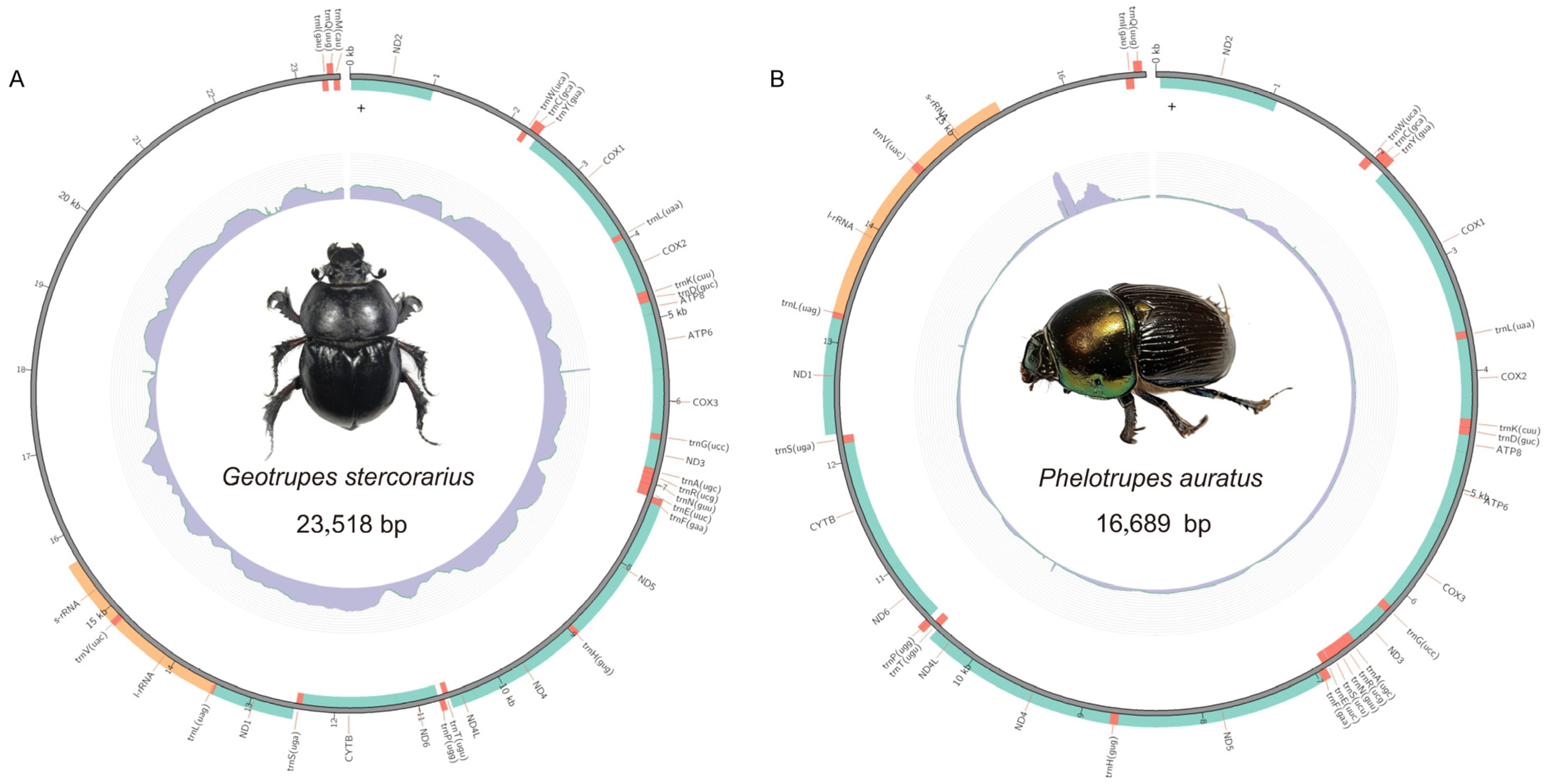
We sequenced and assembled the complete mitochondrial genomes of Geotrupes stercorarius (23,518 bp) and Phelotrupes auratus (16,689 bp) from the QTP (Figure 1). Combined with eight published mitogenomes retrieved from GenBank, our comparative analysis encompassed ten species across the three subfamilies of Geotrupidae (Geotrupinae, Bolboceratinae, and Lethrinae).
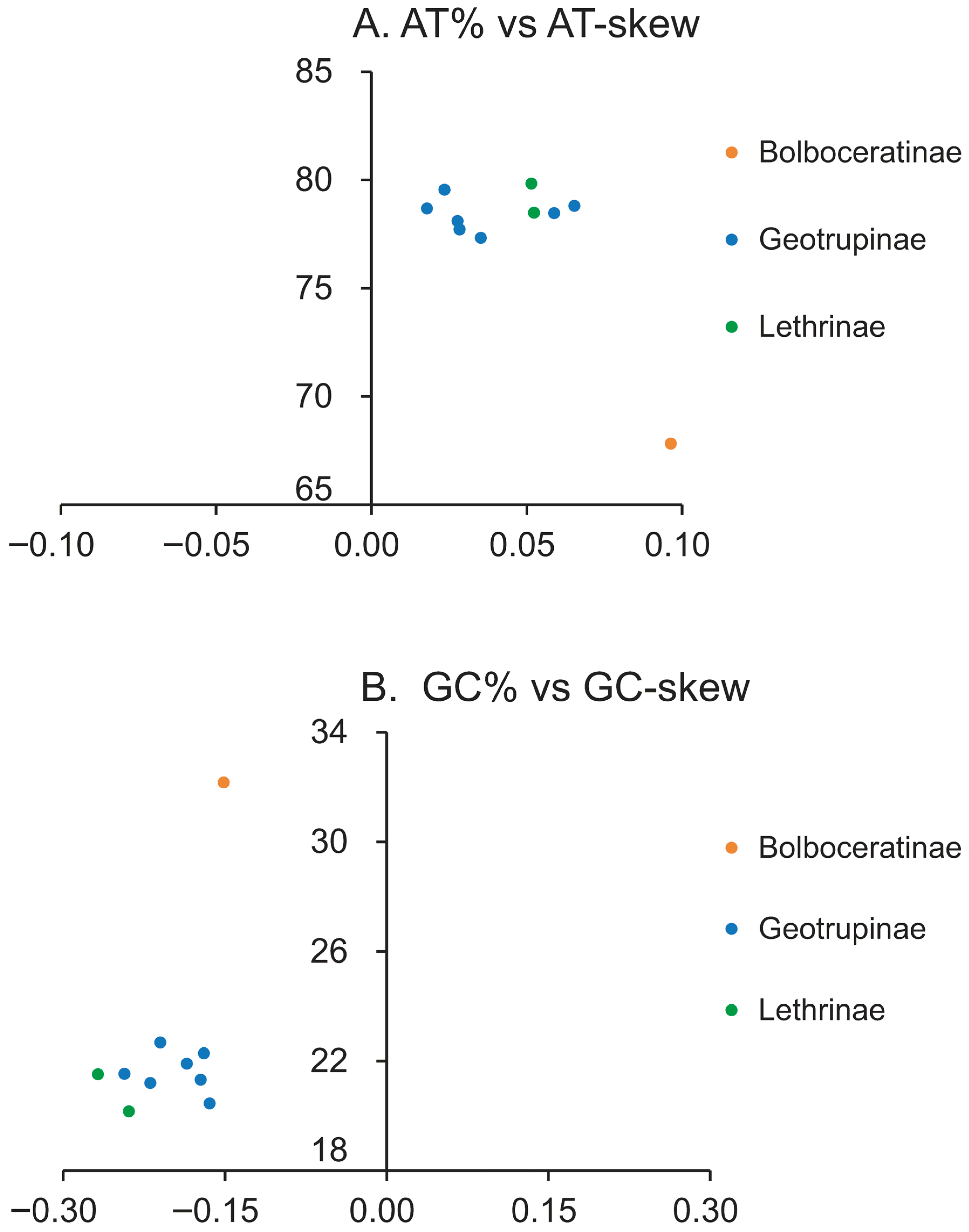
All Geotrupidae mitogenomes contained the typical 37 genes (13 PCGs, 2 rRNAs, 22 tRNAs) and a control region, with no gene rearrangements detected (Table S5). Genome lengths varied considerably, ranging from 12,501 bp in Anoplotrupes stercorosus (MT862428) to 24,944 bp in Lethrus scoparius, primarily due to length polymorphism in the control region (Figure S1). All mitogenomes exhibited a strong AT bias, with total A+T content ranging from 67.83% in Bolboceratex sp. to 79.83% in Lethrus scoparius. The subfamily Bolboceratinae showed significantly lower total A+T content than Geotrupinae and Lethrinae. AT-skew was consistently positive, while GC-skew was negative across all species (Figure 2).

3.2. Nucleotide Composition, Codon Usage, and Evolutionary Rates

In protein-coding genes (PCGs), the A+T content was highest at the third codon position (94.18% on average), significantly exceeding that at the first and second positions (Figure S2). Notably, the two newly sequenced plateau species did not exhibit extreme A+T content compared to their congeners, and no significant differences in A+T content were observed across the three subfamilies.
Nucleotide diversity of 13 PCGs differed significantly across genera and individual genes. The genus Lethrus displayed markedly higher Pi values than the other three genera for most genes (e.g., atp6, nad1, nad3) (p < 0.001), with nad3 reaching the peak (Figure S3A). Conversely, Pi values for Anoplotrupes were generally close to zero (Figure S3). The two newly sequenced species showed lower nucleotide diversity than the other analyzed species; among their PCGs, atp8 had the highest polymorphism (Pi = 0.173), while nad1 exhibited the lowest (Pi = 0.107). In contrast, among the other species, nad6 displayed the highest diversity (Pi = 0.251), whereas cox1 had the lowest (Pi = 0.163) (Figure S4).
The evolutionary rates (Ka/Ks) of all 13 PCGs were less than 1 (range: 0.05–0.43), indicating they are under strong purifying selection. The atp8 gene showed the highest evolutionary rate, while cox1 was the most conserved (Figure S5). A significant negative correlation was observed between Ka/Ks values and the G+C content of PCGs (R2 = 0.73, p < 0.01; Figure S6). In the branch-site model analysis, when P. auratus was designated as the foreground branch, significant signals of positive selection were detected in atp6 (p = 0.002; Table S6). When G. stercorarius was set as the foreground branch, only a single codon in the nad5 gene showed a marginally significant signal (p = 0.051; Table S6).
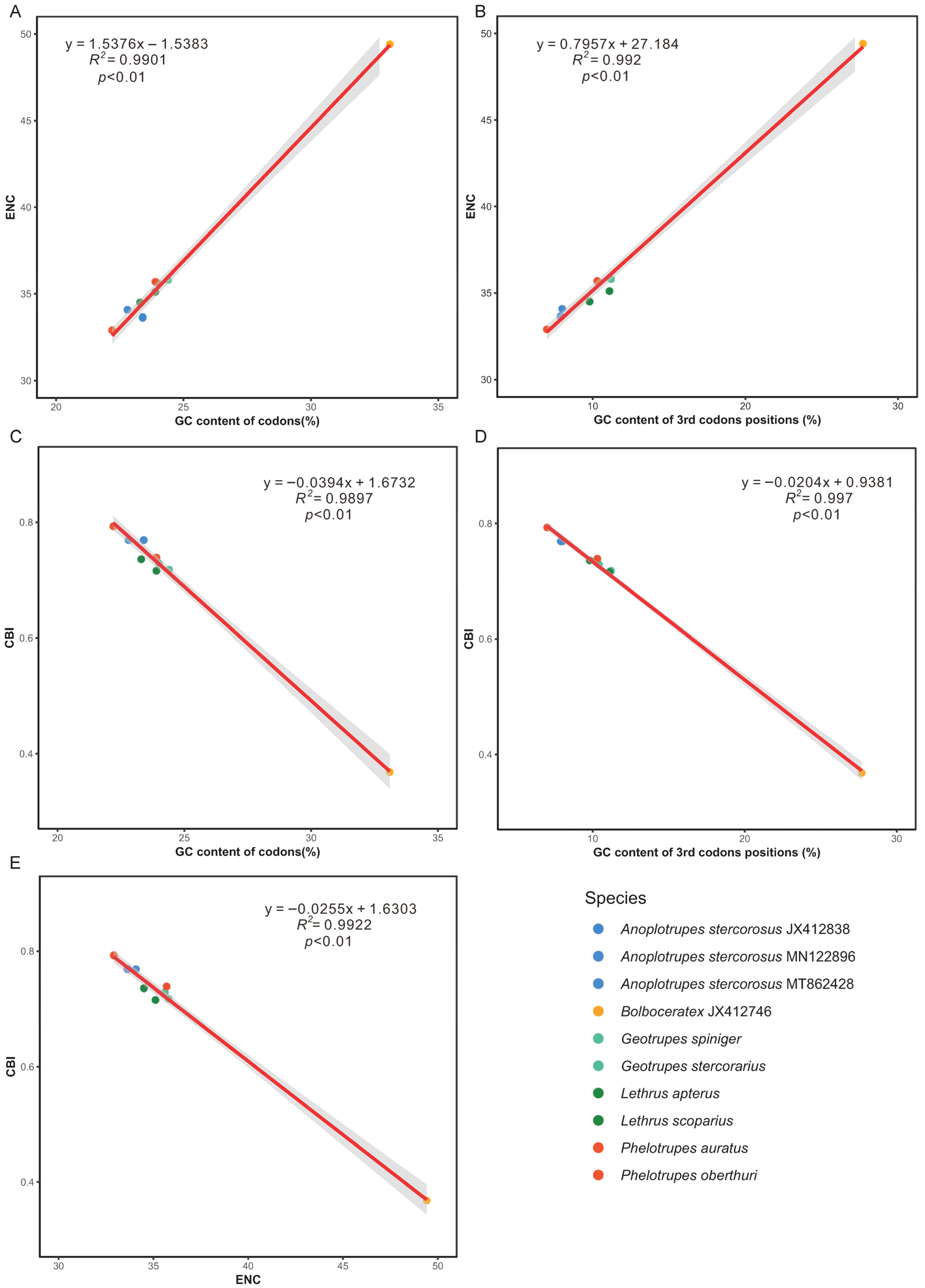
Codon usage analysis revealed a preference for AT-ending codons (Figure S7; Table S7). The effective number of codons (ENC) showed a strong positive correlation with both overall GC% and GC3%, while the codon bias index (CBI) was negatively correlated with these metrics (Figure 3). All species plotted below the expected ENC curve, indicating that factors beyond mutational bias could influence codon usage (Figure S8).

3.3. Structural Conservation of RNA Genes and Non-Coding Regions

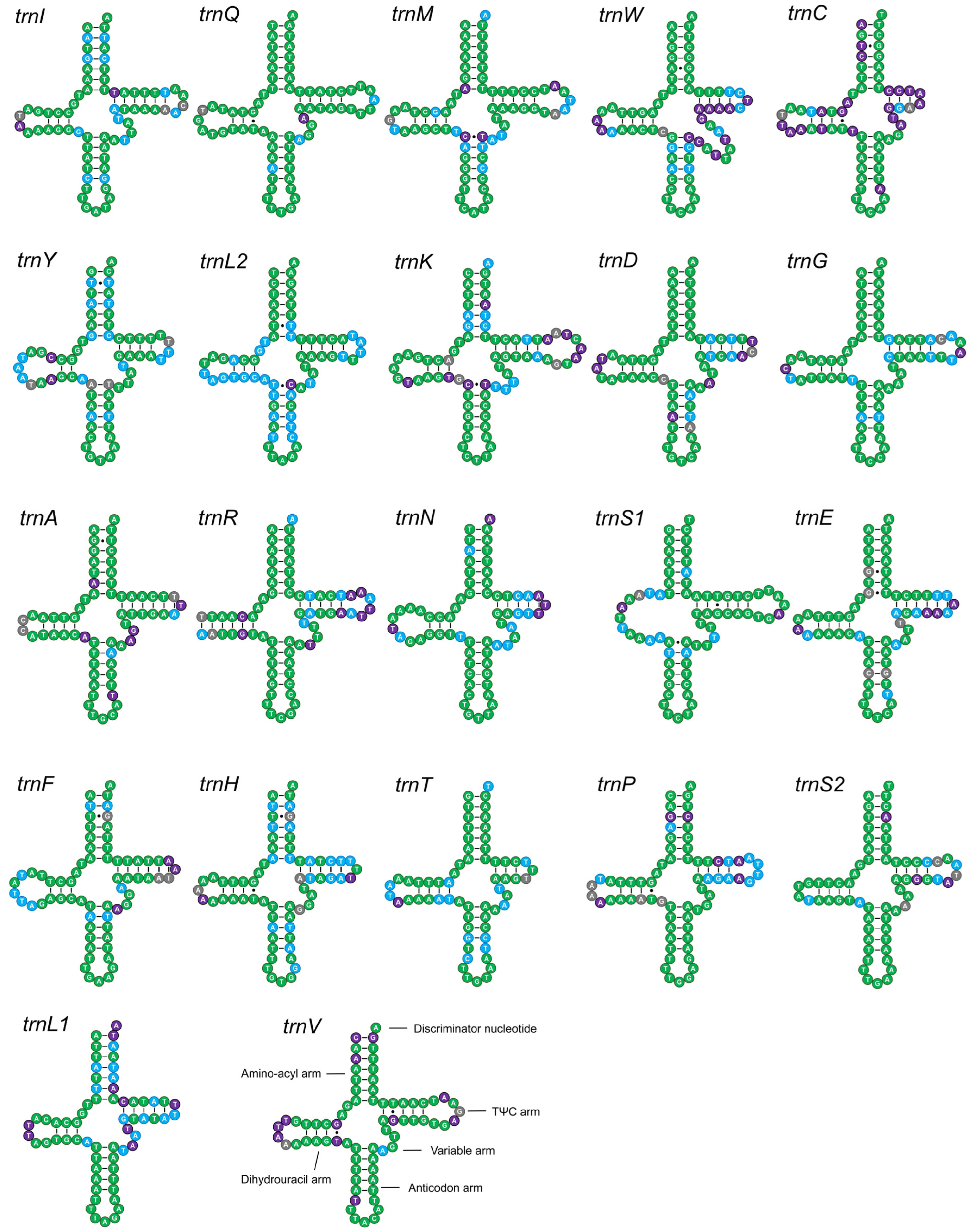
The secondary structures of the 22 tRNAs were highly conserved within Geotrupidae. All exhibited the typical cloverleaf structure except trnS1, which lacked the DHU arm. Sequence conservation rates for tRNAs ranged from 54.41% (family level) to 100% (within some subfamilies) (Figure 4). The lengths of rrnS and rrnL genes were 587–791 bp and 1266–1310 bp, respectively, with A+T contents above 78%. Sequence conservation was highest within each subfamily, particularly in Lethrinae.
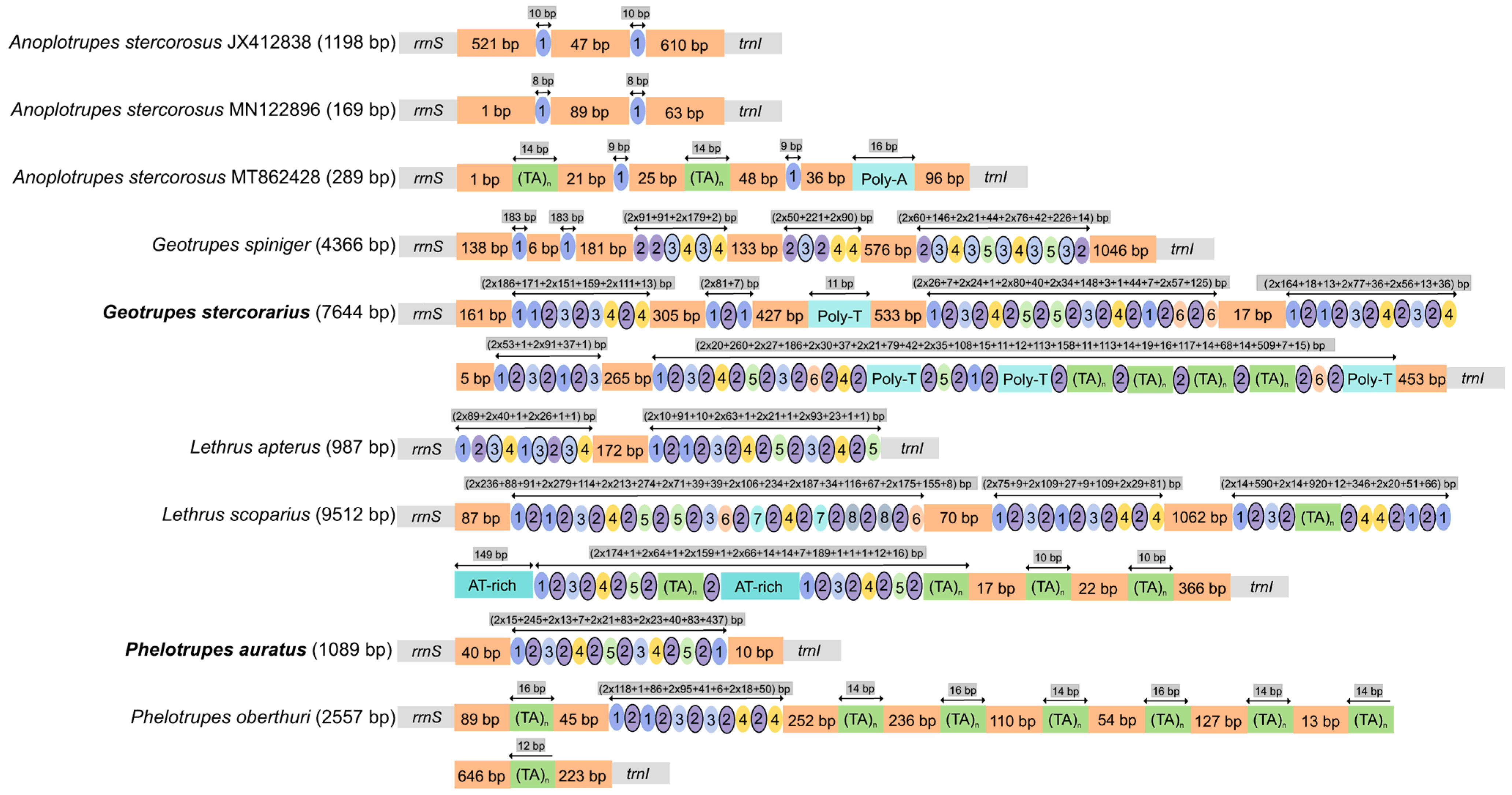
The control region (CR), located between rrnS and trnI, was the major source of genome size variation, containing AT-rich segments and repetitive sequences. Its length varied dramatically from 169 bp (Anoplotrupes stercorosus MN122896) to 9512 bp (Lethrus scoparius) (Figure 5). While Bolboceratinae species lacked extensive AT-rich repeats, Lethrinae possessed a pronounced AT-rich profile and exhibited a greater number of repeat units than Geotrupinae (Figure 5). Notably, Lethrus scoparius had the longest repeat unit (279 bp), resulting in the longest control region (9512 bp) among all species (Table S8). The two species from the QTP exhibited considerable variation in control region length, with G. stercorarius displaying a more complex structure and a greater number of distinct repetitive units than P. auratus (Figure 5). Additionally, a non-coding region with structural similarity to the CR (containing repetitive units) was identified between nad2 and trnW in both Geotrupinae and Lethrinae, with the longest one (2538 bp) presented in Geotrupes spiniger (Figure S9, Table S9). The repeat copy number in Geotrupinae was higher than that in Lethrinae, and a poly-A structure in this region was unique to the genus Geotrupes (Figure S9). Notably, G. spiniger harbored the longest repeat unit (139 bp), resulting in the longest between nad2 and trnW spacer (2538 bp) across all taxa (Table S9). A short, highly conserved intergenic spacer was consistently found between trnS2 and nad1 across all species, ranging from 7 bp to 23 bp in length (Figure S10).

3.4. Mitochondrial Phylogeny of Geotrupidae

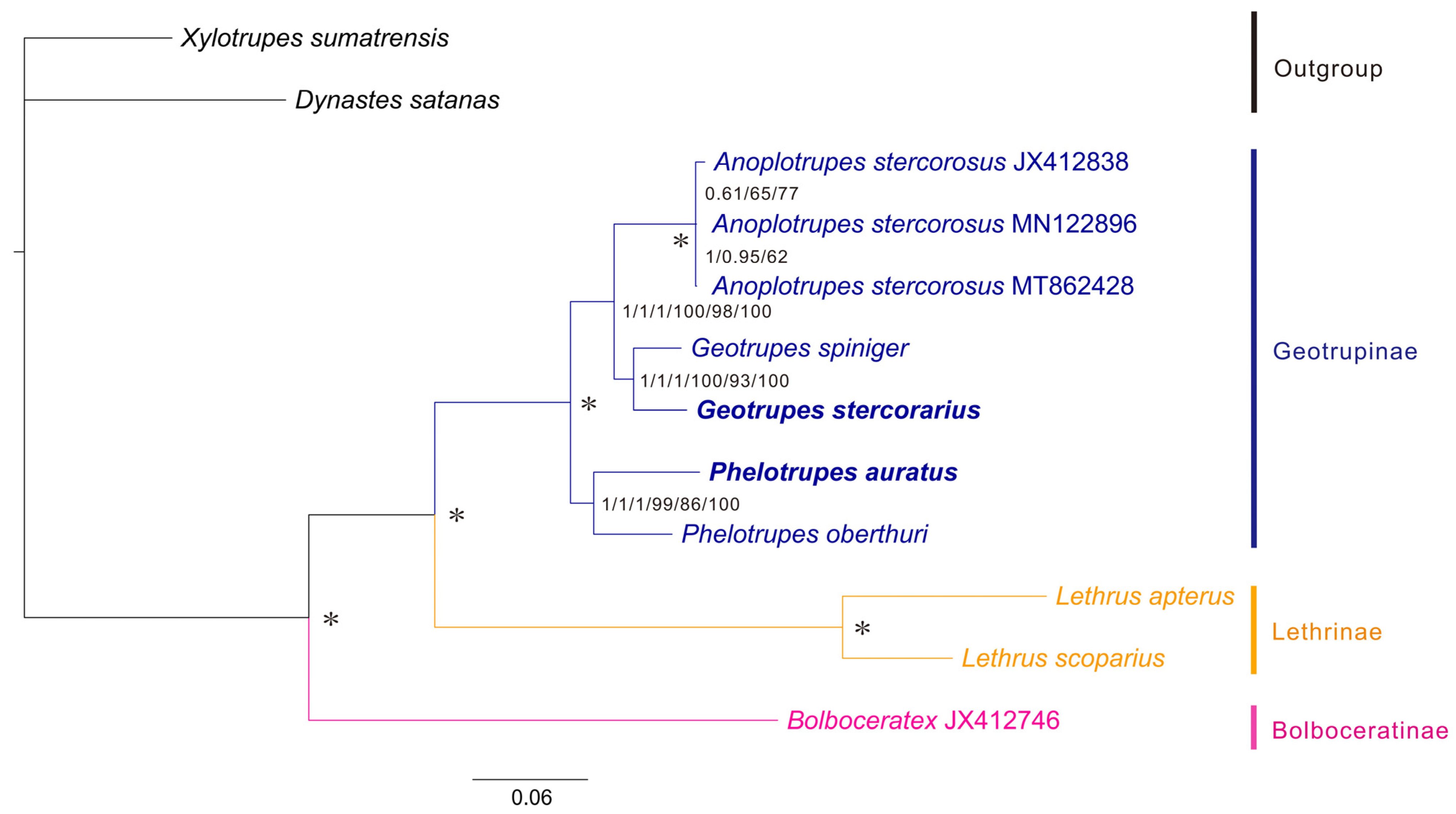
Phylogenetic analyses based on the three datasets (P123, P123AA, P123R) using both ML and BI methods yielded largely congruent and well-supported topologies (Figure 6). The resulting phylogeny strongly supports the monophyly of each of the three subfamilies (all Bayesian Posterior Probabilities, PP = 1.0). Bolboceratinae was recovered as the earliest-diverging lineage, whereas Lethrinae and Geotrupinae formed a sister clade with strong support (PP = 1.0). Within Geotrupinae, Geotrupes stercorarius formed a well-supported clade with G. spiniger. This Geotrupes clade was recovered as the sister group to the genus Anoplotrupes (PP = 1.0), with the genus Phelotrupes positioned as the basal lineage within the subfamily (Figure 6).

4. Discussion

4.1. A Robust Phylogenetic Framework for Geotrupidae and Its Taxonomic Implications

The primary contribution of this study is the establishment of a well-supported mitochondrial phylogenomic framework for Geotrupidae. Our analyses based on multiple datasets and inference methods consistently recovered the monophyly of the two subfamilies (Geotrupinae, Lethrinae) with strong supports (Figure 6), which was consistent with previous studies based on larval morphological characteristics and partial single-gene sequences [17,37]. The taxonomic status of Bolboceratinae remains a matter of debate to this day [38,39]. The recovered topology—(Bolboceratinae, (Lethrinae, Geotrupinae))—was consistent with previous studies [17] and offered an evolutionary narrative congruent with ecological shifts. The basal position of the predominantly saprophagous Bolboceratinae suggested that coprophagy, the defining habit of Geotrupinae and Lethrinae, is a derived trait within the family. This supports the hypothesis of an evolutionary transition from generalist saprophagy to specialized dung-feeding, a key innovation that may have driven diversification in this group [11,40].
Crucially, by incorporating G. stercorarius and P. auratus into a mitogenomic phylogeny for the first time, we resolved the relationships among Geotrupes, Phelotrupes, and Anoplotrupes within Geotrupinae. This result further supports that these three genera belong to the same evolutionary lineage [37], which is consistent with their shared morphological characteristics, such as coprophagous nesting behavior [6,41,42].
The unstable positioning of conspecific sequences and the generally higher node support in BI trees compared to ML BS values both pointed to limitations in mitochondria data for resolving shallow divergences. This may arise from insufficient accumulation of mitochondrial genetic variation following recent population divergence or mitochondrial gene flow between related populations, which can obscure lineage boundaries [43,44]. These issues highlight the inherent limitations of mitogenomes in resolving very recent divergences or complex population histories [8,45], as indicated by the Carbula humerigera complex, where mitogenomes failed to delineate recent species accurately compared to nuclear genes [46]. These sequences likely represent distinct geographical populations where incomplete lineage sorting or mitochondrial introgression obscures phylogenetic signal [47]. This underscores the necessity of future studies to incorporate multi-locus nuclear data to fully resolve species-level relationships and population structure within Geotrupidae.

4.2. Conserved and Variable Features in Geotrupidae Mitogenomes

Our comparative analysis reveals a highly conserved mitogenomic architecture across Geotrupidae, consistent with the pattern observed in most insects [10]. No gene rearrangements were detected, and the core set of 37 genes and their order are maintained. The most striking source of genomic variation is the extreme length polymorphism of CR, which accounted for nearly all size differences between species (e.g., ~9.5 kb in Lethrus scoparius vs. ~1 kb in others). CR expansion via tandem repeats is common in beetles and these repetitive regions hold potential as population-level markers [48], though their functional and evolutionary significance in Geotrupidae warrants further study. Concurrently, the number of tandem repeat sequences within this segment correlates with the size of CR, a phenomenon also observed in other species [49]. Moreover, a distinct inverse relationship existed between sequence size and the number of tandem repeats [50]. In G. stercorarius and P. auratus, two repeat sequences were arranged in parallel, clearly demonstrating a sequence pattern that competitively accumulated the maximum possible number of copies [51]. The discovery of an extended, repeat-containing non-coding region between nad2 and trnW in some species (notably Geotrupes spiniger) was intriguing. While its function was unknown, analogous regions in other insects have been implicated in replication regulation [12,52], suggesting a target for future functional investigation.
Strong AT bias and codon usage preferences are pervasive, with the third codon position being exceptionally AT-rich. This is attributed to mutational pressure and is a common feature of insect mitogenomes, likely reflecting replication or transcription-associated strand asymmetry [8,12]. Notably, the two newly sequenced species from the QTP did not exhibit markedly divergent base composition or codon usage patterns from their lowland congeners, suggesting that the extreme mitochondrial genomic environment is primarily shaped by deep phylogenetic history rather than recent altitude-associated adaptation [53].
All PCGs are under strong purifying selection (Ka/Ks << 1), with the expected pattern of cox1 being the most conserved and atp8 the most rapidly evolving. The high conservation of cox1 reaffirms its utility as a DNA barcode for species identification in this family [54].

4.3. Insights and Perspectives on High-Altitude Lineages and Future Research

A key objective of this study was to examine the mitogenomes of high-altitude dung beetle lineages for signatures of adaptation. Our PAML analyses did not detect widespread positive selection across the 13 PCGs when considering the two QTP species as a foreground branch, suggesting that high-altitude adaptation in these Geotrupes and Phelotrupes populations may not be strongly mediated by amino acid changes in mitochondrial proteins [55,56]. The extreme conditions of the QTP (hypoxia, low temperature, strong UV radiation) exert strong selective pressure on energy metabolism, membrane stability, and genetic integrity [57,58]. Adaptive evolution to these stressors may therefore involve multiple synergistic mechanisms beyond positive selection in protein-coding genes, such as: (1) nuclear-regulated changes in mitochondrial function or biochemical adjustments (Comparative studies on other QTP endemics, like mammals and insects, reveal both conserved and lineage-specific adaptive strategies to these extremes [59,60]); (2) structural variations in non-coding regions influencing replication or transcription efficiency; and (3) biochemical or physiological adjustments (e.g., metabolic rate modulation) not requiring fixed changes in PCG sequences [61,62]. The single signal of positive selection on atp6 in one species (Phelotrupes auratus) when analyzed alone requires cautious interpretation and validation with larger population-level sampling, as it could reflect lineage-specific innovation or a false positive [63,64].
Further study is needed by expanding taxa sampling and integrating diverse data (e.g., nuclear genomic, transcriptomic, or phenotypic) to comprehensively test adaptation hypotheses, resolve shallow nodes, and understand the full evolutionary history of Geotrupidae. Despite these limitations, our work provides valuable mitochondrial genome resources—the first complete mitogenomes for two QTP dung beetle species and a robust subfamily-level phylogeny—that will facilitate and guide these future investigations.

5. Conclusions

This study provides the first complete mitogenomes for Geotrupidae from the QTP. Our comparative analyses confirmed a conserved gene order and composition across the family, with the control region identified as the primary source of structural variation. The mitogenomic phylogeny robustly resolved subfamily relationships, supporting a phylogeny of (Bolboceratinae, (Lethrinae, Geotrupinae)) and establishing a sister-group relationship between Anoplotrupes and Geotrupes within Geotrupinae. All PCGs were under strong purifying selection, and no widespread positive selection linked to high-altitude adaptation was detected. Together, these results provide a crucial phylogenetic framework and genomic resources for the family. Future studies should integrate nuclear genomic data and focus on the functional role of dynamic non-coding regions to fully unravel the group’s evolutionary history and adaptation mechanisms.

Supplementary Materials

The following supporting information can be downloaded at: https://www.mdpi.com/article/10.3390/biology15020164/s1, Figure S1: Size comparison of mitochondrial genomic components across Geotrupidae. Bars represent the lengths (in base pairs) of protein-coding genes (PCGs, concatenated), ribosomal RNA genes (rrnL, rrnS), the control region (CR), and transfer RNA genes (tRNAs, concatenated) for each species. Species are abbreviated as follows: As, Anoplotrupes stercorosus JX412838; Ast, Anoplotrupes stercorosus MN122896; Aste, Anoplotrupes stercorosus MT862428; Bo, Bolboceratex JX412746; Gs, Geotrupes spiniger; Gst, Geotrupes stercorarius; La, Lethrus apterus; Ls, Lethrus scoparius; Pa, Phelotrupes auratus; Po, Phelotrupes oberthuri; Figure S2: A+T content variation in mitochondrial protein-coding genes across Geotrupidae subfamilies. The scatter plot shows the mean A+T content (with standard deviation) for all 13 PCGs combined within each of the three subfamilies: Geotrupinae, Lethrinae, and Bolboceratinae; Figure S3: Nucleotide diversity varies among 13 protein-coding genes: (A) inter-gene variation; (B) inter-genus variation. * p < 0.05, ** p < 0.01, *** p < 0.001; independent samples t-test. Different colors denote different genera; Figure S4: Nucleotide diversity (Pi) of mitochondrial protein-coding genes. Sliding window analysis (window: 100 bp, step: 25 bp) was performed separately for the two newly sequenced species (blue lines) and the eight previously published species (red lines) to compare sequence polymorphism across each of the 13 PCGs; Figure S5: Evolutionary rates and GC content of mitochondrial protein-coding genes in Geotrupidae. For each of the 13 PCGs, the bar chart shows the mean Ka/Ks ratio (left Y-axis) across all species, and the line plot shows the corresponding mean G+C content (right Y-axis). Error bars represent standard deviation; Figure S6: Correlation between evolutionary rate (Ka/Ks) and G+C content for mitochondrial protein-coding genes. Each point represents one of the 13 PCGs. The regression line and coefficient of determination (R2) are shown; Figure S7: Relative Synonymous Codon Usage (RSCU) in the two newly sequenced mitogenomes. RSCU values for all codons used in the mitochondrial PCGs of Geotrupes stercorarius and Phelotrupes auratus. Codon families are color-coded by their corresponding amino acid. An RSCU value > 1.0 indicates a codon is used more frequently than expected under equal usage; Figure S8: Patterns of codon usage in Geotrupidae mitogenomes. (A) Relationship between the effective number of codons (ENC) and GC3 content. The solid curve (ENC*) represents the expected ENC under pure mutational bias. (B) Relationship between GC content at the first and second codon positions (GC12) and at the third position (GC3). The diagonal dashed line (y = x) is provided for reference; Figure S9: Structural organization of the intergenic spacer between nad2 and trnW in Geotrupidae mitogenomes. The diagram annotations follow the same scheme as in Figure 5; Figure S10: Sequence alignment of the conserved intergenic spacer between trnS2 and nad1. Bases conserved across all ten Geotrupidae species are highlighted in dark gray. Sequences from the two newly sequenced species are marked with a red asterisk. Light blue shading indicates bases conserved within Geotrupinae, and light green shading indicates bases conserved within Lethrinae; Table S1: Sample collection details for the newly sequenced Geotrupidae specimens; Table S2: List of Geotrupidae species used in this study with their taxonomic classification and GenBank accession numbers. Newly sequenced mitogenomes are highlighted with an asterisk; Table S3: Results of substitution saturation tests (DAMBE analysis) for the phylogenetic datasets. Iss, index of substitution saturation; Iss.cS, the critical Iss value; Table S4: The best partitioning schemes and substitution models selected by IQ-TREE for the three datasets; Table S5: Annotation of the complete mitochondrial genomes of Geotrupes stercorarius and Phelotrupes auratus; Table S6: Results of the branch-site model in PAML; Table S7: Codon usage statistics for the 13 mitochondrial protein-coding genes across Geotrupidae mitogenomes. RSCU, relative synonymous codon usage; %, percentage of the total count; AA, amino acid; Table S8: Maximum tandem repeats in the mitochondrial control regions of nine Geotrupidae species; Table S9: Maximum tandem repeats in the mitochondrial “nad2-trnW” intergenic spacer of six Geotrupidae species. Reference [10] is cited in the Supplementary Materials.

Author Contributions

Conceptualization, M.-L.Y.; Methodology, H.W., S.-M.A. and H.-H.-Y.L.; Software, H.W. and S.-M.A.; Validation, H.W., S.-M.A. and S.-J.L.; Formal Analysis, H.W. and H.-H.-Y.L.; Investigation, H.W., S.-M.A., H.-H.-Y.L. and S.-J.L.; Resources, H.W., H.-H.-Y.L. and S.-J.L.; Data Curation, S.-M.A. and S.-J.L.; Writing—Original Draft Preparation, H.W. and S.-M.A.; Writing—Review & Editing, M.-L.Y. and Y.-X.W.; Visualization, H.W.; Supervision, M.-L.Y. and Y.-X.W.; Project Administration, H.W.; Funding Acquisition, M.-L.Y. and Y.-X.W. All authors have read and agreed to the published version of the manuscript.

Funding

This study was funded by the Second Tibetan Plateau Scientific Expedition and Research (STEP) Program (2019QZKK0302) and the Earmarked Fund for XJARS (XJARS-13).

Institutional Review Board Statement

Not applicable.

Informed Consent Statement

Not applicable.

Data Availability Statement

The two mitochondrial genome sequences newly sequenced in this study have been deposited at GenBank under the accession number PX715248-49.

Conflicts of Interest

The authors declare no conflicts of interest.

References

  1. Engel, M. Family-group names in Coleoptera (Insecta), redux. Zookeys 2011, 148, 171–184. [Google Scholar] [CrossRef]
  2. Luo, Y.P.; Lu, Y.Y.; Wang, X.P.; Bai, M. Advances in the taxonomy of Geotrupidae and the current study progress of species in China. J. Environ. Entomol. 2025, 1–23. Available online: https://link.cnki.net/urlid/44.1640.Q.20250704.1918.008 (accessed on 13 January 2026). (In Chinese)
  3. Browne, J.; Scholtz, C.H. A phylogeny of the families of Scarabaeoidea (Coleoptera). Syst. Entomol. 1999, 24, 51–84. [Google Scholar] [CrossRef]
  4. Scholtz, C.H.; Browne, D.J. Polyphyly in the Geotrupidae (Coleoptera: Scarabaeoidea): A case for a new family. J. Nat. Hist. 1996, 30, 597–614. [Google Scholar] [CrossRef]
  5. Rossini, M.; Forshage, M. On the types of Bolboceratidae (Coleoptera: Scarabaeoidea) in the Swedish Museum of Natural History in Stockholm. Zootaxa 2023, 5301, 427–446. [Google Scholar] [CrossRef] [PubMed]
  6. Lawrence, J.F.; Ślipiski, A.; Seago, A.E.; Thayer, M.K.; Newton, A.F.; Marvaldi, A.E. Phylogeny of the Coleoptera based on morphological characters of adults and larvae. Ann. Zool. 2011, 61, 1–217. [Google Scholar] [CrossRef]
  7. Gustafson, G.T.; Baca, S.M.; Alexander, A.M.; Short, A. Phylogenomic analysis of the beetle suborder Adephaga with comparison of tailored and generalized ultraconserved element probe performance. Syst. Entomol. 2020, 45, 552–570. [Google Scholar] [CrossRef]
  8. Cameron, S.L. Insect mitochondrial genomics: A decade of progress. Annu. Rev. Entomol. 2025, 70, 83–101. [Google Scholar] [CrossRef]
  9. Wei, Z.H.; Shi, A.M. The complete mitochondrial genomes of four lagriine species (Coleoptera, Tenebrionidae) and phylogenetic relationships within Tenebrionidae. PeerJ 2023, 11, e15483. [Google Scholar] [CrossRef]
  10. Bubán, R.Z.; Tóth, R.B.; Freytag, C.; Sramkó, G.; Barta, Z.; Nagy, N.A. The first complete mitochondrial genome of a Lethrus species (Coleoptera, Geotrupidae) with phylogenetic implications. Zookeys 2025, 1236, 1–17. [Google Scholar] [CrossRef]
  11. Hanski, I.; Cambefort, Y. Dung Beetle Ecology; Princeton University Press: Princeton, NJ, USA, 2014. [Google Scholar]
  12. Zhang, H.H.; He, Q.J.; Zhao, Z.Y.; Zhang, B.; Zhou, J.; Wang, C.Y.; Yi, C.H.; Zhao, M. Mitochondrial genome comparison and phylogenetic analysis of four species of dung beetles (Coleoptera: Scarabaeidae: Scarabaeinae). Ecol. Evol. 2025, 15, e71906. [Google Scholar] [CrossRef] [PubMed]
  13. Natta, G.; Voyron, S.; Lumini, E.; Laini, A.; Santovito, A.; Roggero, A.; Palestrini, C.; Rolando, A. DNA metabarcoding of gut microbiota reveals considerable taxonomic diff erences among wild individuals of the dung beetle Trypocopris pyrenaeus (Coleoptera: Geotrupidae). Eur. J. Entomol. 2024, 121, 40–53. [Google Scholar] [CrossRef]
  14. Tóth, J.P.; Bereczki, J.; Rácz, R.; Varga, Z.; Barta, Z.; Sramkó, G. Phylogenetic relationships in the genus Lethrus (Coleoptera: Geotrupidae) reveal contrasting evolutionary history in Europe. Syst. Entomol. 2019, 44, 899–910. [Google Scholar] [CrossRef]
  15. Carisio, L.; Cervella, P.; Palestrini, C.; DelPero, M.; Rolando, A. Biogeographical patterns of genetic differentiation in dung beetles of the genus Trypocopris (Coleoptera, Geotrupidae) inferred from mtDNA and AFLP analyses. J. Biogeogr. 2004, 31, 1149–1162. [Google Scholar] [CrossRef]
  16. Niogret, J.; Felix, A.-E.; Nicot, A.; Lumaret, J.-P. Chemosystematics using cuticular compounds: A powerful tool to separate species in Mediterranean dung beetles (Coleoptera: Geotrupidae). J. Insect Sci. 2019, 19, 18. [Google Scholar] [CrossRef]
  17. Cunha, R.L.; Verdú, J.R.; Lobo, J.M.; Zardoya, R. Ancient origin of endemic Iberian earth-boring dung beetles (Geotrupidae). Mol. Phylogenet. Evol. 2011, 59, 578–586. [Google Scholar] [CrossRef]
  18. Chen, S.F.; Zhou, Y.Q.; Chen, Y.R.; Gu, J. Fastp: An ultra-fast all-in-one FASTQ preprocessor. Bioinformatics 2018, 34, 884–890. [Google Scholar] [CrossRef]
  19. Jin, J.J.; Yu, W.B.; Yang, J.B.; Song, Y.; de Pamphilis, C.W.; Yi, T.S.; Li, D.Z. GetOrganelle: A fast and versatile toolkit for accurate de novo assembly of organelle genomes. Genome Biol. 2020, 21, 241. [Google Scholar] [CrossRef]
  20. Meng, G.L.; Li, Y.Y.; Yang, C.T.; Liu, S.L. MitoZ: A toolkit for animal mitochondrial genome assembly, annotation and visualization. Nucleic Acids Res. 2019, 47, e63. [Google Scholar] [CrossRef]
  21. Grant, J.R.; Stothard, P. The CGView Server: A comparative genomics tool for circular genomes. Nucleic Acids Res. 2008, 36, W181–W184. [Google Scholar] [CrossRef]
  22. Perna, N.T.; Kocher, T.D. Patterns of nucleotide composition at fourfold degenerate sites of animal mitochondrial genomes. J. Mol. Evol. 1995, 41, 353–358. [Google Scholar] [CrossRef] [PubMed]
  23. Tamura, K.; Stecher, G.; Kumar, S. MEGA11: Molecular evolutionary genetics analysis version 11. Mol. Biol. Evol. 2021, 38, 3022–3027. [Google Scholar] [CrossRef] [PubMed]
  24. Rozas, J.; Ferrer-Mata, A.; Sánchez-DelBarrio, J.C.; Guirao-Rico, S.; Librado, P.; Ramos-Onsins, S.E.; Sánchez-Gracia, A. DnaSP 6: DNA sequence polymorphism analysis of large data sets. Mol. Biol. Evol. 2017, 34, 3299–3302. [Google Scholar] [CrossRef] [PubMed]
  25. Yang, Z.H. PAML 4: Phylogenetic analysis by maximum likelihood. Mol. Biol. Evol. 2007, 24, 1586–1591. [Google Scholar] [CrossRef]
  26. Zhang, J.Z.; Nielsen, R.; Yang, Z.H. Evaluation of an improved branch-site likelihood method for detecting positive selection at the molecular level. Mol. Biol. Evol. 2005, 22, 2472–2479. [Google Scholar] [CrossRef]
  27. Benson, G. Tandem repeats finder: A program to analyze DNA sequences. Nucleic Acids Res. 1999, 27, 573–580. [Google Scholar] [CrossRef]
  28. Katoh, K.; Standley, D.M. MAFFT multiple sequence alignment software version 7: Improvements in performance and usability. Mol. Biol. Evol. 2013, 30, 772–780. [Google Scholar] [CrossRef]
  29. Castresana, J. Selection of conserved blocks from multiple alignments for their use in phylogenetic analysis. Mol. Biol. Evol. 2000, 17, 540–552. [Google Scholar] [CrossRef]
  30. Xia, X.H. DAMBE7: New and improved tools for data analysis in molecular biology and evolution. Mol. Biol. Evol. 2018, 35, 1550–1552. [Google Scholar] [CrossRef]
  31. Minh, B.Q.; Schmidt, H.A.; Chernomor, O.; Schrempf, D.; Woodhams, M.D.; von Haeseler, A.; Lanfear, R. IQ-TREE 2: New models and efficient methods for phylogenetic inference in the genomic era. Mol. Biol. Evol. 2020, 37, 1530–1534. [Google Scholar] [CrossRef]
  32. Kalyaanamoorthy, S.; Minh, B.Q.; Wong, T.K.F.; von Haeseler, A.; Jermiin, L.S. ModelFinder: Fast model selection for accurate phylogenetic estimates. Nat. Methods 2017, 14, 587–589. [Google Scholar] [CrossRef]
  33. Stamatakis, A. RAxML version 8: A tool for phylogenetic analysis and post-analysis of large phylogenies. Bioinformatics 2014, 30, 1312–1313. [Google Scholar] [CrossRef] [PubMed]
  34. Hoang, D.T.; Chernomor, O.; von Haeseler, A.; Minh, B.Q.; Vinh, L.S. UFBoot2: Improving the ultrafast bootstrap approximation. Mol. Biol. Evol. 2018, 35, 518–522. [Google Scholar] [CrossRef] [PubMed]
  35. Ronquist, F.; Teslenko, M.; van der Mark, P.; Ayres, D.L.; Darling, A.; Höhna, S.; Larget, B.; Liu, L.; Suchard, M.A.; Huelsenbeck, J.P. MrBayes 3.2: Efficient Bayesian phylogenetic inference and model choice across a large model space. Syst. Biol. 2012, 61, 539–542. [Google Scholar] [CrossRef]
  36. Czech, L.; Huerta-Cepas, J.; Stamatakis, A. TreeView: An application to display phylogenetic trees on personal computers (vol 124, pg 357, 1996). Mol. Biol. Evol. 2017, 34, 2427. [Google Scholar] [CrossRef][Green Version]
  37. Verdú, J.R.; Galante, E.; Lumaret, J.P.; Cabrero-Sañudo, F.J. Phylogenetic analysis of Geotrupidae (Coleoptera, Scarabaeoidea) based on larvae. Syst. Entomol. 2004, 29, 509–523. [Google Scholar] [CrossRef]
  38. Zhang, S.Q.; Che, L.H.; Li, Y.; Liang, D.; Pang, H.; Ślipiński, A.; Zhang, P. Evolutionary history of Coleoptera revealed by extensive sampling of genes and species. Nat. Commun. 2018, 9, 205. [Google Scholar] [CrossRef]
  39. Dietz, L.; Seidel, M.; Eberle, J.; Misof, B.; Pacheco, T.L.; Podsiadlowski, L.; Ranasinghe, S.; Gunter, N.L.; Niehuis, O.; Mayer, C. A transcriptome-based phylogeny of Scarabaeoidea confirms the sister group relationship of dung beetles and phytophagous pleurostict scarabs (Coleoptera). Syst. Entomol. 2023, 48, 672–686. [Google Scholar] [CrossRef]
  40. Andujar, C.; Serrano, J.; Gomez-Zurita, J. Winding up the molecular clock in the genus Carabus (Coleoptera: Carabidae): Assessment of methodological decisions on rate and node age estimation. BMC Evol. Biol. 2012, 12, 40. [Google Scholar] [CrossRef]
  41. Löbl, I.; Smetana, A. Catalogue of Palaearctic Coleoptera, Volume 1: Archostemata-Myxophaga-Adephaga; Apollo Books: Stenstrup, Denmark, 2003; p. 819. [Google Scholar]
  42. Ochi, T.; Kon, M.; Bai, M. Nine new taxa of the genera Odontotrypes and Phelotrupes (Coleoptera, Geotrupidae) from China. Elytra 2017, 7, 85–104. [Google Scholar]
  43. Ravago-Gotanco, R.; de la Cruz, T.L.; Pante, M.J.; Borsa, P. Cryptic genetic diversity in the mottled rabbitfish Siganus fuscescens with mitochondrial introgression at a contact zone in the South China Sea. PLoS ONE 2018, 13, e0193220. [Google Scholar] [CrossRef]
  44. Funk, D.J.; Omland, K.E. Species-level paraphyly and polyphyly: Frequency, causes, and consequences, with insights from animal mitochondrial DNA. Annu. Rev. Ecol. Evol. Syst. 2003, 34, 397–423. [Google Scholar] [CrossRef]
  45. Ballard, J.W.O.; Whitlock, M.C. The incomplete natural history of mitochondria. Mol. Ecol. 2004, 13, 729–744. [Google Scholar] [CrossRef] [PubMed]
  46. Zhou, J.Y.; Wang, S.J.; Yu, S.J.; Li, Y.F.; Qiao, M.; Zhao, Q.; Hughes, E.; Liu, H.X.; Bu, W.J. Limits of mitochondrial genes in delimiting species within a Carbula species complex (Hemiptera: Pentatomidae). Arch. Insect Biochem. Physiol. 2023, 115, e22075. [Google Scholar] [CrossRef] [PubMed]
  47. Avise, J.C. Phylogeography: The History and Formation of Species; Harvard University Press: Cambridge, MA, USA, 2000. [Google Scholar]
  48. Morgan, B.; Wang, T.Y.; Chen, Y.Z.; Moctezuma, V.; Burgos, O.; Le, M.H.; Huang, J.P. Long-read sequencing data reveals dynamic evolution of mitochondrial genome size and the phylogenetic utility of mitochondrial DNA in Hercules beetles (Dynastes; Scarabaeidae). Genome Biol. Evol. 2022, 14, evac147. [Google Scholar] [CrossRef]
  49. Liu, Y.G.; Kurokawa, T.; Sekino, M.; Tanabe, T.; Watanabe, K. Complete mitochondrial DNA sequence of the ark shell Scapharca broughtonii: An ultra-large metazoan mitochondrial genome. Comp. Biochem. Physiol. Part D Genom. 2013, 8, 72–81. [Google Scholar] [CrossRef]
  50. Sung, W.; Tucker, A.; Bergeron, R.D.; Lynch, M.; Thomas, W.K. Simple sequence repeat variation in the Daphnia pulex genome. BMC Genom. 2010, 11, 691. [Google Scholar] [CrossRef]
  51. Zhang, H.Y.; Chang, M.D.; Zhang, X.C.; Cai, P.Y.; Dai, Y.X.; Song, T.Z.; Wu, Z.Z.; Xu, H.J.; Qiao, M.Q. Functional identification and evolutionary analysis of two novel plasmids mediating quinolone resistance in Proteus vulgaris. Microorganisms 2020, 8, 1074. [Google Scholar] [CrossRef]
  52. Szafranski, P. New Dielis species and structural dichotomy of the mitochondrial cox2 gene in Scoliidae wasps. Sci. Rep. 2023, 13, 1950. [Google Scholar] [CrossRef]
  53. Theodoridis, S.; Fordham, D.A.; Brown, S.C.; Li, S.; Rahbek, C.; Nogues-Bravo, D. Evolutionary history and past climate change shape the distribution of genetic diversity in terrestrial mammals. Nat. Commun. 2020, 11, 2557. [Google Scholar] [CrossRef]
  54. Bianchi, F.M.; Gonçalves, L.T. Borrowing the pentatomomorpha tome from the DNA barcode library: Scanning the overall performance of cox1 as a tool. J. Zool. Syst. Evol. Res. 2021, 59, 992–1012. [Google Scholar] [CrossRef]
  55. Henderson, D.M.; Lee, A.; Ervasti, J.M. Disease-causing missense mutations in actin binding domain 1 of dystrophin induce thermodynamic instability and protein aggregation. Proc. Natl. Acad. Sci. USA 2010, 107, 9632–9637. [Google Scholar] [CrossRef] [PubMed]
  56. Caporali, L.; Iommarini, L.; La Morgia, C.; Olivieri, A.; Achilli, A.; Maresca, A.; Valentino, M.L.; Capristo, M.; Tagliavini, F.; Del Dotto, V. Peculiar combinations of individually non-pathogenic missense mitochondrial DNA variants cause low penetrance Leber’s hereditary optic neuropathy. PLoS Genet. 2018, 14, e1007210. [Google Scholar] [CrossRef] [PubMed]
  57. Hao, Y.; Xiong, Y.; Cheng, Y.L.; Song, G.; Jia, C.X.; Qu, Y.H.; Lei, F.M. Comparative transcriptomics of 3 high-altitude passerine birds and their low-altitude relatives. Proc. Natl. Acad. Sci. USA 2019, 116, 11851–11856. [Google Scholar] [CrossRef]
  58. Xiong, Y.; Fan, L.Q.; Hao, Y.; Cheng, Y.L.; Chang, Y.B.; Wang, J.; Lin, H.Y.; Song, G.; Qu, Y.H.; Lei, F.M. Physiological and genetic convergence supports hypoxia resistance in high-altitude songbirds. PLoS Genet. 2020, 16, e1009270. [Google Scholar] [CrossRef]
  59. Wu, D.D.; Yang, C.P.; Wang, M.S.; Dong, K.Z.; Yan, D.W.; Hao, Z.Q.; Fan, S.Q.; Chu, S.Z.; Shen, Q.S.; Jiang, L.P. Convergent genomic signatures of high-altitude adaptation among domestic mammals. Natl. Sci. Rev. 2020, 7, 952–963. [Google Scholar] [CrossRef]
  60. Zhao, Y.J.; Su, C.Y.; He, B.; Nie, R.; Wang, Y.L.; Ma, J.Y.; Song, J.Y.; Yang, Q.; Hao, J.S. Dispersal from the Qinghai-Tibet plateau by a high-altitude butterfly is associated with rapid expansion and reorganization of its genome. Nat. Commun. 2023, 14, 8190. [Google Scholar] [CrossRef]
  61. Chitra, L.; Boopathy, R. Altered mitochondrial biogenesis and its fusion gene expression is involved in the high-altitude adaptation of rat lung. Respir. Physiol. Neurobiol. 2014, 192, 74–84. [Google Scholar] [CrossRef]
  62. Lai, D.W.; Qu, X.L.; Wang, Z.; He, S.; Li, X.Z.; Bao, Q.; Sun, G.M.; Zhang, J.; Zhu, Y.B.; Yi, G.Q. Integrative genomic, transcriptomic and epigenomic analysis reveals cis-regulatory contributions to high-altitude adaptation in Tibetan pigs. Mol. Biol. Evol. 2025, 42, msaf169. [Google Scholar] [CrossRef]
  63. Yang, Z.H.; Nielsen, R.; Goldman, N.; Pedersen, A.-M.K. Codon-substitution models for heterogeneous selection pressure at amino acid sites. Genetics 2000, 155, 431–449. [Google Scholar] [CrossRef]
  64. Kosakovsky Pond, S.L.; Frost, S.D. Not so different after all: A comparison of methods for detecting amino acid sites under selection. Mol. Biol. Evol. 2005, 22, 1208–1222. [Google Scholar] [CrossRef]
Figure 1. Circular maps of the mitogenomes of Geotrupes stercorarius (A) and Phelotrupes auratus (B). The maps depict the organization of the 37 mitochondrial genes: 13 protein-coding genes (PCGs, green), 22 transfer RNA genes (tRNAs, orange), and two ribosomal RNA genes (rRNAs, yellow). The major non-coding control region is shown in gray. Genes on the outer strand are transcribed clockwise.
Biology 15 00164 g001
Figure 2. Nucleotide composition skews in Geotrupidae mitogenomes. (A) AT-skew plotted against overall AT content. (B) GC-skew plotted against overall GC content. Values were calculated for the entire major strand (J-strand) of each complete mitochondrial genome.
Biology 15 00164 g002
Figure 3. Analysis of codon usage bias in Geotrupidae mitogenomes. Correlations between (A) effective number of codons (ENC) and overall GC content (GC%), (B) ENC and third-position GC content (GC3%), (C) codon bias index (CBI) and GC3%, (D) CBI and GC%, and (E) ENC and CBI. The red line represents the linear regression fit of the relationship. The shaded area around the line indicates the 95% confidence interval of the regression. Each point represents one species, and the same color denotes one genus.
Biology 15 00164 g003
Figure 4. Predicted secondary structures of the 22 mitochondrial tRNA genes of Geotrupidae. tRNAs are displayed in their genomic order, starting with trnI. Nucleotide conservation is color-coded: green (conserved across all Geotrupidae), blue (conserved within Geotrupinae), purple (conserved within the genus Geotrupes), and gray (not conserved). Watson–Crick pairings are indicated by bars, and G-U wobble pairs by dots.
Biology 15 00164 g004
Figure 5. Structural organization of the mitochondrial control region in Geotrupidae. The region located between rrnS and trnI is depicted for representative species. Key features are annotated: orange blocks (non-repetitive spacers), colored ellipses with numbers (unique tandem repeat units), bordered ellipses (inter-repeat spacers), green blocks (TA motifs), light blue blocks (poly-A/poly-T/AT-rich stretches), and gray blocks (scale). Different numbers and colors indicate different tandem repeat units.
Biology 15 00164 g005
Figure 6. Phylogenetic relationships within Geotrupidae inferred from mitochondrial genomes. Numbers from left to right are Bayesian posterior probabilities (PP) and ML bootstrap (BS) values of each of the three datasets (P123, P123AA and P123R). Asterisk (*) indicates PP = 1.0 and BS = 100.
Biology 15 00164 g006
Disclaimer/Publisher’s Note: The statements, opinions and data contained in all publications are solely those of the individual author(s) and contributor(s) and not of MDPI and/or the editor(s). MDPI and/or the editor(s) disclaim responsibility for any injury to people or property resulting from any ideas, methods, instructions or products referred to in the content.