Review

Steam Explosion Processing of Bast Fibers: Effects on Fiber Structure and Performance in Textile and Composites Applications

1
Laboratoire d'Études et de Recherche sur le Matériau Bois (LERMAB), French National Research Institute for Agriculture, Food and Environment (INRAE), Université de Lorraine, F-54000 Nancy, France
2
Instituto Tecnológico de Aguascalientes, Av. A. López Mateos 1801 Oriente, Aguascalientes 20256, Mexico
3
SECIHTI—Secretaría de Ciencia, Humanidades, Tecnología e Innovación, Benito Juárez 03940, Mexico
4
Université de Lorraine, CentraleSupélec, LMOPS, F-57000 Metz, France
5
Polymers Composites and Hybrids (PCH), IMT Mines Ales, F-30100 Ales, France
6
Key Laboratory of Vegetable Biology of Yunnan Province, College of Landscape and Horticulture, Yunnan Agricultural University, Kunming 650201, China
7
National & Local Joint Engineering Research Center of Technical Fiber Composites for Safety and Health, School of Textile and Clothing, Nantong University, Nantong 226019, China
*
Authors to whom correspondence should be addressed.
Fibers 2026, 14(7), 79; https://doi.org/10.3390/fib14070079
Submission received: 15 May 2026 / Revised: 18 June 2026 / Accepted: 29 June 2026 / Published: 2 July 2026

Highlights

What are the main findings?
Steam explosion modifies bast fibers through coupled chemical and structural transformations rather than simple mechanical defibrillation.
Treatment severity governs the balance between fiber individualization and cellulose degradation, making optimization biomass-dependent.
Improved fiber morphology and surface chemistry generally enhance fiber–matrix interfacial interactions while reducing chemical consumption.
What are the implications of the main findings?
A mechanistic understanding of steam explosion is required to establish robust processing–structure–property relationships.
Standardized processing strategies are needed to enable the industrial production of high-performance and sustainable bast fibers for textile and composite applications.

Abstract

In response to the increasing needs for environmentally friendly products, lignocellulosic natural fibers have been of interest as potential replacements for synthetic reinforcement materials in textiles, composites, and related applications. Among these resources, bast fibers derived from plant stems (flax, hemp, nettle, jute, hop), which contain a high cellulose content, have good mechanical properties, low density, and are renewable, are highly promising. Steam explosion has emerged as a green fiber extraction, defibrillation, and surface modification pretreatment technology. Despite the growing number of studies on steam-exploded natural fibers, a comprehensive understanding of the relationships between processing conditions, fiber modifications, mechanisms, and end-use performance remains limited. This review investigates the structural, chemical, and morphological influences of steam explosion on bast fibers. Specifically, it focuses on the mechanism of steam explosion including the solubilization of hemicellulose, partial lignin redistribution or removal, fiber individualization, and cellulose enrichment. The literature indicates that steam explosion can improve fiber separation, fineness, surface morphology, and interfacial adhesion of the composite materials and reduce the use of hazardous chemicals compared with conventional extraction methods. Nonetheless, conflicting results have also been documented, where the same steam explosion conditions can yield distinct fiber characteristics according to biomass type, composition of biomass, moisture concentration, and the amount of processing involved. Excessive treatment severity may lead to fiber shortening, cellulose degradation, and deterioration of fiber quality, particularly for textile applications requiring long fibers. This review highlights current knowledge gaps regarding the optimization of processing conditions, the understanding of steam explosion mechanisms, and the scale-up of the technology for industrial applications.

1. Introduction

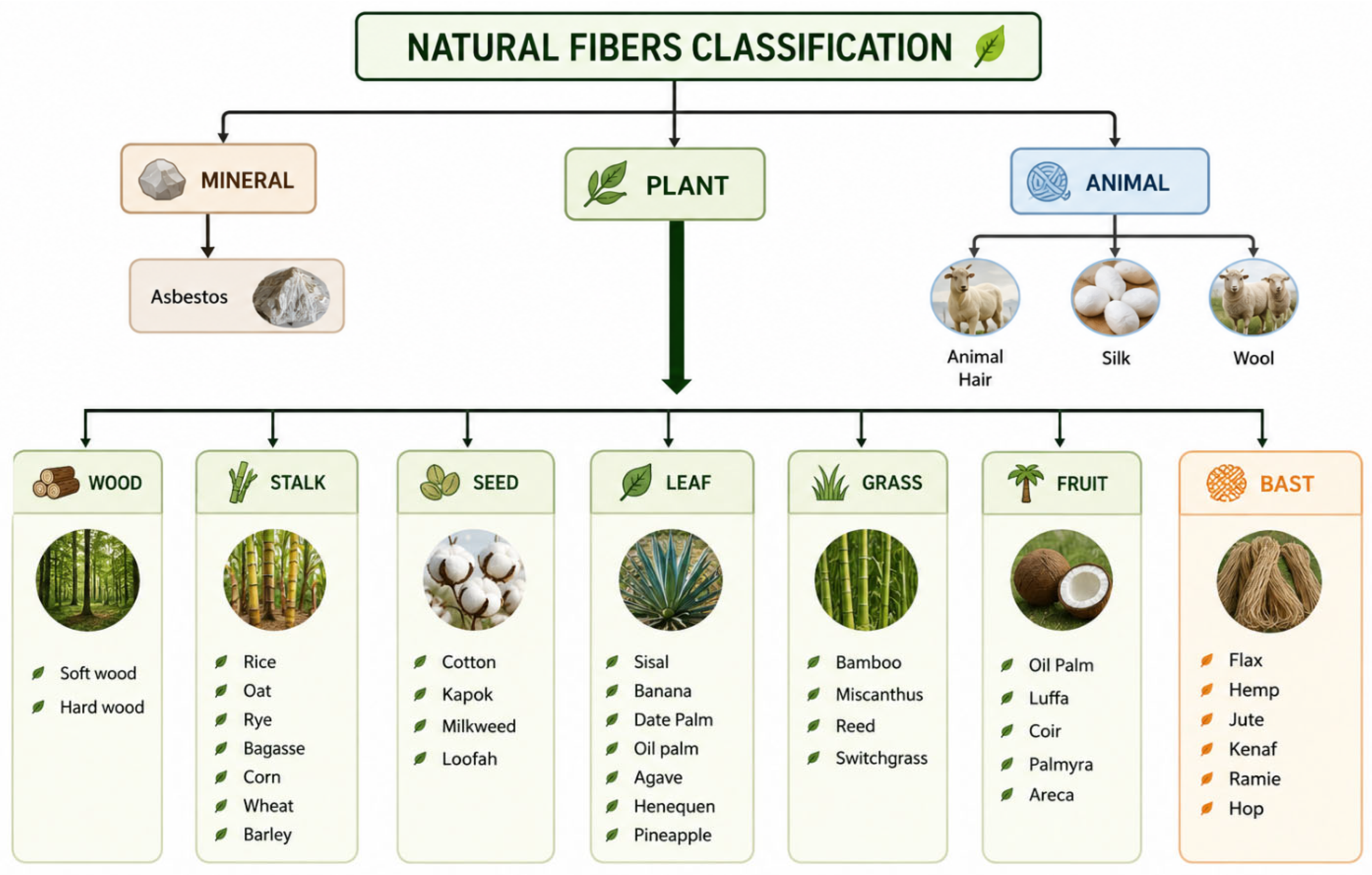
Natural fibers have attracted considerable interest as sustainable alternatives to synthetic fibers due to their renewability, biodegradability, low density, and competitive mechanical properties. They may be obtained from different sources and plant fractions, which gives rise to a variety of structural organizations and physico-chemical characteristics. Plant-based fibers can be classified based on their anatomical origin into wood, stalk, seed, leaf, grass, fruit, and bast fibers, in addition to mineral and animal fibers (Figure 1) [1]. Among the different types of fibers, bast fibers have attracted more attention from the scientific community, owing to their high cellulose content, low microfibril angle, high aspect ratio, and excellent specific mechanical properties [2]. Bast fibers obtained from the phloem of dicotyledonous plant stems include major industrial fibers such as flax, hemp, jute, kenaf, and ramie [3]. These fibers are particulaly suitable for high-value textile and bio-based composites applications. Although they are extracted from raw materials and used as excellent material in some ways, their extraction and utilization are challenging because the elementary fibers are very closely bundled into a complex lignocellulosic matrix, consisting of hemicellulose, lignin, and pectins. Such complexity limits fiber individualization, hence, the final behavior of the fibers [3]. Thus, efficient and environmentally friendly pretreatment methods are necessary for the removal of non-cellulosic elements to promote fiber utilization while maintaining their intrinsic performance. In addition, dedicated fiber crops, large amounts of lignocellulosic agricultural residues and by-products are produced globally through agricultural and food-processing activities [4]. They include grapevine residues, corncobs, soybean hulls, wheat straw, rice husks, and sugarcane bagasse [5]. These are abundant and low-cost sources of cellulose, hemicellulose, and lignin, with valorization serving to reduce waste and pursue circular economy strategies along these lines [5]. Many different pretreatment technologies, such as steam explosion, have been evaluated for improving the accessibility and utilization of those lignocellulosic products. However, bast fibers are still particularly attractive due to their high cellulose content, favorable aspect ratio, and excellent mechanical properties that have been beneficial for high-value textile and composite applications.
Interest in using natural bast fibers for textiles and composite applications has grown with the increased demand for sustainable and eco-friendly materials obtained from various sources (Figure 1) [1], including flax, hemp, jute, kenaf, and various other agricultural by-products. Bast fibers have many benefits, including being biodegradable, renewable, and having good mechanical properties [2]. Moreover, they present a lower ecological impact relative to synthetic fibers such as polyester and nylon in terms of biodegradability and energy required during manufacturing, respectively [6]. Nonetheless, widespread use of cellulose-based fibers remains limited due to the challenges related to their extraction and purification process, which have a strong influence on the fiber’s quality and mechanical performance [7]. The challenges for effective utilization of natural bast fibers are particularly evident given their high lignin content and complex lignocellulosic structure [8]. To ensure optimal fiber quality, effective extraction methods are required to remove non-cellulosic components such as lignin, hemicellulose, and pectin, which bind the fibers within the plant matrix.
Methods for natural bast fiber extraction can be identified as biological, chemical, mechanical, and hybrid processes with associated advantages and drawbacks [7]. While biological retting methods such as water and dew retting are considered environmentally friendly and capable of producing high-quality fibers, they also present important limitations. Water retting requires long processing times and large volumes of water and generates highly polluted effluents [9], which has led to this practice being largely restricted or prohibited in Europe and the United States for environmental reasons, encouraging the development of more sustainable fiber extraction technologies [6,7,10]. Dew retting, on the other hand, is strongly dependent on climatic conditions and microbial activity, making it an empirical and poorly controlled process whose efficiency and reproducibility may be further challenged by climate change [11]. Chemical retting, with fast processing, high efficiency, and excellent scalability, involves toxic chemicals that can cause environmental concerns and damage to the fiber if not appropriately controlled [12]. Mechanical extraction is simple, inexpensive, and suitable for large-scale industrial applications since it does not require the use of chemicals; however, it often results in lower-quality fiber that may lead to structural damage in some cases [13]. Hybrid methods such as steam explosion, ultrasound-assisted, microwave-assisted, and mechanical–chemical combined methods are promising alternatives that reduce processing time, increase fiber purification, and increase extraction efficiency while keeping acceptable fiber quality [14]. Therefore, it is important to consider appropriate extraction methods based on fiber quality, environmental impact, processing time, and economic factors. Hybrid methodologies are an appropriate compromise between efficiency, sustainability, and large-scale applicability.
Among these pretreatment technologies, steam explosion has attracted considerable attention due to its environmentally friendly nature, low chemical consumption, and effectiveness at enhancing fiber separation and accessibility. Therefore, it has emerged as one of the most promising approaches for the valorization of natural fibers.
Steam explosion has emerged as a promising alternative pretreatment method for natural fibers, which has become a new method of natural fiber pretreatment [15]. This method involves subjecting plant fibers to high-pressure saturated steam (typically between 0.7 and 4.8 MPa) for a controlled period, followed by fast decompression [16]. The sudden pressure drop causes structural disruption in the plant’s cell walls, leading to effective fiber fibrillation and facilitating the removal of lignin and hemicellulose [17].
Compared to conventional retting, steam explosion offers an advantage. The process partially hydrolyzes lignin and hemicelluloses, which improves fiber separation and surface morphology [17]. It also promotes the production of more uniform and finer fibers, which are beneficial for textile applications [18]. In addition, unlike microbial retting, which can take weeks, steam explosion occurs within minutes to hours, significantly reducing processing time [15]. Further, the process requires limited chemical inputs, reduces water consumption, and generates fewer pollutants, making it more sustainable than traditional retting [15].
Recent studies have demonstrated the effectiveness of steam explosion in improving the mechanical properties of bast fibers and enhancing fiber–matrix adhesion in composite applications [14,15]. Moreover, the ability to control processing parameters, such as temperature, pressure, and duration, allows for tailored fiber modification suited to different applications [19,20].
Despite the increasing attention to steam explosion as an environmentally friendly pretreatment technology for natural fibers, such links among steam explosion process dimensions, fiber modifications, and end-utilization properties in the textile and composite industry have not yet been thoroughly investigated. In addition, prior reviews have mainly focused on biomass fractionation, biofuel generation or general lignocellulosic biomass processing; however, there is currently a lack of comprehensive understanding on steam explosion applied for bast fiber production and its applications in textile and composite materials.
This review aims to provide a comprehensive analysis of steam explosion as a fiber pretreatment method, comparing it with traditional retting techniques. Specifically, this study aims (1) to examine the effectiveness of steam explosion in improving fiber quality and separation; (2) to compare steam explosion with retting in terms of fiber structure, mechanical performance, and environmental impact; and (3) to identify knowledge gaps and future research opportunities for optimizing steam explosion parameters in order to contribute to the development of sustainable and high-performance textile materials.

2. Definition and Mechanism of Steam Explosion

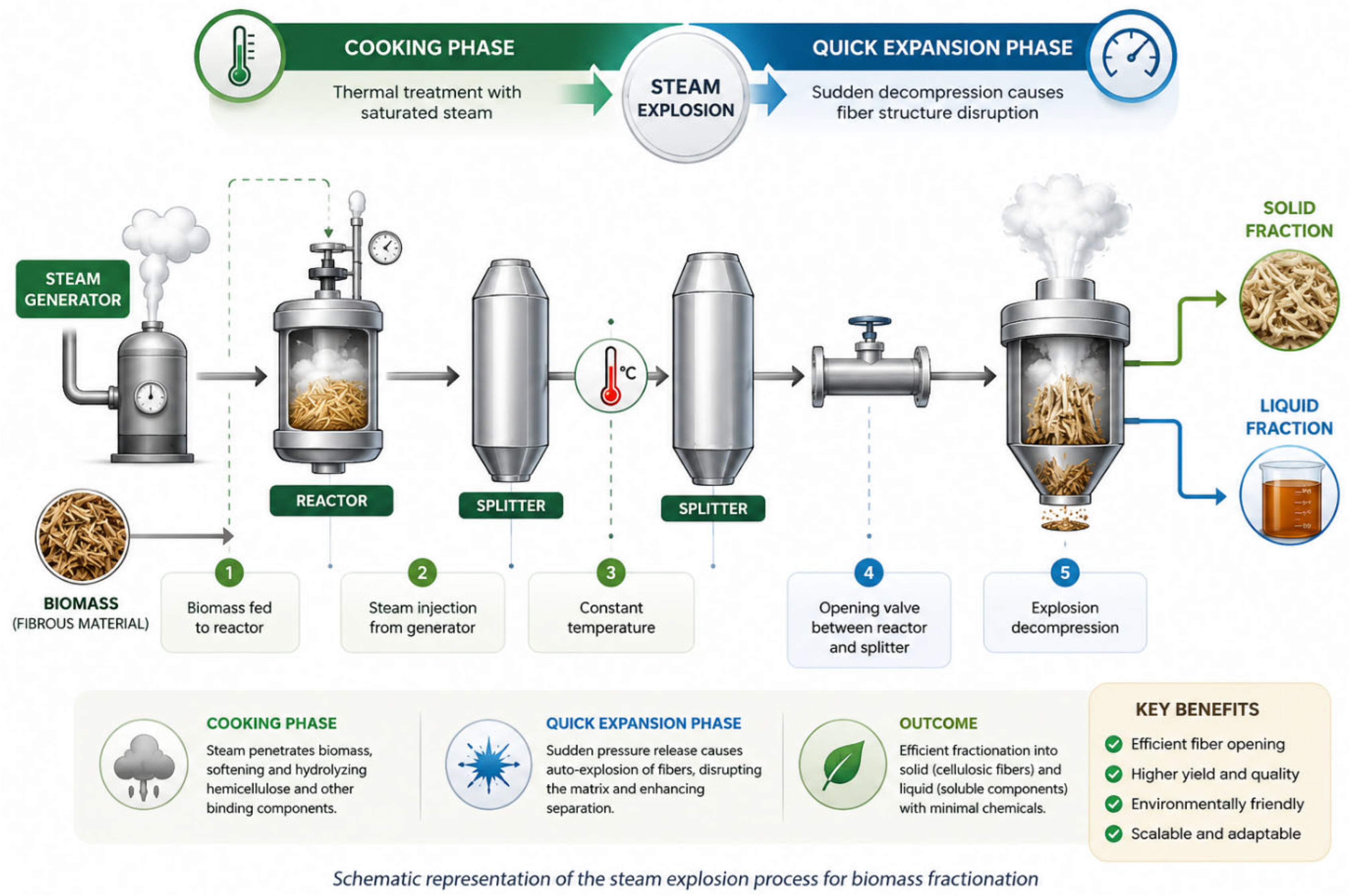
Steam explosion is a physico-chemical process in which lignocellulosic material is subjected to high-pressure (typically between 5 and 45), high-temperature steam (typically between 160 and 260 °C) for a short period of time (typically from a few seconds to several minutes) followed by a rapid decompression [21] as can be seen in Figure 2. At the biomass level, steam is usually applied at approximately 160–240 °C for a few minutes, during which heat and subcritical water can enter fibers and start hydrolyzing hemicellulose and other matrix constituents [22]. The activity consists of two phases: (1) steam heating (hydrolysis), where the high-temperature moisture degrades a fraction of the lignocellulosic matrix, and (2) explosive release, where the pressure drops quickly to atmospheric level [23]. The rapid depressurization evokes vapor expansion inside cell walls, creating mechanical shear forces affecting fiber structure and mechanical detachment from the fibers [24]. Briefly, the steam explosion mechanism integrates thermal hydrolysis with a sudden pressure release, leading to an efficient opening-up of the lignocellulosic fiber structure by tearing the binding components (hemicellulose, lignin, pectin) that stabilizes fibers.

3. Key Factors Influencing Steam Explosion: Role of the Cooking Phase and Quick Expansion Phase

3.1. Cooking Phase

In the cooking phase, the biomass is exposed to high-pressure saturated steam at elevated temperature for a defined residence time. Auto-hydrolysis reactions take place due to the release of acetic acid from hemicellulose, which creates an acidic environment inside the reactor [25]. This leads to solubilization and depolymerization of hemicellulose, partial redistribution or depolymerization of lignin, and the cleavage of lignin–carbohydrate complexes [26]. Consequently, the lignocellulosic matrix weakens and fibers become swollen, promoting additional structural disruption. Temperature and residence time are the most important factors for this stage. Higher temperature hastens the kinetics of hydrolysis reactions, while longer residence times promote greater removal of hemicellulose [27]. Thus, temperature and residence time are commonly combined into a single severity factor (log R0), which provides a quantitative measure of treatment intensity. The severity factor is derived from first-order reaction kinetics and the Arrhenius relationship, assuming that biomass hydrolysis reactions are primarily governed by temperature and exposure time. It is widely used to compare different steam explosion operating conditions [28].
The severity factor is expressed as:
Severity   index = log 10 0 t e [ T 100 14.75 ] d t
where T is the treatment temperature (°C), t is the residence time (min), and 14.75 is an empirical constant derived from the temperature dependence of lignocellulosic biomass hydrolysis reactions.
Optimal hydrolysis conditions can be either at higher temperature for short residence time or low temperature for long residence time. Nonetheless, excessive severity can lead to the breakdown of the sugar released and the production of inhibitory compounds.

3.2. Quick Expansion Phase

The quick expansion phase starts when the discharge valve opens suddenly, and pressure drops immediately from several bars to atmospheric pressure. The resulting fast decompression leads to the explosive vaporization of the water contained in the biomass structure [26]. This sudden expansion creates large-scale mechanical shear forces that lead to fiber rupture, defibrillation, and a massive decrease in particle size. The cell wall geometry is disrupted, and micro- and macropores form, and the specific surface area is increased greatly [29]. This transformation promotes heat and mass transfer, and can make cellulose more accessible for further chemical or biological processes. Furthermore, smaller particle size enables more uniform treatment and enhances pretreatment performance [30]. Hence, the ultimate characteristic of steam explosion may be determined by the simultaneous effect of chemical modifications in the cooking phase as well as by mechanical fragmentation due to the rapid decompression phase of the steam explosion.

4. Impact of Steam Explosion on Lignocellulosic Biomass Structure

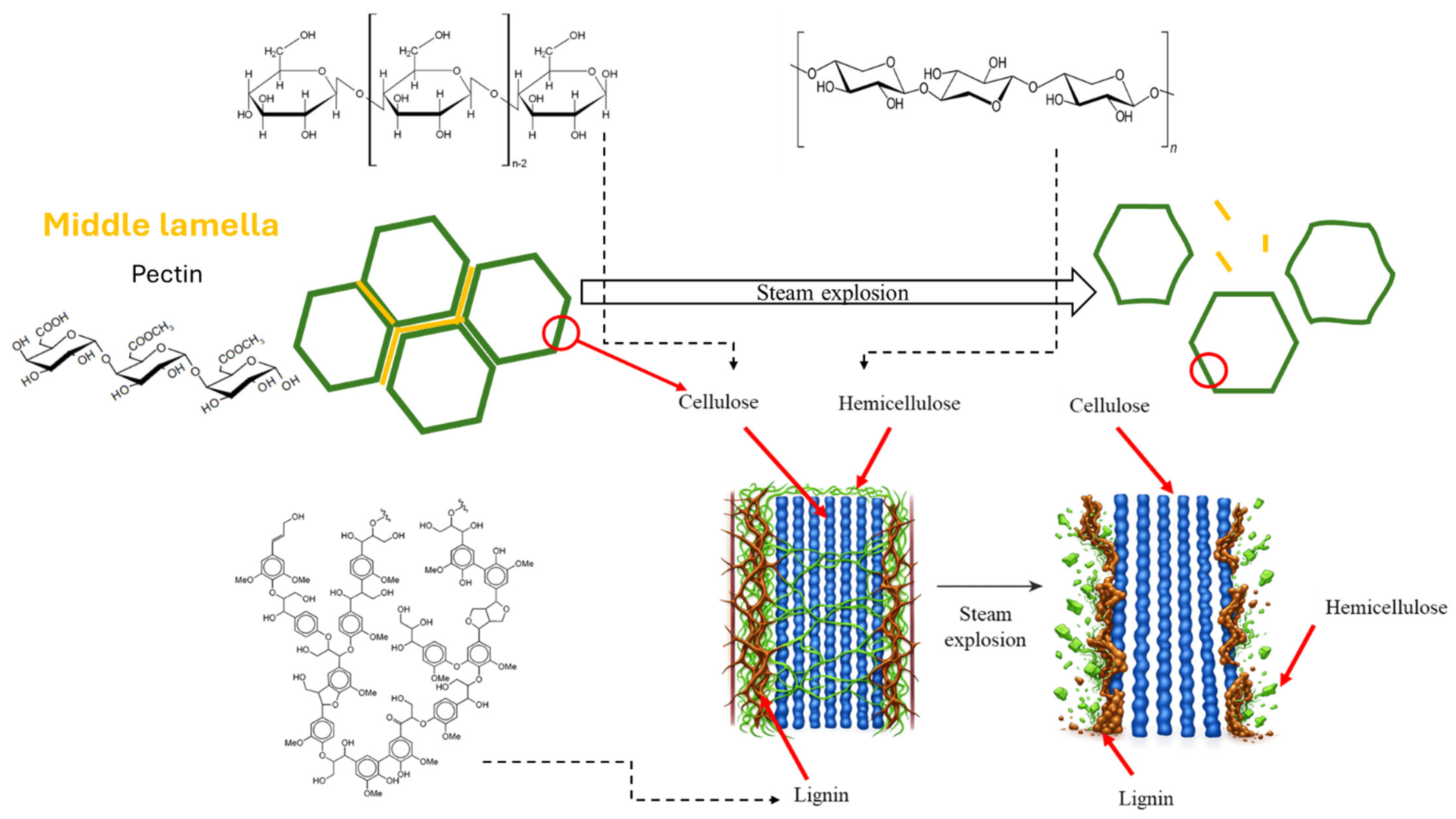
Steam explosion induces change in the structure of lignocellulosic biomass across the various layers. At the molecular scale, the auto-hydrolysis of hemicelluloses and pectins weakens the middle lamella, while lignin is partially depolymerized and redistributed, and cellulose becomes more accessible owing to cell wall distribution. These physico-chemical changes result in fiber separation, increased porosity, surface roughness, and a reduction in particle size. Mechanistic alterations of the main cell wall components and their related structural, mechanical, and morphological changes are outlined in Figure 3.

4.1. Morphological Modification

Steam explosion pretreatment dramatically transforms the morphology of lignocellulosic biomass by applying high-pressure steam followed by an instantaneous pressure release, which creates intense mechanical forces that rupture fiber bundles, crack cell walls, and generate many pores and cracks in the material [31].
Vignon et al. demonstrated the impact of steam explosion on the morphology of hemp hurds by applying various thermal pretreatments. Based on microscopic observations, the authors showed that at 210 °C, the fibers retained their original structure, whereas treatment at 220 °C led to fiber disintegration. At a higher temperature (240 °C), complete defibration and a reduction in fiber size were observed [32]. Auxenfans et al. worked on the morphological modification of three types of lignocellulosic biomass: miscanthus x giganteus, poplar, and wheat straw after steam explosion pretreatment. They used scanning electron microscopy (SEM) to compare untreated and treated samples, focusing on structural changes at increased severities. In the untreated state, the fibers appeared smooth, compact, and well organized, with tightly bound cell walls. However, after the steam explosion, the morphology changed significantly: the samples became increasingly disrupted and porous. Cell wall layers were delaminated, large fiber bundles broke into smaller fragments, and irregular cracks appeared across the surface. They demonstrated a greatly increasing surface area and enabling hydrolytic enzymes to penetrate more effectively. This morphological disruption is directly linked to the observed improvements in enzymatic digestibility, making steam explosion a powerful pretreatment for enhancing biomass conversion [33].
In 2024, Xing et al. showed that steam explosion of tea residue dietary fiber (0.3–1.0 MPa, 30–90 s) transformed compact leaf and mesophyll structures into sponge-like networks with large cavities and rough textures visible under SEM [34]. In another example, Serrano-Martinez et al. reported that rice straw pretreated via steam explosion achieved 70% cellulose extraction, with SEM confirming increased porosity and disrupted fiber bundles [35].

4.2. Mechanical Modifications

Steam explosion tends to preserve or even enhance key mechanical properties of lignocellulosic fibers while facilitating structural changes that improve their processing and end-use performance. Kukle et al. showed that steam explosion enhances the defibration of hemp fibers as a result of auto-hydrolysis and rapid pressure release that disrupt the middle lamella and weaken the bonding between individual fibers. This process allows fibers to be split into elementary fibers. However, the treatment also produces structural changes in the cell wall, such as partial degradation of hemicellulose and lignin and increased fiber fragmentation, which may impair the structural integrity and mechanical behavior of the fibers [36]. Another example was reported in 2023, when researchers studying bamboo bundles found that steam-exploded fibers exhibited a tensile strength of up to 532 MPa and Young’s modulus of approximately 23 GPa. Values comparable to or higher than untreated fibers, demonstrating that fiber integrity was largely retained despite structural refinement [25]. In 2024, a study showed that when sugarcane bagasse and corn stover were steam exploded and used as binders in briquettes, they achieved moderate strengths (up to 12,888 kPa for bagasse), illustrating that steam explosion can enhance mechanical cohesion in densified products [19].

4.3. Chemical Modification: Impact on Cell Wall

During steam explosion, the structural components of the plant cell wall are modified at different levels depending on the severity of the treatment (combination of temperature, residence time). At high severity, hemicelluloses are extensively hydrolyzed and partially solubilized, while lignin undergoes partial depolymerization followed by condensation reactions, and tends to migrate and redeposit on the fiber surface. In contrast, cellulose is only slightly affected but becomes more accessible due to the removal of surrounding matrix polymers and the disruption of the cell wall architecture.
Moussa et al. examined hemp fibers that underwent both a basic soda (8% NaOH) pretreatment and a steam explosion at 190 °C for 4 min. Sugar analysis of the treated biomass revealed an almost complete removal of pectins and hemicellulose components. This extensive hydrolysis of non-cellulosic polysaccharides led to an increase in cellulose content from 79% to 91%, as cellulose degradation only begins at more advanced stages of the treatment [37].
Simangunsong et al. investigated how particle size and treatment severity affect xylan recovery from beech wood during steam explosion pretreatment, identifying 1 mm particles at a severity log (R0) = 3.65 as the optimal condition. This combination maximizes xylan extraction (~10% w/w) while minimizing degradation and inhibitor formation. Smaller particles lead to over-degradation, and larger ones undergo incomplete hydrolysis, both resulting in lower sugar recovery [38].
Besserer et al. investigated the structural modifications occurring at the cell wall level during steam explosion treatment of okoumé wood. The samples were first impregnated with sulfuric acid (0.5%) for 24 h prior to the explosion process. The relative distribution of cellulose and lignin within the cell wall was examined using fluorescence microscopy. They conclude that for untreated samples, the cell walls consist of a mixture of cellulose and lignin, which appears yellow in color. In the pretreated samples, the relocalization of lignin to the surface was detected, appearing in red [39].
Several studies have investigated the impact of steam explosion on the crystallinity of cellulose. The degree of crystallinity depends on the arrangement of intra- and intermolecular hydrogen bonds. Steam explosion can lead to the degradation of cellulose, particularly in the amorphous regions, thereby resulting in an increase in crystallinity.
Sutka et al. evaluated the effect of steam explosion on the cellulose crystallinity of hemp fibers. Analyses were performed on untreated fibers and on fibers subjected to an alkaline pretreatment with sodium hydroxide followed by steam explosion. The results showed a significant increase (from 70.9 to 79.9%) in crystallinity following steam explosion [40]. Similarly, Diop et al. confirmed that fibers recovered after steam explosion, exhibiting crystallinity degrees above 85% [41]. Serrano-Martinez et al. applied steam explosion to rice straw and reported a 70% purified cellulose. X-Ray Diffraction analysis confirmed a notable increase in crystallinity due to selective removal of hemicellulose and amorphous fractions [35], it is worth mentioning that combining chemical pretreatment such as dilute acids, alkaline (like NaOH, Na2CO3), hydrogen peroxide, or SO2 with steam explosion offers a great strategy to improve biomass conversion, because when coupled with chemical pretreatment, this combined approach further enhances enzymatic accessibility and hydrolysis yields. Usually, acid or alkaline impregnation loosens lignin–carbohydrate complexes and softens the lignocellulosic matrix. When NaOH is applied before or during steam explosion, significant delignification occurs, the lignin sheath is disrupted, cellulose accessibility is enhanced, and sugar yield post-enzymatic saccharification can more than double compared to untreated biomass as we can see in the studies on corn stover, where they report over 100% increase in reducing sugar yield [42]. Alternatively, integrating acid catalysts such as SO2 or acetic acid enhances hemicellulose solubilization, directing the process toward the generation of valuable degradation products like furfural and 5-hydroxymethylfurfural in the liquid fraction, without compromising structural fractionation [43].

5. Steam Explosion for Textile Production

Textiles are primarily used for apparel and furnishings, manufactured from either plant or animal fibers, and their production involves several key steps to transform raw fibers into finished textile materials. First, the raw fiber preparation includes cleaning, opening and drawing to align and refine them. The prepared fibers are then spun into yarn and finally woven or knitted to create the fabric [44]. A significant challenge in this production chain is the natural heterogeneity of fiber properties, from batch to batch or even within the same batch, which can compromise product consistency. The textile industry therefore requires fibers with high tightly controlled characteristics, such as fineness, staple, length, strength and color to ensure uniform quality. To achieve homogeneity, fibers often undergo pretreatments such as mechanical opening, chemical degumming, or enzymatic adjustments that modify fiber fineness, remove impurity, regulate color, and alter chemical composition, thereby standardizing fiber quality prior to spinning and fabric formation [45].
In addition to these traditional approaches, steam explosion is known as an efficient method for bast fiber refining. In fact, at moderate or low severity, steam explosion can selectively target the amorphous components of the middle lamella of the cell wall, particularly pectins. The partial solubilization of these interfibrillar binding polymers weakens the cohesion between adjacent cells, leading to a progressive fragilization of the inter-fiber layer (Figure 3). This step is called “degumming” by some authors [10,43]. As a result, individual fibers can be more easily separated during subsequent mechanical refining, enabling efficient defibration, preserving the structural integrity of cellulose-rich fiber bundles.
The work of El Hage et al. showed that steam explosion and alkaline impregnation result in hop fiber individualization induced by eliminating non-cellulosic binding elements. Specifically, the pectin showed a significant reduction in galacturonic acid which decreased, from 3.06% (untreated hop fibers) to 0.99% after treatment at 5 g/L NaOH. In contrast hemicellulose sugars reduced less significantly, xylose decreased from 1.28% in untreated fibers to 0.51 after 5 g/L NaOH treatment and steam explosion, while mannose decreased from 0.39% to 0.28% under the same conditions. With selective removal, the sensitivity of pectin was higher than that of hemicellulose, so they can decrease the fiber bundles and improve fiber separation [46].
Steam explosion has been used as pretreatment to separate the bark cotton stalks into fibers. The fibers extracted by steam explosion exhibit a fineness greater than 57 dtex. This separation of fiber bundles within the bark is primarily attributed to the removal of pectin which dropped from 8.3% to 2.7% and hemicellulose from 19.3% to 15.7%, resulting in a rise in cellulose content from 32% to 54%. A subsequent treatment with potassium hydroxide removed approximately 87% of hemicellulose and 45% of lignin in the fibers, reducing the fiber fineness significantly to 28 dtex [47]. Sauvageon et al. applied a steam-explosion treatment to hemp fibers, combined with a pre-impregnation of the fibers in an 8% NaOH solution, but under these conditions, relatively short and partially degraded fibers were isolated. This process resulted in individualized fibers with a defibrillation rate of 91.2% [48]. Zou et al. demonstrated that combining enzymatic and alkaline pretreatment with steam explosion (2 MPa, 6 min) significantly improved the separation and purification of bamboo fibers by partially removing lignin and hemicellulose while maintaining high crystallinity [49]. Lê et al. introduced the StEXCell process, which applied mild steam explosion (210 °C, 7 min) followed by alkaline extraction to produce high-quality dissolving pulp for regenerated textile fibers like viscose, reducing chemical consumption by 50% compared to conventional kraft pulping [50]. Raissova, 2025 applied steam explosion (200 °C, 4 min) after enzymatic degumming with pectate lyase on flax and hemp, achieving almost complete pectin removal (0%) and preserving cellulose content (94%), offering a cleaner approach for processing natural bast fibers for textile application [51].

6. Composite Applications of Steam-Exploded Bast Fibers

Steam-exploded fibers have become very promising reinforcement materials for bio-based composites owing to their improved chemical composition and surface properties. Thomsen et al. reported that in steam explosion treatment of retted hemp fibers, the cellulose content was increased to 86–90%, by removing non-cellulosic components (hemicellulose, lignin, pectin, and other non-cell wall materials). These cellulose-enriched fibers were established as potential reinforcement materials for composite applications, as fiber strength usually increases with cellulose content [52]. Qu et al. investigated the use of steam-exploded cotton stalk bast fibers for composite reinforcements using the technology of steam-exploded fibers as the fiber composites. To facilitate composites fabrication, each step in the manufacturing process was steam explosion pretreatment, fiber drying, melt mixing with the PBS matrix and compression molding. This process made it easier to add individual fibers into the polymer and decrease the size of larger fiber bundles. One of the key benefits of steam explosion in composite is to enhance fiber morphology and interfacial interactions. With the partial degradation of hemicellulose and lignin at the onset of the treatment, bonding between the simple fibers is decreased and fiber separation is enhanced with increased surface roughness. SEM analysis demonstrated that steam-exploded fibers were more evenly dispersed in the poly(butylene succinate) matrix and better fiber–matrix adhesion was achieved than the untreated fibers. The decrease in fiber bundles and construction of more individually formed fiber fibers enhanced interfacial adhesion of the reinforcement with the matrix [53]. These structural changes resulted in considerable mechanical performance improvements. Tensile modulus, flexural strength, and flexural modulus of composites reinforced with steam-exploded fibers were significantly higher than those of composites reinforced with untreated fibers. As one would expect, the maximum flexural strength was 64.15 MPa, a rise of approximately three times compared with neat PBS. Enhanced mechanical properties with better separation of fibers and stronger interfacial interactions were reported based on steam explosion treatment [53]. These advantages, which have certain limitations, were not desirable. Thomsen et al. reported that severe steam explosion conditions may result in substantial dry matter losses and cellulose degradation, reducing the reinforcing potential of the fibers [52]. Additionally, SEM measurements published by Qu et al. continued to demonstrate fiber pull-out and incomplete interfacial bonding within some areas of the composite, suggesting that fiber–matrix adhesion continues to represent a limiting factor [53]. Thus the optimized steam explosion parameters are needed to balance fiber purification with fiber integrity preservation and composite mechanical performance.

7. Steam Explosion Pretreats Natural Fibers for Textile and Composite Applications

To illustrate the diversity of steam explosion applications for natural fibers, Table 1 summarizes representative studies reported in the literature. The table is organized according to the type of fiber investigated and includes the pretreatment and the corresponding applications. This comparison highlights the influence of processing parameters on fiber properties and demonstrates the versatility of steam explosion as a pretreatment strategy for textile and composite applications.
Steam explosion has gradually found applications across numerous sectors, including food processing, pharmaceuticals, bioenergy, chemical manufacturing, and environmental protection, as can be seen below.
It is important to note that steam explosions like other processes could present advantages and drawbacks depending on the processing conditions and the targeted application. The main benefits and limitations reported in the literature are summarized in Table 2.

8. Regulatory Aspects and Contribution to Sustainable Development Goals

The increasing interest in bast fibers for textile and composite applications is complemented by their high technical performance and renewable nature in addition to a growing regulatory landscape in the form of advances in sustainable materials and circular economy. Bast fibers, as per their biodegradability, renewability, and potential for adding value to agricultural residues, are closely aligned with global sustainability goals and environmental regulations [67,68]. Throughout the European Union, there are regulatory efforts in order to promote and steer towards more sustainable and circular materials. The European Green Deal and the Circular Economy Action Plan have promoted resource efficiency, waste reduction and renewable feedstocks in industry [67,69]. Furthermore, the EU Strategy for Sustainable and Circular Textiles also seeks to increase the sustainability, durability, recyclability, and circularity of textile products and contribute to their environmental footprint reduction [70,71]. These programs allow for the ideal climate in which bast fibers can be used in textiles and composites. The Registration, Evaluation, Authorisation and Restriction of Chemicals (REACH) regulation further promotes lessening hazardous substances in and development of cleaner sources or methods for extracting or processing natural fibers [72]. In the United States (US), the USDA BioPreferred® Program supports the development and commercialization of bio-based products developed from renewable biological resources [73]. The program supports the replacement of petroleum-based materials with renewable alternatives and encourages the incorporation of sustainable feedstocks into industrial products. Bast fibers are in line with the goals of US bioeconomy and sustainable manufacturing strategies through their renewable origin and potential for substituting synthetic materials in textiles and composites [73]. Beyond the EU and the US, growing global interest in bio-based materials and circular economy strategies further supports the development of sustainable fiber-based products [74]. Bast fibers can contribute to several United Nations Sustainable Development Goals (SDGs) as well [75]. Bast fibers promote SDG 9 Industry, Innovation and Infrastructure. By doing so, they create breakthrough bio-based products and provide innovative production modes. Partial replacement of fossil-based materials with lignocellulosic fibers is associated with SDG 13 (Climate Action) as it decreases environmental impacts and greenhouse gas emissions. Moreover, valorization of agricultural residues and renewable biomass resources supports SDG 15 (Life on Land) by facilitating sustainable resource management and also reducing reliance on non-renewable raw materials [75]. Overall, existing structures and initiatives create opportunities for the development of renewable and bio-based materials. Thus, bast fibers and the extraction and processing technologies that constitute them are anticipated to play a significant part in the switch towards more sustainable textile and composites applications.

9. Conclusions and Further Perspectives

Bast fibers are considered promising alternatives to fossil-based materials because of their renewability, lower environmental impact, and availability for wide use from agricultural residues. In this respect, steam explosion is the main pretreatment to produce high-value fibers in a way that minimizes the release of toxic chemicals which are often utilized in traditional extraction processes. Alterations in structure and composition caused by this treatment allow the development of high-performance materials for textiles and composites. However, it is necessary to control process severity to keep fiber integrity, particularly because, in applications that must be able to deal with a good enough length of fiber, such information remains important. Thus, optimization of operating characteristics and redesign of reactor configuration are required for large-scale implementation. The combination of natural fibers and steam explosion technology is a promising alternative to an environmentally damaging material, and the integration is a key factor in the progress toward a circular bioeconomy. Further studies are necessary to reduce the requirement for energy, to enhance fiber quality for textile processing and to develop integrated green processes to fully exploit agricultural biomass as a resource for high-value applications.
Steam explosion has in this sense drawn intense attention as one of the most environmentally efficient pretreatment technology for bast fibers. Compared with traditional chemical extraction techniques, steam explosion significantly reduces the use of hazardous chemicals while promoting fiber defibrillation, cellulose enrichment, surface remodeling and partial hemicellulose and lignin removal. These structural and compositional aspects that promote favorable thermal stability, fiber individualization, interfacial adhesion and mechanical properties of textile and composite materials can be concluded through such structural and compositional modification. Steam explosion effectiveness highly relies on processing parameters of temperature, residence time, pressure, moisture, and impregnation. The moderate treatment severity leads to better fiber separation and surface characteristics and the excessive treatment severity leads to cellulose degradation, fiber shortening, hornification behavior, and deterioration of mechanical properties. This highlighted the importance of controlling the process conditions to preserve fiber integrity, especially for textile fields where fiber length, flexibility, fineness, and spinnability are all important parameters. Recent works also show that steam-exploded bast fibers can be applied to some high impact applications. In the field of textiles, steam explosion promotes cottinization, i.e., the conversion of bast fibers into finer and more individualized cotton-like fibers, while improving fineness and softness for the production of yarns and fabrics. Under composite form, the treatment enhances bonding between the fiber and the matrix with an interfacial adhesion structure and enhances stress transfer and thus, mechanical performance of the resulting composite material. Moreover, steam explosion provides a pathway of recovery from agricultural residues and underutilized biomass to functional and sustainable materials. While favorable trends are evident, a number of limitations and issues still arise that need to be conquered before the adoption on a large scale in an industrial context can be realized. The energy requirement for steam generation, reactor scalability, process reproducibility and fiber damage control are significant limitations of using steam. Moreover, variability in biomass origin, morphology, chemical composition, and maturity would greatly influence treatment performance, and ultimate fiber properties. Therefore there is a need for the standardization of pretreatment conditions and greater understandings of structure property relationships. Further studies are needed to develop optimized steam explosion systems that utilize minimal energy to produce fibers that are of controlled morphology and achieve consistent quality. More attention should also be placed on hybrid and integrated green pretreatment methods, combining steam explosion with enzymatic, biological or low-impact chemical treatments. Improved characterization and life cycle assessment studies will be required to assess the sustainability of this process with a stronger environmental and economic analysis. Moreover, more research is necessary to enhance the performance of fibers for the spinning of textiles, composites with high performance, flame-retardant materials, and other advanced bio-based applications. The success of bast fibers integration and the steam explosion technology present some promising avenues for sustainable materials development with minimal environmental impacts. Industrial applications for such renewable resources could also significantly contribute to the transition to a circular bioeconomy and the decrease in dependency on fossil-based materials.

Author Contributions

P.E.H.: Investigation, Writing—original draft. R.E.H.: Investigation, Data curation, C.S.: Investigation, Conceptualization. J.L.: Validation, Resources. D.I.M.-C.: Conceptualization. H.V.: Validation, Conceptualization, Funding acquisition, Review and editing. N.B.: Validation, Conceptualization, Writing, Funding acquisition. All authors have read and agreed to the published version of the manuscript.

Funding

This research was funded by State Administration of Foreign Experts Affairs, grant number H20250565.

Data Availability Statement

No new data were created or analyzed in this study.

Acknowledgments

The authors express their gratitude to the Mexican government (SECIHTI) for the financial support provided through a doctoral scholarship. They also owe thanks to the Grand Est Region, France, for its financial support. The authors thank the Platform Green Process for Wood (GP4Wood) of LERMaB (Université de Lorraine-INRAe), F-54000 Nancy, France. ChatGPT (OpenAI, GPT-5.5) was used solely to improve the graphical presentation of Figure 1 and Figure 2 based on author-generated sketches. All scientific content, concepts, and figure designs originated from the authors.

Conflicts of Interest

The authors declare no conflict of interest.

References

  1. Thyavihalli Girijappa, Y.G.; Mavinkere Rangappa, S.; Parameswaranpillai, J.; Siengchin, S. Natural fibers as sustainable and renewable resource for development of eco-friendly composites: A comprehensive review. Front. Mater. 2019, 6, 481024. [Google Scholar] [CrossRef]
  2. Niknejad, E.; Jafari, R.; Valipour Motlagh, N. Mechanical properties of biodegradable fibers and fibrous mats: A comprehensive review. Molecules 2025, 30, 3276. [Google Scholar] [CrossRef] [PubMed]
  3. Panwar, R.; Yadav, R.; De, A.K.; Singh, A.; Baheti, V.; Venkatesan, H. Raw materials for sustainable agro-textiles: Natural versus synthetic fibres. In Agro-Textiles: Environmental and Ecological Perspectives; Springer: Berlin/Heidelberg, Germany, 2026; pp. 33–59. [Google Scholar]
  4. Shah, A.M.; Zhang, H.; Shahid, M.; Ghazal, H.; Shah, A.R.; Niaz, M.; Naz, T.; Ghimire, K.; Goswami, N.; Shi, W.; et al. The vital roles of agricultural crop residues and agro-industrial by-products to support sustainable livestock productivity in subtropical regions. Animals 2025, 15, 1184. [Google Scholar] [PubMed]
  5. Singh, M.; Kumar, N.; Gupta, A.; Palai, I.; Kumari, A.; Arshi, A.M.K. A comprehensive review on utilization of agricultural waste for reinforced structural products: A sustainable perspective. Bulg. Chem. Commun. 2025, 57, 5–16. [Google Scholar]
  6. Negi, A. Environmental impact of textile materials: Challenges in fiber–dye chemistry and implication of microbial biodegradation. Polymers 2025, 17, 871. [Google Scholar] [CrossRef] [PubMed]
  7. Eleutério, T.; Trota, M.J.; Meirelles, M.G.; Vasconcelos, H.C. A review of natural fibers: Classification, composition, extraction, treatments, and applications. Fibers 2025, 13, 119. [Google Scholar] [CrossRef]
  8. Abdel Kader, A.H.; Fahmy, T.Y.; Kamel, S. Lignocellulosic reinforced composites: A snapshot of progress. J. Wood Chem. Technol. 2025, 45, 167–195. [Google Scholar] [CrossRef]
  9. Pratheesh, P. Retting to Mechanization: Comparative Environmental Burdens of Coir Processing in Kerala. World Dev. Sustain. 2026, 100326. [Google Scholar] [CrossRef]
  10. Sayam, S. Natural fibers in sustainable materials: Extraction technologies, fiber modification, and performance–sustainability relationships. RSC Adv. 2026, 16, 10495–10537. [Google Scholar] [CrossRef] [PubMed]
  11. Yadav, D.; Yadav, S.; Dwivedi, R.; Anand, G.; Yadav, P.K. Potential of microbial enzymes in retting natural fibers: A review. Curr. Biochem. Eng. 2016, 3, 89–99. [Google Scholar] [CrossRef]
  12. Lee, C.; Khalina, A.; Lee, S.; Liu, M. A comprehensive review on bast fibre retting process for optimal performance in fibre-reinforced polymer composites. Adv. Mater. Sci. Eng. 2020, 2020, 6074063. [Google Scholar] [CrossRef]
  13. Farag, G.Y.; Abou Taleb, E.; Hamouda, T. Natural fibers extraction methods and properties: A review. Egypt. J. Chem. 2025, 68, 445–464. [Google Scholar]
  14. Schieppati, D. Ultrasound-Assisted Depolymerization and Chemical Modification of Waste Lignin for Value-Added Products Manufacturing. Doctoral Dissertation, Ecole Polytechnique, Montreal, QC, Canada, 2025. [Google Scholar]
  15. Gladysheva, E.K. Liquid hot water and steam explosion pretreatment methods for cellulosic raw materials: A review. Polymers 2025, 17, 1783. [Google Scholar] [CrossRef] [PubMed]
  16. Ale, S.; Dhungana, P.; Howieson, J.; Bhattarai, R.R. Effective valorisation of cereal lignocellulosic waste: A review of pretreatment techniques to enhance microstructural modification. Sustain. Food Technol. 2026, 4, 241–260. [Google Scholar]
  17. Zulkifli, A.A.B.; Kamarudin, S.; Sahari, N.; Sultan, S.M.; Yacob, N.; Mohammad, M. Cellulose microfibres from durian waste using modified steam explosion as pre-treatment. J. Clim. Change 2025, 11, 18. [Google Scholar] [CrossRef]
  18. Rajlakshmi, R.; Banerjee, R. Bioprospecting of jute fibre: An eco-friendly physico-biochemical based technology. Ind. Crops Prod. 2025, 229, 120910. [Google Scholar] [CrossRef]
  19. Van der Westhuizen, L.; Rorke, D.C.; Görgens, J.F. Exploring the impact of steam explosion pretreatment on the binding characteristics of coal-biomass briquettes: A study on lignocellulose type and fibre morphology. Waste Biomass Valorization 2025, 16, 281–297. [Google Scholar]
  20. Figel, L.; Aguilar, K.; Ziegler-Devin, I.; Saker, S.; Brosse, N.; Besserer, A. Cell wall chemical and structural changes of wood by steam explosion to increase fungal growth for myco-composite production. ACS Sustain. Chem. Eng. 2025, 13, 7812–7823. [Google Scholar] [CrossRef]
  21. Ziegler-Devin, I.; Chrusciel, L.; Brosse, N. Steam explosion pretreatment of lignocellulosic biomass: A mini review of theorical and experimental approaches. Front. Chem. 2021, 9, 705358. [Google Scholar] [CrossRef] [PubMed]
  22. Li, Z.; Cheng, X. Progress in the preparation of biomass energy from steam-exploded lignocellulose. Adv. Eng. Innov. 2024, 9, 47–56. [Google Scholar] [CrossRef]
  23. Jacquet, N.; Maniet, G.; Vanderghem, C.; Richel, A.; Paquot, M. Influence of steam explosion on the thermal stability of lignins isolated from lignocellulosic biomass: A TGA-FTIR study. Polym. Degrad. Stab. 2011, 96, 1582–1588. [Google Scholar]
  24. Muzamal, M.; Gamstedt, E.K.; Rasmuson, A. Modeling wood fiber deformation caused by vapor expansion during steam explosion of wood. Wood Sci. Technol. 2014, 48, 353–372. [Google Scholar] [CrossRef]
  25. Ngiwngam, K.; Chinvorarat, S.; Rachtanapun, P.; Auras, R.; Wittaya, T.; Tongdeesoontorn, W. Effect of chemical and steam explosion pulping on the physical and mechanical properties of sugarcane straw pulp trays. Polymers 2023, 15, 3132. [Google Scholar] [CrossRef] [PubMed]
  26. Wang, L.; Kong, F.; Chen, H. Steam explosion pretreatment and saccharification of lignocellulosic biomass. In Handbook of Biorefinery Research and Technology: Biomass Logistics to Saccharification; Springer: Dordrecht, The Netherlands, 2024; pp. 341–354. [Google Scholar]
  27. Xia, X.; Zhao, Y.; Zhang, W.; Zhang, J.; Wang, J.; Yuan, S.; Zhou, Z. Interaction mechanism between steam explosion pressures and bamboo fibers separation. Ind. Crops Prod. 2024, 222, 119695. [Google Scholar] [CrossRef]
  28. Overend, R.P.; Chornet, E. Fractionation of lignocellulosics by steam-aqueous pretreatments. Philos. Trans. R. Soc. Lond. Ser. A Math. Phys. Sci. 1987, 321, 523–536. [Google Scholar] [CrossRef]
  29. Cai, C.; Wang, G.; Wang, L.; Zhang, X. Rethinking the role of steam explosion on biomass composition, structure, and saccharification with new-designed pilot-operated pneumatic decompression mode. Biomass Convers. Biorefin. 2024, 14, 16899–16910. [Google Scholar]
  30. Tian, X.Y.; Liu, J.F.; Cheng, Z.; Wu, N.N.; Tan, B. Structure, thermal stability, physicochemical and functional characteristics of insoluble dietary fiber obtained from rice bran with steam explosion treatment: Effect of different steam pressure and particle size of rice bran. Food Res. Int. 2024, 187, 114310. [Google Scholar] [CrossRef] [PubMed]
  31. Muzamal, M. Structural Modifications in Spruce Wood during Steam Explosion Pretreatment. Doctoral Dissertation, Chalmers Tekniska Hogskola, Gothenburg, Sweden, 2016. [Google Scholar]
  32. Vignon, M.R.; Garcia-Jaldon, C.; Dupeyre, D. Steam explosion of woody hemp chenevotte. Int. J. Biol. Macromol. 1995, 17, 395–404. [Google Scholar] [CrossRef] [PubMed]
  33. Auxenfans, T.; Crônier, D.; Chabbert, B.; Paës, G. Understanding the structural and chemical changes of plant biomass following steam explosion pretreatment. Biotechnol. Biofuels 2017, 10, 36. [Google Scholar] [CrossRef] [PubMed]
  34. Xing, Y.; Zhou, Y.; Kuang, C.; Luo, K.; Cheng, Y.; Wang, X.; Wang, S. Structural, physicochemical and functional properties of dietary fibers from tea residue modified by steam explosion. Front. Sustain. Food Syst. 2024, 7, 1326102. [Google Scholar] [CrossRef]
  35. Serrano-Martínez, V.M.; Pérez-Aguilar, H.; Carbonell-Blasco, M.P.; Arán-Ais, F.; Orgilés-Calpena, E. Steam explosion-based method for the extraction of cellulose and lignin from rice straw waste. Appl. Sci. 2024, 14, 2059. [Google Scholar] [CrossRef]
  36. Kukle, S.; Grāvītis, J.; Putniņa, A.; Stikute, A. The effect of steam explosion treatment on technical hemp fibres. In Environment. Technology. Resources, Proceedings of the International Scientific and Practical Conference; RTU Press: Riga, Latvia, 2011; Volume 1, pp. 230–237. [Google Scholar]
  37. Moussa, M.; El Hage, R.; Sonnier, R.; Chrusciel, L.; Ziegler-Devin, I.; Brosse, N. Toward the cottonization of hemp fibers by steam explosion flame-retardant fibers. Ind. Crops Prod. 2020, 151, 112242. [Google Scholar] [CrossRef]
  38. Simangunsong, E.; Ziegler-Devin, I.; Chrusciel, L.; Girods, P.; Wistara, N.; Brosse, N. Steam explosion of beech wood: Effect of the particle size on the xylans recovery. Waste Biomass Valorization 2020, 11, 625–633. [Google Scholar]
  39. Besserer, A.; Obame, S.N.; Safou-Tchima, R.; Saker, S.; Ziegler-Devin, I.; Brosse, N. Biorefining of Aucoumea klaineana wood: Impact of steam explosion on the composition and ultrastructure the cell wall. Ind. Crops Prod. 2022, 177, 114432. [Google Scholar] [CrossRef]
  40. Sutka, A.; Kukle, S.; Gravitis, J.; Berzins, A. Chemical and physical modification of hemp fibres by steam explosion technology. IOP Conf. Ser. Mater. Sci. Eng. 2013, 49, 012053. [Google Scholar] [CrossRef]
  41. Diop, C.I.K.; Lavoie, J.M.; Huneault, M.A. Structural changes of Salix miyabeana cellulose fibres during dilute acid steam explosion: Impact of reaction temperature and retention time. Carbohydr. Polym. 2015, 119, 8–17. [Google Scholar] [CrossRef] [PubMed]
  42. Liu, X.; Lin, Q.; Yan, Y.; Peng, F.; Sun, R.; Ren, J. Hemicellulose from plant biomass in medical and pharmaceutical application: A critical review. Curr. Med. Chem. 2019, 26, 2430–2455. [Google Scholar] [CrossRef] [PubMed]
  43. Sahari, N.; Nazri, N.S.; Mohammad, M.; Razali, H.; Yunus, N.; Al-Shaibani, S.M.S. Sequential multiple compound extraction from biomass using steam explosion as pretreatment: A review. Ind. Crops Prod. 2024, 221, 119070. [Google Scholar] [CrossRef]
  44. Haidir, F.; Fahma, F.; Firmanda, A.; Purnawati, R.; Suryanegara, L.; MacMillan, C. Natural fibres for textile application. IOP Conf. Ser. Earth Environ. Sci. 2024, 1358, 012006. [Google Scholar] [CrossRef]
  45. Wang, S.; Salmon, S. Enzymatic degumming of hemp: A literature review. Cellulose 2025, 32, 7501–7533. [Google Scholar] [CrossRef]
  46. El Hage, P.; Mansoor, D.; Segovia, C.; Mendoza-Castillo, D.I.; Brosse, N.; Vahabi, H. Homogeneous fibers from hop stems via steam explosion: Advancing a novel bioresource. Ind. Crops Prod. 2026, 247, 123537. [Google Scholar] [CrossRef]
  47. Dong, Z.; Hou, X.; Sun, F.; Zhang, L.; Yang, Y. Textile grade long natural cellulose fibers from bark of cotton stalks using steam explosion as a pretreatment. Cellulose 2014, 21, 3851–3860. [Google Scholar] [CrossRef]
  48. Sauvageon, T.; Lavoie, J.M.; Segovia, C.; Brosse, N. Toward the cottonization of hemp fibers by steam explosion—Part 1: Defibration and morphological characterization. Text. Res. J. 2018, 88, 1047–1055. [Google Scholar]
  49. Zou, Y.; Zhang, W.; Yuan, S.; Zhang, J.; Chen, H. Effects of different pretreatments combined with steam explosion on the properties of bamboo fibers. BioResources 2023, 18, 855. [Google Scholar]
  50. Lê, H.Q.; She, J.; Fang, W.; Sixta, H. StExCell: Novel steam-explosion-based biorefinery concept for dissolving pulp production. Holzforschung 2024, 78, 631–646. [Google Scholar]
  51. Raissova, K.A. Investigation of the enzymatic degumming and steam explosion’s impact on the chemical and biological properties of the natural fibers. Eurasian J. Appl. Biotechnol. 2024, 3S, 135. [Google Scholar] [CrossRef]
  52. Thomsen, A.B.; Thygesen, A.; Bohn, V.; Nielsen, K.V.; Pallesen, B.; Jørgensen, M.S. Effects of chemical–physical pre-treatment processes on hemp fibres for reinforcement of composites and for textiles. Ind. Crops Prod. 2006, 24, 113–118. [Google Scholar]
  53. Qu, J.; Tan, B.; Feng, Y.; Hu, S. Mechanical Properties of Poly(Butylene Succinate) Reinforced with Continuously Steam-Exploded Cotton Stalk Bast. Polym.-Plast. Technol. Eng. 2011, 50, 1405–1411. [Google Scholar]
  54. Zhang, X.; Han, G.; Jiang, W.; Zhang, Y.; Li, X.; Li, M. Effect of steam pressure on chemical and structural properties of kenaf fibers during steam explosion process. BioResources 2016, 11, 6590. [Google Scholar] [CrossRef]
  55. Song, Y.; Han, G.; Jiang, W. Comparison of the performance of kenaf fiber using different reagents presoak combined with steam explosion treatment. J. Text. Inst. 2017, 108, 1762–1767. [Google Scholar] [CrossRef]
  56. Singh, S.K.; Khan, S.; Mishra, R.K. Extraction and characterization of nano fibers from cotton fibers and its composite. J. Nat. Fibers 2022, 19, 14788–14802. [Google Scholar] [CrossRef]
  57. Limousin, R.; Guendoul, F.; Vibert, C.; Antoun, K.; Ségovia, C.; Ziegler-Devin, I.; Brosse, N. Hop stems, a new fibrous bioresource. Ind. Crops Prod. 2023, 201, 116966. [Google Scholar] [CrossRef]
  58. Chalard, M.; Buffet, C.; Brosse, N.; Melelli, A.; Scheel, M.; D’arras, P.; Bourmaud, A.; Baley, C. Flax for composite reinforcement: Impact of middle lamella degradation on flax fibre bundle mechanical properties. Compos. Part C Open Access 2025, 18, 100678. [Google Scholar] [CrossRef]
  59. Kiran, P.K.; Ravindra, B.M.; Raju, K.C.; Divakar, M.S.; Avinash, A.K.; Kishore, S.K.; Karen, V.C.C.; Antonia, N.R.M.; Simuzar, S.M. Industrial Cannabis sativa (Fiber or Hemp): Hemp Cottonization—Advantages and Current Challenges. Int. J. Sci. Res. Arch. 2025, 14, 1233–1267. [Google Scholar]
  60. Vochozka, M.; Maroušková, A.; Váchal, J.; Straková, J. Economic and environmental aspects of steam-explosion pretreatment. Waste Biomass Valorization 2016, 7, 1549–1554. [Google Scholar] [CrossRef]
  61. Asada, C.; Sasaki, C.; Uto, Y.; Sakafuji, J.; Nakamura, Y. Effect of steam explosion pretreatment with ultra-high temperature and pressure on effective utilization of softwood biomass. Biochem. Eng. J. 2012, 60, 25–29. [Google Scholar] [CrossRef]
  62. Zabihi, S.; Sharafi, A.; Motamedi, H.; Esmaeilzadeh, F.; Doherty, W.O. Environmentally friendly acetic acid/steam explosion/supercritical carbon dioxide system for the pre-treatment of wheat straw. Environ. Sci. Pollut. Res. 2021, 28, 37867–37881. [Google Scholar]
  63. Pérez-Limiñana, M.A.; Pérez-Aguilar, H.; Ruzafa-Silvestre, C.; Orgilés-Calpena, E.; Arán-Ais, F. Effect of processing time of steam-explosion for the extraction of cellulose fibers from Phoenix canariensis palm leaves as potential renewable feedstock for materials. Polymers 2022, 14, 5206. [Google Scholar] [CrossRef] [PubMed]
  64. Ma, C.; Ni, L.; Guo, Z.; Zeng, H.; Wu, M.; Zhang, M.; Zheng, B. Principle and application of steam explosion technology in modification of food fiber. Foods 2022, 11, 3370. [Google Scholar] [CrossRef] [PubMed]
  65. Meng, X.; Xu, X.; Hu, S.; Chu, R.; Li, X.; Li, W.; Yu, S.; Sun, Y. Changes in the pore structure and oxygen-containing functional groups of lignite under steam explosion and their influence on water molecule resorption. Colloids Surf. A Physicochem. Eng. Asp. 2025, 725, 137675. [Google Scholar] [CrossRef]
  66. Zhao, W.; Zhang, J.; Zhang, W.; Yuan, S.; Chen, H.; Wu, A. Effect of bamboo unit morphology on the preparation of bamboo fibers by steam explosion. Ind. Crops Prod. 2023, 202, 117066. [Google Scholar] [CrossRef]
  67. Zhao, W.; Zou, Y.; Zhang, W.; Chen, H.; Zhang, J.; Wu, A.; Yuan, S.; Zhao, Y. Optimization of process parameters for bamboo fiber extraction by steam explosion. J. Nat. Fibers 2024, 21, 2301369. [Google Scholar] [CrossRef]
  68. Xue, B.; Wu, G.; Li, J.; Wei, D.; Li, J.; Ji, C.; Wang, Y.; Sun, F. Recent advances in fiber pretreatment for plant fiber-reinforced PLA biocomposites: Interfacial tailoring, properties, and applications. J. Ind. Text. 2025, 55, 15280837251401709. [Google Scholar] [CrossRef]
  69. European Commission. The European Green Deal. COM(2019) 640 Final; European Commission: Brussels, Belgium, 2019. [Google Scholar]
  70. European Commission. EU Strategy for Sustainable and Circular Textiles. COM(2022) 141 Final; European Commission: Brussels, Belgium, 2022. [Google Scholar]
  71. European Commission. A New Circular Economy Action Plan: For a Cleaner and More Competitive Europe. COM(2020) 98 Final; European Commission: Brussels, Belgium, 2020. [Google Scholar]
  72. European Parliament and Council. Regulation (EC) No 1907/2006 Concerning the Registration, Evaluation, Authorisation and Restriction of Chemicals (REACH). Off. J. Eur. Union 2006, L396, 1–849. [Google Scholar]
  73. United States Department of Agriculture. BioPreferred® Program; United States Department of Agriculture: Washington, DC, USA, 2026.
  74. OECD. The Bioeconomy to 2030: Designing a Policy Agenda; OECD Publishing: Paris, France, 2009. [Google Scholar]
  75. United Nations. Transforming Our World: The 2030 Agenda for Sustainable Development; United Nations: New York, NY, USA, 2015. [Google Scholar]
Figure 1. Schematic representation of natural fiber classification.
Fibers 14 00079 g001
Figure 2. Schematic illustration of the steam explosion process.
Fibers 14 00079 g002
Figure 3. Fiber degumming and cell wall alteration via steam explosion pretreatment.
Fibers 14 00079 g003
Table 1. Summary of steam explosion treatment conditions, structural modification, and applications of different types of natural bast fibers including bast fibers.
Fiber TypeTreatmentConditionsResultsApplicationReferences
Technical hemp fibersSteam explosion (with/without NaOH pretreatment)180–220 °C, 10–23 bar, 60 s. Optional 3–4% NaOH at 80 °C (1 h)Cellulose increased (60–64% → 73–75% raw, up to 85–90% retted). Fiber diameter decreased to 10–20 µm. Strong fiber individualization (middle lamella disruption). Better defibration with alkali pretreatment.Pretreatment for textile fibers (elementary fiber production)[36]
Kenaf bast fibersSteam explosionWater impregnation 12 h (fiber/liquid 1:20), 1–3 MPa, 3 min, washing to neutral, drying at 75 °C.Hemicellulose, pectin and acid-soluble lignin decreased (50–60% removal). Cellulose content increased up to 2.5 MPa. Crystallinity increased from 65.3% to 78.2%. Fiber defibrillation and gum removal increased with pressure. At 3 MPa cellulose degraded and crystalline decreased. Optimal pressure < 2.5 MPa for textile degumming.Textile fibers (degumming and fiber separation)[54]
Kenaf bast fibersSteam explosion (with chemical pretreatment: H2SO4, H2O2, NaOH)Pre-soaking: 60 °C, 1 h, liquid ratio 1:20 → Steam explosion: 220 °C, 10 min, liquid content = 75%, repeated 3 times.Fiber separation increased and surface became rougher. Hemicellulose and lignin decreased (best removal with NaOH). Cellulose content increased after NaOH + STEX. Crystallinity increased (max = 63.22%). Fiber fineness increased (highest with NaOH). Breaking tenacity increased (best for NaOH-treated fibers). H2O2 caused fiber damage, H2SO4 gave weaker fibers.Textile fibers (degumming and fiber refinement)[55]
Hemp fiberSteam explosion + NaOH (4%)≈190–210 °C, 1–5 min, NaOH impregnationImproved fiber separation, removal of lignin/pectin, defibration = 60–80%.Textile (limited), composites[48]
Hemp fiberSteam explosion + NaOH (8%)≈200 °C, =3–4 min, NaOH 8%High defibration (91%), elementary fibers (15–25 µm), high uniformity.Composites (excellent), textile limites)[48]
Hemp technical fibers → cottonized and phosphorylated hemp fibersNaOH impregnation + steam explosion + phosphorylation8 wt% NaOH, 15 h, 190 °C, 4 min, fast decompression, FR graphted cured at 150 °C, 2 hElementary fiber separation increased. Thermal stability increased after steam explosion.Flame retardant cottonized hemp fibers for textile processing[37]
Cotton fiber (Gossypium hirsutum and Gossypium arboreum) → nanocellulose fibersAlkali treatment + steam explosion + bleaching + acid hydrolysisSodium hydroxide 2% (2–6 h, 28 °C) → steam explosion 120 °C, autoclave, 15–60 min → Bleaching (sodium hypochlorite) → Oxalic acid 5%Removal of lignin, hemicellulose and wax increased. Cellulose purity and crystallinity increased. Fiber diameter decreased to the nanometric scale (minimum 1–2 nm). Surface roughness increased improving bonding with epoxy. Composite tensile load increased to 147.11 N at 50% fiber. Maximum hardness obtained at 30% fiber. Toughness decreased at 50% fiber due to porosity.Reinforcement for polymer composites and biomedical/engineering materials[56]
Hop bast fibers (from hop stems)Decortication + degumming by steam explosionWater impregnation 15 h, 200 °C, 4 min, sudden decompressionPectin and lignin decreased (70% pectin removal). Defibration increased (2% to 29.1%). Cellulose preserved. Tensile strength maintained at 501 MPa. Ash decreased (from 5.31% to 1.54%). Fibers morphology and mechanical properties close to hempTextile fibers and adhesive-free binder less panels from shives[57]
Flax fiber bundles (under-retted and well retted)Steam explosion (as complementary retting treatment)Water impregnation (liquid/fiber ratio 2.5:1), 200 °C, 4 min fast decompression, air dryingStrong middle lamella degradation, higher fiber individualization, removal pectin’s and cortical residues. Tensile strength of bundles. decreased (67–80%) due to loss inter-fiber cohesion. Slight mechanical degradation of elementary fibers (more pronounced for well-retted fibers).Reinforcement for bio composites (optimization of bundle division and fiber/matrix stress transfer)[58]
Jute bast fiber (middle and lower portions)Steam explosion pretreatment + enzymatic rettingSteam explosion 0.5 MPa–10 min → Enzymatic retting at pH 4.5, 45–50 °C, solid/liquid 1:20, 4 h (middle)/6 h (lower)Cellulose increased to 75.6% (middle) and 72.1% (lower). Hemicellulose, lignin and pectin strongly decreased. Crystallinity increased to 73.1%. Tenacity increased 65% (middle) and 46% (lower). Fineness improved to 2.15 tex. Thermal stability increased (degradation = 374 °C vs. 324 °C raw). Whiteness increased and yellowness decreased.Textile fibers (spinning-grade), sustainable retting process.[18]
Hemp fiber (Cannabis sativa)Steam explosion (cottonization process)Biomass impregnated with NaOH (up to 8%), maceration 15 h, steam treatment 190–210 °C for 1–5 min, explosive decompression, washing and dryingDefibration increased (91.2% fiber separation). Production of fine elementary fibers, about 50% fibers < 3 mm length. Fiber suitable for cotton spinning. Some fiber damage observed due to combined steam explosion and alkali treatment.Textile fibers (cottonized hemp), spinning and fabric production[59]
Table 2. Advantages and drawbacks of steam explosion pretreatment of natural bast fibers.
AspectAdvantagesDrawbacksReferences
ProcessLow use of chemical solventsHigh energy consumption[60]
 Short treatment timeHigh-pressure equipment required[61]
 Eco-friendly and environmentally friendlyPrecise control of parameters needed[62]
Raw fiber structureEfficient fiber individualizationFiber shortening[63]
 Decrease fiber diameterFormation of short fibers[64,65,66]
 Increase in specific surface areaPossible structure damage under severe conditions[53,64,65]
Chemical compositionPartial removal of hemicellulose and ligninCellulose degradation at higher severity[54,56]
 Increase in cellulose contentLoss of material at very high severity[54,63]
Crystallinity and thermal behaviorIncrease crystallinity---[67]
 Improved thermal stability---[30]
Textile applicationFiner and more homogeneous fibersDifficult to obtain long fibers for spinning[67]
 Cottonization potentialReduced fiber length limits textile processing.[14,43,59]
Composites performanceEnhanced mechanical properties and interfacial adhesion.Possible reduction in intrinsic fiber strength if overtreated[68]
Disclaimer/Publisher’s Note: The statements, opinions and data contained in all publications are solely those of the individual author(s) and contributor(s) and not of MDPI and/or the editor(s). MDPI and/or the editor(s) disclaim responsibility for any injury to people or property resulting from any ideas, methods, instructions or products referred to in the content.