

Fracture Behavior Under Mode I Loading in Laminated Composite Materials Repaired with Structural Adhesives

Highlights
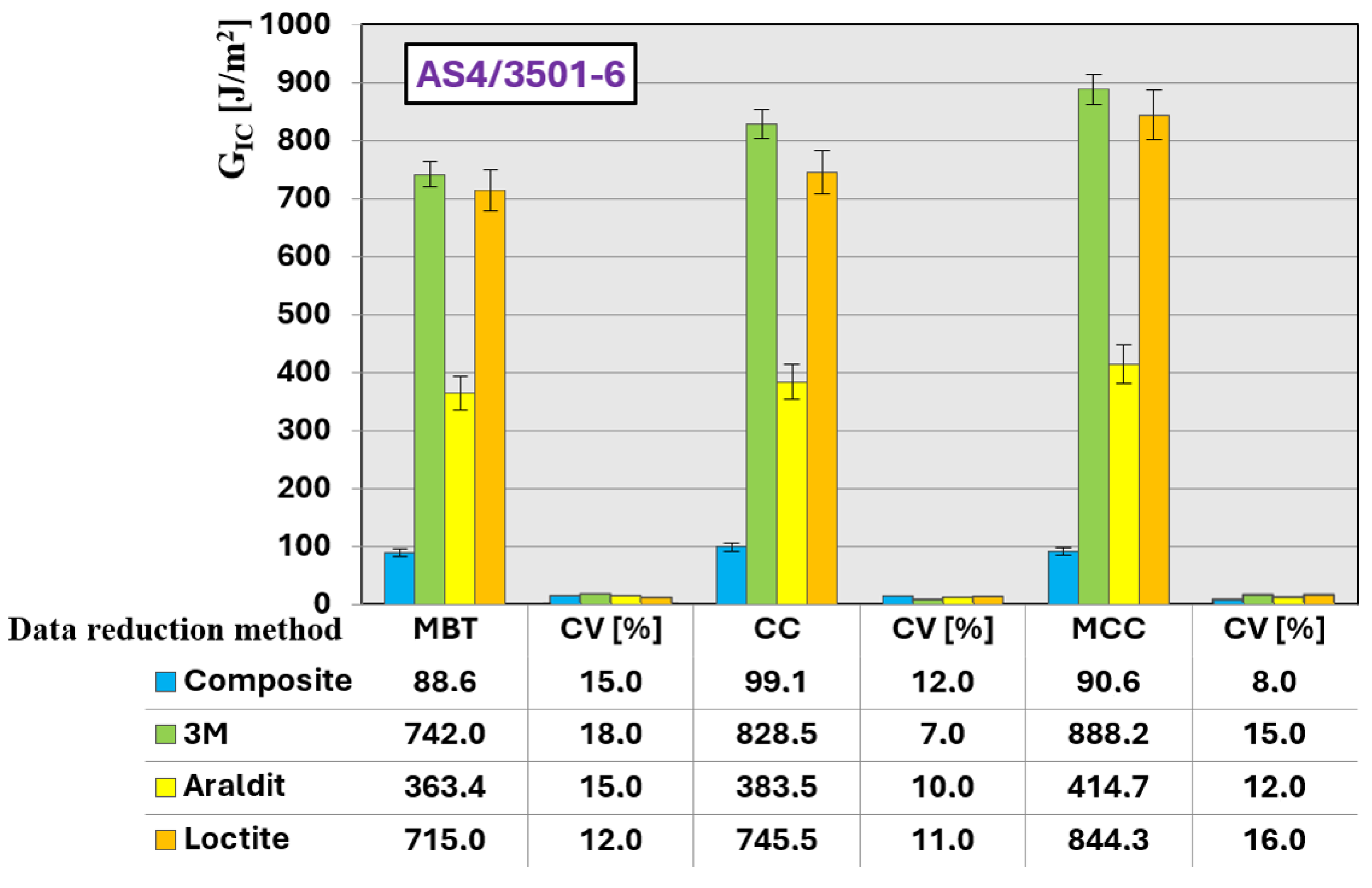
- Adhesive-based repair partially restores the Mode I fracture performance of previously delaminated CFRP laminates, reaching values comparable to the baseline material.
- The laminate with a modified epoxy matrix (AS4/8552) shows significantly higher fracture toughness than the unmodified epoxy system (AS4/3501-6), even after adhesive-based repair.
- Repair effectiveness strongly depends on the mechanical behaviour and ductility of the adhesive, with acrylic adhesives providing enhanced energy dissipation and more stable crack propagation under Mode I loading.
- Adhesive selection for composite repair should prioritize energy dissipation capability rather than stiffness alone, especially for damage scenarios dominated by Mode I.
Abstract
1. Introduction
2. Materials and Methods
2.1. Materials and Specimens
2.2. Adhesives
2.3. Static Fracture Toughness
3. Results and Discussion
4. Conclusions
Author Contributions
Funding
Data Availability Statement
Conflicts of Interest
References
- Elango, I.; Arumugam, V.; Dhakal, H.N. Fabrication and comparison of interlaminar fracture toughness behaviour of glass epoxy composites with recycled milled Kevlar-carbon hybrid fillers. Heliyon 2024, 10, e38842. [Google Scholar] [CrossRef]
- de Cássia Mendonça Sales, R.; Rossi Dias Endo, B.L.; Donadon, M.V. Influence of Temperature on Interlaminar Fracture Toughness of a Carbon Fiber-Epoxy Composite Material. Adv. Mater. Res. 2016, 1135, 35–51. [Google Scholar] [CrossRef]
- Vigón, P.; Argüelles, A.; Mollón, V.; Lozano, M.; Bonhomme, J.; Viña, J. Study of the Influence of the Type of Aging on the Behavior of Delamination of Adhesive Joints in Carbon-Fiber-Reinforced Epoxy Composites. Materials 2022, 15, 3669. [Google Scholar] [CrossRef]
- Takeda, T. Mode I fracture toughness determination and environmental durability evaluation of adhesive bonds by wedge test. Int. J. Adhes. Adhes. 2023, 127, 103521. [Google Scholar] [CrossRef]
- Zhang, L.; Sun, Y.; Huang, S.; Xu, H.; Zhang, Z.; Jiang, M.; Li, B.; Zong, L.; Wang, S.; Zhang, J. Poly(acrylic acid)-grafted cellulose nanocrystal reinforced supramolecular adhesives: Ultrahigh strength, humidity resistance, and pH-controlled recyclability. Carbohydr. Polym. 2025, 363, 123705. [Google Scholar] [CrossRef]
- Santos, D.; Akhavan-Safar, A.; Carbas, R.J.C.; Marques, E.A.S.; Wenig, S.; da Silva, L.F.M. Load-control vs. displacement-control strategy in fatigue threshold analysis of adhesives: Effects of temperature. Eng. Fract. Mech. 2023, 284, 109255. [Google Scholar] [CrossRef]
- Calabrese, A.S.; Bocciarelli, M.; D’Antino, T.; Papa, T.; Colombi, P. Repair and strengthening of existing structures using FRP composites externally-bonded with toughened epoxy adhesives. Procedia Struct. Integr. 2024, 64, 1832–1839. [Google Scholar] [CrossRef]
- Yildirim, C.; Ulus, H.; Beylergil, B.; Al-Nadhari, A.; Topal, S.; Yildiz, M. Effect of atmospheric plasma treatment on Mode-I and Mode-II fracture toughness properties of adhesively bonded carbon fiber/PEKK composite joints. Eng. Fract. Mech. 2023, 289, 109463. [Google Scholar] [CrossRef]
- Hashimoto, K.; Yashiro, S.; Onodera, S.; Ryuzono, K. Asymmetric stacking patch for debonding suppression in single-sided patch repair of composite structures. Compos. Struct. 2025, 355, 118843. [Google Scholar] [CrossRef]
- Yao, Y.; Shi, P.; Chen, M.; Chen, G.; Gao, C.; Boisse, P.; Zhu, Y. Experimental and numerical study on Mode I and Mode II interfacial fracture toughness of co-cured steel-CFRP hybrid composites. Int. J. Adhes. Adhes. 2022, 112, 103030. [Google Scholar] [CrossRef]
- May, M. Measuring the rate-dependent mode I fracture toughness of composites—A review. Compos. Part. A Appl. Sci. Manuf. 2016, 81, 1–12. [Google Scholar] [CrossRef]
- NASA. NASA Standard Tests for Toughened Resin Composites; NASA: Washington, DC, USA, 1983.
- Chai, H. On the correlation between the mode I failure of adhesive joints and laminated composites. Eng. Fract. Mech. 1986, 24, 413–431. [Google Scholar] [CrossRef]
- Schmandt, C.; Marzi, S. Effect of crack opening velocity and adhesive layer thickness on the fracture behaviour of hyperelastic adhesive joints subjected to mode I loading. Int. J. Adhes. Adhes. 2018, 83, 9–14. [Google Scholar] [CrossRef]
- Figueiredo, J.C.P.; Campilho, R.D.S.G.; Marques, E.A.S.; Machado, J.J.M.; da Silva, L.F.M. Adhesive thickness influence on the shear fracture toughness measurements of adhesive joints. Int. J. Adhes. Adhes. 2018, 83, 15–23. [Google Scholar] [CrossRef]
- Cooper, V.; Ivankovic, A.; Karac, A.; McAuliffe, D.; Murphy, N. Effects of bond gap thickness on the fracture of nano-toughened epoxy adhesive joints. Polymer 2012, 53, 5540–5553. [Google Scholar] [CrossRef][Green Version]
- Olhan, S.; Antil, B.; Behera, B.K. Repair technologies for structural polymeric composites: An automotive perspective. Compos. Struct. 2025, 352, 118711. [Google Scholar] [CrossRef]
- Gao, X.; Qian, H.; Wang, J.; Hong, Y.; Chen, Y.; Zhao, L.; Hu, D. Self-reinforced thermoplastic polyurethane composite with excellent mechanical properties, heat resistance and sustainable recycling. Compos. Part B Eng. 2025, 297, 112342. [Google Scholar] [CrossRef]
- Modestou, M.; Semitekolos, D.; Liu, T.; Podara, C.; Orfanidis, S.; Lima, A.T.; Charitidis, C. Recycling of Glass Fibers from Wind Turbine Blade Wastes via Chemical-Assisted Solvolysis. Fibers 2025, 13, 163. [Google Scholar] [CrossRef]
- Sahu, B.; Sahoo, C.K.; Chennamsetti, R.; Arockiarajan, A. Effect of graphene nanoparticles (GNP) on adhesively bonded patch repaired composite under tensile static and fatigue loading. Int. J. Adhes. Adhes. 2025, 142, 104072. [Google Scholar] [CrossRef]
- Ma, Y.; Nutt, S. Chemical treatment for recycling of amine/epoxy composites at atmospheric pressure. Polym. Degrad. Stab. 2018, 153, 307–317. [Google Scholar] [CrossRef]
- Liu, Y.; Farnsworth, M.; Tiwari, A. A review of optimisation techniques used in the composite recycling area: State-of-the-art and steps towards a research agenda. J. Clean. Prod. 2017, 140, 1775–1781. [Google Scholar] [CrossRef]
- Zhang, Y.; Vassilopoulos, A.P.; Keller, T. Effects of low and high temperatures on tensile behavior of adhesively-bonded GFRP joints. Compos. Struct. 2010, 92, 1631–1639. [Google Scholar] [CrossRef]
- Lechte, C.; Darwiche, R.; Hausdörfer, T.; Biermann, J.; Schmidt, A.; Wiegand, A.; Kanzow, P. Repairability of an alkasite composite: Shear bond strength after different surface treatments. Int. J. Adhes. Adhes. 2025, 140, 104012. [Google Scholar] [CrossRef]
- Yasar, M.; Prasad, V.; Hu, Y.; Murphy, N.; Ivankovic, A. Mode I Fracture Toughness Behaviour of Recyclable Piezoelectric Composites. Procedia Struct. Integr. 2024, 52, 165–175. [Google Scholar] [CrossRef]
- Moura, L.S.; Galvis, A.F.; Ramirez, A.F.; Abuquerque, E.L.; Sollero, P. Fatigue analysis of crack propagation in structures with bonded composite repairs. Eng. Anal. Bound. Elem. 2025, 172, 106116. [Google Scholar] [CrossRef]
- de Morais, A.B. A modified direct method to determine the bondline mode I traction-separation law from the adhesively bonded metal double cantilever beam specimen. Eng. Fract. Mech. 2025, 315, 110861. [Google Scholar] [CrossRef]
- Kojouri, A.S.; Karami, J.; Kalteremidou, K.A.; Fan, J.; Sharma, A.; Vassilopoulos, A.P.; Michaud, V.; Van Paepegem, W.; Van Hemelrijck, D. An experimental and analytical study of mode I fracture and crack kinking in thick adhesive joints. Compos. Part B Eng. 2024, 284, 111695. [Google Scholar] [CrossRef]
- Škec, L.; Alfano, G. Characterisation of mode-I fracture resistance of adhesive layers with imperfections. Eng. Fract. Mech. 2024, 301, 110028. [Google Scholar] [CrossRef]
- Ribas, M.; Akhavan-Safar, A.; Adam-Cottard, P.; Carbas, R.J.C.; Marques, E.A.S.; Wenig, S.; da Silva, L.F.M. Exploring strain rate variation in the adhesive layer during constant speed mode I fracture tests: Loading speed and test temperature effects. Theor. Appl. Fract. Mech. 2024, 130, 104274. [Google Scholar] [CrossRef]
- Gören, S.; Pereira, F.A.M.; Quyền, N.; de Moura, M.F.S.F.; Dourado, N. Fracture characterisation of a bi-material adhesive joint under mode I loading: Effect of roughness at the bonding interface. Int. J. Solids Struct. 2025, 310, 113221. [Google Scholar] [CrossRef]
- Taib, A.A.; Boukhili, R.; Achiou, S.; Gordon, S.; Boukehili, H. Bonded joints with composite adherends. Part I. Effect of specimen configuration, adhesive thickness, spew fillet and adherend stiffness on fracture. Int. J. Adhes. Adhes. 2006, 26, 226–236. [Google Scholar] [CrossRef]
- Banea, M.D.; Da Silva, L.F.M.; Campilho, R.D.S.G. Mode II fracture toughness of adhesively bonded joints as a function of temperature: Experimental and numerical study. J. Adhes. 2012, 88, 534–551. [Google Scholar] [CrossRef]
- Kouno, Y.; Imanaka, M.; Hino, R.; Omiya, M.; Yoshida, F. R-curve behavior of adhesively bonded composite joints with highly toughened epoxy adhesive under mixed mode conditions. Int. J. Adhes. Adhes. 2021, 105, 102762. [Google Scholar] [CrossRef]
- ASTM D 5528-01; Standard Test Method for Mode I Interlaminar Fracture Toughness of Unidirectional Fiber-Reinforced Polymer Matrix Composites 1. ASTM International: West Conshohocken, PA, USA, 2007.
- Tourkantoni, I.; Tserpes, K.; Marinis, D.; Farsari, E.; Amanatides, E. Mechanical Characterization of Carbon Fibers and Their Interfaces Recycled through Plasma-Assisted Solvolysis under Different Processing Conditions. Fibers 2025, 13, 158. [Google Scholar] [CrossRef]



| Properties | Epoxy (2-Components) | Acrylic |
|---|---|---|
| Impact resistance | Poor | Good |
| Service temperature (°C) | −55 to 120 | −70 to 120 |
| Curing temperature/mixing required | Yes | No |
| Odor | Low | Low |
| Toxicity | Moderate | Moderate |
| Flammability | Low | Low |
| Material | Elastic Modulus | Tensile Strength | Shear Modulus | Shear Strength | ||
|---|---|---|---|---|---|---|
| E11 GPa | E22 [GPa] | σ11 [MPa] | σ22 [MPa] | G12 [GPa] | τmax [MPa] | |
| 8552 | 144 | 10.6 | 1703 | 30.8 | 5.36 | 67.7 |
| 3501-6 | 131 | 8.9 | 1954 | 24 | 5.09 | 79.3 |
| Base | Viscosity [mPa·s] | Tensile Modulus [GPa] | Tensile Strength [MPa] | Shear Strength [MPa] | |
|---|---|---|---|---|---|
| Loctite® EA 9461TM | Epoxy | 150,000 a 250,000 | 2.76 | 30.3 | 13.8 |
| Araldite® 2015 | Epoxy | Thixotropic | 2 | 30.0 | 15.0 |
| 3MTM DP8810NS | Acrylic | 45,000 | 0.86 | 11.37 | 6.9 |
Disclaimer/Publisher’s Note: The statements, opinions and data contained in all publications are solely those of the individual author(s) and contributor(s) and not of MDPI and/or the editor(s). MDPI and/or the editor(s) disclaim responsibility for any injury to people or property resulting from any ideas, methods, instructions or products referred to in the content. |
© 2026 by the authors. Licensee MDPI, Basel, Switzerland. This article is an open access article distributed under the terms and conditions of the Creative Commons Attribution (CC BY) license.
Share and Cite
Vigón, P.; Argüelles, A.; Lozano, M.; Viña, J. Fracture Behavior Under Mode I Loading in Laminated Composite Materials Repaired with Structural Adhesives. Fibers 2026, 14, 20. https://doi.org/10.3390/fib14020020
Vigón P, Argüelles A, Lozano M, Viña J. Fracture Behavior Under Mode I Loading in Laminated Composite Materials Repaired with Structural Adhesives. Fibers. 2026; 14(2):20. https://doi.org/10.3390/fib14020020
Chicago/Turabian StyleVigón, Paula, Antonio Argüelles, Miguel Lozano, and Jaime Viña. 2026. "Fracture Behavior Under Mode I Loading in Laminated Composite Materials Repaired with Structural Adhesives" Fibers 14, no. 2: 20. https://doi.org/10.3390/fib14020020
APA StyleVigón, P., Argüelles, A., Lozano, M., & Viña, J. (2026). Fracture Behavior Under Mode I Loading in Laminated Composite Materials Repaired with Structural Adhesives. Fibers, 14(2), 20. https://doi.org/10.3390/fib14020020