Article

Thermal Stability and Flammability Behaviors of Phosphorus/Graphene Oxide Co-Modified Waterborne Polyurethane Coatings: An Experimental Study


1
College of Energy Environment and Safety Engineering, China Jiliang University, Hangzhou 310018, China
2
Joint Innovation Key Laboratory of Ministry of Emergency Management for Emerging Risk Identification, Prevention and Control in Safety Production, Beijing 100012, China
3
China Academy of Safety Science and Technology, Beijing 100012, China
4
School of Emergency Management and Safety Engineering, China University of Mining & Technology-Beijing, Beijing 100084, China
*
Author to whom correspondence should be addressed.
Coatings 2026, 16(6), 691; https://doi.org/10.3390/coatings16060691 (registering DOI)
Submission received: 9 May 2026 / Revised: 3 June 2026 / Accepted: 7 June 2026 / Published: 10 June 2026
(This article belongs to the Section Functional Polymer Coatings and Films)

Highlights

  • P- and SiO2@GO can be used together to modify waterborne polyurethane coatings.
  • SiO2@GO (2%) significantly enhances WPU hydrophobicity and thermal stability.
  • P-/SiO2@GO-modified WPU reaches an LOI of 32.2% and reduces PHRR by 32.4%.
  • The flame-retardant performance of WPU was significantly enhanced.

Abstract

To enhance flame retardancy of waterborne polyurethane (WPU) coatings, this paper proposes a co-modification method using modified graphene oxide (SiO2@GO) and a phosphorus flame retardant (P-). SiO2@GO refers to graphene oxide (GO) with an attached silicon dioxide (SiO2) layer, while the phosphorus flame retardant (P-) in this work is THPO, a reactive flame retardant used as a chain extender. The influence of component additions on flame retardancy was systematically investigated. Modified WPU coatings (P-SiO2@GO/WPU) were prepared using THPO and SiO2@GO as flame-retardant chain extenders. The morphology, structure, and thermal stability of P-SiO2@GO/WPU were characterized by scanning electron microscopy (SEM), Fourier transform infrared (FTIR) spectroscopy, and thermogravimetric analysis (TGA). At 2% SiO2@GO, coatings showed enhanced hydrophobicity (water repellency) and thermal stability. With 4% phosphorus flame retardant (P-), the limiting oxygen index (LOI, a measure of flame retardancy) reached 32.2%, and the heat release rate was 32.4% lower than before modification. A continuous, dense P/Si-containing carbonaceous ceramic-like barrier layer was formed, effectively blocking the release of combustible gases and the transfer of heat, thereby demonstrating excellent flame retardancy. This synergistic P-SiO2@GO/WPU modification offers theoretical support and practical guidance for optimizing and enhancing the flame-retardant performance of WPU coatings.

1. Introduction

Waterborne polyurethane (WPU) is an outstanding polymer material that uses water as the primary dispersion medium. Owing to its remarkable mechanical strength, interfacial adhesion, and medium corrosion resistance, WPU has garnered extensive attention in both academia and industry [1]. It is frequently used in surface protection coatings for substrates such as metal, paper, and leather. Apart from the aforementioned physical and chemical properties, WPU also offers significant advantages in applications due to its low volatile organic compound (VOC) emissions, environmental friendliness, highly tunable molecular structure, and functional adjustability [2]. Compared with traditional solvent-based polyurethane (PU), WPU offers significant advantages and has been widely applied in paper coating, metal anti-corrosion, and leather finishing. Nevertheless, the existence of hydrophilic groups in WPU will diminish its corrosion resistance [3]. Meanwhile, the limiting oxygen index (LOI) of unmodified WPU is only around 18% [4], making it highly flammable. Therefore, to enhance the safety and comprehensive performance of WPU in functional applications, in-depth modification of WPU has become an urgent necessity. In recent years, the synergistic improvement of WPU performance through the introduction of nano-fillers has become a popular topic in academia.
Graphene oxide (GO) possesses an ultra-high theoretical specific surface area (up to ~2600 m2/g), exceptional mechanical strength (such as a high Young’s modulus), and outstanding physical barrier properties. Its unique two-dimensional lamellar structure makes it highly effective in restricting the transfer of heat and combustible gases during polymer degradation. Furthermore, its lamellar surface and edges contain abundant oxygen-containing functional groups (such as -COOH, -OH, and C-O-C). These functional groups not only facilitate strong interfacial interactions with the polymer matrix but also provide highly active sites for targeted chemical grafting modification [5,6,7,8]. However, owing to the layered stacking structure of GO, it is extremely challenging to achieve uniform dispersion in polyurethane (PU) and other polymer matrices solely through ultrasonic treatment, and it tends to agglomerate in these polymer systems. The dispersion of GO in the polymer matrix is poor, so it is difficult to fully leverage its enhancement effect. Improving GO dispersion through surface modification can effectively enhance the composite’s comprehensive properties. In the field of polymer flame retardants, submicron spherical amorphous silica (SiO2) is widely used because it can promote the formation of a dense inorganic protective layer during combustion. Nano-SiO2 has a three-dimensional network structure, exhibiting high dielectric strength, high resistivity, good chemical stability, low thermal conductivity, and excellent high-temperature performance. Due to its small size effect and surface effect, nano-SiO2 is prone to causing a percolation effect: when it penetrates into the material, it will interact with the unsaturated bonds in the polymer chain, thereby improving the heat resistance, light stability, and chemical stability of the material, thereby enhancing the anti-aging and chemical corrosion resistance of the product [9,10]. Schmaucks et al. [11] demonstrated that spherical, amorphous (non-crystalline) silicon dioxide (SiO2) nanoparticles, which are characterized by their nanoscale particle size and high specific surface area, can migrate to the surface of the material during combustion. As a result, they form a dense physical barrier that effectively inhibits heat transfer and blocks the escape of flammable gases. Moreover, introducing nanofillers has become a well-established strategy for optimizing the condensed-phase flame-retardant properties of polymers [12]. This physical barrier not only significantly reduces the peak heat release rate but also improves the material’s rheological behavior and enhances the mechanical stability of the carbon layer [13]. Therefore, using SiO2 to modify GO can effectively address GO’s tendency to agglomerate and increase its surface area. This approach significantly enhances the permeability and corrosion resistance of waterborne polyurethane (WPU) and improves the carbon layer density and thermal stability in the WPU system, making it a crucial implementation path for improving the comprehensive protection performance of coating materials. Huang et al. [14] conducted a systematic investigation into the mechanism through which graphene suppresses the flammability of polymer nanocomposites. Their findings indicated that when 3 wt% graphene was incorporated into the polymer matrix, the peak heat release rate (PHRR) decreased by approximately 35% compared to the neat polymer, and the char residue after combustion increased significantly. These enhancements were ascribed to the in situ formation of a compact physical barrier by graphene nanosheets during combustion, which effectively impeded heat transfer and the release of combustible volatiles. Similarly, Wang et al. [15] introduced graphene oxide (GO) nanosheets into a polyurethane (PU) matrix through in situ polymerization. The resultant composites showed an increase of approximately 28 °C in the temperature at 5% weight loss (T5%) relative to neat PU, and the char residue at 700 °C increased substantially from 5.3% to 19.7%. These results suggest that GO significantly improves the thermal stability of PU and promotes condensed-phase charring. Additionally, Kim et al. [16] demonstrated that functionalized graphene could form an effective physical barrier layer in polyurethane composite coatings even at low loadings of ≤3 wt%, resulting in a marked reduction in gas permeability. This provides direct experimental evidence for the condensed-phase barrier effect of graphene-based nanofillers in flame-retardant polymer systems.
When optimizing flame-retardancy, introducing flame-retardant groups into polyurethane chains is an effective approach. Wu Denghui et al. [17] synthesized a chain extender, pentaerythritol diphosphate diphosphoryl chloride ethanolamine, and used it to prepare a modified waterborne polyurethane (WPU). The experimental results indicate that the vertical combustion level can achieve UL94V-0. Moreover, numerous studies have demonstrated that adding nano-SiO2 to the polymer can also achieve a certain level of flame-retardant effect [18]. Polymers modified with nano-SiO2 exhibit lower combustion values, slower flame propagation, and significant advantages, such as reduced smoke density and a suppressed flue gas generation rate. The incorporation of silica sol has been reported to improve the water resistance, thermal stability, and flame-retardant performance of WPU. Li et al. [19] reported that the LOI of silica-sol-modified WPU reached 26% when the silica-sol content was 20 wt%. These findings indicate that silicon-containing inorganic components can contribute to condensed-phase protection during combustion. However, further improvement of flame retardancy generally requires the rational combination of silicon-containing components with reactive flame-retardant groups. In recent years, substantial quantitative evidence has been accumulated regarding phosphorus-containing flame-retardant modifications of polyurethane coatings. Chattopadhyay and Webster [20] systematically reviewed advances in the thermal stability and flame retardancy of polyurethanes, emphasizing that organophosphorus compounds containing P-C bonds exhibit more durable flame-retardant performance in waterborne polyurethane (WPU) systems than those containing P-O-C linkages. This advantage was mainly due to their superior hydrolytic stability, particularly important under hot, humid service conditions. Liang et al. [21] reported that the covalent incorporation of reactive organophosphorus flame retardants into WPU molecular chains increased the limiting oxygen index (LOI) of the coating from approximately 18% to 26%–30%, reduced the peak heat release rate (PHRR) by about 40%–50%, and enabled a UL-94 V-0 rating when the phosphorus content was maintained within 2–3 wt%. Moreover, compared with physically blended additives, reactive modification can effectively suppress the migration and precipitation of flame retardants during long-term use, thereby providing markedly improved flame-retardant durability. Gaan et al. [22] further investigated the flame-retardant modification of polyurethane systems using dopo-based phosphamide compounds, where DOPO denotes 9,10-dihydro-9-oxa-10-phosphaphenanthrene-10-oxide. Their results showed that, at a phosphorus content of approximately 2.2 wt%, the LOI increased from 18% to around 28%, while the PHRR decreased by about 42%. The covalent introduction strategy also endowed the system with substantially better flame-retardant durability than physical blending. Collectively, these quantitative findings demonstrate that covalently introducing flame-retardant moieties into the WPU backbone via P-C-bond-containing reactive chain extenders is an effective strategy for achieving efficient, durable flame-retardant coatings. This conclusion is highly consistent with the design rationale of the present study, which employs THPO as a reactive flame-retardant chain extender. Notably, Shi et al. [23] synergistically incorporated phosphorus-containing aluminum compounds and graphene-based materials into polyurethane elastomers. Cone calorimetry results revealed that, compared with neat PU, the composite system exhibited approximately 58% reductions in PHRR and in total smoke release (TSR). These improvements highlight the advantages of combining gas-phase radical scavenging induced by phosphorus-containing components with condensed-phase char promotion derived from graphene-based materials. Therefore, this study provides an important reference for the rational design of the P-SiO2@GO/WPU multicomponent synergistic flame-retardant system.
Tris(hydroxymethyl)phosphine oxide (THPO), a halogen-free organophosphorus compound, is widely recognized as a relatively low-toxicity and environmentally friendly alternative to traditional halogenated flame retardants [24]. It has a relatively high phosphorus content and contains a P-C bond in its molecule. Compared with the P-O-C bond, the P-C bond has better hydrolysis and acid–alkali resistance, which is why it has been used for flame-retardant modification of various polymers. In this paper, the SiO2@GO hybrid graft was prepared via electrostatic assembly and introduced into a waterborne polyurethane (WPU) system to obtain SiO2@GO/WPU-modified composites. On this basis, a modified waterborne polyurethane coating (P-SiO2@GO/WPU) was prepared by using the phosphorus flame retardant THPO as a reactive flame-retardant chain extender, while SiO2@GO simultaneously acted on the WPU system. Subsequently, the fire resistance and flame retardancy of the material were studied. A limiting oxygen index test, a cone calorimeter test, and a solid residue analysis were employed to evaluate flame spread inhibition ability, combustion heat release behavior, and the compactness and integrity of the material’s carbon layer. Compared with the traditional physical blending method, in this study THPO was covalently grafted onto the WPU molecular chain, effectively addressing the common industry problems of easy migration and poor durability of small-molecule flame retardants. The SiO2@GO hybrid structure not only remarkably enhances the dispersion and stability of graphene in the WPU matrix but also forms a multiscale synergistic flame-retardant mechanism with phosphorus-containing groups, including gas-phase free-radical capture, condensed-phase catalytic charring, and physical barrier enhancement. The composite coating has excellent application potential for interior building decoration, industrial equipment, and transportation coatings. It offers innovative ideas and theoretical guidance for the design of high-performance, environmentally friendly waterborne polyurethane flame-retardant materials.

2. Experimental Section

2.1. Main Reagents

Waterborne polyurethane (WPU), designated as XH-390 (30% solid content, viscosity: 50–200 cP), was supplied by Dongguan Xuhua New Material Technology Co., Ltd., Dongguan, China. Graphene oxide (GO) was purchased from Suzhou Tanfeng Technology Co., Ltd., Suzhou, China. The company adopts an improved Hummers method [25], using 325-mesh natural flake graphite as the precursor, and then ultrasonically exfoliates it into single- or few-layer nanosheets for industrialization. Later in the research process, before introducing it into the WPU matrix, GO was further ultrasonically dispersed (30 min at room temperature) in the laboratory to prevent agglomeration and maintain its exfoliated state. The phosphate flame retardant was provided by Shenzhen Dianshifang Technology Co., Ltd., Shenzhen, China. Nano-silica (SiO2), Hydrophilic-150 grade (purity: 99.8%, specific surface area: 150 m2/g, particle size: 7–40 nm), was purchased from Aladdin Century Co., Ltd., Shanghai, China. γ-Aminopropyltriethoxysilane (APTES, also known as silane coupling agent KH550) and N, N-dimethylformamide (DMF) were analytical-grade reagents sourced from Aladdin Reagent Co., Ltd. Xylene, also of analytical grade, was acquired from the same supplier. Anhydrous ethanol (industrial-grade) was obtained from Aladdin Reagent Co., Ltd. Deionized water was prepared in-house in the laboratory.

2.2. Preparation of Silica-Modified Graphene Oxide

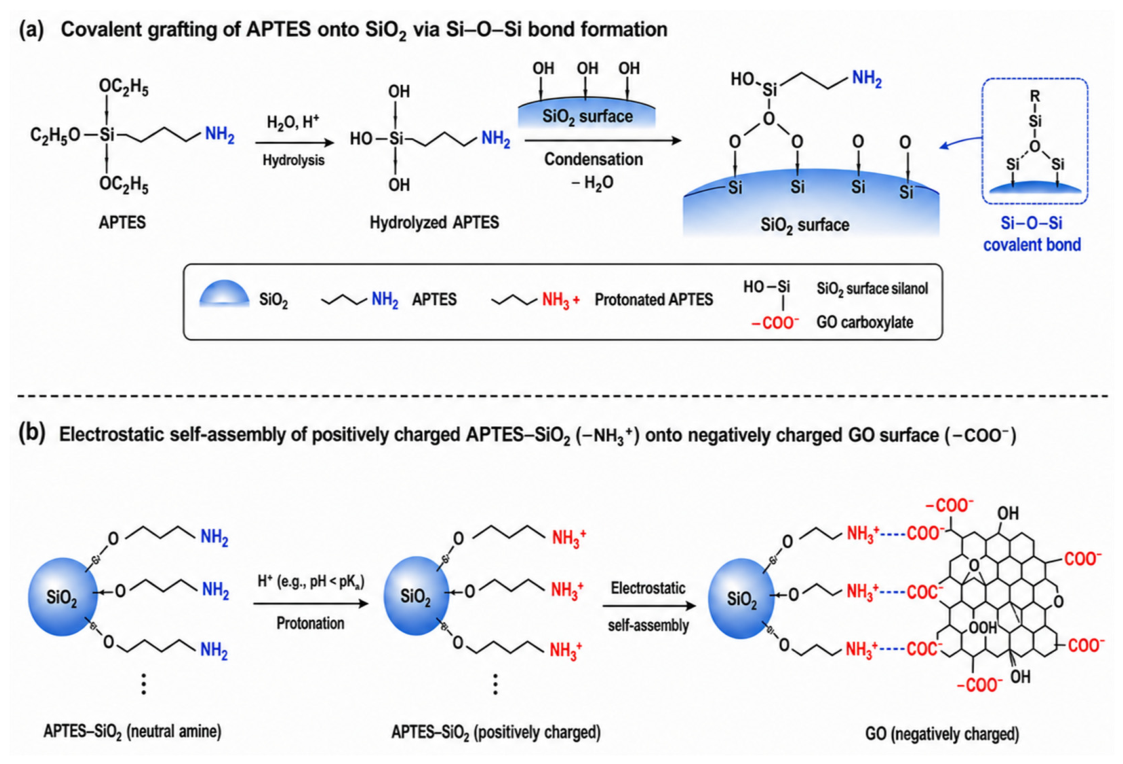
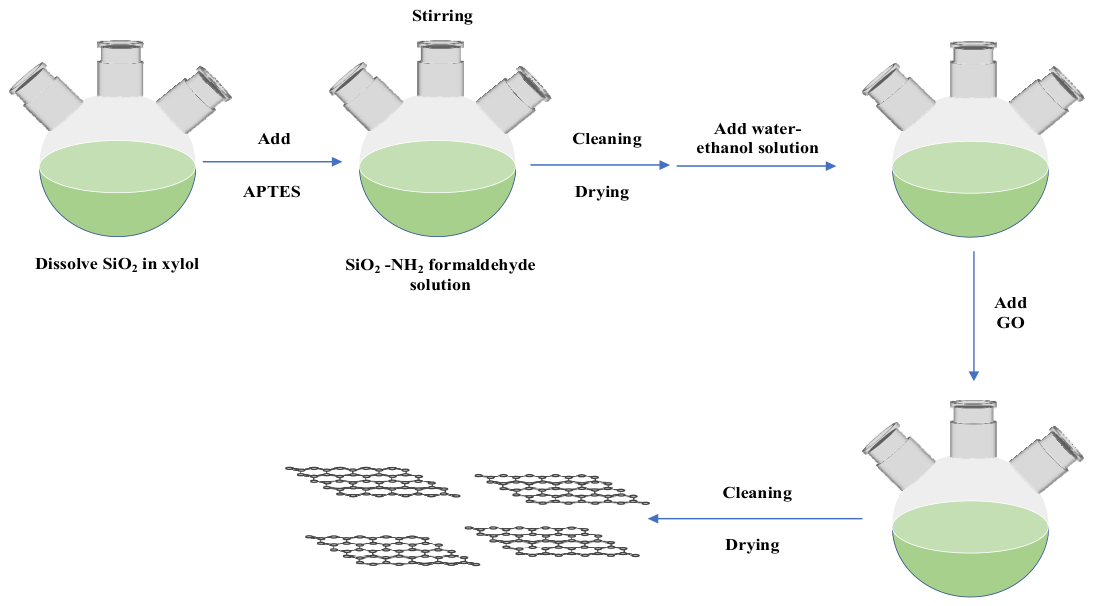
SiO2-modified GO (SiO2@GO) was synthesized via an electrostatic interaction method. Nano-SiO2 particles were first dried in a vacuum oven at 120 °C for 24 h to remove moisture. Subsequently, Surface amination of SiO2 was performed by refluxing SiO2 (3 g) and APTES (5 mg) in xylene (400 mL) at 120 °C for 5 h. The hydrolysis of APTES and its subsequent condensation with surface hydroxyls on SiO2 established robust Si-O-Si covalent bonds, yielding APTES-SiO2 nanoparticles with outward-facing -NH2 groups (Figure 1a). After removing physisorbed APTES via ethanol washing, the SiO2@GO composites were fabricated through electrostatic self-assembly. Specifically, APTES-SiO2 (0.2 g) and GO (0.2 g) were stirred in an ethanol/aqueous solution (600/150 v/v) at room temperature for 12 h. The protonation of -NH2 to -NH3+ on silica and the deprotonation of carboxyls to -COO on GO created an electrostatic complementarity, driving the spontaneous deposition of APTES-SiO2 onto the GO nanosheets (Figure 1b). This mechanism is widely corroborated by the previous literature on amine-nanoparticle/GO interactions [26]. Conversely, bare SiO2 nanoparticles carry a net negative charge in aqueous media, which would electrostatically repel GO, thereby inhibiting assembly. The detailed preparation procedure is illustrated in Figure 2. Finally, the mixture was filtered, dried, and sieved to yield SiO2@GO, which was then stored in a vacuum oven at 120 °C for 24 h prior to use.

2.3. Preparation of Modified Graphene Oxide/Waterborne Polyurethane Emulsion

SiO2@GO at mass fractions of 0.5%, 1%, 2%, and 4% was separately dispersed in deionized water. After standing for 12 h to ensure complete dispersion, the suspensions were mechanically stirred and ultrasonicated for 30 min to obtain homogeneous SiO2@GO dispersions. Each dispersion was then thoroughly mixed with waterborne polyurethane and mechanically stirred at room temperature for 30 min to yield SiO2@GO-modified waterborne polyurethane emulsions. The resulting emulsions were cast onto polytetrafluoroethylene (PTFE) plates and dried at room temperature for 7 days, then at 80 °C for 2 h, and finally at 100 °C for 2 h. After cooling to ambient temperature, the films were peeled off and stored for further use. The specific components of the formula are presented in Table 1.

2.4. Preparation of Waterborne Polyurethane Film Modified with Phosphorus/Graphene Oxide

The SiO2@GO dispersion, prepared as described above, was mixed with waterborne polyurethane and varying mass fractions of phosphorus-based flame retardants (2%, 4%, and 6%) through mechanical stirring for 30 min, yielding a phosphorus/graphene oxide synergistically modified waterborne polyurethane emulsion. The resulting emulsion was poured into a polytetrafluoroethylene mold and allowed to level naturally. After being cured at room temperature for 7 days, the sample was dried at 80 °C for 2 h, followed by an additional 2 h of drying at 100 °C. Upon cooling, the film was peeled from the mold and characterized for subsequent performance.

3. Experimental Testing and Characterization

Static water contact angles were measured using a contact angle goniometer (JC2000D1, Shanghai Zhongchen Digital Technic Apparatus Co., Ltd., Shanghai, China) by depositing 2 μL droplets of deionized water onto the coated surfaces. A minimum of 3 measurements were taken at randomly chosen positions on each specimen, and the results are reported as the mean ± standard deviation (SD; n = 3). Water absorption was evaluated by immersing the coated specimens in deionized water at room temperature for 24 h. For each formulation, three independently prepared specimens were examined. Water absorption was calculated as W(%) = (m1 − m0)/m0 × 100%, where m0 and m1 represent the masses of the specimens before and after immersion, respectively. The data are presented as the mean ± SD (n = 3). Statistical significance was assessed using one-way ANOVA followed by Tukey’s post hoc test; p < 0.05 was considered statistically significant.
Fourier transform infrared (FTIR) spectroscopy is a widely used analytical technique for identifying chemical compounds and elucidating the molecular structure of materials. In this study, a Thermo Scientific Nicolet iS10 Fourier transform infrared spectrometer (Thermo Fisher Scientific Inc., Waltham, MA, USA) was used to analyze the samples. The chemical structures were deduced by examining the vibrational spectra of the molecules’ functional groups. Sample preparation was carried out using the potassium bromide (KBr) pellet method. A total of 16 scans were performed over a wavenumber range of 400–4000 cm−1 to ensure a high spectral resolution and signal-to-noise ratio.
X-ray diffraction (XRD) was used to determine the crystal structure and lattice parameters of the material by analyzing its diffraction pattern in response to incident X-rays. Diffraction patterns were obtained through data processing using a Bruker D2 Phaser X-ray diffractometer (Bruker AXS GmbH, Karlsruhe, Germany). The measurements were conducted with Cu Kα radiation (λ = 1.5406 Å) generated from a Cu target, operated at 40 kV and 8 mA. The scanning angle (2θ) ranged from 10° to 80°, with a scanning rate of 3°/min, enabling accurate characterization of the crystal structure and interlayer spacing of the samples.
Scanning electron microscopy (SEM, Carl Zeiss Microscopy GmbH, Jena, Germany): The microstructure of the samples was analyzed using a ZEISS Gemini 300 field emission scanning electron microscopy (SEM). The samples were mounted on conductive adhesive, and their surface morphology was examined. Additionally, the carbon layer structure of the carbonized products formed after pyrolysis treatment was investigated.
Thermogravimetric analysis (TGA) was performed using a STA 449 F3 synchronous thermal analyzer manufactured by Netzsch, (Selb, Germany). The measurements were conducted under a nitrogen (N2) atmosphere, with a gas flow rate of 40 mL/min, a heating rate of 10 °C/min, and a sample mass of 5–10 mg. To ensure data accuracy and reproducibility, the TGA test for each sample was performed in triplicate. The TGA curves displayed in the figures are the most representative ones, and the related thermal parameters are reported as the average values.
The limiting oxygen index (LOI) of the samples was determined in accordance with ASTM D2863-17 [27] using a JL-JF-3 oxygen index instrument manufactured by Nanjing Jionglei Metrology Instrument Co., Ltd., Nanjing, China. The instrument is equipped with a high-precision flow control system providing an oxygen concentration resolution of ±0.1%. For each formulation, at least 5 specimen strips were tested using the standard up-and-down method to ensure reproducibility, yielding a repeatability standard deviation within ±0.2%. The specimens were prepared with dimensions of 100.0 mm × 6.5 mm × 3.0 mm, and the calculated average values were recorded.
Cone calorimeter tests were conducted in accordance with ISO 5660-1:2015 [28]. The specimens measured 100.0 mm × 100.0 mm × 3.0 mm and were wrapped in aluminum foil to prevent edge burning. The external heat flux was set to 50 kW/m2. The time to ignition, heat release rate, total heat release, and smoke production rate were recorded. To quantify the experimental uncertainty and eliminate random errors, all sample variants were tested in triplicate (n = 3) under identical conditions, and the calculated average values were recorded.

4. Results and Discussion

4.1. Analysis of the Structure and Properties of Modified Graphene Oxide

4.1.1. Chemical Molecular Structure Analysis

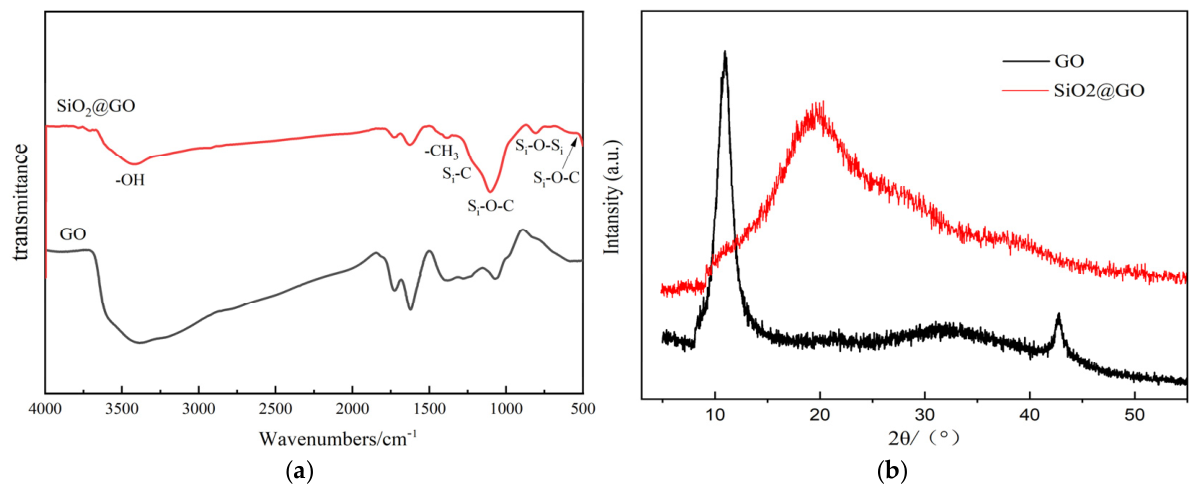
The molecular structures of graphene oxide (GO) and SiO2@GO were characterized using Fourier transform infrared (FTIR) spectroscopy. The test results are presented in Figure 3a. The bifunctional binding mechanism of APTES was directly verified via FTIR spectroscopy (Figure 3a). For the SiO2 modification, a diagnostic peak at 1220 cm−1 (Si-C stretching from the APTES propyl chain) confirms successful silanization, while the 807 cm−1 band (symmetric Si-O-Si stretching) verifies the covalent condensation between APTES silanols and silica hydroxyls. The subsequent integration of APTES-SiO2 with GO is evidenced by the Si-O-C stretching vibrations at 1102 and 610 cm−1, indicating robust interfacial chemical bonding.
Additionally, the retention of active amine functionalities is confirmed by the N-H stretching within the broad 3300–3400 cm−1 region and the N-H bending shoulder at 1560–1600 cm−1. Taken together, these spectral findings perfectly align with the proposed structural model (Figure 1), illustrating APTES as a pivotal molecular bridge that covalently tethers to SiO2 at one end and couples with GO via electrostatic interactions (-NH3+… -COO) and potential amide bonds at the other. In Figure 3b, the complete disappearance of the GO (001) diffraction peak at 2θ ≈ 10° in SiO2@GO indicates a severe disruption of the long-range ordered layer stacking of GO, which can be attributed to both the masking effect of densely packed SiO2 nanoparticles and the intercalation-induced disordering of the GO layered structure, providing evidence for partial exfoliation of GO upon SiO2 incorporation. This structural disruption, together with the improved interfacial compatibility introduced by APTES functionalization, is expected to enhance the dispersion and interfacial interactions of SiO2@GO within the composite matrix.

4.1.2. Micro-Morphological Analysis

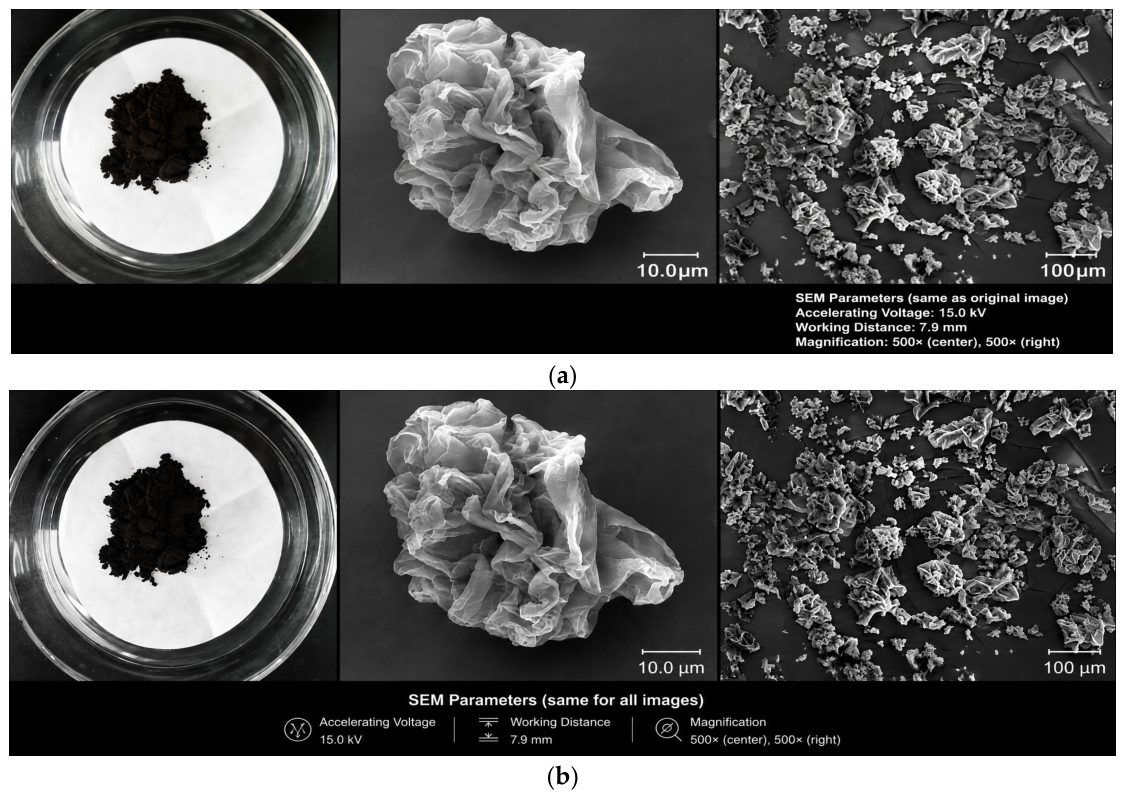
The microstructure of graphene oxide (GO) before and after modification was characterized by scanning electron microscopy (SEM). The results are presented in Figure 4. The original GO surface is clean, exhibiting a smooth lamellar structure with a slightly wrinkled surface. In contrast, on the surface of the modified SiO2@GO, fine particles are attached and densely distributed, particularly at the edges of the sheets and in the fold areas, forming a more distinct dark-spot distribution. Combining the results of Fourier transform infrared (FTIR) spectroscopy and X-ray diffraction (XRD), it can be concluded that SiO2 was grafted onto the surface of GO and uniformly dispersed on it. This modification effectively mitigated GO’s tendency to agglomerate, enhancing the dispersibility of modified SiO2@GO and its compatibility with waterborne polyurethane (WPU).

4.2. Characterization of the Performance of SiO2@GO/WPU

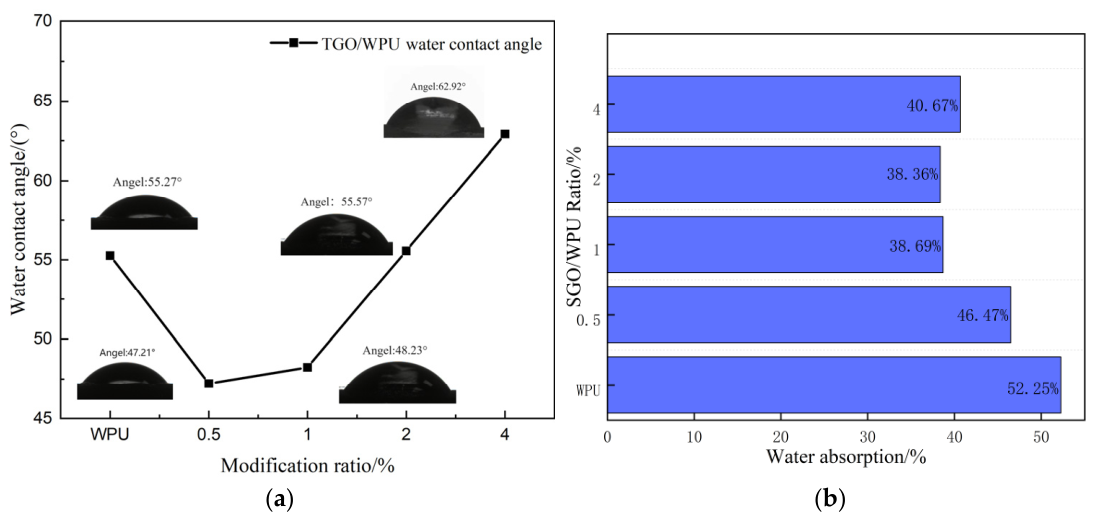
The data in Table 2 represent the mean ± standard deviation results of three independent measurements (n = 3) of the modified polyurethane coating samples prepared separately with different SiO2@GO additions under the same conditions. Figure 5 depicts the mean variation in the water contact angle and water absorption of waterborne polyurethane (WPU) films with different additions of SiO2@GO. As can be observed from Figure 5a, as the content of the modified SiO2@GO particles increases, the static water contact angle of the film initially increases and then decreases. When the SiO2@GO content was 2%, the contact angle reached 68.57°, 13.3° higher than that of the pure WPU film. From Figure 5b, it is evident that with increasing an addition ratio of modified SiO2@GO, the film’s water absorption first decreases and then increases, from 52.25% for the unmodified film to 38.36% at an addition amount of 2%. The above results indicate that the introduction of SiO2@GO significantly enhances the hydrophobicity and water resistance of the film. This enhancement is primarily attributed to the following two aspects. Firstly, the surface of the modified SiO2@GO is rich in reactive groups, which can cross-link with the polyurethane molecular chains, increase the film’s cross-linking density, and render the film’s structure more compact. Simultaneously, the modified particles exhibit good compatibility and dispersibility in the polyurethane matrix. Secondly, the surface of the silica microspheres attached to the graphene oxide sheet contains a large number of silicon-containing hydrophobic carbon chains, which impart additional hydrophobicity and further enhance the film’s hydrophobicity. It is noteworthy that when the SiO2@GO addition exceeds 2%, the water contact angle decreases slightly, and the water absorption rate increases slightly. This is mainly because excessive fillers cause agglomeration of nanoparticles, which deteriorates nanofiller dispersion in the polyurethane, leading to a decrease in the water contact angle and a slight increase in the coating’s water absorption.

4.3. Performance Test of Waterborne Polyurethane (WPU) Synergistically Modified by Phosphorus Flame Retardant (P-) and SiO2@GO

4.3.1. Limiting Oxygen Index (LOI) Test

Table 3 presents the limiting oxygen index (LOI) test results of different composition systems, including pure WPU; SiO2@GO-WPU-2%-modified composites with a 2% SiO2@GO mass fraction; and WPU synergistically modified composites with 2%, 4%, and 6% phosphorus flame retardant (P-) added on the basis of 2% SiO2@GO. From the table of test results, it is clear that the LOI value of WPU increased after the introduction of SiO2@GO, but the increase was limited. It is hypothesized that SiO2@GO mainly inhibits the pyrolysis reaction in the condensed phase by forming a physical barrier layer, but it has no ability to capture P-based radicals in the gas phase. As a result, it cannot effectively suppress the combustion of combustible gas generated by the pyrolysis of the WPU soft segment. With the addition of phosphorus flame retardants, the LOI value of the modified WPU continued to increase as the P-addition amount increased. When the P- mass fraction is 4%, the LOI value reaches 32.2%. The above results indicate a strong synergistic effect between phosphorus-based flame retardants and SiO2@GO in enhancing the flame-retardant performance of WPU.

4.3.2. Analysis of Cone Calorimeter Performance

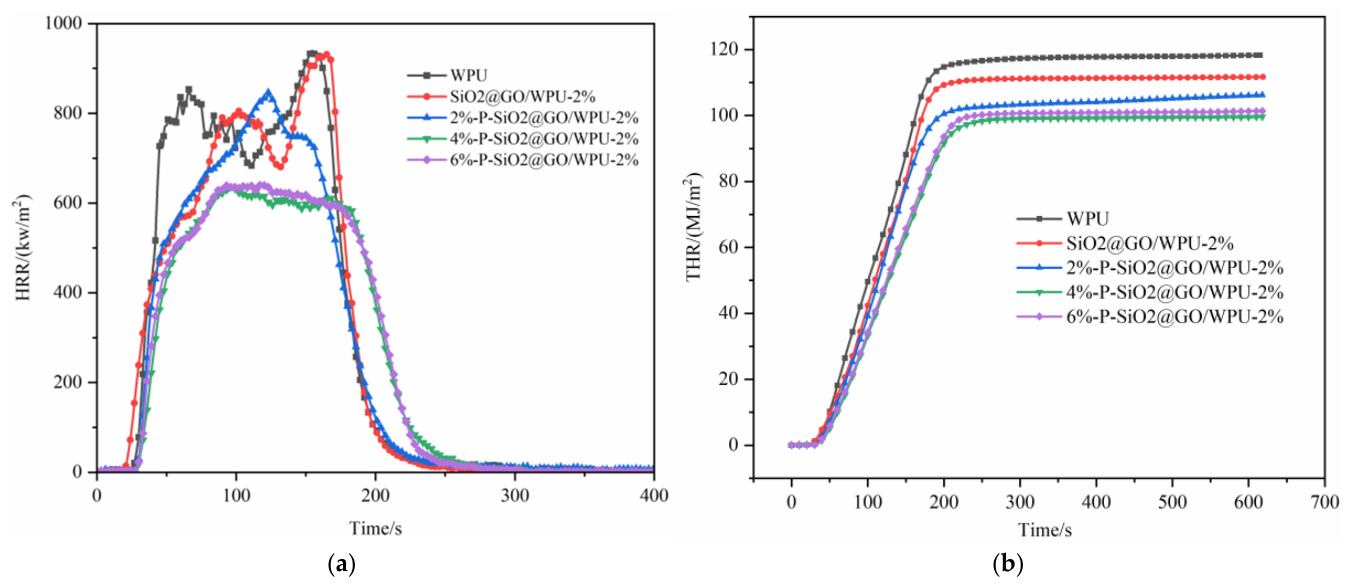
A comprehensive analysis of Figure 6 and Table 3 reveals that upon the introduction of SiO2@GO particles, the ignition time of the modified waterborne polyurethane (WPU) film is longer than that of pure WPU. The peak heat release rate of pure WPU was 942.1 kW/m2. However, when 2% SiO2@GO was added, this value decreased to 931.2 kW/m2, showing a slight reduction. Simultaneously, the smoke production rate of the film is significantly reduced, indicating that the introduction of SiO2@GO can exert a certain degree of smoke suppression effect. This effect can slow the release of smoke during combustion, thereby reducing the material’s fire risk to a certain extent.
Further research on Figure 6 and Table 4 reveals that, under the combined action of the phosphorus flame retardant P- and SiO2@GO, as the P- addition increases, the ignition time of the modified material gradually lengthens, whereas the maximum heat release rate and total heat release decline. According to the cone calorimeter test standard (ISO 5660-1:2015 [28]), the optimized 4–P-SiO2@GO/WPU-2% coating demonstrated a significant effect in mitigating fire hazards. The maximum heat release rate dropped to 636.5 kW/m2, and the total heat release was 99.5 MJ/m2, both 32.4% and 15.9% lower than those for pure WPU. Meanwhile, the ignition time (TTI) was substantially extended from 15 s to 28 s. Nevertheless, the smoke generation rate increased at this time, and the smoke suppression performance was relatively weakened. This is primarily due to the condensed-phase flame-retardant mechanism of phosphorus-based flame retardants. At high temperatures, they decompose to produce phosphoric acid, catalyze oxidation reactions on the surface of the carbon layer, generate CO and CO2, and release smoke particles.
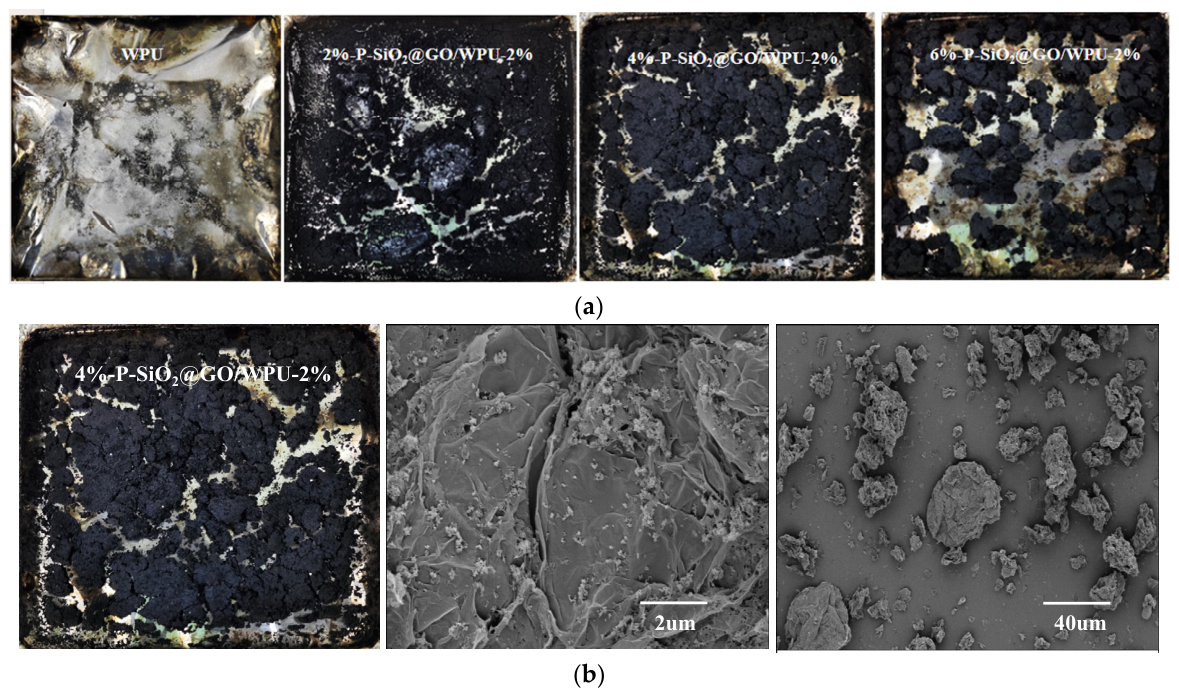
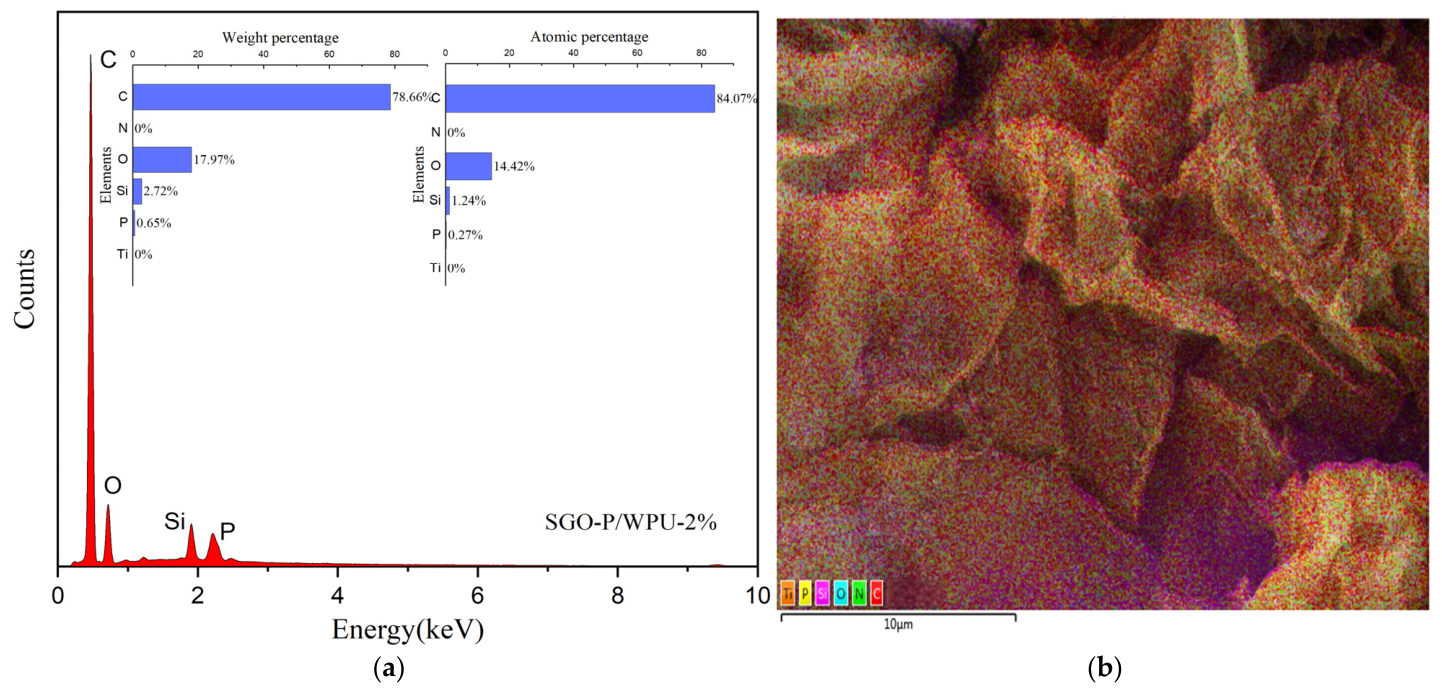
According to Figure 7, after high-temperature burning, only a sparse carbon residue layer was generated in WPU, and small holes were observed on its surface. The mass and heat transfer channels formed by these holes would, to a certain extent, promote the combustion reaction. In contrast, the P-SiO2@GO/WPU-modified material still had a carbon-residue layer at 600 °C. When the P- addition amount was 4%, the carbon residue layer was denser, with fewer pores. This could effectively block the exchange of oxygen and heat, as well as the volatilization of combustible gas in the material, demonstrating good flame-retardant and thermal-insulation effects. The mechanism underlying this phenomenon can be explained from the perspective of the P/Si synergistic condensed-phase effect. During heating and combustion, the phosphorus-containing groups preferentially decompose to generate phosphoric or polyphosphoric acid species, which catalyze dehydration and carbonization of the WPU matrix and promote the formation of a phosphorus-containing char layer. Meanwhile, the SiO2@GO component can migrate and enrich at the residue surface. Rather than forming a simple protective SiO2 layer, the silicon-containing component may participate in high-temperature sintering/ceramization reactions with phosphorus-containing species and the char matrix, resulting in a compact P/Si-containing ceramic-like protective layer. This ceramic-like barrier reinforces the char structure, reduces defects and pores, and effectively inhibits oxygen diffusion, heat transfer, and the release of combustible volatiles. The element distribution on the char residue surface shown in Figure 8 further confirms the coexistence of phosphorus and silicon in the residue, indicating that both phosphorus-containing species and silicon-containing components play important roles in the condensed-phase flame-retardant mechanism.

4.3.3. TG Analysis

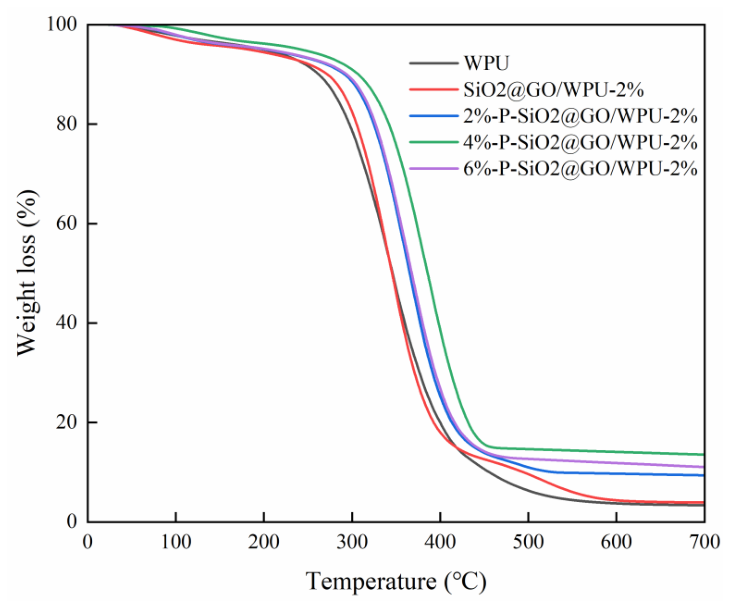
Figure 9 presents the thermogravimetric analysis results for WPU and SiO2@GO/WPU. Based on the analysis of Figure 9, the four samples exhibit similar thermal decomposition trends. The entire thermal decomposition temperature range can be roughly divided as follows: below 150 °C, it represents the volatilization of water and low-boiling-point solvents contained in the film; the temperature range of 250–350 °C corresponds to the decomposition of hard-segment carbamate in the system; and the range of 350–600 °C is attributed to the decomposition caused by the fracture of soft-segment C-C or C-O-C bonds. As shown in the figure, the initial decomposition temperature of the modified WPU increased with the addition of P-SiO2@GO. When the mass loss rate was 5%, the thermal decomposition temperature of WPU was 190 °C, while those of the modified SiO2@GO/WPU-2%, 2%-P-SiO2@GO/WPU-2%, 4%-P-SiO2@GO/WPU-2%, and 6%-P-SiO2@GO/WPU-2% were 205 °C, 210 °C, 263 °C, and 234 °C, respectively. The thermal stability of polyurethane was improved to a certain extent.
It can also be observed from Figure 9 that as the amount of P-SiO2@GO increases, the char residue of P-SiO2@GO/WPU first increases and then decreases. The char residue rate of 4%-P-SiO2@GO/WPU-2% is the highest, reaching 13.02%. An increase in the char residue rate can reduce the generation of flammable gases during the decomposition process. Moreover, the carbon layer covering the polymer surface can also provide a certain degree of heat and oxygen insulation, which is conducive to enhancing the flame retardancy of the polymer. The above research results (as shown in Table 1) also indicate that the limiting oxygen index of pure WPU is 17.8%, classifying it as a flammable material. The limiting oxygen index of P-SiO2@GO/WPU has been significantly improved. When the addition amount of the phosphorus-based flame retardant is 4% and that of SiO2@GO is 2%, the limiting oxygen index reaches 32.2%. This also indirectly reflects that the synergistic flame-retardant effect of P- and SiO2@GO is better, effectively inhibiting the combustion of polyurethane in air. Evaluated via thermogravimetric analysis (TGA), the optimized 4%-P-SiO2@GO/WPU-2% coating exhibited markedly enhanced thermal stability compared to the neat WPU. Specifically, the initial degradation temperature (T5%) was significantly delayed from 190 °C to 263 °C. Furthermore, a substantial char residue of 13.02% was retained, evidencing that the co-modification effectively facilitates the formation of a robust condensed-phase thermal shield. This behavior aligns with established P-Si synergistic mechanisms in WPU systems [29,30], wherein the phosphorus moieties act as charring agents to promote carbonization, while the silicon constituents fortify the structural integrity of the resultant protective char layer.

5. Conclusions

This study centers on the application of phosphorus/graphene oxide synergistically modified waterborne polyurethane (WPU) coatings to enhance flame-retardant properties. The impacts of modified graphene oxide (SiO2@GO) and the phosphorus-containing flame retardant THPO on the comprehensive properties of the coatings at different addition amounts were systematically explored. The flame-retardant properties were quantitatively characterized using SEM, FTIR, and TGA. The main conclusions are as follows:
(1)
Utilizing the phosphorus-based flame retardant THPO as a chain extender alongside the synergistic modification of waterborne polyurethane (WPU) with SiO2@GO, the fabricated P-SiO2@GO coating exhibits superior hydrophobicity, enhanced thermal stability, and outstanding flame retardancy. These combined properties render the coating highly promising for applications across the construction, transportation, and textile industries, particularly in fire-hazardous environments.
(2)
The addition of SiO2@GO and P- containing various components exhibits a significant co-modification effect in enhancing the flame-retardant properties of the coating. When 2% SiO2@GO and 4% P- are added, the water absorption rate of the coating decreases by 13.89%, and the heat release rate and heat release amount are reduced by 32.4% and 15.9%, respectively, thereby balancing the coating’s functional use and thermal stability.
(3)
Scanning electron microscopy (SEM) and thermogravimetric analysis (TGA) indicate that, subsequent to high-temperature calcination, P-SiO2@GO/WPU generates a continuous and dense P/Si-containing carbonaceous ceramic-like barrier layer on its surface. This protective layer can be attributed to the synergistic charring effect of phosphorus-containing species and the high-temperature sintering/ceramization of silicon-containing components within the char matrix. The resultant compact barrier efficiently impedes the volatilization of combustible gases and heat transfer. Moreover, the synergistic modification with P-SiO2@GO elevates the initial decomposition temperature of waterborne polyurethane. When 4% phosphorus-based flame retardant and 2% SiO2@GO are incorporated, the material’s limiting oxygen index reahces 32.2%, suggesting excellent flame retardancy.
(4)
Future research will prioritize the systematic assessment of the coatings’ long-term weatherability and UV aging resistance under dynamic, severe environmental conditions. Concurrently, evaluating the interfacial adhesion and compatibility across diverse industrial substrates is indispensable for expanding their application spectrum. Ultimately, streamlining the electrostatic self-assembly preparation process will provide the essential theoretical and technical frameworks required for scalable, economically viable mass production.

Author Contributions

Conceptualization, C.L.; methodology, C.H.; investigation, B.H.; resources, H.Z.; writing—original draft preparation, C.L.; writing—review and editing, C.L.; visualization, T.X.; validation, C.H.; supervision, X.L.; funding acquisition, X.L. and H.Z. All authors have read and agreed to the published version of the manuscript.

Funding

This research was funded by [the Key R&D Program of Zhejiang] grant number [2025C02001] and [the Science Foundation of the China Academy of Safety Science and Technology] grant number [2026JBKY16].

Data Availability Statement

Data are contained within this article.

Acknowledgments

The authors would like to thank all individuals who contributed to this study. This work was supported by the Key R&D Program of Zhejiang Foundation (Grant No. 2025C02001) and the Science Foundation of the China Academy of Safety Science and Technology Foundation (Grant No. 2026JBKY16).

Conflicts of Interest

The authors declare no conflicts of interest.

References

  1. Yan, Z.; Qiao, H.; Wang, Y.; Mei, Y.; Li, J.; Qin, C. Preparation and Performances of Nano-SiO2 Modified Graphene Oxide/Waterborne Polyurethane Composites. China Plast. Ind. 2024, 52, 63–68. [Google Scholar] [CrossRef]
  2. Chen, X.; Wang, S.; Yang, T.; Wu, Z. Development of Silicone Modified Waterborne Polyurethane Leather Finishing Agent. Silicone Mater. 2025, 39, 6–11. [Google Scholar]
  3. Gu, L.; Ge, Z.; Huang, M.; Luo, Y. Halogen-free flame-retardant waterborne polyurethane with a novel cyclic structure of phosphorus− nitrogen synergistic flame retardant. J. Appl. Polym. Sci. 2015, 132, 859–869. [Google Scholar] [CrossRef]
  4. Wu, W.; Mo, Y.; Yue, M.; Huang, X.; Hu, C. Research Progress in Waterborne Polyurethane Flame-retardant Composite Materials. New Chem. Mater. 2025, 53, 15–17+23. [Google Scholar] [CrossRef]
  5. Si, J.; Li, Y.; Yu, X. Curing behavior and mechanical properties of an eco-friendly cold-mixed epoxy asphalt. Mater. Struct. 2019, 52, 81. [Google Scholar] [CrossRef]
  6. Yu, W.; Sisi, L.; Haiyan, Y.; Jie, L. Progress in the functional modification of graphene/graphene oxide: A review. RSC Adv. 2020, 10, 15328–15345. [Google Scholar] [CrossRef]
  7. Yu, Y.; Xu, R.; Chen, J.; Kang, J.; Xiang, M.; Li, Y.; Li, L.; Sheng, X. Ordered structure effects on β-nucleated isotactic polypropylene/graphene oxide composites with different thermal histories. RSC Adv. 2019, 9, 19630–19640. [Google Scholar] [CrossRef]
  8. Yu, Y.; Zeng, F.; Chen, J.; Kang, J.; Yang, F.; Cao, Y.; Xiang, M. Effects of ordered structure on non-isothermal crystallization kinetics and subsequent melting behavior of β-nucleated isotactic polypropylene/graphene oxide composites. J. Therm. Anal. Calorim. 2019, 136, 1667–1678. [Google Scholar] [CrossRef]
  9. Chen, J.; Zhang, W.; Ge, H.; Tan, J.; Liu, J. Preparation and properties of phenolic resin/graphene oxide encapsulated SiO2 nanoparticles composites. Polym. Eng. Sci. 2018, 58, 2143–2148. [Google Scholar] [CrossRef]
  10. Zhao, X.; Li, J.; Li, Q.; Qiao, L.; Zhang, L.; Liu, Z.; Yang, C. Fabrication of a scratch & heat resistant superhydrophobic SiO2 surface with self-cleaning and semi-transparent performance. RSC Adv. 2018, 8, 25008–25013. [Google Scholar] [CrossRef]
  11. Gallo, E.; Schartel, B.; Schmaucks, G.; von der Ehe, K.; Böhning, M. Effect of well dispersed amorphous silicon dioxide in flame retarded styrene butadiene rubber. Plast. Rubber Compos. 2013, 42, 34–42. [Google Scholar] [CrossRef]
  12. Pavlicevic, J.; Spírková, M.; Jovicic, M.; Budinski-Simendic, J.; Pilic, B.; Balos, S. Structure-Functional property relationship of aliphatic polyurethane-silica hybrid films. Prog. Org. Coat. 2019, 126, 62–74. [Google Scholar] [CrossRef]
  13. Schartel, B.; Schmaucks, G. Flame Retardancy Synergism in Polymers Through Different Inert Fillers’ Geometry. Polym. Eng. Sci. 2017, 57, 1099–1109. [Google Scholar] [CrossRef]
  14. Huang, G.; Gao, J.; Wang, X.; Liang, H.; Ge, C. How can graphene reduce the flammability of polymer nanocomposites? Mater. Lett. 2012, 66, 187–189. [Google Scholar] [CrossRef]
  15. Wang, X.; Hu, Y.; Song, L.; Yang, H.; Xing, W.; Lu, H. In situ polymerization of graphene nanosheets and polyurethane with enhanced mechanical and thermal properties. J. Mater. Chem. 2011, 21, 4222–4227. [Google Scholar] [CrossRef]
  16. Kim, H.; Miura, Y.; Macosko, C.W. Graphene/Polyurethane Nanocomposites for Improved Gas Barrier and Electrical Conductivity. Chem. Mater. 2010, 22, 3441–3450. [Google Scholar] [CrossRef]
  17. Wu, D.; Zhao, P.; Zhang, M.; Liu, Y. Preparation and properties of flame retardant rigid polyurethane foam with phosphorus–nitrogen intumescent flame retardant. High Perform. Polym. 2013, 25, 868–875. [Google Scholar] [CrossRef]
  18. Su, Q.; Yang, L.; Lv, J.; Di, K.; Chen, X. Phosphorus and Silicon Synergistic Flame Retardant Modified Waterborne Polyurethane. China Synth. Resin Plast. 2020, 37, 24–27+38. [Google Scholar] [CrossRef]
  19. Li, J.; Wang, C.; Wang, H.; Huang, Y.; Xu, G. Study of Waterborne Polyurethane Modified with Halogen-Free Silica Sol Flame Retardant. Paint. Coat. Ind. 2011, 41, 38–43. [Google Scholar]
  20. Chattopadhyay, D.K.; Webster, D.C. Thermal stability and flame retardancy of polyurethanes. Prog. Polym. Sci. 2009, 34, 1068–1133. [Google Scholar] [CrossRef]
  21. Liang, S.Y.; Neisius, N.M.; Gaan, S. Recent developments in flame retardant polymeric coatings. Prog. Org. Coat. 2013, 76, 1642–1665. [Google Scholar] [CrossRef]
  22. Gaan, S.; Liang, S.Y.; Mispreuve, H.; Perler, H.; Naescher, R.; Neisius, M. Flame retardant flexible polyurethane foams from novel DOPO-phosphonamidate additives. Polym. Degrad. Stabilit 2015, 113, 180–188. [Google Scholar] [CrossRef]
  23. Shi, Y.; Yu, B.; Duan, L.J.; Gui, Z.; Wang, B.; Hu, Y.; Yuen, R.K.K. Graphitic carbon nitride/phosphorus-rich aluminum phosphinates hybrids as smoke suppressants and flame retardants for polystyrene. J. Hazard. Mater. 2017, 332, 87–96. [Google Scholar] [CrossRef]
  24. Ma, C. Synthesis of Phosphine Oxide-Containing Hyperbranched Flame Retardants and Study on Flame Retardancy and Mechanisms of Their Typical Polymer Composites. Ph.D. Thesis, University of Science and Technology of China, Hefei, China, 2017. Available online: https://kns.cnki.net/kcms2/article/abstract?v=wdP5rvnYoIyaLszcXn6YpM2nGlc4i4ZfzQVL3gOO6rH79lnlyGkTnHwmwu0cUM4Nfynx4j4mEBhgf8Byme9U4NlbBjfldyl_UmbLLPWrEMUfUxN4jXwokYHVndjMto4Scz2ICekRLBs47Y-fzaBPsJheTqEOSfyzE4Av6xL_Flf883BDn7UWm70tBy8EF73V&uniplatform=NZKPT&language=CHS (accessed on 15 January 2026).
  25. Hummers, W.S.; Offeman, R.E. Preparation of graphitic oxide. J. Am. Chem. Soc. 1958, 80, 1339. [Google Scholar] [CrossRef]
  26. Ramezanzadeh, B.; Haeri, Z.; Ramezanzadeh, M. A facile route of making silica nanoparticles-covered graphene oxide nanohybrids (SiO2-GO); fabrication of SiO2-GO/epoxy composite coating with superior barrier and corrosion protection performance. Chem. Eng. J. 2016, 303, 511–528. [Google Scholar] [CrossRef]
  27. ASTM D2863-17; Standard Test Method for Measuring the Minimum Oxygen Concentration to Support Candle-Like Combustion of Plastics (Oxygen Index). ASTM International: West Conshohocken, PA, USA, 2017.
  28. ISO 5660-1:2015; Reaction-to-Fire Tests—Heat Release, Smoke Production and Mass Loss Rate—Part 1: Heat Release Rate (Cone Calorimeter Method) and Smoke Production Rate (Dynamic Measurement). International Organization for Standardization: Geneva, Switzerland, 2015.
  29. Cui, M.; Li, J.; Chen, X.; Hong, W.; Chen, Y.; Xiang, J.; Yan, J.; Fan, H. A halogen-free, flame retardant, waterborne polyurethane coating based on the synergistic effect of phosphorus and silicon. Prog. Org. Coat. 2021, 158, 106359. [Google Scholar] [CrossRef]
  30. Liang, X.; Liu, C.; Chen, Y.; Yin, F.; Bao, D.; Zhou, G. Waterborne polyurethane composites flame retardancy based on the bi-DOPO derivatives and dangling poly(dimethylsiloxane) chains. Prog. Org. Coat. 2023, 177, 107388. [Google Scholar] [CrossRef]
Figure 1. Chemical reaction scheme illustrating the bifunctional linking role of APTES in the preparation of SiO2@GO: (a) covalent grafting of APTES onto SiO2 via Si-O-Si bond formation; (b) electrostatic self-assembly of positively charged APTES-SiO2 (-NH3+) onto the negatively charged GO surface (-COO).
Coatings 16 00691 g001
Figure 2. Schematic illustration of the preparation process for modified graphene oxide.
Coatings 16 00691 g002
Figure 3. FT-IR and XRD spectra of GO and SiO2@GO. (a) FT-IR spectrum. (b) XRD spectrum.
Coatings 16 00691 g003
Figure 4. GO, SiO2@GO microstructure analysis. (a) GO micro-morphology analysis. (b) Micro-morphology analysis of SiO2@GO.
Coatings 16 00691 g004
Figure 5. Changes in water contact angle and water absorption of SiO2@GO/WPU film. (a) Water contact angle of SiO2@GO/WPU film. (b) Water absorption of SiO2@GO/WPU film.
Coatings 16 00691 g005
Figure 6. Heat release rate and total heat release curves of PU and SiO2@GO/WPU film. (a) HRR curve. (b) THR curve.
Coatings 16 00691 g006
Figure 7. SEM analysis of combustion solid residues. (a) Analysis of P-SiO2@GO/WPU combustion solid residues with different amounts of phosphorus flame retardants. (b) SEM analysis of 4%-P-SiO2@GO/WPU-2% combustion solid residue.
Coatings 16 00691 g007
Figure 8. 4%-P-SiO2@GO/WPU-2 carbon residue surface element distribution map. (a) Surface element analysis. (b) Surface element distribution map.
Coatings 16 00691 g008
Figure 9. TG test curve analysis.
Coatings 16 00691 g009
Table 1. Detailed formulations and specific component quantities for pure and modified WPU coatings.
Sample CodeWPU Emulsion/(g)WPU Solids/(g)SiO2@GO/(g)THPO (P-)/(g)
WPU1003000
SiO2@GO/WPU-0.5%100300.150
SiO2@GO/WPU-1%100300.30
SiO2@GO/WPU-2%100300.60
SiO2@GO/WPU-4%100301.20
2%-P-SiO2@GO/WPU-2.0%100300.60.6
4%-P-SiO2@GO/WPU-2.0%100300.61.2
6%-P-SiO2@GO/WPU-2.0%100300.61.8
Table 2. Water contact angle and water absorption of coatings at different SiO2@GO concentrations.
SiO2@GO Content (wt%)Water Contact Angle (°) Mean ± SD (n = 3)Water Absorption (%) Mean ± SD (n = 3)
055.27 ± 1.9252.25 ± 2.18
0.548.84 ± 2.0546.47 ± 1.95
1.062.26 ± 1.8338.69 ± 1.74
2.068.57 ± 2.4438.36 ± 1.61
4.063.42 ± 2.1640.67 ± 1.78
Table 3. Limiting oxygen index test results.
Name of FilmWPUSiO2@GO/WPU-2%2%-P-SiO2@GO/WPU-2%4%-P-SiO2@GO/WPU-2%6%-P-SiO2@GO/WPU-2%
Limiting oxygen index/(%)17.820.326.732.231.6
Table 4. Cone calorimeter test data of WPU and modified film.
Name of FilmTime to Ignition/sPeak Heat Release Rate/(kW·m−2)Total Heat Release/(MJ·m−2)Smoke Production Rate/(m2·s−1)
WPU15942.1118.30.019
SiO2@GO/WPU-2%20931.2111.70.017
2%-P-SiO2@GO/WPU-2%27746.0106.20.043
4%-P-SiO2@GO/WPU-2%28636.599.50.049
6%-P-SiO2@GO/WPU-2%29640.1101.40.050
Disclaimer/Publisher’s Note: The statements, opinions and data contained in all publications are solely those of the individual author(s) and contributor(s) and not of MDPI and/or the editor(s). MDPI and/or the editor(s) disclaim responsibility for any injury to people or property resulting from any ideas, methods, instructions or products referred to in the content.