Article

Ag–ZnO and Cu–ZnO Nanocomposites as Dual-Function Agents: Antifungal Activity and Cytotoxic Effects in MDA-MB-231 Breast Cancer Cells


1
Institute of Biology, Biotechnology, and Environmental Protection, Faculty of Natural Sciences, University of Silesia in Katowice, 40-032 Katowice, Poland
2
Faculty of Pharmaceutical Sciences, Medical University of Silesia, 41-200 Sosnowiec, Poland
3
Institute of Material Engineering, Faculty of Science and Technology, University of Silesia in Katowice, 41-500 Chorzow, Poland
4
Doctoral School, University of Silesia in Katowice, 40-032 Katowice, Poland
5
Materials Research Laboratory, Silesian University of Technology, 44-100 Gliwice, Poland
*
Author to whom correspondence should be addressed.
Coatings 2026, 16(6), 690; https://doi.org/10.3390/coatings16060690 (registering DOI)
Submission received: 15 May 2026 / Revised: 4 June 2026 / Accepted: 7 June 2026 / Published: 10 June 2026

Highlights

What are the main findings?
  • Phase-pure ZnO-based nanocomposites functionalized with Ag+ and Cu2+ ions were successfully synthesized and characterized.
  • Both metal oxide nanocomposites (MONCs) exhibit pronounced antifungal activity against clinically relevant fungal strains.
  • The MONCs interact with fungal surface groups, disrupting cellular metabolism and inducing oxidative stress.
  • Both nanocomposites demonstrate selective cytotoxicity toward MDA-MB-231 triple-negative breast cancer cells.
What are the implications of the main findings?
  • Comparing MIC and cytotoxic data reveals a selectivity window, especially for Ag-ZnO NC.
  • Ag-ZnO NC is active against triple-negative breast cancer cells within its antifungal range.
  • Validation of non-cancerous cells and in vivo is needed for a therapeutic index.

Abstract
Rising triple-negative breast cancer (TNBC) cases and Candida infection risks during chemotherapy demand novel therapies, with metal-oxide nanocomposites emerging as a promising solution. In this study, we synthesized Ag-ZnO and Cu-ZnO nanocomposites as established quantitative links between their physicochemical properties, ion release behaviour, and biological activity, evaluating antifungal effects against Candida albicans (ATCC 90028) and Saccharomyces cerevisiae (ATCC 9763), and their anticancer potential against MDA-MB-231 cells (ATCC HTB-26). The results revealed Ag (~13–19 nm) and Cu (~4–8 nm) nanoparticles dispersed in a ZnO matrix, with XPS confirming mixed Ag0/Ag(I)/Ag(III) and Cu(I)/Cu(II) speciation. Ag-ZnO NC exhibited strong antifungal activity (MIC = 25 mg L−1) against both fungi, while Cu-ZnO NC was only effective (MIC = 100 mg L−1) against S. cerevisiae. Aqueous release of Ag+ was ~2.6-fold higher than Cu2+. Ag-ZnO NC induced marked ROS generation (~6-fold higher than S. cerevisiae) and dehydrogenase inhibition (6.6- and ~20-fold, respectively). ATR-FTIR linked species-specific susceptibility to cell-wall architecture. SEM confirmed membrane destabilization and perforation. In MDA-MB-231, necrotic fractions reached ~9% and >40% for Ag-ZnO and Cu-ZnO, respectively. Both metal oxide nanocomposites (MONCs) act through ion release, revealing a selectivity window, especially for Ag-ZnO. Further studies on non-cancerous cells, ion-release kinetics, uptake and in vivo validation are essential to establish a therapeutic index.

Graphical Abstract

1. Introduction

Fungal infections have been a problem for centuries. However, their importance has grown with the emergence of newer varieties of civilization diseases and those related to immune system impairment. Nowadays, fungal pathogens are responsible for more than 13 million infections, resulting in 1.5 million deaths every year [1,2]. The global emergence of significant fungal infections posing a public health risk is mostly associated with Candida spp. (e.g., C. albicans). Immunocompromised and critically ill patients are particularly susceptible to fungal pathogens, especially those with viral infections (influenza, HIV, COVID-19, tuberculosis) or chronic conditions (chronic respiratory diseases, diabetes, organ transplantation). This risk is markedly elevated in cancer patients, where chemotherapy-induced neutropenia, hematopoietic stem cell transplantation, and immunosuppression promote invasive fungal infections caused by Candida, Aspergillus, Fusarium, Cryptococcus and Mucorales, often resulting in severe outcomes and high mortality [2,3,4,5]. Similar infections have also been documented in patients receiving novel immunotherapies such as bispecific T-cell engager therapy [6]. In hematologic malignancies, an even broader spectrum of opportunistic pathogens has been reported, including Trichosporon spp., Rhodotorula spp. alongside Aspergillus, Fusarium and Cryptococcus species, reflecting profound immune dysfunction in this population [7]. Collectively, these cases prolong hospitalization, increase healthcare costs and mortality, promote antifungal resistance, and limit available treatment options.
The treatment of fungal infections is increasingly challenged by the limited number of available antifungal drug classes (polyenes, azoles, echinocandins, allylamines and flucytosine) and the rapid rise in antifungal resistance (AFR), a specific form of antimicrobial resistance (AMR) in which fungi acquire the ability to survive treatment [2,8]. Resistance develops through several mechanisms, including reduced intracellular drug levels, altered sterol biosynthesis, overproduction of the target enzyme, and structural modifications of the drug target [8]. An increasing prevalence of azole resistance is observed among Candida and Aspergillus spp. [9,10,11], polyene resistance in Fusarium, Scedosporium and Mucorales species [9,12,13,14], and echinocandin resistance in selected strains [15]. Particularly concerning are Candida auris and C. albicans, which frequently show reduced azoles sensitivity [16,17], further complicating the management of invasive fungal infections and contributing to higher morbidity and mortality [2,3,8]. Restricted treatment options and rising AFR highlight the urgent need for new therapies. In 2025, the WHO reported promising new antifungal agents, including fosmanogepix (active against Candida, Aspergillus and Cryptococcus spp.), olorofim (effective against azole-resistant Aspergillus and difficult-to-treat moulds such as Scedosporium spp.), and next-generation echinocandin-class agents rezafungin and ibrexafungerp [9]. Alongside these emerging agents, nanobiotechnology offers a promising complementary strategy, with nanoparticles (NPs) and nanocomposites (NCs) enhancing antifungal efficacy and drug delivery to help overcome resistance [9,18]. Metal and metal oxide NPs (Au, Ag, Cu, Fe, ZnO, CuO, TiO2, NiO, Fe3O4) exhibit broad antimicrobial activity [19,20,21,22,23] and are increasingly explored against the dominant fungal pathogens Candida, Aspergillus and Cryptococcus, which cause over 90% of human fungal diseases [24]. Among them, Ag, Au and Fe NPs are predominantly studied [25], showing high antifungal activity against Candida and Cryptococcus species [26,27]. Their phenomenon is associated with NPs’ ability to overcome major resistance mechanisms, including enzymatic inactivation, modifications of intracellular targets and destabilization of membrane permeability. The antimicrobial mechanisms are largely dependent on the release of metal ions, which interact with biological molecules such as membrane proteins, lipids, and polysaccharides (manno-protein, mannose chains, β-glucans, and chitin). This process triggers a cascade of intracellular events, including firstly the generation of reactive oxygen species (ROS), DNA and ATP damage, disruption of cellular structures and processes, leading to metabolic imbalance and inhibition of microorganisms’ growth [25,28,29,30,31,32,33]. This is attributed to their unique physicochemical properties compared to bulk materials, which exhibit significant antimicrobial activity [34,35,36].
Nanostructure properties in connection to nanobiotechnology have become a central component of modern oncology. It is also increasingly recognized as a key branch of nanomedicine, especially in breast cancer treatment. Breast cancer, with all its varieties, remains difficult to effectively control with conventional treatments, with high death rates and a significant negative impact on patients’ quality of life [37]. The studies on it support both the discovery and development of anticancer therapeutics by enabling the design of more effective and targeted drug delivery systems. Moreover, advances in the synthesis of novel nanoparticle-based materials have expanded their potential applications in cancer diagnosis and treatment [38,39]. Several engineered nanomaterials have already demonstrated promising outcomes in experimental cancer models, highlighting their potential for future oncological applications. Among these, Au NPs are predominantly studied, showing promising effects on breast cancer cell lines MCF-7 [40] and 4T1 [37], including bimetallic Au/Ag NPs [41] and alginate-coated Au NPs functionalized with dopamine (Au@Alg-DA), which enhanced photothermal and radiotherapy in 4T1 models [42]. Ag NPs also act as anticancer agents and radiosensitizers in triple-negative MDA-MB-231 cells [43], while carboplatin-loaded Ag NPs show enhanced activity against C6 glioma, MCF-7 and A549 lines [44]. However, the small size and high surface reactivity of NPs raise safety concerns, as they may enter the bloodstream and accumulate in organs, inducing excessive ROS, inflammation and systemic toxicity. A thorough understanding of nanotoxicology is therefore essential to design safe, precisely targeted nanoproducts [45].
This work aims to develop and systematically evaluate Ag–ZnO and Cu–ZnO nanocomposites as dual-function platforms, and to establish quantitative structure–activity relationships linking their physicochemical properties to antifungal and anticancer performance. In contrast to conventional approaches that investigate antimicrobial and anticancer effects independently, this study introduces a unified, cross-system framework that directly compares biological responses in fungal and cancer models within the same material platform. Antifungal activity is assessed against Candida albicans (ATCC 90028) and Saccharomyces cerevisiae (ATCC 9763) through MIC determination, supported by the mechanistic evaluation of metabolic disruption (dehydrogenase activity) and oxidative stress (ROS generation). Interfacial interactions between nanocomposites and fungal cells are further probed using ATR-FTIR spectroscopy and SEM imaging. In parallel, anticancer activity is evaluated in MDA-MB-231 (ATCC HTB-26) cells using multiparametric assays, including WST-1 metabolic activity, LDH release, and detailed cell death analysis. These biological investigations are integrated with comprehensive physicochemical characterization, including morphology and size (TEM), surface composition and oxidation states (XPS), colloidal behaviour (DLS, ζ-potential), and ion release behaviour. Critically, this work correlates ion release kinetics and mixed-valence surface chemistry with biological outcomes across distinct cell types, enabling direct identification of ion-driven versus redox-mediated mechanisms. Finally, this study provides one of the first systematic comparisons of Ag- and Cu-based ZnO nanocomposites across both fungal and cancer systems, revealing how compositional tuning governs selectivity, mechanism, and therapeutic potential within a single nanomaterial platform.

2. Materials and Methods

2.1. Nanocomposite Synthesis

The synthesis of Ag–ZnO and Cu–ZnO nanocomposites was carried out via a modified chemical reduction method adapted from Nowak et al. [46]. Briefly, commercially available ZnO nanopowder (<50 nm, Sigma-Aldrich, Merck, St. Louis, MO, USA) was dispersed in distilled water to prepare a 1 wt% suspension, which served as the oxide matrix. Subsequently, 100 mL of 1 wt% NaOH solution (purity > 99.99%, VWR & Avantor®, Gdansk, Poland) was added under continuous stirring to establish alkaline conditions. Metal precursors, AgNO3 (purity > 99.9999%, Sigma-Aldrich, Merck, St. Louis, MO, USA) for Ag–ZnO and Cu(CH3COO)2·H2O (98.0%–102.0%, VWR & Avantor®, Gdansk, Poland) for Cu–ZnO, were then introduced dropwise (100 mL, 1 wt%) into the ZnO suspension to initiate nanoparticle formation. In the case of Cu–ZnO, 2 wt% L-ascorbic acid (100 mL, Biomus, Lublin, Poland) was additionally employed as a reducing agent to facilitate Cu2+ ion reduction. All reactions were conducted at 100 °C with constant stirring at 130 rpm for 2 h to ensure complete nanocomposite formation and stabilization. The resulting materials were isolated by filtration through a polyethylene membrane and dried in air at room temperature. A schematic representation of the synthesis procedure is provided in Figure 1. Prior to use, the stock suspension of metal oxide nanocomposites (MONCs, 500 mg L−1) was ultrasonicated (20 kHz, 5 min) immediately before dilution to the required working concentrations.

2.2. The Morphological and Chemical Characterization of Novel MONCs

High-resolution Transmission Electron Microscopy (HRTEM) was employed to determine the morphology and crystallite phase of newly synthesized MONCs. Analyses were performed using a Titan 80-300 FEI microscope (Thermo Fisher Scientific, Waltham, MA, USA) operated at 300 kV. The samples for TEM measurements were prepared according to the procedure described by Strach et al. [47], with the nanoproducts subsequently dispersed in ethanol and ultrasonicated (Omni Sonic Ruptor 400; PerkinElmer, Kennesaw, GA, USA) to eliminate agglomerates. The MONC solution was applied to an amorphous carbon film with a 300-mesh grid, and the film was coated with a copper grid. The chemical composition of samples required the use of an energy-dispersive X-ray spectroscopy EDS detector (FEI Company, Hillsboro, OR, USA).
The surface chemical composition of the MONCs was obtained using X-ray photoelectron spectroscopy (XPS) Physical Electronics PHI 5700 (Physical Electronics Inc., Chanhassen, MN, USA) [46]. Photoelectrons were excited by a monochromatized Al Kα radiation from the sample surface. The survey spectrum showed the presence of main core level lines from C, O, Zn, Ag, and Cu with no evidence of impurities. The high-resolution XPS spectra for all core levels were corrected for background using the iterated Shirley algorithm, and the bands were fitted with a combination of Gaussian and Lorentzian lines in the ULVAC-PHI MultiPak software (version 9.6.1.7, Physical Electronics Inc., Chanhassen, MN, USA). The binding energy value was corrected for a minor surface charging effect by referencing the C 1s line at 284.5 eV.
The ζ-potential (surface charge) and hydrodynamic diameter of MONCs (in MilliQ solution) were measured using dynamic light scattering (DLS) on a Litesizer 500 (Anton Parr GmbH, Graz, Austria), following the manufacturer’s guidelines. The pH of the aqueous suspensions was determined at room temperature (20–22 °C) using pH-Fix test strips (Ref. 92110, Macherey-Nagel GmbH & Co. KG, Duren, Germany).
The kinetics of Ag+ and Cu2+ ion release from Ag–ZnO and Cu–ZnO nanocomposites were investigated in aqueous suspensions following the methodology described by Dulski et al. [48]. The samples were incubated for 48 h under conditions relevant to biological assays (37 °C, 110 rpm), simulating the intended application environment. At predetermined time points (0.5, 1, 2, 3, 4, 6, 8, 24, and 48 h), aliquots were collected and immediately centrifuged (10 min) to separate the solid phase. The resulting supernatants were analyzed for dissolved Ag+ and Cu2+ concentrations using a Thermo Scientific iCE 3000 Series Atomic Absorption Spectrometer (Thermo Fisher Scientific, Bremen, Germany) equipped with an air–acetylene flame. Measurements were performed at 328.1 nm for Ag+ and 324.8 nm for Cu2+, with optimized burner heights of 7.0 mm and 6.2 mm, respectively. All analyses were conducted in triplicate with deuterium background correction. Quantification was based on external calibration using Certipure standard solutions (Ag+: 0.313–2.5 mg L−1; Cu2+: 0.3–3.0 mg L−1), and results were corrected for procedural blanks. The cumulative amount of released ions was calculated according to Equation (1) [49]:
q t m g   g 1 = C t C 0 · V W ,
where qt is the amount of adsorbate released into the environment at time (mg g−1); W is the mass of the adsorbent (g); C0 is the initial concentration of the adsorbate (mg L−1) equal to 0; Ct is the concentration of the adsorbate at time t (mg L−1); V is the volume of the solution (L).
Finally, the rate of adsorption in liquid–solid interactions was estimated with two widely used adsorption kinetic models [49,50]:
Pseudo-first-order (PFO) expression:
q t m g   g 1 =   q e   1 e k 1 t ,
Pseudo-second-order (PSO) expression:
q t m g   g 1 =   q e 2 k 2 t 1 + q e k 2 t ,
where qt is the amount of ions released into the environment at time t (mg g−1); qe is the amount of ions at equilibrium (mg g−1); k1 is the rate constant for the PFO model (h−1); k2 is the rate constant for the PSO model (g mg−1 h−1); t is the adsorption/desorption time (h).

2.3. Antifungal Potential of MONCs

2.3.1. Microbial Strains and Culture Conditions

The model microorganisms chosen in this study were obtained from the American Type Culture Collection (ATCC). The basic characteristics and selective culture medium are collected in Table 1.
Before use, the isolates were thawed from −80 °C and immediately inoculated into selective broth, then incubated (37 °C, 130 rpm) for 24 h, following the ATTC instructions. For all experiments, cells were harvested at the midpoint (t1/2) of the exponential (log) growth phase, which was calculated using Statistica software version 13.3 (Spotfire, Goteborg, Sweden and an online tool available at https://www.wolframalpha.com according to the Verhulst logistic model for sigmoidal microbial growth [51].

2.3.2. Evaluation of the Potential Toxicity of MONCs Against Fungal Cells

The effectiveness of the engineered MONCs on selected fungal strains was evaluated by determining their minimum inhibitory concentrations (MICs). In this stage, ZnO NPs-base matrix was also tested to assess its impact on microbial cells. Serial dilutions of MONCs and ZnO NPs (1,10, 25, 50, 100, 200, and 300 mg L−1) were tested in broth using a 12-well plate. In the next step, mid-potential-phase microbial cells were added to each well to achieve an OD600 of 0.1 (~107 CFU mL−1). Control constituted a growth medium inoculated with fungi and without nanocomposites. Prepared in this way, plates were next incubated for 24 h at 37 °C with shaking at 110 rpm. After this, MIC was defined as the lowest concentration of MONCs/NPs that completely inhibited visible microbial growth. To determine whether the observed inhibition was reversible or lethal, aliquots from each well were spotted onto solid agar plates and incubated for the next 24 h at 37 °C. Wells showing no colony growth were interpreted as having a lethal effect at that nanostructure concentration.
In the next part, the proposed experiments were carried out exclusively for MONCs exhibiting antifungal activity, as determined by obtained MIC values.

2.3.3. Dehydrogenase Activity (EC 1.1.1)

The intensity of respiratory processes and enzymatic activity associated with the electron transport chain was determined according to Nweke et al. [52] using a colorimetric assay based on the reduction of colourless 2,3,5-triphenyltetrazolium chloride (TTC) to red 1,3,5-triphenylformazan (TPF), which is then quantified spectrophotometrically. Following the incubation period, a 2.8 mL aliquot of a 24-h bacterial culture treated with nanoparticles (37 °C, 140 rpm) was collected in duplicate. To one set of replicates, 0.2 mL of 0.4% (w/v) TTC solution was added, whereas sterile distilled water was added to the control samples. The samples were incubated for 4 h at 37 °C under static, dark conditions. Following incubation, 4 mL of absolute ethanol was added to each sample to extract the produced TPF. The mixtures were shaken for 24 h at room temperature in the dark to ensure complete dissolution of the formazan. Subsequently, samples were centrifuged at 15,000 rpm for 5 min at 4 °C. The absorbance of the supernatant was measured at λ = 485 nm against ethanol as a blank. Dehydrogenase activity was calculated based on the following Equation (4):
D E H μ g   T P F   h 1 m L 1 = A T A C x   t   V ,
where AT is the absorbance of the sample with TTC; AC is the absorbance of the control sample (without TTC); x is the slope of the calibration curve; t is the time of incubation with TTC (h); V is the volume of supernatant used for enzyme activity determination.
To quantify the concentration of TPF formed, a calibration curve was prepared using a TPF stock solution (0.1 g L−1). Working standards were prepared in ethanol to obtain final concentrations of 0, 2, 5, 7, 10, 12, 15, 17, 20, 25, 30, 35, 40, 45, and 50 μg mL−1 TPF.

2.3.4. Total Reactive Oxygen Species (ROS) Production

Intracellular ROS levels were quantified using 2′,7′-dichlorodihydrofluorescein diacetate (H2DCFDA), which is oxidized by ROS to fluorescent 2′,7′-dichlorofluorescein (DCF), following Alpaslan et al. [53] and Yang et al. [54]. Fungal cultures were adjusted to an optical density of OD600 = 0.1 in PBS, supplemented with MONCs and incubated for 1 h at 37 °C with shaking at 130 rpm. Abiotic MONC controls were prepared in parallel. After incubation, 200 μL of each sample was transferred to a 96-well plate, and 1 μL of H2DCFDA (4 mM in DMSO) was added. Following 30 min incubation in the dark at room temperature, fluorescence was measured (Ex 485 nm, Em 530 nm). Fungal viability was assessed by planting serial dilutions on YM agar (BD 271210) and counting CFU after 24 h at 37 °C. ROS levels were expressed as fluorescence arbitrary units (AU) per log CFU mL−1, corrected for background.

2.3.5. Fourier Transform Infrared Spectroscopy (ATR-FTIR)

For FTIR analysis, fungal cells (MONCs with antifungal activity and control) were incubated for 4 h, washed three times with ultrapure water, and centrifuged (4700 rpm, 20 min, 4 °C). The obtained pellet was freeze-dried (−15 °C, 18 h; Alpha 2-4 LSCbasic, Martin Christ Gefriertrocknungsanlagen GmbH, Germany) [55]. This preparation preserved molecular and structural features associated with cell–nanomaterial interactions, enabling subsequent spectroscopic analysis. FTIR spectra were recorded using an Agilent Cary 640 spectrometer equipped with a standard source and a DTGS Peltier-cooled detector. Measurements were performed with a GladiATR diamond accessory over the spectral range of 400–4000 cm−1. For each strain, eight spectra were collected for both control and NC-treated samples, with each spectrum averaged over 16 scans at a resolution of 4 cm−1. The acquired spectra were post-processed using Win-IR Pro (v2.96), including baseline correction, removal of water and CO2 contributions, and ATR correction (n = 1.388) [56]. The prepared data were used to perform integrated band intensity analysis to quantify specific molecular changes, focusing on the characteristic bands of the structures listed in Table 2. Quantitative results were also visualized using box-and-whisker plots.
Further preprocessing involved second-derivative transformation using a 13-point Savitzky–Golay algorithm [56], followed by vector normalization. These steps enhanced spectral resolution and reduced non-chemical interferences such as scattering effects and baseline distortions [59,60].

2.3.6. Scanning Electron Microscopy (SEM)

Fungal cell surface morphology of MONC-treated and control fungal culture was examined using a Hitachi SU8010 field emission scanning electron microscope (Hitachi High-Tech Corporation, Tokyo, Japan) after 4 h exposure [61]. Next, samples were centrifuged (4700 rpm, 20 min, 4 °C) to remove the growth medium and washed three times with sterile ultrapure water. The pellets were fixed in 2.5% glutaraldehyde for 18 h at 4 °C to preserve cellular structure, then centrifuged and rinsed again. Dehydration was performed using a graded ethanol series (30%–99.8%), with 10 min incubation at each concentration followed by centrifugation (2000 rpm, 10 min, room temperature). Subsequently, samples were dried using a CO2 critical point dryer (Leica EM CPD300, Leica Microsystems, Vienna, Austria), mounted on carbon tape, and sputter-coated with 10 nm gold layer (Safematic CCU-010 HV, Safematic GmbH, Zizers, Switzerland). Imaging was performed using a secondary electron detector at accelerating voltages of 3 kV and 5 kV.

2.4. In Vitro Analysis of MONCs Using MDA-MB-231 Human Cell Line

The effect of exposure to MONC and ZnO NP matrix itself on human cells was assessed using the MDA-MB-231 epithelial breast cancer cell line (ATCC, #HTB-26), derived from mammary gland tissue. Cellular metabolic activity was determined using the WST-1 assay (Cell Proliferation Reagent WST-1, UNSPSC Code: 12352200, Roche). This method is based on the cleavage of tetrazolium salt (TTC) to a soluble formazan (TPF) dye by mitochondrial dehydrogenases in metabolically active cells. The amount of formazan produced, reflected by a colour change, is directly proportional to the level of cellular metabolic activity. Consequently, the impact of MONCs on the cytotoxicity of MDA-MB-231 cells was also evaluated using the LDH assay (Cytotoxicity Detection Kit LDH, UNSPSC Code: 12352200, Roche), which measures lactate dehydrogenase (LDH) released into the culture medium from damaged cells. LDH catalyses the conversion of lactate to pyruvate with simultaneous reduction of NAD+ to NADH, which in turn reduces TTC to the coloured TPF, allowing quantification of cytotoxicity. Absorbance of the final products was measured spectrophotometrically at 440 nm (WST-1 assay) or 500 nm (LDH assay) using an ASYS UVM340 reader (Biogenet, Jozefow, Poland).
Methodologically, all assays were performed according to a multi-step protocol. Cell culture was carried out in DMEM medium (#P04-03550, PAN Biotech, Aidenbach, Germany) supplemented with 10% of fetal bovine serum (FBS, PAN Biotech, #P30-8500) and a working gentamycin solution (0.1 mg mL−1 in DPBS buffer), prepared by diluting 1 mL of gentamicin (50 mg mL−1, Sigma-Aldrich, #G1397-10ML) with 4 mL of DPBS (PAN Biotech, #P04-36500). Before the experiment, MDA-MB-231 cells were detached with trypsin-EDTA (Gibco), counted using a Bürker chamber, and seeded at 3000 cells per well in 100 μL DMEM in 96-well plates (Nunc) and incubated for 24 h in 37 °C and air-CO2 (5%) humidified incubator. The treatment step required replacing the old medium with new DMEM containing MONCs and ZnO NPs matrix at concentrations ranging from 0.003 to 30 mg L−1, with at least four technical replicates per concentration, and incubation for 24 h at 37 °C and air-CO2 (5%) humidified environment. After exposure, cytotoxicity was assessed using WST-1 and LDH tests according to manufactures instructions.
The morphology of cells after exposure to MONCs, as well as that of the untreated control, was examined using an inverted microscope (Zeiss Axiovert 40 CFL, Zeiss, Oberkochen, Germany). Additionally, crystal violet staining was performed according to the protocol of Feoktistova et al. [62] to confirm the degree of confluence of the cell cultures. To analyse changes in the morphology and confluence of the cell cultures, cultures were first established in 6-well plates (Nunc). For this purpose, after detaching the cells from the culture flask using a trypsin-EDTA (ethylenediaminetetraacetic acid) solution (Gibco) and determining the cell count using a Bürker chamber, 3 × 10⁵ cells were seeded into each well of the plate. Next, 1.5 mL of DMEM medium was added to each well containing cells. The prepared 6-well plate was placed in a 5% CO2 incubator for 24 h in 37 °C. In the second stage, the medium was removed from the cells adhering to the bottom of each well of the 6-well plates and replaced with medium containing MONCs/NPs at a range of concentrations 30, 6, 0.3, and 0.003 mg L−1. Each concentration of MONCs/NPs was tested in three replicates. The 6-well plates with cell cultures treated with various concentrations of MONCs/NPs were then placed in a 5% CO2 incubator. Incubation was carried out for 24 h. In the third stage, after removing the 6-well plates from the incubator, microscopic analysis of cell morphology was performed and then the cell staining procedure was started. The crystal violet (0.5% solution) staining was performed using PBS to wash cells instead of water and omitting the last stage of cell dissolution. The 6-well plates were stained and dried for at least 1 h at room temperature, after which the adherent cells on the well culture surfaces were used for visual assessment of live-cell density in the respective cultures.
Flow cytometry was employed to quantitatively assess cell viability and cell death at the single-cell level following exposure to MONCs and ZnO NPs. The MDA-MB-231 cells were detached with trypsin-EDTA, counted using a Bürker chamber, and seeded at 3 × 10⁵ cells per 3 cm of a 6-well plate (Cellstar, Greiner Bio-One GmbH, Kremsmunster, Austria) in 2 mL of DMEM. After 24 h of incubation in a 5% CO2 incubator, the medium was replaced with fresh DMEM containing the highest selected MONCs concentration (as determined by WST-1 and LDH assays) that did not compromise viability. Parallel cultures were also treated with the ZnO NPs matrix alone or untreated as a control and incubated for a further 24 h. Cells were then washed with PBS, detached, centrifuged (100 rcf, 3 min, 4 °C), washed with Hanks balanced salt solution (HBSS, #21-022-CVRBD, Mediatech Inc., Manassas, Va, USA) and resuspended in 1 mL of HBSS. Staining was performed with the Vybrant® DyeCycleTM Violet/SYTOX® AADvancedTM Apoptosis Kit (#A35135, Life Technologies, Warsaw, Poland) according to the manufacturer’s instructions (incubation conditions: 15 min, 37 °C, in the dark), allowing discrimination of early/late apoptotic and necrotic cells. Samples were analyzed on a BD FACSAriaTM II Cell Sorter (BD Group, Bornem, Belgium) (405/488 nm laser, emission 440 and 660 nm).

2.5. Statistical Data Assessment

All statistical and graphical analyses were performed using OriginPro 2023 (OriginLab Corporation, Northampton, MA, USA) and STATISTICA 13.3 (TIBCO Software Inc., Palo Alto, CA, USA), with additional support from MS Office 2019 (Microsoft Inc., Redmond, WA, USA). Data are presented as mean ± standard deviation/error (SD/SE) from at least three independent repeats. Statistical differences between MONC-treated samples and control were assessed using one-way ANOVA followed by Tukey’s HSD post hoc test, with significance set at p < 0.05. The processed spectral data were then used as input for Principal Component Analysis (PCA), performed in OriginPro 2023 (OriginLab Corporation, USA), to identify similarities and differences in chemical composition and to evaluate the molecular impact of nanomaterials on fungal cells qualitatively.

3. Results

3.1. Comprehensive Characterization of MONCs

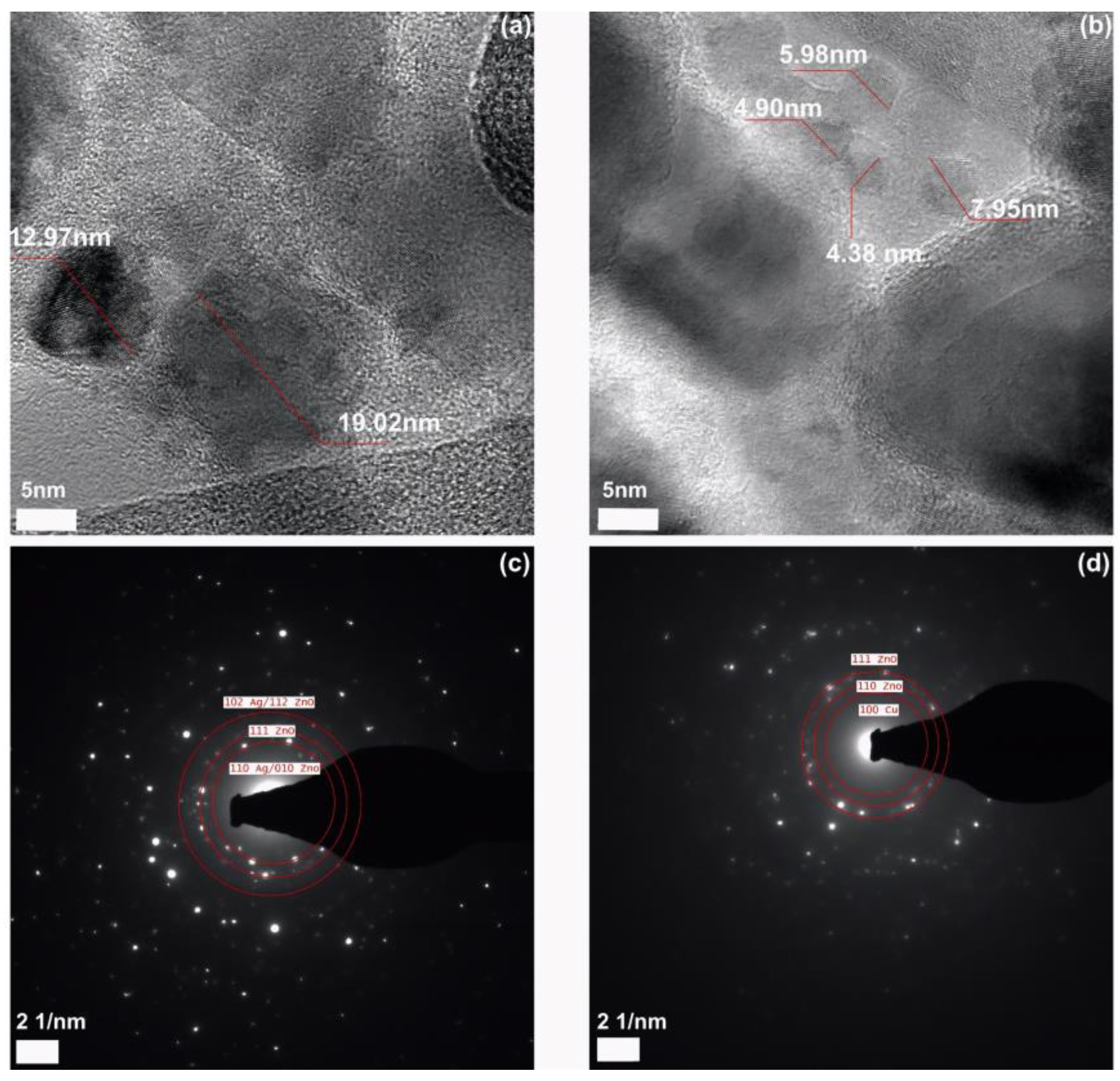
High-resolution transmission electron microscopy (HRTEM) images (Figure 2a,b) confirm the formation of hybrid nanostructures in which metallic Ag and Cu nanoparticles are immobilized within the ZnO matrix, forming a heterogeneous yet well-integrated architecture with intimate interfacial contact. Both systems show local aggregation, while individual particles remain predominantly quasi-spherical, indicating isotropic growth under diffusion-controlled reduction. Ag–ZnO contains larger nanoparticles (12.97–19.02 nm) with narrow dispersion, whereas Cu–ZnO features significantly smaller, more uniformly distributed particles (4.48–7.95 nm), likely due to a higher nucleation rate promoted by ascorbic acid acting as reducing and capping agent, yielding a higher density of interfacial active sites.
Selected area electron diffraction (SAED) patterns (Figure 2c,d) confirm the polycrystalline, multiphase nature of the nanocomposites. Both systems display reflections from wurtzite ZnO planes (100), (002) and (101), accompanied by rings assigned to Ag/AgO phases (111)/(200) in Ag–ZnO and to Cu/CuO phases (111), (110), (100) in Cu–ZnO, indicating partial oxidation of the metallic component. This combination of nanoscale dispersion, high interfacial density and redox-active domains is expected to govern ion release kinetics and surface-mediated reactions.
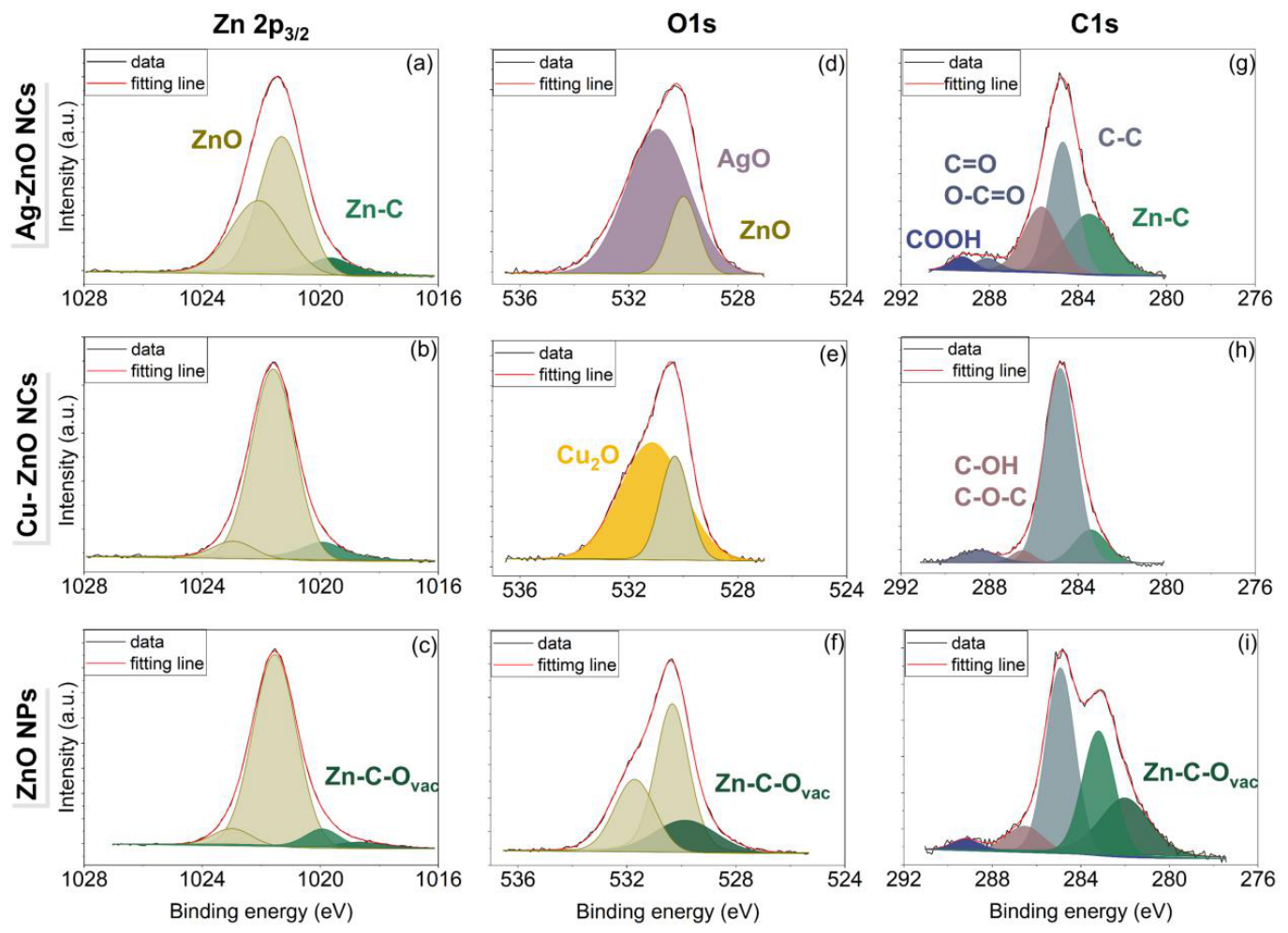
XPS measurements were used to investigate the surface chemical compositions of the Ag-ZnO and Cu-ZnO NCs, as well as the reference ZnO matrix NPs sample. High-resolution Ag 3d, Cu 2p, C 1s, O 1s and Zn 2p3/2 spectra were collected for all samples, and the atomic concentrations of the surface species were determined. The colloidal stability and surface properties of MONCs were evaluated via ζ-potential and DLS hydrodynamic diameter measurements using concentrations corresponding to optimal dispersion. The pH value of MONCs in aqueous solutions was also determined. All results of these analyses are compiled in Table 3.
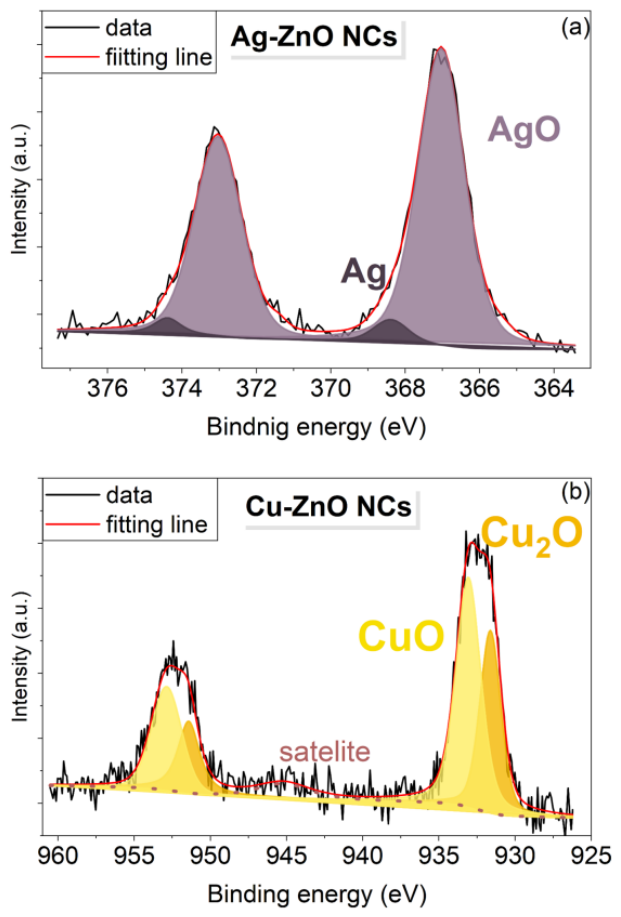
In all samples, three components corresponding to ZnO were identified in the Zn 2p3/2 core-level spectrum, with binding energies in the range of 1019.7–1022.95 eV (Figure 3a–c). In addition, an extra peak at around 1018.7 eV observed in the reference sample (Figure 3c) was attributed to an oxygen vacancy formed under ultra-high vacuum conditions due to surface charging and ascribed to Zn-C-Ovac. In the O 1s spectrum, a peak around 530.0 ± 0.4 eV was assigned to ZnO in all samples (Figure 3d–f). In contrast, an additional peak at 529.85 eV in the reference sample (Figure 3f) confirmed the formation of surface oxygen vacancies. In the Ag-ZnO NC sample, a peak at 530.9 eV was attributed to AgO (Figure 3d), whereas the peak at 531.15 eV in the Cu-ZnO NC sample was ascribed to Cu2O (Figure 3e), with overlap preventing clear separation of the two copper oxides in the O 1s line. The Cu 2p spectrum (Figure 4b) confirmed the presence of both CuO (933.1 eV) and Cu2O (931.7 eV) on the Cu-ZnO NC surface, together with an additional line at 945.2 eV corresponding to the Cu2O satellite. In the high-resolution Ag 3d spectrum (Figure 4a), silver was found in the 0, +1, and +2 oxidation states, with two doublets at ~367.1 eV and 368.4 eV assigned to AgO and Ag0, respectively. In the C 1s spectra (Figure 3g–i), peaks at approximately 283.2 ± 0.2 eV were identified as characteristic of carbon atoms chemically interacting with the metal surface. In contrast, in the reference sample, a line at 282.1 eV (Figure 3i) was assigned to Zn-C-Ovac. A second component at 284.8 ± 0.1 eV was attributed to aliphatic carbon (C-C/C-H) in all samples. An additional component at 285.65 eV in Ag-ZnO NC and at 286.55 eV in Cu-ZnO NC and ZnO NPs was assigned to C-OH/C-O-C groups. The peak around 288.2 ± 0.4 eV recorded in both MONCs was attributed to carbonyl (C=O) or O-C-O groups, while the signal at ~289.2 eV in Ag-ZnO NC and ZnO NPs was assigned to carboxyl or carboxylate groups (O-C=O, COO- and COOH).
The ζ-potential and dynamic light scattering (DLS) measurements were used to evaluate the colloidal stability and aggregation behaviour of the nanocomposites in aqueous media at pH 7. The bare ZnO matrix exhibits a positive ζ-potential of +9 mV, indicating a net positively charged surface under these conditions. Upon incorporation of Ag or Cu, a reversal of surface charge is observed, with both Ag–ZnO and Cu–ZnO systems exhibiting negative ζ-potential values. This change indicates a modification of the surface chemistry induced by metal deposition, resulting in altered interfacial charge properties. Among the modified systems, Cu–ZnO shows a less negative ζ-potential (−6.3 ± 1.1 mV) compared to Ag–ZnO (−11.4 ± 0.4 mV), indicating a lower magnitude of electrostatic repulsion at pH 7. It should be emphasized that all measurements were performed at a single pH value; therefore, no conclusions regarding the isoelectric point or full surface charge evolution can be drawn, and the reported values describe only the charge state under these specific conditions.
Despite the observed differences in ζ-potential, both modified systems exhibit low absolute surface charge values, indicating limited electrostatic stabilization and a general tendency toward aggregation. This is consistent with DLS results, where the hydrodynamic diameter of bare ZnO is the largest (1420 ± 279 nm), confirming pronounced aggregation already in the unmodified material. For the modified systems, Ag–ZnO shows a hydrodynamic diameter of 1083 ± 176 nm, while Cu–ZnO exhibits a value of 940 ± 114 nm, indicating the formation of large secondary aggregates in both cases.
The similarity in aggregate sizes, despite differences in surface charge, suggests that aggregation is governed primarily by non-electrostatic interactions, including van der Waals forces and possible interparticle bridging effects. The slightly smaller hydrodynamic diameter observed for Cu–ZnO may be related to differences in primary particle morphology and size distribution, which can influence packing efficiency within aggregates. Further studies across a broader pH range would be required to fully resolve the relationship between surface charge evolution, aggregation behaviour, and system stability.

3.2. Fungal Response to Metal-Oxide Nanocomposites (MONCs)

The antifungal activity was evaluated by determining the minimum inhibitory concentration (MIC) and was compiled with the assessment of the release of metal ions from Ag-ZnO and Cu-ZnO NCs. Moreover, the generation of general reactive oxygen species (ROS) and dehydrogenase activity was determined. Interactions between the MONCs and fungal cells were further investigated using ATR-FTIR spectroscopy, while changes in surface morphology were analyzed through scanning electron microscopy (SEM).

3.2.1. Antifungal Potential of Synthesized MONCs

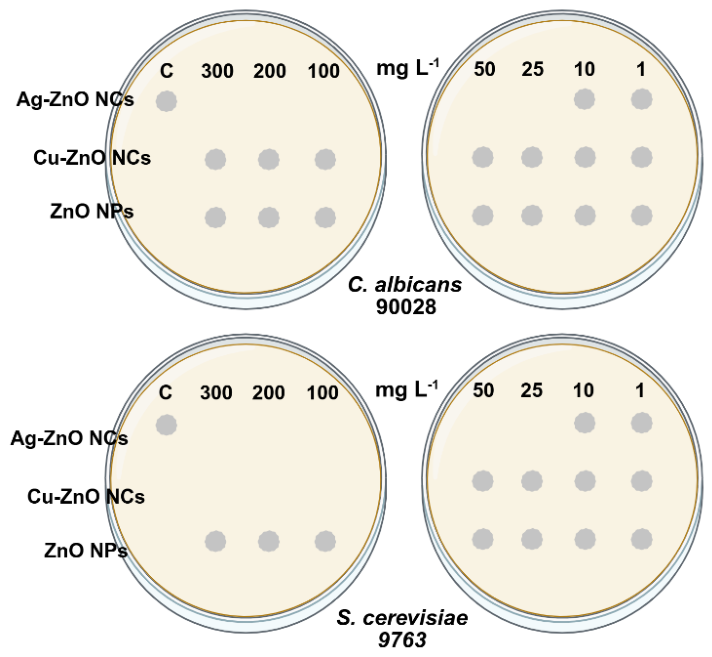
The antifungal effectiveness of the newly synthesized MONCs was assessed against fungal strains obtained from the American Type Culture Collection (ATCC): Candida albicans (90028 ATCC), a pathogen with a significant role in oral inflammation, and Saccharomyces cerevisiae (9763 ATCC), a model laboratory reference strain. According to MIC experiments, the results revealed that antifungal activity depended on the type of active metal incorporated into the ZnO NPs matrix. Among the tested MONCs, Ag-ZnO NCs demonstrated strong antifungal properties against both treated fungal strains, exhibiting equal effectiveness with an MIC of 25 mg L−1 (Figure 5 and Figure S3). In contrast, Cu–ZnO NCs showed only limited activity and were considerably less effective than Ag-ZnO NCs against S. cerevisiae, with an MIC of 100 mg L−1. Importantly, ZnO NPs used alone as the matrix exhibited no toxic effect against both fungal strains even at the highest tested concentration (300 mg·L−1).
The ion release behaviour of Ag–ZnO and Cu–ZnO nanocomposites was investigated under concentrations corresponding to their minimum inhibitory concentrations (MICs), i.e., 25 mg L−1 for Ag–ZnO and 100 mg L−1 for Cu–ZnO, ensuring direct relevance to biological activity. Quantitative determination of released Ag+ and Cu2+ ions was performed using flame atomic absorption spectrometry (FA-AAS) following desorption in ultrapure Milli-Q water.
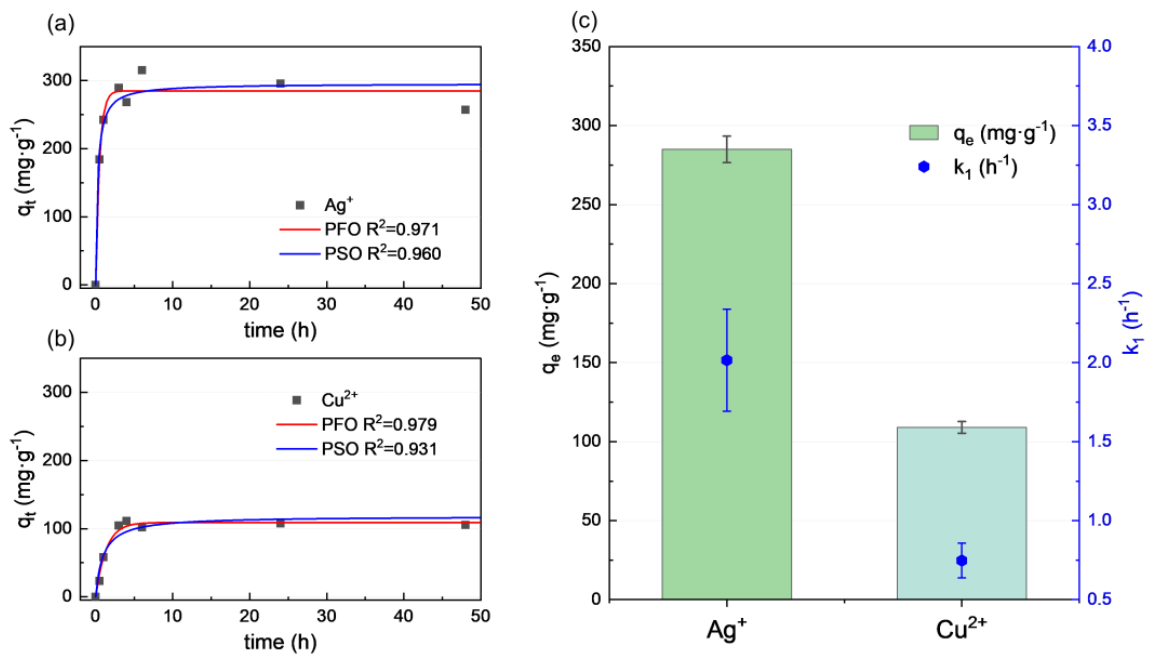
For kinetic analysis, the release data were transformed according to Equation (1) and fitted using pseudo-first-order (PFO) and pseudo-second-order (PSO) models (Equations (2) and (3)). The resulting fits (Figure 6a,b) and corresponding parameters (Table 4) indicate that the PFO model provides a superior description of the experimental data for both systems, with correlation coefficients of R2 = 0.97 for Ag+ and R2 = 0.98 for Cu2+.
In the case of Ag–ZnO, the equilibrium release capacity reaches 284.92 mg g−1, indicating a substantial reservoir of labile Ag species. The release profile is characterized by a rapid initial stage, corresponding to the desorption of weakly bound or surface-exposed ions, followed by a slower approach to equilibrium within the 48 h experimental window. A comparable kinetic trend is observed for Cu–ZnO; however, the equilibrium release is significantly lower, reaching 109.02 mg g−1 (Figure 6b).
Direct comparison of the two systems reveals pronounced differences in both release extent and kinetics. The total amount of released Ag+ is approximately 2.6-fold higher than that of Cu2+ (Figure 6c), consistent with differences in surface speciation and redox behaviour. Furthermore, the release kinetics of Ag+ are markedly faster, with a PFO rate constant of 2.02 h−1, corresponding to an estimated characteristic equilibration time of ~47 min. In contrast, Cu2+ release proceeds more slowly, with a rate constant of 0.75 h−1 and a corresponding equilibration time of ~2 h 6 min, i.e., approximately 2.7 times longer than for Ag+.
Further analysis of selected nanocomposites with antifungal properties is justified by their varying biological activity, as indicated by MIC values. The study includes Ag-ZnO NCs (25 mg L−1) against C. albicans and S. cerevisiae, as well as Cu-ZnO (MIC 100 mg L−1) for S. cerevisiae only. Conducting experiments at MIC-equivalent concentrations enables an objective comparison of their effectiveness and a better understanding of antifungal mechanisms, which is essential for further optimization of the composition and properties of these materials.

3.2.2. MONCs’ Response to Fungi

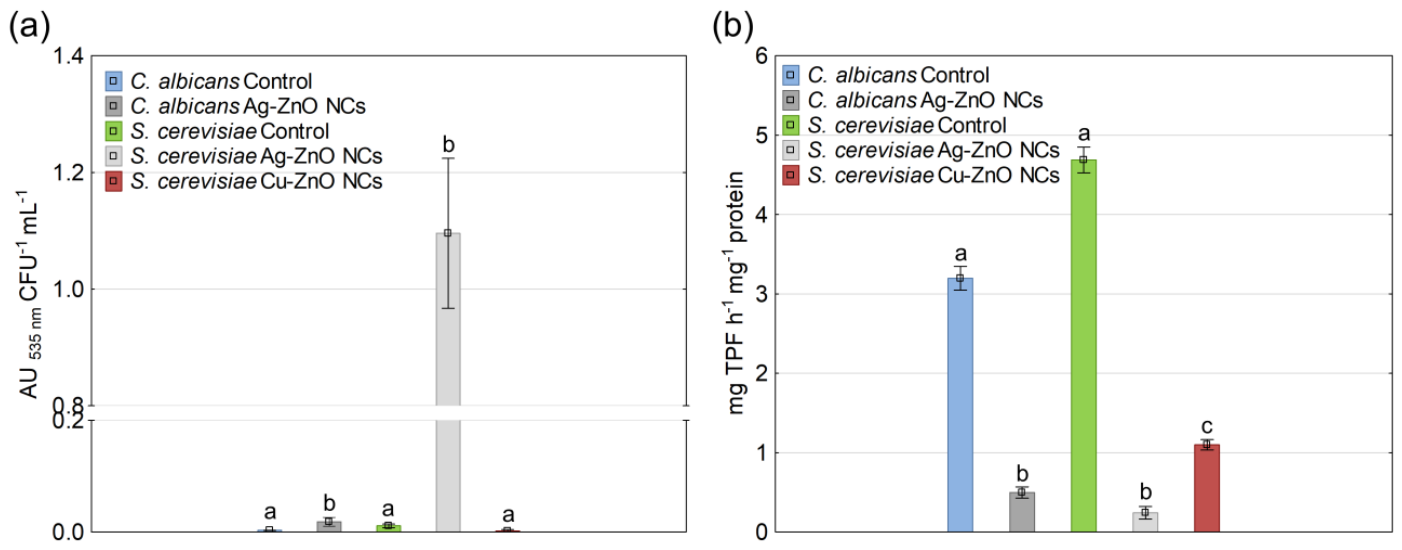
The effect of MONCs on general reactive oxygen species (ROS) production was clearly demonstrated in cultures treated with Ag-ZnO NCs (Figure 7a). In C. albicans cultures treated with Ag-ZnO NCs, ROS levels were 0.018 ± 0.008 AU CFU−1 mL−1. In contrast, in the control they were 0.003 ± 0.001 AU CFU−1 mL−1. For comparison, S. cerevisiae treated with Ag-ZnO NCs exhibited significantly higher ROS production, reaching 1.096 ± 0.129 AU CFU−1 mL−1, compared with the control (0.001 ± 0.003 AU CFU−1 mL−1). It should be noted that the response was markedly higher in S. cerevisiae, with ROS levels approximately 6-fold greater than in the corresponding C. albicans cultures. Cu-ZnO NCs did not have a statistically significant effect on ROS generation compared with untreated cultures.
The synthesized MONCs also affected fungal dehydrogenase activity (DHA) (Figure 7b). This effect was particularly evident in cultures of both Candida spp. and Saccharomyces spp. treated with Ag-ZnO NCs, where a strong inhibition of DHA was observed. In S. cerevisiae exposed to Ag NPs, DHA activity was reduced nearly 20-fold compared to the control (4.69 mg TPF h−1 mg−1 protein). In comparison, in C. albicans cultures treated with Ag-ZnO NCs for 24 h, a 6.6-fold decrease in DHA activity was observed relative to the control (3.20 mg TPF h−1 mg−1 protein). Additionally, an inhibitory effect was also detected for Cu-ZnO NCs in S. cerevisiae, where DHA activity reached 1.10 mg TPF h−1 mg−1 protein, corresponding to 23% of the control activity.
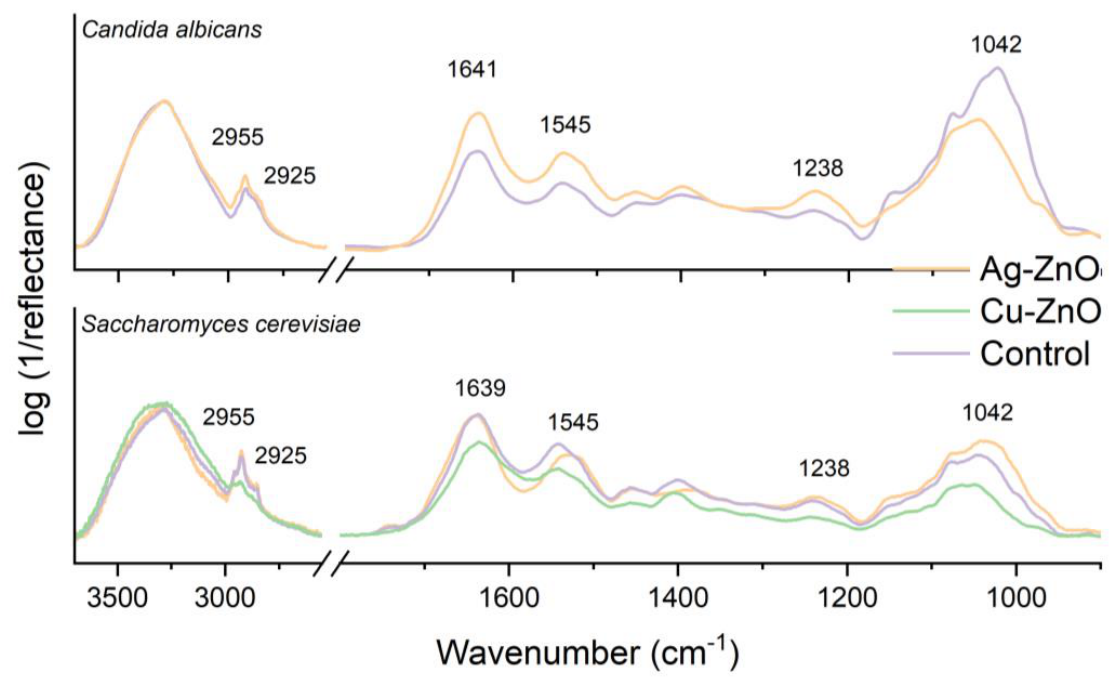
The raw infrared spectra (FTIR), independent of the fungal strain, consistently exhibited characteristic bands corresponding to key biomolecular functional groups. These include CH3 and CH2 stretching vibrations of lipid methylene and methyl groups in the 3000–2800 cm−1 region, carbonyl (C=O) stretching at 1750–1700 cm−1, protein-associated amide I (1700–1600 cm−1) and amide II (1580–1500 cm−1) bands. Additional features were observed at approximately 1450 cm−1 and 1397 cm−1, attributed to CH3 bending vibrations and amine III modes in proteins. A band near 1230 cm−1 is characteristic of phosphate-containing groups (PO2), carboxyl (–COOH), and hydroxyl (C–OH) vibrations, while the strong absorption at 1084 cm−1 corresponds to P=O stretching modes in phosphodiesters. The spectral region between 1200 and 950 cm−1 is dominated by polysaccharide-associated C–O–C and C–O stretching vibrations, reflecting the carbohydrate composition of fungal cell walls, including β-glucans, mannans, and chitin (Figure 8).
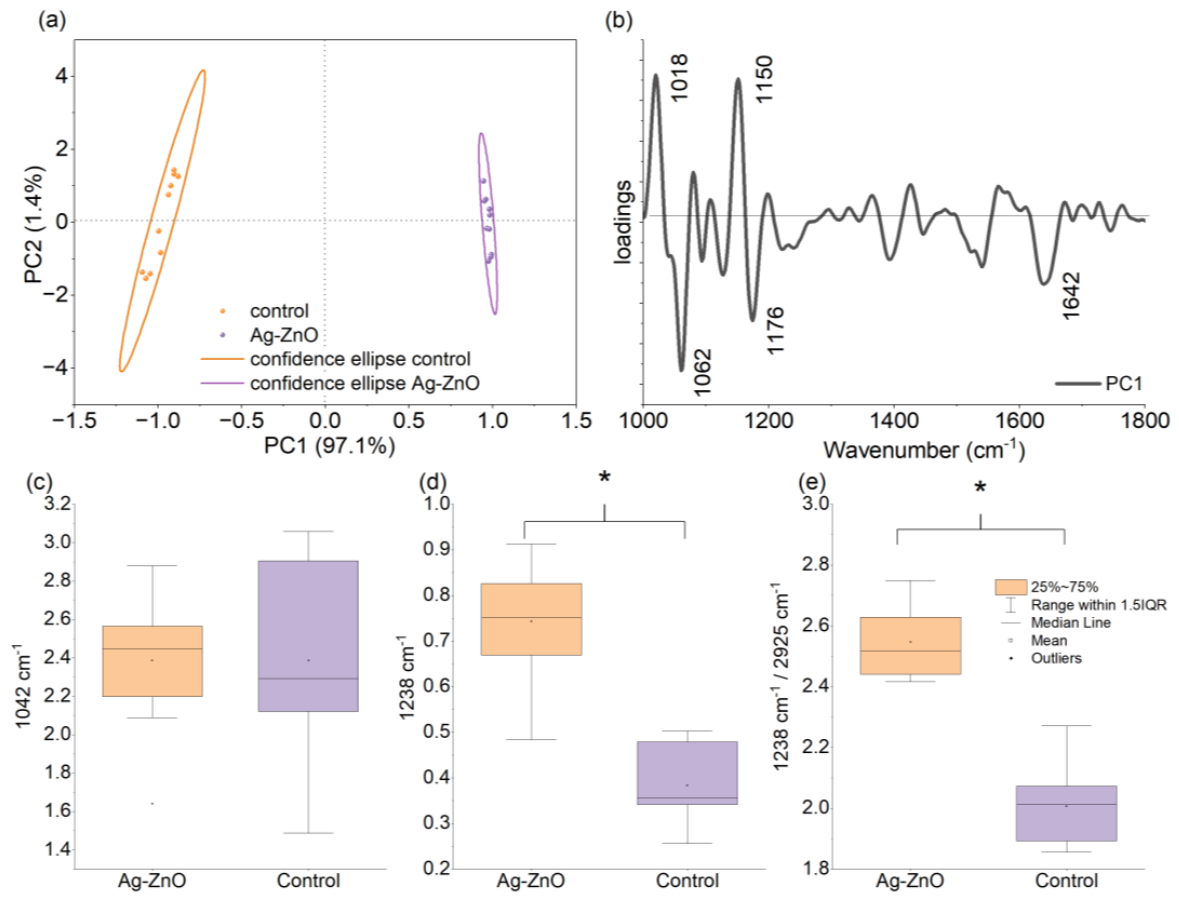
The PCA loading plots for C. albicans spectra identify the spectral features driving the separation observed in the score plots (Figure 9a,b). PC1 (97.1% of total variance) captures the dominant biochemical alterations induced by Ag–ZnO exposure. Positive loadings at 1018 and 1150 cm−1 correspond to C–O and C–O–C stretching of polysaccharides (β-glucans, mannans), consistent with the increased 1238 cm−1 band and 1238/2925 ratio, confirming cell wall polysaccharide remodeling. Negative loadings at 1062 and 1176 cm−1 (COO stretching and ether C–O–C linkages in chitin/chitosan) and at 1642 cm−1 (β-sheet proteins) are control-specific, reflecting the baseline chitin structure and intact cell wall-associated proteins in untreated cells.
Box-and-whisker analysis of characteristic FTIR bands provided a semi-quantitative evaluation of functional group-specific alterations (Figure 9c–e and Figure S1a–d), with independent Mann–Whitney t-tests confirming significant differences (p < 0.05) in bands related to membrane and cell wall components. In Ag–ZnO-treated samples, significant changes were observed for the 1238 cm−1 band and the 1238/2925, 1238/1641, 1545/1641, and 2925/2955 ratios. The increased 1238 cm−1 intensity (PO2 asymmetric stretching) and corresponding ratio increases indicate enrichment of phosphate-containing species (phospholipids, phosphorylated polysaccharides) relative to lipids and proteins, consistent with membrane reorganization and altered phosphomannan content. The rise in the 1545/1641 ratio (amide II/amide I) reflects partial protein denaturation or rearrangement, while the increase in 2925/2955—negligible in controls—indicates changes in lipid saturation and chain packing consistent with Ag-induced membrane restructuring. The 2924/1658 cm−1 ratio showed no significant change (p < 0.02), suggesting limited alterations in bulk saturated fatty acids.
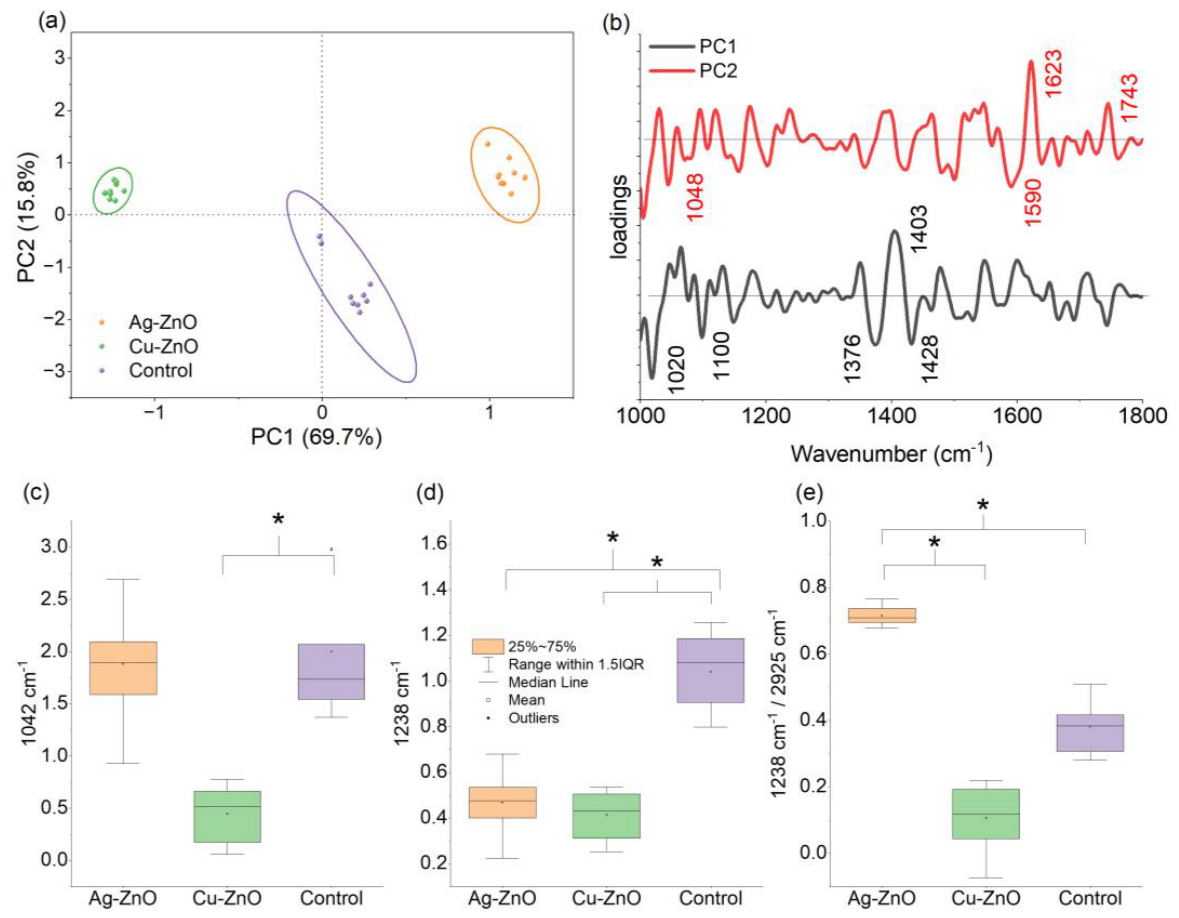
A similar approach was applied to S. cerevisiae, which possesses a simpler wall dominated by β-glucans and mannans with lower chitin content than C. albicans. The PCA loading plots identify the spectral features responsible for the separation observed in the score plots (Figure 10a,b). PC1 (69.7% of total variance) captures the dominant alterations induced by nanocomposite exposure. For Cu–ZnO-treated samples, a pronounced contribution at 1403 cm−1 (symmetric COO stretching) indicates strong coordination of Cu2+ ions with carboxylate-containing biomolecules, including protein side chains and cell wall components. In contrast, PC1 for Ag–ZnO-treated samples is dominated by contributions at 1020 and 1100 cm−1 (C–O and C–O–C stretching of polysaccharides) and at 1376 and 1428 cm−1 (CH deformation and COO vibrations), reflecting modifications in carbohydrate-rich and carboxyl-containing structures. Consistent with the PCA score plot, Ag–ZnO-treated samples remain closer to the control, indicating alterations primarily localized within the cell wall rather than affecting the entire cellular structure. PC2 (15.8% of variance) captures secondary variations at 1048 cm−1 (C–O stretching of carbohydrates) and 1590 cm−1 (protein-related vibrations), while distinct control-specific features at 1623 and 1743 cm−1 (amide I and C=O ester stretching) confirm undisturbed protein folding and lipid organization in untreated cells.
Box-and-whisker analysis of raw FTIR spectra (Figure 8) provided a semi-quantitative evaluation of functional group-specific variations (Figure 10c–e and Figure S2a–d), with independent t-tests confirming significant differences (p < 0.05) in membrane- and cell wall-related parameters. In Ag–ZnO-treated samples, significant changes were observed for the 1238 cm−1 band and the 1238/2925 and 1545/1639 ratios. The decreased 1238 cm−1 intensity indicates disruption of phospholipids and phosphorylated cell wall components, while the lower 1545/1639 ratio (amide II/amide I) reflects partial protein denaturation; the increased 1238/2925 ratio suggests relative enrichment of phosphate groups relative to lipid methylene content. Cu–ZnO-treated samples showed more extensive alterations, with significant changes (p < 0.05) at 1042 and 1238 cm−1 and in multiple ratios (1238/2925, 1238/1639, 1545/1639, 2925/1639, 2925/2955). Notably, the decreased lipid-associated ratios (2925/1639 and 2925/2955) indicate disturbed lipid-to-protein balance and disruption of lipid packing.
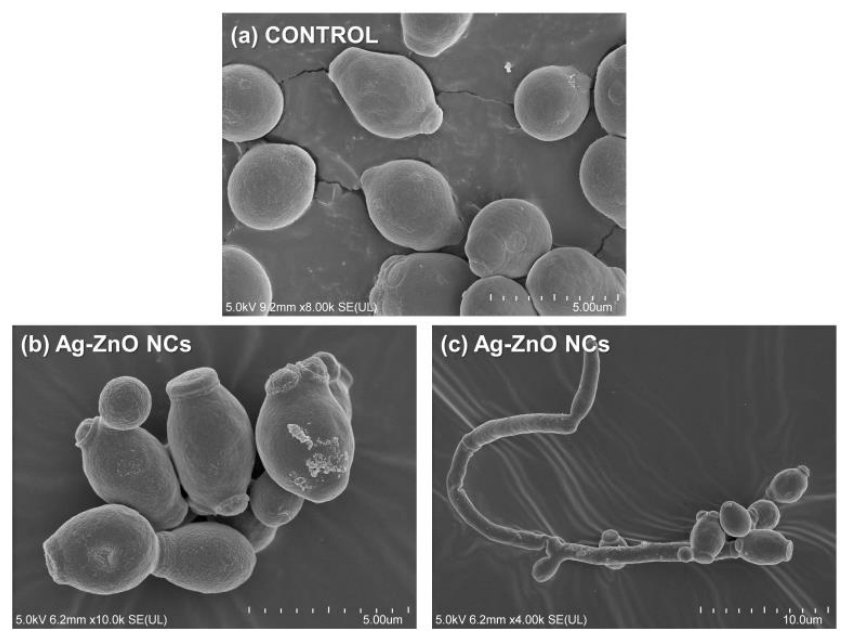
Scanning electron microscopy was employed to evaluate the effect of metal–organic nanocomposites on the surface topography and microstructure of fungal cells. The control cells (Figure 11a) exhibit a typical morphology with a smooth and regular surface (Figure 11a). After treatment with silver–zinc oxide nanocomposites, no significant cytotoxic effect was observed (Figure 11b). The cells retained their original size, shape, and surface characteristics, remaining comparable to the control. However, a more detailed observation showed the formation of pseudohyphae (Figure 11c). These structures appear as elongated chains of attached cells with distinct constrictions at the septa.
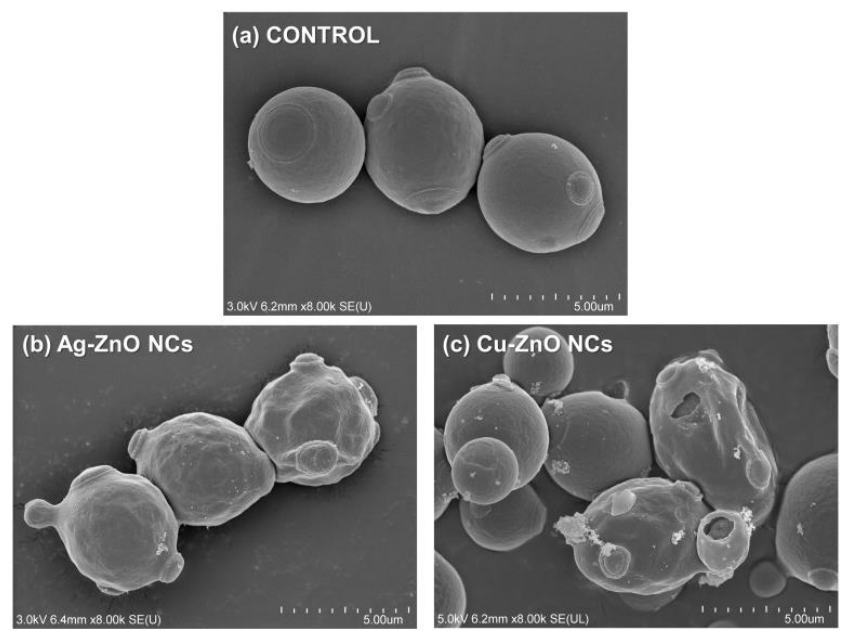
The SEM images of control cells illustrated a smooth surface and typical budding morphology for Saccharomyces cerevisiae (Figure 12a). Following exposure to silver–zinc oxide nanocomposites (Figure 12b), no evident perforations of the cell surface were detected. Nevertheless, the cells exhibited irregular morphology, including surface wrinkling and shrinkage. Despite these changes, the budding process was still observed and appeared relatively similar to that of the control cells. In contrast, treatment of Saccharomyces cerevisiae with copper–zinc oxide nanocomposites (Figure 12c) resulted in a more pronounced effect. A portion of the cells maintained a smooth surface comparable to the control cells shown in Figure 12a and preserved their budding capacity, as also visible in Figure 12b,c. However, a significant fraction of the cell population exhibited substantial deformation, accompanied by clear disruption of cell wall integrity.

3.3. Study of the Effects of Nanocomposites on a Cell Line

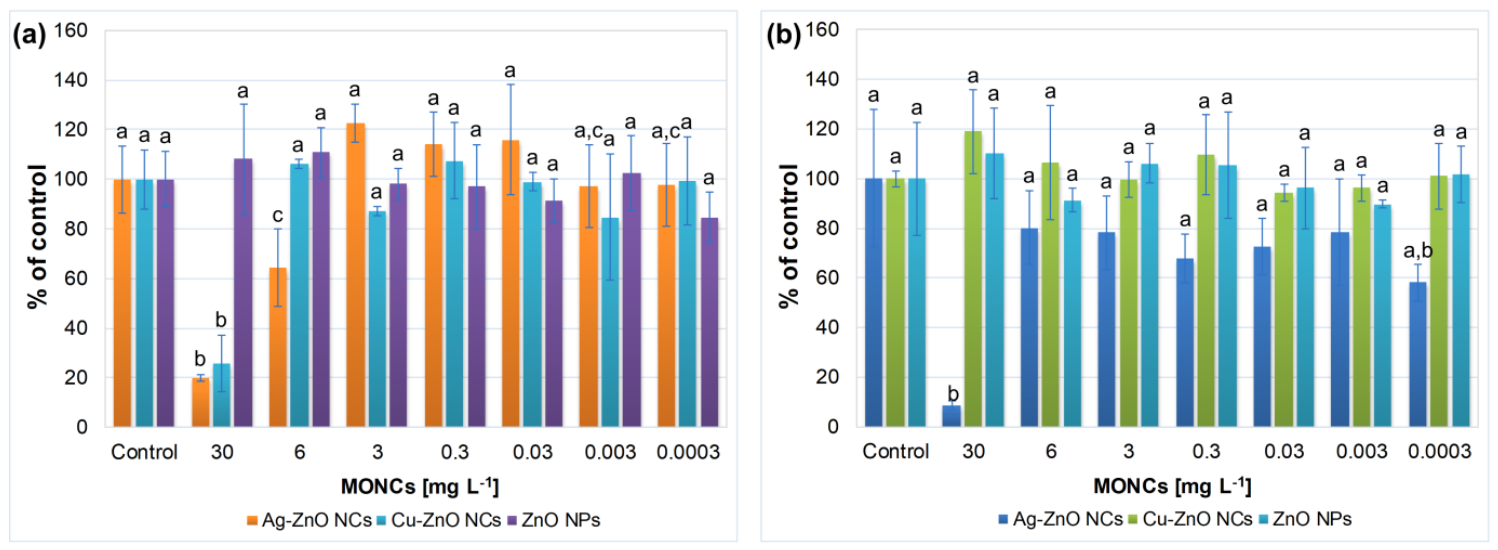
The metabolic activity (Figure 13a) and membrane integrity (Figure 13b) of MDA-MB-231 cells exposed to Ag- and Cu-ZnO NCs and ZnO NPs alone were evaluated using WST-1 and LDH assays. Overall, both assays revealed only a limited, dose-dependent decrease in mitochondrial dehydrogenases and LDH activities, indicating impaired cellular metabolism and compromised membrane integrity. At the highest tested concentration (30 mg L−1), the materials produced clearly distinct effects: Ag-ZnO NC caused a drastic drop in metabolic activity together with an ~85% reduction in the proportion of dying cells relative to the control, suggesting massive cell death, most likely via necrosis, whereas Cu-ZnO NC showed the opposite trend—a slight increase in metabolic activity with a decrease in dying cells, possibly reflecting enhanced viability and proliferation. At 6 mg L−1, the responses were considerably more moderate: Cu-ZnO NC induced no abrupt changes, ZnO NPs caused only a statistically non-significant decrease in metabolic activity with a slight increase in dying cells (no meaningful cytotoxicity), and Ag-ZnO NC reduced both parameters by ~25% relative to the control—markedly less than at 30 mg L−1. Below 6 mg L−1, all parameters stabilized across the tested NC types.
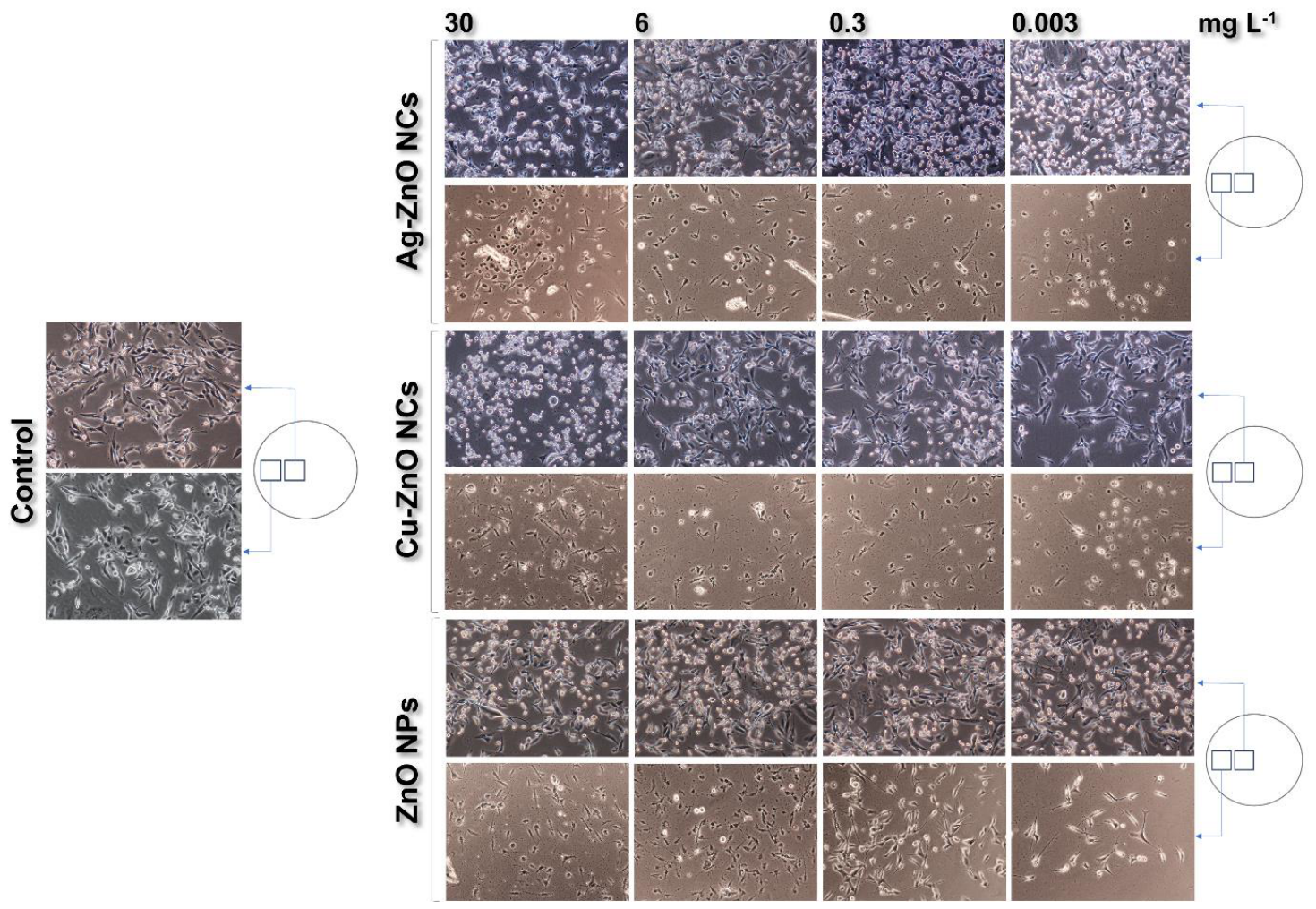
In the next step, the morphology and viability of MDA-MB-231 cells treated with MONCs and ZnO NPs at 30, 6, 0.3, and 0.003 mg L−1 in 6-well plates (3 cm diameter) were examined microscopically. Despite several seeding strategies, cells could not be distributed uniformly: the highest density occurred in the central region, decreased markedly along the radius, and rose again at the periphery. Observations were therefore carried out in two regions—adjacent to (but excluding) the central point and in the outer region just inside the peripheral ring of dense cells (Figure 14 and Figure S4). Cells in the low-density mid-radial zone were the most sensitive to the tested nanocomposites, while densely populated central cells were noticeably more resistant. In the sparse zone, MONC-exposed cells displayed altered morphology relative to controls (elongated, thinner shapes with irregular “rough” edges) and debris-like artifacts likely originating from disintegrated cells (Figure 14).
In the dense zones, the effects on confluence and morphology depended on the NC type. ZnO NPs had the most neutral effect, comparable to controls at all concentrations. In contrast, Ag-ZnO and Cu-ZnO NCs at 30 mg L−1 produced a clear drop in confluence, confirmed by microscopy and crystal violet staining (Figure 14 and Figure S4). Ag-ZnO NC induced numerous detached spherical cells with smaller/thinner shapes and thin protrusions, with markedly reduced crystal violet staining due to detached cells being washed away during fixation—consistent with the WST-1 and LDH results and indicative of increased cell death. Cu-ZnO NC likewise produced detached spherical cells, but the underlying adherent layer retained near-normal morphology and remained detectable by crystal violet staining (Figure S4). At lower Ag-ZnO NC concentrations (0.3 and 0.003 mg L−1), dense regions showed a marked rise in metabolic activity, with abundant actively dividing cells clustered at the growth surface, corroborated by WST-1 and LDH assays (Figure 13). Conversely, lower Cu-ZnO NC concentrations (6, 0.3 and 0.003 mg L−1) produced no detectable changes in morphology or confluence within the dense-colony regions (Figure 14).
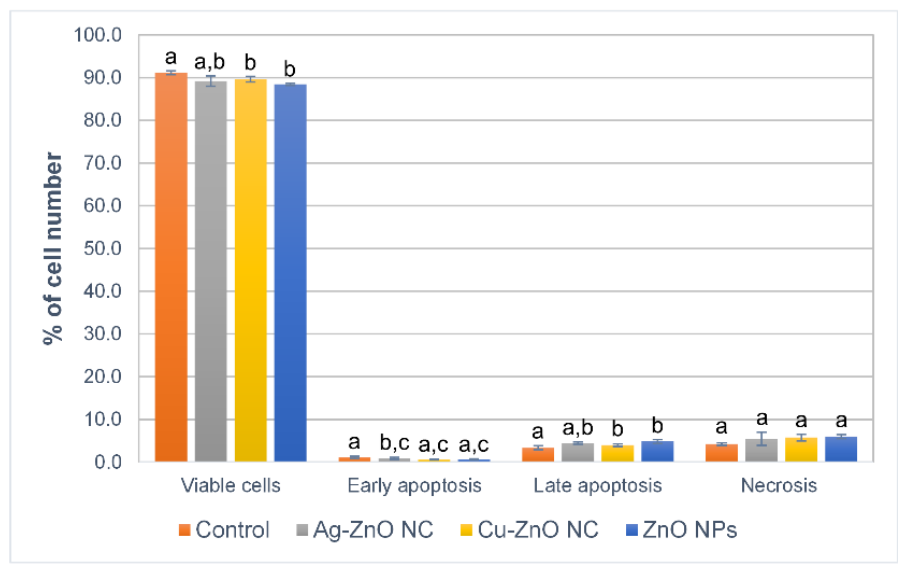
Because the response at 6 mg L−1 was the most informative, falling between the strong cytotoxic/proliferative effects observed at the highest MONCs concentration and the lack of response at lower concentrations, flow cytometric analysis of cell viability and death (early and late apoptosis, and necrosis) was performed at this concentration in order to identify more precisely the type of cell death occurring in this dose range. The analysis revealed a statistically non-significant increase in the proportion of necrotic cells, approximately 9%, >40%, and 25%, in cultures exposed to Ag-ZnO, Cu-ZnO NCs, and ZnO NPs, respectively (Figure 15).

4. Discussion

4.1. Synthesized Nanocomposite Materials

The HRTEM and SAED analyses collectively confirm the structural characteristics and morphology of the synthesized nanocomposites. The agglomeration of Ag and Cu nanoparticles within the ZnO matrix is a recurring feature in such systems, attributed to the high surface energy of metallic nanoparticles and limited spheric stabilization during synthesis [63,64,65]. The particle size estimated from HRTEM (Ag 13–19 nm, Cu 4.5–8 nm) was smaller than the average size of MONPs obtained from statistical TEM analysis in our previous work [66]. This was expected because the resolution of HRTEM shows individual crystallites rather than aggregated structures [65]. The SAED indexing provides complementary structural information that is reflected in the literature. consistent. For example, in wurtzite ZnO, the most frequently reported reflections correspond to the (100), (002), (101), (102), and (110) planes [64,67], which was also indicated in our studies. The (010) and (112) reflections identified in the Ag-ZnO NC pattern may also be assigned to crystallographic planes of hexagonal ZnO. Metallic Ag fcc structure is commonly identified by (111), (200), and (220) reflections [67], whereas the (110) and (102) planes are observed in monoclinic AgO. This is in good agreement with the data obtained from XPS.
The XPS analysis provides a coherent surface-chemistry picture of the Ag-ZnO and Cu-ZnO NCs and the reference ZnO matrix. The Zn 2p3/2 core level observed at 1019.7–1022.95 eV corresponds to Zn2+ in the wurtzite ZnO structure, in agreement with literature data reported for Cu-doped ZnO nanofibers [68] and for Au- and Cu2O-modified ZnO films [69]. The low binding energy line at 1018.7 eV, correlated with the O 1s peak at 529.85 eV and contribution at 282.1 eV, supports the assignment of Zn-C-Ovac associated with local chemical environment. The reduced O 1s binding energy is related to lattice oxygen in ZnO, which assumes contributions from surface OH or absorbed H2O. In contrast, the low energy of the C 1s component suggests strong interaction between carbon-congaing species and the oxide matrix or charged surface in the UHV environment [70,71,72]. For Cu-ZnO, the Cu2p3/2 core level showed Cu0 from Cu+. It is hard to separate both lines due to their almost the same binding energies, and only the satellite structure unambiguously fingerprints Cu2+ [73]. The main lines at 933.1 eV (CuO) and 931.7 eV (Cu2O), together with the weak Cu(I)-type satellite at 945.2 eV (rather than the strong Cu(II) featured at 942–944 eV), confirm the coexistence of CuO and Cu2O surface phases [73]. The corresponding O 1s peak at 531.15 eV overlaps the ZnO lattice contribution and makes quantitative deconvolution of the two copper oxides difficult to separate [72,73]. The Ag 3d region showed the doublets at 367.1 and 368.4 eV. They are best interpreted as a surface mixture of Ag(I)/Ag(III) and Ag0, while our previous bulk XRD investigation [66] indicated Ag3O4. The discrepancy reflects differences in probing depth (XPS: 3–5 nm; XRD: 10–50 µm) and the surface instability of Ag(III) under vacuum [74]. The C 1s components at 285.65/286.55, 288.2, and 289.2 eV are typical of adventitious surface carbon.
The absolute ζ-potential values measured for all three systems fall below the < 30 mV threshold conventionally associated with electrostatically stabilized colloids [75], with the Cu-ZnO NC suspension (−6.3 mV) lying closest to the rapid-coagulation range. The sign reversal between the bare ZnO matrix and the MONCs is consistent with the well-known isoelectric point of ZnO at pH 9–10 [76]. The bare matrix bears protonated-Zn-OH2+ groups, whereas the deposited Ag/AgO and Cu oxide domains, which have markedly lower IEPs, dominate the outer surface of the composites and impose the negative charge. The counterintuitive Dh trend, with the largest value (1420 nm) for the bare matrix despite the smallest ζ of the MONCs, is also consistent with the literature, where ZnO aggregation peaks near its IEP, while the negative-ζ window of the MONCs provides moderate electrostatic regulation that partially limits agglomeration [77].

4.2. MONCs and Their Antifungal Efficacy

In this work, two fungal strains that differ in cell wall architecture were selected: C. albicans, representing a clinically relevant opportunistic pathogen, and S. cerevisiae, serving as a well-established model organism in molecular and cell biology research. All experiments were conducted using cultures harvested at the mid-logarithmic growth phase, which ensures the use of actively dividing cells with uniform size and protein content, reflecting species-specific growth dynamics, and thereby guarantees reproducible and comparable experimental conditions across all assays.
Accordingly, for C. albicans, only Ag-ZnO NC at 25 mg L−1 were included in further analyses, as Cu-ZnO NC failed to exert any inhibitory effect against this strain within the tested concentration range, rendering mechanistic investigation at sub-effective concentrations scientifically, in this work, unjustified. For S. cerevisiae, both Ag-ZnO NC, with the same sensitivity as compared to C. albicans, with MIC 25 mg L−1, and Cu-ZnO NC with 100 mg L−1, were subjected to further analysis, as both materials demonstrated antifungal activity against this strain. Several research groups have reported the antifungal potential of compositionally analogous Ag-nanocomposites. With regard to Ag-based nanosystems active against C. albicans, antifungal activity of nanocomposites of similar chemical composition to those investigated in the present work has been reported for AgO/Ag/ZnO [78]. The antifungal efficacy of Ag NPs against S. cerevisiae is further supported by several experimental studies, including those of Babele et al. [79], Čekuolytė et al. [80], and Lee et al. [81], all of which reported significant growth inhibition of this strain upon exposure to Ag nanoparticles. Coper-based nanosystems have likewise demonstrated efficacy against both S. cerevisiae, including Cu2O nanorods [82], cellulosic nanoparticles (c-Cu NPs) [83], functionalized CuO NPs [84], and C. albicans, as shown for CuO NPs [85] and polycaprolactone-copper fibers (PCL-CuO NPs) [86]. The fact that Cu-based nanocomposites in these studies retained activity against C. albicans, a strain resistant to Cu-ZnO NC in the present work, suggests the limited efficacy observed here and indicates the need for further modification of Cu-ZnO NC, for example, through organic polymer stabilization, to improve ion release and broaden the antifungal spectrum.
The antimicrobial activity of metal-based NCs is largely mediated by the release of metal ions into the surrounding environment [25]. Given the central role of this process in determining biological efficacy, ion release kinetics were quantitatively characterized in the present study. The kinetic analysis of metal ion desorption from Ag-ZnO and Cu-ZnO NCs provides important insight into the mechanisms underlying their antifungal activity. For both systems, the pseudo-first-order (PFO) model described the experimental data more accurately than the pseudo-second-order (PSO) model, indicating that the desorption process is governed primarily by the rapid release of surface-bound ions, followed by a gradual establishment of equilibrium. For Ag+ ions, the PFO model yielded a strong fit (R2 = 0.97) with an equilibrium release of 284.92 mg g−1 and a rate constant of 2.02 h−1, corresponding to an equilibrium time of approximately 47 min. A similar trend was observed for Cu2+ (R2 = 0.98), with a markedly lower rate constant of 0.75 h−1 and equilibrium release of 109.02 mg g−1, indicating a considerably slower desorption process, with equilibrium reached after approximately 2 h and 6 min. These differences in both the magnitude and kinetics of ion release are particularly noteworthy. Under aqueous conditions, approximately 2.6 times more Ag+ ions were released than Cu2+, while the equilibrium for copper was reached roughly 2.7 times later. The release kinetics of ions from both systems follow the pseudo-first-order (PFO) model, consistent with McQuillan et al. [87], who demonstrated that silver ion release from nanomaterial proceeds according to PFO governed by the decreasing particle surface area, a mechanism structurally analogous to the desorption process described in this work. The quantitative and kinetic differences between the Ag-ZnO and Cu-ZnO NCs are rationalized by Long et al. [88], who showed that the nature of surface interactions strongly governs ion release; weaker oxygen-mediated coordination yields significantly greater ion release than stronger sulfur-mediated binding. By analogy, weaker interfacial interactions between Ag and ZnO matrix result in faster and more pronounced Ag+ release (rate constant 2.02 h−1, equilibrium 47 min). In contrast, strong Cu coordination markedly retards desorption (rate constant 0.75 h−1, equilibrium 2 h 6 min). This slow and quantitatively limited Cu2+ release is consistent with Giannousi et al. [82], who reported the weakest antifungal activity for smaller Cu-based NPs, attributing their biological effect predominantly to particle-specific rather than ion-mediated mechanisms. This interpretation is further supported by Reyes et al. [89], observing Cu release kinetics characterized by a rapid initial burst followed by prolonged equilibration, a pattern qualitatively consistent with the Cu-ZnO NC described here, where equilibration time was approximately 2.7-fold longer than for Ag-ZnO NC. This behavior can be rationalized by two key factors: (1) the higher silver loading in Ag-ZnO NC and (2) the higher mobility and weaker retention of Ag+ ions in the ZnO matrix compared to Cu-containing systems, where copper tends to form less soluble and more strongly bound oxide species that limit ion release [90,91]. Weaker binding at the surface facilitates faster and more extensive ion mobilization, which may directly account for the superior antifungal potency of Ag-ZnO NC, as evidenced by its 4-fold lower MIC value (25 mg L−1) compared to Cu-ZnO (100 mg L−1). Collectively, these findings suggest that the biological efficacy of the studied MONCs is closely tied to their ion release profiles. The rapid and abundant liberation of Ag+ ions from the NCs surface appears to be a critical determinant of antimicrobial performance, supporting the view that ion-mediated toxicity plays a central role in the activity of metal-doped ZnO nanocomposites. The differences in ion release kinetics and magnitude observed between the two MONCs can be primarily attributed to intrinsic differences in surface binding strength. Silver ions interact more weakly with the ZnO NPs matrix than copper ions, facilitating faster and more extensive mobilization into the aqueous environment. This interpretation is further supported by the markedly shorter equilibrium time and higher rate constant recorded for Ag+ desorption compared to Cu2+ [90,91]. Consequently, the rapid and abundant release of Ag+ ions from the nanocomposite surface may directly account for the superior antifungal potency of Ag-ZnO NC, achieved at a considerably lower applied concentration than that required for Cu-ZnO NC. It should be noted that the use of concentrations exceeding the MIC values was deliberately avoided. At elevated concentrations, metal-based NPs and NCs exhibit a strong tendency toward agglomeration, resulting in the formation of larger aggregates with altered physicochemical properties, reduced effective surface area, and unpredictable behaviour in suspension [87,88]. This loss of colloidal stability can significantly complicate the interpretation of biological results, as it becomes impossible to reliably distinguish the intrinsic activity of the NPs/NCs from artifacts introduced by aggregation-driven changes in their size, morphology, and ion release profiles [92,93]. Working at MIC-equivalent concentrations, therefore, not only reflects clinically and ecologically meaningful exposure levels but also ensures greater experimental control and interpretability.
Concentrations selected for subsequent mechanistic analyses were based on the MIC values determined for each MONC–strain combination. Accordingly, Ag-ZnO NC was investigated against both C. albicans and S. cerevisiae, as it demonstrated antifungal activity against both strains. In contrast, Cu-ZnO NC was included exclusively for S. cerevisiae, being the only strain for which inhibitory activity was observed. Mechanistic investigations encompassed assessment of reactive oxygen species (ROS) generation and dehydrogenase activity, complemented by ATR-FTIR spectroscopy to examine molecular-level MONC–cell interactions, and SEM to evaluate nanocomposite-induced changes in cell surface morphology.
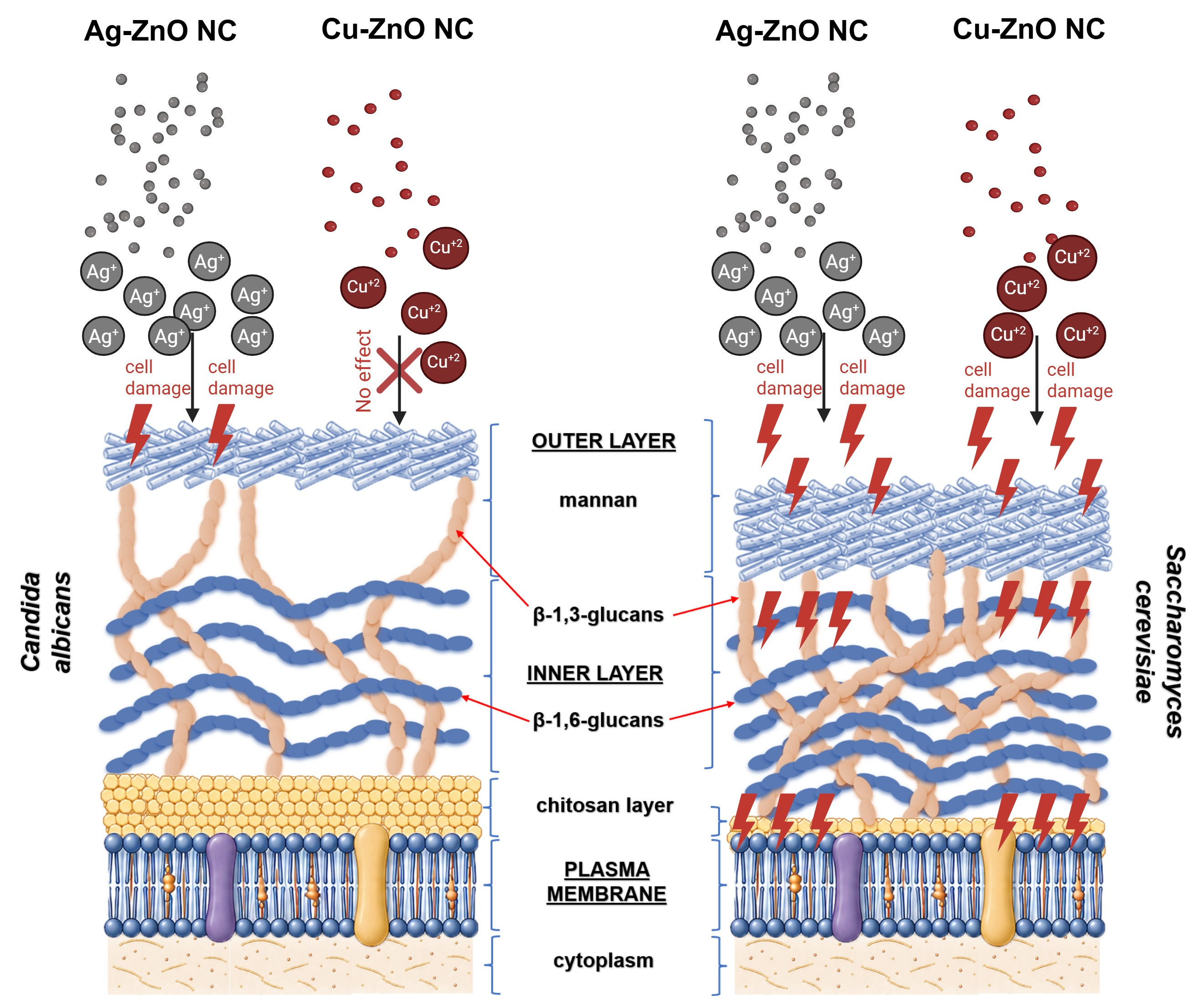
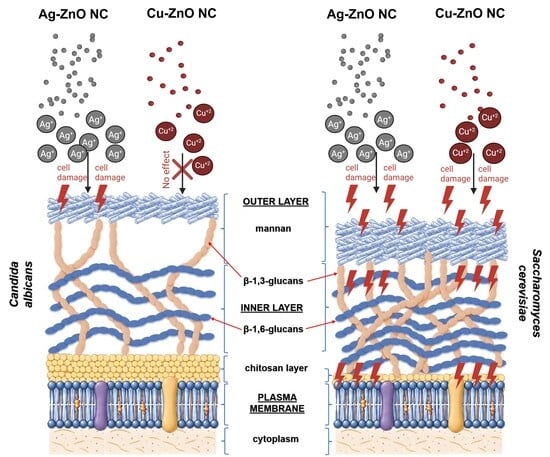
Exposure to Ag-ZnO NC resulted in a marked induction of oxidative stress in both fungal strains, as reflected by significantly elevated ROS levels compared to untreated controls. Notably, the oxidative response was considerably more pronounced in S. cerevisiae, where ROS levels were approximately 6-fold higher than in C. albicans cultures treated under equivalent conditions. This difference may be linked to the distinct cell wall compositions of the two strains, where the thicker, chitin-rich wall of C. albicans may partially attenuate nanoparticle interactions with the cell membrane, thereby limiting intracellular ROS accumulation relative to the simple, β-glucan-dominated wall of S. cerevisiae. This species-specific pattern diverges from findings reported for Ag NPs alone, where ROS elevation was observed exclusively in C. albicans and not in S. cerevisiae [81], underscoring how nanocomposite surface chemistry rather than the silver component alone governs the oxidative outcome. The strain-dependent nature of Ag-induced oxidative stress is further supported by Čekuolytė et al. [80], who reported significant ROS generation and lipid peroxidation in C. guilliermondii exposed to biosynthesized Ag NPs. In contrast, Cu-ZnO NC did not elicit a statistically significant ROS response in either strain, suggesting that oxidative stress induction is not the primary mechanism underlying the limited antifungal activity of this nanocomposite. Cooper-based nanoparticles have been shown to operate through ROS-independent pathways, including direct membrane disruption and interference with metal homeostasis [82,83,85].
The inhibition of dehydrogenase activity (DHA) further corroborates these findings and points to a disruption of core metabolic functions. Treatment with Ag-ZnO NC resulted in a 6.6-fold reduction in DHA in C. albicans and nearly 20-fold reduction in S. cerevisiae relative to their respective controls, indicating severe impairment of the electron transport chain and overall cellular respiration [94]. These results are consistent with the respirometry data reported by Fais et al. [95], who demonstrated that ZnO NPs and Ag-Ag2O NPs significantly impair mitochondrial electron transport chain function, with concurrent inhibition of complex C-I and C-IV activity, through synergic mechanisms involving ROS generation and Ag+-mediated binding of thiol groups in mitochondrial proteins. The contribution of individual components is further supported by Babele et al. [79], who showed that ZnO NPs broadly dysregulate the metabolomic profile of S. cerevisiae, including downregulation of TCA cycle-associated genes, and by Oprica et al. [96], who demonstrated that Ag NPs reduce the activity of multiple Krebs cycle dehydrogenases by 50%–60% in fungal mycelia, indicating that silver-mediated interference with mitochondrial enzymes is conserved across fungal species. Moreover, in this work, Cu-ZnO NC also exerted a measurable inhibitory effect on DHA activity in S. cerevisiae, reducing it to approximately 23% of the control value, despite the absence of a significant ROS response. This dissociation between oxidative stress and metabolic inhibition suggests that Cu2+ ions act through direct metal-protein interactions rather than ROS-mediated oxidative damage. Zuily et al. [97] presented that copper inactivates iron–sulfur cluster enzymes in an ROS-independent manner, while Giangregorio et al. [98] showed that Cu2+ blocks mitochondrial carrier function by bridging cysteine residues.
ATR-FTIR spectroscopy combined with multivariate analysis revealed that the differential antifungal responses of C. albicans to Ag-ZnO NC and S. cerevisiae to both Ag-ZnO and Cu-ZnO NCs are primarily governed by species-specific cell wall architecture. Although both species share β-glucans, mannans, and structural proteins, their organization differs substantially, which is reflected in spectral profiles and the extent of nanocomposite-induced molecular perturbation, consistent with previous ATR-FTIR studies [99]. C. albicans possesses a thicker, more complex wall enriched in chitin and chitosan, conferring rigidity and resistance to external stress. This is evidence by strong FTIR bands in the 1062–1176 cm−1 region, associated with inner-wall polysaccharides [100]. PCA showed that PC1 (97.1% variance) captured polysaccharide remodeling upon Ag-ZnO NC exposure, while effects on membrane lipids and proteins remained limited. Similar findings by Djearamane et al. [101] indicate that ZnO NPs primarily affect polysaccharide, amide, and phosphate groups, with the cell wall acting as the main interaction interface. Reduced intensity near 1238 cm−1 further suggests that the chitin-rich wall partially shields membrane components [102]. In contrast, S. cerevisiae has a simpler wall dominated by β-glucans and mannans with low chitin content, making it more susceptible to nanoparticle damage [103,104]. Bands in the 1018–1084 cm−1 region confirmed the predominance of these polysaccharides [105]. PCA showed clear separation along PC1 and PC2, while band-ratio analysis (1238/2925, 1238/1641, 1545/1641, and 2925/2955) indicated multi-target disruption affecting wall components, membrane lipids, and protein structure. Similar effects were reported by Tan et al. [106], supporting the idea that the lack of a chitin barrier enables broader nanoparticle penetration. Cu-ZnO NC showed strong interactions with carboxyl and phosphate groups, promoting oxidative stress, lipid peroxidation, and protein denaturation. This aligns with findings by Babele et al. [79] and Garcia-Marin et al. [85], demonstrating ROS generation, cell wall integrity pathway activation, and intracellular nanoparticle accumulation.
SEM analysis provided direct morphological evidence of the cytotoxic effects exerted by Ag-ZnO and Cu-ZnO NCs, complementing the biochemical data from ROS and DHA measurements. Notably, only in the presence of Cu-ZnO NC were visible cell wall perforations observed, suggesting that membrane destabilization and metabolic disruption, rather than direct physical penetration, constitute the primary modes of action. In turn, the results obtained for C. albicans treated with Ag-ZnO NC are in contradiction with the observations by Ishida et al. [27] reporting Ag NPs-induced cell wall disruption without cytoplasmic leakage. In C. albicans, Ag-ZnO NC induced pseudohyphae formation, a stress-associated morphological transition reflecting an adaptive response to hostile conditions. Radhakrishnan et al. [107] showed that Ag NPs alter membrane fluidity and fatty acid composition, particularly oleic acid, essential for hyphal morphogenesis, while Harrison et al. [108] demonstrated that metal ions can redirect the fungi to a hyphae differentiation pattern in a concentration-dependent manner. Fekete et al. [109] established a regulatory link between oxidative stress response and morphological transition. Lara et al. [110] provided direct SEM evidence of this phenomenon, reporting that Ag NPs treatment of C. albicans biofilms contained predominantly fungi cells with few pseudohyphae. In S. cerevisiae, Ag-ZnO NC caused wrinkling and shrinkage with largely preserved budding, consistent with the dual mechanism identified by Márquez et al. [94], in which Ag NPs impair cellular respiration. Moreover, Cu-ZnO NC elicited a markedly distinct response, with a substantial fraction of S. cerevisiae cells exhibiting severe deformation and complete absence of budding, indicative of cell cycle arrest, mechanistically consistent with the observed DHA inhibition. Garcia-Marin et al. [85] showed that CuO NPs accumulate within the cell wall and cytoplasm, with ROS production peaking due to extensive cell death, directly explaining the coexistence of intact and severely damage cells shown in SEM images. Bao et al. [111] further confirmed that CuO NPs’ toxicity is mediated by Cu2+ released at the cell surface rather than nanoparticle internalization. That cell wall composition heterogeneity drives population-level variability in damage.

4.3. Cytotoxicity of MONCs Against MDA-MB-231 Cancer Cells

The cytotoxicity profile recorded for Ag-ZnO and Cu-ZnO NCs and pristine ZnO NPs in MDA-MB-231 cells is in good agreement with the body of evidence accumulated for metal-doped ZnO nanocomposites in triple-negative breast cancer (TNBC). Multiple independent studies have shown that doping ZnO with a second metal component markedly enhanced the antiproliferative response in TNBC cells compared with undoped ZnO NPs. Biogenic Ag-doped ZnO nanostructures, for example, reduced MDA-MB-231 viability to about 27% vs. 37% for undoped ZnO, an effect attributed to enhanced ROS generation after Ag incorporation [112]. A similar trend has been described for bimetallic Ni/Cu-doped ZnO, which produced dose-dependent cytotoxicity in MDA-MB-231 cells while sparing normal BHK-21 cells [113]. The ranking observed in the presented work, like Ag-ZnO NC ≥ Cu-ZnO NC > ZnO NPs at the highest tested concentration, therefore agrees with the general principle that introducing a second metal phase potentiates the activity of the ZnO matrix, most likely through enhanced ROS generation and additional ion release from the dopant phase [114]. The mild, statistically non-significant response of ZnO NPs alone is also consistent with the literature. Pristine ZnO typically exhibits clear cytotoxicity towards TNBC cells only at IC50 values of 35–105 mg L−1, depending on synthesis route and particle size [115,116]. Our highest concentration (30 mg L−1) sits at the lower edge of this range, which explains the borderline changes in metabolic activity and LDH release. The accepted mechanism of ZnO-mediated cancer-cell death involves cellular internalization, lysosomal acidification, dissolution to Zn2+, ROS generation, and ultimately mitochondrial dysfunction [114,117]. At 30 mg L−1, this cascade was apparently triggered too weakly to produce a statistically significant 24 h outcome in mDA-MB-231, which agrees with reports that this cell line is less sensitive to ZnO than MDA-MB-468 or MCF-7 lines [118].
The drastic drop in metabolic activity caused by 30 mg L−1 Ag-ZnO NC, accompanied by an apparent decrease in LDH-positive cells, is most consistent with massive primary necrosis followed by loss of LDH from completely lysed and washed-away cells. The standard LDH protocol systematically underestimates cytotoxicity when cell loss or detachment is severe, because dead/detached cells are removed with the supernatant and no longer contribute to the read-out [119,120]. The literature on Ag-mediated death of cancer cells supports this mechanism: Ag NPs disrupt the cytoskeleton and membrane nanostructure, increase membrane roughness, and trigger necrotic death with abundant cellular debris [121]. Proteomic and pathway analyses further indicate that silver species deregulate genes involved in cell–cell adhesion and focal adhesion signaling [122,123]. The “rough”, elongated, and fragmented morphology observed in the sparse mid-radial zone of Ag-ZnO-treated wells is fully consistent with this phenotype, and the detached, halo-bordered spherical cells in the dense regions are diagnostic of necrotic membrane blebbing. Co-release of Ag+ and probably Zn2+ (not determined in this work) is a plausible synergistic driver, since silver depletes intracellular thiols and inhibits cytoskeleton proteins, while zinc is known to predispose cells to disrupt mitochondrial respiration [114,121].
The biphasic behaviour of Cu-ZnO NC—characterized by the apparent stimulation in the WST-1/LDH read-out at 30 mg L−1, and accompanied by widespread detachment under the microscope—is one of the most informative findings of the present study and points to the disruption of cell adhesion rather than direct cytotoxicity. Similarly to Ag-ZnO NC, the detached but membrane-intact cells are washed away with supernatant before WST-1 measurement, leaving only the more resistant adherent fraction to contribute to the formazan signal. The simultaneous decrease in LDH-positive fraction indicates that the floating cells were not lysed [119,120]. CuO- and Cu-ZnO-based nanostructures are known to interfere with adhesion-related pathways and to induce non-ROS-mediated cell-death programs, with transcriptomic data implicating the Wnt family of secreted signaling proteins and cadherin signaling as key targets [124,125]. Ag NPs have likewise been shown to weaken cell–substrate adhesion in breast cancer lines using xCELLigence impedance measurements [126]. Our observations extend this picture to Cu-ZnO NC and underline that microscopy and crystal violet staining are essential complements to enzymatic viability assays. Without them, the Cu-ZnO NC would have appeared erroneously “non-cytotoxic” or even cytoprotective at 30 mg L−1. The marked rise in metabolic activity at the lowest Ag-ZnO concentrations (0.3 and 0.003 mg L−1) is best interpreted as a hermetic response. Hormesis has been documented for a wide range of nanomaterials, including Ag NPs in mammalian cell lines, where sub-toxic doses promote proliferation and stress-adaptive responses [127], and ZnO NPs in microbial systems, where growth and biofilm formation are stimulated below 25 mg L−1 [128]. Importantly, the same review notes that WST-1 readings can register increased viability/proliferation at low NP doses where MTT does not, owing to differences in their enzymatic chemistry [127], which matches our observations precisely. The stimulatory effect at 0.3 and 0.003 mg L−1 is consistent with the known trophic role of low-dose Zn2+ as a cofactor for zinc-finger transcription factors and proliferation-associated kinases.
The strong heterogeneity between dense central regions and sparse mid-radial zones, with the latter being more sensitive to all tested NCs, reflects a well-documented dose-per-cell effect. At lower local density, each cell is exposed to a higher effective NC dose, whereas crowded cells benefit from mutual shielding and reduced per-cell uptake [129]. Single-cell flow- and mass-cytometry studies of metallic NPs have shown that even within the same population, NP loading per cell varies by an order of magnitude and correlates directly with cell death [130]. This phenomenon argues for the routine inclusion of microscopic, region-resolved analysis whenever in vitro nanotoxicity is assessed in non-uniformly seeded multi-well plates, and relying on bulk endpoint assays alone may smooth out biologically meaningful intra-well gradients. The flow-cytometric profile at 6 mg L−1, with a non-significant increase in late-apoptotic and necrotic populations across all three nanostructures and the largest necrotic shift for Cu-ZnO NC (>40%), is again consistent with the picture that emerges from the full dataset, where ZnO matrix and its MONCs drive a mixed apoptotic/necrotic phenotype whose balance depends on the dopant. Biogenic Ag-based NCs preferentially push MDA-MB-231 cells towards apoptosis [112,118], whereas Cu-systems more often act through non-canonical, adhesion-related and non-ROS pathways [124], in line with our observation of widespread necrosis-like detachment for Cu-ZnO NC at 6 mg L−1.

5. Conclusions

The HRTEM and SAED data confirmed a polycrystalline morphology, with the diffraction planes ascribed to silver consistent with monoclinic AgO and corroborating the mixed Ag0/Ag(I)/Ag(III) speciation revealed by XPS. The XPS analysis further confirms a slightly oxygen-deficient ZnO matrix decoration with mixed Cu(I)/Cu(II) oxide phases on Cu-ZnO NC and a metallic/oxidic Ag0-AgO surface mixture on Ag-ZnO NC. Finally, the ζ and Dh measurements reveal limited electrostatic stability in all three systems, with the metal loading reversing the surface charge from positive (ZnO matrix NPs) to negative (MONCs) and partially limiting agglomeration through enhanced electrostatic repulsion.
The biological activity of both Ag-ZnO and Cu-ZnO NCs is driven primarily by their respective ion-release profiles. At the same time, pristine ZnO NPs exhibit only weak cytotoxicity within the tested concentration range. Ag-ZnO NC releases Ag+ ions that trigger marked oxidative stress and elevated ROS levels in fungi and induce fast, predominantly necrotic death in MDA-MB-231 triple-negative breast cancer cells, accompanied by the disruption of mitochondrial function and membrane integrity. Cu-ZnO NC acts mainly through Cu2+-mediated enzymatic inhibition in fungi, whereas in cancer cells its dominant effect is the disruption of cell–substrate adhesion preceding cell death rather than direct cytotoxicity. Species-specific cell-wall architecture proved to be a key determinant of fungal susceptibility. The thicker, chitin-rich wall of C. albicans attenuated nanocomposite interactions. It confined their action to the outer carbohydrate layer, whereas the structurally simpler wall of S. cerevisiae permitted broader, multi-target perturbations of polysaccharides, membrane lipids, and proteins.
Comparison of antifungal MIC values with cytotoxic concentrations in MDA-MB-231 cells reveals a potentially exploitable selectivity window for both NCs, particularly for Ag-ZnO NC, which is active against TNBC cells at the concentrations within the antifungal range. However, these conclusions remain preliminary, being based on a single cancer cell line in vitro. Rigorous evaluation against non-cancerous cells, supported by quantitative ion-release measurements, single-cell uptake quantification and adhesion-resolved viability assays, will be essential to establish a meaningful therapeutic index and to define the safety profile of these nanocomposites prior to any biomedical application.

Supplementary Materials

The following supporting information can be downloaded at: https://www.mdpi.com/article/10.3390/coatings16060690/s1, Figure S1: Box-and-whisker plots of phosphate-related biochemical parameters in C. albicans exposed to Ag–ZnO nanocomposite at the minimum inhibitory concentration (MIC) compared with untreated controls (a–d). Data are presented as medians with interquartile ranges and minimum and maximum values from vector-normalized infrared spectra. Statistical significance was assessed using the Mann–Whitney test, with * indicating p < 0.05; Figure S2: Box-and-whisker plots of phosphate-related biochemical parameters in S. cerevisiae exposed to Ag–ZnO and Cu–ZnO nanocomposites at the minimum inhibitory concentration (MIC), compared with untreated controls (a–d). Data are presented as medians with interquartile ranges, along with minimum and maximum values, derived from vector-normalized infrared spectra. Statistical significance was evaluated using the Mann–Whitney test (p < 0.05); Figure S3: Minimum inhibitory concentration (MIC) values (mg L−1) determined for C. albicans (ATCC 90028) (a) and S. cerevisiae (ATCC 9763) (b) following 24 h exposure to MONCs and respective controls; Figure S4: The visualization of MDA-MB-231 live cell density in the cultures treated with ZnO and Ag-ZnO NC, Cu-ZnO NC and ZnO matrix NPs at concentrations of 30, 6, 0.3, and 0.003 mg L−1 on 6-well plates using the crystal violet staining technique.

Author Contributions

Conceptualization, M.I.A., A.Z., M.P.-S., A.N., M.D. and D.W.; methodology, M.I.A., A.Z., M.P.-S., A.N., M.D., A.S., I.P. and D.W.; validation, M.I.A., A.N. and D.W.; investigation, M.I.A., A.Z., M.P.-S., I.P. and D.W.; data curation, M.I.A. and D.W.; writing—original draft preparation, M.I.A., A.Z., M.P.-S., A.N., M.D. and D.W.; visualization, M.I.A., A.Z., A.N., M.D., A.S., K.M. and D.W.; supervision, D.W.; funding acquisition, D.W. All authors have read and agreed to the published version of the manuscript.

Funding

This research was financed by the funds granted under the Research Excellence Initiative of the University of Silesia in Katowice.

Data Availability Statement

The original contributions presented in this study are included in the article/Supplementary Materials. Further inquiries can be directed to the corresponding author.

Acknowledgments

The authors would like to thank Maria Augustyniak from the Faculty of Natural Sciences, University of Silesia in Katowice, Poland, for analytical support provided using the Litesizer 500 instrument.

Conflicts of Interest

The authors declare no conflicts of interest.

References

  1. Brown, G.D.; Ballou, E.R.; Bates, S.; Bignell, E.M.; Borman, A.M.; Brand, A.C.; Brown, A.J.P.; Coelho, C.; Cook, P.C.; Farrer, R.A.; et al. The pathobiology of human fungal infections. Nat. Rev. Microbiol. 2024, 22, 687–704. [Google Scholar] [CrossRef]
  2. Genet, A.; Girma, A. Emerging and Reemerging Human Fungal Pathogens That Affect People with Weakened Immune Systems: A Systematic Review. Universa Med. 2024, 43, 102–113. [Google Scholar] [CrossRef]
  3. Lockhart, S.R.; Chowdhary, A.; Gold, J.A.W. The Rapid Emergence of Antifungal Resistant Human-Pathogenic Fungi. Nat. Rev. Microbiol. 2023, 21, 818–832. [Google Scholar] [CrossRef]
  4. Chen, K.; Wang, Q.; Pleasants, R.A.; Ge, L.; Liu, W.; Peng, K.; Zhai, S. Empiric Treatment against Invasive Fungal Diseases in Febrile Neutropenic Patients: A Systematic Review and Network Meta-Analysis. BMC Infect. Dis. 2017, 17, 159. [Google Scholar] [CrossRef] [PubMed]
  5. Cumbo, T.A.; Segal, B.H. Prevention, Diagnosis, and Treatment of Invasive Fungal Infections in Patients with Cancer and Neutropenia. J. Natl. Compr. Cancer Netw. 2004, 2, 455–469. [Google Scholar] [CrossRef]
  6. Little, J.S.; Weiss, Z.F.; Hammond, S.P. Invasive Fungal Infections and Targeted Therapies in Hematological Malignancies. J. Fungi 2021, 7, 1058. [Google Scholar] [CrossRef] [PubMed]
  7. Oberoi, J.K.; Sheoran, L.; Sagar, T.; Saxena, S. Invasive Fungal Infections in Hemato-Oncology. Indian J. Med. Microbiol. 2023, 44, 100353. [Google Scholar] [CrossRef]
  8. Mudenda, S. Global Burden of Fungal Infections and Antifungal Resistance from 1961 to 2024: Findings and Future Implications. Pharmacol. Pharm. 2024, 15, 81–112. [Google Scholar] [CrossRef]
  9. Gurajala, S.; Challapilla, M. A Quiet but Growing Threat: Global Perspectives on Antifungal Resistance and Future Therapeutic Approaches. Indian J. Pharmacol. 2026, 58, 35–45. [Google Scholar] [CrossRef]
  10. Zubovskaia, A. Azole-Resistant Aspergillus Fumigatus: Epidemiology, Diagnosis, and Treatment Considerations. J. Fungi 2025, 11, 731. [Google Scholar] [CrossRef]
  11. Novak, A.R.; Bradley, M.E.; Kiser, T.H.; Mueller, S.W. Azole-Resistant Aspergillus and Echinocandin-Resistant Candida: What Are the Treatment Options? Curr. Fungal Infect. Rep. 2020, 14, 141–152. [Google Scholar] [CrossRef]
  12. Calvo, M.; Caccamo, M.; Cammarata, D.M.; Trovato, L. Antifungal Susceptibility Trends Among Filamentous Fungi: An Epidemiological Evaluation on Aspergillus spp., Fusarium spp., and Scedosporium spp. from Southern Italy. Antibiotics 2026, 15, 146. [Google Scholar] [CrossRef]
  13. Dannaoui, E. Antifungal Resistance in Mucorales. Int. J. Antimicrob. Agents 2017, 50, 617–621. [Google Scholar] [CrossRef] [PubMed]
  14. Taj-Aldeen, S.J.; Salah, H.; Al-Hatmi, A.M.S.; Hamed, M.; Theelen, B.; van Diepeningen, A.D.; Boekhout, T.; Lass-Flörl, C. In Vitro Resistance of Clinical Fusarium Species to Amphotericin B and Voriconazole Using the EUCAST Antifungal Susceptibility Method. Diagn. Microbiol. Infect. Dis. 2016, 85, 438–443. [Google Scholar] [CrossRef]
  15. Healey, K.R.; Perlin, D.S. Fungal Resistance to Echinocandins and the MDR Phenomenon in Candida Glabrata. J. Fungi 2018, 4, 105. [Google Scholar] [CrossRef]
  16. Salmanton-García, J.; Almeida, J.N.d.; Colombo, A.L. Candidozyma auris (Formerly Candida auris): Resistant, Long-Lasting, and Everywhere. Clin. Microbiol. Infect. 2026, 32, 374–381. [Google Scholar] [CrossRef]
  17. Cho, S.Y.; Lee, C.E.; Nho, D.; Lee, D.G. Invasive Fungal Infections in Hematologic Diseases: Evidence, Challenges, and Clinical Practice. Blood Res. 2025, 60, 65. [Google Scholar] [CrossRef]
  18. Urban-Chmiel, R.; Marek, A.; Stępień-Pyśniak, D.; Wieczorek, K.; Dec, M.; Nowaczek, A.; Osek, J. Antibiotic Resistance in Bacteria—A Review. Antibiotics 2022, 11, 1079. [Google Scholar] [CrossRef] [PubMed]
  19. Wasilewska, A.; Klekotka, U.; Zambrzycka, M.; Zambrowski, G.; Święcicka, I.; Kalska-Szostko, B. Physico-Chemical Properties and Antimicrobial Activity of Silver Nanoparticles Fabricated by Green Synthesis. Food Chem. 2023, 400, 133960. [Google Scholar] [CrossRef] [PubMed]
  20. Lai, M.J.; Huang, Y.W.; Chen, H.C.; Tsao, L.I.; Chang Chien, C.F.; Singh, B.; Liu, B.R. Effect of Size and Concentration of Copper Nanoparticles on the Antimicrobial Activity in Escherichia coli through Multiple Mechanisms. Nanomaterials 2022, 12, 3715. [Google Scholar] [CrossRef]
  21. Chalayon, P.; Tangwongsan, C. Antibacterial Effects of Copper Microparticles/Copper Nanoparticles/Copper(II) Oxide Nanoparticles and Copper Microparticles/Copper Nanoparticles/Copper(I) Oxide Nanoparticles from Ultrasono-Electrochemical with Hydrothermal Assisted Synthesis Method. Eng. J. 2021, 25, 55–66. [Google Scholar] [CrossRef]
  22. Dadi, R.; Azouani, R.; Traore, M.; Mielcarek, C.; Kanaev, A. Antibacterial Activity of ZnO and CuO Nanoparticles against Gram Positive and Gram Negative Strains. Mater. Sci. Eng. C 2019, 104, 109968. [Google Scholar] [CrossRef] [PubMed]
  23. Basavegowda, N.; Baek, K.H. Multimetallic Nanoparticles as Alternative Antimicrobial Agents: Challenges and Perspectives. Molecules 2021, 26, 912. [Google Scholar] [CrossRef]
  24. Zhu, X.; Chen, Y.; Yu, D.; Fang, W.; Liao, W.; Pan, W. Progress in the Application of Nanoparticles for the Treatment of Fungal Infections: A Review. Mycology 2024, 15, 1–16. [Google Scholar] [CrossRef] [PubMed]
  25. Carmo, P.H.F.; Garcia, M.T.; Figueiredo-Godoi, L.M.A.; Lage, A.C.P.; Silva, N.S.d.; Junqueira, J.C. Metal Nanoparticles to Combat Candida albicans Infections: An Update. Microorganisms 2023, 11, 138. [Google Scholar] [CrossRef] [PubMed]
  26. Rónavári, A.; Igaz, N.; Gopisetty, M.K.; Szerencsés, B.; Kovács, D.; Papp, C.; Vágvölgyi, C.; Boros, I.M.; Kónya, Z.; Kiricsi, M.; et al. Biosynthesized Silver and Gold Nanoparticles Are Potent Antimycotics against Opportunistic Pathogenic Yeasts and Dermatophytes. Int. J. Nanomed. 2018, 13, 695–703. [Google Scholar] [CrossRef]
  27. Ishida, K.; Cipriano, T.F.; Rocha, G.M.; Weissmüller, G.; Gomes, F.; Miranda, K.; Rozental, S. Silver Nanoparticle Production by the Fungus Fusarium oxysporum: Nanoparticle Characterisation and Analysis of Antifungal Activity against Pathogenic Yeasts. Mem. Inst. Oswaldo Cruz 2014, 109, 220–228. [Google Scholar] [CrossRef]
  28. Hallmann, L.; Gerngroß, M.D. Antibacterial Polysaccharides in Dental Implantology. Mar. Drugs 2025, 23, 321. [Google Scholar] [CrossRef]
  29. Liu, F.; Chen, Y.; Huang, Y.; Jin, Q.; Ji, J. Nanomaterial-Based Therapeutics for Enhanced Antifungal Therapy. J. Mater. Chem. B 2024, 12, 9173–9198. [Google Scholar] [CrossRef]
  30. Juárez-Maldonado, A.; Tortella, G.; Rubilar, O.; Fincheira, P.; Benavides-Mendoza, A. Biostimulation and Toxicity: The Magnitude of the Impact of Nanomaterials in Microorganisms and Plants. J. Adv. Res. 2021, 31, 113–126. [Google Scholar] [CrossRef]
  31. Khanna, K.; Kohli, S.K.; Handa, N.; Kaur, H.; Ohri, P.; Bhardwaj, R.; Yousaf, B.; Rinklebe, J.; Ahmad, P. Enthralling the Impact of Engineered Nanoparticles on Soil Microbiome: A Concentric Approach towards Environmental Risks and Cogitation. Ecotoxicol. Environ. Saf. 2021, 222, 112459. [Google Scholar] [CrossRef]
  32. Pal, A.; Goswami, R.; Roy, D.N. A Critical Assessment on Biochemical and Molecular Mechanisms of Toxicity Developed by Emerging Nanomaterials on Important Microbes. Environ. Nanotechnol. Monit. Manag. 2021, 16, 100485. [Google Scholar] [CrossRef]
  33. Fan, X.; Yahia, L.; Sacher, E. Antimicrobial Properties of the Ag, Cu Nanoparticle System. Biology 2021, 10, 137. [Google Scholar] [CrossRef] [PubMed]
  34. Joudeh, N.; Linke, D. Nanoparticle Classification, Physicochemical Properties, Characterization, and Applications: A Comprehensive Review for Biologists. J. Nanobiotechnol. 2022, 20, 262. [Google Scholar] [CrossRef]
  35. Baig, N.; Kammakakam, I.; Falath, W.; Kammakakam, I. Nanomaterials: A Review of Synthesis Methods, Properties, Recent Progress, and Challenges. Mater. Adv. 2021, 2, 1821–1871. [Google Scholar] [CrossRef]
  36. Khan, I.; Saeed, K.; Khan, I. Nanoparticles: Properties, Applications and Toxicities. Arab. J. Chem. 2019, 12, 908–931. [Google Scholar] [CrossRef]
  37. Javadi, M.M.; Soleimani, N.; Zandi, A. Enhancing Breast Cancer Immunotherapy Using Gold Nanoparticles Carrying Tumor Antigens. Sci. Rep. 2025, 15, 16747. [Google Scholar] [CrossRef]
  38. Lionadi, I.; Payam, A.F. Nanotechnology in Cancer Therapy: How Nanoparticles Are Shaping the Future of Personalized Treatment. ACS Nano Med. 2026, 1, 871–911. [Google Scholar] [CrossRef] [PubMed]
  39. Jain, K.K. Recent Advances in Nanooncology. Technol. Cancer Res. Treat. 2008, 7, 1–13. [Google Scholar] [CrossRef]
  40. Elmetwalli, A.; El-Sewedy, T.; Hassan, M.G.; Abdel-Monem, M.O.; Hassan, J.; Ismail, N.F.; Salama, A.F.; Fu, J.; Mousa, N.; Sabir, D.K.; et al. Gold Nanoparticles Mediate Suppression of Angiogenesis and Breast Cancer Growth via MMP-9/NF-κB/mTOR and PD-L1/PD-1 Signaling: Integrative in Vitro Validation and Network Pharmacology Insights. Naunyn-Schmiedeberg’s Arch. Pharmacol. 2025, 398, 7087–7105. [Google Scholar] [CrossRef]
  41. Martínez-Sanmiguel, J.J.; Zarate-Triviño, D.; García-García, M.P.; García-Martín, J.M.; Mayoral, Á.; Huttel, Y.; Martínez, L.; Cholula-Díaz, J.L. Antitumor Activity of Bimetallic Silver/Gold Nanoparticles against MCF-7 Breast Cancer Cells. RSC Adv. 2024, 14, 39102–39111. [Google Scholar] [CrossRef]
  42. Ghaffarlou, M.; Rashidzadeh, H.; Mohammadi, A.; Mousazadeh, N.; Barsbay, M.; Sharafi, A.; Gharbavi, M.; Danafar, H.; Javani, S. Photothermal and Radiotherapy with Alginate-Coated Gold Nanoparticles for Breast Cancer Treatment. Sci. Rep. 2024, 14, 13299. [Google Scholar] [CrossRef]
  43. Montazersaheb, S.; Eftekhari, A.; Shafaroodi, A.; Tavakoli, S.; Jafari, S.; Baran, A.; Baran, M.F.; Jafari, S.; Ahmadian, E. Green-Synthesized Silver Nanoparticles from Peel Extract of Pumpkin as a Potent Radiosensitizer against Triple-Negative Breast Cancer (TNBC). Cancer Nanotechnol. 2024, 15, 47. [Google Scholar] [CrossRef]
  44. Tunç, T. Synthesis and Characterization of Silver Nanoparticles Loaded with Carboplatin as a Potential Antimicrobial and Cancer Therapy. Cancer Nanotechnol. 2024, 15, 2. [Google Scholar] [CrossRef]
  45. Hou, W.; Song, W.Q.; Zhang, R.X.; Lomova, M.v.; Sadovnikov, A.v.; Song, Y.J. Nanomedicine-Mediated Immunotherapy for Cancer Treatment. ACS Biomater. Sci. Eng. 2026, 12, 1968–1990. [Google Scholar] [CrossRef] [PubMed]
  46. Nowak, A.; Szade, J.; Talik, E.; Ratuszna, A.; Ostafin, M.; Peszke, J. Structural, Spectroscopic and Biological Investigation of Copper Oxides Nanoparticles with Various Capping Agents. Mater. Chem. Phys. 2014, 145, 465–470. [Google Scholar] [CrossRef]
  47. Strach, A.; Dulski, M.; Wasilkowski, D.; Matus, K.; Dudek, K.; Podwórny, J.; Rawicka, P.; Grebnevs, V.; Waloszczyk, N.; Nowak, A.; et al. Multifaceted Assessment of Porous Silica Nanocomposites: Unraveling Physical, Structural, and Biological Transformations Induced by Microwave Field Modification. Nanomaterials 2024, 14, 337. [Google Scholar] [CrossRef]
  48. Dulski, M.; Strach, A.; Zaleski, R.; Gorgol, M.; Matyja, E.; Laskowska, M.; Nowak, A.; Pawlik, K.; Rawicka, P.; Grebnevs, V.; et al. Mechanisms of Silver Capture, Reduction, and Release in Propyl Carboxylic Acid-Functionalized SBA-15. Sep. Purif. Technol. 2026, 386, 136542. [Google Scholar] [CrossRef]
  49. Moussout, H.; Ahlafi, H.; Aazza, M.; Maghat, H. Critical of Linear and Nonlinear Equations of Pseudo-First Order and Pseudo-Second Order Kinetic Models. Karbala Int. J. Mod. Sci. 2018, 4, 244–254. [Google Scholar] [CrossRef]
  50. Gharibzadeh, F.; Kalantary, R.R.; Esrafili, A.; Ravanipour, M.; Azari, A. Desorption Kinetics and Isotherms of Phenanthrene from Contaminated Soil. J. Environ. Health Sci. Eng. 2019, 17, 171–181. [Google Scholar] [CrossRef]
  51. Ji, X.W.; Liu, P.T.; Tang, J.C.; Wan, C.J.; Yang, Y.; Zhao, Z.; Zhao, D.P. Different Antibacterial Mechanisms of Titania Nanotube Arrays at Various Growth Phases of E. coli. Trans. Nonferrous Met. Soc. China (Engl. Ed.) 2021, 31, 3821–3830. [Google Scholar] [CrossRef]
  52. Nweke, C.O.; Alisi, C.S.; Okolo, J.C.; Nwanyanwu, C.E. Toxicity Of Zinc To Heterotrophic Bacteria From A Tropical River Sediment. Appl. Ecol. Environ. Res. 2007, 5, 123–132. [Google Scholar] [CrossRef]
  53. Alpaslan, E.; Geilich, B.M.; Yazici, H.; Webster, T.J. pH-Controlled Cerium Oxide Nanoparticle Inhibition of Both Gram-Positive and Gram-Negative Bacteria Growth. Sci. Rep. 2017, 7, 45859. [Google Scholar] [CrossRef]
  54. Yang, Y.; Wang, J.; Xiu, Z.; Alvarez, P.J.J. Impacts of Silver Nanoparticles on Cellular and Transcriptional Activity of Nitrogen-Cycling Bacteria. Environ. Toxicol. Chem. 2013, 32, 1488–1494. [Google Scholar] [CrossRef]
  55. Metryka, O.; Wasilkowski, D.; Dulski, M.; Adamczyk-Habrajska, M.; Augustyniak, M.; Mrozik, A. Metallic Nanoparticle Actions on the Outer Layer Structure and Properties of Bacillus cereus and Staphylococcus epidermidis. Chemosphere 2024, 354, 141691. [Google Scholar] [CrossRef]
  56. Savitzky, A.; Golay, M.J.E. Smoothing And Differentiation Of Data By Simplified Least Squares Procedures. Anal. Chem. 1964, 36, 1627–1639. [Google Scholar] [CrossRef]
  57. Dróżdż, A.; Matusiak, K.; Setkowicz, Z.; Ciarach, M.; Janeczko, K.; Sandt, C.; Borondics, F.; Horak, D.; Babic, M.; Chwiej, J. FTIR Microspectroscopy Revealed Biochemical Changes in Liver and Kidneys as a Result of Exposure to Low Dose of Iron Oxide Nanoparticles. Spectrochim. Acta Part A Mol. Biomol. Spectrosc. 2020, 236, 118355. [Google Scholar] [CrossRef]
  58. Lorenz-Fonfria, V.A. Infrared Difference Spectroscopy of Proteins: From Bands to Bonds. Chem. Rev. 2020, 120, 3466–3576. [Google Scholar] [CrossRef]
  59. Rieppo, L.; Saarakkala, S.; Närhi, T.; Helminen, H.J.; Jurvelin, J.S.; Rieppo, J. Application of Second Derivative Spectroscopy for Increasing Molecular Specificity of Fourier Transform Infrared Spectroscopic Imaging of Articular Cartilage. Osteoarthr. Cartil. 2012, 20, 451–459. [Google Scholar] [CrossRef]
  60. Vongsvivut, J.; Heraud, P.; Gupta, A.; Puri, M.; McNaughton, D.; Barrow, C.J. FTIR Microspectroscopy for Rapid Screening and Monitoring of Polyunsaturated Fatty Acid Production in Commercially Valuable Marine Yeasts and Protists. Analyst 2013, 138, 6016–6031. [Google Scholar] [CrossRef]
  61. Fischer, E.R.; Hansen, B.T.; Nair, V.; Hoyt, F.H.; Dorward, D.W. Scanning Electron Microscopy. Curr. Protoc. Microbiol. 2012, 25, 2B.2.1–2B.2.47. [Google Scholar] [CrossRef]
  62. Feoktistova, M.; Geserick, P.; Leverkus, M. Crystal Violet Assay for Determining Viability of Cultured Cells. Cold Spring Harb. Protoc. 2016, 2016, 343–346. [Google Scholar] [CrossRef]
  63. Sun, Y.; Zhang, W.; Li, Q.; Liu, H.; Wang, X. Preparations and Applications of Zinc Oxide Based Photocatalytic Materials. Adv. Sens. Energy Mater. 2023, 2, 100069. [Google Scholar] [CrossRef]
  64. Slathia, S.; Gupta, T.; Chauhan, R.P. Green Synthesis of Ag–ZnO Nanocomposite Using Azadirachta Indica Leaf Extract Exhibiting Excellent Optical and Electrical Properties. Phys. B Condens. Matter 2021, 621, 413287. [Google Scholar] [CrossRef]
  65. Liu, X.; Liu, H.L.; Zhang, W.X.; Li, X.M.; Fang, N.; Wang, X.H.; Wu, J.H. Facile Synthesis and Photocatalytic Activity of Bi-Phase Dispersible Cu-ZnO Hybrid Nanoparticles. Nanoscale Res. Lett. 2015, 10, 195. [Google Scholar] [CrossRef]
  66. Ahmed, M.I.; Nowak, A.; Dulski, M.; Strach, A.; Zielińska, A.; Paul-Samojedny, M.; Potocka, I.; Matus, K.; Wasilkowski, D. Metal Oxide Nanocomposites as Next-Generation Antimicrobial Agents Against Oral Cariogenic Pathogens: Mechanistic Actions of Ag–ZnO and Cu–ZnO on S. mutans and S. sobrinus. Materials 2026, 19, 1634. [Google Scholar] [CrossRef]
  67. Zhu, X.; Wang, J.; Yang, D.; Liu, J.; He, L.; Tang, M.; Feng, W.; Wu, X. Fabrication, Characterization and High Photocatalytic Activity of Ag-ZnO Heterojunctions under UV-Visible Light. RSC Adv. 2021, 11, 27257–27266. [Google Scholar] [CrossRef]
  68. Jeevarathinam, M.; Asharani, I.V. Synthesis of CuO, ZnO Nanoparticles, and CuO-ZnO Nanocomposite for Enhanced Photocatalytic Degradation of Rhodamine B: A Comparative Study. Sci. Rep. 2024, 14, 9718. [Google Scholar] [CrossRef]
  69. Tomić, M.; Claros, M.; Gràcia, I.; Figueras, E.; Cané, C.; Vallejos, S. Zno Structures with Surface Nanoscale Interfaces Formed by Au, Fe2O3, or Cu2O Modifier Nanoparticles: Characterization and Gas Sensing Properties. Sensors 2021, 21, 4509. [Google Scholar] [CrossRef]
  70. Frankcombe, T.J.; Liu, Y. Interpretation of Oxygen 1s X-Ray Photoelectron Spectroscopy of ZnO. Chem. Mater. 2023, 35, 5468–5474. [Google Scholar] [CrossRef]
  71. Easton, C.D.; Morgan, D.J. Critical Examination of the Use of X-Ray Photoelectron Spectroscopy (XPS) O1s to Characterize Oxygen Vacancies in Catalytic Materials and Beyond. J. Vac. Sci. Technol. A 2025, 43, 053205. [Google Scholar] [CrossRef]
  72. Sivkov, D.V.; Petrova, O.V.; Nekipelov, S.V.; Vinogradov, A.S.; Skandakov, R.N.; Isaenko, S.I.; Ob’edkov, A.M.; Kaverin, B.S.; Vilkov, I.V.; Korolev, R.I.; et al. The Identification of Cu–O–C Bond in Cu/MWCNTs Hybrid Nanocomposite by XPS and NEXAFS Spectroscopy. Nanomaterials 2021, 11, 2993. [Google Scholar] [CrossRef]
  73. Biesinger, M.C. Advanced Analysis of Copper X-Ray Photoelectron Spectra. Surf. Interface Anal. 2017, 49, 1325–1334. [Google Scholar] [CrossRef]
  74. Ferraria, A.M.; Carapeto, A.P.; Botelho Do Rego, A.M. X-Ray Photoelectron Spectroscopy: Silver Salts Revisited. Vacuum 2012, 86, 1988–1991. [Google Scholar] [CrossRef]
  75. Marsalek, R. Particle Size and Zeta Potential of ZnO. APCBEE Procedia 2014, 9, 13–17. [Google Scholar] [CrossRef]
  76. Fatehah, M.O.; Aziz, H.A.; Stoll, S. Stability of ZnO Nanoparticles in Solution. Influence of pH, Dissolution, Aggregation and Disaggregation Effects. J. Colloid Sci. Biotechnol. 2014, 3, 75–84. [Google Scholar] [CrossRef]
  77. Parsai, T.; Kumar, A. Understanding Effect of Solution Chemistry on Heteroaggregation of Zinc Oxide and Copper Oxide Nanoparticles. Chemosphere 2019, 235, 457–469. [Google Scholar] [CrossRef]
  78. Ramakrishnegowda, D.H.; Swamy, C.K.; Kumar, B.M.A.; Rangappa, S.; Rangappa, K.S.; Shivanna, S. Ag mediated plasmonic AgO/ZnO composite and its pharmaceutical relevance. Mater. Sci. Eng. B 2023, 292, 116437. [Google Scholar] [CrossRef]
  79. Babele, P.K.; Thakre, P.K.; Kumawat, R.; Tomar, R.S. Zinc Oxide Nanoparticles Induce Toxicity by Affecting Cell Wall Integrity Pathway, Mitochondrial Function and Lipid Homeostasis in Saccharomyces cerevisiae. Chemosphere 2018, 213, 65–75. [Google Scholar] [CrossRef] [PubMed]
  80. Čekuolytė, K.; Šapaitė, D.; Žemgulytė, E.; Gudiukaitė, R.; Lastauskienė, E. Induction of Apoptosis with Silver Nanoparticles Obtained Using Thermophilic Bacteria. J. Funct. Biomater. 2024, 15, 142. [Google Scholar] [CrossRef]
  81. Lee, B.; Lee, M.J.; Yun, S.J.; Kim, K.; Choi, I.H.; Park, S. Silver Nanoparticles Induce Reactive Oxygen Species-Mediated Cell Cycle Delay and Synergistic Cytotoxicity with 3-Bromopyruvate in Candida albicans, but Not in Saccharomyces cerevisiae. Int. J. Nanomed. 2019, 14, 4801–4816. [Google Scholar] [CrossRef]
  82. Giannousi, K.; Sarafidis, G.; Mourdikoudis, S.; Pantazaki, A.; Dendrinou-Samara, C. Selective Synthesis of Cu2O and Cu/Cu2O NPs: Antifungal Activity to Yeast Saccharomyces cerevisiae and DNA Interaction. Inorg. Chem. 2014, 53, 9657–9666. [Google Scholar] [CrossRef]
  83. Rong-Mullins, X.; Winans, M.J.; Lee, J.B.; Lonergan, Z.R.; Pilolli, V.A.; Weatherly, L.M.; Carmenzind, T.W.; Jiang, L.; Cumming, J.R.; Oporto, G.S.; et al. Proteomic and Genetic Analysis of the Response of S. cerevisiae to Soluble Copper Leads to Improvement of the Antimicrobial Function of Cellulosic Copper Nanoparticles. Metallomics 2017, 9, 1304–1315. [Google Scholar] [CrossRef]
  84. Halbus, A.F.; Horozov, T.S.; Paunov, V.N. Self-Grafting Copper Oxide Nanoparticles Show a Strong Enhancement of Their Anti-Algal and Anti-Yeast Action. Nanoscale Adv. 2019, 1, 2323–2336. [Google Scholar] [CrossRef]
  85. Garcia-Marin, L.E.; Juarez-Moreno, K.; Vilchis-Nestor, A.R.; Castro-Longoria, E. Highly Antifungal Activity of Biosynthesized Copper Oxide Nanoparticles against Candida albicans. Nanomaterials 2022, 12, 3856. [Google Scholar] [CrossRef]
  86. Muñoz-Escobar, A.; Reyes-López, S.Y. Antifungal Susceptibility of Candida Species to Copper Oxide Nanoparticles on Polycaprolactone Fibers (PCL-CuONPs). PLoS ONE 2020, 15, e0228864. [Google Scholar] [CrossRef]
  87. McQuillan, J.S.; Groenaga Infante, H.; Stokes, E.; Shaw, A.M. Silver Nanoparticle Enhanced Silver Ion Stress Response in Escherichia coli K12. Nanotoxicology 2012, 6, 857–866. [Google Scholar] [CrossRef]
  88. Long, Y.M.; Hu, L.G.; Yan, X.T.; Zhao, X.C.; Zhou, Q.F.; Cai, Y.; Jiang, G. bin Surface Ligand Controls Silver Ion Release of Nanosilver and Its Antibacterial Activity against Escherichia coli. Int. J. Nanomed. 2017, 12, 3193–3206. [Google Scholar] [CrossRef]
  89. Reyes, V.C.; Spitzmiller, M.R.; Hong-Hermesdorf, A.; Kropat, J.; Damoiseaux, R.D.; Merchant, S.S.; Mahendra, S. Copper Status of Exposed Microorganisms Influences Susceptibility to Metallic Nanoparticles. Environ. Toxicol. Chem. 2016, 35, 1148–1158. [Google Scholar] [CrossRef]
  90. Raghupathi, K.R.; Koodali, R.T.; Manna, A.C. Size-Dependent Bacterial Growth Inhibition and Mechanism of Antibacterial Activity of Zinc Oxide Nanoparticles. Langmuir 2011, 27, 4020–4028. [Google Scholar] [CrossRef]
  91. Heinlaan, M.; Ivask, A.; Blinova, I.; Dubourguier, H.C.; Kahru, A. Toxicity of Nanosized and Bulk ZnO, CuO and TiO2 to Bacteria Vibrio fischeri and Crustaceans Daphnia magna and Thamnocephalus platyurus. Chemosphere 2008, 71, 1308–1316. [Google Scholar] [CrossRef]
  92. Singh, A.V.; Varma, M.; Laux, P.; Choudhary, S.; Datusalia, A.K.; Gupta, N.; Luch, A.; Gandhi, A.; Kulkarni, P.; Nath, B. Artificial Intelligence and Machine Learning Disciplines with the Potential to Improve the Nanotoxicology and Nanomedicine Fields: A Comprehensive Review. Arch. Toxicol. 2023, 97, 963–979. [Google Scholar] [CrossRef]
  93. Ameen, F.; Alsamhary, K.; Alabdullatif, J.A.; ALNadhari, S. A Review on Metal-Based Nanoparticles and Their Toxicity to Beneficial Soil Bacteria and Fungi. Ecotoxicol. Environ. Saf. 2021, 213, 112027. [Google Scholar] [CrossRef]
  94. Márquez, I.G.; Ghiyasvand, M.; Massarsky, A.; Babu, M.; Samanfar, B.; Omidi, K.; Moon, T.W.; Smith, M.L.; Golshani, A. Zinc Oxide and Silver Nanoparticles Toxicity in the Baker’s Yeast, Saccharomyces cerevisiae. PLoS ONE 2018, 13, e0193111. [Google Scholar] [CrossRef]
  95. Fais, G.; Sidorowicz, A.; Perra, G.; Dessì, D.; Loy, F.; Lai, N.; Follesa, P.; Orrù, R.; Cao, G.; Concas, A. Cytotoxic Effects of ZnO and Ag Nanoparticles Synthesized in Microalgae Extracts on PC12 Cells. Mar. Drugs 2024, 22, 549. [Google Scholar] [CrossRef]
  96. Oprica, L.; Andries, M.; Sacarescu, L.; Popescu, L.; Pricop, D.; Creanga, D.; Balasoiu, M. Citrate-Silver Nanoparticles and Their Impact on Some Environmental Beneficial Fungi. Saudi J. Biol. Sci. 2020, 27, 3365–3375. [Google Scholar] [CrossRef]
  97. Zuily, L.; Lahrach, N.; Fassler, R.; Genest, O.; Faller, P.; Sénèque, O.; Denis, Y.; Castanié-Cornet, M.P.; Genevaux, P.; Jakob, U.; et al. Copper Induces Protein Aggregation, a Toxic Process Compensated by Molecular Chaperones. mBio 2022, 13, e03251-21. [Google Scholar] [CrossRef]
  98. Giangregorio, N.; Tonazzi, A.; Console, L.; Prejanò, M.; Marino, T.; Russo, N.; Indiveri, C. Effect of Copper on the Mitochondrial Carnitine/Acylcarnitine Carrier via Interaction with Cys136 and Cys155. Possible Implications in Pathophysiology. Molecules 2020, 25, 820. [Google Scholar] [CrossRef]
  99. Quilès, F.; Accoceberry, I.; Couzigou, C.; Francius, G.; Noël, T.; El-Kirat-Chatel, S. AFM Combined to ATR-FTIR Reveals Candida Cell Wall Changes under Caspofungin Treatment. Nanoscale 2017, 9, 13731–13738. [Google Scholar] [CrossRef]
  100. Adt, I.; Toubas, D.; Pinon, J.M.; Manfait, M.; Sockalingum, G.D. FTIR Spectroscopy as a Potential Tool to Analyse Structural Modifications during Morphogenesis of Candida albicans. Arch. Microbiol. 2006, 185, 277–285. [Google Scholar] [CrossRef]
  101. Djearamane, S.; Xiu, L.J.; Wong, L.S.; Rajamani, R.; Bharathi, D.; Kayarohanam, S.; de Cruz, A.E.; Tey, L.H.; Janakiraman, A.K.; Aminuzzaman, M.; et al. Antifungal Properties of Zinc Oxide Nanoparticles on Candida albicans. Coatings 2022, 12, 1864. [Google Scholar] [CrossRef]
  102. Dróżdż, A.; Kubera, D.; Olender, A.; Dabrowski, W.; Szukala, M.; Wosko, S.; Chwiej, J.; Rugiel, M.; Kawoń, K.; Gagoś, M. ATR-FTIR Spectroscopic Markers Indicating Drug Resistance in Selected Candida Strains. Sci. Rep. 2025, 15, 18130. [Google Scholar] [CrossRef]
  103. Galichet, A.; Sockalingum, G.D.; Belarbi, A.; Manfait, M. FTIR Spectroscopic Analysis of Saccharomyces cerevisiae Cell Walls: Study of an Anomalous Strain Exhibiting a Pink-Colored Cell Phenotype. FEMS Microbiol. Lett. 2001, 197, 179–186. [Google Scholar] [CrossRef]
  104. Bakir, G.; Dahms, T.E.S.; Martin-Yken, H.; Bechtel, H.A.; Gough, K.M. Saccharomyces cerevisiae Cell Wall Remodeling in the Absence of Knr4 and Kre6 Revealed by Nano-Fourier Transform Infrared Spectroscopy. Appl. Spectrosc. 2024, 78, 355–364. [Google Scholar] [CrossRef]
  105. Binati, L.R.; Ferremi Leali, N.; Avesani, M.; Salvetti, E.; Felis, G.E.; Monti, F.; Torriani, S. Application of FTIR Microspectroscopy in Oenology: Shedding Light on Cell Wall Composition of Saccharomyces cerevisiae Strains. Food Bioprocess Technol. 2024, 17, 1596–1609. [Google Scholar] [CrossRef]
  106. Tan, E.P.; Djearamane, S.; Wong, L.S.; Rajamani, R.; Tanislaus Antony, A.C.; Subbaih, S.K.; Janakiraman, A.K.; Aminuzzaman, M.; Subramaniyan, V.; Sekar, M.; et al. An In Vitro Study of the Antifungal Efficacy of Zinc Oxide Nanoparticles against Saccharomyces cerevisiae. Coatings 2022, 12, 1988. [Google Scholar] [CrossRef]
  107. Radhakrishnan, V.S.; Mudiam, M.K.R.; Kumar, M.; Dwivedi, S.P.; Singh, S.P.; Prasad, T. Silver Nanoparticles Induced Alterations in Multiple Cellular Targets, Which Are Critical for Drug Susceptibilities and Pathogenicity in Fungal Pathogen (Candida albicans). Int. J. Nanomed. 2018, 13, 2647–2663. [Google Scholar] [CrossRef]
  108. Harrison, J.J.; Ceri, H.; Yerly, J.; Rabiei, M.; Hu, Y.; Martinuzzi, R.; Turner, R.J. Metal Ions May Suppress or Enhance Cellular Differentiation in Candida albicans and Candida tropicalis Biofilms. Appl. Environ. Microbiol. 2007, 73, 4940–4949. [Google Scholar] [CrossRef]
  109. Fekete, A.; Emri, T.; Gyetvai, Á.; Gazdag, Z.; Pesti, M.; Varga, Z.; Balla, J.; Cserháti, C.; Emody, L.; Gergely, L.; et al. Development of Oxidative Stress Tolerance Resulted in Reduced Ability to Undergo Morphologic Transitions and Decreased Pathogenicity in a T-Butylhydroperoxide-Tolerant Mutant of Candida albicans. FEMS Yeast Res. 2007, 7, 834–847. [Google Scholar] [CrossRef]
  110. Lara, H.H.; Romero-Urbina, D.G.; Pierce, C.; Lopez-Ribot, J.L.; Arellano-Jiménez, M.J.; Jose-Yacaman, M. Effect of Silver Nanoparticles on Candida albicans Biofilms: An Ultrastructural Study. J. Nanobiotechnol. 2015, 13, 91. [Google Scholar] [CrossRef]
  111. Bao, S.; Lu, Q.; Fang, T.; Dai, H.; Zhang, C. Assessment of the Toxicity of CuO Nanoparticles by Using Saccharomyces cerevisiae Mutants with Multiple Genes Deleted. Appl. Environ. Microbiol. 2015, 81, 8098–8107. [Google Scholar] [CrossRef]
  112. Banthia, P.; Vyas, R.; Jain, A.; Daga, D.; Ichikawa, T.; Kulshrestha, V.; Sharma, A.; Agarwal, R.D.; Kapoor, N.; Gambhir, L.; et al. Biogenic Ag-Doped ZnO Nanostructures Induced Cytotoxicity in Luminal A and Triple-Negative Human Breast Cancer Cells. Nanomedicine 2024, 19, 2479–2493. [Google Scholar] [CrossRef]
  113. Ayub, H.; Jabeen, U.; Ahmad, I.; Aamir, M.; Ullah, A.; Mushtaq, A.; Behlil, F.; Javaid, B.; Syed, A.; Elgorban, A.M.; et al. Enhanced Anticancer and Biological Activities of Environmentally Friendly Ni/Cu-ZnO Solid Solution Nanoparticles. Heliyon 2024, 10, e44963. [Google Scholar] [CrossRef]
  114. Tseriotis, V.S.; Ampazis, D.; Karachrysafi, S.; Papamitsou, T.; Petrakis, G.; Kouvelas, D.; Mavropoulos, P.; Lallas, K.; Sič, A.; Fouskas, V.; et al. ZnO-Based Nanoparticles for Targeted Cancer Chemotherapy and the Role of Tumor Microenvironment: A Systematic Review. Int. J. Mol. Sci. 2025, 26, 8417. [Google Scholar] [CrossRef]
  115. Mongy, Y.; Shalaby, T. Green Synthesis of Zinc Oxide Nanoparticles Using Rhus Coriaria Extract and Their Anticancer Activity against Triple-Negative Breast Cancer Cells. Sci. Rep. 2024, 14, 13470. [Google Scholar] [CrossRef]
  116. Zarrinnahad, H.; Dehdast, S.A.; Fard, G.C.; Nourbakhsh, M.; Koohi, M.K.; Panahi, G.; Karimpour, A.; Rezayat, S.M.; Shabani, M. The Effect of Biosynthesized Zinc Oxide Nanoparticles on Gene Expression and Apoptosis in Triple-Negative Breast Cancer Cells. DARU J. Pharm. Sci. 2025, 33, 10. [Google Scholar] [CrossRef]
  117. Liao, C.; Jin, Y.; Li, Y.; Tjong, S.C. Interactions of Zinc Oxide Nanostructures with Mammalian Cells: Cytotoxicity and Photocatalytic Toxicity. Int. J. Mol. Sci. 2020, 21, 6305. [Google Scholar] [CrossRef]
  118. Stepankova, H.; Swiatkowski, M.; Kruszynski, R.; Svec, P.; Michalkova, H.; Smolikova, V.; Ridoskova, A.; Splichal, Z.; Michalek, P.; Richtera, L.; et al. The Anti-Proliferative Activity of Coordination Compound-Based Zno Nanoparticles as a Promising Agent against Triple Negative Breast Cancer Cells. Int. J. Nanomed. 2021, 16, 4431–4449. [Google Scholar] [CrossRef]
  119. Chan, F.K.M.; Moriwaki, K.; de Rosa, M.J. Detection of Necrosis by Release of Lactate Dehydrogenase Activity. Methods Mol. Biol. 2013, 979, 65–70. [Google Scholar] [CrossRef]
  120. Smith, S.M.; Wunder, M.B.; Norris, D.A.; Shellman, Y.G. A Simple Protocol for Using a LDH-Based Cytotoxicity Assay to Assess the Effects of Death and Growth Inhibition at the Same Time. PLoS ONE 2011, 6, e26908. [Google Scholar] [CrossRef]
  121. Xiao, H.; Chen, Y.; Alnaggar, M. Silver Nanoparticles Induce Cell Death of Colon Cancer Cells through Impairing Cytoskeleton and Membrane Nanostructure. Micron 2019, 126, 102750. [Google Scholar] [CrossRef]
  122. Martin, M.E.; Reaves, D.K.; Jeffcoat, B.; Enders, J.R.; Costantini, L.M.; Yeyeodu, S.T.; Botta, D.; Kavanagh, T.J.; Fleming, J.M. Silver Nanoparticles Alter Epithelial Basement Membrane Integrity, Cell Adhesion Molecule Expression, and TGF-Β1 Secretion. Nanomed. Nanotechnol. Biol. Med. 2019, 21, 102070. [Google Scholar] [CrossRef]
  123. Martínez-Esquivias, F.; Gutiérrez-Angulo, M.; Becerra-Ruiz, J.S.; Martinez-Perez, L.A.; de La Cruz-Ahumada, C.J.; Guzmán-Flores, J.M. Bioinformatic Analysis of the Effect of Silver Nanoparticles on Colorectal Cancer Cell Line. BioMed Res. Int. 2022, 2022, 6828837. [Google Scholar] [CrossRef]
  124. Peters, A.N.; Weaver, N.A.; Monahan, K.S.; Kim, K. Non-ROS-Mediated Cytotoxicity of ZnO and CuO in ML-1 and CA77 Thyroid Cancer Cell Lines. Int. J. Mol. Sci. 2023, 24, 4055. [Google Scholar] [CrossRef]
  125. Allam, R.M.; El-Nasr, N.M.E.A.; Elbaset, M.A.; Saleh, D.O.; El-Seidy, A.M.A. Unveiling the Potency of ZnO and CuO Nanocomposites in Combating Hepatocellular Carcinoma by Inducing Cell Death and Suppressing Migration. Sci. Rep. 2025, 15, 15477. [Google Scholar] [CrossRef]
  126. Rodríguez-Razón, C.M.; Yañez-Sánchez, I.; Ramos-Santillan, V.O.; Velásquez-Ordóñez, C.; Gutiérrez-Rubio, S.A.; García-García, M.R.; López-Roa, R.I.; Sánchez-Hernández, P.E.; Daneri-Navarro, A.; García-Iglesias, T. Adhesion, Proliferation, and Apoptosis in Different Molecular Portraits of Breast Cancer Treated with Silver Nanoparticles and Its Pathway-Network Analysis. Int. J. Nanomed. 2018, 13, 1081–1095. [Google Scholar] [CrossRef]
  127. Iavicoli, I.; Leso, V.; Fontana, L.; Calabrese, E.J. Nanoparticle Exposure and Hormetic Dose–Responses: An Update. Int. J. Mol. Sci. 2018, 19, 805. [Google Scholar] [CrossRef]
  128. Al-Momani, H.; Aolymat, I.; Ibrahim, L.; Albalawi, H.; al Balawi, D.; Albiss, B.A.; Almasri, M.; Alghweiri, S. Low-Dose Zinc Oxide Nanoparticles Trigger the Growth and Biofilm Formation of Pseudomonas aeruginosa: A Hormetic Response. BMC Microbiol. 2024, 24, 290. [Google Scholar] [CrossRef]
  129. di Stolfo, L.; Lee, W.S.; Vanhecke, D.; Balog, S.; Taladriz-Blanco, P.; Petri-Fink, A.; Rothen-Rutishauser, B. The Impact of Cell Density Variations on Nanoparticle Uptake across Bioprinted A549 Gradients. Front. Bioeng. Biotechnol. 2025, 13, 1584635. [Google Scholar] [CrossRef]
  130. Ha, M.K.; Chung, K.H.; Yoon, T.H. Heterogeneity in Biodistribution and Cytotoxicity of Silver Nanoparticles in Pulmonary Adenocarcinoma Human Cells. Nanomaterials 2020, 10, 36. [Google Scholar] [CrossRef]
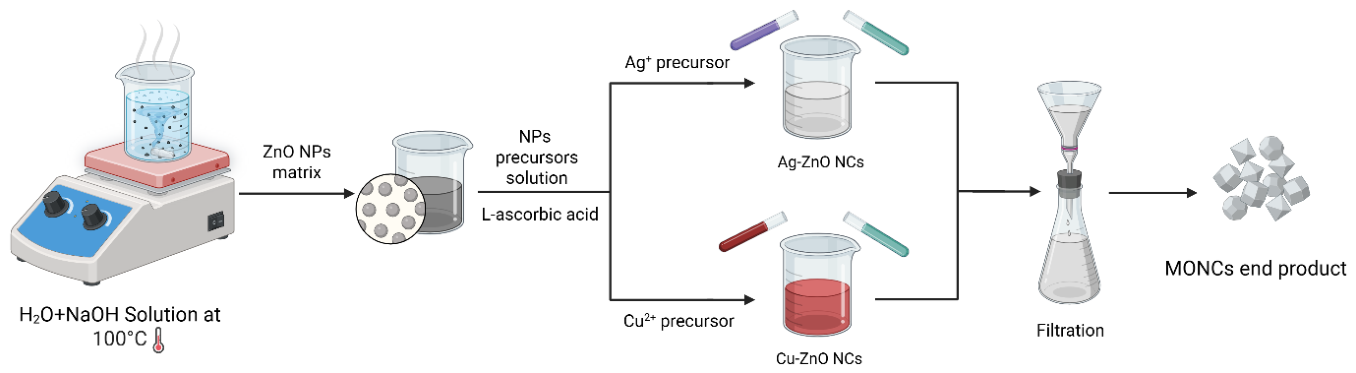
Figure 1. The stages of MONC synthesis through chemical reduction. Created with BioRender. Wasilkowski, D. (2026) (https://BioRender.com/rec1uw5, accessed on 6 June 2026).
Coatings 16 00690 g001
Figure 2. HRTEM images of the (a) Ag-ZnO and (b) Cu-ZnO nanocomposites together with their corresponding SAED patterns (c) Ag-ZnO and (d) Cu-ZnO.
Coatings 16 00690 g002
Figure 3. High-resolution XPS spectra of the (ac) Zn 2p3/2, (df) O 1s and (gi) C 1s for Ag-ZnO, Cu-ZnO NCs, and ZnO matrix NPs.
Coatings 16 00690 g003
Figure 4. High-resolution XPS spectra of (a) Ag 3d for Ag-ZnO and (b) Cu 2p for Cu-ZnO nanocomposite.
Coatings 16 00690 g004
Figure 5. Schematic illustration of MIC values (mg L−1) for C. albicans (90028 ATCC) and S. cerevisiae (9763 ATCC) treated with MONCs and controls after 24 h of exposure.
Coatings 16 00690 g005
Figure 6. Data fitted with PFO and PSO kinetic models for Ag+ (a) and Cu2+ (b) ions, obtained from ion desorption from MONCs, including the coefficient of determination (R2). Histogram (c) showing the desorption capacity at equilibrium (qe) (right axis) and the rate constant k1 values (left axis) with standard deviations.
Coatings 16 00690 g006
Figure 7. The total ROS generation (a) and DHA (b) of C. albicans (90028 ATCC) and S. cerevisiae (9763 ATCC) treated with MONCs and controls after 24 h of exposure (mean ± SD/SE; n = 3). Within each fungal species, values sharing the same letter(s) are not significantly different (p < 0.05).
Coatings 16 00690 g007
Figure 8. Representative FTIR spectra of Ag-ZnO-treated (orange), Cu-ZnO-treated (green), and control (violet) cells for the analysed fungal strains. Spectral differences highlight molecular alterations induced by the nanocomposite treatment.
Coatings 16 00690 g008
Figure 9. (a) PCA results for C. albicans based on vector-normalized spectra in the 1000–1800 cm−1 range, analyzed at a 95% confidence level. (b) PC1 loading plot highlighting key spectral features contributing to group differentiation and indicating biomarker variation across the spectral range. (ce) Box-and-whisker plots showing the distribution of selected biochemical parameters for C. albicans exposed to Ag-ZnO nanocomposites at MIC, compared to untreated controls. The graphs display the median, minimum, and maximum values, along with interquartile ranges, for integrated band intensities or intensity ratios derived from infrared spectra. Statistical significance was assessed using an independent t-test, with significant differences indicated for p < 0.05 (*).
Coatings 16 00690 g009
Figure 10. (a) Principal Component Analysis (PCA) for S. cerevisiae score plot based on vector-normalized spectra in the 1000–1800 cm−1 range (95% confidence level). (b) Corresponding PC1 and PC2 loading plots highlighting the spectral regions responsible for group separation and the associated biochemical variations. (ce) Box-and-whisker plots of protein- and lipid-related biochemical parameters in S. cerevisiae exposed to Ag–ZnO and Cu–ZnO nanocomposites at the minimum inhibitory concentration (MIC), compared with untreated controls. Data are presented as medians with interquartile ranges, along with minimum and maximum values, derived from vector-normalized infrared spectra. Statistical significance was evaluated using the Mann–Whitney test (p < 0.05, *).
Coatings 16 00690 g010
Figure 11. SEM images of C. albicans control cells (a) and exposed to Ag-ZnO NCs (b,c).
Coatings 16 00690 g011
Figure 12. SEM images of S. cerevisiae control cells (a) and exposed to Ag-ZnO NCs (b) and Cu-ZnO NCs (c).
Coatings 16 00690 g012
Figure 13. WST-1 (a) and LDH (b) assays for MDA-MB-231 human cell line exposed to Ag-ZnO and Cu-ZnO NCs, and matrix ZnO NPs and for untreated control (mean ± SD; n = 4). Within each sample, values sharing the same letter(s) are not significantly different (p < 0.05).
Coatings 16 00690 g013
Figure 14. Visualization of MDA-MB-231 human cell line exposed to Ag-ZnO and Cu-ZnO NCs, and matrix ZnO NPs, compared with the untreated control. Squares with circles indicate the locations where photographs were taken; central zone or the periphery of the culture dish.
Coatings 16 00690 g014
Figure 15. Flow cytometry assays for MDA-MB-231 human cell line after 24 h of exposure (at the concentration of 6 mg L−1) to Ag-ZnO and Cu-ZnO NCs, and matrix ZnO NPs, and for the untreated control (mean ± SD; n = 3). Within each group, values sharing the same letter(s) are not significantly different (p < 0.05).
Coatings 16 00690 g015
Table 1. Fungal strains obtained from ATCC and selective culture media of reference microorganisms.
FungiATTCMedia
Reference Number
Formula [g L−1]
Candida albicans90028271120YM Broth (BD 271120)
Yeast Extract, Malt Extract, Peptone, Dextrose
Saccharomyces cerevisiae9763
Table 2. Characteristic FTIR absorption bands of chemical constituents in control and MONC-treated fungal cells [57,58].
Position (cm−1) of BandsMain Contribution
1042carbohydrates (glycogen and β-glucans
1238phospholipids and phosphorylated compounds
1545/1639protein structural alterations (amide II/amide I ratio)
2925/1639relative lipid-to-protein proportion
2925/2955lipid structural organization
Table 3. The surface and structural characterization of the synthesized MONCs and ZnO matrix NPs used in this study (mean ± SD; n ≥ 3).
AnalysisUnitsMONCsNP
Ag-ZnOCu-ZnOZnO
XPSat %C 1s30.4543.2132.29
O 1s41.6435.5942.78
Zn 2p3/226.7019.5824.94
Ag 3d1.22--
Cu 2p-1.61-
ζmV−11.4 ± 0.4−6.3 ± 1.19.0 ± 1.3
Dhnm1082.5 ± 175.9939.7 ± 113.81420 ± 279
pH-6.56.56.5
at %—atomic composition; ζ—ZETA potential; Dh—hydrodynamic diameter; - not applicable.
Table 4. Kinetic parameters for PFO and PSO model fitting for silver- and copper-containing MONCs (n = 3; ±SD).
ModelParametrAg+Cu2+
PFOqe (mg g−1)284.92 ± 8.38109.02 ± 3.70
k1 (h−1)2.02 ± 0.320.75 ± 0.11
R20.9710.979
PSOqe (mg g−1)295.57 ± 12.3118.31 ± 8.49
k2 (g mg−1 h−1)0.03 ± 0.010.02 ± 0.007
R20.9600.931
Disclaimer/Publisher’s Note: The statements, opinions and data contained in all publications are solely those of the individual author(s) and contributor(s) and not of MDPI and/or the editor(s). MDPI and/or the editor(s) disclaim responsibility for any injury to people or property resulting from any ideas, methods, instructions or products referred to in the content.