Article

High-Temperature Tribological Behavior of CrAlN/CrAlN-Ag Composite Coatings

1
Engineering Training Center, Shenyang Institute of Engineering, Shenyang 110136, China
2
School of Mechanical Engineering, Shenyang Jianzhu University, Shenyang 110168, China
3
School of Mechanical Engineering, Dalian University of Technology, Dalian 116024, China
*
Author to whom correspondence should be addressed.
Coatings 2026, 16(6), 636; https://doi.org/10.3390/coatings16060636
Submission received: 3 April 2026 / Revised: 14 May 2026 / Accepted: 22 May 2026 / Published: 25 May 2026
(This article belongs to the Special Issue Ceramic-Based Coatings for High-Performance Applications)

Abstract

To further improve the high-temperature dry sliding performance of Si3N4 ceramics, a CrAlN transition layer was introduced to improve interfacial stability, while Ag was incorporated as a solid lubricant into the CrAlN matrix. The effects of Ag content on the microstructure and mechanical properties of the coatings were systematically examined, and the tribological performance was evaluated from 25 °C to 550 °C under dry sliding conditions. The Ag concentration increased with increasing Ag target power and affected the morphology, nanoparticle distribution, surface roughness, and mechanical properties of the coatings. Among the tested samples, the coating containing 9.6 at.% Ag exhibited a comparatively favorable combination of mechanical properties within the investigated composition range, with a hardness of 11.5 GPa, an H/E ratio of 0.0913, and an H3/E2 value of 0.096 GPa. Tribological tests showed that the average coefficient of friction decreased from 0.32 at 25 °C to 0.12 at 550 °C. This reduction may be associated with temperature-assisted Ag redistribution toward the worn surface and the possible development of Ag-rich surface features at elevated temperatures. However, the wear rate increased with temperature, reaching 3.6 × 10⁻⁵ mm3/(N·m) at 550 °C, suggesting that friction reduction was accompanied by increased material removal and possible near-surface weakening. These results indicate that controlling Ag content is important for balancing friction reduction and wear resistance in ceramic-based self-lubricating coatings.

1. Introduction

Silicon nitride (Si3N4) ceramics have attracted significant attention for high-temperature structural and tribological applications, such as gas turbines, high-speed cutting tools, and aerospace components, owing to their excellent thermomechanical properties, including high hardness, superior fracture toughness, and outstanding thermal shock resistance [1,2]. Nevertheless, their dry sliding behavior remains strongly dependent on the applied load, sliding speed, counterface material, temperature, and atmosphere. Previous studies have reported that Si3N4 ceramics can exhibit friction coefficients around or above 0.5 under dry sliding conditions, accompanied by wear damage and tribochemical or oxidation-related wear. Therefore, further surface modification remains necessary to reduce friction and improve tribological reliability under severe dry sliding conditions [3,4]. To overcome these surface property limitations, the deposition of transition metal nitride hard coatings on the substrate surface has proven to be a highly effective protective strategy. Among these, chromium aluminum nitride (CrAlN) coatings are widely utilized for the surface modification of ceramic substrates due to their outstanding thermal stability, high-temperature oxidation resistance, and excellent mechanical strength [5,6,7]. Nevertheless, despite providing exceptional wear protection, CrAlN coatings inherently lack self-lubricating properties. Consequently, monolithic CrAlN coatings still exhibit relatively high coefficients of friction under high-temperature dry sliding conditions. This not only increases energy consumption during operation but also induces severe frictional heating, potentially leading to the premature failure of coated components. To achieve an optimal balance between wear resistance and low friction, the incorporation of solid lubricants into the hard coating matrix has emerged as a highly promising approach. Silver (Ag), renowned for its excellent lubricity across a broad temperature range, can be incorporated into coatings to construct a self-lubricating system [8]. Therefore, the development of CrAlN/CrAlN-Ag composite coatings on Si3N4 substrates offers a synergistic solution, in which the CrAlN matrix provides robust load-bearing capacity and wear resistance, while the incorporated Ag phase acts as an effective solid lubricant, ultimately aiming to significantly enhance the overall high-temperature tribological performance of the material system.
Although the incorporation of Ag into hard nitride matrices (e.g., TiN, CrN, VN, and TiAlN) has been extensively documented as a viable strategy for reducing friction across a broad temperature spectrum, a persistent dichotomy exists between lubricating efficacy and mechanical integrity [9,10,11,12,13]. As a soft metal, Ag provides lubrication at room temperature by forming a shear layer; at elevated temperatures, it exploits its high diffusion rate to migrate to the surface and form a lubricating film, thereby exhibiting excellent friction-reduction properties across a broad temperature range [14,15]. However, precisely controlling the distribution of Ag remains a significant challenge, as excessive Ag content often compromises the hardness of the coating [15,16,17]. Furthermore, due to the substantial disparity in physical properties (e.g., mismatch in coefficients of thermal expansion) between the Si3N4 ceramic substrate and the nitride coating, coupled with the potential for Ag addition to further weaken interfacial adhesion, the introduction of a suitable transition layer is crucial to alleviate thermal stress and enhance interfacial bonding strength [18,19]. Although Ag-containing self-lubricating coatings have been widely studied on metallic substrates, most previous investigations focused on single-layer architectures, metallic substrates, or different coating/substrate systems. To the best of our knowledge, systematic studies on CrAlN/CrAlN-Ag composite coatings featuring a dedicated CrAlN transition layer on Si3N4 ceramic substrates under dry sliding conditions from 25 to 550 °C remain limited.
Based on the aforementioned research background and existing issues, in this study, a CrAlN/CrAlN-Ag composite coating system featuring a CrAlN transition layer was constructed on Si3N4 ceramic substrates using radio frequency (RF) magnetron sputtering. By tailoring the sputtering power of the Ag target, the Ag content within the coatings was regulated, and its influence on the microstructural evolution and mechanical properties was systematically analyzed. In addition, friction and wear tests were conducted across a broad temperature range from 25 °C to 550 °C to evaluate the temperature-dependent tribological behavior of the coatings. Particular attention was paid to the evolution of wear morphology, Ag distribution, and the possible role of Ag-rich surface features during high-temperature sliding. This study aims to provide experimental support for the structural optimization and performance tailoring of ceramic-based self-lubricating composite coatings.

2. Materials and Methods

2.1. Coating Preparation

In this study, CrAlN/CrAlN-Ag composite coatings were deposited on Si3N4 ceramic substrates (with a surface roughness of ~0.04 μm) using radio frequency magnetron sputtering. High-purity Cr50Al50 alloy and pure silver (Ag, 99.99%) targets were utilized as the sputtering sources. Prior to deposition, the Si3N4 substrates were ultrasonically cleaned sequentially in acetone, deionized water, and absolute ethanol for 15 min each, followed by a drying process. The vacuum of the sputtering chamber was evacuated to a base pressure of 9.0 × 10⁻⁴ Pa. Before the onset of deposition, the Si3N4 substrates were heated to 300 °C, and the targets were pre-sputtered at a power of 100 W for 20 min in a pure argon (Ar) atmosphere to remove surface contaminants. During the deposition process, the substrate rotation speed was set to 2 rpm/min, and the working pressure was maintained at 0.5 Pa. High-purity argon (Ar) and nitrogen (N2) were introduced as the working gases, both with a flow rate of 50 sccm. The sputtering power for the CrAl target was fixed at 160 W. To regulate the Ag content, the sputtering power for the Ag target was varied at 30 W, 35 W, 40 W, 45 W, and 50 W, corresponding to the sample designations A1, A2, A3, A4, and A5, respectively. In the fabrication process, a monolithic CrAlN coating was initially deposited for 120 min to serve as the transition underlayer, followed immediately by the deposition of the CrAlN-Ag functional top layer for another 120 min under the same conditions. The detailed processing parameters for the coating preparation are summarized in Table 1.
For each Ag target power condition (A1–A5), three identical Si3N4 substrates were coated simultaneously in a single deposition run to ensure the consistency of sample preparation. All subsequent characterization and tribological tests were carried out on at least two independent samples for each condition to verify the reproducibility of the results.

2.2. Coating Characterization

The surface and cross-sectional morphologies of the coatings, along with their chemical composition distributions, were characterized using a scanning electron microscope (SEM, ZEISS GeminiSEM 300, Carl Zeiss Microscopy GmbH, Jena, Germany) equipped with an energy-dispersive X-ray spectrometer (EDS, Oxford Instruments, High Wycombe, UK). The hardness and elastic modulus of the coatings were evaluated using a nanoindentation system (Bruker Hysitron TI 980, Bruker, Billerica, MA, USA) operating in static indentation mode. To eliminate the influence of the substrate effect, the maximum indentation depth was strictly controlled to be less than 10% of the total coating thickness. Nanoindentation measurements were performed at five different positions on each sample, and the reported hardness and elastic modulus values represent the average results.
In addition, ImageJ2.0 software was used to quantitatively analyze the surface distribution of Ag nanoparticles from the SEM images. For each coating sample, three representative SEM surface images or regions with the same magnification were selected for analysis. The analyzed area of each region was kept at approximately 5.6 μm2. Before particle counting, the images were converted to 8-bit grayscale images, and Ag nanoparticles were identified according to their grayscale contrast using threshold segmentation. The Analyze Particles function in ImageJ was then used to determine the particle number and particle size. Obvious artifacts and particles intersecting the image boundary were excluded from the analysis. The surface number density of Ag nanoparticles was calculated by dividing the counted particle number by the analyzed area. The reported values represent the average results obtained from the analyzed regions.

2.3. Tribological Testing

The tribological properties of the coatings under dry sliding conditions were evaluated using an Rtec MFT-5000 tribometer (Rtec Instruments, San Jose, CA, USA). The tests were performed in a reciprocating ball-on-disk sliding configuration. Si3N4 ceramic balls with a diameter of 6.35 mm were utilized as the friction counterparts. The testing parameters were configured with a normal load of 10 N, a sliding frequency of 3 Hz, a reciprocating stroke length of 10 mm, and a total duration of 20 min for each single test. To comprehensively investigate the tribological behavior of the coatings across a broad temperature range, the sliding tests were conducted at both room temperature and prescribed elevated temperatures (up to 550 °C). For each condition, tribological tests were performed on three independent samples to ensure the repeatability and reproducibility of the results. Following the tests, the morphologies of the wear tracks were observed using SEM to elucidate the underlying wear mechanisms.
The selected testing temperatures were used to examine the progressive evolution of the tribological behavior of the CrAlN/CrAlN-Ag coatings under increasing thermal exposure. Specifically, 25 °C was selected as the room-temperature baseline condition, while 150 °C and 350 °C were used as intermediate temperatures to evaluate gradual changes in friction behavior, wear morphology, and Ag distribution. The highest temperature of 550 °C was selected to assess the coating response under severe high-temperature sliding conditions. These temperature points were not intended to represent confirmed mechanistic transition temperatures, but rather to provide a comparative temperature range for evaluating the evolution of friction and wear behavior.

3. Results and Discussion

3.1. Structure of the CrAlN/CrAlN-Ag Composite Coatings

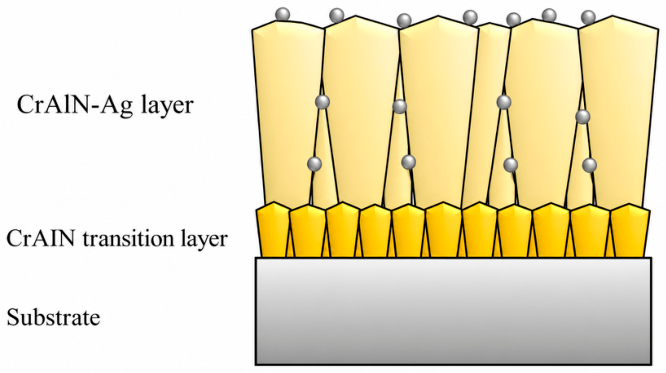
Figure 1 illustrates the typical structural schematic of the CrAlN/CrAlN-Ag composite coatings. This coating system employs a gradient design strategy, comprising an underlying Si3N4 ceramic substrate, an intermediate CrAlN hard transition layer, and a top CrAlN-Ag functional layer. Notably, the CrAlN transition layer was introduced to help alleviate the interfacial stress associated with the mismatch in coefficients of thermal expansion (CTE) between the ceramic substrate and the transition metal nitride coating. Meanwhile, the top CrAlN-Ag functional layer leverages the synergistic coupling effect between the hard matrix and the lubricating phase to sustain the structural integrity of the coating under extreme operating conditions. Through a hierarchical protection mechanism, this multilayer composite architecture aims to comprehensively enhance the overall wear resistance of the coatings in severe service environments, such as high loads and elevated temperatures.

3.2. Ag Concentration

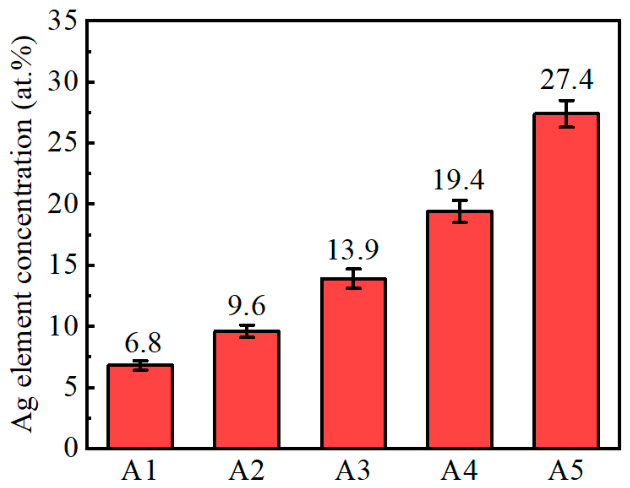
Figure 2 presents the variation in the Ag concentration of the CrAlN/CrAlN-Ag composite coatings as a function of the Ag target sputtering power. The atomic percentages of Ag for the five sample groups (A1, A2, A3, A4, and A5) were experimentally determined to be 6.8 at.%, 9.6 at.%, 13.9 at.%, 19.4 at.%, and 27.4 at.%, respectively. The results show that the Ag concentration in the coatings increased with increasing Ag target power. This phenomenon can be attributed to the intensified ion bombardment on the Ag target surface at higher RF powers. The enhanced bombardment leads to a higher flux of sputtered Ag atoms, thereby increasing the Ag content incorporated into the functional layer during the deposition process.

3.3. Surface and Cross-Sectional Morphologies

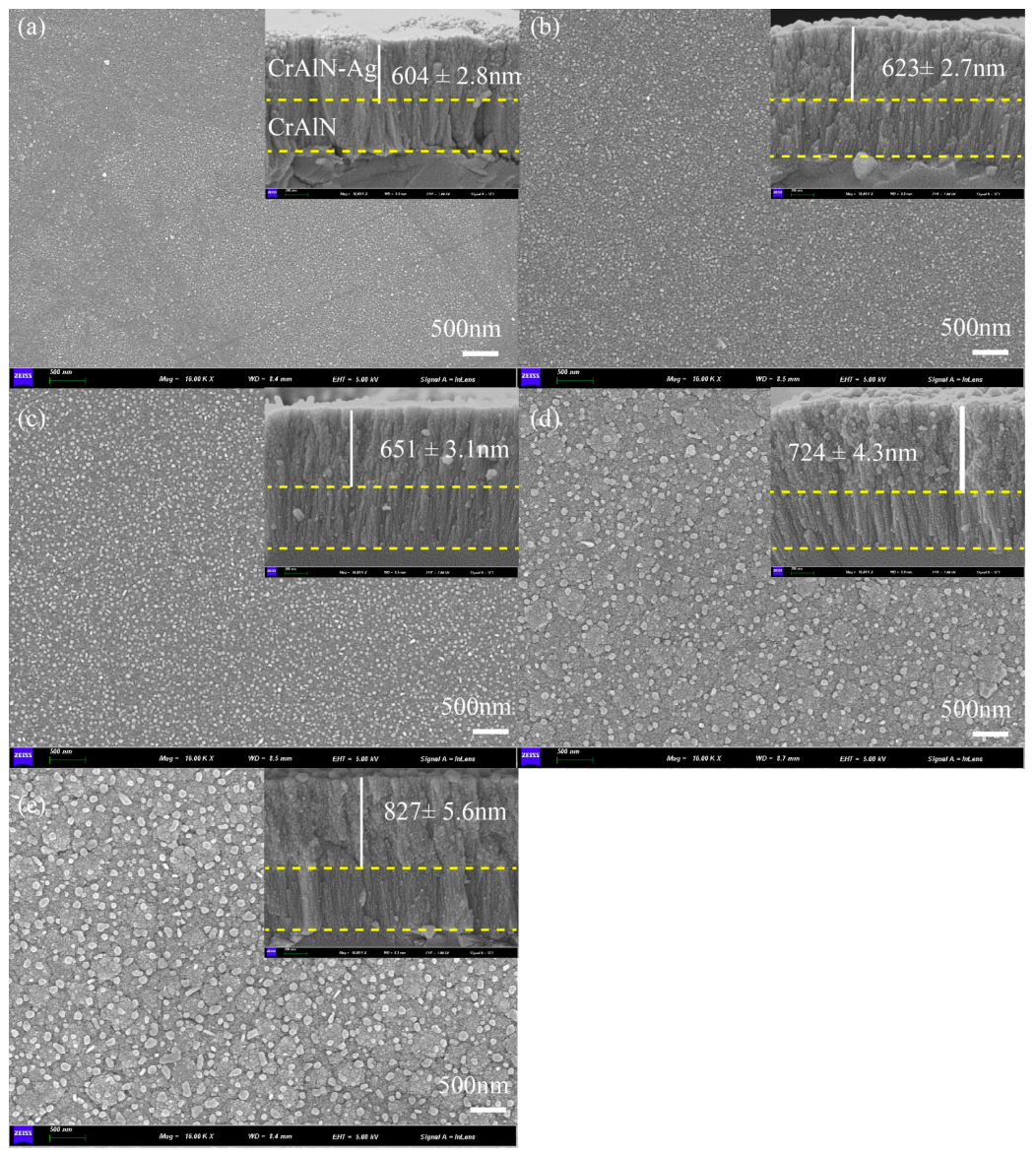
Figure 3 details the surface and cross-sectional SEM morphologies of the CrAlN/CrAlN-Ag coatings with various Ag concentrations. For the A1 sample (6.8 at.% Ag), fine and nearly spherical white Ag nanoparticles are dispersed on the coating surface. Owing to their small particle size and high degree of dispersion, these nanoparticles uniformly cover the continuous and dense hard matrix, as depicted in Figure 3a. The surface structure of the A1 sample exhibits excellent densification, devoid of obvious microcracks, pores, or spallation defects, indicating superior film-forming quality at a lower doping concentration. As shown in Figure 3b,c, samples A2 and A3 still maintain a uniform and dense surface morphology without obvious morphological degradation, indicating that the coatings preserved a relatively intact microstructural appearance within this concentration range. However, when the Ag concentration further increases above 19.4 at.%, as depicted in Figure 3d,e, the severe segregation and aggregation of Ag atoms lead to excessive particle growth. This results in reduced surface smoothness and pronounced heterogeneity for samples A4 and A5. ImageJ-based quantitative analysis was further performed to support the SEM observations. The calculated surface number density of Ag nanoparticles decreased from approximately 146.3 particles/μm2 for A1 to approximately 21.6 particles/μm2 for A5. This tendency suggests that increasing Ag content promoted particle coarsening and aggregation, resulting in a lower apparent particle number density and more heterogeneous surface morphology.
According to cross-sectional SEM observations, the CrAlN transition layer exhibits a distinct layered arrangement and a dense columnar grain structure. Upon the introduction of the Ag component, the columnar growth mode of the CrAlN-Ag functional layer is significantly refined and improved. With the elevation of the sputtering power and the concurrent increase in Ag concentration, the deposition rate of the CrAlN-Ag functional layer increases, leading to a gradual increase in its thickness from 604 ± 2.8 nm for the A1 sample to 827 ± 5.6 nm for the A5 sample.

3.4. Surface Roughness

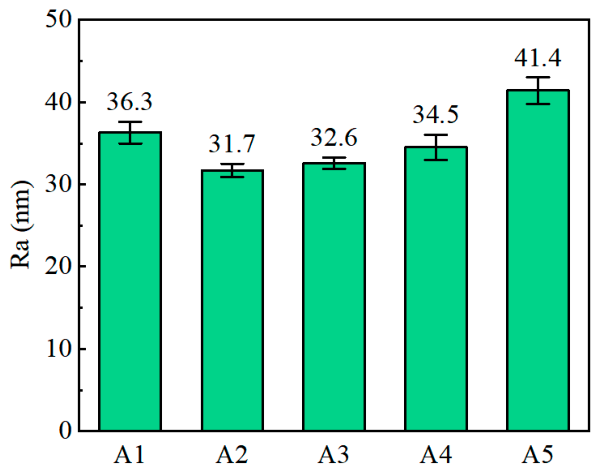
As illustrated in Figure 4, with increasing Ag content, the surface roughness of the coatings exhibits an initial decrease followed by a subsequent increase. This phenomenon arises because, at lower Ag concentrations, the Ag nanoparticles can be uniformly dispersed within the coating matrix, filling the microscopic depressions on the surface. This facilitates the formation of a denser and smoother coating surface, thereby effectively reducing the surface roughness. However, as the Ag content increases further, the surface roughness begins to exhibit a continuous upward trend, gradually escalating from 31.7 nm to 41.4 nm. This is primarily attributed to the fact that once the Ag content exceeds a critical threshold, the excessive Ag nanoparticles tend to agglomerate or aggregate, resulting in enlarged particle sizes and a non-uniform distribution. These agglomerates form protruding microstructures on the coating surface, which roughens the surface morphology and ultimately leads to a significant increase in the overall surface roughness of the coatings [20,21].

3.5. Hardness and Elastic Modulus

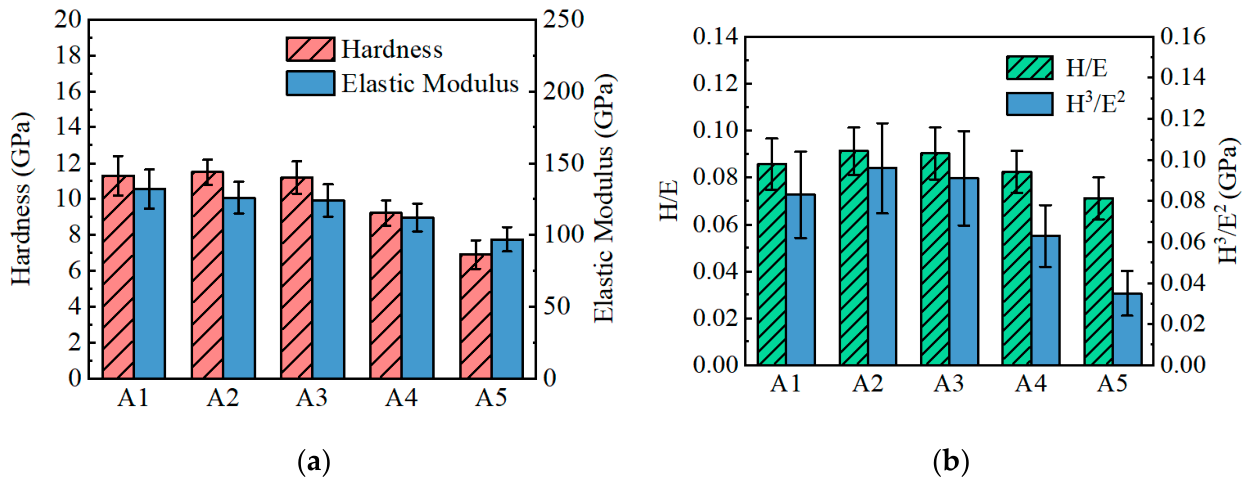
In the characterization of the mechanical properties of coatings, researchers conventionally employ the parameters H/E (elastic strain to failure) and H3/E2 (GPa) (resistance to plastic deformation) to comprehensively evaluate the wear resistance and load-bearing capacity of the coatings. Specifically, H/E is closely related to the elastic recovery capability and toughness of the material, whereas H3/E2 directly reflects the coating’s ability to resist localized plastic deformation; a higher ratio indicates that the coating is less susceptible to permanent damage when subjected to external applied loads [22,23]. Figure 5 illustrates the variations in the mechanical properties of the CrAlN/CrAlN-Ag coatings with different Ag concentrations. As shown in Figure 5a, with the increase in Ag concentration, both the hardness and elastic modulus of the coatings exhibit an overall declining trend. This phenomenon is primarily attributed to the segregation of the soft Ag phase at the grain boundaries, which induces lattice distortion and weakens the inter-boundary interaction forces. It is noteworthy that sample A2 shows a relatively high hardness value of approximately 11.5 GPa, together with an elastic modulus of approximately 126.3 GPa. This suggests that, at a moderate Ag concentration, the coating may possess a relatively compact microstructure and a more uniform distribution of Ag nanoparticles. As depicted in Figure 5b, sample A2 exhibits comparatively higher H/E and H3/E2 ratios among the tested coatings, with values of 0.0913 and 0.096 GPa, respectively. These results suggest that A2 possesses relatively favorable elastic recovery-related behavior and resistance to plastic deformation within the investigated composition range.
As summarized in Table 2 and shown in Figure 3, Figure 4 and Figure 5, when the Ag content increases from 9.6 at.% to 13.9 at.%, the surface roughness begins to increase slightly, while the H/E and H3/E2 ratios show a decreasing tendency. Meanwhile, the SEM observations indicate that Ag nanoparticles begin to exhibit signs of agglomeration. When the Ag concentration further increases to 19.4 at.% and above, more pronounced Ag segregation and particle coarsening are observed, accompanied by a reduction in hardness and elastic recovery-related parameters. These results suggest that excessive Ag incorporation may adversely affect the compactness and mechanical reliability of the coating. Therefore, within the investigated composition range, the coating containing 9.6 at.% Ag showed a comparatively favorable combination of hardness, H/E, H3/E2, and surface roughness under the present experimental conditions.

3.6. Effect of Temperature on the Tribological Behavior of the Coatings

This section investigates the influence of temperature on the tribological behavior of the CrAlN/CrAlN-Ag coatings. The tribological tests were conducted under a normal load of 10 N at 25 °C, 150 °C, 350 °C, and 550 °C. The selected testing temperatures were used to examine the progressive evolution of the tribological behavior of the CrAlN/CrAlN-Ag coatings under increasing thermal exposure. Specifically, 25 °C served as the baseline condition, 150 °C and 350 °C were used to capture intermediate changes in friction behavior, wear morphology, and Ag distribution, and 550 °C was selected to evaluate the coating performance under a severe high-temperature sliding condition.
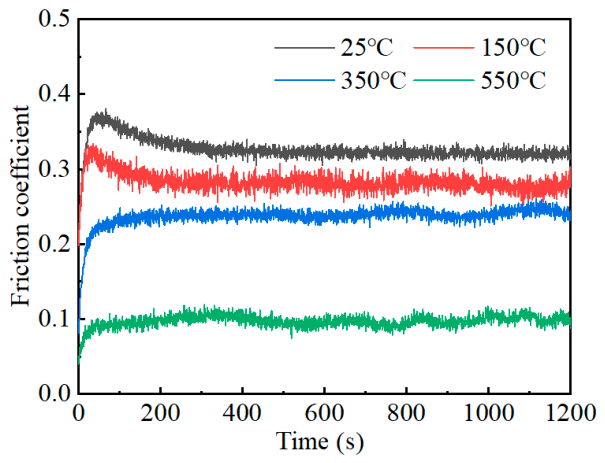
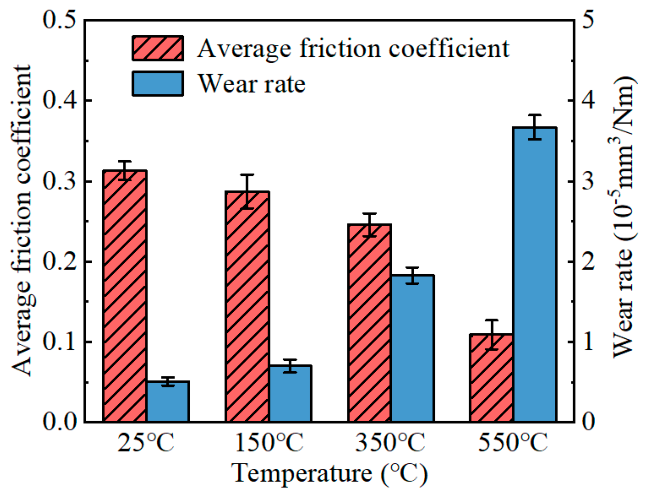
Based on the mechanical property results presented in Section 3.5, sample A2 showed a comparatively favorable combination of hardness, H/E, H3/E2, and surface roughness among the investigated coatings. Therefore, coating A2 was selected as a representative composition for the subsequent temperature-dependent tribological evaluation. The time-dependent friction coefficient curves of the CrAlN/CrAlN-Ag coatings at various temperatures are illustrated in Figure 6, while the corresponding average coefficients of friction (COFs) and wear rates are presented in Figure 7. The experimental results indicate that at room temperature, the coatings experienced a prolonged running-in period during the initial sliding stage. As the testing temperature elevated, the duration of the running-in phase gradually shortened, and at higher temperatures, this transient stage almost completely disappeared. This phenomenon suggests that the high-temperature environment facilitates the rapid transition of the sliding interface into a steady state. Furthermore, as the temperature increases from room temperature to 550 °C, the average COF of the coatings exhibits a pronounced decreasing trend. Specifically, the average COF is 0.32 at room temperature; it decreases to 0.28 when the temperature is elevated to 150 °C, and further drops to 0.24 at 350 °C. Remarkably, when the temperature reaches 550 °C, the COF is significantly reduced to 0.12, exhibiting merely slight fluctuations throughout the entire sliding process. The decrease in COF at elevated temperatures may be associated with enhanced Ag redistribution toward the worn surface and the possible development of Ag-rich surface features, which could reduce the interfacial shear resistance during sliding. This interpretation is consistent with our previous first-principles calculations, which indicated that Ag atoms exhibit a favorable migration tendency toward the coating surface in CrAlN-Ag coatings [12]. However, the wear rate of the coatings exhibits a progressive increase with the rising temperature. At 150 °C, 350 °C, and 550 °C, the wear rates of the coatings are recorded as 0.7 × 10⁻⁵ mm3/(N·m), 1.8 × 10⁻⁵ mm3/(N·m), and 3.6 × 10⁻⁵ mm3/(N·m), respectively. This suggests that although elevated temperatures may facilitate friction reduction.
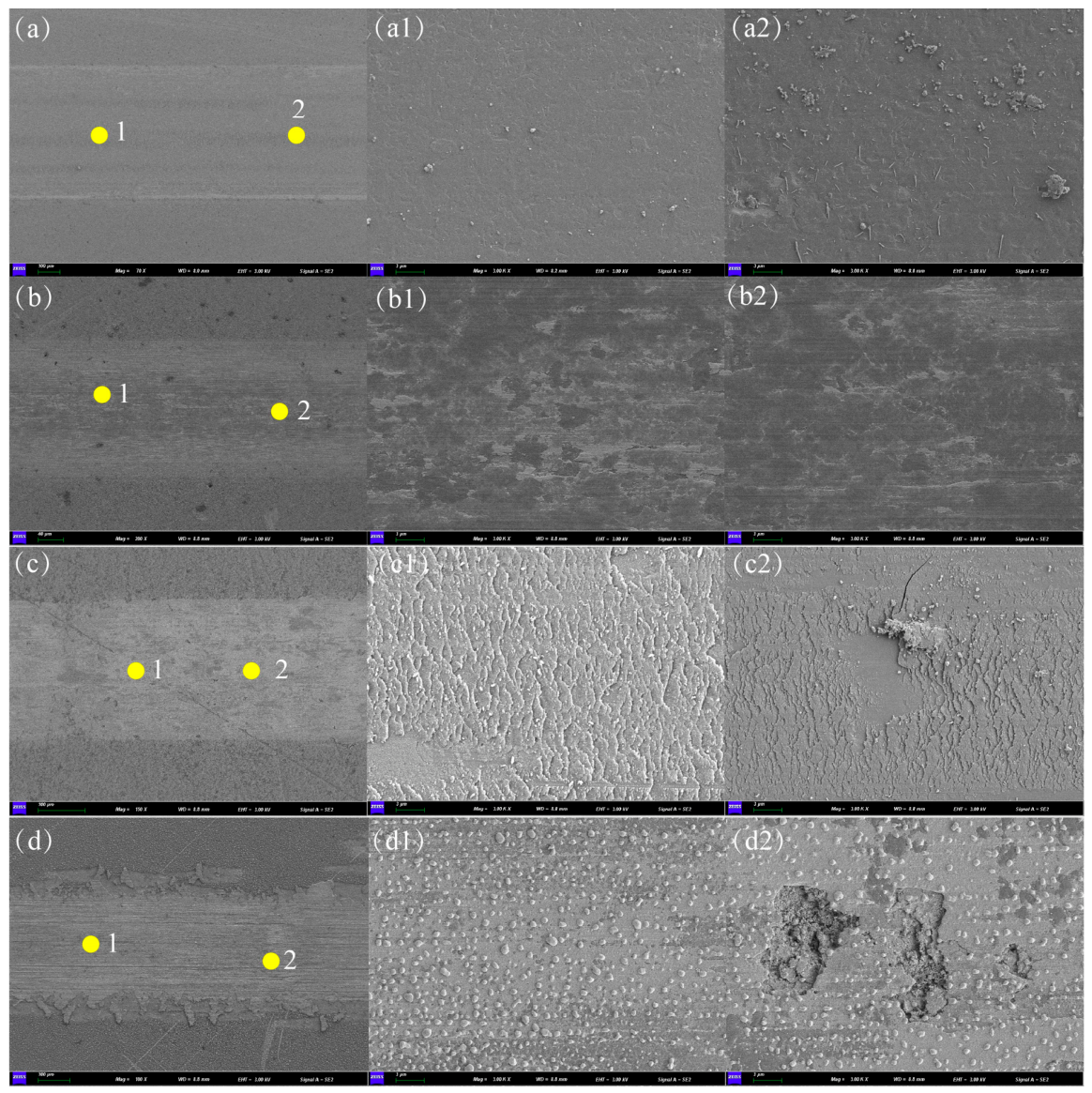
To further understand the temperature-dependent wear behavior of the CrAlN/CrAlN-Ag coating, the morphologies of the wear tracks were analyzed, as shown in Figure 8. At 25 °C, the wear track remains relatively smooth and intact, with only minor localized spallation. This indicates that the coating maintains good surface integrity under room-temperature sliding conditions. The relatively low COF at this temperature may be related to the presence of metallic Ag on the coating surface, which can provide a low-shear-strength phase during sliding.
At 150 °C, the wear morphology shows no obvious deterioration compared with that observed at 25 °C. The wear track remains relatively smooth, and no large-scale cracking, peeling, or delamination is observed. This suggests that the coating still maintains relatively stable surface integrity under low-to-moderate thermal exposure. The Ag-rich features observed on the worn surface may contribute to the maintenance of a relatively low friction coefficient at this temperature.
When the temperature increases to 350 °C, Ag-rich regions become more evident on the worn surface, as shown in Figure 8c. This observation suggests that Ag redistribution may become more pronounced at elevated temperatures. Such Ag-rich features may contribute to the reduction in COF by providing a locally lubricating surface layer. However, localized spallation is also observed within the worn region, indicating the onset of local material removal under the combined effects of temperature and sliding contact.
At 550 °C, a larger amount of bright Ag-rich features can be observed on the worn surface, as shown in Figure 8d. These features may be associated with enhanced Ag mobility and redistribution under high-temperature sliding conditions. The possible formation of an Ag-rich surface layer may contribute to the further decrease in COF at this temperature. However, the increased wear rate indicates that friction reduction is accompanied by enhanced material removal. This behavior may be related to local near-surface weakening, Ag redistribution, and possible oxidation effects under high-temperature sliding.
Although the wear rate increases with temperature, the SEM observations show no catastrophic peeling or large-scale delamination after sliding at 550 °C. Therefore, the coating appears to retain overall structural integrity under the present high-temperature sliding conditions. The increased wear rate is more reasonably interpreted as localized material removal rather than complete coating failure.

3.7. Wear Mechanisms of the CrAlN/CrAlN-Ag Composite Coatings

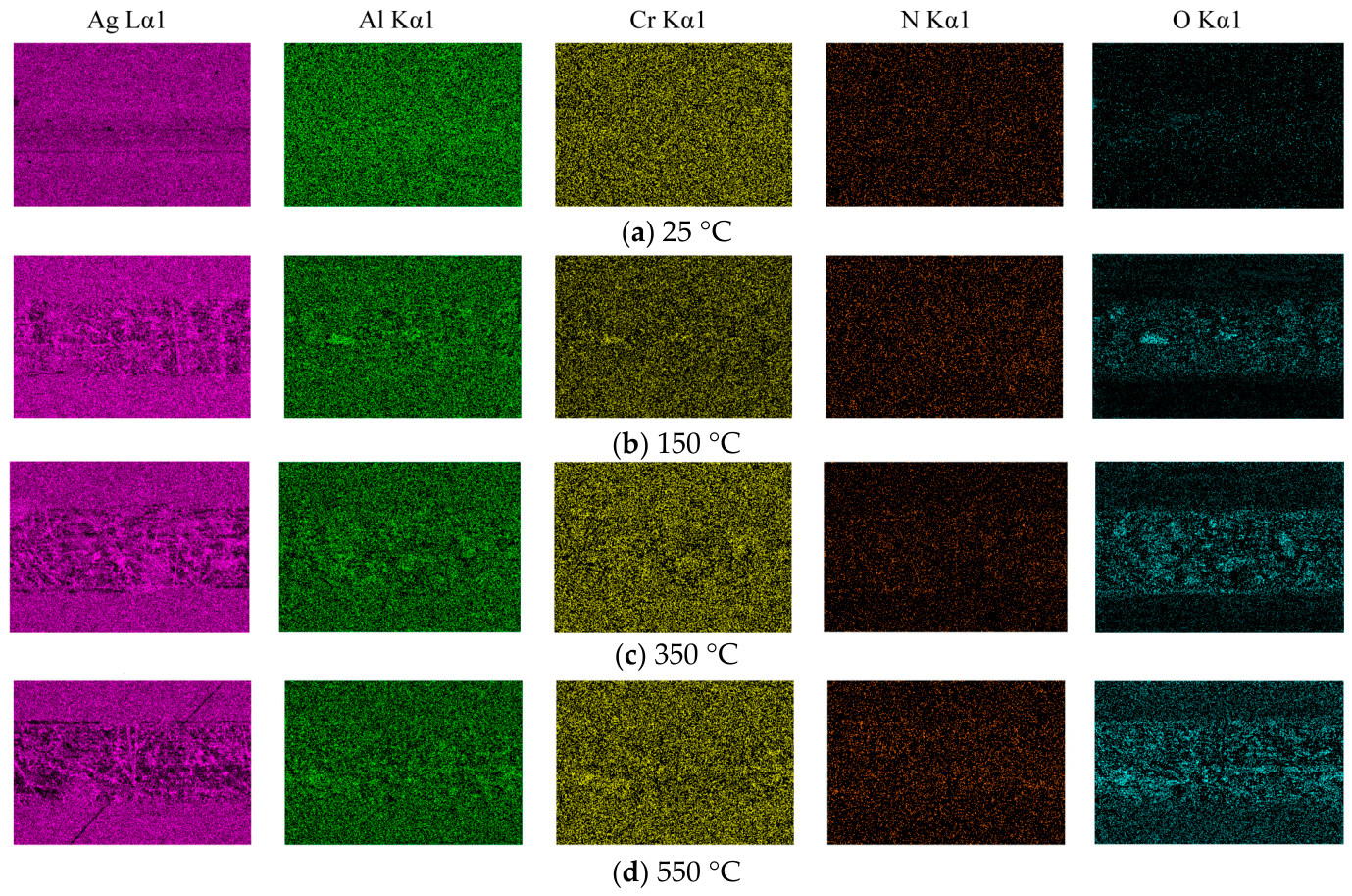
As shown in Figure 9, the EDS analysis results of the wear tracks reveal temperature-dependent variations in the elemental distribution on the worn surface. At room temperature, Ag is relatively uniformly distributed within the worn region. With increasing temperature, Ag-rich regions become more evident on the worn surface, and oxygen is also detected in the wear track. These observations suggest that Ag redistribution and oxidation-related effects may be involved in the temperature-dependent tribological behavior of the CrAlN/CrAlN-Ag coating.
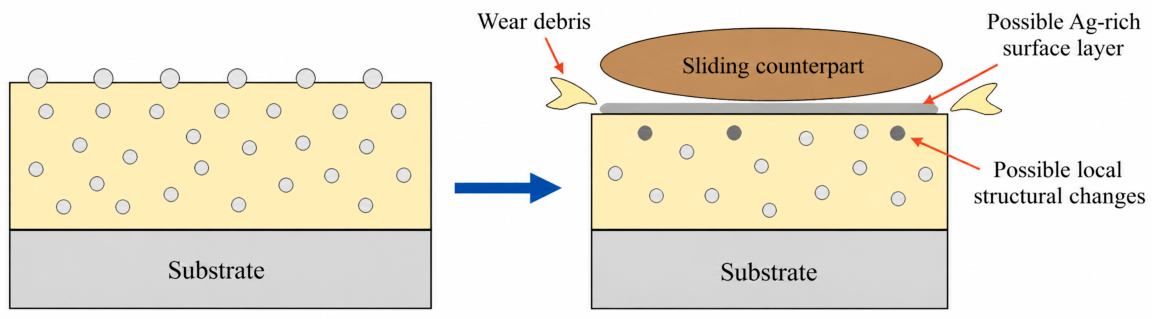
Figure 10 presents a schematic illustration of the possible wear process of the CrAlN/CrAlN-Ag coatings at different temperatures. The decrease in COF at elevated temperatures may be associated with the increased presence of Ag-rich regions on the worn surface. These Ag-rich regions could reduce interfacial shear resistance during sliding, thereby contributing to the lower friction coefficient. This interpretation is also consistent with our previous first-principles calculations, which suggested that Ag atoms may exhibit a tendency to segregate toward the coating surface in CrAlN-Ag coatings [12].
However, although the friction coefficient decreased with increasing temperature, the wear rate increased simultaneously. This result indicates that friction reduction did not necessarily correspond to improved wear resistance under the present high-temperature sliding conditions. The increased wear rate may be related to the combined effects of Ag redistribution, local material removal, and possible oxidation-related reactions. Nevertheless, SEM observations showed no catastrophic peeling or large-scale delamination after testing at 550 °C, suggesting that the coating retained overall structural integrity under the present testing conditions.

4. Conclusions

In this study, CrAlN/CrAlN-Ag composite coatings with different Ag contents were deposited on Si3N4 ceramic substrates by RF magnetron sputtering, and their microstructure, mechanical properties, and high-temperature tribological behavior were investigated. The Ag content increased with increasing Ag target power, and excessive Ag addition promoted nanoparticle agglomeration and deterioration of mechanical properties. Among the tested coatings, the sample containing 9.6 at.% Ag exhibited a comparatively favorable combination of mechanical properties within the investigated composition range, with a hardness of 11.5 GPa, an H/E ratio of 0.0913, and an H3/E2 value of 0.096 GPa. Considering the overlap in some standard deviations, this composition is discussed as a comparatively favorable sample rather than a statistically confirmed optimum. Temperature-dependent tribological tests showed that the average friction coefficient decreased from 0.32 at 25 °C to 0.12 at 550 °C. However, the wear rate increased to 3.6 × 10⁻⁵ mm3/(N·m) at 550 °C, suggesting that friction reduction at elevated temperatures was accompanied by increased local material removal, possible near-surface weakening, and potential oxidation effects. Therefore, controlling the Ag content is important for achieving a balance between friction reduction and wear resistance in ceramic-based self-lubricating coatings for high-temperature applications.

Author Contributions

Conceptualization, H.L. and Y.W.; methodology, H.L.; software, J.L.; validation, H.L. and Y.W.; formal analysis, H.L.; investigation, H.L.; resources, H.L.; data curation, J.L.; writing—original draft preparation, H.L.; writing—review and editing, Y.W.; visualization, J.L.; supervision, Y.W.; project administration, H.L.; funding acquisition, H.L. All authors have read and agreed to the published version of the manuscript.

Funding

This research received no external funding.

Institutional Review Board Statement

Not applicable.

Informed Consent Statement

Not applicable.

Data Availability Statement

The raw data supporting the conclusions of this article will be made available by the authors on request.

Acknowledgments

The authors gratefully acknowledge Yuhou Wu for providing essential experimental equipment and financial support for this research. During the preparation of this manuscript, the author(s) used Gemini 3.1 for the purposes of translating and refining the English text.

Conflicts of Interest

The authors declare no conflicts of interest.

Abbreviations

The following abbreviations are used in this manuscript:
Si3N4Silicon nitride
CrAlNChromium aluminum nitride
AgSilver
RFRadio frequency
ArArgon
N2Nitrogen
CTECoefficient of thermal expansion
SEMScanning electron microscope
EDSEnergy-dispersive X-ray spectrometer
COFCoefficient of friction
H/EElastic strain to failure
H3/E2Resistance to plastic deformation

References

  1. Wang, L.; Huang, C.; Xu, L.; Shi, Z.; Wang, Z.; Huang, S.; Qu, M.; Xu, Z.; Zhang, D.; Guo, B.; et al. Silicon Nitride Based Low Thermal Expansion Ceramic Tool Materials and Their Performance. Ceram. Int. 2025, 51, 41780–41789. [Google Scholar] [CrossRef]
  2. Zheng, Q.; Liu, J.; Yang, H.; Chen, T.; Hu, W.; Wu, N. Molecular Dynamics Study of Fretting Wear Characteristics of Silicon Nitride Bearings. Adv. Theory Simul. 2025, 8, 2401119. [Google Scholar] [CrossRef]
  3. Yao, J.; Wu, Y.; Sun, J.; Tian, J.; Zhou, P.; Bao, Z.; Xia, Z.; Gao, L. Friction and Wear Characteristics of Silicon Nitride Ceramics under Dry Friction Condition. Mater. Res. Express 2021, 8, 035701. [Google Scholar] [CrossRef]
  4. Huang, C.; Zou, B.; Liu, Y.; Zhang, S.; Huang, C.; Li, S. Study on Friction Characterization and Wear-Resistance Properties of Si3N4 Ceramic Sliding against Different High-Temperature Alloys. Ceram. Int. 2016, 42, 17210–17221. [Google Scholar] [CrossRef]
  5. Lu, H.; Wu, Y.; Liu, Z.; Wang, H.; Yan, G.; Bai, X.; Guo, J.; Zheng, T. Effect of Process Parameters on the Growth and Wear Resistance of CrAlN Coating on Silicon Nitride Surface. Ind. Lubr. Tribol. 2024, 76, 186–195. [Google Scholar] [CrossRef]
  6. Luo, Y.; Ning, C.; Dong, Y.; Xiao, C.; Wang, X.; Peng, H.; Cai, Z. Impact Abrasive Wear Resistance of CrN and CrAlN Coatings. Coatings 2022, 12, 427. [Google Scholar] [CrossRef]
  7. Li, M.; Yu, Y.; Zou, C.; Tian, C.; Xiang, Y. Tribological and Corrosion Performance of CrAlN/CrN Coatings in Artificial Seawater under Varied Nitrogen Pressures. Coatings 2023, 13, 2090. [Google Scholar] [CrossRef]
  8. Zhou, F.; Qian, J.; Zhang, M.; Wu, Y.; Wang, Q.; Zhou, Z. Tribocorrosion Properties of CrMoN/Ag Coatings with Various Ag Contents in Seawater. Surf. Coat. Technol. 2023, 473, 129993. [Google Scholar] [CrossRef]
  9. Ren, T.; Fang, H.; Zhao, H.; He, J. Influence of Ag Target Power on Microstructure and Properties of TiN-Si3N4-Ag Composite Coatings. J. Mater. Eng. Perform. 2023, 33, 8425–8433. [Google Scholar] [CrossRef]
  10. Lenzi, V.; Marques, L. Molecular Dynamics Simulation of Ti Metal Cutting Using a TiN:Ag Self-Lubricating Coated Tool. Materials 2023, 16, 1344. [Google Scholar] [CrossRef]
  11. Huang, K.; Cao, X.; Kong, L.; Lu, Z.; Zhang, G.; Ding, Q.; Hu, H. Effect of Ag Content on Friction and Wear Properties of Ag and v Co-Doped CrN Coatings at 25–700 °C. Ceram. Int. 2021, 47, 35021–35028. [Google Scholar] [CrossRef]
  12. Tillmann, W.; Grisales, D.; Echavarría, A.M.; Calderón, J.A.; Gaitan, G.B. Effect of Ag Doping on the Microstructure and Electrochemical Response of TiAlN Coatings Deposited by DCMS/HiPIMS Magnetron Sputtering. J. Mater. Eng. Perform. 2022, 31, 3811–3825. [Google Scholar] [CrossRef]
  13. Mejía Vásquez, H.D.; Perea, D.; Bejarano, G. Development and Characterization of TiAlN (Ag, Cu) Nanocomposite Coatings Deposited by DC Magnetron Sputtering for Tribological Applications. Surf. Coat. Technol. 2020, 381, 125095. [Google Scholar] [CrossRef]
  14. Lu, H.; Wu, Y.; Liu, Z.; Zheng, T.; Guo, J. Regulation of Ag Atom Diffusion in CrAlN-Ag Coatings Based on Diffusion Mechanism. Int. J. Appl. Ceram. Technol. 2025, 22, e15150. [Google Scholar] [CrossRef]
  15. Ren, M.; Yu, H.; Zhu, L.; Li, H.; Wang, H.; Xing, Z.; Xu, B. Microstructure, Mechanical Properties and Tribological Behaviors of TiAlN-Ag Composite Coatings by Pulsed Magnetron Sputtering Method. Surf. Coat. Technol. 2022, 436, 128286. [Google Scholar] [CrossRef]
  16. Zhao, Y.; Mu, Y.; Liu, M. Mechanical Properties and Friction−Wear Characteristics of VN/Ag Multilayer Coatings with Heterogeneous and Transition Interfaces. Trans. Nonferrous Met. Soc. China 2020, 30, 472–483. [Google Scholar] [CrossRef]
  17. Rajput, S.S.; Gangopadhyay, S.; Yaqub, T.B.; Cavaleiro, A.; Fernandes, F. Room and High Temperature Tribological Performance of CrAlN(Ag) Coatings: The Influence of Ag Additions. Surf. Coat. Technol. 2022, 450, 129011. [Google Scholar] [CrossRef]
  18. Cao, H.; Qi, F.; Ouyang, X.; Zhao, N.; Zhou, Y.; Li, B.; Luo, W.; Liao, B.; Luo, J. Effect of Ti Transition Layer Thickness on the Structure, Mechanical and Adhesion Properties of Ti-DLC Coatings on Aluminum Alloys. Materials 2018, 11, 1742. [Google Scholar] [CrossRef]
  19. Zhu, H.; Guo, W.; Zhou, L.; Peng, W.; Wang, H.; Dong, H.; Xing, Z. Effect of NiCrCoAlY Transition Layer Thickness on Structure and Properties of BNT/NiCrCoAlY Ceramic Coatings. J. Therm. Spray Technol. 2025, 34, 444–459. [Google Scholar] [CrossRef]
  20. Ren, Y.; Jia, J.; Cao, X.; Zhang, G.; Ding, Q. Effect of Ag Contents on the Microstructure and Tribological Behaviors of NbN–Ag Coatings at Elevated Temperatures. Vacuum 2022, 204, 111330. [Google Scholar] [CrossRef]
  21. Domínguez-Meister, S.; Rojas, T.C.; Frías, J.E.; Sánchez-López, J.C. Silver Effect on the Tribological and Antibacterial Properties of A-C:Ag Coatings. Tribol. Int. 2019, 140, 105837. [Google Scholar] [CrossRef]
  22. Li, F.; Rawat, R.S.; Zhang, P.; Wei, D.; Yang, K.; Dang, B. Mechanical Properties and Reciprocating Sliding Tribological Behaviors of γ-TiAl Substrate and Plasma-Based Mo–Si–Ti Coating. J. Mater. Res. Technol. 2023, 26, 1469–1483. [Google Scholar] [CrossRef]
  23. Ardila, L.C.; Dueñas, R.; Orozco, G.; Olaya, J.J.; Ordoñez, A.F.; Moreno, C.M.; Pineda, Y. Influence of Si Addition on the Chemical and Tribological Performance of TiAlCrN Coating Deposited by Co-Sputtering. Crystals 2023, 13, 1666. [Google Scholar] [CrossRef]
Figure 1. Schematic diagram of the CrAlN/CrAlN-Ag composite coating structure.
Coatings 16 00636 g001
Figure 2. Ag concentration of the CrAlN/CrAlN-Ag composite coatings deposited at different Ag target powers.
Coatings 16 00636 g002
Figure 3. Surface and cross-sectional SEM morphologies of the CrAlN/CrAlN-Ag coatings with different Ag concentrations: (a) A1, (b) A2, (c) A3, (d) A4, and (e) A5.
Coatings 16 00636 g003
Figure 4. Surface roughness of the CrAlN/CrAlN-Ag composite coatings as a function of Ag concentration.
Coatings 16 00636 g004
Figure 5. Mechanical properties of the CrAlN/CrAlN-Ag composite coatings with different Ag concentrations: (a) hardness and elastic modulus; (b) H/E and H3/E2 ratios.
Coatings 16 00636 g005
Figure 6. Time-dependent friction coefficient curves of the CrAlN/CrAlN-Ag composite coatings at different temperatures.
Coatings 16 00636 g006
Figure 7. Average coefficients of friction and wear rates of the CrAlN/CrAlN-Ag composite coatings at different temperatures.
Coatings 16 00636 g007
Figure 8. Morphologies of the wear tracks for the CrAlN/CrAlN-Ag composite coatings tested at different temperatures: (ad) low-magnification overall morphologies of the wear tracks at 25 °C, 150 °C, 350 °C, and 550 °C, respectively; (a1,b1,c1,d1) and (a2,b2,c2,d2) are the corresponding local magnified views of region 1 and region 2 marked in (ad).
Coatings 16 00636 g008
Figure 9. Compositional analysis of the wear tracks for the CrAlN/CrAlN-Ag composite coatings tested at different temperatures: (a) 25 °C, (b) 150 °C, (c) 350 °C, (d) 550 °C.
Coatings 16 00636 g009
Figure 10. Schematic illustration of the wear mechanisms of the CrAlN/CrAlN-Ag composite coatings.
Coatings 16 00636 g010
Table 1. Detailed deposition parameters for the CrAlN/CrAlN-Ag composite coatings.
ParametersA1A2A3A4A5
Substrate temperature (°C)300
CrAlN layer deposition time (min)120
CrAlN-Ag layer deposition time (min)120
CrAl target power (W)160
Ag target power (W)3035404550
Ar flow rate (sccm)50
N2 flow rate (sccm)50
Working pressure (Pa)0.5
Substrate bias (V)−150
Table 2. Summary of the main properties of CrAlN/CrAlN-Ag composite coatings (mean ± standard deviation).
SampleAg (at.%)Thickness (nm)Roughness (nm)Hardness (GPa)Elastic Modulus (GPa)H/EH3/E2 (GPa)
A16.8 ± 0.4604 ± 2.836.3 ± 1.311.3 ± 1.1132 ± 13.50.0856 ± 0.0110.083 ± 0.021
A29.6 ± 0.5623 ± 2.731.7 ± 0.811.5 ± 0.7126 ± 11.10.0913 ± 0.0100.096 ± 0.022
A313.9 ± 0.8651 ± 3.132.6 ± 0.711.2 ± 0.9124 ± 11.30.0903 ± 0.0110.091 ± 0.023
A419.4 ± 0.9724 ± 4.334.5 ± 1.59.23 ± 0.7112 ± 9.60.0824 ± 0.0090.063 ± 0.015
A527.4 ± 1.1827 ± 5.641.4 ± 1.66.9 ± 0.897 ± 8.50.0711 ± 0.0090.035 ± 0.011
Disclaimer/Publisher’s Note: The statements, opinions and data contained in all publications are solely those of the individual author(s) and contributor(s) and not of MDPI and/or the editor(s). MDPI and/or the editor(s) disclaim responsibility for any injury to people or property resulting from any ideas, methods, instructions or products referred to in the content.