


Highlights
What are the main findings?
- HEAs obtained by mechanical alloying reach Vickers hardnesses between 900 and 1000 HV.
- MxCy-type carbide was found in annealed HEAs.
What are the implications of the main findings
- Annealing generates changes in the FCC matrix of HEAs.
- The structure and composition of the FCC phase affect the hardness.
Abstract
The present study examined the interactions between the structure, microstructure and mechanical properties of CrMnFeCoNi, CrMnFeCoNiV0.5 and CrMnFeCoNiMo0.5 High-Entropy Alloys (HEAs). Starting from elemental powders, the HEAs were obtained by high-energy ball milling, followed by vacuum annealing at 1373 K for 1 h. After milling, a binary FCC-BCC solid solution was formed; the samples showed hardness values ranging from 800 to 973 HV. Evidence shows that annealing HEAs reduced the solubility of V and Mo in the alloys’ FCC structure. Additionally, the Cr content in the FCC phase also decreases. The carbon derived from the decomposition of the process control agent was trapped in the interstices of the HEA structure during mechanical alloying. This amount of carbon is sufficient to form carbides during annealing. The thermodynamic stability of the precursor elements in HEAs is a determining factor in MxCy-type formation. The hardness response of HEAs was associated with the HEAs’ structure, while the elastic modulus was affected by their microstructure.
1. Introduction
Conventional alloys are limited to one or two main alloying elements, selected for their expected properties. These elements are complemented with other metallic or non-metallic elements in smaller quantities to fine-tune their performance [1]. Nevertheless, this challenge has now been overcome with the discovery of High-Entropy Alloys (HEAs). These alloys consist of at least five elements, with concentrations ranging from 5 to 35 at. % or in equal or nearly equiatomic composition [2,3]. Some notable properties of HEAs include an excellent combination of strength, strain-hardening capacity, plasticity, ductility, and fracture toughness. In certain instances, its properties may exceed those of conventional metals and alloys [4]. The first proposed alloy was the equiatomic CrMnFeCoNi system, which exhibits a face-centered cubic (FCC) structure [3]. This system is of particular interest due to its balanced combination of ductility and relatively good strength. Therefore, the addition of other elements to the CrMnFeCoNi HEA has been studied to enhance its strength [5].
Regarding fabrication methods, techniques such as conventional melting, arc melting, magnetron sputtering deposition, and electromagnetic induction casting are used to consolidate CrMnFeCoNi-based HEAs [6,7,8,9,10,11,12,13,14,15,16,17]. However, these synthesis methods frequently lead to the formation of intermetallic phases and elemental segregation due to relatively slow cooling rates (close to equilibrium) [18], resulting in a non-homogeneous microstructure. An alternative preparation route that has proven effective is mechanical alloying (MA) via high-energy ball milling (HEBM), which promotes the formation of a highly homogeneous solid solution [19]. There are some advantages to using HEBM to obtain HEAs. For example, fine-grained refinement, high microstructural and chemical homogeneity, stabilization of metastable phases and increased concentrations of structural defects and lattice distortions [20]. Furthermore, the process is carried out at room temperature. This synthesis method is of particular interest due to its operational ease and the potential for industrial-scale implementation [18,19].
Numerous studies on CrMnFeCoNi-based HEAs produced by MA report that carbides form during milling and within the consolidated HEA bulk. This formation is due to the inherent use of process control agents (PCAs), such as heptane, toluene, isopropanol, ethanol, and others with high carbon content [21]. The formation of carbides and the incorporation of other elements positively affect the final mechanical properties of HEAs [21,22,23]. According to the literature, the addition of V and Mo to high-entropy alloys based on CrMnFeCoNi has significantly improved their mechanical properties compared with other refractory metals, such as W and Nb [8,13,15,16,24,25,26,27,28,29,30]. In addition, reports indicate that the addition of V and Mo in HEAs with stoichiometries CrMnFeCo-NiV0.5 and CrMnFeCoNiMo0.5 does not have a substantial effect on new phase formation. However, the preparation method can significantly impact the resulting microstructures and phases, as detailed in Table 1. According to some authors, the addition of Mo or V to the CrMnFeCoNi HEA can promote the formation of two- or multiphase structures, depending on the synthesis pathway and composition [8,13,15,16,24,25,26,27,28,29,30].
Table 1.
Reported microstructures and obtained phases in CrMnFeCoNi-based HEAs with V and Mo additions as a function of processing methods.
On the other hand, these methods yield only small quantities of HEAs with refractory elements, which are not viable for industrial-scale use. Furthermore, it is imperative to consider the specific operating conditions and the elevated production costs. Consequently, economical, easy-to-operate routes for producing HEAs are being explored, such as mechanical alloying followed by annealing to produce HEA powders for use as surface coatings.
According to previous studies, the formation of BCC, HCP, or σ phases limits the alloy’s plasticity by reducing the number of slip systems, thereby increasing mechanical strength [8]. Hence, it is imperative to obtain and understand a relationship that facilitates the synthesis of an FCC solid solution reinforced by the dispersion of secondary phases.
Therefore, this study analyzes the structural and microstructural properties, as well as the hardness, of the CrMnFeCoNi, CrMnFeCoNiV0.5, and CrMnFeCoNiMo0.5 HEAs obtained via mechanical alloying followed by annealing. The objective is to evaluate the influence of V and Mo as alloying elements on the structure and microstructure of CrMnFeCoNi high-entropy alloys (HEAs) and on their hardness properties, to determine their suitability for potential application as tool coatings. In addition, a comprehensive analysis of the impact of PCA’s carbon content on structural and hardness properties during mechanical alloying and annealing has been conducted.
2. Materials and Methods
2.1. Theory/Calculations for HEAs Design
Empirical equations have been widely used to calculate thermodynamic properties and predict solid-solution formation in HEAs [31]. Table S1 presents the equations for the thermodynamic parameters and conditions used to predict the formation of an FCC solid solution [31]. The physicochemical properties were used to calculate the thermodynamic parameters. Please refer to the Supplementary Material (Tables S2–S4) for the values of the mixing Gibbs free energy (ΔGmix), mixing enthalpy (ΔHmix), mixing entropy (ΔSmix), atomic radius difference (δ), melting points (Tm), solid solution formability (Ω) and valence electron concentration (VECmix).
To calculate the HEAs’ mixing enthalpy, the (∆Hijmix) enthalpy for the binary systems with an equiatomic composition was used. The values are summarized in Table S2 [32]. The physicochemical properties of the elements Co, Cr, Fe, Ni, Mn, V, and Mo, including their atomic weight (Ai), melting temperature (Tm), valence electron concentration (VEC), and atomic radius (ri), are presented in Table S3 [33,34,35]. The nominal atomic fractions (xi) of the elements in three HEA systems are also shown in Table S4.
2.2. HEAs Synthesis by Mechanical Alloying (MA)
CrMnFeCoNi, CrMnFeCoNiV0.5 and CrMnFeCoNiMo0.5 powder mixtures were synthesized by MA using elemental powders of Co (2 µm, 99.8%, Sigma Aldrich, Toluca, Mexico State, Mexico), Cr (<45 µm, >99%, Sigma Aldrich, Toluca, Mexico State, Mexico), Fe (<75 µm, >99%, Alfa Aesar, Miami, FL, USA), Mn (<45 µm, >99%, Sigma Aldrich), Ni (<50 µm, 99.7%, Sigma Aldrich), V (<150 µm, 99.9%, Sigma Aldrich) and Mo (<75 µm, >99.9%, Alfa Aesar). The powder mixtures were mechanically alloyed in a High-Energy Ball Mill (model SPEX mill-8000M, Metuchen, NJ, USA) using hermetically sealed, hardened-steel vials (57 HRC) under a protective Ar atmosphere to prevent oxidation of the samples. In addition, 6 hardened steel balls (57 HRC) of different diameters (3 × 13 mm and 3 × 11 mm) were used as the milling media. The vials were filled with 8.5 g of powder mixture, maintaining a ball-to-powder weight ratio of 5:1 for all experimental runs, and 1 mL of n-heptane was added as a process control agent (PCA). The Clamp Speed was 1060 cycles/min (1725 RPM). The HEA powder mixtures were mechanically alloyed for 15 h. The milling was performed in 60 min cycles with 30 min pauses, using forced ventilation to prevent sample overheating.
2.3. Annealed Treatment
The MA powders were placed in a quartz tube and sealed under vacuum (1 × 10⁻³ Torr). Subsequently, the powders in vacuum-sealed tubes were annealed at 1373 K. For the annealing treatment, a heating rate of 5 K was used from room temperature to 1373 K, and the temperature was maintained at 1373 K for 1 h. Subsequently, the powders were cooled slowly (5 K/min) to room temperature. The annealing process was carried out in a tubular furnace (Carbolite model 1500, Hope Valley, UK).
2.4. Powders Characterization
The structural characterization was carried out by X-ray diffraction (XRD) on a Panalytical Philips X’Pert diffractometer using CuKα radiation (λ = 1.5406 Å) over 20–100° in 2θ, with a step size of 0.016° and a step time of 0.38 s. The FULLPROF program was used to perform structural refinement and determine the lattice parameters [34]. The Williamson–Hall method was used to determine both the crystallite size and the lattice strain [36,37,38].
The chemical composition of HEA powders obtained by mechanical alloying and after annealing heat treatment was determined using an inductively coupled plasma optical emission spectrometer (iCAP 7400 ICP-OES, Thermo Fisher Scientific, Bremen, Alemania). For microstructural and hardness characterization, the powders were dispersed and mounted in conductive Bakelite, and the samples were prepared using conventional metallographic techniques in accordance with ASTM E3 [39]. The sanding process used silicon carbide sandpapers with grain sizes ranging from 320 to 2000, followed by polishing with 5 µm alumina paste. The microstructure and chemical composition of the alloyed and annealed powders were analyzed using a Hitachi SU3500 Scanning Electron Microscope (SEM, Hitachi SU3500 (Hitachi, Tokio, Japón) operated at 10 kV and equipped with an EDS detector. Furthermore, the microstructure and chemical composition of the phases in cross-sections of the alloyed and annealed powders were analyzed using the same Hitachi SU3500 microscope under identical conditions.
2.5. Measurement of Hardness
The HEA powders mounted in cross-section were used to determine the mechanical properties. According to ASTM E92-23, the Vickers microhardness (HV) was measured with a 50 g load and a 10 s dwell time, and the distance between indentations was 2.5 times the indentation size [40]. The average hardness value was obtained by averaging 10 measurements taken at different locations. The measurements were collected using a Vickers microhardness Tester LM300AT (LECO, St. Joseph, MI, USA).
Nanoindentation tests were conducted using a Nano Indenter G200 (Agilent, Palo Alto, CA, USA). The tests were performed with an indentation load of 2 mN, a dwell time of 10 s, and a Poisson’s ratio of 0.3. The nanohardness (H) and elastic modulus (E) values were averaged from 6 measurements.
3. Results and Discussion
3.1. Design Parameters of HEAs
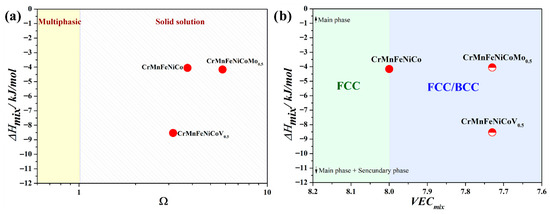
The thermodynamic parameter values calculated for the CrMnFeCoNi, CrMnFeCoNiV0.5 and CrMnFeCoNiMo0.5 HEAs, as well as the criteria that predict the formation of a solid solution with an FCC structure, are shown in Table S5. These values are plotted in Figure 1. The relationship between Ω vs. ∆Hmix suggests the formation of a HEA in solid solution (Figure 1a). The calculated ∆Hmix for the CrMnFeCoNiV0.5 HEA is more negative than that for the CrMnFeCoNiMo0.5 sample. This value suggests the possibility of secondary phase formation in HEAs (Figure 1b).
Figure 1.
Prediction of HEAs formation in (a) solid solution and (b) main phase by the relationship between Ω vs. ∆Hmix and VECmix vs. ∆Hmix, respectively.
Conversely, the CrMnFeCoNi, CrMnFeCoNiV0.5, and CrMnFeCoNiMo0.5 samples exhibited VECmix values of 8.00, 7.73, and 7.73, respectively. It has been reported that values of VECmix ≥ 8.00 predict the formation of HEAs in solid solution with a single-phase FCC structure, the range of values 6.87 < VECmix < 8.00 suggests the formation of HEAs in solid solution composed of a mixture of BCC/FCC phases and values 6.87 > VECmix predict the formation of BCC solid solution [41]. Therefore, based on the values reported in Table S5 and Figure 1b, the CrMnFeCoNi HEA is expected to consist of a single-phase FCC structure. Meanwhile, the VEC values of CrMnFeCoNiV0.5 and CrMnFeCoNiMo0.5 indicate the formation of a solid solution composed mainly of FCC and BCC phases.
3.2. Structural Analysis
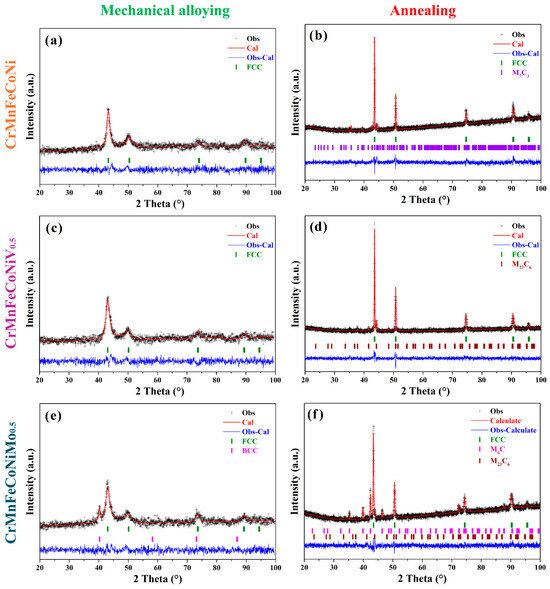
Figure 2 shows the XRD patterns fitting of the HEA powder obtained by MA for 15 h and the annealed HEA powder at 1373 K. The alloyed powders showed diffraction peaks corresponding to the (111), (200), (220) and (311) planes (Figure 2a,c,e). These peaks correspond to an FCC structure (Bragg positions/green) (ICSD-00-023-0297). However, the XRD pattern of the CrMnFeCoNiMo0.5 sample showed a reflection located at 40.2° in 2θ (Bragg positions/pink). According to the crystallographic database, this peak corresponds to the BCC-Mo crystalline structure (ICSD-00-001-1208). The presence of the peak associated with the Mo structure in the CrMnFeCoNiMo0.5 HEA may be due to the low solubility of Mo in the matrix. This phenomenon can be attributed to its low diffusion coefficient [42,43]. The phases identified in the alloyed powders agree with the predictions of the design equations results (Figure 1) and the literature reports [44].
Figure 2.
X-ray diffraction patterns of (a,b) CrMnFeCoNi, (c,d) CrMnFeCoNiV0.5 and (e,f) CrMnFeCoNi Mo0.5 HEAs from alloyed and annealed powders.
Additionally, the reflections exhibited broadening and low intensity due to the high deformations caused by HEBM processing. It has been reported that this behavior is commonly associated with the occupation of lattice sites by elements of different atomic sizes, as well as by vacancies and a high density of dislocations in the crystalline structure [45]. The diffractograms of Figure 2b,d,f show the impact of annealing treatment at 1373 K for 1 h on the structural stability of milled HEA powders. In all HEAs, the FCC phase was identified as the main phase, accompanied by a significant increase in its crystallinity. However, new peaks associated with secondary phases were also observed in each sample. The new reflections in the CrMnFeCoNi HEA corresponded to a Cr7C3-type structure (ICSD-00-006-0683).
Meanwhile, the secondary phase in the CrMnFeCoNiV0.5 HEA was associated with a M23C6-type structure (ICSD-01-089-2724). However, the CrMnFeCoNiMo0.5 HEA exhibited the presence of two secondary phases, which were related to the Mo3Co3C (M6C-type) (ICSD-03-065-7128) and M23C6 structures. The BCC phase in alloyed Mo powders was not observed after annealing.
Carbide formation has been commonly observed in consolidated CrMnFeCoNi HEAs previously obtained by mechanical milling [21]. In fact, it has been reported that the use of toluene and n-heptane in the CrMnFeCoNi HEA synthesis by MA always results in carbide formation [21]. The carbon source that induces carbide formation in this study may be related to the presence of carbon in the PCA and/or the milling media. Vaidya et al. reported that a carbon content of 1 wt.% of carbon in the HEAs provides the necessary thermodynamic driving force for Cr-carbide formation [44]. According to the Ellingham diagram, Cr has the highest tendency to form carbides in the form of Cr7C3 in HEAs, due to its more negative free energy of formation [46]. However, the Cr7C3 phase was not observed in HEAs containing V and Mo, despite its greater stability compared to the M23C6 phase. Some authors have reported that carbides with Cr7C3-type structures, where M is a multi-element mixture such as Cr, Fe and Mo, change from a stable to a metastable structure, whereas M23C6-type carbides tend to stabilize [47]. Therefore, it can be suggested that incorporating a sixth element into the CrMnFeCoNi HEA may increase the stability of the M23C6 phase.
On the other hand, superalloys with high Mo content promote the formation of M6C-type carbides. For example, Jiang et al. observed Mo-rich carbides with an M6C structure in a Ni-16Mo-7Cr-4Fe-0.5Mn-0.05C superalloy [48]. These results indicate that the presence of Mo in an alloy is essential for the formation of M6C-type carbides and that refractory elements commonly form carbides in high-entropy alloys, superalloys, and ferrous alloys [21,48,49]. However, the secondary phases commonly found in these HEAs, such as the σ phase, µ phase and V-rich/Mo-rich tetragonal phases, were not observed [8,13,15,16,24,25,26,27,28,29,30].
In Table 2, the calculated lattice parameters of the phases present in alloyed HEA powders and annealed HEA powders are summarized. These parameters were obtained from XRD pattern refinement. The a-parameter of the FCC phase in the alloyed HEA powders (3.63–3.64 Å) shows no significant changes despite the addition of a sixth element. This parameter aligns with the reported HEBM values for 15 h [21,42]. However, after annealing, the a-parameter of the FCC phase in the three HEAs decreases by approximately 1%, to 3.60 Å.
Table 2.
Space group and lattice parameter of phases formed in the alloyed and annealed powders.
Nevertheless, HEAs synthesized at high temperatures revealed an a-parameter of 3.6 Å for the FCC phase of CrMnFeCoNi HEAs containing V and Mo [15,24]. It has been reported that the atomic radius difference (δ) and the lattice parameter (a) are directly related [15]. In this study, the lattice parameter demonstrated no correlation with the difference in atomic size in the alloyed powders. Meanwhile, the main phase (FCC) of the annealed powders satisfied the established criteria (Figure S1). Table 2 also shows that the lattice parameters of the carbides formed during HEA powder annealing exceed 10 Å.
The peak broadening in the XRD patterns was analyzed to calculate the crystallite size and lattice strain of alloyed and annealed powders (Table 3). The crystallite size and lattice strain values were obtained using the Williamson–Hall equation (Equation (1)) [37,38].
where β is the full width at half maximum (FWHM) obtained from the reflections of the diffraction patterns, θ is the angle at positions of the (111), (200) and (220) h k l indices, ε is the lattice strain, K is a constant with a value of 0.94 (the Debye–Scherrer constant for spherical-shaped particles), λ is a constant value of 0.15406 nm for CuKα radiation used in XRD experiments and D is the average crystallite size.
Table 3.
Crystallite size (D), microstrain (ε) in milled and annealed HEA powders.
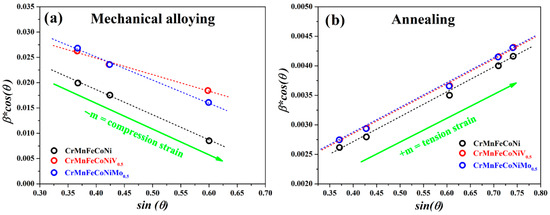
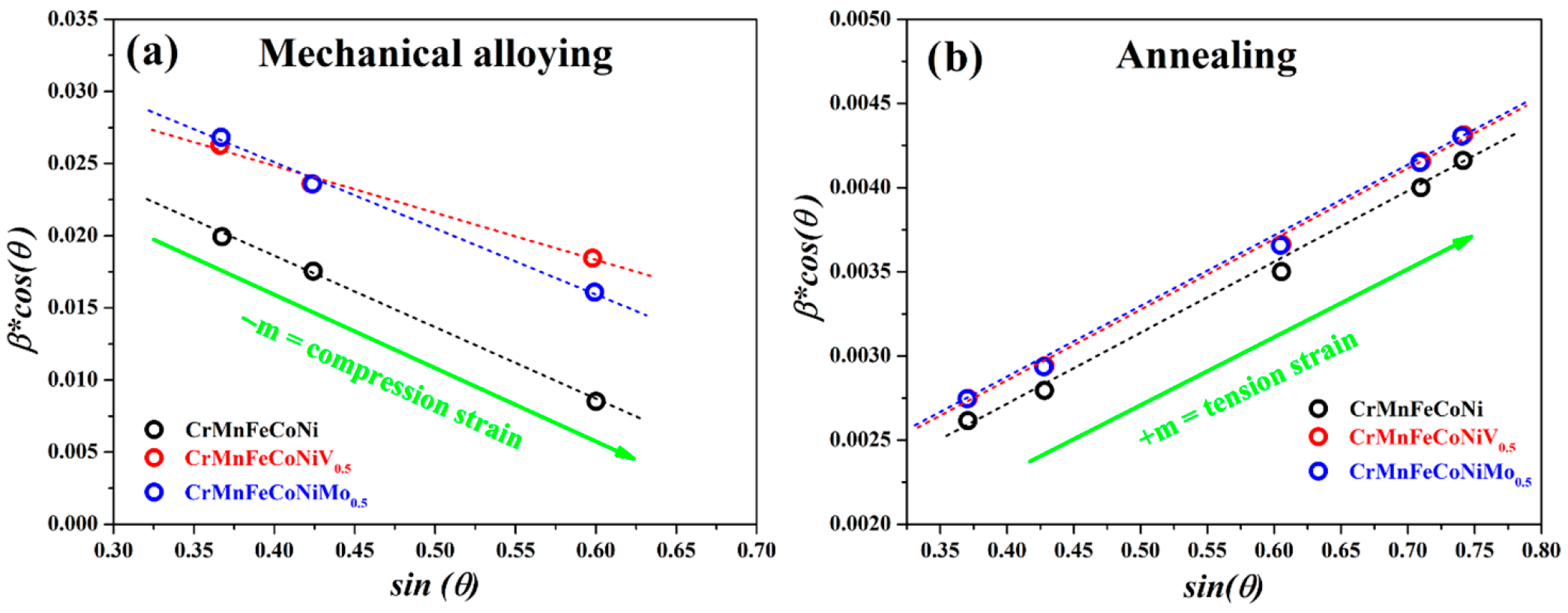
The full width at half maximum (FWHM) and 2θ were obtained by XRD pattern refinement. FWHM in the peaks from the (111), (200), and (220) planes were higher in the CrMnFeCoNiV0.5 and CrMnFeCoNiMo0.5 HEAs compared with the CrMnFeCoNi sample. This result suggests anisotropic behavior in the materials [50]. Thus, anisotropy could be favored by adding the sixth alloying element (V and Mo) and by the plastic deformation induced by HEBM. Figure 3 shows the Williamson–Hall plot. The linear fit reveals a negative slope for alloyed powders and a positive slope for annealed powders. The positive slope indicates the presence of tensile strain, while the opposite indicates the presence of compressive strain in the material [51,52].
Figure 3.
Williamson–Hall plots of (a) milled and (b) annealed powders from CrMnFeCoNi, CrMnFeCoNiV0.5 and CrMnFeCoNiMo0.5 HEAs.
Therefore, during the synthesis of HEAs, the MA process induces compressive strain, whereas the annealing treatment induces tensile strain. The slope (4ε) and ordinate-intercept (Kλ/D) of the Williamson–Hall plot provide information about lattice strain and average crystallite size, respectively [48]. The ε and D values are summarized in Table 3. D values of the alloyed powders and annealed powders were 13.4–15.1 nm and 30.1–30.9 nm, respectively. Therefore, the crystallite size increases by up to two times after annealing. However, the values for the alloyed powders are very close to the values reported for MA processes in the literature (12 ± 5 nm) [53]. The alloyed CrMnFeCoNiV0.5 HEA shows a smaller crystallite size than the Mo-containing HEA.
On the other hand, ε is very similar in all HEAs and shifts from positive values in alloyed powders to negative values after annealing. It has been reported that changes in microstrains and small crystallite size improve the hardness and other mechanical properties of HEA milled powders [25,54]. The characteristics of the structure of the CrMnFeCoNi, CrMnFeCoNiV0.5 and CrMnFeCoNiMo0.5 HEAs suggest similar mechanical properties. The V and Mo content in HEAs could slightly improve the mechanical properties, as confirmed in other studies [8,13,15,16,24,25,26,27,28,29,30].
3.3. Microstructural and Chemical Analysis of Milled and Annealed Powders
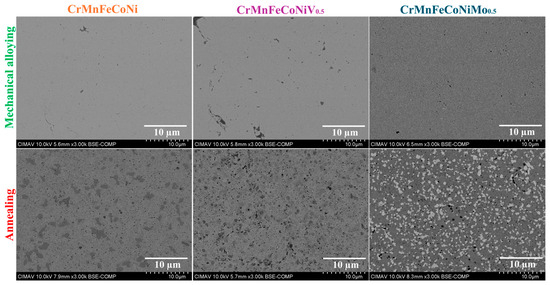
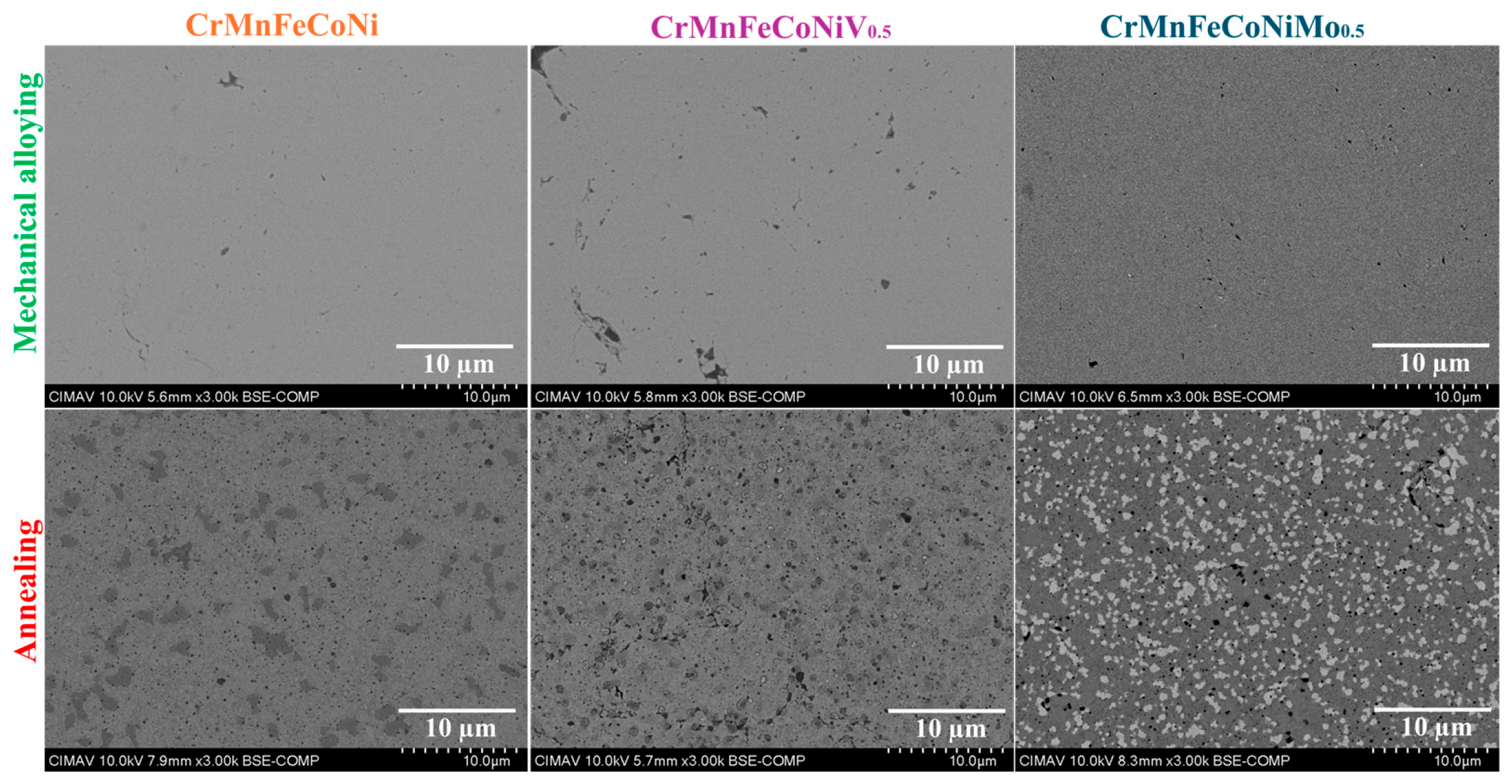
Figure 4 shows cross-sectional SEM images revealing the microstructure of milled and annealed powders at 1373 K. The powders obtained by MA exhibit a homogeneous microstructure without evident elemental segregation. After annealing, new microstructures with irregular shapes were formed. Some of these elements are associated with the previously identified carbide formation in the XRD patterns. According to the chemical analysis results (ICP-OES), the elemental composition of HEAs closely matches their nominal composition (Table 4). However, the carbon content exceeds 3 at. %. From a thermodynamic perspective, this amount of carbon is sufficient to form carbides after an annealing heat treatment, as evidenced by the XRD patterns (Figure 2).
Figure 4.
Cross-section micrographs of milled and annealed powders from the CrMnFeCoNi, CrMnFeCoNiV0.5 and CrMnFeCoNiMo0.5 compositions.
Table 4.
Summary chart with chemical (ICP-OES) analyses of CrMnFeCoNi, CrMnFeCoNiV0.5 and CrMnFeCoNiMo0.5 HEA powders.
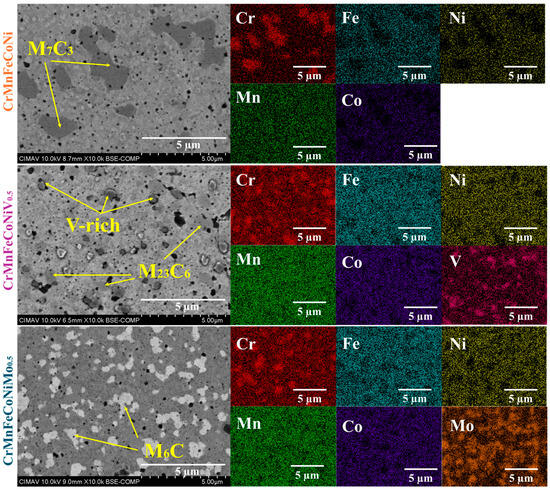
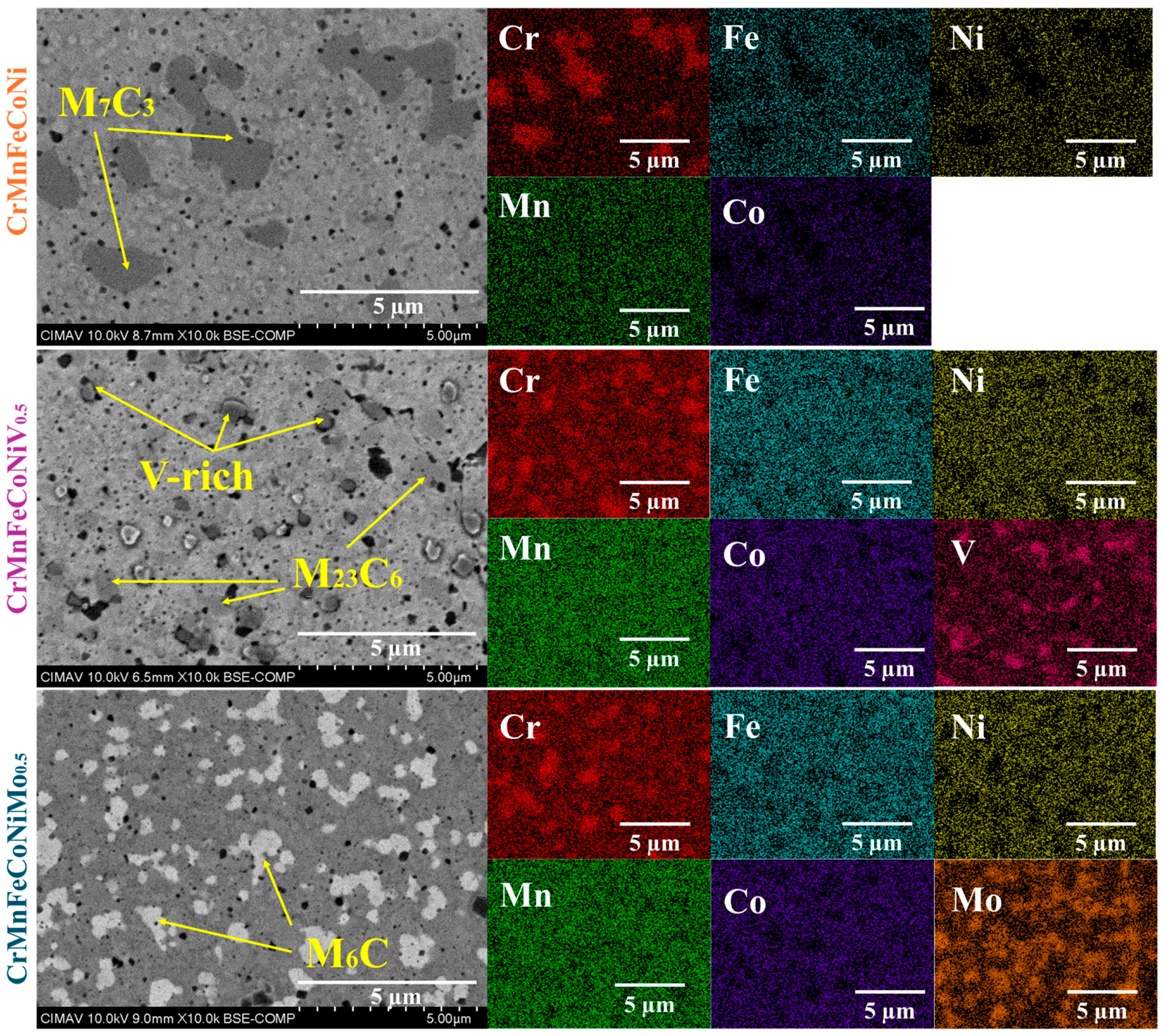
Elemental mappings across the cross-sections of the annealed powders reveal, in all samples, a homogeneous distribution of Mn, Fe, Co, and Ni, with evident Cr-rich regions (Figure 5). However, Cr-rich microstructures exhibit low levels of Fe, Ni, and Co. In addition, V-rich and Mo-rich regions are observed to contain a sixth element. Regions with high concentrations of V were linked to the presence of V segregation, while regions with abundant Mo were associated with carbide formation.
Figure 5.
Backscattered electron micrographs and elemental mappings of annealed CrMnFeCoNi, CrMnFeCoNiV0.5 and CrMnFeCoNiMo0.5 HEAs powders.
According to the EDS analyses of the different microstructures in the HEAs (Table 5), Cr-rich regions are associated with the formation of M7C3- and M23C6-type carbides. In CrMnFeCoNiV0.5 HEA, regions with high concentrations of V were observed but were not identified by X-ray diffraction because the concentration of this phase could be under its detection limit. These regions could be V-rich or associated with the σ phase, as reported in the literature [27]. However, the CrMnFeCoNiMo0.5 HEA exhibited bright regions with elevated Mo levels. These microstructures were associated with the M6C carbide phase. Usually, the HEAs in FCC-type solid solution exhibit a solubility limit of approximately 2.0 at. % Mo at 1173 K. Concurrently, elevated Mo contents in the HEAs form σ and µ precipitates, which show tetragonal and rhombohedral structures, respectively [55]. However, in this study, the precipitates σ and µ were not observed in the CrMnFeCoNiMo0.5 HEA because the PCA carbon contained in the structural defects of the HEAs was thermodynamically sufficient to promote the formation of M6C-type carbide. Another important fact is the substantial decrease in the Cr content of the matrix (FCC) across all annealed HEAs to 13 at. % Cr.
Table 5.
SEM-EDS analyses of the observed microstructures in the alloyed and annealed powders of CrMnFeCoNi, CrMnFeCoNiV0.5 and CrMnFeCoNiMo0.5 HEAs.
Furthermore, it was observed that the concentrations of V and Mo in the HEAs did not exceed 5 at. % and 2.8 at. %, respectively. Similar studies on CrMnFeCoNi HEA with Mo and V additions, obtained by arc melting, have reported the formation of a single-phase FCC structure over the 0–4 at. % range [8,25]. The presence of black regions in all alloys has been attributed to the presence of Cr-rich high-entropy oxides (HEOx). Nevertheless, HEOx was not detected by XRD analysis. The HEOx content may be below the diffractometer detection limit. The formation of HEOx is often observed and reported during the consolidation of such HEAs [8,13,15,16,24,25,26,27,28,29,30].
These results suggest that oxygen trapped in the metal bulk and carbon from the process control agent (heptane) could be incorporated into structural defects, such as vacancies and dislocations, generated during mechanical alloying. Consequently, during annealing, carbon and oxygen react to form carbides and oxides, respectively.
3.4. Mechanical Properties of Mechanically Alloyed and Annealed Powders
The mechanical properties, such as hardness (H) and elastic modulus (E), of the studied HEAs with elemental compositions similar to those reported in this work are shown in Table 6. The hardness of milled powders is higher than that of annealed powders. Furthermore, the addition of a sixth element increases the hardness of annealed HEAs. Microhardness of milled powders increases in the following order: CrMnFeCoNi (856 HV) < CrMnFeCoNiV0.5 (928 HV) < CrMnFeCoNiMo0.5 (978 HV). The microhardness of annealed HEAs changes as follows: CrMnFeCoNi (359 HV) < CrMnFeCoNiMo0.5 (449 HV) < CrMnFeCoNiV0.5 (491 HV). The annealing treatment results in a noticeable 40%–49% reduction in microhardness. On the other hand, nanoindentation testing revealed that the observed values for CrMnFeCoNi, CrMnFeCoNiV0.5, and CrMnFeCoNiMo0.5 HEAs without heat treatment were 7.9, 9.8, and 12.8 GPa, respectively. Meanwhile, the annealed powders were 6.8, 7.3, and 8.8 GPa, respectively. These values indicate a reduction in nano-hardness of 15%, 25%, and 30%, respectively, after the annealing treatment. In addition, the standard deviation was low in the samples without heat treatment, which may be due to the alloy’s uniform microstructure and the absence of other microstructures (Figure 5). The E values showed a high degree of similarity within the range of 150–190 GPa, as indicated by the standard deviation. The samples CrMnFeCoNi and CrMnFeCoNiV0.5 exhibited an enhancement in elastic modulus, while the sample CoCrFeMnNiMo0.5 HEA demonstrated a reduction in this property.
Table 6.
Comparative summary table with hardness and elastic modulus of CrMnFeCoNi, CrMnFeCoNiV0.5, and CrMnFeCoNiMo0.5 HEA systems obtained in this work and results reported in the literature.
Furthermore, HV, H, and E values of the CrMnFeCoNi, CrMnFeCoNiV, and CrMnFeCoNiMo HEAs obtained using different alloying methods are compared in Table 6. Compared to other reported methods, HV of the HEAs obtained by MA is higher than that of methods involving equilibrium. In the CrMnFeCoNiV HEA, the annealed alloys present microhardness values similar to those consolidated by SPS (525 HV ± 35). In comparison, it is lower than that obtained by arc melting (>700 HV at an equiatomic V content) [25,26]. However, the CrMnFeCoNi0.8V alloy synthesized by arc melting exhibits the best nanoindentation and elastic modulus values. Similarly, after annealing, the CrMnFeCoNiMo HEA exhibits higher microhardness than samples synthesized by high-frequency induction and arc melting, a lower E value than the arc-melting-synthesized sample, and values similar to those of the sputtered sample [13,15,16,24].
The behavior of micro- and nanomechanical properties indicates that adding V or Mo to HEAs enhances these properties when the metals are in solid solution. However, these elements have a deleterious effect during annealing because they tend to form unwanted microstructures. It can also be argued that reducing Cr content in the FCC matrix adversely affects mechanical properties.
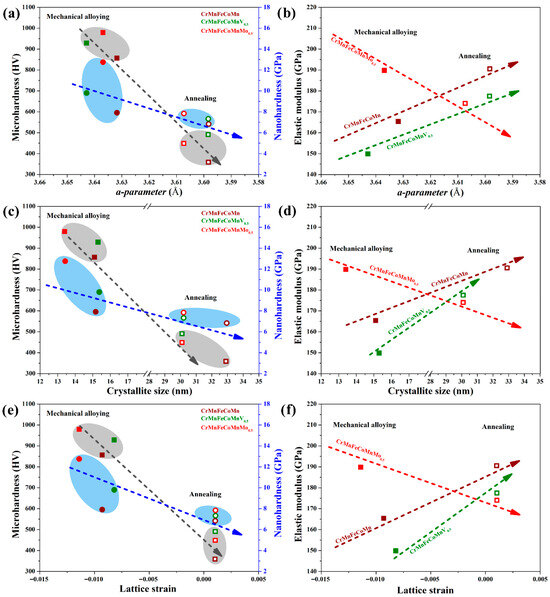
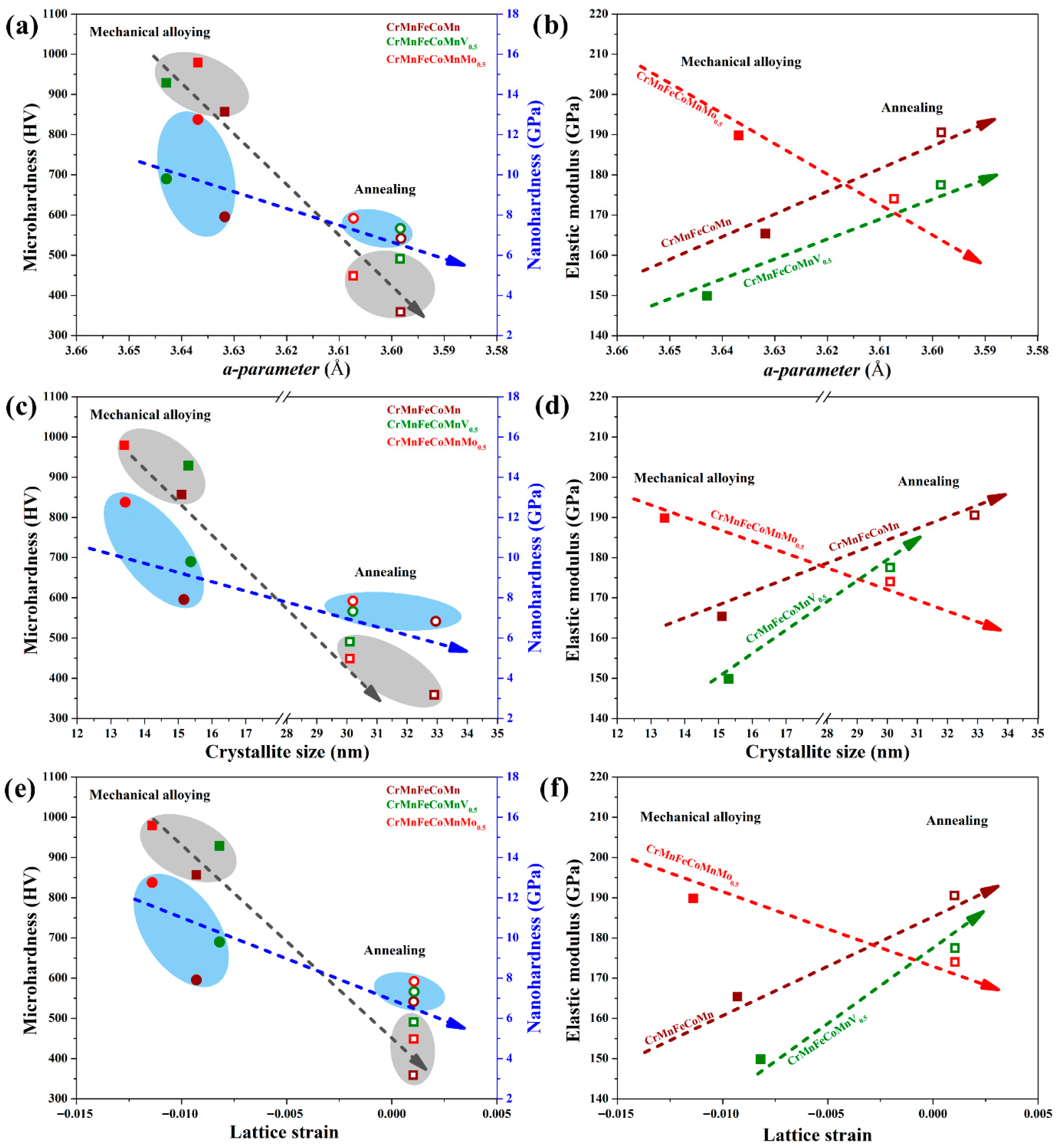
The relationship between the hardness properties and the structure of HEAs (FCC) is shown in Figure 6. A reduction in the lattice parameter of the FCC phase, an increase in crystallite size and a transition from compressive strain to tensile strain were observed in the crystalline structure of the alloy powders after the annealing treatment. This modification of the crystalline structure reduced the hardness of all HEAs (Figure 6a,c,e). However, this pattern was not identified in the elastic modulus behavior of the HEAs. In the CrMnFeCoNi and CrMnFeCoNiV HEAs, the elastic modulus increased in response to variations in the crystalline structure of the annealed powders. Meanwhile, the E value in the HEA with Mo decreased (Figure 6b,d,f). Consequently, this property may not be associated with the crystalline structure because the a-parameter of the unit lattice decreases with the annealing treatment. At the same time, the elastic modulus does not behave proportionally. Some studies have reported that the distribution and size of carbide precipitates affect the elastic modulus of steel [62]. It has also been reported that the interstitial carbon content in the steel matrix affects this property [63]. Therefore, the behavior of the elastic modulus of HEAs could be controlled by three factors: (I) carbon content in the interstices of the FCC structure, (II) the different types of carbides formed in each of the HEAs and (III) the specific size and spatial distribution of carbides.
Figure 6.
Influence of (a,b) a-parameter of FCC phase, (c,d) crystallite size and (e,f) lattice strain on hardness and elastic modulus of HEAs. The gray regions correspond to microhardness, and the blue areas correspond to nanohardness.
4. Conclusions
The research findings revealed that the annealing process generates secondary phases in HEAs produced by mechanical alloying. Furthermore, it was found that the structure and composition of such phases are influenced by the refractory elements (Cr, V, and Mo) incorporated into the alloy. Based on the analysis of the structure, microstructure, and mechanical properties of HEAs, the following can be concluded:
A concentration of less than 3 at. % C in the HEA promotes the formation of various carbide types during annealing. Cr is responsible for the formation of Cr-rich carbides of the M7C3 and M23C6 types. Meanwhile, Mo facilitates the formation of Mo-rich M6C carbides.
The hardness and elastic modulus of HEAs are influenced by various factors, including the content of refractory elements (Cr, V, and Mo), the lattice parameter, the crystallite size, and the residual strain in the FCC matrix. In addition to the formation of carbides during the annealing process. The results suggest that the relationship between structure and hardness properties exhibits a specific pattern. The hardness of the HEAs is associated with the a-parameter of the FCC phase, lattice strain, crystallite size, and carbide crystallization during annealing, as well as reducing the Cr content in the FCC phase. In contrast, the elastic modulus may be linked to the microstructure of HEAs, specifically to the carbide precipitation from the elements inside HEAs.
Supplementary Materials
The following supporting information can be downloaded at: https://www.mdpi.com/article/10.3390/coatings16040491/s1, Table S1. Equations and thermodynamic parameters used for the designing and prediction of the formation of an FCC-type solid solution in HEAs [31]; Table S2. Binary mixing enthalpies (∆Hijmix) of pairs of alloying elements in CrMnFeCoNi, CrMnFeCoNiV0.5 and CrMnFeCoNiMo0.5 HEA. The ∆Hijmix values were calculated using the Miedema’s model [32]; Table S3. Physicochemical properties of pure Co, Cr, Fe, Ni, Mn, V and Mo [33,34,35]; Table S4. Nominal atomic fractions (xi) of elements Co, Cr, Fe, Ni, Mn, V and Mo in HEA [33,34,35]; Table S5. Thermodynamic parameters of the CrMnFeCoNi, CrMnFeCoNiV0.5 and CrMnFeCoNi Mo0.5 HEAs and conditions to obtain FCC-type solid solution; Figure S1. Plot of the atomic radius difference and lattice parameter of the alloyed and annealed powders of HEAs.
Author Contributions
Conceptualization: R.M.S., A.M.G., C.G.G.R.; methodology: A.M.G., M.A.R.E.R., C.D.G.E., A.H.M., J.M.M.D.; writing—original draft: A.M.G., C.G.G.R., R.M.S.; review and editing: E.J.G.C., X.A.S., E.A.J.A., S.G.; supervision: R.M.S. All authors have read and agreed to the published version of the manuscript.
Funding
This work was funded by the Centro de Investigación en Materiales Avanzados. S. González is grateful to the Spanish Ministry of Science, Innovation and Universities for the financial support through the “Beatriz Galindo” Program (BG23/00159).
Institutional Review Board Statement
Not applicable.
Informed Consent Statement
Not applicable.
Data Availability Statement
Data will be made available on request.
Acknowledgments
The authors would like to thank Flor G. Nevarez-Vargas, A. I. Gonzalez-Jacquez and K. Campos-Venegas for their valuable technical support throughout the study.
Conflicts of Interest
The authors declare no conflicts of interest.
References
- Han, S.Z.; Choi, E.-A.; Lim, S.H.; Kim, S.; Lee, J. Alloy design strategies to increase strength and its trade-offs together. Prog. Mater. Sci. 2021, 117, 100720. [Google Scholar] [CrossRef] [Scilit]
- Yeh, J.-W.; Lin, S.-J.; Chin, T.-S.; Gan, J.-Y.; Chen, S.-K.; Shun, T.-T.; Tsau, C.-H.; Chou, S.-Y. Formation of simple crystal structures in Cu-Co-Ni-Cr-Al-FeTi-V alloys with multiprincipal metallic elements. Metall. Mater. Trans. A 2004, 35, 2533–2536. [Google Scholar] [CrossRef] [Scilit]
- Cantor, B.; Chang, I.; Knight, P.; Vincent, A. Microstructural development in equiatomic multicomponent alloys. Mater. Sci. Eng. A 2004, 375, 213–218. [Google Scholar] [CrossRef] [Scilit]
- Ye, Y.; Wang, Q.; Lu, J.; Liu, C.; Yang, Y. High-entropy alloy: Challenges and prospects. Mater. Today 2016, 19, 349–362. [Google Scholar] [CrossRef] [Scilit]
- Wang, X.; Zhang, Y.; Qiao, Y.; Chen, G. Novel microstructure and properties of multicomponent CoCrCuFeNiTix alloys. Intermetallics 2007, 15, 357–362. [Google Scholar] [CrossRef] [Scilit]
- Raturi, A.; Biswas, K.; Gurao, N. A mechanistic perspective on the kinetics of plastic deformation in FCC high entropy alloys: Effect of strain. strain rate and temperature. Scr. Mater. 2021, 197, 113809. [Google Scholar] [CrossRef] [Scilit]
- Kumar, J.; Kumar, N.; Das, S.; Gurao, N.; Biswas, K. Effect of Al addition on the microstructural evolution of equiatomic CoCrCFeMnNi alloy. Trans. Indian Inst. Met. 2018, 71, 2749–2758. [Google Scholar] [CrossRef] [Scilit]
- Qin, G.; Chen, R.; Zheng, H.; Fang, H.; Wang, L.; Su, Y.; Guo, J.; Fu, H. Strengthening FCC-CoCrCFeMnN high entropy alloys by Mo addition. J. Mater. Sci. Technol. 2019, 35, 578–583. [Google Scholar] [CrossRef] [Scilit]
- Ma, S.; Zhang, Y. Effect of Nb addition on the microstructure and properties of AlCoCrFeNi high-entropy alloy. Mater. Sci. Eng. A 2012, 532, 480–486. [Google Scholar] [CrossRef] [Scilit]
- Zhu, J.; Fu, H.; Zhang, H.; Wang, A.; Li, H.; Hu, Z. Synthesis and properties of multiprincipal component AlCoCrFeNiSix alloys. Mater. Sci. Eng. A 2010, 527, 7210–7214. [Google Scholar] [CrossRef] [Scilit]
- Tong, Y.; Chen, D.; Han, B.; Wang, J.; Feng, R.; Yang, T.; Zhao, C.; Zhao, Y.; Guo, W.; Shimizu, Y.; et al. Outstanding tensile properties of a precipitation strengthened FeCoNiCrTi0.2 high-entropy alloy at room and cryogenic temperatures. Acta Mater. 2019, 165, 228–240. [Google Scholar] [CrossRef] [Scilit]
- Colombini, E.; Garzoni, A.; Giovanardi, R.; Veronesi, P. Casagrande, Al, cu and Zr addition to high entropy alloys: The effect on recrystallization temperature. Mater. Sci. Forum 2019, 941, 1137–1142. [Google Scholar] [CrossRef] [Scilit]
- Karantzalis, A.E.; Poulia, A.; Kamnis, S.; Sfikas, A.; Fotsis, A.; Georgatis, E. Modification of cantor high entropy alloy by the addition of Mo and Nb: Microstructure evaluation. nanoindentation-based mechanical properties, and sliding wear response assessment. Alloys 2022, 1, 70–92. [Google Scholar] [CrossRef] [Scilit]
- Jo, Y.; Jung, S.; Choi, W.; Sohn, S.; Kim, H.; Lee, B.; Kim, N.J.; Lee, S. Cryogenic strength improvement by utilizing room-temperature deformation twinning in a partially recrystallized VCrMnFeCoNi high-entropy alloy. Nat. Commun. 2017, 8, 15719. [Google Scholar] [CrossRef] [Scilit]
- Wang, S.; Chen, L.; Li, Q.; Wang, S.; Wu, M.; Yang, S.; Xiang, D. Effects of Al or Mo addition on microstructure and mechanical properties of Fe-rich nonequiatomic FeCrCoMnNi high-entropy alloy. Metals 2022, 12, 191. [Google Scholar] [CrossRef] [Scilit]
- Zhao, Y.; Zhang, X.; Quan, H.; Chen, Y.; Wang, S.; Zhang, S. Effect of Mo addition on structures and properties of FeCoNiCrMn high entropy alloy film by direct current magnetron sputtering. J. Alloys Compd. 2022, 895, 162709. [Google Scholar] [CrossRef] [Scilit]
- Taheriniya, S.; Choi, N.; Yang, S.; Sonkusare, R.; Yu, J.H.; Lee, J.-S.; Rösner, H.; Peterlechner, M.; Boll, T.; Gammer, C.; et al. Additively manufactured equiatomic CoCrFeMnNi high entropy alloy: Precipitation-induced heterogeneity by mechano-chemical coupling. J. Alloys Compd. 2023, 938, 168514. [Google Scholar] [CrossRef] [Scilit]
- Alcalá, M.; Real, C.; Fombella, I.; Trigo, I.; Córdoba, J. Effects of milling time, sintering temperature, Al content on the chemical Nature, microhardness and microstructure of mechanochemically synthesized FeCoNiCrMn high entropy alloy. J. Alloys Compd. 2018, 749, 834–843. [Google Scholar] [CrossRef] [Scilit]
- Suryanarayana, C. Non-Equilibrium Processing of Materials; Elsevier: Amsterdam, The Netherlands, 1999. [Google Scholar] [CrossRef] [Scilit]
- Suryanarayana, C. Mechanical alloying and milling. Prog. Mater. Sci. 2001, 46, 1–184. [Google Scholar] [CrossRef] [Scilit]
- Ravi, R.; Bakshi, S.R. Microstructural evolution and wear behavior of carbon added CoCrFeMnNi multi-component alloy fabricated by mechanical alloying and spark plasma sintering. J. Alloys Compd. 2021, 883, 160879. [Google Scholar] [CrossRef] [Scilit]
- Park, J.-H.; Kim, J.-I.; Shinohara, Y.; Hagio, T.; Umehara, N.; Ichino, R. Super hardening of few alloy plating by phase transformation of amorphous to metal carbides-dispersed nanocrystalline alloys and application as promising alternative for hard chromium plating. Surf. Coat. Technol. 2024, 477, 130388. [Google Scholar] [CrossRef] [Scilit]
- Gao, Y.; Zhang, M.; Li, J.; Wang, R.; Yuan, Z.; Tan, Z.; Yu, W. Precipitation mechanisms and crystallographic study of co-precipitation carbides in super austenitic stainless steel. J. Alloys Compd. 2025, 1036, 181942. [Google Scholar] [CrossRef] [Scilit]
- Huang, T.-H.; Hsueh, C.-H. Microstructures and mechanical properties of (CoCrFeMnNi)100-xMox high entropy alloy films. Intermetallics 2021, 135, 107236. [Google Scholar] [CrossRef] [Scilit]
- Stepanov, N.; Shaysultanov, D.; Salishchev, G.; Tikhonovsky, M.; Oleynik, E.; Tortika, A.; Senkov, O. Effect of V content on microstructure and mechanical properties of the CoCrFeMnNiVx high entropy alloys. J. Alloys Compd. 2015, 628, 170–185. [Google Scholar] [CrossRef] [Scilit]
- Vaidya, M.; Karati, A.; Guruvidyathri, K.; Nagini, M.; Pradeep, K.; Murty, B. Suppression of σ-phase in nanocrystalline CoCrFeMnNiV high entropy alloy by unsolicited contamination during mechanical alloying and spark plasma sintering. Mater. Chem. Phys. 2020, 255, 123558. [Google Scholar] [CrossRef] [Scilit]
- Sfikas, A.K.; Kamnis, S.; Tse, M.C.; Christofidou, K.A.; Gonzalez, S.; Karantzalis, A.E.; Georgatis, E. Microstructural evaluation of thermal-sprayed CoCrFeMnNi0.8V high-entropy alloy coatings. Coatings 2023, 13, 1004. [Google Scholar] [CrossRef] [Scilit]
- González, S.; Sfikas, A.; Kamnis, S.; Garay-Reyes, C.; Hurtado-Macias, A.; Martínez-Sánchez, R. Wear resistant CoCrFeMnNi0.8V high entropy alloy with multi length-scale hierarchical microstructure. Mater. Lett. 2023, 331, 133504. [Google Scholar] [CrossRef] [Scilit]
- Fang, S.; Wang, C.; Li, C.-L.; Luan, J.-H.; Jiao, Z.-B.; Liu, C.-T.; Hsueh, C.-H. Microstructures and mechanical properties of CoCrFeMnNiVx high entropy alloy films. J. Alloys Compd. 2020, 820, 153388. [Google Scholar] [CrossRef] [Scilit]
- Yang, J.; Jo, Y.H.; Kim, D.W.; Choi, W.-M.; Kim, H.S.; Lee, B.-J.; Sohn, S.S.; Lee, S. Effects of transformation-induced plasticity (TRIP) on tensile property improvement of Fe45Co30Cr10V10Ni5-xMnx high-entropy alloys. Mater. Sci. Eng. A 2020, 772, 138809. [Google Scholar] [CrossRef] [Scilit]
- Gao, M.C.; Yeh, J.-W.; Liaw, P.K.; Zhang, Y. High-Entropy Alloys: Fundamentals and Applications; Springer: Cham, Switzerland, 2016. [Google Scholar] [CrossRef] [Scilit]
- Takeuchi, A.; Inoue, A. Classification of bulk metallic glasses by atomic size difference, heat of mixing and period of constituent elements and its application to characterization of the main alloying element. Mater. Trans. 2005, 46, 2817–2829. [Google Scholar] [CrossRef] [Scilit]
- Sheng, G.; Liu, C.T. Phase stability in high entropy alloys: Formation of solid solution phase or amorphous phase. Prog. Nat. Sci. Mater. Int. 2011, 21, 433–446. [Google Scholar] [CrossRef] [Scilit]
- Prohaska, T.; Irrgeher, J.; Benefield, J.; Böhlke, J.K.; Chesson, L.A.; Coplen, T.B.; Ding, T.; Dunn, P.J.; Gröning, M.; Holden, N.E.; et al. Standard atomic weights of the elements 2021 (IUPAC technical report). Pure Appl. Chem. 2022, 94, 573–600. [Google Scholar] [CrossRef] [Scilit]
- Lide, D.R. CRC Handbook of Chemistry and Physics; CRC Press: Boca Raton, FL, USA, 2004; Volume 85. [Google Scholar]
- Rodríguez-Carvajal, J. Recent advances in magnetic structure determination by neutron powder diffraction. Phys. B Condens. Matter 1993, 192, 55–69. [Google Scholar] [CrossRef] [Scilit]
- Williamson, G.; Hall, W. X-ray line broadening from field aluminum and wolfram. Acta Metall. 1953, 1, 22–31. [Google Scholar] [CrossRef] [Scilit]
- Warren, B.; Averbach, B. The effect of cold-work distortion on X-ray patterns. J. Appl. Phys. 1950, 21, 595–599. [Google Scholar] [CrossRef] [Scilit]
- ASTM E3; Standard Guide for Preparation of Metallographic Specimens. ASTM International: West Conshohocken, PA, USA, 2017.
- ASTM E92-23; Standard Test Methods for Vickers Hardness and Knoop Hardness of Metallic Materials. ASTM International: West Conshohocken, PA, USA, 2023.
- Guo, S.; Ng, C.; Lu, J.; Liu, C. Effect of valence electron concentration on stability of FCC or BCC phase in high entropy alloys. J. Appl. Phys. 2011, 109, 103505. [Google Scholar] [CrossRef] [Scilit]
- Heijlegen, G.; Rieck, G. Diffusion in the Mo-Ni, Mo-Fe and Mo-Co systems. Acta Metall. 1974, 22, 1269–1281. [Google Scholar] [CrossRef] [Scilit]
- Pelleg, J. Diffusion in the vanadium system. Philos. Mag. 1977, 36, 725–732. [Google Scholar] [CrossRef] [Scilit]
- Vaidya, M.; Karati, A.; Marshal, A.; Pradeep, K.; Murty, B. Phase evolution and stability of nanocrystalline CoCrFeNi and CoCrFeMnNi high entropy alloys. J. Alloys Compd. 2019, 770, 1004–1015. [Google Scholar] [CrossRef] [Scilit]
- Ahmad, A.S.; Su, Y.; Liu, S.; Stahl, K.; Wu, Y.; Hui, X.; Ruett, U.; Gutowski, O.; Glazyrin, K.; Liermann, H.; et al. Structural stability of high entropy alloys under pressure and temperature. J. Appl. Phys. 2017, 121, 235901. [Google Scholar] [CrossRef] [Scilit]
- Shatynski, S.R. The thermochemistry of transition metal carbides. Oxid. Met. 1979, 13, 105–118. [Google Scholar] [CrossRef] [Scilit]
- Hillert, M.; Qiu, C. A reassessment of the Fe-Cr-Mo-C system. J. Phase Equilibria 1992, 13, 512–521. [Google Scholar] [CrossRef] [Scilit]
- Jiang, L.; Zhang, W.-Z.; Xu, Z.-F.; Huang, H.-F.; Ye, X.-X.; Leng, B.; Yan, L.; Li, Z.-J.; Zhou, X.-T. M2C and M6C carbide precipitation in Ni-Mo-Cr based superalloys containing silicon. Mater. Des. 2016, 112, 300–308. [Google Scholar] [CrossRef] [Scilit]
- Trembach, B.; Krbata, M.; Haibadulov, B.; Iokhov, O.; Tsebriuk, I.; Pomohaiev, I.; Korobkov, Y.; Neduzha, L. Optimization of Elemental Transfer Efficiency in Fe-C-Cr-Ti-Cu Hardfacing by Self-Shielded Flux-Cored Wire: A Synergistic Taguchi–ANOVA–FD–PCA–GRA Approach. Eng 2026, 7, 139. [Google Scholar] [CrossRef] [Scilit]
- Brandstetter, S.; Derlet, P.; Van Petegem, S.; Van Swygenhoven, H. Williamson–hall anisotropy in nanocrystalline metals: X-ray diffraction experiments and atomistic simulations. Acta Mater. 2008, 56, 165–176. [Google Scholar] [CrossRef] [Scilit]
- Ahlawat, A.; Sathe, V.; Reddy, V.; Gupta, A. Mossbauer, Raman and X-ray diffraction studies of superparamagnetic NiFe2O4 nanoparticles prepared by sol–gel auto-combustion method. J. Magn. Magn. Mater. 2011, 323, 2049–2054. [Google Scholar] [CrossRef] [Scilit]
- Murugesan, A.; Chandrasekaran, G. Impact of Gd3+ substitution on the structural, magnetic and electrical properties of cobalt ferrite nanoparticles. RSC Adv. 2015, 5, 73714–73725. [Google Scholar] [CrossRef] [Scilit]
- Laurent-Brocq, M.; Goujon, P.-A.; Monnier, J.; Villeroy, B.; Perriére, L.; Pirés, R.; Garcin, G. Microstructure and mechanical properties of a CoCrFeMnNi high entropy alloy processed by milling and spark plasma sintering. J. Alloys Compd. 2019, 780, 856–865. [Google Scholar] [CrossRef] [Scilit]
- Venkateswarlu, K.; Sandhyarani, M.; Nellaippan, T.; Rameshbabu, N. Estimation of crystallite size, lattice strain and dislocation density of nanocrystalline carbonate substituted hydroxyapatite by X-ray peak variance analysis. Procedia Mater. Sci. 2014, 5, 212–221. [Google Scholar] [CrossRef] [Scilit]
- Wu, Q.; Wang, Z.; He, F.; Li, J.; Wang, J. Revealing the selection of σ and µ phases in CoCrFeNiMox high entropy alloys by calphad. J. Phase Equilibria Diffus. 2018, 39, 446–453. [Google Scholar] [CrossRef] [Scilit]
- Gludovatz, B.; George, E.P.; Ritchie, R.O. Processing, microstructure and mechanical properties of the CrMnFeCoNi high-entropy alloy. JOM 2015, 67, 2262–2270. [Google Scholar] [CrossRef] [Scilit]
- Wang, R.; Kamada, S. Hardness and corrosion behavior of CrMnFeCoNi alloy fabricated by ball milling and spark plasma sintering. Materials 2024, 17, 4793. [Google Scholar] [CrossRef] [Scilit]
- Fujita, K.; Matsuura, H.; Kawaguchi, T.; Kikuchi, S. Effect of nitrogen addition on sintering behavior of high-entropy alloy CrMnFeCoNi powder. Mater. Lett. 2024, 367, 136627. [Google Scholar] [CrossRef] [Scilit]
- Huang, H.; Tian, X.; Wang, C.; Yan, J. Significant improvement in surface hardness of CrMnFeCoNi high entropy alloy via nanosecond pulse laser grain refinement. Vacuum 2024, 226, 113319. [Google Scholar] [CrossRef] [Scilit]
- Cui, Z.; Mi, Y.; Qiu, D.; Dong, P.; Qin, Z.; Gong, D.; Li, W. Microstructure and mechanical properties of additively manufactured CrMnFeCoNi high-entropy alloys after ultrasonic surface rolling process. J. Alloys Compd. 2021, 887, 161393. [Google Scholar] [CrossRef] [Scilit]
- Xiao, L.; Zheng, Z.; Guo, S.; Huang, P.; Wang, F. Ultra-strong nanostructured CrMnFeCoNi high entropy alloys. Mater. Des. 2020, 194, 108895. [Google Scholar] [CrossRef] [Scilit]
- Wang, B.; Zhang, H.; Mi, P.; Zhang, G.; Hao, L.; Xu, B.; Sun, M.; Li, D. Revealing the evolution behavior of multiple carbides precipitation and mechanical response in M54 secondary hardening steel. Mater. Charact. 2024, 211, 113856. [Google Scholar] [CrossRef] [Scilit]
- Qi, X.; Fang, Q.; Wang, Z.; Chen, C.; Lv, B.; Yang, Z.; Feng, X.; Zhang, F. Effect of interstitial carbon/nitrogen content on microstructure and tensile deformation behavior of Cr-bearing high-Mn steel. Mater. Sci. Eng. A 2025, 943, 148792. [Google Scholar] [CrossRef] [Scilit]

Disclaimer/Publisher’s Note: The statements, opinions and data contained in all publications are solely those of the individual author(s) and contributor(s) and not of MDPI and/or the editor(s). MDPI and/or the editor(s) disclaim responsibility for any injury to people or property resulting from any ideas, methods, instructions or products referred to in the content. |
© 2026 by the authors. Licensee MDPI, Basel, Switzerland. This article is an open access article distributed under the terms and conditions of the Creative Commons Attribution (CC BY) license.