Article

Smart Superhydrophobic Surfaces with Reversible Thermochromism for On-Demand Photothermal Anti-Icing

1
School of Mechanical Engineering, Guangxi University, Nanning 530004, China
2
School of Chemistry and Chemical Engineering, Guangxi University, Nanning 530004, China
*
Authors to whom correspondence should be addressed.
Coatings 2026, 16(4), 429; https://doi.org/10.3390/coatings16040429
Submission received: 5 March 2026 / Revised: 27 March 2026 / Accepted: 1 April 2026 / Published: 3 April 2026
(This article belongs to the Special Issue Developments in Anti-Icing Coatings for Cold Environments)

Abstract

Photothermal superhydrophobic surfaces represent a promising solution for passive anti-icing; however, the persistent high solar absorption of static black coatings often leads to undesirable overheating under non-icing conditions. To address this limitation, we developed a smart superhydrophobic polydimethylsiloxane (PDMS) surface embedded with thermochromic capsules (TC) (S-PDMS/TC) featuring reversible thermochromic capability via a facile combination of spin-coating and femtosecond laser ablation. The resulting hierarchical micro-grid structure acts as a sacrificial layer, shielding fragile nanostructures against mechanical abrasion, while endowing the surface with robust superhydrophobicity (contact angle > 155°). Uniquely, S-PDMS/TC exhibits an adaptive color transition from pale yellow to deep black when the temperature drops below 5 °C. This response enables on-demand photothermal enhancement, significantly boosting solar absorption in freezing environments while minimizing heat absorption at room temperature. Consequently, S-PDMS/TC demonstrates superior anti-icing performance, extending the freezing time to 310 s and reducing ice adhesion strength to 40.4 kPa. Notably, during photothermal de-icing, the meltwater exhibits spontaneous dewetting behavior driven by the replenishment of the air cushion, effectively preventing secondary icing. This work presents a mechanically durable and intelligent strategy for ice protection, successfully balancing efficient de-icing with thermal management.

1. Introduction

Ice accumulation poses severe threats to outdoor infrastructure, ranging from power transmission lines and wind turbines to aviation systems, frequently leading to catastrophic safety accidents and substantial economic losses [1,2]. Although traditional de-icing methods, such as electro-heating [3], thermal fluids [4], chemical de-icing agents [5], and mechanical vibration [6], are widely employed, they are often energy-intensive, environmentally detrimental, and limited in efficiency. Consequently, passive anti-icing strategies, particularly nature-inspired superhydrophobic surfaces (SHS), have been proposed as a promising solution to repel water droplets and delay freezing [7,8,9,10]. To address the limitations of conventional SHS in high-humidity or extremely low-temperature conditions, photothermal anti-icing surfaces have attracted extensive attention [11,12]. By harvesting solar energy and converting it into heat, these surfaces can actively prevent icing or accelerate the de-icing process.
To overcome the inherent limitations of passive anti-icing, incorporating photothermal materials into superhydrophobic coatings has emerged as an effective strategy for active de-icing. Cao et al. [13] fabricated a superhydrophobic mesh by embedding candle soot into a flexible adhesive, achieving a rapid surface temperature rise to 120 °C and an ultra-low ice adhesion strength of 3.0 kPa due to the unique hierarchical structure of soot. Li et al. [14] combined graphite powder with polyurea to construct a mechanically durable coating; benefiting from the hydrogen bonding in polyurea and the blackbody effect of graphite, the coating exhibited excellent abrasion resistance and could delay freezing for over 2900 s. Beyond carbon materials, plasmonic nanoparticles have also demonstrated great potential. Yang et al. [15] developed a fluorine-free SiO2/TiN coating, utilizing the plasmonic photothermal effect of Titanium Nitride (TiN) nanoparticles. This coating not only achieved a high contact angle of 159.1° but also realized a surface temperature of 133.8 °C under simulated sunlight, significantly extending the icing time. However, despite these advancements, most reported photothermal surfaces possess a static dark appearance with constant high solar absorption. This “always-on” photothermal mode is uncontrollable; it leads to continuous heat accumulation even in hot summers or non-icing conditions, potentially accelerating material aging and causing thermal pollution. Therefore, developing a smart surface that can adaptively regulate its solar absorption capacity remains a significant challenge.
Herein, we propose a smart superhydrophobic polydimethylsiloxane (PDMS) surface embedded with thermochromic capsules (TC) (S-PDMS/TC) featuring adaptive thermochromic capability, fabricated via a facile combination of spin-coating and femtosecond laser ablation. By embedding TC into a PDMS matrix and constructing a hierarchical micro-grid structure, the resulting surface achieves both excellent superhydrophobicity and mechanical durability. Uniquely, the S-PDMS/TC exhibits a reversible color transition from yellow to black when the temperature drops below 5 °C, enabling on-demand photothermal ice protection while avoiding overheating at room temperature. We systematically investigated the fabrication parameters, wettability, and anti-icing performance. Notably, the S-PDMS/TC utilizes a sacrificial layer mechanism for enhanced wear resistance and a spontaneous dewetting behavior during ice melting, offering a robust and intelligent strategy for anti-icing applications.

2. Materials and Methods

2.1. Materials

Thermochromic microcapsules (TC) with a nominal color transition temperature of ~5 °C and an average particle size of 3–5 μm were purchased from Wuhan Lanabai Pharmaceutical Chemical Co., Ltd. (Wuhan, China). These commercial microcapsules consist of a protective polymer shell encapsulating a classic ternary thermochromic core: a fluoran-based leuco dye (2-Anilino-6-dibutylamino-3-methylfluoran, ODB-2) as the color former, Bisphenol A (BPA) as the proton-donating color developer, and a specific aliphatic co-solvent tailored to dictate the ~5 °C phase transition. Polydimethylsiloxane (PDMS, Sylgard 184), including the silicone elastomer base and the curing agent, was obtained from Dow Corning (Midlan, MI, USA). Sodium chloride (NaCl), sodium hydroxide (NaOH), and hydrochloric acid (HCl), which were utilized for the subsequent chemical durability tests, were all purchased from Macklin Biochemical Co., Ltd. (Shanghai, China). Pristine aluminum plates (PAl) were obtained from a local metal market. Deionized (DI) water was used throughout all experiments.

2.2. Preparation of the PDMS/TC Coating

The preparation of the PDMS/TC composite coating involved substrate pretreatment and spin-coating. Commercial aluminum plates were selected as substrates. To remove the oxide layer and impurities for enhanced adhesion, the PAl were mechanically polished using 1000-grit sandpaper. Following polishing, the substrates were ultrasonically cleaned in anhydrous ethanol and acetone for 10 min each, and subsequently dried. Simultaneously, the PDMS monomer and curing agent were mixed (ratio 10:1) to prepare the coating solution. Then, 2 wt.% of TC was added to the PDMS precursor. The mixture was stirred vigorously to ensure uniform dispersion of the TC fillers. The prepared mixture was spin-coated onto the pretreated Al substrate at 500 rpm for 3 min to form a uniform coating. Finally, the coated samples were cured in an oven at 80 °C for 2 h.

2.3. Preparation of the S-PDMS/TC Surface

The PDMS/TC samples were processed using a femtosecond laser ablation system to fabricate the superhydrophobic S-PDMS/TC surface. The PDMS/TC sample was fixed on the processing platform. The optimized laser parameters were set as follows: scanning speed of 3 mm/s, laser power of 2.35 W, and pulse repetition frequency of 1000 Hz. A grid pattern with a spacing of 100 μm in both the x and y directions was ablated onto the PDMS/TC surface.

2.4. Anti-Icing and De-Icing Experiments

The anti-deicing experiments were all carried out using a freezing platform at a temperature of −15 °C and a humidity of 30%. The samples were placed horizontally on the freezing platform, and then 10 μL drops of ultrapure water were added to the surface. The temperature of the freezing platform was set to −15 °C. The freezing platform was activated and a high-speed camera was switched on to record the icing process. After freezing, the samples were placed to record the melting process of the ice droplets.
The adhesion strength of the ice was measured using a cooling platform and a digital force transducer (accuracy 0.01 N). After the water droplets were completely frozen, the digital force sensor feed was controlled by a rolling screw, and the maximum peak force of the sensor was recorded after the ice was smoothly removed.

2.5. Durability Tests

Mechanical Durability (Sandpaper Abrasion Test): To evaluate the mechanical robustness of the coating, a standard sandpaper abrasion test was conducted. The prepared S-PDMS/TC sample was placed face-down on a piece of 1000-grit sandpaper. A 100 g weight was applied to the back of the sample to ensure uniform contact pressure. The sample was then dragged longitudinally across the sandpaper for a distance of 20 cm, which was defined as one abrasion cycle. After each predefined cycle, the contact angle (CA), contact angle hysteresis (CAH), and ice adhesion strength of the abraded surface were systematically measured to assess performance retention.
Chemical Durability: To assess the chemical stability of the S-PDMS/TC coating in harsh environments, the prepared samples were separately immersed in three corrosive aqueous solutions: an acidic solution (HCl, pH = 3), an alkaline solution (NaOH, pH = 11), and a salt solution (3.2 wt.% NaCl). During the continuous immersion process, the samples were periodically extracted at 2-h intervals, thoroughly rinsed with deionized water, and dried. Subsequently, the CA and ice adhesion strength were measured to monitor the dynamic degradation of its icephobic and hydrophobic properties over time.

2.6. Characterization

The microscopic morphology of the samples was observed by scanning electron microscopy (SEM, Merlin, Zeiss, Oberkochen, Germany), and the elemental distribution of the samples was analyzed by energy dispersive spectroscopy (EDS) in SEM. The chemical composition of the samples was characterized using a Fourier Transform Infrared Spectroscopy (FTIR, model WD6901A, manufactured by Tianjin Energy Spectrum Technology Co., Ltd., Tianjin, China). The CA and CAH of the sample surfaces were tested using an OCA 20 contact angle system (Dataphysics, Filderstadt, Germany). The delayed icing time of the droplets was recorded by a high-speed camera (FASTCAM MINI UX100TYPE 200K-M, Photron, Tokyo, Japan); The color-changing process was recorded using a mobile phone camera. Sample temperature changes were recorded using an infrared camera.

3. Results & Discussion

3.1. Design, Preparation of S-PDMS/TC

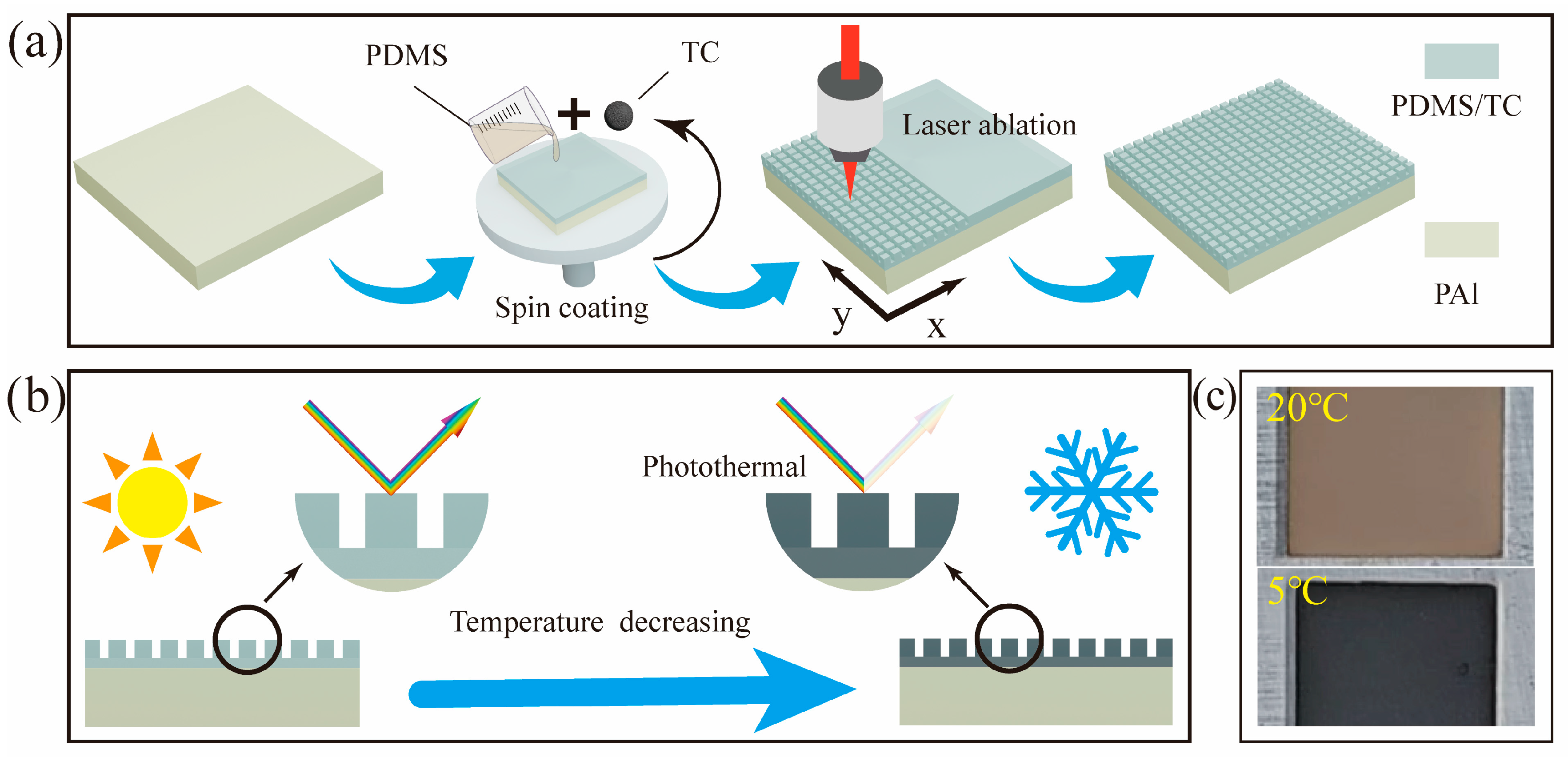
Figure 1a illustrates the fabrication process of the S-PDMS/TC composite coating, which integrates spin-coating with femtosecond laser ablation technology. Initially, the PAl substrates were mechanically polished to remove the oxide layer and create a fresh interface, thereby enhancing the adhesion between the substrate and the coating. Subsequently, a PDMS/TC composite layer was deposited onto the substrate via spin-coating. The thermochromic capsules (TC) were introduced into the PDMS matrix to endow the coating with adaptive color-changing capabilities, specifically to enhance photothermal performance by turning black at low temperatures. After thermal curing, the smooth PDMS/TC surface underwent micro/nano-structuring via femtosecond laser ablation. This step constructed a hierarchical micro-grid structure, significantly increasing surface roughness and imparting superhydrophobicity to the sample.
Figure 1b,c demonstrate the photothermal mechanism and color evolution of S-PDMS/TC in low-temperature environments. At room temperature (20 °C), the surface exhibits a pale-yellow color, corresponding to limited solar light absorption capacity. However, as the temperature drops below the phase transition threshold of the TC (5 °C), the surface undergoes a distinct transition from yellow to black. This darkening effect significantly boosts the light absorption and photothermal conversion efficiency of the S-PDMS/TC, providing a robust thermodynamic basis for its anti-icing performance in freezing conditions.

3.2. Characterization, Morphology, and Wettability of S-PDMS/TC

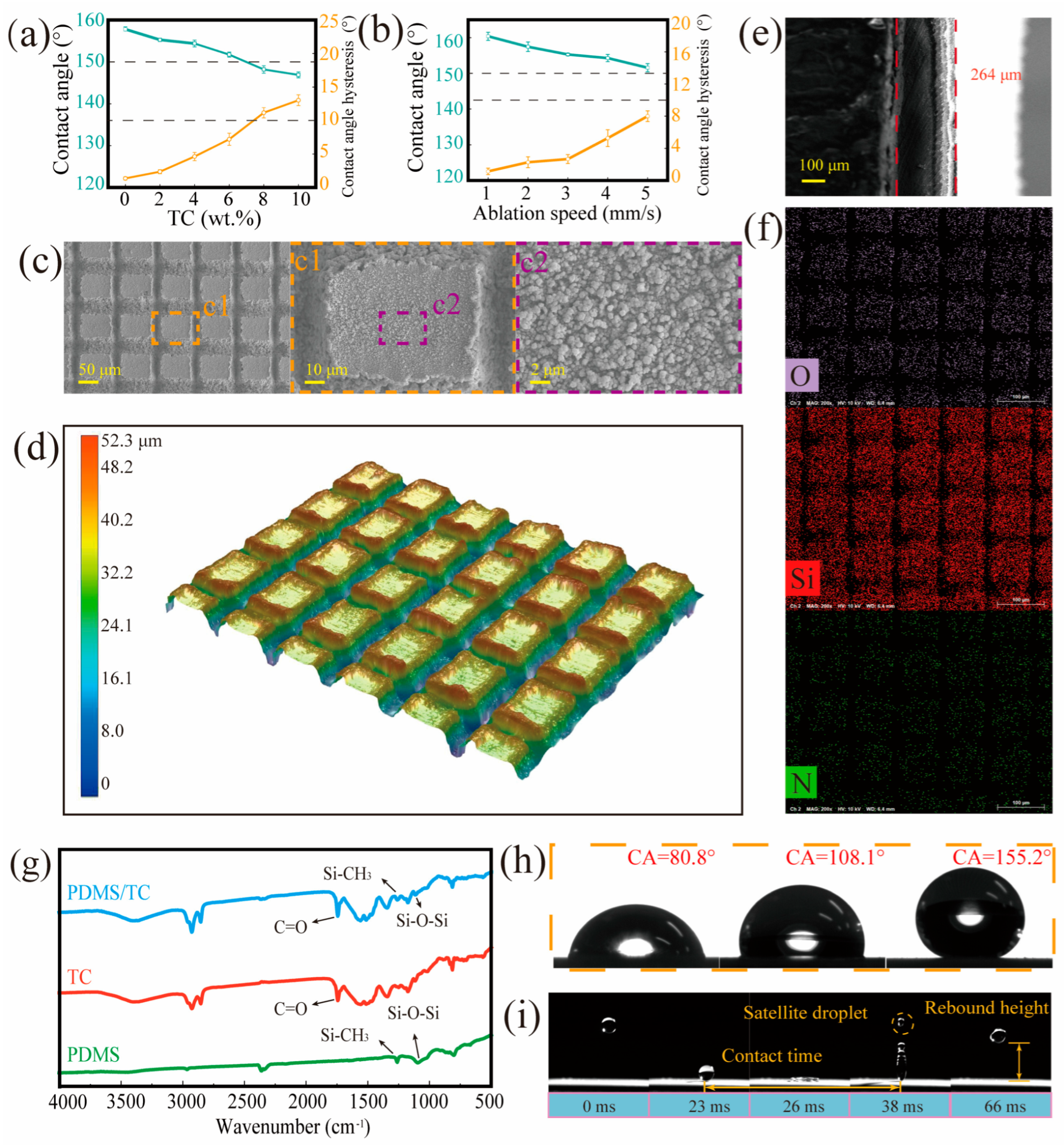
To balance the photothermal performance and superhydrophobicity of S-PDMS/TC, the effect of TC concentration was first investigated (Figure 2a). While the PDMS matrix, combined with laser-induced roughness, theoretically facilitates a Cassie-Baxter superhydrophobic state, experimental results indicate a decline in the CA and an increase in the CAH with increasing TC content. This trend suggests that excessive TC incorporation will alter the intrinsic surface energy or disrupt the uniformity of the laser-induced microstructures, thereby compromising superhydrophobicity [16]. Conversely, insufficient TC content results in inadequate photothermal conversion at low temperatures. Consequently, 2 wt.% was selected as the optimal concentration. Furthermore, laser ablation speed plays a critical role in micro-structure fabrication (Figure 2b). Increasing the ablation speed reduces the laser dwell time, leading to shallower ablation depths and insufficient roughness, which in turn diminishes hydrophobicity [17]. Notably, an excessively low speed is also detrimental; the resulting heat accumulation during processing can cause local overheating, deactivating the thermochromic function of the TC particles [18,19]. Therefore, an ablation speed of 3 mm/s was determined to be optimal to maintain both structural integrity and functional activity.
The morphology and chemical composition of the optimized S-PDMS/TC were comprehensively characterized. SEM images (Figure 2c) reveal that the femtosecond laser treatment created a uniform micro-grid structure on the surface. High-magnification views further disclose a dense layer of nanoparticles covering the micro-structures, which are attributed to hydrophobic silica generated from laser-induced PDMS decomposition [17,20]. This hierarchical micro/nano-texture is essential for superhydrophobicity. The 3D optical profilometry image (Figure 2d) confirms the structural regularity with an average ablation depth of 52.3 μm, demonstrating precise process control. To characterize the thickness of the S-PDMS/TC coating, we used SEM to examine the cross-section of the structure, and the thickness was found to be 264 μm (Figure 2e). Chemical analysis further confirms the successful fabrication of the composite coating. EDS mapping (Figure 2f) reveals a uniform distribution of Si and N elements, corresponding to the PDMS matrix and TC fillers respectively, across the surface without significant agglomeration. In the FTIR spectra (Figure 2g), the S-PDMS/TC composite perfectly retains the characteristic peaks of both the PDMS matrix (Si–CH3 bending at 1258 cm−1; Si–O–Si asymmetric stretching at 1080 cm−1) and the embedded TC (C=O stretching at 1735 cm−1, primarily originating from the lactone ring of ODB-2) [21,22]. The absence of any significant peak shifts or the emergence of new functional group bands indicates that the composite is formed through physical blending, successfully preserving the intrinsic chemical functionality and structural integrity of both components.
Based on the constructed micro/nano-structures, S-PDMS/TC exhibits excellent wettability. Figure 2h compares the CA of different samples. PAl exhibited a hydrophilic nature (CA of 80.8°), while the non-lasered PDMS/TC surface showed intrinsic hydrophobicity (CA of 108.1°). In distinct contrast, the laser-structured S-PDMS/TC achieved a superhydrophobic state with a CA of 155.2°. To further evaluate the dynamic water-repellency, which is crucial for anti-icing applications, droplet impact tests were conducted (Figure 2i). When a 10 μL water droplet impacted the surface at 1.0 m s−1, it retracted and bounced off rapidly without adhesion, reaching a maximum rebound height of 1.4 cm. The total solid–liquid contact time was only ~15 ms. Such minimized contact time is expected to significantly reduce heat transfer and water retention of supercooled droplets, thereby delaying the icing process [23].

3.3. Anti-Icing Performance and Mechanical Durability

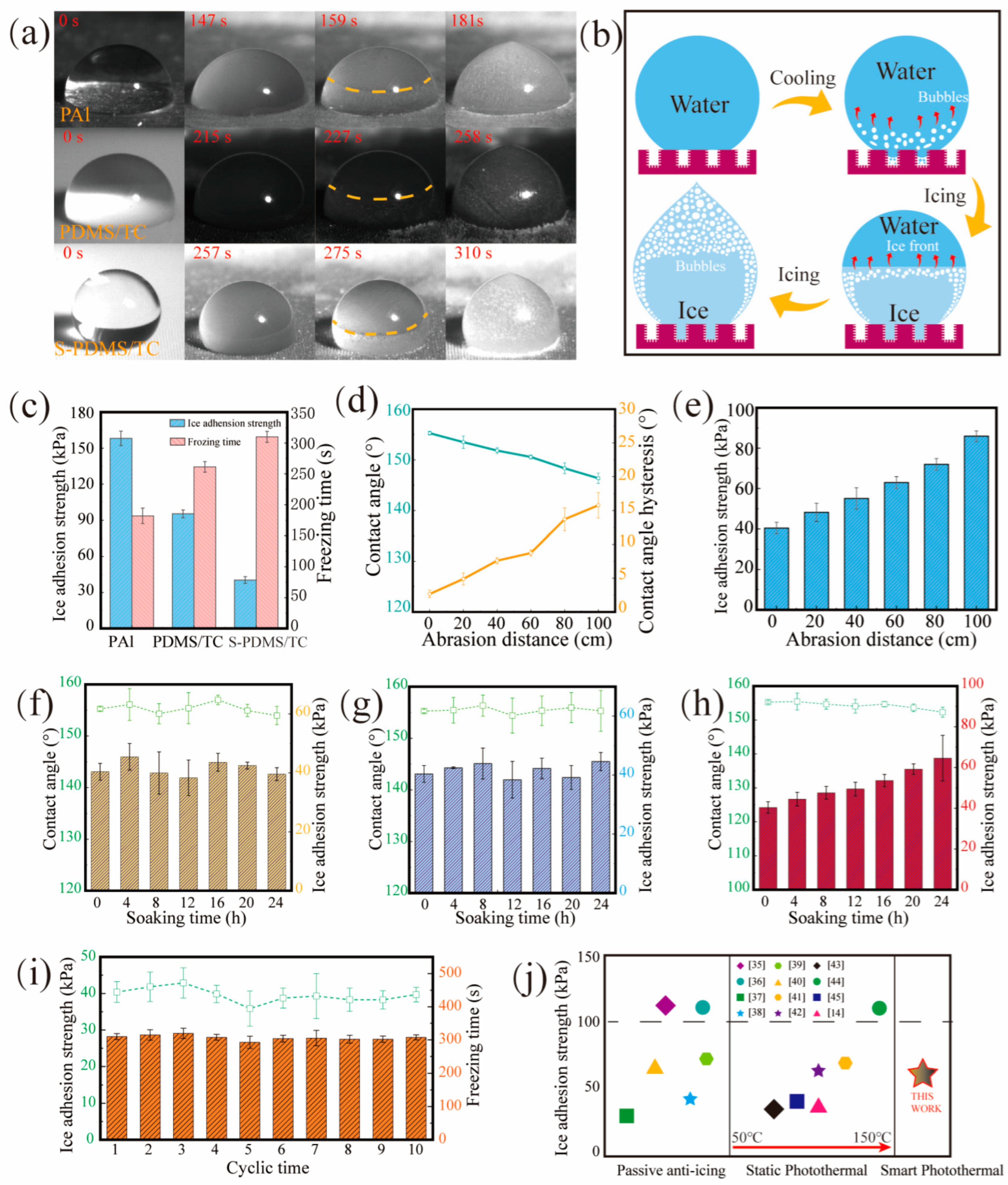
To evaluate the anti-icing performance under static conditions, the freezing process of water droplets on a cooling stage (−15 °C) was recorded (Figure 3a). The droplets on PAl and PDMS/TC surfaces froze completely within 181 s and 258 s, respectively. In contrast, S-PDMS/TC exhibited the most significant icing delay with a freezing time extended to 310 s, representing approximately 1.7 times that of the PAl surface. Figure 3b illustrates the mechanism underlying this delayed freezing. At room temperature, the droplet maintains a stable Cassie-Baxter state on the S-PDMS/TC surface, supported by the hierarchical micro/nano-structures [24,25]. This configuration traps distinct air pockets at the solid–liquid interface. These air pockets serve as effective thermal insulators, significantly hindering heat transfer from the cold substrate to the droplet, thereby retarding nucleation and freezing [26]. As the temperature decreases, although partial penetration of the droplet into the micro-texture may occur, the trapped air tends to migrate upward and accumulate at the droplet’s apex, continuing to provide thermal resistance until the droplet is fully frozen.
Beyond icing delay, low ice adhesion strength is critical for the effortless removal of accumulated ice [27]. As shown in Figure 3c, the PAl surface exhibits a high ice adhesion strength of 158.1 kPa, indicating non-ice-phobic behavior. The PDMS/TC coating shows a reduced adhesion strength of 95.3 kPa, meeting the general criterion for ice-phobic materials (<100 kPa) [28]. Notably, the S-PDMS/TC surface demonstrates a remarkable reduction in ice adhesion strength to 40.4 kPa. This ultra-low adhesion, attributed to the minimized solid-ice contact area, implies that ice accumulated on the S-PDMS/TC surface can be easily shed under minor external forces, effectively preventing further ice accretion.
The mechanical stability of superhydrophobic surfaces in harsh environments is a critical challenge for practical applications [29]. To address this, the durability of S-PDMS/TC was systematically evaluated via linear abrasion tests. The unique micro-grid design plays a protective role: the protruding tops of the grids act as a sacrificial layer against mechanical friction, effectively shielding the fragile nanostructures housed within the grid valleys. As shown in Figure 3d, even after an abrasion distance of 60 cm, the CAH remained below 10°, and the CA stayed above 150°, indicating the retention of superhydrophobicity. Furthermore, even after 100 cm of abrasion, the ice adhesion strength on the S-PDMS/TC surface only slightly increased to 85.9 kPa (Figure 3e), which is still well within the ice-phobic range. These results confirm that S-PDMS/TC maintains reliable ice-phobic performance even after significant mechanical wear.
To evaluate the environmental durability of the S-PDMS/TC coating in harsh outdoor scenarios, its chemical stability was systematically assessed through acid, alkali, and salt resistance tests, as illustrated in Figure 3f–h. When immersed in an acidic solution (HCl, pH = 3), the CA and ice adhesion strength of the coating exhibited negligible fluctuations regardless of the immersion time. This stability is attributed to the robust cross-linked PDMS network, which demonstrates excellent resistance to weak acids; protons are thermodynamically incapable of cleaving the stable Si–O–Si bonds at room temperature [30]. Furthermore, the superhydrophobic “air cushion” serves as a reliable physical barrier, effectively preventing the acidic solution from penetrating and corroding the vulnerable regions at the base of the micro-grid [31]. A similar robust performance was observed during the salt resistance test (3.5 wt.% NaCl). Both the CA and ice adhesion strength remained virtually unaffected, primarily because sodium and chloride ions lack the chemical capability to disrupt the stable siloxane backbone [32].
In contrast, during the extreme alkali resistance test (Figure 3h, NaOH, pH = 11) the CA experienced a slight decrease from 155.2° to 152.3° after 24 h of immersion, accompanied by an increase in ice adhesion strength to 64.0 kPa. This localized degradation occurs because hydroxide ions can nucleophilically attack the Si–O–Si backbone of the PDMS matrix, leading to the cleavage of siloxane bonds and a partial reduction in intrinsic hydrophobicity [33]. Consequently, water droplets can partially penetrate the protective air cushion, seeping into the bottom of the micro-grid. Upon freezing, the penetrating ice forms a mechanical interlock with the micro-grid structures, resulting in an elevated ice adhesion strength [34].
Figure 3. Anti-icing performance and mechanical durability of S-PDMS/TC. (a) Time-lapse side-view images of water droplets freezing on PAl, PDMS/TC, and S-PDMS/TC surfaces. (b) Schematic illustration of the icing mechanism and air cushion effect on the S-PDMS/TC surface. (c) Comparison of ice adhesion strength and freezing time for PAl, PDMS/TC, and S-PDMS/TC surfaces. (d) Variations in CA and CAH of the S-PDMS/TC surface as a function of abrasion distance in sandpaper abrasion tests. (e) Ice adhesion strength of the S-PDMS/TC surface after different abrasion distances. (fh) Variations in CA and ice adhesion strength of the S-PDMS/TC coating as a function of immersion time in acidic (f), salt (g), and alkaline (h) solutions, respectively. (i) Evolution of ice adhesion strength and icing delay time for the S-PDMS/TC coating over 10 consecutive icing/deicing cycles. (j) Comprehensive performance comparison between this work and recently reported state-of-the-art anti-icing coatings [14,35,36,37,38,39,40,41,42,43,44,45].
Coatings 16 00429 g003
To evaluate the long-term reliability of the anti-icing performance, cyclic icing/deicing tests were conducted on the S-PDMS/TC coating, as depicted in Figure 3i. Throughout 10 consecutive cycles, the ice adhesion strength remained remarkably stable at 40.4 ± 5 kPa, exhibiting no obvious signs of deterioration. Simultaneously, the icing delay time consistently maintained a high level of 310 ± 20 s without any observable decreasing trend. These results powerfully demonstrate the excellent durability and robust structural stability of the S-PDMS/TC coating under repeated icing and deicing conditions.
To comprehensively evaluate the rational design of our smart surface, its performance was benchmarked against recently reported state-of-the-art anti-icing coatings in a conceptual classification map (Figure 3j). While achieving icephobic performance (initial ice adhesion strength < 100 kPa) is the universal objective for all comparative coatings, Figure 3j elucidates a critical limitation in current strategies. As shown in the left and middle regions, conventional passive icephobic surfaces [35,36,37,38,39,40] rely solely on chemical/structural modifications, leading to performance stagnation with many points above the 100 kPa threshold. Static photothermal surfaces [14,41,42,43,44,45] effectively lower ice adhesion via heat generation but remain locked into a static thermal mode, and the unmanaged excessive heating risks are inherent in these static designs under high-irradiance, non-freezing conditions. Uniquely, our S-PDMS/TC coating occupies the exclusive optimal quadrant: Smart Photothermal coatings, simultaneously achieving highly competitive icephobicity well below the efficient icephobic threshold while pioneering smart, adaptive thermal management to resolve this critical summer overheating design bottleneck [46].

3.4. Reversible Thermochromism and Self-Cleaning

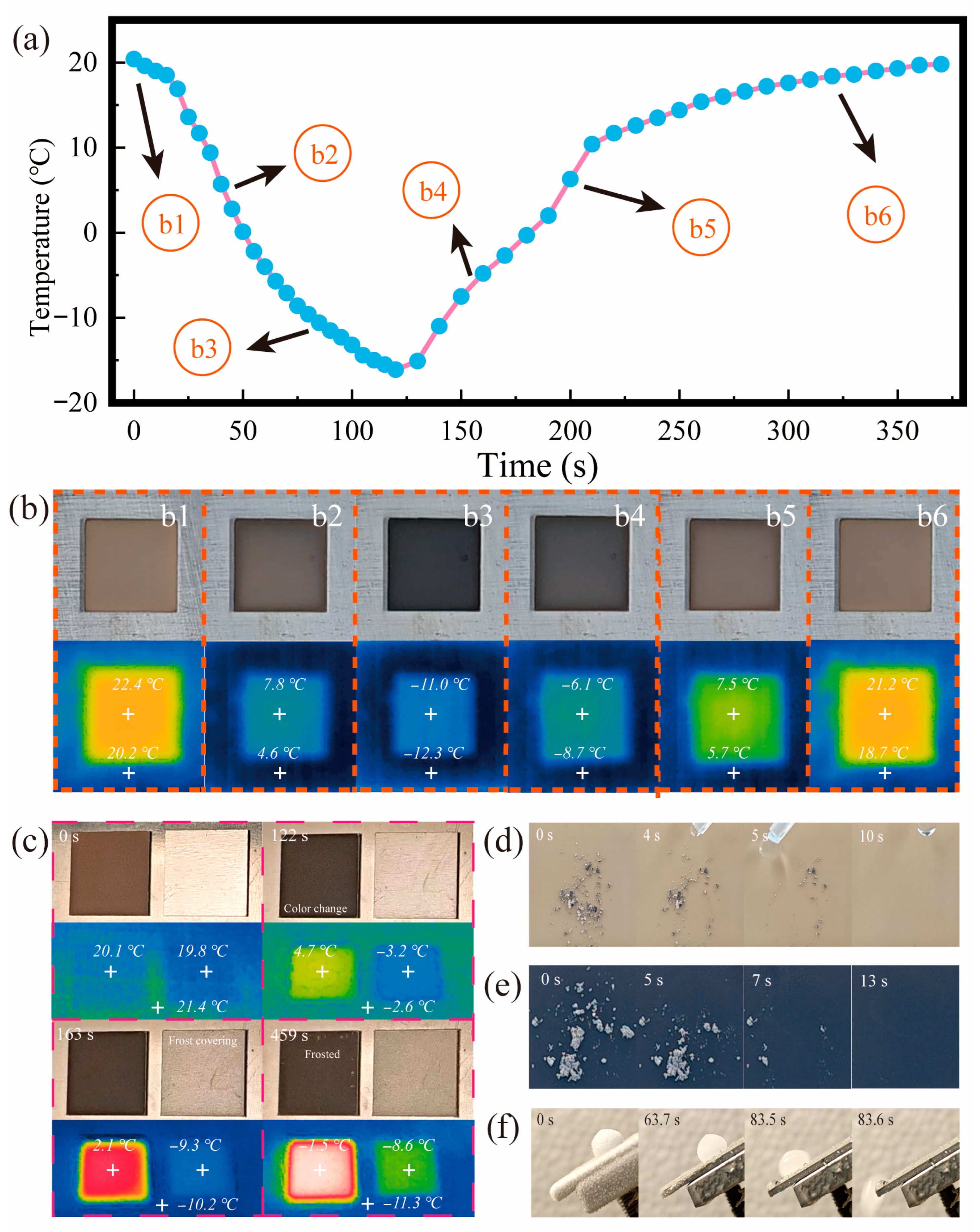
To intuitively monitor the dynamic thermochromic behavior of S-PDMS/TC in practical scenarios, a cooling-heating cycle was simulated using a semiconductor cooling stage, with the temperature profile recorded over time (Figure 4a). During the cooling phase, once the surface temperature dropped to the transition threshold of TC (5 °C), a visible color evolution was initiated on the S-PDMS/TC surface (Figure 4b). As the temperature continued to decrease, the surface gradually darkened, eventually turning deep black, a state that endows the S-PDMS/TC with significantly enhanced light absorption capacity. To verify the reversibility, the cooling was ceased after 200 s. As the platform temperature naturally rose, the S-PDMS/TC surface gradually faded from black back to its initial yellow state. This complete cycle confirms that S-PDMS/TC possesses excellent reversible thermochromic behavior, enabling it to intelligently and dynamically regulate its photothermal absorption properties in response to environmental temperature fluctuations.
Fundamentally, this macroscopic reversible transition originates from the synergistic chemical interactions within the ternary core of the embedded TC microcapsules, which comprises a fluoran-based leuco dye (ODB-2) as the color former, Bisphenol A (BPA) as the proton-donating developer, and a phase-change co-solvent [47]. At ambient temperatures (>5 °C), the molten liquid co-solvent spatially isolates ODB-2 from BPA, maintaining the lactone ring of ODB-2 in a closed, sp3-hybridized state that lacks an extended π-conjugated system, thereby rendering the microcapsules pale yellow to minimize undesired solar absorption. However, upon exposure to freezing conditions (<5 °C), the rapid crystallization of the co-solvent induces localized phase separation, forcing the BPA molecules into highly aggregated proximity with ODB-2. Driven by this thermodynamic solidification, the phenolic hydroxyl groups of BPA aggressively donate protons to cleave the lactone ring, transforming the central carbon of ODB-2 into an sp2-hybridized state [48]. This critical structural evolution establishes a massive, highly delocalized π-conjugated framework across the molecule, rapidly shifting the microcapsules to a deep black state that enables strong broadband solar absorption and subsequent non-radiative relaxation for highly efficient, on-demand photothermal anti-icing.
To dynamically evaluate the on-demand photothermal anti-frosting performance, the S-PDMS/TC coating and the PAl control were placed on a semiconductor cooling stage under an illumination intensity of 1 sun (Figure 4c). As the stage temperature decreased, the surface temperature of S-PDMS/TC dropped to 4.7 °C at 122 s, successfully crossing the phase-transition threshold of the incorporated microcapsules. Consequently, the coating rapidly transitioned to a deep black state, significantly amplifying its solar absorption capacity. Driven by this activated photothermal effect, the S-PDMS/TC coating generated localized heat to counteract the active cooling. By 163 s, the PAl surface was completely covered by a dense frost layer due to the lack of thermal regulation. In stark contrast, the S-PDMS/TC surface remained entirely frost-free at this stage. It was not until 459 s that initial frost formation was observed on the S-PDMS/TC surface. This substantial delay demonstrates the exceptional and timely photothermal efficacy of the adaptive S-PDMS/TC coating under freezing conditions.
In outdoor applications, the accumulation of contaminants often compromises anti-icing and photothermal efficiency; thus, self-cleaning capability is vital. Figure 4c demonstrates the self-cleaning process at room temperature (20 °C): when water droplets rolled over the surface covered with dust, the particles were easily removed, exhibiting excellent cleaning performance. Crucially, we investigated whether S-PDMS/TC retains this property at low temperatures after the thermochromic transition. As shown in Figure 4d, even at −5 °C where the surface had turned black, rolling droplets continued to effectively remove contaminants. This result provides strong evidence that the thermochromic process does not alter the surface’s micro/nano-roughness or low surface energy, ensuring that S-PDMS/TC maintains robust superhydrophobic self-cleaning functionality even in its colored, low-temperature state.
Beyond anti-icing and de-icing, spontaneous dewetting after ice melting is critical for preventing secondary icing of meltwater. Figure 4e records the unique behavior of the S-PDMS/TC surface during an icing-melting cycle. Upon heating, as the ice layer melted into water, the droplet did not spread but immediately reverted to a superhydrophobic state, exhibiting a spontaneous dewetting phenomenon. This rapid recovery of the Cassie-Baxter state, driven by ultra-low adhesion and the timely replenishment of the air cushion, eliminates water residue and effectively prevents secondary icing [49].

4. Conclusions

We developed a smart superhydrophobic surface with reversible thermochromic capability, robust mechanical durability, and superior anti-icing performance. The S-PDMS/TC, fabricated via a facile combination of spin-coating and femtosecond laser ablation, exhibited a hierarchical micro-grid structure composed of PDMS and thermochromic capsules, which remarkably enabled adaptive photothermal conversion. Specifically, the surface color reversibly transitions from pale yellow to deep black when the temperature drops below 5 °C, realizing “on-demand” solar absorption to avoid overheating at room temperature while ensuring efficient heating in freezing conditions. Further, a prolonged icing delay time of 310 s and an ultra-low ice adhesion strength of 40.4 kPa were achieved on the S-PDMS/TC surface at −15 °C. Notably, the meltwater exhibited a spontaneous dewetting behavior during the photothermal de-icing process, driven by the replenishment of the air cushion, which effectively prevents secondary icing. The abrasion test showed that the laser-induced micro-grids play a crucial role as a sacrificial layer in protecting the functional nanostructures, maintaining robust superhydrophobicity even after rigorous mechanical wear. Therefore, the S-PDMS/TC is shown to be a reliable and intelligent interface for all-weather anti-icing applications in outdoor infrastructure.

Author Contributions

Conceptualization, L.L.; methodology, L.L.; investigation, S.L. and L.L.; data curation, S.L. and J.H.; writing—original draft preparation, S.L.; writing—review and editing, S.L., J.H. and L.L.; supervision, L.L. and Y.W. All authors have read and agreed to the published version of the manuscript.

Funding

The work is supported by the Specific Research Project of Guangxi for Research Bases and Talents (AE30100196), Youth Science Foundation of Guangxi Zhuang Autonomous Region (KY01030030124030), National Natural Science Foundation of China (Grant No. 52471073), Guangxi Major Special Project Plan Project (Grant No. GuiKe JF2503980019), and Guangxi Province Talent Project (Financial support from Science and Technology Department).

Institutional Review Board Statement

Not applicable.

Informed Consent Statement

Not applicable.

Data Availability Statement

Data are contained within the article.

Conflicts of Interest

The authors declare no conflicts of interest.

References

  1. Kreder, M.J.; Alvarenga, J.; Kim, P.; Aizenberg, J. Design of anti-icing surfaces: Smooth, textured or slippery? Nat. Rev. Mater. 2016, 1, 15033–15048. [Google Scholar] [CrossRef] [Scilit]
  2. Rekuviene, R.; Saeidiharzand, S.; Mažeika, L.; Samaitis, V.; Jankauskas, A.; Sadaghiani, A.K.; Gharib, G.; Muganlı, Z.; Koşar, A. A review on passive and active anti-icing and de-icing technologies. Appl. Therm. Eng. 2024, 250, 123474–123487. [Google Scholar]
  3. Gao, H.; Zhou, Y.; Ma, J.; Jin, H.; Bao, J.; Wen, D. Recent advancements in electro-thermal anti-/de-icing materials. RSC Adv. 2025, 15, 17102–17115. [Google Scholar] [CrossRef] [Scilit]
  4. Li, Y.; Zheng, H.; Chi, H.; Guo, W.; Feng, F. An Experimental Study on the Surface De-Icing of FRP Plates via the External Hot-Air Method. Coatings 2025, 15, 42. [Google Scholar] [CrossRef] [Scilit]
  5. Ito, K.; Fukatsu, A.; Okada, K.; Takahashi, M. Machine learning-assisted chemical design of highly efficient deicers. Sci. Rep. 2024, 14, 12453–12465. [Google Scholar] [CrossRef] [Scilit]
  6. Zhang, Z.; Zhang, H.; Zhang, X.; Hu, Q.; Jiang, X. A Review of Wind Turbine Icing and Anti/De-Icing Technologies. Energies 2024, 17, 2805. [Google Scholar] [CrossRef] [Scilit]
  7. Hamid, M.; Song, M.; Yu-Hang Chao, C.; Qaisrani, M.A.; Shi, H.; Shao, K.; Zhen, Z.; Gao, R.; Zhang, X.; Zhang, L.; et al. Can nature-inspired surface and interface designs offer practical solutions for anti-icing? Renew. Sustain. Energy Rev. 2026, 228, 116563–116599. [Google Scholar] [CrossRef] [Scilit]
  8. Wang, Y.; Li, J.; Song, H.; Wang, F.; Su, X.; Zhang, D.; Xu, J. Biomimetic Superhydrophobic Surfaces: From Nature to Application. Materials 2025, 18, 2772. [Google Scholar] [CrossRef] [Scilit] [PubMed]
  9. Huo, T.; Xue, X.; Sun, Y.; Huang, S.; Pan, Y.; Li, F. Glomerulus Inspired Charged Nanofibrous Membrane for High-Efficient Micro/Nano-Emulsion Separation. Adv. Funct. Mater. 2026, 36, e21336. [Google Scholar] [CrossRef] [Scilit]
  10. Luo, Y.; Sun, Y.; An, S.; Wei, P.; Wang, S.; Li, Z.; Pan, Y.; Li, F. Janus Composite Porous Structure with Asymmetric Selective-Wettability for Unidirectional Liquid Transportation and High-Efficiency Oil-Water Separation. ACS Appl. Mater. Interfaces 2025, 17, 31654–31666. [Google Scholar] [CrossRef] [Scilit] [PubMed]
  11. Li, X.; Hu, T.; Xia, T.; Chen, Z.; Zhang, Z.; Song, J.; Liu, L.; Liu, J.; Chen, S.; Jiang, L.; et al. Triple-Scale Photothermal Superhydrophobic Anti/De-Icing Coating with Enhanced Mechanical Robustness and Chemical Stability via Introducing Low-Cost Green Petroleum Coke Particles. Langmuir 2025, 41, 29288–29298. [Google Scholar]
  12. Sun, H.; Li, C.; Jiang, L.; Liu, S.; Li, J.; Huang, S.; Zhou, T.; Fan, J.; Hu, X.; Tan, X. Effective MXene Superhydrophobic Coating with Passive Anti-Icing and Active Photothermal Deicing. ACS Appl. Eng. Mater. 2026, 4, 1211–1224. [Google Scholar] [CrossRef] [Scilit]
  13. Cao, Z.; Gong, Z.; Ma, X.; Peng, J.; Xiong, Y.; Nie, Y.; Duan, Y.; Li, H.; Zhou, S.; Rao, T.; et al. A superhydrophobic/photothermal synergistic anti-icing mesh with active/passive anti-icing function. Mater. Res. Express 2024, 11, 075009–075019. [Google Scholar]
  14. Li, X.; Tan, X.; Xiao, T.; Li, X.; Jiang, L.; Tan, X.; Liu, S.; Li, T. Superhydrophobic photothermal coatings based on polyurea for durable anti-icing and deicing. Surf. Interfaces 2024, 54, 105120–105134. [Google Scholar]
  15. Yang, T.; Lu, Q.; Ren, F.; Xin, S.; Zhang, H.; Qiao, H.; Wang, Z.; Liu, L. A Fluorine-Free Superhydrophobic Micro–Nano Structured SiO2/TiN Coating for Anti-icing and Photothermal Deicing. ACS Appl. Nano Mater. 2024, 7, 14737–14747. [Google Scholar]
  16. Zhang, F.; Xu, D.; Zhang, D.; Ma, L.; Wang, J.; Huang, Y.; Chen, M.; Qian, H.; Li, X. A durable and photothermal superhydrophobic coating with entwinned CNTs-SiO2 hybrids for anti-icing applications. Chem. Eng. J. 2021, 423, 130238–130249. [Google Scholar] [CrossRef] [Scilit]
  17. Guo, Y.; Zhao, H.; Zhao, G. Laser-Induced Superhydrophobic Polymer Surface for Droplet Manipulation, Controllable Light-Driven Actuator, and Underwater Motion Monitoring. ACS Appl. Mater. Interfaces 2025, 17, 12707–12719. [Google Scholar]
  18. Li, Y.; He, G.; Liu, H.; Wang, M. Investigation of Heat Accumulation in Femtosecond Laser Drilling of Carbon Fiber-Reinforced Polymer. Micromachines 2023, 14, 913. [Google Scholar] [CrossRef] [Scilit]
  19. Song, J.; Wang, B.; Jiang, Q.; Hao, X. Effect of Laser Parameters on Surface Morphology and Material Removal Mechanism of Ablation Grooves in CFRP Composites Using Finite Element Simulations. Materials 2025, 18, 790. [Google Scholar] [CrossRef] [Scilit]
  20. Chakraborty, A.; Gottumukkala, N.R.; Gupta, M.C. Superhydrophobic Surface by Laser Ablation of PDMS. Langmuir 2023, 39, 11259–11267. [Google Scholar] [CrossRef] [Scilit]
  21. Bellido-Aguilar, D.A.; Zheng, S.; Huang, Y.; Zeng, X.; Zhang, Q.; Chen, Z. Solvent-Free Synthesis and Hydrophobization of Biobased Epoxy Coatings for Anti-Icing and Anticorrosion Applications. ACS Sustain. Chem. Eng. 2019, 7, 19131–19141. [Google Scholar] [CrossRef] [Scilit]
  22. Zou, W.; Li, Z.; Wang, Z.; Sun, D.; Zhang, P. Poplar-based thermochromic composites that change colour at 38 °C to 46 °C. Sci. Rep. 2021, 11, 16865–16874. [Google Scholar] [CrossRef] [Scilit]
  23. Han, X.; Li, J.; Tang, X.; Li, W.; Zhao, H.; Yang, L.; Wang, L. Droplet Bouncing: Fundamentals, Regulations, and Applications. Small 2022, 18, e2200277. [Google Scholar] [CrossRef] [Scilit]
  24. Tourkine, P.; Le Merrer, M.; Quere, D. Delayed freezing on water repellent materials. Langmuir 2009, 25, 7214–7216. [Google Scholar] [CrossRef] [Scilit]
  25. Wang, C.; Zhong, L.; Zhang, J.; Zhan, M.; Ren, K.; Wang, P.; Liu, B.; Wang, Z.; Zhao, J. An Eco-Friendly Sb2Se3-Based Superhydrophobic Photothermal Coating for Scalable Anti-icing and De-icing Applications. ACS Appl. Mater. Interfaces 2025, 17, 44872–44883. [Google Scholar] [CrossRef] [Scilit]
  26. Guo, C.; Ang, Y.; Lu, J.; Fan, R.; Liu, S. Fabrication of Superhydrophobic Carbon Fiber Composite Surfaces and Evaluation of Their Anti-Icing Performance under Static and Impacting Droplets. ACS Appl. Polym. Mater. 2025, 7, 13210–13218. [Google Scholar] [CrossRef] [Scilit]
  27. Wang, T.; Yao, H.; Wang, N.; Wang, Y.; Wang, F. Design and performance study of superhydrophobic low-adhesion anti-icing coating with photothermal response. Mater. Chem. Phys. 2025, 342, 130996–131008. [Google Scholar] [CrossRef] [Scilit]
  28. Golovin, K.; Kobaku, S.P.R.; Lee, D.H.; DiLoreto, E.T.; Mabry, J.M.; Tuteja, A. Designing durable icephobic surfaces. Sci. Adv. 2016, 2, e1501496. [Google Scholar] [CrossRef] [Scilit]
  29. Wang, D.; Sun, Q.; Hokkanen, M.J.; Zhang, C.; Lin, F.-Y.; Liu, Q.; Zhu, S.-P.; Zhou, T.; Chang, Q.; He, B.; et al. Design of robust superhydrophobic surfaces. Nature 2020, 582, 55–59. [Google Scholar] [CrossRef] [Scilit]
  30. Guo, X.J.; Zhang, D.; Xue, C.H.; Liu, B.Y.; Huang, M.C.; Wang, H.D.; Wang, X.; Deng, F.Q.; Pu, Y.P.; An, Q.F. Scalable and Mechanically Durable Superhydrophobic Coating of SiO2/Polydimethylsiloxane/Epoxy Nanocomposite. ACS Appl. Mater. Interfaces 2023, 15, 4612–4622. [Google Scholar]
  31. Wu, Y.; Meng, X.; Zhang, B. Photothermal Superhydrophobic Anticorrosion Coating with Passive Anti-Icing and Active Deicing Properties. Langmuir 2025, 41, 18334–18343. [Google Scholar] [CrossRef] [Scilit]
  32. Joy, J.; Tizzile, J.S.J.; Sukumaran, A.; Chenan, A. Superhydrophobic Polyaniline-Siloxane Coatings with Excellent Barrier and Active Corrosion Protection Properties for Mild Steel. Langmuir 2024, 40, 8205–8224. [Google Scholar]
  33. Hou, Y.; Zhu, G.; Cui, J.; Wu, N.; Zhao, B.; Xu, J.; Zhao, N. Superior Hard but Quickly Reversible Si-O-Si Network Enables Scalable Fabrication of Transparent, Self-Healing, Robust, and Programmable Multifunctional Nanocomposite Coatings. J. Am. Chem. Soc. 2022, 144, 436–445. [Google Scholar]
  34. Cheng, H.; Yang, G.; Li, D.; Li, M.; Cao, Y.; Fu, Q.; Sun, Y. Ultralow Icing Adhesion of a Superhydrophobic Coating Based on the Synergistic Effect of Soft and Stiff Particles. Langmuir 2021, 37, 12016–12026. [Google Scholar] [CrossRef] [Scilit]
  35. Tian, J.; Qi, X.; Li, C.; Xian, G. Mussel-Inspired Fabrication of an Environment-Friendly and Self-Adhesive Superhydrophobic Polydopamine Coating with Excellent Mechanical Durability, Anti-Icing and Self-Cleaning Performances. ACS Appl. Mater. Interfaces 2023, 15, 26000–26015. [Google Scholar] [CrossRef] [Scilit]
  36. Memon, H.; Liu, J.; De Focatiis, D.S.A.; Choi, K.-s.; Hou, X. Intrinsic dependence of ice adhesion strength on surface roughness. Surf. Coat. Technol. 2020, 385, 125382–125392. [Google Scholar]
  37. Zhuo, Y.; Håkonsen, V.; Liu, S.; Li, T.; Wang, F.; Luo, S.; Xiao, S.; He, J.; Zhang, Z. Ultra-robust icephobic coatings with high toughness, strong substrate adhesion and self-healing capability. Sci. China Mater. 2023, 66, 2071–2078. [Google Scholar]
  38. Li, S.; Hou, Y.; Kappl, M.; Steffen, W.; Liu, J.; Butt, H.J. Vapor Lubrication for Reducing Water and Ice Adhesion on Poly(dimethylsiloxane) Brushes. Adv. Mater. 2022, 34, e2203242. [Google Scholar] [CrossRef] [Scilit]
  39. Chen, T.; Dong, X.; Han, L.; Cong, Q.; Qi, Y.; Jin, J.; Liu, C.; Wang, M. Changing the freezing interface characteristics to reduce the ice adhesion strength. Appl. Therm. Eng. 2023, 230, 120796–120807. [Google Scholar] [CrossRef] [Scilit]
  40. Yeong, Y.H.; Wang, C.; Wynne, K.J.; Gupta, M.C. Oil-Infused Superhydrophobic Silicone Material for Low Ice Adhesion with Long-Term Infusion Stability. ACS Appl. Mater. Interfaces 2016, 8, 32050–32059. [Google Scholar]
  41. Liu, Y.; Guo, R.; Liu, J.; Zhang, Q. Robust PFMA/CNTs composite PDMS superhydrophobic film via SI-CuCRP method for efficient anti-icing. Colloids Surf. A 2023, 660, 130913–130923. [Google Scholar] [CrossRef] [Scilit]
  42. Yang, X.; Liu, Y.; Zhong, Y.; Chen, H. Robust photothermal anti/de-icing hydrophobic coating based on polydopamine (PDA) composition. Appl. Surf. Sci. 2025, 681, 161427. [Google Scholar] [CrossRef] [Scilit]
  43. Wu, Y.; Dong, L.; Shu, X.; Zhang, Y.; Ran, Q. Breathable and Self-Healing Photothermal Superhydrophobic Coating Featuring Exceptional Liquid Impalement Resistance and Anti-/Deicing Capabilities for Concrete Materials. ACS Appl. Mater. Interfaces 2025, 17, 18852–18868. [Google Scholar] [CrossRef] [Scilit]
  44. Gao, H.; Liu, Y.; Wang, G.; Li, S.; Han, Z.; Ren, L. A multifunctional graphene composite coating with switchable wettability. Chem. Eng. J. 2021, 415, 128862–128872. [Google Scholar] [CrossRef] [Scilit]
  45. Yu, C.; Hu, R.; Luo, X.; Zou, H.; Wu, Z.; Zhang, K. Photothermal Anti-icing Coatings Composed of Spherical Multiwalled Carbon Nanotube Modified Particles: Synergistic High-Efficiency Deicing and Superior Thermal Conductivity. Langmuir 2025, 41, 19218–19229. [Google Scholar] [CrossRef] [Scilit]
  46. Du, J.; Wang, W.; Fu, Y.; Li, X.; Tan, J.; Li, H.; Chen, X.; Chu, F.; Min, Q.; Tso, C.Y. A self-regulated photothermal anti-/deicing film for all-season applications. Nat. Commun. 2026, 17, 2632–2645. [Google Scholar] [CrossRef] [Scilit] [PubMed]
  47. Liu, Y.; Wu, Y.; Ma, Y.; Wang, P.; Yu, B.; Pei, X.; Liu, S.; Zhou, F. Reversible thermochromic and heat storage coating for adaptive de/anti-icing and thermal regulation. Chem. Eng. J. 2024, 482, 148837–148846. [Google Scholar] [CrossRef] [Scilit]
  48. Babazadeh-Mamaqani, M.; Mohammadi-Jorjafki, M.; Alipour-Fakhri, S.; Mardani, H.; Roghani-Mamaqani, H. Thermal-Induced Chromism and Fluorescence Emission of Rhodamine B-Containing Polymers with Different Polarities: Tracking Temperature and Development of Thermochromic Labels. Macromolecules 2023, 56, 5843–5853. [Google Scholar] [CrossRef] [Scilit]
  49. Wang, L.; Tian, Z.; Jiang, G.; Luo, X.; Chen, C.; Hu, X.; Zhang, H.; Zhong, M. Spontaneous dewetting transitions of droplets during icing & melting cycle. Nat. Commun. 2022, 13, 378–393. [Google Scholar] [CrossRef] [Scilit]
Figure 1. Design strategy and characterization of the S-PDMS/TC. (a) Schematic illustration of S-PDMS/TC fabrication via spin-coating and femtosecond laser ablation. (b) Schematic mechanism of the thermochromic response and enhanced photothermal absorption during temperature reduction. (c) Optical images showing the color evolution of the S-PDMS/TC surface at different temperatures.
Coatings 16 00429 g001
Figure 2. Optimization, morphology, chemical composition, and wettability of S-PDMS/TC. (a) Effect of TC concentration (wt.%) on the CA and CAH. (b) Regulation of surface wettability by laser ablation speed. (c) SEM images of the S-PDMS/TC surface with high-magnification insets showing the hierarchical structure. (d) 3D optical profilometry image of the S-PDMS/TC surface. (e) The thickness of the S-PDMS/TC. (f) EDS elemental mapping images (Si, N, O) of the S-PDMS/TC surface. (g) FTIR spectra of PDMS, TC, and PDMS/TC. (h) Comparison of static CA on PAl, PDMS/TC, and S-PDMS/TC surfaces. (i) High-speed snapshots of a water droplet (10 μL) impacting the S-PDMS/TC surface at a velocity of 1.0 m s−1.
Coatings 16 00429 g002
Figure 4. Thermochromic response and environmental adaptability of S-PDMS/TC. (a) Temperature-time profile of the semiconductor cooling stage during a cooling-heating cycle. (b) Optical micrographs and corresponding infrared thermal images of the S-PDMS/TC surface at different temperatures, illustrating the reversible evolution of color and surface radiative temperature. (c) Sequential optical and thermal images capturing the surface frosting evolution on S-PDMS/TC and PAl. (d,e) Demonstration of the self-cleaning process on the S-PDMS/TC surface at (d) room temperature (20 °C) and (e) low temperature (−5 °C). (f) Snapshots of the spontaneous dewetting behavior of a water droplet on the S-PDMS/TC surface during an icing-melting cycle.
Coatings 16 00429 g004
Disclaimer/Publisher’s Note: The statements, opinions and data contained in all publications are solely those of the individual author(s) and contributor(s) and not of MDPI and/or the editor(s). MDPI and/or the editor(s) disclaim responsibility for any injury to people or property resulting from any ideas, methods, instructions or products referred to in the content.