Review

Multiscale Rheological Properties of Pavement Asphalt: A State-of-the-Art Review
1
School of Civil Engineering, Chongqing Jiaotong University, Chongqing 400074, China
2
School of Materials Science and Engineering, Chongqing Jiaotong University, Chongqing 400074, China
3
National and Local Joint Engineering Laboratory of Traffic Civil Engineering Materials, Chongqing Jiaotong University, Chongqing 400074, China
*
Authors to whom correspondence should be addressed.
Coatings 2026, 16(3), 355; https://doi.org/10.3390/coatings16030355
Submission received: 15 January 2026 / Revised: 14 February 2026 / Accepted: 5 March 2026 / Published: 11 March 2026
(This article belongs to the Special Issue Advances in Pavement Materials and Civil Engineering)

Highlights

What are the main findings?
  • A full review of the chemicals in asphalt, ideas about its structure, and how it flows when subjected to different forces.
What are the implications of the main findings?
  • A revelation of the rheology of colloidal structures and supramolecular models.
  • A thorough and detailed evaluation of large-amplitude oscillatory shear testing.

Abstract

Asphalt rheological properties are fundamental to pavement performance, yet their accurate assessment requires multi-scale characterization due to asphalt’s inherent complexity. This article reviews the connections between asphalt rheology across chemical, microstructural, and macro-mechanical scales, employing a methodological analysis of supramolecular and colloidal models for micro-scale behavior and dynamic shear rheometry for macro-scale properties. Current research confirms asphalt as a complex multiphase continuum, where micro-scale rheology is explained by intermolecular interactions and colloidal structures, while macro-scale analysis successfully characterizes linear viscoelasticity through established empirical and mechanical models. However, the study identifies critical gaps: nonlinear viscoelastic characterization under large-amplitude oscillatory shear (LAOS) remains underdeveloped, and fundamental issues like directly probing molecular interactions and the origin of microstructures like the “bee structure” are unresolved. The primary conclusion is that a comprehensive understanding of asphalt rheology hinges on future research that integrates experimental and simulation data across these scales to bridge the gaps between chemical composition, microstructure, and macroscopic performance.

1. Introduction

Asphalt rheology primarily focuses on studying the properties of asphalt, such as elasticity, viscosity, viscoelasticity, and deformation, and their responses to variations in temperature, time, and loading conditions [1], which is closely connected to the asphalt pavement performance. The asphalt’s rheological properties are influenced by various factors, including atmospheric conditions, temperature, sunlight, moisture, and loading. Understanding these properties is crucial for improving asphalt pavement performance and preventing pavement deterioration.
Asphalt compounds can be categorized into different components based on specific properties. Researchers often study the rheological mechanisms of asphalt by examining the rheological properties of these individual components. Extensive research indicates that at room temperature, polar components primarily contribute to elasticity, while non-polar components primarily contribute to viscosity [2]. The 12-molecule model, commonly used in numerical simulations of asphalt, is based on the four asphalt components and the eight average molecular models proposed by the Strategic Highway Research Program (SHRP). This model enables a more in-depth investigation of asphalt rheological mechanisms, including intermolecular interactions and molecular aggregation behavior. However, the asphalt system is complex, consisting of hundreds of thousands of compounds [3]. Each component remains intricate, making it difficult to create precise molecular models for numerical simulations. As a result, simulation results often show only trends similar to those of experimental results. Scattering experiments have confirmed the presence of asphalt micelles, indicating that the macroscopic properties of asphalt materials depend not only on the physicochemical properties of individual molecules but also on molecular aggregation behavior and aggregation structures.
The action of wheel loading on asphalt pavements can be understood as low-frequency vertical oscillations and localized impacts. Asphalt, which serves as a binder in pavements, exhibits linear or nonlinear viscoelastic behavior under environmental and loading conditions [4]. As a result, researchers often use rheological parameters obtained through dynamic mechanical analysis to assess the performance of asphalt pavements. Viscoelasticity is the most prominent rheological property of asphalt. Currently, numerous well-established empirical algebraic and mechanical element models describe the linear viscoelasticity of asphalt over a wide frequency or temperature range. However, these models have drawbacks, including a lack of universality across different types of asphalt, an inability to describe viscoelasticity under extreme conditions, and excessive parameterization and inflexibility. Creep tests under steady shear loads are the most commonly used method to study the nonlinear viscoelasticity of asphalt. However, these testing methods cannot fully reflect the actual stress conditions experienced by asphalt pavements. In addition, methods for predicting the fatigue life of asphalt often underestimate it by neglecting factors such as nonlinear viscoelasticity and thixotropy. This leads to overly conservative predictions.
The research methods for the rheological properties of polymer materials can be divided into structural and phenomenological approaches. The structural approach uses thermodynamics and statistical mechanics to construct microscale models that describe the internal structure of materials, enabling the study of microscale rheological properties. Phenomenological approaches, on the other hand, do not consider the microstructure. Instead, they employ mathematical methods from continuum mechanics to study the macroscopic rheological properties. In the realm of asphalt materials, ongoing research is predominantly centered on macroscopic rheology [5]. Indeed, establishing a connection between rheological mechanisms and macroscopic rheological properties is essential for a better understanding of asphalt’s constitutive behavior.
In recent years, research in asphalt rheology has progressively advanced towards more complex nonlinear behaviours and deeper multiscale correlations [6,7]. In the realm of nonlinear rheology (LAOS), investigations have transcended the linear viscoelastic regime to systematically characterise asphalt’s intricate responses under high-amplitude shear. This includes quantifying nonlinearity through higher-order harmonic analysis and Lissajous curve decomposition, revealing pronounced higher-order harmonic intensity within the nonlinear domain for specific modified asphalts.
Regarding the time–temperature superposition principle (TTSP) in modified bitumen, research focus has shifted towards identifying its failure boundaries [8,9]. For instance, certain polymer modifiers or high wax content may disrupt temperature-frequency equivalence, leading to failure in constructing the master curve. This is often assessed by examining the continuity of data within black plots. However, most current studies remain focused on observing macroscopic rheological responses through alterations in microstructure, whilst research systems for reverse-predicting or quantifying specific microstructural features based on rheological parameters remain underdeveloped.
Compared to recent reviews focusing on specific modification techniques or fatigue damage mechanisms, this work provides a multiscale correlative framework centred more squarely on the rheological mechanisms themselves. In light of this, this work thoroughly reviews significant advancements in the field and methodically contrasts research findings on asphalt rheological mechanisms by conducting a systematic search of the Elsevier library using the keyword “asphalt rheology” from the 1950s to 2024, with each section encompassing approximately 50 publications. It not only systematically reviews the microscopic systems—from chemical composition, intermolecular interactions, and colloidal structures to honeycomb structures—alongside linear and nonlinear macroscopic rheology, but also places particular emphasis on elucidating the specific, mechanistic connections between these scales.
The core contributions lie in: (1) explicitly proposing a physical picture for the transformation of microscopic parameters (such as interaction strength and colloid index) into macroscopic rheological parameters (such as |G*| and δ); (2) emphasising the importance of establishing structure-property relationships in the nonlinear regime, alongside the dynamic transition of colloidal structure from ‘sol’ to “gel” to ‘aged gel’ and its direct influence on rheological properties; (3) It systematically identifies the current research gap between linear viscoelastic testing and microstructural prediction, alongside the limitations of existing rheological models in terms of universality, thereby providing a clear direction for future research.
The structure–performance relationship of asphalt materials is depicted in Figure 1. Figure 1 outlines the multiscale structure-property relationship framework for asphalt discussed herein. From left to right, it clearly illustrates the logical chain extending from the molecular scale (chemical composition, intermolecular interactions) to the mesoscale (microscopic structures such as micelles and honeycomb structures), then to the macroscale (rheological parameters), ultimately influencing pavement performance at the engineering scale. The figure particularly emphasises the intervention of ‘dynamic regulation’ (such as ageing and modification) at each scale, alongside the pivotal role of rheological parameters as the core bridge linking microscopic mechanisms to macroscopic resistance against external stimuli (wheel loads, environmental factors).

2. Chemical Composition

2.1. Element Composition and Functional Groups

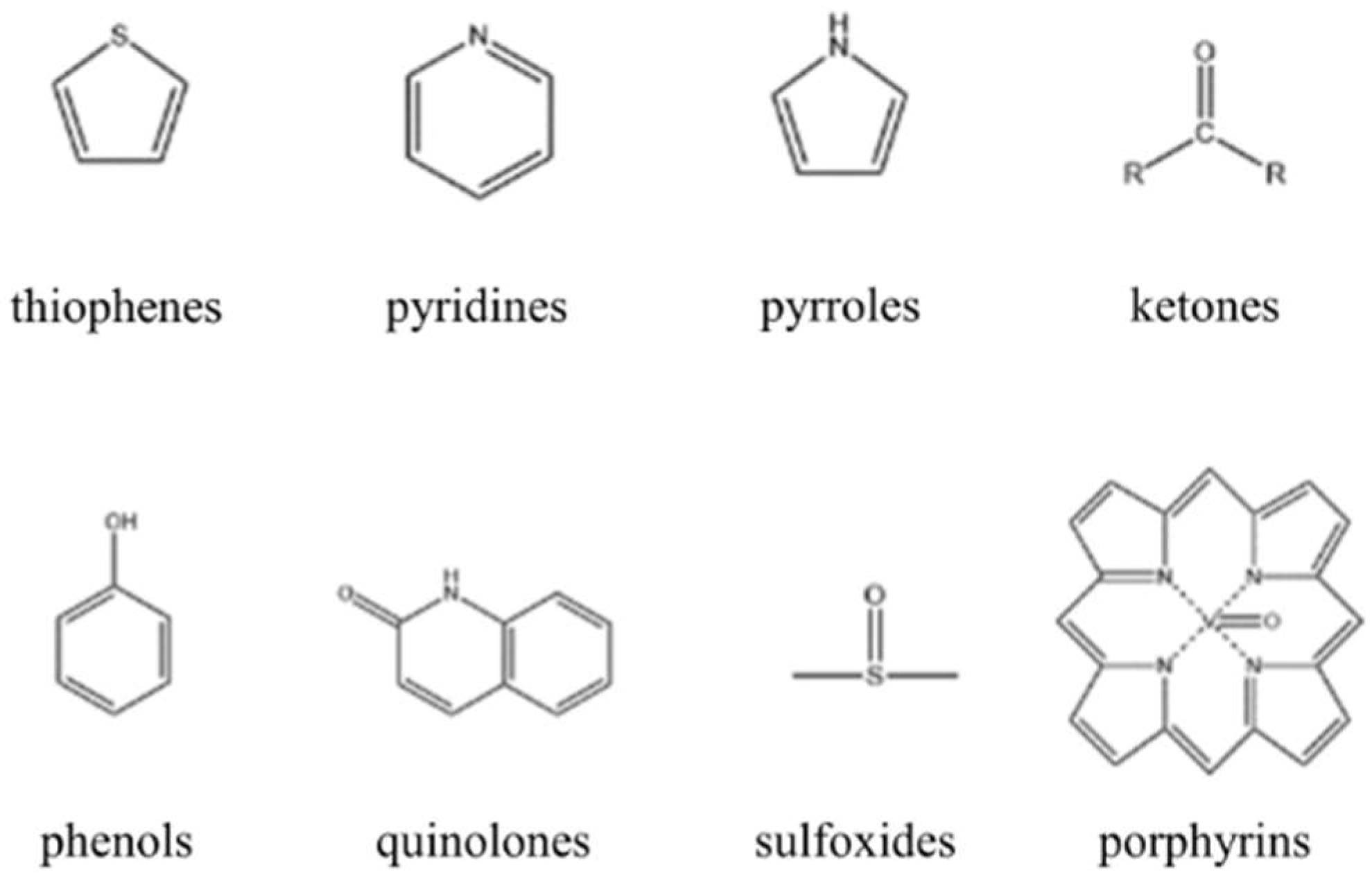
Chemically, asphalt is a complex mixture primarily composed of carbon (80%~88%) and hydrogen (8%~12%). It also contains sulfur (0%~9%), oxygen (0%~2%), nitrogen (0%~2%), as well as trace amounts of metals such as nickel, iron, vanadium, and manganese [10,11,12,13]. Asphalt primarily contains aliphatic compounds, aromatic compounds, or a combination of both [3,14]. Other elements present in lower amounts combine with these compounds to form heteroatomic compounds with various functional groups. Sulfur exists in the form of sulfides or dibenzothiophenes [15]. Alkaline nitrogen exists in the form of pyridine, while non-alkaline nitrogen exists in the form of pyrrole [2]. When asphalt undergoes oxidation, it introduces oxygen elements and forms new heteroatomic compounds. Benzyl groups are prone to oxidation to ketones, and further oxidation can lead to the formation of carboxyl groups and even anhydrides [10]. Oxygen atoms also exist in the form of phenols, quinones, and sulfoxides. Metal elements are often present in the form of porphyrins [16]. Figure 2 illustrates common compounds and characteristic functional groups found in asphalt. Due to the complex composition of asphalt, its compounds are often categorized into different fractions based on their properties, including molecular size, ionic nature (acidic, basic, or amphoteric), and polarity.

2.2. SARA Fractions (Saturates, Aromatics, Resins and Asphaltenes)

2.2.1. Basic Properties of SARA Fractions

Corbett’s SARA separation method is the most commonly used technique for separating compounds in asphalt based on their polarity differences. This method uses solvent precipitation and chromatographic column techniques to separate asphalt into asphaltenes, resins, aromatics, and saturates [17]. The four fractions mentioned above are referred to as SARA fractions. The properties of the SARA fractions are presented in Table 1 [10,11,18,19,20].
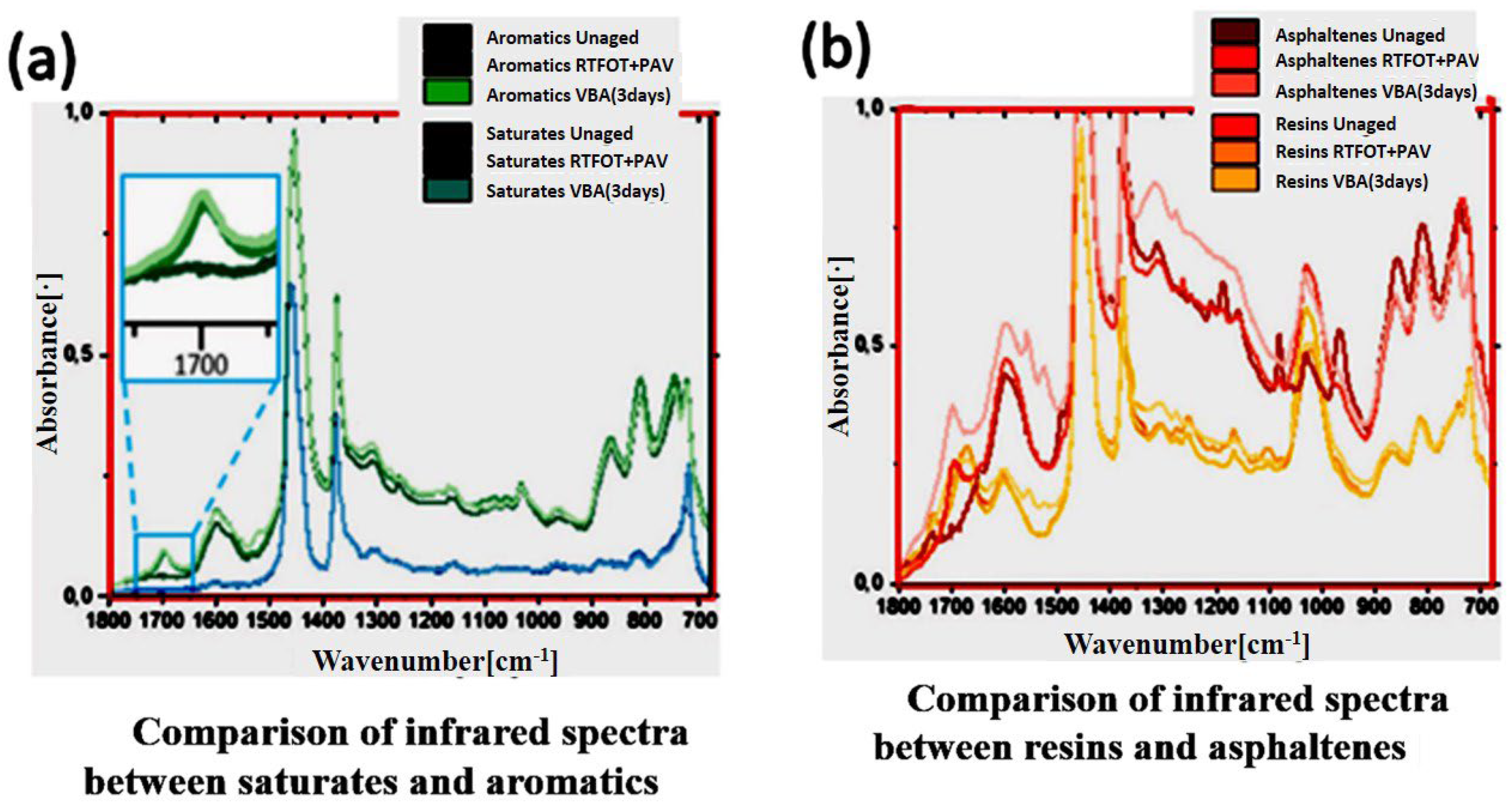
The aromatics and saturates exhibit similar Fourier-transform infrared (FTIR) spectra, indicating that they have similar covalent bonds or functional groups. The differences in peak intensities in their spectra suggest variations in the content of these similar bonds or functional groups. Figure 3a demonstrates that aging leads to a notable rise in the carbonyl peak (at wavenumber 1700 cm−1) and sulfone peak (at wavenumber 1030 cm−1) within the aromatics. This suggests that oxidative aging affects the aromatic fraction more than the saturate fraction.
The resins and asphaltenes are the polar fractions. Resins contain a significant number of ketone functional groups (Figure 3b). Asphaltenes molecules primarily consist of island-type structures (typically consisting of 4 to 10 aromatic rings). Sabbah et al. [22] utilized two-step laser desorption-ionization mass spectrometry (L2MS) to characterize asphaltenes. Their findings revealed that under high-power laser irradiation, archipelago-type compounds undergo single-molecule decomposition.

2.2.2. Correlation Between SARA Fractions and Rheological Properties

Robertson et al. [23] conducted a study on the correlation between chemical composition and rheological properties of asphalt. They found that polar molecules play a significant role in the elasticity of asphalt materials, whereas nonpolar molecules primarily affect viscosity. Dealy [24] studied how the ratio of asphaltenes to maltene affects the rheological properties of asphalt. The results showed that as the asphaltenes content increased, the asphalt viscosity also increased significantly. Conversely, an increase in maltene led to a significant decrease in viscosity. In the study by Sultana and Bhasin, a similar pattern was observed. They found that the modulus of asphalt increased with an increase in the content of polar components, particularly influenced by the presence of asphaltenes [25]. Eberhardsteiner et al. [26] proposed a micromechanical model to predict the viscoelastic behavior of asphalt based on the rheological properties of SARA fractions. The model’s predictions showed good agreement with the experimental data.
However, methodological variations and any inconsistencies should be carefully considered when comparing findings from various investigations of the relationship between chemical composition and rheological characteristics. For example, SARA separation results for bitumens from various sources show intrinsic heterogeneity, despite numerous studies confirming the main influence of polar components (especially asphaltenes) on elastic modulus. Additionally, the definition and quantification of components are direct.
This might lead to inconsistent reported relationships between rheological parameters and the “colloidal index (IC)” or “asphaltic index (IA)” across investigations using various separation procedures. Some of the research listed in Table 5 investigated rheological parameters only in the linear viscoelastic (LVE) domain, suggesting that these correlations might not apply directly to the high-strain, nonlinear conditions frequently encountered in real paving. This restriction underscores how insufficient it is to construct universal “structure-property correlations” based solely on LVE parameters. Non-linear viscoelastic (NLVE) characterization should be used.
Among the four fractions, saturates have the weakest polarity, while asphaltenes have the strongest polarity, with aromatics and resins falling in between. Asphalt oxidation aging increases the amount of polar components in asphalt. The content of saturates remains consistent before and after asphalt aging, while aromatics and resins decrease, and asphaltenes content increases. This is because, as asphalt ages, the number of functional groups, such as sulfoxides, in aromatic components and resins increases. This causes aromatic components with higher polarity or molecular weight to be categorized as asphaltenes [11,26,27]. As a result, aged asphalt typically has lower flowability compared to the original asphalt.

2.2.3. Waxes

Wax, as a special component, has similarities in chemical composition and properties with the saturates. It typically makes up less than 5% of asphalt used for roads but significantly affects its rheological properties [28]. Wax in asphalt can be defined in various ways, and this paper distinguishes it into macrocrystalline wax and microcrystalline wax.
Macrocrystalline wax (typically containing 24 to 40 carbon atoms) is composed of n-alkanes with few or no side chains [29,30]. It forms a uniform, ordered, periodic crystalline structure, which gives it strong shear resistance but poor plasticity. The main type of wax found in asphalt is microcrystalline wax (typically with more than 40 carbon atoms). It is composed of isoalkanes and cycloalkanes, which make it difficult for the wax to form a consistent, organized crystalline structure. This lack of uniformity leads to improved plasticity [31]. When the temperature falls below the wax’s melting point, the wax will crystallize, grow, and interconnect to form a network-like structure. This structure surrounds and adsorbs other components of the asphalt, making it less fluid and more deformable, thereby diminishing its low-temperature performance [32,33,34]. However, in the high-temperature environment of asphalt production and mixing for pavement laying, wax behaves as a low-viscosity Newtonian fluid, reducing asphalt viscosity. Additionally, wax exhibits good compatibility with asphalt [35]. Therefore, despite the various adverse effects of wax on asphalt, in recent years, research has also focused on using wax as an additive to improve asphalt rheological properties and facilitate the development of warm-mix asphalt technology. The petroleum waxes mentioned above have large, flat plate-like crystals that can negatively impact the adhesion between asphalt and aggregates. On the other hand, waxes used as additives are commonly referred to as “commercial waxes”, including synthetic waxes, mineral waxes, modified montan wax (similar to petroleum wax but with a higher molecular weight [35]), and functionalized waxes (containing polar functional groups such as amide groups, and so on [36]).
Asphalt is a chemically continuous system without distinct boundaries between its components [37]. Any separation method (for example, Ion Exchange Chromatography (IEC), Size-Exclusion Chromatography (SEC), Thin-Layer Chromatography (TLC), etc.) [2] results in components that remain heterogeneous, with different components separated under specific conditions. When conditions change, the separation results also change accordingly.

2.3. Molecular Simulation Models

2.3.1. All-Atom Simulation

Molecular Dynamics (MD) simulation is an effective tool for studying the relationship between molecular structure and function. In MD simulations, all atoms follow the laws of Newtonian motion. Interactions between atoms are constrained using force field functions. Kinetic and mechanical properties of materials are obtained using statistical mechanics and by calculating atomic trajectories and relative positions through simulations [38]. The establishment of molecular models is a prerequisite for conducting MD simulations. SHRP has proposed average models for eight different types of asphalt (AAA-1, AAB-1, AAC-1, AAD-1, AAF-1, AAG-1, AAK-1, and AAM-1) based on average molecular weight, elemental analysis, and nuclear magnetic resonance data [39]. Li et al. [40] further refined the average molecular models of AAA-1, AAK-1, and AAM-1 based on asphalt’s SARA fractions and 12 typical molecular models. The improved AAA-1 model shows a density close to that of AAA-1 asphalt, differing by 0.06 g/cm3. This provides a more reliable model for establishing the connection between asphalt chemical composition and rheological properties. You et al. [41] employed a 12-component all-atom model to predict the rheological properties of asphalt at the microscale. The results demonstrated a good agreement between the simulated viscosity and laboratory data.
Additionally, as the temperature increased, the simulation results closely approximated the experimental data. Kang et al. [42] used full-atom MD simulations to investigate the glass transition of asphalt. They concluded that asphalt undergoes a transition from viscoelasticity to a Newtonian fluid state at 400 K. Given the intricate nature of asphalt systems, it is presently unfeasible to construct asphalt models that precisely replicate real conditions. Furthermore, cumulative errors may arise during simulations. Therefore, it is essential to validate simulation results with experimental data.

2.3.2. Coarse-Grained Simulation

The coarse-grained model simplifies atom interactions, providing a lower resolution than the full-atom model. However, it enables more efficient long-term mesoscale simulations. Standard mesoscale simulation methods for modeling asphalt molecule behavior include coarse-grained molecular dynamics (CGMD), Monte Carlo (MC) methods, and dissipative particle dynamics (DPD) [43]. Li et al. [44] constructed a coarse-grained asphalt model suitable for CGMD and explored the aggregation behavior of asphalt molecules employing the Martini force field. The simulation results showed significant changes in diffusion coefficients across different temperatures, spanning several orders of magnitude, consistent with the viscoelastic behavior of asphalt. Aguilera-Mercado et al. [45] employed the (MC) method to investigate the aggregation behavior of asphaltenes and resins in crude oil. Compared to the methods mentioned above, DPD is capable of simulating large, complex colloidal systems and is better suited for asphalt-related research. This method maps multiple atoms into a single bead based on the structure of the all-atomic model. It calculates interaction parameters between beads using Flory–Huggins parameters and maintains the rigidity of the aromatic system by setting average bond lengths and spring constants. Guan et al. [38] employed the DPD method to explain the self-assembly behavior of polycyclic aromatic hydrocarbon systems within heavy petroleum. Tang et al. [46] utilized the DPD method to investigate the compatibility between SBS modifiers and asphalt. The simulation results provided molecular-level insights into the modification mechanism, demonstrating good agreement with rheological experiments.
Given the intricate nature of asphalt systems, it is presently unfeasible to construct asphalt models that precisely replicate real conditions. Furthermore, cumulative errors may arise during simulations. Therefore, it is essential to validate simulation results with experimental data [47,48].

3. Microstructure

3.1. Intermolecular Interactions

Intermolecular interactions in asphalt cause molecules to bond together, forming a network structure. The strength of these bonds affects the viscosity and hardness of asphalt, making it a crucial factor in its rheological properties [14,49]. Typical intermolecular interactions in asphalt systems are summarized in Table 2.
The intermolecular interactions mentioned above not only dictate the form of asphalt and its fractions (especially asphaltenes) but also determine the molecular behavior and microstructure within asphalt. The intermolecular interactions in asphalt restrain certain molecules, giving asphalt its elastic characteristics. When relatively free molecules overcome these constraints and begin to move, asphalt exhibits its viscous characteristics. Functional groups within asphalt compounds also contribute to the intermolecular network binding. Asphaltenes, containing nearly all functional groups present in asphalt, thus have the strongest binding capability [51,52,53]. Furthermore, temperature influences the establishment of a new equilibrium in intermolecular interactions. At low temperatures, asphalt molecules with lower energy tend to form tighter network connections. Conversely, higher temperatures provide asphalt molecules with greater kinetic energy, allowing them to break free from these constraints and move more freely, resulting in a less compact network structure [2].

3.2. Supramolecular Structures

While characterizing the exact strength of intermolecular forces in asphalt systems remains difficult, it is clear that the properties of asphalt materials are influenced not only by individual molecule properties but also by the aggregation states formed through intermolecular interactions, i.e., the supramolecular structures consisting of covalent bonds and intermolecular interactions. Molecular interactions are considered the key determinants of the behavior of supramolecular structures. These interactions are highly sensitive and fragile when exposed to external factors such as temperature and loading [54]. Cho et al. [55] established a supramolecular assembly model for asphalt based on a solvent-solute system using the host-guest system from supramolecular chemistry. In this model, host molecules act as the solvent and guest molecules act as the solute. Together, they form the preorganized supramolecular body (PSB). PSBs can explain some fundamental rheological properties of asphalt. External actions, such as stirring or shearing, can disrupt PSBs, leading to deformation of the asphalt. PSBs with dipole–dipole interactions contribute to the viscosity of asphalt, while those with π-π interactions enhance the ductility of asphalt. The mutual adhesion between PSBs allows for self-assembly, resulting in the formation of supramolecular structures. The PSBs will assemble into two types of structures: one is an irreversible structure with chain-like or linear morphology containing strong covalent bonds, while the other is a reversible structure with certain sliding ability.
The asphalt supramolecular model primarily explains asphalt’s fundamental rheological properties through intermolecular interactions. However, due to current limitations in characterizing intermolecular interactions, this model remains largely conceptual. When explaining the rheological properties of asphalt under complex conditions, researchers often turn to another higher-scale model, the colloidal structure. This model is also based on a solvent-solute system.

3.3. Early Stage Colloidal Structure

In 1923, based on the characteristics of the Tyndall effect, Brownian motion, and the inability of asphaltene solutions to pass through a semipermeable membrane, Nellensteyn proposed the colloid structure of asphalt [56]. Mack conducted further research into the colloidal structure of asphalt. He proposed that asphaltene constituted the dispersed phase, while the resin-oil mixture served as the dispersed medium [57]. In 1940, Pfeiffer introduced a new colloidal structure model for asphalt, building upon previous findings. This novel structure is centered on asphaltene, with soluble components adsorbed on its surface or within its interior, forming micelles. In micelles, the maltenes with the highest molecular weight and strongest aromaticity encapsulate the asphaltenes, while these maltenes are surrounded by other maltenes with lower molecular weight and aromaticity until reaching the inter-micellar phase [58]. Based on the content of each fraction in asphalt and its rheological properties, asphalt can be classified into the following structures: (1) Sol Structure: When there is a sufficient amount of oil and resins, asphaltene clusters are completely dispersed and can move freely within a viscosity permissible range. The rheological behavior resembles that of a Newtonian fluid. (2) Gel Structure: When the amount of oil and resin is low, and the asphaltene content is high, the concentration of asphaltene clusters increases, forming an irregular network structure. The rheological behavior is that of a non-Newtonian fluid. (3) Sol–Gel Structure: Most pavement asphalts belong to the sol–gel structure, which is an intermediate state between sol and gel structures [59]. In the sol–gel structures, the asphaltene content is moderate, and there is an appropriate amount of resin to maintain colloid stability. The rheological behavior exhibits viscoelasticity.
The interaction and aggregation of asphaltene micelles are important factors determining the colloid type and influencing the rheological properties. Gaestel et al. [60] introduced the colloid index IC to describe the degree of colloidization, which is expressed as shown in Equation (1).
I C = x a s p h + x f l o c x s u r f
In Equation (1), xi represents the mass of various fractions in asphalt, asph represents asphaltene, floc represents flocculant, referring to components in the maltenes that cause asphaltenes flocculation, and surf represents surfactant, referring to components that generate surface activity and promote asphaltenes dispersion. For SARA fractions, Equation (1) can be rewritten as:
I C = x A s p h a l t e n e s + x S a t u r a t e s x R e s i n s + x A r o m a t i c s
As I C increases, colloidal stability decreases. The I C of road asphalt is typically between 0.5 and 2.7. When I C > 1.2, asphalt exhibits typical gel-like structural characteristics, with high stiffness and an elastic network. When I C < 0.7, it exhibits typical sol structural characteristics [11,61]. In general, aging will gradually transform the sol–gel structure of asphalt into a gel structure, leading to an increase in I C . Li et al. [62] found that although some asphalts had similar I C , they displayed different levels of I C reduction after aging. This indicates that even though these asphalts have similar colloid structures, their resistance to aging may differ.
In addition to the colloid index I C , the asphaltene index IA (Equation (3)) can also be used to describe colloidal stability [63].
I A = x A s p h a l t e n e s + x R e s i n s x S a t u r a t e s + x A r o m a t i c s
The methods mentioned above all incorporate asphaltenes as a critical factor, since micelles are dispersed in the maltenes, with asphaltenes at their cores. The flocculation ratio-dilution method (Equation (4)) is also employed to assess colloidal stability. This method offers a simpler experimental procedure, as it eliminates the need to separate asphalt fractions [64].
P = P 0 1 P a
where Pa represents the degree of anti-flocculation, which refers to the difficulty of asphalt being dissolved and dispersed in soluble solvents; a smaller value indicates that asphalt is more difficult to form a stable colloidal structure. P 0 denotes the ability of the solvent to disperse the asphaltenes, i.e., the solvent’s capacity to dissolve asphaltene. P represents a comprehensive indicator of the colloidal state of asphalt, with higher values indicating a more stable colloidal structure that is less prone to flocculation [64].

3.4. Modern Colloidal Structures

3.4.1. Asphaltene Micelles

With advances in experimental methods, more precise descriptions of colloid structures have emerged. X-ray, small-angle scattering, and neutron small-angle scattering studies have shown that asphaltenes will form micelles in organic solvents, crude oil, and asphalt [65,66,67,68,69,70,71]. Yen et al. [72] proposed the Yen model, suggesting that asphaltene molecules aggregate into micelles driven by π-π interactions or weak covalent bonds. In the Yen model, multiple aromatic layers stack parallel to each other and are surrounded by extending aliphatic chains. Asphaltene micelles can further aggregate into supermicelles, clusters, and flocs. Wang et al. [73] used transmission electron microscopy (TEM) to observe the microstructure of asphaltene. Asphaltene exhibited two forms under TEM, namely, needle-like and plate-like structures. At higher resolutions (10 nm), both forms displayed a highly ordered layered structure, indicating the presence of a crystalline structure in asphaltene, consistent with the Yen model.
Mullins revised the Yen model in 2010 based on previous research findings. The modified Yen model suggests that asphaltene molecules form two levels of aggregation: nanoclusters and clusters. The asphaltenes are in a dispersed state in a low-concentration asphaltene solution. As the solution concentration increases, dimers, trimers, and other oligomers begin to appear. When the concentration of the asphaltene solution reaches a certain level, the additional asphalt molecules aggregate to form new aggregates. The newly formed aggregates remain relatively constant in size and number. At this stage, they are referred to as nanoaggregates. As the concentration of the asphaltene solution increases, the nanoaggregates come closer together to form clusters (<30 nm) and even flocculate (>300 nm) [31,74,75]. The shape, size, and stability of aggregates are significantly influenced by temperature, solution concentration, and the source of asphaltenes, which in turn affect the colloidal structure of asphalt.

3.4.2. Correlation Between Colloidal Structures and Rheological Properties

The proposal and modification of the Yen model provide strong evidence for explaining the rheological properties of asphalt and offer a clearer description of the transition process between colloidal structures.
Lesueur et al. [76] studied the relationship between asphalt’s linear viscoelastic properties and its internal structure. The study found that the Newtonian fluid behavior of asphalt at high temperature is caused by the Brownian motion of colloidal particles, which can be fully described by zero shear viscosity and temperature dependence. When the asphalt is at a lower temperature, longer loading time, or higher loading frequency, the viscosity of the maltenes increases and hinders the diffusion of the asphaltene micelles, so that the asphalt exhibits elasticity. This transition from Newtonian fluid behavior to viscoelasticity is called α relaxation [11]. The elastic behavior of asphalt becomes more significant as the temperature decreases, eventually exhibiting glassy elasticity. This process is known as β relaxation. Although the main reason for this phenomenon is the solute undergoing a glass transition, the interaction between micelles also plays an important role, as it is inversely related to the relaxation rate and asphaltenes content [27].
Aging leads to the transformation of non-polar fractions into polar groups, thereby altering the original colloidal structure. The change in colloidal structure is reversible with the aid of additives; that is, the aged asphalt can reconstruct its colloidal structure with the help of additives (rejuvenators [77], warm-mix agents [78], etc.), bringing its rheological properties closer to those of the original asphalt. Filippelli et al. [78] combined the inverse Laplace transform with nuclear magnetic resonance relaxation times to calculate P(T2), which represents the probability density function (a function that describes the structure of substances). By comparing the relaxation times of original asphalt, aged asphalt, and aged asphalt with warm mix additives, it was observed that the additives effectively extended the relaxation times of various fractions in the asphalt. This indicates that additives reconstructed the colloidal structure of aged asphalt, making it more fluid, but they could not restore the light fraction lost during the aging process.
Colloidal structure models explain why asphalt exhibits rheological properties and provide a theoretical foundation for the relationship between its chemical composition and rheology. As illustrated, the transition from sol-type to sol–gel-type, and ultimately to gel-type structures, is accompanied by a shift in micelles from a dispersed state to a continuous network. This structural evolution directly leads to systematic changes in macroscopic rheological parameters: the complex modulus and viscosity increase significantly, while the phase angle decreases (i.e., enhanced material elasticity). This theory links the increase in colloidal index, chemical composition changes due to ageing, and the resulting mechanical property hardening, providing a clear physical picture for understanding processes such as ageing and modification.

3.5. Bee Structure

3.5.1. Morphology of Asphalt Under Atomic Force Microscopy

Asphalt is a heterogeneous multiphase material with a complex microstructure [79]. Understanding the origin, chemical composition, and mechanical properties of asphalt’s microstructure helps further elucidate its rheological characteristics. Currently, various optical and electron microscopy techniques, such as scanning electron microscopy, environmental scanning electron microscopy, fluorescence microscopy, and atomic force microscopy (AFM), are commonly used to investigate the microstructure of asphalt materials. In contrast to other observation techniques mentioned above, AFM not only provides the ability to capture the microstructure of samples at sub-nanometer resolution but also allows for the quantitative assessment of mechanical properties, including modulus and deformation [80], which is more conducive to the construction of the correlation between the microstructure and rheological properties of asphalt.
In 1996, Loeber et al. [81] were the first to utilize AFM to observe the “bee structure” of gel-type asphalt. Masson and co-workers [82] used a combination of AFM and phase-contrast microscopy to investigate the structure and behavior of asphalt at low temperatures, categorizing AFM-imaged asphalt into three phases: Catanaphase, Periphase, and Paraphase.
In addition to the typical bee structure, AFM also observed other structures. Across different asphalts and sample preparation methods, dendrite structures, flower-like domains, flake-like domains, and other microscopic morphologies can be observed (Table 3).
However, there is no consensus on the origin of asphalt’s bee structure, which is mainly divided into three viewpoints: asphaltenes [86,87], trace metals in asphalt [82], and crystalline waxes [88,89,90].
These contradictory theories about the structure’s origin highlight the shortcomings of the characterization methods used today. It is challenging to perform non-destructive in situ chemical characterization of specific microdomains, as atomic force microscopy (AFM) primarily provides surface topography information. As a result, based on sample parameters (e.g., high wax or high asphaltene concentration) and observed topographical correlations, various study teams may propose different dominant mechanisms. This discrepancy also raises the possibility that honeycomb patterns are a collective surface expression of phase separation and aggregation behaviors across several ingredients rather than the result of a single chemical component. To settle this dispute, AFM must be more widely integrated with supplementary methods that can provide chemical information, such as AFM-IR, to directly establish it.

3.5.2. Correlation Between Bee Structure and Rheological Properties

As outlined in Section 3.5.1, AFM has revealed diverse microscopic morphologies on bitumen surfaces, including honeycomb, dendritic, and floral structures. However, owing to the “honeycomb structure’s” most pronounced characteristics and the overwhelming focus of existing research on its correlation with macroscopic rheological properties, this section will primarily review findings on honeycomb structures. The rheological significance of other morphologies remains to be elucidated by future studies.
Many research teams have employed AFM to study the mechanical behavior of different phases of the bee structure [59,91,92,93,94]. This imaging can be described as follows: the Catanaphase, composed of asphaltenes, is surrounded by the Periphase, consisting of resins and aromatics, and dispersed within the Paraphase, composed of saturates. This is consistent with modern theories of asphalt colloid structure, further supporting the validity of using colloid structure models to explain asphalt rheological properties. In the study by Dourado et al. [92], it was observed that the overall elastic modulus of the honeycomb structure is lower than that of the phase gaps, and the elasticity recovery of the bee structure is highly dependent on the colloidal structure of asphalt. Zhang et al. [95] obtained different derived asphalts by blending the SARA fraction content of asphalt, and studied the micro-morphology and micro-rheological properties of the samples by AFM. The results show that the number of bee structures in asphalt is related to the asphaltenes content. The storage modulus and loss modulus increase with the increase in asphaltenes and resins content and decrease with the increase in saturates and aromatics content, which is consistent with the results obtained from the dynamic shear rheometer (DSR) test.
The effect of aging on the rheological properties of asphalt is also reflected in AFM imaging. Asphalt tends to form more small bee structures with lower peaks after aging. These small bee structures tend to aggregate and may even form cracks [62]. Xing et al. [96] obtained the distribution of functional groups before and after aging of asphalt at the nanoscale using AFM-based infrared spectroscopy (AFM-IR; chemical analysis can be performed at the resolution of AFM). Ganter et al. [97] found that, compared with unaged asphalt, the AFM images of short- and long-term-aged asphalt showed more bee structures, and the moduli of each phase changed significantly.

3.6. Summary

In conclusion, the colloidal network structure is determined by the strength of intermolecular contacts, and its properties directly translate into quantifiable rheological parameters. From colloidal structure to interactions: Bituminous nano-aggregate formation and stability are determined by the strength of intermolecular forces in bitumen, such as hydrogen bonding and π-π stacking. By affecting colloidal indices (such as IC), the total of these forces ultimately decides whether bitumen displays a sol, sol–gel, or gel structure. Age-related increases in polar functional groups, such as carbonyl groups, for example, improve intermolecular polar contacts and encourage the transformation of resins and aromatics into bituminous components. IC rises as a result, and the structure becomes more gel-like.
The type and strength of the colloidal structure directly govern macroscopic rheological responses. A reinforced gel network implies greater structural rigidity and stronger constraints on molecular motion. Interactions and aggregation behaviours at the microscopic level are “materialised” through the mesoscopic scale of the colloidal structure, ultimately captured by dynamic shear rheometers (DSR) as specific parameters such as |G*| and δ.
Among these: Complex modulus |G*|: Characterizes the material’s overall resistance to deformation. Stronger colloidal networks provide a more robust framework to resist shear, directly leading to higher |G| values.
Phase angle δ: Reflects the ratio of viscous (dissipative) to elastic (storage) response. Within gel structures, deformation induces reversible elastic deformation of the network rather than irreversible viscous flow; hence, δ diminishes. The commonly observed increase in |G*| and decrease in δ following aging precisely manifests the macroscopic manifestation of microstructural gelation.
Relaxation behavior: α-relaxation correlates with the glass transition and corresponds to large-scale cooperative motion of colloidal network units. A denser gel network significantly prolongs its relaxation time. β-relaxation relates to more localized molecular motion (e.g., movement of small-molecule components) and is less directly influenced by the network structure.
Viscosity: As a measure of flow resistance, viscosity increases sharply with enhanced interaction strength and network connectivity within the colloidal network. This explains the marked viscosity increase observed in high-asphalt-content or aged bitumens.

4. Rheological Properties of Asphalt Under Dynamic Shear Loading

Asphalt exhibits a range of rheological properties, including viscoelasticity, shear thinning, and thixotropy [98]. Various microscale studies can help elucidate the rheological mechanisms of asphalt and provide a theoretical basis and direction for its modification. However, these methods often have strict requirements for instruments and the environment, and cannot directly reflect asphalt performance.
Therefore, a series of research methods for asphalt rheological properties based on dynamic mechanics and quasi-static mechanics has also been developed. Among them, the dynamic mechanical analysis method measures the material’s mechanical response by applying a periodically varying stress or strain. When the vehicle passes through a specific point on the asphalt pavement, the point can be regarded as bearing a load with a minor frequency. At the same time, due to the unevenness of the asphalt pavement, wheel loads induce vertical vibration and localized impacts on the pavement. The complex dynamic mechanics between the vehicle and pavement can be simulated by superposing multiple simple steady shear loads. Hence, it is more practical to study the rheological properties of asphalt by the dynamic mechanics analysis method.

4.1. Linear Viscoelasticity

Over five years, SHRP conducted a series of studies and established a comprehensive set of methods for grading and evaluating asphalt performance. One of SHRP’s key recommendations was the utilization of DSR testing to test the dynamic viscoelastic properties of asphalt binder under dynamic shear loading [99]. The main output parameters of the DSR test are dynamic modulus and phase angle. The dynamic modulus characterizes the ability of viscoelastic materials to resist deformation, that is, the elastic part of asphalt. The phase angle characterizes the time lag in the response, representing the viscous part of asphalt [100].
In the 1950s, Van der Poel developed a nomogram for asphalt based on penetration and softening-point test results, and determined the stiffness modulus of asphalt as a function of loading process, frequency, and temperature [101]. However, a nomogram cannot effectively characterize the viscoelasticity of modified asphalt [102]. At the same time, with the development of modern computer technology, to better describe the dynamic viscoelastic mechanical characteristics of asphalt materials, researchers established functions of asphalt viscoelasticity as a function of frequency, temperature, and strain. These viscoelastic mechanical models are mainly divided into empirical algebraic models and mechanical element models.
Viscoelasticity is the most prominent rheological behavior of asphalt. It is generally believed that the strain produced by asphalt under vehicle loading is linear viscoelastic, but under high temperature and heavy loading, the asphalt strain far exceeds its linear viscoelastic region [103,104]. Therefore, research on the viscoelasticity of asphalt is primarily divided into two categories: linear viscoelasticity (LVE) and nonlinear viscoelasticity (NLVE). The methods of dividing linear and nonlinear viscoelastic regions are mainly done in two ways: (1) Linear and nonlinear viscoelastic regions in asphalt are defined by the transition point in the stress or strain sweep curves from the plateau to the descending region [105]. (2) Linear and nonlinear viscoelastic regions are divided according to the decrease in dynamic modulus to 95% of the initial modulus [3].

4.1.1. Time–Temperature Superposition Principle

Throughout the entire lifecycle of asphalt materials, they experience a wide range of temperature and frequency loads. However, existing testing equipment and methods are challenging to replicate such broad testing conditions [4]. The time–temperature superposition principle (TTSP) states that the mechanical behavior of viscoelastic materials under long-term (or low-frequency) loading can be approximated by short-term (or high-frequency) tests at higher temperatures (or loading frequencies) [11]. In general, the TTSP is also applicable to asphalt materials [106,107]. Based on the TTSP, data measured at different temperatures (within the same testing frequency range) can be shifted appropriately relative to a reference temperature to form a continuous, smooth curve, known as the master curve. The master curve is a function that characterizes a material’s viscoelasticity and depends on factors such as temperature, frequency, and strain. It serves as a tool for studying the viscoelastic properties of asphalt materials over a wide temperature and frequency range.
The master curve constructed from the TTSP must use the temperature-shift function to calculate the shift factor α(T). As shown in Equation (5), the shift factor is multiplied by the frequency to obtain the reduced frequency ξ of the master curve.
ξ = f ( a T )
The shift factor plays an important role in constructing the master curve. At present, the methods for calculating the shift factor mainly include: numerical methods (no functional form shift factor), the WLF equation, log-linear, quadratic polynomial, and Viscosity Temperature Susceptibility (VTS, mainly for unaged asphalt). The commonly used calculation methods are listed in Table 4.
When selecting displacement factor equations, their applicable conditions must be considered. The WLF equation is an empirical formula that is generally effective for many bitumens over a temperature range approximately Tg + 100 °C above the glass transition temperature Tg. However, it is unsuitable for regions where temperatures are close to Tg or significantly exceed its upper applicability limit. For the latter, the Arrhenius equation may prove more appropriate. The VTS method is explicitly intended for use with unaged bitumen. Different asphalts, particularly modified or high-wax varieties, may exhibit temperature dependencies deviating from these classical equations. This can cause failure or errors in master curve construction, manifesting in black plots where data points fail to overlap into a single curve. Consequently, no displacement factor model is universally applicable; its suitability must be rigorously validated by superimposing experimental data.
The methods for constructing the master curve based on the TTSP allow data comparison across different test conditions (temperature or frequency). To reduce errors caused by the calculation and use of the shift factor, Wicket diagrams [112,113], the least-squares method [114], Kramers–Kronig relations [107,115], Bueche–Rouse theory [116], and other methods are used to optimize the calculation of the shift factor. However, the TTSP is not applicable to all asphalt materials, such as asphalt with high wax content, high asphaltenes content, and some modified asphalt [11]. When constructing the master curve, it is necessary to select an appropriate model based on the material’s viscoelastic mechanical characteristics. The viscoelastic properties of asphalt materials are typically categorized into two types: viscoelastic liquids and viscoelastic solids. Under dynamic loading with sufficiently low frequencies, the complex modulus of liquid materials approaches 0°, and the phase angle approaches 90°, while for solid materials, the complex modulus approaches a constant value, and the phase angle approaches 0° [102]. Generally, asphalt binder is regarded as a viscoelastic liquid, and a few polymer-modified asphalt binders are regarded as viscoelastic solids [4]. In addition, the master curve needs to be established in the LVE region, where the macromolecules in the asphalt material do not undergo structural rearrangement with temperature changes [117], to ensure the effectiveness of the TTSP.
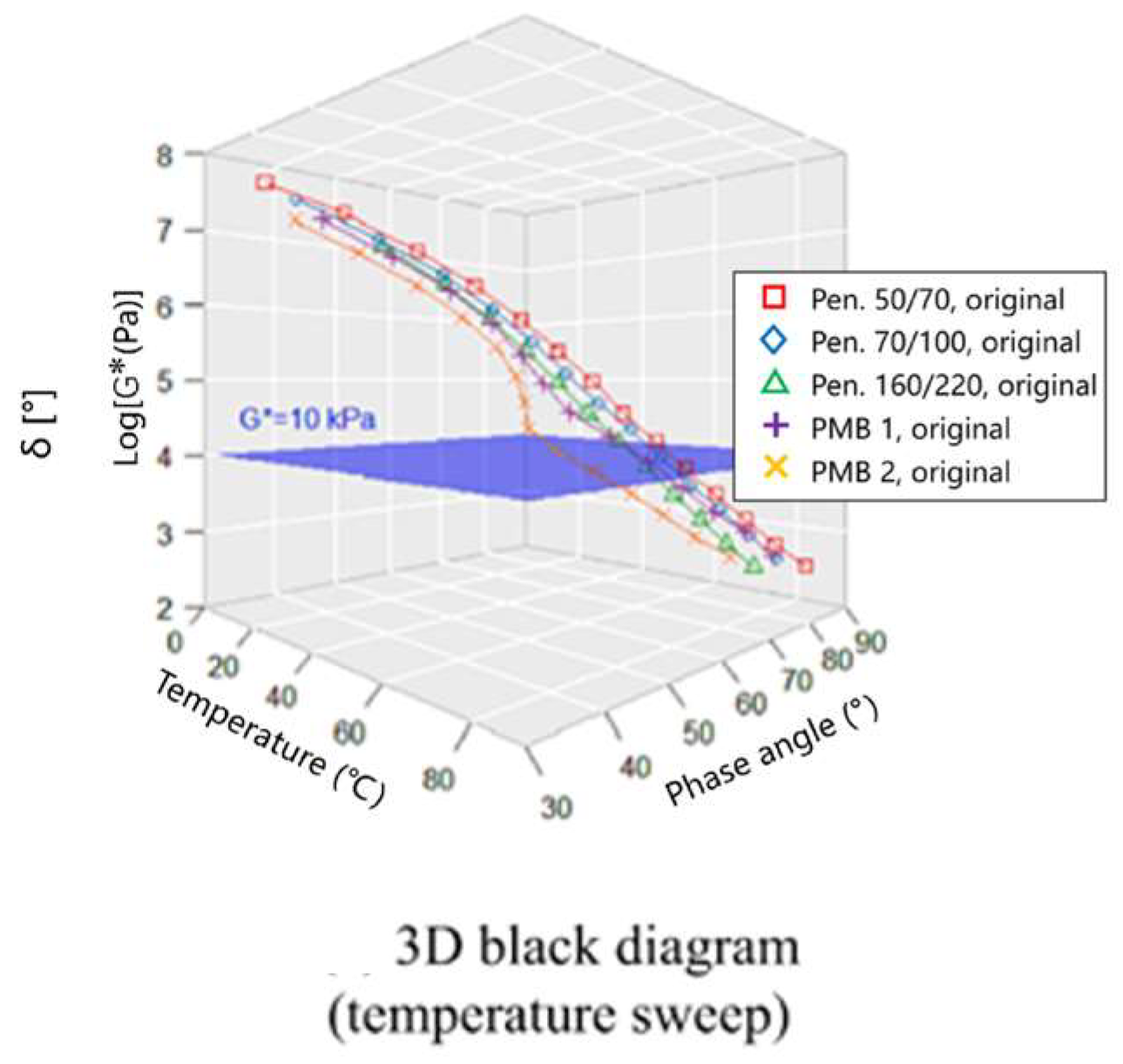
The black diagram is a rheological relationship diagram based on phase angle and complex modulus. It does not need to use the TTSP to shift the test data and can reflect the original data characteristics. Therefore, the validity of the TTSP is often judged by the shape of the black space diagram (Figure 4).
From a microscopic perspective, the efficacy of TTSP stems from the fact that molecular motion rates (relaxation times) at different temperatures follow the same principles of activation energy. In other words, elevated temperatures impart greater kinetic energy to molecular segments or colloidal aggregates, enabling them to overcome energy barriers and rearrange more rapidly. This effectively accelerates the relaxation process on the temporal scale. Consequently, shifting high-frequency data at elevated temperatures towards lower frequencies via a horizontal displacement factor (e.g., the WLF equation [26]) can simulate the response observed under prolonged loading at lower temperatures.
However, when asphalt’s microstructure undergoes fundamental changes within the test temperature range (e.g., wax crystallisation/melting or colloidal structure phase transitions), the activation energy for molecular motion becomes non-constant. Consequently, TTSP becomes ineffective, as evidenced by Black’s diagram, in which data from different temperatures do not overlay into a single curve. This further underscores that microstructural stability is a prerequisite for the validity of macroscopic rheological models.

4.1.2. Empirical Algebraic Models

The empirical algebraic model usually uses a concise mathematical formula to fit the master curve. The commonly used empirical algebraic models are summarized in Table 5.
When fitting the linear viscoelastic behavior of asphalt using empirical algebraic models, the selection of an appropriate model is essential based on the test data. In most instances, these models provide a good fit within specific conditions. However, it is critical to recognize that these models are not universally applicable and their validity is constrained by temperature, frequency range, and binder type. For instance, some models may not effectively characterize the LVE properties of modified asphalt at low temperatures or of asphalt with high wax content. The widely used Christensen-Anderson (CA) model and its derivatives are typically calibrated in the intermediate temperature range relevant to pavement performance and may not accurately capture behavior near the glass transition or at very high temperatures. Furthermore, these empirical algebraic models employ mathematical analytical formulas that may not inherently satisfy the fundamental Kramers–Kronig relations between the storage and loss moduli, limiting their physical basis and extrapolation reliability [4].
To describe the linear viscoelasticity of bitumen, researchers have proposed various empirical algebraic models. Among these, the Christensen-Anderson (CA) model and its variants are widely applied due to their formal simplicity and minimal parameter requirements. This model characterises the variation of the complex modulus with equivalent frequency using two asymptotes (glass and rubber moduli) and a shape parameter. However, the CA model exhibits reduced fitting accuracy at extremely low temperatures near the glass transition and at very high frequencies. The sigmoidal model, by introducing additional parameters, offers greater flexibility in fitting and is particularly suitable for modified bitumen. A comprehensive list of models is provided in Appendix A.1.

4.1.3. Mechanical Element Models

The mechanical element model investigates the dynamic viscoelastic behavior by elucidating the constitutive relationship of asphalt materials. Researchers typically employ spring elements, which adhere to Hooke’s law, to represent the material’s elasticity, and dashpot elements equipped with Newtonian fluid to represent its viscosity. These two types of mechanical elements are combined using various connection modes (series, parallel, or both) to depict the material’s mechanical behavior, and the material’s complex mechanical characteristics are described by adding or removing elements. The classical mechanical element models employed to characterize the viscoelastic properties of asphalt include the Kelvin, Maxwell, Kelvin–Voigt, Burgers, modified Burgers, generalized Kelvin, and generalized Maxwell models, among others [119,120,121]. While these classical models offer intuitive theories with well-defined physical concepts, they occasionally do not align closely with experimental findings [122,123,124,125].
In the definition of a Newtonian dashpot, for viscoelastic materials, it is assumed that they adhere to the constitutive relationship given by Equation (6). Building upon this assumption, a fractional derivative constitutive equation is introduced.
σ t ~ d α ε ( t ) d t α ,   ( 0 < α < 1 )
where σ t denotes shear stress, ε ( t ) denotes shear strain, t denotes time, and α denotes differential order.
Mechanical element models originate from the material’s constitutive relations. Whilst classical models such as Burgers offer physical intuitiveness, they struggle to accurately describe asphalt behaviour across its broad temperature and frequency domains. Fractional-order derivative models (e.g., Huet and 2S2P1D models) achieve precise characterisation of broadband viscoelastic behaviour with fewer parameters by incorporating differential operators of non-integer orders. For instance, the 2S2P1D model successfully simulates the transition from the glassy to the flow state through a combination of two springs, two parabolic elements, and a damping pot. Key parameters of these models—such as the fractional order—are closely related to the colloidal structure of asphalt, though their physical interpretation requires further elaboration. The complete model equations and parameters are detailed in Appendix A.2.
Although these mechanical element models can describe the viscoelastic properties of asphalt materials, they lack flexibility for simulating complex materials such as asphalt due to the large number of parameters [104]. In addition, these models cannot accurately describe the viscoelasticity under extreme conditions (i.e., the fitting degree of the two ends of the master curve is poor), and they also lack versatility in the face of different asphalt materials [117]

4.1.4. Correlation Between Microstructures and Rheological Properties

The rheological properties of polymers are susceptible to molecular weight distribution [126]. Themeli et al. [127] used the δ-method to determine the molecular weight distribution of asphalt based on the phase angle. The method’s validity was verified by gel permeation chromatography (GPC) results. Furthermore, they introduced the concept of aging molecular distribution displacement as a parameter to assess the aging progression of asphalt. Pipintakos et al. [128] used a variety of statistical methods to demonstrate a significant relationship between the chemical composition of asphalt and its rheological properties. Merusi et al. [129] used the multiphase filler model to explain the stress yield behavior of asphalt at low shear rates. Obviously, the rheological parameters are the bridge between the microscopic mechanism and the macroscopic performance.
Table 5 summarizes some studies on the relationship between microstructure and asphalt rheological properties, organized into two sections. (a) focuses on chemical composition and colloidal structure parameters, while (b) summarises studies correlating microstructural features with rheological properties.
Interpretation of Table 5a: This table demonstrates that the colloid index or bitumen index generally exhibits a positive correlation with the complex modulus. Interpretation of Table 5b: This table is primarily based on atomic force microscopy (AFM) observations. Studies by Soenen et al. and Li et al. both found that the dimensions, quantity, and distribution of the ‘honeycomb-like structures’ are closely correlated with variations in the asphalt’s storage modulus and loss modulus.
Table 5. (a) Correlation between microstructures and rheological properties. (b) Correlation between microstructures and rheological properties.
ReferenceFactorsMethodsFindings
(a)
Wang et al. [130]Colloid index (Ic)Characterizing various types of asphalt and their fractions using DSR to establish the relationship between colloid index and rheological parameters.The complex modulus of asphalt is significantly correlated with the colloid index, increasing with the increase in colloid index.
Siroma et al. [131]Molecular weightBased on the phase angle master curve of asphalt, the molecular weight distribution of asphalt was calculated by δ-method.The molecular weight distribution (MWD) calculated by δ-method has the same trend as the GPC test results. The molecular aggregation index (MAI) was proposed to quantify the aggregation rate of asphaltene.
Krolkral et al. [132]Molecular weightBased on the phase angle master curve of asphalt, the MWD of asphalt is calculated by δ-method. The molecular weight distribution is decomposed into four Gaussian functions, and the asphalt structure is inversely calculated by viscoelastic master curve.During the aging process of asphalt, the proportion of low molecular weight components gradually decreased, while that of high molecular weight components increased.
Paliukaite et al. [133]Chemical compositionThe strength of functional groups in asphalt was determined semi-quantitatively using Fourier transform infrared spectroscopy, and the metal content in asphalt was indirectly assessed using an organic element analyzer. The impact of chemical composition on asphalt was evaluated by comparing the changes in these parameters and the master curve before and after aging.Carbon, oxygen, and sulfur are the primary elements that significantly impact asphalt performance. The presence of heavy metals in asphalt results in reduced asphaltenes content and heightened sensitivity of sulfur to oxygen within the structure.
Weigel et al. [134]Chemical compositionThrough a variety of statistical methods to explore whether there is a relationship between the chemical composition of asphalt and its rheological parameters.There is a significant relationship between asphaltenes content and phase angle and complex modulus, but the accuracy of the established prediction model decreases above 50 °C.
(b)
Yu et al. [135]Chemical composition, Bee structureDerived asphalt was prepared by blending four groups of components of two kinds of original asphalt. Based on the AFM and DSC test results of original asphalt, SARA fractions and derived asphalt, as well as their viscoelastic properties, the relationship between chemical composition, microstructure and rheological properties was established.Increasing the asphaltenes content in the derived asphalt can approximately simulate asphalt aging. With the increase in asphaltenes content, the micelles in the asphalt gradually increase, and the transition from sol structure to gel structure is gradually realized. The higher the asphaltenes content, the higher the glass transition temperature of asphalt, and the smaller the phase angle.
Oldham et al. [136]Bee structureBy comparing the morphology and rheological parameter changes in asphalt before and after aging, as well as after the addition of rejuvenators using AFM and DSR, a connection between asphalt’s morphology and rheological properties was established.The length of bee structure is significantly related to the hardness and viscosity of asphalt, and the addition of rejuvenator will significantly affect the length of bee structure.
Soenen et al. [137]Interactions between polycyclic aromatic structuresThe size of aromatic structure was semi-quantitatively analyzed by spectral techniques, and the relationship between the interaction force between aromatic structures and the rheological properties of asphalt was established by combining the master curve.Under higher temperature or longer loading times, the viscoelasticity of asphalt is primarily influenced by its larger conjugated aromatic structure. Conversely, at lower temperatures or shorter loading times, the viscoelasticity of asphalt is notably associated with its smaller aromatic structure.
Li et al. [138]Asphaltene particle sizeEstablish a continuous relaxation spectrum using the storage modulus and loss modulus from the master curve. Then, calculate the equivalent asphalt particle size based on the longest relaxation time in the relaxation spectrum.The equivalent asphaltene particle size aeq was proposed. The longest relaxation time and equivalent asphaltene particle size of asphalt increase with the increase in aging degree.
NOTE: The rheological parameters in these works are derived from the LVE region of asphalt, and only the complex modulus at this time has a clear and precise physical meaning.

4.2. Nonlinear Viscoelasticity

4.2.1. Nonlinear Viscoelastic Characterization Methods

Under high strain or stress, asphalt is more likely to exhibit NLVE behavior [139]. Masad and Somadevan [140] developed a finite element model of the microstructure of hot-mix asphalt to investigate the impact of local strain on the strain distribution within aggregates and the binder. The findings indicate that the average binder strain is approximately 8 times greater than the overall mixture strain. The linear viscoelastic strain of certain asphalt binders is 1% [141], yet the strain amplitude in the linear amplitude scanning (LAS) test can reach 30%. This significant deviation from linear behavior in the strain amplitude during testing can potentially impact the assessment of asphalt fatigue performance due to NLVE. The simplified viscoelastic continuum damage theory (S-VECD) is commonly used to study the fatigue performance of asphalt. However, NLVE effects are rarely accounted for, thereby diminishing the accuracy of asphalt fatigue life prediction [142].
Currently, NLVE of asphalt is commonly assessed through multiple stress creep recovery (MSCR) [143], repeated stress sweep (RSS) [139], and incremental stress sweep (ISS) tests [142], with analysis using models such as the Schaper model [144], Delgadillo model [104], Narayan model [98], and others. The mechanical behavior of asphalt damage is similar to the nonlinear viscoelastic behavior, as reflected in the increase in the phase angle and the decrease in the dynamic modulus. To improve the prediction accuracy of asphalt fatigue life, Safaei et al. [142] used the LAS test to calculate the nonlinear dynamic shear modulus based on the S-VECD theory. An et al. [139] determined the NLVE strain threshold of asphalt binder using an ISS test and separated it from the damage process.
In addition to the steady-shear load-based test methods mentioned earlier, the large-amplitude oscillatory shear (LAOS) test is also used to assess nonlinear viscoelasticity [145]. This approach is not only more versatile but also more representative of the actual stresses experienced by road asphalt materials [146,147].
In a stress-controlled LAOS test, the strain-time curve of asphalt can be divided into three stages: the unstable zone, the stable zone, and the damage zone. In strain-controlled mode, the stress-time curve can be divided into two stages: the stable zone and damage zone [103]. With an increase in LAOS loading cycles, the microstructure of the asphalt material changes, leading to damage [148,149]. Therefore, it is necessary to select undamaged data for analysis of LAOS test results.
The input strain and input strain rate under the strain-controlled mode are shown as formula (7):
γ ( t ) = γ 0 sin ω t , γ ( t ) = ω γ 0 cos ω t
where γ(t) denotes the dimensionless input shear strain, γ ˙ (t) represents the input shear strain rate (in units of s−1), and γ0 denotes the strain amplitude, and ω is the angular frequency (in units of rad/s).
The corresponding output stress can be expressed by Equation (8):
σ ( t ) = σ 0 sin ( ω t + δ )
where σ(t) denotes the output stress, σ0 denotes the stress amplitude, and δ denotes the phase angle.

4.2.2. Nonlinear Viscoelastic Evaluation Methods in the LAOS Test

Unlike LVE test methods, in the nonlinear viscoelastic region of stress–strain response during LAOS testing, the stress–strain response is no longer a sine waveform, and the complex modulus loses its precise physical meaning at this point. Therefore, it is necessary to develop alternative methods to qualitatively and quantitatively analyze the NLVE of asphalt under LAOS testing. The commonly used evaluation methods are shown in Table 6.
Shan et al. [149] found that the matrix asphalt only has the first-order harmonic intensity in the LVE state, and the third-order and fifth-order harmonic relative intensity ratios appear in the NLVE state, and that the NLVE behavior of the asphalt is more significant with the increase in loading level. In the LAOS test, different control modes will have different results. For instance, in the strain-controlled mode, the third-order relative harmonic strength (I1/I3) of asphalt increases with higher strain and frequency, and decreases with lower temperature. In other words, asphalt exhibits more pronounced NLVE behavior under high-strain, low-temperature, and high-frequency conditions [157,158,159]. However, under stress-controlled mode, the NLVE of asphalt becomes increasingly pronounced under high stress, high temperature, and low-frequency conditions [149,160]. For example, in the strain-controlled mode, the Lissajous curve exhibits substantial distortion under high stress, low frequency, and low temperature, indicating a more pronounced NLVE [157,158,161]. Conversely, under stress-control mode, asphalt exhibits enhanced nonlinear viscoelasticity under high stress, low frequency, and high temperature [149].
The stress decomposition and strain decomposition method is mainly used to judge the rheological properties of asphalt, such as stress (strain) softening (hardening) and shear thinning (thickening) [149,158]. There are many classical nonlinear viscoelastic constitutive models under LAOS loading [103,145,162,163,164,165], but few researchers have applied them to asphalt materials. Padmarekha et al. [152] developed a Frame-Invariant model to fit the stress–strain curves of matrix asphalt and rubber-powder-modified asphalt under LAOS loading. Diab et al. [156] used the Bergström-Boyce model to fit the stress–strain curves of asphalt in the LVE and NLVE regions. These models can effectively capture the NLVE behaviors exhibited by various asphalt types. However, as with the aforementioned NLVE analysis methods that rely on the LAOS test, the parameters in these models often lack physical significance or fail to correlate with pavement performance. In the study by Saboo et al. [159], it was found that I1/I3 was significantly correlated with the fatigue life Nf of asphalt, and a relationship independent of temperature, aging condition, and asphalt type was established. Therefore, it is feasible to establish a relationship between the evaluation index and road performance under the LAOS test, which can be further studied in the future.

4.3. Thixotropy

Due to the combined effects of vehicle load and the external environment, fatigue failure of asphalt pavement will occur during its service life, resulting in a series of pavement issues. In many early investigations on asphalt fatigue, researchers believed that asphalt fatigue is caused by damage and is an irreversible process. The fatigue factor, cumulative dissipated energy ratio, and other indicators are proposed to evaluate the fatigue characteristics of asphalt [120,166,167,168], and a series of models are used to predict the asphalt fatigue life [120,169,170]. In fact, changes in rheological parameters during asphalt fatigue damage are not solely due to damage, but also to the coupling effects of other factors, such as thixotropy and NLVE [171,172,173,174,175].
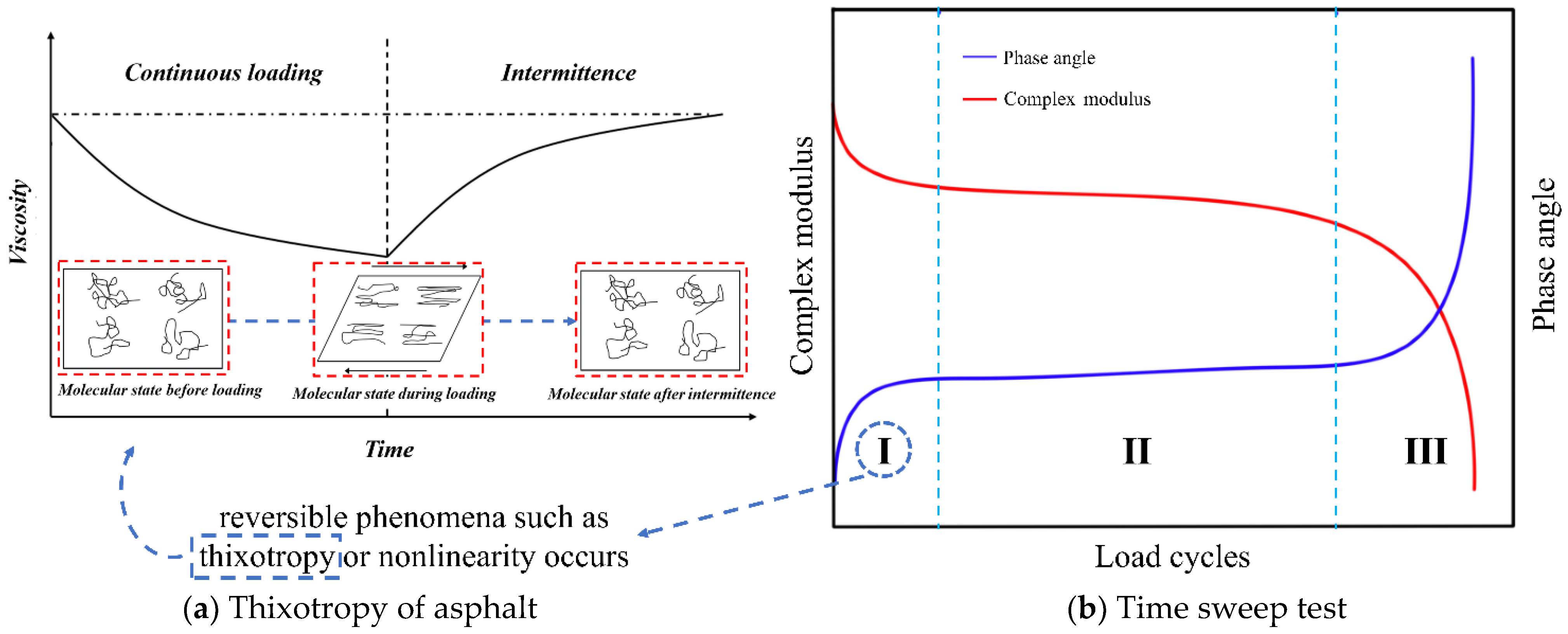
As depicted in Figure 5a, asphalt thixotropy refers to the orientation, extension, and unwinding of asphalt molecules under long-term loading, resulting in a decrease in viscosity. When the loading stops for a period of time, the asphalt molecules gradually return to the state before the load, and the viscosity gradually recovers [176].
The variation in viscoelastic parameters caused by thixotropy can be fully restored, but fatigue damage will decrease the effective area of asphalt, and the variation in viscoelastic parameters will be wholly or partially restored at a relatively low rate [177]. To enhance the precision of asphalt fatigue life prediction, researchers have delved deeper into examining the impact of thixotropy on asphalt’s fatigue characteristics. The findings indicate that fatigue-life prediction models based on damage theory tend to overestimate the extent of asphalt damage. H. Di Benedetto et al. [178] took into account the influence of thixotropy when investigating asphalt fatigue characteristics. They divided the fatigue process into three stages (Figure 5b). During the time sweep test, reversible phenomena such as thixotropy or nonlinear viscoelasticity occur in the initial stage of asphalt, leading to a rapid decrease in the complex modulus, followed by stabilization (stage 1). As loading cycles increase, the asphalt develops small cracks due to fatigue, leading to a gradual decrease in the complex modulus (stage 2). Subsequently, these cracks grow and connect, forming larger cracks leading to asphalt failure, accompanied by a rapid drop in the complex modulus (stage 3). Shan [176] and Lv et al. [172] studied the effect of thixotropy on the fatigue characteristics of asphalt, and also believed that the decrease in modulus at the initial stage was caused by thixotropy and nonlinear viscoelasticity.

5. Conclusions and Future Perspective

This study systematically reviews advances in the multiscale rheological behaviour of asphalt pavement materials, aiming to bridge the cognitive gap between their microstructure and macroscopic performance. Key consensus points, existing knowledge gaps, and priority areas for future research can be summarised as follows:

5.1. Conclusions

Current research has confirmed that bitumen constitutes a complex multiphase chemical continuum, with its macroscopic rheological properties rooted at the microscopic scale. The chemical composition, particularly the proportions and polarities of SARA components, fundamentally governs bitumen’s viscoelasticity. Polar constituents (such as asphaltenes) primarily contribute elasticity, whilst non-polar components predominantly influence viscosity. Colloidal structure theories, notably the Yen-Mullins model, provide a robust framework for explaining asphaltene nanoaggregation and its performance implications. Regarding macroscopic characterisation, dynamic shear rheometer (DSR) testing within the linear viscoelastic (LVE) region has been standardised. Master curves constructed via the time–temperature superposition principle (TTSP), alongside various empirical algebraic and mechanical element models, effectively describe asphalt’s linear response across broad temperature and frequency domains. Significant correlations exist between rheological parameters and microscopic morphologies such as the ‘honeycomb structure’ observed via atomic force microscopy (AFM), further substantiating the notion that microstructure governs macroscopic performance.
Despite the aforementioned consensus, several critical knowledge gaps continue to impede the establishment of a comprehensive structure-property relationship. Firstly, there remains a lack of universal bridging models capable of quantitatively linking intermolecular interactions, colloidal structural indices, and measurable rheological parameters (such as |G*|, δ) across micro- and macro-scales. Secondly, the understanding of non-linear viscoelasticity (NLVE) remains far from mature. Most microstructure-property correlation studies remain confined to the linear viscoelastic (LVE) regime, whilst large-amplitude oscillatory shear (LAOS) testing methods—capable of authentically reflecting complex pavement loading conditions—and their data interpretation are still in their infancy. Furthermore, existing rheological models (e.g., empirical and fractional-derivative models) frequently suffer from limitations, including insufficient universality, ambiguous physical interpretations of parameters, and inadequate descriptions of extreme conditions. Finally, no definitive consensus has been reached regarding the chemical origins of microstructural features such as ‘honeycomb structures’ or their representativeness within the bulk matrix.

5.2. Future Perspective

Future research should focus on the following areas in order to address the aforementioned challenges:
(1) Developing deeply integrated multi-scale methodologies: There is an urgent need to combine advanced molecular simulations (such as coarse-grained molecular dynamics), high-resolution chemical imaging techniques (such as AFM-IR), and macroscopic rheological measurements to establish quantitative, verifiable models spanning molecular motion to colloidal network evolution, thereby bridging the theoretical gap between scales.
(2) Establish a universal model encompassing both linear and nonlinear behaviours: Focus on developing constitutive models that can accurately describe linear viscoelasticity across a wide temperature and frequency range while effectively characterising nonlinear responses under low-amplitude oscillatory stress (LAOS). Model parameters should possess clear physical significance and be directly linked to the chemical/colloidal properties of asphalt, thereby enhancing predictive capability and universality across different asphalt types, including various modified asphalts.
(3) Enhancing Fatigue Life Prediction Frameworks: Designing novel experimental protocols and analytical theories to isolate and quantify the coupled effects of reversible non-linear viscoelastic and thixotropic behaviour alongside genuine irreversible damage during fatigue processes, thereby developing more precise asphalt fatigue life prediction methodologies.

6. Patents

Patent: Training method, component content analysis method, and equipment for component content analysis (202511720449X).

Author Contributions

Conceptualization, Q.Z. and Z.C.; methodology, X.C.; validation, Q.Z., Q.L. and Y.Y.; formal analysis, X.C.; investigation, L.H.; resources, X.C.; writing—original draft preparation, Q.Z.; writing—review and editing, Z.C.; visualization, X.C.; supervision, Q.L.; project administration, J.G.; funding acquisition, L.H. and X.C.; All authors have read and agreed to the published version of the manuscript.

Funding

This work was sponsored by Chongqing Natural Science Foundation Project, China (NO. CSTB2025NSCQ-GPX0887), and the Natural Sciences Challenge Grant Program of Chongqing Jiaotong University (XJ2023000501).

Data Availability Statement

Data are contained within the article.

Acknowledgments

The authors gratefully acknowledge all financial support.

Conflicts of Interest

The authors declare no conflicts of interest.

Appendix A

Appendix A.1

Table A1. Algebraic models.
ModelsEquationsParameters
Jongepier and Kuilman’s model [179] H ( τ ) = G g β π e x p ln τ τ m β 2 H ( τ ) : relaxation spectrum
β : width of relaxation spectrum
τ : relaxation time
τ m : mean relaxation time
Dobson’s model [117] l o g ω r σ = l o g ( G r σ 1 ) + 20.5 G r σ 230.3 ω r = η 0 ω α T / G g
G r = | G | / G g
b: shear-susceptibility index
Dickinson and Witt’s model [180] l o g G r = 0.5 l o g ω r [ ( log ω r ) 2 + 2 β 2 ] 0.5 δ ω r = 45 1 l o g ω r [ ( log ω r ) 2 + 2 β 2 ] 0.5 l o g G g = 8.88 + 0.58 β B W
β B D = l o g G g l o g G x
Christensen and Anderson (CA) model [181] G g = 1 + ( ω r ) l o g 2 R R l o g 2
δ = 90 1 + ( ω r ) L o g 2 R
R = l o g G g l o g G x
Gg: Glass transition modulus (Pa),
ω: Angular frequency (rad/s)
Fractional model [182] | G | = η 0 ω i = 1 m   ( 1 + ( μ i ω ) 2 ) i = 1 n   ( 1 + ( λ i ω ) 2 ) 1 2 ( n m )
δ = π 2 + 1 n m 1 m   α t a n ( μ k ω ) 1 n   α t a n ( λ k ω )
μ k , λ k :   relaxation   time ,   ( μ k , λ k > 0 )
n , m :   numbers   of   relaxation   time ,   ( n > > m )
α : fourier transform of the Dirac delta function
Christensen, Anderson and Marasteanu (CAM) model [183] | G | = G g 1 + ω c ω υ ω υ
s ^ = 90 ω 1 + ω c ω υ
ν = l o g 2 / R
Modified Christensen, Anderson and Marasteanu model [102] | G | = G e + G g G e 1 + f c f k m e k G e = | G | ( f 0 )
G g = | G | ( f )
Al-Qadi and co-workers’ model [184] | G | G g 1 1 1 + ( ω ω 0 ) υ
δ = 90 1 + ( ω ω 0 ) υ m
ω 0 : the scale parameter
v, m: dimensionless parameters
Polynomial model [185] l o g G = A ( l o g f r ) 3 + B ( l o g f r ) 2 + C ( l o g f r ) + D f r : reduced frequency (Hz),
|G*|: complex modulus (Pa)
Sigmoidal model [185] l o g | G | = v α 1 + e β + γ ( l o g ( ω r ) ) v : lower asymptote
α : the difference between the values of the upper and lower asymptote
ω r = 10 ( β r )

Appendix A.2

Table A2. Fractional derivative models.
ModelsEquationsParameters
Huet model [186] G = G 1 + o ( i ω τ ) k + ( i ω τ ) h ,
(0 < h < k < 1)
G : limit of the complex modulus
τ m : mean relaxation time
o: dimensionless constant
Huet-Sayegh (HS) model [187] G = G 0 + G G 0 1 + o ( i ω τ ) k + ( i ω τ ) h G 0 : elastic modulus
Di Benedetto and Neifar (DBN) model [188] G = ( 1 G 0 + i = 1 n 1 G i + i ω η i ( T ) ) 1 G 0 : elastic modulus of the single spring
η i ( T ) : a viscosity function of the temperature
2S2P1D model [189] G = G 0 + G G 0 1 + o ( i ω τ ) k + ( i ω τ ) h + ( i ω τ β ) 1 o , β : dimensionless constan

References

  1. Shen, J. Rheology of asphalt materials (part 1). Pet. Asph. 1988, 4, 35–39. [Google Scholar]
  2. Wang, Y.; Wang, W.; Wang, L. Understanding the relationships between rheology and chemistry of asphalt binders: A review. Constr. Build. Mater. 2022, 329, 127161. [Google Scholar] [CrossRef] [Scilit]
  3. Petersen, J.C.; Robertson, R.E.; Branthaver, J.F.; Harnsberger, P.M.; Duvall, J.J.; Kim, S.S.; Anderson, D.A.; Christiansen, D.W.; Bahia, H.U. Binder Characterization and Evaluation: Volume 1; Report No. SHRP-A-367; Strategic Highway Research Program, National Research Council: Washington, DC, USA, 1994. [Google Scholar]
  4. Yang, S. Research on Dynamic Viscoelastic Fractional Constitutive Model of Asphalt Binders and Mixtures. Ph.D. Thesis, Hunan University, Changsha, China, 2020. [Google Scholar]
  5. Yan, X. Rheology of Road Materials; China Communications Press Co., Ltd.: Beijing, China, 2019. [Google Scholar]
  6. Chen, Y.; Wu, Z.; Liang, J.; He, W.; Xiao, F. Method for optimizing key evaluation parameters of recycled asphalt: Based on rheology and chemistry. J. Clean. Prod. 2025, 516, 145844. [Google Scholar] [CrossRef] [Scilit]
  7. Pipintakos, G.; Sreeram, A.; Mirwald, J.; Bhasin, A. Engineering bitumen for future asphalt pavements: A review of chemistry, structure and rheology. Mater. Des. 2024, 244, 113157. [Google Scholar] [CrossRef] [Scilit]
  8. Bi, Y.; Chen, H.; Chen, Z.; Pei, J.; Zhang, J.; Luo, Z.; Wang, W.; Gao, J. A comprehensive review of rheological behaviors of asphalt binders, mastics, and mixtures from a generalized rheology perspective. Fuel 2025, 393, 134984. [Google Scholar] [CrossRef] [Scilit]
  9. Liu, J.; Feng, Z.; Wang, Z.; Guo, W.; Jing, H.; Ren, S. Multiscale characterization of rubberized asphalt performance: Coupling rheology, adhesive behavior, and nanomorphology. Constr. Build. Mater. 2025, 503, 144548. [Google Scholar] [CrossRef] [Scilit]
  10. Mortazavi, M.; Moulthrop, J.S. The SHRP Materials Reference Library; Binders; National Research Council: Washington, DC, USA, 1993. [Google Scholar]
  11. Lesueur, D. The colloidal structure of bitumen: Consequences on the rheology and on the mechanisms of bitumen modification. Adv. Colloid Interface Sci. 2009, 145, 42–82. [Google Scholar] [CrossRef] [Scilit]
  12. Domin, M.A.; Herod, A.A.; Kandiyoti, R.; Larsen, J.W.; Lazaro, M.-J.; Li, S.; Rahimi, P. A Comparative Study of Bitumen Molecular-Weight Distributions. Energy Fuels 1999, 13, 552–557. [Google Scholar] [CrossRef] [Scilit]
  13. Bai, T.; Xiang, B.; Li, M.; Manica, R.; Liu, Q. Mechanism of modification of bitumen zeta potential by sodium citrate: Interactions between bitumen metal content and ligands. Colloids Surf. A Physicochem. Eng. Asp. 2022, 653, 130007. [Google Scholar] [CrossRef] [Scilit]
  14. Robertson, R.E. Chemical Properties of Asphalts and Their Relationship to Pavement Performance; National Research Council: Washington, DC, USA, 1994. [Google Scholar]
  15. Green, J.B.; Yu, S.; Pearson, C.D.; Reynolds, J.W. Analysis of sulfur compound types in asphalt. Symp. Combust. 1993, 27, 2085–2092. [Google Scholar] [CrossRef] [Scilit]
  16. López, L.; Mónaco, S.L. Vanadium, nickel and sulfur in crude oils and source rocks and their relationship with biomarkers: Implications for the origin of crude oils in Venezuelan basins. Org. Geochem. 2017, 104, 53–68. [Google Scholar] [CrossRef] [Scilit]
  17. Corbett, L.W. Composition of asphalt based on generic fractionation, using solvent deasphaltening, elution-adsorption chromatography, and densimetric characterization. Anal. Chem. 2002, 41, 576–579. [Google Scholar] [CrossRef] [Scilit]
  18. Zhang, C.; Xu, T.; Shi, H.; Wang, L. Physicochemical and pyrolysis properties of SARA fractions separated from asphalt binder. J. Therm. Anal. Calorim. 2015, 122, 241–249. [Google Scholar] [CrossRef] [Scilit]
  19. Michon, L.; Martin, D.; Planche, J.-P.; Hanquet, B. Estimation of average structural parameters of bitumens by 13C nuclear magnetic resonance spectroscopy. Fuel 1997, 76, 9–15. [Google Scholar] [CrossRef] [Scilit]
  20. Speight, J. Petroleum Asphaltenes-Part 1: Asphaltenes, resins and the structure of petroleum. Oil Gas Sci. Technol. 2004, 59, 467–477. [Google Scholar] [CrossRef] [Scilit]
  21. Mirwald, J.; Werkovits, S.; Camargo, I.; Maschauer, D.; Hofko, B.; Grothe, H. Investigating bitumen long-term-ageing in the laboratory by spectroscopic analysis of the SARA fractions. Constr. Build. Mater. 2020, 258, 119577. [Google Scholar] [CrossRef] [Scilit]
  22. Sabbah, H.; Morrow, A.L.; Pomerantz, A.E.; Zare, R.N. Evidence for island structures as the dominant architecture of asphaltenes. Energy Fuels 2011, 25, 1597–1604. [Google Scholar] [CrossRef] [Scilit]
  23. Robertson, R.E.; Branthaver, J.F.; Harnsberger, P.M.; Peterson, J.C.; Dorrence, S.M.; McKay, J.F.; Turner, F.; Pauli, T.; Huang, S.C.; Huh, J.D.; et al. Fundamental Properties of Asphalts and Modified Asphalts, Volume I: Interpretive Report; Federal Highway Administration: Washington, DC, USA, 2001. [Google Scholar]
  24. Dealy, J.M. Rheological properties of oil sand bitumens. Can. J. Chem. Eng. 1979, 57, 677–683. [Google Scholar] [CrossRef] [Scilit]
  25. Sultana, S.; Bhasin, A. Effect of chemical composition on rheology and mechanical properties of asphalt binder. Constr. Build. Mater. 2014, 72, 293–300. [Google Scholar] [CrossRef] [Scilit]
  26. Eberhardsteiner, L.; Füssl, J.; Hofko, B.; Handle, F.; Hospodka, M.; Blab, R.; Grothe, H. Towards a microstructural model of bitumen ageing behaviour. Int. J. Pavement Eng. 2015, 16, 939–949. [Google Scholar] [CrossRef] [Scilit]
  27. Mangiafico, S.; Di Benedetto, H.; Sauzéat, C.; Olard, F.; Pouget, S.; Planque, L. Effect of colloidal structure of bituminous binder blends on linear viscoelastic behaviour of mixtures containing Reclaimed Asphalt Pavement. Mater. Des. 2016, 111, 126–139. [Google Scholar] [CrossRef] [Scilit]
  28. López-Paz, J.; Gracia-Fernández, C.; Gómez-Barreiro, S.; López-Beceiro, J.; Nebreda, J.; Artiaga, R. Study of bitumen crystallization by temperature-modulated differential scanning calorimetry and rheology. J. Mater. Res. 2012, 27, 1410–1416. [Google Scholar] [CrossRef] [Scilit]
  29. Gawel, I.; Czechowski, F.; Bagińska, K. Study of wax isolated from bitumen. In Proceedings of the Eurasphalt & Eurobitume Congress, Strasbourg, France, 7–10 May 1996. [Google Scholar]
  30. Lu, X.; Kalman, B.; Redelius, P. A new test method for determination of wax content in crude oils, residues and bitumens. Fuel 2008, 87, 1543–1551. [Google Scholar] [CrossRef] [Scilit]
  31. Tan, Y.; Li, G.; Dan, L.; Lyu, H.; Meng, A. Research progress of bitumen microstructures and components. J. Traffic Transp. Eng. 2020, 20, 1–17. [Google Scholar]
  32. Liu, H. Study On Wax-Reducing Modification and Ageing of Paving Asphalt. Ph.D. Thesis, China University of Petroleum (East China), Qingdao, China, 2012. [Google Scholar]
  33. Soenen, H.; Besamusca, J.; Fischer, H.R.; Poulikakos, L.D.; Planche, J.-P.; Das, P.K.; Kringos, N.; Grenfell, J.R.A.; Lu, X.; Chailleux, E. Laboratory investigation of bitumen based on round robin DSC and AFM tests. Mater. Struct. 2014, 47, 1205–1220. [Google Scholar] [CrossRef] [Scilit]
  34. Lu, X.; Langton, M.; Olofsson, P.; Redelius, P. Wax morphology in bitumen. J. Mater. Sci. 2005, 40, 1893–1900. [Google Scholar] [CrossRef] [Scilit]
  35. Merusi, F.; Filippi, S.; Polacco, G. Effect of synthetic and functionalized waxes on bituminous binders: From the glassy state to the intermediate viscoelastic domain. Constr. Build. Mater. 2017, 136, 541–555. [Google Scholar] [CrossRef] [Scilit]
  36. Polacco, G.; Filippi, S.; Paci, M.; Giuliani, F.; Merusi, F. Structural and rheological characterization of wax modified bitumens. Fuel 2012, 95, 407–416. [Google Scholar] [CrossRef] [Scilit]
  37. Redelius, P.; Soenen, H. Relation between bitumen chemistry and performance. Fuel 2015, 140, 34–43. [Google Scholar] [CrossRef] [Scilit]
  38. Guan, D.; Feng, S.; Zhang, L.; Shi, Q.; Zhao, S.; Xu, C. Mesoscale simulation for heavy petroleum system using structural unit and dissipative particle dynamics (SU–DPD) frameworks. Energy Fuels 2019, 33, 1049–1060. [Google Scholar] [CrossRef] [Scilit]
  39. Jennings, P.W.; Pribanic, J.A.; Desando, M.A.; Raub, M.F.; Moats, R.; Smith, J.A.; Mendes, T.M.; McGrane, M.; Fanconi, B.; VanderHart, D.L.; et al. Binder Characterization and Evaluation by Nuclear Magnetic Resonance Spectroscopy; National Research Council: Washington, DC, USA, 1993. [Google Scholar]
  40. Li, D.D.; Greenfield, M.L. Chemical compositions of improved model asphalt systems for molecular simulations. Fuel 2014, 115, 347–356. [Google Scholar] [CrossRef] [Scilit]
  41. You, L.; Spyriouni, T.; Dai, Q.; You, Z.; Khanal, A. Experimental and molecular dynamics simulation study on thermal, transport, and rheological properties of asphalt. Constr. Build. Mater. 2020, 265, 120358. [Google Scholar] [CrossRef] [Scilit]
  42. Kang, Y.; Zhou, D.; Wu, Q.; Liang, R.; Shangguan, S.; Liao, Z.; Wei, N. Molecular dynamics study on the glass forming process of asphalt. Constr. Build. Mater. 2019, 214, 430–440. [Google Scholar] [CrossRef] [Scilit]
  43. De Oliveira, F.C.; Maia, J.M.; Tavares, F.W. Asphaltenes at the water-oil interface using DPD/COSMO-SAC. Colloids Surf. A Physicochem. Eng. Asp. 2021, 625, 126828. [Google Scholar] [CrossRef] [Scilit]
  44. Li, G.; Han, M.; Tan, Y.; Meng, A.; Li, J.; Li, S. Research on bitumen molecule aggregation based on coarse-grained molecular dynamics. Constr. Build. Mater. 2020, 263, 120933. [Google Scholar] [CrossRef] [Scilit]
  45. Aguilera-Mercado, B.M.; Herdes, C.; Murgich, J.; Müller, E.A. Mesoscopic Simulation of Aggregation of Asphaltene and Resin Molecules in Crude Oils. Energy Fuels 2005, 20, 327–338. [Google Scholar] [CrossRef] [Scilit]
  46. Tang, J.; Wang, H. Coarse grained modeling of nanostructure and asphaltene aggregation in asphalt binder using dissipative particle dynamics. Constr. Build. Mater. 2022, 314, 125605. [Google Scholar] [CrossRef] [Scilit]
  47. Yao, H.; Liu, J.; Xu, M.; Ji, J.; Dai, Q.; You, Z. Discussion on molecular dynamics (MD) simulations of the asphalt materials. Adv. Colloid Interface Sci. 2022, 299, 102565. [Google Scholar] [CrossRef] [Scilit]
  48. Wang, H.; Zheng, W.; You, Z.; Ji, J.; Li, L.; Chen, Y. Research progress on compatibility evaluation methods of polymer modifiers and petroleum asphalt binders. J. Traffic Transp. Eng. 2023, 23, 8–26. [Google Scholar]
  49. Cheng, D.; Little, D.N.; Lytton, R.L.; Holste, J.C. Surface Energy Measurement of Asphalt and Its Application to Predicting Fatigue and Healing in Asphalt Mixtures. Transp. Res. Rec. 2002, 1810, 44–53. [Google Scholar] [CrossRef] [Scilit]
  50. Liu, B.; Long, J.; Ren, Q.; Li, B.; Shen, H.; Zhang, S. Preliminary Exploration for Supramolecular System of Tahe Asphaltene. Acta Pet. Sin. (Pet. Process. Sect.) 2017, 33, 16–24. [Google Scholar]
  51. Bian, Y. Aggregation of Novelly Synthesized Phthalocyanines and Effect on Association of Heavy Petroleum Fractions. Ph.D. Thesis, China University of Petroleum (East China), Qingdao, China, 2015. [Google Scholar]
  52. Xiao, S.; Li, M.; Li, Y. Characterization of functional groups and hydrogen bond of asphaltenes from petroleum and coal tar by infrared spectroscopy. Pet. Process. Petrochem. 2022, 53, 99–103. [Google Scholar]
  53. Bukka, K.; Miller, J.D.; Hanson, F.V.; Misra, M.; Oblad, A. The influence of carboxylic acid content on bitumen viscosity. Fuel 1994, 73, 257–268. [Google Scholar] [CrossRef] [Scilit]
  54. Steed, J.W.; Atwood, J.L. Supramolecular Chemistry; John Wiley & Sons: Chichester, UK, 2022. [Google Scholar]
  55. Cho, D.-W.; Kim, K.; Lee, M.-J. Chemical model to explain asphalt binder and asphalt–aggregate interface behaviors. Can. J. Civ. Eng. 2010, 37, 45–53. [Google Scholar] [CrossRef] [Scilit]
  56. Nellensteyn, F. The constitution of asphalt. J. Inst. Pet. Technol. 1924, 10, 311–323. [Google Scholar]
  57. Mack, C. Colloid Chemistry of Asphalts. J. Phys. Chem. 1931, 36, 2901–2914. [Google Scholar] [CrossRef] [Scilit]
  58. Pfeiffer, J.P.; Saal, R.N.J. Asphaltic Bitumen as Colloid System. J. Phys. Chem. 1940, 44, 139–149. [Google Scholar] [CrossRef] [Scilit]
  59. Shan, L.; Zhang, E.; Liu, S.; Xu, H.; Tan, Y. Analysis of Microscopic Damage Mechanism of Asphalt Binder Through Atomic Force Microscopy (AFM). China J. Highw. Transp. 2020, 33, 171–177. [Google Scholar]
  60. Gaestel, C.; Smadja, R.; Lamminan, K. Contribution à la connaissance des propriétés des bitumes routiers. Rev. Gentile Routes Aérodromes 1971, 466, 85–94. [Google Scholar]
  61. Yu, X.; Burnham, N.A.; Tao, M. Surface microstructure of bitumen characterized by atomic force microscopy. Adv. Colloid Interface Sci. 2015, 218, 17–33. [Google Scholar] [CrossRef] [Scilit]
  62. Li, Z.; Fa, C.; Zhao, H.; Zhang, Y.; Chen, H.; Xie, H. Investigation on evolution of bitumen composition and micro-structure during aging. Constr. Build. Mater. 2020, 244, 118322. [Google Scholar] [CrossRef] [Scilit]
  63. Oyekunle, L.O. Certain Relationships between Chemical Composition and Properties of Petroleum Asphalts from Different Origin. Oil Gas Sci. Technol.—Rev. d’IFP Energ. Nouv. 2006, 61, 433–441. [Google Scholar] [CrossRef] [Scilit]
  64. Li, J. Study on the Diffusion Behavior of Asphalt Rejuvenator and Influence Factors. Ph.D. Thesis, China University of Petroleum (East China), Qingdao, China, 2010. [Google Scholar]
  65. Dwiggins, C., Jr. A small angle X-ray scattering study of the colloidal nature of petroleum. J. Phys. Chem. 1965, 69, 3500–3506. [Google Scholar] [CrossRef] [Scilit]
  66. Ravey, J.; Ducouret, G.; Espinat, D. Asphaltene macrostructure by small angle neutron scattering. Fuel 1988, 67, 1560–1567. [Google Scholar] [CrossRef] [Scilit]
  67. Overfield, R.; Sheu, E.; Sinha, S.; Liang, K. SANS study of asphaltene aggregation. Fuel Sci. Technol. Int. 1989, 7, 611–624. [Google Scholar] [CrossRef] [Scilit]
  68. Bardon, C.; Barre, L.; Espinat, D.; Guille, V.; Li, M.H.; Lambard, J.; Ravey, J.; Rosenberg, E.; Zemb, T. The colloidal structure of crude oils and suspensions of asphaltenes and resins. Fuel Sci. Technol. Int. 1996, 14, 203–242. [Google Scholar] [CrossRef] [Scilit]
  69. Mason, T.; Lin, M. Asphaltene nanoparticle aggregation in mixtures of incompatible crude oils. Phys. Rev. E 2003, 67, 050401. [Google Scholar] [CrossRef] [Scilit]
  70. Yen, T.F. The colloidal aspect of a macrostructure of petroleum asphalt. Fuel Sci. Technol. Int. 1992, 10, 723–733. [Google Scholar] [CrossRef] [Scilit]
  71. Shan, L.; Xie, R.; Wagner, N.J.; He, H.; Liu, Y. Microstructure of neat and SBS modified asphalt binder by small-angle neutron scattering. Fuel 2019, 253, 1589–1596. [Google Scholar] [CrossRef] [Scilit]
  72. Dickie, J.P.; Yen, T.F. Macrostructures of the asphaltic fractions by various instrumental methods. Anal. Chem. 1967, 39, 1847–1852. [Google Scholar] [CrossRef] [Scilit]
  73. Wang, Y.; Zhao, K. Different forms of asphaltene microstructures discovered in transmission electron microscopy. J. Mater. Civ. Eng. 2016, 28, 04016137. [Google Scholar] [CrossRef] [Scilit]
  74. Mullins, O.; Sabbah, H.; Eyssautier, J.; Pomerantz, A.E.; Barré, L.; Andrews, A.B.; Ruiz-Morales, Y.; Mostowfi, F.; McFarlane, R.; Goual, L.; et al. Advances in Asphaltene Science and the Yen–Mullins Model. Energy Fuels 2012, 26, 3986–4003. [Google Scholar] [CrossRef] [Scilit]
  75. Mullins, O.C. The Modified Yen Model. Energy Fuels 2010, 24, 2179–2207. [Google Scholar] [CrossRef] [Scilit]
  76. Lesueur, D.; Gerard, J.F.; Claudy, P.; Letoffe, J.; Planche, J.; Martin, D. A structure-related model to describe asphalt linear viscoelasticity. J. Rheol. 1996, 40, 813–836. [Google Scholar] [CrossRef] [Scilit]
  77. Zhang, J.; Sun, H.; Jiang, H.; Xu, X.; Liang, M.; Hou, Y.; Yao, Z. Experimental assessment of reclaimed bitumen and RAP asphalt mixtures incorporating a developed rejuvenator. Constr. Build. Mater. 2019, 215, 660–669. [Google Scholar] [CrossRef] [Scilit]
  78. Filippelli, L.; De Santo, M.P.; Gentile, L.; Rossi, C.O. Quantitative evaluation of the restructuring effect of a warm mix additive on bitumen recycling production. Road Mater. Pavement Des. 2015, 16, 741–749. [Google Scholar] [CrossRef] [Scilit]
  79. Mazumder, M.; Ahmed, R.; Ali, A.W.; Lee, S.-J. SEM and ESEM techniques used for analysis of asphalt binder and mixture: A state of the art review. Constr. Build. Mater. 2018, 186, 313–329. [Google Scholar] [CrossRef] [Scilit]
  80. Das, P.K.; Baaj, H.; Tighe, S.; Kringos, N. Atomic force microscopy to investigate asphalt binders: A state-of-the-art review. Road Mater. Pavement Des. 2016, 17, 693–718. [Google Scholar] [CrossRef] [Scilit]
  81. Loeber, L.; Sutton, O.; Morel, J.; Valleton, J.-M.; Muller, G. New direct observations of asphalts and asphalt binders by scanning electron microscopy and atomic force microscopy. J. Microsc. 1996, 182, 32–39. [Google Scholar] [CrossRef] [Scilit]
  82. Masson, J.F.; Leblond, V.; Margeson, J. Bitumen morphologies by phase-detection atomic force microscopy. J. Microsc. 2006, 221, 17–29. [Google Scholar] [CrossRef] [Scilit] [PubMed]
  83. Masson, J.F.; Leblond, V.; Margeson, J.; Bundalo-Perc, S. Low-temperature bitumen stiffness and viscous paraffinic nano- and micro-domains by cryogenic AFM and PDM. J. Microsc. 2007, 227, 191–202. [Google Scholar] [CrossRef] [Scilit]
  84. Qin, Q.; Farrar, M.J.; Pauli, A.T.; Adams, J.J. Morphology, thermal analysis and rheology of Sasobit modified warm mix asphalt binders. Fuel 2014, 115, 416–425. [Google Scholar] [CrossRef] [Scilit]
  85. Sourty, E.; Tamminga, A.; Michels, M.; Vellinga, W.-P.; Meijer, H. The microstructure of petroleum vacuum residue films for bituminous concrete: A microscopy approach. J. Microsc. 2011, 241, 132–146. [Google Scholar] [CrossRef] [Scilit]
  86. Zhang, H.; Wang, H.; Yu, J. Effect of aging on morphology of organo-montmorillonite modified bitumen by atomic force microscopy. J. Microsc. 2011, 242, 37–45. [Google Scholar] [CrossRef] [Scilit] [PubMed]
  87. Wu, S.-P.; Pang, L.; Mo, L.-T.; Chen, Y.-C.; Zhu, G.-J. Influence of aging on the evolution of structure, morphology and rheology of base and SBS modified bitumen. Constr. Build. Mater. 2009, 23, 1005–1010. [Google Scholar] [CrossRef] [Scilit]
  88. Schmets, A.; Kringos, N.; Pauli, T.; Redelius, P.; Scarpas, T. On the existence of wax-induced phase separation in bitumen. Int. J. Pavement Eng. 2010, 11, 555–563. [Google Scholar] [CrossRef] [Scilit]
  89. Das, P.K.; Kringos, N.; Wallqvist, V.; Birgisson, B. Micromechanical investigation of phase separation in bitumen by combining atomic force microscopy with differential scanning calorimetry results. Road Mater. Pavement Des. 2013, 14, 25–37. [Google Scholar] [CrossRef] [Scilit]
  90. Pauli, A.T.; Grimes, R.W.; Beemer, A.G.; Turner, T.F.; Branthaver, J.F. Morphology of asphalts, asphalt fractions and model wax-doped asphalts studied by atomic force microscopy. Int. J. Pavement Eng. 2011, 12, 291–309. [Google Scholar] [CrossRef] [Scilit]
  91. Allen, R.G.; Little, D.N.; Bhasin, A. Structural Characterization of Micromechanical Properties in Asphalt Using Atomic Force Microscopy. J. Mater. Civ. Eng. 2012, 24, 1317–1327. [Google Scholar] [CrossRef] [Scilit]
  92. Dourado, E.R.; Simao, R.A.; Leite, L. Mechanical properties of asphalt binders evaluated by atomic force microscopy. J. Microsc. 2012, 245, 119–128. [Google Scholar] [CrossRef] [Scilit]
  93. Allen, R.G.; Little, D.N.; Bhasin, A.; Glover, C.J. The effects of chemical composition on asphalt microstructure and their association to pavement performance. Int. J. Pavement Eng. 2014, 15, 9–22. [Google Scholar] [CrossRef] [Scilit]
  94. Carrera, V.; Partal, P.; García-Morales, M.; Gallegos, C.; Páez, A. Influence of Bitumen Colloidal Nature on the Design of Isocyanate-Based Bituminous Products with Enhanced Rheological Properties. Ind. Eng. Chem. Res. 2009, 48, 8464–8470. [Google Scholar] [CrossRef] [Scilit]
  95. Zhang, E.; Shan, L.; Qi, X.; Wang, X.; Fan, Y. Investigating the relationship between chemical composition and mechanical properties of asphalt binders using atomic force microscopy (AFM). Constr. Build. Mater. 2022, 343, 128001. [Google Scholar] [CrossRef] [Scilit]
  96. Xing, C.; Liu, L.; Cui, Y.; Ding, D. Analysis of base bitumen chemical composition and aging behaviors via atomic force microscopy-based infrared spectroscopy. Fuel 2020, 264, 116845. [Google Scholar] [CrossRef] [Scilit]
  97. Ganter, D.; Mielke, T.; Maier, M.; Lupascu, D.C. Bitumen rheology and the impact of rejuvenators. Constr. Build. Mater. 2019, 222, 414–423. [Google Scholar] [CrossRef] [Scilit]
  98. Narayan, S.P.A.; Little, D.N.; Rajagopal, K.R. Nonlinear Viscoelastic Model for Describing the Response of Asphalt Binders within the Context of a Gibbs-Potential–Based Thermodynamic Framework. J. Eng. Mech. 2015, 141, 04014116. [Google Scholar] [CrossRef] [Scilit]
  99. Kennedy, T.W.; Huber, G.A.; Harrigan, E.T.; Cominsky, R.J.; Hughes, C.S.; Von Quintus, H.; Moulthrop, J.S. Superior Performing Asphalt Pavements (Superpave): The Product of the SHRP Asphalt Research Program; National Research Council: Washington, DC, USA, 1994. [Google Scholar]
  100. Zeiada, W.; Liu, H.; Ezzat, H.; Al-Khateeb, G.G.; Underwood, B.S.; Shanableh, A.; Samarai, M. Review of the Superpave performance grading system and recent developments in the performance-based test methods for asphalt binder characterization. Constr. Build. Mater. 2022, 319, 126063. [Google Scholar] [CrossRef] [Scilit]
  101. Van Poel, C.D. A general system describing the visco-elastic properties of bitumens and its relation to routine test data. J. Appl. Chem. 1954, 4, 221–236. [Google Scholar] [CrossRef] [Scilit]
  102. Zeng, M.; Bahia, H.U.; Zhai, H.; Anderson, M.R.; Turner, P. Rheological modeling of modified asphalt binders and mixtures. J. Assoc. Asph. Paving Technol. 2001, 70, 403–441. [Google Scholar]
  103. Shan, L.; Qi, X.; Tan, Y.; Wang, D.; Wang, Y. Review of Nonlinear Viscoelasticity of Asphalt Binders under Oscillatory Shear Loading. China J. Highw. Transp. 2022, 35, 100–113. [Google Scholar]
  104. Delgadillo, R.; Bahia, H.U.; Lakes, R. A nonlinear constitutive relationship for asphalt binders. Mater. Struct. 2012, 45, 457–473. [Google Scholar] [CrossRef] [Scilit]
  105. Conte, T.; Chaouche, M. Rheological behavior of cement pastes under Large Amplitude Oscillatory Shear. Cem. Concr. Res. 2016, 89, 332–344. [Google Scholar] [CrossRef] [Scilit]
  106. Goodrich, J.L. Asphalt and polymer modified asphalt properties related to the performance of asphalt concrete mixes (with discussion). Proc. Assoc. Asph. Paving Technol. 1988, 57, 116–175. [Google Scholar]
  107. Chailleux, E.; Ramond, G.; Such, C.H.; de La Roche, C. A mathematical-based master-curve construction method applied to complex modulus of bituminous materials. Road Mater. Pavement Des. 2006, 7, 75–92. [Google Scholar] [CrossRef] [Scilit]
  108. Williams, M.L.; Landel, R.F.; Ferry, J.D. The Temperature Dependence of Relaxation Mechanisms in Amorphous Polymers and Other Glass-forming Liquids. J. Am. Chem. Soc. 1955, 77, 3701–3707. [Google Scholar] [CrossRef] [Scilit]
  109. Ait-Kadi, A.; Brahimi, B.; Bousmina, M. Polymer blends for enhanced asphalt binders. Polym. Eng. Sci. 1996, 36, 1724–1733. [Google Scholar] [CrossRef] [Scilit]
  110. Pellinen, T.K.; Witczak, M.W.; Bonaquist, R.F. Asphalt Mix Master Curve Construction Using Sigmoidal Fitting Function with Non-Linear Least Squares Optimization. In Recent Advances in Materials Characterization and Modeling of Pavement Systems; American Society of Civil Engineers: Reston, VA, USA, 2003. [Google Scholar]
  111. Mirza, M.W.; Witczak, M.W. Development of a Global Aging System for Short and Long Term Aging of Asphalt Cements (with Discussion); University of Maryland: College Park, MD, USA, 1995. [Google Scholar]
  112. Levenberg, E. Smoothing Asphalt Concrete Complex Modulus Test Data. J. Mater. Civ. Eng. 2011, 23, 606–611. [Google Scholar] [CrossRef] [Scilit]
  113. Chen, J.; Sun, Y.; Zhang, Y.; Xu, H.; Xu, Y. Modeling Method for Analysis of Dynamic Viscoelastic Behavior of Asphalt Mixture. China J. Highw. Transp. 2014, 27, 11–16. [Google Scholar]
  114. Hu, Q.; Jiang, Y.; Li, J.; Fu, T. Fitting of relaxation modulus master curve for solid propellant and W.L.F. equation parameters. J. Solid Rocket Technol. 2003, 46–48. [Google Scholar] [CrossRef]
  115. Caracciolo, R.; Gasparetto, A.; Giovagnoni, M. Application of causality check and of the reduced variables method for experimental determination of Young’s modulus of a viscoelastic material. Mech. Mater. 2001, 33, 693–703. [Google Scholar] [CrossRef] [Scilit]
  116. Rouleau, L.; Deü, J.-F.; Legay, A.; Le Lay, F. Application of Kramers–Kronig relations to time–temperature superposition for viscoelastic materials. Mech. Mater. 2013, 65, 66–75. [Google Scholar] [CrossRef] [Scilit]
  117. Yusoff, N.I.M.; Shaw, M.T.; Airey, G.D. Modelling the linear viscoelastic rheological properties of bituminous binders. Constr. Build. Mater. 2011, 25, 2171–2189. [Google Scholar] [CrossRef] [Scilit]
  118. Zhu, J.; Lundberg, J.; He, L.; Li, G. Extending the Black diagram of bitumen to three dimensions. Constr. Build. Mater. 2022, 349, 128727. [Google Scholar] [CrossRef] [Scilit]
  119. Peng, M.; Xu, Z. Research on nonlinear constitutive relationship of permanent deformation in asphalt pavements. Sci. China Ser. G Phys. Mech. Astron. 2006, 49, 671–682. [Google Scholar] [CrossRef] [Scilit]
  120. Murali Krishnan, J.; Rajagopal, K.R. Review of the uses and modeling of bitumen from ancient to modern times. Appl. Mech. Rev. 2003, 56, 149–214. [Google Scholar] [CrossRef] [Scilit]
  121. Krishnan, J.M.; Rajagopal, K.R. Thermodynamic Framework for the Constitutive Modeling of Asphalt Concrete: Theory and Applications. J. Mater. Civ. Eng. 2004, 16, 155–166. [Google Scholar] [CrossRef] [Scilit]
  122. Darabi, M.K.; Abu Al-Rub, R.K.; Masad, E.A.; Huang, C.W.; Little, D.N. A thermo-viscoelastic–viscoplastic–viscodamage constitutive model for asphaltic materials. Int. J. Solids Struct. 2011, 48, 191–207. [Google Scholar] [CrossRef] [Scilit]
  123. Yin, Y.; Zhang, X. Dynamic viscoelastic behavior of asphalt mixtures based on fractional derivative. J. Cent. South Univ. (Sci. Technol.) 2013, 44, 3891–3897. [Google Scholar]
  124. Xu, Q.; Solaimanian, M. Modelling linear viscoelastic properties of asphalt concrete by the Huet–Sayegh model. Int. J. Pavement Eng. 2009, 10, 401–422. [Google Scholar] [CrossRef] [Scilit]
  125. Shan, L.; Tan, Y.; Zhang, H.; Xu, Y. Analysis of Linear Viscoelastic Response Function Model for Asphalt Binders. J. Mater. Civ. Eng. 2016, 28, 04016010. [Google Scholar] [CrossRef] [Scilit]
  126. Zanzotto, L.; Stastna, J.; Ho, S. Molecular weight distribution of regular asphalts from dynamic material functions. Mater. Struct. 1999, 32, 224–229. [Google Scholar] [CrossRef] [Scilit]
  127. Themeli, A.; Chailleux, E.; Farcas, F.; Chazallon, C.; Migault, B.; Buisson, N. Molecular structure evolution of asphaltite-modified bitumens during ageing; Comparisons with equivalent petroleum bitumens. Int. J. Pavement Res. Technol. 2017, 10, 75–83. [Google Scholar] [CrossRef] [Scilit]
  128. Pipintakos, G.; Lommaert, C.; Varveri, A.; Bergh, W.V.D. Do chemistry and rheology follow the same laboratory ageing trends in bitumen? Mater. Struct. 2022, 55, 146. [Google Scholar] [CrossRef] [Scilit]
  129. Merusi, F.; Polacco, G.; Filippi, S.; Giuliani, F. Structural transitions and physical networks in wax-modified bitumens. Road Mater. Pavement Des. 2013, 14, 289–309. [Google Scholar] [CrossRef] [Scilit]
  130. Wang, T.; Wang, J.; Hou, X.; Xiao, F. Effects of SARA fractions on low temperature properties of asphalt binders. Road Mater. Pavement Des. 2021, 22, 539–556. [Google Scholar] [CrossRef] [Scilit]
  131. Siroma, R.S.; Nguyen, M.L.; Hornych, P.; Lorino, T.; Hung, Y.; Nicolaï, A.; Ziyani, L.; Chailleux, E. Molecular Agglomeration Index: Quantification of the Incidence of Asphaltene Molecular Agglomeration in Aged Asphalt Binders Through Rheological Measurements. Transp. Res. Rec. 2022, 2676, 89–103. [Google Scholar] [CrossRef] [Scilit]
  132. Krolkral, K.; Haddadi, S.; Chailleux, E. Quantification of asphalt binder ageing from apparent molecular weight distributions using a new approximated analytical approach of the phase angle. Road Mater. Pavement Des. 2020, 21, 1045–1060. [Google Scholar] [CrossRef] [Scilit]
  133. Paliukaitė, M.; Vaitkus, A.; Zofka, A. Influence of bitumen chemical composition and ageing on pavement performance. Balt. J. Road Bridge Eng. 2015, 10, 97–105. [Google Scholar] [CrossRef] [Scilit]
  134. Weigel, S.; Stephan, D. Bitumen Characterization with Fourier Transform Infrared Spectroscopy and Multivariate Evaluation: Prediction of Various Physical and Chemical Parameters. Energy Fuels 2018, 32, 10437–10442. [Google Scholar] [CrossRef] [Scilit]
  135. Yu, X.; Burnham, N.A.; Granados-Focil, S.; Tao, M. Bitumen’s microstructures are correlated with its bulk thermal and rheological properties. Fuel 2019, 254, 115509. [Google Scholar] [CrossRef] [Scilit]
  136. Oldham, D.; Hung, A.; Parast, M.M.; Fini, E.H. Investigating bitumen rejuvenation mechanisms using a coupled rheometry-morphology characterization approach. Constr. Build. Mater. 2018, 159, 37–45. [Google Scholar] [CrossRef] [Scilit]
  137. Soenen, H.; Redelius, P. The effect of aromatic interactions on the elasticity of bituminous binders. Rheol. Acta 2014, 53, 741–754. [Google Scholar] [CrossRef] [Scilit]
  138. Li, F.; Wang, Y.; Miljković, M.; Chan, K.M. Changes in the nanoscale asphaltene particles and relaxation spectra of asphalt binders during aging and rejuvenation. Mater. Des. 2022, 219, 110808. [Google Scholar] [CrossRef] [Scilit]
  139. An, X.; Wang, R.; Kang, X.; Yue, J. A more accurate fatigue characterization of GO-modified asphalt binder considering non-linear viscoelastic behaviour and UV exposure effects. Int. J. Fatigue 2023, 168, 107396. [Google Scholar] [CrossRef] [Scilit]
  140. Masad, E.; Somadevan, N. Microstructural finite-element analysis of influence of localized strain distribution on asphalt mix properties. J. Eng. Mech. 2002, 128, 1105–1114. [Google Scholar] [CrossRef] [Scilit]
  141. Airey, G.D.; Rahimzadeh, B.; Collop, A.C. Linear rheological behavior of bituminous paving materials. J. Mater. Civ. Eng. 2004, 16, 212–220. [Google Scholar] [CrossRef] [Scilit]
  142. Safaei, F.; Castorena, C. Material nonlinearity in asphalt binder fatigue testing and analysis. Mater. Des. 2017, 133, 376–389. [Google Scholar] [CrossRef] [Scilit]
  143. Masad, E.A.; Huang, C.W.; D’Angelo, J.; Little, D.N. Characterization of asphalt binder resistance to permanent deformation based on nonlinear viscoelastic analysis of multiple stress creep recovery (MSCR) test. Asph. Paving Technol. Assoc. Asph. Paving Technol.-Proc. Tech. Sess. 2009, 78, 535–562. [Google Scholar]
  144. Park, S.W.; Richard Kim, Y.; Schapery, R.A. A viscoelastic continuum damage model and its application to uniaxial behavior of asphalt concrete. Mech. Mater. 1996, 24, 241–255. [Google Scholar] [CrossRef] [Scilit]
  145. Hyun, K.; Wilhelm, M.; Klein, C.O.; Cho, K.S.; Nam, J.G.; Ahn, K.H.; Lee, S.J.; Ewoldt, R.H.; McKinley, G.H. A review of nonlinear oscillatory shear tests: Analysis and application of large amplitude oscillatory shear (LAOS). Prog. Polym. Sci. 2011, 36, 1697–1753. [Google Scholar] [CrossRef] [Scilit]
  146. Giacomin, A.J.; Bird, R.B.; Johnson, L.M.; Mix, A. Large-amplitude oscillatory shear flow from the corotational Maxwell model. J. Non-Newton. Fluid Mech. 2011, 166, 1081–1099. [Google Scholar] [CrossRef] [Scilit]
  147. Yosick, J.A.; Giacomin, A.J.; Moldenaers, P. A kinetic network model for nonlinear flow behavior of molten plastics in both shear and extension. J. Non-Newton. Fluid Mech. 1997, 70, 103–123. [Google Scholar] [CrossRef] [Scilit]
  148. Thompson, R.L.; Alicke, A.A.; de Souza Mendes, P.R. Model-based material functions for SAOS and LAOS analyses. J. Non-Newton. Fluid Mech. 2015, 215, 19–30. [Google Scholar] [CrossRef] [Scilit]
  149. Shan, L.; He, H.; Wagner, N.J.; Li, Z. Nonlinear rheological behavior of bitumen under LAOS stress. J. Rheol. 2018, 62, 975–989. [Google Scholar] [CrossRef] [Scilit]
  150. Läuger, J.; Stettin, H. Differences between stress and strain control in the non-linear behavior of complex fluids. Rheol. Acta 2010, 49, 909–930. [Google Scholar] [CrossRef] [Scilit]
  151. Ewoldt, R.H.; Hosoi, A.E.; McKinley, G.H. New measures for characterizing nonlinear viscoelasticity in large amplitude oscillatory shear. J. Rheol. 2008, 52, 1427–1458. [Google Scholar] [CrossRef] [Scilit]
  152. Padmarekha, A.; Chockalingam, K.; Saravanan, U.; Deshpande, A.P.; Krishnan, J.M. Large amplitude oscillatory shear of unmodified and modified bitumen. Road Mater. Pavement Des. 2013, 14, 12–24. [Google Scholar] [CrossRef] [Scilit]
  153. Cho, K.S.; Hyun, K.; Ahn, K.H.; Lee, S.J. A geometrical interpretation of large amplitude oscillatory shear response. J. Rheol. 2005, 49, 747–758. [Google Scholar] [CrossRef] [Scilit]
  154. Dimitriou, C.J.; Ewoldt, R.H.; McKinley, G.H. Describing and prescribing the constitutive response of yield stress fluids using large amplitude oscillatory shear stress (LAOStress). J. Rheol. 2013, 57, 27–70. [Google Scholar] [CrossRef] [Scilit]
  155. Blackwell, B.C.; Ewoldt, R.H. A simple thixotropic–viscoelastic constitutive model produces unique signatures in large-amplitude oscillatory shear (LAOS). J. Non-Newton. Fluid Mech. 2014, 208–209, 27–41. [Google Scholar] [CrossRef] [Scilit]
  156. Diab, A.; You, Z.; Adhikari, S.; Li, X. Modeling shear stress response of bituminous materials under small and large strains. Constr. Build. Mater. 2020, 252, 119133. [Google Scholar] [CrossRef] [Scilit]
  157. Wang, Z. Research on Nonlinear Rheological Characteristics of Asphalt Under Laos Strain. Master’s Thesis, Harbin Institute of Technology, Harbin, China, 2020. [Google Scholar]
  158. Gulzar, S.; Underwood, B.S. Nonlinear Viscoelastic Response of Crumb Rubber Modified Asphalt Binder Under Large Strains. Transp. Res. Rec. 2020, 2674, 139–149. [Google Scholar] [CrossRef] [Scilit]
  159. Saboo, N.; Sukhija, M.; Chaudhary, M. Relating asphalt binders response to LAS and LAOS tests at intermediate temperatures. Mech. Time-Depend. Mater. 2021, 25, 21–35. [Google Scholar] [CrossRef] [Scilit]
  160. Shan, L.; Qi, X.; Duan, X.; Liu, S.; Chen, J. Effect of styrene-butadiene-styrene (SBS) on the rheological behavior of asphalt binders. Constr. Build. Mater. 2020, 231, 117076. [Google Scholar] [CrossRef] [Scilit]
  161. Liang, R.; Jin, R.; Zhou, D.; Sun, W.; Kang, Y. Nonlinear rheological behaviors of epoxy asphalt binder compared to base asphalt binder and SBS modified asphalt binder at above ambient temperatures. Constr. Build. Mater. 2020, 250, 118755. [Google Scholar] [CrossRef] [Scilit]
  162. Pearson, D.S.; Rochefort, W.E. Behavior of concentrated polystyrene solutions in large-amplitude oscillating shear fields. J. Polym. Sci. Polym. Phys. Ed. 1982, 20, 83–98. [Google Scholar] [CrossRef] [Scilit]
  163. Helfand, E.; Pearson, D.S. Calculation of the nonlinear stress of polymers in oscillatory shear fields. J. Polym. Sci. Polym. Phys. Ed. 1982, 20, 1249–1258. [Google Scholar] [CrossRef] [Scilit]
  164. Calin, A.; Balan, C.; Wilhelm, M. A New Approach to Determine the Nonlinear Parameter of the Giesekus Constitutive Model. AIP Conf. Proc. 2008, 1027, 1372–1374. [Google Scholar] [CrossRef] [Scilit]
  165. Vittorias, I.; Parkinson, M.; Klimke, K.; Debbaut, B.; Wilhelm, M. Detection and quantification of industrial polyethylene branching topologies via Fourier-transform rheology, NMR and simulation using the Pom-pom model. Rheol. Acta 2007, 46, 321–340. [Google Scholar] [CrossRef] [Scilit]
  166. Pronk, A.C.; Hopman, P.C. Energy dissipation: The leading factor of fatigue. The united states strategic highway research program. Sharing the benefits. In Proceedings of the Conference Organized by the Institution of Civil Engineers in Cooperation with U.S. Strategic Highway Research Program, London, UK, 29–31 October 1990. [Google Scholar]
  167. Pronk, A. Evaluation of the Dissipated Energy Concept for the Interpretation of Fatigue Measurements in the Crack Initiation Phase; Road and Hydraulic Engineering Division: Delft, The Netherlands, 1995. [Google Scholar]
  168. AASHTO M320; Standard Specification for Performance-Graded Asphalt Binder. American Association of State Highway and Transportation Officials: Washington, DC, USA, 2017.
  169. Lee, H.-J.; Kim, Y.R. Viscoelastic Constitutive Model for Asphalt Concrete under Cyclic Loading. J. Eng. Mech. 1998, 124, 32–40. [Google Scholar] [CrossRef] [Scilit]
  170. Si, Z.; Little, D.N.; Lytton, R.L. Characterization of Microdamage and Healing of Asphalt Concrete Mixtures. J. Mater. Civ. Eng. 2002, 14, 461–470. [Google Scholar] [CrossRef] [Scilit]
  171. Shan, L.; Tan, Y.; Underwood, B.S.; Kim, Y.R. Separation of Thixotropy from Fatigue Process of Asphalt Binder. Transp. Res. Rec. 2011, 2207, 89–98. [Google Scholar] [CrossRef] [Scilit]
  172. Lv, H.; Tan, Y.; Zhang, D.; Li, G. Differentiation of thixotropy from damage for accurately characterizing fatigue resistance of asphalt binder. Constr. Build. Mater. 2022, 344, 128225. [Google Scholar] [CrossRef] [Scilit]
  173. Pérez-Jiménez, F.; Botella, R.; López-Montero, T.; Miró, R.; Martínez, A.H. Complexity of the behaviour of asphalt materials in cyclic testing. Int. J. Fatigue 2017, 98, 111–120. [Google Scholar] [CrossRef] [Scilit]
  174. Pérez-Jiménez, F.E.; Botella, R.; Miró, R.; Martínez, A.H. Analysis of the thixotropic behavior and the deterioration process of bitumen in fatigue tests. Constr. Build. Mater. 2015, 101, 277–286. [Google Scholar] [CrossRef] [Scilit]
  175. Pérez-Jiménez, F.E.; Botella, R.; Miró, R. Differentiating between damage and thixotropy in asphalt binder’s fatigue tests. Constr. Build. Mater. 2012, 31, 212–219. [Google Scholar] [CrossRef] [Scilit]
  176. Shan, L. Fatigue & Rheology Mechanism of Asphalt Binder Based on Viscoelastic Characteristic. Ph.D. Thesis, Harbin Institute of Technology, Harbin, China, 2010. [Google Scholar]
  177. Lv, H.; Zhang, D.; Tan, Y.; Cai, L.; Liu, H. Development of a complex index to characterize the recovery evolution of asphalt binder after cyclic loading. Int. J. Fatigue 2022, 156, 106664. [Google Scholar] [CrossRef] [Scilit]
  178. Di Benedetto, H.; De La Roche, C.; Baaj, H.; Pronk, A.; Lundström, R. Fatigue of bituminous mixtures. Mater. Struct. 2004, 37, 202–216. [Google Scholar] [CrossRef] [Scilit]
  179. Jongepier, R.; Kuilman, B. The dynamic shear modulus of bitumens as a function of frequency and temperature. Rheol. Acta 1970, 9, 102–111. [Google Scholar] [CrossRef] [Scilit]
  180. Dickinson, E.J.; Witt, H.P. The Dynamic Shear Modulus of Paving Asphalts as a Function of Frequency. Trans. Soc. Rheol. 1974, 18, 591–606. [Google Scholar] [CrossRef] [Scilit]
  181. Christensen, D.W.; Anderson, D.A. Interpretation of dynamic mechanical test data for paving grade asphalt cements. J. Assoc. Asph. Paving Technol. 1992, 61, 67–116. [Google Scholar]
  182. Šťastná, J.; Kee, D.D.; Powley, M.B. Complex Viscosity as a Generalized Response Function. J. Rheol. 1985, 29, 457–469. [Google Scholar] [CrossRef] [Scilit]
  183. Marasteanu, M.; Anderson, D. Improved model for bitumen rheological characterization. In Proceedings of the Eurobitume Workshop on Performance Related Properties for Bituminous Binders, Luxembourg, 3–6 May 1999. [Google Scholar]
  184. Elseifi, M.A.; Al-Qadi, I.L.; Flinstch, G.W.; Masson, J.-F. Viscoelastic Modeling of Straight Run and Modified Binders Using the Matching Function Approach. Int. J. Pavement Eng. 2002, 3, 53–61. [Google Scholar] [CrossRef] [Scilit]
  185. Bonaquist, R.; Christensen, D.W. Practical Procedure for Developing Dynamic Modulus Master Curves for Pavement Structural Design. Transp. Res. Rec. 2005, 1929, 208–217. [Google Scholar] [CrossRef]
  186. Huet, C. Étude par une méthode d’impédance du comportement viscoélastique des matériaux hydrocarbonés [Study of the Viscoelastic Behavior of Bituminous Mixes by Method of Impedance]. Ph.D. Thesis, Faculte des Sciences de Paris, Paris, France, 1963. (In French) [Google Scholar]
  187. Sayegh, G. Viscoelastic properties of bituminous mixtures. In Proceedings of the International Conference on Structural Design of Asphalt Pavements, Ann Arbor, MI, USA, 7–11 August 1967. [Google Scholar]
  188. Di Benedetto, H.; Mondher, N.; Sauzéat, C.; Olard, F. Three-dimensional Thermo-viscoplastic Behaviour of Bituminous Materials: The DBN Model. Road Mater. Pavement Des. 2007, 8, 285–315. [Google Scholar]
  189. Olard, F.; Di Benedetto, H.; Eckmann, B.; Triquigneaux, J.P. Linear Viscoelastic Properties of Bituminous Binders and Mixtures at Low and Intermediate Temperatures. Road Mater. Pavement Des. 2003, 4, 77–107. [Google Scholar] [CrossRef]
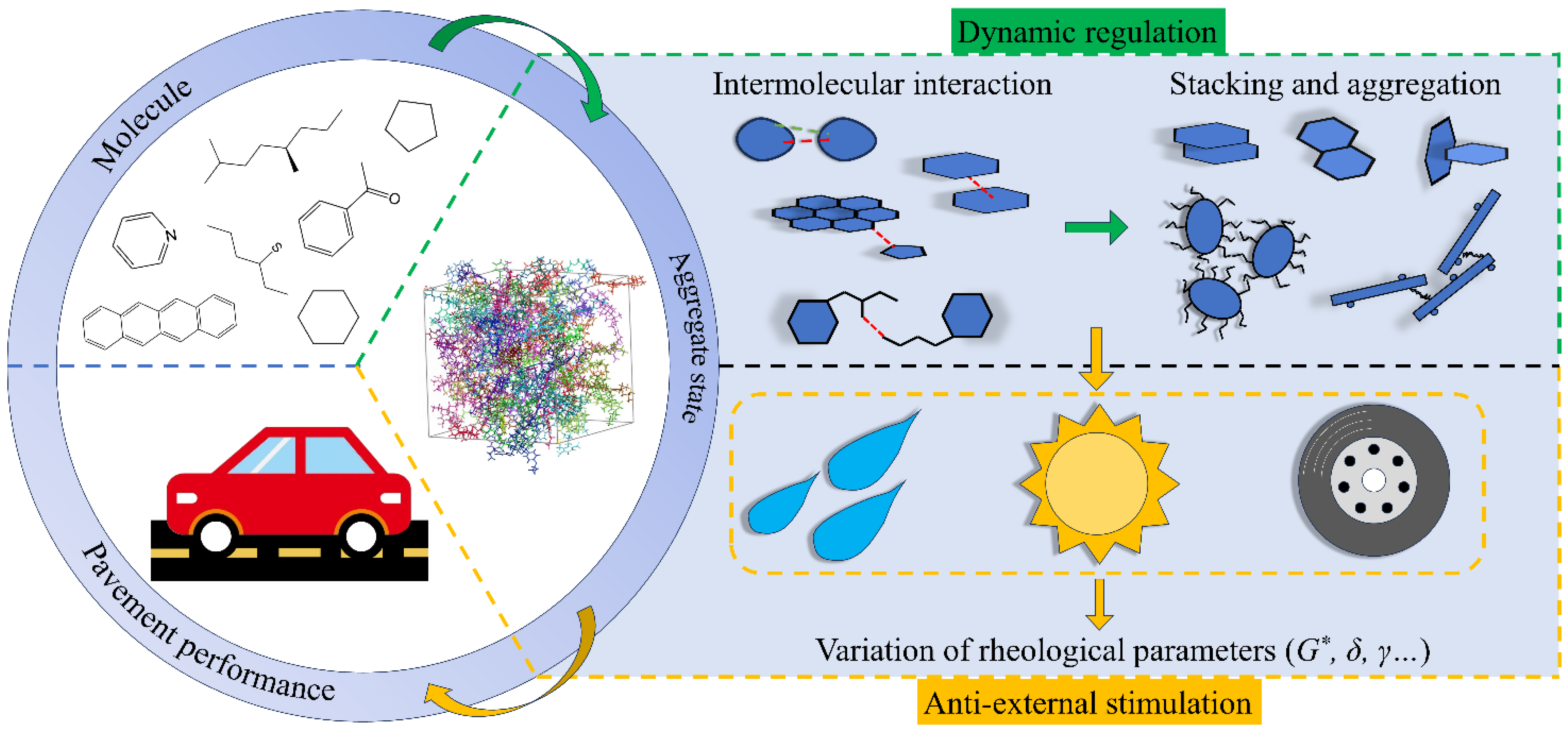
Figure 1. Structure–performance relationship based on rheological properties of asphalt.
Coatings 16 00355 g001
Figure 2. Typical functional groups in asphalt.
Coatings 16 00355 g002
Figure 3. (a) Comparison of infrared spectra between saturates and aromatics [21]. (b) Comparison of infrared spectra between resins and asphaltenes. NOTE: In Figure (a): RTFOT—Rolling Thin Film Oven Test; PAV—Pressure Aging Vessel, VBA—Vienna Binder Aging [21].
Coatings 16 00355 g003
Figure 4. Black diagram [118].
Coatings 16 00355 g004
Figure 5. The variation of rheological parameters of asphalt during fatigue process.
Coatings 16 00355 g005
Table 1. Properties of SARA fractions.
SaturatesAromaticsResinsAsphaltenes
State (room temperature)white translucent liquidyellow or red liquidblack semisolidblack powder
Density/(g·cm−3)0.901.001.071.15
Weight percent/%3.0~19.122.4~46.630.0~50.04.0~22.9
Molar weight/(g·mol−1)600~780500~800830~1100800~3500
Solubility parameter/(MPa−0.5)15.0~17.017.0~18.518.5~20.017.6~21.7
Carbon-hydrogen ratio2.001.51.38~1.691.15
Carbon percentage/%78.0~84.080.0~87.067.0~88.080.0~88.6
Hydrogen percentage/%8.0~12.09.0~13.09.0~12.07.1~10.0
Nitrogen percentage/%<0.10~0.40.2~1.70.3~0.4
Oxygen percentage/%<0.10.20.3~2.00.3~5.0
Sulfur percentage/%<0.10~4.00.4~5.03.0~10
NOTE: Due to the complexity of the chemical composition of asphalt, the physical and chemical properties of the SARA fractions of different asphalts may be outside the range in the table.
Table 2. Intermolecular interactions in the asphalt system.
InteractionsExistence
dipole–dipole interactionBetween molecules with uneven electron distribution
dispersion forceBetween all molecules
hydrogen bondO, S, N and other atoms with large electronegativity often appear in asphaltenes, so N-H…O, O-H…N, S-H…O, O-H…S and other forms of hydrogen bonds often appear in asphaltenes [50].
π-π interactionπ-π stacking often occurs between aromatic compounds in asphalt, which is a non-covalent bond interaction as important as hydrogen bonds. The number of benzene rings, arrangement and side chain length of aromatic compounds in asphalt have a certain influence on π-π interaction [50].
metal coordinationS, N, O heteroatoms with lone pair electrons in asphaltene molecules, which provides the possibility of coordination between asphaltene molecules and porphyrin nickel and porphyrin vanadium containing empty valence orbitals [50].
Table 3. AFM imaging of asphalt under different conditions and different sample preparation methods.
MorphologyAsphaltsSample Preparation Methods
Bee structure [81,83]A gel-type binder (unknown crude source)Heat-cast
Dendrite structure [84]Sasobit modified asphaltSolution-cast
Flower-like domain [85]Binder B1 from a high-sulphur Middle East crude sourceSolution-cast
Flake-like domain [61]SHRP binder AAMHeat-cast
Table 4. Calculation equations of the shift factor.
MethodsEquationsParameter
WLF equation [108] l o g a T = C 1 ( T T 0 ) C 2 + T T 0 ,
T > T g (glass transition temperature)
a T : shift factor
T: temperature (°C)
T 0 : reference temperature (°C)
C 1 , C 2 : constant
Arrhenius equation [109] l o g a T = E a 2.303 R ( 1 T 1 T 0 ) ,
T < T g
E a : Apparent activation energy
R: Universal gas constant, (8.315 K·mol−1)
T: temperature (K)
T 0 : reference temperature (K)
Log-linear [110] l o g a T T 0 = β ( T T 0 ) β : slope
VTS [111] l o g a l o g η = A + V T S [ log T R ] η : viscosity (cPoise)
A: regression intercept
VTS: VTS equation regression slope
T R : temperature (°R)
Quadratic polynomial [4] l o g ξ r = l o g ξ + C 1 T 0 T + C 2 T 0 T 2 ξ r : educed frequency (Hz)
T: temperature (°C)
T 0 : reduced frequency (°C)
ξ : frequency (Hz)
Table 6. Evaluation methods of NLVE under the LAOS test.
MethodsEquations or DefinitionsParametersUses and Legends
Relative intensity of the higher order harmonic [103]Strain-controlled mode:
I n / 1 = I n I 1 = τ n τ 1 = ( τ n c o s   δ n ) 2 + ( τ n s i n   δ n ) 2 τ 1 c o s   δ 1 ) 2 + ( τ 1 s i n   δ 1 ) 2 ,
n = 1,3,5…
Stress-controlled mode:
I n / 1 = I n I 1 = γ n γ 1 = ( y n c o s   δ n ) 2 + ( y n s i n   δ n ) 2 y 1 c o s   δ 1 2 + y i s i n   δ 1 2 ,
n = 1,3,5…
In/1: n-order harmonic relative intensity ratio
τn: n-order harmonic stress
γn: n-order harmonic strain
δn: n-order harmonic phase angle
Evaluate the degree of NLVE of asphalt.
Legend [103]:
Lissajous curve [150,151,152]The Lissajous curve is mainly divided into two types:
① Elastic Lissajous curve (stress–strain curve)
② Viscous Lissajous curve (stress–strain rate curve)
① Elastic Lissajous curve:
·Strain-controlled mode:
G′M: minimum strain modulus, the tangent slope at γ = 0
G′L: maximum strain modulus, the slope from γ = γ0 to the origin
The viscoelastic state and degree of asphalt are judged according to the curve shape.
Legend (Elastic Lissajous curve) [150]:
·Stress-controlled mode:
J′M: minimum nonlinear compliance
J′L: maximum nonlinear compliance
② Viscous Lissajous curve
·Strain-controlled mode:
η′M: minimum strain rate viscosity, the tangent slope at γ = 0
η′L: maximum strain rate viscosity, the slope from γ = γ 0 to the origin
·Stress-controlled mode:
Φ′M: minimum fluidity
Φ′L: maximum fluidity
Stress decomposition and strain decomposition [153,154]① Nonlinear stress:
τ ( t ) = τ O B ( t ) + τ B O ( t )
② Nonlinear strain:
γ ( t ) = γ ( t ) + γ ( t )
③ Chebyshev polynomials:
·Elastic:
τ x = γ 0 n = 0 n   e n ( ω , γ 0 ) T n ( x )
γ ( t ) τ 0 n = 0 n   c n ( ω , τ 0 ) T n ( x )
·Viscous:
τ ( x ) = γ 0 ˙ n = 1   ν n ( ω , γ 0 ) T n ( y )
y ( t ) = τ 0 n = 1 n   f n ( ω , τ 0 ) T n ( x )
τOE(x): apparent elastic stress, x = γ/γ0 = sinωt
τEO(y): apparent viscous stress, x = γ / γ 0 = cosωt
γ : apparent elastic strain
γ : apparent viscous strain
en = Gn(−1)(n−1)/2: n-order Chebyshev coefficient
vn = Gn/ω: n-order Chebyshev coefficient
cn = Jn: n-order Chebyshev coefficient
fn = nωJn: n-order Chebyshev coefficient
Tn(x): n-order Chebyshev coefficient
The rheological behavior of the material was judged according to the Chebyshev coefficient (commonly used third-order Chebyshev coefficient).
Legend [145]:
Constitutive modelJeffreys model [155]:
σ ˙ G 0 + σ η 0 = ξ + η η A γ ˙ + η G 0 γ ˙
ξ: constant
η: infinite shear viscosity
G0: shear modulus
The NLVE behavior under LAOS loading is described.
Bergström-Boyce model [156]:
γ ˙ γ ˙ 0 ( λ B ν ¯ 1 + ξ ) c R τ τ b a s e τ ¯ c u m
τ ¯ c u : cut-off stress below
which no flow will occur
ξ: strain adjustment factor
λ B ν ¯ : viscoelastic chain stretch
Disclaimer/Publisher’s Note: The statements, opinions and data contained in all publications are solely those of the individual author(s) and contributor(s) and not of MDPI and/or the editor(s). MDPI and/or the editor(s) disclaim responsibility for any injury to people or property resulting from any ideas, methods, instructions or products referred to in the content.