


Highlights
What are the main findings?
- •
- The relationship between the deformation, microstructure evolution, and characteristics of a pole screw produced using cold thread rolling is realized. The thread root subsurface experienced severe localized indentation deformation and exhibited the highest hardness. The distinct forming stress states led to a notable difference in the hardened layer depth between the thread crest and root.
- •
- The correlation between the gradient microstructure, the dislocation density distribution, grain boundaries, and the crack propagation paths is clarified. During the crack propagation process, the crack path was influenced by local phase type, grain size, morphology, and internal structure state. Three primary propagation types were identified: transgranular through ferrite, along the ferrite–pearlite phase interface, and cracking through lamellar pearlite.
What are the implications of the main findings?
- •
- This study on the microstructural characteristics and fracture behavior of a cold thread-rolled screw provides theoretical support for material design and process optimization.
- •
- A high-performance screw with high strength and hardness at the thread surface and high plasticity in the core can be obtained through the control of microstructural characteristics.
- •
- High crack resistance of refined and homogeneous ferrite–pearlite microstructures with an appropriate microstructural state can be obtained based on the study of the main crack propagation types.
Abstract
The microstructural characteristics and fracture behavior of a magnetic pole screw were investigated here. The screw threads were produced by cold thread rolling. Microstructural analysis (OM, SEM, EBSD), mechanical testing (tensile, hardness, fastening), and fracture morphology observation were conducted. The results indicate that work hardening and microstructural deformation were introduced by the gradient plastic deformation in the screw thread. The elongated microstructure of ferrite and pearlite was obtained in the deformation zones, resulting in increased hardness and decreased plasticity. The thread root subsurface experienced severe localized indentation deformation and exhibited the highest hardness. The distinct forming stress states led to a notable difference in the hardened layer depth between the thread crest and root. The torsional overload fracture was initiated at the stress-concentrated thread root, where the work-hardened microstructure exhibited a limited capacity to accommodate large plastic deformation. The crack propagation was influenced by the gradient microstructure, following three primary propagation paths: transgranular through ferrite, along the ferrite–pearlite phase interface, and cracking through lamellar pearlite. The results provide theoretical support for material design and process optimization to achieve the production of high-performance screws with high strength and hardness at the thread surface and high plasticity in the center.
1. Introduction
The rotor magnetic pole screw of an industrial synchronous motor is a mechanical fastener that fixes the permanent magnet to the yoke. It plays a crucial role in resisting centrifugal force, ensuring pole position accuracy, electromagnetic performance, and motor stability. With the development of industrial motors towards higher power density, increased operational speeds, and higher sustainability, the rotor is subjected to greater mechanical stresses [1,2]. More stringent requirements have been imposed on pole screws. The wear failure and fracture failure of rotor screws under high stress have become potential risks affecting reliability. Thus, high screw thread surface hardness and strength are required to resist wear and stress concentration during assembly and service. Meanwhile, good plasticity in the screw core is needed to resist impact and fatigue failure and delay crack propagation [3,4].
The mechanical property and reliability of the magnetic pole depend not only on the chemical composition of the raw materials but also on the manufacturing process, which plays a critical role in its final microstructure characteristics, residual stress state, and failure resistance. The primary production methods can be broadly categorized into machining and roll-forming. Thread machining is a subtractive manufacturing process that has a prominent advantage in producing threads with high dimensional accuracy. Araujo et al. [5] and Fetullazade et al. [6] have pointed out that the thread prepared by milling underwent relatively low strain hardening and concentration of residual stresses at thread roots; the cooling aspects of this process could protect the mechanical properties of thread roots. However, machining still faces challenges in terms of production efficiency and precision in slender shaft thread preparation. The roll-forming process can adjust the gradient microstructure in threads for a given material composition, and realize the preparation of high-performance threads with high production efficiency. Especially for cold thread rolling, the work hardening introduced by intense plastic deformation can significantly enhance the hardness and strength of the thread surface and subsurface layer [7,8]. Mechter et al. [9] used a specific plastic deformation pattern to achieve the preparation of a thread gradient structure, and the surface hardness increased by 60%. In addition, researchers have significantly reduced processing time and costs by developing new dies (ground rolling die for anti-loosening bolt with double-thread mechanism proposed by Amano et al. [10]) and optimizing the rolling process (Bayesian optimization by Reinhard et al. [11]). The gradient mechanical property can meet the requirements of thread surface hardening and core toughening under complex working conditions. However, the risk of fracture due to the gradient microstructure, especially at the thread root under complex loading, has become a potential common critical issue in the industry. The non-uniform deformation microstructure in the pole screw also brings new challenges for use in a high-speed synchronous motor. The effect of stress state on the thread root and crest forming and the microstructural evolution mechanisms is not clear. Furthermore, a detailed explanation of crack propagation paths related to the local microstructural characteristics (e.g., grain size, grain orientation, phase boundaries, dislocation density) is also needed to enhance the material’s fracture resistance.
In the present study, the formation mechanism of the gradient microstructure and its effects on mechanical properties and torsional overload fracture behavior were investigated in a magnetic pole screw manufactured by cold thread rolling. The effect of forming stress state on the hardened layer depth and microstructural evolution at the thread crest and root was revealed. The torsional overload crack initiation and propagation behavior were studied in relation to the local mechanical properties. Particular attention was paid to the correlation between the gradient microstructure, the dislocation density distribution, grain boundaries, and the crack propagation paths in the ferrite–pearlite microstructure.
2. Experimental Procedures and Methods
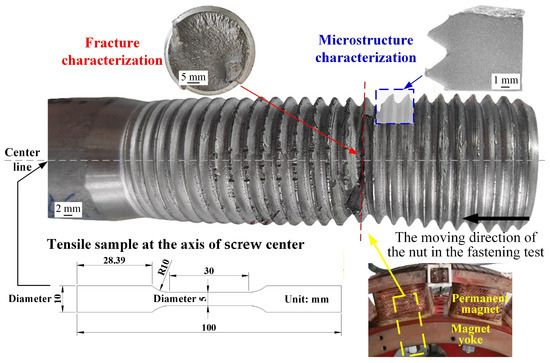
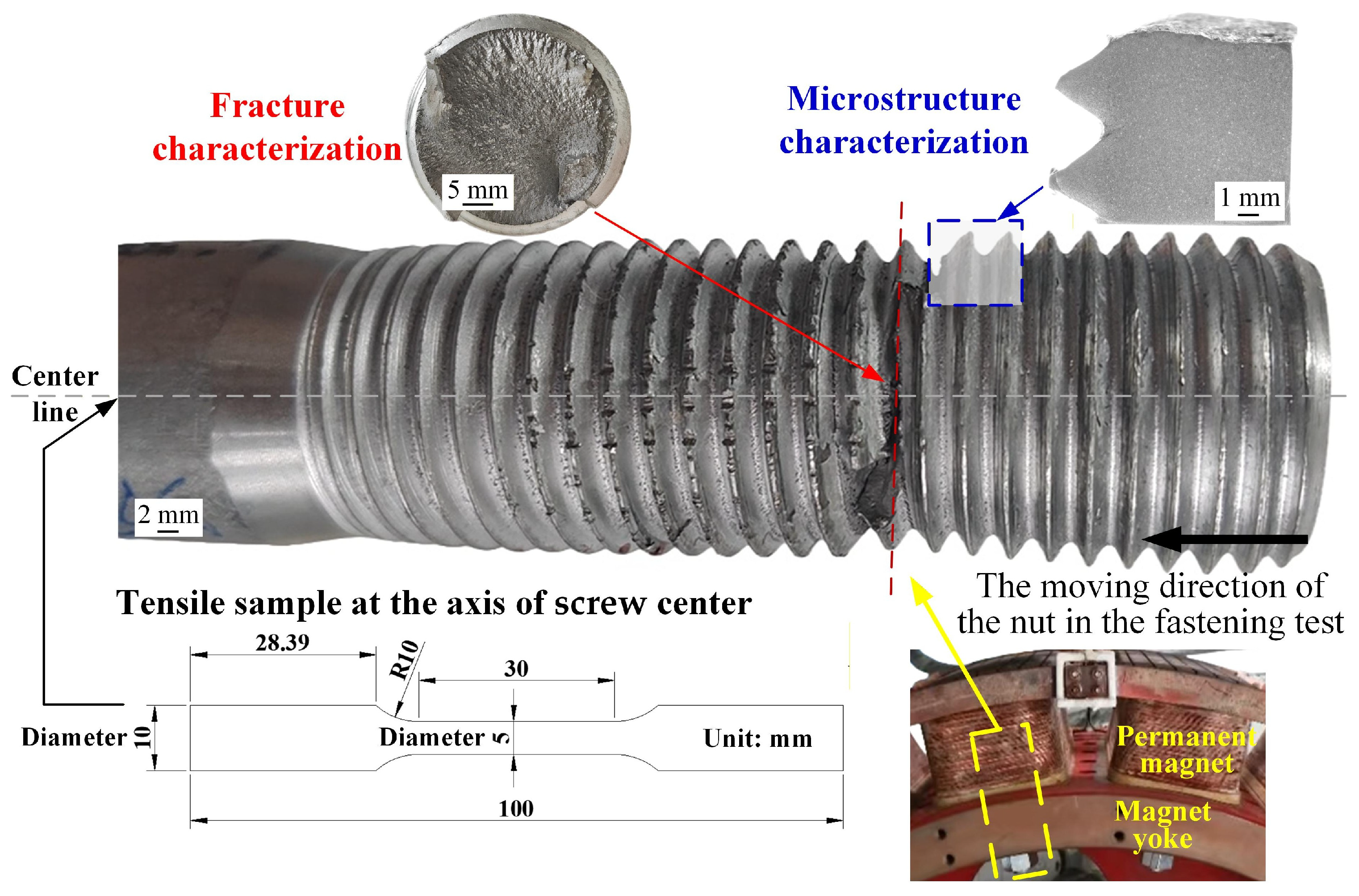
The magnetic pole screws were manufactured from an Fe-0.43C-0.2Si-0.54Mn (wt.%) cold-drawn round steel, which exhibits high tensile strength and durability. The screw threads were produced by cold thread rolling, with a nominal diameter of 36 mm, a length of 360 mm, and a thread length of 100 mm. The critical fracture torque was determined by a fastening test within a specified torque range. The moving direction of the nut in the test is shown in Figure 1. For the tensile sample, the diameter of the gauge was 5 mm and the gauge length was 25 mm (along the parallel screw axis and perpendicular to the cross-sectional direction). A microstructure characterization sample with an appropriate size was prepared. The schematic illustration is shown in Figure 1.
Figure 1.
Schematic illustration of microstructure characterization and mechanical property testing for the magnetic pole screw.
The tensile properties at the axial center position of the screw were measured by the UTM5105 (SUNS Technology Stock Co., Ltd., Shenzhen, China) standard testing machine at a crosshead speed of 5 mm/min at room temperature. The Vickers hardness tests were conducted using an MHV-1000Z (Truer, Shanghai, China) microhardness tester with a loading force of 500 gf and a loading time of 15 s. The microstructure characteristics and fracture morphology were observed using Gemini 300 (Carl Zeiss, Oberkochen, Germany, with electron backscattered diffractometer, EBSD) and ZEM20 (Zeptools, Tongling, China) scanning electron microscopes (SEM) and SUNNY (SUNNY, Hong Kong, China) optical microscope (OM), revealing the relationship between the thread-forming process and the mechanical property. For OM and SEM observation, the samples were mechanically ground and polished following standard metallographic preparation procedures, and then etched with a 4% nital solution. The EBSD samples were first mechanically ground, and then electropolished with an 8% sodium perchlorate alcohol solution at 0.5 A and 20 s. A step size of 0.06 μm and magnification of 4000× were selected for EBSD analysis. For fracture characterization, the sample was prepared using wire-cut electrical discharge machining.
3. Results and Discussion
3.1. Effect of Deformation on Microstructure Evolution and Characteristics
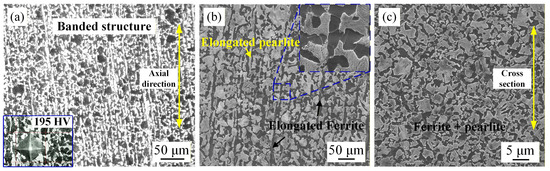
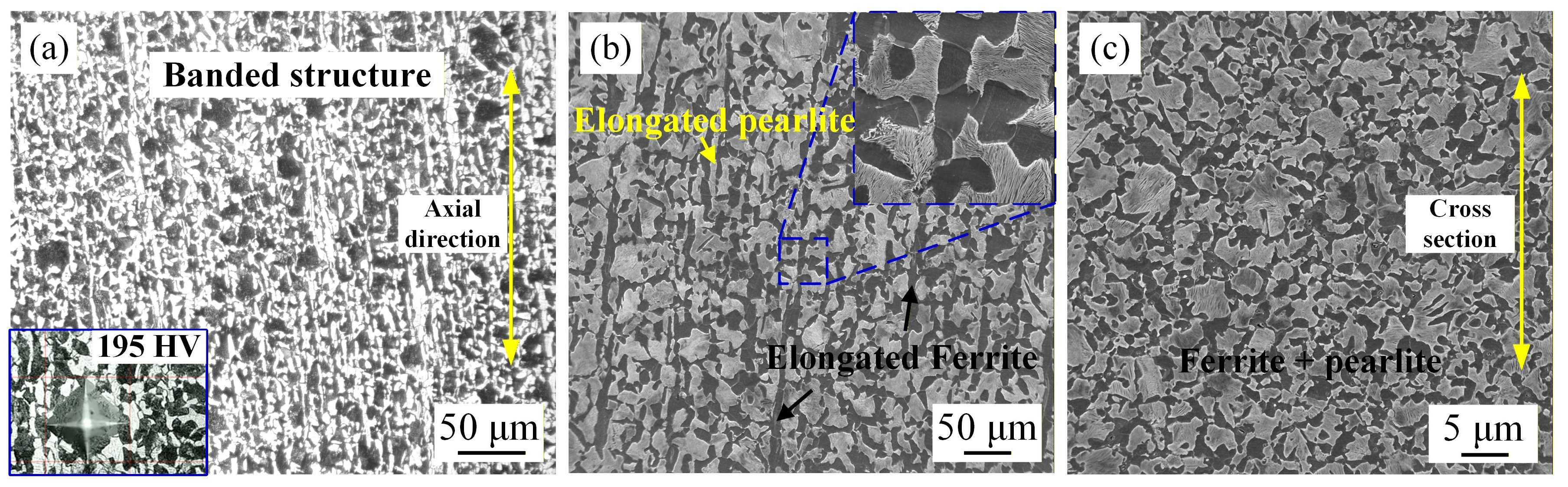
The OM and SEM micrographs of cold-drawn round experimental steel are shown in Figure 2; the OM micrograph of Vickers hardness measurement is provided at the lower left corner of Figure 2a. The banded structure consisted of ferrite, and pearlite was obtained along the axial direction, which was caused by the synergistic effect of axial normal stress and vertical axial compressive stress. The width of elongated ferrite is about 4.3~14.1 μm, which is obviously smaller than the length direction, as shown in Figure 2b. Meanwhile, the elongated pearlite maintains a lamellar morphology without obvious fragmentation, indicating that cold-drawing stress mainly induces the deformation of pearlite colonies rather than lamellar structure destruction. Combined with the microstructure observation in the cross-section (the relatively uniform grain size shown in Figure 2c), the results show that the ferrite–pearlite matrix was elongated and refined during the cold-drawn process. In addition, the Vickers hardness number of 195 HV was obtained in the axial direction.
Figure 2.
OM and SEM micrographs of experimental steel. (a) OM micrograph in the axial direction. (b) SEM micrograph in the axial direction. (c) SEM micrograph in the cross-section.
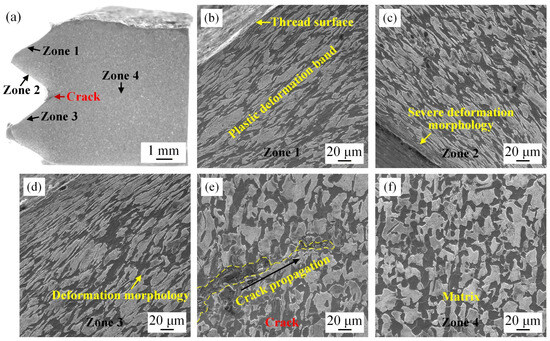
Figure 3 shows the OM and SEM images of the screw thread, in which the representative deformation zones are marked as zones 1–3. The crack was found at the thread root after a fastening test, propagating into the steel matrix. A plastic deformation band approximately parallel to the thread surface can be seen in Figure 3b–d. In the severe deformation zone close to the thread surface, the ferrite and pearlite exhibit significant directional elongation along the stress direction of the thread, forming a fibrous morphology, due to the lower hardness and higher plasticity of ferrite [12]. The degree of microstructural deformation decreased with increasing distance from the thread surface, while the core of the screw retained the initial cold-drawn banded structure aligned along the axial direction, as evidenced in Figure 3f. During the fastening test, zone 2 was subjected to direct contact by the nut thread. When the stress accumulated to a critical extent, a microcrack formed at the thread root. The concentrated plastic deformation (introduced by cold thread rolling) in these zones limited the capacity for further deformation (high torque). Compared to the phase morphology of the matrix and Figure 3b–d, no significant plastic deformation was found in Figure 3e despite the crack propagation. The results indicate that the stress concentration at the crack tip provided the driving force for crack propagation.
Figure 3.
OM and SEM images of the screw thread. (a) Macrograph of screw thread. (b–d) Thread deformation microstructure in zones 1, 2, and 3, respectively. (e) Crack propagation. (f) Matrix microstructure.
3.2. Effect of Microstructure Characteristics on Mechanical Properties
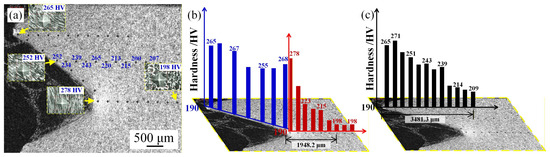
To further investigate the microstructure characteristics and their effect on mechanical properties, some zones were selected for analysis (e.g., hardness/EBSD/tensile/fastening test). Figure 4 shows the hardness distribution maps of the screw thread, and the hardness indentation morphologies are obtained at the same magnification (400×) under the microhardness tester. The hardness was increased by the cold-work strengthening induced by cold thread rolling. As shown in Figure 4b (marked in blue), the hardness distribution near the working surface reveals that the thread crest and root zones exhibit relatively higher hardness than other zones. Significant work hardening occurred at the thread root and crest due to intense plastic deformation induced by the dies. The highest hardness of 278 HV was obtained in the subsurface of the thread root, which was caused by the most severe deformation. Figure 4b (marked in red) and Figure 4c represent the hardness distribution maps form thread surface to the matrix. The heavily deformed microstructure at the surface shows pronounced work hardening via dislocation multiplication and grain refinement, resulting in high hardness [13,14]. A significant difference in hardened layer depth was observed between the thread root (1948.2 μm) and crest (>3481.3 μm). For the forming stress state at the thread crest, the crest was formed in the inter-tooth recessed zone of the dies. During the rotational extrusion process, the applied stress in the larger contact zone was more uniform, which allowed the deep penetration of plastic deformation into the screw. Compared with the thread root, the root was formed in the tooth-tip convex zone of the dies. During the localized indentation process, the stress was highly concentrated on the surface of the thread root, resulting in severe plastic deformation of the microstructure. However, the penetration of the deformation into the microstructure was limited by the stress concentration.
Figure 4.
Hardness distribution maps of screw thread. (a) Macrograph and hardness indentation morphologies of screw thread. (b) Hardness distribution near the working surface and along the path from the thread root to matrix. (c) Hardness distribution from the thread crest to matrix.
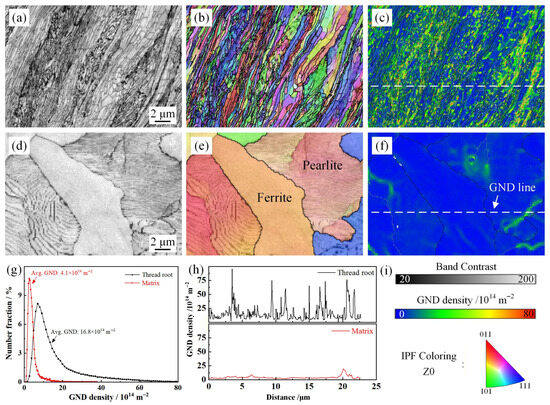
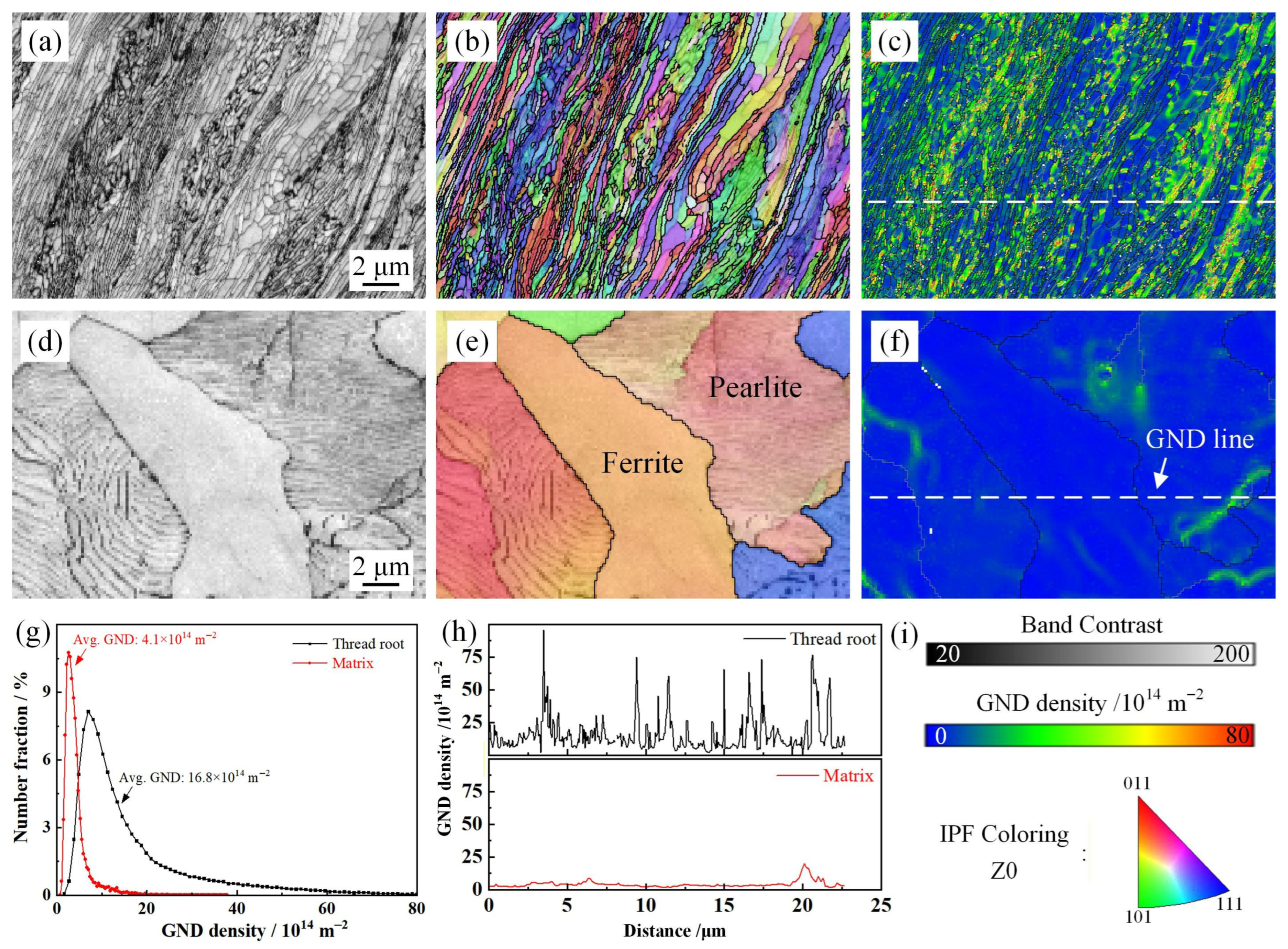
The representative zones in the thread root (undergone the most severe deformation) were selected for EBSD characterization; the high-angle boundaries corresponding to misorientation angles ≥ 15° are marked by black lines. For the zone near the thread root in Figure 5a–c, the band contrast map shows a severely elongated fibrous microstructure without equiaxed grains, while the inverse pole figure (IPF) map exhibits a complex color distribution. The results indicate that the significant grain reorientation was obtained by the severe plastic deformation and the high-angle boundary length per unit zone was substantially increased. The geometrically necessary dislocations (GND) are introduced to accommodate non-uniform plastic deformation [15,16]. The average GND density in the microstructure near the thread root is 16.8 × 10¹⁴ m−2; the GND distribution is highly inhomogeneous depending on the specific microstructural feature, such as phase type, phase/grain boundaries, and local deformation degree, as shown in Figure 5c,h. The resistance of dislocation (induced by deformation) glide was increased in zones of high GND density, due to the increased density of lattice defects. For the microstructure of the matrix away from the root in Figure 5d–f, the characteristics exhibited a large grain size, short high-angle boundary length per unit zone, and low GND density. During the plastic deformation stage, the low dislocation density in the grains (less than 1/4 of that in the thread root subsurface) offered relatively weak resistance to dislocation slip. Furthermore, the low density of high-angle grain boundaries diminished the dislocation interaction at these boundaries. The substantial misorientation induced by high-angle grain boundaries proved theoretically effective at deviating or impeding microcrack propagation [17]. The work hardening effect was significantly reduced, which caused relatively low hardness (less than 7/10 of that in the thread root subsurface).
Figure 5.
Microstructure of the thread root analyzed by EBSD. (a,d) Band contrast maps. (b,e) Combined maps of IPF and misorientation angles (>15°). (c,f) GND distribution maps. (g) Statistical data of GND distribution maps. (h) Statistical data of GND density along the white dotted lines. (i) Legend for EBSD observation. (a–c) Microstructure near the thread root. (d–f) Microstructure of matrix away from the thread root.
The tensile properties, a combination of an ultimate tensile strength of 655 MPa, a yield ratio (yield strength/tensile strength) of 0.55, and a total elongation of 23%, are obtained in the screw’s central axis zones, as shown in Table 1. Mechanical properties of good strength and plasticity matching play a critical role in enhancing the impact resistance during the service process. The critical fracture torque of the screw produced by cold thread rolling is 1900 N·m, which exceeds the design working load of 1750 N·m. The fracture occurred during the fastening test under a specified torque range until failure, which is determined as a torsional overload fracture. The microcracks were formed at the thread root during the fastening test.
Table 1.
Mechanical properties of screw thread.
3.3. Torsional Overload Fracture Behavior: Crack Initiation–Propagation, Fracture Morphology, and Microstructural Dependence
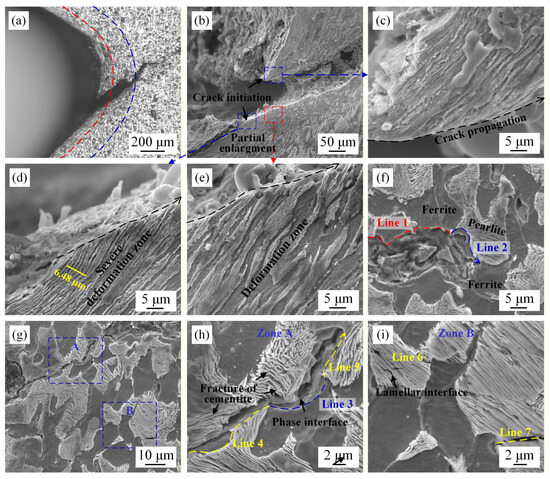
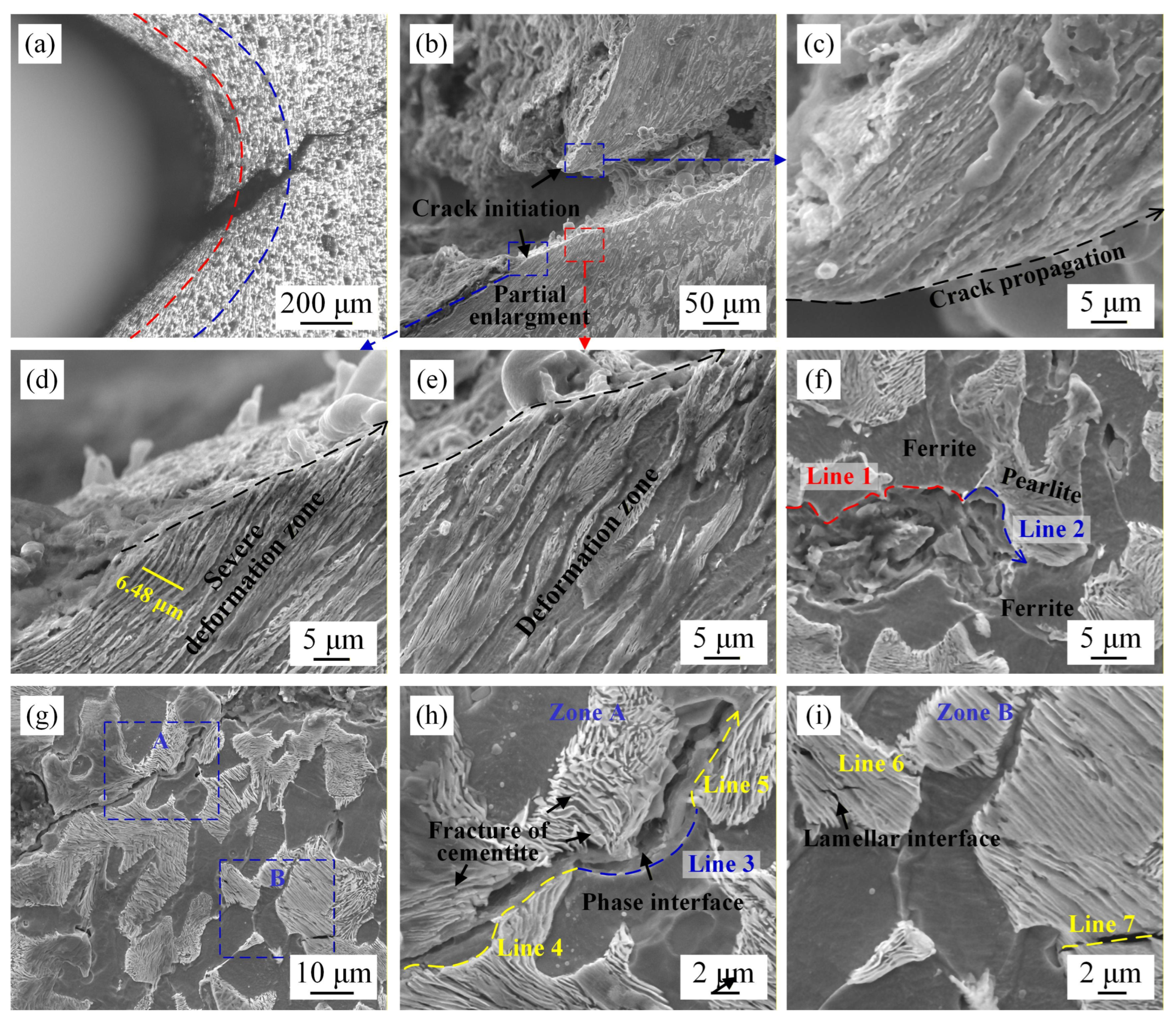
The term “fracture behavior” refers to the sequence and characteristics of failure under torsional loading, with a focus on macroscopic and microscopic features. The crack propagation path can directly reflect the effect of microstructure characteristics on the torsional overload fracture behavior. The OM and SEM micrographs of crack propagation are shown in Figure 6. The changing crack propagation path was obtained in different zones of the gradient deformation microstructure. Compared with the severe plastic deformation zone, the deflection of the propagation path in the side near the undeformed structure is relatively obvious, as shown in Figure 6a. More deformation energy was consumed by the zigzag paths [18]. Figure 6d shows that the width of two adjacent ferrite and pearlite grains is compressed to only about 1.08 μm. The microcrack initiated at the serious stress concentration of the thread root, where the work-hardened microstructure exhibited limited capacity to accommodate large plastic deformation. In addition, the non-metallic inclusions (if introduced during raw material processing) could act as additional stress concentrators, further promoting crack initiation in these regions.
Figure 6.
OM and SEM micrographs of crack propagation. (a) OM micrograph in the thread root. (b) Microstructure in the crack propagation initial stage. (c–f) The corresponding partial enlargement micrographs of the rectangular zones in Figure 6b. (g–i) Microstructure morphology in the zones near the crack tip.
The crack propagation direction is comparatively straight in the initial stage, as shown in Figure 6c–e. The microstructure morphology in the zones near the crack tip is shown in Figure 6f–i, the difference in local phase type, grain size, morphology, and internal structure state in the matrix induced the localized strain incoordination and stress concentration. The main fracture path is divided into three propagation types. (I) Crack propagation through the ferrite grain (line 1): Compared to the lamellar pearlite, the ferrite was relatively easy to undergo plastic deformation due to its low hardness and high plasticity. Transgranular cracking is facilitated at the zones of specific orientation (e.g., appropriate angle between the slip plane and principal stress direction), or inhomogeneous microstructure (e.g., elemental segregation). (II) Crack propagation along the phase interface (lines 2 and 3): Lines 2 and 3 represent crack propagation from ferrite and pearlite to the phase interface, respectively. The ferrite–pearlite dual phases exhibited differences in crystal structure, strength, plasticity, and interfacial bonding strength. When the crack propagated to the phase interface, the incoordination deformation between the dual phases provided paths for crack propagation. (III) Crack propagation through pearlite (lines 4–7): Under the stress, the lamellar microstructure composed of ferrite and cementite exhibited differential deformation, causing cracks to propagate along the lamellae interface between ferrite and cementite, as shown by lines 5 and 6. Further evidence is shown in Figure 7f. From a morphological perspective, the lamellar cementite was prone to fracture under deformation stress, which produced additional microcracks with the surrounding phase, as shown in Figure 6h. Consequently, the coordinated inhibition of crack propagation along these microstructural pathways is essential for achieving superior crack resistance in this material.
Figure 7.
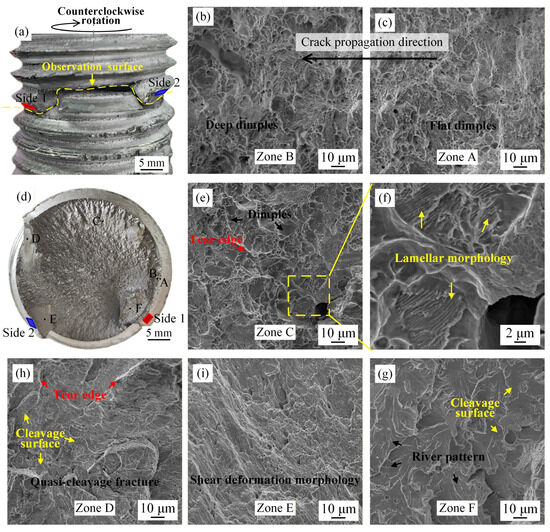
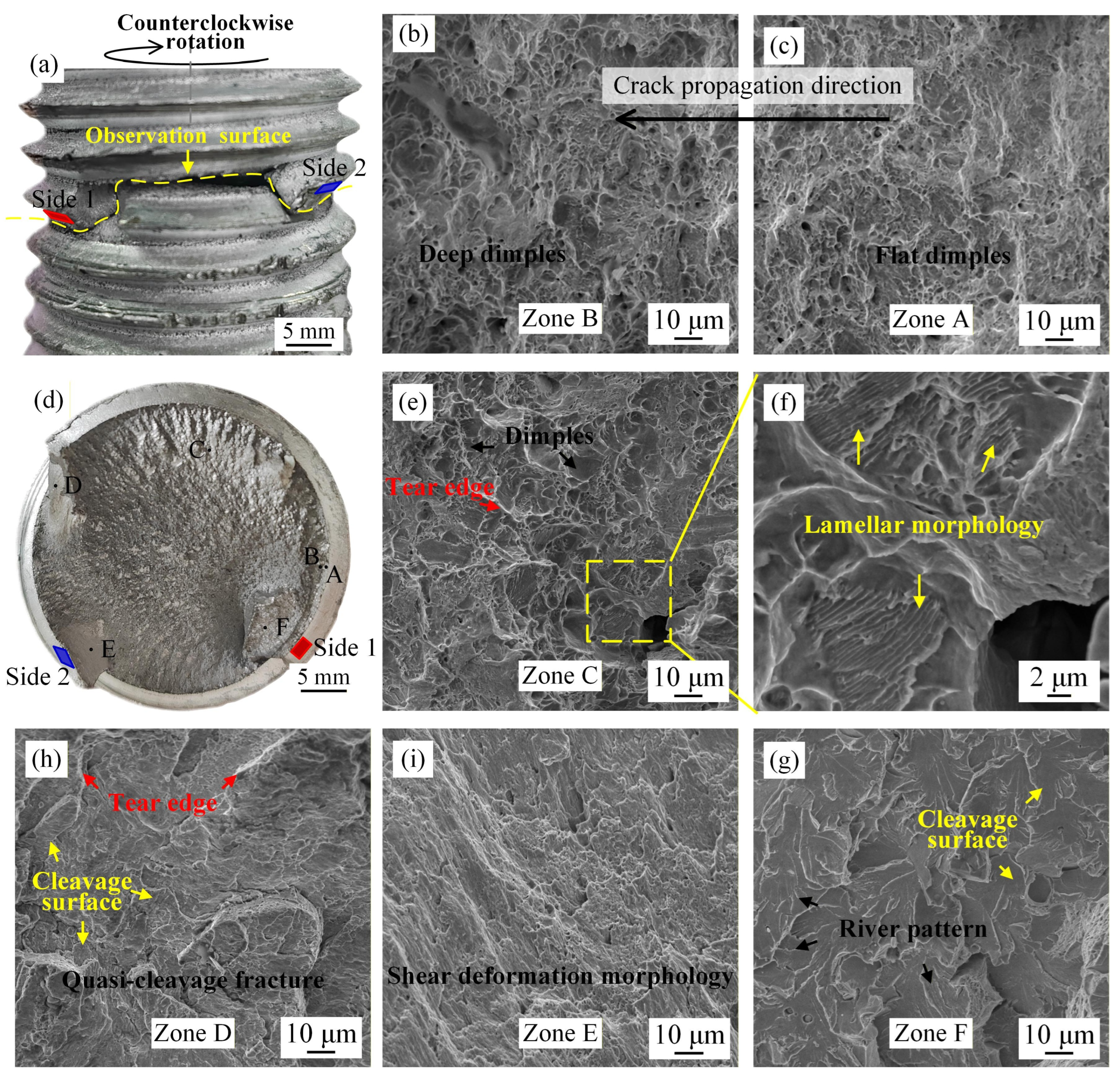
Torsional fracture micrographs of the screw. (a,d) Fracture macrograph of screw. (b,c) Micrographs in zones B and A at fracture initiation stage. (e) Micrographs in zone C at propagation stage. (f) The rectangular zone in Figure 7e. (h) Micrographs in zone D. (i,g) Micrographs in zones E and F at rapid fracture stage.
Figure 7 shows the torsional overload fracture micrographs of the screw, where significant changes in morphology are found during the different stages of crack propagation. During the fracture initiation stage, the crack propagated from zone A of the thread root to the inside of the screw. In zones A and B, from the thread root to the screw axial direction (e.g., from right side to left side in Figure 7c,b), the microfracture morphology changes from flat and small-sized dimples to deep and large-sized dimples. More deformation energy was consumed by the significant plastic deformation in deep and large-sized dimples [19,20]. Combined with the crack propagation micrographs in Figure 6, it can be seen that the microstructure, while experiencing severe plastic deformation, displayed limited ability to hinder crack propagation in the initial stage of fracture. With the increase in torsional deformation, the crack propagated into zone C. The micrograph comprises deep dimples, a tear edge, and lamellar morphology during the stage of stable crack propagation, as shown in Figure 7e,f. The formation of deep dimples and a tear edge proved that the local severe plastic deformation occurred during the high plastic phase. The lamellar morphology shows that the ferrite and cementite in the pearlite underwent differential deformation during this fracture stage, and the lamellar interface provided paths for crack propagation. In the crack propagation instability zone, zone D represents a quasi-cleavage fracture, which contains a cleavage surface tear edge. In this stage, the ability of the microstructure to inhibit crack propagation was limited due to the high deformation stress. Figure 7i,f show the micrographs at the final rapid fracture stage; the shear deformation morphology and cleavage fracture were observed in zone E and zone F, respectively. As the progressive enlargement of the fractured area reached a critical point, these zones underwent a rapid fracture.
The study of the microstructural characteristics and fracture behavior of a cold thread-rolled screw provides theoretical support for material design and process optimization. A high-performance screw with high strength and hardness at the thread surface and high plasticity in the core can be obtained through control of the microstructural characteristics. Based on the study of the main crack propagation types, a refined and homogeneous ferrite–pearlite microstructure with an appropriate microstructural state can be achieved through control of the material and preparation process. Further exploration can focus on the quantitative optimal surface deformation degree and microstructure characteristics, which can aid in the preparation of a high-strength and hardness thread surface without excessive damage to the plasticity. In addition, the integration of surface engineering methods (e.g., nitriding, coatings, etc.) can also enable the synergistic strengthening of the thread surface.
4. Conclusions
In this study, the relationship between the microstructure characteristics, mechanical properties, and torsional overload fracture behavior of a magnetic pole screw was systematically investigated. The main conclusions are summarized as follows:
- (1)
- The gradient plastic deformation in the screw thread was induced by cold thread rolling. Significant work hardening and microstructure deformation occurred in the zones near the surface. The relatively intense deformation was concentrated in the thread root and crest, resulting in a fibrous microstructure of elongated ferrite and pearlite.
- (2)
- Gradient hardness was distributed from the thread surface to the interior due to cold-work strengthening. The highest hardness was obtained at the thread root subsurface because of the most severe localized indentation deformation. The notable difference in the hardened layer depth between the thread crest (>3481.3 μm) and root (1948.2 μm) is attributed to the distinct forming stress states. The thread crest was subjected to relatively uniform compressive stress during rotational extrusion, leading to deep plastic deformation penetration. While the highly concentrated stress at the root resulted in more severe plasticity deformation but limited depth.
- (3)
- The torsional overload fracture behavior of the screw strongly depended on the gradient microstructure. The microcrack was initiated by the serious stress concentration at the thread root, where the work-hardened microstructure exhibited a limited capacity to accommodate large plastic deformation. During the crack propagation process, the crack path was influenced by local phase type, grain size, morphology, and internal structure state. Three primary propagation types were identified: transgranular through ferrite, along the ferrite–pearlite phase interface, and cracking through lamellar pearlite.
Author Contributions
Conceptualization, Y.D., R.D. and S.C.; data curation, Q.M. and K.W.; formal analysis, Y.D. and Y.L.; funding acquisition, R.D. and S.C.; investigation, Y.D., Q.M. and X.W.; methodology, R.D. and Y.L.; project administration, Y.D.; resources, Q.M. and X.W.; software, Y.D. and Y.L.; supervision, X.W. and S.C.; validation, Y.D. and K.W.; visualization, R.D. and Y.L.; writing—original draft, Y.D. and R.D.; writing—review and editing, Y.D., R.D. and S.C. All authors have read and agreed to the published version of the manuscript.
Funding
This work was supported by the National Natural Science Foundation of China (52505381 and 52275339) and the Natural Science Foundation of Jiangsu Province (BK20251005).
Institutional Review Board Statement
Not applicable.
Informed Consent Statement
Written informed consent has been obtained from the patient(s) to publish this paper.
Data Availability Statement
The original contributions presented in this study are included in this article. Further inquiries can be directed to the corresponding author.
Conflicts of Interest
Author Ying Dong, Qinghao Miao, Ke Wang and Xuandong Wu was employed by the company Wolong Electric Nanyang Explosion Protection Group Co., Ltd. The remaining authors declare that the research was conducted in the absence of any commercial or financial relationships that could be construed as a potential conflict of interest.
References
- Souza, D.F.d.; Silva, P.P.F.d.; Sauer, I.L.; Almeida, A.T.d.; Tatizawa, H. Life cycle assessment of electric motors—A systematic literature review. J. Clean. Prod. 2024, 456, 142366. [Google Scholar] [CrossRef] [Scilit]
- Moulai, L.A.; Zaihidee, F.M.; Mekhilef, S.; Tang, J.R.; Mubin, M. Implementation of deep reinforcement learning in permanent magnet synchronous motors control: A review. Annu. Rev. Control 2025, 60, 101014. [Google Scholar] [CrossRef] [Scilit]
- Zhang, S.W.; Zhang, D.W.; Jiang, H.; Jiang, F.; Zhao, S.D. Numerical and experimental analysis of deformation behaviors and microstructure evolution in the thread rolling process. J. Mater. Res. Technol. 2022, 19, 230–242. [Google Scholar] [CrossRef] [Scilit]
- Zhou, J.M.; Li, L.Y.; Hang, P.W.; Ding, Y. Effects of heat treatment and thread rolling sequence on fatigue and corrosion resistance of 304/Q235 bimetal composite Bolts. Mater. Today Commun. 2025, 45, 112175. [Google Scholar] [CrossRef] [Scilit]
- Araujo, A.C.; Mello, G.M.; Cardoso, F.G. Thread milling as a manufacturing process for API threaded connection: Geometrical and cutting force analysis. J. Manuf. Process. 2015, 18, 75–83. [Google Scholar] [CrossRef] [Scilit]
- Fetullazade, E.; Akyildiz, H.K.; Saritas, S. Effects of the machining conditions on the strain hardening and the residual stresses at the roots of screw threads. Mater. Des. 2010, 31, 2025–2031. [Google Scholar] [CrossRef] [Scilit]
- Wan, N.; He, Q.; Jiang, Y.; Zhou, H.; Fu, B. Numerical and experimental investigation of the influence of the machining parameters on residual stress distribution of internal thread cold extrusion. CIRP J. Manuf. Sci. Technol. 2023, 40, 142–154. [Google Scholar] [CrossRef] [Scilit]
- Song, X.; Han, N.; Qi, H.; Hu, Y.; Yang, W.; Li, Z.; Jiang, Z.; Jia, L. Study on the damage mechanism of titanium alloy threads during roll forming based on a machine learning-assisted multi-scale damage model. Int. J. Solids Struct. 2026, 328, 113830. [Google Scholar] [CrossRef] [Scilit]
- Mechter, M.A.; Gadour, M.; Romain, L.; Tuysuz, O.; Brochu, M. Microstructural and fatigue characterization of 316L stainless steel subjected to flow drilling and tapping: Comparison with machined threads. Eng. Fail. Anal. 2024, 164, 108730. [Google Scholar] [CrossRef] [Scilit]
- Amano, S.; Shinbutsu, T.; Okimoto, Y.; Takemasu, T.; Kuwabara, T. Optimization of anti-loosening bolt based on double thread mechanism: Development of ground rolling die and effect of thread accuracy on loosening resistance. Heliyon 2024, 10, e28631. [Google Scholar] [CrossRef] [Scilit] [PubMed]
- Reinhard, J.; Löhe, K.; Kallabis, S.; Graichen, K. Dynamic compensation of the threading speed drop in rolling processes: Bayesian optimization of the roughing and finishing mill. J. Process Control 2025, 156, 103579. [Google Scholar]
- Xiong, J.Z.; Dong, X.C.; Wang, F.H.; Qiu, Y. The formation mechanism of fracture surface separations and their effects on the toughness for ferrite-pearlite steels. Mater. Today Commun. 2024, 41, 110269. [Google Scholar] [CrossRef] [Scilit]
- Hu, L.; Zhang, L.Q.; Zhan, Z.L.; Qin, H.; Wu, K.M. Synergistic optimization of strength and ductility in layered ferrite-martensite dual-phase steel. Mater. Des. 2026, 262, 115428. [Google Scholar] [CrossRef] [Scilit]
- Zhang, K.; Yu, T.T.; Zhu, J.W.; Zhang, T.H.; Li, Z.D.; Li, J.H.; Huang, Z.; Zhang, M.Y. Effect of tempering process on microstructure and hardness of Cu-Cr-Ni weathering steel for bridge construction. J. Mater. Res. Technol. 2025, 39, 4576–4587. [Google Scholar] [CrossRef] [Scilit]
- Gamanov, Š.; Poczklán, L.; Dlouhý, A.; Kruml, T. A step size dependence of KAM, GROD and GND parameters calculated from EBSD. Mater. Charact. 2026, 232, 115952. [Google Scholar] [CrossRef] [Scilit]
- Liu, M.M.; Liu, Y.L.; Li, H. Deformation mechanism of ferrite in a low carbon Al-killed steel: Slip behavior, grain boundary evolution and GND development. Mater. Sci. Eng. A 2022, 842, 143093. [Google Scholar] [CrossRef] [Scilit]
- Xie, G.M.; Cui, H.B.; Luo, Z.A.; Misra, R.D.K.; Wang, G.D. Asymmetric distribution of microstructure and impact toughness in stir zone during friction stir processed a high strength pipeline steel. Mater. Sci. Eng. A 2017, 704, 401–411. [Google Scholar] [CrossRef] [Scilit]
- Duan, R.H.; Xie, G.M.; Luo, Z.A.; Xue, P.; Wang, C.; Misra, R.D.K.; Wang, G.D. Microstructure, crystallography, and toughness in nugget zone of friction stir welded high-strength pipeline steel. Mater. Sci. Eng. A 2020, 791, 139620. [Google Scholar] [CrossRef] [Scilit]
- Das, S.; Kumar, S.; Pradhan, S.K.; Bandyopadhyay, T.K.; Mandal, S. Implications of the microstructure on strength-ductility synergy in a novel B2-strengthened medium manganese advanced high strength steel. Mater. Sci. Eng. A 2025, 924, 147798. [Google Scholar]
- Zhang, D.; Xu, L.Y.; Du, X.C.; Ma, C.; Sun, H.L.; Zhang, W.; Yang, S.F.; Wang, B. Strength-ductility mechanism of Medium-Mn steel with heterostructure modification in the cyclic ART process. J. Mater. Res. Technol. 2025, 39, 9763–9779. [Google Scholar] [CrossRef] [Scilit]

Disclaimer/Publisher’s Note: The statements, opinions and data contained in all publications are solely those of the individual author(s) and contributor(s) and not of MDPI and/or the editor(s). MDPI and/or the editor(s) disclaim responsibility for any injury to people or property resulting from any ideas, methods, instructions or products referred to in the content. |
© 2026 by the authors. Licensee MDPI, Basel, Switzerland. This article is an open access article distributed under the terms and conditions of the Creative Commons Attribution (CC BY) license.