Nyemo Xuelai Tibetan Paper (Tibet, China): Research on Synergistic Correlations Between Surface Properties, Aging Resistance Mechanisms, Traditional Papermaking Crafts, and Protection Strategies
Abstract
1. Introduction
2. Materials and Methods
2.1. Experimental Samples
2.2. Experimental Instruments and Equipment
2.3. Experimental Methods
2.3.1. Observation of Surface Microstructure
2.3.2. Analysis of Surface Chemical Composition
2.3.3. Wettability Testing and Ink Absorption Experiment
2.3.4. Accelerated Aging Experiment
2.4. Statistical Analysis
3. Results and Discussion
3.1. Surface Microstructure of Xuelai Tibetan Paper
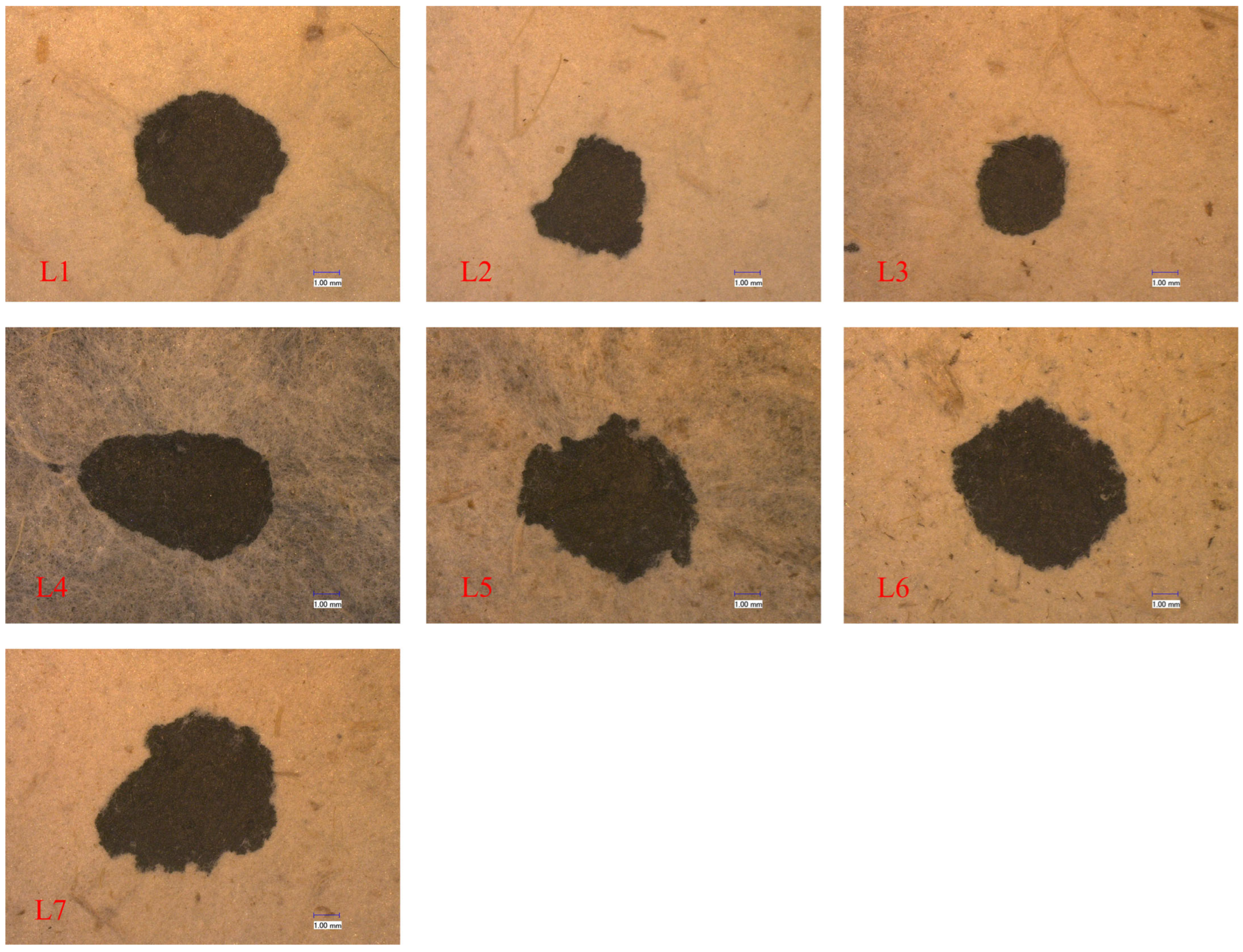
3.1.1. Ultra-Depth-of-Field Microscopic Observation
3.1.2. SEM-EDS Analysis
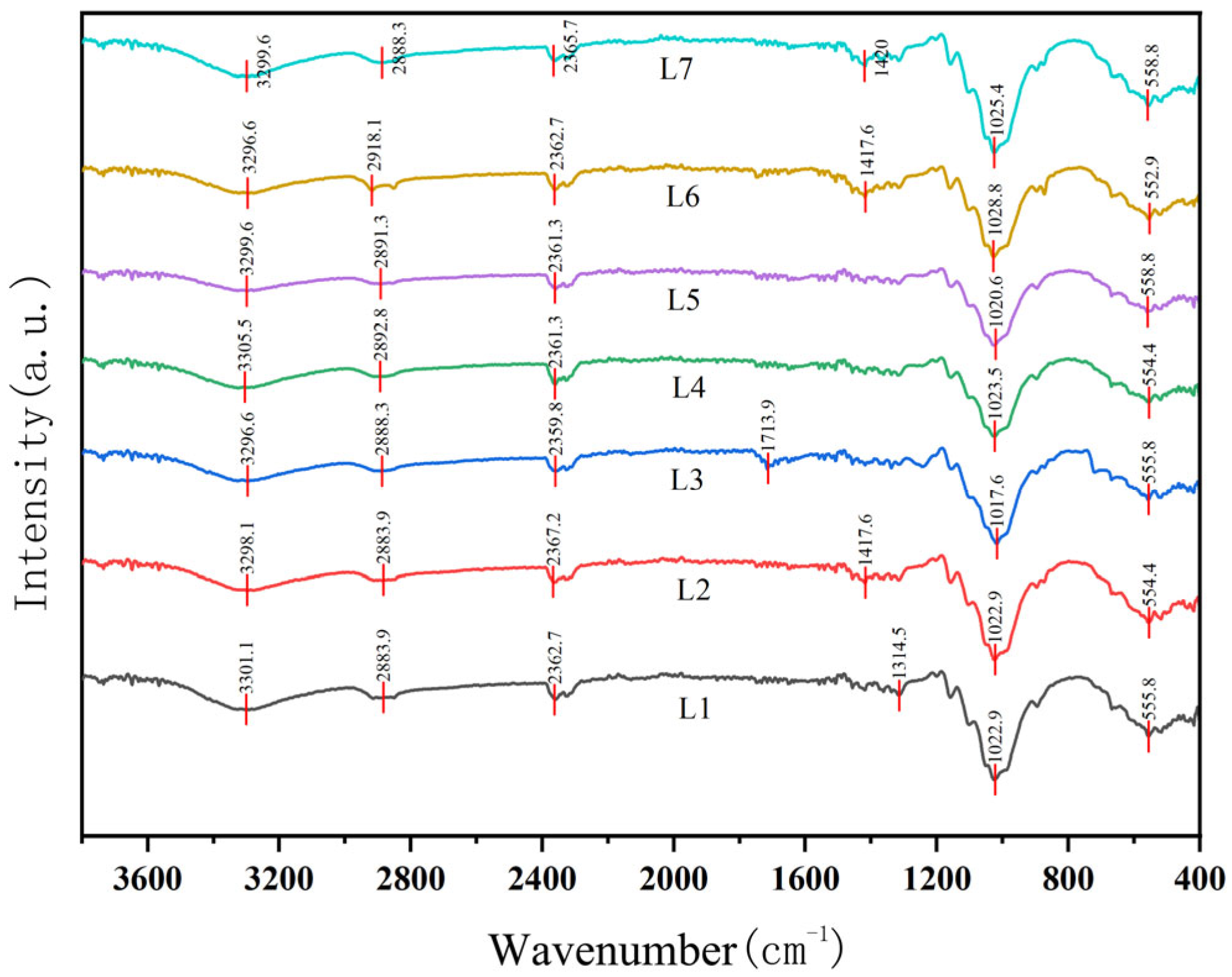
3.2. Surface Chemical Composition of Xuelai Tibetan Paper
3.3. Surface Wettability and Raw Ink Absorption Performance of Xuelai Tibetan Paper
3.4. Aging Resistance of Xuelai Tibetan Paper
3.4.1. Changes in D65 Brightness and Tensile Strength
3.4.2. Changes in Surface pH Value and Chemical Functional Groups
3.5. Correlation Between Surface Properties and Traditional Crafts
3.6. Protection Strategies for Xuelai Tibetan Paper
3.6.1. Protection of Xuelai Tibetan Paper Cultural Relics
3.6.2. Living Inheritance and Process Optimization
4. Conclusions
- (1)
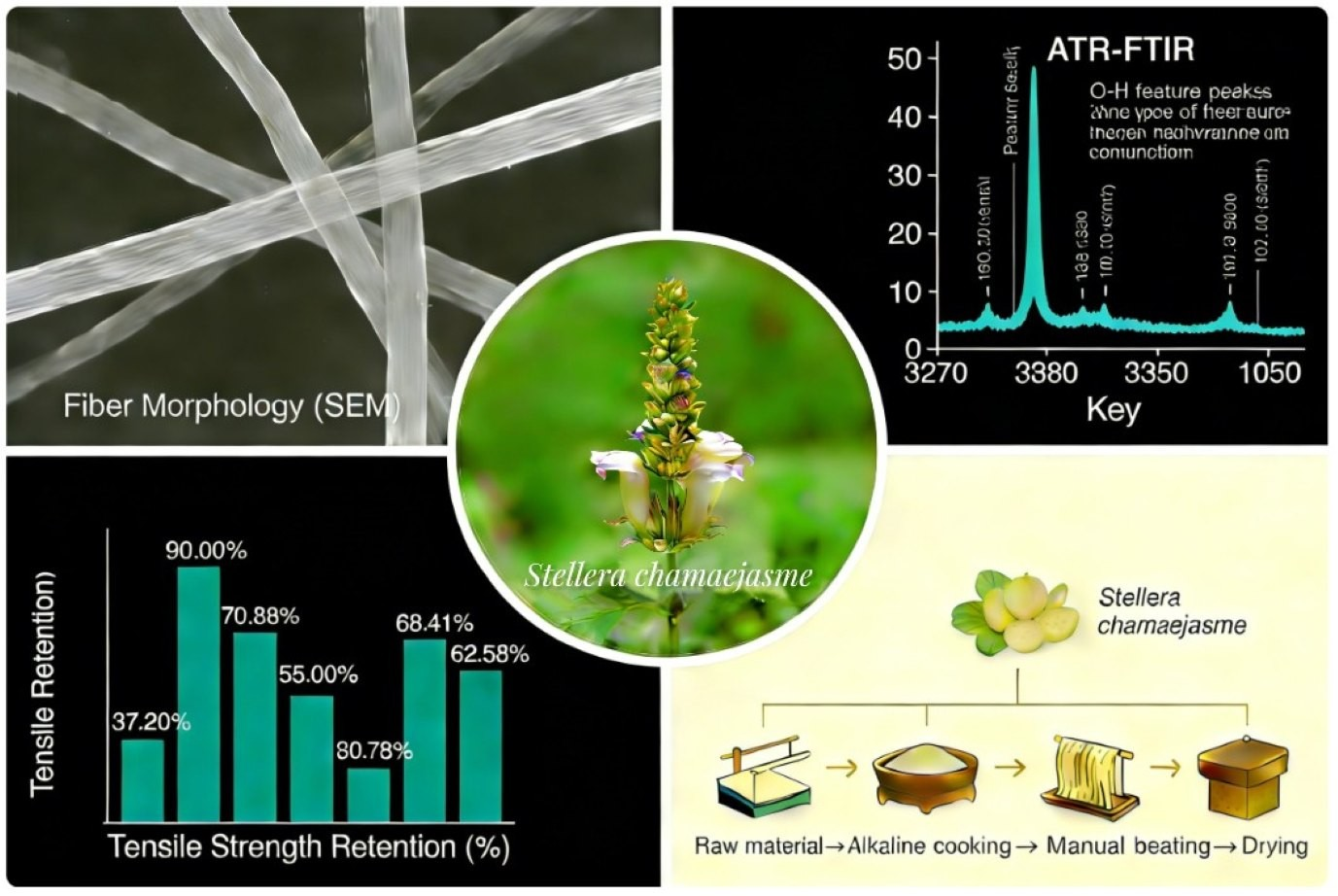
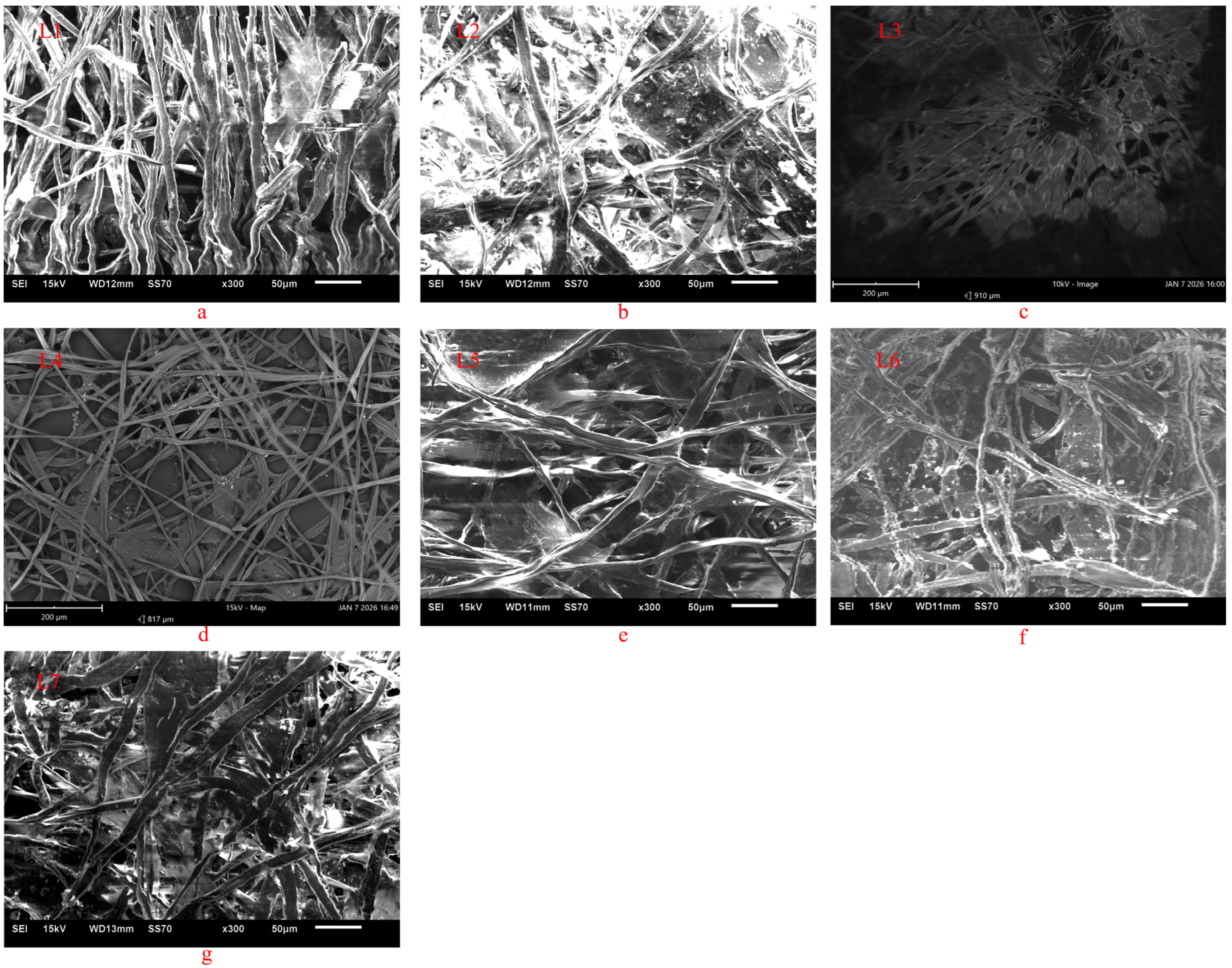
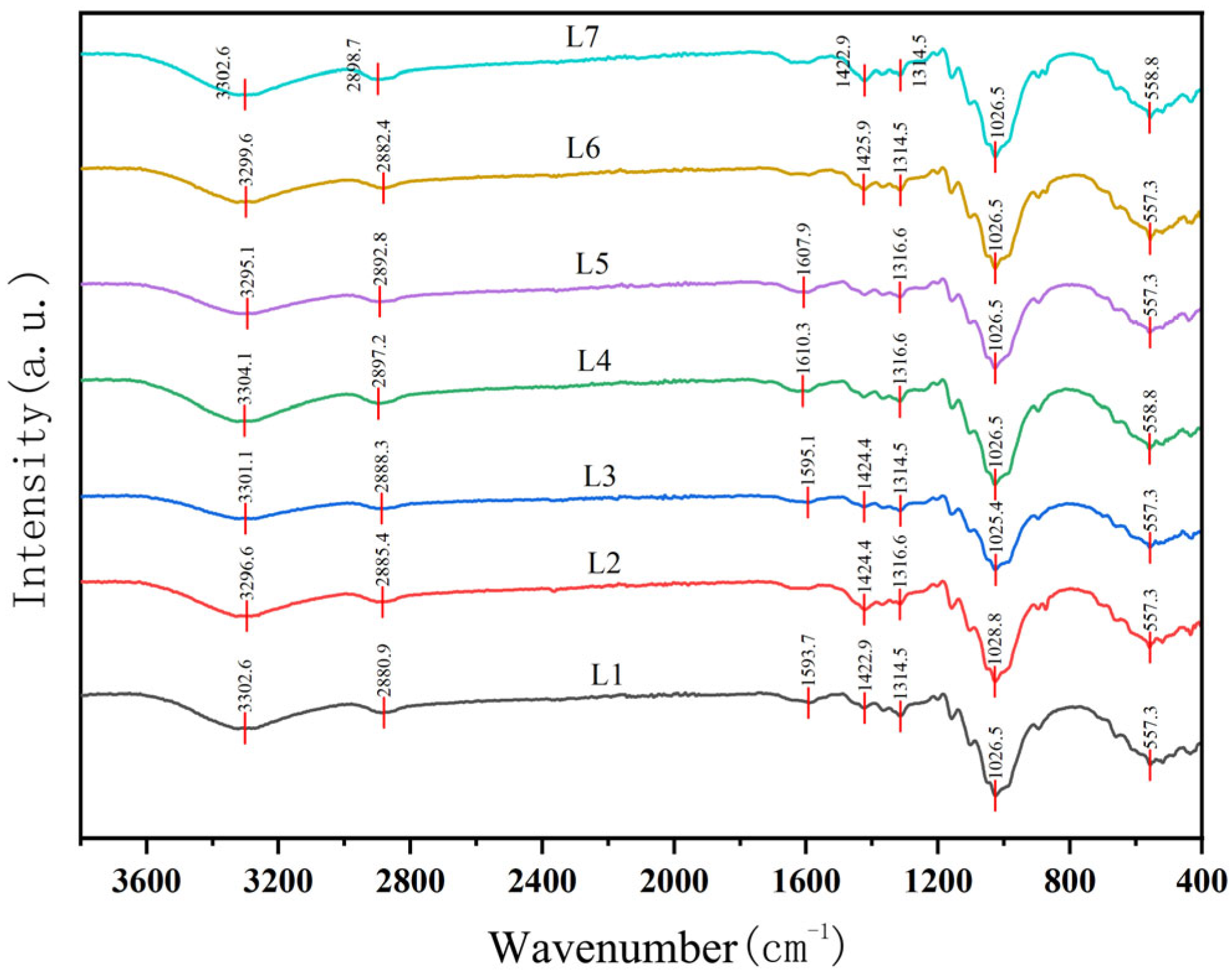
- The surface properties of Xuelai Tibetan paper present significant structural and chemical synergistic advantages. In terms of microstructure, Stellera chamaejasme fibers are flat and ribbon-like with an aspect ratio of 50–80, forming a tightly intertwined fiber network structure using the traditional manual beating process; in terms of chemical composition, ATR-FTIR functional group analysis shows that it takes cellulose as the core chemical component with a relatively low lignin content, and EDS elemental detection shows that some samples retain calcium-based substances derived from plant ash (mass fraction 0%–1.79%). The compactness of the above microstructure, the high stability of the main components, and the weak alkaline buffering effect of calcium-based substances together support the excellent tensile strength and chemical stability of Xuelai Tibetan paper.
- (2)
- Each link of the traditional craft forms precise coupling with surface properties and aging resistance. The intrinsic characteristics of Stellera chamaejasme raw materials lay the material foundation, alkaline cooking removes lignin and retains buffering components, manual beating optimizes the fiber’s interweaving structure, and natural air-drying improves surface uniformity. Finally, after 144 h of dry-heat aging, the Tibetan paper had a D65 brightness retention rate of 84.81%–92.21% and a tensile strength retention rate of 30.78%–90.00%, and statistical analysis confirms that these aging-induced changes in key performance indicators are highly significant (p < 0.001), showing good aging-resistance potential.
- (3)
- During the aging process, the performance degradation of Tibetan paper is mainly caused by cellulose glycosidic bond hydrolysis and pH fluctuation. The existence of calcium-based substances can inhibit hydrolysis by buffering acidic substances, while light and temperature–humidity fluctuations will accelerate lignin oxidation and fiber structure damage, which provides a scientific basis for the formulation of protection strategies.
- (4)
- The proposed dual strategy of cultural relic protection and craft inheritance is targeted and feasible. Preventive protection of cultural relics is realized through pH stabilization treatment and controlled storage environment construction, and living inheritance is realized through raw material standardization, process refinement, and inheritance digitalization, which not only respects the core value of traditional crafts, but also extends the preservation life and inheritance cycle of Tibetan paper through scientific means.
Author Contributions
Funding
Institutional Review Board Statement
Informed Consent Statement
Data Availability Statement
Acknowledgments
Conflicts of Interest
References
- Suo, L.R.Q.; Qi, M.D.J. A Comparative Study on Traditional Tibetan Papermaking Technology and Central Plains Papermaking Technology. Tibet Res. 1998, 2, 100–105. [Google Scholar]
- Sun, L.Q.; Sang, D.Z.X. A Preliminary Study on Tibetan Paper Culture. Tibet Sci. Technol. 2009, 2, 30–33. [Google Scholar]
- Daerwen, N.X.; Da, W. Investigation on Traditional Tibetan Papermaking Technology in Nyemo. Tibet Art Stud. 2013, 4, 60–64. [Google Scholar]
- Li, H.C.; Yu, G.; Qi, Z.X. Study on Fiber Characteristics of Stellera chamaejasme Root and Tibetan Paper. Papermak. Sci. Technol. 2009, 28, 6–8. [Google Scholar]
- Cui, X.; Pan, Y.; Wang, Y.N.; Zheng, X.N.; Gao, Y. Effects of Stellera chamaejasme on Small-scale Community Composition and Soil Physicochemical Properties in Degraded Grassland. Chin. J. Ecol. 2020, 39, 2581–2592. [Google Scholar]
- Zhang, J.S. Investigation on Traditional Handmade Technology of Dege Tibetan Paper. Tibet Res. 2005, 2, 115–116. [Google Scholar]
- Hong, W.; Liu, W.; Ding, L.; Ci, R.Y.Z. Restoration of Diamond Sutra Collected in Tibet Museum. In Proceedings of the National Museum of China Conservation & Restoration Report; National Museum of China, Tibet Museum, Eds.; National Museum of China Press: Beijing, China, 2020; pp. 250–261. [Google Scholar] [CrossRef]
- Liu, Y.X.; Li, X.C.; Wang, S. Research Progress on Raw Materials, Manufacturing and Restoration of Tibetan Paper. China Pulp Pap. 2022, 41, 126–132. [Google Scholar]
- Pan, J.X. A History of Papermaking in China; Shanghai People’s Publishing House: Shanghai, China, 2009. [Google Scholar]
- Li, X.C. Investigation on Tibetan Handmade Papermaking in Dege County of Sichuan Province and Nyemo County of Tibet. Chin. J. Hist. Sci. Technol. 2007, 2, 155–164. [Google Scholar]
- Jia, M.H.; Huang, X.X.; Cai, M.L.; Zhang, M.F.; Da, Z.; Hu, G. Comparative Analysis of Fibers and Papermaking Technology of Common Tibetan Papers for Tibetan Document Restoration. Archiv. Stud. 2021, 4, 116–122. [Google Scholar]
- Zan, Q.G.; Li, H.C.; Ji, Q.S.; Zhang, X.P.; Liang, T.; Ren, Q.Z.M. Preliminary Study on Aging Resistance of Four Kinds of Tibetan Paper. China Pulp Pap. 2020, 39, 87–90. [Google Scholar]
- Li, J.; Fu, H.; Liu, X.; Huang, J.; Li, P.C.; Feng, S.L.; Liu, R.; Su, K. Preliminary Study on Improving Tibetan Paper with Broussonetia Papyrifera Bark. Shandong Chem. Ind. 2025, 54, 5–8. [Google Scholar]
- Wei, J.P.; Gong, D.C.; Wang, S. Research Progress on Jindong Tibetan Paper Technology. China Pulp Pap. 2022, 41, 92–98. [Google Scholar]
- GB/T 10739-2002; Paper and Board—Standard Atmospheric Conditions for Conditioning and Testing. China Standard Press: Beijing, China, 2002.
- GB/T 464-2008; Paper and Board—Accelerated Aging Test Method. China Standard Press: Beijing, China, 2008.
- GB/T 7974-2013; Paper, Board and Pulps—Measurement of Diffuse Blue Reflectance Factor (D65 Brightness). China Standard Press: Beijing, China, 2013.
- GB/T 12914-2008; Paper and Board—Determination of Tensile Properties. China Standard Press: Beijing, China, 2008.
- GB/T 13528-2015; Paper and Board—Determination of Surface pH Value. China Standard Press: Beijing, China, 2015.
- Wang, J.H. Fiber Characteristics and Microscopic Atlas of Papermaking Raw Materials in China; China Light Industry Press: Beijing, China, 1999; pp. 145–146. [Google Scholar]
- Yang, J.; Wei, Q.; Du, S.F. Comparative Study on Ultrastructure of Phloem Fibers of Stellera chamaejasme and Five Kinds of Tibetan Paper Fibers. Trans. China Pulp Pap. 2021, 36, 87–92. [Google Scholar]
- Xiao, Z.P.; Li, Y.X.; Lv, X.F. Research on the Basic Performance and Fiber Appearance Characteristics of Grass Paper from Stellera chamaejasme in Different Origins on the Qinghai–Tibet Plateau. Coatings 2025, 15, 449. [Google Scholar] [CrossRef] [Scilit]
- Cai, M.L.; Zhang, M.F. Study on Properties of Common Tibetan Papers for Tibetan Document Restoration. Archiv. Bull. 2018, 103–107. [Google Scholar]
- Gao, D.; Zhang, S.P.; Zhang, G.; Song, R.J.; Sun, Y.F.; Zhao, W.; Zhao, B.Y. Study on Durability of Zhikong Tibetan Paper. China Pulp Pap. 2019, 38, 36–40. [Google Scholar]
- Lu, C.Q.; Zhang, R.H.; Liu, J.; Luo, C.; Sun, D.Z.; Jiang, Y.; Zhao, X. Determination of 9 Metal Elements in Traditional Handmade Paper by Inductively Coupled Plasma Atomic Emission Spectrometry and Its Traceability Study. Phys. Test. Chem. Anal. (Chem. Anal.) 2019, 55, 677–682. [Google Scholar]
- Yao, N.; Wei, S. Characterization and Identification of Traditional Chinese Handmade Papers via Pyrolysis-Gas Chromatography-Mass Spectrometry. BioResources 2021, 16, 3942–3956. [Google Scholar] [CrossRef] [Scilit]
- Helman-Ważny, A. The Choice of Materials in Early Tibetan Printed Books. In Tibetan Manuscript and Xylograph Traditions: The Written Word and Its Media Within the Tibetan Culture Sphere; Almogi, O., Ed.; Department of Indian and Tibetan Studies, University of Hamburg: Hamburg, Germany, 2016; pp. 171–196. [Google Scholar]
- Han, B.; Niang, J.; Rao, H.; Lü, N.; Oda, H.; Sakamoto, S.; Yang, Y.; Sablier, M. Paper fragments from the Tibetan Samye Monastery: Clues for an unusual sizing recipe implying wheat starch and milk in early Tibetan papermaking. Herit. Sci. 2021, 9, 87. [Google Scholar] [CrossRef] [Scilit]
- Lv, S.X. Study on Non-destructive Identification Method of Traditional Chinese Handmade Paper by Attenuated Total Reflection Infrared Spectroscopy. Spectrosc. Spectr. Anal. 2024, 44, 2450–2458. [Google Scholar]
- Yan, Y.; Wen, C.; Jin, M.; Duan, L.; Zhang, R.; Luo, C.; Xiao, J.; Ye, Z.; Gao, B.; Liu, P.; et al. FTIR Spectroscopy in Cultural Heritage Studies: Non-destructive Analysis of Chinese Handmade Papers. Chem. Res. Chin. Univ. 2019, 35, 586–591. [Google Scholar] [CrossRef] [Scilit]
- Liu, Y.P.; Zhang, C.H.; Lan, W.; Ren, J.L.; Fan, H.M. Study on Dry Heat Aging Properties of Wikstroemia Paper under Different Atmospheric Cooking Conditions. China Pulp Pap. 2022, 41, 43–50. [Google Scholar]
- Lv, H.L.; Ma, Y.W.; Wan, J.Q.; Wang, Y. Study on Hydrogen Bonding Mode of Holocellulose. Trans. China Pulp Pap. 2011, 26, 1–5. [Google Scholar]
- Rischel, A.G. Permanence and Durability of Paper: A Study through the Microscope. Stud. Conserv. 2011, 56, 321–332. [Google Scholar] [CrossRef] [Scilit]
- Yang, F. Study on Aged Paper Used as Mending Paper for Ancient Book Restoration. China Pulp Pap. 2024, 43, 128–136. [Google Scholar]
- Yao, J.J.; Zhang, R.H.; Xiao, J.F.; Luo, C.; Huang, H.J.; Yan, Y.E.; Bi, N.; Tang, Y. Study on Durability of Kaihua Handmade Paper. Papermak. Sci. Technol. 2021, 40, 1–7. [Google Scholar]
- Baty, J.W.; Maitland, C.L.; Minter, W.; Hubbe, M.A.; Jordan-Mowery, S.K. Deacidification for the Conservation and Preservation of Paper-based Works: A Review. BioResources 2010, 5, 1955–2023. [Google Scholar] [CrossRef] [Scilit]
- Xia, W.Z.; Liu, H.; Wang, S.N.; Tang, Y. The Influence of pH on Paper Degradation Trends and Calculation of Alkali Dosage in Deacidification: Taking the Machine-Made Paper of the 1990s as an Example. Acta Chim. Sin. 2025, 83, 527–534. [Google Scholar] [CrossRef] [Scilit]
- Völkel, L.; Prohaska, T.; Potthast, A. Combining Phytate Treatment and Nanocellulose Stabilization for Mitigating Iron Gall Ink Damage in Historic Papers. Herit. Sci. 2020, 8, 86. [Google Scholar] [CrossRef] [Scilit]
- Xiao, Z.P. Study on Properties and Manufacturing Technology of Traditional Stellera chamaejasme Paper. Ph.D. Dissertation, University of Science and Technology Beijing, Beijing, China, 2025. [Google Scholar]
- Tan, J.; Lu, Y.J.; Fu, X.H.; Chen, B.; Ding, Y. Analysis of Effects of Microstructure Changes of Aged Bamboo Paper on Its Properties. Chin. Sci. Bull. 2022, 67, 4429–4438. [Google Scholar] [CrossRef] [Scilit]
- Fan, H.M.; Yun, B.H.; Liu, J.A. Research Progress on Deacidification and Reinforcement Technology of Paper Documents. China Pulp Pap. 2024, 43, 170–180. [Google Scholar]
- Qi, S. Study on In-situ Formation of Calcium Carbonate and Its Application in Deacidification of Aged Paper. Master’s Dissertation, South China University of Technology, Guangzhou, China, 2022. [Google Scholar]
- Gong, H.D.; Li, B. Study on Correlation between Quantity and Biomass Survival Strategy of Tibetan Medicinal Plant Stellera chamaejasme in Qinghai-Tibet Plateau. J. Qujing Norm. Univ. 2024, 43, 13–20. [Google Scholar]



| Sample No. | Raw Material | Paper Description | Grammage (g/m2) | Thickness (μm) | D65 Brightness (% ISO) | Application Scenario |
|---|---|---|---|---|---|---|
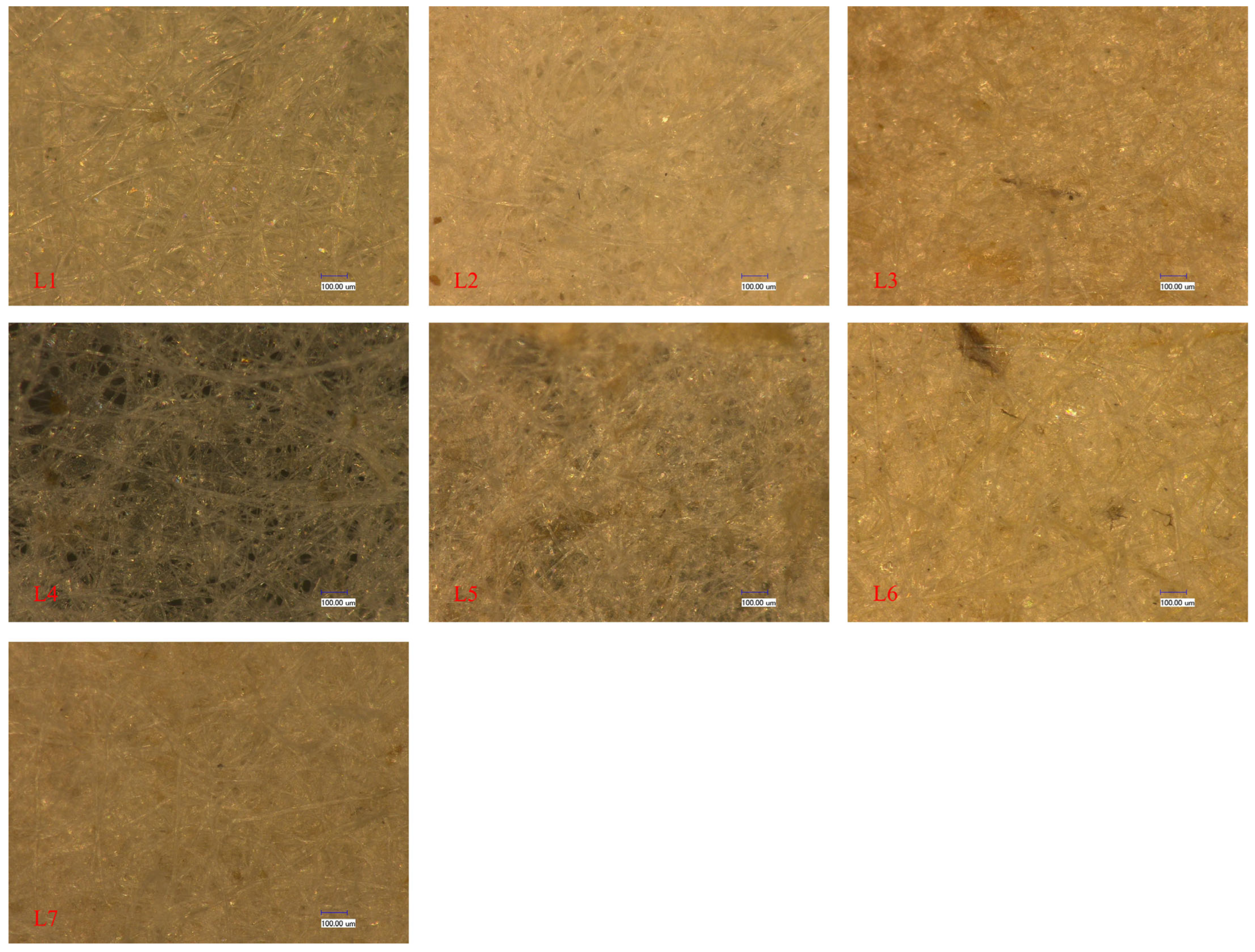
| L1 | Roots of Stellera chamaejasme | Ivory white, uniform texture, with fiber bundles | 53.83 ± 0.65 | 225.00 ± 14.79 | 45.67 ± 0.30 | Buddhist scripture copying |
| L2 | Roots of Stellera chamaejasme | White slightly yellowish, with black impurities | 61.10 ± 0.56 | 173.33 ± 23.95 | 49.08 ± 0.12 | Daily writing |
| L3 | Roots of Stellera chamaejasme | Gray, with fiber bundles and black impurities | 78.34 ± 2.79 | 172.80 ± 22.79 | 36.90 ± 0.70 | Buddhist scripture paper |
| L4 | Roots of Stellera chamaejasme | Extremely thin, beige color | 12.32 ± 3.42 | 85.80 ± 17.20 | 49.68 ± 0.28 | Cultural relic restoration |
| L5 | Roots of Stellera chamaejasme | Gray, relatively thin, with fiber bundles and black impurities | 27.85 ± 2.23 | 113.92 ± 11.63 | 34.63 ± 1.08 | Cultural relic restoration |
| L6 | Waste paper stock (containing Stellera chamaejasme) | Yellowish gray, with many impurities | 74.70 ± 8.04 | 246.40 ± 44.37 | 37.37 ± 1.03 | Notebook paper |
| L7 | Roots of Stellera chamaejasme | Gray | 60.00 ± 3.10 | 178.80 ± 33.74 | 42.06 ± 0.53 | Archive paper |
| Instrument Name | Model | Manufacturer/Country | Application |
|---|---|---|---|
| Ultra-depth-of-field3D video microscope | VHX-600K | KEYENCE, Osaka, Japan | Observation of surface microstructure |
| Scanning Electron Microscope (SEM) | JSM-6610LV | JEOL, Tokyo, Japan | Microstructure and elemental analysis |
| Fourier Transform Infrared Spectrometer (ATR mode) | ALPHA | BRUKER, Ettlingen, Germany | Analysis of surface chemical functional groups |
| Automatic video contact angle measuring instrument | DSA100 | KRUSS, Hamburg, Germany | Wettability testing |
| Self-made ink absorption experimental device | RM-1 | Beijing Bisheng Asset Management Co., Ltd., Beijing, China | Ink absorption performance testing |
| Dry heat aging oven | DHG-9241A | Shanghai Jinghong Experimental Equipment Co., Ltd., Shanghai, China | Accelerated aging experiment |
| Whiteness tester | XT-48B/BN | Hangzhou Yante Instrument Co., Ltd., Hangzhou, China | D65 brightness measurement |
| Micro-controlled tensile testing machine | KZW-300 | Changchun Paper Testing Machine Factory, Changchun, China | Tensile strength testing |
| pH meter | PHS-3C | Shanghai Yitian Instrument Co., Ltd., Shanghai, China | Surface pH measurement |
| Sample No. | Fiber Width (μm) |
|---|---|
| L1 | 12.92 ± 3.49 |
| L2 | 11.42 ± 2.26 |
| L3 | 9.04 ± 3.05 |
| L4 | 13.85 ± 2.94 |
| L5 | 11.04 ± 2.06 |
| L6 | 9.92 ± 2.60 |
| L7 | 12.82 ± 0.93 |
| Average Value | 11.57 ± 1.73 |
| Sample No. | C | O | Ca | Al | Si | Na |
|---|---|---|---|---|---|---|
| L1 | 50.41 | 49.25 | 0 | 0 | 0 | 0.34 |
| L2 | 49.63 | 48.50 | 1.55 | 0 | 0 | 0.32 |
| L3 | 12.63 | 87.37 | 0 | 0 | 0 | 0 |
| L4 | 16.57 | 81.09 | 1.61 | 0.10 | 0.16 | 0.47 |
| L5 | 53.13 | 45.92 | 0.61 | 0.20 | 0.14 | 0 |
| L6 | 50.40 | 48.31 | 1.11 | 0.18 | 0 | 0 |
| L7 | 50.43 | 47.02 | 1.79 | 0 | 0.25 | 0.51 |
| Sample ID | Contact Angle (°) * | Absorption Time (s) * |
|---|---|---|
| L1 | 92, 0, 0, 0, 0 | 0, 1, 1, 1, 1 |
| L2 | 102, 92, 89, 49, 0 | 0, 4, 7, 11, 30 |
| L3 | 87, 83, 75, 44, 0 | 0, 8, 16, 24, 28 |
| L4 | 0, 0, 0, 0, 0 | 0, 0, 0, 0, 0 |
| L5 | 113, 107, 97, 74, 0 | 0, 7, 15, 23, 31 |
| L6 | 85, 54, 0, 0, 0 | 0, 1, 3, 5, 6 |
| L7 | 118, 115, 102, 43, 10 | 0, 1, 3, 5, 6 |
| Sample No. | D65 Brightness Before Aging (% ISO) | D65 Brightness After 24 h Aging (% ISO) | D65 Brightness After 72 h Aging (% ISO) | D65 Brightness After 144 h Aging (% ISO) | D65 Brightness Retention Rate (%) |
|---|---|---|---|---|---|
| L1 | 45.67 ± 0.30 | 43.50 ± 0.60 | 39.89 ± 0.97 | 40.38 ± 0.86 | 88.42 |
| L2 | 49.08 ± 0.12 | 46.95 ± 0.30 | 43.83 ± 0.98 | 42.60 ± 0.89 | 86.80 |
| L3 | 36.90 ± 0.70 | 35.51 ± 0.55 | 32.68 ± 0.46 | 32.36 ± 0.18 | 87.70 |
| L4 | 49.68 ± 0.28 | 48.53 ± 0.40 | 47.02 ± 0.56 | 45.31 ± 0.65 | 91.20 |
| L5 | 34.63 ± 1.08 | 32.53 ± 0.70 | 29.69 ± 0.36 | 29.37 ± 0.36 | 84.81 |
| L6 | 37.37 ± 1.03 | 36.81 ± 1.20 | 34.29 ± 1.51 | 34.46 ± 0.82 | 92.21 |
| L7 | 42.06 ± 0.53 | 40.69 ± 0.75 | 38.72 ± 1.00 | 37.78 ± 0.93 | 89.82 |
| Sample No. | Tensile Index Before Aging (N·m/g) | Tensile Index After 24 h Aging (N·m/g) | Tensile Index After 72 h Aging (N·m/g) | Tensile Index After 144 h Aging (N·m/g) | Tensile Strength Retention Rate (%) |
|---|---|---|---|---|---|
| L1 | 53.87 ± 5.58 | 39.32 ± 3.15 | 17.70 ± 8.55 | 20.04 ± 13.08 | 37.20 |
| L2 | 42.23 ± 0.09 | 39.15 ± 0.72 | 35.14 ± 1.59 | 38.00 ± 2.82 | 90.00 |
| L3 | 33.87 ± 21.51 | 33.06 ± 1.21 | 31.40 ± 2.57 | 23.82 ± 4.29 | 70.33 |
| L4 | 30.03 ± 23.31 | 25.03 ± 3.12 | 17.11 ± 2.30 | 16.51 ± 11.44 | 55.00 |
| L5 | 33.76 ± 5.00 | 30.87 ± 2.15 | 22.00 ± 5.00 | 10.39 ± 4.21 | 30.78 |
| L6 | 34.88 ± 5.18 | 34.28 ± 1.23 | 30.00 ± 5.25 | 23.86 ± 3.73 | 68.41 |
| L7 | 35.46 ± 2.39 | 30.26 ± 1.02 | 22.40 ± 3.88 | 22.19 ± 2.73 | 62.58 |
| Measurement Index | Friedman χ2 | p-Value |
|---|---|---|
| D65 brightness | 22.37 | <0.001 *** |
| pH value | 18.54 | <0.001 *** |
| Tensile index | 25.89 | <0.001 *** |
| Sample No. | pH Value Before Aging | pH Value After 24 h Aging | pH Value After 72 h Aging | pH Value After 144 h Aging | pH Change After 144 h |
|---|---|---|---|---|---|
| L1 | 5.17 ± 0.05 | 5.41 ± 0.08 | 5.76 ± 0.05 | 5.71 ± 0.015 | +0.54 |
| L2 | 5.11 ± 0.03 | 6.04 ± 0.06 | 7.07 ± 0.05 | 6.64 ± 0.005 | +1.53 |
| L3 | 5.75 ± 0.15 | 5.71 ± 0.10 | 5.66 ± 0.01 | 5.63 ± 0.005 | −0.12 |
| L4 | 5.19 ± 0.01 | 5.37 ± 0.12 | 5.44 ± 0.17 | 5.56 ± 0.005 | +0.37 |
| L5 | 6.54 ± 0.11 | 5.80 ± 0.15 | 5.05 ± 0.17 | 5.22 ± 0.010 | −1.32 |
| L6 | 6.91 ± 0.03 | 6.76 ± 0.04 | 6.61 ± 0.05 | 6.50 ± 0.010 | −0.41 |
| L7 | 6.34 ± 0.13 | 6.26 ± 0.12 | 6.12 ± 0.14 | 6.06 ± 0.010 | −0.28 |
Disclaimer/Publisher’s Note: The statements, opinions and data contained in all publications are solely those of the individual author(s) and contributor(s) and not of MDPI and/or the editor(s). MDPI and/or the editor(s) disclaim responsibility for any injury to people or property resulting from any ideas, methods, instructions or products referred to in the content. |
© 2026 by the authors. Licensee MDPI, Basel, Switzerland. This article is an open access article distributed under the terms and conditions of the Creative Commons Attribution (CC BY) license.
Share and Cite
Xiao, Z.; Zhang, X.; Li, Y.; Liu, Z.; Li, H.; Zhang, X.; Ma, R. Nyemo Xuelai Tibetan Paper (Tibet, China): Research on Synergistic Correlations Between Surface Properties, Aging Resistance Mechanisms, Traditional Papermaking Crafts, and Protection Strategies. Coatings 2026, 16, 273. https://doi.org/10.3390/coatings16030273
Xiao Z, Zhang X, Li Y, Liu Z, Li H, Zhang X, Ma R. Nyemo Xuelai Tibetan Paper (Tibet, China): Research on Synergistic Correlations Between Surface Properties, Aging Resistance Mechanisms, Traditional Papermaking Crafts, and Protection Strategies. Coatings. 2026; 16(3):273. https://doi.org/10.3390/coatings16030273
Chicago/Turabian StyleXiao, Zhipeng, Xinyun Zhang, Yanxiang Li, Zhengfeng Liu, Haomiao Li, Xinyuan Zhang, and Ruiying Ma. 2026. "Nyemo Xuelai Tibetan Paper (Tibet, China): Research on Synergistic Correlations Between Surface Properties, Aging Resistance Mechanisms, Traditional Papermaking Crafts, and Protection Strategies" Coatings 16, no. 3: 273. https://doi.org/10.3390/coatings16030273
APA StyleXiao, Z., Zhang, X., Li, Y., Liu, Z., Li, H., Zhang, X., & Ma, R. (2026). Nyemo Xuelai Tibetan Paper (Tibet, China): Research on Synergistic Correlations Between Surface Properties, Aging Resistance Mechanisms, Traditional Papermaking Crafts, and Protection Strategies. Coatings, 16(3), 273. https://doi.org/10.3390/coatings16030273