Article

Optimization of SnCl2:NH4F-Derived Sols for Preparation of Thin Transparent Conductive Crystallized SnO2 Films

by
Anastasiya S. Kovalenko
1,2,
Anastasiya I. Kushakova
1,3,
Anton M. Nikolaev
1,4,
Nadezhda N. Gubanova
1,5,
Vasilii A. Matveev
5,
Ekaterina A. Bondar
6,
Sergei V. Myakin
7,
Oleg A. Zagrebelnyy
1,
Alexandra G. Ivanova
1,4 and
Olga A. Shilova
1,2,4,*
1
Institute of Silicate Chemistry—Branch of Petersburg Nuclear Physics Institute named by B.P. Konstantinov of National Research Centre “Kurchatov Institute”, Saint-Petersburg 199034, Russia
2
Department of Chemistry, Physics, and Biology of Nanoscale Environments, Saint-Petersburg State Institute of Technology, Saint-Petersburg 190013, Russia
3
Department of Inorganic Chemistry, Saint-Petersburg State Institute of Technology, Saint-Petersburg 190013, Russia
4
Basic Department of Nanotechnology and Nanomaterials in Radioelectronics, Saint-Petersburg Electrotechnical University “LETI”, Saint-Petersburg 197022, Russia
5
Petersburg Nuclear Physics Institute named by B.P. Konstantinov of National Research Centre “Kurchatov Institute”, Leningrad Region, Gatchina 188300, Russia
6
Institute of Physics and Technology, Satpayev University, Almaty 050013, Kazakhstan
7
Department of Theoretical Foundations of Materials Science, Saint-Petersburg State Institute of Technology, Saint-Petersburg 190013, Russia
*
Author to whom correspondence should be addressed.
Coatings 2026, 16(2), 210; https://doi.org/10.3390/coatings16020210
Submission received: 20 December 2025 / Revised: 29 January 2026 / Accepted: 3 February 2026 / Published: 6 February 2026

Abstract

Transparent conductive SnO2 films, promising for application in electronic engineering, were obtained by sol–gel synthesis via mixing SnCl2∙2H2O and NH4F solutions, followed by deposition onto glass substrates by centrifugation and heat treatment at 450 °C. The physicochemical processes of SnO2 crystallization in water–alcohol solutions of SnCl2 were analyzed depending on the concentration of the crystallization initiator NH4F and the alcohols used. The sol–gel processing of the thin films was investigated using a Latin square approach. Three factors affecting the film formation conditions were varied at three levels to determine the best combination of film properties involving the maximum transparency and lowest specific electrical resistance. The effect of solvent type (ethanol, 1-butanol and isopropanol), the amount of introduced fluorine (5, 10, and 15 at. %) and the number of deposited layers (10, 15, and 20) on the composition, morphology, crystallization features, transparency and specific surface resistance of the synthesized thin films was studied. The obtained films of ~200–340 nm thickness exhibited ~78%–95% transparency in the visible spectrum range and specific surface resistance (ρs) from ~109 to >1012 Ω/sq. The optimal combination of thin (~250 μm) SnO2<Sn> film target performances including transparency 84% and specific surface resistance ~109 Ω/sq. was achieved in the case of their preparation in isopropanol with an average concentration of NH4F (10 at. % F) and spin-on deposition of 20 layers.

1. Introduction

Tin oxide (SnO2) is a functional semiconductor material in high demand due to its exceptional physical properties such as large band gap (Eg = 3.6–3.7 eV), high optical transparency, relatively high charge carrier mobility, good chemical stability, non-toxicity and wide availability [1,2,3,4,5]. As a transparent conductive oxide, SnO2 is widely used in the manufacture of solar cells, stable resistors, touch sensors, photoelectrochemical water splitting devices, electrochromic and digital displays, flexible electronics, gas-sensitive sensors, and photocatalytic water and air purification devices [1,3,4,6,7,8]. This semiconductor features an advantageous combination of target properties involving a high optical transparency in the visible range of the spectrum, coupled with reflection of infrared radiation and high electrical conductivity [9]. The optical transparency and electrical conductivity of SnO2 are determined by increasing the number of free charge carriers either due to internal defects such as oxygen vacancies or due to external dopants [10].
Oxygen vacancies and defects in SnO2 films arise as a result of heat treatment at temperatures 200–500 °C [3,10]. Films obtained at 400–500 °C feature a stable photocurrent [3], high surface capacity and long service life [10].
Due to the presence of internal defects such as oxygen vacancies, undoped SnO2 is an n-type semiconductor [9]. Its n-type conductivity can be enhanced by the introduction of such dopants as Sb, Ta, and F [9,11], while doping with Al, B, Sb, Zn, Fe and N leads to a change in conductivity behavior towards the p-type [9,10,12]. High-quality SnO2 semiconductors of both n- and p-types are used to fabricate SnO2-based semiconductor devices; however, p-type SnO2 conductors have not yet been sufficiently studied [9].
Fluorine doping of SnO2 films, especially those obtained by the sol–gel method, affords an additional reduction in electrical resistance and increase in the charge carrier concentration, thus improving their electronic characteristics and making possible the use of SnO2 films in modern optoelectronic devices [13,14]. However, the prospects for their implementation are complicated by the problem of maintaining a high transparency of the films.
Thin SnO2 films, including doped ones, are prepared using such methods as the sol–gel dip-coating technique [15], the sol–gel spin-coating technique [16,17], spray pyrolysis [18,19], the co-precipitation, ball milling, solvothermal and pulsed laser deposition methods [20], the thermal evaporation technique [21], the wet chemical process [22], chemical vapor deposition [23], and RF magnetron sputtering [24,25].
Spray pyrolysis has recently become the most commonly used method of depositing films for application in modern devices. However, this method has several drawbacks, including a non-uniform solution distribution on the substrate surface, leading to uneven distribution of crystal formation centers and consequently resulting in non-uniform film composition. Furthermore, the relatively high thickness of films produced by this method can lead to cracking and reduced optical transparency in the visible range of the spectrum. Therefore, the use of films produced by spray pyrolysis is limited.
More uniform films can be produced by magnetron sputtering from the gas phase. However, this method requires complex and expensive equipment.
The sol–gel spin-coating technique is a promising method for obtaining thin films due to simplicity, low cost and possibility for the adjustment of the prepared material composition and structure [16,26,27,28,29].
For these reasons the sol–gel spin-coating technique was chosen for obtaining SnO2-F films in this study. In this process, a sol is centrifuged onto a substrate, where the solvent evaporates and the sol decomposes, resulting in the formation of thin films on the substrate surface. The choice of solvent is crucial in this process [30], since solvents affect the morphology of the resulting films [31,32], which is important for their subsequent application in electronic devices. For example, in transparent conducting oxide applications, thin films with large and well-connected grains and fewer boundaries are needed to reduce interfacial scattering and improve electrical conductivity [33]. Only a few current studies relate to a detailed analysis of the effect of different solvents on the crystallinity and morphology of SnO2-F thin films obtained by the sol–gel method for applications in electronics [30,34]. Therefore, the study of the influence of alcohol solvents on the crystallization and morphology of SnO2-F films is important to determine the optimal synthesis parameters for obtaining films with high transparency and low resistance required for the use in electronic devices. The lack of research devoted to these issues is a reason for the present study.
Thus, in this study we investigate the effect of alcohol solvents on the crystallinity, morphology, transparency and electrical resistance of SnO2-F thin films obtained using the sol–gel spin-coating technique. These issues are essential for promising applications of these films in electronic devices, such as solar cells, gas sensors, and electroluminescent devices. Ethanol, butanol, and isopropanol were chosen as solvents because they have different evaporation temperatures, taking into account that they should be moderate since too high boiling points hinder solvent evaporation, causing solvent residue to remain in the films.
The aim of this study was to investigate the influence of sol–gel synthesis conditions on the crystallization processes and target parameters of thin transparent conductive SnO2 films depending on the choice of organic solvent (ethanol, butane-1, and isopropanol), the concentration of the crystallization initiator NH4F and the number of spin-coating layers.

2. Materials and Methods

2.1. Sol–Gel Synthesis of Thin Undoped SnO2

Thin SnO2 films were synthesized from tin(II) chloride (SnCl2) and ethanol-based sol–gel systems. To prepare the sol, 0.1 mol SnCl2⸱2H2O was dissolved in 100 mL of ethanol at room temperature and stirred with a magnetic stirrer for 3 h. The resulting sol was kept for 24 h at room temperature in the dark. Then thin films were formed from the resulting sol on glass substrates by means of spin-on coating (substrate rotation speed 1500 rpm; film formation time 30 s), providing a uniform sol distribution over the substrate surface. The resulting films were dried at room temperature for 1 h. Subsequently, the films were heat-treated at different temperatures (100 °C, 200 °C, 300 °C and 500 °C) for 30 min in order to determine the optimal heat-treatment temperature for obtaining SnO2 films with a crystalline structure.

2.2. Preparation of Fluorine-Doped SnO2 Thin Films

Fluorine-doped SnO2 thin films were prepared by sol–gel synthesis using SnCl2∙2H2O and NH4F as precursors. The experiment was designed using the Latin square method involving the variation of three factors (A, B, C) characterizing the synthesis conditions at three levels (Table 1). Three different organic solvents (ethanol, 1-butanol, and isopropanol) were used during the synthesis; the amount of NH4F (5, 10, or 15 at. %) and the number of deposited layers (10, 15, 20) were also varied. This arrangement allowed us to adjust the resulting films’ thickness, structure and properties. The prepared sols were spin-on coated to glass substrates by centrifugation (substrate rotation speed: 1500 rpm; film formation time: 30 s), followed by drying at room temperature and heat treatment at 450 °C for 1 h.
The synthesis parameters were selected on the basis of reference data [29,30]. Notably, ethanol is most commonly used for the synthesis of the considered films [35]. The choice of ethanol, 1-butanol and isopropanol is due to their different evaporation temperatures and carbon skeletal structures, which are expected to affect the crystallization and morphology of the resulting films. It is important to note that almost no studies on the synthesis of SnO2 films using butanol have been reported [30]. In this case, the concentration of less than 10 wt.% F relating to SnO2 (5 to 15 at. % F relating to Sn) was chosen to ensure that fluorine acts only as a crystallization initiator to obtain more transparent films. The number of layers was also minimized to achieve maximum film transparency.

2.3. Characterization Methods

The phase composition was studied using a Rigaku SmartLab diffractometer (45 kV, 200 mA, CuKα) via the grazing incident X-ray diffraction (GIXRD) method, providing the characterization of thin polycrystalline films by directing X-rays at very low angles (under 1 degree) and probing only the top nanometers, thus suppressing substrate signals and revealing the surface structure, preferred orientation (texture), crystallite size, and strain [36,37,38]. Measurements were performed at a fixed grazing angle of 0.25 degrees for the X-ray beam incident on the sample; the detector angle range was 2θ = 10–100 degrees; a Soller collimator with a 0.228-degree aperture was installed in front of the detector to increase the resolution.
The surface morphology of the prepared thin films was studied by optical microscopy using an MPE-11 microscope (LOMO, St. Petersburg, Russia) and by scanning electron microscopy using a CC-66 scanning microscope (manufactured in China by order of the company “MELYTEC”, Moscow, Russia) at an accelerating voltage of 20 kV; an EBSD Oxford attachment was used to determine the elemental composition.
The films’ transparency was assessed according to transmission spectra measured using SF 56 UV–visible spectrophotometer (LOMO, St. Petersburg, Russia).
The specific surface electrical resistance ρs of the resulting films was studied by a two-electrode technique using on a P-45X potentiostat–galvanostat instrument (Electrochemical Instruments, Chernogolovka, Russia). It was calculated using volt-ampere characteristic measured with linear sweep voltammetry.
The film thickness was studied using a MII-4 microinterferometer (LOMO, St. Petersburg, Russia) by measuring changes in the film optical characteristics relating to the substrate. The thickness of the prepared SnO2-F films raged from about 200 to 340 nm, particularly 195 nm for No. 4 (ethanol, 10% F, 15 layers), 200 nm for No. 3 (1-butanol, 5% F, 20 layers), 220 nm for No. 2 (isopropanol, 15% F, 10 layers) and 340 nm for No. 8 (isopropanol, 5% F, 15 layers), with the measurement error appr. 10%.
Statistical data processing was performed according to the Latin square approach [39] using the Statistica v.10, 2011 and MS Excel software.
Haacke’s figures of merit were calculated according to the method described in [40] as:
FOM(H)=T10s
where T is the optical transmission and ρs is the specific surface resistance of the prepared SnO2:F films.

3. Experimental Results

3.1. The Influence of Sol–Gel Synthesis Conditions on the Thickness, Surface Morphology and Elemental Composition of SnO2 Thin Films

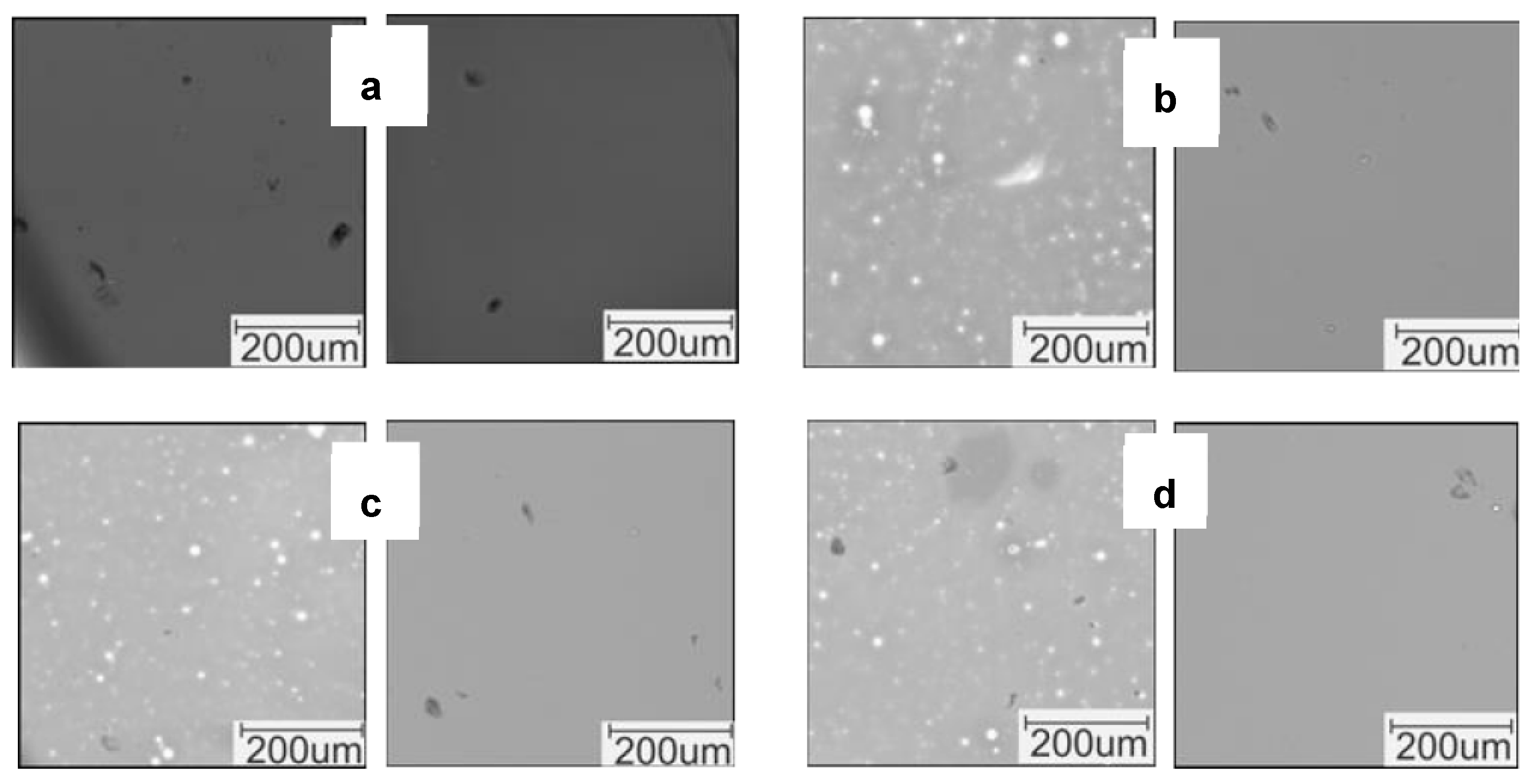
Films spin-on coated from sols are very thin and difficult to see with the naked eye. Their presence on the glass surface was confirmed by scanning electron microscopy (Figure 1).
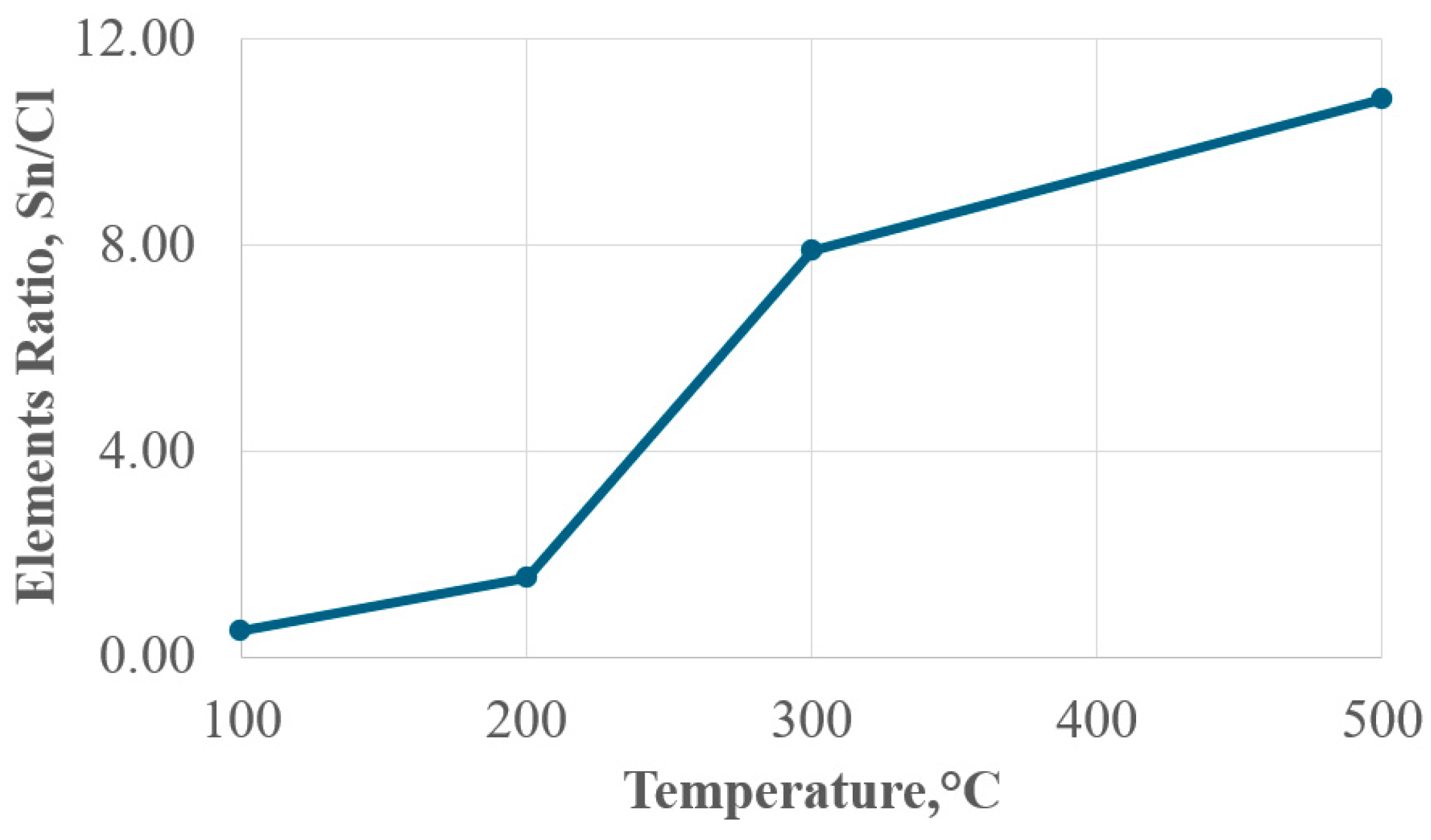
Elemental analysis of the obtained films was carried out using EDX. Since the penetration of the electron beam into the sample significantly exceeds the thickness of the deposited films, the results of the EDX analysis should be interpreted accordingly. It should be taken into account that the significant share of the signal hitting the EBSD detector is related not to the applied film, but to the glass substrate. This worsens the accuracy of determining the content of elements significant for the study (Sn and Cl). However, these elements are absent in the glass composition, so it is possible to evaluate their ratio in the film (Figure 2). For films heat-treated at 100 °C, the Sn:Cl ratio is stable and does not undergo significant changes compared to films that were not exposed to temperature. When the heat treatment temperature is increased to 200 °C, the Sn:Cl ratio increases slightly. With a further increase in temperature to 300 °C, a steeper increase in the Sn:Cl ratio is observed. That indicates the removal of chlorine from the films. When the heat treatment temperature of the films reaches 500 °C, only trace amounts of chlorine are detected in the films. The obtained information is useful in selecting the optimal heat treatment temperature for sol–gel synthesis of fluorine-doped SnO2 films.

3.2. Morphology of Thin Fluorine-Doped SnO2 Films

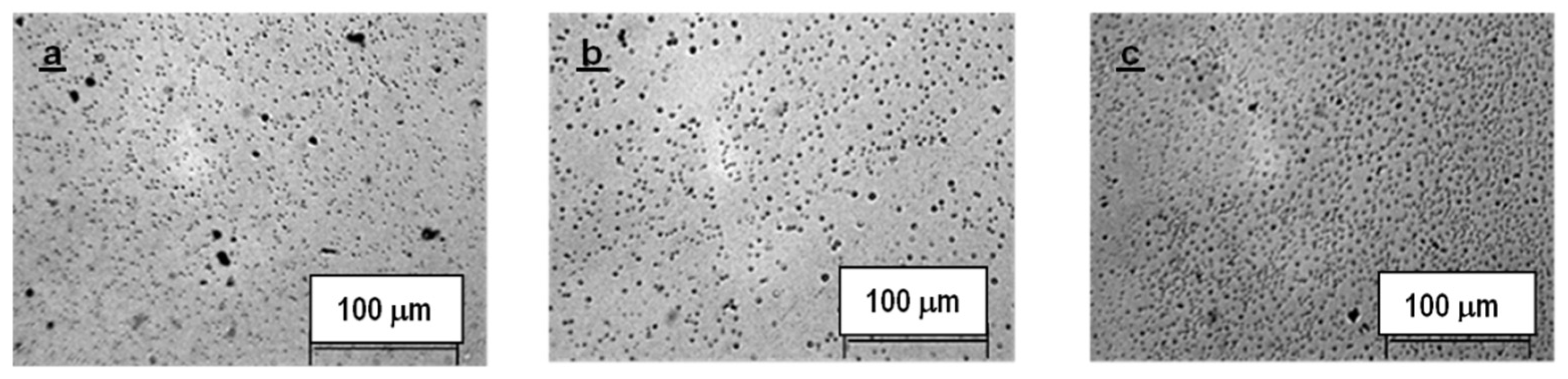
A visual and optical microscope study of the film morphology (Figure 3) revealed that the films have a smooth surface, without fissures or cracks. The addition of ammonium fluoride to an alcohol solution of tin(II) chloride stimulates the formation of crystals in the film structure. Increasing of the fluorine content and the number of layers in films obtained from ethanol-based sol–gel systems leads to an increasing number of crystals in them.
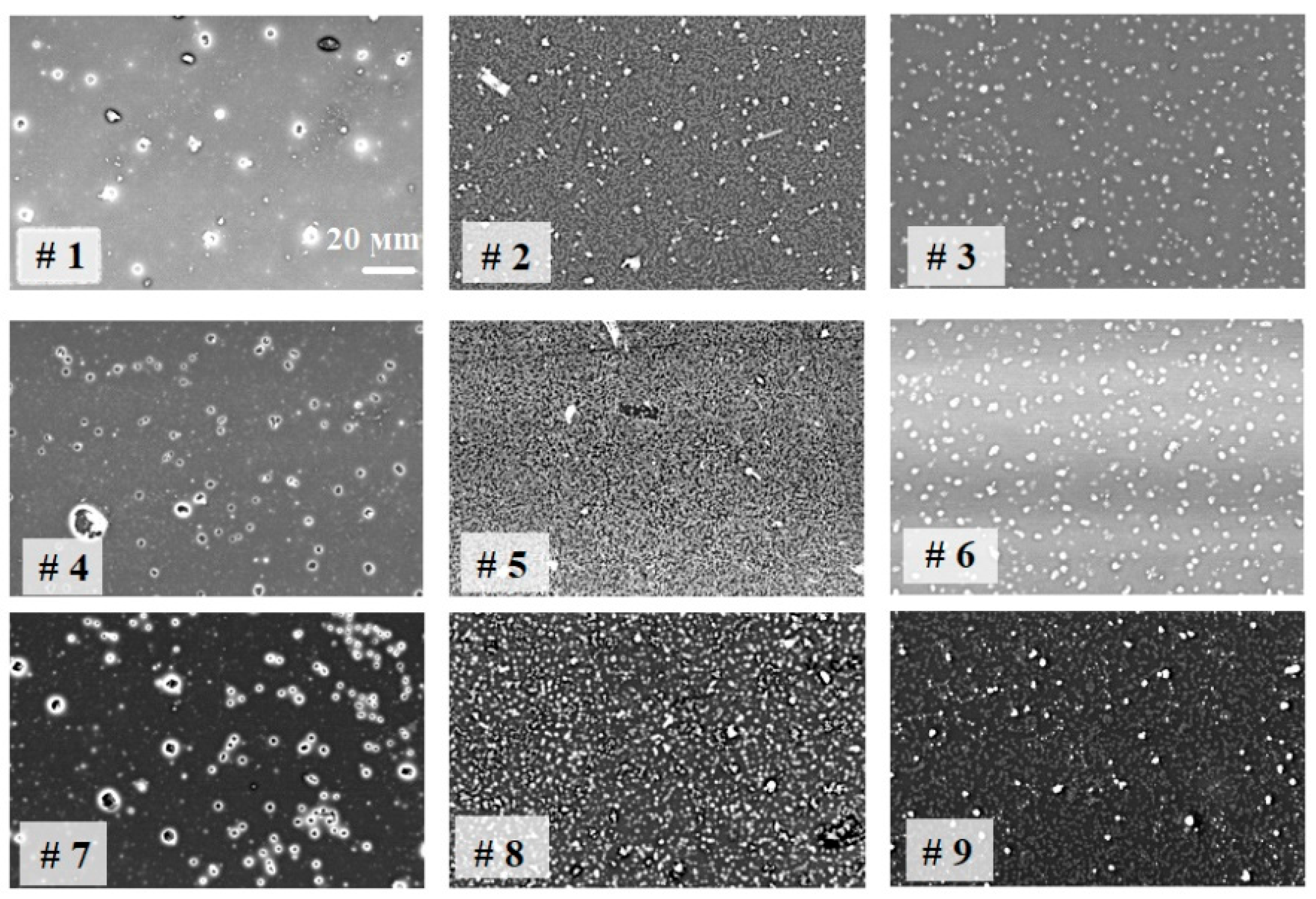
The SEM images of the surface of SnO2-F films are shown in Figure 4.
The obtained SEM images show that the choice of solvent has a significant impact on the morphology of the resulting films. Thus, using ethanol as the solvent leads to the formation of both small-sized crystals and large isolated crystals in the films (# 1, 4, 7; see Table 1). Using 1-butanol as the solvent leads to the formation of crystals that have approximately the same size and are evenly distributed over the entire surface of the film (# 3, 6, 9). The use of isopropanol results in films with a more uniform structure (# 2, 5, 8). Moreover, increasing the number of layers in films based on 1-butanol and isopropanol to 15–20 promotes more intensive crystallization and leads to a decrease in the number of isolated crystals and an increase in the crystallization of the films.
The presence of fluorine in the films could not be confirmed by the EDX analysis. Backscattered electron images show that the films contain compositional inhomogeneities, with an increased tin content relative to the bulk of the film, which may indicate the presence of tin oxide or metallic tin in these areas.

3.3. Phase Composition of SnO2 Thin Films Doped with Fluorine (SnO2-F)

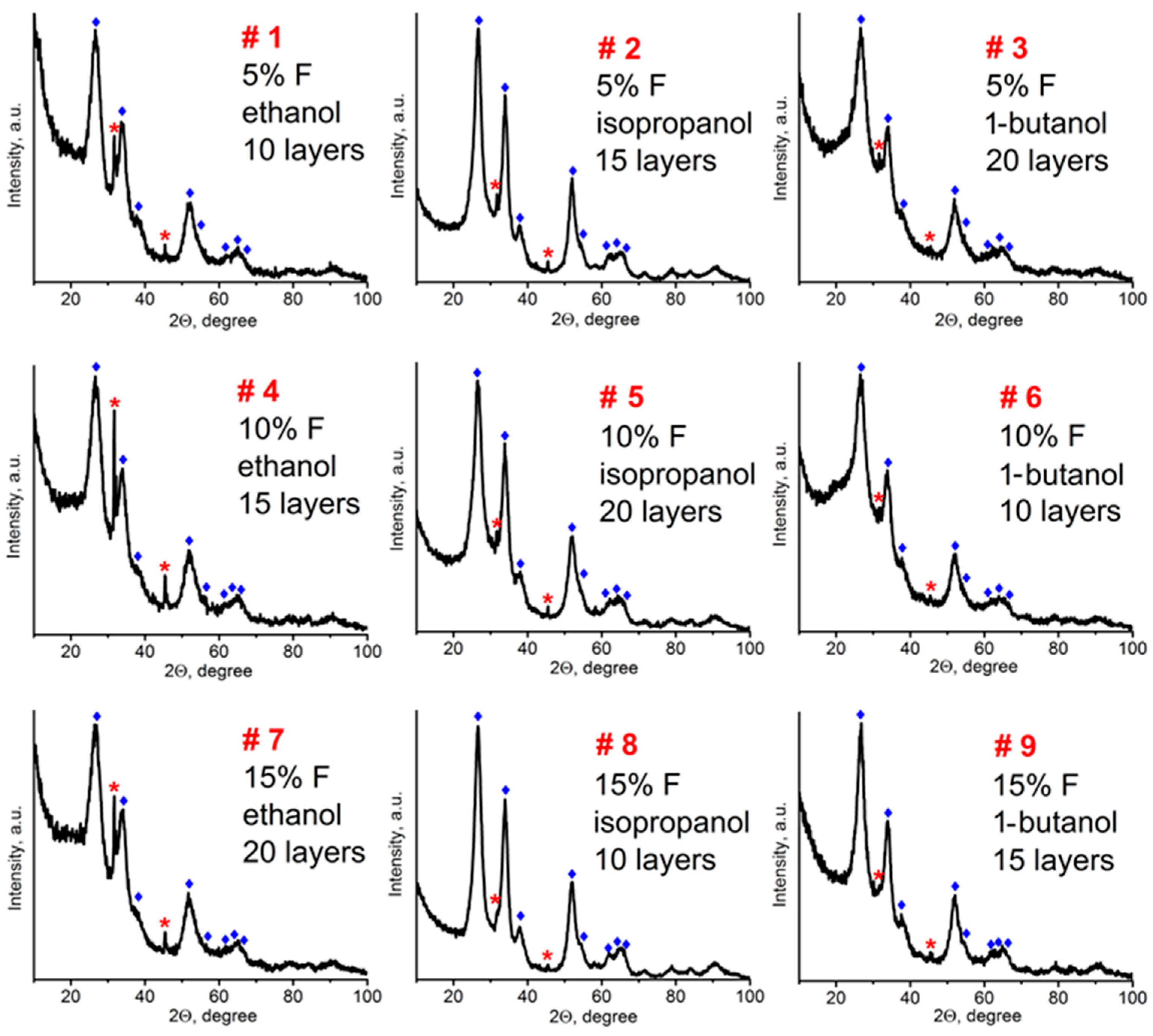
The results of X-ray phase analysis for films obtained from all nine sol compositions (see Table 1) are presented in Figure 5.
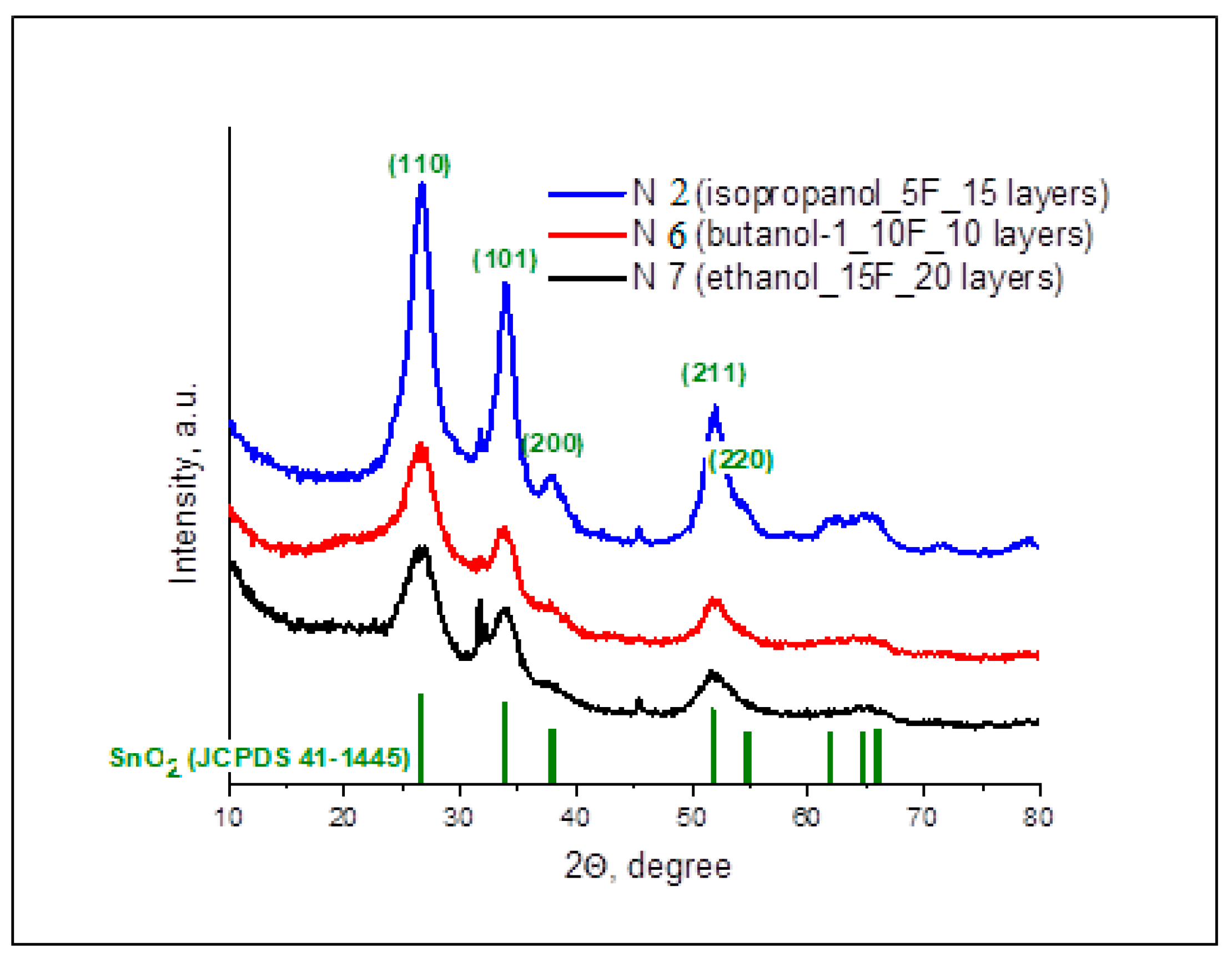
The XRD patterns of all SnO2-F films (Figure 5) are quite similar. The inflected appearance of the background curve is due to the amorphous component; thus only part of the film material has crystallized. The broad Bragg peaks in the diffraction patterns are in good agreement with the XRD pattern of SnO2 (JCPDS 41-1445) (Figure 6). The significant width of the peaks indicates that these are nuclei of tin oxide crystals with a small Dscr (DSCR—coherent scattering region size) from 1.6 to 4.9 nm (see Table 2).
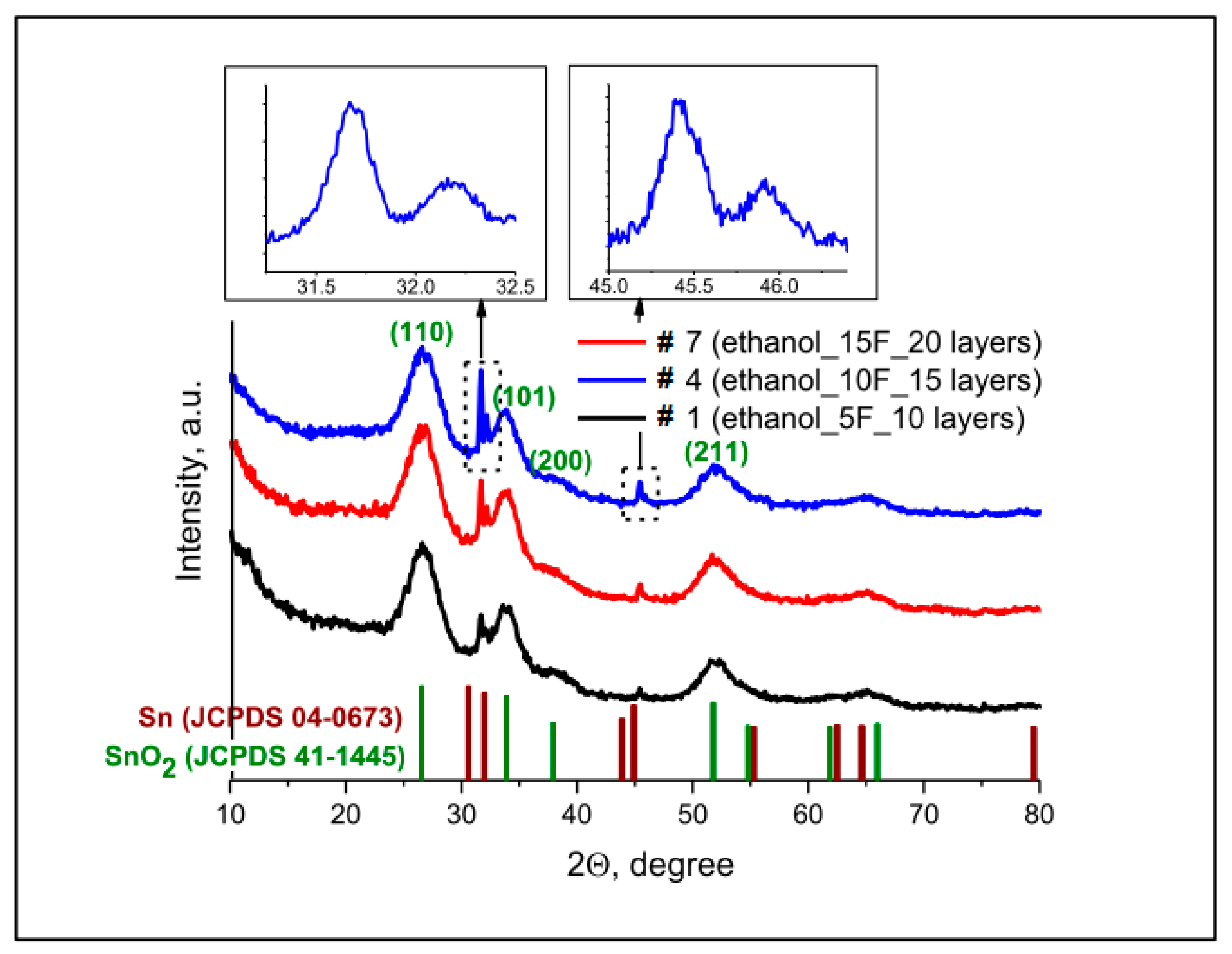
No preferential crystal growth in any specific direction is observed, with the ratio of Bragg peak heights from different sets of crystallographic planes being close to the ratio of peak heights for powders. However, the type of solvent used obviously affects the crystallite size (Table 2 and Figure 7). The XRD pattern of SnO2-F film No. 2 (Figure 7), obtained using isopropanol, features narrower and higher peaks, indicating the higher degree of crystallinity of this film compared to those obtained using ethanol and 1-butanol (SnO2-F films Nos. 6 and 7). The largest crystallite size of 3–5 nm (see Table 2) is observed for films obtained using isopropanol. The use of ethanol in the synthesis process leads to the formation of the smallest crystallite nuclei with sizes of 1.5–3 nm.
Almost all diffraction patterns also show narrower reflections (footnotes in diffraction patterns in Figure 7) from crystallites not related to the SnO2 phase. The size of these crystallites is DSCR 40 ± 5 nm. The most distinct peaks of this phase are observed in films obtained in ethanol (Figure 7). It can be assumed that these reflections belong to the tetragonal body-centered lattice of the β-phase of Sn (JCPDS 04-0673). The observed shift in the Bragg peaks indicates the presence of distortions in the Sn crystal lattice caused by compressive stresses in the film.

3.4. Optical and Electrical Properties of Fluorine-Doped SnO2 Thin Films

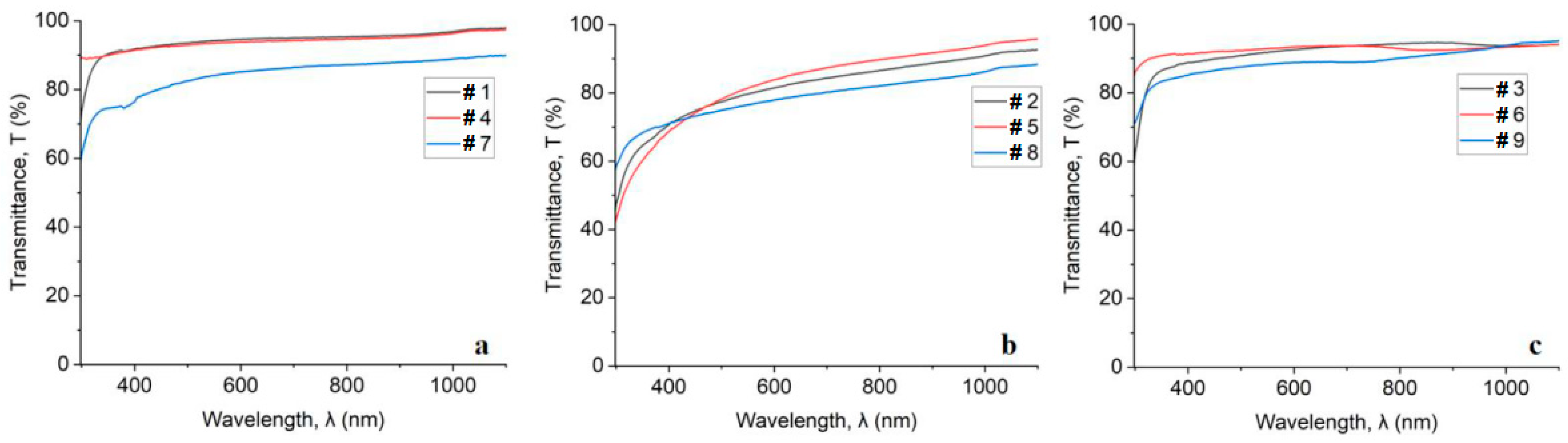
The transparency of the films was assessed using UV–visible spectrometry. The transmission spectra of the resulting SnO2-F films are presented in Figure 8.
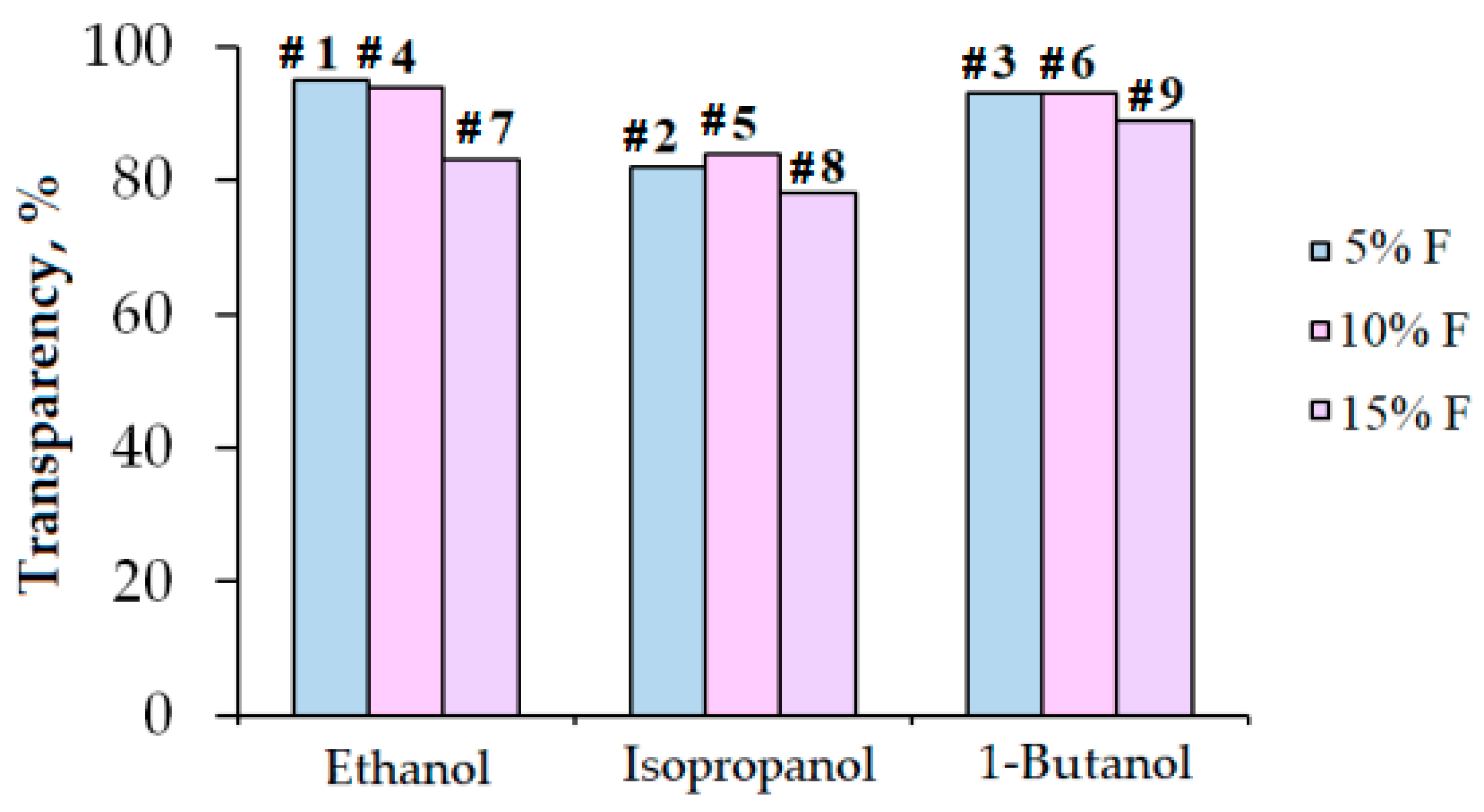
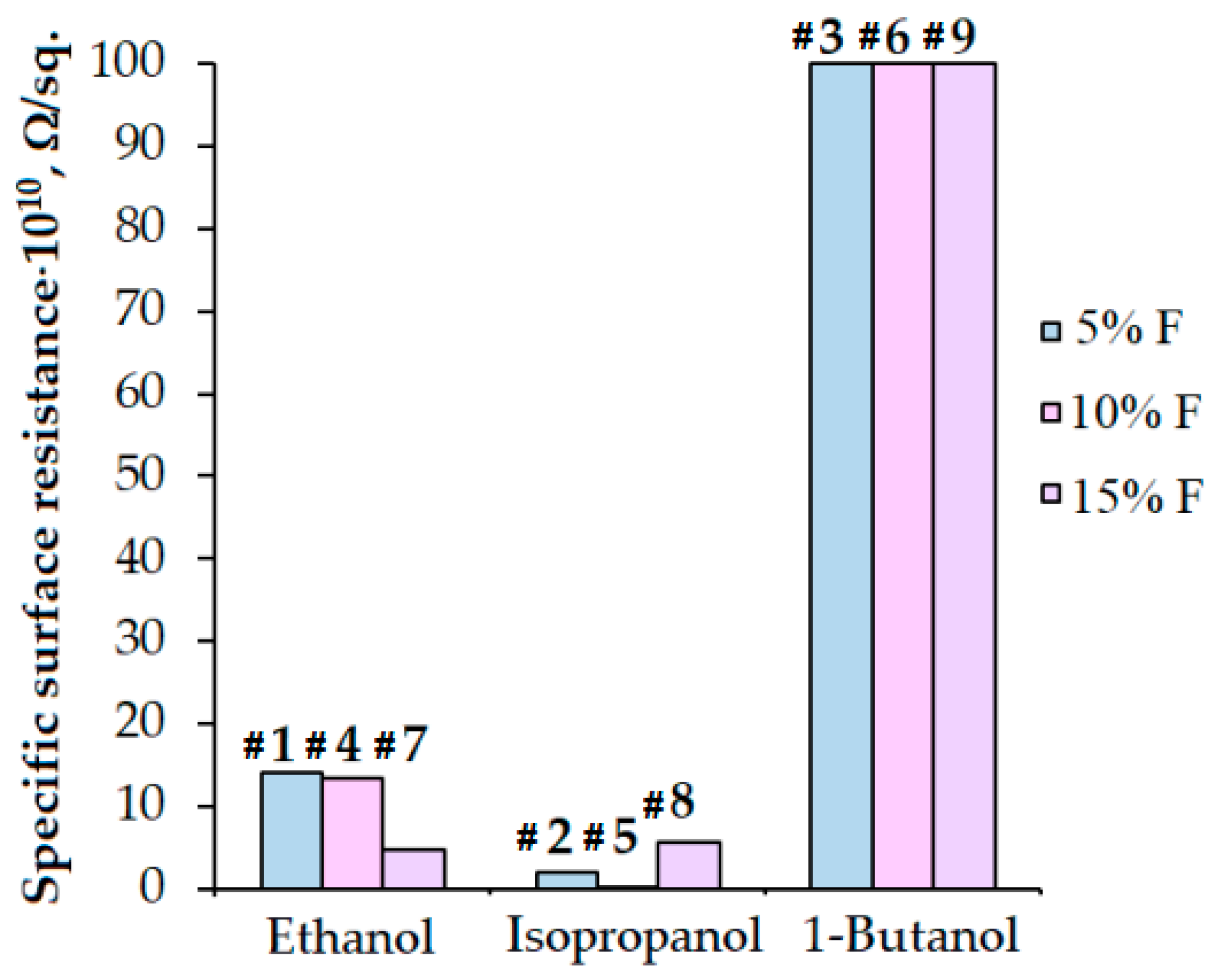
The dependences of transparency and surface resistance of films on the factors considered above are given in Table 3 and Table 4, as well as in Figure 9 and Figure 10, respectively.
The spectra shown in Figure 8 indicate the high transparency of the films (78% to 95%) in the entire visible range (370–800 nm). However, their transparency is highly dependent on their morphology, which in turn is affected by the solvent type and film composition. The films obtained using 1-butanol and ethanol exhibit significantly higher transparency (83%–95%) compared with those synthesized in isopropanol (to 78%–84%). Furthermore, the transparency drops to 84%–78% with the increase in the number of layers and fluorine content.
The specific surface electrical resistance of the studied films varied from 3∙109 Ω/sq. to more than 1012 Ω/sq. The results shown in Table 4 demonstrate that the type of solvent has a decisive influence on the surface resistance of the films. In the case of 1-butanol application as a solvent, it is independent of the number of layers and exceeds 1012 Ω/sq., which does not meet the requirements for the synthesized coatings. The lowest resistance (3∙109 Ω/sq.) is observed for the samples prepared using isopropanol, especially for the 20-layered coating, while the use of ethanol results in intermediate resistance values of about 1011 Ω/sq.

3.5. Statistical Processing of the Transparency Measurements Results and External Influence of SnO2-F Films

To assess the influence of factors A (type of organic solvent), B (fluorine concentration, at. %) and C (number of layers) on the transparency and specific surface resistance of the films, data processing was performed according to the 3 × 3 Latin square approach to the multi-factor experiment design and optimization. The parameters of Latin square analysis based on the initial data from Table 3 and Table 4, as well as the values of the Fisher criterion (F) in comparison with the significance levels [41], are summarized in Table 5.
As can be seen from the calculated intermediate and final data in Table 5, the most significant factor for both parameters (transparency and specific surface resistance) is the choice of organic solvent used in the synthesis of sols. With a 95% confidence level (Fex >> Ftab), it can be assumed that the influence of the solvent on the conductivity of the films is relevant, since the Fisher criterion for it significantly exceeds the table value. At the 95% confidence level (Fex > Ftab), the transparency of films is influenced by both the choice of solvent (factor A) and the concentration of the fluorine-containing component in the sol (factor B). The effect of the number of layers in the films on the surface resistance is almost at the 90% confidence level (Fex ≅ Ftab).

3.6. Haacke’s Figures of Merit (FOM) of Studied SnO2-F Films

To use the obtained SnO2-F films as transparent conductive layers in microelectronic devices, it is necessary to determine the optimal combination of transparency and surface resistance. Ideally, transparency should be increased and surface resistance should be reduced; however, these two conditions are often contradictory. The optimal combination of transparency and conductivity can be determined by calculating Haacke’s figures of merit (FOM) characterizing SnO2-F film efficiency as a transparent conductive layer taking into account both these parameters.
Haacke’s FOM values, calculated according to Equation (1), involving the optical transparency (Table 3) and specific surface resistance (Table 4) of the prepared SnO2:F films, are summarized in Table 6.
Higher Haacke’s FOM values (Table 6) suggest increased efficiency of SnO2-F films as transparent conductive layers. The considered data indicate the significant effect of the solvent on Haacke’s FOM. The lowest efficiency (FOM < 0.48) is observed in the case of 1-butanol. The films synthesized using ethanol exhibit an intermediate Haacke’s FOM level among the studied samples. The highest Haacke’s FOM value (58.3) is achieved for the 20-layered sample No. 5, prepared using isopropanol and containing 10 at. % fluorine. Therefore, this sample features the optimal combination of transparency and specific surface resistance, which is promising for its application as a thin transparent conductive layer.

4. Discussion

Thin (~200–340 nm) films with a crystallized surface were spin-on coated on glass substrates from sols synthesized in organic solvents (ethanol, isopropanol, or 1-butanol) from SnCl2·2H2O with the addition of NH4F. The film structure consists of an amorphous base in which micro- and nanonanocrystals of SnO2 with small crystalline inclusions of β-Sn were formed. Our studies have shown that ethanol contributed to the formation of this metallic phase to a greater extent. The mechanism of these processes can be represented based on previous research [42,43,44,45,46,47] as follows:
It is likely that complexation (alkoxide formation), hydrolysis and condensation occur almost simultaneously and involve the following reactions:
  • Formation of heteroleptic complexes containing both alkoxide (-OR) and other ligands:
S n C l 2 × 2 H 2 O + y N H 4 F + R O H ( N H 4 ) y [ S n F x ( O R ) 2 x ] + 2 H C l + 2 H 2 O
2.
Hydrolysis, involving the replacement of alkoxide groups (-OR) with hydroxyl groups (-OH):
( N H 4 ) y [ S n F x O R ) 2 x + H 2 O [ S n F x ( O H ) 1 x ] + 2 x R O H + y N H 4 O H + x H F
( N H 4 ) y [ S n F x O R ) 2 x + H 2 O   ( N H 4 ) y 1 [ S n F x ( O R ) 1 x ( O H ) ] + R O H + N H 4 O H + H F
3.
Condensation reactions to form Sn−O−Sn bridges:
[ S n F x O H ) 1 x + [ S n F x ( O H ) 1 x ] F x S n O S n F x + H 2 O
( N H 4 ) y 1 [ S n F x O R ) 1 x O H + [ S n F x ( O H ) 1 x ] ( N H 4 ) y 1 [ H O F x S n O S n F x ] + 1 x R O H
F x S n O S n F x     2 S n O 1 x F x
( N H 4 ) y 1 H O F x S n O S n F x   2 S n O 1 x F x + y 1 N H 4 O H  
S n O 1 x F x S n + S n O 2 x F x
ROH: ethanol, isopropanol, or 1-butanol.
In a thin-film coating, complete oxidation of Sn to SnO2 occurs in air with an increase in the time exposure at 450 °C to 2 h or with an increase in the firing temperature to 600 °C [48,49,50].
It is known that the final hydrolysis of SnCl2 occurs during the application of sols onto the glass surface [51]. During subsequent heat treatment at 400–450 °C, metastable SnO1−x Fx is oxidized to SnO2−xFx, and only a small portion of SnO1−x Fx is incorporated into the film structure. As a result of thermal dissociation, SnO1−x Fx disproportionates to SnO2−xFx and Sn.
Due to the low fluorine content in the sols, we did not detect it in the films using either the EDX or the GIXRD method. These results are consistent with the previously reported data [44]. Those researchers did not detect fluorine in SnO2 films using the EDX method at low fluorine content in the initial sols (below 40 wt.%) either. After comprehensive studies, they attributed this to the segregation of fluorine and its preference to remain in solution rather than being incorporated into the lattice of the forming SnO2 film, since the formation of H-F bonds during sol–gel synthesis is preferable to the formation of Sn-F. Fluorine in the sol acts primarily as a nucleation (crystallization) initiator and is not incorporated into the SnO2 structure.
Thus the reactions considered above can be represented as follows:
Tin (II) alkoxide formation:
S n C l 2 × 2 H 2 O + 2 N H 4 F + 2 R O H S n ( O R ) 2 + 2 H F + 2 N H 4 C l + 2 H 2 O  
Hydrolysis of tin(II) alkoxide to form its hydroxides and/or oligomeric alkoxyhydroxides:
S n ( O R ) 2 + 2 H 2 O S n ( O H ) 2 + 2 R O H
S n ( O R ) 2 + H 2 O S n O H O R + R O H
Condensation reactions to form Sn−O−Sn bridges:
S n ( O H ) 2 + S n ( O H ) 2 H O S n O S n O H + H 2 O
S n ( O H ) 2 + S n O H O R H O S n O S n O H + R O H
Heat treatment in air at 450 °C leads to the formation of tin (II) oxide, followed by its disproportionation into tin (IV) oxide and metallic tin:
H O S n O S n O H 2 S n O 1 x + H 2 O
S n O 1 x S n + S n O 2 x
It is likely that a stoichiometry defect (SnO2−x) forms in thin films at a temperature of 450 °C. The main type of defect is oxygen vacancies, which determines the electronic conductivity of the resulting films. The details of the defect formation mechanism in the SnO2–underoxidized Sn system remain unexplored. Presumably, tin atoms partially complete the cation sublattice at the metal–oxide interface, transforming into Sn+2 and Sn+4 ions. Anions of oxygen from the boundary region of the SnO2 crystal migrate to the metallic tin surface to complete the outer crystalline plane, while vacancies are formed in their former locations. Sn+2 ions diffuse to the crystallite surface in accordance with their concentration gradient and are further oxidized there.
It was found that the largest primary crystals (crystallization nuclei) are formed from sols based on isopropanol, while the smallest ones are formed from ethanol-based sols. This is apparently related to the rate of hydrolysis, since the solvent affects the rate of chemical reactions, including hydrolysis, through ion solvation [52]. Particularly, elongation of the carbon chain of an organic solvent and its more branched structure promotes a decrease in hydrolysis rate [53]. As a result, films obtained using isopropanol have the densest and most branched structure, which, in turn, leads to the observed decrease in transparency and surface resistance (due to the high their degree of crystallinity) compared to films synthesized in unbranched 1-butanol and especially in ethanol (in which the hydrolysis rate is the highest in the series ethanol, 1-butanol, isopropanol). The rate of crystal formation and resulting crystal size can also be affected by sol viscosity and the rate of solvent evaporation during deposition onto the substrate [54]. The effect of NH4F concentration and the number of deposited layers on the crystallization process is less significant compared with the solvent type, but generally it was more pronounced for SnO2 <Sn> films prepared in ethanol.
Statistical processing of the experiment data, designed using the Latin square method, also revealed a significant effect of the organic solvent on the electrical conductivity of the films, with the difference in specific surface resistance (ρs) reaching 2 orders of magnitude, from ~1012 Ω/sq. for films prepared in butanol-1 to ~1010 Ω/sq and 3.0∙109 Ω/sq. in the cases of ethanol and isopropanol, respectively.
The surface morphology of thin spin-on glass films is known [54] to be significantly affected by the organic solvent used in the synthesis of sols. The application of a solvent with a lower saturated vapor pressure retards the evaporation of volatile substances during spin-coating, thus facilitating the formation of films with a more uniform structure. In this case, among the solvents studied, isopropanol apparently has the optimal saturated vapor pressure, contributing to the formation of a better crystallized film (the saturated vapor pressure of ethanol, isopropanol and 1-butanol at 20 °C is 5.96, 4.4 and 0.67 kPa, respectively) [55].
Furthermore, probably due to its branched structure, isopropanol retards the hydrolysis of tin chloride, promoting slower particle growth and condensation, which leads to the formation of coarser particles and thicker films with larger crystallites, unlike faster reactions in linear alcohols. A slow hydrolysis rate typically favors the growth of existing particles over the continuous nucleation of new ones. This effect is due to isopropanol’s steric hindrance and different solvent properties compared to linear alcohols, altering the condensation kinetics in sol–gel processes. The 1-butanol has the largest molecules and mostly separated hydroxyls, so all the films synthesized in 1-butanol exhibited the highest surface resistance on the level of 1012 Ω/sq. In the case of ethanol-based films, only an increase in the number of layers to 20 made it possible to reduce ρs to ~5∙1010 Ω/sq. In the future, it is necessary to strive to reduce this indicator to ~105 Ω/sq. and lower. A possible direction of research could be to increase the thickness of SnO2-F films.
The type of organic solvent and amount of introduced NH4F are also found to be statistically significant parameters in respect to the film transparency. The highest transparency (up to 95%) was found for ethanol-based films. However, this is most likely due to insufficient surface crystallization, as evidenced by a deterioration in transparency with a maximum increase in NH4F concentration and film thickness (only 83% in the case of 20 layers and 15 at. % F). Surprisingly, films prepared in 1-butanol demonstrated good transparency, which was as high as 93% for the samples containing 5 and 10 at. % F and comprising 10 and 15 layers, respectively. Reducing the amount of NH4F to 5–10 at. %, coupled with an increase in the number of layers to 15 and 20, had a positive effect on the transparency of isopropanol-based films (82% and 84%). Increasing the amount of NH4F to 15 at. % results in a drop in transparency for all the films, regardless of the number of layers and the choice of solvent. The transparency parameters of the prepared SnO2 films doped with fluorine (T ~78%–95%) correspond to the indices given in the scientific literature [29].
Based on the analysis of both transparency and surface resistivity criteria, as well as Haacke’s FOM, the following recommendations can be formulated for producing SnO2 films with optimal performances. Ethanol provides the best transparency, while isopropanol provides the lowest resistivity. At low fluorine levels (5 at. % F), maximum transparency is maintained; however, surface resistivity is inappropriately high. The effect of the number of layers on both criteria is insignificant, with a slightly greater effect on surface resistivity. Therefore, the number of layers can be selected based on the technological features of production. A compromise solution taking into account both important properties (transparency and surface resistivity) is the use of isopropanol as a solvent to achieve the minimum surface resistance values and prevent a significant decrease in transparency. To further improve the transparency, a small amount of ethanol can be added to the sol. Thus, further research could be focused on selecting organic solvent mixtures for obtaining SnCl2-based film-forming sols. Generally, in this study, the following optimal combination of factors is revealed: A—isopropanol; B—10 at. % F; and C—20 layers.

5. Conclusions

The effect of sol–gel synthesis conditions on the transparency and conductivity of thin transparent SnCl2-based conductive films with a crystallized surface was studied. Based on the use of 3 × 3 Latin square approach in the experimental design with the variation of three factors (choice of organic solvent, crystallization initiator concentration, and number of layers deposited by spin-on coating) at three levels, the most significant factors and their optimal combination promoting SnO2 and Sn crystallization and providing films with uniform structure were revealed.
The type of solvent, namely, ethanol, isopropanol or 1-butanol, and the concentration of the NH4F crystallization initiator were found to be the most significant combination of factors in terms of the effect on transparency and conductivity of the resulting films. Although fluorine was not incorporated into the structure of SnO2 films at low NH4F concentrations (5–15 at. % F), it contributed to higher crystallization of the films, along with carrying out sol–gel synthesis in aqueous–alcoholic isopropanol medium. Ethanol provided the highest transparency (95%) in the visible range of the spectrum. Isopropanol contributed to a decrease in surface resistance (up to 3∙109 Ω/sq.), while 1-butanol was found to be the least suitable solvent due to a high resistance of the films featuring the lowest Haacke’s FOM values. Increasing NH4F concentration from 5 to 15 at. % F improved the electrical conductivity of the films; however, at 15 at. % F, a deterioration in film transparency was observed. The optimal combination of transparency and electrical conductivity was achieved at 10 at. % F. Increasing the number of layers to 20 increased the electrical conductivity due to the greater film thickness, but reduced transparency. Thus, the optimal combination of thin (~250 nm) SnO2<Sn> film target performances including transparency of 84%, specific surface resistance of 3∙109 Ω/sq and a Haacke’s figure of merit of 58.3 was achieved in the case of their preparation in isopropanol with an average concentration of NH4F (10 at. % F) and spin-on deposition of 20 layers.

Author Contributions

Conceptualization, O.A.S. and A.S.K.; synthesis, A.S.K., A.I.K. and A.M.N.; investigation, A.S.K., A.I.K., A.M.N., N.N.G., V.A.M., A.G.I., E.A.B. and O.A.Z.; writing—original draft preparation, A.S.K., O.A.S., N.N.G., V.A.M., A.G.I., S.V.M. and O.A.Z.; review and editing, O.A.S., A.S.K. and A.M.N.; S.V.M., A.G.I. and O.A.Z.; supervision, O.A.S.; project administration, A.G.I. and O.A.S. All authors have read and agreed to the published version of the manuscript.

Funding

This research was funded by the Branch of Petersburg Nuclear Physics Institute named after B.P. Konstantinov of NIC, “Kurchatov Institute”—Institute of Silicate Chemistry (No. 1024030700041-2-1.4.3).

Institutional Review Board Statement

Not applicable.

Informed Consent Statement

Not applicable.

Data Availability Statement

The original contributions presented in this study are included in the article. Further inquiries can be directed to the corresponding author.

Conflicts of Interest

The authors declare no conflicts of interest.

References

  1. Sun, C.; Yang, J.; Xu, M.; Cui, Y.; Ren, W.; Zhang, J.; Zhao, H.; Liang, B. Recent intensification strategies of SnO2-based photocatalysts: A review. Chem. Eng. J. 2022, 427, 131564. [Google Scholar] [CrossRef]
  2. Gunes, I.; Sarica, E.; Ozcan, H.B.; Terlemezoglu, M.; Akyuz, I. Flow rate-dependent properties of SnO2 thin films deposited by ultrasonic spray pyrolysis. Opt. Mater. 2024, 150, 115189. [Google Scholar] [CrossRef]
  3. Hind, P.A.; Kumar, P.; Goutam, U.K.; Rajendra, B.V. Impact of deposition temperature on persistent photoconductivity of SnO2 thin films deposited using spray pyrolysis technique suitable in optoelectronic synaptic devices. Opt. Mater. 2024, 153, 115579. [Google Scholar] [CrossRef]
  4. Benouis, C.E.; Benhaliliba, M.; Yakuphanoglu, F.; Silver, A.T.; Aida, M.S.; Juarez, A.S. Physical properties of ultrasonic sprayed nanosized indium doped SnO2 films. Synth. Met. 2011, 161, 1509–1516. [Google Scholar] [CrossRef]
  5. Jiang, L.; Li, Q.; Li, B.; Guo, S.; Li, S.; Zhang, X.; Tang, X. Efficient and stable perovskite solar cells via oxalic acid doped SnO2 nanocrystals with surface-defect passivation. Colloids Surf. A 2024, 702, 135052. [Google Scholar] [CrossRef]
  6. Yadav, A.A. Influence of film thickness on structural, optical, and electrical properties of spray deposited antimony doped SnO2 thin films. Thin Solid Films 2015, 591, 18–24. [Google Scholar] [CrossRef]
  7. Granqvist, C.G. Electrochromics for smart windows: Oxide-based thin films and devices. Thin Solid Films 2014, 564, 1–38. [Google Scholar] [CrossRef]
  8. Khan, D.; Rehman, A.; Rafiq, M.Z.; Khan, A.M.; Ali, M. Improving the optical properties of SnO2 nanoparticles through Ni doping by sol-gel technique. Curr. Res. Green Sustain. Chem. 2021, 4, 100079. [Google Scholar] [CrossRef]
  9. Sayeed, M.A.; Rouf, H.K. Al-doped SnO2 thin films: Impacts of high temperature annealing on the structural, optical and electrical properties. J. Mater. Res. Technol. 2021, 15, 3409–3425. [Google Scholar] [CrossRef]
  10. Selvaraj, A.R.; Hong, M.; Koo, H.; Mun, J.; Kim, H.-K. Effect of rapid thermal annealing on the charge storage kinetics of conductive N-doped SnO2 thin film anodes for Li-ion batteries. J. Power Sources 2024, 591, 233821. [Google Scholar] [CrossRef]
  11. Yang, H.; Fu, D.; Jiang, M.; Duan, J.; Zhang, F.; Zeng, X.; Bach, U. Ultraviolet laser ablation of fluorine-doped tin oxide thin films for dye-sensitized back-contact solar cells. Thin Solid Films 2013, 531, 519–524. [Google Scholar] [CrossRef]
  12. Wang, Y.; Zhang, H.; Zhang, X.; Zhou, Z.; Wang, L. Tuning electrical and optical properties of SnO2 thin films by dual-doping Al and Sb. Coatings 2025, 15, 669. [Google Scholar] [CrossRef]
  13. Nath, A.; Salam, J.A.; Anand, A.M.; Raj, A.; Jayakrishnan, R. Solar cells using spray coated a-axis grown F: SnO2 thin films. Opt. Mater. 2025, 159, 116612. [Google Scholar] [CrossRef]
  14. Belousov, S.A.; Nosov, A.A.; Men’shikova, T.G.; Rembesa, S.I. Electrophysical properties of metal oxide films SnO2 manufactured by sol-gel technology. Vestn. VGTU 2016, 2. Available online: https://cyberleninka.ru/article/n/elektrofizicheskie-svoystva-metallooksidnyh-plenok-sno2-izgotovlennyh-po-zol-gel-tehnologii/viewer (accessed on 2 February 2026). (In Russian)
  15. Tran, Q.-P.; Fang, J.-S.; Chin, T.-S. Properties of fluorine-doped SnO2 thin films by a green sol–gel method. Mater. Sci. Semicond. Process. 2015, 40, 664–669. [Google Scholar] [CrossRef]
  16. Soumya, S.S.; Xavier, T.S. Effect of cobalt doping on the microstructural, optical and electrical properties of SnO2 thin films by sol-gel spin coating technique. Phys. B Condens. Matter 2022, 624, 413432. [Google Scholar] [CrossRef]
  17. Zhang, X.; Liu, X.; Ning, H.; Yuan, W.; Deng, Y.; Zhang, X.; Wang, S.; Wang, J.; Yao, R.; Peng, J. Characterization studies of the structure and properties of Zr-doped SnO2 thin films by spin-coating technique. Superlattices Microstruct. 2018, 123, 330–337. [Google Scholar] [CrossRef]
  18. Zhang, B.; Tian, Y.; Zhang, J.X.; Cai, W. The role of oxygen vacancy in fluorine-doped SnO2 films. Phys. B Condens. Matter 2011, 406, 1822–1826. [Google Scholar] [CrossRef]
  19. Muniramaiah, R.; Reddy, N.P.; Santhosh, R.; Fernandes, J.M.; Padmanaban, D.B.; Maharana, G.; Kovendhan, M.; Veerappan, G.; Laxminarayana, G.; Banavoth, M.; et al. Solvent effect on the optoelectronic properties of fluorine doped SnO2 thin films prepared by spray-pyrolysis. Surf. Interfaces 2022, 33, 102174. [Google Scholar] [CrossRef]
  20. Vinodkumar, R.; Lethy, K.J.; Beena, D.; Satyanarayana, M.; Jayasree, R.S.; Ganesan, V.; Nayar, V.U.; Mahadevan Pillai, V.P. Effect of thermal annealing on the structural and optical properties of nanostructured zinc oxide thin films prepared by pulsed laser ablation. Sol. Energy Mater. Sol. Cells 2009, 93, 74–78. [Google Scholar] [CrossRef]
  21. Kakade, S.B.; Thorat, S.M.; Holkar, R.R.; Supekar, S.H.; Kale, R.D.; Kalange, A.E. Structural, Morphological, and Optical Properties of as Deposited and Annealed SnO2 thin film using Thermal Evaporation Technique. J. Phys. Conf. Ser. 2024, 2778, 012001. [Google Scholar] [CrossRef]
  22. Majumder, S. Synthesis and characterisation of SnO2 films obtained by a wet chemical process. Mater. Sci.-Pol. 2009, 27, 123–129. [Google Scholar]
  23. Lu, Y.M.; Jiang, J.; Becker, M.; Kramm, B.; Chen, L.; Polity, A.; He, Y.B.; Klar, P.J.; Meyer, B.K. Polycrystalline SnO2 films grown by chemical vapor deposition on quartz glass. Vacuum 2015, 122, 347–352. [Google Scholar] [CrossRef]
  24. Lin, S.-S.; Tsai, Y.-S.; Bai, K.-R. Structural and physical properties of tin oxide thin films for optoelectronic applications. Appl. Surf. Sci. 2016, 380, 203–209. [Google Scholar] [CrossRef]
  25. Montero, J.; Herrero, J.; Guillen, C. Preparation of reactively sputtered Sb-doped SnO2 thin films: Structural, electrical and optical properties. Sol. Energy Mater. Sol. Cells 2010, 94, 612–616. [Google Scholar] [CrossRef]
  26. Adamczyk, A.; Brylewski, T.; Szymczak, P. The influence of Ag addition and different SiO2 precursors on the structure of silica thin films synthesized by the sol–gel method. Molecules 2024, 29, 4592. [Google Scholar] [CrossRef]
  27. Bondar’, E.A.; Shilova, O.A.; Lebedev, I.A.; Dmitrieva, E.A.; Fedosimova, A.I.; Kovalenko, A.S.; Nikolaev, A.M.; Ibraimova, S.A.; Shongalova, A.K.; Isaeva, U.B. Composition and morphology of transparent thin films prepared from water–ethanol sols based on tin(IV) compounds. Russ. J. Inorg. Chem. 2025, 70, 121–129. [Google Scholar] [CrossRef]
  28. Huda, M.N.; Hashmi, G. Fabrication, characterization and performance analysis of sol–gel dip coated SnO2 thin film. Discov. Mater. 2025, 5, 10. [Google Scholar] [CrossRef]
  29. Dalapati, G.K.; Sharma, H.; Guchhait, A.; Chakrabarty, N.; Bamola, P.; Liu, Q.; Saianand, G.; Krishna, A.M.S.; Mukhopadhyay, S.; Dey, A.; et al. Tin oxide for optoelectronic, photovoltaic and energy storage devices: A review. J. Mater. Chem. A 2021, 9, 16621–16684. [Google Scholar] [CrossRef]
  30. Mussabekova, A.K.; Zeinidenov, A.K.; Tazhibayev, S.K.; Omarbekova, G.I.; Abeuov, D.R.; Aimukhanov, A.K. The influence of surface defects in SnO2 thin films prepared from different alcohol solvents on electron transport in polymer solar cells. Synth. Met. 2025, 313, 117907. [Google Scholar] [CrossRef]
  31. Kravtsov, A.; Blinov, A.; Krandievskiy, S.; Rusanov, A. Synthesis and investigation of optical properties of thin films of TiO2, obtained with the media of different alcohols. Newsl. North-Cauc. Fed. Univ. 2016, 2, 16–24. (In Russian) [Google Scholar]
  32. Aimukhanov, A.K.; Rozhkova, X.S.; Ilyassov, B.R.; Omarbekova, G.I.; Seisembekova, T.E. Effect of alcohol solvents on the structural, optical and electrical characteristics of PEDOT:PSS polymer films annealed at low atmospheric pressure. Eurasian Phys. Tech. J. 2022, 19, 35–41. [Google Scholar] [CrossRef]
  33. Mussabekova, A.K.; Ilyassov, B.R.; Aimukhanov, A.K.; Tussupbekova, A.K.; Zeinidenov, A.K.; Valiev, D.; Paygin, V.; Kudryashov, V.V.; Zhakanova, A.M. Promising SnOx electron transport layer for polymer solar cells. Phys. B Condens. Matter 2023, 666, 415113. [Google Scholar] [CrossRef]
  34. Chapagain, S.; Armstrong, P.J.; Panta, R.; Acharya, N.; Druffel, T.; Grapperhaus, C.A. Expanding the solvent diversity and perovskite compatibility of SnO2 inks that are directly deposited on perovskite layers. iScience 2024, 27, 110964. [Google Scholar] [CrossRef] [PubMed]
  35. Sivakumar, H.S.A.; Reddy, T.R.K.; Bitla, Y.; Ganesh, V.; Mohan Kumar, P.; Srinivas Reddy, G.; Poloju, M. Effect of Ti doping on structural, optical and electrical properties of SnO2 transparent conducting thin films deposited by sol-gel spin coating. Opt. Mater. 2021, 113, 110845. [Google Scholar] [CrossRef]
  36. Birkholz, M. Thin Film Analysis by X-Ray Scattering; Wiley-VCH Verlag GmbH Co.: Weinheim, Germany, 2005; 356p. [Google Scholar] [CrossRef]
  37. Fewster, P.; Andrew, N.; Holy, V.; Barmak, K. X-ray diffraction from polycrystalline multilayers in grazing-incidence geometry: Measurement of crystallite size depth distribution. Phys. Rev. B 2005, 72, 174105. [Google Scholar] [CrossRef]
  38. Simeone, D.; Baldinozzi, G.; Gosset, D.; Le Caer, S.; Berar, J. Grazing incidence X-ray diffraction for the study of polycrystalline layers. Thin Solid Films 2013, 530, 9–13. [Google Scholar] [CrossRef]
  39. Colbourn, C.J.; Dinitz, J.H. (Eds.) Handbook of Combinatorial Designs, 2nd ed.; Chapman and Hall/CRC: New York, NY, USA, 2006; 1016p. [Google Scholar] [CrossRef]
  40. Haacke, G. Newfigure of merit for transparent conductors. J. Appl. Phys. 1976, 47, 4086–4089. [Google Scholar] [CrossRef]
  41. Bol’shov, N.N.; Smirnov, N.V. Tables of Mathematical Statistics; Nauka: Moscow, Russia, 1983; 416p. (In Russian) [Google Scholar]
  42. Ramdhan, Z.; Doyan, A.; Kosim. Preliminary Study Flourine Tin Oxide (FTO) Using Sol-Gel Spin Coating Techniques. IOSR J. Appl. Phys. (IOSR-JAP) 2018, 10, 27–30. [Google Scholar] [CrossRef]
  43. Bradley, D.C.; Caldwell, E.V.; Wardlaw, W. The Reactions of Stannic Chloride with Alcohols. J. Chem. Soc. 1957, 3039. [Google Scholar] [CrossRef]
  44. Adjimi, A.; Zeggar, M.L.; Attaf, N.; Aida, M.S. Fluorine-Doped Tin Oxide Thin Films Deposition by Sol-Gel Technique. J. Cryst. Process Technol. 2018, 8, 89–106. [Google Scholar] [CrossRef]
  45. Shi, X.H.; Xu, K.J. Properties of fluorine-doped tin oxide films prepared by an improved sol-gel process. Mater. Sci. Semicond. Process. 2017, 58, 1–7. [Google Scholar] [CrossRef]
  46. Morrison, J.S. Some Reactions of Tin(II) Chloride in Non-Aqueous Solution. Ph.D. Dissertations, University of New Hampshire, Durham, NH, USA, 1965; p. 808. Available online: https://scholars.unh.edu/dissertation/808 (accessed on 2 February 2026).
  47. Marikkannan, M.; Vishnukanthan, V.; Vijayshankar, A.; Mayandi, J.; Pearce, J.M. A novel synthesis of tin oxide thin films by the sol-gel process for optoelectronic applications. AIP Adv. 2015, 5, 027122. [Google Scholar] [CrossRef]
  48. Hadia, N.M.A.; Ryabtsev, S.V.; Domashevskaya, E.P.; Seredin, P.V. Investigation of Structural and optical properties of powder tin oxide (Snox) annealed in air. Condenced Medias Interphase Bord. 2009, 11, 10–15. (In Russian) [Google Scholar]
  49. Choi, W.K.; Sung, H.; Kim, K.H.; Cho, J.S.; Choi, S.C.; Jung, H.-J.; Koh, S.K. Oxidation process from SnO to SnO2. J. Mater. Sci. 1997, 16, 1551–1554. [Google Scholar] [CrossRef]
  50. Soares, M.R.; Dionisio, P.H.; Baumvol, I.J.R.; Schreiner, W.H. Influence of sputtering parameters on the composition and crystallinity of tin oxide. Thin Solid Films 1992, 214, 6–16. [Google Scholar] [CrossRef]
  51. Suikovskaya, N.V. Chemical Methods for Producing Thin Transparent Films; Khimiya (Chemistry) Publishing House: Leningrad, Russia, 1971; 200p. (In Russian) [Google Scholar]
  52. Burger, K. Solvation, Ionic and Complex Formation Reactions in Non-Aqueous Solvents. Experimental Methods for Their Investigation; Akad. Kiadó: Budapest, Hungary; Elsevier Sci. Publ. Co.: Amsterdam, The Netherlands, 1983; 268p. [Google Scholar]
  53. Aelion, R.; Loebel, A.; Eirich, F. Hydrolysis of ethyl silicate. J. Am. Chem. Soc. 1950, 72, 5705–5712. [Google Scholar] [CrossRef]
  54. Shilova, O.A. Synthesis and structure features of composite silicate and hybrid TEOS-derived thin films doped by inorganic and organic additives. J. Sol-Gel Sci. Technol. 2013, 68, 387–410. [Google Scholar] [CrossRef]
  55. Yaws, C.L. Chemical Properties Handbook: Physical, Thermodynamic, Environmental, Transport, Safety, and Health Related Properties for Organic and Inorganic Chemicals; McGraw-Hill: New York, NY, USA, 1999; 779p. [Google Scholar]
Figure 1. SEM images in backscattered electron mode of undoped SnO2 films (left image) and glass without films (right image) after different levels of heat treatment: (a) 100 °C; (b) 200 °C; (c) 300 °C; (d) 500 °C.
Coatings 16 00210 g001
Figure 2. Change in the Sn:Cl ratio in undoped SnO2 films with increasing heat treatment temperature.
Coatings 16 00210 g002
Figure 3. Morphology of SnO2-F thin films obtained from ethanol-based film-forming solutions. Positions in the Latin square: (a) No. 1, (b) No. 4, and (c) No. 7, which correspond to 5, 10 and 20 at. % F and 10, 15 and 20 deposited layers.
Coatings 16 00210 g003
Figure 4. SEM images of the surface of SnO2-F films. The image numbers correspond to the positions of the samples in the Latin square (Table 1).
Coatings 16 00210 g004
Figure 5. X-ray diffraction patterns of all prepared SnO2-F thin films. The diffractogram numbers correspond to the sample positions in the Latin square (Table 1). Asterix (*) and rhombus (◊) indicate SnO2 and Sn phases, respectively.
Coatings 16 00210 g005
Figure 6. Diffraction patterns of SnO2-F films synthesized with different solvents: # 2—isopropanol; # 6—1-butanol; # 7—ethanol. The diffractogram numbers correspond to the sample positions in the Latin square (Table 1).
Coatings 16 00210 g006
Figure 7. Diffraction patterns of SnO2-F films synthesized using ethanol. Positions in the Latin square: # 1, 4, and 7, which correspond to 5, 10 and 20 at. % F and 10, 15 and 20 deposited layers.
Coatings 16 00210 g007
Figure 8. Transmission spectra of thin SnO2-F films obtained on the basis of alcohols: (a) ethyl (positions in the Latin square: # 1, 4, 7); (b) isopropanol (# 2, 5, 8); (c) 1-butanol (# 3, 6, 9).
Coatings 16 00210 g008
Figure 9. Transmittance in the visible spectrum (600 nm) of the studied SnO2-F films obtained on the basis of alcohols: ethanol (positions in the Latin square: # 1, 4, 7); isopropanol (# 2, 5, 8); 1-butanol (# 3, 6, 9).
Coatings 16 00210 g009
Figure 10. Specific surface resistance of SnO2-F films obtained on the basis of alcohols: ethanol (positions in the Latin square: # 1, 4, 7); isopropanol (# 2, 5, 8); 1-butanol (# 3, 6, 9).
Coatings 16 00210 g010
Table 1. Experimental design using the Latin square method.
Factor B: Fluorine Amount, at. %Factor A: Organic Solvent
A1—EthanolA2—IsopropanolA3—1-Butanol
Factor C: Number of Layers
B1–5C1–10 (No. 1)C2–15 (No. 2)C3–20 (No. 3)
B2–10C2–15 (No. 4)C3–20 (No. 5)C1–10 (No. 6)
B3–15C3–20 (No. 7)C1–10 (No. 8)C2–15 (No. 9)
Table 2. Crystal structure parameters of SnO2-F films obtained from grazing incidence X-ray diffraction data.
Fluorine, at. %SolventLayersNo. in Table 1DSCR SnO2, nm
(110)(101)(211)
5Ethanol1012.8 ± 0.53.7 ± 1.42.6 ± 0.8
Isopropanol2023.6 ± 0.64.8 ± 1.04.9 ± 1.9
1-Butanol1532.1 ± 0.53.9 ± 0.32.7 ± 0.9
10Ethanol1541.6 ± 0.72.3 ± 0.22.3 ± 1.4
Isopropanol1053.1 ± 0.54.2 ± 1.23.6 ± 0.7
1-Butanol2062.3 ± 0.53.7 ± 0.32.9 ± 1.0
15Ethanol2072.5 ± 0.73.0 ± 0.22.7 ± 0.8
Isopropanol1583.7 ± 0.44.9 ± 0.24.8 ± 1.7
1-Butanol1093.4 ± 0.74.2 ± 1.43.3 ± 1.1
Note: DSCR—coherent scattering region size.
Table 3. Transmittance of the studied SnO2-F films in the visible spectrum (600 nm).
Transparency, T %
Fluorine, at. %Solvent
EthanolIsopropanol1-Butanol
595 (10 layers)82 (15 layers)93 (20 layers)
1094 (15 layers)84 (20 layers)93 (10 layers)
1583 (20 layers)78 (10 layers)89 (15 layers)
Table 4. Specific surface resistance of SnO2-F films.
Specific Surface Resistance, Ω/sq.
Fluorine, at. %Solvent
EthanolIsopropanol1-Butanol
51.4∙1011 (10 layers)2.0∙1010 (15 layers)>1012 (20 layers)
101.3∙1011 (15 layers)3.0∙109 (20 layers)>1012 (10 layers)
154.7∙1010 (20 layers)5.6∙1010 (10 layers)>1012 (15 layers)
Table 5. Parameters and results of 3 × 3 Latin square analysis.
Output ParameterVariable FactorNumber of Degrees of FreedomSum of Squares
SS
Medium Square
MS
Fisher’s Exact Test, FcalSignificant
Ratios/Level of
Significance
Transparency
(Table 3)
A3 − 1 = 2194.8997.44492.95492.95 > 19.2/0.05
B3 − 1 = 293.5546.78113.60113.60 > 19.2/0.05
C3 − 1 = 26.893.440.62
Residue (error)(3 − 1)‧(3 − 2) = 217.55.8.78
Total:32 − 1 = 8312.89156.44
Specific surface resistance ρs
(Table 4)
A3 − 1 = 217,525.258762.621,918,308.19 191,830 19 / 0.05
B3 − 1 = 25.462.730.19
C3 − 1 = 237.5318.768.808.8 ≅ 9/0.10
Residue (error)(3 − 1)‧(3 − 2) = 225.3112.66
Total:32 − 1 = 817,593.558796.77
Fisher criterion Ftab[2, 2]0.05 = 19.2; Ftab[2, 2]0.10 = 9.0.
Table 6. Haacke FOM of the studied SnO2-F films.
Haacke FOM, ρs Ω−1
Fluorine, at. %Solvent
EthanolIsopropanol1-Butanol
54.3 (10 layers)6.8 (15 layers)<0.48 (20 layers)
104.1 (15 layers)58.3 (20 layers)<0.48 (10 layers)
153.3 (20 layers)1.5 (10 layers)<0.3 (15 layers)
Disclaimer/Publisher’s Note: The statements, opinions and data contained in all publications are solely those of the individual author(s) and contributor(s) and not of MDPI and/or the editor(s). MDPI and/or the editor(s) disclaim responsibility for any injury to people or property resulting from any ideas, methods, instructions or products referred to in the content.