Next Article in Journal
In Vitro Evaluation of the Antimicrobial Properties of Chitosan–Vancomycin Coatings on Grade 4 Titanium Discs: A Preliminary Study
Next Article in Special Issue
A Novel Approach for Simultaneous Improvement of Mechanical and Corrosion Properties in D36 Steel: EP-UIT Hybrid Process
Previous Article in Journal
POSS-Grafted PI/MoS2 Gradient Composite Coatings with Enhanced Tribological Properties Under Atomic Oxygen Irradiation
Previous Article in Special Issue
Comparative Study on the Anti-Corrosion Performance of Epoxy Coatings Containing BIB and HFTC
 
 
Due to scheduled maintenance work on our servers, there may be short service disruptions on this website between 11:00 and 12:00 CEST on March 28th.
Article

Preparation and Research of a Metal Anti-Corrosion Coating Based on PDMS Reinforcement

1
School of Chemistry and Chemical Engineering, Southeast University, Nanjing 210096, China
2
Jiangsu Frontier Electric Technology Co., Ltd., Nanjing 211102, China
3
Anhui Kindon Paint Co., Ltd., Tianchang 239353, China
*
Author to whom correspondence should be addressed.
Coatings 2026, 16(1), 74; https://doi.org/10.3390/coatings16010074
Submission received: 14 December 2025 / Revised: 5 January 2026 / Accepted: 7 January 2026 / Published: 8 January 2026
(This article belongs to the Collection Feature Paper Collection in Corrosion, Wear and Erosion)

Abstract

Metal materials are widely used in power grid infrastructure, but they are prone to metal corrosion due to long-term exposure to various environmental conditions, resulting in significant losses. The existing superhydrophobic coatings have good anti-corrosion performance, but poor wear resistance. Therefore, it is extremely important to improve the wear resistance of superhydrophobic coatings. In this study, a kind of fluorine-modified SiO2 particle was prepared with pentafluorooctyltrimethoxysilane (FAS-13) as the low surface energy modifier, following the fabrication of a superhydrophobic coating on metal substrate via a PDMS-doped spray deposition method to reinforcement wear resistance property. XPS, FT-IR and Raman spectra confirmed the successful introduction of FAS-13 on SiO2 particles, as evidenced by the characteristic fluorine-related peaks. TGA revealed that the fluorine modified SiO2 (F-SiO2) particles exhibited excellent thermal stability, with an initial decomposition temperature of 354 °C. From the perspective of surface morphology, the relevant data indicated a peak-to-valley height difference of only 88.7 nm, with Rq of 11.9 nm and Ra of 8.86 nm. And it also exhibited outstanding superhydrophobic property with contact angle (CA) of 164.44°/159.48°, demonstrating remarkable self-cleaning performance. And it still maintained CA of over 150° even after cyclic abrasion of 3000 cm with 800 grit sandpaper under a 100 g load, showing exceptional wear resistance. In addition, it was revealed that the coated electrode retained a high impedance value of 8.53 × 10⁸ Ω·cm2 at 0.1 Hz after 480 h of immersion in 5 wt% NaCl solution, with the CPE exponent remaining close to unity (from 1.00 to 0.97), highlighting its superior anti-corrosion performance and broad application prospects for metal corrosion prevention.

1. Introduction

The progress of the modern electrical technology and society’s growing demands have driven unprecedented development in the power industry. Metal materials are widely used in the construction of power grid infrastructure, but metal corrosion brings huge economic losses and safety hazards to the power grid [1,2,3,4]. These challenges highlight the urgent need for advanced protective coatings with improved corrosion resistance and long-term durability to effectively mitigate corrosion problems in metal components used in power grid applications.
Superhydrophobic coatings have been widely researched since Academician Jiang revealed the essence of superhydrophobicity in the early 21st century. This type of coating, which exhibits special properties at the macroscopic aspect due to its unique micro-nanostructure, has been widely applied in fields such as self-cleaning, anti-icing and anti-corrosion [5,6]. In fact, the metal corrosion is essentially an electrochemical process. Various corrosion factors from the surrounding environment migrate into the aqueous film adhering to the metal surface, forming an electrolytic medium that facilitates the continuous oxidative dissolution of the metallic substrate [7,8]. As the metal is coated with superhydrophobic coating, water will be difficult to accumulate on its surface, thereby failing to create the conditions necessary for electrochemical corrosion. Meanwhile, the presence of the coating can also physically isolate the penetration of corrosion factors to a certain extent. Therefore, superhydrophobic coating has great potential in the field of metal corrosion [9]. Cui et al. [10] loaded the varnish dispersed with fluorinated SiO2 particles on the surface of AZ31B Mg alloy substrate by stick coating and spraying, respectively, thus obtaining a superhydrophobic surface with a contact angle (CA) of more than 155°. As the electrochemical analysis results indicates, compared with the original AZ31B Mg alloy, the corrosion current density icorr of the PTFE coating modified with fluorinated SiO2 particles is decreased by four orders of magnitude and achieves about 99.9% of corrosion inhibition efficiency (ηp) in 3.5 wt% NaCl solution. Chen et al. [11] added hydrophobic nano-SiO2 particles into the cement mortar, which significantly improved the water resistance of the cement substrate with a CA of 153.16°. The test results indicate that the icorr of superhydrophobic mortar is two orders of magnitude lower than that of ordinary mortar, which can effectively prevent the infiltration of corrosion factors.
Self-cleaning is a surface property that allows deposited contaminants to be efficiently removed by water or external forces, effectively inhibiting surface fouling and moisture retention [12]. It provides referenceable strategies for alleviating this corrosion process. By preventing the retention of deposits and electrolytes on metal surfaces, self-cleaning coatings can reduce the probability of corrosion occurrence and enhance the long-term durability of metallic materials. Sun et al. [4] developed a mechanically robust superhydrophobic coating with self-healing and self-cleaning properties, significantly enhancing the corrosion resistance of carbon steel substrates. This coating has a high water contact angle of 152.4 ± 0.5°, as well as good self-cleaning performance. This coating is expected to protect metal structures exposed to harsh atmospheric conditions.
However, the micro-nanostructures of superhydrophobic surfaces are usually fragile [13,14,15], which are easily damaged by external influences, resulting in the loss of superhydrophobic properties of the surfaces. Tan et al. [16] sprayed epoxy resin (EP) mixed with strontium aluminate (SAO) particles, SiO2 particles and polyphenylene sulfide (PPS) onto the substrate and obtained a surface with a CA of 163.2°. Nevertheless, the CA of the surface decreases to the superhydrophobic critical value, after 400 cm of cyclic abrasion on sandpaper under a 100 g load. Zhang et al. [17] prepared a neat microcavity array on the copper substrate by wet chemical etching, and obtained a superhydrophobic surface after filling with CuO nanosheets. The surface loses its superhydrophobic property after 1200 cm of cyclic abrasion on sandpaper of 1200 grit under a 200 g load.
Polydimethylsiloxane (PDMS) is a kind of organic elastomer with Si-O bond as the main chain. Its unique main chain structure endows it with intrinsically low surface energy and exceptional chemical inertness, thereby exhibiting remarkable hydrophobicity, stability and biocompatibility [18,19]. Meanwhile, the preparation of PDMS is also very simple [20], which can usually be prepared through the mixture and curing of PDMS precursor and curing agent in a certain proportion. For this reason, PDMS has been extensively employed in film materials [21,22], anti-corrosion coatings [23] and even the field of biological neurology [24]. Although PDMS inherently possesses low surface energy, its cured surfaces typically exhibit smooth morphology, which fails to meet the structural requirements for superhydrophobicity. To address this limitation, PDMS is usually used with other fillers [25] or a template [26] to obtain a rough surface in the process of superhydrophobic surface preparation.
In this context, the PDMS-based superhydrophobic coating was prepared by spray method with fluorine-modified nano-SiO2 particles as filler doped into PDMS solution. Owing to the intrinsically low viscosity of the PDMS solution, fluorine-modified nano-SiO2 particles achieve excellent dispersion homogeneity, leading to their uniform surface distribution after curing and reinforcing the wear resistance of the superhydrophobic coating. The chemical composition and thermal stability of fluorine-modified SiO2 particles were systematically investigated using XPS, FTIR, and TGA. And the origin of the superhydrophobicity was elucidated at the molecular level. Subsequently, a series of tests and characterizations were conducted to value the self-cleaning performance, superhydrophobicity and wear resistance of the coating. Furthermore, EIS was employed to evaluate the coating’s corrosion resistance in a saline environment, demonstrating its potential for protective applications.

2. Materials and Methods

2.1. Materials

SiO2 was purchased from Aladdin reagent Co., Ltd. (Shanghai, China). 1H, 1H, 2H, 2H-perfluorooctyltrimethoxysilane (FAS-13), ethyl acetate (EA), ammonia and NaCl were purchased form Meryer (Shanghai) Chemical Technology Co., Ltd. (Shanghai, China). Polydimethylsiloxane (PDMS) was purchased form Nantong Feiyu Biological Technology Co., Ltd. (Nantong, China). Ethanol was purchased form Shanghai Titan Scientific Co., Ltd. (Shanghai, China). Duranate TPA100-polyisocyanate was purchased from the Asahi Kasei Corporation (Tokyo, Japan) and polyaspartic acid ester (aspartic polyurea) resin F420 was purchased from Shenzhen Feiyang Protech Co., Ltd. (Shenzhen, China).

2.2. Preparation of Fluorine-Modified F-SiO2 Particles

In a typical procedure, 6 g of SiO2 powder was put into a round-bottom flask with 200 mL of 95% ethanol and 10 mL of distilled water. The mixture was subjected to ultrasonic treatment for 20 min to enable uniform dispersion. Subsequently, 1 mL of ammonia solution was added to adjust the pH to alkaline condition. And then, FAS-13 (5.81 g, 12.4 mmol) was introduced into the mixture. The reaction was carried out at 80 °C under constant stirring of 200 rpm for 5 h. After completion, the obtained solution was filtered and washed with ethanol repeatedly, and then dried in an oven to obtain fluorine-modified nano-SiO2 particles, hereinafter referred to as F-SiO2 [27,28].

2.3. Preparation of F-SiO2/PDMS Composite Coating

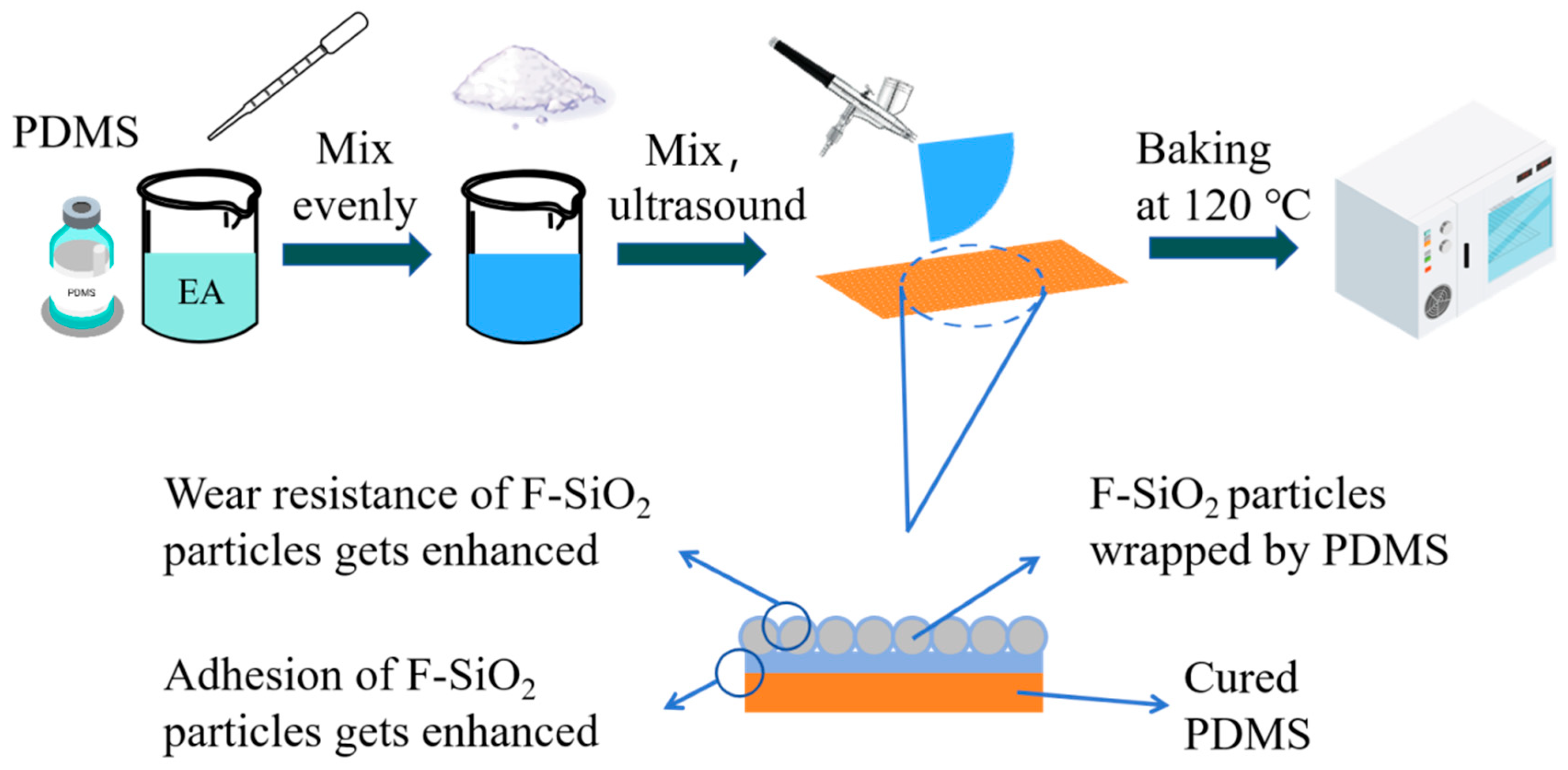
An amount of 30 mL of EA was placed into a beaker, followed by the addition of 3 g of PDMS precursor. The mixture was then stirred vigorously for 20 min to enable full dispersion. Subsequently, the curing agent was introduced at a mass ratio of 1: 10 (PDMS precursor to curing agent) and stirring was continued for an additional 2 h to achieve homogeneity. Next, 4 g of F-SiO2 were added into the beaker and uniformly dispersed through magnetic stirring and ultrasonication [29,30]. And the mixture was sprayed onto the metal substrate with a spray pen, and the substrate was transferred to an oven and cured at 120 °C for 5 h. When the PDMS was completely solidified, the F-SiO2/PDMS composite coating was obtained. The preparation process is shown in Figure 1.

2.4. Preparation of Test Electrode

Firstly, a 10 cm copper wire was welded vertically onto the top of a Q235 steel cylinder (11.28 mm of diameter, 5 mm of thickness), and then it was placed vertically into the center of a hollow PVC pipe (20 mm of inner diameter, 26.4 mm of outer diameter, 35 mm of height). Secondly, TPA-100 and F420 were mixed evenly in a 1: 1 ratio and injected into PVC pipe. As the mixture was completely cured, use 240 grit sandpaper to polish the bottom of the PVC pipe until the Q235 steel surface is exposed, and the electrode is obtained. After that, spray F-SiO2/PDMS onto the electrode surface with the method as 2.3 did to prepare the electrode to be tested.

2.5. Accelerated Aging Simulation

Electrodes were immersed in a 5 wt% NaCl solution at a constant ambient temperature of 25 °C for accelerated aging simulation. The solution was refreshed every 24 h. At predetermined time intervals (namely 24 h, 48 h, 96 h, 168 h, 240 h, 360 h and 480 h), specimens were retrieved, rinsed sequentially with deionized water, blow-dried, and subjected to subsequent testing.

2.6. Characterization

Escalab 250xi X-ray photoelectron spectrometer (XPS, Thermo Fisher Scientific Inc., Waltham, MA, USA) was used to analyze the chemical composition of F-SiO2 particles, including C, O, F and Si.
Nicolet IS50 FT-IR (Thermo Fisher Scientific Inc., Waltham, MA, USA) was used to characterize the structures of unmodified SiO2 and F-SiO2 particles. Before the test, these particles were dried in advance and made into samples through KBr mixed compression method. The infrared absorption spectra of the samples were obtained by scanning in the range of 400–4000 cm−1.
Xplora Plus microscopic Raman spectrometer (Horiba France SAS, Longjumeau, France) was used to characterize the structure of unmodified SiO2 and F-SiO2 particles from another dimension. The scanning range was 400–1000 cm−1 and the laser band was selected at 532 nm.
TG209F1 thermogravimetric analysis (TGA, Netzsch, Woden, Australia) was used to test the thermal stability of unmodified SiO2 and F-SiO2 particles. The test was conducted at a heating rate of 20 °C/min under N2 protection, and the temperature range was from 30 °C to 700 °C.
To test the self-cleaning ability of F-SiO2/PDMS coating, the sample, as well as a control group, was tilted at a certain angle. And a certain amount of quartz sand was placed on the samples with 2 mL of water sprayed onto their surface through a syringe; the condition of quartz sand and water were observed at the same time.
DSA25 standard contact angle (Krüss Scientific Instruments (Shanghai) Co., Ltd., Shanghai, China) tester was used to measure the superhydrophobicity of F-SiO2/PDMS coating. The water contact angles (CA) were obtained by calculating the angles between the tangent lines of the gas–liquid interface and the straight lines of the solid–liquid interface as the water droplets were static on the surface of the coating. In addition, to evaluate the wear resistance of F-SiO2/PDMS coating, it was placed downward on 800 grit sandpaper, and loaded with a weight of 100 g. The process of moving the sample 10 cm longitudinally and then 10 cm laterally along the sandpaper is defined as a wear time. The CA of the sample after worn were measured and stopped as the CA decreased significantly. In the actual test process, the measurement was carried out every five times of wear and when measuring the CA of five random difference areas on the surface of the sample were recorded, and the results were averaged.
The atomic force microscope (AFM, Bruker Dimension icon model, Bruker (Beijing) Technology Co., Ltd., Beijing, China) was used to analyze the surface roughness of F-SiO2/PDMS coating. The scanner was set to tap mode, the scanning frequency was 1.0 Hz and the scanning area was 10 μm.
The scanning electron microscope (Nova Nano SEM450, Thermo Fisher Scientific Inc., Waltham, MA, USA) was used to observe the surface topography of F-SiO2/PDMS coating, and the excitation voltage was 10 kV.
Electrochemical Impedance Spectroscopy (EIS, Corrtest Instruments Corporation, CS350M, Wuhan Coste Instrument Co., Ltd., Wuhan, China) test was used to study the corrosion behavior of coated electrode. A three-electrode configuration was employed in the electrolytic cell: a saturated calomel electrode (SCE) as the reference electrode, a platinum plate as the counter electrode, and the coated electrode as the working electrode. The electrolyte consists of 1000 mL of 3.5 wt% sodium chloride solution. During the test, the electrodes are always fully immersed in the electrolyte. EIS tests were conducted at room temperature within a shielded cage, with a standardized exposed area of 1 cm2 for each specimen. Prior to impedance measurements, the open-circuit potential (OCP) of the specimens was monitored for 1800 s until a stable value was reached. EIS scans were then performed over a frequency range of 105 to 10−2 Hz, with a sinusoidal signal amplitude of 10 mV. To ensure the reliability of results, five parallel specimens were prepared, and each specimen was measured in triplicate.

3. Results and Discussion

3.1. Chemical Elements and Structural Analysis of F-SiO2

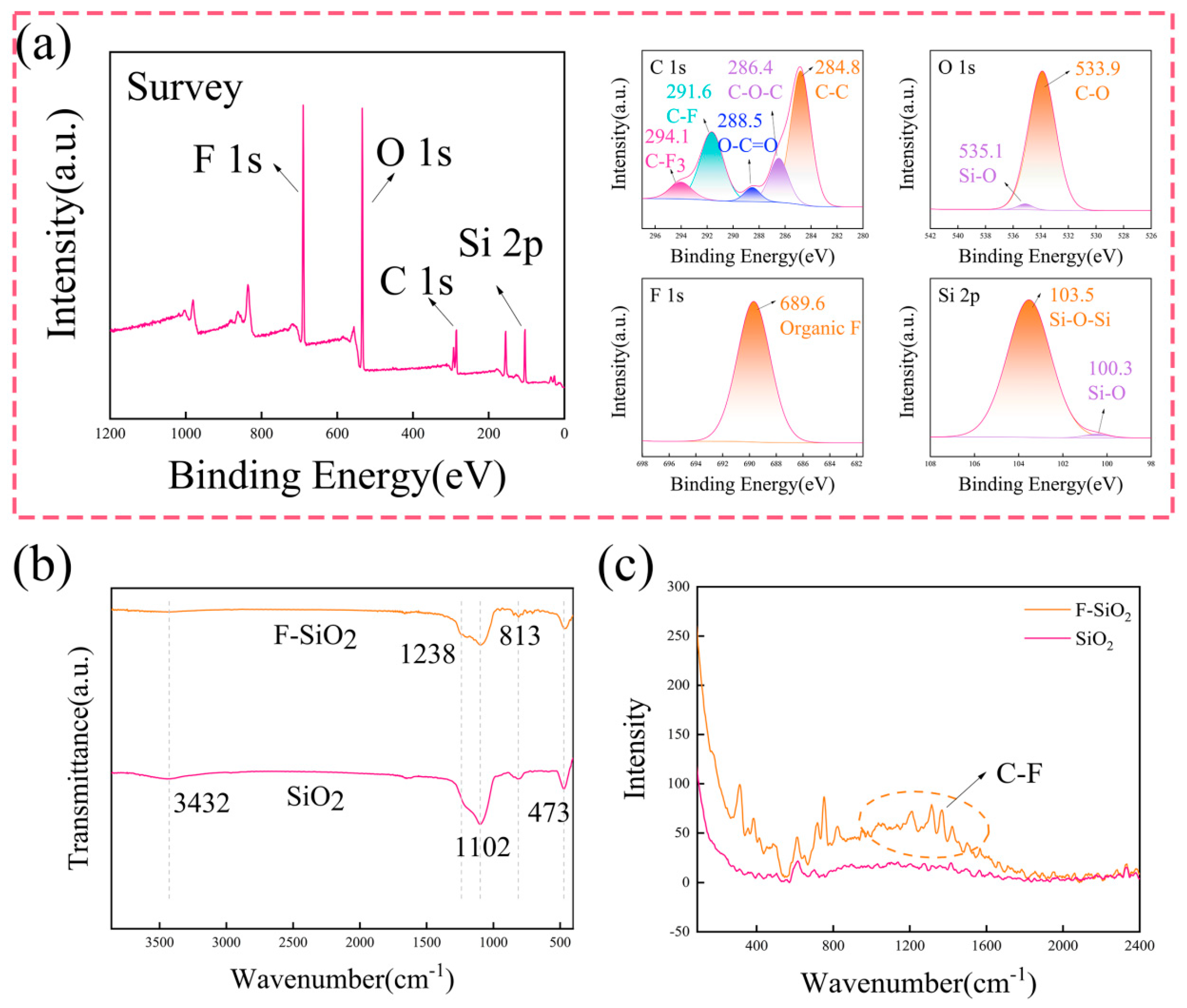
The chemical elements of F-SiO2 particles were analyzed by XPS and the results are shown in Figure 2a. The peaks of C, O, Si and F can be seen clearly in the full spectrum. Specifically, in the C 1s spectrum, the peaks at 291.3 eV and 294.1 eV correspond to C-F and C-F3, and the peak at 284.8 eV corresponds to C-C. These binding energy values are consistent with those reported for fluorinated organosilane compounds in the Thermo Fisher Scientific XPS Reference Database [31]. Furthermore, a single F 1s peak centered at approximately 688–689 eV is observed, which is characteristic of organic fluorine (C-F bonds) and is widely regarded as a fingerprint signal of fluorinated alkyl silanes. This result provides strong evidence for the successful grafting of FAS-13 onto the surface of SiO2 particles. The peak at 533.9 eV in O 1s corresponds to C-O, which corresponds to the methoxy group from FAS-13 that did not completely react in the modification process. In the O 1s and Si 2p spectra, the peak strength of Si-O is weak, which may be caused by the shielding of grafted FAS-13, which shows the full coverage of FAS-13 on the surface of SiO2 particles indirectly.
The chemical structure of F-SiO2 particles was further analyzed by FT-IR spectroscopy, and unmodified SiO2 particles were set as the control group. It can be seen in Figure 2b that the stretching vibrational peak at 3432 cm−1 is attributed to Si-OH, which is obvious on the spectral curve of unmodified SiO2 particles, and weakened to a certain extent on the spectral curve of F-SiO2 particles, indicating that FAS-13 and SiO2 have reacted. The peaks at 1102 cm−1 and 813 cm−1 are, respectively, attributed to antisymmetric stretching vibration and symmetric stretching vibration of Si-O-Si, and the stretching vibration peak of C-F appears at 1238 cm−1, indicating that FAS-13 is successfully grafted onto the surface of SiO2 molecule. As a supplement, Raman spectra of unmodified SiO2 and F-SiO2 were measured, as shown in Figure 2c. It can be seen that the Raman spectrum curve of F-SiO2 particles shows a strong signal in a wide range of 800–1400 cm−1, mainly attributed to the stretching vibration of C-F in FAS-13. There are 13 fluorine atoms distributed in the molecular structure of FAS-13 showing multiple characteristic peaks in this range, reflecting several stretching vibrations of C-F in different chemical environments.

3.2. Thermal Stability Analysis of F-SiO2

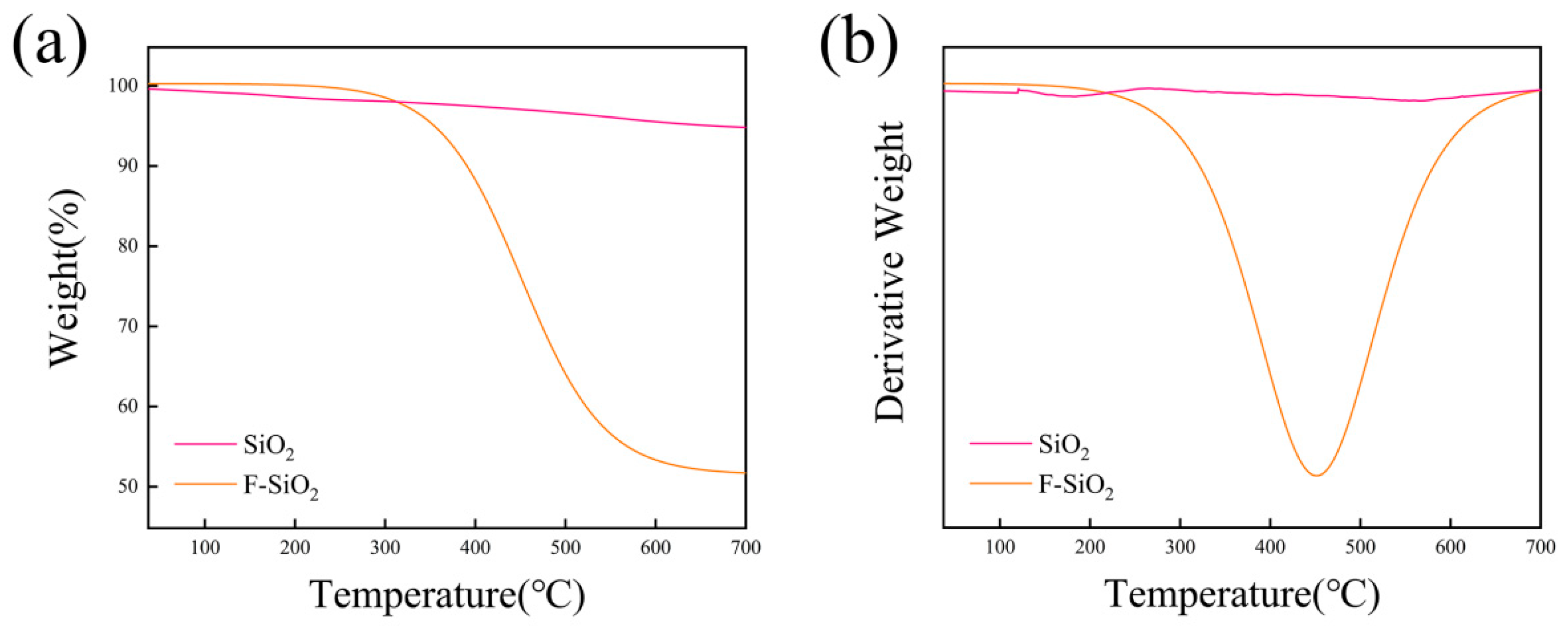
The thermal stability of unmodified SiO2 and F-SiO2 particles was evaluated through TGA. As is shown in Figure 3a, unmodified SiO2 maintains excellent thermal stability throughout the whole process, and can still remain about 95% of the residual mass at 700 °C. However, only 51.7% of the mass of F-SiO2 particles remains after the test, and the mass loss is mainly led by the decomposition of FAS-13 [32,33]. When the mass of F-SiO2 particles is 95%, the corresponding temperature is defined as initial decomposition temperature, which is 354 °C for F-SiO2. This initial decomposition temperature is much higher than the temperature in the actual application environment. Figure 3b shows the DTGA curves of unmodified SiO2 and F-SiO2 particles, in which the former is almost horizontal, showing the excellent thermal stability of unmodified SiO2. Additionally, the loss rate of its mass is relatively average, while the DTGA curve of F-SiO2 particles shows that it reaches the maximum decomposition rate at 453 °C, corresponding to the violent decomposition of FAS-13.

3.3. Surface Topography Analysis of F-SiO2/PDMS Coating

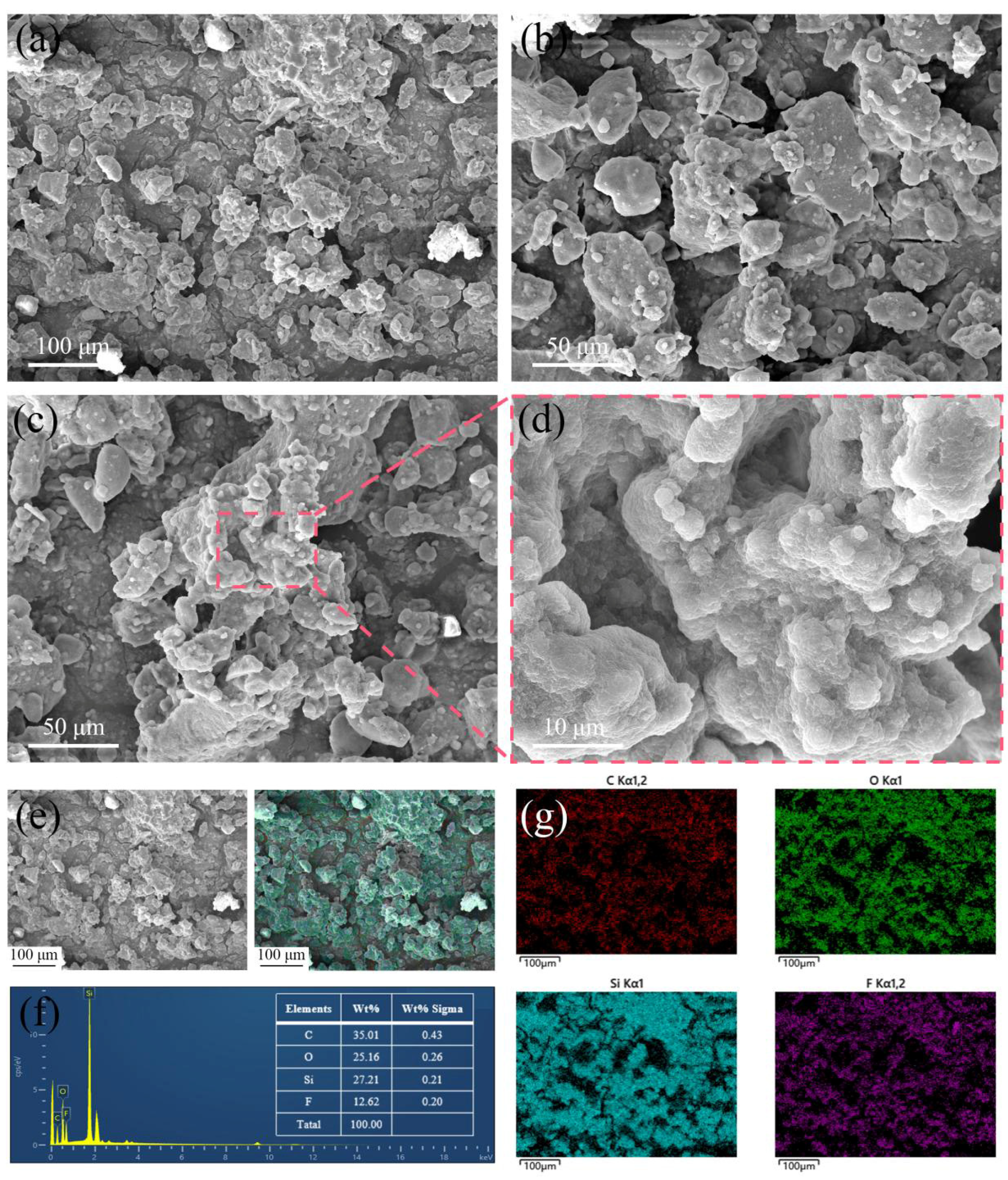
The surface topography of F-SiO2/PDMS coating was obtained through SEM. From Figure 4a,b, we can clearly see that F-SiO2 particles are distributed in an irregular shape on PDMS, and the particle size varies from nanometer to micron. Therefore, these particles stack together and produce many voids and depressions (Figure 4c,d), leaving sufficient space for air, thus forming air cushions. This is the key structure to become superhydrophobic. In addition, EDS analysis was carried out, and the results are shown in Figure 4e–g. The surface of the coating is mainly composed of C, O, Si and F with mass fractions of 35.01%, 25.16%, 27.21% and 12.62%, respectively. It can be seen from EDS mappings that the four elements are evenly distributed on the surface except for voids and depressions.
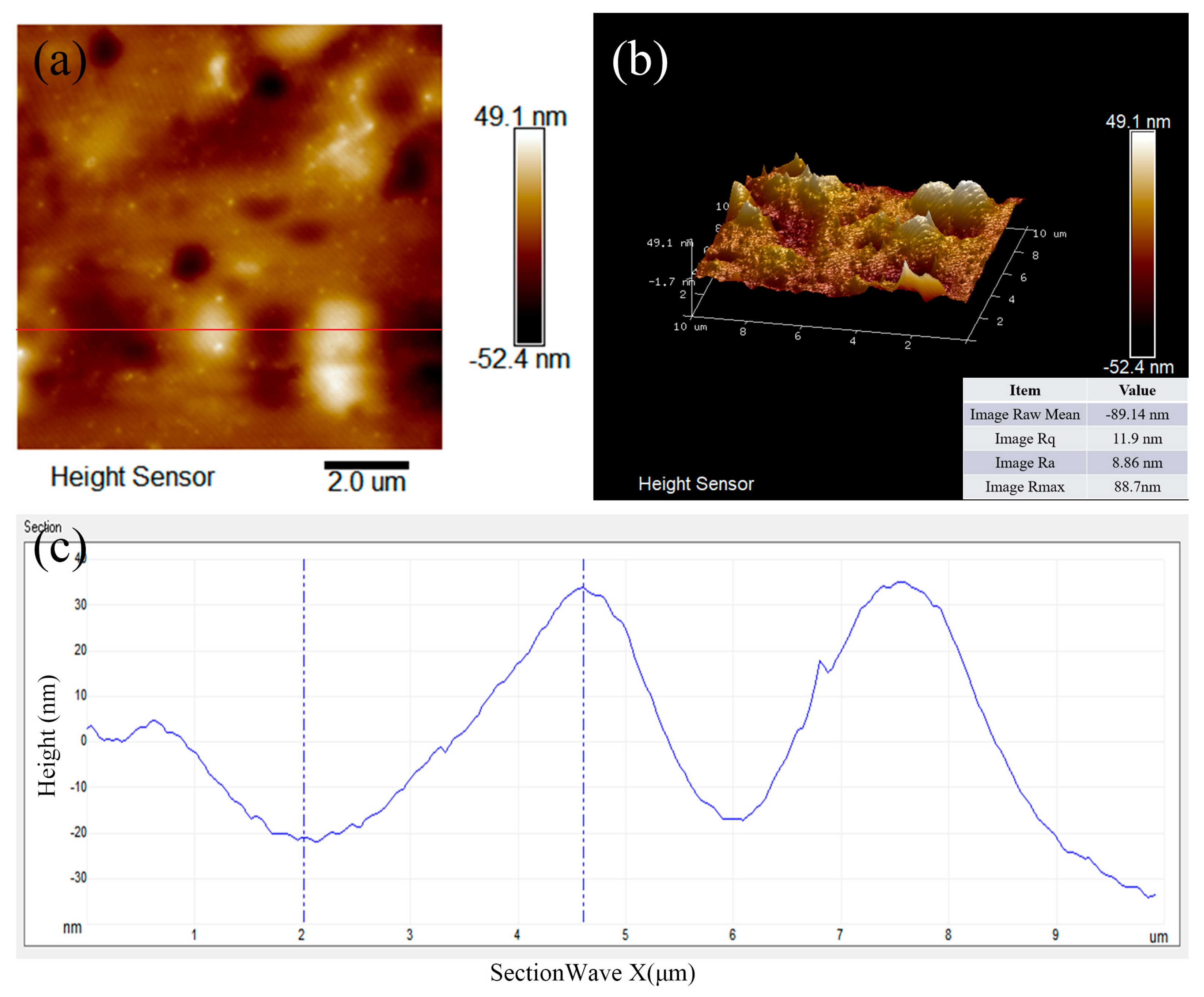
For the purpose of researching the detailed condition of the surface roughness of F-SiO2/PDMS composite coating, it was characterized by AFM. Figure 5a,b is the 2D and 3D morphology of the measurement area, showing the fluctuation condition of F-SiO2 particles. It is obvious that the fluctuation height of the particles based on the central plane is small, which is approximately ±50 nm. It can be attributed to the abundance of fluorine atoms in FAS-13, which weakens the intermolecular force and makes it difficult for F-SiO2 particles to combine in the modification process, thus leading to the generation of small-sized particles. Specifically, the vertical drop between the peaks and valleys of the measurement area is 88.7 nm, Rq is 11.9 nm, and Ra is 8.86 nm. Figure 5c shows the thickness curve of the coating at the red line in Figure 5a. It can be seen that the fluctuations are relatively average, and the air cushion has a high retention ratio, which is conducive to improving the superhydrophobic performance.

3.4. Self-Cleaning and Wear Resistance Performance Analysis

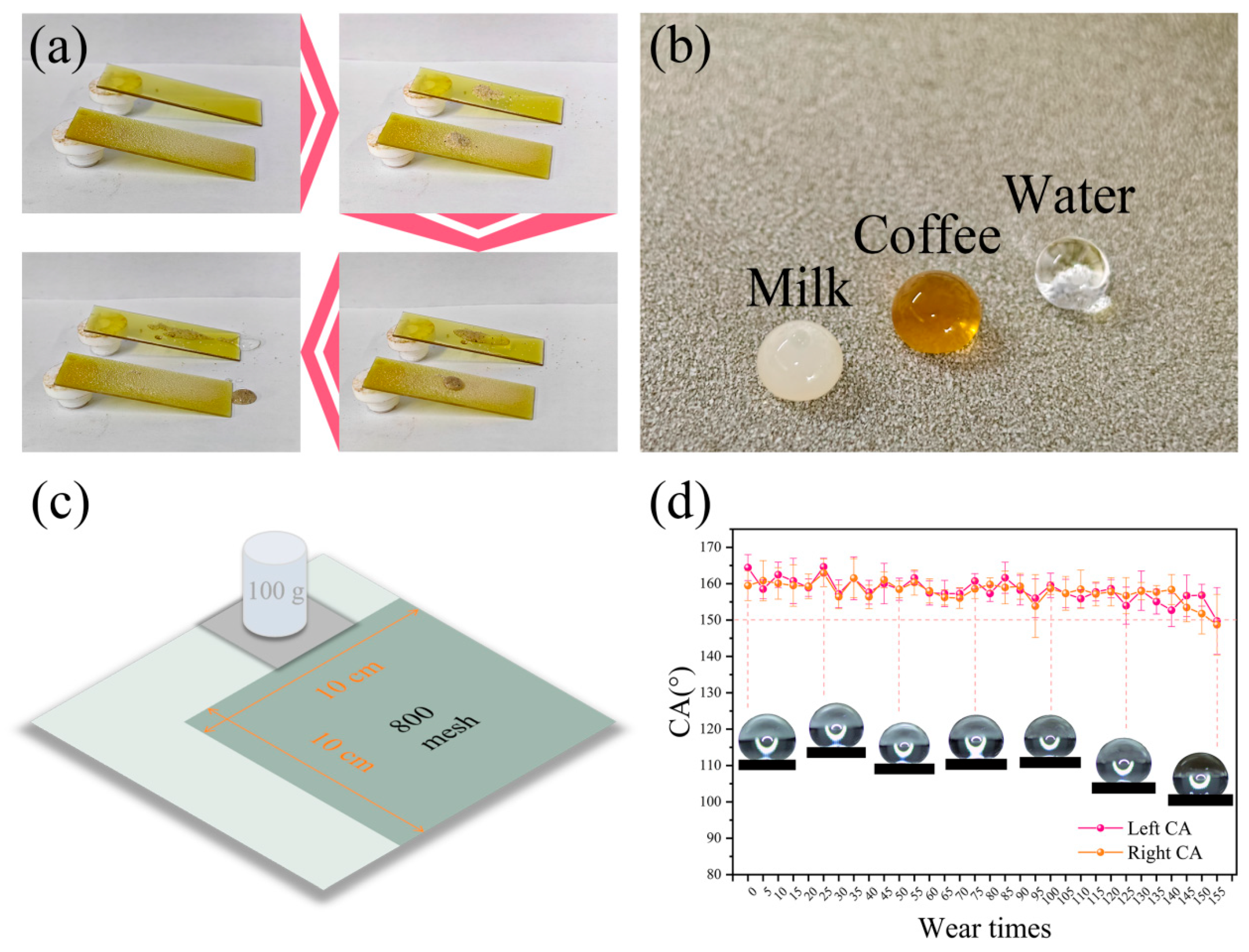
An intuitive method was used to evaluate the self-cleaning ability of F-SiO2/PDMS coating to fine sand, as shown in Figure 6a. First of all, F-SiO2/PDMS was loaded on a polyurethane (PU)-coated glass plate as the experimental group, and a control group was set up. And then, they were both placed at a specific angle. Some fine sand was then placed on the surfaces of these samples, followed by the addition of distilled water dropwise. Initially, the water wetted the fine sand on the PU coating and continued to flow downward and formed a water droplet. Due to the interaction between the water and the fine sand, the droplet remained stationary in the middle of the coating without rolling. As more water was added, the droplet grew larger and eventually rolled down under the influence of gravity. The phenomenon on F-SiO2/PDMS coating was similar. Notably, the fine sand on the PU coating still remained on its surface and did not roll down with the droplet. Meanwhile on the F-SiO2/PDMS coating, the fine sand rolled down together with the droplet, leaving no residual fine sand on the surface. This phenomenon demonstrates the superior self-cleaning performance of the F-SiO2/PDMS coating. Additionally, the wettability of various liquids on the superhydrophobic coating was examined. As shown in Figure 6b, besides water, milk and coffee also formed spherical droplets on the surface, indicating that the coating exhibits resistance properties against common liquid substances.
In addition, the superhydrophobic wear resistance of the F-SiO2/PDMS coating was assessed, with the process diagram in Figure 6c. Prior to the test, the left CA and the right CA of the coating were, respectively, 164.44° and 159.48° (Figure 6d). For ease of expression, they were referred to as 164.44°/159.48°, and so forth. During subsequent measures, the CA fluctuated as the times of wear increased but consistently remained above 150°. As the wear times progressed, the uneven distribution of F-SiO2 particles on the surface increased, which contributed to the lengthening of the error bars. Starting from the 140th wear, the CA in part on the surface frequently decreased to below 150°. Between 140th and 155th wear, the minimum measured CA exhibited a downward trend, indicating significant damage to the coating surface. Ultimately, after 155 wear times, corresponding to a cumulative wear length of 3100 cm, the CA of the coating decreased to 149.76°/148.71°, falling below 150°.

3.5. EIS Analysis of Coated Electrode

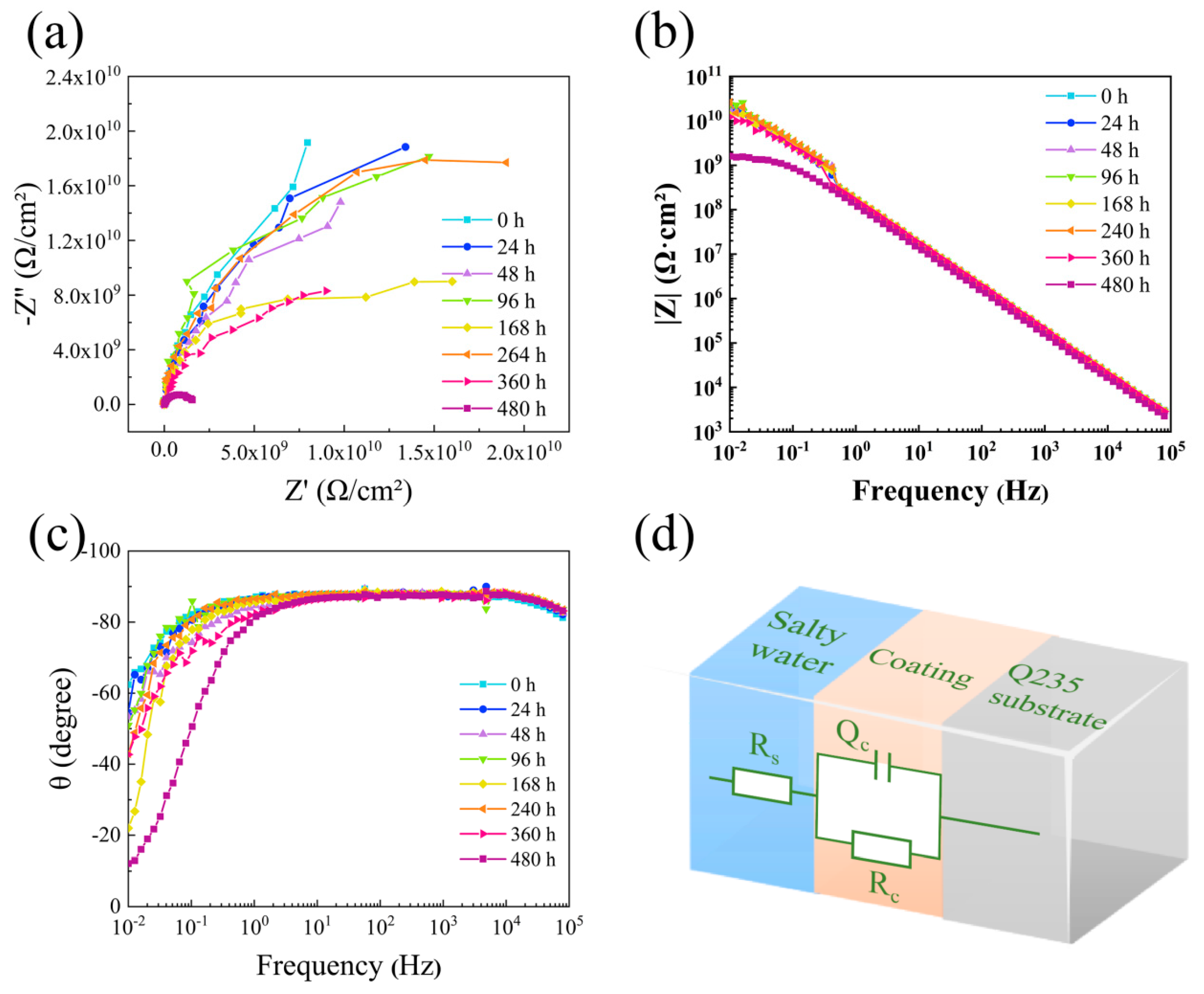
As is shown in Figure 7a, in the salt water immersion test of the first 360 h, the Nyquist plot shows a nearly vertical line almost perpendicular to the horizontal axis, which is a large-radius capacitive arc. The Bode modulus plot (Figure 7b) is a diagonal line with the phase angle close to −90° over a wide range (Figure 7c). And the low-frequency impedance of the coating remains basically stable, always maintaining between approximately 2.43 × 10⁹ and 3.52 × 10⁹ Ω·cm2 at 0.1 Hz. At this time, the impedance of the coating gets quite large, indicating that the coating exhibits excellent protective performance to prevent the penetration of corrosion factors effectively. After 480 h of the test, as the corrosion factors gradually penetrate the coating, a complete capacitive arc emerges in Figure 7a, with a notably reduced arc radius. Meanwhile in the Bode modulus plot (Figure 7b), a plateau begins to appear in the low-frequency range while the phase angle range approaching −90° is only slightly narrowed. The impedance value at 0.1 Hz still remains at 8.53 × 10⁸ Ω·cm2, with only a single time constant still observed. It indicates that the coating exhibits excellent anti-corrosion and stability properties within 480 h. Only a minimal amount of corrosion factors can infiltrate the coating through micropores and cracks on the surface at a slow rate, and, at the same time, they fail to reach the coating/metal substrate interface.
EIS was utilized to evaluate the degradation behavior and protective performance of the coating in a 5 wt% NaCl solution. The experimental impedance spectra were fitted using an equivalent circuit (Figure 7d) comprising solution resistance (Rs), coating resistance (Rc), and a constant phase element (CPE)—the latter accounting for the non-ideal capacitive behavior of the coating (see Table 1).
Rs corresponds to the electrolyte resistance, which is primarily influenced by NaCl concentration, electrode spacing, and temperature, and is independent of the coating’s bulk properties. The minimal fluctuations in fitted Rs values reflect the stability of the testing conditions.
Rc is correlated with the coating’s ability to impede electrolyte penetration and ion transport through pores and defects. During the initial immersion stage (0–360 h), Rc decreased moderately from 3.951 × 10¹⁰ Ω·cm2 to 1.373 × 10¹⁰ Ω·cm2, indicating that the coating maintained structural integrity and effective barrier performance. At this stage, electrolyte ingress was confined to isolated pores and microdefects, and ion transport through the coating remained highly restricted. After 480 h of immersion, however, Rc dropped by one order of magnitude to 1.528 × 10⁹ Ω·cm2. This significant decline suggests the formation of interconnected electrolyte pathways within the coating, enabling deep electrolyte penetration, a marked increase in ionic conductivity, and rapid deterioration of barrier properties. The transition from slow to rapid Rc decay reflects the coating system’s shift from diffusion-controlled degradation to an accelerated failure stage.
The CPE, defined by parameters Y0 (frequency constant) and n (CPE exponent), describes the non-ideal capacitive behavior of the coating arising from surface roughness, thickness inhomogeneity, and microstructural heterogeneity. For quantitative comparison, the CPE parameter Y0 was converted to effective capacitance (Ceff), which provides a more intuitive measure of the coating’s water absorption and dielectric evolution during immersion. The conversion follows the relationship:
C eff = ( Y 0 × R c 1 n ) 1 n
Ceff is the effective capacitance (F·cm−2), Y0 is the CPE frequency constant (S·sn·cm−2), Rc is the coating resistance (Ω·cm2), and n is the CPE exponent.
During the initial immersion period (0–360 h), Ceff increased slightly from 6.37 × 10⁻¹⁰ F·cm−2 to 7.62 × 10⁻¹⁰ F·cm−2, attributed to uniform water absorption within the coating matrix and a corresponding increase in dielectric constant. Electrolyte penetration remained limited to isolated defects, and the coating retained barrier-controlled behavior. After 480 h of immersion, Ceff rose sharply to 1.1 × 10⁻⁹ F·cm−2, indicating the formation of interconnected electrolyte channels and rapid expansion of the electrochemically active volume within the coating. This significant increase in Ceff reflects enhanced polarization associated with extensive water accumulation and structural degradation, marking the coating’s transition from a stable barrier state to accelerated degradation.
n remained close to unity (ideal capacitance) during the initial 0–360 h of immersion, indicating the coating maintained a relatively uniform and dense microstructure with limited electrolyte penetration. After 480 h of immersion, n decreased slightly to 0.9698, reflecting an increased deviation from ideal capacitive behavior. This change is ascribed to electrolyte ingress, water accumulation, and the development of microstructural inhomogeneities within the coating. The concurrent decrease in Rc and increase in Ceff at this stage further confirm the formation of interconnected penetration pathways and the coating’s transition to accelerated degradation.
In addition to the χ2 value, the fitting quality was further evaluated by the good overlap degree between the experimental and simulated spectra, which indicates that the fitting process is reliable.
Throughout the immersion period, the coating predominantly exhibited barrier-controlled behavior and maintained robust corrosion protection. The EIS results confirm that the coating’s degradation progresses from a slow, diffusion-limited stage to an accelerated failure stage after 480 h, but its overall performance remains satisfactory even under harsh high-salt conditions.

4. Conclusions

In this study, we first synthesized FAS-13 modified superhydrophobic F-SiO2 particles and subsequently fabricated a PDMS-enhanced superhydrophobic anti-corrosion coating via doping and spraying with PDMS and F-SiO2. TGA revealed that the F-SiO2 particles exhibited an initial decomposition temperature of 354 °C, confirming their excellent thermal stability for practical applications. And the fabricated F-SiO2/PDMS coating demonstrated a CA of 164.44°/159.48°, still retaining over 150° even after 3000 cm of cyclic abrasion with 800 grit sandpaper under a load of 100 g, indicating outstanding self-cleaning and wear resistance properties. The origin of superhydrophobicity of the coating was discussed via SEM and AFM, indicating that the F-SiO2 formed abundant micro-nanostructures and cavities on the metal surface, which provided sufficient space for the retention of air. Furthermore, EIS was employed to evaluate the anti-corrosion performance of the F-SiO2/PDMS coating. As the results showed, the coated electrode still maintained a high impedance value of 8.53 × 10⁸ Ω·cm2 at 0.1 Hz after 480 h of immersion in 5 wt% NaCl solution, underscoring the exceptional corrosion resistance property of F-SiO2/PDMS coating.

Author Contributions

C.X.: Writing—original draft, Supervision, Resources, Methodology, Investigation, Formal analysis, Conceptualization. P.D.: Methodology, Validation, Resources, Project administration. G.F.: Methodology, Validation, Software. J.W. and X.L.: Software, Formal analysis, Writing—review and editing. Z.W. and S.S.: Validation, Writing—review and editing. L.Y.: Software, Writing—original draft, Writing—review and editing. B.S.: Methodology, Formal analysis, Writing—review and editing, Supervision. All authors have read and agreed to the published version of the manuscript.

Funding

This work was supported by funds from the Jiangsu Frontier Electric Power Enterprise Fund project CX202115.

Institutional Review Board Statement

Not applicable.

Informed Consent Statement

Informed consent was obtained from all subjects involved in the study.

Data Availability Statement

The data is contained within the article.

Conflicts of Interest

Author Peng Dou: I hereby disclose my conflict of interest as outlined by the MDPI guidelines. I am currently employed by the company Jiangsu Frontier Electric Technology Co., Ltd. and was employed by the company Jiangsu Frontier Electric Technology Co., Ltd. while contributing to this manuscript. My contributions to this work and manuscript were made independently without any requirement, guidance or input by my employer. I received no financial compensation from any source for the contributions I made to this scientific work and manuscript. Author Lixin Yuan: I hereby disclose my conflict of interest as outlined by the MDPI guidelines. I am currently employed by the company Anhui Kindon Paint Co., Ltd. and was employed by the company Anhui Kindon Paint Co., Ltd. while contributing to this manuscript. My contributions to this work and manuscript were made independently without any requirement, guidance or input by my employer. I received no financial compensation from any source for the contributions I made to this scientific work and manuscript.

References

  1. Chen, T.J.; Yang, B.Q.; Li, B.; Guo, J.L.; Zhang, P.; Cao, X.Z. Effects of electrochemical corrosion characteristis on electrochemical cold drawing of Q235 steel bar. J. Mater. Process. Technol. 2020, 275, 116375. [Google Scholar] [CrossRef]
  2. Javaherdashti, R. Environmental Impacts of Corrosion and Assessment Strategies. In Corrosion Policy Decision Making; John Wiley and Sons: Hoboken, NJ, USA, 2022; pp. 349–367. [Google Scholar]
  3. Kotabagi, S.D.; Minagalavar, R.L.; Rajappa, S.K.; Rathod, M.R.; Sajjan, A.M.; Suma, J.G. Surface interaction of expired Brilcure (Ticagrelor) drug on soft-cast steel in 0.5 M H2SO4 medium: Corrosion protection, surface characterizations and computational studies. J. Taiwan Inst. Chem. Eng. 2024, 165, 105791. [Google Scholar] [CrossRef]
  4. Sun, J.; Wang, J.; Xu, W.; Zhang, B. A mechanically robust superhydrophobic corrosion resistant coating with self-healing capability. Mater. Des. 2024, 240, 112881. [Google Scholar] [CrossRef]
  5. Chen, C.; Wang, Y.; Lu, C.; Chou, P.; Wu, B.; Sil, M.C. Synergistic effect of metal cation and 1-dimethylamino-2-propanol on copper corrosion protection in alkaline solution. J. Taiwan Inst. Chem. Eng. 2024, 156, 105322. [Google Scholar] [CrossRef]
  6. Krishna, N.G.; Mathew, A.M.; Philip, J. New insights into the mechanism causing the loss of anti-corrosion property of superhydrophobic titanium surfaces. Colloids Surf. A Physicochem. Eng. Asp. 2024, 693, 134071. [Google Scholar] [CrossRef]
  7. Arachchige, L.J.; Li, C.; Wang, F. Recent advances in understanding iron/steel corrosion: Mechanistic insights from molecular simulations. Curr. Opin. Solid State Mater. Sci. 2025, 35, 101216. [Google Scholar] [CrossRef]
  8. Thacker, H.; Ram, V. Green corrosion inhibitors derived from plant extracts and drugs for mild steel in acid media: A review. Results Surf. Interfaces 2025, 18, 100364. [Google Scholar] [CrossRef]
  9. Wang, D.; Sun, Q.; Hokkanen, M.J.; Zhang, C.; Lin, F.Y.; Liu, Q.; Zhu, S.P.; Zhou, T.; Chang, Q.; He, B.; et al. Design of robust superhydrophobic surfaces. Nature 2020, 582, 55–59. [Google Scholar] [CrossRef]
  10. Cui, W.; Chen, Z.; Xiong, R.; Tang, L.; Zhu, L.; Cai, C.; Zhou, X. Anti-corrosion performance of superhydrophobic nanoparticle-modified hybrid coatings on AZ31B magnesium alloys. Surf. Interfaces 2025, 68, 106722. [Google Scholar] [CrossRef]
  11. Chen, D.; Cui, L.; Rong, H.; Liu, D.e.; Fang, Y.; Sithole, T.J.; Wang, Y.; Lv, Y.; Lv, Z.; Xiang, T. Effect of hydrophobic nanoparticle size on corrosion resistance of superhydrophobic mortar. Constr. Build. Mater. 2025, 467, 140282. [Google Scholar] [CrossRef]
  12. Xue, S.; Yang, S.; Li, X.; Li, Q.; Hu, B. A comprehensive review on self-cleaning glass surfaces: Durability, mechanisms, and functional applications. RSC Adv. 2024, 14, 34390–34414. [Google Scholar] [CrossRef] [PubMed]
  13. Li, J.; Wu, C.; Wang, F.; Xu, J.; Jin, W. Wear-resistant superhydrophobic and high oleophobic copper surface constructed by tin soldering rod-like copper particles inside protective structure. Surf. Coat. Technol. 2025, 511, 132266. [Google Scholar] [CrossRef]
  14. Li, X.; Ma, C.; Shi, T.; Yang, H.; Zhang, C.; Qi, W.; Li, C.; Liu, R.; He, W.; Liu, Y. Waterborne robust superhydrophobic PFDTES@TiO2-PU coating with stable corrosion resistance, long-term environmental adaptability, and delayed icing functions on Al–Li alloy. J. Mater. Res. Technol. 2024, 32, 3357–3370. [Google Scholar] [CrossRef]
  15. Li, X.; Liu, H.; Guo, W.; Zhou, L.; Cui, Q.; Deng, X.; Shu, W.; Shi, T.; Xing, Z.; Wang, H. Effect of TiO2 content on the thermal control properties of Al2O3-xTiO2 composite coatings prepared by supersonic plasma spraying technology. J. Mater. Res. Technol. 2024, 32, 3582–3593. [Google Scholar] [CrossRef]
  16. Tan, Y.; Guo, R.; Li, L.; Qin, W.; Zhao, Z.; Zhong, Y.; Ma, Q.; Zhang, D.; Liu, Z.; Yuan, Y.; et al. Long afterglow luminescent superhydrophobic coating for metal corrosion protection and visual marking. Surf. Coat. Technol. 2025, 512, 132354. [Google Scholar] [CrossRef]
  17. Zhang, M.; Fan, J.; Li, H. Robust superhydrophobic surface with excellent corrosion resistance based on wet chemical etching method. Surf. Interfaces 2025, 64, 106363. [Google Scholar] [CrossRef]
  18. Zhang, G.; Ma, W.; Gao, Y.; Zhao, Y.; Zhao, G.; Meng, J.; Zuo, D.; Sun, Y. Clarification of the effect of cooling rate on abrasive embedding behavior of PDMS in cryogenic abrasive air-jet machining. J. Manuf. Process. 2025, 134, 749–761. [Google Scholar] [CrossRef]
  19. Zhu, L.; Lu, H.; Huo, T.; Liu, D.; Yan, Z.; Zhang, J. Superhydrophobic PDMS/MOF-74@PU sponge with photothermal property for efficient oil/water separation. Sep. Purif. Technol. 2025, 364, 132525. [Google Scholar] [CrossRef]
  20. Sharma, B.; Gupta, R.; Sharma, A.; Chowdhuri, A.; Tomar, M. Power in motion: KNN-PDMS self-biased flexible piezoelectric nanogenerators. Mater. Today Commun. 2025, 44, 112140. [Google Scholar] [CrossRef]
  21. Li, P.; Shang, C.; Tong, Z.; Wang, H. Temperature sensitivity enhancement of OFDR fibers based on PDMS/Glycerol films. Opt. Mater. 2025, 163, 116940. [Google Scholar] [CrossRef]
  22. Luo, F.; Sun, J.; Zou, Y.; Yang, X.; Lin, B.; Feng, Y.; Li, H. Outstanding self-healing and plasticity of imine-linked dynamic PDMS with high softness and stability. Chem. Eng. J. 2025, 511, 161905. [Google Scholar] [CrossRef]
  23. Xiao, Z.; Li, S.; Liu, Z.; Zhou, A.; Geng, Y.; Zhang, K.; Liu, Y.; Zhang, X. Preparation and properties of the PDMS/h-BN/PDA composite anti-corrosion coating on a carbon steel surface. FlatChem 2025, 50, 100839. [Google Scholar] [CrossRef]
  24. Wang, M.; Zhang, Y.; Wang, A.; Gan, Z.; Zhang, L.; Kang, X. Soft neural interface with color adjusted PDMS encapsulation layer for spinal cord stimulation. J. Neurosci. Methods 2025, 417, 110402. [Google Scholar] [CrossRef] [PubMed]
  25. Jiang, L.; Gong, M.; Sun, J.; Lin, Y.; Tu, K.; Chen, Y.; Xiao, T.; Li, X.; Tan, X. The design and performance research of PTFE/PVDF/PDMS superhydrophobic radiative cooling composite coating with high infrared emissivity. Mater. Today Commun. 2024, 38, 108406. [Google Scholar] [CrossRef]
  26. Su, X.; Qin, G.; Deng, P.; Li, K.; Xie, H.; Wu, W. Self-cleaning PDMS films with durable superhydrophobicity and photocatalytic capability based on TiO2-modified nanopillar array. Prog. Org. Coat. 2024, 195, 108684. [Google Scholar] [CrossRef]
  27. Li, C.; Dou, P.; Zhao, R.; Shi, Y.; Fu, G.; Shen, B. Preparation and Super-Hydrophobic Mechanism Analysis of FAS-17-Modified SiO2/PDMS Coatings for High-Voltage Composite Insulators. Coatings 2023, 13, 563. [Google Scholar] [CrossRef]
  28. Wang, L.; Xie, G.; Mi, X.; Zhang, B.; Du, Y.; Zhu, Q.; Yu, Z. Surface-Modified TiO2@SiO2 Nanocomposites for Enhanced Dispersibility and Optical Performance to Apply in the Printing Process as a Pigment. ACS Omega 2023, 8, 20116–20124. [Google Scholar] [CrossRef]
  29. He, S.; Chen, J.; Lu, Y.; Huang, S.; Feng, K. Enhanced waterproof performance of superhydrophobic SiO2/PDMS coating. Prog. Org. Coat. 2024, 197, 108845. [Google Scholar] [CrossRef]
  30. Wang, X.; Ding, H.; Sun, S.; Zhang, H.; Zhou, R.; Li, Y.; Liang, Y.; Wang, J. Preparation of a temperature-sensitive superhydrophobic self-cleaning SiO2-TiO2@PDMS coating with photocatalytic activity. Surf. Coat. Technol. 2021, 408, 126853. [Google Scholar] [CrossRef]
  31. Scientific, T.F. X-Ray Photoelectron Spectroscopy (XPS). Available online: https://www.thermofisher.com (accessed on 23 December 2025).
  32. Mussa, M.; Shtawa, A.; Takita, S. The Influence of Adding Silica Fluoroalkylsilane on the Morphology, Mechanical, and Corrosion Resistance Properties of Sol-Gel Derived Coatings. Eng. Proc. 2023, 56, 98. [Google Scholar] [CrossRef]
  33. Ahn, S.; Friedman, S.K.; Notestein, J.M. Effect of surface modification on silica supported Ti catalysts for cyclohexene oxidation with vapor-phase hydrogen peroxide. RSC Adv. 2024, 14, 25425–25428. [Google Scholar] [CrossRef]
Figure 1. The preparation process of F-SiO2/PDMS coating.
Coatings 16 00074 g001
Figure 2. (a) XPS spectrum of F-SiO2 particles. FT-IR (b) and Raman (c) spectrum of SiO2 and F-SiO2 particles.
Coatings 16 00074 g002
Figure 3. SiO2 and F-SiO2 particles: (a) TGA curve and (b) DTGA curve.
Coatings 16 00074 g003
Figure 4. F-SiO2/PDMS coating: (ad) SEM images and (eg) EDS mappings.
Coatings 16 00074 g004
Figure 5. The AFM analysis of F-SiO2/PDMS coating: (a) The 2D morphology. (b) The 3D morphology. (c) The coating thickness curve analyzed at the red line in (a).
Coatings 16 00074 g005
Figure 6. (a) The self-cleaning test of F-SiO2/PDMS coating for fine sands. (b) Wetting situation of different liquids on F-SiO2/PDMS coating. (c) The process diagram of wear resistance test. (d) CA variation of F-SiO2/PDMS coating with wear times.
Coatings 16 00074 g006
Figure 7. EIS analysis at salt water immersion test of F-SiO2/PDMS coated electrode: (a) Nyquist plot. (b) Bode modulus plot. (c) Bode phase plot. (d) The equivalent circuit model.
Coatings 16 00074 g007
Table 1. Fitted EIS equivalent circuit parameters of the coating at different immersion times.
Immersion Duration (h)Rs (Ω·cm2)CPE-Y0 (S · sn·cm−2)nCPERc (Ω·cm2)Ceff (F·cm−2)Χ2 (Chi-Square)
0541.96.367 × 10−101.00003.951 × 10106.37 × 10−100.1045
24406.96.694 × 10−101.00003.327 × 10106.69 × 10−100.0934
48381.46.180 × 10−101.00002.533 × 10106.18 × 10−100.1325
96441.65.753 × 10−101.00003.536 × 10105.75 × 10−100.1803
168400.26.445 × 10−101.00001.790 × 10106.45 × 10−100.1042
240399.35.578 × 10−101.00003.366 × 10105.58 × 10−100.1587
360377.37.616 × 10−101.00001.373 × 10107.62 × 10−100.0351
480149.31.351 × 10−90.96981.528 × 1091.1 × 10−90.0017
Disclaimer/Publisher’s Note: The statements, opinions and data contained in all publications are solely those of the individual author(s) and contributor(s) and not of MDPI and/or the editor(s). MDPI and/or the editor(s) disclaim responsibility for any injury to people or property resulting from any ideas, methods, instructions or products referred to in the content.