Next Article in Journal
Tribological Performance of High-Speed Laser-Cladded cBN Reinforced Composite Coatings: The Influence of Ag Additions
Previous Article in Journal
Research on Application of High-Pressure Cyclic Grouting Technology in Soft Soil Layers
Previous Article in Special Issue
Preparation and Research of a Metal Anti-Corrosion Coating Based on PDMS Reinforcement
 
 
Due to scheduled maintenance work on our servers, there may be short service disruptions on this website between 11:00 and 12:00 CEST on March 28th.
Article

A Novel Approach for Simultaneous Improvement of Mechanical and Corrosion Properties in D36 Steel: EP-UIT Hybrid Process


1
Central Research Institute of Building and Construction Co., Ltd., Metallurgical Corporation of China Limited (MCC) Group, Beijing 100089, China
2
CIMC Offshore Co., Ltd., China International Marine Containers Co., Ltd. (CIMC) Group, Shenzhen 518000, China
3
Advanced Materials Institute, International Graduate School at Shenzhen, Tsinghua University, Shenzhen 518055, China
4
School of Mechatronics Engineering and Automation, Foshan University, Foshan 528225, China
*
Author to whom correspondence should be addressed.
Coatings 2026, 16(2), 195; https://doi.org/10.3390/coatings16020195

Submission received: 20 December 2025 / Revised: 18 January 2026 / Accepted: 24 January 2026 / Published: 4 February 2026
(This article belongs to the Collection Feature Paper Collection in Corrosion, Wear and Erosion)

Abstract

This study investigates the synergistic effects of an electropulsing (EP) and ultrasonic impact treatment (UIT) hybrid process on the mechanical and corrosion properties of D36 low-carbon steel. Conventional UIT has been shown to enhance surface hardness and induce compressive residual stress but is limited by a shallow affected depth and potential for increased surface roughness, which can exacerbate corrosion. In this work, we integrate high-energy electropulsing with UIT to overcome these limitations. The EP-UIT process leverages the combined effects of acoustoplasticity, thermal softening, and electroplasticity to achieve a significantly deeper hardened layer, extending beyond 2 mm, which is an order of magnitude thicker than that obtained by UIT alone. Microstructural analysis reveals that the process induces continuous dynamic recrystallization (CDRX), resulting in a gradient nanostructured layer with equiaxed grains near the surface and submicron ferrite grains at greater depths. Additionally, cementite dissolution and reprecipitation lead to a dual-phase microstructure comprising a supersaturated ferrite matrix and spheroidized Fe3C particles. The EP-UIT treatment also forms a dense oxide scale composed primarily of magnetite (Fe3O4) and hematite (α-Fe2O3), significantly enhancing corrosion resistance. Potentiodynamic polarization tests demonstrate that EP-UIT reduces the corrosion current density by 68% compared to UIT-treated samples, while electrochemical impedance spectroscopy confirms the improved barrier properties of the oxide layer. This innovative approach offers a promising strategy for significantly extending the service life of welded marine structures by concurrently enhancing their mechanical properties and corrosion resistance.

1. Introduction

Fatigue and environmentally assisted cracking represent the primary factors contributing to the failure rates observed in welded marine structures. Specifically, more than 70% of in-service collapse incidents can be traced back to weld toes, where stress concentration, tensile residual stress, and micro-chemical heterogeneity coexist [1,2]. Given that crack initiation predominantly occurs at the surface, post-weld surface engineering techniques are routinely employed to extend the service life of ships, offshore platforms, and harbor installations [3,4].
Conventional mitigation strategies, including shot peening, grinding, tungsten inert gas remelting, laser shock peening, and the application of organic or metallic coatings, have been shown to enhance fatigue life by a factor of 2 to 5. Nevertheless, each of these methods is accompanied by inherent limitations. Shot peening and laser shock peening can induce compressive residual stress, yet the depth of this effect is limited to a range of 0.1–0.3 mm. Furthermore, these processes may increase surface roughness, which, in turn, expedites pitting corrosion [5,6]. Local remelting, while capable of refining the solidification microstructure, is susceptible to reheat cracking and distortion. Although coatings offer certain protective functions, they are prone to mechanical damage and cathodic under-film corrosion [7,8]. A notable shortcoming shared by these techniques is their inability to simultaneously produce a deeply strengthened layer and a stable, self-healing passive film within a single processing step.
Ultrasonic impact treatment (UIT) has emerged as the most promising mechanical post-weld treatment approach [9]. This is attributed to the fact that the multi-directional, high-strain-rate impacts generated by UIT can effectively close the notches at weld toes, induce deep-seated compressive residual stresses, and refine the surface grains [10,11,12]. As codified in the recommendations of the International Institute of Welding, UIT upgrades the fatigue category of steel welds by at least two classes in accordance with the standards set by the American Association of State Highway and Transportation Officials. Moreover, it extends the fatigue life of welded structures by an order of magnitude [13,14]. However, UIT fundamentally operates as a cold-working process. During this process, work-hardening leads to the plastic strain reaching saturation at a depth of approximately 0.5 mm [15]. Concurrently, localized shear-band heating and surface exfoliation have the potential to generate micro-notches, which can serve as initiation sites for corrosion [16,17]. Consequently, the corrosion performance of ferritic steels subjected to UIT treatment remains a topic of ongoing debate. Only modest enhancements in corrosion resistance have been reported, and these are ascribed to either strain-induced martensite formation or an increase in surface roughness [18,19].
Hybrid surface-engineering approaches, which integrate thermal or electrical energy with mechanical deformation, are currently being actively explored to surmount the inherent saturation limit associated with cold working. Prior efforts have endeavored to combine UIT with furnace heating [18] or electro-spark alloying [19,20,21] techniques. Furnace heating after UIT can further refine the microstructure and increase hardness by an additional 30–50%. While furnace heating can improve the mechanical properties, it does not significantly enhance corrosion resistance. The formation of a protective oxide layer is limited, and the surface remains susceptible to environmental degradation. Electro-spark alloying can introduce hard alloy particles into the surface layer, significantly improving surface hardness and wear resistance. The depth of the hardened layer remains limited to the electro-spark alloying deposition thickness, typically less than 1 mm. Coatings applied after laser shock peening can provide additional corrosion protection. However, these coatings are prone to mechanical damage and may fail under harsh environmental conditions. High-energy electropulsing (EP), which involves the application of microsecond-duration current pulses with a current density ranging from 102 to 103 A·mm−2, offers an in situ, non-equilibrium energy input mechanism. This energy input activates the electroplastic effect, accelerates dynamic recrystallization, and facilitates selective surface oxidation, all without inducing bulk heating [22,23,24]. Previous studies on copper [25], aluminum [26], titanium [27], steels [28,29], and magnesium alloys [30,31] have revealed that EP-assisted rolling or drawing processes can enhance the critical strain for crack initiation by 40–120%, while concurrently promoting the formation of a compact oxide film [28,29,30,31,32]. This deeper hardened layer significantly improves the fatigue resistance and overall mechanical robustness of the material. The electro-spark alloying process requires specialized equipment and precise control of deposition parameters, making it less portable and more complex than the EP-UIT process. Additionally, the process is often limited to small-scale applications due to the challenges in achieving uniform deposition over large areas. The EP-UIT process is conducted using a handheld tool, making it highly portable and scalable for industrial applications. This portability is a significant advantage over other hybrid processes that require complex setups or external heating stages. The comparison of UIT with and without assisted electropulsing is summarized in Table 1. Therefore, the EP-UIT process is highly portable and scalable, making it suitable for a wide range of industrial applications. While other hybrid processes also show promise, they often require complex setups, additional stages, or specialized equipment, limiting their practicality and effectiveness in real-world scenarios.
This study pioneers the integration of EP with UIT to modify the surface microstructures in D36 low-carbon steel. Three pivotal scientific questions are addressed: (i) Can electrically assisted deformation surmount the intrinsic depth limitation of conventional UIT and generate a gradient nanostructured layer with a thickness exceeding 2 mm? (ii) Does the synergistic interplay of Joule heating and electro-migration initiate the in situ formation of a dense, adherent oxide layer that imparts immediate corrosion-barrier functionality? (iii) How do the collective actions of dislocation multiplication, continuous dynamic recrystallization, and cementite dissolution collectively govern the hardness and electrochemical stability of the processed surface layer? To date, the synergistic potential of combining EP with UIT has not been explored in ferritic steels, and the corresponding electrochemical response remains unclear.

2. Materials and Methods

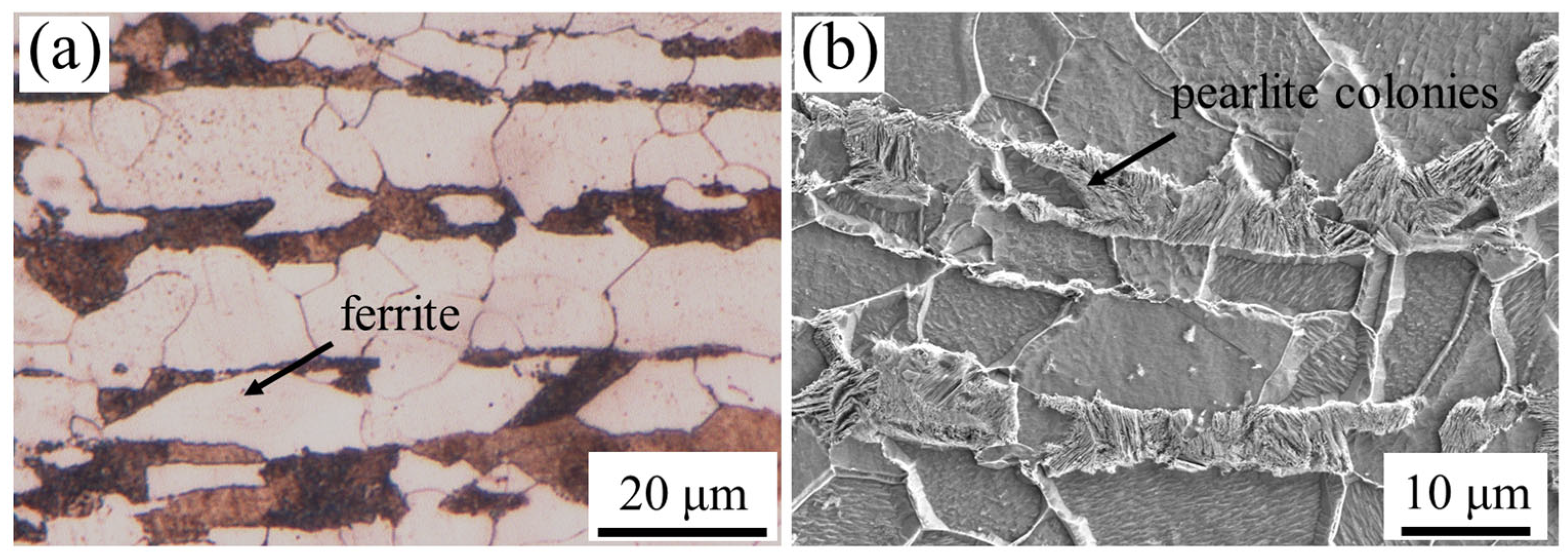
The commercially available D36 low-carbon steel, with a chemical composition (in wt.%) of 0.16 C, 0.22 Si, 1.54 Mn, 0.04 Al, 0.01 Cr, and 0.002 Nb, and the balance being Fe, was supplied by Baoshan Iron & Steel Co., Ltd. (Shanghai, China). It was received in the form of a 14 mm thick hot-rolled plate. The as-received microstructure of the steel was characterized by equiaxed ferrite grains with an average grain size of approximately 10 µm, along with pearlite colonies exhibiting an inter-lamellar spacing of around 100 nm (as illustrated in Figure 1). Rectangular specimens with dimensions of 70 mm × 14 mm × 12.5 mm were prepared using wire-electro-discharge machining, with the longitudinal axis of the specimens aligned parallel to the rolling direction. Prior to treatment, all specimens were ground to a 2000-grit finish using SiC abrasive paper, followed by ultrasonic cleaning in ethanol and subsequent drying in a controlled environment.
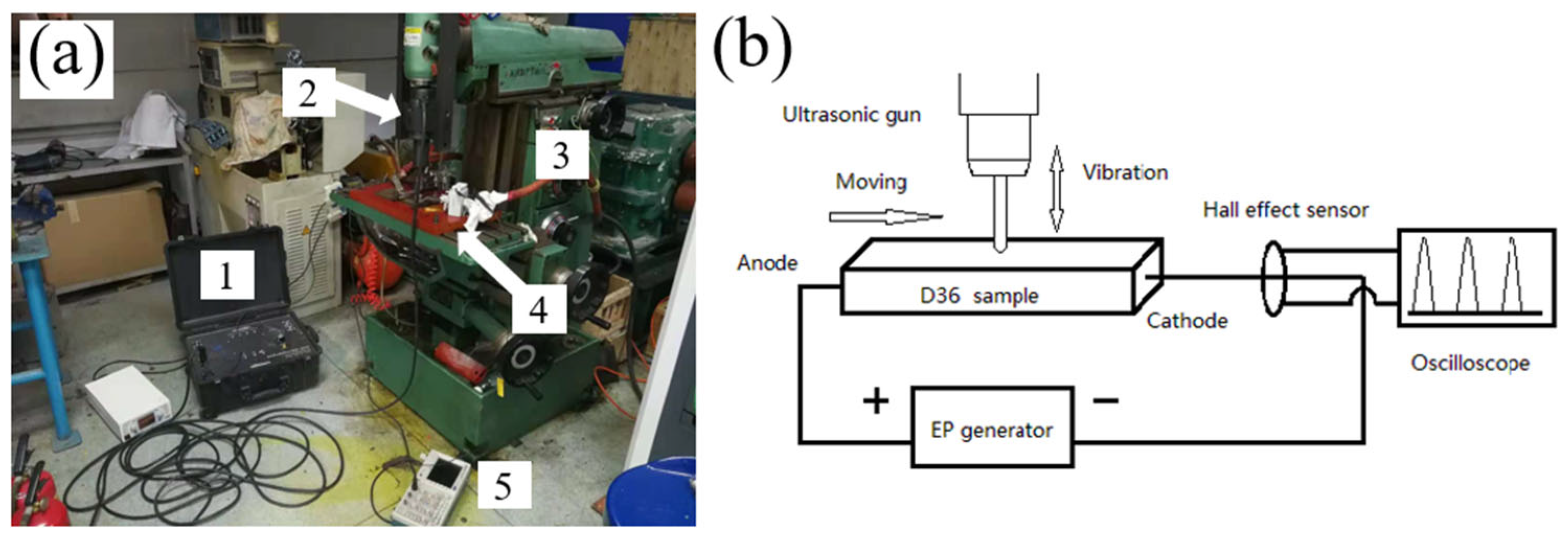
Ultrasonic impact treatment is a method to achieve strengthening by the high-frequency impact on the surface of the workpiece, which is driven by high-power ultrasound through a transducer that converts electrical energy into high-frequency (20–55 kHz) amplitude (20–50 μm). UIT was conducted utilizing equipment supplied by Huawin Electrical & Mechanical Technology Co., Ltd. (Jinan, China). The ultrasonic gun, which was rigidly mounted on a modified milling machine (as shown in Figure 2a), was outfitted with a 5 mm diameter alloy steel indenter featuring a hemispherical tip. The static force was generated by the self-weight of the ultrasonic gun itself. During the operation, the indenter oscillated between the sample and the horn at a frequency of 20 kHz, with a peak-to-peak amplitude of 20 µm, delivering an approximate power output of 1.4 kW. This setup is notably different from the conventional ultrasonic surface rolling process, in which the indenter is directly affixed to the horn.
A self-assembled high-energy pulsed-current generator was integrated into the experimental setup to facilitate the application of EP during UIT. To prevent current leakage, all conductive paths between the sample/fixture and the machine frame were thoroughly electrically insulated. The current waveforms were continuously monitored using a 200 MHz digital oscilloscope. Two distinct levels of EP intensity were investigated, as detailed in Table 2. The peak current density was kept constant, while the frequency was adjusted to precisely regulate the root-mean-square (rms) current density and, consequently, the extent of Joule heating.
The indenter traversed the sample surface at a velocity of 3 mm·s−1. A single longitudinal pass led to the formation of a furrow approximately 4 mm in width. During the return stroke, a lateral feed of 2 mm was implemented, resulting in partially overlapping tracks. This strategy was adopted to minimize surface roughness. Covering the entire upper surface of the sample, which was defined as one complete pass, required an approximate time span of 90–100 s. A total of five passes was applied during the treatment process.
After the treatment, the samples were sectioned perpendicular to the treated surface. Subsequently, they were subjected to grinding, followed by polishing with colloidal diamond paste and etching in a 3% Nital solution. The microstructures were examined using a Hirox KH-7000 3D optical microscope and a Hitachi S-4800 field emission gun scanning electron microscope (FEG-SEM) (Hitachi, Naka, Japan), which was operated at an accelerating voltage of 5 kV and a beam current of 5 mA. Electron backscatter diffraction (EBSD), performed at 20 kV and 20 mA with a step size of 0.4 µm, was utilized to quantify local misorientations. Regions that had experienced severe deformation were analyzed using a JEOL JEM-2100 transmission electron microscope (TEM) (JEOL, Tokyo, Japan).
Microhardness measurements were performed with a tester (HV-1000Z) (Shanghai Precision Instrument Co., Ltd., Shanghai, China) on both the cross-sections and the treated surface of the samples. A diamond indenter was applied with a load of 200 gf for a dwell time of 15 s. The indentations were precisely positioned at a depth of at least 50 µm beneath the treated surface to avoid any overlap with the indentation impression, which had an approximate width of 50 µm.
Phase identification was carried out utilizing X-ray diffraction (XRD) with the Bragg–Brentano geometry and Cu Kα radiation. A Rigaku micro-diffractometer, operating at an accelerating voltage of 40 kV and a tube current of 200 mA, was employed for this analysis. The 2θ angle was scanned across a range spanning from 10° to 90°.
Surface chemistry analysis was conducted employing a ThermoFisher ESCALAB 250Xi X-ray photoelectron spectroscopy (XPS) system (ThermoFisher Scientific Co., Ltd., West Sussex, UK). Monochromatic Al Kα radiation, with an energy of 1486.6 eV and generated at an accelerating voltage of 15 kV and a tube current of 10 mA, was utilized for the analysis. Core-level spectra were acquired with a pass energy of 50 eV and a step size of 0.05 eV under a pressure of 1.0 × 10⁻¹⁰ mbar. The spectrometer was calibrated using the Au 4f7/2 peak at 83.8 eV, and the binding energies were charge-corrected with reference to the adventitious C 1s peak at 284.8 eV. Following Shirley background subtraction, the peaks were fitted using mixed Lorentzian–Gaussian line shapes.
Corrosion resistance was assessed utilizing a PARSTAT 4000 (Princeton Applied Research, Oak Ridge, TN, USA) potentiostat in a 3.5 wt.% NaCl solution maintained at a temperature of 25 °C. A saturated calomel electrode (SCE) was employed as the reference electrode, while a platinum electrode was used as the counter electrode. Its potential is typically +0.241 V relative to the standard hydrogen electrode at 25 °C. The SCE consists of a mercury (Hg) and mercurous chloride (Hg2Cl2) mixture in a saturated KCl solution, providing a stable reference point for measuring electrode potentials. The samples were embedded in epoxy resin, ensuring that only the treated surface was exposed to the solution. Potentiodynamic polarization scans were recorded once the open-circuit potential (Eocp) had reached a stable state. These scans were conducted over a potential range of Eocp ± 0.3 V at a scan rate of 0.5 mV·s−1. Electrochemical impedance spectroscopy (EIS) measurements were performed at the Eocp. A sinusoidal signal with an amplitude of 10 mV was applied, and the frequency was swept from 105 Hz down to 0.01 Hz. To guarantee the reproducibility of the results, each test was repeated a minimum of five times.

3. Results

3.1. Microstructure and Morphology

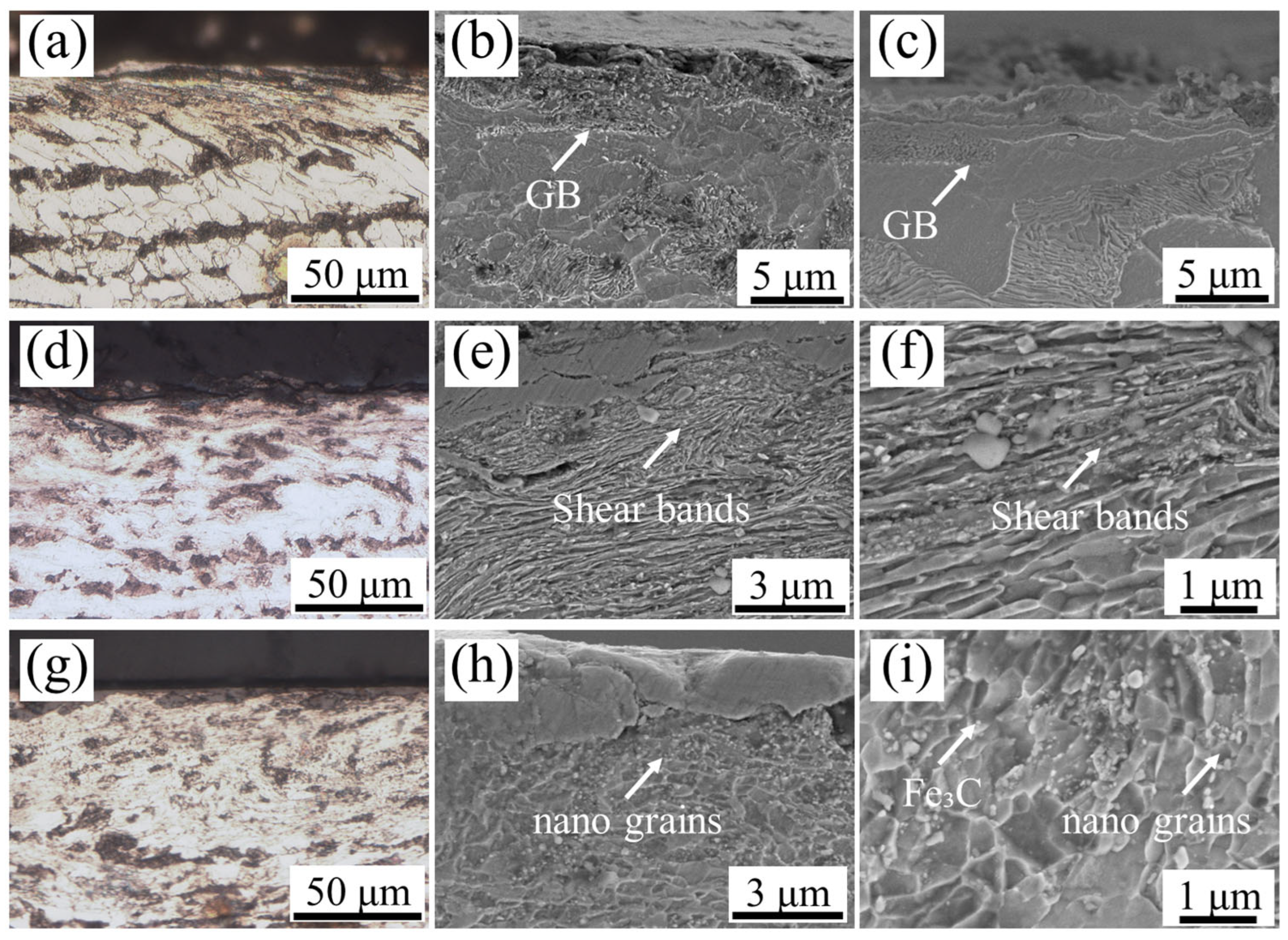
Figure 3 presents the cross-sectional microstructures of samples subjected to different treatments. UIT resulted in the formation of a deformation layer with a thickness ranging from 50 to 100 µm (as shown in Figure 3a). Within the topmost 20 µm from the top surface, severe shear deformation refined the pearlite lamellae into nanoscale fragments and elongated the ferrite grains, which were further subdivided by a high density of deformation-induced boundaries (as depicted in Figure 3b). As the depth increased, the strain gradient maintained the original pearlite morphology, with only sporadic fractures of pearlite colonies occurring near the surface.
The zone affected by UIT is inherently heterogeneous in nature. Figure 3c reveals the presence of sporadic, virtually undeformed islands, the origin of which can be attributed to two main factors: (i) misalignment of the indenter relative to the surface normal attenuates the ultrasonic oscillation, thereby locally suppressing plastic strain accumulation; (ii) prolonged or excessive impact can embrittle the severely cold-worked surface layer, resulting in exfoliation that removes the previously hardened material.
Electropulsing fundamentally restructured the subsurface microstructure, as demonstrated in Figure 3d–i. The combined effects of Joule heating and severe plastic deformation led to the formation of an adherent oxide scale and extended the affected depth to beyond 100 µm in both EP-UIT1 and EP-UIT2 treatments. In these treated samples, pearlite was no longer discernible; instead, the redistribution of cementite played a dominant role in governing microstructural evolution.
In the case of EP-UIT1, a 5–10 µm subsurface ribbon, which is characteristic of extreme shear deformation, formed immediately beneath the oxide layer (as shown in Figure 3e). Energy-dispersive X-ray spectroscopy (EDS) line scans and Fe-3d elemental mapping revealed no retained carbides, confirming the complete dissolution of cementite. Deeper within the material, elongated submicron ferrite grains were observed, adorned with discrete ~20 nm Fe3C precipitates (as depicted in Figure 3i), which are remnants of partial cementite dissolution.
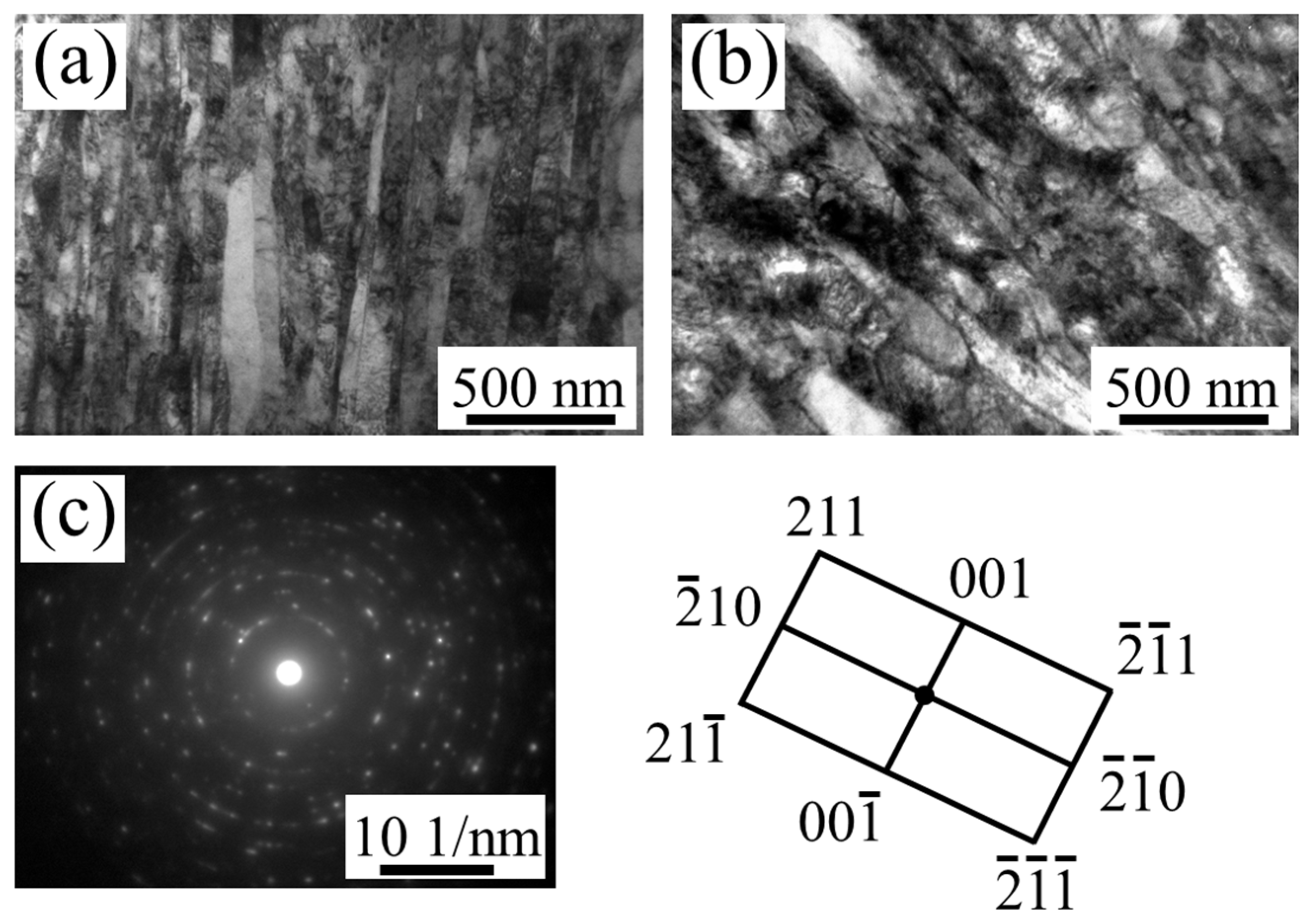
Bright-field TEM image of the ribbon structure depicted in Figure 3e (shown in Figure 4a) reveals the presence of 70–100 nm nano-lamellae that are delineated by dense dislocation walls. Dislocation tangles traverse these lamellae and intersect with the dense dislocation walls, giving rise to a highly intricate and convoluted substructure. Cementite particles were observed in the SEM and TEM images, and austenite grains were hardly found in the specimen after treatment. Immediately beneath this zone (as illustrated in Figure 4b), the microstructure undergoes coarsening, transforming into slightly elongated submicron grains that are still partitioned by dense dislocation walls. The selected-area diffraction pattern for Fe3C along [001] exhibits a characteristic orthorhombic symmetry due to the orthorhombic crystal structure of cementite (shown in Figure 4c). The {120} plane alignment means that the electron beam is approximately parallel to the (120) plane, which may cause slight distortions in the pattern compared to a perfect [001] zone axis due to beam tilt effects. The orientation-dependent contrast observed in this region provides evidence of a spatially heterogeneous distribution of dislocation density.
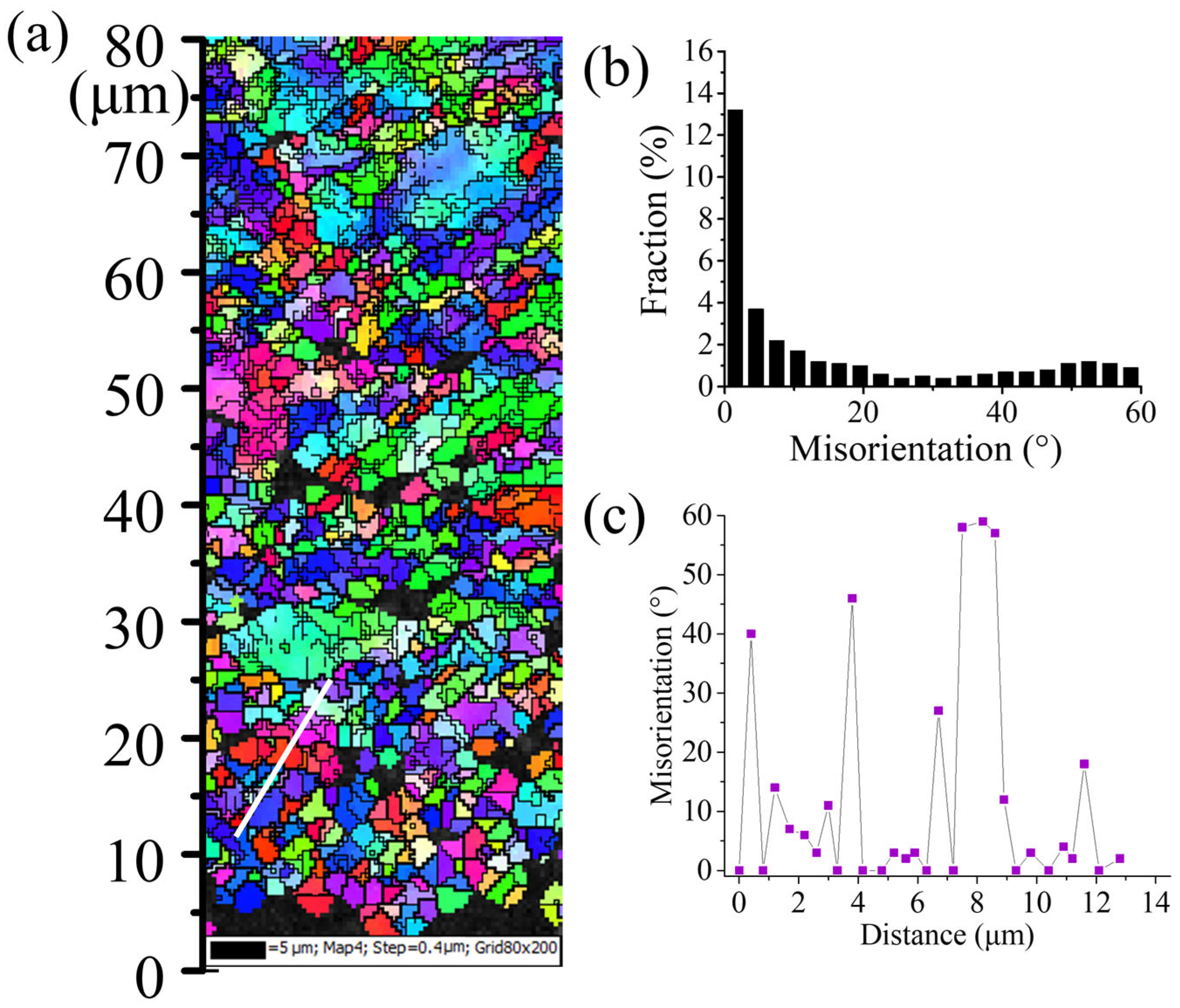
Figure 5a illustrates the near-surface layer of the EP-UIT1 sample. The microstructure is refined into equiaxed grains with an approximate size of ~200 nm, which are almost entirely bounded by high-angle grain boundaries (with a misorientation angle θ > 15°). This refinement results in the bimodal misorientation distribution depicted in Figure 5b. The complete consumption of the parent grains ensures that every line scan (as shown in Figure 5c) intersects a series of successive high-angle grain boundaries, generating discrete misorientation distributions in the range of 30–60°.
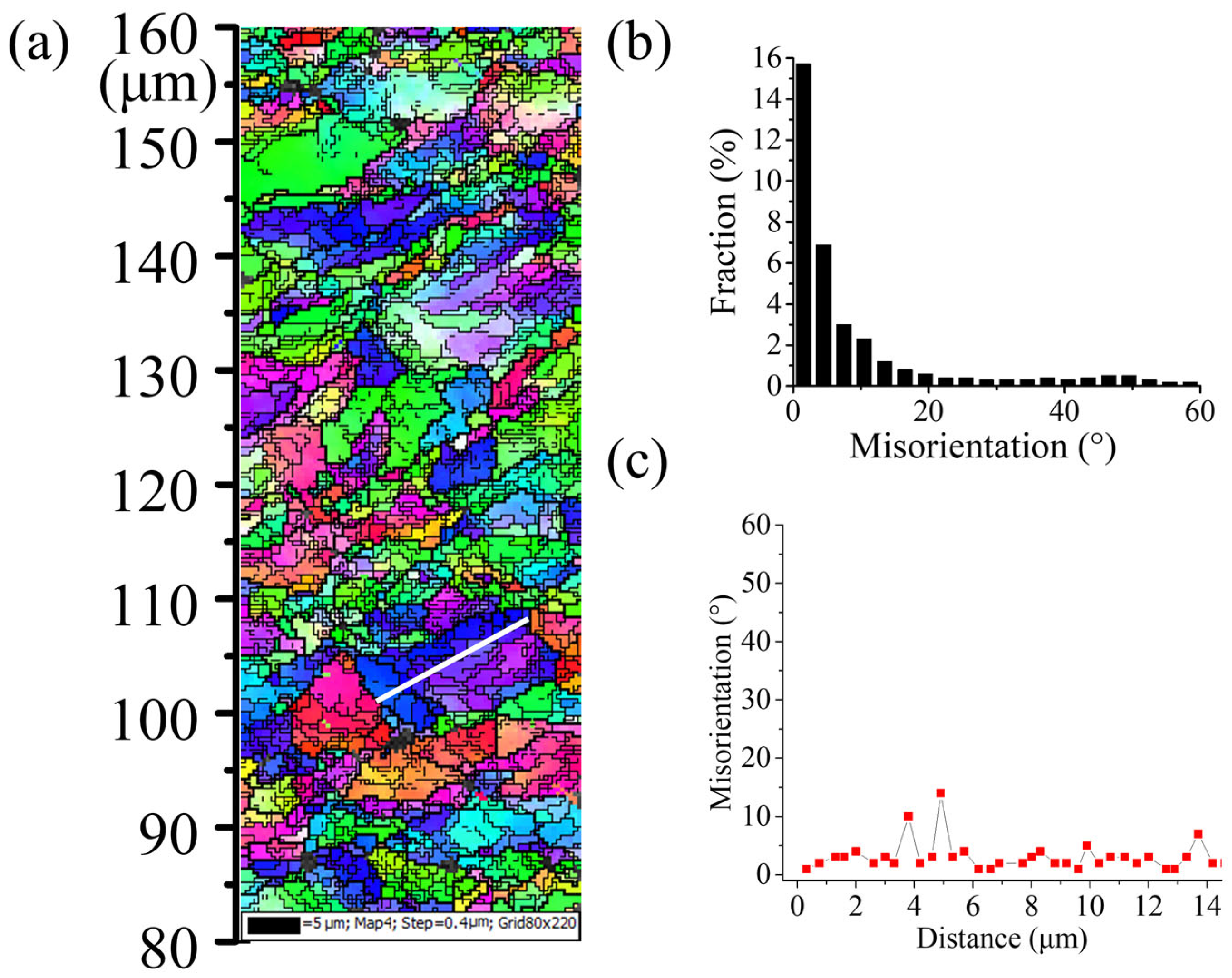
At greater depths from subsurface to center (as shown in Figure 6a,b), low-angle grain boundaries (with misorientation angles ranging from 2° to 15°) predominate. The parent ferrite grains are delineated by dense networks of low-angle grain boundaries, while their interiors exhibit misorientation angles of less than 3° (as illustrated in Figure 6c). The transition from equiaxed grains at the surface to subsurface substructures provides evidence of continuous dynamic recrystallization that has been accelerated by the electric current. This current amplified dislocation mobility and facilitated subgrain rotation, thereby contributing to the observed microstructural evolution.
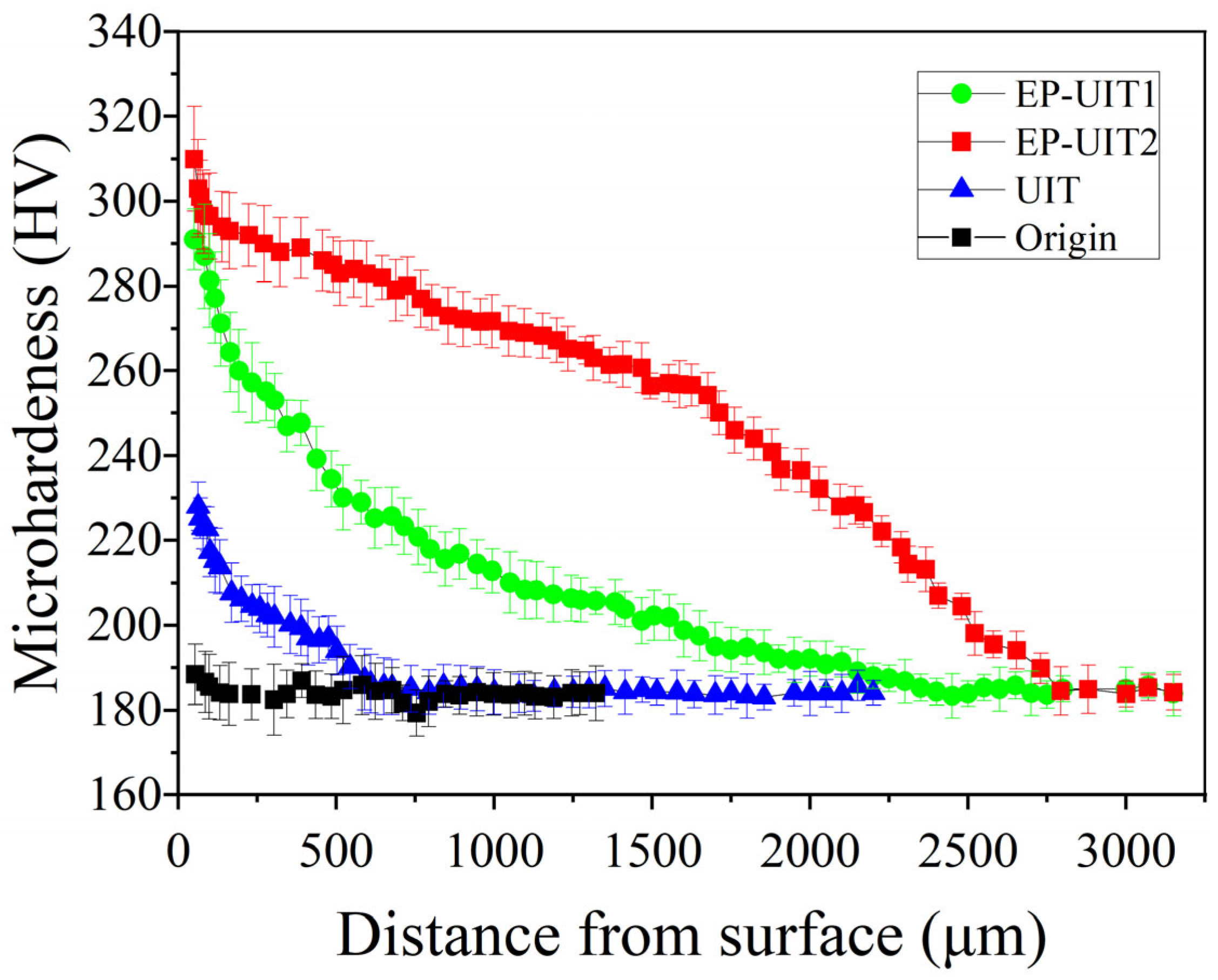
Figure 7 presents the cross-sectional microhardness profiles from surface to center of samples subjected to the respective treatments. Conventional UIT resulted in the formation of a hardened layer approximately 500 µm in depth. The maximum hardness at the surface reached around 230 HV, in contrast to 182 HV for the untreated matrix, representing a 27% increase attributable to work hardening. The hardness exhibits a steep decline with increasing depth, a result that is entirely consistent with the findings reported in the literature concerning UIT [33,34,35].
In the case of EP-UIT treatments, the hardened layer extends beyond 2 mm, which is an order of magnitude thicker than the approximately 500 µm upper limit that has been universally reported for conventional UIT, regardless of the alloy type or treatment intensity. The surface hardness reached a peak value of 313 HV for EP-UIT1 and 293 HV for EP-UIT2. The hardness gradient is most pronounced within the superficial 200 µm of the layer, reflecting the superposition of multiple strengthening mechanisms. The depth-dependent behavior of these mechanisms will be analyzed in the following section.

3.2. Surface Chemical Compositions

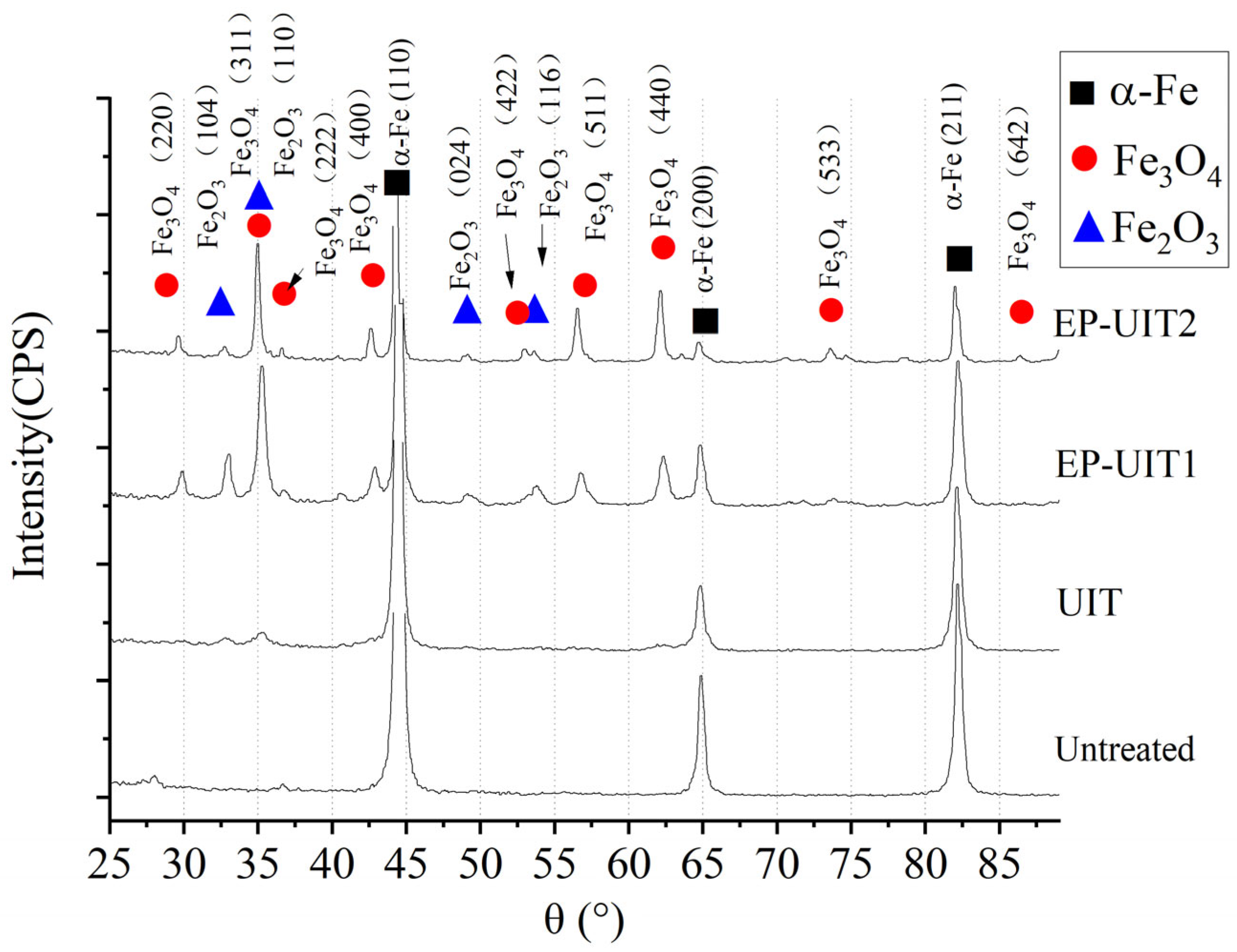
Figure 8 displays the X-ray diffraction patterns of the samples in both the as-received state and after undergoing the respective treatments. In the initial state, three well-defined α-Fe reflections, corresponding to the (110), (200), and (211) planes, are clearly observable. After conventional UIT, these peaks maintain their relative intensities; however, they experience a uniform and slight shift towards lower 2θ angles. This shift consists of the introduction of a small amount of tensile lattice strain.
Following EP-UIT treatment, additional diffraction peaks emerge in the X-ray diffraction patterns, which can be unambiguously indexed to magnetite (Fe3O4) and hematite (α-Fe2O3). Despite the oxide scale being less than 5 µm in thickness (as shown in Figure 3), its lateral continuity ensures a substantial contribution to the diffracted signal. Quantitative phase analysis, conducted using the reference-intensity-ratio method [36], yields the weight fractions listed in Table 3. The analysis reveals that the oxide scale is predominantly composed of magnetite, with a minor hematite component. Concurrently, all α-Fe diffraction peaks shift to lower 2θ angles, indicating an expansion of the body-centered cubic lattice. The increase in the lattice parameter, as detailed in Table 3, is attributed to the formation of a supersaturated solid solution of interstitial atoms. Finally, the presence of the oxide overlayer leads to attenuation of the substrate signal. Specifically, the integrated intensities of the (110), (200), and (211) ferrite reflections decrease significantly, and the degree of attenuation scales with the applied current density.
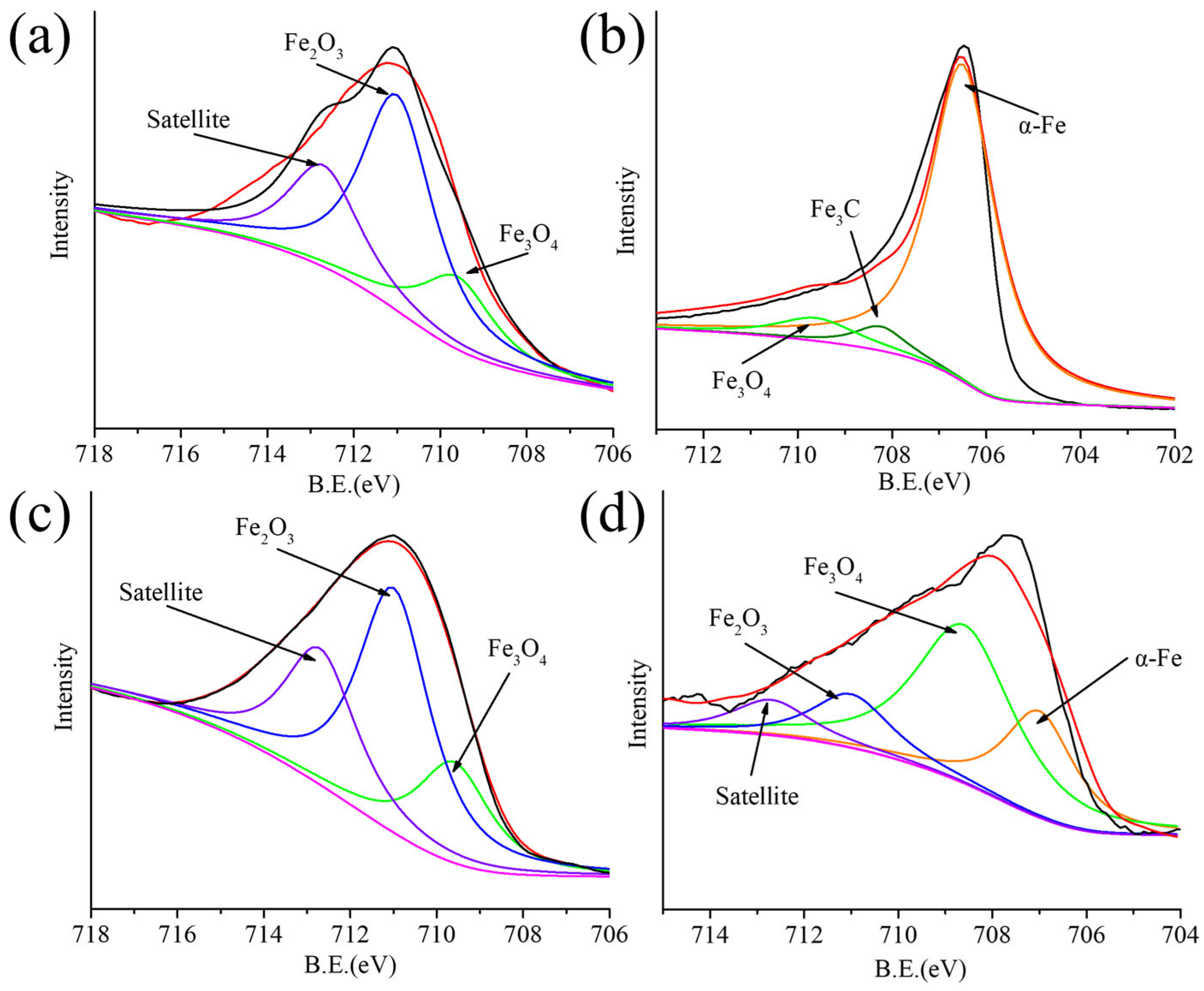
High-resolution Fe (2p) photoelectron spectra were obtained to determine the speciation of iron within the near-surface region (<8 nm). Successive layers were removed through Ar+ sputtering until the substrate was exposed. Following Shirley-background subtraction, each core-level envelope was fitted using a combination of Gaussian (80%) and Lorentzian (20%) components. These components were constrained according to the binding energies, full widths at half-maximum, and area ratios compiled in Table 4 [37,38,39]. Although, in principle, multiple splitting (such as the Fe2+ triplet and Fe3+ quartet) could be resolved, potential ambiguities in assigning satellite structures were circumvented by fitting chemically distinct phases: α-Fe, Fe3C, Fe3O4, and α-Fe2O3. Additionally, an Fe0 satellite peak, resulting from 3d→4s shake-up processes, was incorporated into the fitting model. Minor rigid shifts (<±0.2 eV) in peak position and width were allowed to optimize the overall fit while maintaining the predefined physical constraints.
Fe 2p3/2 high-resolution XPS spectra and their deconvolutions are displayed in Figure 9. The as-received UIT surface (Figure 9a) is fully oxidized: the envelope exhibits only Fe3O4 and α-Fe2O3 contributions, with no metallic shoulder at lower binding energy. After 36 nm Ar+ sputtering (Figure 9b) the spectrum shifts abruptly to ~707 eV and narrows markedly, proving metallic α-Fe as the dominant phase; the residual high-binding-energy tail is accounted for by a minor Fe3C component. The absence of any oxide signature confirms that the UIT-induced scale is a contiguous nanometre-thick film, below the resolution limits of both SEM and XRD, whose removal exposes the underlying metallic substrate.
The Fe 2p3/2 spectrum of the as-received EP-UIT1 surface (Figure 9c) mirrors that of the UIT specimen, indicating rapid room-temperature oxidation to a comparable ~8 nm magnetite/hematite bilayer. After removal of 36 nm by Ar+ sputtering (Figure 9d) the centroid shifts from 711 eV to 708 eV with only modest intensity change, showing a magnetite-rich interior in which the Fe2+/Fe3+ ratio exceeds that of the outermost region. This depth-dependent valence gradient, Fe3+-dominated surface and Fe2+-enriched subsurface, accords with literature reports for air-formed films [38,40] and confirms that the oxide stoichiometry is determined by the concurrent action of severe plastic deformation, Joule heating and transient electric field rather than by simple thermal oxidation. A weak metallic contribution at 707 eV further implies that nanoscale ferrite inclusions persist within the scale.

3.3. Potentiodynamic Polarization Behavior

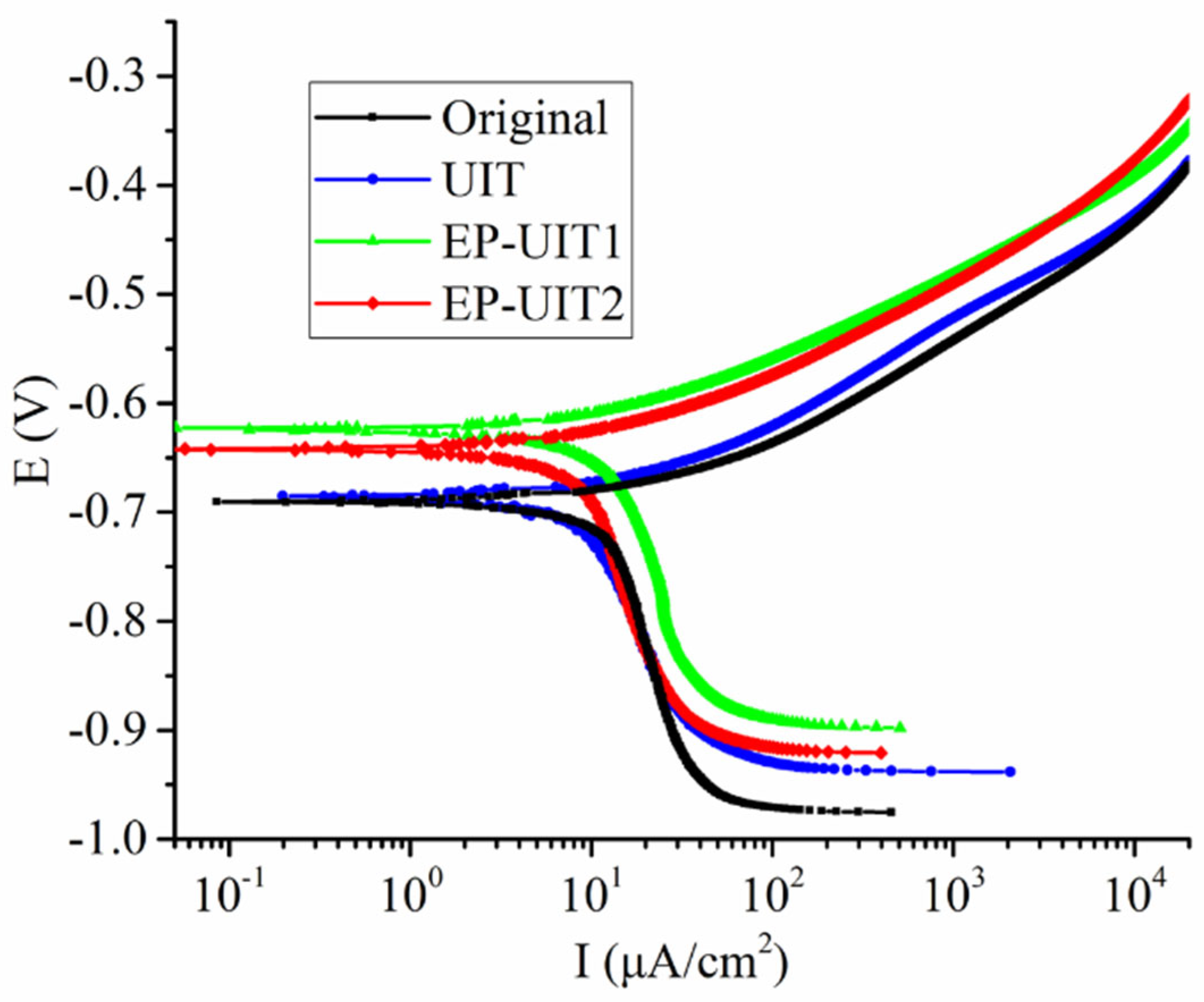
The potentiodynamic polarization curves are presented in Figure 10. The curve corresponding to the EP-UIT treatment is shifted towards more noble potential and exhibits lower current values compared to the reference curve for conventional UIT. This shift results in a higher corrosion potential (E_corr) for the EP-UIT-treated sample than that of the UIT reference. An elevated E_corr signifies suppression of the anodic half-reaction and a concomitant decrease in the ratio of anodic to cathodic exchange current densities. Nevertheless, E_corr alone is insufficient to rank corrosion resistance; the corrosion current density (I_corr) is the decisive parameter. Because the electrode system is uncomplicated, the potential-current relationship obeys the Butler–Volmer equation [41]:
I = I c o r r [ exp E E c o r r β a e x p ( E E c o r r β c ) ]
where βa and βc denote the anodic and cathodic Tafel slopes dictated by the electric-double-layer characteristics. Owing to the merely leftward shift of the EP-UIT curve relative to the UIT trace, conventional tangent-line extrapolation is insufficiently sensitive to resolve the difference in corrosion current density. Numerical fitting of the full Butler–Volmer expression [41] is therefore employed to quantify I_corr.
Consequently, the corrosion current density was calculated by non-linear regression of the Butler–Volmer equation (Equation (1)) to the weak-polarization data, defined as E_corr ± (10–30) mV in both the anodic and cathodic directions. Obviously, oxygen is the sole depolarizer being reduced within the weak-polarization window, the polarization resistance Rp is obtained directly from the Stern–Geary relation [41]:
I c o r r = β a ·   β c β a +   β c × 1 R p
The electrochemical parameters calculated by weak-polarization fitting are summarized in Table 5. Relative to UIT, EP-UIT raises E_corr by ~40 mV and lowers I_corr by 68%, evidencing suppression of the corrosion couple; the latter value coincides with that reported for low-carbon steel after conventional chemical blackening [42,43,44]. Orders-of-magnitude reductions, occasionally claimed for organic or electrochemically formed coatings, are not attainable here: the magnetite/hematite scale merely impedes electrolyte ingress and alters the anode/cathode area ratio without modifying the intrinsic electrode kinetics. Consistently, the anodic and cathodic Tafel slopes (βa, βc) remain essentially unchanged, reflecting an unaltered electric-double-layer structure. The combined decrease in I_corr and stable slope yield a four-fold increase in polarization resistance for EP-UIT specimens compared with UIT specimens.
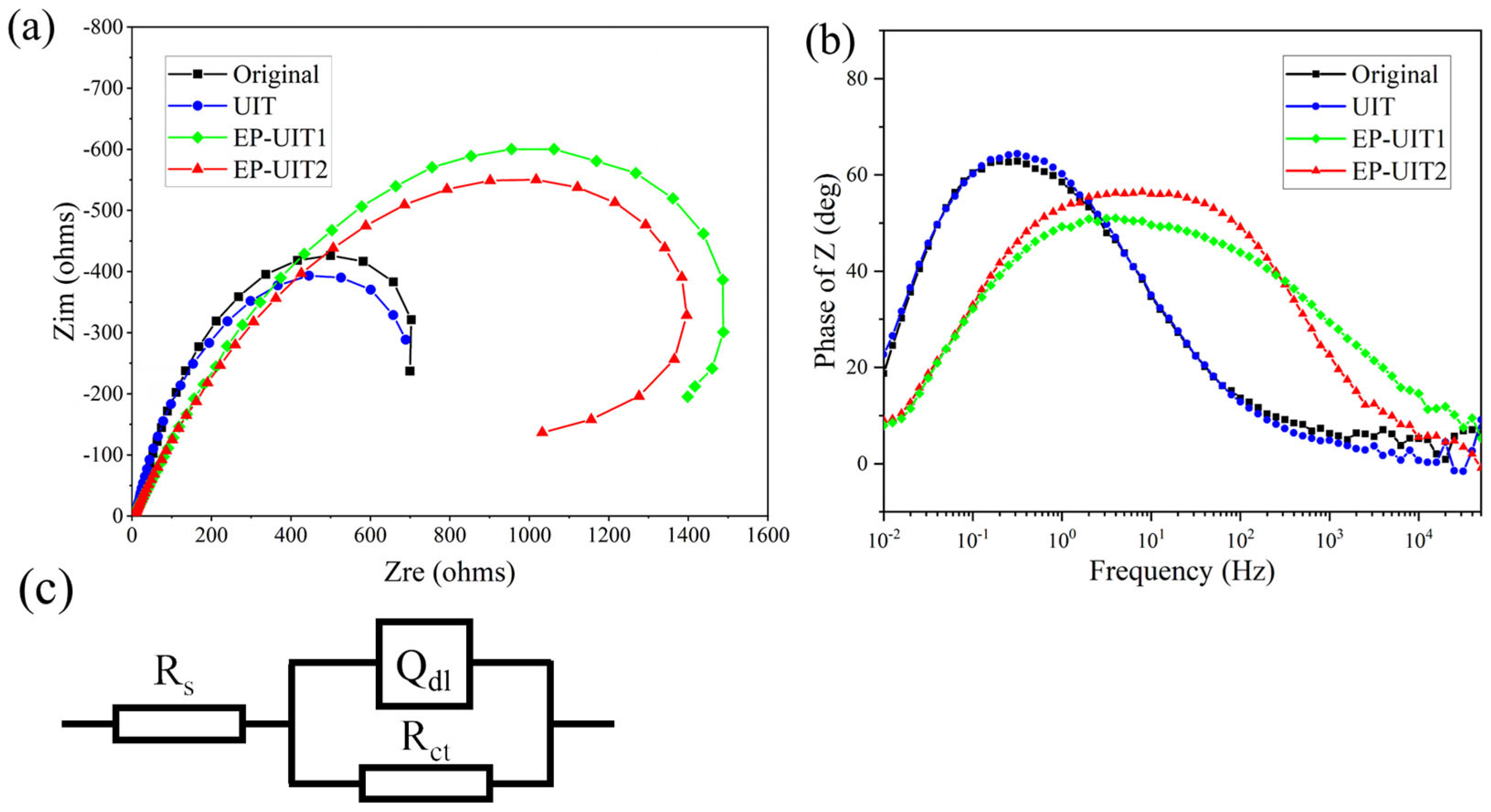
Electrochemical impedance spectroscopy Nyquist spectra are presented in Figure 11a. All specimens exhibit a single, depressed capacitive arc, signifying one time-constant and confirming that charge-transfer, not electrolyte diffusion, limits the corrosion rate. Arc radius for the as-received and UIT surfaces are comparable and approximately half that of EP-UIT; the enlarged radius reflects the barrier action of the magnetite/hematite scale against electrolyte penetration. Consistently, the Bode phase plots (Figure 11b) reveal a higher maximum phase angle at high frequency for EP-UIT, corroborating its superior corrosion resistance.
To simulate the measured impedance data, the equivalent circuit is shown in Figure 12 (with one time constant) was used [45]. In this equivalent model, the circuit structure is that a charge transfer resistance and a capacitance of double layer are in parallel and then series with a solution resistance. It is obvious that the Nyquist plots deviate from the pure capacitance of double layer due to the energy dispersion in the electrochemical process. As a result, a constant phase angle element of the double layer is adopted to replace the double layer capacitance. The impedance of double layer can be expressed as follows [46]:
Z Q = Y 0 1 ( j ω ) n
θ = 1 n π / 2
in which Y0 is the parameter related to capacitance. Factor n is constant phase element power. Because of the deviation from pure capacitance, the impedance arcs rotated around the point (Rs, 0) by θ clockwise. Both θ and n denote the extent of the deviation. Particularly, when n = 0, capacitance of double layer is pure resistance. While n = 1, capacitance of double layer is pure capacitance corresponding to ideal double layer model.
The electrochemical parameter of electrochemical impedance spectroscopy was fitted by Nyquist plots and listed in Table 6. The solution resistance can be neglected in all the samples. The transfer resistance of EP-UIT is larger than that of original and UIT reflects that the surface structure of EP-UIT hindered the charge transfer perceivably, but the values of transfer resistance are in the same magnitude revealing the oxide of the EP-UIT sample was unable to shield the substrate from the electrolyte absolutely. It can be explained by the crack on the oxide layer. The θ of EP-UIT samples are around 30° indicating a large resistance during the charging and discharging of double layer as well as a high energy dispersion. The small Y0 value of EP-UIT associated with a large characteristic frequency (ω*) also indicates the oxide contributes to improving the corrosion resistance, but the magnitude of the values proves that a small amount of electrolyte infiltrating into the interface between the oxide and the substrate.
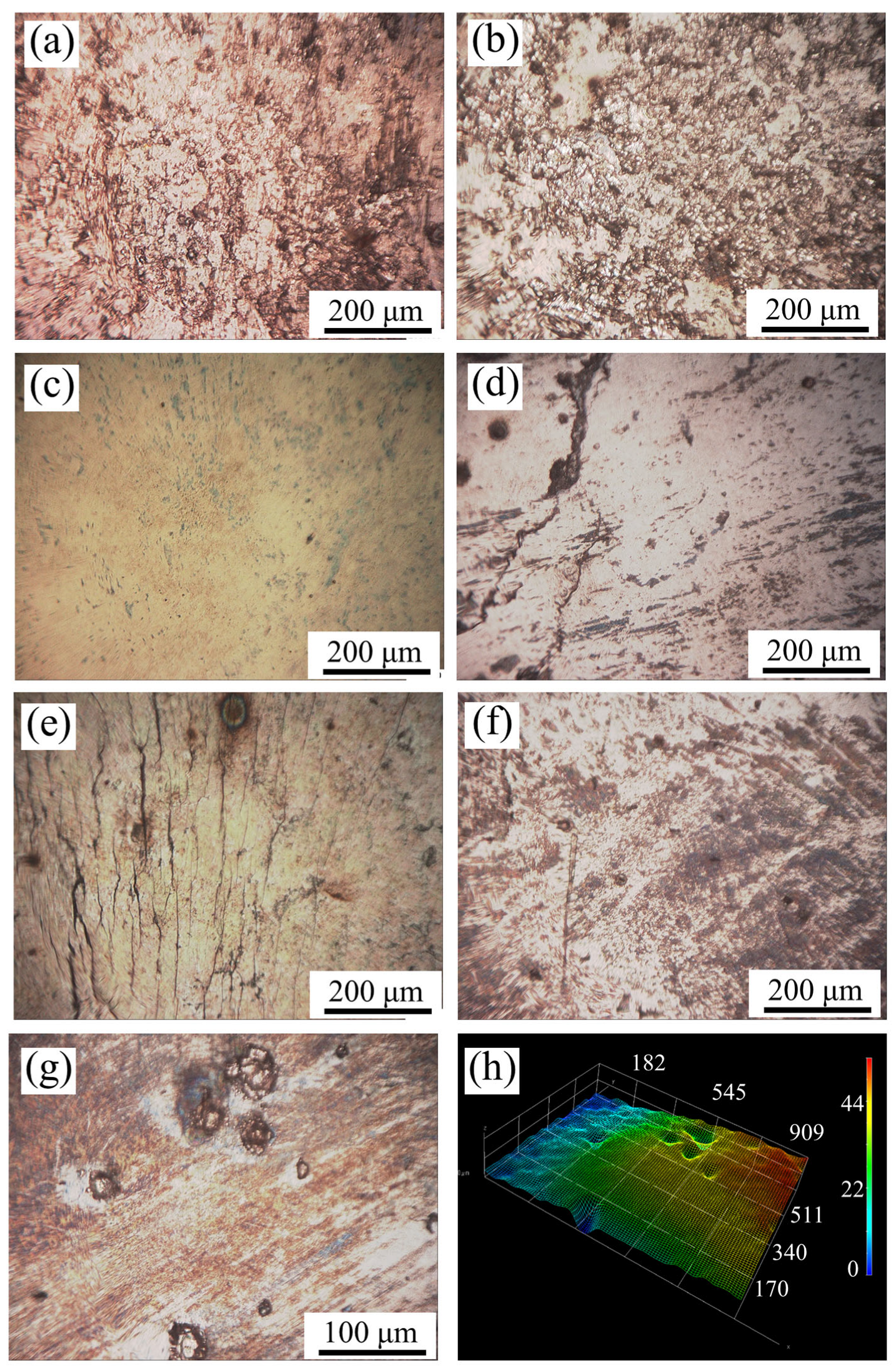
A striking contrast in surface topography before and after potentiodynamic polarization is exhibited in Figure 12. The UIT specimen (Figure 12a) already exhibits a macroscopically rough, heterogeneous relief arising from impact-induced micro-defects described earlier. Following polarization, the enhanced anodic current density accelerates metal dissolution, and the same surface is almost entirely obliterated (Figure 12b), confirming the limited protectiveness of the thin, discontinuous oxide formed by UIT alone.
EP-UIT confers on a markedly superior surface. The oxide film in Figure 12c is smooth and laterally continuous, save for a few impact-induced cracks generated after its formation. After polarization the layer remains essentially intact (Figure 12d,f), providing effective barrier protection. Localized attack is, however, unavoidable: pits nucleate within 10 min and penetrate ~15 µm (Figure 12g,h). Because the oxide blankets most of the surface, the anodic area shrinks to the few bare metal sites; the corresponding current concentration drives rapid local dissolution. Complete avoidance of pitting is impossible in a self-passivating system where microscopic metal exposure persists, and the oxide itself is electronically conductive. Moreover, Cl actively destabilizes the film by catalyzing Fe2+→Fe3+ oxidation, so the scale is ultimately penetrated in NaCl-containing electrolytes.

4. Discussion

4.1. Acoustoplastic Effects

Electropulsing-assisted UIT drives an order-of-magnitude deeper deformation layer than UIT alone. The first enabler is acoustoplasticity: ultrasonic-frequency stress selectively channels energy to crystal defects (dislocations, vacancies, boundaries), lowering the yield strength with minimal energy input [10,35,47]. The traditional understanding of acoustoplasticity focused on extrinsic factors such as stress superposition, heating, and surface friction changes. These factors do not fundamentally alter the material’s deformation mechanisms or microstructures. Recent research has identified an intrinsic effect where ultrasonic vibrations enhance dislocation dipole annihilation and subgrain formation. This process changes the material’s deformation mechanism and yield surface, leading to significant softening [48]. In conventional UIT, however, the abrupt rise of impact stress outruns dislocation kinetics. Slip systems remain uncoordinated and rapid work-hardening soon promotes local embrittlement. Consequently, micro-cracks nucleate (Figure 3) and plastic strain saturate despite the acoustoplastic benefit. The intrinsic effect of ultrasonic vibrations on the deformation mechanisms and microstructures of metals represents a significant advancement in understanding acoustoplasticity. This intrinsic mechanism provides a deeper insight into how ultrasonic vibrations can fundamentally alter the material properties, beyond just extrinsic effects.

4.2. Thermal Effects

The Euler-angle misorientation map (Figure 5a and Figure 6a) proves pronounced ferrite grain refinement during EP-UIT1, accomplished by continuous dynamic recrystallization. For a high stacking-fault-energy metal deformed below 0.5 Tm, continuous dynamic recrystallization is the sole viable restoration mechanism [49]. In EP-UIT1, Joule heating and the electric current enhance dislocation mobility and activate multiple slip systems, accelerating every stage of continuous dynamic recrystallization from dislocation-wall or tangle formation to sub-boundary evolution. The resultant multi-slip accommodation suppresses strain localization and delivers a sub-micrometer, equiaxed grain structure. At the higher temperature of EP-UIT2, high-angle boundary migration is triggered, and the grains coarsen accordingly.
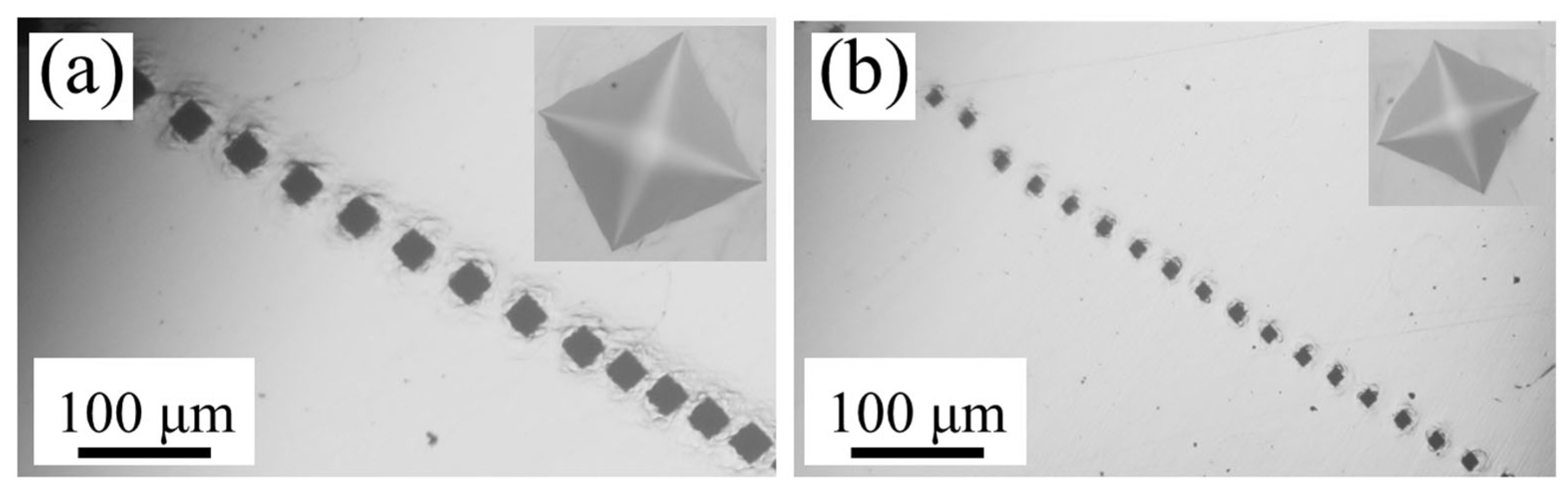
Cementite redistribution during EP-UIT is both unique and pronounced compared with conventional UIT. As shown in Figure 3, the pearlite lamellae dissolve within the first few micrometers, leaving only fractured cementite fragments. Realizing such extensive decomposition simultaneously satisfies thermodynamic and kinetic criteria. Severe plastic strain imposes a highly curved ferrite/cementite interface; the resultant capillary excess Gibbs energy [50] provides the thermodynamic driving force. In EP-UIT2, the higher processing temperature triggered extensive grain-boundary migration that annihilated a large fraction of dislocations. The supersaturated carbon, deprived of its dislocation sinks, is represented as nanoscale, spheroidized cementite. These particles pin both grain boundaries and dislocations, impeding recovery and restricting grain growth. The resultant dispersion strengthening explains the sustained high hardness in the near-surface region (Figure 5) and why EP-UIT1, where carbon remains predominantly in solution, outperforms EP-UIT2 in hardness. After applying EP-UIT, yield strength increases from 383 MPa to 518 MPa (35.2% increase), ultimate tensile strength increases from 543 MPa to 691 MPa (27.2% increase), and total elongation decreases from 31% to 21%. The optical micrograph of residual indentation imprints before and after treatments is shown in Figure 13. The average microhardness increases from 182 HV0.2 to 230 HV0.2 (26.4% increase). The improvement in tensile properties is mainly attributed to grain refinement, as described by the Hall–Petch equation [51]:
σ y = σ 0 + K y d 1 2
where σy is the strength of the material, σ0 is the friction stress, Ky is a constant, and d is the grain size. From Equation (5), it can be inferred that the mechanical properties of the metallic material will be improved as the grain size decreases under the EP-UIT effect. The increase in hardness primarily results from surface plastic deformation, which induces deformation strengthening [52]. With increasing the distance from the treated surface, the effect of EP-UIT gradually decreases, which causes a decrease in hardness increment until it reaches the same level as the substrate [53]. Gu et al. [54] reported that, in welded joints of DH36 steel treated with ultrasonic impact treatment, the average ultimate tensile strength increased by up to 10.90%. Ultrasonic impact treatment not only enhances material strength but also improves plasticity, achieving a synergistic effect. Moreover, the presence of fine grains helps to distribute internal stress and suppress the formation of localized strain, thereby enhancing the overall stability of the material.

4.3. Electroplastic Effects

Beyond simple resistive heating, the electric pulse exerts an athermal electroplastic action: the electron wind exerts a drag force on dislocations, lowering the activation barrier for kink nucleation and enhancing their mobility, while simultaneously accelerating thermally activated recovery events reported in the literature. It should be noted that the temperature attained the hot-working regime during EP-UIT. Conrad [23] reported that, at room temperature, a direct-current density of 10–102 A·mm−2 increases the strain rate of ferritic steel by roughly two orders of magnitude. However, the present thermal excursion dominates the process by exponentially amplifying the Boltzmann term of the thermal-activation equation, so the Joule effect is the principal agent responsible for the observed enhancement of plasticity.
Simultaneously, the electric pulse superimposes an additional energetic contribution: the resistivity mismatch between ferrite and cementite generates a non-uniform current-density field that further elevates the system’s free energy and destabilizes the carbide [55]. Joule heating supplies the energy necessary for carbon diffusion, enabling rapid spheroidization and dissolution. Consequently, EP-UIT produces a cementite-depleted, carbon-supersaturated surface layer that far exceeds the redistribution achievable by mechanical treatment alone.
Beyond classical thermodynamics, a dislocation-based mechanism offers an additional pathway for cementite dissolution. Carbon exhibits a binding energy of 0.75 eV to dislocation cores, almost twice the 0.40 eV C, Fe bond energy within cementite [56], so mobile dislocations can scavenge carbon to form Cottrell atmospheres. Atom-probe studies of heavily drawn pearlite [57] reveal carbon segregation at subgrain boundaries, corroborating a dislocation-drag model in which moving dislocations strip carbon from adjacent carbides. In EP-UIT, Joule heating and electroplasticity enhance dislocation mobility, accelerating this drag process, while the ultrahigh dislocation density provides ample sites to accommodate the extracted carbon. The resulting supersaturated solid solution delivers a measurable increment in lattice parameter and accounts for a significant fraction of the observed solution strengthening.
Coupling the thermal–electroplastic contribution with the acoustoplastic field yields a synergistic but non-additive response. Mordyuk et al. [17] synchronized ultrasonic excitation with high-current pulses and observed a clear reduction in flow stress, yet the combined effect fell short of the sum of the individual mechanisms. A unified predictive model remains elusive: acoustoplasticity lacks a mature theoretical framework, and the non-linear interaction between electron wind, phonon damping, and dislocation inertia presently defies quantitative description.
The concerted action of the three aforementioned effects markedly enhances dislocation mobility by lowering the activation-energy barrier and by direct momentum transfer from the electron wind. Consequently, additional slip systems are activated, and macroscopic plasticity is sustained to greater depth, accounting for the large strain and pronounced work-hardening observed below the surface. It should be noted, however, that the hardness increases beyond ~1 mm arises solely from an increased dislocation density; at these depths, the applied stress is insufficient to operate all slip systems, and only those favorably oriented contribute to deformation.
Additionally, albeit subordinate, factors may modulate cementite behavior. Electro-migration of carbon under the direct-current field is conceivable, yet the polarity-sensitive drift expected with direct-current pulses remains experimentally unverified in the present system and warrants dedicated investigation. Likewise, the highly heterogeneous stress state introduced by impact alternating regions of intense compression and residual tension could bias carbon diffusion toward lower-compression or tensile domains; given the spatial complexity of the residual stress field, this contribution is difficult to quantify and is therefore considered secondary.

4.4. Surface Oxidation

EP-UIT deposits an oxide scale one order of magnitude thicker than that produced by UIT alone, and this layer is the principal source of the markedly improved corrosion resistance confirmed by potentiodynamic polarization. Although native oxide is universally detected, even on untreated surfaces by XPS, the electric-pulse-induced temperature rise is the dominant accelerator: it simultaneously lowers the activation energy for oxidation and enhances oxygen diffusion through both the metal matrix and the existing oxide, thereby driving reaction kinetics that are unattainable under conventional UIT conditions.
An additional impediment to oxidation is the pristine metal lattice itself: its perfect, densely packed arrangement obstructs oxygen ingress and limits oxide growth, so even EP alone yields only a negligible film. UIT surmounts this barrier by imposing severe plastic deformation that injects a high density of dislocations, vacancies, and grain boundaries, thereby providing rapid-diffusion pathways for oxygen. Simultaneously, the repeated impacts fluidize the near-surface metal (Figure 3), continually renewing the gas–metal interface and enlarging its effective area. The synergistic consequence is an oxide scale whose thickness and uniformity greatly exceed those attainable by either thermal or mechanical stimulation alone.
The enhanced corrosion resistance conferred by EP-UIT is attributable to the dense oxide barrier that physically isolates the metal from the electrolyte; magnetite (Fe2+-rich) rather than hematite (Fe3+) is the dominant protective phase. Because the scale neither alters the underlying electrochemical couple nor withstands Cl-containing media, long-term exposure without supplementary protection is impractical. Nevertheless, EP-UIT offers a rapid, solvent-free alternative to conventional chemical passivation, demonstrating that a purely mechanical route can deliver appreciable, albeit intermediate, i.e., corrosion mitigation.

5. Conclusions

In conclusion, the integration of electropulsing with ultrasonic impact treatment has been successfully demonstrated as a novel and effective approach for enhancing the mechanical and corrosion resistance properties of D36 low-carbon steel. The primary objectives of this study were to overcome the depth limitations of conventional UIT, facilitate the in situ formation of a protective oxide layer, and improve the hardness and electrochemical stability of the treated steel through microstructural refinement.
Firstly, the EP-UIT treatment achieved a gradient nanostructured layer with a thickness exceeding 2 mm, which is an 8-fold increase compared to the conventional UIT treatment. This significant enhancement in depth is attributed to the synergistic effects of Joule heating and severe plastic deformation, which promote dislocation multiplication, continuous dynamic recrystallisation, and cementite dissolution. These microstructural transformations result in a substantial increase in the hardness of the treated layer, with values reaching 230 HV, compared to the base material hardness of approximately 182 HV.
Secondly, the simultaneous occurrence of Joule heating and electro-migration during EP-UIT facilitated the in situ formation of a dense, adherent oxide layer. This oxide layer provides immediate corrosion-barrier properties, significantly reducing the corrosion current density by 68% compared to UIT-treated samples. Electrochemical impedance spectroscopy revealed a substantial increase in the charge transfer resistance for EP-UIT-treated samples, indicating enhanced electrochemical stability. The charge transfer resistance values for EP-UIT-treated samples were found to be approximately 10 times higher than those for UIT-treated samples, highlighting the effectiveness of the oxide layer in impeding corrosion.
These quantitative findings clearly demonstrate that the EP-UIT process not only achieves the stated objectives but also significantly outperforms conventional UIT in terms of both mechanical and corrosion resistance properties. The EP-UIT treatment offers a one-step solution for simultaneous deep strengthening and self-passivation of welded marine structures, making it a highly promising technique for applications in marine and other corrosive environments. Future work will focus on optimizing the EP-UIT parameters for different steel grades and exploring the long-term durability and performance of the treated materials in real-world applications.

Author Contributions

X.L. and G.S.: Supervision, Project administration, Funding acquisition, Writing—Review and Editing. T.L.: Methodology, Software, Validation, Formal analysis, Writing—Original Draft, Visualization. L.C.: Conceptualization, Investigation, Resources, Data Curation. All authors have read and agreed to the published version of the manuscript.

Funding

This work was financially supported by the Guangdong Provincial Ocean Economy Development Special Fund (GDNRC[2024]32).

Institutional Review Board Statement

Not applicable.

Informed Consent Statement

Not applicable.

Data Availability Statement

The authors declare that the supporting data for this study are available within the paper and supplement. Also, the data that support the plots within this paper and other findings of this study are available from the corresponding author upon reasonable request.

Conflicts of Interest

Author Tao Liu was employed by the company Central Research Institute of Building and Construction Co., Ltd. Author Lijie Chen was employed by the company CIMC Offshore Co., Ltd. The remaining authors declare that the research was conducted in the absence of any commercial or financial relationships that could be construed as a potential conflict of interest.

References

  1. Alaei, K.; Karlsson, B. Influence of shot peening on fatigue durability of normalized steel subjected to variable amplitude loading. Int. J. Fatigue 2012, 38, 75–83. [Google Scholar] [CrossRef]
  2. Hatamleh, O.; Lyons, J.; Forman, R. Laser and shot peening effects on fatigue crack growth in friction stir welded 7075-T7351 aluminum alloy joints. Int. J. Fatigue 2007, 29, 421–434. [Google Scholar] [CrossRef]
  3. Al-Karawi, H.; Franz von Bock und Polach, R.U.; Al-Emrani, M. Fatigue crack repair in welded structures via tungsten inert gas remelting and high frequency mechanical impact. J. Constr. Steel Res. 2020, 172, 106200. [Google Scholar] [CrossRef]
  4. Ghosh, S.; Bibhanshu, N.; Suwas, S.; Chatterjee, K. Surface mechanical attrition treatment of additively manufactured 316L stainless steel yields gradient nanostructure with superior strength and ductility. Mater. Sci. Eng. A 2021, 820, 141540. [Google Scholar] [CrossRef]
  5. Ulaeto, S.B.; Rajan, R.; Pancrecious, J.K.; Rajan, T.; Pai, B.C. Developments in smart anticorrosive coatings with multifunctional characteristics. Prog. Org. Coat. 2017, 111, 294–314. [Google Scholar] [CrossRef]
  6. Hiroshi, S.; Teppei, O. Effect of stress ratio on the enhancement of fatigue strength in high performance steel welded joints by ultrasonic impact treatment. Int. J. Steel Struct. 2013, 13, 155–161. [Google Scholar] [CrossRef]
  7. Roy, S.; Fisher, J.W.; Yen, B.T. Fatigue resistance of welded details enhanced by ultrasonic impact treatment (UIT). Int. J. Fatigue 2003, 25, 1239–1247. [Google Scholar] [CrossRef]
  8. Statnikov, E.S.; Korolkov, O.V.; Vityazev, V.N. Physics and mechanism of ultrasonic impact. Ultrasonics 2006, 44, e533–e538. [Google Scholar] [CrossRef]
  9. Gu, B.; Yang, Y.; Wang, Y.; Lai, J.; Xu, G.; Gao, L.; Hu, Y.; Luo, F. Study on the effects and mechanisms of ultrasonic impact treatment on impact toughness of Q345 steel welded joints. Eng. Fract. Mech. 2025, 315, 110754. [Google Scholar] [CrossRef]
  10. Mordyuk, B.N.; Prokopenko, G.I. Ultrasonic impact peening for the surface properties’ management. J. Sound. Vib. 2006, 308, 855–866. [Google Scholar] [CrossRef]
  11. Yan, M.J.; Li, R.F.; Bi, X.L.; Qiao, L.; Cheng, J.B.; Liu, B. Microstructure and properties of extreme high-speed laser cladded nickel-based coatings assisted by ultrasonic impact treatment. Surf. Coat. Technol. 2025, 498, 131820. [Google Scholar] [CrossRef]
  12. Yekta, R.T.; Ghahremani, K.; Walbridge, S. Effect of quality control parameter variations on the fatigue performance of ultrasonic impact treated welds. Int. J. Fatigue 2013, 55, 245–256. [Google Scholar] [CrossRef]
  13. Vilhauer, B.; Bennett, C.R.; Matamoros, A.B.; Rolfe, S.T. Fatigue behavior of welded coverplates treated with Ultrasonic Impact Treatment and bolting. Eng. Struct. 2012, 34, 163–172. [Google Scholar] [CrossRef]
  14. Mordyuk, B.N.; Prokopenko, G.I.; Vasylyev, M.A.; Iefimov, M.O. Effect of structure evolution induced by ultrasonic peening on the corrosion behavior of AISI-321 stainless steel. Mater. Sci. Eng. A 2007, 458, 253–261. [Google Scholar] [CrossRef]
  15. Yuan, Y.; Li, R.; Bi, X.; Yan, M.; Cheng, J.; Gu, J. Review on numerical simulation of ultrasonic impact treatment (UIT): Present situation and prospect. J. Mater. Res. Technol. 2024, 30, 1319–1340. [Google Scholar] [CrossRef]
  16. Liu, Y.; Wang, D.P.; Deng, C.Y.; Xia, L.Q.; Huo, L.X.; Wang, L.J.; Gong, B.M. Influence of re-ultrasonic impact treatment on fatigue behaviors of S690QL welded joints. Int. J. Fatigue 2014, 66, 155–160. [Google Scholar] [CrossRef]
  17. Mordyuk, B.N.; Prokopenko, G.I.; Grinkevych, K.E.; Piskun, N.A.; Popova, T.V.; Liu, B. Effects of ultrasonic impact treatment combined with the electric discharge surface alloying by molybdenum on the surface related properties of low-carbon steel G21Mn5. Surf. Coat. Technol. 2017, 309, 969–979. [Google Scholar] [CrossRef]
  18. Yue, X.; Wang, Y.; Zhang, P.; Jiang, X. Investigation of surface integrity in inconel 718 enhanced by heat treatment, ultrasonic impact and multi-media jet processing. Sci. Rep. 2025, 15, 34123. [Google Scholar] [CrossRef]
  19. Liu, Y.; Wang, D.P.; Deng, C.Y.; Huo, L.X.; Wang, L.J.; Cao, S. Feasibility study on preparation of coatings on Ti–6Al–4V by combined ultrasonic impact treatment and electrospark deposition. Mater. Des. 2014, 63, 488–492. [Google Scholar] [CrossRef]
  20. Liu, Y.; Wang, D.; Deng, C.; Huo, L.; Wang, L.; Fang, R. Study on fabrication of ceramic coatings on Ti–6Al–4V alloy by combined ultrasonic impact treatment and electrospark. Surf. Eng. 2014, 31, 892–897. [Google Scholar] [CrossRef]
  21. Haponova, O.; Tarelnyk, V.; Mościcki, T.; Tarelnyk, N. Hybrid Surface Treatment Technologies Based on the Electrospark Alloying Method: A Review. Coatings 2025, 15, 721. [Google Scholar] [CrossRef]
  22. Sprecher, A.F.; Mannan, S.L.; Conrad, H. On the mechanisms for the electroplastic effect in metals. Acta. Metall. 1986, 34, 1145–1162. [Google Scholar] [CrossRef]
  23. Conrad, H. Electroplasticity in metals and ceramics. Mater. Sci. Eng. A 2000, 287, 276–287. [Google Scholar] [CrossRef]
  24. Tang, G.Y.; Zhang, J.; Zheng, M.X.; Fang, W.; Li, Q. Experimental study of electroplastic effect on stainless steel wire 304L. Mater. Sci. Eng. A 2000, 281, 263–267. [Google Scholar] [CrossRef]
  25. Rudolf, C.; Goswami, R.; Kang, W.; Thomas, J. Effects of electric current on the plastic deformation behavior of pure copper, iron, and titanium. Acta Mater. 2021, 209, 116776. [Google Scholar] [CrossRef]
  26. Song, Y.; Chen, L.; Hao, C.; Hua, L.; Xu, H.; Lu, J.; Wang, Z.; Lin, J.; Liu, Y.; Xie, L. Electroplasticity constitutive modeling of aluminum alloys based on dislocation density evolution. J. Mater. Res. Technol. 2024, 33, 3501–3517. [Google Scholar] [CrossRef]
  27. Niu, H.; Gao, P.; Li, H.; Zhan, M. Mechanism and modelling of the electroplastic effect in titanium alloy: From the perspective of dislocation slip. Int. J. Plast. 2025, 192, 104405. [Google Scholar] [CrossRef]
  28. Wang, H.B.; Song, G.L.; Tang, G.Y. Effect of electropulsing on surface mechanical properties and microstructure of AISI 304 stainless steel during ultrasonic surface rolling process. Mater. Sci. Eng. A 2016, 662, 456–467. [Google Scholar] [CrossRef]
  29. Wang, H.B.; Song, G.L.; Tang, G.Y. Enhanced surface properties of austenitic stainless steel by electropulsing-assisted ultrasonic surface rolling process. Surf. Coat. Technol. 2015, 282, 149–154. [Google Scholar] [CrossRef]
  30. Jiang, Y.B.; Tang, G.Y.; Shek, C.H.; Zhu, Y.H.; Guan, L.; Wang, S.N.; Xu, Z.H. Improved ductility of aged Mg-9Al-1Zn alloy strip by electropulsing treatment. J. Mater. Res. 2009, 24, 1810–1814. [Google Scholar] [CrossRef][Green Version]
  31. Jiang, Y.B.; Tang, G.Y.; Shek, C.H.; Zhu, Y.H.; Xu, Z.H. On the thermodynamics and kinetics of electropulsing induced dissolution of β-Mg17Al12 phase in an aged Mg–9Al–1Zn alloy. Acta Mater. 2009, 57, 4797–4808. [Google Scholar] [CrossRef]
  32. Liu, T.; Li, X.P.; Tang, G.Y.; Song, G.L. Effect of ultrasonic impact treatment assisted with high energy electropulsing on microstructure of D36 carbon steel. J. Mater. Res. 2016, 31, 3956–3967. [Google Scholar] [CrossRef]
  33. Maddox, S.J.; Doré, M.; Smith, S.D. A case study of the use of ultrasonic peening for upgrading a welded steel structure. Weld. World 2011, 55, 56–67. [Google Scholar] [CrossRef]
  34. Jinu, G.R.; Sathiya, P.; Ravichandran, G.; Rathinam, A. Investigation of the fatigue behaviour of butt-welded joints treated by ultrasonic peening process and compared with fatigue life assessment standards. Int. J. Adv. Manuf. Technol. 2009, 40, 74–83. [Google Scholar] [CrossRef]
  35. Malaki, M.; Ding, H.T. A review of ultrasonic peening treatment. Mater. Des. 2015, 87, 1072–1086. [Google Scholar] [CrossRef]
  36. Chung, F.H. Quantitative Interpretation of X-Ray Diffraction Patterns of Mixtures III. Simultaneous Determination of a Set of Reference Intensities. J. Appl. Cryst. 1975, 8, 17–19. [Google Scholar] [CrossRef]
  37. Grosvenor, A.P.; Kobe, B.A.; Biesinger, M.C.; Mclntyre, N.S. Investigation of multiplet splitting of Fe 2p XPS spectra and bonding in iron compounds. Surf. Interface Anal. 2004, 36, 1564–1574. [Google Scholar] [CrossRef]
  38. Goutier, F.; Valette, S.; Laborde, E.; Lefort, P. 304L stainless steel oxidation in carbon dioxide: An XPS study. J. Alloys Compd. 2011, 509, 3246–3251. [Google Scholar] [CrossRef]
  39. Ghods, P.; Isgor, O.B.; Brown, J.R.; Bensebaa, F.; Kingston, D. XPS depth profiling study on the passive oxide film of carbon steel in saturated calcium hydroxide solution and the effect of chloride on the film properties. Appl. Surf. Sci. 2011, 257, 4669–4677. [Google Scholar] [CrossRef]
  40. Ghods, P.; Isgor, O.B.; Bensebaa, F.; Kingston, D. Angle-resolved XPS study of carbon steel passivity and chloride-induced depassivation in simulated concrete pore solution. Corros. Sci. 2012, 58, 159–167. [Google Scholar] [CrossRef]
  41. Popov, B. Basics of Corrosion Measurements. In Corrosion Engineering, 1st ed.; Elsevier: Amsterdam, The Netherlands, 2015; pp. 181–237. [Google Scholar]
  42. Fattah-Alhosseini, A.; Yazdani Khan, H.; Heidarpour, A. Comparison of anti-corrosive properties between hot alkaline nitrate blackening and hydrothermal blackening routes. J. Alloys Compd. 2016, 676, 474–480. [Google Scholar] [CrossRef]
  43. Iuchi, T.; Yamada, Y.; Sugiura, M.; Torao, A. Thermometry in Steel Production; Elsevier: Amsterdam, The Netherlands, 2010; pp. 217–277. [Google Scholar]
  44. Zhu, H.L.; Cao, F.H.; Zuo, D.T.; Zhu, L.M.; Jin, D.L.; Yao, K.H. A new hydrothermal blackening technology for Fe3O4 coatings of carbon steel. Appl. Surf. Sci. 2008, 254, 5905–5909. [Google Scholar] [CrossRef]
  45. Onofre-Bustamente, E.; Domínguez-Crespo, M.A.; Genescá-Llongueras, J.; Rodríguez-Gómez, M.A. Characteristics of blueing as an alternative chemical conversion treatment on carbon steel. Surf. Coat. Technol. 2007, 201, 4666–4676. [Google Scholar] [CrossRef]
  46. Qi, H.; Wang, Y.; Feng, J.; Peng, R.; Shi, Q.; Xie, X. Microbiologically Influenced Corrosion of Q235 Carbon Steel by Ectothiorhodospira sp. Int. J. Environ. Res. Public Health 2022, 19, 15416. [Google Scholar] [CrossRef]
  47. Siddiq, A.; Ghassemieh, E. Thermomechanical analyses of ultrasonic welding process using thermal and acoustic softening effects. Mech. Mater. 2008, 40, 982–1000. [Google Scholar] [CrossRef]
  48. Siu, K.W.; Liu, H.; Ngan, A.H.W. A universal law for metallurgical effects on acoustoplasticity. Materialia 2019, 5, 100214. [Google Scholar] [CrossRef]
  49. Sakai, T.; Belyakov, A.; Kaibyshev, R.; Miura, H.; Jonas, J.J. Dynamic and post-dynamic recrystallization under hot, cold and severe plastic deformation conditions. Prog. Mater. Sci. 2014, 60, 130–207. [Google Scholar] [CrossRef]
  50. Sauvage, X.; Copreaux, J.; Danoix, F.; Blavette, D. Atomic-scale observation and modelling of cementite dissolution in heavily deformed pearlitic steels. Philos. Mag. A 2000, 80, 781–796. [Google Scholar] [CrossRef]
  51. Petch, N.J. The cleavage strength of polycrystals. J. Iron. Steel. Int. 1953, 174, 25–28. [Google Scholar]
  52. Cherif, A.; Pyoun, Y.; Scholtes, B. Effects of ultrasonic nanocrystal surface modification (UNSM) on residual stress state and fatigue strength of AISI 304. J. Mater. Eng. Perform. 2010, 19, 282. [Google Scholar]
  53. Ghahremani, K.; Walbridge, S.; Topper, T. High cycle fatigue behaviour of impact treated welds under variable amplitude loading conditions. Int. J. Fatigue 2015, 81, 128. [Google Scholar] [CrossRef]
  54. Gu, B.; Wang, Y.; Gao, L.; Xu, G.; Liu, L.; Sun, S. Effects of ultrasonic impact treatment on the tensile properties of DH36 steel welded joints. Eng. Fract. Mech. 2025, 315, 110798. [Google Scholar] [CrossRef]
  55. Rahnama, A.; Qin, R.S. The effect of electropulsing on the interlamellar spacing and mechanical properties of a hot-rolled 0.14% carbon steel. Mater. Sci. Eng. A 2015, 627, 145–152. [Google Scholar] [CrossRef]
  56. Gavriljuk, V.G. Comment on “Effect of interlamellar spacing on cementite dissolution during wire drawing of pearlitic steel wires”. Scr. Mater. 2001, 45, 1469–1472. [Google Scholar] [CrossRef]
  57. Li, Y.; Choi, P.; Borchers, C.; Westerkamp, S.; Goto, S.; Raabe, D.; Kirchheim, R. Atomic-scale mechanisms of deformation-induced cementite decomposition in pearlite. Acta Mater. 2011, 59, 3965–3977. [Google Scholar] [CrossRef]
Figure 1. Initial microstructure of as-rolled D36 low-carbon steel. (a) Optical micrograph; (b) SEM image.
Coatings 16 00195 g001
Figure 2. (a) EP-UIT equipment setup: 1—ultrasonic generator; 2—ultrasonic gun for energy transmission; 3—modified milling machine as support; 4—sample with electrodes for treatment application; 5—oscilloscope for signal monitoring. (b) Schematic diagram of the EP-UIT treatment process. The ultrasonic horn vibrates ultrasonically in the direction of the milling machine spindle, while the sample undergoes a horizontal linear movement.
Coatings 16 00195 g002
Figure 3. Microstructures observed on cross-sections of different processed samples from the top surface. (a) OM image after UIT; (b,c) SEM micrographs after UIT; the arrow indicates the grain boundaries (GBs). (d) OM image after EP-UIT1; (e,f) SEM micrographs after EP-UIT1; the arrow indicates the shear bands. (g) OM image after EP-UIT2; (h,i) SEM micrographs after EP-UIT2; the arrow indicates the nano grains and Fe3C particles.
Coatings 16 00195 g003
Figure 4. TEM micrographs and selected area diffraction patterns of samples in EP-UIT1; (a) the ribbon structure formed after treatment; (b) nanocrystalline grains immediately below the ribbon layer; (c) corresponding selected area diffraction pattern of Fe3C particles.
Coatings 16 00195 g004
Figure 5. (a) EBSD Euler-angle misorientation maps of the EP-UIT1 cross-section from top surface to center (0–80 µm); (b) corresponding misorientation distributions and (c) local misorientation white line profiles from the lower left corner to the upper right corner.
Coatings 16 00195 g005
Figure 6. (a) EBSD Euler-angle misorientation maps of the EP-UIT1 cross-section from subsurface to center (80–160 µm); (b) corresponding misorientation distributions and (c) local misorientation white line profiles from the lower left corner to the upper right corner.
Coatings 16 00195 g006
Figure 7. Cross-sectional microhardness depth profiles in the as-received and ultrasonically impact-treated conditions.
Coatings 16 00195 g007
Figure 8. X-ray diffraction patterns of the as-received material and after conventional UIT, EP-UIT1 and EP-UIT2 treatments.
Coatings 16 00195 g008
Figure 9. High-resolution Fe 2p3/2 XPS spectra and component fits: (a) UIT; (b) UIT after 36 nm Ar+ sputter; (c) EP-UIT1; (d) EP-UIT1 after 36 nm Ar+ sputter.
Coatings 16 00195 g009
Figure 10. Potentiodynamic polarization curves of the as-received, UIT and EP-UIT-treated samples in NaCl solution (3.5 wt.%).
Coatings 16 00195 g010
Figure 11. Electrochemical impedance spectroscopy of (a) Nyquist plots; (b) Bode plots and (c) equivalent circuit of different samples in 3.5 wt.% NaCl solution.
Coatings 16 00195 g011
Figure 12. OM images of surface of samples subjected to the treatments before and after potentiodynamic polarization test: (a,c,e) is UIT, EP-UIT1, EP-UIT2 before test respectively; (b,d,f) is UIT, EP-UIT1, EP-UIT2 after test respectively; (g) shows the corrosion pit on the surface of EP-UIT2 sample after test; (h) 3D reconstructed profile of (g).
Coatings 16 00195 g012
Figure 13. Optical micrographs of the representative residual indentation imprints (a) before and (b) after EP-UIT1 treatment samples.
Coatings 16 00195 g013
Table 1. Comparison of ultrasonic impact treatment with and without assisted electropulsing.
AspectsConventional UITEP-UIT
Depth of affected layer0.5 mm>2 mm
Recrystallization mechanismLimited to surface layerContinuous dynamic recrystallization
Corrosion resistanceModest improvementSignificant enhancement
Microstructural refinementLimited to surface grainsGradient nanostructure
Surface oxidationNegligible oxide layerDense oxide layer
Table 2. Electrical parameters and measured temperatures during EP-UIT.
ConditionFrequency
(Hz)
Peak Current Density
(A·mm−2)
Root-Mean-Square Current Density
(A·mm−2)
Duration
(μs)
Temperature (Beginning)
(°C)
Temperature (Ending)
(°C)
EP-UIT140017.442.2789260440
EP-UIT250016.602.7595350610
Table 3. Lattice parameter of α-Fe and weight fractions of Fe3O4 and Fe2O3 in the surface oxide, determined from the integrated intensities of Fe3O4(440) and Fe2O3(110).
Treatmenta (α-Fe), (pm)Fe3O4 (wt. %)Fe2O3 (wt. %)
As received286.64--
UIT287.41 ± 0.12--
EP-UIT1287.71 ± 0.2368.6 ± 3.831.4 ± 3.8
EP-UIT2287.79 ± 0.2977.5 ± 5.522.5 ± 5.5
Table 4. The peak parameters of Fe 2p3/2 used in the fitting.
Compounds or PhasePeak Position
(Bonding Energy)
Fe 2p3/2 (±0.4 eV)
Full Widths at
Half-Maximum Fe
2p3/2 (±0.2 eV)
α-Fe707.01.8
Fe3C (cementite)708.22.0
Fe3O4 (magnetite)709.62.0
Fe2O3 (hematite)711.02.0
Satellite peak712.72.6
Table 5. Electrochemical parameters of different samples measured by potentiodynamic polarization test in 3.5 wt.% NaCl solution.
SampleEcorr (mV)Icorr (μA·cm−2)Corrosion Rate (g/(m2·h))βa (mV)βc (mV)Rp (kΩ·cm2)
Original−667.4 ± 10.822.14 ± 0.800.2307 ± 0.008322.7 ± 3.172.7 ± 9.30.78 ± 0.26
UIT−663.2 ± 9.622.44 ± 1.410.2338 ± 0.014724.4 ± 3.769.0 ± 14.30.69 ± 0.16
EP-UIT1−618.2 ± 13.57.40 ± 2.330.0771 ± 0.024327.1 ± 5.075.2 ± 17.32.36 ± 0.44
EP-UIT2−620.7 ± 10.18.19 ± 2.560.0853 ± 0.026733.3 ± 5.4109.7 ± 14.52.80 ± 0.29
Table 6. Equivalent circuit parameters measured and fitted by EIS of different samples.
SampleRs (Ω·cm2)Rct (Ω·cm2)θ (°)nY0 (sn·Ω−1·cm−2)ω* (Hz)
Original4.98127.770.914(9.55) E−30.2
UIT7.1120017.300.808(15.78) E−30.4
EP-UIT14.6217227.670.693(2.88) E−36.3
EP-UIT24.0270832.420.640(2.43) E−34.8
Disclaimer/Publisher’s Note: The statements, opinions and data contained in all publications are solely those of the individual author(s) and contributor(s) and not of MDPI and/or the editor(s). MDPI and/or the editor(s) disclaim responsibility for any injury to people or property resulting from any ideas, methods, instructions or products referred to in the content.