


Abstract
With the rapid development of the Internet of Things (IoT), micro-energy storage devices face increasing demands for miniaturization, high energy density, and high power density. Owing to their excellent electrical conductivity and mechanical strength, TiN thin films are promising candidates for micro-supercapacitor electrodes. In this work, TiN thin films were prepared by direct current magnetron sputtering under different N2/Ar flow ratios. The effects of the N2/Ar flow ratio on the crystal structure, surface morphology, roughness, and electrochemical capacitive performance of TiN thin films were systematically investigated. The results show that at lower N2/Ar flow ratios, the films consist of a mixture of TiN and Ti2O3 phases, while at higher N2/Ar ratios, single-phase TiN with a preferred orientation along the (220) plane is detected in the obtained films. AFM measurements indicate that the root mean square roughness first increases and then decreases with increases in N2/Ar flow ratios, and it reaches a maximum of around 15.9 nm when the N2/Ar flow ratio is 5:15. XPS results show that the 5:15 sample contains the highest oxygen vacancy concentration, offering it the best conductivity, which is confirmed by four-probe measurements. Electrochemical tests demonstrate that the N2/Ar flow ratio has a significant influence on the specific capacitance of TiN films, with the highest value of 3.29 mF/cm2 achieved at a N2/Ar flow ratio of 5:15, which is likely due to the rough and porous surface and much better conductivity of the as-deposited films. This study provides an important experimental basis for optimizing the performance of TiN thin-film electrodes.
1. Introduction
The rapid expansion of Internet of Things (IoT) technologies has created an urgent demand for miniaturized energy storage devices that can be seamlessly integrated into chip-based, thin-film, and three-dimensional nanostructured microsystems [1,2,3,4]. Among various candidates, micro-supercapacitors (MSCs) have attracted significant attention, owing to their exceptional combination of high power density, considerable energy density, fast frequency response, and outstanding cycling stability, making them ideal for next-generation microscale electronics. Within this framework, transition metal nitrides (TMNs) such as VN, TiN, CrN, and RuN have emerged as attractive electrode materials due to their high conductivity, thermal stability, and cost-effectiveness [5,6,7,8]. Among these TMNs, TiN has attracted increasing attention due to its excellent electrical conductivity (4000–55,500 S/cm [9]), robust mechanical and chemical stability, and efficient charge transport properties. These features facilitate rapid electron transfer and effective charge collection, thereby positioning TiN as a highly competitive candidate for micro-supercapacitor electrodes and other semiconductor-related applications [10,11].
Extensive research has been devoted to tailoring the morphology and structure of TiN electrodes to enhance their electrochemical performance. As early as 2006, Kumta et al. [12] prepared TiN powder and coated it on Ni substrates to investigate its electrochemical mechanism. Subsequently, Dong et al. [13] synthesized mesoporous TiN spheres via a template-free method, achieving a specific capacitance of 133 F/g at a scan rate of 2 mV/s. Yang et al. [14] reported a corn-like TiN electrode fabricated by hydrothermal synthesis combined with atomic layer deposition, which delivered a volumetric energy density of up to 1.5 mWh/cm3 with negligible capacitance decay after 20,000 cycles. Hou et al. [15] developed a chrysanthemum-shaped TiN electrode by nitriding a hydrothermally prepared chrysanthemum-like TiO2 precursor; the electrode exhibited a specific capacitance of 23.35 F/g at 1.0 A/g and retained 90.0% of its capacitance after 10,000 cycles at a scan rate of 0.1 V/s. In 2013, Xie et al. [16] fabricated TiN nanoarray electrodes by nitriding TiO2 nanotubes obtained through the anodic oxidation of Ti foils. These electrodes, featuring short nanotubes with long nanopores, demonstrated that increasing the aspect ratio of the nanotubes from 7.0 to 117.8 enhanced their capacitance by a factor of 9.5. A specific capacitance of 99.7 mF/cm2 was achieved at a current density of 0.2 mA/cm2. Achour et al. [17] used DC reactive magnetron sputtering to grow nanoporous TiN films in vertically arranged carbon nanotubes, and compared these with directly grown TiN films. The thin film electrodes had a specific capacitance of 18.3 mF/cm2 at a scan rate of 1000 mV/s. In 2018, Wang et al. [18] chemically prepared TiN nanoarray electrodes with an energy density of 0.0290 mWh/cm3 and a power density of 200 W/cm3 using metal Ti as the substrate. Qin et al. [19] obtained self-supporting, binder-free hierarchical porous nanoparticle (H-TiN NPs) electrodes through the electrochemical anodizing and annealing of titanium foils, and directly prepared TiN carbon nanotube (TiN NTs) electrodes on bendable titanium foils, with a volume-specific capacitance of 69 F/cm3 for TiN NTS electrodes and 120 F/cm3 for H-TiN NPS electrodes at a current density of 0.83 A/cm3. If two H-TiN NPS electrodes were used to form a flexible all-solid-state symmetrical device, the volume-specific capacitance was 5.9 F/cm3, the energy density was 0.53 mWh/cm3 at a current density of 0.02 A/cm3, and the capacitance retention rate was as high as 99% after 3000 cycles. Wei et al. [20] developed a three-dimensional nanoarray TiN thin-film electrode through a combined approach of photolithography, deep etching, and magnetron sputtering. The electrode delivered a remarkable specific capacitance of 43.8 mF/cm2 at a current density of 1.0 mA/cm2, and exhibited outstanding cycling stability, with nearly no capacitance degradation even after 20,000 charge/discharge cycles at 2.0 mA/cm2. Moreover, when assembled into a symmetric supercapacitor, the three-dimensional nanoarray TiN thin-film electrodes achieved an exceptionally high energy density of 20.5 mWh/cm3 at a power density of 0.86 W/cm3. Shi et al. [11] used a combination of photolithography, deep etching and magnetron sputtering technology to obtain a three-dimensional nanoarray structure TiN thin film electrode, which had a specific capacitance of 43.8 mF/cm2 at a current density of 1.0 mA/cm2, and its specific capacitance was basically not attenuated after 20,000 cycles of charging and discharging at 2.0 mA/cm2 current density, and it was stable. If a symmetrical capacitor assembled with a three-dimensional nanoarray structure TiN thin film electrode was assembled, its energy density would be as high as 20.5 mWh/cm3 when the power density was 0.86 W/cm3.
TiN films can be fabricated by many methods, such as sol–gel [21], arc ion plating [22], ALD [23], magnetron sputtering [1,5], etc. Magnetron sputtering is a classical physical vapor deposition method with the advantages of low cost, simple process flow, good repeatability, and easy control of the thin film’s composition, structure, and thickness. It allows for the adjustment of process parameters to effectively improve the performance of thin film electrodes [24,25]. Sun et al. [1] prepared TiN thin films by direct current reactive magnetron sputtering and set the substrate bias and working air pressure to −150 V and 0.3 Pa, respectively. When the substrate temperature decreased from 350 °C to room temperature, the growth rate and surface roughness of the film remained basically unchanged, and these were ~4.3 nm/min and ~0.66 nm, respectively. The resistivity increased from 32.8 to 35.8 μΩ·cm. Tian et al. [5] prepared TiN films with ultra-low resistivity on Si substrates by radiofrequency magnetron sputtering, and found that when the substrate bias increased from 0 V to −200 V, the resistivity of the thin films decreased from 132.9 to 27.3 μΩ·cm, and the surface roughness of the films decreased significantly. The intra-column porosity of the TiN films increased, the conductivity of the TiN films decreased from 1530 S/cm to 426 S/cm, and their area-specific capacitance increased from 10.42 mF/cm2 to 15.60 mF/cm2 at a scanning rate of 10 mV/s.
In summary, most existing studies have employed combining techniques, such as hydrothermal synthesis, thermal evaporation, and related hybrid approaches, to fabricate titanium nitride (TiN) thin-film electrodes with nanostructures of high specific surface area. Although the obtained TiN thin films exhibited enhanced electrochemical performance in micro-supercapacitors, the combination of techniques resulted in an increasing complexity of the preparation process, a reduction in preparation efficiency, and poor cost-effectiveness. In contrast, utilizing a single magnetron sputtering process to optimize parameters such as gas flow or post-deposition annealing conditions for the preparation of high-surface-area TiN thin-film electrodes offers significant advantages in terms of cost-effectiveness and fabrication efficiency [26]. However, most of the research using sputtering technology focuses on regulating parameters such as working gas pressure and substrate bias. There are few studies on the regulation of key parameters such as the flow ratio of the reaction gas and sputtering gas or the annealing atmosphere.
In this study, we adopt a cost-effective and environmentally friendly magnetron sputtering process to fabricate TiN thin-film electrodes. We vary the flow ratio between the reactive gas and sputtering gas (N2/Ar) during the magnetron sputtering process to tune the electrochemical performance of the TiN films for micro-supercapacitors. The purpose of this work is to systematically investigate the influence of key deposition parameters of the N2/Ar flow ratio on the performance of the obtained TiN thin films.
2. Experiment
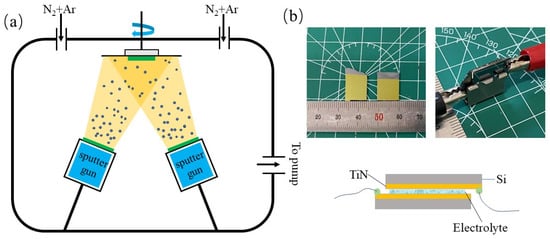
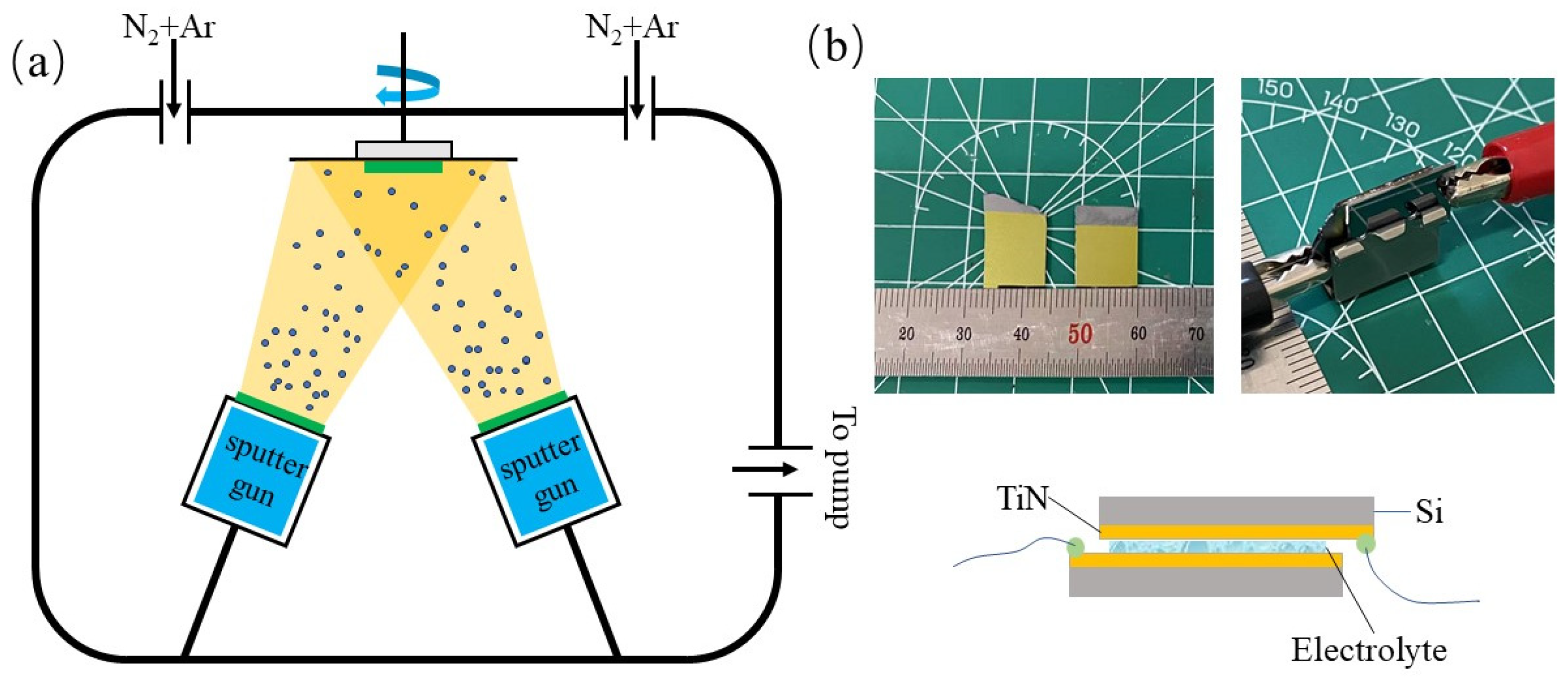
TiN thin films were deposited on (100)-oriented monocrystalline silicon substrates using a home-made JCP-350M2 high-vacuum multi-target magnetron sputtering machine, as shown in Figure 1a. A high-purity Ti target (purity 99.99%) with a diameter of 49 mm was used as the sputtering source. Silicon substrates with a size of 20 mm × 15 mm × 1 mm were ultrasonically cleaned in acetone, ethyl ethanol, and de-ionized water sequentially for 15 min. Then they were blown dry with N2 and put on holders in the chamber. Prior to deposition, the chamber was evacuated to a base vacuum of approximately 1 × 10⁻⁴ Pa to ensure a clean and stable environment. Subsequently, high-purity argon (Ar, purity 99.99%) and nitrogen (N2, purity 99.99%) were introduced as the sputtering and reactive gases, respectively. The flow rates of N2 and Ar were precisely controlled using mass flow controllers to achieve four specific N2/Ar flow ratios: 2.5:17.5 sccm; 5:15 sccm; 7.5:12.5 sccm; and 10:10 sccm (1 sccm = 1 mL/min). The total gas flow rate was maintained at a constant 20 sccm throughout all of the deposition processes. A pre-sputtering treatment was performed for 20 min at a sputtering power of 80 W to remove surface contaminants from the titanium target and ensure film purity. Following the pre-sputtering treatment, the shutter was opened, and the substrate holder began to rotate. A deposition time of 90 min was adopted to obtain 1-μm-thick films, and no additional heating was applied to the substrate holder or the chamber, i.e., room-temperature depositions were conducted in this work.
Figure 1.
Schematic illustration of the TiN thin film deposition process (a) and the preparation process of the supercapacitor using TiN electrodes with digital photos (b).
The phase composition of the obtained thin films was analyzed using a Panalytical Empyren X-ray diffractometer (The Netherlands). To avoid the strong diffraction peaks from the single-crystal silicon substrate, a 3° offset was applied for the incident X-ray. The other measurement conditions were as follows: Cu target Kα radiation (wavelength 0.1541 nm), conventional θ–2θ scan mode, with a scanning angle (2θ) range of 30° to 65°. The growth morphologies of the obtained TiN films were characterized by Asylum Research Cypher ES atomic force microscopy (AFM, Oxford Instruments, UK) over an area of around 6.0 μm2 on every sample surface, and the roughness was obtained by analyzing the AFM data. The composition and chemical bonding states were determined using X-ray photoelectron spectroscopy (Thermo Scientific ESCALAB 250Xi, USA) with Al Ka (1486.7 eV) as the excitation source at a scanning speed of 0.1 eV per step. The detailed parameters are as follows: the base pressure of the chamber during analyses was about 3.1 × 10⁻⁶ Pa, the electron emission angle was 0.2°, and the size of the analyzed area was about 0.04 mm2. The spectrum was collected following a 10 min depth-etching process with an Ar+ ion beam to remove the oxide contaminant on the sample’s surface.
Furthermore, the electrical resistivity of the samples was obtained using an RTS-9 dual-configuration four-probe measurement instrument (4Probes Tech Ltd., Guangzhou, China). The electrochemical performance of the thin film electrodes was evaluated using a CHI660e electrochemical workstation (CH Instruments, Shanghai, China) with a standard three-electrode system. A platinum sheet (10 mm × 10 mm) served as the counter electrode, and an Ag/AgCl electrode with a glass tube and frit was used as the reference electrode. The working electrode was prepared by exposing a 10 mm × 10 mm square area of the sample, connecting a wire, and sealing the remainder with insulating resin. The electrolyte used was a 1 mol/L KCl solution. The primary electrochemical characterization techniques employed were Cyclic Voltammetric (CV) and Galvanostatic Charge/Discharge (GCD) tests. For CV tests, the test voltage window was −0.4–0.4 V, and the scanning speed was in the range of 0.005–0.5 V/s. For GCD tests, the testing voltage window was –0.4 to 0.4 V, and the applied current density ranged from 0.15 to 0.55 mA/cm2. Finally, a simple supercapacitor using the obtained TiN electrodes was made, as shown in Figure 1b.
3. Results and Discussion
3.1. Crystal Structure and Composition
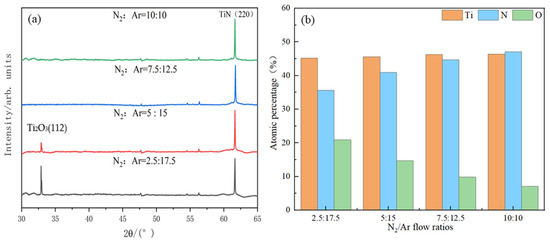
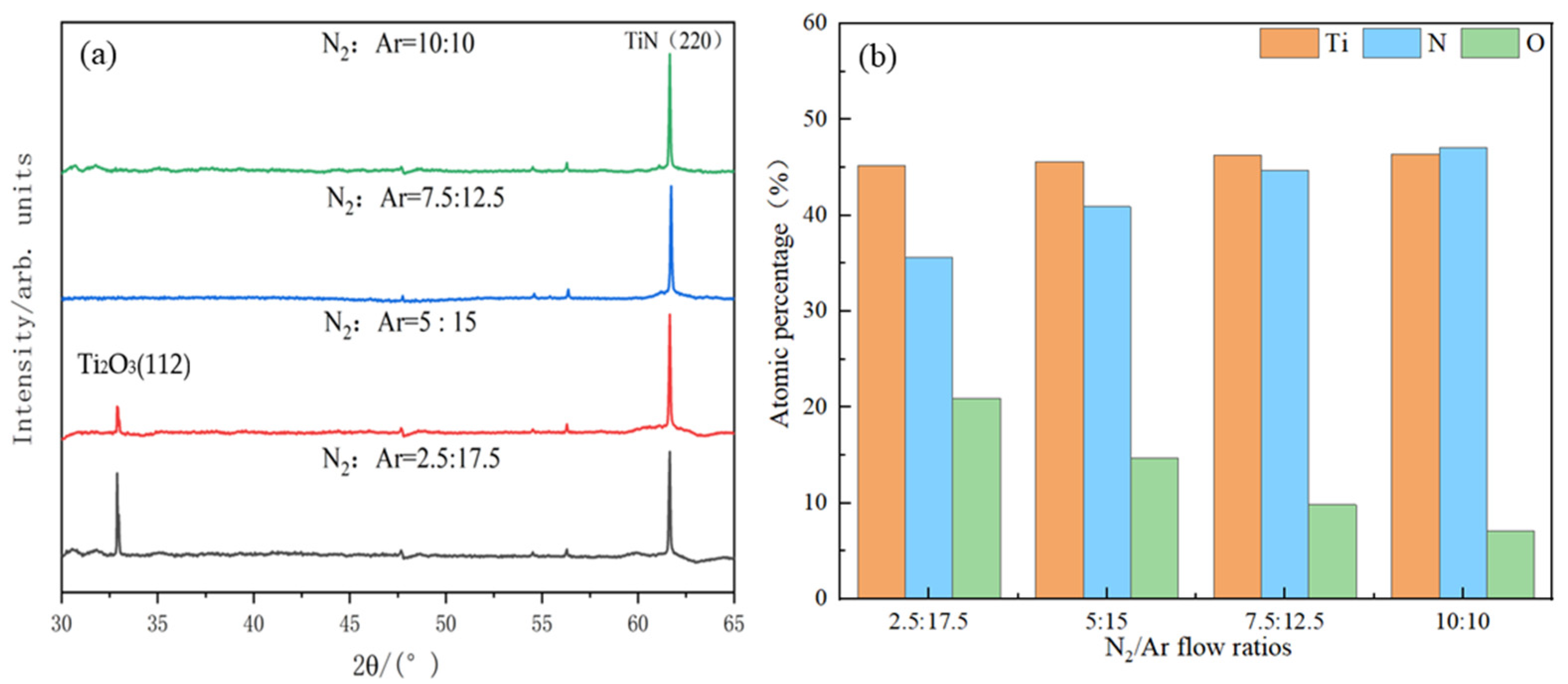
Figure 2a shows the XRD patterns of TiN films prepared at different flow ratios. When the N2/Ar flow ratios are 2.5:17.5 and 5:15, the diffraction peaks corresponding to the Ti2O3 (112) and TiN (220) planes appear near 36°and 62°, respectively, indicating that the TiN films obtained under these conditions are composed of a mixture of Ti2O3 and TiN phases. When the N2/Ar flow ratios increase to 7.5:12.5 and 10:10, only the diffraction peaks corresponding to the TiN phase (220) crystal plane appear in the XRD patterns, indicating that the TiN thin film under these conditions is composed of single-phase TiN. With an increase in the N2/Ar flow ratio, the growth of the TiN films gradually exhibits preferential growth along the (220) crystal plane, which may be due to the slight channel-blocking energy of the crystal plane [27]. With an increase in the proportion of nitrogen, the XRD peak strength of the (112) crystal plane of Ti2O3 decreases, and when the ratio of nitrogen increases further, the (112) peak of Ti2O3 disappears; only the TiN(220) peak remains. One possible reason for this is that when the proportion of nitrogen is small, the opportunity for Ti atoms in the reaction chamber to react with N2 is smaller, and it is easier for them to react with the residual O2 in the chamber and form Ti oxides. When the proportion of nitrogen increases, the chance of reaction between Ti atoms and nitrogen increases, making it easier to form Ti nitrides.
Figure 2.
XRD patterns (a) and element content (b) of the TiN films prepared at different N2/Ar flow ratios.
Figure 2b presents the content of main elements within the obtained TiN thin films. We can see that with an increase in the N2/Ar flow ratio, nitrogen content increases gradually, and titanium content remains almost constant around 45%. Meanwhile, oxygen content decreases with an increase in the flow ratio. Even though there is no titanium oxide peak in the XRD patterns for the cases of 7.5:12.5 and 10:10, we still detect the existence of oxygen content. We think it is possibly from gas impurity in the chamber, like residual gas absorbed on the well or oxygen atoms absorbed on the sample surface when exposed to the atmosphere. Another possible source is contamination on the film surface from operations and tests.
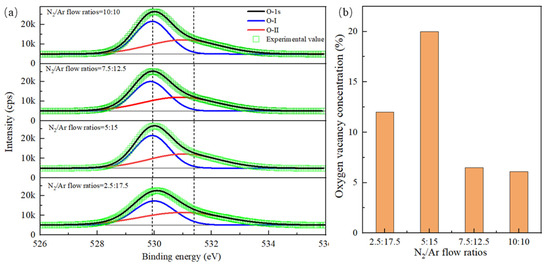
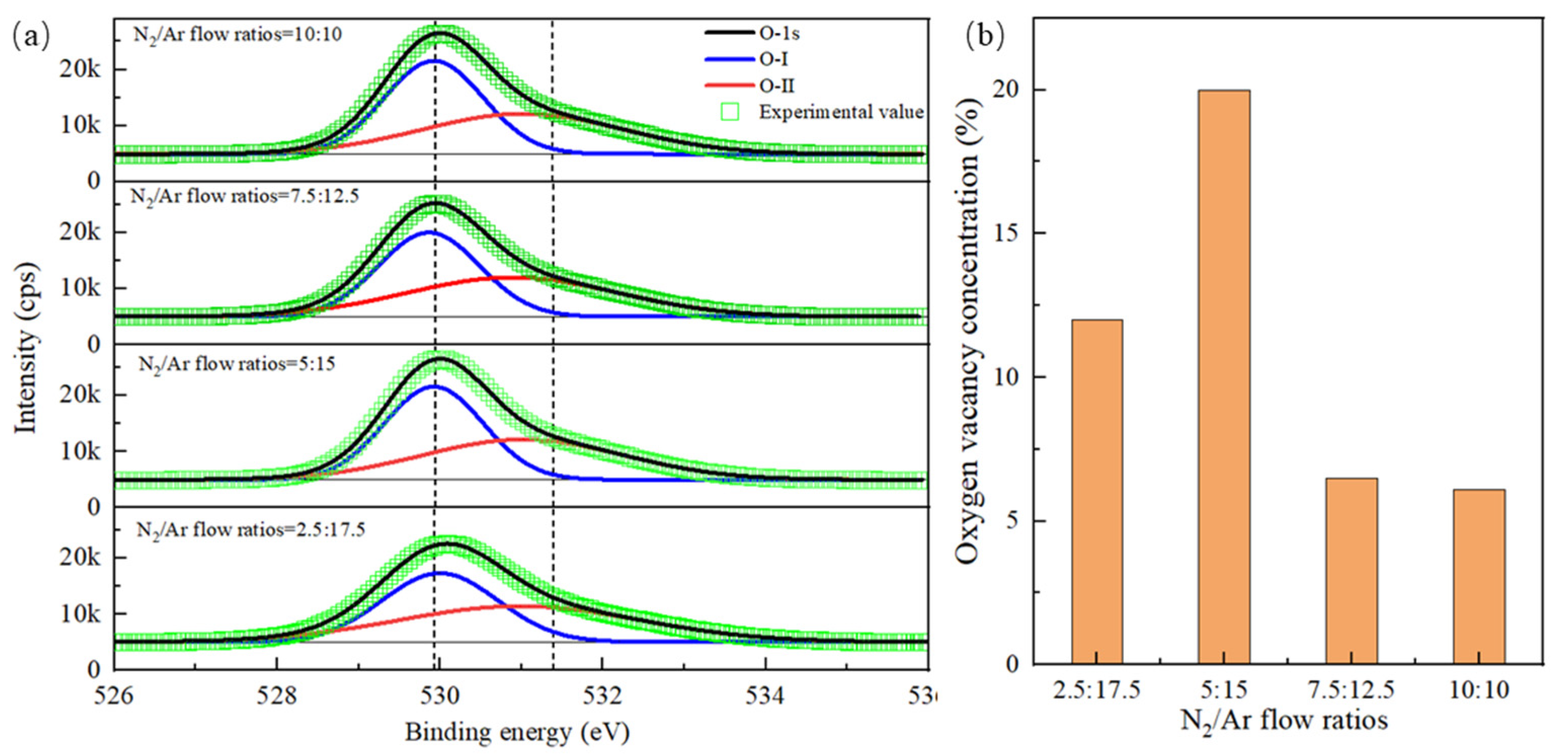
Apart from the element content, we also obtained the oxygen vacancy concentration within the obtained TiN films by decomposing the high-resolution O 1s peak, as shown in Figure 3a. The O-1s spectra could be decomposed into two sub-peaks: the O-I peak located at 530.1 ± 0.2 eV, which corresponds to lattice oxygen, and the O-II peak located at 531.4 ± 0.2 eV, which corresponds to vacancy oxygen [28]. Thus, oxygen vacancy concentration can be quantitatively assessed by calculating the peak area ratio of O-II/(O-I + O-II), as shown in Figure 3b. It is obvious that the TiN thin film obtained under the N2/Ar flow ratio of 5:15 contains the highest level of oxygen vacancy, which is known to play a positive role in improving conductivity for doped semiconductors by facilitating ion transport [29,30]. Therefore, it is expected that the conductivity of the TiN films produced with the 5:15 ratio should be the best.
Figure 3.
High resolution XPS spectrum of O 1s peak (a) and oxygen vacancy concentration (b) of TiN thin films obtained at different flow ratios.
3.2. Surface Topography and Resistivity
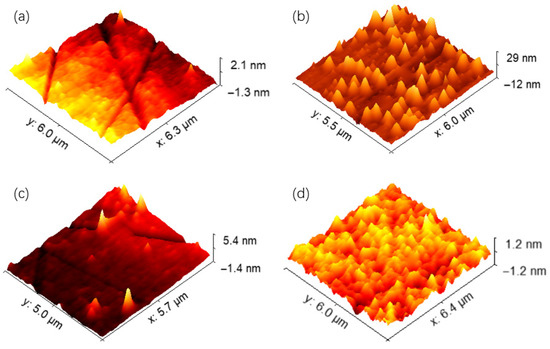
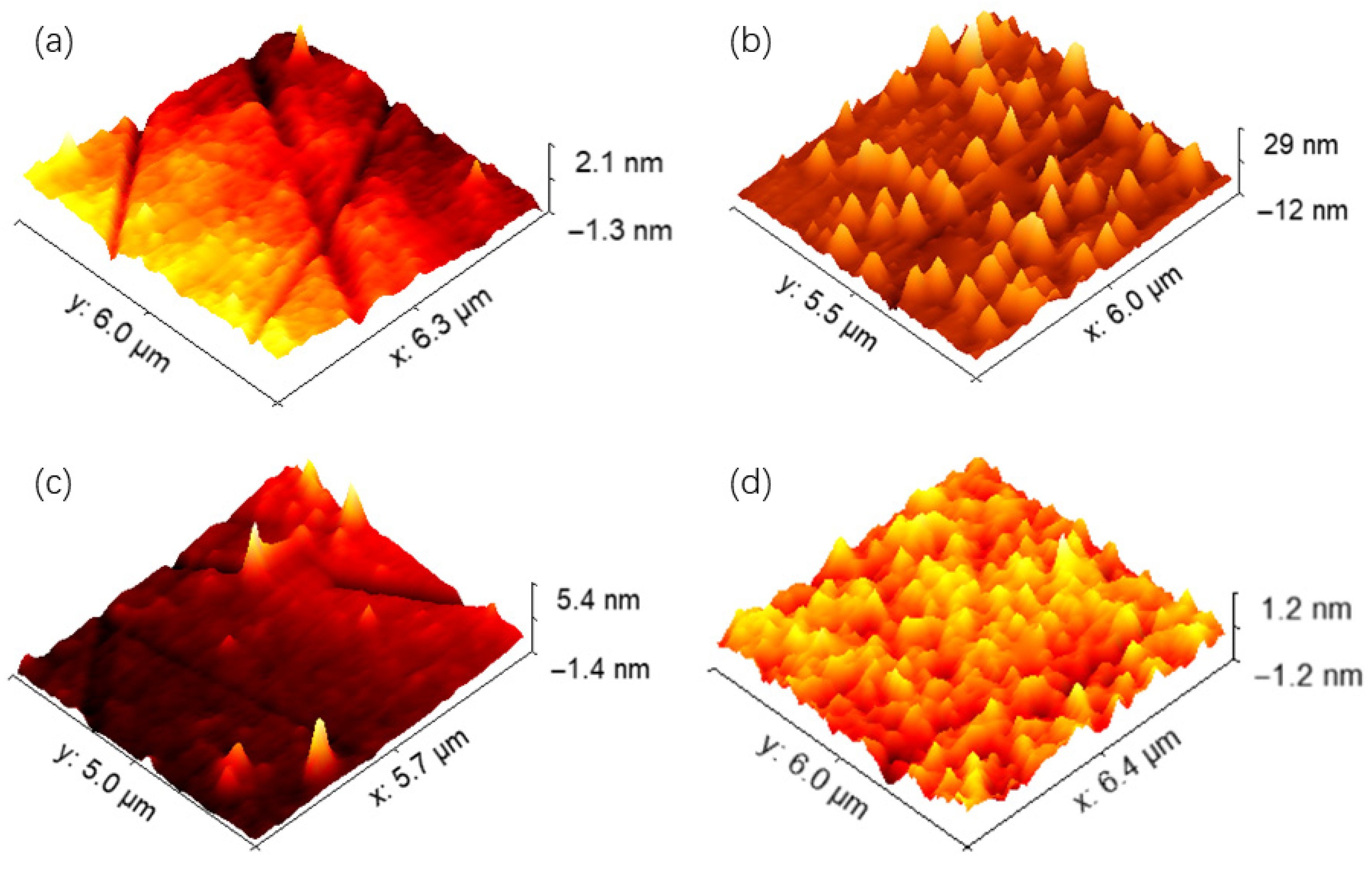
We also conducted an AFM observation over approximately 6.0 μm2 on the TiN thin films grown under different flow ratios, as shown in Figure 4. It can be observed that all the films exhibit an island-like surface topography composed of closely packed surface islands with sizes ranging from 0.1 to several micrometers. The samples of 5:15 and 7.5:12.5 seem to be much rougher, while the samples of 5:15 and 10:10 exhibit much higher island density. All the samples show one or more deep ditches, which are possibly due to defects in the substrate.
Figure 4.
AFM images of TiN films grown at different N2/Ar flow ratios, (a) 2.5:17.5, (b) 5:15, (c) 7.5:12.5, (d) 10:10.
The root mean square roughness (RRMS) is the most widely used parameter to characterize film surface roughness, which can be calculated using the following equation
where Zi is the measured height of the i-th point in the scan area,
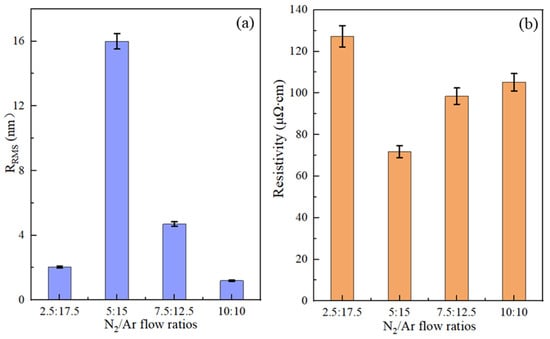
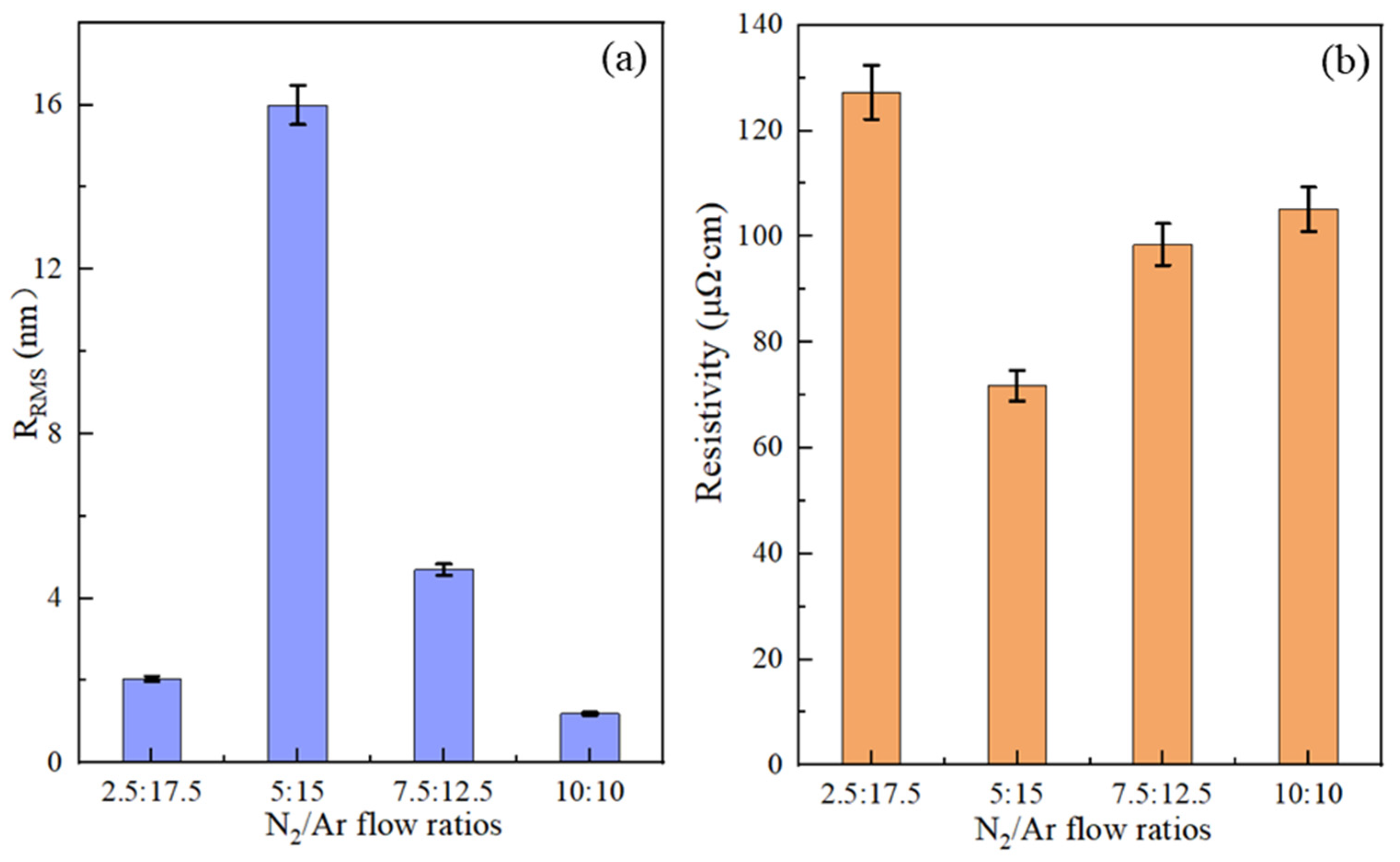
is the average of height, and N is the number of height measurements. Figure 5a shows the rms roughness obtained from AFM image data. We can see that the RRMS first increases and then decreases with the increase in N2/Ar flow ratio, which means the N2 content increases in the gas mixture. RRMS reaches its maximum in the case of 5:15, about 15.9 nm, indicating that the gas ratio has a significant impact on the film roughness. When N2:Ar = 5:15, the content of N2 is relatively high, and collisions between sputtered particles are more frequent. The sputtered particles with reduced momentum are dispersed on the substrate surface, ensuring sufficient time for the growth of crystal nuclei, which leads to a relatively rough film surface. However, as the content of N2 further increases, the Ti atoms sputtered onto the substrate surface undergo secondary sputtering, which in turn reduces the roughness of the film surface [17].
Figure 5.
RMS roughness (a) and electrical resistivity (b) of the TiN films obtained at different N2/Ar flow ratios.
We also performed electrical conductivity tests on the samples using four-probe methods. Figure 5b presents the resistivity of the TiN films obtained under different N2/Ar flow ratios. It is obvious that all the TiN thin films exhibit good conductivity, with the resistivity ranging from 60 to 140 μΩ·cm. It is worthy to note that the sample of 5:15 exhibits the best conductivity, showing the lowest resistivity of 70 μΩ·cm. Combined with the XPS results as shown in Figure 3, we attribute this conductivity to the high oxygen vacancy concentration of the TiN film obtained under the N2/Ar flow ratio of 5:15.
3.3. CV and GCD Curves
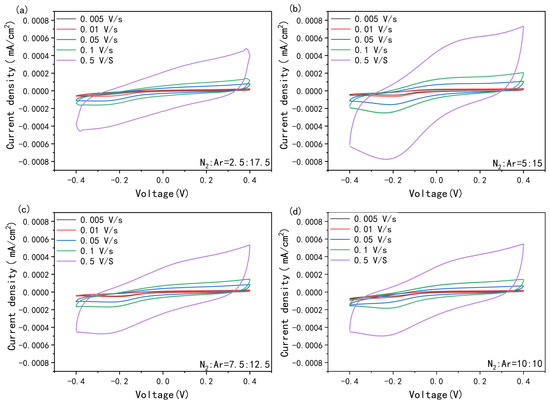
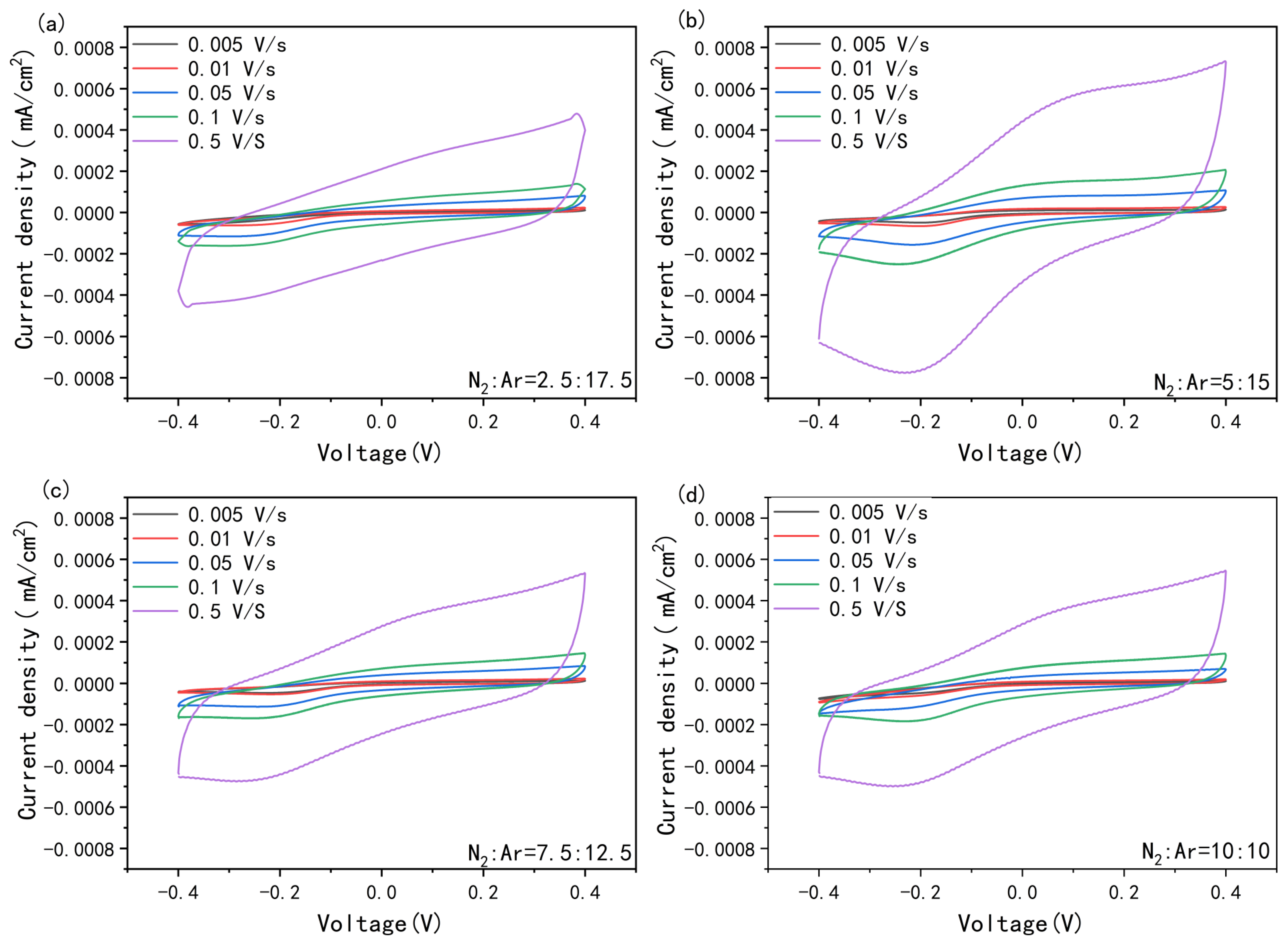
The voltammetry cycle (CV) test is a measurement of the current change curve in a capacitor system by applying a zigzag voltage signal to the working electrode over experimental time, as shown in Figure S1. To investigate the electrochemical behavior of the as-deposited TiN thin films for applications in supercapacitors, CV measurements were carried out on the four thin-film electrodes at different sweep rates (5–5000 mV/s), as shown in Figure 6. All samples were measured in the −0.4 V to 0.4 V potential window in an aqueous solution of 1 M KCl as an electrolyte. In the CV test, the specific capacitance Cs of the electrode can be calculated by the following formula
where i is the current (A), V is the voltage (V), v is the sweep rate (V/s), ∆V is the voltage window (V), and S is the area of the working electrode (cm2). As can be seen, at scan rates at or below 0.05 V/s, the CV curves of the thin-film electrodes deviate significantly from the rectangular shape, indicating poor capacitive performance. When the scan rate exceeds 0.05 V/s, the CV curves progressively develop characteristic rectangular features, demonstrating excellent capacitive behavior of the electrode material. When the scanning rate is 0.5 V/s, the shape of the CV curve is close to rectangular, which indicates that the TiN thin film electrodes exhibit good capacitance characteristics. Therefore, to achieve optimal capacitive performance, the supercapacitor should be operated within an appropriate scan rate range. Additionally, when observing the CV curves with different gas ratios but the same scan rate, it is found that when the ratio N2/Ar = 5:15, the area enclosed by the CV curve is the largest, indicating that the specific capacitance of that TiN thin film electrode is the largest.
Figure 6.
Cycle voltammetric (CV) curves at different scanning rates of the TiN thin-film electrode at different flow ratios, (a) 2.5:17.5, (b) 5:15, (c) 7.5:12.5, (d) 10:10.
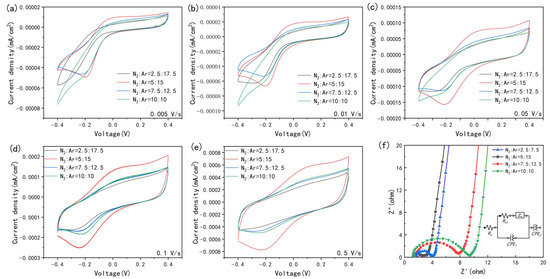
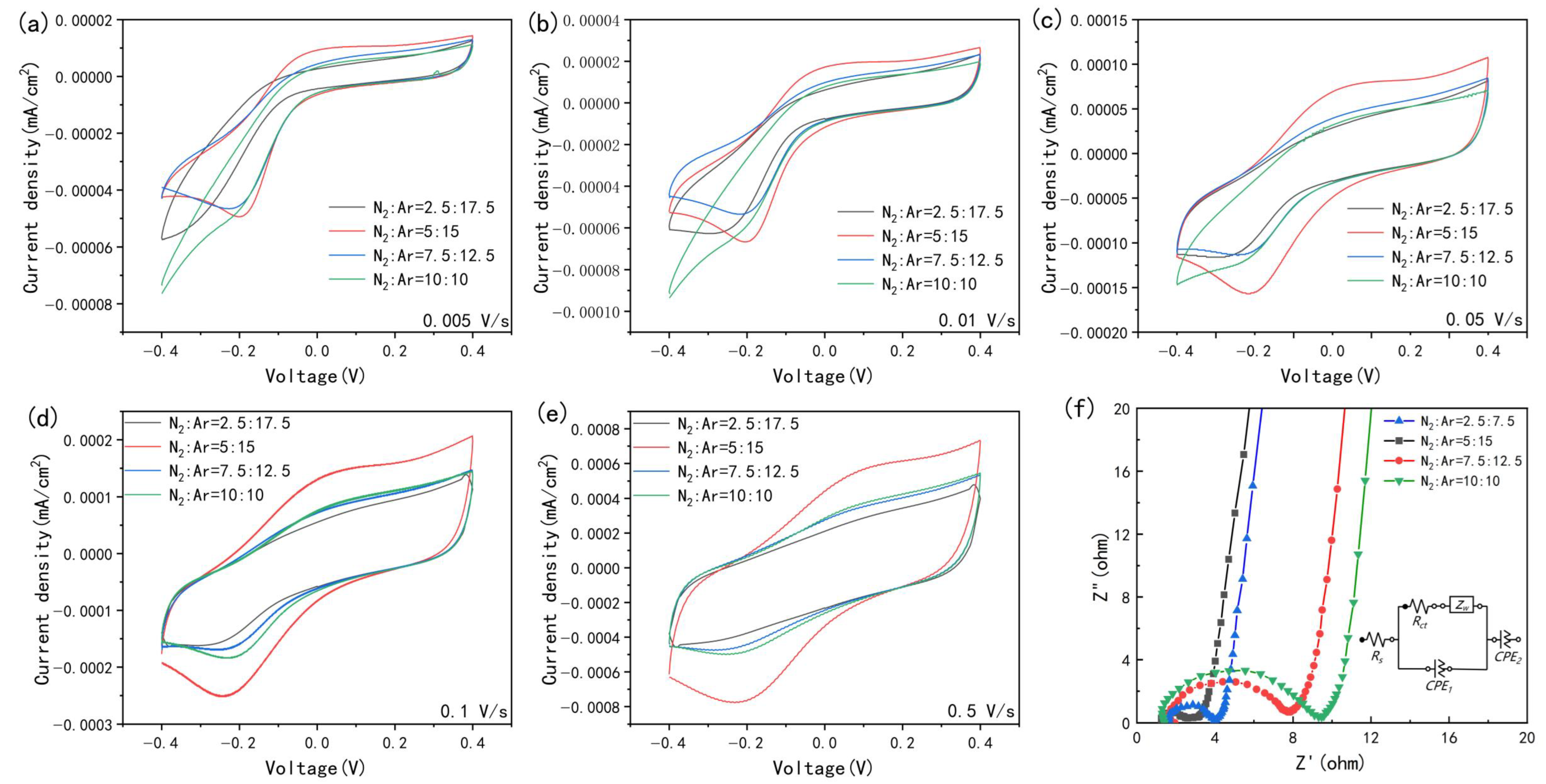
Figure 7 shows the CV curves of the TiN thin-film electrodes obtained at different scan rates. An electrical impedance spectroscopy measurement was conducted to obtain a better understanding of the electrochemical behavior of the TiN thin-film electrodes (Figure 7f). As can be seen from Figure 7a–e, when the scanning speed is below 0.05 V/s, the shape of the CV curve of each sample is roughly the same, and there is a downward spike in the range of −0.4~−0.2 V for the 10:10 sample, which may be due to the offset of the reduction peak due to the weakening conductivity of TiN phase [31]. When the scanning speed is higher than 0.05 V/s, as shown in Figure 7c–e, the CV curve shape of the 5:15 sample is closest to the ideal rectangle, indicating that the capacitance performance of the 5:15 sample is the best at the higher scanning speed. This deduction can be supported by the Nyquist diagram as shown in Figure 7f. At high frequencies, the diameter of the semicircle and the intercept on the real axis give the interfacial charge transfer resistance (Rct) and the equivalent series resistance (Rs), respectively. Obviously, the equivalent series resistances of the four as-prepared TiN thin-film electrodes are very low. The low Rs can accelerate the electrostatic adsorption of ions, thereby making it close to the ideal capacitive behavior [32]. The 5:15 sample has the lowest Rs and Rct values among the four as-prepared electrodes, indicating its higher conductivity and better electrochemical performance. In addition, a faster ion diffusion rate and capacitive behavior are indicated by the straight line at low frequency, which is almost parallel to the y-axis.
Figure 7.
Cycle voltammetric (CV) curves of the TiN thin-film electrode at different scan rates: (a) 0.005 V/s, (b) 0.01 V/s, (c) 0.05 V/s, (d) 0.1 V/s, (e) 0.5 V/s. (f) Nyquist plots of EIS spectra of the as-prepared TiN thin films with frequency in the range of 0.01 Hz to 100 kHz. The inset is the diagram of the equivalent circuit.
Galvanostatic charge/discharge (GCD) testing refers to applying cathodic and anodic currents to a thin-film electrode and recording the variation in the electrode potential over time, as shown in Figure S2. In GCD tests, the specific capacitance Cs of the electrode can be calculated by the following formula:
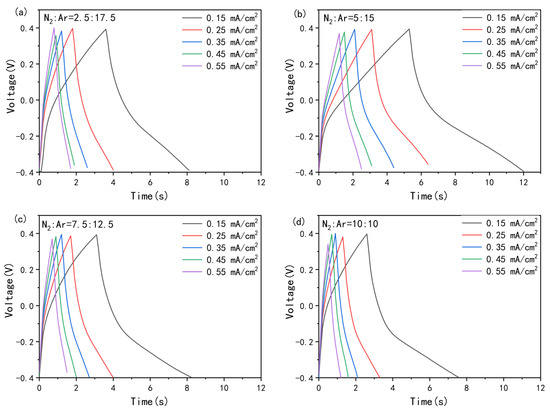
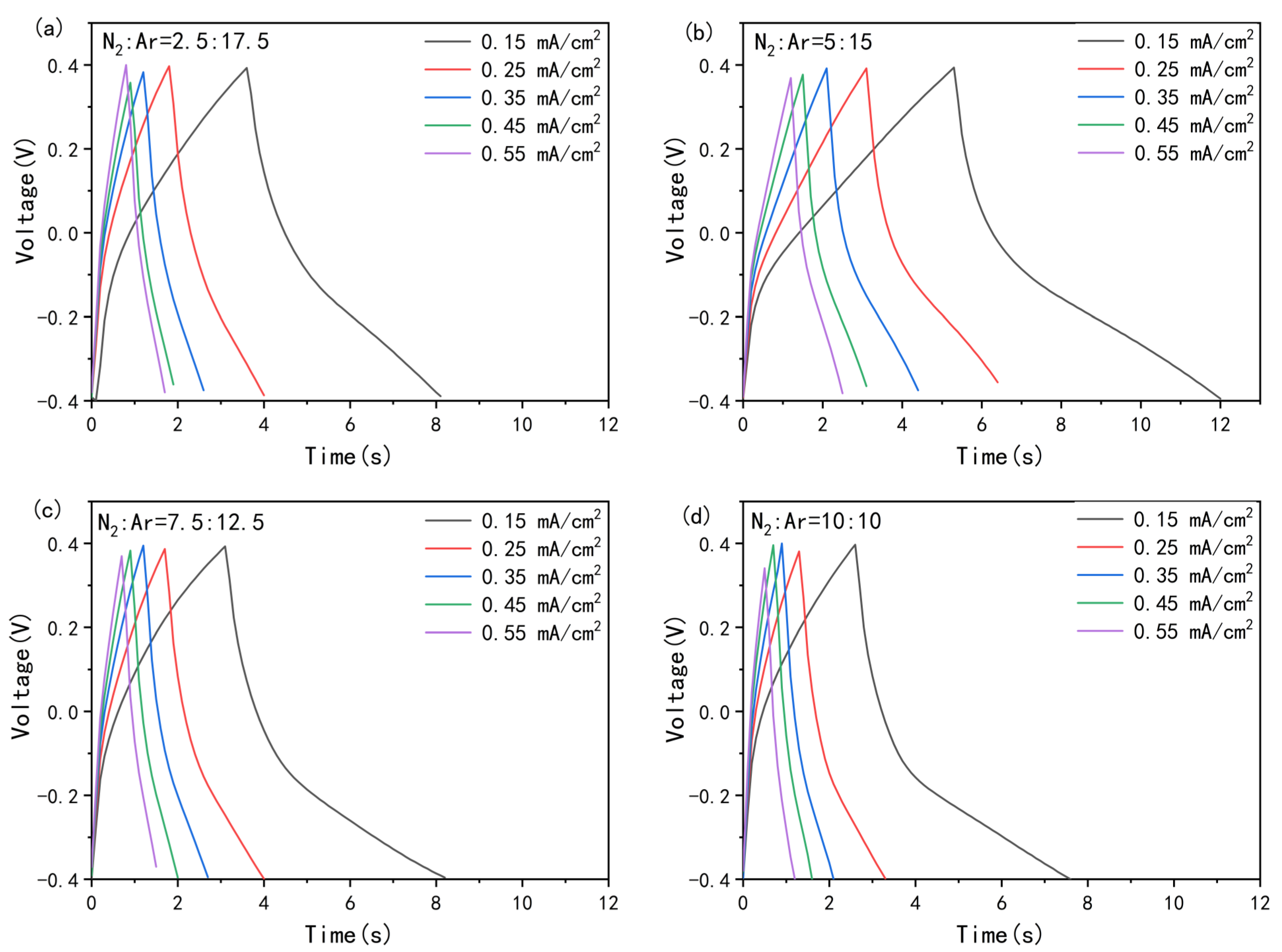
where i is the current, td is the discharge time, ∆V is the voltage window, and S is the area of the working electrode. Figure 8 shows the GCD curves of the TiN thin-film electrodes obtained with different N2/Ar flow ratios. As can be seen from the figure, the shape of the GCD curves is close to an isosceles triangle, and the charging and discharging times of the thin film electrodes increase gradually with the decrease in the test current density, which indicates their exceptional electrochemical reversibility and capacitive electrochemical behaviors [33]. Observing the GCD curves with different gas flow ratios but the same current density, it is found that the discharge time of the thin film electrode is the longest when the N2/Ar flow ratio is 5:15, suggesting that the specific capacitance of the thin film electrode is the largest, agreeing with the superior electrochemical performance given by the CV tests.
Figure 8.
Galvanostatic charge/discharge curves of the TiN film electrodes obtained with different N2/Ar flow ratios, (a) 2.5:17.5, (b) 5:15, (c) 7.5:12.5, (d) 10:10.
3.4. Specific Capacitance
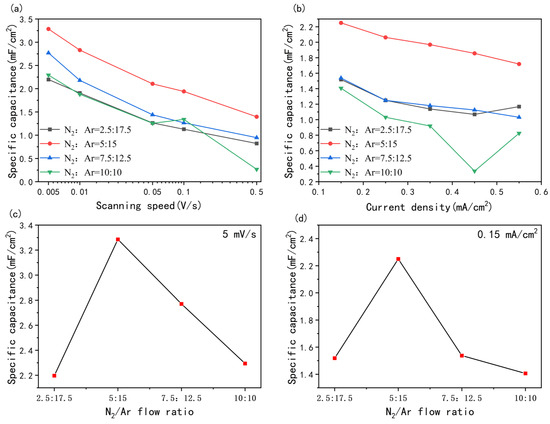
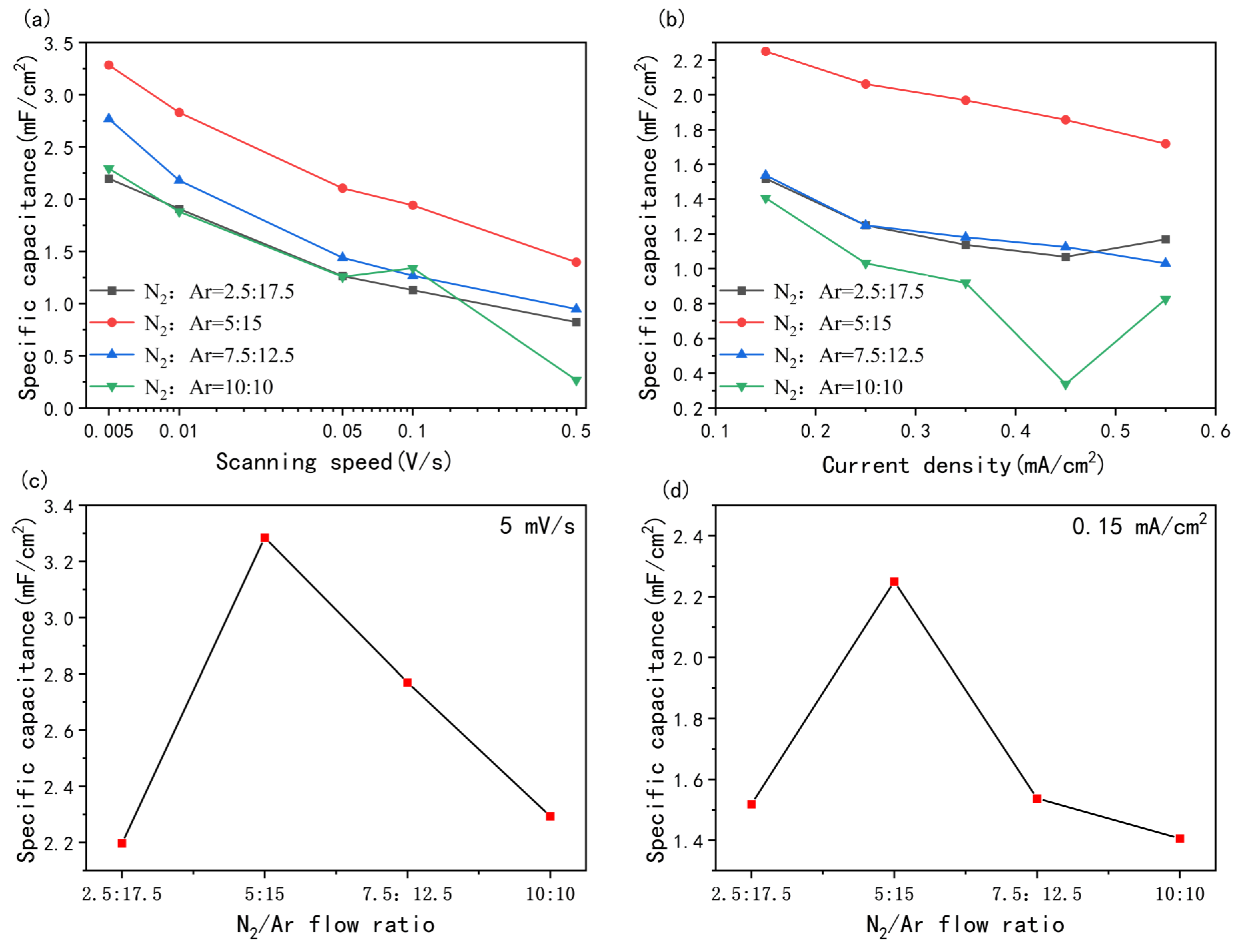
Figure 9a shows the dependence of the specific capacitance on the scanning rate for the TiN thin film electrodes prepared with different N2/Ar ratios. It can be seen that, when the scanning rate gradually increases from 0.005 V/s to 0.5 V/s, the specific capacitance of the thin film electrode always decreases at any gas ratio. At any scan rate, the specific capacitance of the thin film electrode always reaches its maximum at a N2/Ar flow ratio of 5:15. When the scanning rate is 0.005 V/s, as shown in Figure 9c, the specific capacitance increases first and then decreases as the N2/Ar flow ratio gradually increases from 2.5:17.5 to 10:10, and the maximum specific capacitance of the film electrode is 3.29 mF/cm2 at the N2/Ar flow ratio of 5:15.
Figure 9.
The curves of the specific capacitance vs. scanning rate (a) and vs. current density (b) at different gas ratios; and the specific capacitance of the thin film electrodes prepared at different N2/Ar flow ratios tested with 5mV/s (c) and 0.15 mA/cm2 (d).
Figure 9b shows the dependence of the specific capacitance on the current density for the TiN thin film electrodes prepared under different gas ratios. It can be concluded that when the test current density gradually increases from 0.15 mA/cm2 to 0.55 mA/cm2, the specific capacitance of the thin film electrode always decreases at any gas ratio. The specific capacitance of the film electrode reaches its maximum at the N2/Ar flow ratio of 5:15 at any test current density. When the test current density is 0.15 mA/cm2, as shown in Figure 9d, the specific capacitance increases first and then decreases as the N2/Ar flow ratio gradually increases from 2.5:17.5 to 10:10, and the TiN film electrode obtained with the N2/Ar flow ratio of 5:15 has a maximum specific capacitance of 2.25 mF/cm2. We compare this value with that of the previous works reported in the literature, as shown in Table 1. We can see that the potential window of this work is the largest, around 0.8 V, and the specific capacitance of this work is fairly high at a scanning rate of less than 10 mV/s, indicating that the capacitive performance of the TiN thin-film electrodes fabricated in this work is rather competitive.
Table 1.
Comparison of TiN-based thin film supercapacitor electrodes prepared by different methods in the literature.
In summary, the optimal N2/Ar flow ratio is 5:15. This is because, when N2:Ar = 2.5:17.5, the nitrogen concentration is relatively low, making it difficult to form stoichiometric TiN films (Ti:N = 1:1). In addition, the higher content of titanium oxides is unfavorable for electron transport. As a result, the film electrode contains less conductive TiN and more titanium oxynitrides, leading to a lower specific capacitance. When N2:Ar = 5:15, the higher nitrogen ratio promotes the formation of TiN films with increased surface roughness and larger specific surface area, thereby resulting in a higher specific capacitance. However, when the N2/Ar flow ratio is 7.5:12.5 or 10:10, the (112) diffraction peak of Ti2O3 in the TiN film electrodes becomes insignificant. The presence of Ti2O3 contributes to an optimal surface roughness in the thin film, which increases the specific surface area and thereby facilitates the charge exchange process. Meanwhile, the surface of Ti2O3 contains numerous oxygen vacancies that effectively enhance the electrical conductivity of the electrode material [28,29]. Therefore, an appropriate content of Ti2O3 plays a critical role in improving the electrode capacitance; the disappearance of this phase leads to a decrease in specific capacitance [15].
3.5. Stability Testing of the Optimal Sample
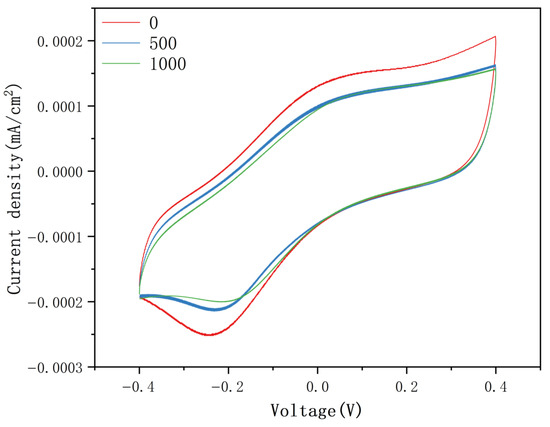
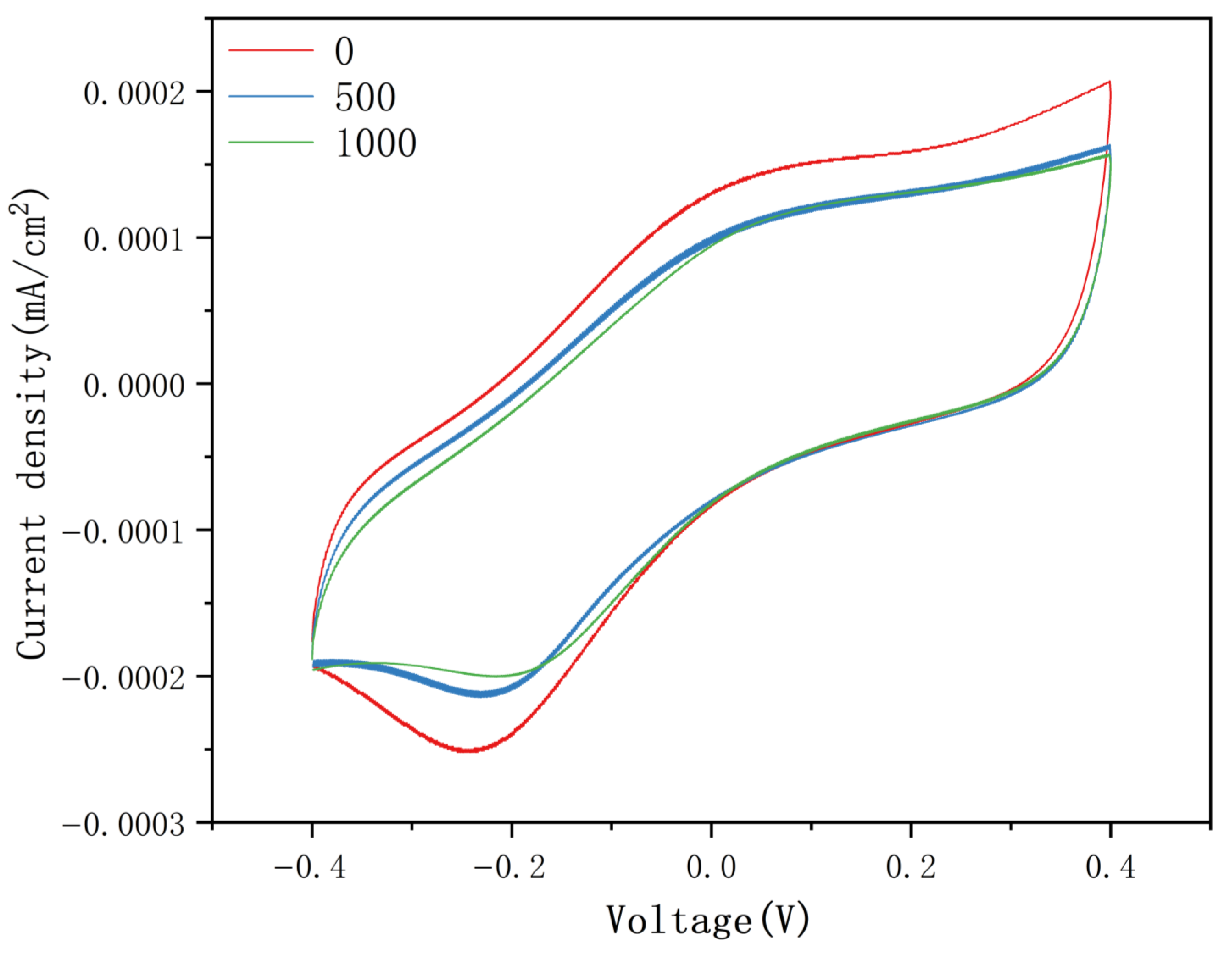
To verify the long-term stability of the TiN thin-film microcapacitor, we conducted cycle voltammetric tests on the optimal sample (N2/Ar ratio of 5:15, unannealed) after 0, 500, and 1000 charge–discharge cycles at a scan rate of 0.1 V/s, and the results are shown in Figure 10. As can be seen from the figure, the CV curve area is the largest after 0 cycles, corresponding to the highest specific capacitance of the capacitor. After 500 charge–discharge cycles, the CV curve area decreases significantly, indicating that the specific capacitance of the capacitor suffered a degradation. However, after 1000 cycles, the CV curve area decreases only slightly, which indicates that the performance degradation gradually reaches a saturation state, and the capacitor retains fairly good cycle stability.
Figure 10.
CV curves of the optimal sample (N2/Ar flow ratio of 5:15) at a scan rate of 0.1 V/s after 0, 500, and 1000 cycles.
The device performance exhibits a notable degradation after 500 charge–discharge cycles, and the underlying mechanism is presumably associated with the presence of the metastable Ti2O3 phase. Specifically, the film possesses a mixed-phase structure composed of TiN and Ti2O3, which elevates the density of interfaces within the film [38]. Moreover, the discrepancies in work function and electronegativity between these two phases introduce inherent instability to the device [39]. During prolonged charge–discharge cycling, the processes of charge transfer and exchange are more prone to induce performance degradation in this dual-phase structure compared with single-phase TiN films [40]. The relevant research conducted by the following scholars has also corroborated this inference. For instance, Zhu et al. [37] fabricated TiN films on silicon substrates via the chemical solution deposition method, which featured a well-defined single TiN phase; accordingly, the resultant films demonstrated significantly superior stability to the devices reported in this work. Similarly, Chandra et al. [41] prepared single-phase TiN films by magnetron sputtering, and these films also exhibited excellent cycling stability, with performance degradation only observed after 1000 cycles. The authors attributed such outstanding performance to the high specific surface area and the stable single-phase structure with a (111) preferred orientation.
4. Conclusions
This study systematically investigates the effects of the N2/Ar flow ratio on the microstructure and electrochemical performance of TiN thin films prepared by direct current magnetron sputtering. The results indicate that the N2/Ar flow ratio significantly regulates the phase composition and surface morphology of the films, as well as their conductivity: at lower nitrogen ratios, the films consist of coexisting TiN and Ti2O3 phases; as the nitrogen ratio increases to 7.5:12.5 and above, the films transform into a single TiN phase with a preferred orientation along the (110) plane. The root mean square roughness first increases and then decreases with an increase in the N2/Ar flow ratios, and it reaches a maximum of around 15.9 nm when the N2/Ar flow ratio is 5:15. XPS results show that this sample contains the highest oxygen vacancy concentration, offering it the best conductivity, which is confirmed by four-probe measurements. The N2/Ar flow ratio has a significant influence on the electrochemical capacitive performance of TiN films, with the highest value of 3.29 mF/cm2 achieved at a N2/Ar flow ratio of 5:15, which is likely due to the rough and porous surface and much better conductivity of the as-deposited films obtained with this ratio. Under this condition, the film electrodes demonstrate optimal electrochemical energy storage performance. These findings reveal that, for micro-supercapacitor electrodes, maintaining appropriate surface roughness and conductivity is critical for enhancing capacitive performance.
Supplementary Materials
The following supporting information can be downloaded at: https://www.mdpi.com/article/10.3390/coatings16010069/s1, Figure S1: Volt-ampere cycle tests: (a) the applied voltage excitation signal, and (b) the current response signal of the ideal capacitor.; Figure S2: Galvanostatic charge/discharge test: (a) applied current excitation signal, (b) voltage response signal of ideal capacitor.
Author Contributions
Conceptualization, M.Z.; Methodology, J.T. and L.Y.; Validation, S.B.; Formal analysis, J.T.; Investigation, L.Y. and J.T.; Resources, M.Z.; Data curation, S.B.; Writing—original draft preparation, J.T.; Writing—review and editing, M.Z.; Supervision, M.Z.; Project administration, J.T.; Funding acquisition, M.Z. All authors have read and agreed to the published version of the manuscript.
Funding
This research was supported by the Liaoning Revitalization Talents Program, China (XLYC1807170), and the Liaoning BaiQianWan Talents Program.
Institutional Review Board Statement
Not applicable.
Informed Consent Statement
Not applicable.
Data Availability Statement
The original contributions presented in the study are included in the article/Supplementary Materials; further inquiries can be directed to the corresponding author.
Conflicts of Interest
The authors declare no conflicts of interest.
References
- Sun, N.; Zhou, D.; Liu, W.; Li, A.; Su, Y.; Jiang, P.; Zou, Y.; Shi, S.; Liu, F. Sputtered titanium nitride films with finely tailored surface activity and porosity for high performance on-chip micro-supercapacitors. J. Power Sources 2021, 489, 229406. [Google Scholar] [CrossRef] [Scilit]
- Miller, J.; Simon, P. Electrochemical Capacitors for Energy Management. Science 2008, 321, 651–652. [Google Scholar] [CrossRef] [Scilit]
- Wang, Z. Self-Powered Nanosensors and Nanosystems. Adv. Mater. 2012, 24, 280–285. [Google Scholar] [CrossRef] [Scilit]
- Koomey, J.; Matthews, H.S.; Williams, E. Smart Everything: Will Intelligent Systems Reduce Resource Use? Annu. Rev. Environ. Resour. 2013, 38, 311–343. [Google Scholar] [CrossRef] [Scilit]
- Oyama, S. Preparation and catalytic properties of transition metal carbides and nitrides. Catal. Today 1992, 15, 179–200. [Google Scholar] [CrossRef] [Scilit]
- Cao, D.; Xing, Y.; Tantratian, K.; Wang, X.; Ma, Y.; Mukhopadhyay, A.; Cheng, Z.; Zhang, Q.; Jiao, Y.; Chen, L.; et al. 3D Printed High-Performance Lithium Metal Microbatteries Enabled by Nanocellulose. Adv. Mater. 2019, 31, 1807313. [Google Scholar] [CrossRef] [Scilit] [PubMed]
- Simon, P.; Gogotsi, Y. Materials for electrochemical capacitors. Nat. Mater. 2008, 7, 845–854. [Google Scholar] [CrossRef] [Scilit]
- Chmiola, J.; Largeot, C.; Taberna, P.-L.; Simon, P.; Gogotsi, Y. Monolithic Carbide-Derived Carbon Films for Micro-Supercapacitors. Science 2010, 328, 480–483. [Google Scholar] [CrossRef] [Scilit]
- Lu, X.; Wang, G.; Zhai, T.; Yu, M.; Xie, S.; Ling, Y.; Liang, C.; Tong, Y.; Li, Y. Stabilized TiN Nanowire Arrays for High-Performance and Flexible Supercapacitors. Nano Lett. 2012, 12, 5376–5381. [Google Scholar] [CrossRef] [Scilit]
- Zhang, Q.; Wang, X.; Pan, Z.; Sun, J.; Zhao, J.; Zhang, J.; Zhang, C.; Tang, L.; Luo, J.; Song, B.; et al. Wrapping Aligned Carbon Nanotube Composite Sheets around Vanadium Nitride Nanowire Arrays for Asymmetric Coaxial Fiber-Shaped Supercapacitors with Ultrahigh Energy Density. Nano Lett. 2017, 17, 2719–2726. [Google Scholar] [CrossRef] [Scilit]
- Shi, J.; Jiang, B.; Li, C.; Yan, F.; Wang, D.; Yang, C.; Wan, J. Review of Transition Metal Nitrides and Transition Metal Nitrides/Carbon nanocomposites for supercapacitor electrodes. Mater. Chem. Phys. 2020, 245, 122533. [Google Scholar] [CrossRef] [Scilit]
- Choi, D.; Kumta, P. Nanocrystalline TiN Derived by Two-Step Halide Approach for Electrochemical Capacitors. J. Electrochem. Soc. 2006, 153, A2298–A2303. [Google Scholar] [CrossRef] [Scilit]
- Dong, S.; Chen, X.; Gu, L.; Zhou, X.; Xu, H.; Wang, H.; Liu, Z.; Han, P.; Yao, J.; Wang, L.; et al. Facile Preparation of Mesoporous Titanium Nitride Microspheres for Electrochemical Energy Storage. ACS Appl. Mater. Interfaces 2011, 3, 93–98. [Google Scholar] [CrossRef] [Scilit]
- Yang, P.; Chao, D.; Zhu, C.; Xia, X.; Zhang, Y.; Wang, X.; Sun, P.; Tay, B.K.; Shen, Z.; Mai, W.; et al. Ultrafast-Charging Supercapacitors Based on Corn-Like Titanium Nitride Nanostructures. Adv. Sci. 2016, 3, 201500299. [Google Scholar] [CrossRef] [Scilit]
- Hou, X.; Li, Q.; Zhang, L.; Yang, T.; Chen, J.; Su, L. Tunable preparation of chrysanthemum-like titanium nitride as flexible electrode materials for ultrafast-charging/discharging and excellent stable supercapacitors. J. Power Sources 2018, 396, 319–326. [Google Scholar] [CrossRef] [Scilit]
- Xie, Y.; Wang, Y.; Du, H. Electrochemical capacitance performance of titanium nitride nanoarray. Mater. Sci. Eng. B 2013, 178, 1443–1451. [Google Scholar] [CrossRef] [Scilit]
- Achour, A.; Ducros, J.B.; Porto, R.L.; Boujtita, M.; Gautron, E.; Le Brizoual, L.; Djouadi, M.A.; Brousse, T. Hierarchical nanocomposite electrodes based on titanium nitride and carbon nanotubes for micro-supercapacitors. Nano Energy 2014, 7, 104–113. [Google Scholar] [CrossRef] [Scilit]
- Wang, C.; Zhou, P.; Wang, Z.; Liu, Y.; Wang, P.; Qin, X.; Zhang, X.; Dai, Y.; Whangbo, M.-H.; Huang, B. TiN nanosheet arrays on Ti foils for high-performance supercapacitance. RSC Adv. 2018, 8, 12841–12847. [Google Scholar] [CrossRef] [Scilit] [PubMed]
- Qin, P.; Li, X.; Gao, B.; Fu, J.; Xia, L.; Zhang, X.; Huo, K.; Shen, W.; Chu, P.K. Hierarchical TiN nanoparticles-assembled nanopillars for flexible supercapacitors with high volumetric capacitance. Nanoscale 2018, 10, 8728–8734. [Google Scholar] [CrossRef] [Scilit] [PubMed]
- Wei, B.; Liang, H.; Qi, Z.; Zhang, D.; Shen, H.; Hu, W.; Wang, Z. Construction of 3D Si@Ti@TiN thin film arrays for aqueous symmetric supercapacitors. Chem. Commun. 2019, 55, 1402–1405. [Google Scholar] [CrossRef] [Scilit]
- Rhee, S.Y.; Nguyen, D.T.; Han, S.Y.; Klementiev, K.; Youn, W.; Yun, G.; Kwon, Y.; Han, S.W.; Kim, J.H.; Kim, T.; et al. Boric acid-mediated sol–gel construction of transparent, photoactive TiO2 films. Chem. Commun. 2025, 61, 17938–17941. [Google Scholar] [CrossRef] [Scilit]
- Zhang, M.; Lin, G.; Dong, C.; Wen, L. Amorphous TiO2 films with high refractive index deposited by pulsed bias arc ion plating. Surf. Coat. Technol. 2007, 201, 7252–7258. [Google Scholar] [CrossRef] [Scilit]
- Badovinac, I.J.; Piltaver, I.K.; Črep, L.; Babić, D.J.; Janković, I.Š.; Veličan, K.; Salamon, K.; Kocijan, M.; Podlogar, M.; Gračanin, N.; et al. Synergistic enhancement of solar photocatalysis in ALD-grown TiO2-Cu composite films. Surf. Interfaces 2025, 73, 107570. [Google Scholar] [CrossRef] [Scilit]
- Li, L.; Kishi, A.; Liu, Q.; Itai, Y.; Fujihara, R.; Ohno, Y.; Ao, J.P. GaN Schottky Barrier Diode With TiN Electrode for Microwave Rectification. IEEE J. Electron. Devices Soc. 2014, 2, 168–173. [Google Scholar] [CrossRef] [Scilit]
- Liu, X.; Zhou, D.; Guan, Y.; Li, S.; Cao, F.; Dong, X. Endurance properties of silicon-doped hafnium oxide ferroelectric and antiferroelectric-like thin films: A comparative study and prediction. Acta Mater. 2018, 154, 190–198. [Google Scholar] [CrossRef] [Scilit]
- Sun, N.; Zhou, D.; Shi, S.; Liu, W.; Zhao, X.; Liu, F.; Tian, Z.; Li, S.; Wang, J.; Ali, F. DC substrate bias enables preparation of superior-performance TiN electrode films over a wide process window. Mater. Res. Bull. 2019, 119, 110575. [Google Scholar] [CrossRef] [Scilit]
- Zhang, M.; Ma, X.; Zhang, S.; Hou, L.; Kim, K.H. One-step fabrication of wear resistant and friction-reducing Al2O3/MoS2 nanocomposite coatings on 2A50 aluminum alloy by plasma electrolytic oxidation with MoS2 nanoparticle additive. Surf. Coat. Technol. 2025, 497, 131796. [Google Scholar] [CrossRef] [Scilit]
- Chan, M.-H.; Lu, F.-H. Characterization of N-doped TiO2 films prepared by reactive sputtering using air/Ar mixtures. Thin Solid Film. 2009, 518, 1369–1372. [Google Scholar] [CrossRef] [Scilit]
- Hu, W.; Zhang, M.; Ma, X.; Wang, Y.; Kim, K.H. First-principle calculations of the electronic structure and optical properties of β-Ga2O3 with various vacancy defects. Vacuum 2024, 229, 113585. [Google Scholar] [CrossRef] [Scilit]
- Zhang, M.; Tan, J.; Yi, L.; Zhang, X.; Bai, S. A comprehensive study on the electronic and photoelectric properties of Sn-doped β-Ga2O3 by combining first-principles calculation and experiments. Mater. Today Chem. 2025, 50, 103189. [Google Scholar] [CrossRef] [Scilit]
- Yoshimatsu, K.; Kurokawa, H.; Horiba, K.; Kumigashira, H.; Ohtomo, A. Large anisotropy in conductivity of Ti2O3 films. APL Mater. 2018, 6, 101101. [Google Scholar] [CrossRef] [Scilit]
- Qi, Z.B.; Wei, B.B.; Wang, J.H.; Yang, Y.; Wang, Z.C. Nanostructured porous CrN thin films by oblique angle magnetron sputtering for symmetric supercapacitors. J. Alloys Compd. 2019, 806, 953–959. [Google Scholar] [CrossRef] [Scilit]
- Sun, N.; Xu, J.; Su, Y.; Jiang, P.; Zou, Y.; Liu, W.; Wang, M.; Zhou, D. Energy storage performance of in-situ grown titanium nitride current collector/titanium oxynitride laminated thin film electrodes. Chem. Eng. J. 2023, 474, 145603. [Google Scholar] [CrossRef] [Scilit]
- Achour, A.; Porto, R.L.; Soussou, M.A.; Boujtita, M.; Aissa, K.A.; Le Brizoual, L.; Djouadi, A.; Brousse, T. Titanium nitride films for micro-supercapacitors: Effect of surface chemistry and film morphology on the capacitance. J. Power Sources 2015, 300, 525–532. [Google Scholar] [CrossRef] [Scilit]
- Lu, P.; Ohlckers, P.; Muller, L.; Leopold, S.; Hofmann, M.; Grigoras, K.; Ahopelto, J.; Prunnila, M.; Chen, X.Y. Nano fabricated silicon nanorod array with titanium nitride coating for on-chip supercapacitors. Electrochem. Commun. 2016, 70, 51–55. [Google Scholar] [CrossRef] [Scilit]
- Achour, A.; Lucio-Porto, R.; Chaker, M.; Arman, A.; Ahmadpourian, A.; Soussou, M.A.; Boujtita, M.; Le Brizoual, L.; Djouadi, M.A.; Brousse, T. Titanium vanadium nitride electrode for micro-supercapacitors. Electrochem. Commun. 2017, 77, 40–43. [Google Scholar] [CrossRef] [Scilit]
- Tong, H.; Nan, Z.; Zhang, H.; Yang, B.; Liu, Y.; Guo, P.; Wei, Y.; Zi, Z.; Zhu, X. Synthesis and performance of TiN film electrode for supercapacitor by a facile chemical solution deposition method. J. Mater. Sci. Mater. Electron. 2024, 35, 182. [Google Scholar] [CrossRef] [Scilit]
- Bharti, B.; Kumar, S.; Lee, H.-N.; Kumar, R. Formation of oxygen vacancies and Ti3+ state in TiO2 thin film and enhanced optical properties by air plasma treatment. Sci. Rep. 2016, 6, 32355. [Google Scholar] [CrossRef] [Scilit]
- Singh, V.; Pulikkotil, J.J. Electronic phase transition and transport properties of Ti2O3. J. Alloys Compd. 2016, 658, 430–434. [Google Scholar] [CrossRef] [Scilit]
- Hu, W.; Zhang, M.; Ma, X.; Lv, M.; Zhou, X. Investigation of electronic structure, photoelectric and thermodynamic properties of Mg-doped β-Ga2O3 using first-principles calculation. Vacuum 2025, 235, 114145. [Google Scholar] [CrossRef] [Scilit]
- Jhajhria, D.; Tiwari, P.; Chandra, R. Planar Microsupercapacitors Based on Oblique Angle Deposited Highly Porous TiN Thin Films. Acs Appl. Mater. Inter. 2022, 14, 26162–26170. [Google Scholar] [CrossRef] [Scilit] [PubMed]

Disclaimer/Publisher’s Note: The statements, opinions and data contained in all publications are solely those of the individual author(s) and contributor(s) and not of MDPI and/or the editor(s). MDPI and/or the editor(s) disclaim responsibility for any injury to people or property resulting from any ideas, methods, instructions or products referred to in the content. |
© 2026 by the authors. Licensee MDPI, Basel, Switzerland. This article is an open access article distributed under the terms and conditions of the Creative Commons Attribution (CC BY) license.