Unraveling the Effects of Concentration and Temperature on the Molecular Dynamics Adsorption of a Phosphonic Acid Scale Inhibitor
 ,
,
Highlights
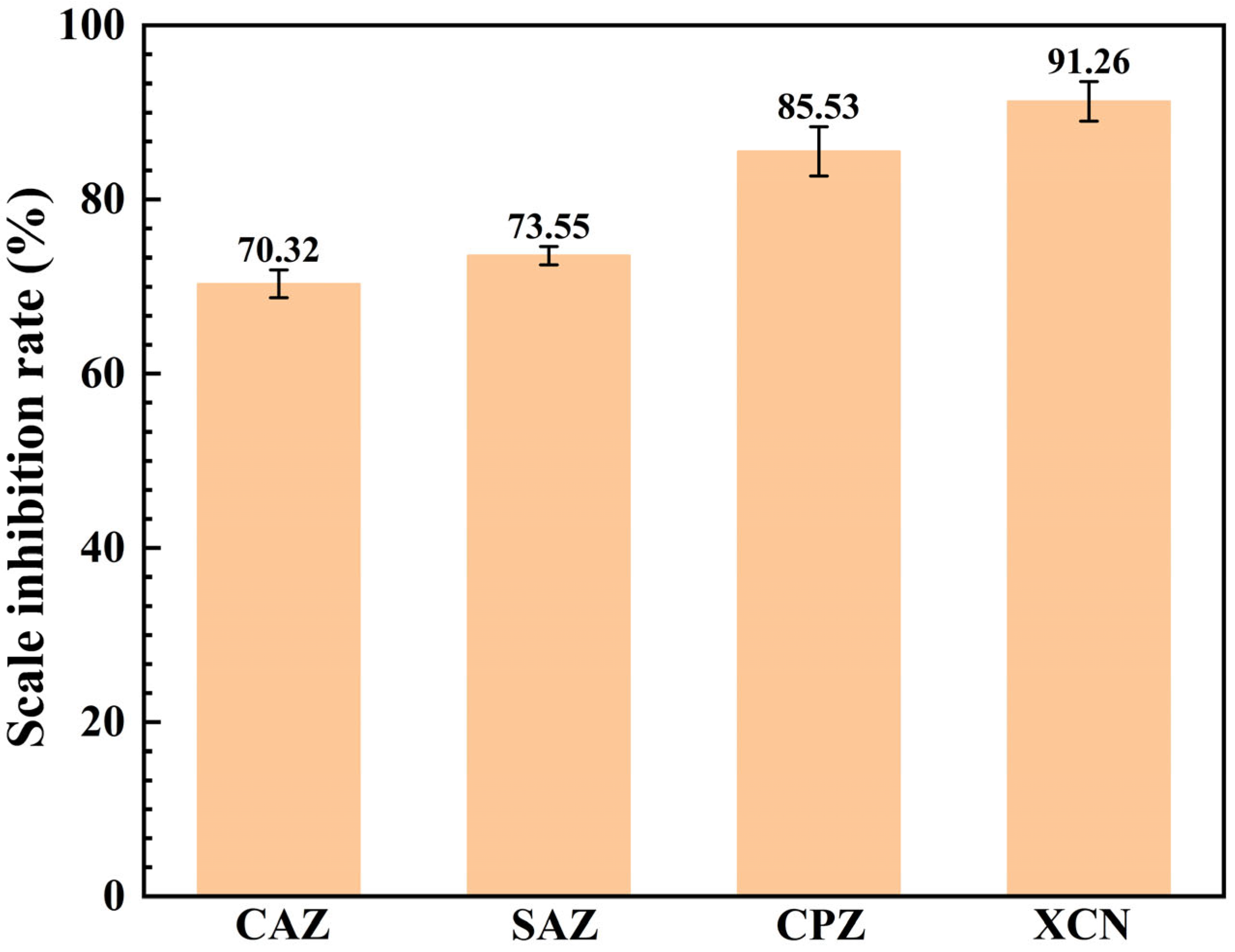
- A scale inhibitor with 91.26% efficiency was identified through static tests.
- Effects of concentration and temperature on adsorption of inhibitor were unraveled.
- Adsorption behavior was investigated using molecular dynamics simulations.
Abstract
1. Introduction
2. Experimental
2.1. Materials
2.2. Methods
2.2.1. Scale Inhibition Rate Test
2.2.2. Molecular Dynamics Simulations
- 1.
- We drew 3D molecular models of the XCN scale inhibitor and water molecule using ChemDraw, and imported them into Gaussian for structural optimization. Subsequently, we imported the optimized models into Materials Studio and performed further geometry optimization using the Smart algorithm in the Forcite module.
- 2.
- We imported the calcite unit cell from the Materials Studio crystal database (lattice parameters: a = b = 4.99 Å, c = 17.061 Å, α = β = γ = 90°) and cleaved the calcite (104) surface using the Build Surface task. Then, we built a supercell via the Symmetry task in the Build module, with the calcite (104) supercell dimensions of 24.29 Å in length and 14.97 Å in width.
- 3.
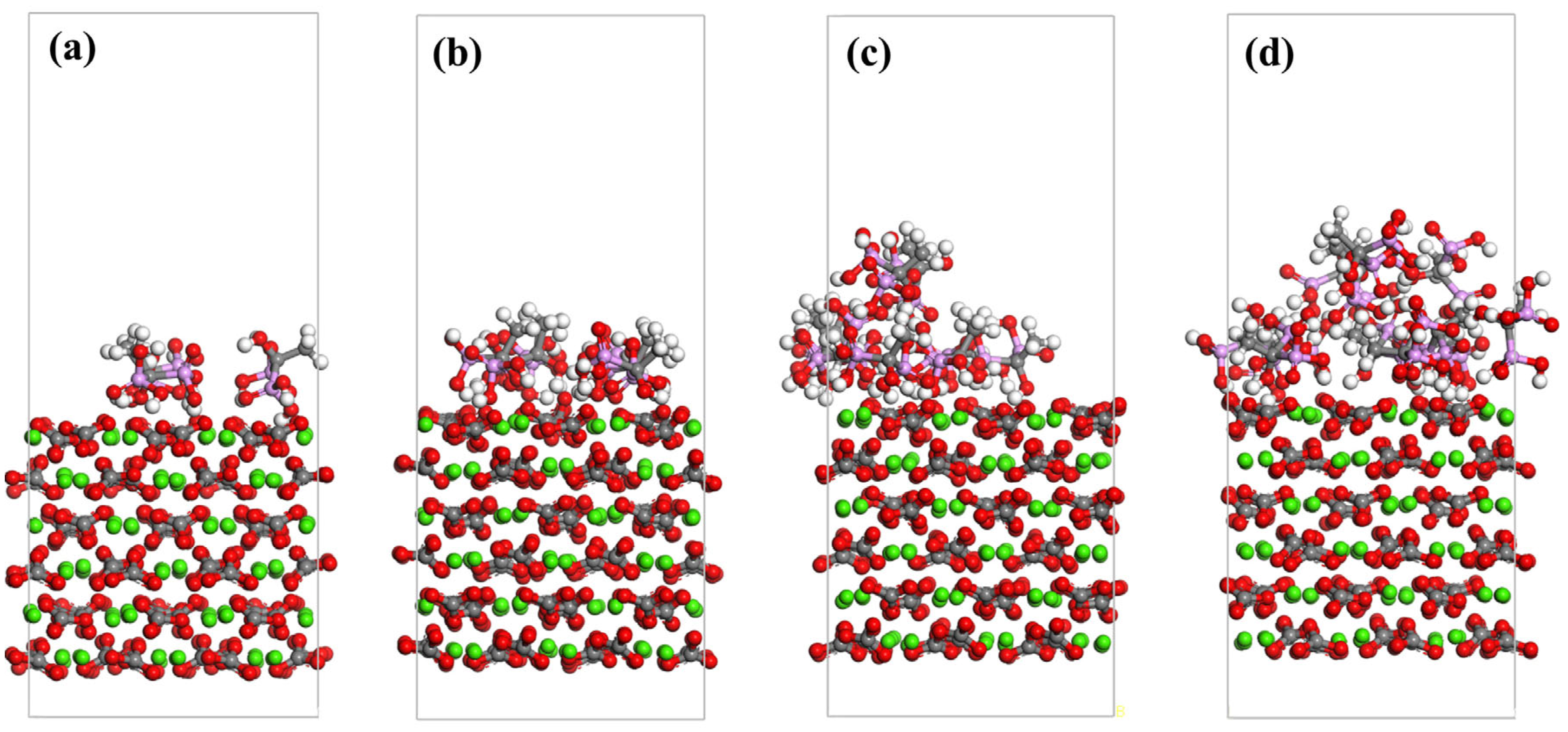
- We constructed solution layers of scale inhibitor at varying concentrations using the Amorphous Cell module, with the same length and width as the iron surface model. Each layer contained 1, 3, 6, and 9 XCN scale inhibitor molecules, respectively, along with 500 water molecules. The scale inhibitor molecules were randomly placed using the Monte Carlo method, and structural optimization was performed using the Geometry Optimization task in the Forcite module.
- 4.
- To eliminate solvent effects on the inhibitor’s performance, an anhydrous adsorption model was constructed by representing the aqueous environment with a dielectric constant. A vacuum layer of 20 Å was added above the calcite (104) surface, and the system was geometry-optimized to obtain the lowest-energy configuration.
- 5.
- MD simulations were conducted under the COMPASS II force field.
3. Results and Discussion
3.1. Screening and Evaluation of Scale Inhibitors
3.2. Effect of Concentration on Scale Inhibition Performance
3.3. Effect of Temperature on Scale Inhibition Performance
3.4. Effect of Concentration on the Adsorption of Scale Inhibitors
3.4.1. Determination of System Equilibrium
3.4.2. MD Simulation Results
3.5. Effect of Temperature on the Adsorption of Scale Inhibitors
3.5.1. Determination of System Equilibrium
3.5.2. MD Simulation Results
4. Conclusions
- (1)
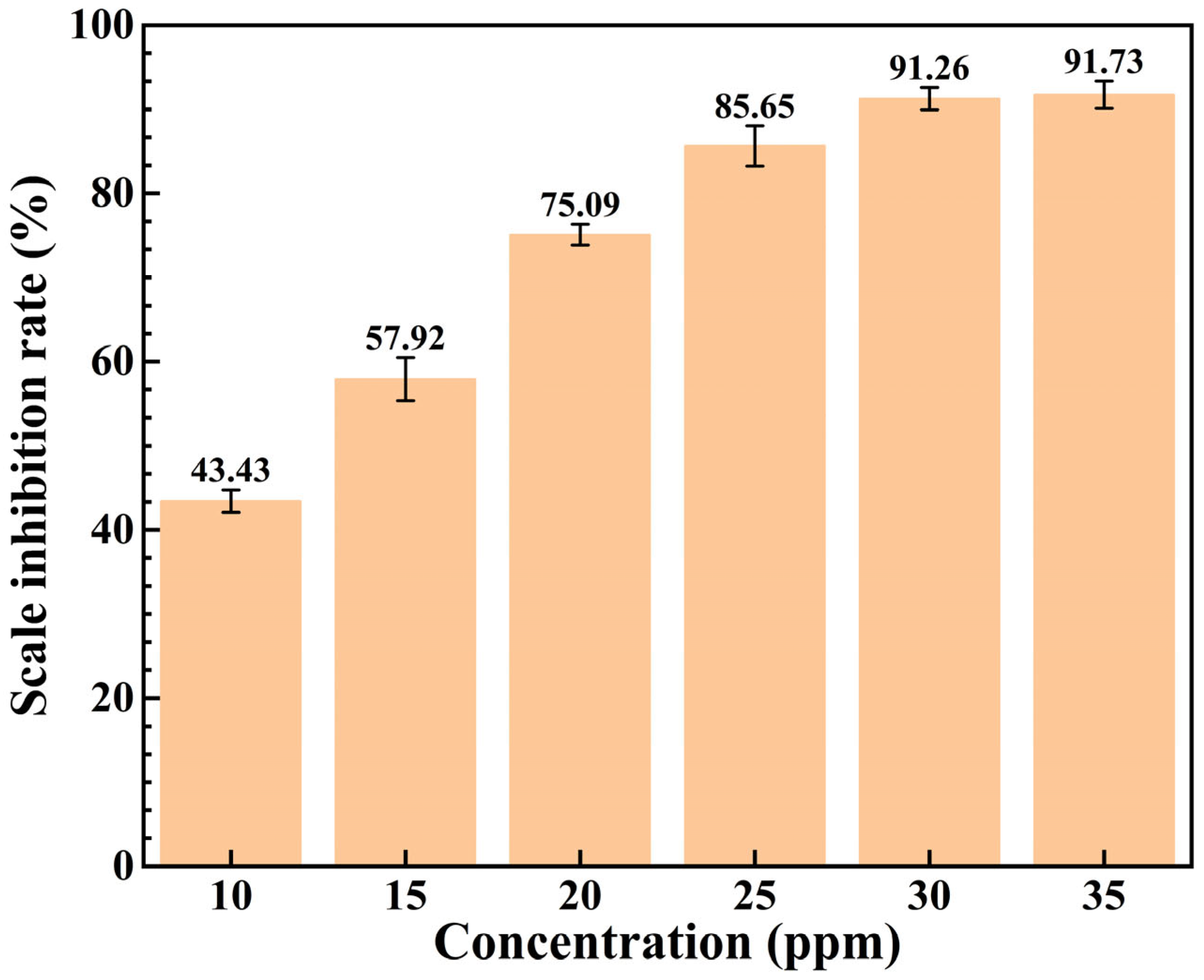
- At 60 °C, the scale inhibition rate of the XCN scale inhibitor reaches a threshold of 91.26% at a concentration of 30 ppm. A further increase in concentration to 35 ppm results in only a marginal improvement in rate.
- (2)
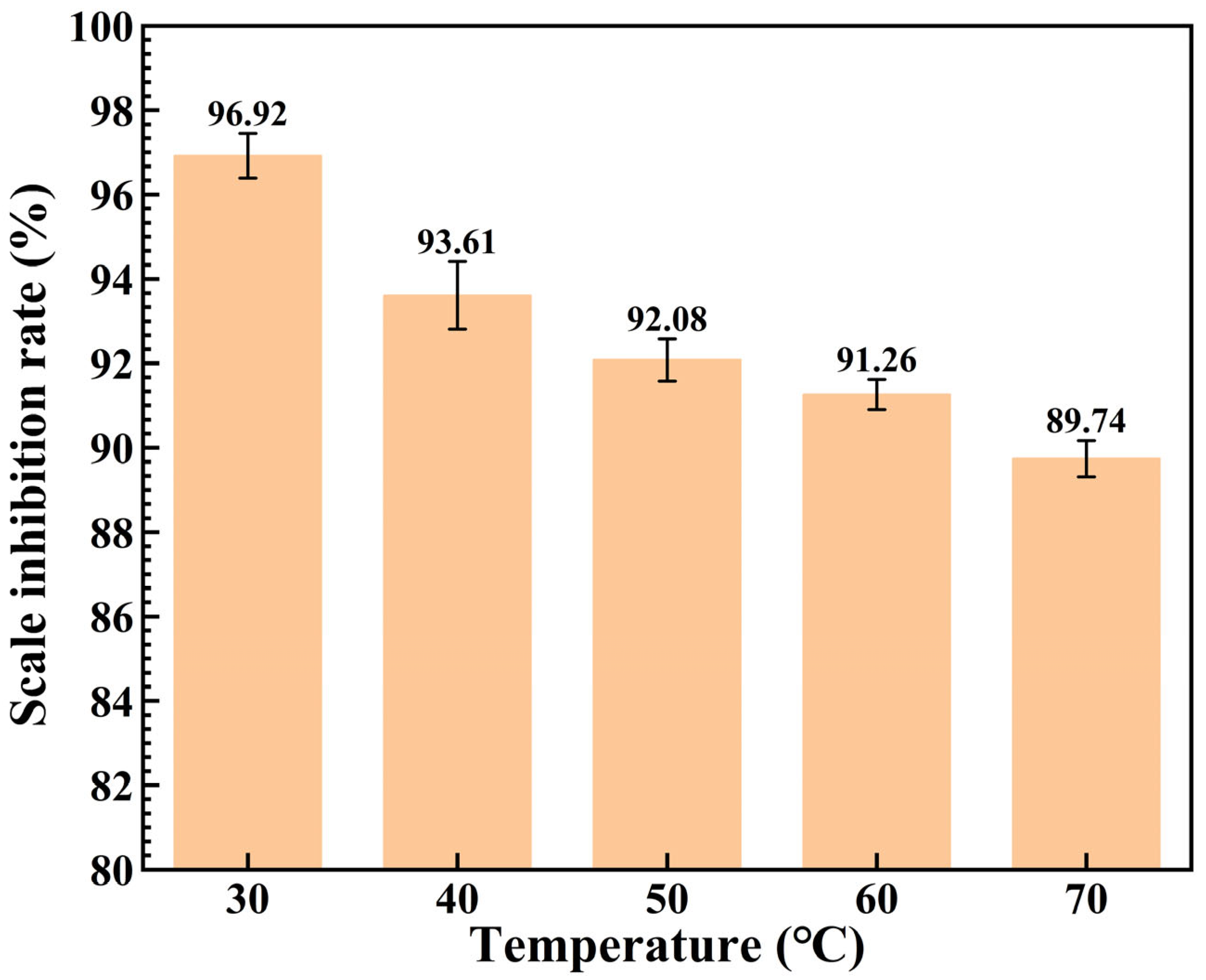
- The XCN scale inhibitor demonstrates excellent performance at 30 °C, achieving 96.92% rate at a concentration of 30 ppm. However, the results from static tests conducted across a temperature range of 30–60 °C show a consistent decline in inhibition rate with increasing temperature.
- (3)
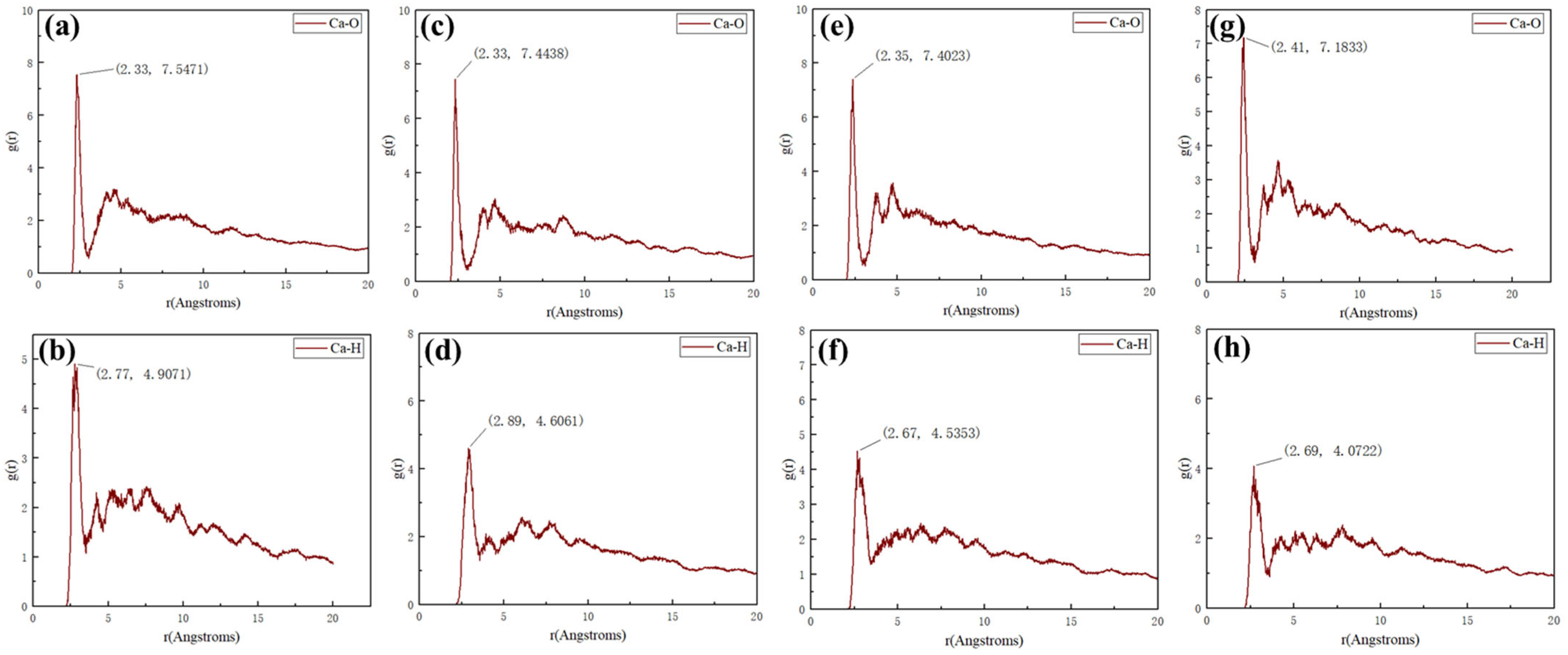
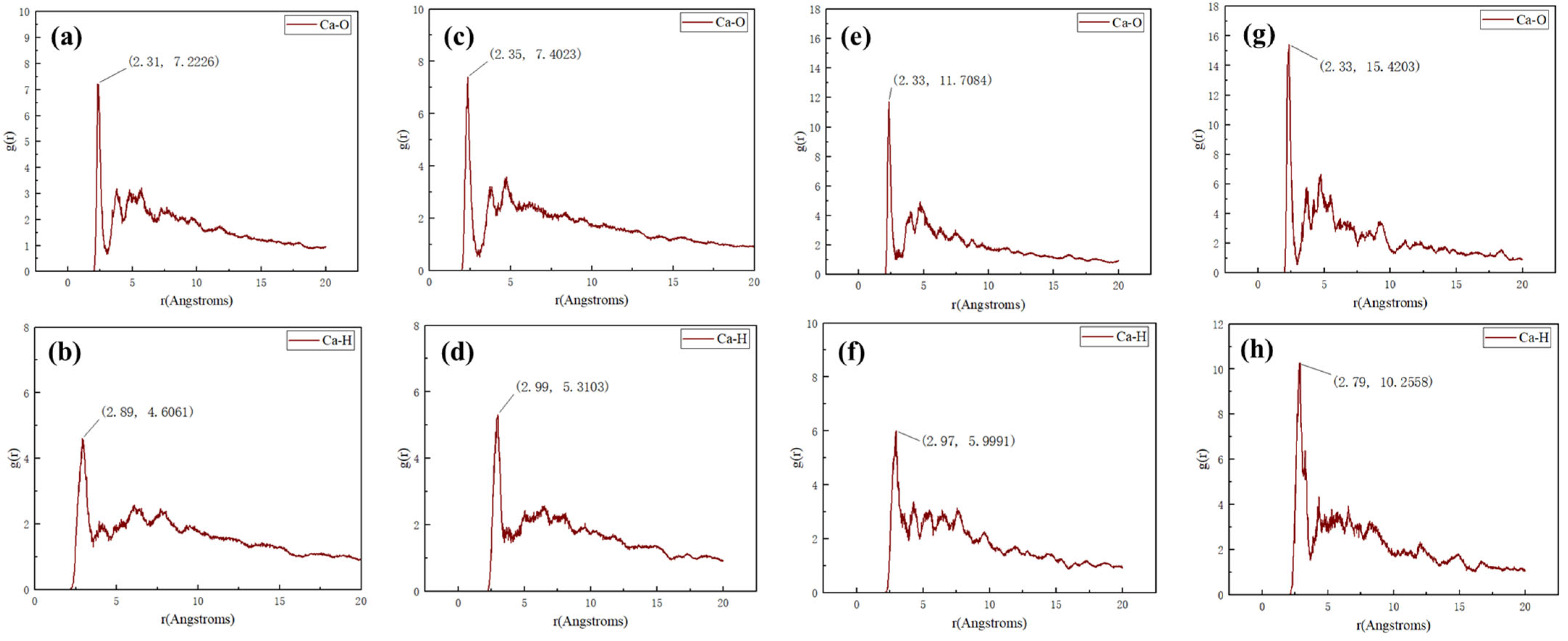
- The MD simulation results identify an optimal concentration for XCN’s scale inhibition. The bonding energy to calcite peaks at 437.0067 kJ/mol with nine molecules, after which it decreases, suggesting a saturation threshold. This non-monotonic trend points to competing effects: while increased concentration strengthens the collective interaction of O/H atoms with surface Ca2+ (as confirmed by RDF analyses), an excess leads to less favorable adsorption configurations. The primary inhibitory mechanism is attributed to chemical adsorption that induces severe lattice distortion and structural weakening.
- (4)
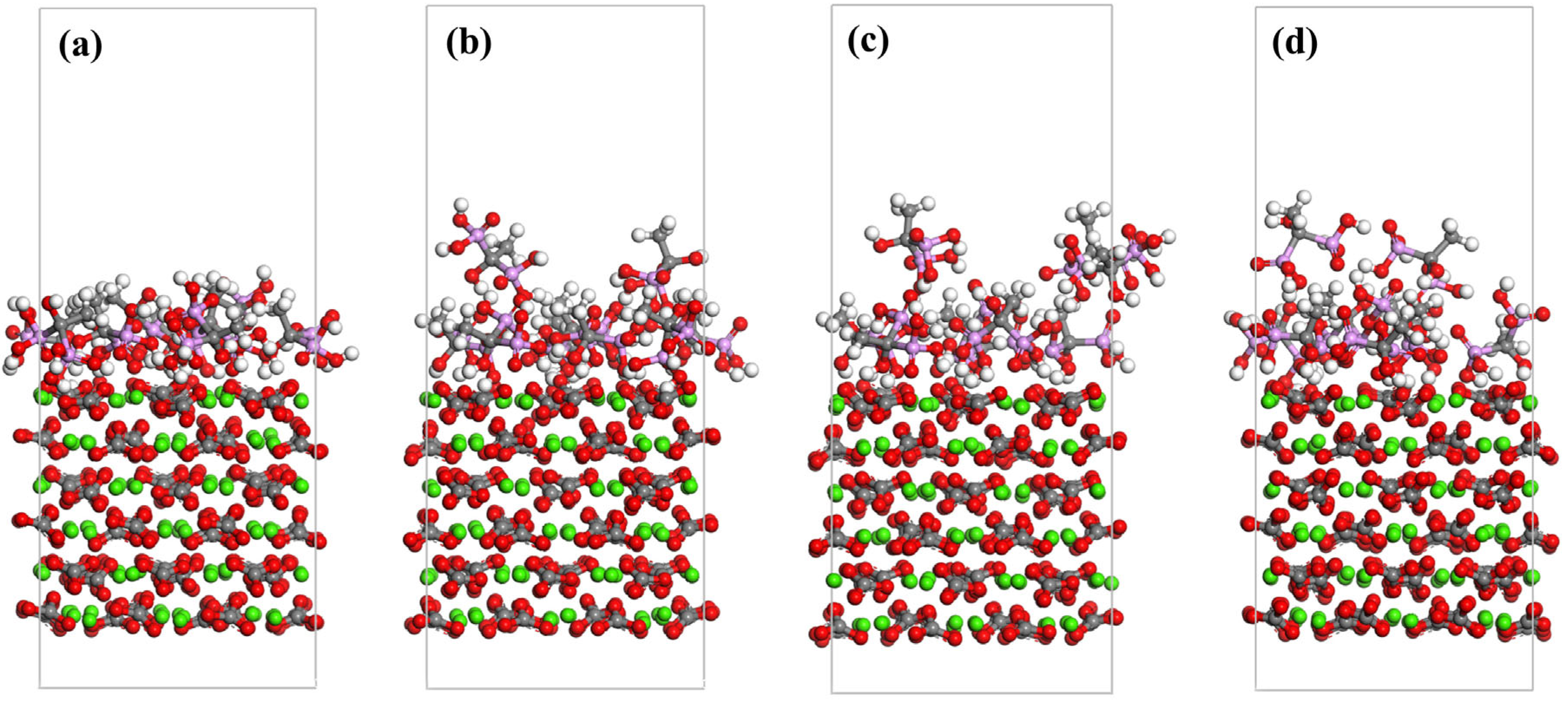
- The MD simulation results also demonstrate that elevated temperatures compromise the scale inhibition performance of XCN. While the inhibitor functions by lattice distortion and exhibits near-complete adsorption at 328 K, a temperature increase to 338 K triggers significant desorption. This is corroborated by RDF analyses, which shows a weakening of the Ca-O and Ca-H interactions critical for adsorption. The findings suggest that beyond its optimal bonding energy threshold (peaking at 437.0067 kJ/mol for nine molecules), thermal energy promotes desorption, likely due to entropic effects, leading to reduced scale inhibition efficiency.
Author Contributions
Funding
Institutional Review Board Statement
Informed Consent Statement
Data Availability Statement
Conflicts of Interest
References
- Li, J.; Tang, M.; Ye, Z.; Chen, L.; Zhou, Y. Scale formation and control in oil and gas fields: A review. J. Dispers. Sci. Technol. 2017, 38, 661–670. [Google Scholar] [CrossRef] [Scilit]
- Soprych, P.; Czerski, G. The Use of Biomass Ash as a Catalyst in the Gasification Process—A Review. Energies 2025, 18, 5653. [Google Scholar] [CrossRef] [Scilit]
- Wen, L.; Huang, W.; Zhang, Y.; Jiu, B.; Yan, D.; Hao, R.; Hao, H. Mineralogy and Geochemistry of Rare Earth Elements in Carboniferous-Permian Coals at the Eastern Margin of the Ordos Basin. ACS Omega 2024, 9, 32481–32501. [Google Scholar] [CrossRef] [Scilit] [PubMed]
- Kamal, M.S.; Hussein, I.; Mahmoud, M.; Sultan, A.S.; Saad, M.A. Oilfield scale formation and chemical removal: A review. J. Pet. Sci. Eng. 2018, 171, 127–139. [Google Scholar] [CrossRef] [Scilit]
- Husna, U.Z.; Elraies, K.A.; Shuhili, J.A.B.; Elryes, A.A. A review: The utilization potency of biopolymer as an eco-friendly scale inhibitors. J. Pet. Explor. Prod. Technol. 2022, 12, 1075–1094. [Google Scholar] [CrossRef] [Scilit]
- Nanda, D.; Behera, D.; Pattnaik, S.S.; Behera, A.K. Advances in natural polymer-based hydrogels: Synthesis, applications, and future directions in biomedical and environmental fields. Discov. Polym. 2025, 2, 6. [Google Scholar] [CrossRef] [Scilit]
- Jiang, J.; Feng, Q.; Guo, P.; Shi, L.; Zhang, Y. DL-Methionine-Mediated PET-RDRP: A Route to Low-Molecular-Weight Polyacrylic Acid for Effective Scale Inhibition. J. Appl. Polym. Sci. 2025, 143, e58014. [Google Scholar] [CrossRef] [Scilit]
- Peronno, D.; Cheap-Charpentier, H.; Horner, O.; Perrot, H. Study of the inhibition effect of two polymers on calcium carbonate formation by fast controlled precipitation method and quartz crystal microbalance. J. Water Process. Eng. 2015, 7, 11–20. [Google Scholar] [CrossRef] [Scilit]
- Khormali, A.; Ahmadi, S. Trends in using organic compounds as scale inhibitors: Past, present, and future scenarios. In Industrial Scale Inhibition: Principles, Design, and Applications; Wiley: Hoboken, NJ, USA, 2024; pp. 188–205. [Google Scholar]
- Jafar Mazumder, M.A. A review of green scale inhibitors: Process, types, mechanism and properties. Coatings 2020, 10, 928. [Google Scholar] [CrossRef] [Scilit]
- Huang, H.; Yao, Q.; Chen, H.; Liu, B. Scale inhibitors with a hyper-branched structure: Preparation, characterization and scale inhibition mechanism. RSC Adv. 2016, 6, 92943–92952. [Google Scholar] [CrossRef] [Scilit]
- Xiao, Y.; Ren, D.; Liu, T.; Wang, Z.; Ruan, M.; Xu, J.; Zhang, S.; Zhang, X.; Gong, X.; Chen, W. Research on the Mechanism of Scale Inhibitors and Development of Enhanced Scale Inhibition Technology. J. Appl. Polym. Sci. 2025, 142, e57652. [Google Scholar] [CrossRef] [Scilit]
- Zhang, M.-L.; Ruan, Z.; Han, Y.; Cao, Z.-W.; Zhao, L.; Xu, Y.-Q.; Cao, Z.-Y.; Shi, W.-Y.; Xu, Y. Controllable synthesis of polyaspartic acid: Studying into the chain length effect for calcium scale inhibition. Desalination 2024, 570, 117080. [Google Scholar] [CrossRef] [Scilit]
- Tian, X.; Zhu, Y.; Huang, X.; Liu, Y.; Gao, G.; Ai, Q.; Chen, M.T.; Weng, X.; Feng, Y.; Zhang, B. Temperature-Responsive Polymer Grafted Carbon Nanotubes for Active Control of Mineral Scaling. ACS Nano 2025, 19, 21506–21514. [Google Scholar] [CrossRef] [Scilit]
- Jalab, R.; Saad, M.A.; Hussein, I.A.; Onawole, A.T. Calcite scale inhibition using environmental-friendly amino acid inhibitors: DFT investigation. ACS Omega 2021, 6, 32120–32132. [Google Scholar] [CrossRef] [Scilit] [PubMed]
- SY/T 5673-2020; General Technical Conditions of Scale Inhibitor for Oil Fields. The Standards Press of China: Beijing, China, 2020.
- GB/T 7476-1987; Water Quality–Determination of Calcium–EDTA Titrimetric Method. The Standards Press of China: Beijing, China, 1987.
- Bahlakeh, G.; Ramezanzadeh, B. A detailed molecular dynamics simulation and experimental investigation on the interfacial bonding mechanism of an epoxy adhesive on carbon steel sheets decorated with a novel cerium–lanthanum nanofilm. ACS Appl. Mater. Interfaces 2017, 9, 17536–17551. [Google Scholar] [CrossRef] [Scilit]
- Bahlakeh, G.; Ramezanzadeh, B.; Saeb, M.R.; Terryn, H.; Ghaffari, M. Corrosion protection properties and interfacial adhesion mechanism of an epoxy/polyamide coating applied on the steel surface decorated with cerium oxide nanofilm: Complementary experimental, molecular dynamics (MD) and first principle quantum mechanics (QM) simulation methods. Appl. Surf. Sci. 2017, 419, 650–669. [Google Scholar] [CrossRef] [Scilit]
- Wang, D.; Li, S.; Ying, Y.; Wang, M.; Xiao, H.; Chen, Z. Theoretical and experimental studies of structure and inhibition efficiency of imidazoline derivatives. Corros. Sci. 1999, 41, 1911–1919. [Google Scholar] [CrossRef] [Scilit]
- Zhang, Z.; Tian, N.; Huang, X.; Shang, W.; Wu, L. Synergistic inhibition of carbon steel corrosion in 0.5 M HCl solution by indigo carmine and some cationic organic compounds: Experimental and theoretical studies. RSC Adv. 2016, 6, 22250–22268. [Google Scholar] [CrossRef] [Scilit]
- Wang, H.; Hu, J.; Yang, Z.; Yin, Z.; Xiong, Q.; Zhong, X. The study of a highly efficient and environment-friendly scale inhibitor for calcium carbonate scale in oil fields. Petroleum 2021, 7, 325–334. [Google Scholar] [CrossRef] [Scilit]
- Khamis, E.; Abd-El-Khalek, D.; Fawzy, M.; Soliman, K.A.; Abdel-Gaber, A.; Anwar, J. Innovative application of green surfactants as eco-friendly scale inhibitors in industrial water systems. Sci. Rep. 2024, 14, 28073. [Google Scholar] [CrossRef] [Scilit]
- Solmaz, R.; Salci, A.; Dogrubas, M.; Dursun, Y.A.; Kaya, S.; Berisha, A.; Kardas, G. Comprehensive experimental and theoretical study on the adsorption and corrosion inhibition efficiency of Pyronin B for mild steel protection in HCl solution. J. Phys. Chem. C 2024, 128, 21809–21825. [Google Scholar] [CrossRef] [Scilit]
- Luo, F.; Yao, P.; Zhang, J.; Li, E. Alkyl pyridine ionic liquid as a green corrosion inhibitor for mild steel in acidic medium. RSC Adv. 2025, 15, 27369–27387. [Google Scholar] [CrossRef] [Scilit]
- Luzar, A.; Chandler, D. Effect of environment on hydrogen bond dynamics in liquid water. Phys. Rev. Lett. 1996, 76, 928. [Google Scholar] [CrossRef] [Scilit]
- Lin, C.; Liu, L.; Liu, Y.; Leng, J. The compatibility of polylactic acid and polybutylene succinate blends by molecular and mesoscopic dynamics. Int. J. Smart Nano Mater. 2020, 11, 24–37. [Google Scholar] [CrossRef] [Scilit]
- Chen, D.; Shen, Y.; Liu, W.C.; Xiao, Y.; Li, Y. Mechanisms of Calcium Carbonate Scaling Regulated by Single and Multi-Ion Interactions: Insights from Experiments and Molecular Dynamics Simulations. J. Environ. Chem. Eng. 2025, 13, 117723. [Google Scholar] [CrossRef] [Scilit]





| Solution | Composition |
|---|---|
| A | NaCl: 41.25 g/L, CaCl2·2H2O: 15.19 g/L, MgCl2·6H2O: 4.60 g/L |
| B | NaCl: 41.25 g/L, NaHCO3: 9.20 g/L, Na2SO4: 0.04 g/L |
| Number | Etotal | Esi | Esf | Eads |
|---|---|---|---|---|
| 3 | −82,802.7227 ± 10.0126 | −10.3995 ± 2.5342 | −82,561.5111 ± 15.2540 | −230.8120 ± 7.7756 |
| 6 | −83,070.3980 ± 16.0875 | −59.1926 ± 13.3502 | −82,594.8501 ± 10.5246 | −416.3553 ± 7.7873 |
| 9 | −83,223.9265 ± 12.5302 | −177.0292 ± 10.4508 | −82,609.8906 ± 16.0972 | −437.0067 ± 14.0178 |
| 12 | −83,373.7164 ± 20.4052 | −387.4245 ± 15.8253 | −82,595.8939 ± 18.3851 | −390.3980 ± 13.8052 |
| Temperature (K) | Etotal | Esi | Esf | Eads |
|---|---|---|---|---|
| 328 | −83,181.4725 ± 9.2547 | −174.6102 ± 11.3094 | −82,561.0586 ± 12.5358 | −445.8037 ± 14.5905 |
| 338 | −83,104.5062 ± 10.5042 | −187.6949 ± 15.2553 | −82,501.2341 ± 12.0537 | −415.5772 ± 16.8048 |
| 348 | −83,087.4232 ± 20.5842 | −192.4931 ± 10.6358 | −82,498.5686 ± 15.8265 | −396.3615 ± 5.8781 |
| 358 | −83,001.2867 ± 18.876 | −205.2975 ± 14.6358 | −82,463.5723 ± 10.8074 | −332.4169 ± 6.5672 |
Disclaimer/Publisher’s Note: The statements, opinions and data contained in all publications are solely those of the individual author(s) and contributor(s) and not of MDPI and/or the editor(s). MDPI and/or the editor(s) disclaim responsibility for any injury to people or property resulting from any ideas, methods, instructions or products referred to in the content. |
© 2026 by the authors. Licensee MDPI, Basel, Switzerland. This article is an open access article distributed under the terms and conditions of the Creative Commons Attribution (CC BY) license.
Share and Cite
Wu, H.; Zhang, B.; Yang, Y.; Sun, T.; Zhang, S.; Yang, Z.; Huang, K.; Tang, J.; Xiang, G. Unraveling the Effects of Concentration and Temperature on the Molecular Dynamics Adsorption of a Phosphonic Acid Scale Inhibitor. Coatings 2026, 16, 42. https://doi.org/10.3390/coatings16010042
Wu H, Zhang B, Yang Y, Sun T, Zhang S, Yang Z, Huang K, Tang J, Xiang G. Unraveling the Effects of Concentration and Temperature on the Molecular Dynamics Adsorption of a Phosphonic Acid Scale Inhibitor. Coatings. 2026; 16(1):42. https://doi.org/10.3390/coatings16010042
Chicago/Turabian StyleWu, Hongjun, Bao Zhang, Yi Yang, Tao Sun, Shiling Zhang, Zhongwu Yang, Kun Huang, Jiaxin Tang, and Guangguang Xiang. 2026. "Unraveling the Effects of Concentration and Temperature on the Molecular Dynamics Adsorption of a Phosphonic Acid Scale Inhibitor" Coatings 16, no. 1: 42. https://doi.org/10.3390/coatings16010042
APA StyleWu, H., Zhang, B., Yang, Y., Sun, T., Zhang, S., Yang, Z., Huang, K., Tang, J., & Xiang, G. (2026). Unraveling the Effects of Concentration and Temperature on the Molecular Dynamics Adsorption of a Phosphonic Acid Scale Inhibitor. Coatings, 16(1), 42. https://doi.org/10.3390/coatings16010042