Article

Underwater Performance of Eco-Friendly Choline-Based Ionic Liquid Coatings Applied on Stone Surfaces


1
Calabria Marine Centre, Stazione Zoologica Anton Dohrn—CRIMAC, C. da Torre Spaccata, 87071 Amendolara, Italy
2
Department of Chemical Biological, Pharmaceutical and Environmental Sciences, University of Messina, Viale F. Stagno d’Alcontres, 31, 98166 Messina, Italy
3
Department of Integrative Marine Ecology, Stazione Zoologica Anton Dohrn, Villa Comunale, 80121 Naples, Italy
4
National Biodiversity Future Center, Piazza Marina 61, 90133 Palermo, Italy
5
Department of Biology and Evolution of Marine Organisms, Sicily Marine Centre, Stazione Zoologica Anton Dohrn, c/o Villa Pace, Contrada Porticatello 29, 98167 Messina, Italy
6
National Institute for Environmental Protection and Research, Via dei Mille 46, 98057 Milazzo, Italy
7
University of Gastronomic Sciences, Piazza Vittorio Emanuele 9, Pollenzo, 12060 Bra, Italy
8
Department of Integrative Marine Ecology, Calabria Marine Centre, Stazione Zoologica Anton Dohrn—CRIMAC, C. da Torre Spaccata, 87071 Amendolara, Italy
9
Department of Biology, Ecology and Earth Sciences, University of Calabria, Via P. Bucci Cubo 12 B, 87036 Arcavacata di Rende, Italy
10
Department of Ecosustainable Marine Biotechnology, Stazione Zoologica Anton Dohrn, Via Acton, 55, 80133 Naples, Italy
11
Department of Ecosustainable Marine Biotechnology, Calabria Marine Centre, Stazione Zoologica Anton Dohrn—CRIMAC, C. da Torre Spaccata, 87071 Amendolara, Italy
*
Authors to whom correspondence should be addressed.
These authors contributed equally to this work.
Coatings 2026, 16(1), 136; https://doi.org/10.3390/coatings16010136
Submission received: 6 December 2025 / Revised: 14 January 2026 / Accepted: 16 January 2026 / Published: 20 January 2026

Abstract

In the marine environment, numerous factors endanger the preservation of underwater rock surfaces as well as submerged archeological artifacts, including physical, chemical, and biological processes. Limestone and marble are common materials used in artifacts due to their availability and long-term durability. However, such surfaces provide a suitable substrate for the settlement of micro- and macro-organisms, causing so-called biofouling, which significantly contributes to stone deterioration. Previous studies have demonstrated the applicability of antifouling coatings containing ionic liquids (ILs) on marble surfaces and assessed their durability for up to 15 days under submerged environments. To further corroborate these results, additional physical studies (colorimetric, contact angles, capillarity water absorption measurements, and UV aging) were carried out on treated limestone. Washout tests were also performed on both lithotypes to verify the coatings’ stability under medium-term underwater exposures. The results of these investigations are reported here. Our data confirm that the application of IL-based coatings had no effect on the intrinsic properties of the limestone surfaces, as previously reported for marble, including resistance to daily UV irradiation. In addition, laboratory tests demonstrated good coating durability against seawater erosive action for up to 6 months.

1. Introduction

Marine biofouling is the main driver of biodeterioration, as it leads to surface damage through microbial adhesion, biofilm formation, and consequent macrofouling problems [1]. Over time, this phenomenon results in structural weakening, and in the case of cultural heritage items, in the loss of readability of the artifacts [2]. The rate of biodeterioration depends not only on environmental factors, but also on intrinsic substrate properties, such as porosity, texture, mineral composition, and mechanical strength [3].
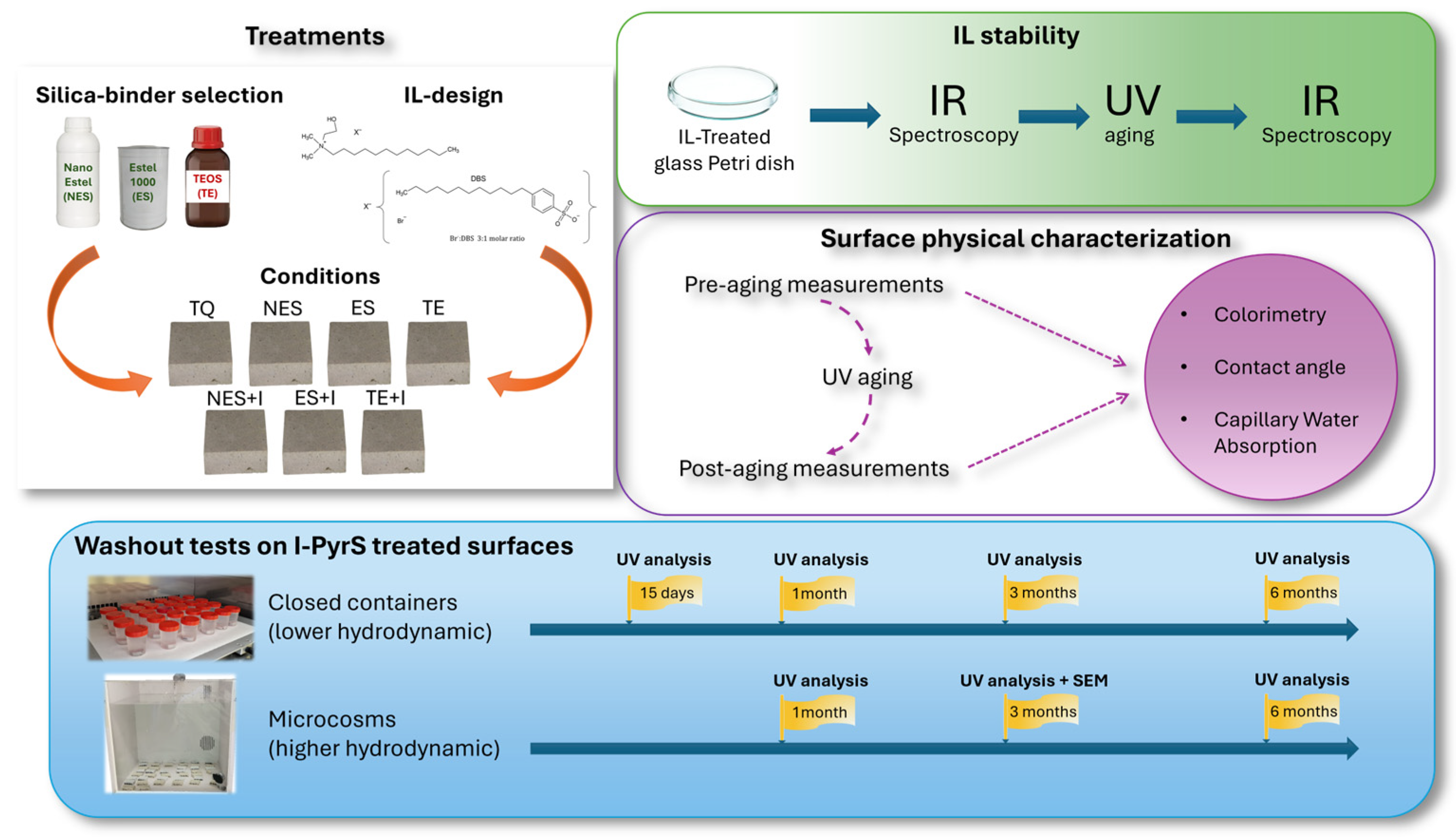
In response to these challenges, research has increasingly focused on the development of eco-sustainable antifouling coatings for underwater rocks and stone cultural heritage. Despite growing interest, there are currently no standardized or protocol-based studies assessing the effectiveness and durability of antifouling coatings, which highlights the need for novel experimental solutions. Among the emerging solutions, ionic liquids (ILs) are particularly promising due to their tunable physicochemical and biological properties [4,5,6,7]. ILs combine very low volatility, thermal and chemical stability, conductivity, high heat capacity, low melting point (<100 °C), and remarkable electrochemical potential [8,9,10]. Their ionic nature also makes them manageable during synthetic production and highly versatile for a wide range of applications [11]. The bioactive potential is related to their amphiphilic property, which facilitates interactions with microbial membranes, interfering with biological processes and contributing to their antimicrobial efficacy [12,13]. Recent studies have led to the development of surface-active ionic liquids (SA-ILs), incorporating cholinium-based cations and surfactant anions such as Dodecylbenzenesulfonate (DBS) or halides [14]. When used in combination with nanosilica-based consolidants, SA-ILs have been shown to significantly reduce microbial adhesion and biofilm formation on stone surfaces. Moreover, cholinium cations bonded to bromide and Dodecylbenzenesulfonate (DBS) anions in a 3:1 (IL) molar ratio exhibited remarkable antimicrobial activity. Choline, a B-complex vitamin nutrient, and bromide and DBS, generally considered eco-friendly at low concentrations, make this formulation a promising candidate for the development of multifunctional eco-sustainable coatings [15]. Our previous studies confirmed that the inclusion of ionic components with surfactant properties enhances the antimicrobial performance and revealed good applicability on marble probes and durability when applied to marble surfaces exposed to the aquatic environment [16]. Here, we present the physicochemical investigations of porous limestone surfaces treated with different silica@IL formulations. The experimental design is shown in Figure 1. Compared with marble, limestone exhibits higher porosity, which can significantly influence the performance of surface coatings due to differences in absorption and retention behavior. We also evaluate the medium-term durability of this IL-based coating against key deterioration agents typical of the underwater environment, on both lithotypes. In our study, short-term (15 days) and mid-term (6 months) timings were defined, considering that long-term investigations typically refer to exposures lasting a full year and encompassing all seasonal variations.

2. Materials and Methods

2.1. Experimental Material

San Lucido limestone (from Calabria, Italy) and Carrara marble were used as stone substrates. Both materials, from a mineralogical perspective, were mainly composed of calcite. The marble surfaces appeared homogenous with a low porosity (about 2%), whereas the limestone had higher accessible porosity (about 17%) and contained a small fraction of dolomites (<2%) [17]. The total number of samples was calculated based on the number of experimental conditions, with three replicates per condition for each test performed. Only limestone specimens were subjected to physical characterization, since surface analysis of the treated marble with IL had been carried out in our previous studies [16]. Before treatment, all specimens were cleaned by brushing with bi-distilled water, and dried in an oven for 24 h at 80 °C.

2.2. Application of Coatings on Stone Probes

Limestone specimens (5 cm × 5 cm × 2 cm) were characterized before and after the application of three different coatings: two IL–consolidant bilayer treatments, consisting of a first layer of silica-based consolidant, Nano Estel (NES) or Estel 1000 (ES) (CTS srl, Altavilla Vicentina, Italy); and one monolayer treatment made of tetraethyl orthosilicate (TEOS, Sigma-Aldrich, USA) mixed with IL, composed of a mixture of N-(2-Hydroxyethyl)-N,N-Dimethyl-1-Dodecanaminium cations and bromide and DBS anions in a 3:1 molar ratio.
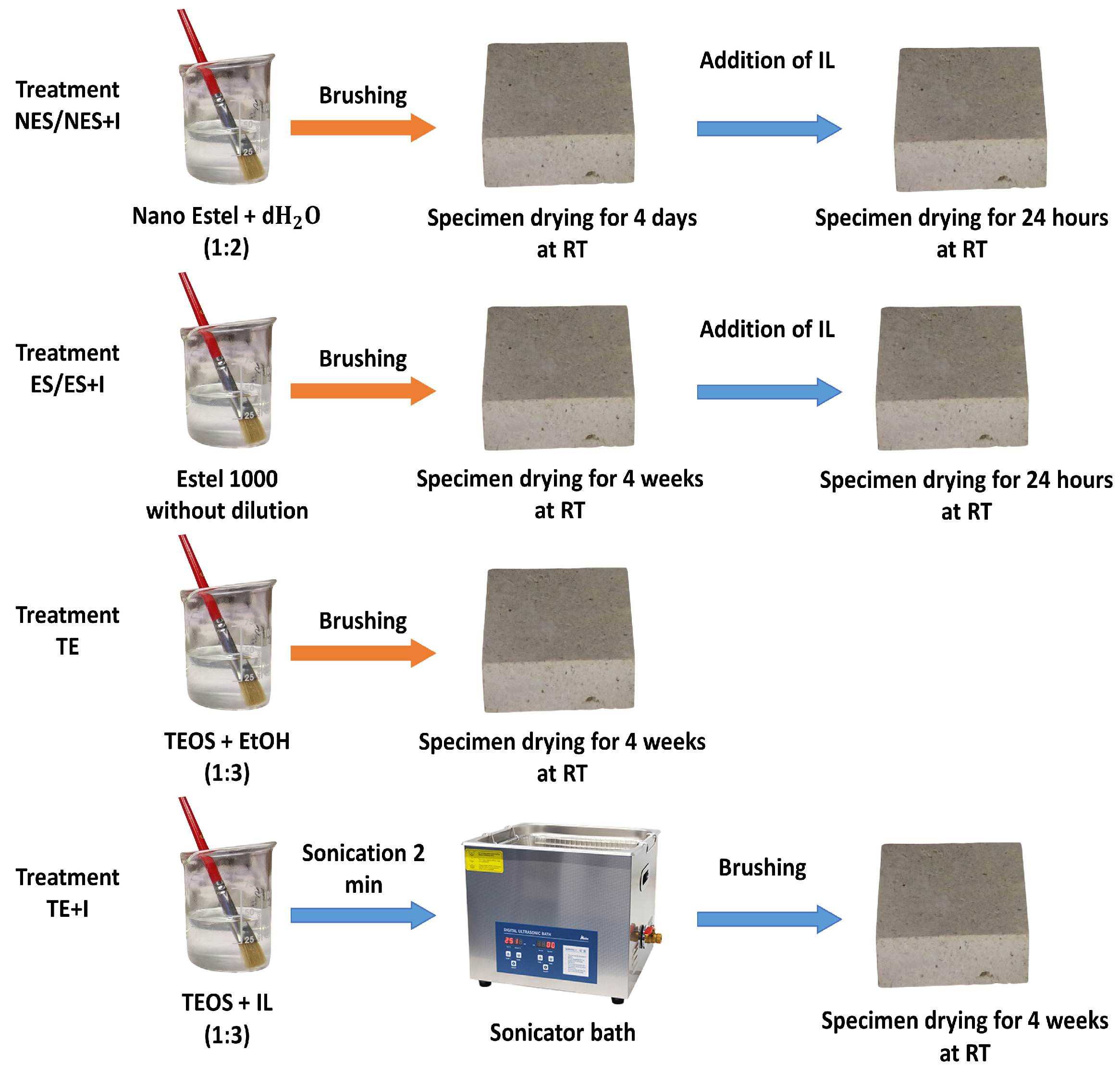
NES and ES coatings were applied by making two consecutive brush applications and left to dry at room temperature for the time recommended by the producers (NES setting time 4 days, ES setting time 4 weeks). After drying, IL was applied to the pre-treated specimens in the same way and left to dry at room temperature for 24 h (NES+I; ES+I). Concerning the monolayer treatment, 69 mL of IL (0.0375 M in CH3OH) was added to 31 mL of TEOS (TE+I). The resulting mixture was sonicated for 2 min and then applied to the stone surfaces by two consecutive brush applications. Absolute ethanol was added instead of IL on the control surfaces. Treated surfaces were left to dry at room temperature for 4 weeks according to the manufacturer’s specifications. Figure 2 schematized the bare and IL–consolidant bilayer/monolayer application. This procedure, as well as the amount of each product, have been setup in our previous research [14,16].
Limestone and marble specimens tested for durability under submerged conditions were treated with silica-based coatings containing the IL Pyrene-1-sulfonate derivative (I-PyrS) according to the procedure adopted in our previous study [16]. The resulting mixture was used to trace the distribution and presence of IL on the surfaces, as the product emits fluorescence under UV light. Table 1 summarizes the treatments.

2.3. Physical Characterization of Limestone Probes

Any changes in treated limestone surfaces were compared to the untreated ones by evaluating variations in color, hydrophobicity, and absorption. All the tests were performed before any treatment, after treatment, and after induced aging.
Colorimetric measurements were carried out in accordance with the guidelines provided by UNI EN ISO/CIE 11664-4:2019 [18]. Measurements were carried out at 5 points per surface using a ZL 310 colorimeter, which provides L*, a*, and b* CIE-Lab coordinates. L* is the brightness index (0 = absolute black, 100 = absolute white), while a* and b* are chromaticity coordinates (a* ranges from green (a* < 0) to red (a* > 0); b* ranges from blue (b* < 0) to yellow (b* > 0)). Color variation of the surfaces was calculated using the following formula:
E = L * 2 + a * 2 + b * 2
The ΔE values obtained for replicates of the same condition were averaged, and the standard deviation was calculated and reported in the graphs.
Contact angle tests were carried out to evaluate the degree of hydrophilicity/hydrophobicity of the treated surfaces. Measurements were performed using the LSA Surface Analyzer System (LAUDA Scientific, Germany), according to the regulatory standard of static contact angle measurement [19]. The contact angle measurement was taken at 5 points on the surface of each sample to represent the behavior of the entire surface. The average value of the measurements was in turn averaged with the average value obtained from the replicates of the same condition. This resulted in a single value and standard deviation for each condition tested.
Capillary water absorption tests were carried out according to UNI EN 15801:2010 [20]. A 1 cm thick layer of absorbent paper was placed in the bottom of a container and saturated with demineralized water. The specimens were weighed, placed on the wetted support with the test surface in contact with the paper, and subsequently weighed after 10, 20, 30, and 60 min, and after 4, 6, 24, 48, 72, and 96 h. The test was stopped after 5 days, when specimens showed saturation. Water absorption (Qi) at time ti was calculated as follows:
Q i = m i m 0 A
where mi is the specimen mass at time ti, m0 is the initial dry mass, and A is the surface area in contact with water. Qi values from replicate specimens were averaged, and the standard deviation was calculated.
UV aging tests were performed by placing specimens in a SUNTEST XLS+ chamber (ATLAS, USA), and exposing them to an artificial daylight fluorescent lamp, emitting visible and UV radiation (λ = 300–800 nm, irradiance = 500 W m−2) for 507 h at 35 °C. This time of exposure was chosen to check the eventual early stages of degradation of the coating. The parameters correspond to an integrated radiant dose of about 2.5 × 10² kWh m−2. When compared with the average daily global solar irradiation in Southern Italy (≈4.5–5 kWh m−2 day−1) [21], this exposure is roughly equivalent to about 50–55 days of outdoor sunlight in Southern Italy. This equivalence, however, is based solely on the integrated radiant energy and does not consider differences in spectral distribution, angle of incidence, or natural day–night and climatic cycles. Furthermore, the coatings investigated in this study are intended for underwater applications, where both UV and visible radiation are strongly attenuated by the water column; consequently, the same laboratory dose would correspond to a much longer period of natural exposure in real marine environments. In addition, the physicochemical behavior of the coatings may differ simply because they are in permanent contact with water, which can influence photochemical reactions, diffusion processes, and degradation mechanisms.

2.4. Coatings Stability

The stability of the IL coating was verified by IR spectroscopy. The investigation was carried out at the end of the coating setting time and after UV aging. Glass Petri dishes (70 mm in diameter) were washed with acetone and left to dry under a hood at room temperature. The dish surfaces were then covered with IL by brush, applying the same amount of coating used for limestone treatment. The dishes were left to dry under a hood overnight and then subjected to artificial daylight irradiation in a SUNTEST XLS+ chamber (ATLAS, USA), under the same parameters used for UV aging of treated stone specimens. At the end of exposure, part of the coating was scratched from the surface and analyzed by IR spectroscopy. The spectrophotometer used was a Perkin Elmer Spectrum 100 (Perkin Elmer, USA), equipped with an attenuated total reflectance (ATR) accessory. Infrared spectra were recorded in ATR mode, in the range of 500–4000 cm−1, with a resolution of 4 cm−1.

2.5. Coating Durability Under Submerged Conditions

Coating durability was evaluated through washout tests [16] over a period of 6 months under two different conditions: small and closed containers with sterile seawater (lower volume and hydrodynamic erosive force) and closed-system microcosms (higher volumes and hydrodynamic erosive force).
For the experiments in sterile seawater, treated specimens were sterilized under UV, placed individually inside 120 mL screw-cap sterile containers, and filled with 80 mL of sterilized seawater. The systems were incubated in a thermostatic shaker incubator at 20 °C with a rotation speed of 100 r/min. At increasing intervals of 15 days, and 1, 3, and 6 months, three replicates of each tested condition were analyzed. The samples were washed with bi-distilled water and weighed before and after drying in an oven for 2 h at 40 °C to confirm complete moisture removal. Finally, samples were photographed under UV light.
Another set of limestone and marble specimens was subjected to washout inside the closed-system microcosms facility at the Calabria Marine Centre of the Stazione Zoologica Anton Dohrn. This experiment was designed to evaluate coating resistance in a larger volume, under controlled conditions and increased hydrodynamic regime, simulating the marine environment. Tanks (30 cm × 47 cm × 28 cm) were supplied with seawater from an external transport system connected to the coastal sea. Before entering the tanks, the seawater was filtered through a sand filter (30 kg of flake glass sand, grain size 0.4–0.8 mm) and a protein skimmer, then clarified with UV treatment (Helix Max 2.0 UV sterilizer, Aqua Medic, Bissendorf, Germany), and the organic residues were oxidized using an ozone generator (Aqua Medic Ozone 400). For the experiment, three tanks were filled with ~40 L of seawater treated with the external system described above and subsequently maintained under internal recirculation only, operating as a closed system. Evaporative water loss was compensated with reverse-osmosis (RO) freshwater, and the system was operated with a continuous water recirculation rate of approximately 240 L h−1. Each closed-system tank was equipped with a water recirculation pump with mechanical filtration (10/30 PPi) and biological purification and connected to an automated chiller-heater system (Aqua Medic T Controller Twin 2.0) to ensure stable temperature control. The seawater temperature inside the tanks was maintained at 19.3 ± 0.1 °C and continuously monitored using HOBO Pendant® loggers (mod. MX2201, ±0.5 °C accuracy), Onset Computer Corp., Bourne, MA, USA, while salinity was kept at 36.4 ± 0.2 psu and measured daily using the HANNA Instruments HI98319, Woonsocket, RI, USA. Three replicates for each tested condition were placed in each tank and one from each tank was taken at increasing intervals of 1, 3, and 6 months and subjected to the same procedures performed after the washout specimens’ sampling. Finally, they were photographed under UV light.

2.6. Quantification of IL Detachment After Washout

UV fluorescence images of stone probes were analyzed through ImageJ Software (v1.54p for Windows) to quantify IL detachment from washed probes in both sterile and microcosm conditions. A threshold-based segmentation workflow was applied to generate a binary coating mask and to compute the detached area as a percentage of the analyzed surface (area fraction). To provide the highest contrast between coating signal and background, color channels were separated, and the best condition was chosen (red signal). The region of interest (ROI) corresponding to the surface area of the probe was manually selected. Detached areas were identified as spots with reduced or absent UV fluorescence signal, and, accordingly, thresholding parameters were chosen to maximize separation between intact coating (white) and detached area (black) within the ROI (Supplementary Material Figure S1). For each probe, IL detachment was computed by measuring the fraction of black spot pixels relative to the total ROI and reported as percentage of area (%Area, see Table 3).

2.7. Surface Analysis Through Scanning Electron Microscopy (SEM)

The micro-morphological features of I-PyrS-treated limestone surfaces exposed in the microcosm for 3 months were examined by SEM. After UV visualization, specimens were metallized with graphite and visualized with Ultra-High-Resolution SEM (UHR-SEM)—ZEISS CrossBeam 350 equipment, coupled with the EDS-EDAX OCTANE spectrometer (ZEISS, Jena, Germany). Investigation was carried out by X-ray energy dispersive (EDX) and back-scattering electron (BSE) techniques.

2.8. Statistical Analyses

Pairwise comparisons on ΔE and capillary water absorption values before and after aging were conducted using Welch’s t-test for independent samples to account for unequal variances and small sample size. To specifically assess whether UV aging affected binder-only and IL-based formulations differently, targeted pairwise comparisons were performed between each binder-only treatment and its corresponding IL-containing formulation (NES vs. NES+I, ES vs. ES+I, TE vs. TE+I).
As a first step, statistical analyses on percentages of IL detachment from washed probes were conducted using a full-factorial ANOVA on the complete dataset including exposure times of 1, 3, and 6 months; material (marble vs. limestone), exposure condition (microcosm vs. sterile), and time (1, 3, and 6 months) were considered as fixed factors. All two-way and three-way interaction terms were included in the model to test overall differences in detachment dynamics across substrates, exposure regimes, and time. To specifically investigate coating degradation during the late exposure phase, when detachment became visually and quantitatively more pronounced, a second ANOVA was performed using only data from 3 and 6 months. This restricted analysis was used to assess whether substrate- and exposure-related differences persisted after the initial degradation phase. To specifically evaluate whether observed differences in coating detachment were functionally relevant, equivalence testing was applied using the two one-sided tests (TOST) procedure. This approach allows formal assessment of similarity between groups by testing whether the difference between means falls within a predefined equivalence margin. Equivalence was evaluated using a symmetric equivalence margin of Δ = ±3% detachment, selected a priori based on experimental resolution and practical relevance of coating loss. Equivalence was accepted when the 90% confidence interval (CI) of the mean difference lay entirely within the equivalence bounds. Equivalence testing was conducted for two complementary comparisons to assess whether substrate-dependent differences were negligible (lithotype), or different coatings exhibited equivalent detachment behavior (treatment). Statistical analysis was performed in R (version 4.5.2; R Foundation for Statistical Computing, Vienna, Austria).

3. Results and Discussion

3.1. Physical Characterization of Untreated, Treated, and Aged Limestone Probes

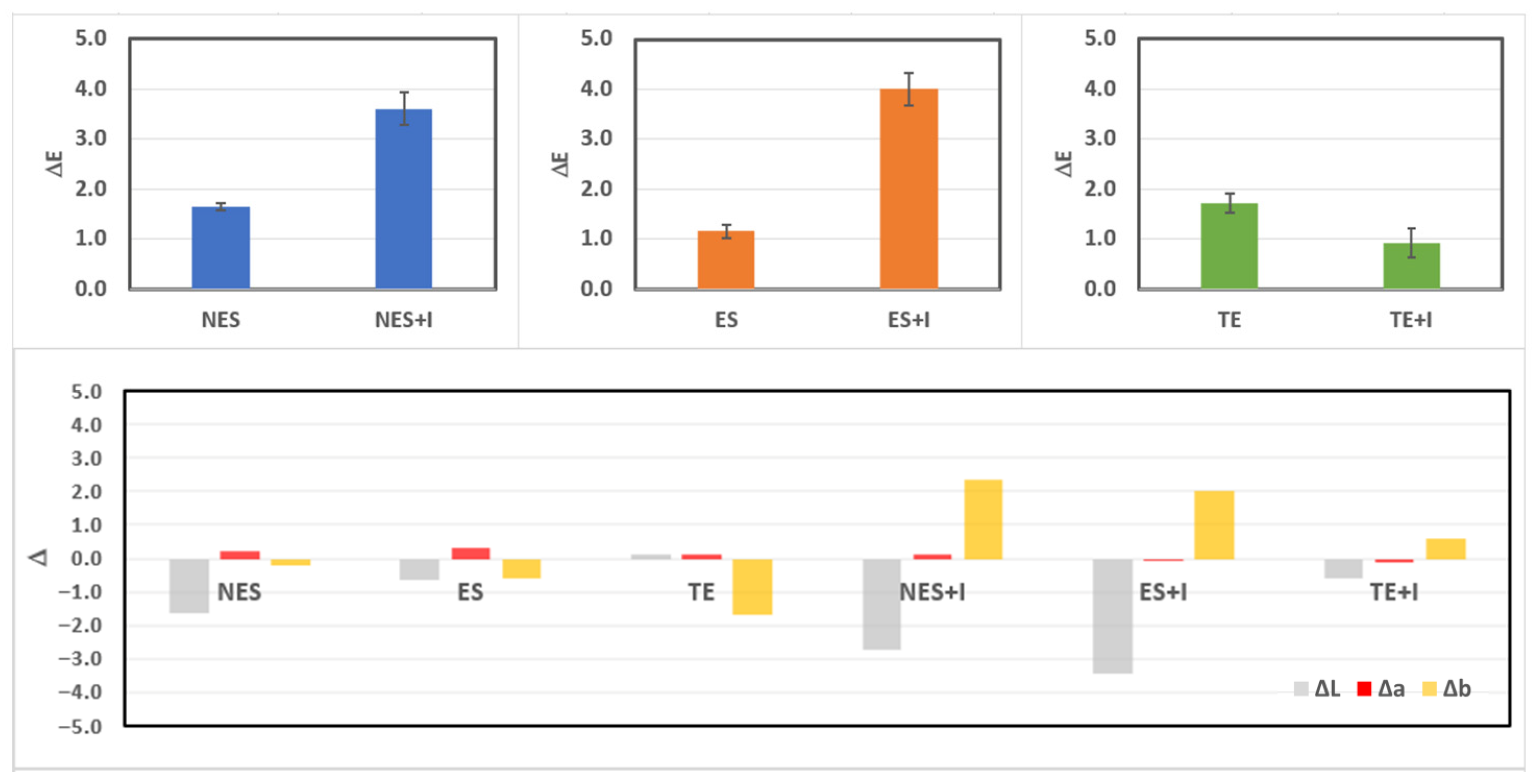
Colorimetric measurements showed that IL treatment of limestone surfaces caused a colorimetric variation of ΔE < 5 (Figure 3). This value is typically considered the threshold beyond which color variations become visible to the naked eye, and thus unacceptable in cultural heritage conservation [22,23]. Treatment of limestone surfaces with binders alone produced a color variation of ΔE < 2. The addition of IL to Nano Estel (NES) and Estel (ES) binders resulted in a slightly higher variation, but still below the threshold.
A detailed analysis of the individual components, L*, a*, and b*, indicated that the L* and b* coordinates contribute most to the ΔE value. For NES and ES treatments with IL addition, L* values decreased by about 3 units, while b* values increased by about 2 units. Due to the high porosity of the material, IL layering causes yellowing and darkening of the surface. Manoudis et al. (2009) report that silica-based consolidants applied to porous calcareous surfaces, if not cured, give rise to a wetting phenomenon that causes a colorimetric change in brightness [24]. This effect was already observed following the application of IL on marble surfaces. Such an effect is temporary, although it may persist for several months after treatment [16]. For limestone specimens, a variation in b* value is also observed due to the color of the material, which imparts a yellowish hue due to the wetting effect.
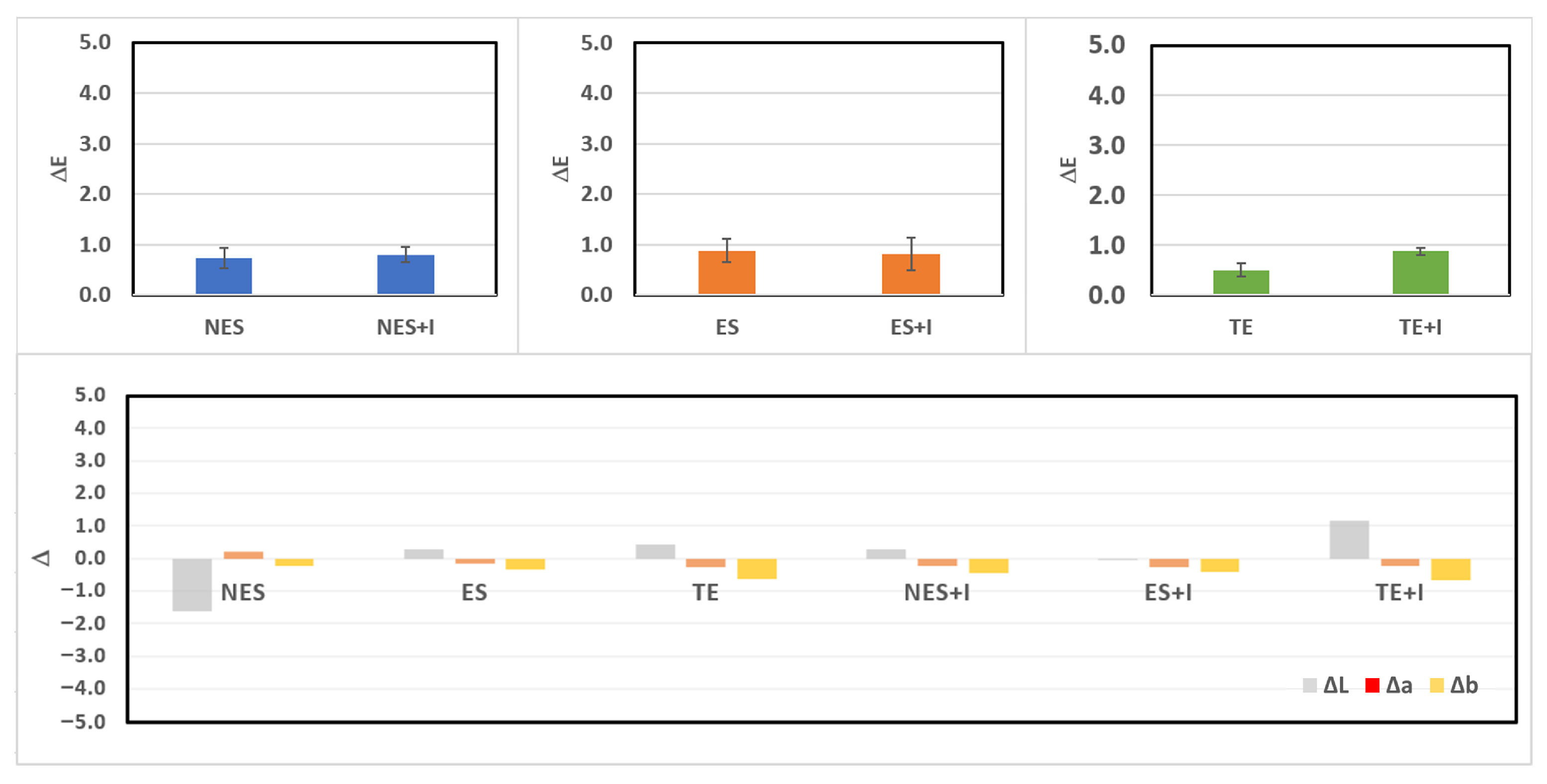
The analysis of colorimetric variations between treated and aged surfaces provides insight into the effects of UV-daylight radiation on the coated surfaces. A variation of ΔE < 1.5 was detected for all limestone treatments (Figure 4), which is lower than that observed for treated and aged marble specimens (ca. 3.5 for bilayer treatments) [16]. For NES+I and ES+I treatments, the L* and b* coordinates shifted in the opposite direction compared to treated–untreated variation, as reported in Figure 3. This result can be attributed to coating equilibrium processes triggered by UV-daylight exposure.
Despite colorimetric variations being detected in some cases, statistical evaluations reported no significant differences between groups (binder vs. binder+IL) (Welch’s t-test; p > 0.05, Supplementary Material Tables S1 and S2).
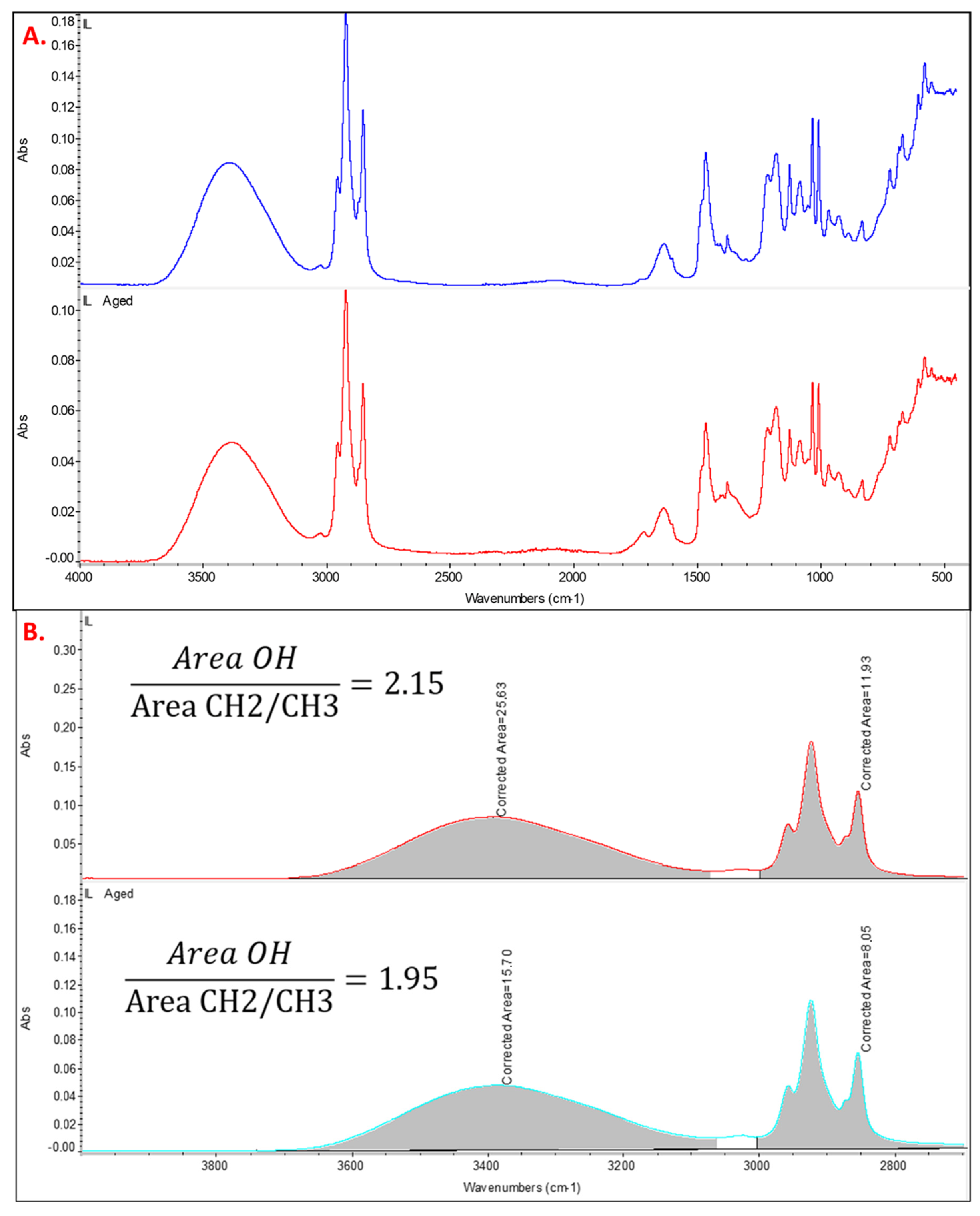
The long-term effects of UV irradiation on the IL mixture were evaluated by IR spectroscopy. The spectra collected from IL-treated glass surfaces after UV aging largely overlapped with those of the untreated IL coatings (Figure 5A), indicating that no significant chemical modifications occurred. No appreciable changes in peak positions or relative intensities were observed, except for a decrease in the OH stretching band centered at approximately 3300 cm−1.
The reduction in this band, evaluated relative to the methyl group signals of the IL used as an internal reference (Figure 5B), indicates a decrease in the water content of the IL film. This effect can be attributed to the prolonged UV exposure (507 h at 35 °C), which likely promoted the progressive loss of absorbed or solvated water from the IL layer.
The contact angle measurements on treated limestone specimens are reported in Table 2. Untreated limestone showed a contact angle close to 0°, reflecting its high porosity. The NES+I and TE+I treatments did not alter the hydrophilic nature of the limestone surfaces. For the Estel treatment, a large increase in contact angle was detected, a behavior ascribable to residual solvent within the coating. However, IL application reduced the contact angle, restoring wettability similar to that of other IL-treated or untreated surfaces. The IL treatments maintain a null contact angle indicative of high hydrophilicity. This behavior has been previously observed on marble surfaces treated with IL [16,25]. Moreover, the results are consistent with the colorimetric measurements, where post-aging color changes reflect specimen drying.
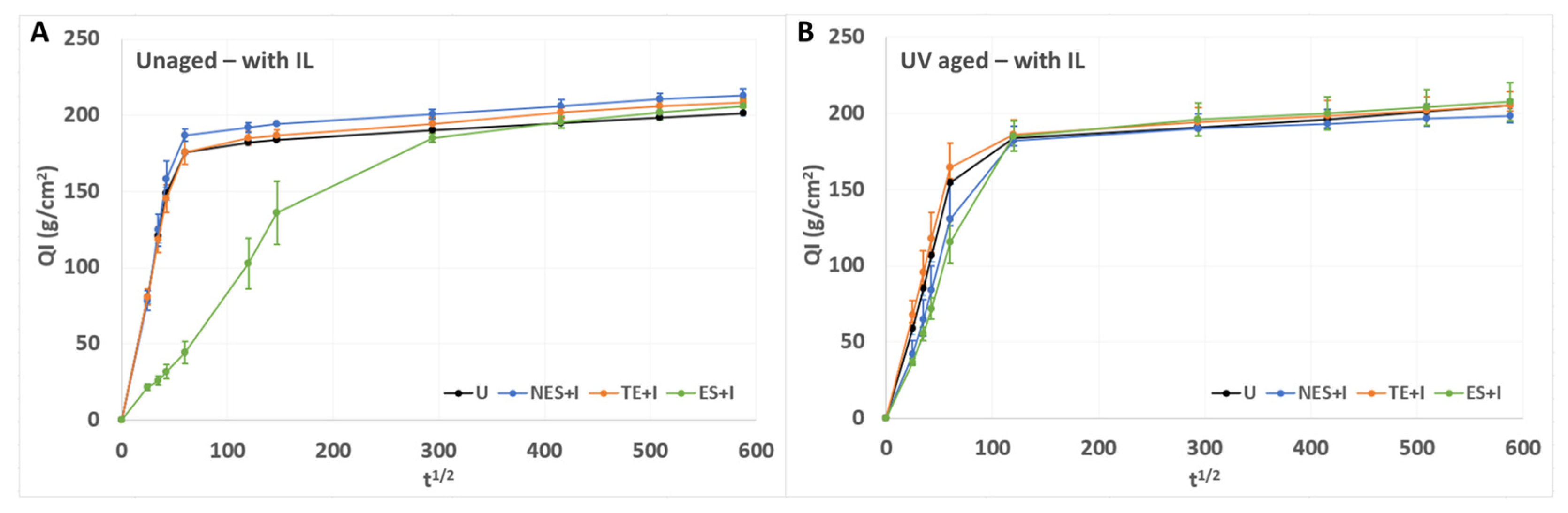
Capillary absorption tests on treated and aged limestone specimens showed a water uptake trend similar to that of untreated specimens (Figure 6). This behavior is consistent with the high hydrophilicity of the surfaces, as indicated by contact angle measurements. The residual solvent in the Estel coating delayed capillary water absorption during the first 24 h. Thereafter, the treatment showed a trend comparable to the other conditions, reaching saturation after 5 days. Solvent evaporation, potentially induced by UV-daily exposure, may account for the acceleration of the process. To support these assumptions, Welch’s t-test reported no statistical differences among groups (p > 0.05), except for ES+I vs. U before aging (p < 0.05, Supplementary Material Tables S3 and S4).

3.2. Evaluation of Coatings Durability

Coating detachment (%Area) quantified through ImageJ analysis was found to be significantly reduced in limestones exposed to microcosms at longer times of exposure to seawater (Table 3; Supplementary Material Figure S1). A full factorial ANOVA applied to the complete dataset including exposure time, lithotype, and washout condition revealed a significant effect (p < 0.001, Supplementary Material Table S5) of all factors on the durability of coating over time. These results have been clarified through a second ANOVA considering only 3 and 6 months as time of exposure to seawater when lithotype and washout conditions remained a significant factor (p < 0.001). In contrast, time was no longer significant within this interval (p = 0.71, Supplementary Material Table S6), nor were its interactions with Material or Group, suggesting that most coating degradation had already occurred by 3 months and that detachment reached a plateau thereafter.
Table 3. %Area (MEAN ± SD) of IL detachment after washout in sterile and microcosm conditions at 1, 3, and 6 months of exposure to seawater. Red values are statistically different in comparison to other conditions (TOST equivalence test).
TIMESAMPLESterile ConditionMicrocosm
MEAN (%Area)SDMEAN (%Area)SD
Marble1 monthTE+I 0.180.190.650.13
NES+I1.200.210.920.16
ES+I0.890.151.400.18
3 monthsTE+I 1.280.281.580.15
NES+I1.050.111.090.17
ES+I2.150.172.070.18
6 monthsTE+I 1.080.142.340.21
NES+I2.050.100.690.18
ES+I1.200.201.870.20
Limestone1 monthTE+I 2.110.232.090.18
NES+I1.590.191.510.19
ES+I0.880.161.940.17
3 monthsTE+I 1.680.188.021.56
NES+I3.520.197.981.76
ES+I2.620.183.130.22
6 monthsTE+I 2.790.227.310.51
NES+I3.540.1910.332.93
ES+I3.260.172.750.18
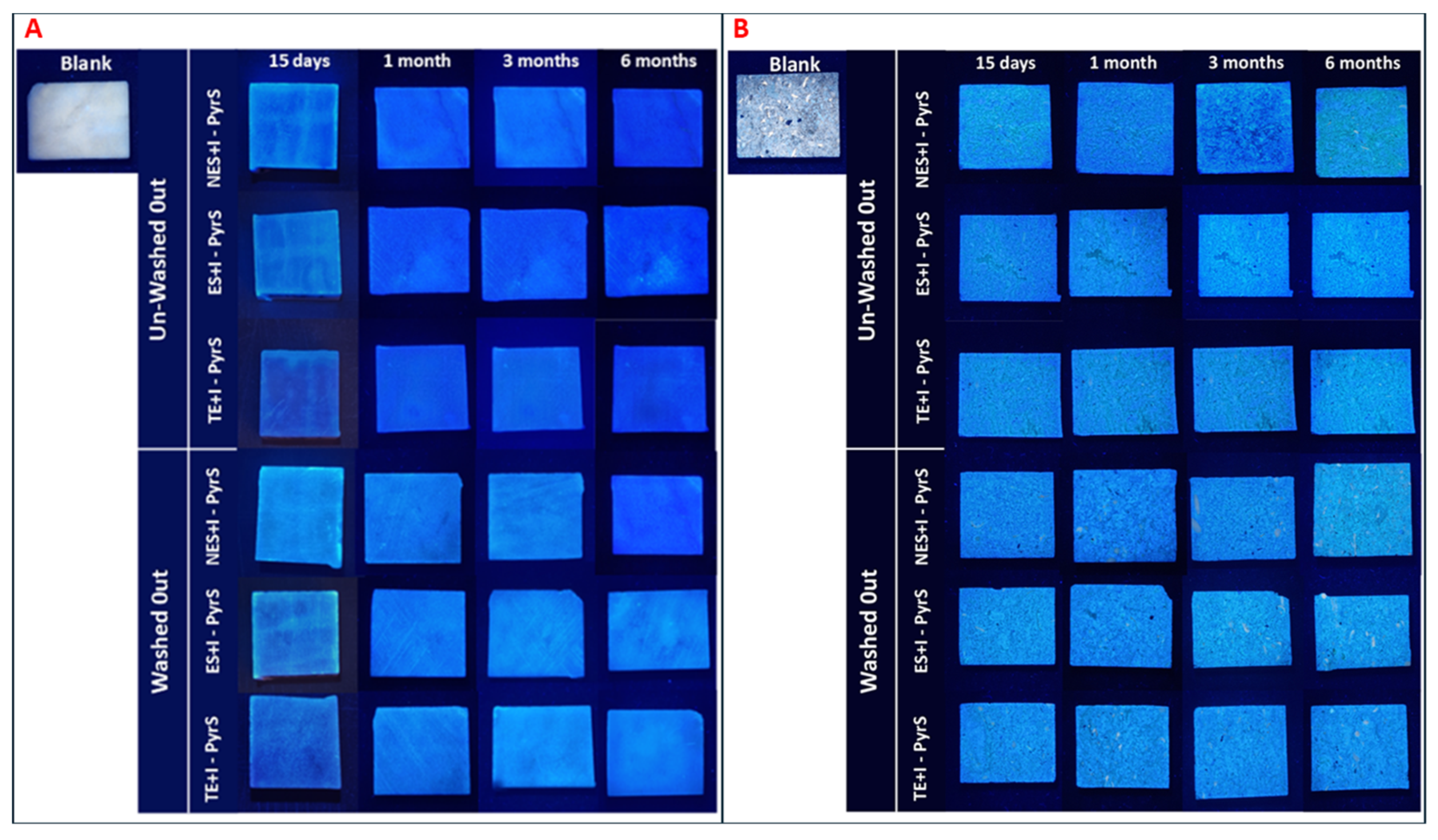
Going deeper into the results, UV emission of I-PyrS-treated marble and limestone surfaces demonstrated the durability of the coatings over the full duration of the experiment (6 months), as shown in Figure 7, in small and closed containers with sterile seawater. UV fluorescence was clearly visible on both lithotypes demonstrating no washout effects for all treatments tested. In fact, a range of 0.18%–3.54% (Table 3) of IL detachment was quantified through ImageJ analyses with values classified as equivalent across all coating formulations and exposure times (TOST equivalence test, Supplementary Material Table S7). This positive effect can be favored by the low hydrodynamic regime of the experimental setup employed.
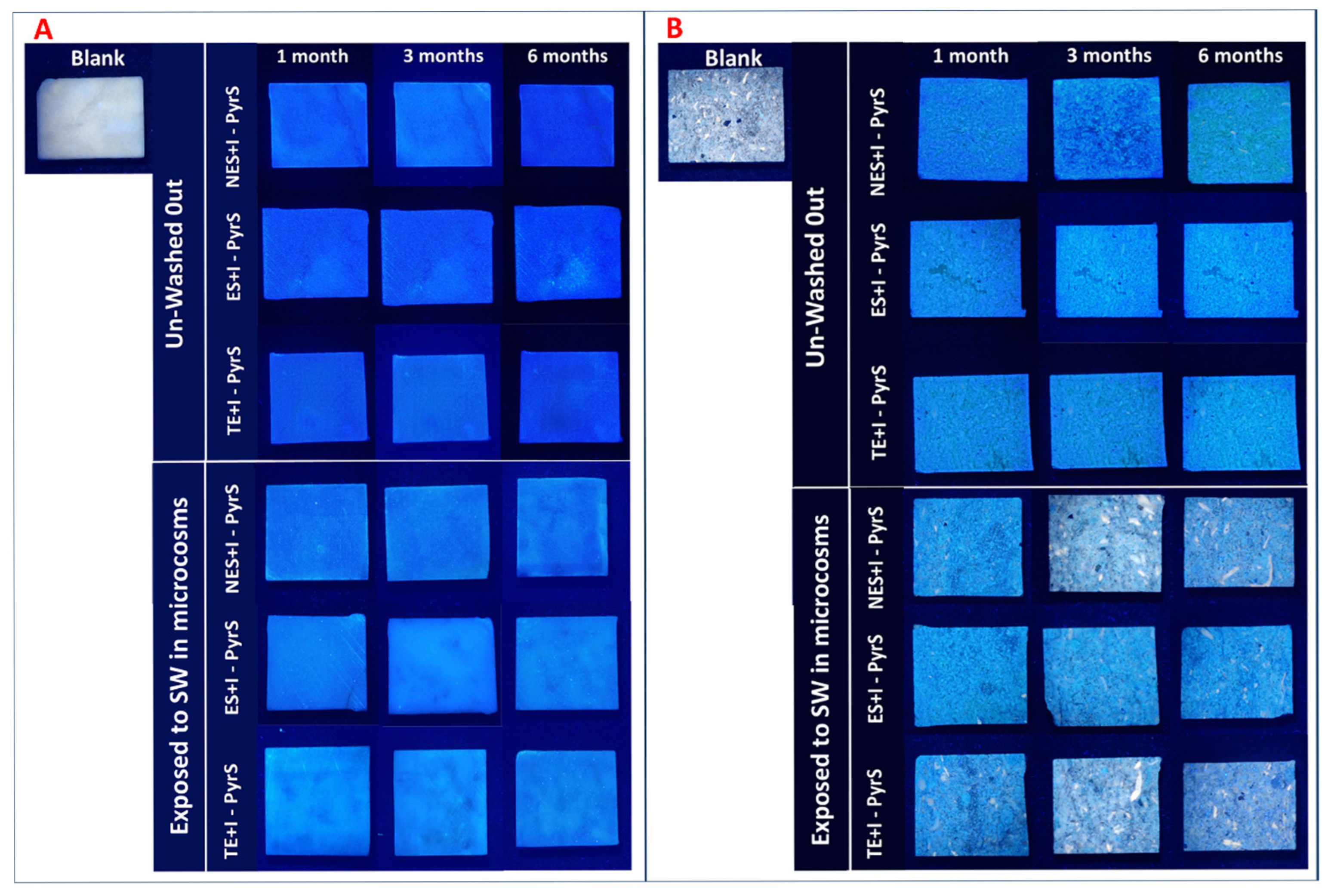
Even under higher hydrodynamic conditions (microcosms), all marble specimens sampled at increasing time intervals showed luminescence similar to that of un-exposed specimens (Figure 8A), with a 0.65%–2.34% of IL detachment (Table 3). This suggests that IL, when applied to marble surfaces, persists under intense washout conditions for up to 6 months, making these treatments suitable for further experimentation in marine environment. Limestone specimens exposed for 1 month in microcosms also showed luminescence similar to that of un-exposed ones (Figure 8B), and low percentages of area where the coating was lost (%Area from 1.51 to 2.09; Table 3). For both marble at all times of exposure and limestone at 1 month, %Area was quite similar, with mean differences falling within the equivalence margin (TOST equivalence test, Supplementary Material Table S8). However, non-luminescent spots were clearly visible on samples treated with NES+I-PyrS and TE+I-PyrS after 3 and 6 months. In these cases, IL detachment was significantly higher (Table 3), with 7.98% (3 months) and 10.33% (6 months) in NES+I-PyrS, and 8.02% (3 months) and 7.31% (6 months) in TE+I-PyrS. In fact, values did not pass the TOST equivalence test when compared to other conditions (Supplementary Material Table S8). Compared to the durability results obtained in small-scale experimental conditions (80 mL on shaker at 100 r/min, Figure 7B), the larger volume (40 L) and the higher hydrodynamic regime negatively act on coatings (Figure 8B) and can be considered relevant factors contributing to washout of the coating on limestone surfaces. Among the limestone treatments, the ES binder provided the best performance, with only small areas of the ES+I-PyrS exhibiting reduced luminescence (%Area= 2.75–3.13; Table 3). This binder–IL combination can therefore be considered a promising candidate for further validation under real marine conditions.
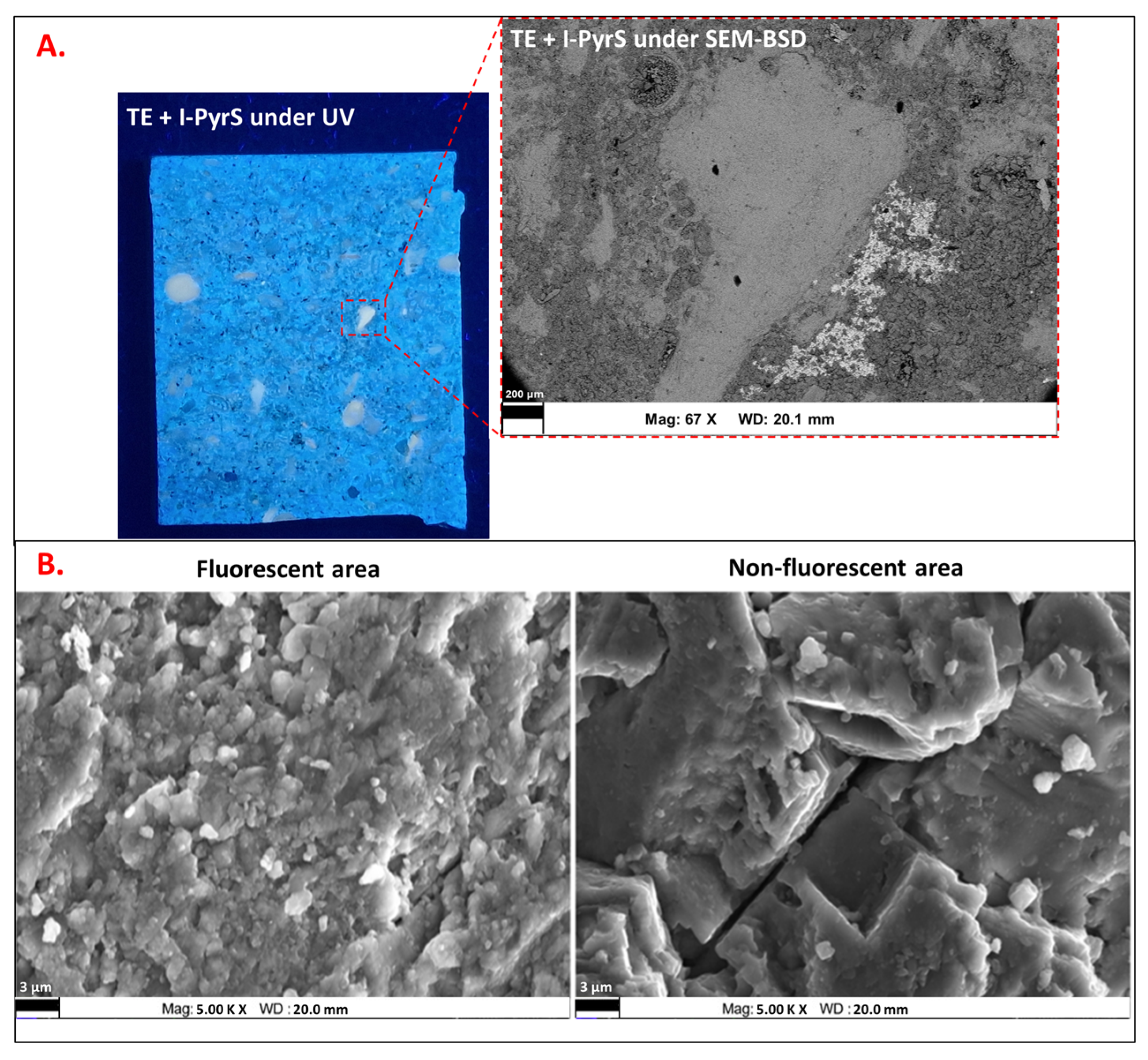
As reported in Figure 9, SEM-BSD shows brighter and darker areas that correspond to the non-fluorescent and fluorescent areas observed under UV light, respectively. The result is a grayscale image that can be attributed to the surface porosity.
The coating applied to a stone surface is absorbed by capillarity. When it is applied on a heterogeneous surface, the liquid phase is preferentially drawn toward the more porous zones, while compact areas retain smaller amounts of product. This process leads to a redistribution of the coating already during application, generating spatially heterogeneous loadings controlled by local porosity and capillary uptake [26,27]. Therefore, porous areas act as reservoirs of the product, whereas compact domains are covered only by a relatively thin superficial layer.
Accordingly, before microcosm exposure, even the most compact areas appear covered by a continuous thin film, producing an almost homogeneous luminescent limestone surface. During exposure, however, a washout process takes place, which preferentially removes these thinner surface layers from the less porous areas, while a larger fraction of the coating is retained within the pore network of the more porous zones (Figure 9B). Therefore, the observed loss of fluorescence from compact domains is not only due to detachment of the coating, but also to the fact that, owing to the initial redistribution, these areas contained less product and are thus more rapidly depleted. On marble specimens, this competitive redistribution between compact and porous areas is largely prevented by the more uniform porosity of the surface, allowing a more homogeneous penetration and retention of the coating.
These findings support the hypothesis that the compactness present in some areas of the limestone surface does not promote an efficient capillary absorption of the coatings, which is almost completely lost over time.

4. Conclusions

The present study confirms that IL-based antifouling coatings maintain their chemical stability and durability when applied to limestone substrates, in agreement with previous findings reported for marble substrates [16]. These results classify these treatments as suitable coatings for further experimentations on surfaces in underwater environment.
The combination of IL with the consolidants/binders Nano Estel, TEOS, and Estel 1000, used as adhesion promoters, has shown a negligible impact on intrinsic surface properties. In fact, color variations remained within the acceptable thresholds set by restoration guidelines, while contact angle and capillary absorption tests confirmed the preservation of high surface wettability, a potentially beneficial feature for antifouling efficacy [25]. UV aging tests confirmed the chemical stability of the silica@IL formulations, while IR spectroscopy showed no significant IL degradation after prolonged UV exposure. Moreover, the coatings exhibited variable resistance to the erosive action exerted by seawater when comparing results obtained from limestone and marble under the two experimental setups (washout in closed containers with 80 mL of seawater and microcosm tests with 40 L). Fluorescence-based monitoring using the I-PyrS-tagged formulation showed the persistence of coatings on both marble and limestone surfaces submerged in the small containers for up to six months. This positive effect can be favored by the low volume and hydrodynamic regime characteristic of the small-container setup.
However, under more dynamic conditions simulated in the microcosms, all the treatments applied on marble surfaces were not negatively influenced by the increased volume and hydrodynamic force. In contrast, different results were reported for limestone, where a localized loss of coating (TE+I and NES+I) was observed (about 8%–10% of the total area), starting from the third month. The ES+I coating showed the highest durability on limestone for up to six months. Such variable results can be ascribed to the high porosity of limestone material generating a heterogenous distribution of coating on probe surfaces, with compact areas retaining a thin layer that easily detaches under the erosive action of seawater.
In summary, these findings support the potential of IL-based treatments as resistant antifouling strategies for the conservation of underwater cultural heritage items. It is important to specify that our results were obtained under controlled laboratory conditions: small scale, limited time interval, and absence of biotic and seasonal factors typical of real marine environments. Nevertheless, these findings allow the identification of the most promising coatings that can be considered suitable for further experiments in real marine conditions, where long-term durability can be evaluated, the influence of micro- and macro-foulers can be studied, and their antifouling effect can be tested [28]. Furthermore, ecotoxicological studies on marine model species will be essential to assess the low or negligible deleterious effects on organism survival and reproduction [29]. From a chemical perspective, future work should focus on optimizing the formulation to enhance coating penetration and adhesion on substrates with heterogeneous porosity. If our data are confirmed in real marine conditions and toxicity can be excluded, given their chemical stability and durability, IL-based coatings will be considered promising for broader industrial applications, such as the protection of stone and concrete infrastructures in ports and other aquatic environments, where biofouling represents a significant maintenance challenge.

Supplementary Materials

The following supporting information can be downloaded at: https://www.mdpi.com/article/10.3390/coatings16010136/s1.

Author Contributions

Conceptualization, F.D.L., S.L.S., C.E.U., S.A.R., C.G. (Christian Galasso) and N.R.; methodology, S.L.S., S.A.R., M.L., M.M., C.E.U., C.G. (Christian Galasso) and N.R.; investigation, M.L., S.L.S., S.A.R., C.G. (Chiara Giommi) and L.E.; data curation, S.A.R., M.L., M.M., C.E.U., C.G. (Christian Galasso) and N.R.; writing—original draft preparation, M.L.; writing—review and editing, M.R., C.G. (Chiara Giommi), M.M., C.G. (Christian Galasso) and N.R.; supervision, S.A.R., C.E.U., C.G. (Christian Galasso) and N.R.; funding acquisition, T.R., S.G., D.d.P. and M.F.L.R. All authors have read and agreed to the published version of the manuscript.

Funding

This research was funded by the UNALTERABLE research activity, funding program Centro Ricerche ed Infrastrutture Marine Avanzate in Calabria (CRIMAC)—Fondo FSC 2014–2020—Piano Stralcio «Ricerca e Innovazione 2015–2017»—Programma Nazionale Infrastrutture di Ricerca (PNIR), linea d’azione 1, CUP C64I20000320001.

Institutional Review Board Statement

Not applicable.

Informed Consent Statement

Not applicable.

Data Availability Statement

No new data were created or analyzed in this study.

Conflicts of Interest

The authors declare no conflict of interest.

References

  1. Callow, M.E.; Callow, J.E. Marine Biofouling: A Sticky Problem. Biologist 2002, 49, 10–14. [Google Scholar]
  2. López-Arce, P.; Zornoza-Indart, A.; Gomez-Villalba, L.; Pérez-Monserrat, E.M.; Alvarez de Buergo, M.; Vivar, G.; Fort, R. Archaeological Ceramic Amphorae from Underwater Marine Environments: Influence of Firing Temperature on Salt Crystallization Decay. J. Eur. Ceram. Soc. 2013, 33, 2031–2042. [Google Scholar] [CrossRef]
  3. La Russa, M.F.; Ricca, M.; Belfiore, C.M.; Ruffolo, S.A.; Álvarez, M.; Buergo Ballester, D.E.; Crisci, G.M. The Contribution of Earth Sciences to the Preservation of Underwater Archeological Stone Materials: An Analytical Approach. Int. J. Conserv. Sci. 2015, 6, 335–348. [Google Scholar]
  4. Xin, B.; Hao, J. Imidazolium-Based Ionic Liquids Grafted on Solid Surfaces. Chem. Soc. Rev. 2014, 43, 7171–7187. [Google Scholar] [CrossRef] [PubMed]
  5. Cardiano, P.; Fazio, E.; Lazzara, G.; Manickam, S.; Milioto, S.; Neri, F.; Mineo, P.G.; Piperno, A.; Lo Schiavo, S. Highly Untangled Multiwalled Carbon Nanotube@polyhedral Oligomeric Silsesquioxane Ionic Hybrids: Synthesis, Characterization and Nonlinear Optical Properties. Carbon 2015, 86, 325–337. [Google Scholar] [CrossRef]
  6. Pendleton, J.N.; Gilmore, B.F. The Antimicrobial Potential of Ionic Liquids: A Source of Chemical Diversity for Infection and Biofilm Control. Int. J. Antimicrob. Agents 2015, 46, 131–139. [Google Scholar] [CrossRef] [PubMed]
  7. De Leo, F.; Cardiano, P.; De Carlo, G.; Lo Schiavo, S.; Urzì, C. Testing the Antimicrobial Properties of an Upcoming “Environmental-Friendly” Family of Ionic Liquids. J. Mol. Liq. 2017, 248, 81–85. [Google Scholar] [CrossRef]
  8. Seddon, K.R. Ionic Liquids for Clean Technology. J. Chem. Technol. Biotechnol. 1997, 68, 351–356. [Google Scholar] [CrossRef]
  9. Welton, T. Room-Temperature Ionic Liquids. Solvents for Synthesis and Catalysis. Chem. Rev. 1999, 99, 2071–2083. [Google Scholar] [CrossRef]
  10. Wasserscheid, P.; Welton, T. Ionic Liquids in Synthesis. In Ionic Liquids in Synthesis; Wiley: Hoboken, NJ, USA, 2007; Volume 1, ISBN 978-3-527-31239-9. [Google Scholar]
  11. Misra, A.; Franco Castillo, I.; Müller, D.P.; González, C.; Eyssautier-Chuine, S.; Ziegler, A.; de la Fuente, J.M.; Mitchell, S.G.; Streb, C. Polyoxometalate-Ionic Liquids (POM-ILs) as Anticorrosion and Antibacterial Coatings for Natural Stones. Angew. Chem.—Int. Ed. 2018, 57, 14926–14931. [Google Scholar] [CrossRef]
  12. Sharma, V.K.; Gupta, J.; Mitra, J.B.; Srinivasan, H.; Sakai, V.G.; Ghosh, S.K.; Mitra, S. The Physics of Antimicrobial Activity of Ionic Liquids. J. Phys. Chem. Lett. 2024, 15, 7075–7083. [Google Scholar] [CrossRef]
  13. Borkowski, A.; Syczewski, M.; Czarnecka-Skwarek, A. Ionic Liquids Strongly Affect the Interaction of Bacteria with Magnesium Oxide and Silica Nanoparticles. RSC Adv. 2019, 9, 28724–28734. [Google Scholar] [CrossRef]
  14. De Leo, F.; Marchetta, A.; Capillo, G.; Germanà, A.; Primerano, P.; Schiavo, S.L.; Urzì, C. Surface Active Ionic Liquids Based Coatings as Subaerial Anti-biofilms for Stone Built Cultural Heritage. Coatings 2021, 11, 26. [Google Scholar] [CrossRef]
  15. e Silva, F.A.; Siopa, F.; Figueiredo, B.F.H.T.; Gonçalves, A.M.M.; Pereira, J.L.; Gonçalves, F.; Coutinho, J.A.P.; Afonso, C.A.M.; Ventura, S.P.M. Sustainable Design for Environment-Friendly Mono and Dicationic Cholinium-Based Ionic Liquids. Ecotoxicol. Environ. Saf. 2014, 108, 302–310. [Google Scholar] [CrossRef] [PubMed]
  16. Luci, M.; De Leo, F.; De Pascale, D.; Galasso, C.; La Russa, M.F.; Lo Schiavo, S.; Ricca, M.; Ruffolo, S.A.; Ruocco, N.; Urzì, C. Surface-Active Ionic-Liquid-Based Coatings as Anti-Biofilms for Stone: An Evaluation of Their Physical Properties. Coatings 2023, 13, 1669. [Google Scholar] [CrossRef]
  17. Veltri, S.; Palermo, A.M.; De Filpo, G.; Xu, F. Subsurface Treatment of TiO2 Nanoparticles for Limestone: Prolonged Surface Photocatalytic Biocidal Activities. Build. Environ. 2019, 149, 655–661. [Google Scholar] [CrossRef]
  18. ISO/CIE 11664-4; Colorimetria-Parte 4: Spazio Colore L* A* B* CIE 1976. Ente Nazionale Italiano di Unificazione: Milano, Italy, 2019.
  19. ISO/CIE 15802; Conservazione Dei Beni Culturali-Metodi Di Prova-Determinazione Dell’angolo Di Contatto Statico. Ente Nazionale Italiano di Unificazione: Milano, Italy, 2010.
  20. ISO/CIE 15801; Conservazione Dei Beni Culturali-Metodi Di Prova-Determinazione Dell’assorbimento Dell’acqua per Capillarità. Ente Nazionale Italiano di Unificazione: Milano, Italy, 2010.
  21. Global Solar Atlas. Available online: https://globalsolaratlas.info/ (accessed on 19 January 2025).
  22. Berns, R.S.; Reiman, D.M. Color Managing the Third Edition of Billmeyer and Saltzman’s Principles of Color Technology. Color. Res. Appl. 2002, 27, 360–373. [Google Scholar] [CrossRef]
  23. Grossi, C.M.; Esbert, R.M.; Dã Az-Pache, F.; Alonso, F.J. Soiling of Building Stones in Urban Environments. Build. Environ. 2003, 38, 147–159. [Google Scholar] [CrossRef]
  24. Manoudis, P.N.; Karapanagiotis, I.; Tsakalof, A.; Zuburtikudis, I.; Kolinkeová, B.; Panayiotou, C. Superhydrophobic Films for the Protection of Outdoor Cultural Heritage Assets. Appl. Phys. A Mater. Sci. Process 2009, 97, 351–360. [Google Scholar] [CrossRef]
  25. Donnelly, B.; Sammut, K.; Tang, Y. Materials Selection for Antifouling Systems in Marine Structures. Molecules 2022, 27, 3408. [Google Scholar] [CrossRef]
  26. Massinelli, G.; Possenti, E.; Colombo, C.; Gatta, G.D.; Realini, M.; Marinoni, N. 4D Imaging and Quantification of the Effect of a Phosphate-Based Treatment on Building Materials by Means of Synchrotron X-Ray Microtomography: New Insights into the Dynamic of the Consolidation Process. Constr. Build. Mater. 2023, 397, 132348. [Google Scholar] [CrossRef]
  27. Possenti, E.; Conti, C.; Gatta, G.D.; Marinoni, N.; Merlini, M.; Realini, M.; Vaughan, G.B.M.; Colombo, C. Synchrotron X-Ray Diffraction Computed Tomography to Non-Destructively Study Inorganic Treatments for Stone Conservation. iScience 2022, 25, 105112. [Google Scholar] [CrossRef] [PubMed]
  28. Sánchez, A.; Yebra, D.M. Ageing Tests and Long-Term Performance of Marine Antifouling Coatings. In Advances in Marine Antifouling Coatings and Technologies; Elsevier Ltd.: Amsterdam, The Netherlands, 2009; pp. 393–421. ISBN 9781845693862. [Google Scholar]
  29. Amara, I.; Miled, W.; Slama, R.B.; Ladhari, N. Antifouling Processes and Toxicity Effects of Antifouling Paints on Marine Environment. A Review. Environ. Toxicol. Pharmacol. 2017, 57, 115–130. [Google Scholar] [CrossRef] [PubMed]
Figure 1. Experimental design. The diagram illustrates the silica-based consolidants (NES, ES, TE) used as binders for the ionic liquid (IL)-based coating, generating the conditions NES/NES+I, ES/ES+I, and TE/TE+I. Untreated samples (TQ) were also included in all tests. IL stability was evaluated by IR spectroscopy of treated Petri dishes, while surface physical properties were assessed through colorimetric analysis, contact angle, and capillarity water absorption tests; both measurements were performed before and after UV aging. Subsequently, washout tests on I-PyrS-treated stone surfaces were performed in closed containers with a lower hydrodynamic regime and in microcosms with a higher hydrodynamic regime. At each sampling time, visualization under UV light was carried out. After 3 months of exposure in the microcosms, scanning electron microscopy analysis was also performed to investigate the micro-morphological features of the treated limestone surfaces.
Coatings 16 00136 g001
Figure 2. Schematization of bare and IL–consolidant bilayer/monolayer treatments: Nano Estel/Nano Estel+IL (NES/NES+I); Estel 1000/Estel 1000+IL (ES/ES+I); TEOS alone (TE) and TEOS+IL (TE+I).
Coatings 16 00136 g002
Figure 3. Colorimetric differences between untreated and treated limestone specimens. For each treatment, the value of ΔL (grey), Δa (red), and Δb (yellow) are reported.
Coatings 16 00136 g003
Figure 4. Colorimetric differences between aged and treated limestone specimens. For each treatment, the value of ΔL (grey), Δa (red), and Δb (yellow) are reported.
Coatings 16 00136 g004
Figure 5. (A) IR spectra of the IL mixture before (IL) and after UV aging (IL aged). (B) FTIR spectra of IL mixture (IL) compared with aged IL (IL aged); the regions corresponding to the OH and CH2/CH3 bands and their relative ratios are highlighted.
Coatings 16 00136 g005
Figure 6. Capillary absorption of unaged (A) and aged (B) limestones. For both conditions, untreated (black), NES+I (blue), TE+I (orange), and ES+I (green) treatments are reported.
Coatings 16 00136 g006
Figure 7. Photos of untreated and treated specimens under UV illumination, highlighting the luminescence of I-PyrS: (A) marble and (B) limestone. Unwashed and washed samples up to 6 months are shown. Before the test, untreated samples (blank) exhibited no luminescence, whereas treated samples not yet subjected to washout showed clearly visible luminescence.
Coatings 16 00136 g007
Figure 8. Photos of untreated and treated specimens under UV illumination, highlighting the luminescence of I-PyrS: (A) marble and (B) limestone. Samples are shown unexposed (un-washed out) and after microcosm exposure periods of up to 6 months. Before the test, untreated samples (blank) exhibited no luminescence, whereas treated samples not yet exposed showed clearly visible luminescence.
Coatings 16 00136 g008
Figure 9. (A) Limestone sample treated with tetraethyl orthosilicate plus I-PyrS (TE+I-PyrS) and exposed in microcosm for 3 months, observed under UV light and SEB-BSD; (B) SEM images of the luminescent and non-luminescent areas of treated limestone surfaces exposed in microcosm for 3 months.
Coatings 16 00136 g009
Table 1. Summary of treatments with IL (N-(2-Hydroxyethyl)-N,N-dimethyl-1-dodecanaminium Br:DBS 3:1) and I-PyrS (IL Pyrene-1-sulfonate).
IDBinderIL/I-PyrS
ProductAmount (g/m2)ApplicationAmount (mmol/m2)
ProductActive Matter
Untreated-----
NESNano Estel16024--
NES+I/I-PyrSNano Estel16024Top layer1.14
TETEOS16048--
TE+I/I-PyrSTEOS16048Mixed with binder1.14
ESEstel 1000160120--
ES+I/I-PyrSEstel 1000160120Top layer1.14
Table 2. Contact angle measurements for untreated, treated, and aged limestone samples.
IDα
Before Treatment
α
After Treatment
α
After Aging
Untreated0-0
NES000
NES+I/I-PyrS000
TE05.8 ± 3.60
TE+I/I-PyrS000
ES0106.8 ± 6.18.7 ± 2.3
ES+I/I-PyrS000
Disclaimer/Publisher’s Note: The statements, opinions and data contained in all publications are solely those of the individual author(s) and contributor(s) and not of MDPI and/or the editor(s). MDPI and/or the editor(s) disclaim responsibility for any injury to people or property resulting from any ideas, methods, instructions or products referred to in the content.