Article

Durable Anti-Icing Slippery Surface with Y-Shaped Composite Porous Structure Prepared by Two-Step Anodic Oxidation

College of Materials Science and Engineering, Chongqing University, Chongqing 400044, China
*
Author to whom correspondence should be addressed.
Coatings 2026, 16(1), 135; https://doi.org/10.3390/coatings16010135
Submission received: 14 December 2025 / Revised: 5 January 2026 / Accepted: 17 January 2026 / Published: 20 January 2026
(This article belongs to the Special Issue Durability of Transmission Lines)

Abstract

Ice accumulation on power transmission lines poses serious threats to operational safety and can lead to substantial social and economic impacts. While various anti-icing coatings have been investigated, their performance is often limited by the effectiveness and durability of anti-icing. Slippery lubricant-infused porous surfaces (SLIPSs) have shown remarkable anti-icing properties and durability, aided by their lubricant-infused and self-healing capability. In this study, SLIPSs were successfully fabricated on aluminum substrates using a two-step anodization process. The effects of the anodizing parameter of the current density on pore diameter and depth at each stage were systematically investigated. Compared to untreated aluminum and superhydrophobic coatings (SHCs), SLIPSs presented good anti-icing properties. First, at −6 °C, droplets slid off the surface completely within 4340.5 ms without pinning, indicating sustained droplet-shedding capability. It also significantly delayed ice formation, extending the freezing time to 80 min—eight times longer than that of the untreated surface. Moreover, the SLIPSs also exhibited ultra-low ice adhesion, with an initial strength of only 6.93 kPa. Meanwhile, after 100 frosting–defrosting cycles, SLIPSs could still maintain low ice adhesion strength (<20 kPa). The prepared SLIPS with a Y-shaped pore structure demonstrates good potential for anti-icing.

1. Introduction

Ice accretion can cause failure such as conductor galloping, wire breakage, and tower collapse, posing a serious threat to the safety of power systems [1,2,3]. Scholars and industry groups have developed various anti-icing/de-icing technologies, which are generally classified into active and passive methods [4,5,6]. Among active methods, high-current ice melting shows good efficiency in de-icing performance. However, expensive equipment, high labor costs, and its time-consuming nature severely hinder its practical adoption [7]. Moreover, this strategy struggles to meet the massive demands posed by increasingly frequent extreme weather events. Therefore, passive anti-icing technologies, which prevent ice accumulation at the source, present a more practical solution [8,9,10].
Superhydrophobic surfaces have attracted widespread attention ever since they were proposed [11,12]. They combine rough micro–nanostructures with low-surface-energy modifiers to acquire a high contact angle (CA > 150°) and a low sliding angle (SA ≤ 10°). These properties make it easy for water droplets to slide off their surface to prevent ice accumulation. Nevertheless, under low-temperature and high-humidity conditions, water vapor tends to condense within the micro–nanostructures of superhydrophobic surfaces, triggering a transition from the hydrophobic to the hydrophilic state, thereby leading to a failure of the anti-icing capability [13,14]. To address this, many researchers are still dedicated to reducing water droplet condensation [15,16]. Moreover, poor durability is also a problem that superhydrophobic surfaces need to overcome, and so far, no significant breakthroughs have been achieved.
In 2011, the Aizenberg team at Harvard University pioneered slippery liquid-infused porous surfaces (SLIPSs). This was achieved by infusing a lubricant into the nanostructured substrate, imparting the surface with simultaneous water and oil repellency [17]. In 2012, the team first reported the ultra-low ice adhesion strength of SLIPSs, proving their potential in anti-icing application [18]. This breakthrough attracted widespread research attention. Researchers from Sun Yat-sen University developed a SLIPS coating via breath figure on an epoxy resin substrate, which exhibited remarkably low ice adhesion [19]. Another study from Zhejiang University fabricated a SLIPS coating with anti-corrosion and anti-icing properties on a magnesium alloy, revealing that a double-layered SLIPS design further enhanced the anti-icing performance [20]. Compared with superhydrophobic coatings/surfaces, the porous structures filled with lubricant is expected to slow or inhibit the condensation of water vapor in nanostructures, thus improving the anti-icing performance. Moreover, SLIPSs are expected to solve the problem of persistence through the self-repairing ability of lubricant [21,22].
In the preliminary work, our team has fabricated a single-hole SLIPS on 7075-T651 aluminum alloy, which keeps low ice adhesion strength under low-temperature and high-humidity conditions [23]. However, this research is insufficient to assess performance for practical, extended applications with only 50 icing/de-icing cycles. In this study, a SLIPS with a Y-shaped composite porous structure was designed and fabricated on 1060 aluminum alloy. The influence of current density parameters in the two-step anodization process on the resulting pore structure was investigated. The optimal current density and duration for the second anodization step were determined through the regulation of current diameter in each step. The anti-icing performance of the SLIPSs was systematically evaluated in comparison with untreated aluminum, superhydrophobic coatings (SHCs), and hydrophobic surface (HS). The dynamic behavior and retention of droplets were observed and analyzed in droplet impact tests. The ice adhesion strength of SLIPSs was measured. The frost behavior and freezing behavior were studied via delayed freezing experiments. Furthermore, the durability of SLIPSs was investigated by frosting/defrosting cycles.

2. Materials and Methods

2.1. Materials

Aluminum plates (1060) were purchased by Dongguan Chaomei Aluminum Products Co., Ltd. (Dongguan, China). Oxalic acid (H2C2O4), phosphoric acid (H3PO4, ≥85%), and anhydrous ethanol were provided by Chuandong Chemical Co., Ltd., Chongqing, China. Sodium hydroxide (NaOH, ≥98.0%) and ethylene glycol were supplied by Chengdu Kelong Chemical Co., Ltd., Chengdu, China. Dimethyl silicone oil (SO, 200 cSt) and n-octadecyltrimethoxysilane (OTS, 98%) were purchased from Aladdin Reagent Co., Ltd. (Shanghai, China).

2.2. Fabrication of SLIPSs

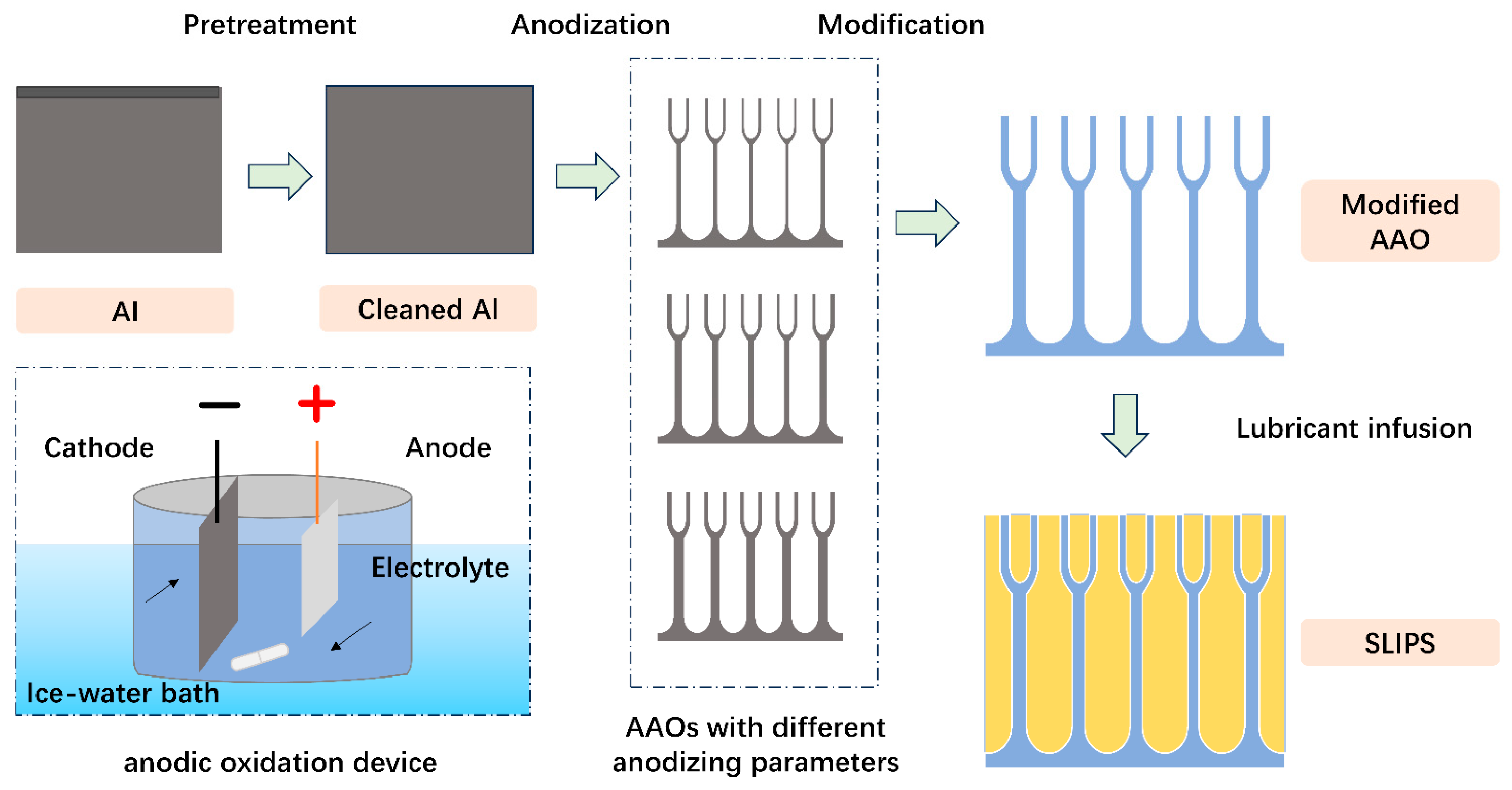
Pretreatment: The aluminum plates were cut into 2.5 × 2.0 × 0.1 cm3 pieces and immersed in 1 mol L−1 NaOH solution for 5 min to remove native oxide layers. To ensure complete removal of sodium hydroxide and terminate the alkaline etching, the samples were ultrasonically cleaned in fresh deionized water for 3 min to eliminate any residual alkali and surface impurities. The samples were then immediately dried to prevent water stain formation that could interfere with subsequent anodization.
Anodization: The process was conducted using a DC power supply (200 V/5 A, Shanghai Anding Electric Co., Ltd., Shanghai, China) with the aluminum sample as the anode and a graphite sheet as the cathode. A two-step anodic oxidation was employed to fabricate Y-shaped pore structures.
Stage 1: Primary anodization in oxalic acid solution (0.3 mol/L, 30 °C) to establish upper-layer pore structures.
Stage 2: Secondary anodization in phosphoric acid solution (0.3 mol/L, 30 °C) to develop lower-layer pores.
After each anodization stage, the samples were ultrasonically cleaned in anhydrous ethanol (5 min) for complete acid removal and oven-dried at 70 °C for 30 min. Different anodic aluminum oxides (AAOs) were obtained by controlling anodizing parameters.
Modification and Lubricant Infusion: To establish a protective hydrophobic barrier that prevents water penetration through the lubricant layer into the hydrophilic porous substrate [24], the anodized aluminum samples were immediately subjected to surface modification upon removal from the 70 °C drying oven. The samples were immersed in a 2 wt% OST–ethanol solution for 30 min, followed by drying at 70 °C for 60 min. At this stage, the preparation of the modified AAO (HS) was completed. Subsequently, to fabricate the SLIPS, a vacuum impregnation process was employed to achieve complete lubricant infiltration. The samples were fully immersed in SO (200 cSt) under a vacuum of −0.1 MPa for 12 h to ensure thorough penetration of the lubricant into the entire porous structure. After removing excess lubricant through 90° inclined drainage for 1 h, the fabrication of the SLIPS was completed. Figure 1 shows the complete fabrication process of SLIPSs.

2.3. Characterization

Surface and cross-sectional microstructures were observed using a field emission scanning electron microscope (SEM, Zeiss Auriga, Oberkochen, Germany), with the sample surfaces sputter-coated with gold prior to testing to enhance conductivity. A Fourier transform infrared spectrometer (FTIR, Nicolet iS5, Waltham, MA, USA) was employed to assess the chemical composition of the surface. Pore size and porosity of the sample surface were measured by importing microstructure images into Nano Measure 1.2 software and Image J 1.54p software, respectively.
A contact angle measuring instrument (SINDIN, SDC-100, Dongguan, China) was adopted to obtain the contact angle (CA), contact angle hysteresis (CAH), and sliding angle (SA) of the samples. The specific procedure was as follows: The CA was recorded by placing a water droplet (5 μL) on the sample surface. Then, 3 μL of liquid was injected and withdrawn to measure the advancing (θA) and receding contact angles (θR), respectively. The difference between those two angles represents the contact angle hysteresis value. The SA was determined by slowly tilting the sample stage until the water droplets (8 μL) started to slide, with the critical tilt angle recorded. Water droplets were deposited at different positions on the sample surface in three repeated experiments, and the average value was calculated.
In the water droplet bounce performance test, the sample was placed on a semiconductor platform with a 30° inclination angle. Liquid water droplets were dropped from a height of 25 cm above the sample surface to impact the sample surface. At room temperature (30 °C), a high-speed image acquisition system was used to record the entire process of water droplets impacting the low-temperature sample surface. Then, the temperature of the semiconductor platform was set to −6 °C, and the above steps were repeated. The high-speed image acquisition system consists of a Qianyanlang M220 high-speed camera (with a resolution of 800 × 600 and a frame rate maintained at 2000 frames per second) and an optical fiber cold light source fill light (Olympus Corporation, Olympus LG-PS2, Tokyo, Japan).
The experimental procedure of delayed freezing is as follows: First, position the sample on a cooling platform. Randomly select five spots on the surface and simultaneously apply individual 7 μL droplets to each spot. During the freezing process, use a camera to monitor the droplet freezing in real time while recording the duration. The recorded freezing time is defined as the period from the moment the first droplet is completely frozen until all droplets are fully frozen. The process is confirmed as fully frozen when the droplet forms an ice tip at its apex during the freezing phase.
To measure the ice adhesion strength on the sample surface, an ice adhesion strength test platform was built. This platform is composed of a high-precision semiconductor constant-temperature test bench, a digital display push–pull dynamometer, a horizontal hand-cranked test bracket, and a low-temperature condensation cycle device. A PTFE cylindrical mold with a diameter of 0.7 cm was placed on the sample surface, and 1 ml of deionized water was injected into the mold. Then, the sample surface and the mold were cooled to −5 °C through the constant-temperature test bench and frozen for 15 min. During the measurement, the ambient humidity was 65%RH. After complete freezing, the horizontal hand-cranked test bracket was used to push the cylindrical mold vertically at a constant speed to separate the mold from the sample surface. The maximum value displayed by the push–pull dynamometer was recorded as the ice adhesion force. Each group of tests is repeated three times, and the average value is taken as the final result. The ice adhesion strength was calculated by dividing this force by the basal area of the mold.
The frosting experiment was conducted on the LTD1-350 high-precision semiconductor constant-temperature test bench manufactured by Tianjin Jingyi Co., Ltd. (Tianjin, China). The test bench has a working area of 100 mm × 100 mm. For the condensation frost formation experiment of the sample, the temperature of the test bench was set to −5 °C, and the ambient humidity was maintained at 65%RH. A camera was used to record the frost formation process on the sample surface. Frosting/defrosting cycles were conducted to study the durability of the SLIPS. In each cycle, the sample surface on the cooling plate was completely frosted. The frost layer was then heated to melt it. The frosting time and ice adhesion strength were measured during these cycles. Whenever the ice adhesion strength exceeded 20 kPa, the upper limit for very low adhesion, cycling was paused for a 12 h self-repair period. The cycles were then resumed. The entire test ended when the ice adhesion strength after self-repair still exceeded 20 kPa.

3. Results and Discussion

3.1. Influence of Current Density Parameters in Two-Step Anodic Oxidation

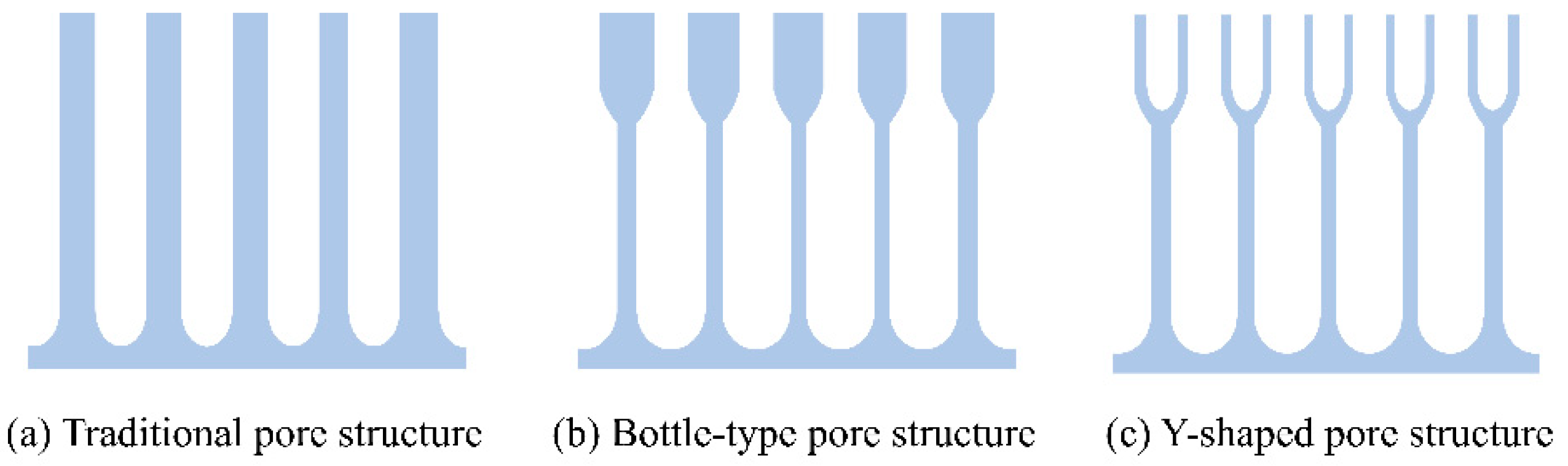
SLIPSs with Y-shaped pores were characterized by smaller upper pores and larger lower pores. The smaller upper pores enhance capillary action, thereby reducing lubricant depletion [25]. Compared to conventional straight-pore structures, the Y-shaped design features larger lower pores, which provide greater pore volume and thus increased lubricant storage capacity. Furthermore, relative to bottle-shaped pore structures, the Y-shaped architecture incorporates a greater number of upper pores, which not only further increases the total pore volume but also significantly enhances surface porosity, leading to improved anti-icing performance [26]. Based on these advantages, the Y-shaped pore SLIPS was designed and investigated in this study (see Figure 2).
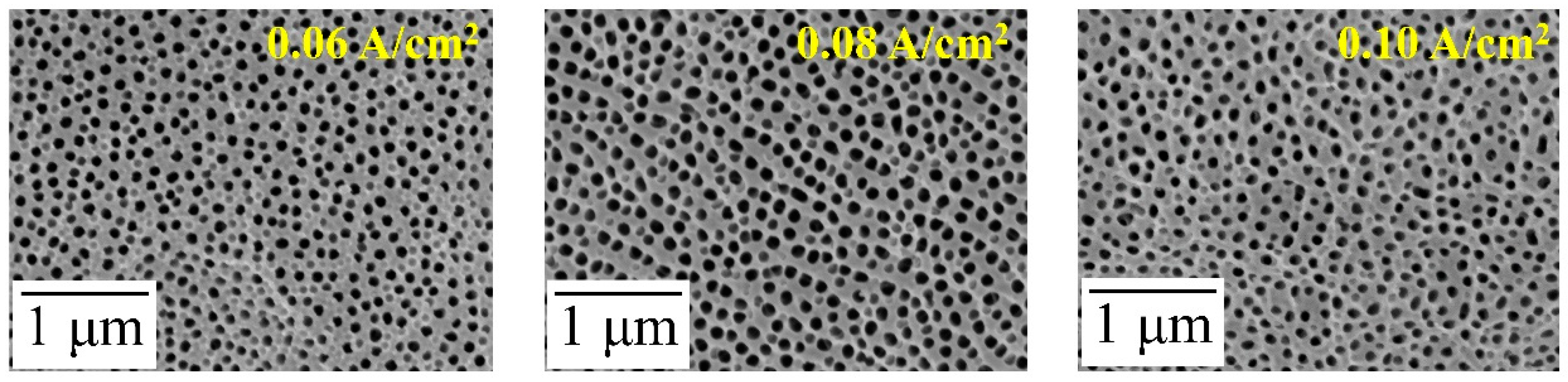
During anodization, the current density parameter exerts a significant influence on the pore structure of AAO [27]. To determine the optimal current density parameters, the first-step current density of anodizing in oxalic acid was regulated to 0.06, 0.08, and 0.10 A/cm2, followed by characterization of the surface and cross-sectional morphology via SEM. Figure 3 displays the surface morphology of anodic aluminum oxide fabricated under varying first-step current densities. It can be observed that at current densities of 0.06 A/cm2 and 0.10 A/cm2, the pore size is excessively small (82.7 nm and 78.2 nm), with a porosity of only approximately 30%. In contrast, at a current density of 0.08 A/cm2, the maximum pore size of 107.9 nm is achieved, accompanied by the highest measured porosity of 48.5%, which is expected to yield superior anti-icing performance. Consequently, the optimal parameter for the first-step current density is determined to be 0.08 A/cm2 (see Table 1).
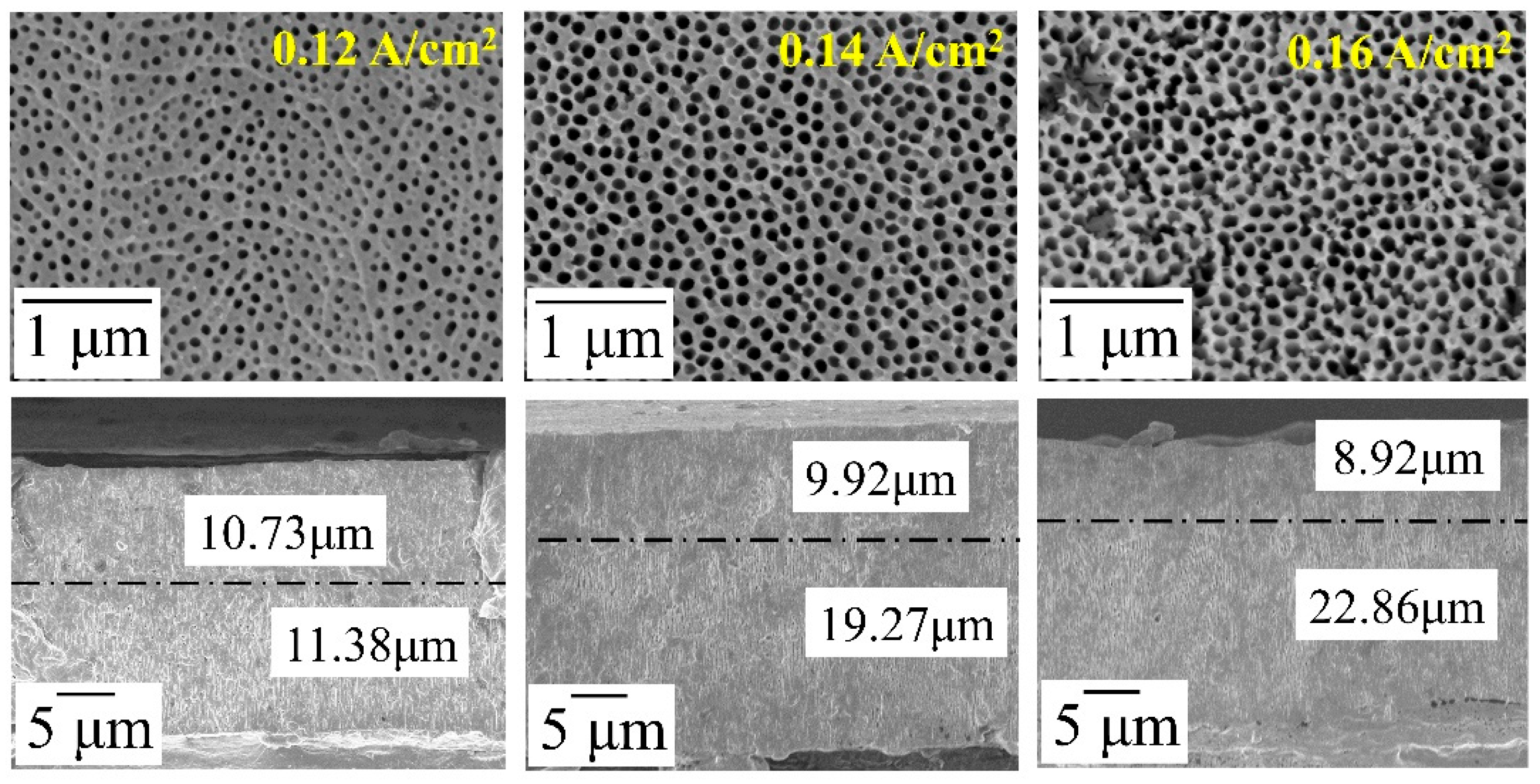
Then, we systematically regulated the current density parameters of the second-step anodization in phosphoric acid (0.12, 0.14, 0.16 A/cm2) while maintaining the first-step current density constant at 0.08 A/cm2. The second-step anodization formed a lower oxide layer based on the initial structure, necessitating simultaneous observation of both the surface and cross-section. Figure 4 shows the microscopic and cross-sectional morphology of anodic aluminum oxide under different second-step current densities. Surface morphology reveals a clear increase in pore diameter with rising current density. Concurrently, the growth of the lower oxide layer coincides with a reduction in the upper layer thickness, demonstrating that the second-step anodization corrodes the upper layer while forming the lower one. The obvious damage to pore structure integrity at a current of 0.16 A/cm2 further confirms this point [28]. Meanwhile, preliminary calculations of Y-shaped pore volumes based on upper/lower pore diameters and oxide thickness (Table 2) under different current densities indicate that larger current densities yield greater Y-shaped pore volumes, providing increased capacity for lubricant storage. Therefore, the optimal parameter for the second-step current density is determined to be 0.14 A/cm2.

3.2. Surface Morphology and Characterization

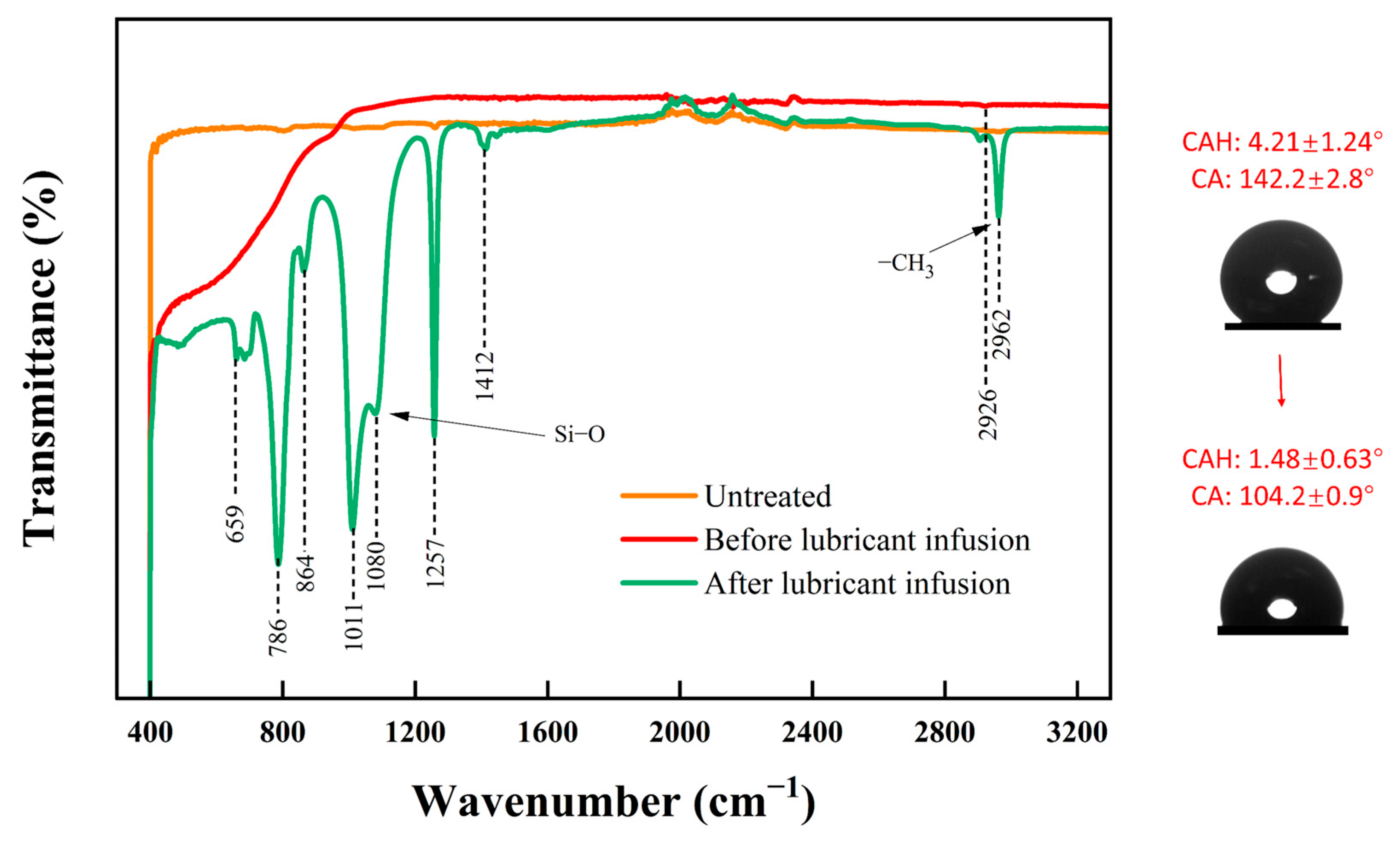
Fourier transform infrared spectroscopy (FTIR) was employed to characterize the surface chemical composition of the samples. As shown in Figure 5, the untreated aluminum substrate exhibits no distinct characteristic peaks. The HS sample shows an absorption peak at 2926 cm−1, originating from the asymmetric –CH2– stretching vibration of the OTS modifier [29]. After lubricant infusion, the FTIR spectrum displays new peaks at 2962 cm−1 and 1258 cm−1, corresponding to the asymmetric methyl stretching vibrations of the dimethyl silicone oil. The peaks at 1080 cm−1 and 1011 cm−1 are attributed to the Si–O stretching vibrations of the lubricant. Additionally, the vibrational signals observed at 1412 cm−1 and 786 cm−1 are associated with the [–O–Si–(CH3)2]–n structure, likely related to the methylene bending of the silicone oil [30]. The FTIR results of the SLIPS confirm the successful infusion of the lubricant.
Macroscopic wettability characterization further reveals significant differences before and after lubricant infusion. The modified AAO sample exhibits a contact angle of 142°, indicating excellent hydrophobicity. After lubricant infusion, the SLIPS sample shows a reduced contact angle of 104°, while the contact angle hysteresis decreases from 4.21° to 1.48°. The extremely low contact angle hysteresis (CAH < 2.5°) enables droplets to roll off easily on the SLIPS surface, thereby reducing the likelihood of droplet retention and freezing.

3.3. Anti-Icing Property

3.3.1. Droplet Impact Behavior

To simulate the initial ice formation process of droplets impacting aluminum surfaces, this study evaluates the anti-icing potential of different aluminum surfaces placed at a 30° inclination, with the assessment primarily based on the dynamic behavior of droplets upon impact.
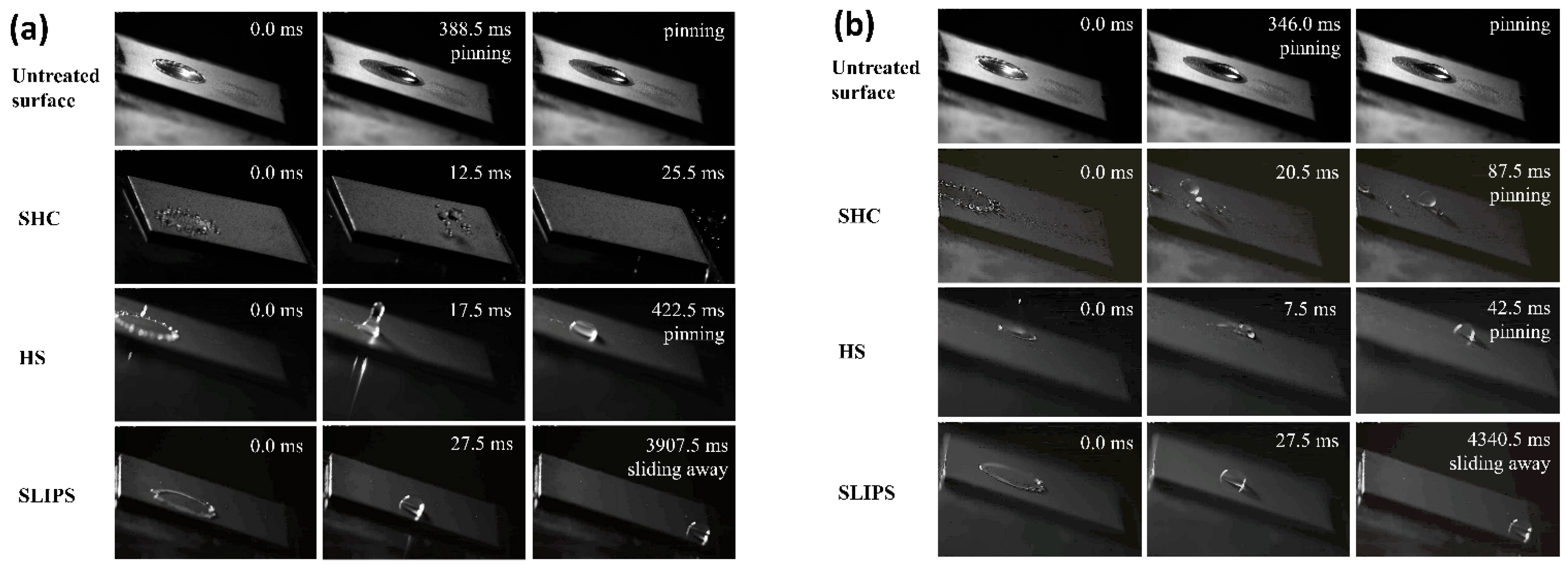
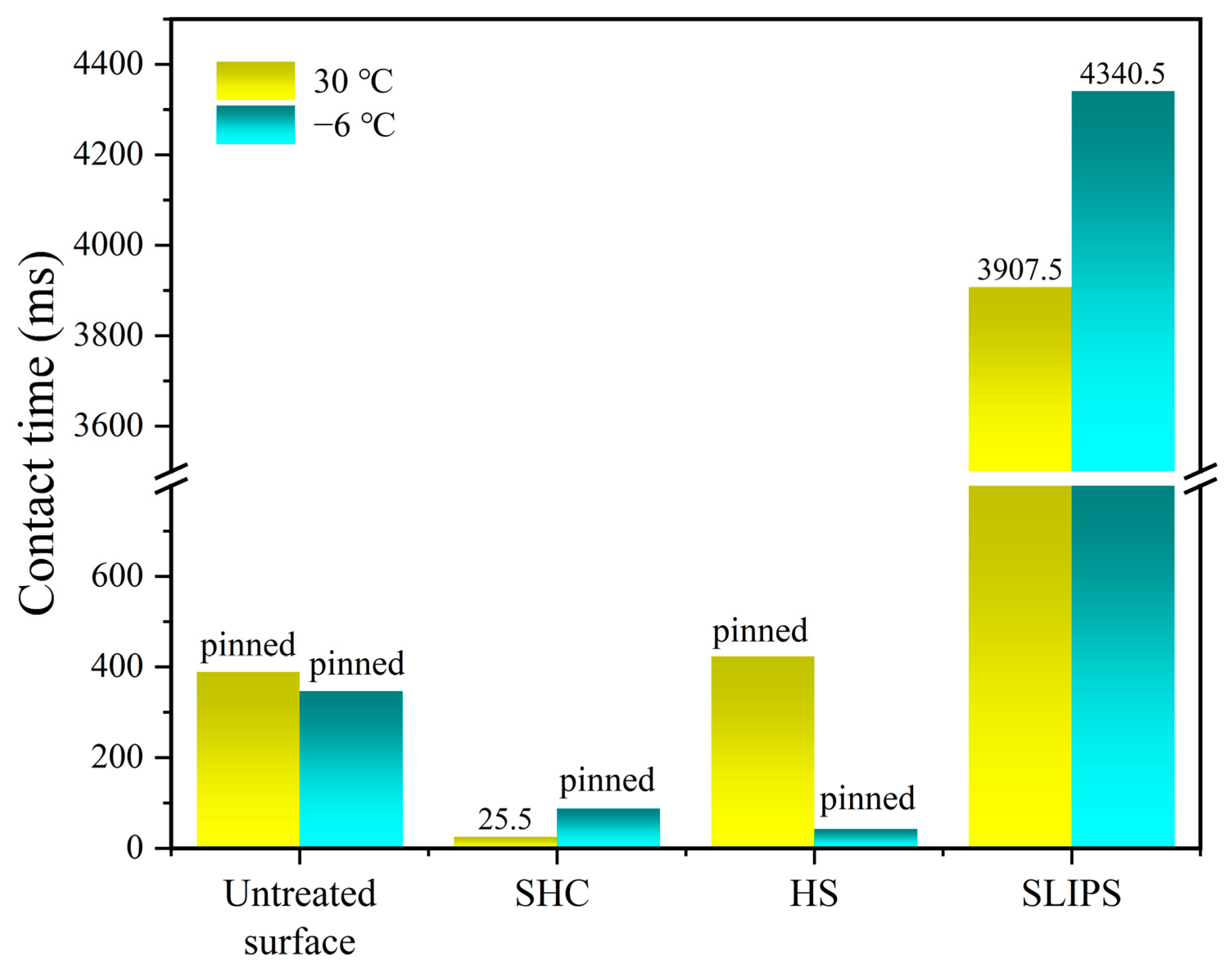
At 30 °C, simulating room temperature, droplets rapidly pinned on the untreated surface within 388.5 ms. In contrast, droplets on the SHC completely rebounded within 25.5 ms, as its micro–nano rough structure traps air to form a “solid–gas–liquid” coexistent Cassie state, achieving low adhesion. On the SLIPS, although droplet slide-off took considerably longer (3907.5 ms) compared to the rapid rebound on the SHC surface, it was observed that at −6 °C—simulating realistic low-temperature icing conditions—the SHC surface experienced droplet pinning after 87.5 ms, indicating a failure in anti-icing performance. This failure mechanism stems from the fact that in a low-temperature and high-humidity environment, water vapor in the air condenses into micro-droplets within the gaps of the SHC’s micro–nano structure, a process that displaces the originally trapped air layer and forces the surface to transition from the Cassie state to the “direct solid–liquid contact” Wenzel state, where droplets are physically “trapped” by the rough structure and cannot continue sliding (see Figure 6).
In comparison, droplets on the SLIPS continued to slide off completely despite an extended slide-off time, ultimately detaching without being captured. This phenomenon is attributed to the dimethyl silicone oil remaining liquid below −50 °C, which can stably maintain the integrity of the lubricating layer at −6 °C. The lubricating oil establishes a “liquid–liquid contact” mode between the droplets and the substrate instead of direct contact with the solid substrate, drastically reducing interfacial frictional resistance and thus effectively avoiding the pinning effect. It can provide continuous anti-icing protection under low temperatures and demonstrates superior potential for practical applications [31] (see Figure 7).

3.3.2. Delayed Freezing

The sliding capability mentioned earlier serves as the first line of defense against icing, promoting the preferential sliding of water droplets off the surface. However, considering real-world scenarios where droplets may be retained due to insufficient tilt angles or other conditions, we further investigated the freezing process of droplets on different surfaces.
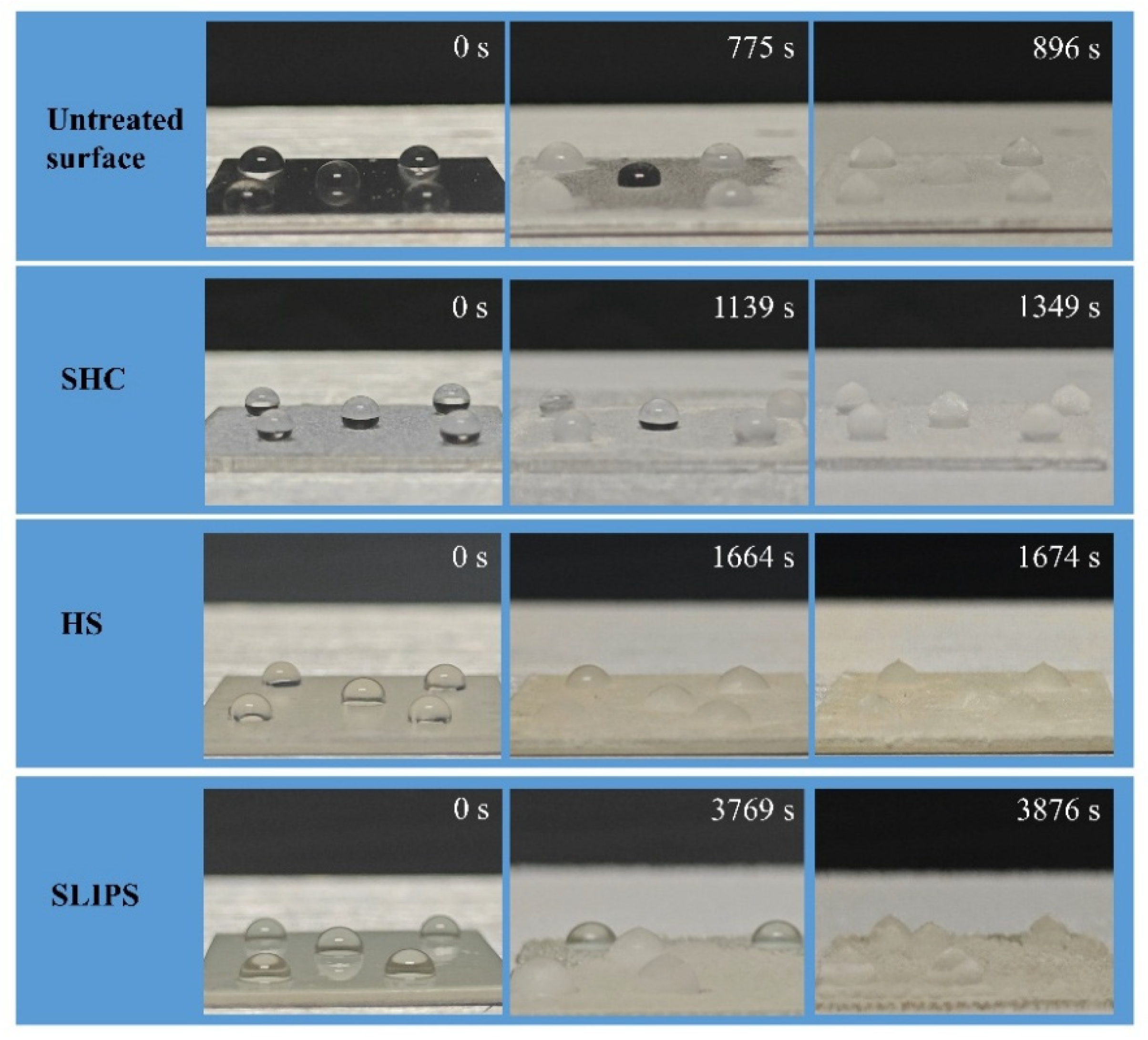
Freezing time test results revealed significant differences in anti-icing performance across the surfaces: droplets on the untreated surface froze the fastest, requiring only 896 s for complete freezing; the SHC and HS followed, with complete freezing times of 1349 s and 1674 s, respectively, while the SLIPS demonstrated a clear advantage, significantly extending the complete droplet freezing time to 3876 s—over one hour. This is because although the SHC and HS reduce the solid–liquid contact area, the droplets are in direct contact with the aluminum oxide substrate. With a thermal conductivity of approximately 30 W/(m·K), aluminum oxide efficiently transfers heat away from the droplets, leading to rapid freezing [32]. In contrast, the SLIPS is covered with a layer of dimethyl silicone oil, and the droplets contact the silicone oil instead. Since dimethyl silicone oil has a thermal conductivity of only about 0.1–0.2 W/(m·K), its heat transfer efficiency is extremely low, effectively blocking heat conduction and significantly slowing down the rate of droplet heat dissipation, thereby prolonging the freezing process [33].
Combining these results with the sliding data from the previous section, we can conclude that even when water droplets are in contact with the SLIPS, the extended freezing delay time of over one hour is sufficient for the droplets to slide off the surface before complete freezing occurs. In contrast, the other three surfaces exhibit droplet pinning under low-temperature and high-humidity conditions, and their relatively fast freezing rates cause droplets to remain on the surface and freeze rapidly. In summary, the SLIPS demonstrates superior anti-icing performance (see Figure 8).

3.3.3. Ice Adhesion Strength

Ice adhesion strength is a critical metric for evaluating the anti-icing performance of materials. According to the literature, ice adhesion strength is typically classified into several levels—below 100 kPa is considered low ice adhesion strength, below 20 kPa is termed ultra-low ice adhesion strength, and below 10 kPa is regarded as extremely low ice adhesion strength. More importantly, for ice to shed automatically under gravity or wind force, the ice adhesion strength of the material must be below 20 kPa [34].
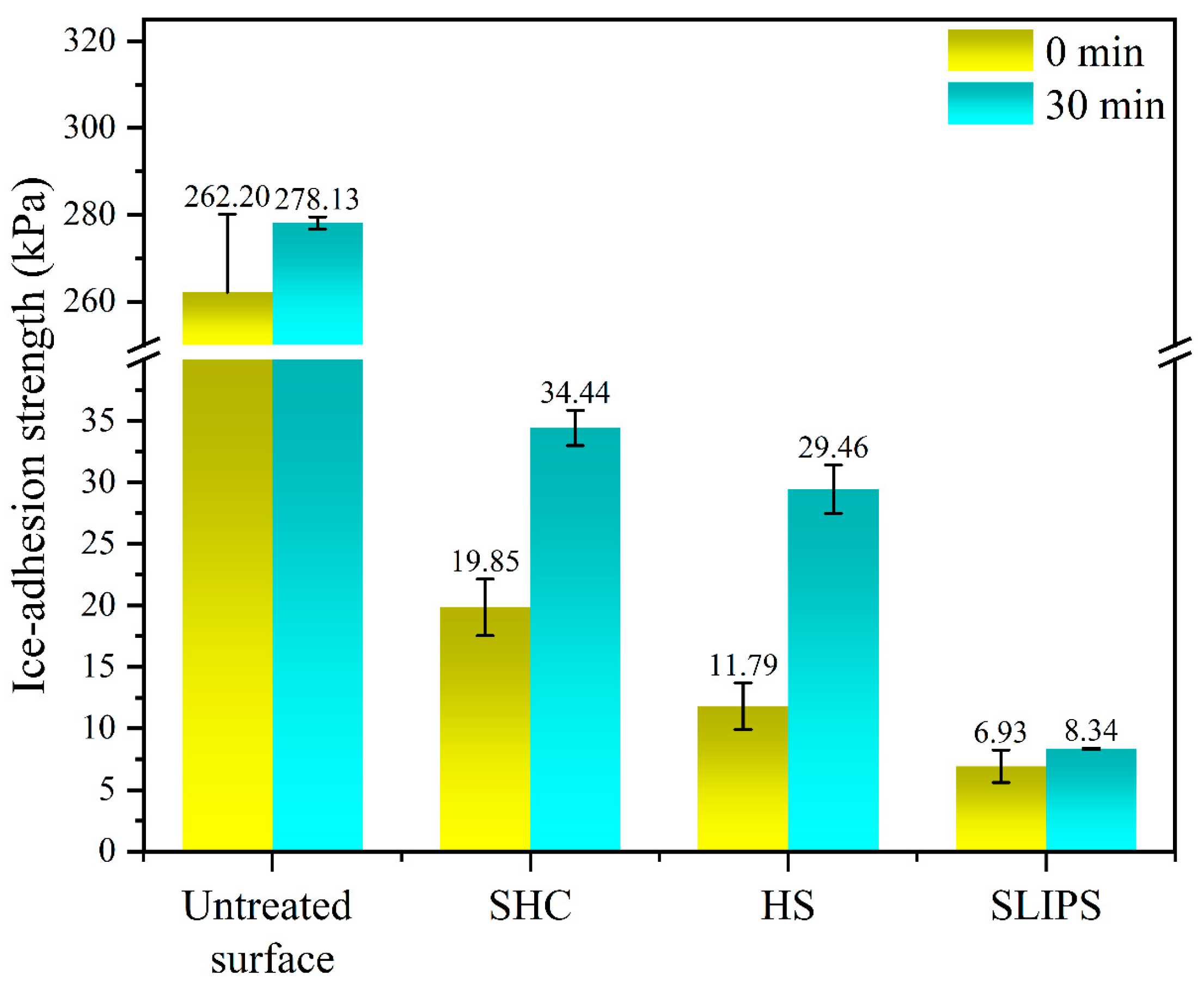
In the initial state, the SHC, HS, and SLIPS all exhibited excellent performance, with ice adhesion strengths below 20 kPa—some even almost reaching extremely low levels (below 10 kPa). Specifically, the SHC, leveraging its micro–nano structures to reduce the direct contact area between ice and the surface, achieved a reduced ice adhesion strength of 19.85 kPa. The HS showed a further reduction to 11.79 kPa. As for the SLIPS, the infused oil film intervenes at the “ice–substrate” interface, transforming direct ice–substrate contact into an indirect “ice–oil–substrate” interaction. This isolation effect significantly weakens interfacial bonding, resulting in an ice adhesion strength as low as 6.93 kPa. Initially, all three samples met the criterion for automatic ice removal under gravity or wind.
However, under low-temperature and high-humidity conditions—such as during frosting—the ice adhesion strength of SHC and HS increases markedly [35]. Our experimental data confirm this trend: the ice adhesion strength of the SHC surface increased from 19.85 kPa to 34.44 kPa, and that of the HS rose from 11.79 kPa to 29.46 kPa, both exceeding the 20 kPa threshold. The underlying reason for this phenomenon is that atmospheric water vapor can penetrate the microstructures of SHC and HS, where it condenses and freezes under low temperatures. The resulting ice forms a tightly interlocked structure with the external ice layer, significantly enhancing the bonding force and leading to a sharp rise in ice adhesion strength [36,37].
In contrast, the oil film of the SLIPS continuously isolates the interface, effectively preventing direct bonding between ice and the substrate [38,39]. As a result, the SLIPS exhibited only a minor increase in ice adhesion strength, from 6.93 kPa to 8.34 kPa. It can therefore be concluded that the SLIPS possesses a unique ability to maintain its anti-icing performance under low-temperature, high-humidity conditions, resisting the adverse effects of frosting.
Long-term stability of anti-icing performance is crucial in real environments. A typical cold spell can last 3–10 days, requiring materials to maintain low ice adhesion strength over extended periods. SHC and HS, whose ice adhesion strength increases sharply under high humidity and low temperatures, struggle to meet this endurance challenge. In comparison, the SLIPS showed only a slight increase in ice adhesion strength even after 30 min of frosting tests, demonstrating its potential to maintain ultra-low ice adhesion under prolonged low-temperature, high-humidity conditions. The findings of this study clearly indicate that the performance of the SLIPS under frosting conditions is far superior to that of other surfaces, making it more suitable for practical anti-icing applications and providing strong support for the development of highly efficient and durable anti-icing materials [40] (see Figure 9).

3.3.4. Frosting Delay Time

Beyond the sliding and freezing behavior of liquid water droplets, the frosting process of atmospheric water vapor on surfaces represents another critical factor influencing anti-icing performance. To compare the frost suppression capabilities of different surfaces, we systematically measured the frosting delay times of untreated aluminum, SHC surfaces, HS, and SLIPS. Complete data are shown in Figure 10.
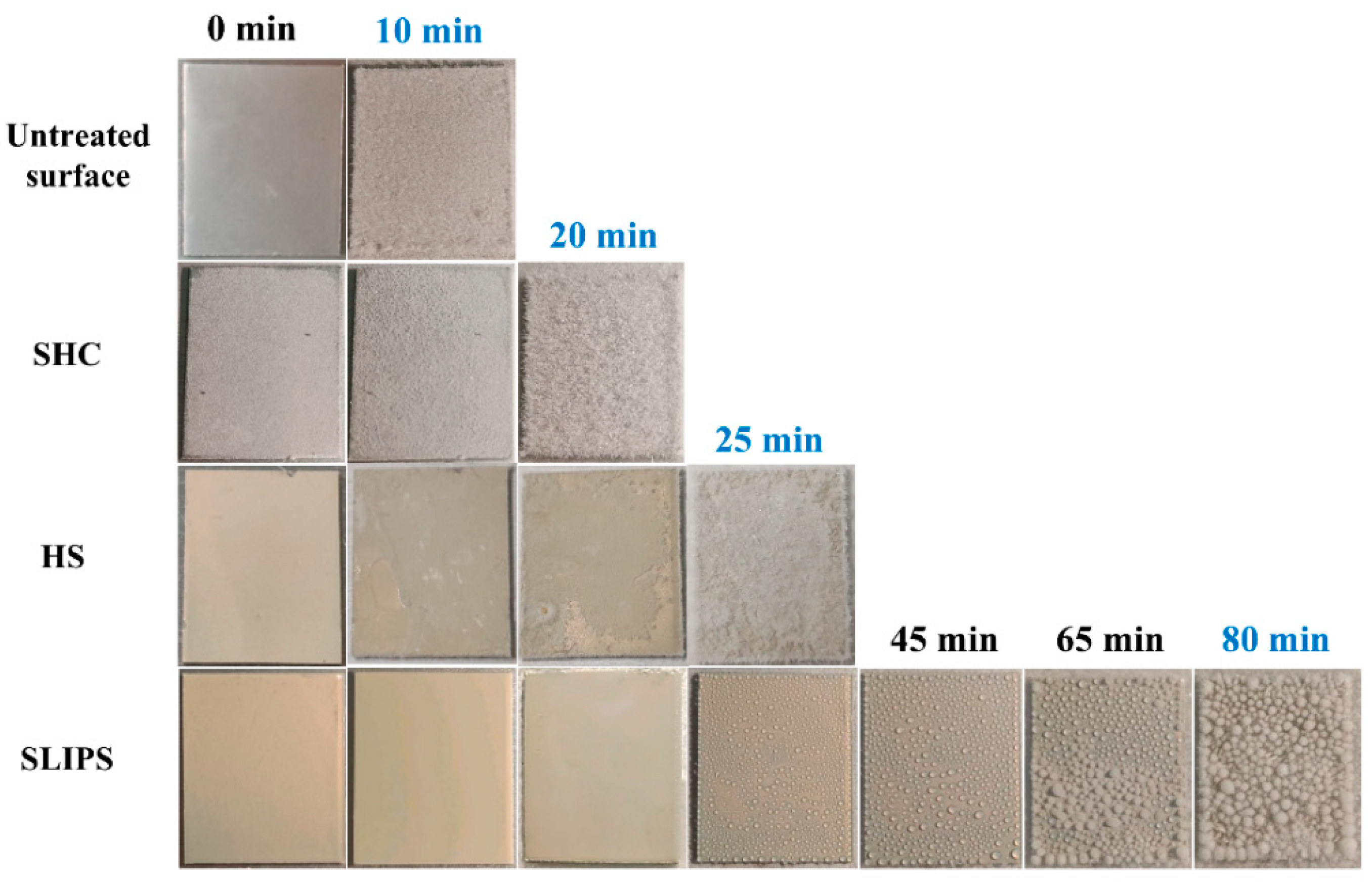
Frost formed fastest on the untreated aluminum surface, which became fully covered in just 10 min.
In contrast, the SHC and HS delayed the frosting process due to their reduced solid–liquid contact area, extending the time to complete frosting to 20 min and 25 min, respectively [41]. During frosting, water vapor from the air pinned onto these surfaces, forming fine frost crystals that accumulated into a dense ice layer.
The SLIPS far outperformed the other three surfaces, exhibiting a prolonged complete frosting time of 80 min—eight times that of the untreated aluminum—demonstrating remarkable anti-icing superiority. This performance is mainly attributed to two factors. First, unlike the other surfaces, frost formation on the SLIPS does not occur via direct vapor pinning. Instead, due to the low thermal conductivity of the infused lubricant, which slows down the surface heat loss rate and hinders water vapor from rapidly acquiring the cooling capacity required for condensation, water vapor initially condenses into micro-droplets. These droplets are then enveloped by the lubricant via the cloaking effect [42]. Finally, when these cloaked droplets come into close proximity, the attractive forces between their surrounding oil films cause them to coalesce into larger droplets [43]. Some of these larger droplets slide away along the smooth lubricant-infused interface without remaining on the surface [30]. Only the larger droplets that do not slide off gradually freeze, eventually forming a frost layer. This makes frosting considerably more difficult than on SHC or HS [18,44].
Second, the lubricant layer infused in the SLIPS creates a smooth and defect-free interface, effectively eliminating the pinning sites required for heterogeneous nucleation [45]. As a result, frost formation on the SLIPS occurs mainly via homogeneous nucleation. In comparison, the untreated surface, SHC, and HS primarily undergo heterogeneous nucleation. Homogeneous nucleation involves a higher energy barrier and is intrinsically more difficult to initiate, leading to significantly delayed frost formation [18].
In conclusion, these two factors enable the SLIPS to effectively retard frost formation, demonstrating outstanding anti-icing performance.

3.3.5. Durability

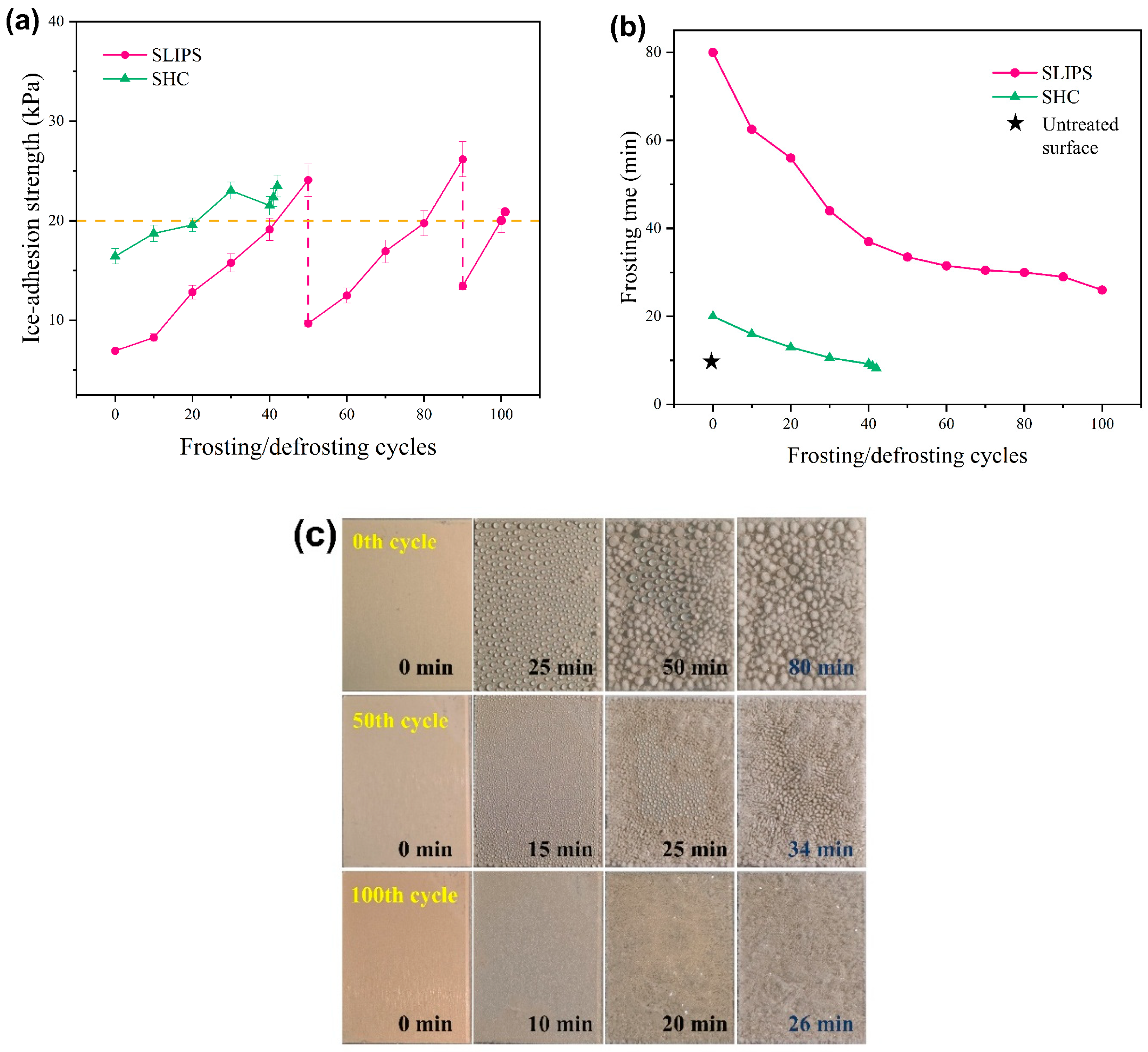
In practical low-temperature and high-humidity environments, the surface of conductors is prone to recurrent frost formation and melting. To evaluate the durability of anti-icing performance, frosting/defrosting cycle tests were conducted on SLIPS and SHC. Since an ice adhesion strength below 20 kPa enables autonomous ice shedding, a threshold of 20 kPa of ice adhesion strength was adopted as the failure determination criterion. The frost formation time under different numbers of cycles was recorded simultaneously. During the experiments, when the ice adhesion strength of a sample approached or exceeded 20 kPa, the sample was allowed to self-heal before resuming the cycle.
As shown in the evolution of ice adhesion strength with cycle number (Figure 11a), both SLIPS and SHC exhibited an increasing trend in ice adhesion strength as the number of cycles rose. Although SLIPS experiences partial lubricant depletion during frost/defrost cycles, the stored lubricant in the pore structure enables self-replenishment. Consequently, when the ice adhesion strength of SLIPS approached or surpassed 20 kPa, a marked decrease was observed after self-healing, and the value did not exceed the failure threshold until the 100th cycle. In contrast, the anti-icing mechanism of SHC relies on its superhydrophobic micro–nanostructure. The frosting/defrosting cycles cause irreversible damage to this structure, leading to an ice adhesion strength exceeding 20 kPa already at the 41st cycle. After the self-healing period, the adhesion strength did not recover but continued to rise, indicating complete failure of its anti-icing structure. Regarding the variation in frost formation time (Figure 11b), the initial frost delay time of SLIPS reached 80 min. Even after 100 cycles when failure occurred, the residual lubricant still maintained a frost delay of approximately 26 min. It is worth noting that the frost formation time of SHC, after 41 cycles, fell below that of the untreated aluminum surface, demonstrating a total loss of its anti-frosting capability.
From the frost morphologies of SLIPS at different cycles (Figure 11c), it can be observed that as the cycle progressed, the size of frozen droplets gradually decreased and their distribution became denser. This is attributed to the loss of lubricant, which hinders the migration and coalescence of liquid water droplets into larger ones.
In conclusion, owing to the self-healing capability of its stored lubricant, SLIPS demonstrates a significantly larger number of cycles to failure and a more stable anti-frosting performance than SHC. This renders SLIPS a more robust strategy for practical engineering applications requiring long-term anti-icing performance.

4. Conclusions

This study successfully fabricated a SLIPS with a Y-shaped structure on 1060 aluminum alloy via a two-step anodization process. The optimal two-step anodization parameters were determined: the first-step anodizing in oxalic acid at a current density of 0.08 A/cm2 for 10 min, followed by the second-step anodizing in phosphoric acid at a current density of 0.14 A/cm2 for 10 min. Researchers also evaluated the anti-icing performance of the SLIPS. The results demonstrate that the SLIPS exhibits excellent anti-icing effectiveness, with core advantages reflected in four aspects. Firstly, for SLIPS, it is difficult to capture droplets, effectively preventing droplet pinning and promoting rapid droplet slide-off. Secondly, regarding the freezing process, the low thermal conductivity of the lubricant layer significantly delays droplet freezing, buying sufficient time for droplet removal. Thirdly, in terms of ice adhesion properties, the surface exhibits extremely low ice adhesion strength and stable performance, successfully overcoming the performance degradation issue in low-temperature environments. Additionally, concerning frosting behavior, it also demonstrates a significant delaying effect on the frosting process, further expanding its applicability in anti-icing scenarios. Furthermore, the SLIPS maintains low ice adhesion (<20 kPa) for 100 frosting/defrosting cycles. Based on these comprehensive characteristics, the SLIPS shows promising application prospects in long-term anti-icing projects such as power transmission lines.

Author Contributions

C.Y.: Methodology, investigation, writing—original draft, formal analysis, visualization, and project administration. G.L.: Investigation, help writing the original draft, and validation. Q.Z.: Investigation, data curation, and visualization. Y.Z.: Investigation. Y.Y.: Funding acquisition, supervision, and writing—review and editing. All authors have read and agreed to the published version of the manuscript.

Funding

This work is supported by the National Undergraduate Training Program on Innovation and Entrepreneurship (Number: 202510611113).

Institutional Review Board Statement

Not applicable.

Informed Consent Statement

Not applicable.

Data Availability Statement

The data that have been used cannot be shared at this time, for legal or ethical reasons.

Acknowledgments

We thank Jie Xiao and for technical assistance and Yijin Wang for helping with language editing.

Conflicts of Interest

The authors declare no conflicts of interest.

Abbreviations

The following abbreviations are used in this manuscript:
SLIPSSlippery Lubricant-Infused Porous Surfaces
SHCSuperhydrophobic Coatings
HSHydrophobic Surface
AAOAnodic Aluminum Oxide
CAContact Angle
SASliding Angle
CAHContact Angle Hysteresis

References

  1. Zhang, Z.; Zhang, H.; Yue, S.; Zeng, W. A Review of Icing and Anti-Icing Technology for Transmission Lines. Energies 2023, 16, 601. [Google Scholar] [CrossRef]
  2. Lu, J.; Zeng, M.; Zeng, X.; Fang, Z.; Yuan, J. Analysis of Ice-Covering Characteristics of China Hunan Power Grid. IEEE Trans. Ind. Appl. 2015, 51, 1997–2002. [Google Scholar] [CrossRef]
  3. Tomaszewski, M.; Bartodziej, G. Prevention of Effects of Overhead Line Failures Caused by Ice and Snow Adhesion and Accretion. Cold Reg. Sci. Technol. 2011, 65, 211–218. [Google Scholar] [CrossRef]
  4. Rekuviene, R.; Saeidiharzand, S.; Mažeika, L.; Samaitis, V.; Jankauskas, A.; Sadaghiani, A.K.; Gharib, G.; Muganlı, Z.; Koşar, A. A Review on Passive and Active Anti-Icing and de-Icing Technologies. Appl. Therm. Eng. 2024, 250, 123474. [Google Scholar] [CrossRef]
  5. Aquino, J.; Nazaripouya, H. Methods Utilized to Improve Resilience of Power Systems Against Ice Storms. In Proceedings of the 2022 IEEE International Conference on Environment and Electrical Engineering and 2022 IEEE Industrial and Commercial Power Systems Europe (EEEIC/I&CPS Europe), Prague, Czech Republic, 28 June–1 July 2022; pp. 1–5. [Google Scholar]
  6. Brettschneider, S.; Fofana, I. Evolution of Countermeasures against Atmospheric Icing of Power Lines over the Past Four Decades and Their Applications into Field Operations. Energies 2021, 14, 6291. [Google Scholar] [CrossRef]
  7. Juanjuan, W.; Chuang, F.; Yiping, C.; Hong, R.; Shukai, X.; Tao, Y.; Licheng, L. Research and Application of DC De–Icing Technology in China Southern Power Grid. IEEE Trans. Power Deliv. 2012, 27, 1234–1242. [Google Scholar] [CrossRef]
  8. Menini, R.; Ghalmi, Z.; Farzaneh, M. Highly Resistant Icephobic Coatings on Aluminum Alloys. Cold Reg. Sci. Technol. 2011, 65, 65–69. [Google Scholar] [CrossRef]
  9. Tao, B.; Cheng, L.; Wang, J.; Zhang, X.; Liao, R. A Review on Mechanism and Application of Functional Coatings for Overhead Transmission Lines. Front. Mater. 2022, 9, 995290. [Google Scholar] [CrossRef]
  10. Long, Y.; Yin, X.; Mu, P.; Wang, Q.; Hu, J.; Li, J. Slippery Liquid-Infused Porous Surface (SLIPS) with Superior Liquid Repellency, Anti-Corrosion, Anti-Icing and Intensified Durability for Protecting Substrates. Chem. Eng. J. 2020, 401, 126137. [Google Scholar] [CrossRef]
  11. Si, Y.; Guo, Z. Superhydrophobic Nanocoatings: From Materials to Fabrications and to Applications. Nanoscale 2015, 7, 5922–5946. [Google Scholar] [CrossRef]
  12. Wen, G.; Guo, Z.; Liu, W. Biomimetic Polymeric Superhydrophobic Surfaces and Nanostructures: From Fabrication to Applications. Nanoscale 2017, 9, 3338–3366. [Google Scholar] [CrossRef]
  13. Li, W.; Zhan, Y.; Yu, S. Applications of Superhydrophobic Coatings in Anti-Icing: Theory, Mechanisms, Impact Factors, Challenges and Perspectives. Prog. Org. Coat. 2021, 152, 106117. [Google Scholar] [CrossRef]
  14. Zeng, Q.; Zhou, H.; Huang, J.; Guo, Z. Review on the Recent Development of Durable Superhydrophobic Materials for Practical Applications. Nanoscale 2021, 13, 11734–11764. [Google Scholar] [CrossRef]
  15. Xu, K.; Qiao, Y.; Sun, S.; Zhang, H.; Song, J.; Liu, F.; Zhang, Y. One-Step Fabrication of Superhydrophobic Surface on Overhead Aluminum Conductors for Anti-Icing Application. Chem. Lett. 2025, 54, upaf086. [Google Scholar] [CrossRef]
  16. He, Q.; Xu, Y.; Zhang, F.; Jia, Y.; Du, Z.; Li, G.; Shi, B.; Li, P.; Ning, M.; Li, A. Preparation Methods and Research Progress of Super-Hydrophobic Anti-Icing Surface. Adv. Colloid Interface Sci. 2024, 323, 103069. [Google Scholar] [CrossRef] [PubMed]
  17. Wong, T.-S.; Kang, S.H.; Tang, S.K.Y.; Smythe, E.J.; Hatton, B.D.; Grinthal, A.; Aizenberg, J. Bioinspired Self-Repairing Slippery Surfaces with Pressure-Stable Omniphobicity. Nature 2011, 477, 443–447. [Google Scholar] [CrossRef] [PubMed]
  18. Kim, P.; Wong, T.-S.; Alvarenga, J.; Kreder, M.J.; Adorno-Martinez, W.E.; Aizenberg, J. Liquid-Infused Nanostructured Surfaces with Extreme Anti-Ice and Anti-Frost Performance. ACS Nano 2012, 6, 6569–6577. [Google Scholar] [CrossRef]
  19. Zhao, S.; Shen, T.; Li, Y.; Deng, R.; Yang, H.; Li, W. Epoxy-resin-based Slippery Liquid Infused Anti-icing Coating Based on Breath Figure. Acta Polym. Sin. 2021, 52, 1622–1631. [Google Scholar] [CrossRef]
  20. Zhang, J.; Gu, C.; Tu, J. Robust Slippery Coating with Superior Corrosion Resistance and Anti-Icing Performance for AZ31B Mg Alloy Protection. ACS Appl. Mater. Interfaces 2017, 9, 11247–11257. [Google Scholar] [CrossRef]
  21. Qian, H.; Liu, B.; Wu, D.; Liu, W.; Chowwanonthapunya, T.; Zhang, D. Facile Fabrication of Slippery Lubricant-Infused Porous Surface with Pressure Responsive Property for Anti-Icing Application. Colloids Surf. A Physicochem. Eng. Asp. 2021, 618, 126457. [Google Scholar] [CrossRef]
  22. Yu, Z.; Zhang, H.; Yang, Y.; Wang, B.; Guo, Z. Slippery Liquid-Infused Porous Surfaces (SLIPS) for Anti-Icing. Mater. Today 2025, 88, 906–932. [Google Scholar] [CrossRef]
  23. Yuan, Y.; Wang, L.; Liu, G.; Liao, R. Fabrication of Ultralow Ice-Adhesion Slippery Liquid Infused Porous Surfaces on Aluminum Alloy (7075-T651). Coatings 2020, 10, 1025. [Google Scholar] [CrossRef]
  24. Xiang, H.; Cheng, L.; Liu, G.; Zhu, T.; Dai, X.; Wei, Z.; Zhou, J.; Liao, R.; Yuan, Y. Proper Matching of Lubricants and Modifiers: Another Key Factor for Durable Anti-Icing Performance of Lubricated Surfaces. Surf. Interfaces 2023, 37, 102653. [Google Scholar] [CrossRef]
  25. Wong, W.S.Y.; Hegner, K.I.; Donadei, V.; Hauer, L.; Naga, A.; Vollmer, D. Capillary Balancing: Designing Frost-Resistant Lubricant-Infused Surfaces. Nano Lett. 2020, 20, 8508–8515. [Google Scholar] [CrossRef]
  26. Xiang, H.; Yuan, Y.; Zhang, C.; Dai, X.; Zhu, T.; Song, L.; Gai, Y.; Liao, R. Key Factors Affecting Durable Anti-Icing of Slippery Surfaces: Pore Size and Porosity. ACS Appl. Mater. Interfaces 2023, 15, 3599–3612. [Google Scholar] [CrossRef]
  27. Li, B.; Bai, J.; Yang, L.; Zhang, L.; Dai, X.; Zhang, C.; Hua, X.; Zhu, T.; Xiang, H.; Liao, R.; et al. Effects of the Second Anodization Parameters on the Hydrophobicity and Anti-Icing Properties of Al Surface with Composite Nanopore Structure. Coatings 2023, 13, 1859. [Google Scholar] [CrossRef]
  28. Li, B.; Bai, J.; He, J.; Ding, C.; Dai, X.; Ci, W.; Zhu, T.; Liao, R.; Yuan, Y.; Li, B.; et al. A Review on Superhydrophobic Surface with Anti-Icing Properties in Overhead Transmission Lines. Coatings 2023, 13, 301. [Google Scholar] [CrossRef]
  29. Gautam, V.; Praveen, L.L.; Vardhan, R.V.; Mandal, S. Exploring the Protection of Spray-Pyrolysed Tungsten Oxide Hydrophobic Coating on Stainless Steel in a Marine Environment. Bull. Mat. Sci. 2024, 47, 204. [Google Scholar] [CrossRef]
  30. Li, B.; Bai, J.; Fan, L.; Mao, X.; Ding, Z.; Mu, H.; Liu, G.; Yuan, Y. Fabrication of Slippery Surfaces on Aluminum Alloy and Its Anti-Icing Performance in Glaze Ice. Coatings 2023, 13, 732. [Google Scholar] [CrossRef]
  31. Gao, S.; Jiao, L.; Yi, M.; Wang, J.; Wang, X. Mechanism and research progress of anti/de-icing using hydrophobic/superhydrophobic surfaces. Acta Aerodyn. Sin. 2021, 39, 151–160. [Google Scholar] [CrossRef]
  32. Tiwari, J.; Feng, T. Accurate Prediction of Thermal Conductivity of Al2O3 at Ultrahigh Temperatures. Phys. Rev. B 2024, 109, 075201. [Google Scholar] [CrossRef]
  33. Zhou, Y.; Wang, Z.; Xie, Z.; Wang, Y. Parametric Investigation on the Performance of a Battery Thermal Management System with Immersion Cooling. Energies 2022, 15, 2554. [Google Scholar] [CrossRef]
  34. Chen, J.; Liu, J.; He, M.; Li, K.; Cui, D.; Zhang, Q.; Zeng, X.; Zhang, Y.; Wang, J.; Song, Y. Superhydrophobic Surfaces Cannot Reduce Ice Adhesion. Appl. Phys. Lett. 2012, 101, 111603. [Google Scholar] [CrossRef]
  35. Ma, L.; Zhang, Z.; Gao, L.; Liu, Y.; Hu, H. Bio-Inspired Icephobic Coatings for Aircraft Icing Mitigation: A Critical Review. Rev. Adhes. Adhes. 2020, 8, 168–198. [Google Scholar] [CrossRef]
  36. Sarkar, D.K.; Farzaneh, M. Superhydrophobic Coatings with Reduced Ice Adhesion. J. Adhes. Sci. Technol. 2009, 23, 1215–1237. [Google Scholar] [CrossRef]
  37. Yeong, Y.H.; Steele, A.; Loth, E.; Bayer, I.; De Combarieu, G.; Lakeman, C. Temperature and Humidity Effects on Superhydrophobicity of Nanocomposite Coatings. Appl. Phys. Lett. 2012, 100, 053112. [Google Scholar] [CrossRef]
  38. Ijaz, A.; Miko, A.; Demirel, A.L. Low Ice Adhesion Anti-Icing Coatings Based on PEG Release from Mesoporous Silica Particle Loaded SBS. Mater. Adv. 2022, 3, 8168–8177. [Google Scholar] [CrossRef]
  39. Liang, Z.-H.; Wu, S.-L.; Liu, C.; Yang, H.-C.; Darling, S.B.; Xu, Z.-K. When SLIPS Meets TIPS: An Endogenous Lubricant-Infused Surface by Taking the Diluent as the Lubricant. Chem. Eng. J. 2021, 425, 130600. [Google Scholar] [CrossRef]
  40. Aktas, B.; Jafari, R.; Koivuluoto, H. Flame-Sprayed Ceramic and Metallic Slippery Liquid-Infused Porous and Icephobic Surfaces. J. Therm. Spray Technol. 2025, 34, 1843–1854. [Google Scholar] [CrossRef]
  41. He, H.; Guo, Z. Superhydrophobic Materials Used for Anti-Icing Theory, Application, and Development. iScience 2021, 24, 103357. [Google Scholar] [CrossRef]
  42. Rykaczewski, K.; Anand, S.; Subramanyam, S.B.; Varanasi, K.K. Mechanism of Frost Formation on Lubricant-Impregnated Surfaces. Langmuir 2013, 29, 5230–5238. [Google Scholar] [CrossRef]
  43. Sasidharanpillai, A.; Lee, Y.; Lee, S. Design of Stable Liquid Infused Surfaces: Influence of Oil Viscosity on Stability. Colloids Surf. A Physicochem. Eng. Asp. 2022, 646, 128923. [Google Scholar] [CrossRef]
  44. Zhu, Z.; Liang, H.; Sun, D.-W. Infusing Silicone and Camellia Seed Oils into Micro-/Nanostructures for Developing Novel Anti-Icing/Frosting Surfaces for Food Freezing Applications. ACS Appl. Mater. Interfaces 2023, 15, 14874–14883. [Google Scholar] [CrossRef] [PubMed]
  45. Barthwal, S.; Lim, S.-H. Rapid Fabrication of a Dual-Scale Micro-Nanostructured Superhydrophobic Aluminum Surface with Delayed Condensation and Ice Formation Properties. Soft Matter 2019, 15, 7945–7955. [Google Scholar] [CrossRef] [PubMed]
Figure 1. Anodic oxidation preparation process and device of the samples.
Coatings 16 00135 g001
Figure 2. Schematic diagrams of different types of pore structures.
Coatings 16 00135 g002
Figure 3. Micrographs of samples at different first-step current densities.
Coatings 16 00135 g003
Figure 4. Microscopic and cross-sectional morphology of composite pore structure under different current densities and oxidation times at second-step anodizing.
Coatings 16 00135 g004
Figure 5. FTIR spectra of the untreated aluminum surface, HS, and SLIPS, and contact angle results before and after lubricant-infusing.
Coatings 16 00135 g005
Figure 6. Droplet impact behavior at 30 °C (a) and −6 °C (b).
Coatings 16 00135 g006
Figure 7. Quantitative comparison of impact dynamics between 30 °C and −6 °C.
Coatings 16 00135 g007
Figure 8. Process image spanning from the freezing of the initial droplet to the freezing of all droplets.
Coatings 16 00135 g008
Figure 9. Initial ice adhesion strength of various aluminum surfaces and their ice adhesion strength after 30 min of frosting.
Coatings 16 00135 g009
Figure 10. Frosting process of different aluminum surfaces under −5 °C.
Coatings 16 00135 g010
Figure 11. Frosting time variation (a), ice adhesion strength variation (b), and macroscopic frosting process variation (c) during the frosting/defrosting cycle.
Coatings 16 00135 g011
Table 1. Cross-sectional size details of samples under different current densities of first-step anodizing.
NO.Current Density (A/cm2)Pore Size (nm)Surface Porosity (%)
10.0682.729.4
20.08104.245.9
30.1078.230.5
Table 2. Cross-sectional size details of samples under different current densities of second-step anodizing.
NO.Current Density (A/cm2)Pore Size of Upper Layer (nm)Surface Porosity
(%)
Pore Size of Lower Layer (nm)Upper Film Thickness
(μm)
Lower Film Thickness
(μm)
Pore Volume of a Y-Shape
(10−20 m3)
10.1274.421.636188.88910.7311.3836.6
20.14107.948.501220.9729.9219.2797.4
30.16122.849.931238.1258.9222.86112.3
Disclaimer/Publisher’s Note: The statements, opinions and data contained in all publications are solely those of the individual author(s) and contributor(s) and not of MDPI and/or the editor(s). MDPI and/or the editor(s) disclaim responsibility for any injury to people or property resulting from any ideas, methods, instructions or products referred to in the content.