Article

Exploring the Mechanical and Thermal Properties of BaTiS3 and BaTiSe3 Chalcogenides via Density Functional Theory


by
Adel Bandar Alruqi
1,* and
Nicholas O. Ongwen
2
1
Department of Physics, Faculty of Science, King Abdulaziz University, Jeddah 21589, Saudi Arabia
2
Faculty of Biological and Physical Sciences, Tom Mboya University, Homa Bay 40300, Kenya
*
Author to whom correspondence should be addressed.
Coatings 2025, 15(12), 1479; https://doi.org/10.3390/coatings15121479
Submission received: 21 October 2025 / Revised: 21 November 2025 / Accepted: 12 December 2025 / Published: 15 December 2025
(This article belongs to the Special Issue Surface Chemistry in Science and Industry)

Abstract

The exploration of chalcogenides is on the rise owing to their desirable optical, electronic, thermoelectric, and thermal properties. Chalcogenide materials have been investigated for possible applications in areas such as non-linear optics and solar cells. Among these materials are BaTiS3 and BaTiSe3. BaTiS3 has shown promise in the above-mentioned applications due to its low thermal conductivity. However, neither the thermal properties of BaTiSe3 nor the mechanical properties of both BaTiS3 and BaTiSe3 have been reported. In this work, we performed a computational study of the mechanical and thermal properties of both materials within the density functional theory using Quantum Espresso and BoltzTrap2 codes, employing generalized gradient approximation. The results showed that the computed thermal conductivity of BaTiS3 at 0.43 W/m/K is comparable to the literature values. The computed elastic constants of BaTiS3 (bulk modulus of 44.7 GPa, shear modulus of 11.2 GPa, Young’s modulus of 29.6 GPa, and Vickers hardness of 1.053 GPa) were higher than those of BaTiSe3. The calculated properties obtained in this work add to the literature on the properties of BaTiS3 and BaTiSe3. However, since the work was computational, the results can be verified by an experimental investigation.

1. Introduction

Chalcogenides are compounds that contain one or more chalcogen elements (group 16 of the periodic table, such as oxygen, sulfur, selenium, tellurium, and polonium) combined with metals or semimetals [1]. There are different types of chalcogenides, including metal chalcogenides, which are compounds formed between metals and chalcogens such as transition metal dichalcogenides like molybdenum sulfide and tungsten sulfide; metal oxides such as titanium dioxide and zinc oxide; and semiconductor chalcogenides, which are used in photovoltaics and optoelectronics such as cadmium telluride (used in solar cells) and lead sulfide (used in infrared detectors) [2,3,4,5]. Chalcogenide glasses also exist; and are basically amorphous materials made from sulfur, selenium, or tellurium with elements like arsenic or germanium [6,7]. Chalcogenides are mainly used in optical fibers for infrared transmission; phase-change memory in electronics (such as Ge2Sb2Te5 in data storage); infrared optics, lasers, and sensors in optoelectronics; and energy production and storage in solar cells and batteries [8].
BaTiS3 and BaTiSe3 are common chalcogenides that have been studied for possible applications in solar cells, dielectrics, and ferroelectrics, owing to their hexagonal crystal system with octahedral shapes [9]. BaTiS3 was first synthesized in the mid-20th century during a wave of interest in exploring new types of perovskite-like materials. Early research in the 1960s and ’70s revealed that it has a hexagonal structure made up of chains of TiS6 octahedra [10]. By the 1980s and ’90s, researchers had confirmed that it is a semiconductor with a relatively narrow bandgap of about 0.5 eV, making it a promising candidate for application in optoelectronic devices [11]. One of its unique properties compared to traditional oxide-based perovskites is its lower thermal conductivity, which makes it particularly appealing for thermoelectric applications [11]. BaTiSe3, on the other hand, has gained traction only recently. Its high-quality single crystals were first synthesized and reported in 2024 by Zhao et al. [12] using chemical vapor transport. Subsequent work has extended its exploration in nanocrystal form, placing it alongside other hexagonal ABX3 selenides for optoelectronic applications [13].
As interest in perovskite materials for solar energy continues to grow, BaTiS3 has attracted fresh attention as a promising alternative to lead-based perovskites. It has shown strong light absorption, directional optical responses, and notable excitonic behavior, all of which make it a compelling candidate for infrared photodetectors and advanced optical systems [11,12]. It is currently being considered for next-generation thin-film solar cells, thanks in part to its low thermal conductivity [11]. Research on BaTiS3 has mainly placed emphasis on its semiconducting nature, dielectric behavior, and potential for use in nonlinear optical applications [14]. However, with the growing interest in perovskite-inspired materials for solar energy, it is now also being explored for its potential in solar cells due to its ideal bandgap and strong ability to absorb light. It is currently being investigated as an alternative to lead-based perovskites in solar cells, and also in thermoelectrics for heat-to-electricity conversion [15].
Recently, Gillani et al. [9] investigated the electronic, optical, and thermodynamic properties (specific heat capacity, free energy, thermal conductivity, and Debye temperature) of BaTiS3. Zhao et al. [12], on the other hand, looked into the thermal conductivity of BaTiS3 for a possible application in thermoelectrics, where they reported low thermal conductivity of BaTiS3, which is good for thermoelectric power generation application. However, the mechanical properties of both BaTiS3 and BaTiSe3 are not available in the literature. The thermal properties of BaTiSe3 are not available in the literature either. The present study investigated the mechanical and thermal properties of BaTiS3 and BaTiSe3 for the first time, and a comparison was made between the two. The thermal properties of BaTiS3 were computed for the sake of comparison with the existing literature, as well as for comparison with BaTiSe3.

2. Computational Methods

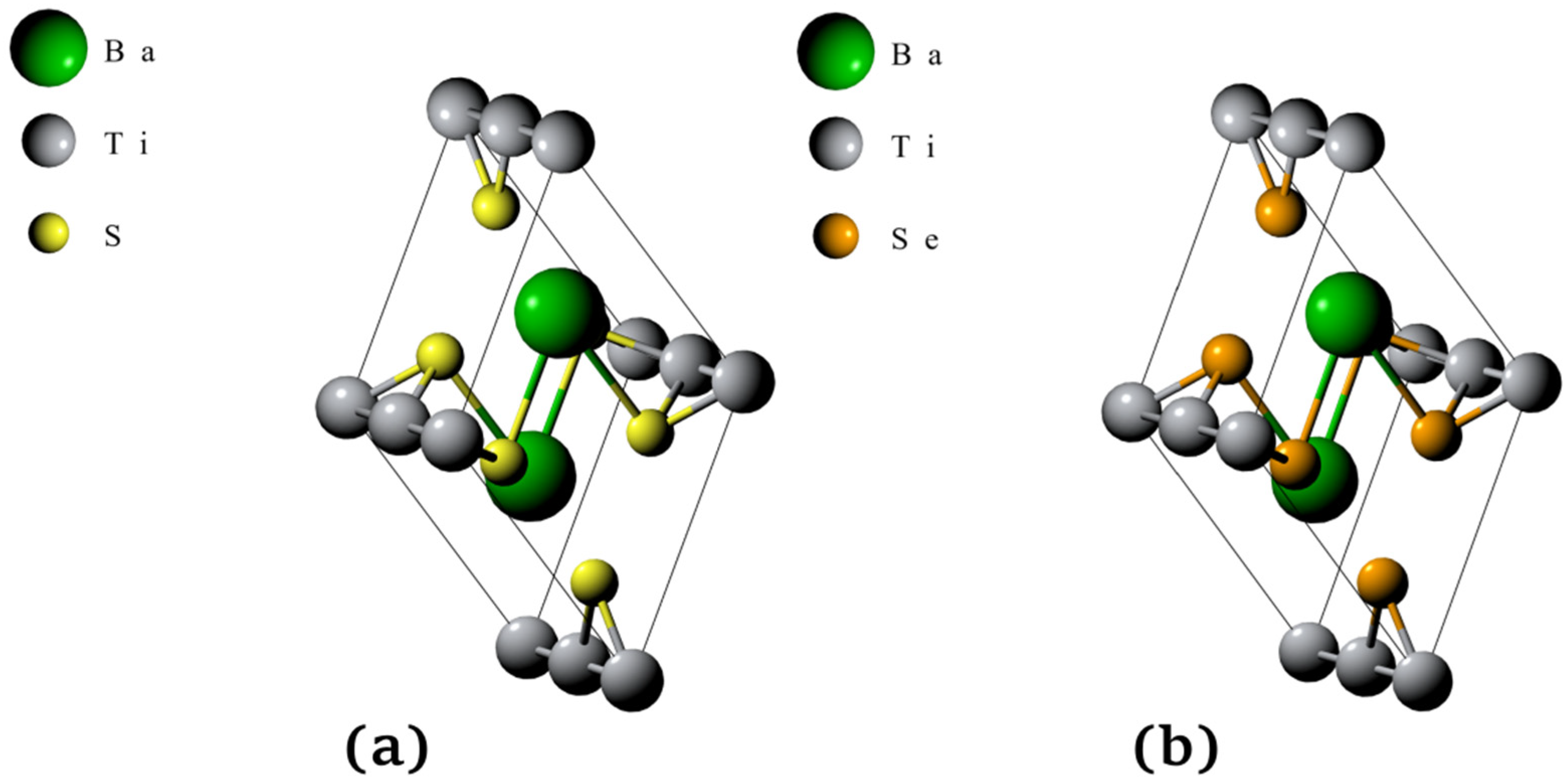
The crystallographic information files for both BaTiS3 and BaTiSe3 were obtained from the Automatic Flow of Materials [16,17], both of which were hexagonal crystal structures of space group P63/mmc, #194 (Figure 1). BaTiS3 had the lattice parameters a = b = 6.831   Å ,   c = 5.946   Å , while BaTiSe3 had the lattice parameters a = b = 7.139   Å ,   c = 6.171   Å . The cells were then optimized by varying their kinetic energy cut-offs from 20 to 90 Ry in the range of 10 Ry, K_points from 2 × 2 × 2 to 9 × 9 × 9 in the range of 1 × 1 × 1, and lattice parameters within 10% below and above the reference values for both parameters a and c . The optimum lattice points were obtained by performing variable-cell relaxations of the cells using the Broyden, Fletcher, Goldfarb, and Shanno algorithm [18]. At the end of the optimization, we obtained the kinetic energy cut-off convergence of 4.3 × 10⁻⁴ Ry and 2.6 × 10⁻⁴ Ry for BaTiS3 and BaTiSe3, respectively, which occurred at 70 Ry. For the K_points, we used the optimum value of 7 × 7 × 7. We used stress tensor convergence thresholds within ×10−6 Ry/bohr3. All the calculations were done within the density functional theory using Quantum Espresso code [19]. The generalized gradient approximation was employed using the Perdew–Burke–Ernzerhof exchange-correlation functional, with ultrasoft pseudopotentials.
The formation energies of the samples were calculated in order to test their structural stability. This was done according to the relation [20]:
E F A = n B a E F + n T i E F + n S   o r   S e E F ,
where A = BaTiS3 or BaTiSe3, and n is the number of atoms of each species. The calculation of the enthalpy of formation was related to the formation energy by:
H f = E f 0   K + E Z P E + E t h e r m a l ,
where + E Z P E is the zero-point energy contribution from phonons and E t h e r m a l is the vibrational energy change from 0 to 298 K. Both E Z P E   a n d   E t h e r m a l were calculated using Thermo_pw code.
Computations of the mechanical properties of the optimized samples were done using the stress–stain method with small strains of ±0.006, and the corresponding stresses were obtained, from which the elastic stiffness constants and, consequently, the elastic properties were obtained [21]. Hexagonal crystals have five independent elastic stiffness constants [22]— c 11 , c 12 , c 13 , c 33 ,   a n d   c 44 —with the additional relation:
c 66 = c 11 c 12 2
For a hexagonal unit cell to be mechanically stable, the following Born stability criteria must be satisfied [23]:
c 33 c 11 + c 12 2 c 13 2 > 0 ; c 44 > 0 ; c 66 > 0 ; c 11 > c 12 ;   c 11 + c 12 c 33 > 22 c 13 2
For the calculation of thermal properties, the BoltzTrap2 code [24] was employed. Since the BoltzTrap2 code produces only the electronic thermal conductivity, the lattice thermal conductivity ( κ L ) was obtained from the relation [25]:
κ L = A M ¯ Θ D 3 δ γ 2 n 2 / 3 T ,
where M ¯ is the average atomic mass per atom, Θ D is the Debye temperature, δ 3 is the volume per atom, γ is the Grüneisen parameter, n is the number of atoms per primitive cell, and A is an empirical constant (A = 3.1 × 10⁻⁶). The Grüneisen parameter was estimated from the Poisson ratio (μ) using the relation [25]:
λ = 3 2 1 + μ 2 3 μ ,
The effective thermal conductivity (κ) is the sum of the two thermal conductivities:
κ = κ e + κ L

3. Results and Discussion

3.1. Structural Properties

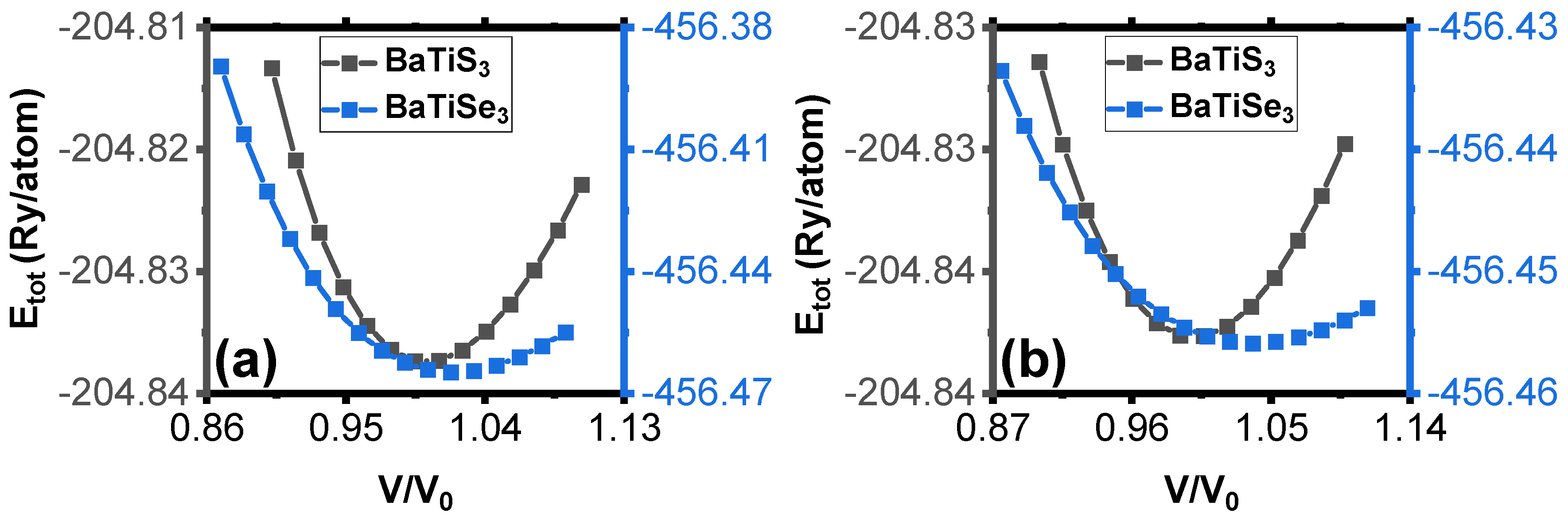
Figure 2 displays how total energy varies with the normalized volumes for parameters a and c for both BaTiS3 and BaTiSe3. The minimum points of the curves correspond to the equilibrium lattice constants, which are presented in Table 1. Table 1 shows that the calculated lattice parameters of BaTiS3 are in very good accord with the existing values in the literature, both experimental [26] and computational [13], representing a deviation of within 1.010% for parameter a and within 1.457% for parameter c. Likewise, the values of the lattice parameters of BaTiSe3 are in good agreement with both the computational study by Mathew et al. [27] and the experimental study by Zhao et al. [12], representing a deviation of within 1.038% for parameter a and within 1.623% for parameter c. Zhao et al. recorded a lattice parameter of 21.1 Å for parameter a for a 3 × 3 × 1 supercell, translating to 7.033 Å for the primitive cell. These results show that the calculations in this study were done with good accuracy.
Chalcogenides are widely used in nonlinear optics due to their high refractive index and strong optical nonlinearity. Higher density often correlates with stronger electronic polarizability, leading to an increased nonlinear refractive index, which is crucial for applications such as all-optical switching and frequency conversion [27]. Moreover, a denser material often has better crystal quality with fewer voids or defects, improving carrier mobility and reducing recombination losses [28]. The above advantages of higher density make BaTiSe3 a better chalcogenide compared to BaTiS3 in the aforementioned applications (Table 1).
The lower formation energy as well as enthalpy of formation of BaTiSe3 implies that it is more structurally stable compared to BaTiS3. This also implies that BaTiSe3 can be synthesized at lower temperatures and with fewer defects, ensuring high-quality single-phase materials with minimal impurities. Since non-linear optical materials need to maintain their properties over time, the lower formation energy and enthalpy of formation of BaTiSe3 suggest that it is less prone to decomposition, thus ensuring long-term performance.

3.2. Mechanical Properties

The mechanical properties of materials can be viewed in terms of the elastic constants. Table 2 shows that BaTiSe3 is not mechanically stable, since it has a negative value of the stiffness constant c 44 . The negative value of c 44 can be a computational artifact, which can result from the structure not being fully relaxed, too large applied strain, or self-consistent function noise being too high. However, we eliminated these factors in this study by re-relaxing the structure with a high precision, ensuring the small strain amplitude of within 0.006, and the high kinetic energy cut-off of 70 Ry and K_point mesh of 7 × 7 × 7. Since c 44 ensures resistance to shear along the basal plane and ensures that the material does not undergo spontaneous shear deformation, its negative value for BaTiSe3 implies that it can easily be deformed. BaTiS3, on the other hand, shows mechanical stability, since all the conditions in Equation (4) are met. The instability of BaTiSe3 implies that it collapses/deforms easily under applied stress, and therefore, it cannot maintain its elastic and plastic properties over its intended use. This leads to consequences such as structural failure (including cracking, delamination, or phase transitions), degraded electronic, optical, or thermal performance, shorter material lifetime, and reduced reliability [29].
The mechanical instability of BaTiSe3 experienced in this work is not good for the manufacture of non-linear optics materials that are used in frequency conversion, ultrafast optics, and photonic devices, which require shear and compression stability for their optical properties to remain unchanged under high laser intensities. Moreover, these devices require stable crystal lattices to prevent birefringence changes, ensuring efficient phase matching in nonlinear processes. In solar cell application, mechanical stability plays a crucial role in that stable absorber layers prevent degradation, improving the efficiency and lifespan of solar cells [30]. BaTiS3 is therefore the option between the two materials as regards their mechanical stabilities.
Table 2 also shows that BaTiS3 has superior mechanical properties compared to BaTiSe3. The higher bulk modulus of BaTiS3 ensures structural integrity, reducing unwanted distortions that affect nonlinear optical properties. It also ensures stable atomic arrangements that maintain consistent third-order nonlinear susceptibility, which is critical for frequency conversion and ultrafast optics. In solar cells, the bulk modulus of BaTiS3 can help prevent structural deformations, ensuring long-term durability of solar absorber layers [31]. Thus, BaTiS3 is a better chalcogenide than BaTiSe3 in regard to its bulk moduli.
At the time of conducting this study, there were no published values for the bulk moduli of both BaTiS3 and BaTiSe3, making the data presented here a valuable reference for future research.
The computed shear and Young’s moduli of BaTiS3 are significantly higher than those of BaTiSe3, indicating that BaTiS3 is mechanically stronger and more rigid. Its higher shear modulus suggests greater resistance to deformation, which is important for maintaining stability under high-intensity laser exposure. In contrast, the lower shear modulus of BaTiSe3 implies greater flexibility, making it more prone to deformation, something that can interfere with precise optical phase matching. For comparison, copper indium gallium diselenide (CIGS, a well-known material used in solar cells) has a shear modulus in the range of 20–25 GPa. This balance of flexibility and mechanical resilience makes BaTiS3 well-suited for thin-film applications [31].
The higher Young’s modulus of BaTiS3 also means that it maintains its shape better under stress, contributing to the stability of optical components such as crystals and fibers during intense laser operations. Additionally, its reduced tendency to deform with thermal expansion ensures more consistent phase matching in nonlinear optical processes like second-harmonic generation, optical parametric oscillation, and frequency conversion. This mechanical robustness also helps prevent structural deformation in solar cell layers, thus enhancing overall device reliability [32].
The Poisson ratios (Table 2) indicate that both BaTiS3 and BaTiSe3 are ductile materials, with BaTiSe3 being the more ductile of the two. Since materials with a Poisson ratio above 0.27 are generally considered ductile [33], both compounds fall comfortably within this range. This level of ductility suggests that they are less likely to suffer mechanical failure, which is important for avoiding microcracks when exposed to high-intensity lasers. Their relatively high Poisson ratios also make them suitable for thin-film solar cells, as they can better withstand mechanical stress. For comparison, CIGS solar cells (a well-established thin-film technology) have a Poisson ratio of about 0.35, which gives them a good balance of flexibility and mechanical durability, even for use in curved or flexible panels [34]. Similarly, the ductility of BaTiS3 and BaTiSe3 suggests that they could also be promising candidates for flexible solar panel applications.
The computed Vickers hardness values show that while both materials are relatively soft, BaTiSe3 is notably softer than BaTiS3. This softness means they’re easier to cut, shape, and polish into optical components. However, it also makes them more susceptible to surface damage, which could degrade the performance and long-term efficiency of solar cells. Still, their lower hardness offers advantages during fabrication, particularly for precision applications in photonics and flexible electronics.

3.3. Thermal Properties

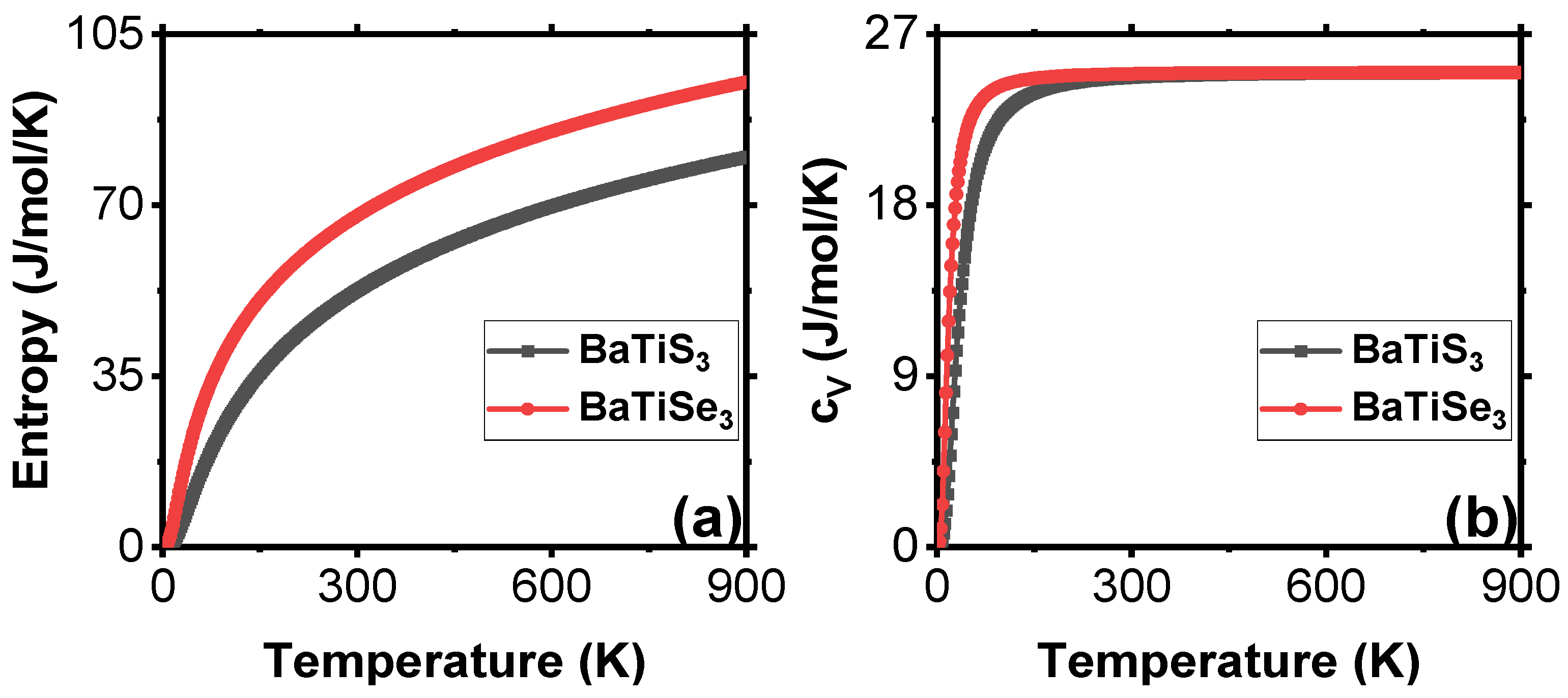
Chalcogenides generally have unique thermal properties, including low thermal conductivity, high thermal stability, and phase-change behavior. Figure 3 displays the entropy and specific heat at constant volume for both materials as functions of temperature, which reveals that BaTiSe3 has a higher entropy than BaTiS3 (Figure 3a). High entropy in the amorphous phase enables the formation of chalcogenide glasses, which are widely used in infrared optics and nonlinear optical devices, such as supercontinuum generation and photonic switches. For example, As2Se3 and As2S3 glasses exhibit strong nonlinear refractive indices due to their flexible network structures [35]. Moreover, high entropy stabilizes metastable phases, which are important in materials used for thin-film solar cells. Thus, BaTiSe3 performs better than BaTiS3 in this regard. However, there are no reported values of entropy of these materials in the literature for comparison. Table 3 shows the calculated entropy for both samples.
Figure 3b presents the curves of specific heat capacity at constant volume, which shows that the specific heats of both materials saturate due to the Dulong–Petit classical limit at temperatures above 100 K. This is because more phonon modes (higher-frequency vibrations) become thermally accessible, and the number of active degrees of freedom rapidly increases, causing the specific heat to rise sharply [36]. Low specific heats at low temperatures arise because the available thermal energy is too small to excite most vibrational modes. Only the long-wavelength low-frequency phonons (which have lower energy) can be thermally excited at low temperatures [37]. The computed specific heats presented in Table 3 show a slight difference between the two materials investigated in this study. Although heavier atoms (selenium compared to sulfur in this study) usually have lower vibrational frequencies and can sometimes reduce the specific heat capacity, a more massive compound like BaTiSe3 can still have a higher specific heat capacity than BaTiS3 if other physical factors dominate. For instance, replacing sulfur with selenium generally softens the lattice because Se–Ti bonds are longer and less stiff than S–Ti bonds. This leads to low-energy phonon modes and a higher phonon density of states at accessible temperatures, which increases the specific heat capacity even if the atoms are heavier [38]. The computed specific heat capacity of BaTiS3 is 23.5% higher than that obtained by Gillani et al. [9].
Table 3. The calculated thermal properties of BaTiS3 and BaTiSe3 at room temperature.
Sample S (J/mol/K) c V (J/mol/K) κ e (W/m/K) κ l (W/m/K) κ e f f (W/m/K)
B a T i S 3 52.524.7 (~20 [9])0.2090.2210.430 (0.39 [39])
B a T i S e 3 67.724.90.6480.0360.684
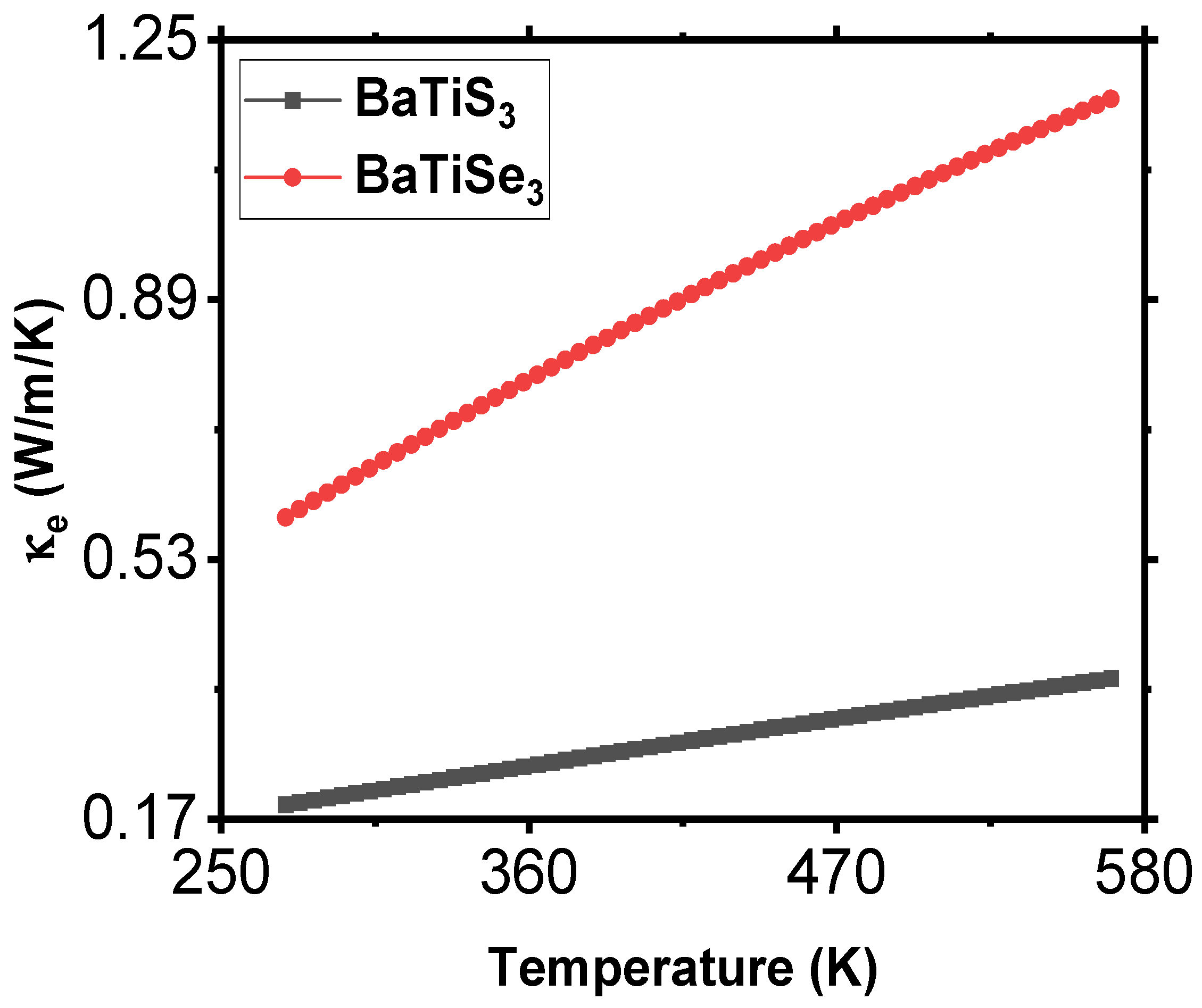
Chalcogenides like SnSe, Bi2Te3, and Cu2Se exhibit ultra-low thermal conductivities. For instance, SnSe has a thermal conductivity of 0.23 W/m/K, which helps maintain the temperature gradient necessary for efficient thermoelectric energy conversion [40]. This is due to strong phonon scattering, which arises from anharmonic lattice vibrations, layered structures, and defects. The computed thermal conductivities of BaTiS3 and BaTiSe3 (Table 3 and Figure 4) show that BaTiS3 has a lower thermal conductivity, which is good for heat dissipation control in areas such as waste heat recovery, power generation, and Peltier cooling devices. Although the computed thermal conductivity of BaTiS3 is comparable to that available in the literature, with a deviation of 10.26% higher than that obtained by Edessa [39], the value for BaTiSe3 is not available in the literature for comparison.
The optimal thermoelectric efficiency of materials will not be complete without mentioning the electronic properties, especially the band gaps. This is because thermoelectric efficiency requires materials with a narrow band gap, typically within 0.1–0.5 eV, since this range provides an ideal compromise between electrical conductivity and the Seebeck coefficient [41]. In this context, both BaTiS3 with a band gap of 0.5 eV [41] and BaTiSe3 with a band gap of 0.3 [26] fall into the favorable narrow-gap semiconductor regime. The narrow band gap materials are suitable for thermoelectric operation because they enable sufficient thermal excitation of carriers at elevated temperatures, which improves electrical conductivity while keeping the Seebeck coefficient reasonably high. These narrow band gaps also help suppress bipolar conduction, which is a harmful phenomenon that occurs when both electrons and holes are thermally excited and begin to counteract each other’s contributions to the Seebeck voltage, while also increasing thermal conductivity [42,43].

4. Conclusions

The results of this study revealed that the lattice parameters agree very well with both experimental and computational literature values. BaTiSe3 turned out to be more structurally stable and can therefore be synthesized at lower temperatures with fewer defects, since it had lower values of both the formation energy and enthalpy of formation. However, the same BaTiSe3 turned out to be unstable mechanically due to the negative value of its elastic stiffness constant c 44 , implying that it will collapse easily under an applied stress. BaTiS3 possessed superior mechanical properties (bulk modulus = 44.7 GPa, shear modulus = 11.2 GPa, Young’s modulus = 29.6 GPa, Poisson ratio = 0.390, and Vickers hardness = 1.053 GPa), which are good for ensuring the long-term durability of solar absorber layers. The computed thermal properties showed that BaTiSe3 has a higher entropy of 67.7 J/mol/K compared to 52.5 J/mol/K for BaTiS3, which is good for the functioning of chalcogenide glasses for infrared optics and nonlinear optical devices. The specific heat capacities of both samples approached the Dulong–Petit classical limit at high temperatures, since more phonon modes become thermally accessible. The computed specific heat was 24.7 and 24.9 J/mol/K for BaTiS3 and BaTiSe3, respectively. The recorded thermal conductivity was 0.430 and 0.684 W/m/K for BaTiS3 and BaTiSe3, respectively. The recorded values of the mechanical and thermal properties of BaTiS3 are good for substrates for nonlinear optical and solar cell devices.

Author Contributions

Conceptualization, A.B.A.; methodology, A.B.A. and N.O.O.; software, A.B.A. and N.O.O.; validation, N.O.O.; formal analysis, A.B.A. and N.O.O.; investigation, A.B.A.; resources, A.B.A. and N.O.O.; data curation, A.B.A.; writing—original draft preparation, A.B.A. and N.O.O.; writing—review and editing, A.B.A.; visualization, A.B.A. All authors have read and agreed to the published version of the manuscript.

Funding

This project was funded by the Deanship of Scientific Research (DSR) at King Abdulaziz University, Jeddah, Saudi Arabia, under grant No. (IPP:1113-130-2025). The authors, therefore, acknowledge, with thanks, DSR for technical and financial support.

Data Availability Statement

The data presented in this study are available in the article.

Conflicts of Interest

The authors declare no conflicts of interest.

References

  1. Wu, Z.; Stuhrmann, G.; Dehnen, S. Crystalline chalcogenidometalate-based compounds from uncommon reaction media. Chem. Commun. 2022, 58, 11609–11624. [Google Scholar] [CrossRef] [PubMed]
  2. Chen, G.; Li, C.; Yu, C.; Wang, M.; Lee, C. Ternary chalcogenides GeSb2Se3 and Ge3Sb4Se7 containing a ∞1[Sb2Se2]2− 1D chain and a 2D structure related to SnSe. Inorg. Chem. 2020, 59, 11207–11212. [Google Scholar] [CrossRef] [PubMed]
  3. Chen, M.; Xue, H.; Guo, S. Multinary metal chalcogenides with tetrahedral structures for second-order nonlinear optical, photocatalytic, and photovoltaic applications. Coord. Chem. Rev. 2018, 368, 115–133. [Google Scholar] [CrossRef]
  4. Rao, V.N.; Ravi, P.; Sathish, M.; Vijayakumar, M.; Sakar, M.; Karthik, M.; Balakumar, S.; Reddy, K.R.; Shetti, N.P.; Aminabhavi, T.M.; et al. Metal chalcogenide-based core/shell photocatalysts for solar hydrogen production: Recent advances, properties and technology challenges. J. Hazard. Mater. 2021, 415, 125588. [Google Scholar] [CrossRef]
  5. Woods-Robinson, R.; Han, Y.; Zhang, H.; Ablekim, T.; Khan, I.; Persson, K.A.; Zakutayev, A. Wide band gap chalcogenide semiconductors. Chem. Rev. 2019, 120, 4007–4055. [Google Scholar] [CrossRef]
  6. Boukhris, I.; Al-Buriahi, M.; Akyildirim, H.; Alalawi, A.; Kebaili, I.; Sayyed, M. Chalcogenide glass-ceramics for radiation shielding applications. Ceram. Int. 2020, 46, 19385–19392. [Google Scholar] [CrossRef]
  7. Khan, H.; Dwivedi, P.; Islam, S.; Husain, M.; Zulfequar, M. Solution processing of chalcogenide glasses: A facile path towards functional integration. Opt. Mater. 2021, 119, 111332. [Google Scholar] [CrossRef]
  8. Simon, A.A.; Badamchi, B.; Subbaraman, H.; Sakaguchi, Y.; Jones, L.; Kunold, H.; van Rooyen, I.J.; Mitkova, M. Introduction of chalcogenide glasses to additive manufacturing: Nanoparticle ink formulation, inkjet printing, and phase change devices fabrication. Sci. Rep. 2021, 11, 14311. [Google Scholar] [CrossRef]
  9. Gillani, S.F.; Yasmin, N.; Usman, Z.; Khan, H.M.; Safdar, M.; Mirza, M. First principles study on optical and thermal properties of BaTiS3. Optik 2022, 261, 169196. [Google Scholar] [CrossRef]
  10. Fu, L.C.; Cheng, W.J.; Liu, Y.; Shi, L.C.; Peng, Y.; Zhang, J.; Li, Z.W.; Li, X.D.; Zhu, J.L.; Wang, X.C.; et al. Structure and properties of a quasi-one-dimensional compound BaTiS3 under pressure. High Press. Res. 2024, 44, 95–104. [Google Scholar] [CrossRef]
  11. Yang, F.; Li, K.; Fan, M.; Yao, W.; Fu, L.; Xiong, C.; Jiang, S.; Li, D.; Xu, M.; Chen, C.; et al. Strongly anisotropic quasi-1D BaTiS3 chalcogenide perovskite for near-infrared polarized photodetection. Adv. Opt. Mater. 2022, 11, 2201859. [Google Scholar] [CrossRef]
  12. Zhao, B.; Mei, H.; Du, Z.; Singh, S.; Chang, T.; Li, J.; Ilyas, B.; Song, Q.; Liu, T.; Shao, Y.; et al. Infrared optical anisotropy in quasi-1D hexagonal chalcogenide BaTiSe3. Adv. Opt. Mater. 2024, 12, 2400327. [Google Scholar] [CrossRef]
  13. Agarwal, S.; Perilla, S.R.; Marques, M.R.; Hayes, D.C.; Vincent, K.C.; Agrawal, R. Hexagonal ABX3 nanocrystals: Rod-shaped BaNbS3 and BaTaS3; BaTiSe3, BaZrSe3, and other selenide derivatives for optoelectronic applications. Nanoscale Adv. 2025, 7, 6864–6873. [Google Scholar] [CrossRef]
  14. Wu, J.; Cong, X.; Niu, S.; Liu, F.; Zhao, H.; Du, Z.; Ravichandran, J.; Tan, P.; Wang, H. Linear dichroism conversion in quasi-1D perovskite chalcogenide. Adv. Mater. 2019, 31, 1902118. [Google Scholar] [CrossRef] [PubMed]
  15. Fu, H. Review of lead-free halide perovskites as light-absorbers for photovoltaic applications: From materials to solar cells. Sol. Energy Mater. Sol. Cells 2019, 193, 107–132. [Google Scholar] [CrossRef]
  16. Available online: https://aflowlib.org/material/?id=aflow:53c428c9fc059e5a (accessed on 20 October 2025).
  17. Available online: https://aflowlib.org/material/?id=aflow:bd489646dffcfa9f (accessed on 20 October 2025).
  18. Ongwen, N.O.; Ogam, E.; Otunga HFellah, Z.E.A.; Oduor, A.; Mageto, M. Temperature-dependent elastic constants of substrates for manufacture of mems devices. Kabar. J. Res. Innov. 2022, 12, 30–35. [Google Scholar] [CrossRef]
  19. Giannozzi, P.; Baroni, S.; Bonini, N.; Calandra, M.; Car, R.; Cavazzoni, C.; Ceresoli, D.; Chiarotti, G.L.; Cococcioni, M.; Dabo, I.; et al. Quantum Espresso: A modular and open-source software project for quantum simulations of materials. J. Phys. Condens. Matter 2009, 21, 395502. [Google Scholar] [CrossRef]
  20. Alruqi, A.B.; Ongwen, N.O. First principles investigation of elastic, electronic and thermoelectric properties of lead-free Cs–X–I (X = Pb, Gd, Nd, Y) perovskites. J. Phys. Commun. 2024, 8, 125004. [Google Scholar] [CrossRef]
  21. Ongwen, N.O.; Ogam, E.; Otunga, H.O. Ab initio study of elastic properties of orthorhombic cadmium stannate as a substrate for the manufacture of MEMS devices. Mater. Today Commun. 2021, 26, 101822. [Google Scholar] [CrossRef]
  22. Fast, L.; Wills, J.M.; Johansson, B.; Eriksson, O. Elastic constants of hexagonal transition metals: Theory. Phys. Rev. B 1995, 51, 17431–17438. [Google Scholar] [CrossRef]
  23. Pasianot, R.; Savin, E.J. Elastic constants for the H. C. P. lattice. Phys. Status Solidi 1993, 176, 327–334. [Google Scholar] [CrossRef]
  24. Madsen, J.K.H.; Carrete, J.; Verstraete, M.J. BoltzTraP2, a program for interpolating band structures and calculating semi-classical transport coefficients. Comput. Phys. Commun. 2018, 231, 140–145. [Google Scholar] [CrossRef]
  25. Wang, X.; Shu, G.; Zhu, G.; Wang, J.-S.; Sun, J.; Ding, X.; Li, B.; Gao, Z. An interpretable formula for lattice thermal conductivity of crystals. Mater. Today Phys. 2024, 48, 2542–5293. [Google Scholar] [CrossRef]
  26. Huster, J. Die kristallstruktur von BaTiS3/Crystal structure of BaTiS3. Z. Naturforschung B 1980, 35, 775. [Google Scholar] [CrossRef]
  27. Mathew, T.; Rahul, K.S.; Joseph, S.; Mathew, V. Density functional study of structural, electronic and optical properties of quasi-one-dimensional compounds BaTiX3 (X = S, Se). Superlattices Microstruct. 2021, 153, 106859. [Google Scholar] [CrossRef]
  28. Shengru, H.; Shengru, Y.; Yang, L.; Bing, H. Theoretical understanding of nonlinear optical properties in solids: A perspective. J. Phys. Chem. Lett. 2024, 15, 3323–3335. [Google Scholar] [CrossRef]
  29. Nazif, K.N.; Nitta, F.U.; Daus, A.; Saraswat, K.C.; Pop, E. Efficiency limit of transition metal dichalcogenide solar cells. Commun. Phys. 2023, 6, 367. [Google Scholar] [CrossRef]
  30. Popovich, V.; Maris, M.; Janssen, M.; Bennett, I.; Richardson, I. Understanding the properties of silicon solar cells aluminium contact layers and its effect on mechanical stability. Mater. Sci. Appl. 2013, 4, 118–127. [Google Scholar] [CrossRef]
  31. Nikogosyan, D.N. Beta barium borate (BBO). Appl. Phys. A 1991, 52, 359–368. [Google Scholar] [CrossRef]
  32. Lai, T.; Hsiao, Y.; Fang, T. Mechanical properties of CIGS film with different metallic composition by co-evaporation method. Mater. Res. Express 2017, 4, 115006. [Google Scholar] [CrossRef]
  33. Li, P.; Fu, C.; Zhong, H.; Du, B.; Guo, K.; Meng, Y.; Du, C.; He, J.; Wang, L.; Wang, Y. A Nondestructive measurement method of optical fiber Youngs modulus based on OFDR. Sensors 2022, 22, 450. [Google Scholar] [CrossRef]
  34. Ongwen, N.; Ogam, E.; Fellah, Z.; Mageto, M.; Othieno, H.; Otunga, H. Thermal properties and pressure-dependent elastic constants of cadmium stannate as a substrate for MEMS: An ab initio study. Phys. B Condens. Matter 2023, 651, 414599. [Google Scholar] [CrossRef]
  35. Fang, T.-H.; Hsiao, Y.-J.; Kang, S.-H. Mechanical characteristics of copper indium gallium diselenide compound nanopillars using in situ transmission electron microscopy compression. Scr. Mater. 2015, 108, 130–135. [Google Scholar] [CrossRef]
  36. Zhang, X.-Y.; Chen, F.-F.; Zhang, X.-F.; Ji, W. Research progress of third-order optical nonlinearity of chalcogenide glasses. Chin. Phys. B 2018, 27, 084208. [Google Scholar] [CrossRef]
  37. Dulong, P.L.; Petit, A.T. Mémoire sur quelques points importants de la théorie de la chaleur. Ann. Chim. Phys. 1819, 10, 395–413. [Google Scholar]
  38. Kittel, C. Introduction to Solid State Physics, 8th ed.; John Wiley & Sons: Hoboken, NJ, USA, 2004. [Google Scholar]
  39. Edossa, T.G. Density functional theory study of mechanical, thermal, and thermodynamic properties of zinc-blende CdS and CdSe. Sci. Rep. 2025, 15, 39135. [Google Scholar] [CrossRef]
  40. Sun, B.; Niu, S.; Hermann, R.P.; Moon, J.; Shulumba, N.; Page, K.; Zhao, B.; Thind, A.S.; Mahalingam, K.; Milam-Guerrero, J.; et al. High frequency atomic tunneling yields ultralowand glass-like thermal conductivity in chalcogenidesingle crystals. Nat. Commun. 2020, 11, 6039. [Google Scholar] [CrossRef]
  41. Xiao, Y.; Chang, C.; Pei, Y.; Wu, D.; Peng, K.; Zhou, X.; Gong, S.; He, J.; Zhang, Y.; Zeng, Z.; et al. Origin of low thermal conductivity in SnSe. Phys. Rev. B 2016, 94, 125203. [Google Scholar] [CrossRef]
  42. Paudel, T.R.; Tsymbal, E.Y. Evaluating the thermoelectric properties of BaTiS3 by density functional theory. ACS Omega 2020, 5, 12385–12390. [Google Scholar] [CrossRef]
  43. Graziosi, P.; Neophytou, N. Ultra-High Thermoelectric Power Factors in Narrow Gap Materials with Asymmetric Bands. J. Phys. Chem. C 2020, 124, 18462–18473. [Google Scholar] [CrossRef]
Figure 1. Three-dimensional structures of (a) BaTiS3 and (b) BaTiSe3.
Coatings 15 01479 g001
Figure 2. Curves of total energy of BaTiS3 and BaTiSe3 for (a) parameter a and (b) parameter c with unit cell volumes.
Coatings 15 01479 g002
Figure 3. The calculated (a) entropy, and (b) specific heat capacity at constant volumes of BaTiS3 and BaTiSe3.
Coatings 15 01479 g003
Figure 4. Electronic thermal conductivities of BaTiS3 and BaTiSe3 as functions of temperature.
Coatings 15 01479 g004
Table 1. The calculated lattice parameters, density, and formation energies of BaTiS3 and BaTiSe3.
Sample a   ( Å ) c   ( Å ) c / a ρ   ( k g / m 3 ) E f   ( R y / a t o m ) H f   ( k J / m o l )
BaTiS36.798 (6.75 [26]) (6.73 [13])5.835 (5.8 [26]) (5.92 [13])0.8584002−0.469−230.6
BaTiSe37.055 (7.129 [26]) (7.033 [12])6.001 (6.034 [26]) (6.1 [12])0.8515420−3.498−1691.5
Table 2. The calculated elastic constants and Vickers hardness of BaTiS3 and BaTiSe3.
Sample B a T i S 3 B a T i S e 3
c 11 (GPa)80.963.1
c 12 (GPa)27.429.9
c 13 (GPa)17.519.4
c 33 (GPa)118.483.1
c 44 (GPa)0.9−2.7
c 66 (GPa)26.716.6
B (GPa)44.738.5
G (GPa)11.21.55
E (GPa)29.62.04
μ0.3900.491
H V , T i a n (GPa)1.0530.033
Disclaimer/Publisher’s Note: The statements, opinions and data contained in all publications are solely those of the individual author(s) and contributor(s) and not of MDPI and/or the editor(s). MDPI and/or the editor(s) disclaim responsibility for any injury to people or property resulting from any ideas, methods, instructions or products referred to in the content.