Article

Effect of Nd:YAG Nanosecond Laser Ablation on the Microstructure and Surface Properties of Coated Hardmetals


1
Grupo de Integridad y Evaluación de Materiales, Departamento Ingeniería, Universidad Pedagógica y Tecnológica de Colombia, Tunja 150003, Colombia
2
Laboratorio de Espectroscopía Atómica y Molecular (LEAM), Universidad Industrial de Santander—UIS, A.A. 678, Bucaramanga 681012, Colombia
3
Grupo de Investigación en Tomografía Computarizada para Caracterización de Yacimientos (GIT), Universidad Industrial de Santander—UIS, A.A. 678, Bucaramanga 681012, Colombia
4
Universidad ECCI, Bogotá 111311, Colombia
*
Author to whom correspondence should be addressed.
Coatings 2025, 15(12), 1413; https://doi.org/10.3390/coatings15121413
Submission received: 30 October 2025 / Revised: 18 November 2025 / Accepted: 28 November 2025 / Published: 2 December 2025

Abstract

Nanosecond-pulsed Nd:YAG laser ablation was investigated as a method for removing Al Ti-based hard coatings deposited on WC–Co hardmetal inserts. Systematic variation in laser parameters identified conditions for complete coating removal while preserving substrate integrity. The laser was operated at 532 nm, under a range of fluences (0.1–11.7 J/cm2), pulse delays (20–180 µs), and pulse numbers (1–300). LIBS qualitative monitoring enabled precise ablation progress by identifying Ti, Al, and O layers, and later the detection of Co and W signals. Scanning electron microscopy (SEM/EDS) and optical profilometry confirmed that 5–10 pulses at intermediate delays (60–80 µs, 4.8–7.1 J/cm2) provided complete removal of ~18 µm-thick coatings while maintaining substrate integrity. In contrast, higher energies and excessive pulses caused localized melting and surface irregularities. These results demonstrate that Nd:YAG laser ablation, especially when coupled with LIBS, offers a precise, fast, and environmentally alternative to conventional chemical stripping methods for the refurbishment and recycling of cutting tools.

1. Introduction

The tungsten carbide–cobalt (WC-Co) is a high-hardness, high-strength material with excellent wear resistance and flexural strength, in which the metal component, cobalt binder, provides toughness and plasticity, making it suitable for cutting and drilling applications in high-load environments [1,2,3]. Co and W are strategic and critical raw materials due to their essential roles in high-performance tools, batteries, and advanced alloys, and because their primary sources are limited and geopolitically concentrated [4,5,6]. Recycling WC-Co scraps reduces dependence on primary mining, stabilizes, and mitigates supply risks. That is the reason for recovering Co and W is essential for securing resources, reducing environmental impact, and supporting sustainable industrial production [7,8]. Coated WC–Co composites combine the mechanical strength of the substrate with the enhanced surface properties imparted by nanostructured coatings. However, at the end of their operational lifetime, these materials must be recycled for the reasons previously discussed; yet, the strong adhesion and high chemical stability of the coatings make their removal particularly challenging. Thus, selective removal of the coatings is essential to recover these materials while preserving the integrity of the substrate, minimizing the impact on tungsten and, mainly, cobalt, for subsequent reuse [9,10,11].
The industrial relevance of coating-removal processes for WC–Co tools is particularly significant in sectors such as cutting tool manufacturing, automotive production, and aerospace machining, where these tools are employed to machine high-strength alloys, hardened steels, and superalloys under demanding thermo-mechanical conditions [12]. In these industries, the ability to reuse tools through repeated stripping–resharpening–recoating cycles is critical for lowering operational costs, increasing productivity, and reducing waste generation. Moreover, because W and Co are strategic and geopolitically sensitive materials, the preservation and recovery of intact WC–Co substrates provide both economic and environmental advantages [13]. The challenge of removing highly adherent and chemically stable coatings, such as AlTiN or AlCrSiN, without altering the WC–Co microstructure or damaging the cobalt binder phase, continues to drive the development of selective, rapid, and environmentally responsible stripping technologies [14]. This context highlights the limitations of conventional chemical approaches and supports the growing interest in advanced alternatives such as laser ablation and its integration with LIBS for real-time control.
The electrochemical stripping of nanostructured coating is a well-known removal process that is time-consuming and environmentally damaging [15,16]. These methods can oxidize WC, causing residues and high roughness, which makes it difficult for the adhesion of new coating [17]. Experiments on quaternary coatings such as AlCrSiN show that chemical methods can damage the hard-metal substrate [15]. Chemical stripping can also affect the metallic phase of tungsten carbide due to the chemical reactivity of cobalt in this phase, similar to that of titanium in the coating, making it difficult to preserve the original morphology of the piece [16]. At the industrial level, the removal of these coatings is carried out using chemical methods by wet processing that presents disadvantages such disposal of residues, mainly strong acids and/or bases, which pose a significant environmental problem, as well as uneven layer removal and long process times, in the order of hours [7,15,16,17,18,19].
The laser ablation arises as an alternative to coating stripping. Coating elimination is closely related to the interaction between laser parameters (wavelength, fluence, and pulse duration) and the optical, thermal, and microstructural properties of the coating. Both nanosecond and femtosecond lasers are applied, with ultrashort pulses offering higher precision and reduced thermal damage [20,21]. Optimized conditions allow well-defined craters and patterns, where ablation threshold, crater geometry, and material removal rate are determined by film composition and laser fluence [22,23]. This flexibility makes laser ablation attractive for micro-patterning, device fabrication, and coating repair, providing a clean, maskless, and rapid alternative to conventional chemical etching methods [15,24,25]. Although laser ablation has higher initial equipment costs than chemical stripping, the absence of chemical consumables, reduced waste, and shorter processing times can make it a cost-effective alternative in precision or environmentally regulated applications.
Furthermore, recent research demonstrates that laser processing not only enables the selective elimination of coatings but can also enhance material properties [26,27]. In WC-Co coatings, Nd:YAG laser ablation refines the microstructure, redistributes the W and Co phases, and improves hardness and wear resistance, with reported microhardness up to 1395 HV [28]. Similarly, excimer and Nd:YAG lasers have been used to remove paints, polymers, and oxides under varied conditions (wavelength, pulse duration, fluence, and repetition rate), offering a chemical-free, energy-efficient process [29]. The ability of Nd:YAG lasers to operate at multiple harmonics (266, 532, 1064 nm) expands their applicability, ranging from surface cleaning to the processing of difficult-to-remove thin films, confirming their relevance for industrial and technological applications [30]. However, the lack of control over the depth of coating removal denotes a significant challenge in preserving the substrate, especially cobalt.
Consequently, Laser-Induced Breakdown Spectroscopy (LIBS) employs a focused laser pulse to ablate (vaporize) material and form a plasma, whose emission reveals elemental composition [31]. LIBS is a well-established tool for qualitative analysis of surfaces [32,33]. Pulse duration critically affects performance: femtosecond lasers achieve low ablation thresholds, high spatial resolution, and minimal thermal effects, while nanosecond pulses involve complex thermodynamic interactions that influence plasma behavior [34,35]. Multipulse configurations, such as double- or triple-pulse LIBS, further enhance emission intensity—by up to two orders of magnitude—through improved plasma coupling when optimized delays and geometries are applied [36].
LIBS extends beyond elemental detection to depth profiling and 3D mapping, making it suitable for coatings, electrodes, and layered systems. Increasingly used for real-time process monitoring, LIBS benefits from advanced calibration and signal-processing methods that improve accuracy and reproducibility. Overall, when combined with laser ablation, LIBS provides a rapid, sensitive, and spatially resolved analytical tool with expanding applications in both research and industry [31,36].
This study evaluates the feasibility of using a nanosecond-pulsed Nd:YAG laser for the ablation of multi-layer AlTiN coatings on WC-Co tools. The objective is to identify optimal laser parameters that ensure complete coating removal with minimal damage to the substrate, paving the way for more sustainable and cost-effective tool refurbishment processes.

2. Materials and Methods

2.1. Materials

The substrate material used in this study consisted of square-shaped WC-Co cemented carbide inserts (SPUN 190408:M8330) with dimensions of 19 × 19 × 4 mm, a clearance angle of 11°, and a corner radius of 0.8 mm. The inserts were coated using the PVD process with a multilayer structure comprising TiN (~1 µm), Al2O3 (~6 µm), and TiCN (~11 µm), resulting in an overall coating thickness of approximately 18 µm.

2.2. Experimental Procedure

Laser ablation was carried out using a Quanta Q-Smart 850 Nd:YAG laser, Lannion, France system operating at a wavelength of 532 nm (second harmonic) and pulse durations of 5 ns. The laser source provides a nominal maximum pulse energy of 850 mJ at 532 nm. The optical system included a converging lens for beam focusing and a glass beam-splitting sheet to calibrate incident and reflected energies. The transmitted pulse energy varied from 3.05 mJ to 367.3 mJ, corresponding to fluences between 0.1 and 11.7 J/cm2. The experimental setup is illustrated in Figure 1.
The glass beam-splitter, oriented at a slight angle to the laser path, allowed concurrent measurement of transmitted and reflected energy for each delay setting. Calibration curves were obtained by correlating the nominal laser output energy with the transmitted energy through the optical system, using the reflected signal from the beam-splitter measured by a photodiode detector, to accurately estimate the effective fluence incident on the sample surface.
After laser elimination, the irradiated samples were characterized using:
  • Oxford Instruments Spectrometer Shamrock SR-500, Concord, MA, USA by Andor. Atomic spectrum varying energy and number of pulses with the following laser conditions: pulses 10-laser (variable energy) TD2-TI8, grid 2399l-nm, shutter 12 µm, ablations 10. Energy Signal 6 decreases to signal 1, from 120 to 20 delay.
  • Zeiss (Oberkochen, Germany) EVO MA 10 Scanning Electron Microscopy (SEM), equipped with EDS for surface and compositional analysis.
  • Bruker (Billerica, MA, USA) 3D ContourX-100 Optical profilometry (Gwyddion software 2.37) to quantify ablation depth and surface roughness.

3. Results

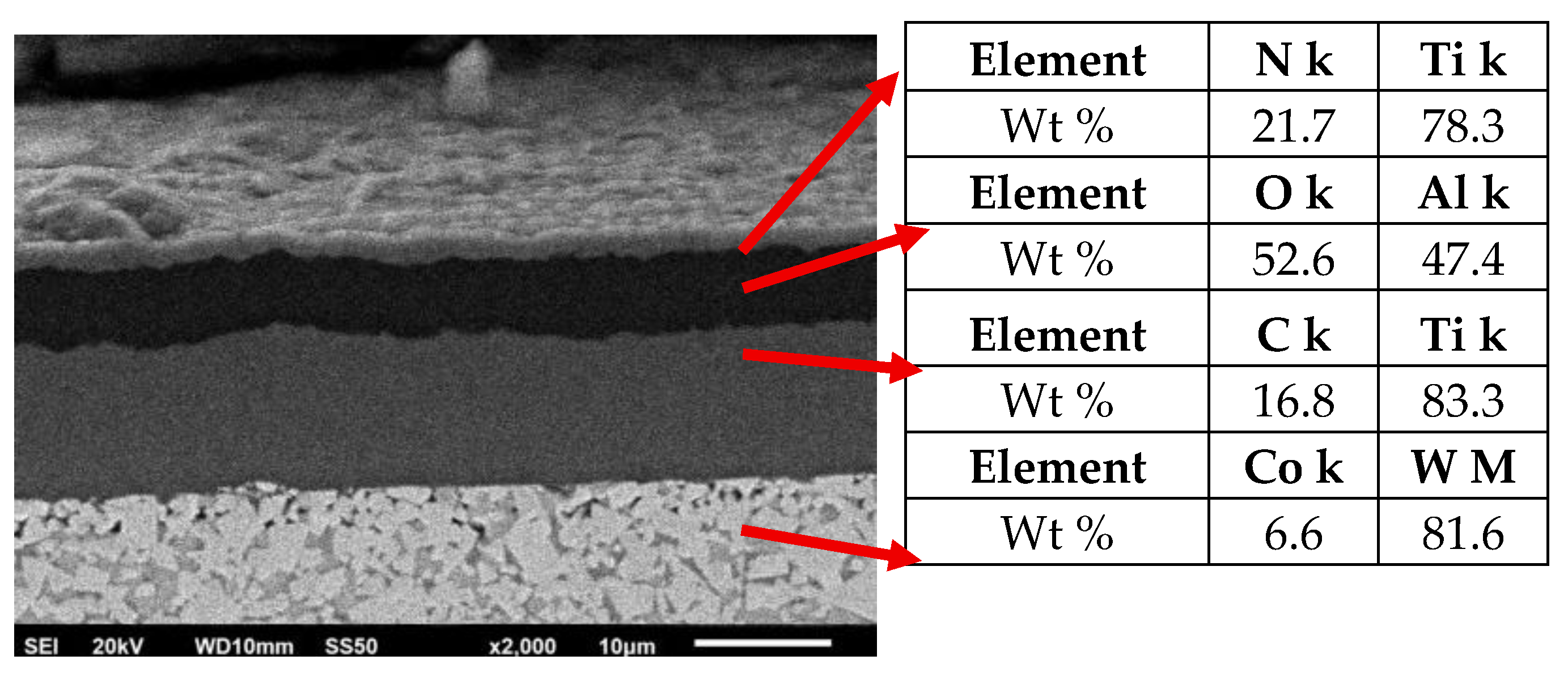
Figure 2 shows the cross-sectional SEM analysis revealed a commercial multilayer coating deposited on WC-Co inserts consisted of three distinct layers: TiN (~1 µm), Al2O3 (~6 µm), and TiCN (~11 µm), for a total thickness of approximately 18 µm.
Semiquantitative analysis using EDS confirmed the composition of each layer, with Ti and N dominating the outermost layer, Al and O in the intermediate ceramic layer, and Ti and C in the inner layer adjacent to the WC-Co substrate. The substrate contained 6.61 wt% Co and coarse WC grains (2.5–5 µm), consistent with specifications for cutting-grade cemented carbides.
In this film, the laser ablation experiments were performed using ultrashort (5 ns) pulses under varying pulse delay conditions, from 20 µs to 180 µs, with corresponding energy levels ranging from 367.3 mJ to 3.05 mJ. The delay parameter, referred to as “Delaypulse,” represents the temporal interval between the energy pump excitation and pulse release in the Q-switched system, influencing pulse energy and fluence.
The fluence values ranged from 11.69 J/cm2 (at 20 µs) to 0.1 J/cm2 (at 180 µs), with a constant spot diameter of 2 mm. For each delay setting, single-pulse and multi-pulse ablation sequences were tested (1, 5, 10, 20, 40, 80, and up to 300 pulses), to determine the minimum energy and pulse number required for full coating removal as follows in Table 1.
The highest transmitted energy (367.30 mJ) and fluence (11.69 J/cm2) were achieved at a 20 µs delay, while energy values decreased progressively with longer delays. Delays exceeding 140 µs were associated with energy inputs less than 1.2 J/cm2 and therefore do not produce significant ablation effects. The data presented in Table 1, along with SEM and EDS analyses, indicate which energy levels are not suitable for laser ablation. Consequently, energy values corresponding to 140 to 180 µs delay were excluded from further experiments.
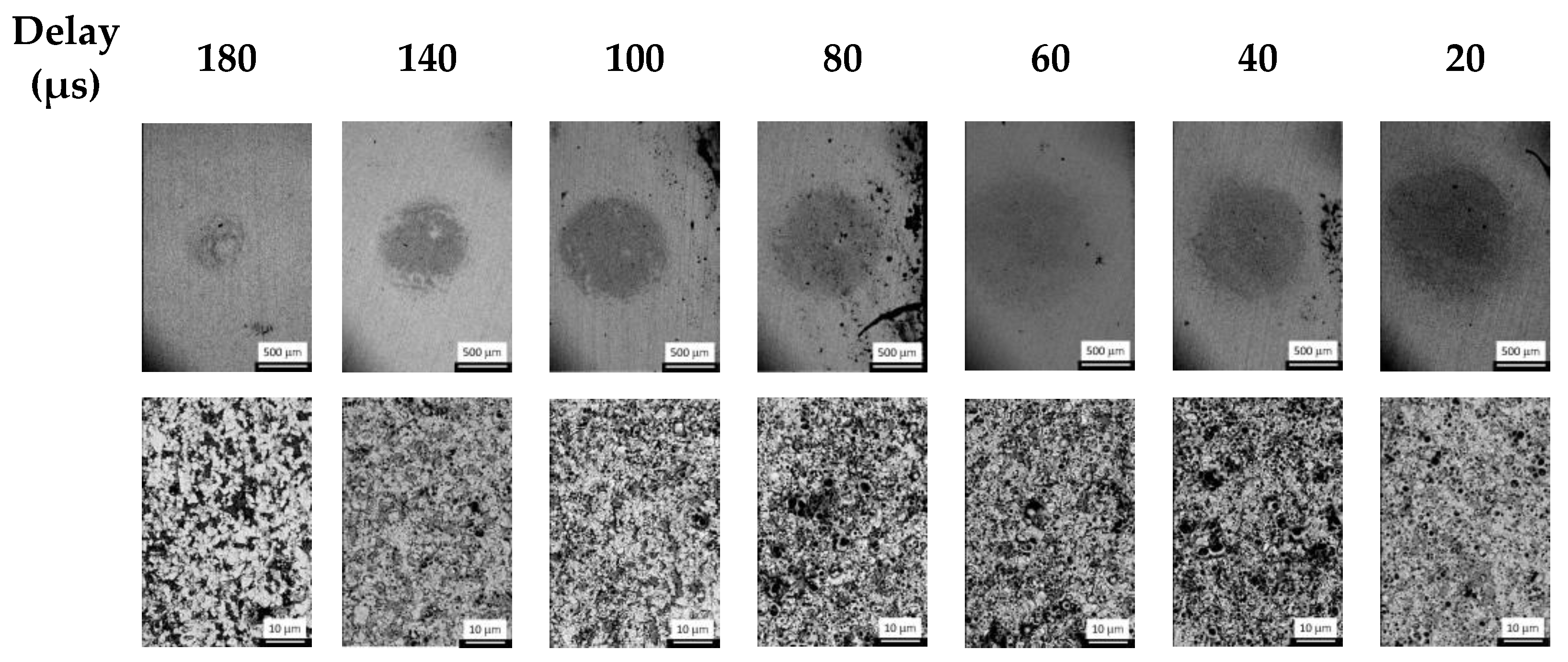
A single pulse preliminary ablation test was carried out on the WC-Co substrate to determine the laser parameters to be used further in the coated inserts. As observed in Figure 3, the morphology of the WC–Co substrate changes noticeably with the delay time due to variations in laser fluence.
At short delays (20–40 µs), corresponding to the highest transmitted energy, evident melting of the Co binder and localized redeposition can be seen, indicating excessive energy input that partially alters the microstructure [34,37].
At intermediate delays (60–80 µs), the surface exhibits uniform texturing without visible melting or resolidification features, suggesting a possible selective removal of the coating layers while maintaining the integrity of the WC–Co matrix. For longer delays (≥120 µs), no significant ablation marks were observed, indicating that the delivered energy was below the threshold required for material removal under the present conditions.
Based on these observations, varying pulse numbers were performed solely to refine the experimental parameters. These trials led to the selection of 5, 10, and 40 pulses for the subsequent experiments, enabling the evaluation of the combined influence of delay time and pulse number on coating removal while preserving the substrate integrity of the WC-Co substrate. The condition of 10 pulses was identified as the optimal ablation regime, enabling the removal of the coating in agreement with the profilometry results, discussed in Section Surface Morphology and Profilometry.
A more detailed analysis of the 10-pulse condition was performed using the Nd:YAG laser system integrated with LIBS to determine the minimum energy required to initiate coating ablation while minimizing effects on the WC–Co substrate. LIBS provided reliable identification of the elemental composition of the AlTiN/TiCN coatings through their characteristic emission lines. As a qualitative technique, LIBS is suitable for rapid screening and in situ monitoring during laser processing [32,38].
The NIST Atomic Spectra Database [38,39,40] was used as a reference to identify the spectral lines observed in LIBS. This database provides critically evaluated atomic emission and absorption lines for all elements, allowing accurate correlation between measured peaks and their corresponding atomic species, thus ensuring reliable identification of Ti, Al, O, Co, and W in the ablated samples.
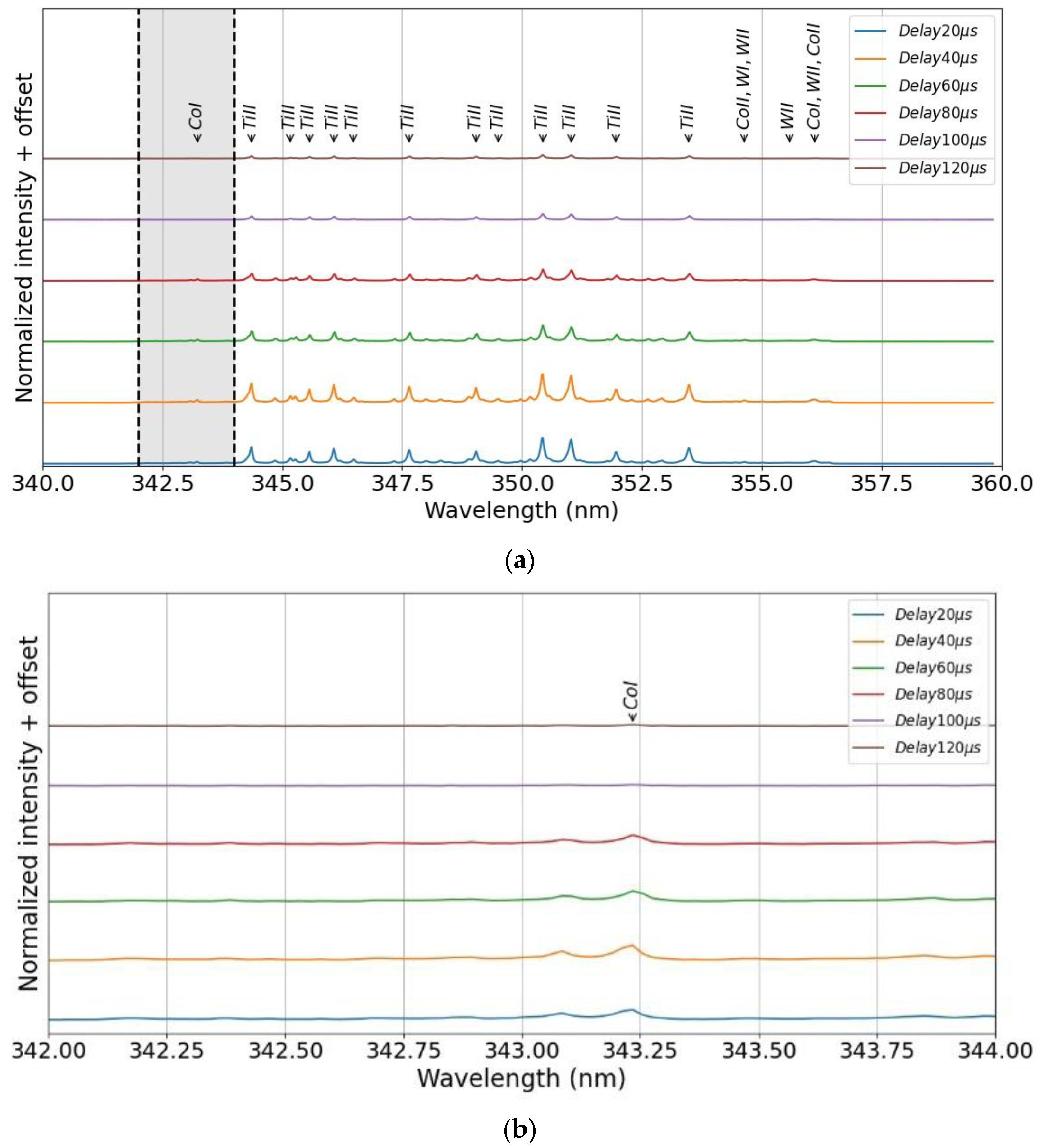
Figure 4a shows the spectral lines in the range from 340 to 360 nm wavelength region containing the strong emission lines of Ti, Co, and W with 10 laser shots.
In the figure, the spectral lines show the variation in the laser output energy as a function of the delay time during the ablation of AlTiN-coated WC–Co substrates. The energy delivered to the sample surface decreases progressively as the delay increases. The brown line corresponds to the lowest energy level, obtained at a 120 µs delay, while the energy increases with shorter delays, reaching its maximum value at 20 µs (blue line).
A focused LIBS spectrum is shown in Figure 4b in the range from 342 to 344 nm, which permits determining the influence of the laser conditions in the presence of Cobalt belonging to the substrate Cobalt emissions from the substrate are not observed at higher laser energies (100 and 120 µs), suggesting that the energy input is insufficient to penetrate the coating and induce cobalt sublimation. In contrast, at lower energies (20 to 80 µs), the cobalt emission line at 343.25 nm becomes apparent, indicating that the coating has been effectively ablated and the Nd:YAG laser is interacting with the substrate.
  • Titanium and Nitrogen signals
Strong emission lines of Ti I and Ti II were consistently detected in the range of 340–360 nm. These lines confirm the ablation of the TiN-rich top coating layer, in agreement with previous studies on PVD coatings [41]. Nitrogen lines were weaker but still observable, indicating partial dissociation in the plasma.
  • Aluminum and Oxygen
At intermediate delay times (60–100 µs), additional lines of Al and O appeared. This is consistent with the ablation of the Al2O3 and AlTiN interlayers, which provide oxidation resistance [27]. The detection of O I lines also suggests minor plasma–atmosphere interactions.
  • Cobalt and Tungsten
At higher pulse energies and longer ablation, Co and W emission lines became evident. The appearance of these peaks indicates that the ablation reached the WC–Co substrate, removing the protective coatings. This observation confirms the selectivity of LIBS, allowing the identification of each ablated layer [42].
  • Effect of Delay Time
At short delays (20 µs), spectra exhibited higher intensity but lower resolution due to strong continuum background emission. At intermediate delays (60–80 µs), the signal-to-noise ratio improved, and discrete emission lines (Ti, Al, O) were clearly resolved. At long delays (100–120 µs), the plasma intensity decayed, reducing signal strength but still allowing detection of substrate elements (Co, W) [20].
The LIBS results demonstrate the technique’s ability to monitor coating removal in real time, identifying each layer of the TiN/Al2O3/AlTiN system before exposing the WC–Co substrate. By correlating emission line intensity with delay time and number of pulses, it is possible to establish the threshold energy for selective ablation of each layer. Compared with conventional characterization methods (SEM–EDS), LIBS provides immediate elemental information and avoids destructive sample preparation [43].

Surface Morphology and Profilometry

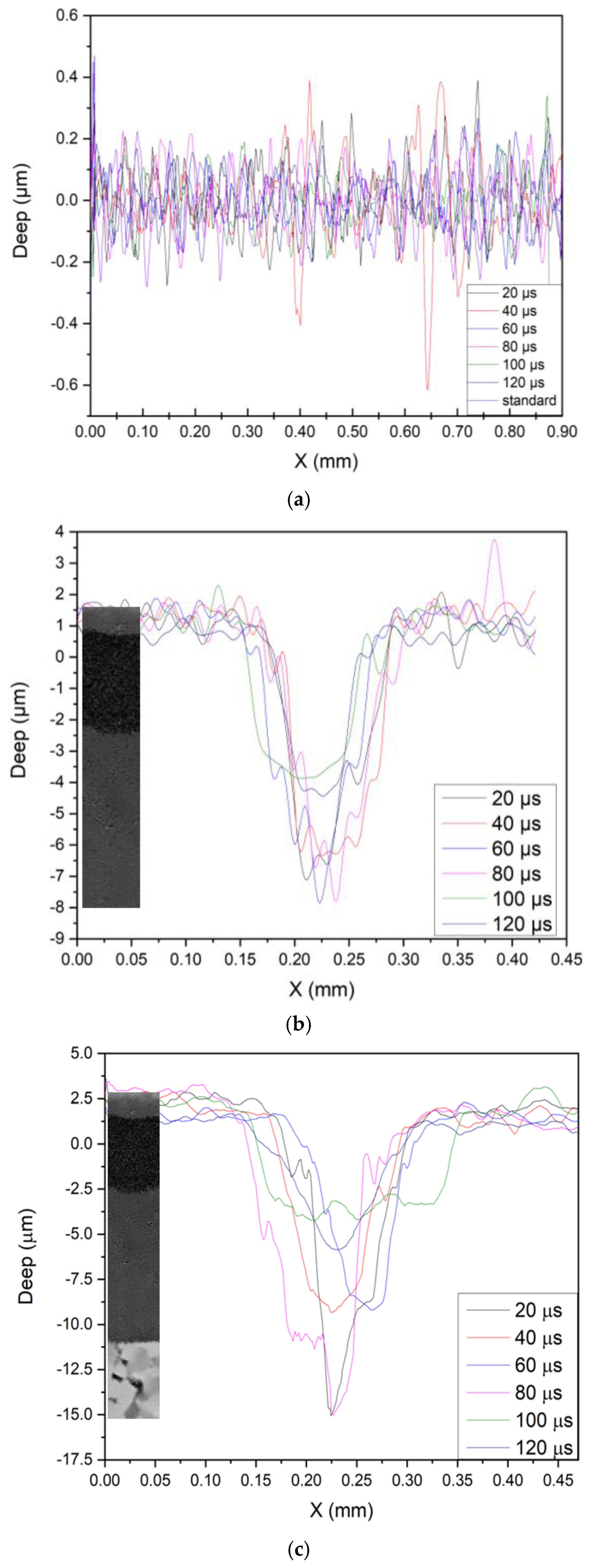
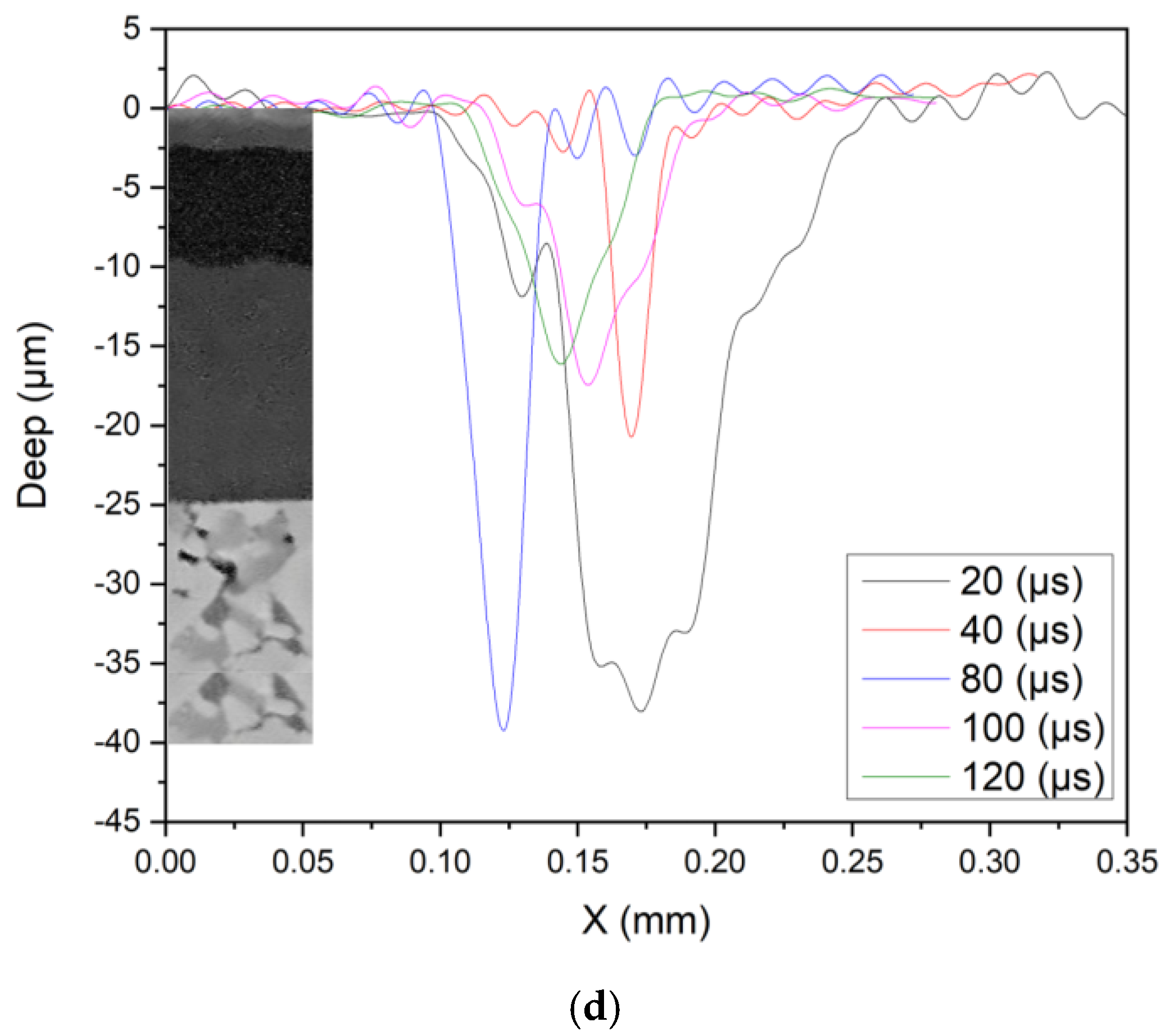
Surface topography measurements using optical profilometry at 1, 5, 10, and 40 pulses varying the delays, from 20 µs to 120 µs, are shown in Figure 5.
For a single-pulse irradiation (Figure 5a), no delay setting produced full ablation; profilometry showed surface roughness changes of only ~0.2–0.4 µm, with negligible coating removal except at the shortest delays. However, when applying 5 pulses (Figure 5b) at delays between 20 µs and 80 µs, a significant coating removal is observed with depths ranging from 5 µm to 9 µm.
At 10 pulses (Figure 5c), ablation depths for 60 µs and 80 µs reach 14 and 18 µm, respectively. The condition of 10 pulses at a 60 µs delay (fluence ≈ 7.1 J/cm2) was identified as the optimal ablation regime, achieving removal of the ~18 µm-thick coating, reducing the substrate melting. Increasing the number of pulses to 40, as shown in Figure 5d, led to excessive substrate melting and the formation of irregular surface features, rendering the surface unsuitable for recoating.
Table 2 summarizes the roughness values as a function of delay time and number of impacts, obtained from a representative region within the deepest area of each laser crater.
The roughness analysis reveals a dependence of the surface morphology on both the number of laser pulses and the delay time. As shown in Table 2, increasing the number of impacts generally leads to higher roughness values, reflecting the cumulative thermal and mechanical effects associated with repeated pulse interactions.
These effects are governed by the transient dynamics of laser–matter interaction. At short delays (20–40 µs) and for 1 to 10 impacts, the residual plasma from the previous pulse shields the surface, reducing energy coupling and resulting in shallow craters with low Ra values. Intermediate delays (60–100 µs) allow the plasma to dissipate, improving absorption and producing deeper ablation and higher roughness due to melting and resolidification. At longer delays (100 µs and 120 µs), the roughness tends to stabilize or even decrease, indicating reduced ablation efficiency due to plasma dissipation and thermal diffusion [44,45,46].
In contrast, at 40 impacts, for all delays, the energies associated with the repeated impacts produce excessive melting, molten material is expelled from the crater, droplets solidify and redeposit around the perimeter, and a characteristic “splashing” morphology emerges. This redeposited material increases peak-to-valley roughness [12].
Overall, the correlation between delay, pulse number, and ablation depth reflects the balance between plasma shielding and thermal diffusion, emphasizing the critical role of delay optimization in controlling both efficiency and surface morphology—consistent with previously reported nanosecond-laser ablation regimes.
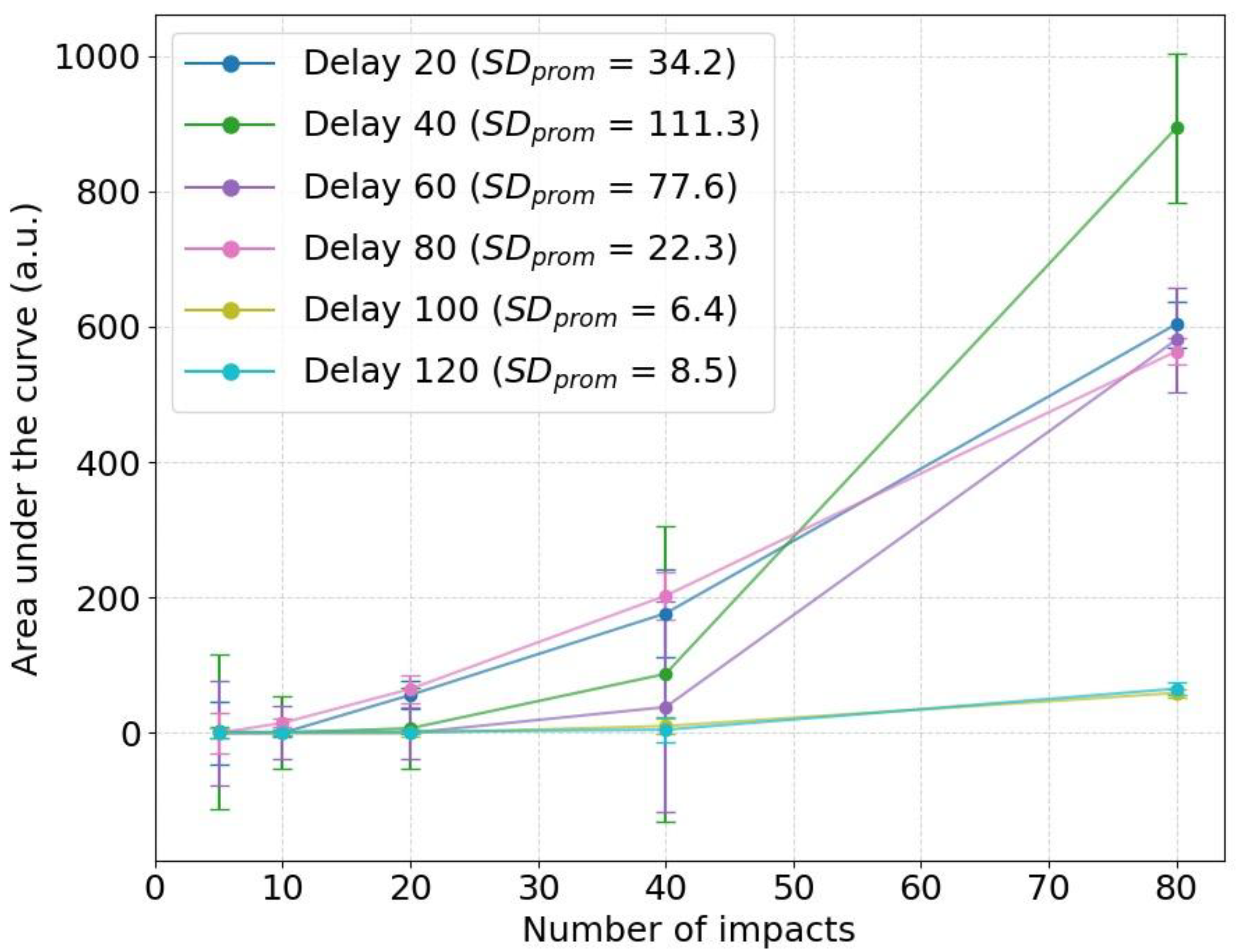
On the other hand, a linear fitting was applied to the initial ablation regime to compare how the ablated area evolves with the number of laser impacts for each delay condition (Figure 6).
The slopes, expressed in arbitrary units per pulse (a.u./pulse), represent a relative measure of ablation efficiency rather than an absolute rate. Although the process is not strictly linear for high pulse counts, the first 40 pulses exhibit an approximately proportional trend that justifies this simplified approach. The slopes for 20, 40, 60, and 80 µs delays were 8.2, 11.9, 7.9, and 6.9 a.u./pulse, indicating the highest efficiency in the 40–80 µs range, while the values for 100 and 120 µs (0.8 and 0.9 a.u./pulse) correspond to minimal ablation due to lower fluence. This analysis quantitatively supports the observed influence of delay time on ablation behavior and is presented as a comparative empirical tool, not as a physical model of the laser–material interaction.
Table 3 presents the trend lines fitted to the relationship between the number of impacts and the area under the curve. For each delay, the corresponding slope, standard deviation, correlation coefficient, and the equation of the fitted line are provided.
Arbitrary Units (au) are typically used in LIBS studies when exact calibration to physical units is not performed. Instead, relative changes in ablation efficiency are analyzed [47].
The statistical results (Table 3) indicate that the delay time of the laser pulse significantly influences the amount of ablated material, as seen from the AUC values. The slope (m) of each regression line reflects the increase in ablated material per additional laser pulse. Delays of 40 µs and 20 µs yielded the highest slopes, 11.95 and 8.21, respectively, corresponding to stronger ablation effects, likely due to higher energy delivery. This is consistent with studies that report enhanced plasma emission intensities at shorter delay times [48,49].
In contrast, longer delays (100 and 120 µs) showed minimal ablation (slopes < 1), with lower standard deviations, indicating more stable but less intense ablation. The coefficient of determination (R2) values confirm the reliability of the models, with most above 0.85, and the highest value observed at 80 µs (R2 = 0.98), suggesting good consistency despite moderate ablation.
Trend and physical analysis of slopes
High efficiency range (20–40 µs)
The maximum slope is recorded at 40 µs (11.95), suggesting that this delay configuration maximizes pulse ablation efficiency. The behavior can also be attributed to the optimal balance between plasma formation time and the arrival of the next pulse, allowing for constructive interaction of the laser with the excited material [50].
Decrease in efficiency (60–80 µs)
The slopes decrease moderately to ~7.7, indicating that although ablation continues, efficiency is decreasing, probably due to thermal dissipation or a lower effective energy density at the surface. This region could represent a saturation threshold for cobalt removal.
Low response zone (100–120 µs)
The slopes fall to values close to 0.8, indicating minimal effectiveness in material removal. This may be due to a significant loss of pulse energy before ablation or because the time delay no longer matches the dynamics of the plasma generated [47,51], where prolonged delays reduce effective interaction.
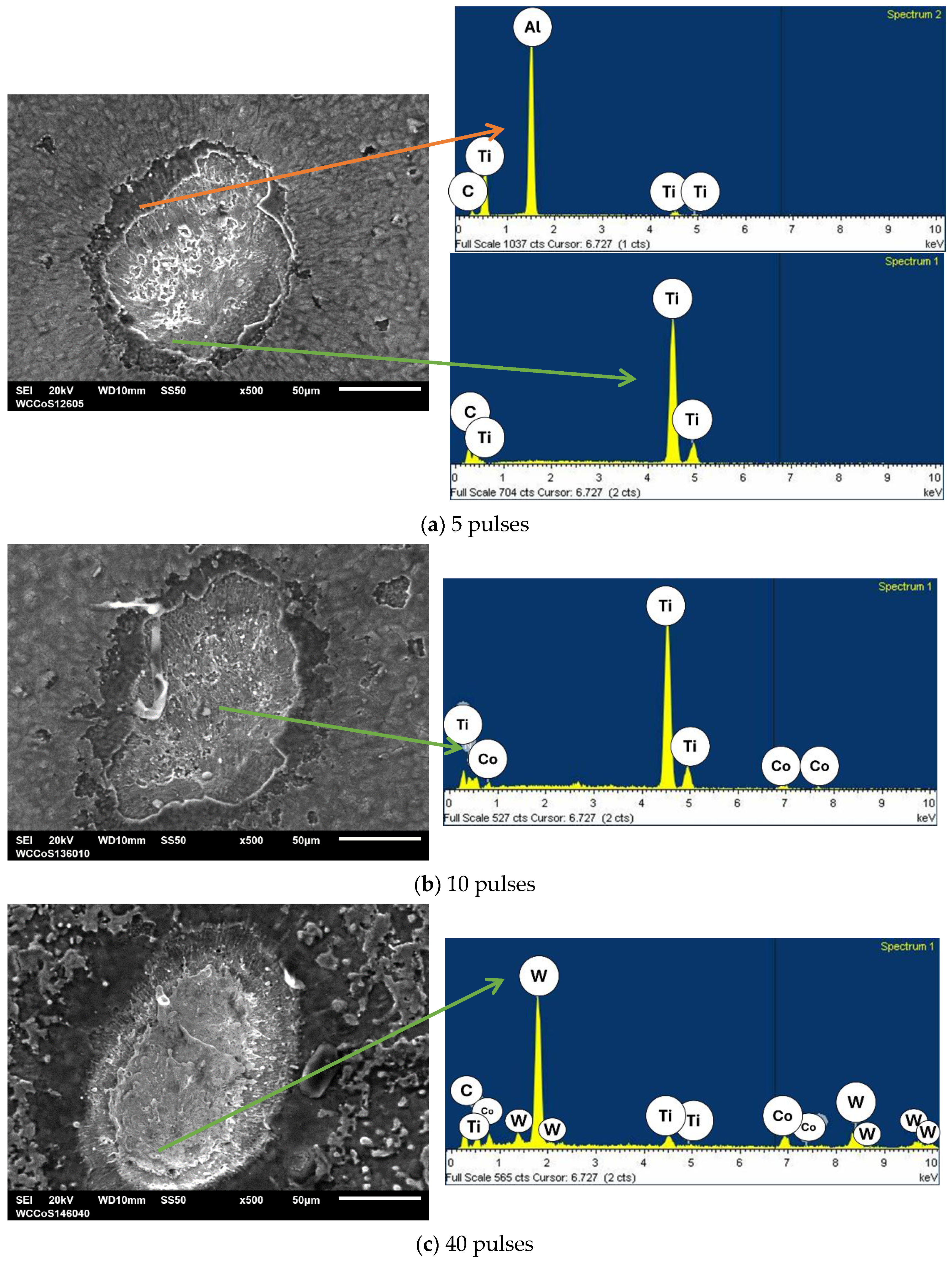
Figure 7 shows the SEM and EDS analysis of an Nd:YAG laser-impacted area for different pulses (5, 10, and 40) and their corresponding delay times and fluences.
In Figure 7a, the EDS analysis revealed that the secondary layer is composed of Al2O3, with aluminum as the predominant element. Titanium was also detected at the bottom of the crater, indicating ablation up to the third layer without reaching the substrate. Similarly, in Figure 7b, the presence of cobalt detected by EDS indicates proper ablation of the tri-layer thin film.
Finally, with 40 laser pulses (Figure 7c), EDS results indicate a clear reduction in the characteristic elements of the AlTiN/TiCN coating within the ablated zone, together with the appearance of W and Co signals from the substrate; also, plasma-induced spallation, melt expulsion, and material redeposition are observed. This compositional transition confirms that the laser pulses effectively reached the substrate under controlled conditions, without evidence of extensive melting or structural degradation.

4. Conclusions

In this work, nanosecond Nd:YAG laser irradiation at 532 nm was evaluated as a selective stripping technique for AlTiN multilayer coatings on WC–Co hardmetal inserts. The main conclusions are:
Selective stripping feasibility: Nanosecond Nd:YAG ablation enables the selective removal of ~18 µm AlTiN multilayer coatings from WC–Co inserts, provided that fluence, inter-pulse delay and number of pulses are kept within a controlled processing window.
Optimal processing window: An effective parameter range was identified between 5 and 10 pulses and inter-pulse delays of 60–80 µs (≈4.8–7.1 J·cm−2), achieving complete coating removal with minimal microstructural alteration of the WC–Co substrate and maintaining its suitability for recoating.
LIBS-assisted process control: The integration of LIBS allowed real-time discrimination between coating and substrate (Ti, Al, O vs. Co, W signals), enabling in situ end-point detection and reducing over-ablation of the cobalt-rich binder, which is critical for closed-loop industrial control.
Surface condition for recoating: SEM and optical profilometry confirmed that, within the optimal window, the resulting surfaces exhibit controlled roughness and limited cobalt melting, remaining compatible with industrial recoating. Shorter delays and/or higher pulse numbers promote excessive melting, resolidification and irregular features.
Broader implications and future work: The proposed laser-based process represents a cleaner alternative to chemical stripping, supporting circular economy strategies for WC–Co tools by enabling substrate reuse and reducing chemical waste. Future work should extend this approach to other coating systems (e.g., TiAlN, AlCrSiN, CrN, DLC), explore different laser wavelengths and pulse regimes, and systematically evaluate tool performance after recoating, including life cycle and techno-economic assessments.

Author Contributions

Conceptualization and methodology, L.C.A. and G.A.L.; validation, C.M.M., L.C.A.; formal analysis, R.C.H. and E.M.-O.; investigation, G.A.L., R.C.H. and E.M.-O.; resources, R.C.H., E.M.-O. and C.M.M.; data curation, G.A.L. and L.C.A.; writing—original draft preparation, G.A.L.; writing—review and editing, G.A.L. and L.C.A.; supervision, R.C.H., E.M.-O. and C.M.M.; project administration, L.C.A. and C.M.M.; funding acquisition, C.M.M. and R.C.H. All authors have read and agreed to the published version of the manuscript.

Funding

This research was funded by MINCIENCIAS, the project is identified by the code BPIN 2021000100031 through the grant “Contrato de Crédito Educativo C2 (Becas Bicentenario, 2021)”.

Institutional Review Board Statement

Not applicable.

Informed Consent Statement

Not applicable.

Data Availability Statement

Data are contained within the article.

Acknowledgments

The authors acknowledge Joel Moreno from the “Laboratorio de investigación y desarrollo tecnológico en recubrimientos avanzados, CINVESTAV” in Querétaro, México.

Conflicts of Interest

The authors declare no conflicts of interest.

References

  1. Fudger, S.J.; Luckenbaugh, T.L.; Hornbuckle, B.C.; Darling, K.A. Mechanical Properties of Cemented Tungsten Carbide with Nanocrystalline FeNiZr Binder. Int. J. Refract. Met. Hard Mater. 2024, 118, 106465. [Google Scholar] [CrossRef]
  2. Ortiz-Membrado, L.; Liu, C.; Cabezas, L.; Lin, L.L.; Mahani, S.F.; Wang, M.S.; Jiménez-Piqué, E.; Llanes, L. Fracture Mechanics Analysis of Hardmetals by Using Artificial Small-Scale Flaws Machined at the Surface through Short-Pulse Laser Ablation. Int. J. Refract. Met. Hard Mater. 2023, 111, 106084. [Google Scholar] [CrossRef]
  3. Ponomarev, S.S.; Shatov, A.V.; Mikhailov, A.A.; Firstov, S.A. Carbon Distribution in WC Based Cemented Carbides. Int. J. Refract. Met. Hard Mater. 2015, 49, 42–56. [Google Scholar] [CrossRef]
  4. Mégret, A.; Vitry, V.; Delaunois, F. Study of the Processing of a Recycled WC–Co Powder: Can It Compete with Conventional WC–Co Powders? J. Sustain. Met. 2021, 7, 448–458. [Google Scholar] [CrossRef]
  5. Pacini, A.; Lupi, F.; Rossi, A.; Seggiani, M.; Lanzetta, M. Direct Recycling of WC-Co Grinding Chip. Materials 2023, 16, 1347. [Google Scholar] [CrossRef]
  6. Tkaczyk, A.H.; Bartl, A.; Amato, A.; Lapkovskis, V.; Petranikova, M. Sustainability Evaluation of Essential Critical Raw Materials: Cobalt, Niobium, Tungsten and Rare Earth Elements. J. Phys. D Appl. Phys. 2018, 51, 203001. [Google Scholar] [CrossRef]
  7. Katiyar, P.K.; Randhawa, N.S. A Comprehensive Review on Recycling Methods for Cemented Tungsten Carbide Scraps Highlighting the Electrochemical Techniques. Int. J. Refract. Met. Hard Mater. 2020, 90, 105251. [Google Scholar] [CrossRef]
  8. Kumar, R.; Kariminejad, A.; Antonov, M.; Goljandin, D.; Klimczyk, P.; Hussainova, I. Progress in Sustainable Recycling and Circular Economy of Tungsten Carbide Hard Metal Scraps for Industry 5.0 and Onwards. Sustainability 2023, 15, 12249. [Google Scholar] [CrossRef]
  9. Kim, B.; Nam, H.K.; Watanabe, S.; Park, S.; Kim, Y.; Kim, Y.-J.; Fushinobu, K.; Kim, S.-W. Selective Laser Ablation of Metal Thin Films Using Ultrashort Pulses. Int. J. Precis. Eng. Manuf.—Green Technol. 2021, 8, 771–782. [Google Scholar] [CrossRef]
  10. Kim, J.; Na, S. Metal Thin Film Ablation with Femtosecond Pulsed Laser. Opt. Laser Technol. 2007, 39, 1443–1448. [Google Scholar] [CrossRef]
  11. Ostendorf, A.; Gurevich, E.L.; Shizhou, X. Selective Ablation of Thin Films by Pulsed Laser. In Fundamentals of Laser-Assisted Micro-and Nanotechnologies; Springer International Publishing: Cham, Switzerland, 2014; pp. 201–219. [Google Scholar]
  12. Riu, G.; Monclús, M.A.; Slawik, S.; Cinca, N.; Tarrés, E.; Mücklich, F.; Llanes, L.; Molina-Aldareguia, J.M.; Guitar, M.A.; Roa, J.J. Microstructural and Mechanical Properties at the Submicrometric Length Scale under Service-like Working Conditions on Ground WC-Co Grades. Int. J. Refract. Met. Hard Mater. 2023, 116, 106359. [Google Scholar] [CrossRef]
  13. Kretschmer, A.; Jaszfi, V.; Dalbauer, V.; Schott, V.; Benedikt, S.; Eriksson, A.O.; Limbeck, A.; Mayrhofer, P.H. Designing Selective Stripping Processes for Al-Cr-N Hard Coatings on WC-Co Cemented Carbides. Surf. Coat. Technol. 2023, 472, 129914. [Google Scholar] [CrossRef]
  14. Matei, A.A.; Turcu, R.N.; Pencea, I.; Herghelegiu, E.; Petrescu, M.I.; Niculescu, F. Comparative Characterization of the TiN and TiAlN Coatings Deposited on a New WC-Co Tool Using a CAE-PVD Technique. Crystals 2023, 13, 112. [Google Scholar] [CrossRef]
  15. Ardila, L.C.; Moreno, C.M.; Sánchez, J.M. Electrolytic Removal of Chromium Rich PVD Coatings from Hardmetals Substrates. Int. J. Refract. Met. Hard Mater. 2010, 28, 155–162. [Google Scholar] [CrossRef]
  16. Tavola, F.; Gaudenzi, G.P.D.; Bidinotto, G.; Casamichiela, F.; Pola, A.; Tedeschi, S.; Bozzini, B. Efficient and Sustainable Electrochemical Demolition of Hard-Metal Scrap with Co-Rich Binder. ChemSusChem 2025, 18, e202402218. [Google Scholar] [CrossRef]
  17. Kang, H.; Li, J.; Zhang, C.; Lu, J.; Wang, Q.; Wang, Y. Study of the Electrochemical Recovery of Cobalt from Spent Cemented Carbide. RSC Adv. 2020, 10, 22036–22042. [Google Scholar] [CrossRef]
  18. Rebolé, R.; Martínez, A.; Rodriguez, R.; Fuentes, G.G.; Spain, E.; Watson, N.; Avelar-Batista, J.C.; Housden, J.; Montalá, F.; Carreras, L.J.; et al. Microstructural and Tribological Investigations of CrN Coated, Wet-Stripped and Recoated Functional Substrates Used for Cutting and Forming Tools. Thin Solid Film. 2004, 469–470, 466–471. [Google Scholar] [CrossRef]
  19. Zhang, Q.; Xi, X.; Zhang, L.; Feng, M.; Nie, Z.; Ma, L. The Electrochemical Dissolution Mechanism and Treatment Process in the Molten-Salt Electrolytic Recovery of WC-Co Two-Phase Scraps. J. Electroanal. Chem. 2021, 896, 115219. [Google Scholar] [CrossRef]
  20. LI, N.; HAREFA, E.; ZHOU, W. Nanosecond Laser Preheating Effect on Ablation Morphology and Plasma Emission in Collinear Dual-Pulse Laser-Induced Breakdown Spectroscopy. Plasma Sci. Technol. 2022, 24, 115507. [Google Scholar] [CrossRef]
  21. Shirk, M.D.; Molian, P.A.; Malshe, A.P. Ultrashort Pulsed Laser Ablation of Diamond. J. Laser Appl. 1998, 10, 64–70. [Google Scholar] [CrossRef]
  22. B, J.C.D.; Ivanov, D.; Bilmes, G.M. Laser Ablation Thresholds of Thin Aluminium Films. In Proceedings of the Ultrafast Optics 2023—UFOXIII, Bariloche, Argentina, 26–31 March 2023; Optica Publishing Group: Washington, DC, USA, 2023; p. P2.17. [Google Scholar]
  23. Zawadzka, A.; Plociennik, P.; Lukasiak, Z.; Bartkiewicz, K.; Korcala, A.; Ouazzani, H.E.; Sahraoui, B. Laser Ablation and Thin Film Deposition. In Proceedings of the 2011 13th International Conference on Transparent Optical Networks, Stockholm, Sweden, 26–30 June 2011; IEEE: Ln Piscataway, NJ, USA, 2011; pp. 1–4. [Google Scholar]
  24. Furberg, A.; Fransson, K.; Zackrisson, M.; Larsson, M.; Arvidsson, R. Environmental and Resource Aspects of Substituting Cemented Carbide with Polycrystalline Diamond: The Case of Machining Tools. J. Clean. Prod. 2020, 277, 123577. [Google Scholar] [CrossRef]
  25. Primus, T.; Hlavinka, J.; Zeman, P.; Brajer, J.; Šorm, M.; Čermák, A.; Kožmín, P.; Holešovský, F. Investigation of Multiparameter Laser Stripping of Altin and Dlc c Coatings. Materials 2021, 14, 951. [Google Scholar] [CrossRef]
  26. Bouzakis, K.D.; Michailidis, N.; Skordaris, G.; Bouzakis, E.; Biermann, D.; M’Saoubi, R. Cutting with Coated Tools: Coating Technologies, Characterization Methods and Performance Optimization. CIRP Ann.—Manuf. Technol. 2012, 61, 703–723. [Google Scholar] [CrossRef]
  27. Marimuthu, S.; Kamara, A.M.; Whitehead, D.; Mativenga, P.; Li, L.; Yang, S.; Cooke, K. Laser Stripping of TiAlN Coating to Facilitate Reuse of Cutting Tools. Proc. Inst. Mech. Eng. Part B J. Eng. Manuf. 2011, 225, 1851–1862. [Google Scholar] [CrossRef]
  28. Li, W.; Yang, H.; Liu, Y.; Li, F.; Yi, J.; Eckert, J. Effect of Laser Power on Microstructure and Properties of WC-12Co Composite Coatings Deposited by Laser-Based Directed Energy Deposition. Materials 2024, 17, 4215. [Google Scholar] [CrossRef]
  29. Sundar, M.; Whitehead, D.; Mativenga, P.T.; Li, L.; Cooke, K.E. Excimer Laser Decoating of Chromium Titanium Aluminium Nitride to Facilitate Re-Use of Cutting Tools. Opt. Laser Technol. 2009, 41, 938–944. [Google Scholar] [CrossRef]
  30. Kearns, A.; Fischer, C.; Watkins, K.G.; Glasmacher, M.; Kheyrandish, H.; Brown, A.; Steen, W.M.; Beahan, P. Laser Removal of Oxides from a Copper Substrate Using Q-Switched Nd:YAG Radiation at 1064 Nm, 532 Nm and 266 Nm. Appl. Surf. Sci. 1998, 127–129, 773–780. [Google Scholar] [CrossRef]
  31. Haddad, J.E.; Canioni, L.; Bousquet, B. Good Practices in LIBS Analysis: Review and Advices. Spectrochim. Acta Part B At. Spectrosc. 2014, 101, 171–182. [Google Scholar] [CrossRef]
  32. Andrade, D.F.; Pereira-Filho, E.R.; Amarasiriwardena, D. Current Trends in Laser-Induced Breakdown Spectroscopy: A Tutorial Review. Appl. Spectrosc. Rev. 2021, 56, 98–114. [Google Scholar] [CrossRef]
  33. Thomas, J.; Joshi, H.C. Review on Laser-Induced Breakdown Spectroscopy: Methodology and Technical Developments. Appl. Spectrosc. Rev. 2024, 59, 124–155. [Google Scholar] [CrossRef]
  34. Nagarajan, B.; Han, J.; Huang, S.; Qian, J.; Vleugels, J.; Castagne, S. Femtosecond Laser Processing of Cemented Carbide for Selective Removal of Cobalt. Procedia CIRP 2022, 113, 576–581. [Google Scholar] [CrossRef]
  35. von der Heide, C.; Grein, M.; Bräuer, G.; Dietzel, A. Methodology of Selective Metallic Thin Film Ablation from Susceptible Polymer Substrate Using Pulsed Femtosecond Laser. Opt. Express 2020, 28, 33413. [Google Scholar] [CrossRef] [PubMed]
  36. Prochazka, D.; Pořízka, P.; Novotný, J.; Hrdlička, A.; Novotný, K.; Šperka, P.; Kaiser, J. Triple-Pulse LIBS: Laser-Induced Breakdown Spectroscopy Signal Enhancement by Combination of Pre-Ablation and Re-Heating Laser Pulses. J. Anal. At. Spectrom. 2020, 35, 293–300. [Google Scholar] [CrossRef]
  37. Li, T.; Lou, Q.; Dong, J.; Wei, Y.; Liu, J. Selective Removal of Cobalt Binder in Surface Ablation of Tungsten Carbide Hardmetal with Pulsed UV Laser. Surf. Coat. Technol. 2001, 145, 16–23. [Google Scholar] [CrossRef]
  38. Zhang, N.; Ou, T.; Wang, M.; Lin, Z.; Lv, C.; Qin, Y.; Li, J.; Yang, H.; Zhao, N.; Zhang, Q. A Brief Review of Calibration-Free Laser-Induced Breakdown Spectroscopy. Front. Phys. 2022, 10, 887171. [Google Scholar] [CrossRef]
  39. Iqbal, J.; Asghar, H.; Shah, S.K.H.; Naeem, M.; Abbasi, S.A.; Ali, R. Elemental Analysis of Sage (Herb) Using Calibration-Free Laser-Induced Breakdown Spectroscopy. Appl. Opt. 2020, 59, 4927. [Google Scholar] [CrossRef]
  40. Lehtonen, J.; Aaltonen, T. Using Generated LIBS Data as a Base for Neural Network Architecture Development. In Proceedings of the 2023 46th MIPRO ICT and Electronics Convention (MIPRO), Opatija, Croatia, 22–26 May 2023; IEEE: Ln Piscataway, NJ, USA, 2023; pp. 1125–1129. [Google Scholar]
  41. Vereschaka, A.; Grigoriev, S.; Sitnikov, N.; Oganyan, G.; Sotova, C. Influence of Thickness of Multilayer Composite Nano-Structured Coating Ti-TiN-(Ti,Al,Cr)N on Tool Life of Metal-Cutting Tool. Procedia CIRP 2018, 77, 545–548. [Google Scholar] [CrossRef]
  42. Vaca, G.R.G.; Hurtado, L.S.; Reyes, C.S. Laser Ablation of Polytetrafluoroethylene (PTFE) Coatings Applied on EN AW-5251 Substrates; Ablacion Laser de Recubrimientos de Politetrafluoretileno (PTFE) Aplicados Sobre Sustratos EN AW-5251. Rev. De Met. 2014, 50, e027. [Google Scholar] [CrossRef]
  43. Denkena, B.; Dittrich, M.A.; Liu, Y.; Theuer, M. Automatic Regeneration of Cemented Carbide Tools for a Resource Efficient Tool Production. Procedia Manuf. 2018, 21, 259–265. [Google Scholar] [CrossRef]
  44. Guo, C.; Li, K.; Liu, Z.; Chen, Y.; Xu, J.; Li, Z.; Cui, W.; Song, C.; Wang, C.; Jia, X.; et al. CW Laser Damage of Ceramics Induced by Air Filament. Opto-Electron. Adv. 2025, 8, 240296. [Google Scholar] [CrossRef]
  45. Al-Mahdy, A.; Kotadia, H.R.; Sharp, M.C.; Opoz, T.T.; Mullett, J.; Ahuir-Torres, J.I. Effect of Surface Roughness on the Surface Texturing of 316 l Stainless Steel by Nanosecond Pulsed Laser. Lasers Manuf. Mater. Process. 2023, 10, 141–164. [Google Scholar] [CrossRef]
  46. Rebentrost, P.; Engel, A.; Metzner, D.; Lampke, T.; Weißmantel, S. Case Study for the Formation of a Surface Alloy on Cemented Tungsten Carbide Using Ultrashort MHz to GHz Burst-Pulses. Appl. Surf. Sci. 2023, 641, 158418. [Google Scholar] [CrossRef]
  47. Cremers, D.A.; Chinni, R.C. Laser-Induced Breakdown Spectroscopy—Capabilities and Limitations. Appl. Spectrosc. Rev. 2009, 44, 457–506. [Google Scholar] [CrossRef]
  48. Musazzi, S.; Perini, U. Laser-Induced Breakdown Spectroscopy. In Laser-Induced Breakdown Spectroscopy: Theory and Applications.’ Springer Series in Optical Sciences; Agenzia Regionale Per La Protezione Dell’ambiente Della: Reggio Calabria, Italy, 2014; Volume 182, pp. E1–E2. [Google Scholar]
  49. Song, J.; Li, N.; Tian, Y.; Guo, J.; Zheng, R. Study of Interpulse Delay Effects on Orthogonal Dual-Pulse Laser-Induced Breakdown Spectroscopy in Bulk Seawater. J. Anal. At. Spectrom. 2020, 35, 2351–2357. [Google Scholar] [CrossRef]
  50. St-Onge, L.; Detalle, V.; Sabsabi, M. Enhanced Laser-Induced Breakdown Spectroscopy Using the Combination of Fourth-Harmonic and Fundamental Nd: YAG Laser Pulses. Spectrochim. Acta Part B At. Spectrosc. 2002, 57, 121–135. [Google Scholar] [CrossRef]
  51. Radziemski, L.J. From LASER to LIBS, the Path of Technology Development. Spectrochim. Acta Part B At. Spectrosc. 2002, 57, 1109–1113. [Google Scholar] [CrossRef]
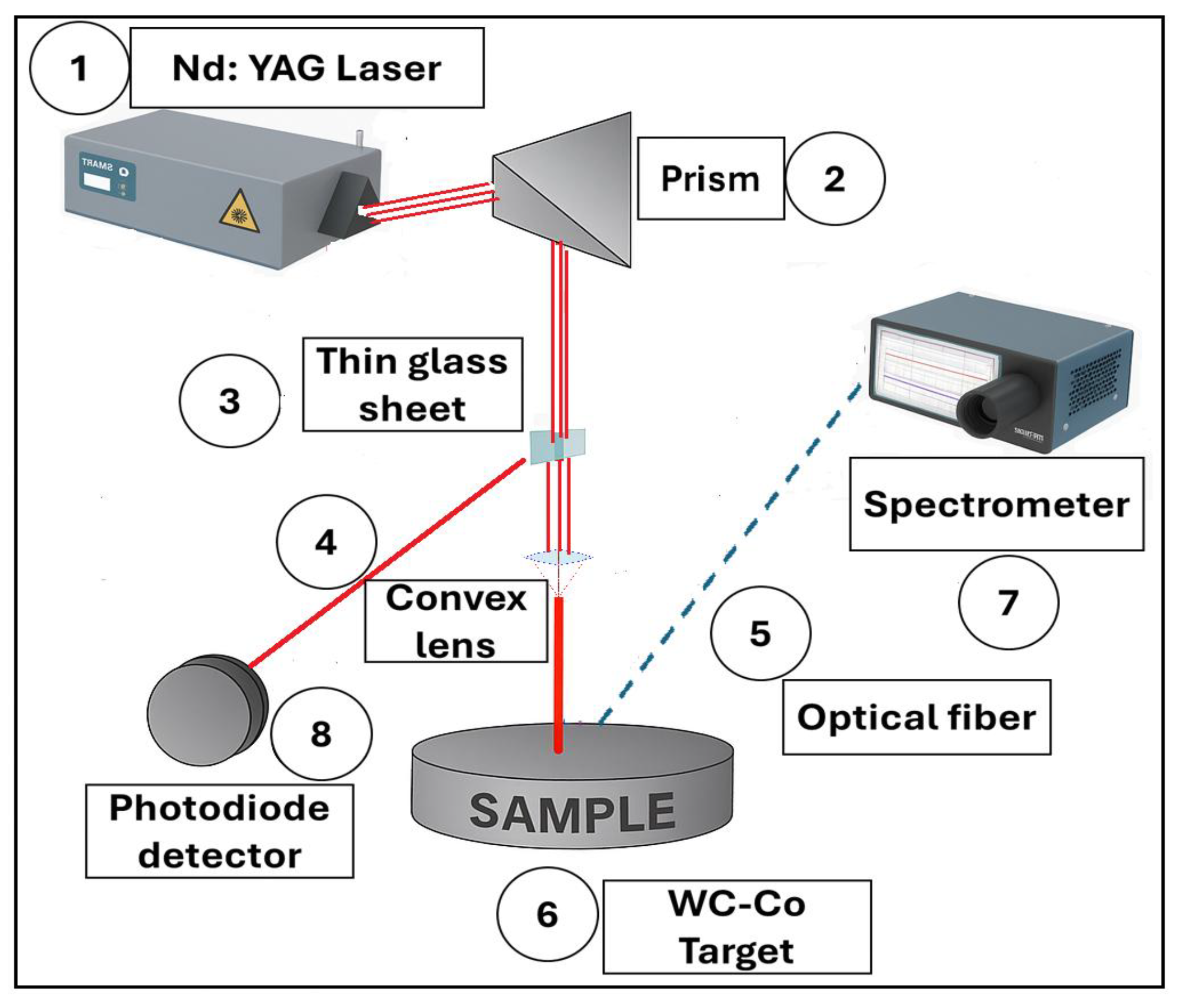
Figure 1. Experimental setup consisting of a Quanta Q-Smart 850 Nd:YAG laser (1), isosceles triangle base prism (2), thin glass sheet (3), a convergent lens (4), polychromatic optical fibers (5), tungsten graft that will serve as the ablation objective (6), Shamrock SR 500i-A spectrometer, with a 12 m inlet slit, with a 50 cm focal length Czerny-Turner mount. The 2400 plane/mm grid was used, which has a blaze in 250 nm. This system is equipped with an Andor Technology camera, istar DH-720 (7), Thorlabs photo-diode detector (8).
Coatings 15 01413 g001
Figure 2. SEM image and semiquantitative EDS analysis of the cross-section of cemented carbide coating thin films, K and L denote characteristic X-ray lines (K and L shells) detected by EDS.
Coatings 15 01413 g002
Figure 3. SEM Micrographs of WC-6%Co substrate varying energy from 180 µs (3.05 mJ) to 20 µs delay (367 mJ) at ×50 and ×2000 magnification.
Coatings 15 01413 g003
Figure 4. LIBS spectrum varying the delay from 20 to 120 µs with 10 pulses (a), and a more detailed cobalt line spectrum (b).
Coatings 15 01413 g004
Figure 5. Profilometry analyses performed using Gwyddion software V 2.37 for 1 (a), 5 (b), 10 (c), and 40 (d) laser pulses.
Coatings 15 01413 g005aCoatings 15 01413 g005b
Figure 6. Relationship between the number of laser pulses and the ablated area measured in arbitrary units (a.u.).
Coatings 15 01413 g006
Figure 7. SEM images and surface EDS maps of laser-ablated regions obtained at a 60 µs delay with varying pulse numbers: (a) 5 pulses, (b) 10 pulses, and (c) 40 pulses.
Coatings 15 01413 g007
Table 1. Nd:YAG laser parameters for each delay pulse setting. The spot diameter is 2 mm.
Delay−Pulse (μs)Measured
Energy (mJ)
Transmitted
Energy (mJ)
Fluence (J/cm2)
2041.0367.311.7
4035.7294.59.4
6027.2221.77.1
8018.6150.44.8
10011.685.32.7
1207.356.81.8
140N.D37.71.2
160N.D6.40.2
180N.D3.10.1
Table 2. Roughness analysis of laser-ablated surfaces obtained by optical profilometry.
Delay (µs)Roughness (Ra)
1 Impact5 Impacts10 Impacts40 Impacts
200.271.102.278.12
400.311.322.054.44
600.281.762,406.65
800.321.703.449.13
1000.331.411.324.44
1200.371.042.153.51
Table 3. Linear regression area under the curve (AUC) vs. impacts.
Delay (µs)Slope (m)Std. Dev. Residuals (σr)R2Equation
208.2151.480.96y = 8.21x − 87.41
4011.95162.750.87y = 11.95x − 172.41
607.74114.300.85y = 7.74x − 116.11
807.6431.480.98y = 7.64x − 67.68
1000.808.910.91y = 0.80x − 11.05
1200.8512.770.85y = 0.86x − 11.82
Disclaimer/Publisher’s Note: The statements, opinions and data contained in all publications are solely those of the individual author(s) and contributor(s) and not of MDPI and/or the editor(s). MDPI and/or the editor(s) disclaim responsibility for any injury to people or property resulting from any ideas, methods, instructions or products referred to in the content.