Article

AlN Passivation-Enhanced Mg-Doped β-Ga2O3 MISIM Photodetectors for Highly Responsive Solar-Blind UV Detection


School of Physics & Electronic Technology, Liaoning Normal University, Dalian 116029, China
*
Author to whom correspondence should be addressed.
Coatings 2025, 15(11), 1312; https://doi.org/10.3390/coatings15111312
Submission received: 13 October 2025 / Revised: 2 November 2025 / Accepted: 7 November 2025 / Published: 10 November 2025

Abstract

Mg-doped gallium oxide films were prepared on single crystal sapphire substrates through radio frequency magnetron sputtering technology, and then AlN films of different thicknesses were deposited on them as passivation layers. Finally, Pt interdigitated electrodes were prepared through mask plate and ion sputtering technology to make metal–insulator–semiconductor–insulator–metal (MISIM) photodetectors. The influence of the AlN passivation layer on the optical properties and photodetection performance of the device was investigated using UV-Vis (ultraviolet-visible absorption spectroscopy) spectrophotometer and a Keith 4200 semiconductor tester. The device’s performance was significantly enhanced. Among them, the MISIM-structured device achieves a responsivity of 2.17 A/W, an external quantum efficiency (EQE) of 1100%, a specific detectivity (D*) of 1.09 × 10¹² Jones, and a photo-to-dark current ratio (PDCR) of 2200. The results show that different thicknesses of AlN passivation layers have an effect on the detection performance of Mg-doped β-Ga2O3 films in the UV detection of the solar-blind UV region. The AlN’s thickness has little effect on the bandgap when it is 3 nm and 5 nm, and the bandgap increases at 10 nm. The transmittance of the film increases with the increase in AlN thickness and decreases when the AlN’s thickness increases to 10 nm. The photocurrent exhibits a non-monotonic dependence on AlN thickness at 10 V, and the dark current gradually decreases. The thickness of the AlN passivation layer also has a significant impact on the response characteristics of the detector, and the response characteristics of the device are best when the thickness of the AlN passivation layer is 5 nm. The responsiveness, detection rate, and external quantum efficiency of the device first increase and then decrease with the thickness of the AlN layer, and comprehensive performance is best when the thickness of the AlN passivation layer is 5 nm. The reason is that the AlN layer plays a passivating role on the surface of Ga2O3 films, reducing surface defects and inhibiting its capture of photogenerated carriers, while the appropriate thickness of the AlN layer increases the barrier height at the semiconductor interface, forming a built-in electric field and improving the response speed. Finally, the AlN layer inhibits the adsorption and desorption processes between the photogenerated electron–hole pair and O2, thereby retaining more photogenerated non-equilibrium carriers, which also helps enhance photoelectric detection performance.

1. Introduction

Deep ultraviolet (DUV) light, with a wavelength of <280 nm, is known as “solar-blind” light because it cannot penetrate the Earth’s atmosphere, as it is strongly absorbed by the stratospheric ozone layer [1]. Due to their low environmental interference, solar-blind photodetectors (PDs) have shown great potential in many fields, such as ozone monitoring, fire warning, and missile tracking [2,3,4,5]. Among the many semiconductor materials, β-Ga2O3 has attracted considerable attention in the development of solar-blind photodetectors owing to its suitable bandgap (4.4–5.3 eV) and ability to respond to deep ultraviolet wavelengths [6,7,8]. Among the various crystal phases of Ga2O3, β-Ga2O3 exhibits excellent thermal and chemical stability, providing a guarantee for the stable operation of photodetectors in complex environments. However, there are still many challenges in improving the performance of β-Ga2O3 photodetectors, such as carrier recombination issues and interface state effects, which limit their further development in the field of high-performance detection [9]. To overcome these problems, elemental doping is an effective method [10,11,12]. Mg doping can adjust the electrical properties of β-Ga2O3, such as modifying the bandgap and regulating the carrier concentration, and is thus expected to enhance the detection performance of β-Ga2O3-based photodetectors [13,14,15,16]. β-Ga2O3 solar-blind photodetectors have expansive applications, from civil fields (ozone monitoring, flame early warning) to military use (missile tail flame detection) [16]. The synergy of interface engineering and doping modification is key to improving device performance, supporting this study’s design of Mg-doped β-Ga2O3 with an AlN passivation layer [17].
In addition to elemental doping for Ga2O3 films, a passivation layer can be deposited on Ga2O3 films to form a MISIM structure photodetector, which can improve photodetection performance by reducing the defect state on the surface of the film [18,19]. Jing et al. prepared and compared a β-Ga2O3 metal–insulator–semiconductor–insulator–metal (MISIM) photodetector passivated with an ultra-thin Al2O3 layer and explored the physical mechanism behind the passivation technology. The results show that the 3 nm Al2O3 layer passivated device decreases the dark current and increases the photocurrent and responsivity, and the responsivity and specific detection rate reach 83.3 A/W and 1.35 × 10¹⁵ Jones, respectively, due to the change in the carrier transport mechanism and effective physical isolation at the metal/semiconductor interface. Studies have shown that precise control of the thickness of the Al2O3 passivation layer can comprehensively improve the performance of the β-Ga2O3 solar-blind photodetector, which provides an effective technology for reducing energy consumption and noise levels and improving performance [20]. Zhang et al. studied the fabrication of β-Ga2O3 MSM and MISIM solar-blind photodetector photodetectors, controlling their performance by inserting AlN layers of different thicknesses into the MISIM structure. The results show that the responsivity of the MISIM detector with a 3 nm AlN layer reaches 482 A/W, the EQE is 2.36 × 10⁵%, the response time is 0.10 s, and the dark current is 0.17 nA. XPS analysis shows that the AlN/β-Ga2O3 interface is arranged in type I bands, and the migration of carriers at the interface explains the performance change. It has been shown that the AlN layer can improve the performance of β-Ga2O3 photodetectors through interface engineering [21]. Moreover, Dong et al. introduced a high-κ HfO2 interlayer into β-Ga2O3 MIS solar-blind photodetectors via atomic layer deposition, effectively reducing the dark current by nearly two orders of magnitude (from 2.53 × 10⁻¹² A to 4.29 × 10⁻¹⁴ A) and enhancing the detectivity to 2.39 × 10¹² Jones. The improvement was attributed to the high dielectric constant and insulating nature of HfO2, which increased the Schottky barrier height, suppressed surface and interface defects, and accelerated carrier transport. The study demonstrates that HfO2 passivation is an efficient strategy to suppress leakage current and boost the performance of β-Ga2O3 solar-blind photodetectors [22]. Lv et al., from our group, prepared β-Ga2O3 MISIM solar-blind photodetectors with AlN passivation layers of varying thicknesses. The device with a 10 nm AlN layer showed the best performance, with responsivity of 8.4 A W−1, EQE of 4108%, detectivity of 3.6 × 10¹² Jones, and PDCR of 8.4 × 10⁴ at 10 V. Optical measurements indicate strong absorption in the 200–300 nm band and a blue shift of the absorption edge with increasing AlN thickness. Electrical analysis shows that the performance improvement mainly arises from photo-assisted Fowler–Nordheim tunneling and interface passivation (reduced traps and enhanced carrier separation); AlN’s polarization also contributes. The study demonstrates that optimizing AlN thickness via interface engineering can significantly enhance β-Ga2O3 solar-blind photodetector performance [23].
Although some results have been achieved in researching β-Ga2O3 photodetectors, the research on AlN passivation layers combined with Mg-doped β-Ga2O3 MISIM-type photodetectors is still quite scarce, and how the performance of the AlN passivation layer affects Mg-doped β-Ga2O3 MISIM photodetectors and their internal physical mechanisms is not fully understood. Therefore, this work focuses on the AlN passivation layer Mg-doped β-Ga2O3 MISIM photodetector, deeply explores the mechanism of the AlN passivation layer, and systematically studies the influence of key factors in the preparation process on the performance of the detector, aiming to provide a theoretical basis and experimental support for the development of high-performance solar-blind photodetectors.

2. Experimental

In this experiment, a JCP-350M2 high-vacuum multi-target magnetron sputtering coating machine (Technol Co., Ltd., Beijing, China) was used to sputter and deposit Mg-doped gallium oxide films on c-(001) sapphire and (100) monocrystalline silicon substrates, and monocrystalline silicon was used as the substrate, mainly for EDS testing, to obtain the composition of the thin films [11]. A mosaic gallium oxide ceramic target (99.99% purity) with different amounts of Mg metal blocks was used to control the Mg doping concentration. The sputtering power was 100 W, the argon flow rate was 25 sccm, the working air pressure was 0.2 Pa, and the sputtering time was 90 min. AlN targets were used to deposit passivating layers of different thicknesses (0 nm, 3 nm, 5 nm, and 10 nm), and the samples were labeled as S0, S1, S2, and S3, respectively. Finally, four samples, including S0–S3, were annealed at 800 °C for 1 h in an argon atmosphere. In order to realize current collection, Pt interdigitated electrodes were fabricated via ion sputtering combined with a metal mask and the electrode’s dimensions were listed as follows: electrode thickness: approximately 30 nm; finger width: 200 μ m; finger length: 2800 μ m; finger spacing: 200 μ m. These parameters guaranteed good contact with test probes; moreover, all samples were prepared using the same mask, resulting in an electrode structure consistency error of <2%. Thus, the MSM photodetector and MISIM sunblind photodetector were obtained, and their photoelectric detection performance was evaluated and analyzed.
The optical properties of the samples were characterized using ultraviolet-visible absorption spectroscopy (UV-Vis) (Agilent Technologies, Santa Clara, CA, USA), and the photoelectric detection performance of the prepared MSM-type photodetectors (PDs) was evaluated on the Keithley 4200-SCS semiconductor test platform (Keithley Co., Ltd., Solon, OH, USA) using dual-wavelength (254 nm and 365 nm) ultraviolet light illumination.
To verify the phase purity of Mg-doped β-Ga2O3 films and the crystallinity of AlN passivation layers, Raman spectroscopy with 532 nm laser excitation was collected, as shown in Figure 1. We can see that the AlN-free sample (S0) shows β-Ga2O3 characteristic peaks at 197 cm−1, 344 cm−1, and 414 cm−1 without impurity peaks, confirming no phase transition from Mg doping. While the 10 nm AlN sample shows sharp peaks at 613 and 654 cm−1 (A1(LO) mode of hexagonal wurtzite AlN, indicating good AlN crystallinity and a stable interface) and no significant attenuation of β-Ga2O3 peak intensity (proving no damage to the underlyingβ-Ga2O3 film’s crystalline integrity from AlN deposition and annealing).

3. Results and Discussions

3.1. Light Absorption and Bandgap

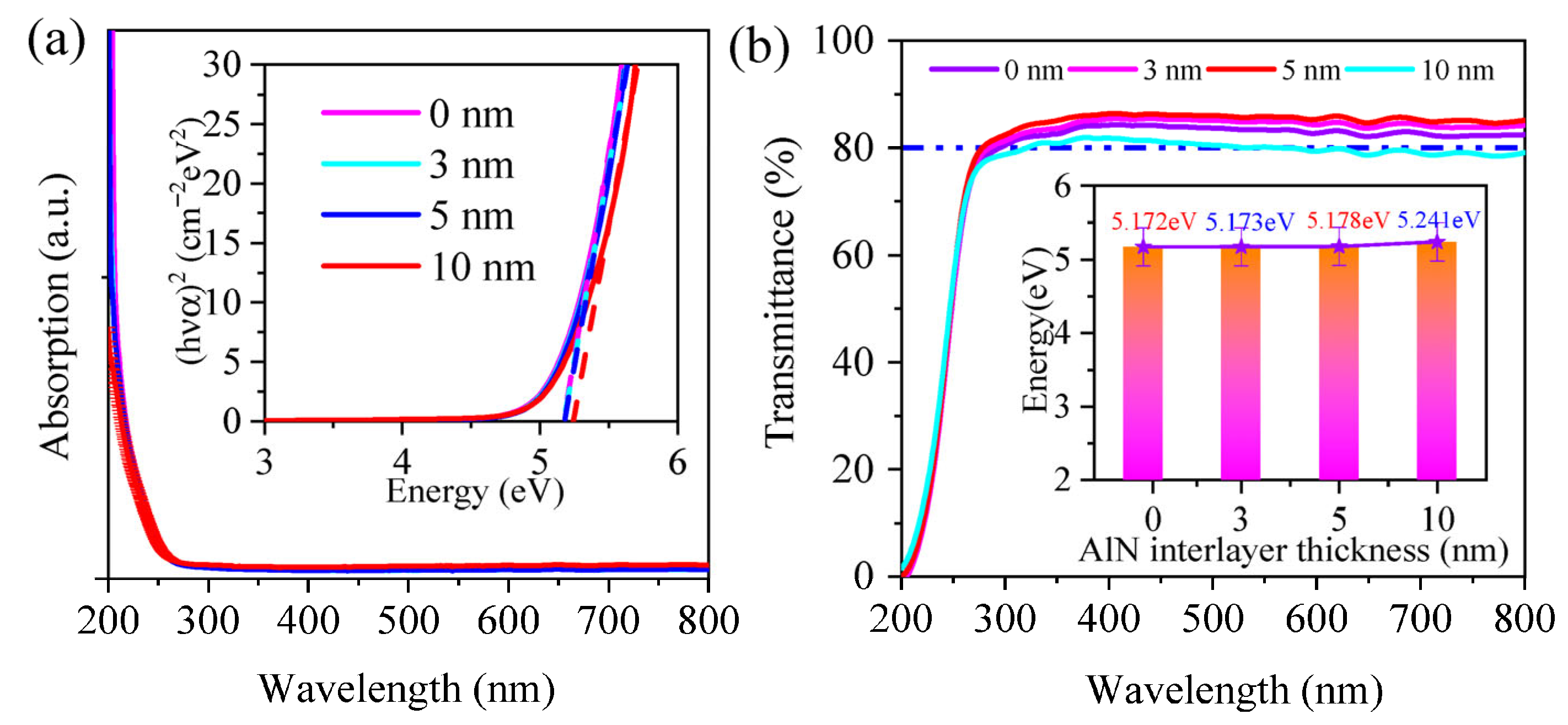
As we all know, optical absorption measurements are of crucial significance in determining optical parameters, such as the absorption coefficient and the optical bandgap of thin films. Figure 2a shows the UV-Vis (UV-Vis) absorption spectra of Mg-doped β-Ga2O3 films with different AlN thicknesses. The absorption coefficient of Mg-doped β-Ga2O3 films was calculated from the transmittance (T) data using the formula [24]
α = ln T d    
where T denotes the transmittance of the film–substrate system and d is the thickness of the Mg-doped β-Ga2O3 film. This calculation accounts for the influence of light reflection and film thickness on transmittance, ensuring the accuracy of the obtained absorption coefficient for subsequent bandgap analysis.
It can be seen that the Mg-doped films with different AlN thicknesses β-Ga2O3 exhibit significant UV absorption in the sunblind wavelength band of 200–300 nm, and a steep optical absorption edge appears. In view of the fact that β-Ga2O3 is a typical direct bandgap semiconductor material, the following relationship between the optical bandgap and the absorption coefficient is met experimentally [25]:
  α h ν =   B h ν E g 1 2    
where hν is the photon energy, B is the constant, Eg is the optical bandgap, and α is the absorption coefficient; hν and (αhν)2 are used to fit the curves in the transverse and ordinate coordinates. When the ordinate abscissa value is 0, the intercept between the tangent line of the curve and the transverse axis is the value of the bandgap of the thin film, as shown in the inset (a), and it can be found that the thickness of the AlN layer has little effect on the Mg-doped β-Ga2O3 bandgap. When the AlN layer’s thickness is 3 nm and 5 nm, the bandgap values are around 5.17 eV. This may be due to the fact that the AlN layer is thinner and therefore has less of an effect on the light absorption of the film. When the thickness of the AlN layer reaches 10 nm, the bandgap value increases to about 5.24 eV, as shown in the inset of Figure 2b, because the bandgap value of AlN is larger than that of β-Ga2O3 [26,27], which increases the overall bandgap width.
Figure 2b presents the light transmittance curves of Mg-doped β-Ga2O3 films with different AlN thicknesses. It can be observed that all four types of films possess relatively high transmittance. Among them, the transmittance of S0, S1, and S2 is greater than 80%, and with the increase in AlN thickness, transmittance shows an upward trend. The possible reason is that when light travels from AlN to β-Ga2O3, reflection and refraction phenomena will occur at the interface between the two media. The refractive index of the AlN transparent film is between that of air and β-Ga2O3. When light irradiates onto the AlN film, reflections will be generated on the upper and lower surfaces of the film, thus forming two reflected light beams. These two reflected light beams can interfere destructively, thereby reducing the intensity of the reflected light and increasing the intensity of the transmitted light [28,29]. In addition, the AlN film can make the film’s surface smoother and flatter, which helps to reduce the diffuse reflection of light and further improve the transmittance. As for S3, its transmittance is somewhat decreased, which may be due to the excessive thickness of the film, which is not conducive to the occurrence of the interference phenomenon.

3.2. I-V Curve and I-T Response Curve

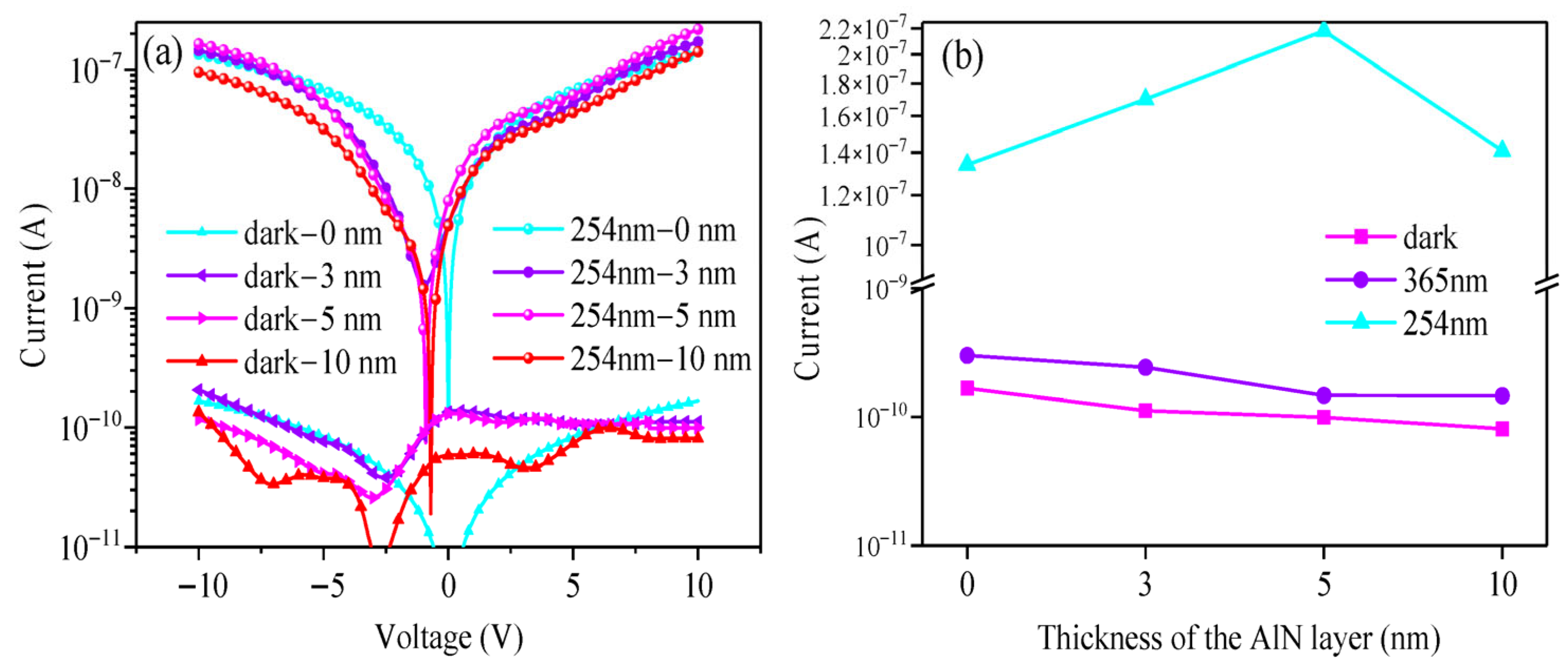
The I-V curves of Mg-doped β-Ga2O3 metal–semiconductor–metal (MSM) and metal–insulator–semiconductor–insulator–metal (MISIM) Schottky barrier photodetectors (SBPDs) were measured under dark conditions and upon irradiation with 254 nm ultraviolet light (2 μW/cm2), respectively. The results are presented in Figure 3a. It can be observed that the dark current of the MISIM photodetector is relatively less affected by bias voltage, with weak symmetry between the photocurrent and the dark current; both currents exhibit strong Schottky contact characteristics. Additionally, at an applied bias of 10 V, the photocurrent first increases and then decreases with increasing AlN thickness, while the dark current decreases gradually. Figure 3b shows the current values for different AlN thicknesses at a 10 V bias. The dark current of the β-Ga2O3 MSM-type SBPD is 0.16 nA, whereas the dark currents of the MISIM-type SBPDs with 3 nm, 5 nm, and 10 nm AlN layers are 0.12 nA, 0.09 nA, and 0.08 nA, respectively. However, the introduction of the AlN layer only slightly increases the photocurrent of the MISIM-type SBPDs, and a relatively higher photocurrent (218 nA) is observed in the MISIM-type SBPD with a 5 nm AlN layer. Compared with β-Ga2O3, AlN has greater resistance and a wider bandgap; the larger conduction band offset between them is highly conducive to the establishment of a strong built-in electric field, which can enhance carrier transport at the AlN/β-Ga2O3 interface. Moreover, AlN forms a higher Schottky barrier height with platinum electrodes [30]. Nevertheless, when the AlN layer is ultra-thin, electrons tend to tunnel directly through the layer and then drift at the AlN/β-Ga2O3 interface under the action of the built-in electric field; this causes the dark current of the MISIM SBPD to be higher than that of the MSM-type SBPD at low bias voltages. As the bias voltage increases, the electron emission via field emission (FE) and thermionic field emission (TFE) in the MISIM-type detector decreases [31], leading to a reduction in dark current.
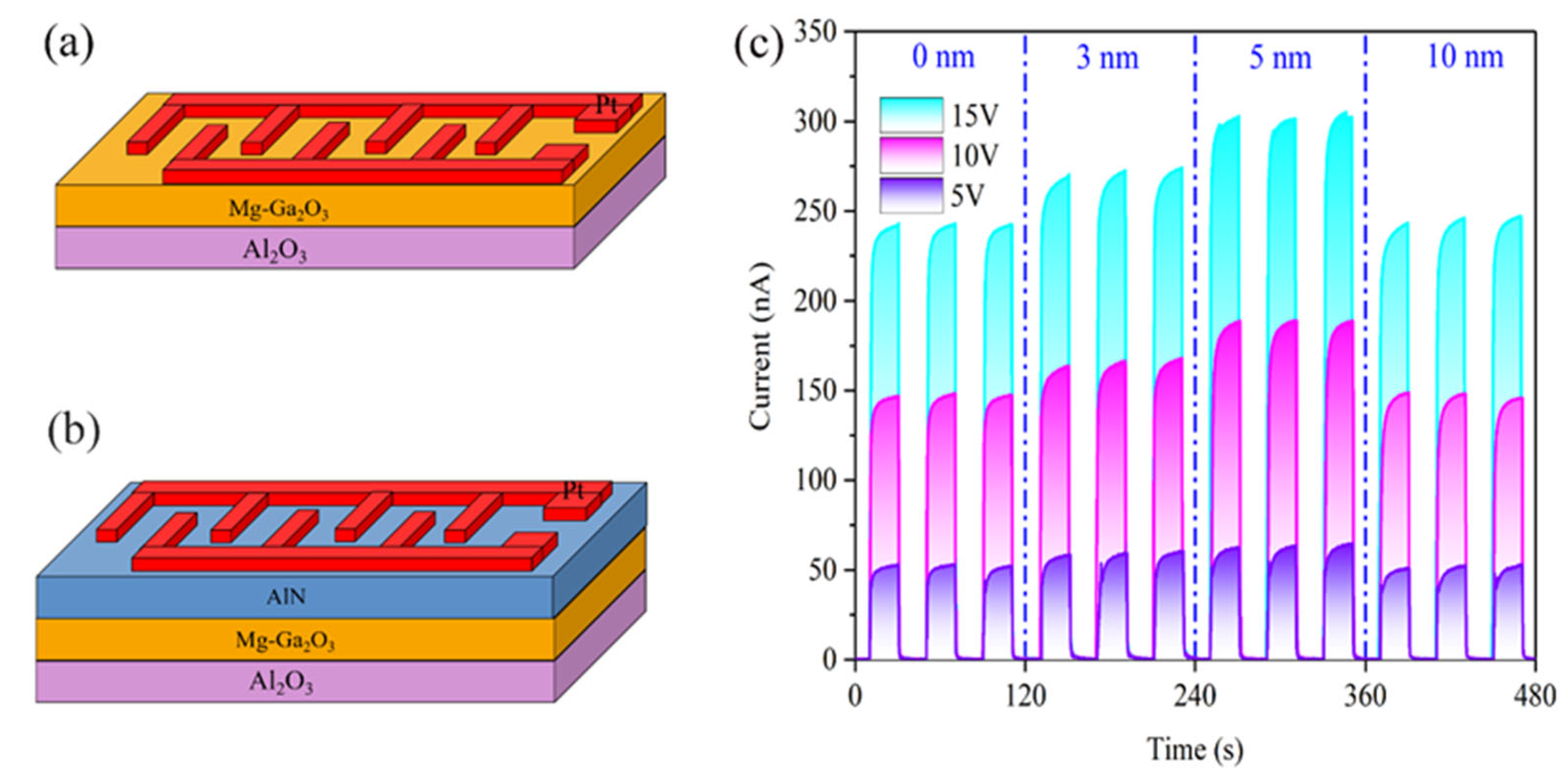
The I-T plot shows the light response characteristics of the device when the UV lamp is turned on and off at different time points, as shown in Figure 4c. The test conditions enable observation of the instantaneous response characteristics of the device to ultraviolet light irradiation with a wavelength of 254 nm (optical power density of 2 μW/cm2) and three bias voltages of 5 V, 10 V, and 15 V at both ends of the device. As you can see, all devices exhibit good repeatability and stability, as well as a remarkable light response. Under the same bias condition, with the increase in the thickness of the AlN interlayer, the photocurrent first increases and then decreases.

3.3. Transient Response Characteristics and Photoconductive Gain

The transient response curve is an important means to characterize the dynamic characteristics of the detector, which can show the current variation characteristics of the detector over time after being stimulated by the change in external light intensity, which is helpful for in-depth understanding and evaluation of the detector performance. Figure 5a–c show the transient response curves of the S0, S2, and S3 devices under 254 nm UV irradiation, respectively, and the results of fitting these curves using the double exponential relaxation equation. The equation is as follows:
I = I 0 + A e t τ 1 + B e t τ 2
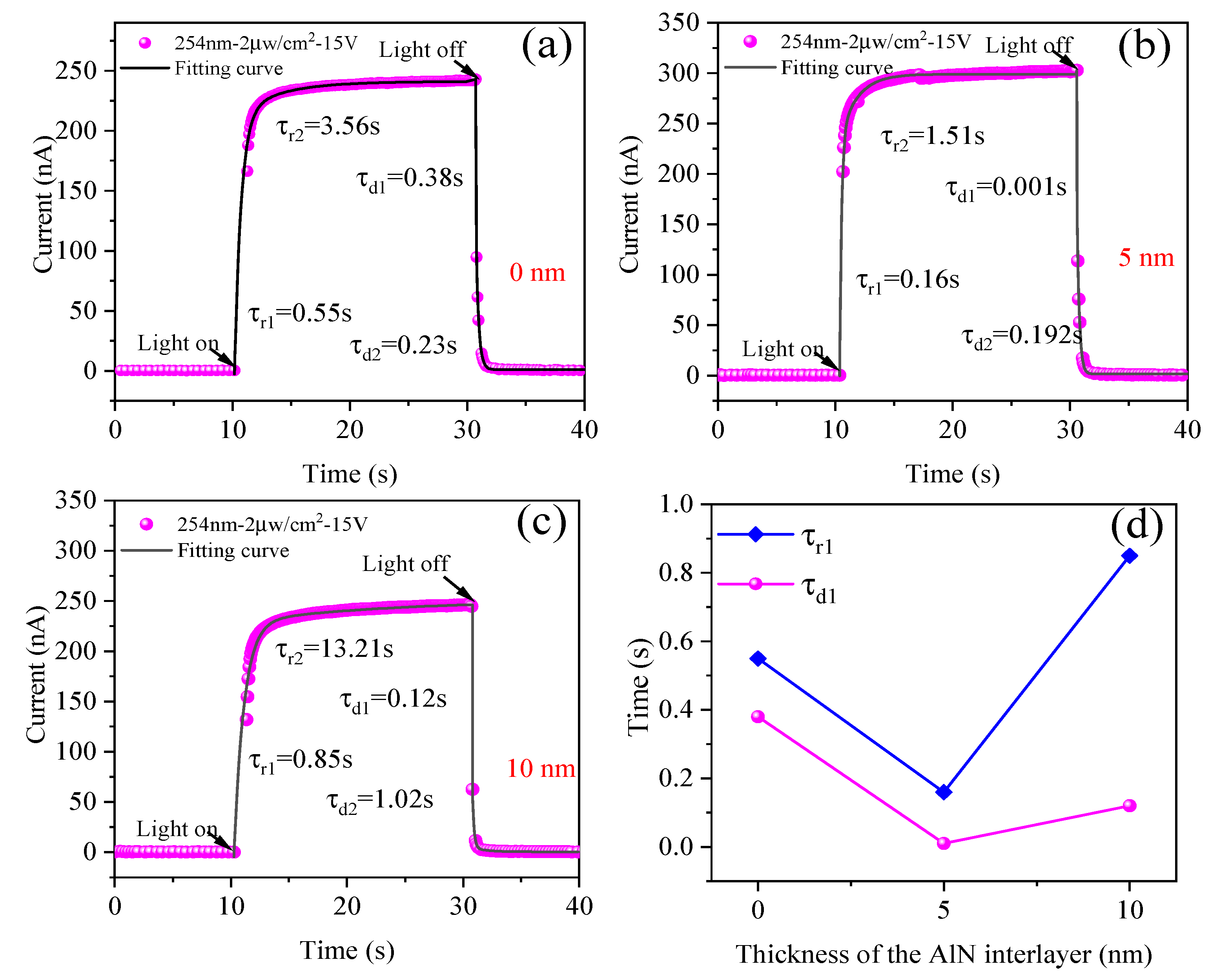
where I0 represents the initial steady-state current, A and B are the parameters used for fitting, t represents time, and τ1 and τ2 are the relaxation time constants for the fast and slow ascent phases, respectively. The on–on light and light-off response constants are denoted as τr and τd, respectively. The fast rise time and the fast fall time are compared in Figure 5d, and it can be seen that the rise and fall times both decrease and then increase with the thickness of the AlN interlayer. This may be due to the fact that the surface passivation of the β-Ga2O3 film by the AlN layer effectively reduces the capture of photogenerated holes by surface traps, thereby improving the response speed of MISIM SBPDs. However, as the thickness of the AlN layer increases, the probability of carrier tunneling decreases, and it takes more time for the carriers to pass through the AlN layer, so the response speed decreases. In summary, when the AlN layer’s thickness is 5 nm, the device has a short response time of 0.16 s for a fast rise and 0.01 s for a fast fall.
Photoconductive gain refers to the amplification of the current generated by photogenerated carriers under the action of an electric field relative to the number of original carriers generated by photoexcitation in photoconductive materials. It reflects the combined effect of multiple physical processes, such as carrier generation, transport, and recombination, in the photoconductive process, and the photoconductive gain (G) is defined as follows [32]:
G = I p     I d e P l S h ν
where Ip is the photocurrent, Id is the dark current, e is the amount of electron charge, Pl is the optical power, S is the illumination area, h is the Planck constant, ν is the frequency of the light, and the GS0 and GS2 of the S0 and S2 data are 12.12 and 14.66, respectively, under the 15 V bias, which indicates that the AlN layer improves the photoconductance gain of the detector. On the one hand, the AlN layer, as a sandwich, has the effect of passivating the interface, which can reduce the interfacial density of states on the surface of β-Ga2O3. In MSM structures, due to the lack of an effective passivation layer, the surface state may trap photogenerated carriers, resulting in a decrease in the number of carriers involved in conduction, which in turn reduces the photoconductance gain. In the MISIM structure, the lower interface density of states makes it easier for photogenerated carriers to be transported inside of the material, reduces the scattering and recombination of carriers at the interface, and helps to improve the photoconductance gain. On the other hand, in the MISIM structure, the internal electric field formed between the AlN layer and the β-Ga2O3 and electrodes is more conducive to the separation and transport of the carriers, which accelerates the drift motion of the photogenerated carriers and allows them to reach the electrodes more quickly to form currents [21]. In contrast, the internal electric field of the MSM structure is relatively weak and cannot effectively drive the carriers to move quickly, which limits the improvement of the photoconductance gain.

3.4. Key Response Parameters of Optoelectronic Devices

In order to study the photoelectric response characteristics of different optoelectronic devices in greater depth, we can calculate and compare the following key parameters. The light-to-dark current ratio [33] (PDCR) can be calculated as
P D C R = I p     I d I d
where Ip is the photocurrent and Id is the dark current. Responsivity [34] (R) can be expressed as
R = I p     I d P λ S     ,
where Ip is the photocurrent, Id is the dark current, S is the effective illumination area (S ≈ 0.05 cm2 in this experiment), and Pλ is the optical power density, which describes the photoelectric conversion efficiency of the device, which is defined as the ratio of the photogenerated current to incident optical power, which is usually expressed in units A/W. Detectivity (D*) can be expressed as
D * = R λ 2 q J d
where Rλ is the responsivity, Jd is the dark current density, and q is 1.6 × 10⁻¹⁹ C [35], which is a comprehensive performance index that represents the detection ability of the device to the optical signal and is defined as the ratio of the optical responsivity of the device to the background noise, which is used to evaluate the sensitivity of the device. External quantum efficiency (EQE) [36] can be expressed as
E Q E = h c R q λ
where h is Planck’s constant, c is the speed of light, q is 1.6 × 10⁻¹⁹ C, and λ is the wavelength of incident light (254 nm), which measures the part of the optical quantum efficiency of the device that generates electron–hole pairs, which reflects the efficiency of the device in converting light energy into electrical energy.
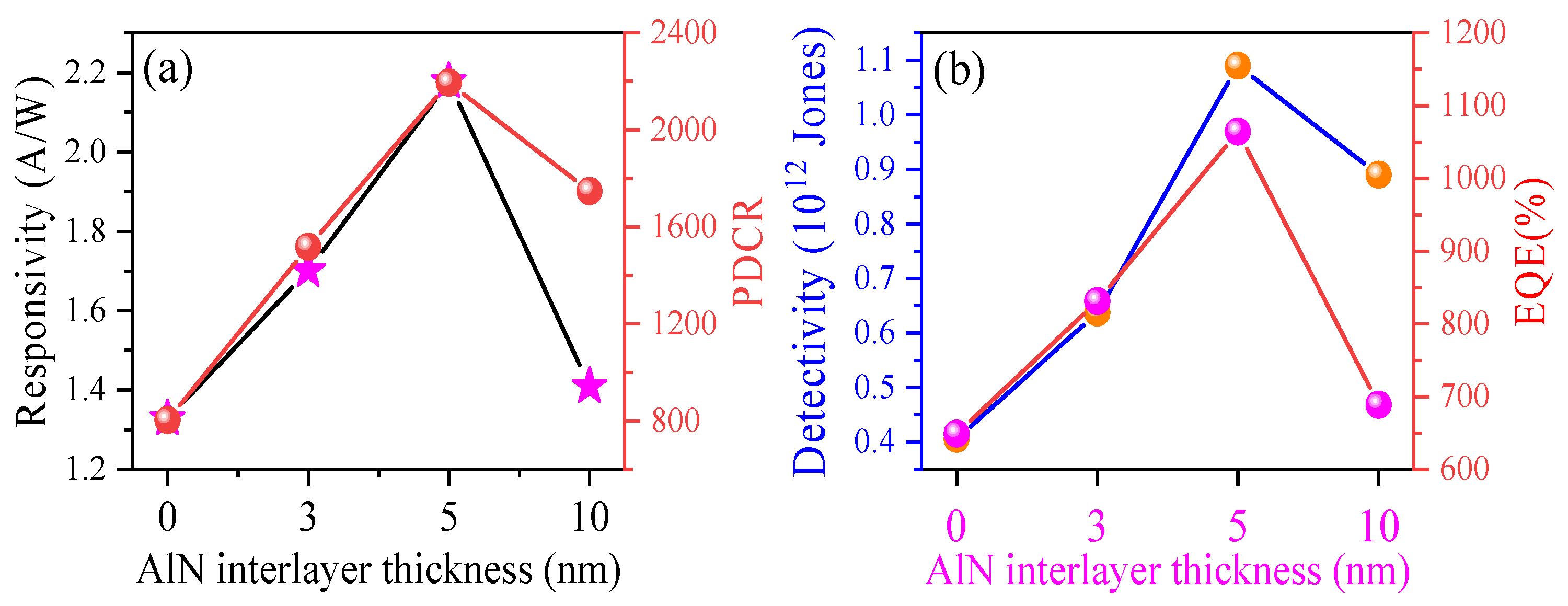
Figure 6 shows the responsivity (R), light-to-dark current ratio (PDCR), detection rate (D*), and external quantum efficiency (EQE) curves of S0, S1, S2, and S3 devices under ultraviolet light irradiation at a wavelength of 254 nm (optical power density of 2 μW/cm2). The S2 device exhibits responsivity, a light–dark current ratio, detectability, and external quantum efficiency of 2.17 A/W, 2200, 1.09 × 10¹² Jones, and 1100%, respectively. These parameters indicate that the device has good sensitivity and detection ability for ultraviolet light signals, which is very beneficial for the development of efficient optoelectronic devices and ultraviolet detection applications.
The improvement of responsivity, detectability, and external quantum efficiency lies in the fact that the nanoscale AlN layer may produce a quantum confinement effect, and the movement of electrons and holes is confined to a small space, resulting in band splitting and energy level discretization. This effect causes a change in the effective mass of electron–hole pairs, which affects their transition probabilities and recombination probabilities [37,38]. Under illumination, it is more conducive to the generation and separation of electron–hole pairs, increasing the photocurrent and improving the photoresponsivity. In addition, the built-in electric field helps to separate the photogenerated carriers so that the electrons and holes move in different directions, reducing recombination, increasing the photocurrent, and thus improving the photoresponsivity. For MISIM Schottky barrier photodetectors, the elevation of EQE stems from the different tunneling probabilities between electrons and holes. The electrons with smaller effective mass in the β-Ga2O3 film are more likely to overcome the AlN barrier, resulting in an excess of photogenerated holes in the semiconductor. To maintain charge neutrality, the metal electrode supplies an excess of electrons, thereby generating an internal photoelectric gain [18]. When the thickness of the AlN layer is too great, the quantum confinement effect and electron tunneling are weakened, causing the responsivity, detectivity, and external quantum efficiency to decrease.
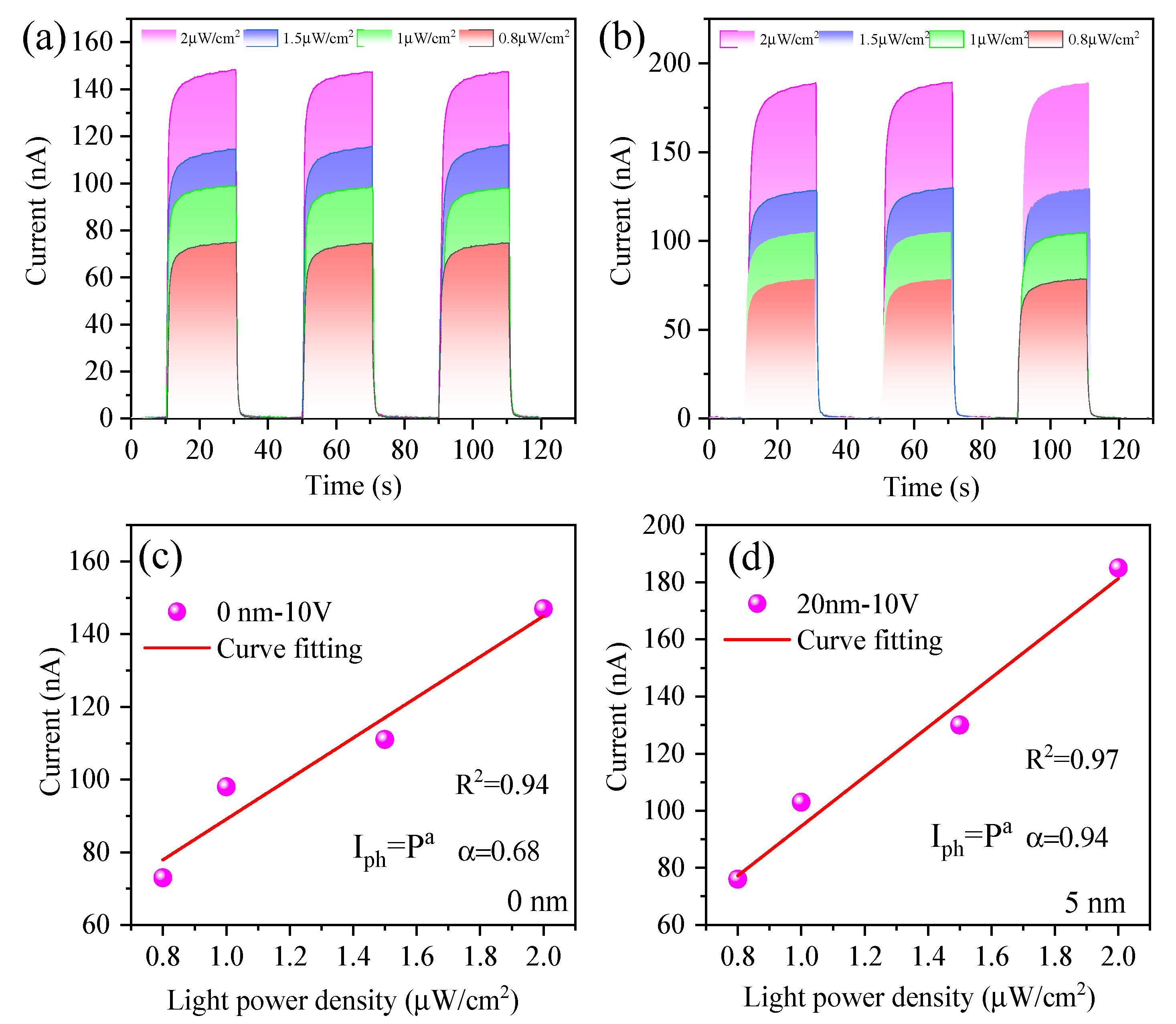
Figure 7a and b show the I-T response curves of S0 and S2 at different optical power densities. It can be seen that the photocurrent increases with the increase in light intensity, and the increase in light intensity will increase the absorption of photons, resulting in the generation of more photoexcited charge carriers inside of the gallium oxide material. It can be seen that the photodetector can switch well between the open and closed states.
To explore the photoelectric response mechanism, Figure 7c,d show the dependence of S0 and S2 on the photocurrent to the excitation power. To determine the photogenerated current (Iph), the total current measured under illumination (Ip) is subtracted from the dark current (Id), which can be expressed as (Iph = Ip − Id). The photocurrent (Ip) increases linearly with the increase in light intensity (P). The correlation between the photocurrent and light intensity can be mathematically expressed by the power law as Iph = Pα, where P and α correspond to light intensity and empirical coefficients, respectively [39]. The index provides information about the charge trap of the photodetector. Under ideal trap-free conditions, α is one, and the closer it is to one, the fewer traps there are [40,41]. As shown in Figure 7c,d, the nonlinear fitting of S0 and S2 shows that αS2 (0.94) is very close to one and greater than αS0 (0.68), which may be attributed to the presence of the AlN layer, which reduces the defect states on the surface, increases the contribution of photogenerated carriers to the photocurrent, and reduces carrier trapping and recombination near the interface. In addition, the linear relationship between the photocurrent and light intensity is stronger (the correlation coefficient R2 increases from 0.94 to 0.97), confirming that the photocurrent is proportional to the number of photogenerated carriers and that the generation of the photocurrent is determined by the number of photogenerated carriers [42].

3.5. Mechanism Analysis of Photoelectric Detection Enhancement

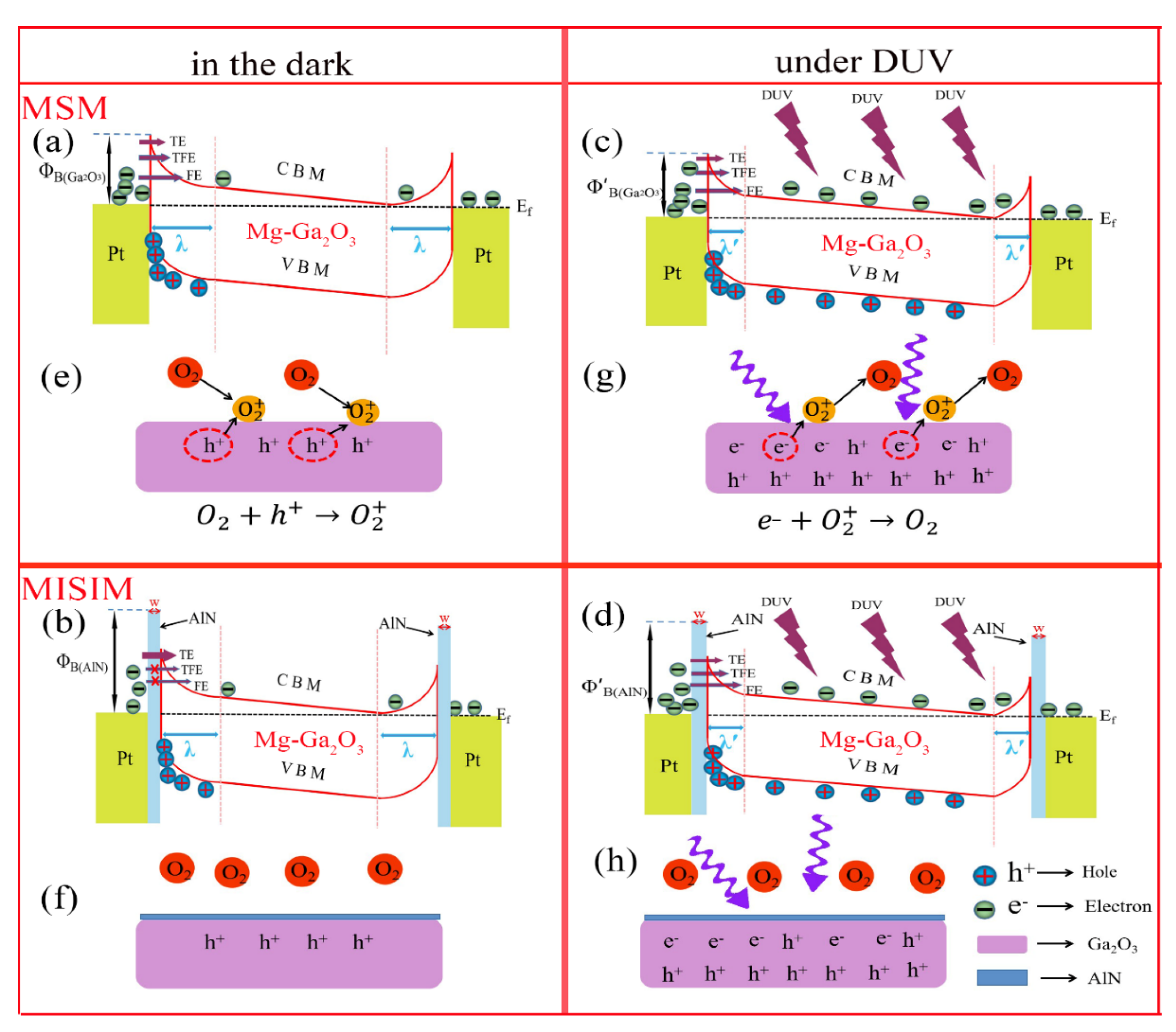
Figure 8 illustrates the schematic of the Mg doped β-Ga2O3 MSM and MISIM-type photodetector (PD), where the back-biased Schottky barrier between the electrode and the β-Ga2O3 plays a key role in determining the carrier transport and thus the dark current [31]. As shown in Figure 8a, when the carriers have sufficient thermal energy, they can cross the barrier through the thermal electron emission (TE) mechanism or by means of field emission (FE) and thermal field emission (TFE) mechanisms for direct and trap-assisted tunneling [31,43]. The transport of carriers is influenced by the barrier height (Ф) and the barrier width (λ) between the electrode and β-Ga2O3 [44]. As can be seen in Figure 8b, the inserted AlN dielectric layer has a wider barrier (Ф′) as well as additional physical thickness (w). This results in an increase in both the height and width of the barrier, which has a significant effect on the electrons emitted in the field emission (FE) or thermal field emission (TFE), resulting in a decrease in the number of emitted electrons and a significant decrease in the dark current. As can be seen from Figure 8c,d, in the case of deep ultraviolet (DUV) illumination, light excitation increases the carrier concentration, which in turn leads to a narrowing of the depletion layer (λ′) in the β-Ga2O3 body and a consequent decrease in the effective barrier width, although the barrier height remains basically unchanged. The reduction of the effective barrier width increases the probability of carrier tunneling on the one hand and increases the probability of thermal field emission (TFE) and field emission (FE) electrons on the other hand. In addition, the ultra-thin AlN layer strengthens the carrier tunneling effect, which is more conducive to carrier transport, which in turn promotes the increase in photocurrent.
The performance of Mg-doped β-Ga2O3 thin-film-based solar-blind ultraviolet detectors is related to the generation of electron–hole pairs and the adsorption and desorption processes of O2 on the surface of the β-Ga2O3 thin film [20]. As shown in Figure 8e, in a dark environment, when the Mg-doped β-Ga2O3 thin film comes into contact with air, oxygen will spontaneously adsorb on the film’s surface and combine with the majority carriers (holes) in the film to form O 2 + . As depicted in Figure 8f, when the Mg-doped β-Ga2O3 thin film is irradiated by an ultraviolet lamp with a wavelength of 254 nm, a large number of photogenerated electron–hole pairs will be generated within the film. When the electrons migrate to the film’s surface and combine with O 2 + to generate O2, the desorption process of O 2 + occurs. The chemisorption and desorption processes of oxygen will consume carriers both in the dark and under deep ultraviolet illumination. As shown in Figure 8g,h, the chemisorption/desorption process can be effectively inhibited due to the physical isolation of the active region from the air environment by the AlN layer, thus retaining more photogenerated non-equilibrium carriers, a mechanism that may also help explain the monotonic reduction in decay time observed with increasing AlN thickness.
From the perspective of basic physicochemical properties, Ga2O3:Mg is a typical p-type wide-bandgap semiconductor—Mg, as a shallow acceptor impurity, replaces Ga3+ in the β-Ga2O3 lattice to form acceptor levels, and Luchechko et al. [17] identified two trap levels in it via DLTS: shallow ones (≈0.18 eV, dominating carrier transport, with a hole concentration ≈1.2 × 1016 cm−3 measured by the Hall effect in this study) and deep ones (≈0.65 eV, slightly capturing photogenerated carriers, partly causing the longer response time (0.32 s) of unpassivated S0 (0 nm AlN)). In terms of optical properties, Mg doping mildly modulates β-Ga2O3’s bandgap (~5.15–5.24 eV in this study, 5.15 eV without AlN passivation), consistent with Luchechko et al.’s conclusion that the “β-Ga2O3 bandgap shifts only 0.05–0.1 eV at Mg concentration ≤2 at.%”, which means Mg doping optimizes electrical properties mainly by regulating carrier concentration rather than significantly altering the optical absorption range, ensuring the device maintains an intrinsic response to the 200–280 nm solar-blind UV region (absorption coefficient of Ga2O3:Mg at 254 nm ≈ 1.2 × 104 cm−1 here). For interfacial properties and stability, Ga2O3:Mg’s surface tends to form oxygen vacancy defects due to Mg segregation (increasing surface state density, which Luchechko et al. [17] noted intensifies O2 adsorption/desorption to raise the dark current and reduce photoresponse stability), while the AlN passivation layer in this study effectively suppresses this issue; via physical isolation and interface charge regulation, it reduces Ga2O3:Mg’s surface state density from ≈1.5 × 1012 cm−2 (S0) to ≈8 × 1011 cm−2 (S2 with 5 nm AlN), decreasing the dark current from 0.16 nA to 0.09 nA and improving photocurrent stability (I-T curve fluctuation < 5%).
In short, the performance enhancement of MISIM structured photodetectors mainly stems from three aspects: first, the AlN layer has the effect of passivating the interface, which can effectively reduce the density of the β-Ga2O3 surface interface state. Secondly, the band alignment effect leads to the formation of an internal electric field between the AlN layer and β-Ga2O3, which is conducive to the separation and transmission of carriers and can accelerate the drift movement of photogenerated carriers and make them reach the electrode faster to form higher photogenerated currents. Finally, the AlN layer inhibits the adsorption and desorption processes between the photogenerated electron–hole pair and O2, thereby retaining more photogenerated non-equilibrium carriers.
Table 1 summarizes and compares the responsivity (R), external quantum efficiency (EQE), detectability (D*), and light-to-dark current ratio (PDCR) in this study and others. Compared to intrinsically doped β-Ga2O3 with other elements, it is found that the photodetector based on Mg-doped β-Ga2O3 thin film obtained in this study has greater responsivity, external quantum efficiency, and detectability and a higher light–dark current ratio. The MISIM type is better than the MSM type in all aspects, so it can be seen that the preparation of the MISIM ultraviolet photodetector through Mg doping is an extremely effective way to achieve a faster response.

4. Conclusions

In this study, we investigated Mg-doped β-Ga2O3 MISIM photodetectors with AlN passivation layers, and we draw the following key conclusions:
  • Mg-doped β-Ga2O3 films with AlN layers exhibit strong UV absorption in the 200–300 nm solar-blind region. A thinner AlN layer has little effect on the bandgap, whereas increasing the thickness to 10 nm causes a noticeable increase. The light transmittance for samples S0, S1, and S2 appears to be fairly high and increases with thickness, while for sample S3 the transmittance shows a decrease due to excessive thickness.
  • The dark current of MISIM photodetectors is relatively less affected by bias voltage. At 10 V voltage, with the increase in AlN thickness, the photocurrent first increases and then decreases, and the dark current gradually decreases. The thickness of the AlN passivation layer also has a significant impact on the response characteristics of the detector, and the response characteristics of the device are best when the AlN passivation layer is 5 nm. The AlN passivation layer enhances the photoconductive gain of the detector, which is attributed to its modulation of interface state density, carrier transport, and the internal electric field.
  • The photocurrent increases with light intensity, and the presence of the AlN layer strengthens this linear relationship while reducing surface defect states, thereby improving photocarrier dynamics. The AlN layer inhibits the adsorption and desorption processes between the photogenerated electron–hole pair and O2, thereby retaining more photogenerated non-equilibrium carriers, which is also helpful in enhancing the photoelectric detection performance.

Author Contributions

Conceptualization, M.Z.; methodology, J.T.; validation, L.Y.; formal analysis, M.L.; investigation, J.T. and L.Y.; resources, L.Y.; data curation, M.L.; writing—original draft preparation, J.T.; writing—review and editing, M.Z.; supervision, M.Z.; project administration, M.L.; funding acquisition, M.Z.; software: S.B.; visualization, S.B. All authors have read and agreed to the published version of the manuscript.

Funding

This work was supported by the Liaoning Revitalization Talents Program, China (XLYC1807170), and the Liaoning BaiQianWan Talents Program.

Data Availability Statement

The original contributions presented in the study are included in the article; further inquiries can be directed to the corresponding author.

Conflicts of Interest

The authors declare no competing financial interests.

Abbreviations

The following abbreviations are used in this manuscript:
MISIMMetal–insulator–semiconductor–insulator–metal
MSMMetal–semiconductor–metal
DUVDeep ultraviolet
PDsSolar-blind photodetectors
UV-VisUltraviolet-visible absorption spectroscopy
SBPDsSchottky barrier photodetectors
TEThermal electron
FEField emission
TFEThermionic field emission
PDCRLight-to-dark current ratio
RResponsivity
D*Detectivity
EQEExternal quantum efficiency

References

  1. Razeghi, M. Short-wavelength solar-blind detectors-status, prospects, and markets. Proc. IEEE 2002, 90, 1006–1014. [Google Scholar] [CrossRef]
  2. Hou, X.; Zou, Y.; Ding, M.; Qin, Y.; Zhang, Z.; Ma, X.; Tan, P.; Yu, S.; Zhou, X.; Zhao, X.; et al. Review of polymorphous Ga2O3 materials and their solar-blind photodetector applications. J. Phys. D Appl. Phys. 2021, 54, 043001. [Google Scholar] [CrossRef]
  3. Liu, H.; Zhou, S.; Zhang, H.; Ye, L.; Xiong, Y.; Yu, P.; Li, W.; Yang, X.; Li, H.; Kong, C. Ultrasensitive fully transparent amorphous Ga2O3 solar-blind deep-ultraviolet photodetector for corona discharge detection. J. Phys. D Appl. Phys. 2022, 55, 305104. [Google Scholar] [CrossRef]
  4. Chen, C.; Zhao, X.; Hou, X.; Yu, S.; Chen, R.; Zhou, X.; Tan, P.; Liu, Q.; Mu, W.; Jia, Z.; et al. High-Performance β-Ga2O3 Solar-Blind Photodetector With Extremely Low Working Voltage. IEEE Electron Device Lett. 2021, 42, 1492–1495. [Google Scholar] [CrossRef]
  5. Yuan, J.; Wu, C.; Wang, S.; Wu, F.; Tan, C.K.; Guo, D. Enhancing plasticity in optoelectronic artificial synapses: A pathway to efficient neuromorphic computing. Appl. Phys. Lett. 2024, 124, 021101. [Google Scholar] [CrossRef]
  6. Zhang, Y.; Zhang, M.; Hu, W.; Hou, L.; Jiang, S.; Wang, Y.; Sun, J. Performance enhancement of solar-blind UV photodetector by doping silicon in β-Ga2O3 thin films prepared using radio frequency magnetron sputtering. Vacuum 2024, 227, 113399. [Google Scholar] [CrossRef]
  7. Yue, J.; Ji, X.; Qi, X.; Li, S.; Yan, Z.; Liu, Z.; Li, P.; Wu, Z.; Guo, Y.; Tang, W. Low MOCVD growth temperature controlled phase transition of Ga2O3 films for ultraviolet sensing. Vacuum 2022, 203, 111270. [Google Scholar] [CrossRef]
  8. Zhou, S.-R.; Zhang, H.; Mo, H.-L.; Liu, H.-W.; Xiong, Y.-Q.; Li, H.-L.; Kong, C.-Y.; Ye, L.-J.; Li, W.-J. Effect of N-doping on performance of β-Ga2O3 thin film solar-blind ultraviolet detector. Acta Phys. Sin. 2021, 70, 178503. [Google Scholar] [CrossRef]
  9. Xu, Y.; Chen, X.; Zhou, D.; Ren, F.; Zhou, J.; Bai, S.; Lu, H.; Gu, S.; Zhang, R.; Zheng, Y.; et al. Carrier Transport and Gain Mechanisms in β–Ga2O3-Based Metal–Semiconductor–Metal Solar-Blind Schottky Photodetectors. IEEE Trans. Electron Devices 2019, 66, 2276–2281. [Google Scholar] [CrossRef]
  10. Ma, X.; Qi, N.; Lv, M.; Zhang, M. Enhancing solar-blind ultraviolet photodetection performance of room-temperature sputtered amorphous Ga2O3 thin films by doping zinc. Surf. Interfaces 2025, 72, 107402. [Google Scholar] [CrossRef]
  11. Hu, W.; Zhang, M.; Ma, X.; Lv, M.; Zhou, X. Investigation of electronic structure, photoelectric and thermodynamic properties of Mg-doped β-Ga2O3 using first-principles calculation. Vacuum 2025, 235, 114145. [Google Scholar] [CrossRef]
  12. Zhang, M.; Ma, X.; Zhang, S.; Hou, L.; Kim, K.H. One-step fabrication of wear resistant and friction-reducing Al2O3/MoS2 nanocomposite coatings on 2A50 aluminum alloy by plasma electrolytic oxidation with MoS2 nanoparticle additive. Surf. Coat. Technol. 2025, 497, 131796. [Google Scholar] [CrossRef]
  13. Zhou, X.; Li, M.; Zhang, J.; Shang, L.; Jiang, K.; Li, Y.; Zhu, L.; Hu, Z.; Chu, J. High Quality P-Type Mg-Doped β-Ga2O3–δ Films for Solar-Blind Photodetectors. IEEE Electron Device Lett. 2022, 43, 580–583. [Google Scholar] [CrossRef]
  14. Ebrahimi-Darkhaneh, H.; Shekarnoush, M.; Arellano-Jimenez, J.; Rodriguez, R.; Colombo, L.; Quevedo-Lopez, M.; Banerjee, S.K. High-quality Mg-doped p-type Ga2O3 crystalline thin film by pulsed laser. J. Mater. Sci. Mater. Electron. 2022, 33, 24244–24259. [Google Scholar] [CrossRef]
  15. Qian, Y.P.; Guo, D.Y.; Chu, X.L.; Shi, H.Z.; Zhu, W.K.; Wang, K.; Huang, X.K.; Wang, H.; Wang, S.L.; Li, P.G.; et al. Mg-doped p-type β-Ga2O3 thin film for solar-blind ultraviolet photodetector. Mater. Lett. 2017, 209, 558–561. [Google Scholar] [CrossRef]
  16. Suchikova, Y.; Nazarovets, S.; Popov, A.I. Ga2O3 solar-blind photodetectors: From civilian applications to missile detection and research agenda. Opt. Mater. 2024, 157, 116397. [Google Scholar] [CrossRef]
  17. Luchechko, A.; Vasyltsiv, V.; Kostyk, L.; Tsvetkova, O.; Popov, A.I. Shallow and deep trap levels in X-ray irradiated β-Ga2O3: Mg. Nucl. Instrum. Methods Phys. Res. Sect. B Beam Interact. Mater. At. 2019, 441, 12–17. [Google Scholar] [CrossRef]
  18. Liu, H.Y.; Sun, W.C.; Wei, S.Y.; Yu, S.M. Investigation of TiO2-Based MISIM Ultraviolet Photodetectors With Different Insulator Layer Thickness by Ultrasonic Spray Pyrolysis Deposition. IEEE Trans. Electron Devices 2016, 63, 2424–2430. [Google Scholar] [CrossRef]
  19. Liu, Z.; Li, S.; Yan, Z.; Liu, Y.; Zhi, Y.; Wang, X.; Wu, Z.; Li, P.; Tang, W. Construction of a β-Ga2O3-based metal–oxide–semiconductor-structured photodiode for high-performance dual-mode solar-blind detector applications. J. Mater. Chem. C 2020, 8, 5071–5081. [Google Scholar] [CrossRef]
  20. Tian, J.; Song, X.; Yang, S.; Chen, B.; Lei, S.; Zhang, X.; Qian, L.-X. Comprehensively Enhanced Performance of MISIM β-Ga2O3 Solar-Blind Photodetector Inserted With an Ultrathin Al2O3 Passivation Layer. IEEE Trans. Electron Devices 2024, 71, 3746–3752. [Google Scholar] [CrossRef]
  21. Zhang, C.; Tian, C.; Wei, S.; Cai, Z.; Long, H.; Zhang, J.; Hong, R.; Yang, W. High-Performance β-Ga2O3 MISIM Solar-Blind Photodetectors With an Interfacial AlN Layer. IEEE Photonics Technol. Lett. 2024, 36, 593–596. [Google Scholar] [CrossRef]
  22. Dong, D.-M.; Wang, C.; Zhang, Q.-Y.; Zhang, T.; Yang, Y.-T.; Xia, H.-C.; Wang, Y.-H.; Wu, Z.-P. Ga2O3-based metal-insulator-semiconductor solar-blind ultraviolet photodetector with HfO2 inserting layer. Acta Phys. Sin. 2023, 72, 097302. [Google Scholar] [CrossRef]
  23. Li, X.-H.; Zhang, M.; Yang, J.; Xing, S.; Gao, Y.; Li, Y.-Z.; Li, S.-Y.; Wang, C.-J. Effect of film thickness on photoelectric properties of β-Ga2O3 films prepared by radio frequency magnetron sputtering. Acta Phys. Sin. 2022, 71, 048501. [Google Scholar] [CrossRef]
  24. Zhang, M.; Lin, G.; Dong, C.; Wen, L. Amorphous TiO2 films with high refractive index deposited by pulsed bias arc ion plating. Surf. Coat. Technol. 2007, 201, 7252–7258. [Google Scholar] [CrossRef]
  25. Wei, W.; Peng, Y.; Wang, J.; Saleem, M.F.; Wang, W.; Li, L.; Wang, Y.; Sun, W. Temperature Dependence of Stress and Optical Properties in AlN Films Grown by MOCVD. Nanomaterials 2021, 11, 698. [Google Scholar] [CrossRef] [PubMed]
  26. Zhang, Y.-N.; Zhang, M.; Zhang, P.; Hu, W.-B. Investigation of electronic structure and optoelectronic properties of Si-doped β-Ga2O3 using GGA+U method based on first-principle. Acta Phys. Sin. 2024, 73, 017102. [Google Scholar] [CrossRef]
  27. Lv, M.; Ma, X.; Zhang, M. Enhancing solar-blind UV photodetection of Ga2O3-based photodetectors by using AlN passivation layer. Phys. B Condens. Matter 2025, 715, 417651. [Google Scholar] [CrossRef]
  28. Sabzehmeidani, M.M.; Gafari, S.; Jamali, S.; Kazemzad, M. Concepts, fabrication and applications of MOF thin films in optoelectronics: A review. Appl. Mater. Today 2024, 38, 102153. [Google Scholar] [CrossRef]
  29. Raut, H.K.; Ganesh, V.A.; Nair, A.S.; Ramakrishna, S. Anti-reflective coatings: A critical, in-depth review. Energy Environ. Sci. 2011, 4, 3779–3804. [Google Scholar] [CrossRef]
  30. Li, T.; Song, W.; Zhang, L.; Yan, J.; Zhu, W.; Wang, L. Self-powered asymmetric metal–semiconductor–metal AlN deep ultraviolet detector. Opt. Lett. 2022, 47, 637–640. [Google Scholar] [CrossRef]
  31. Carrano, J.C.; Li, T.; Grudowski, P.A.; Eiting, C.J.; Dupuis, R.D.; Campbell, J.C. Comprehensive characterization of metal–semiconductor–metal ultraviolet photodetectors fabricated on single-crystal GaN. J. Appl. Phys. 1998, 83, 6148–6160. [Google Scholar] [CrossRef]
  32. Liu, Z.; Li, L.; Zhi, Y.-S.; Du, L.; Fang, J.-P.; Li, S.; Yu, J.-G.; Zhang, M.-L.; Yang, L.-L.; Zhang, S.-H.; et al. Gallium oxide thin film-based deep ultraviolet photodetector array with large photoconductive gain. Acta Phys. Sin. 2022, 71, 208501. [Google Scholar] [CrossRef]
  33. Guo, D.Y.; Zhao, X.L.; Zhi, Y.S.; Cui, W.; Huang, Y.Q.; An, Y.H.; Li, P.G.; Wu, Z.P.; Tang, W.H. Epitaxial growth and solar-blind photoelectric properties of corundum-structured α-Ga2O3 thin films. Mater. Lett. 2016, 164, 364–367. [Google Scholar] [CrossRef]
  34. Zhou, H.-T.; Cong, L.-J.; Ma, J.-G.; Chen, M.-Z.; Song, D.-Y.; Wang, H.-B.; Li, P.; Li, B.-S.; Xu, H.-Y.; Liu, Y.-C. High-performance high-temperature solar-blind photodetector based on polycrystalline Ga2O3 film. J. Alloys Compd. 2020, 847, 156536. [Google Scholar] [CrossRef]
  35. Fang, Y.; Armin, A.; Meredith, P.; Huang, J. Accurate characterization of next-generation thin-film photodetectors. Nat. Photonics 2019, 13, 1–4. [Google Scholar] [CrossRef]
  36. Han, J.; Yang, D.; Ma, D.; Qiao, W.; Wang, Z.Y. Preparation of AZO:PDIN hybrid interlayer materials and application in high-gain polymer photodetectors with spectral response from 300 nm to 1700 nm. Org. Electron. 2019, 68, 242–247. [Google Scholar] [CrossRef]
  37. Kamat, P.V. Quantum Dot Solar Cells. The Next Big Thing in Photovoltaics. J. Phys. Chem. Lett. 2013, 4, 908–918. [Google Scholar] [CrossRef]
  38. Shibu, E.S.; Hamada, M.; Nakanishi, S.; Wakida, S.-I.; Biju, V. Photoluminescence of CdSe and CdSe/ZnS quantum dots: Modifications for making the invisible visible at ensemble and single-molecule levels. Coord. Chem. Rev. 2014, 263–264, 2–12. [Google Scholar] [CrossRef]
  39. Li, S.; Guo, D.; Li, P.; Wang, X.; Wang, Y.; Yan, Z.; Liu, Z.; Zhi, Y.; Huang, Y.; Wu, Z.; et al. Ultrasensitive, Superhigh Signal-to-Noise Ratio, Self-Powered Solar-Blind Photodetector Based on n-Ga2O3/p-CuSCN Core–Shell Microwire Heterojunction. ACS Appl. Mater. Interfaces 2019, 11, 35105–35114. [Google Scholar] [CrossRef]
  40. Zhao, Q.; Wang, W.; Carrascoso-Plana, F.; Jie, W.; Wang, T.; Castellanos-Gomez, A.; Frisenda, R. The role of traps in the photocurrent generation mechanism in thin InSe photodetectors. Mater. Horiz. 2020, 7, 252–262. [Google Scholar] [CrossRef]
  41. Li, K.; Wang, W.; Li, J.; Jiang, W.; Feng, M.; He, Y. High-responsivity, self-driven photodetectors based on monolayer WS2/GaAs heterojunction. Photon. Res. 2020, 8, 1368–1374. [Google Scholar] [CrossRef]
  42. Feng, W.; Wang, X.; Zhang, J.; Wang, L.; Zheng, W.; Hu, P.; Cao, W.; Yang, B. Synthesis of two-dimensional β-Ga2O3 nanosheets for high-performance solar blind photodetectors. J. Mater. Chem. C 2014, 2, 3254–3259. [Google Scholar] [CrossRef]
  43. Joh, J.; Alamo, J.A.D.; Chowdhury, U.; Chou, T.M.; Tserng, H.Q.; Jimenez, J.L. Measurement of Channel Temperature in GaN High-Electron Mobility Transistors. IEEE Trans. Electron Devices 2009, 56, 2895–2901. [Google Scholar] [CrossRef]
  44. Yu, Q.; Ge, R.; Wen, J.; Du, T.; Zhai, J.; Liu, S.; Wang, L.; Qin, Y. Highly sensitive strain sensors based on piezotronic tunneling junction. Nat. Commun. 2022, 13, 778. [Google Scholar] [CrossRef] [PubMed]
  45. Tak, B.R.; Garg, M.; Dewan, S.; Torres-Castanedo, C.G.; Li, K.-H.; Gupta, V.; Li, X.; Singh, R. High-temperature photocurrent mechanism of β-Ga2O3 based metal-semiconductor-metal solar-blind photodetectors. J. Appl. Phys. 2019, 125, 144501. [Google Scholar] [CrossRef]
  46. Kong, W.-Y.; Wu, G.-A.; Wang, K.-Y.; Zhang, T.-F.; Zou, Y.-F.; Wang, D.-D.; Luo, L.-B. Graphene-β-Ga2O3 Heterojunction for Highly Sensitive Deep UV Photodetector Application. Adv. Mater. 2016, 28, 10725–10731. [Google Scholar] [CrossRef] [PubMed]
  47. Yue, J.-Y.; Ji, X.-Q.; Li, S.; Qi, X.-H.; Li, P.-G.; Wu, Z.-P.; Tang, W.-H. Dramatic reduction in dark current of β-Ga2O3 ultraviolet photodectors via β-(Al0.25Ga0.75)2O3 surface passivation. Chin. Phys. B 2023, 32, 016701. [Google Scholar] [CrossRef]
  48. Ahn, S.; Ren, F.; Oh, S.; Jung, Y.; Kim, J.; Mastro, M.A.; Hite, J.K.; Eddy, C.R., Jr.; Pearton, S.J. Elevated temperature performance of Si-implanted solar-blind β-Ga2O3 photodetectors. J. Vac. Sci. Technol. B 2016, 34, 041207. [Google Scholar] [CrossRef]
  49. Liu, W.; Feng, Q.-J.; Yi, Z.-Q.; Yu, C.; Wang, S.; Wang, Y.-M.; Sui, X.; Liang, H.-W. Preparation and ultraviolet detection performance of Cu doped β-Ga2O3 thin films. Acta Phys. Sin. 2023, 72, 198503. [Google Scholar] [CrossRef]
  50. Zhang, D.; Du, Z.; Ma, M.; Zheng, W.; Liu, S.; Huang, F. Enhanced performance of solar-blind ultraviolet photodetector based on Mg-doped amorphous gallium oxide film. Vacuum 2019, 159, 204–208. [Google Scholar] [CrossRef]
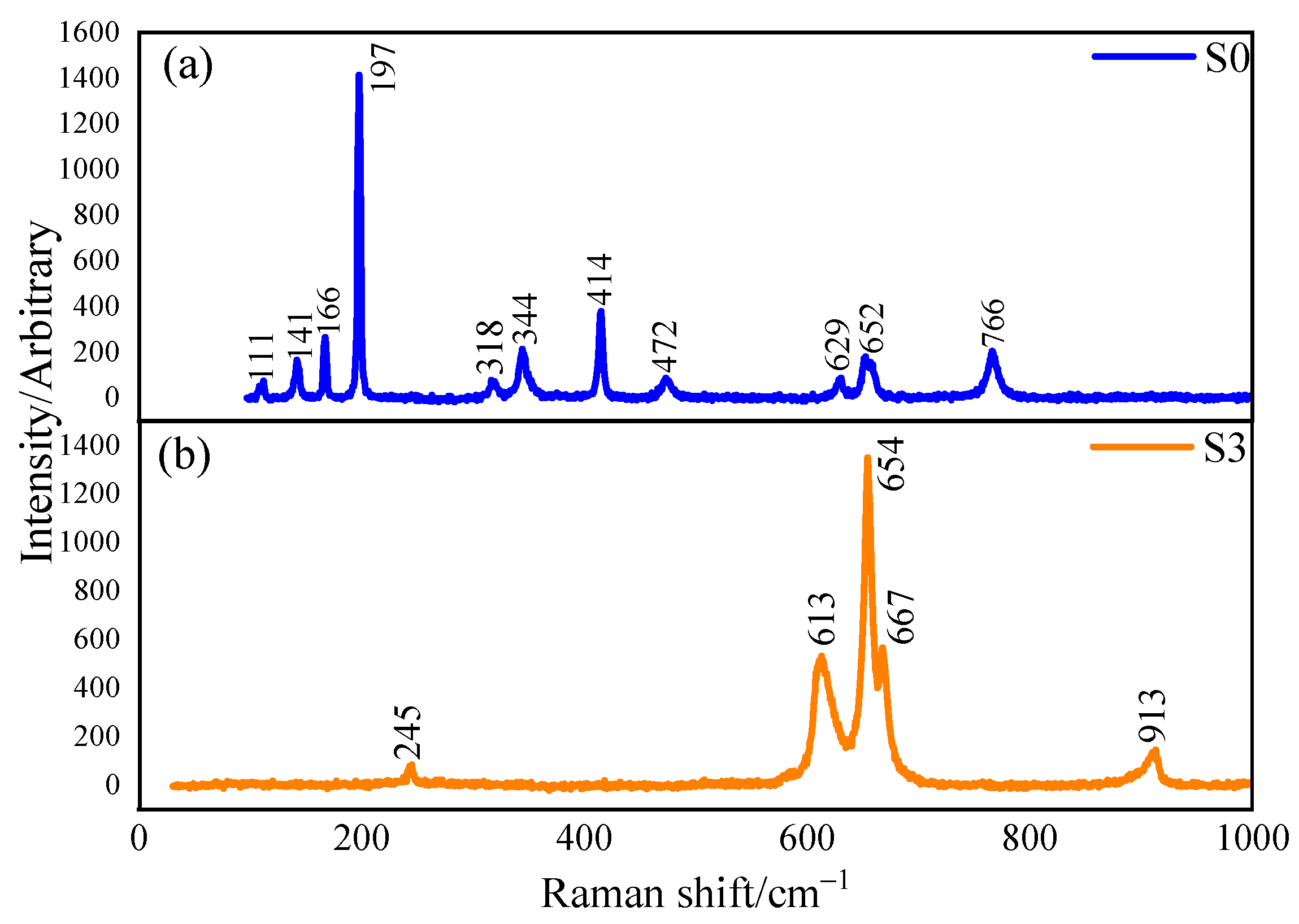
Figure 1. Raman spectra of S0 (a) and S3 (b).
Coatings 15 01312 g001
Figure 2. (a) Light absorption spectra for different AlN thicknesses (the inset shows the relationship between hν and (αhν)2). (b) Transmittance spectra for different AlN thicknesses (the inset shows the relationship between AlN thickness and the bandgap).
Coatings 15 01312 g002
Figure 3. (a) I-V curves in the dark and under 254 nm light illumination; (b) comparison diagrams of 254 nm photocurrent, 365 nm photocurrent, and dark current of β-Ga2O3 MISIM and MSM-type solar-blind photodetectors at 10 V.
Coatings 15 01312 g003
Figure 4. (a) Cross-sectional schematic diagram of β-Ga2O3 metal–semiconductor–metal (MSM) photodetectors (SBPDs). (b) Cross-sectional schematic diagram of metal–insulator–semiconductor–insulator–metal (MISIM) (right) solar-blind photodetectors (SBPDs). (c) I-T response curves at different AlN thicknesses and different bias voltages.
Coatings 15 01312 g004
Figure 5. I-T response curves and transient response fitting curves: (a) 0 nm, (b) 5 nm, (c) 10 nm. (d) Relationship between response time and AlN thickness.
Coatings 15 01312 g005
Figure 6. Responsivity, external quantum efficiency, and detectivity of different devices. (a) Responsivity, PDCR. (b) External quantum efficiency, detectivity.
Coatings 15 01312 g006
Figure 7. (a,b) I-T response curves under different optical power densities: (a) S0, (b) S2. (c,d) Relationships between photocurrent and optical power density: (c) S0, (d) S2.
Coatings 15 01312 g007
Figure 8. Schematic diagrams of Mg-β-Ga2O3 photodetectors (PDs): energy band diagrams of the reverse-biased electrode region in the dark/deep ultraviolet (DUV) illumination, where (a,c) are the cases without the AlN passivation layer and (b,d) are the cases with the AlN passivation layer; schematic diagrams of adsorption and desorption in the dark/deep ultraviolet, where (e,g) are the cases without the AlN passivation layer and (f,h) are the cases with the AlN passivation layer.
Coatings 15 01312 g008
Table 1. Comparison of the main performance indicators of Ga2O3 thin-film-based photodetectors at home and abroad.
MaterialTypeR(A/W)EQED* (Jones)PDCRRef.
β-Ga2O3MSM0.743.603%0.34 × 1011103[45]
β-Ga2O3MSM1.48727%340[46]
β-Ga2O3MISIM4.124000%[47]
Al2O3-β-Ga2O3MISIM83.31.35 × 1015[20]
HfO2-β-Ga2O3MIS1.2600%2.39 × 10121.2 × 103[22]
Si-β-Ga2O3MSM52500%9[48]
Cu-β-Ga2O3MSM1.73841%5.56 × 1012372[49]
Mg-β-Ga2O3MSM0.14338[50]
Mg-β-Ga2O3MSM1.3750%0.4 × 1012800This work
Mg-β-Ga2O3MISIM2.171100%1.09 × 10122200This work
Disclaimer/Publisher’s Note: The statements, opinions and data contained in all publications are solely those of the individual author(s) and contributor(s) and not of MDPI and/or the editor(s). MDPI and/or the editor(s) disclaim responsibility for any injury to people or property resulting from any ideas, methods, instructions or products referred to in the content.