

Guava Leaf Extract as a Sustainable Preservative Alternative in Semi-Solid Pharmaceuticals: Efficacy and Stability Assessment

 ,
,  ,
,  ,
,  and
and 
Abstract
1. Introduction
2. Results
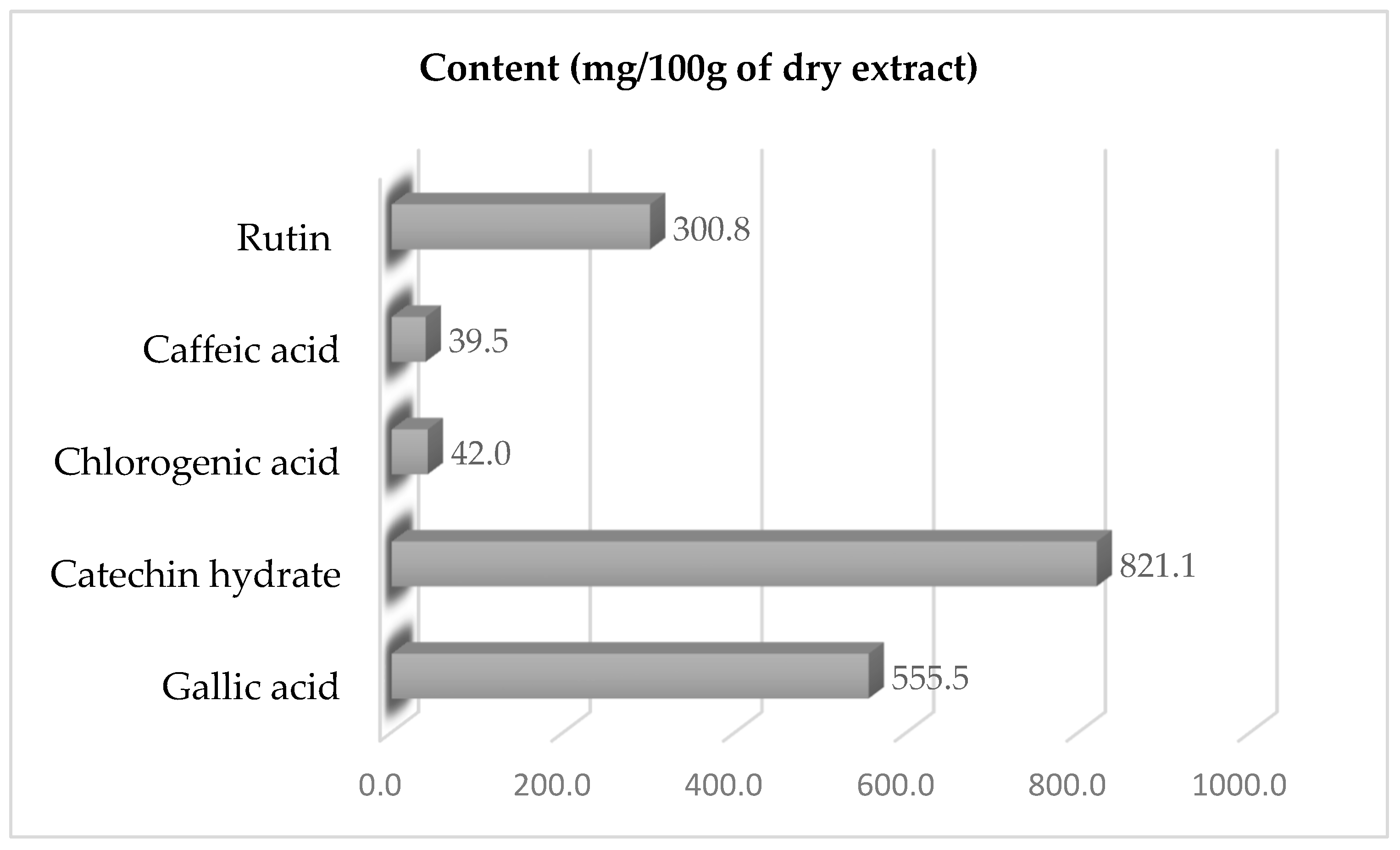
2.1. Chemical Characterization of Psidium guajava (L.) Extract
2.2. Antimicrobial Efficacy Test of 10% P. guajava (L.) Leaf Extract Powder in Five Semi-Solid Pharmaceutical Preparations
2.3. Pharmaceutical Preparations with Natural Preservative (10% P. guajava Leaf Extract) in Comparison to Pharmaceutical Preparations with Chemical Preservatives (Methyl and Propyl Paraben)
2.4. Stability Test of Pharmaceutical Preparations
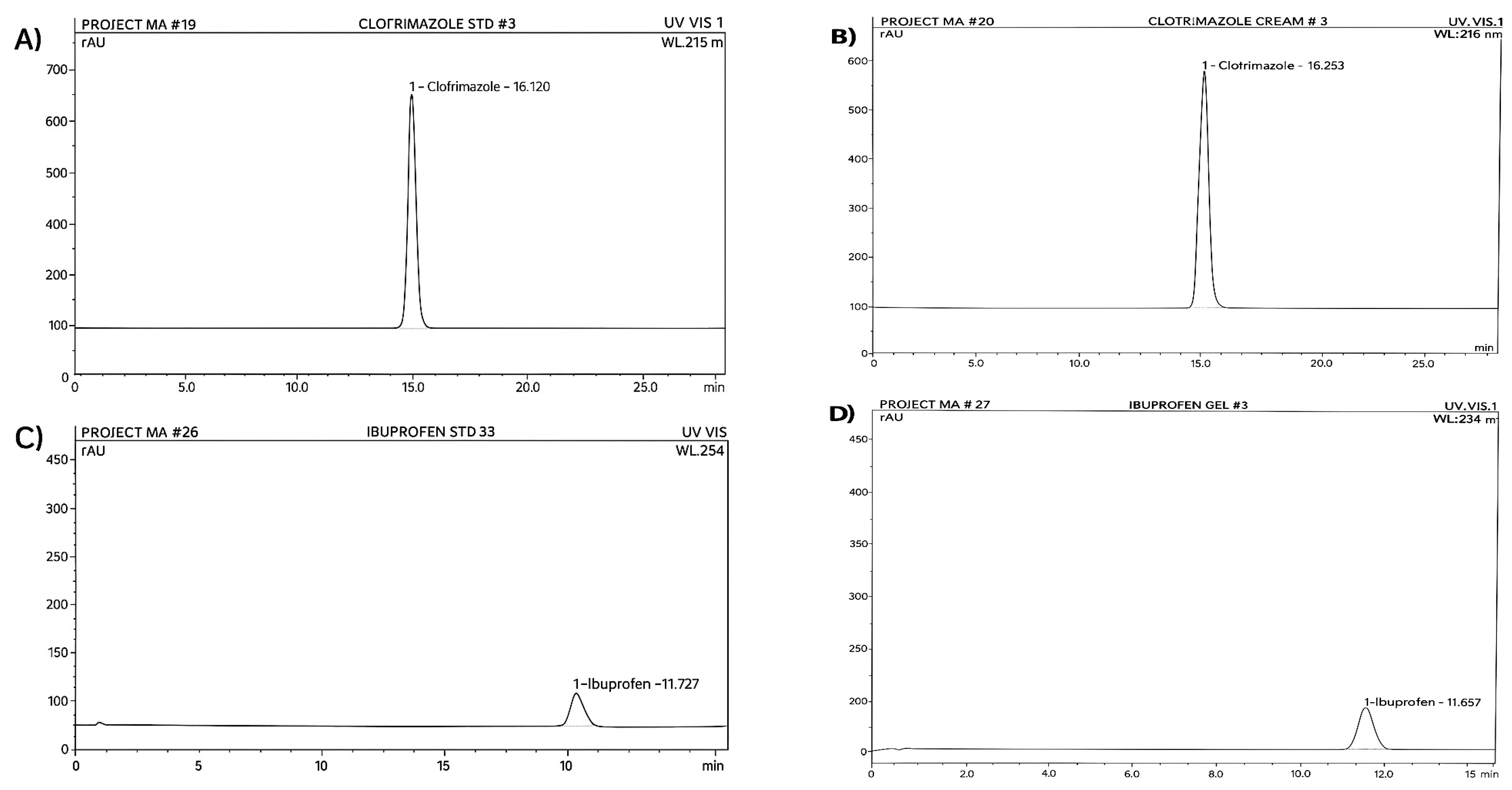
2.4.1. Characterization of Ibuprofen Gel, Clotrimazole Cream, and Permethrin Cream by HPLC
2.4.2. Chemical Stability Test of Pharmaceutical Preparations
2.5. Microbial Stability of Pharmaceutical Preparations
2.5.1. Direct Transfer (Broth Media) for Clotrimazole Cream and Ibuprofen Emulgel
2.5.2. Microbial Limit Test—Total Count for Clotrimazole Cream and Ibuprofen Emulgel
3. Discussion
4. Materials and Methods
4.1. The Collection of Psidium guajava Leaves and Extraction
4.2. Chemical Characterizations of Psidium guajava (L.) Leaf Extract Using High-Performance Liquid Chromatography (HPLC)
4.3. Preparation of Semi-Solid Dosage Forms Containing Psidium guajava (L.) Leaf Extract
4.3.1. Preparation of Ibuprofen Gel
4.3.2. Preparation of Clotrimazole Cream
4.3.3. Preparation of Permethrin Cream
4.3.4. Preparation of Gentamicin Cream
4.3.5. Preparation of Indomethacin Emulgel
4.4. Chemical and Physical Analytical Tests
4.4.1. Test for Ibuprofen Gel, Clotrimazole Cream and Permethrin Cream
4.4.2. Test for Gentamicin Cream
4.4.3. Chemical Stability Testing of Pharmaceutical Preparations
4.5. Testing the Effectiveness of Antimicrobial Preservative (Protection)
4.5.1. Tested Microorganisms
4.5.2. Evaluation of the Effectiveness of Preservation of Prepared Formulas
4.5.3. Antimicrobial Effectiveness Test
- A ≥ 2.0 log10 decrease in the bacterial count by Day 14.
- No increase in the bacterial count after Day 14.
- No increase in the fungal count (yeasts and molds) from the initial inoculum during the test period
4.5.4. Aerobic Microbial Count (AMC) and Total Yeast and Mold Count (TYMC)
4.5.5. Acceptance Criteria for Finished Products
4.6. Stability Test
- -
- Chemical analysis of the content of active ingredients (by HPLC);
- -
- Physical attributes, such as color, texture, and smell, and measurement of pH;
- -
- Using microbiological limit tests and preservative challenges, antimicrobial efficacy.
5. Conclusions
Supplementary Materials
Author Contributions
Funding
Institutional Review Board Statement
Informed Consent Statement
Data Availability Statement
Acknowledgments
Conflicts of Interest
Abbreviations
| RH | Relative humidity |
| HPLC | High-performance liquid chromatography |
| ATCC | American Type Culture Collection |
| O.D. | Optical density |
| CFUs | Colony-forming units |
| SCDM Digest Medium | Soyabean Casein |
| CDSLP | Casein digest–soy lecithin polysorbate |
| FLM | Fluid Lactose Medium |
| SCDA | Soyabean Casein Digest Agar |
References
- Yadav, P.; Taleuzzaman, M.; Kumar, P. Simultaneous estimation of aspirin, atorvastatin calcium and clopidogrel bisulphate in a combined dosage form by RP-HPLC. AJOCS 2019, 6, 1–10. [Google Scholar] [CrossRef]
- Peate, I. The skin: Largest organ of the body. Br. J. Healthc. Assist. 2021, 15, 446–451. [Google Scholar] [CrossRef]
- Gilaberte, Y.; Prieto-Torres, L.; Pastushenko, I.; Juarranz, Á. Anatomy and function of the skin. In Nanoscience in Dermatology; Hamblin, M.R., Avci, P., Prow, T.W., Eds.; Academic Press: Boston, MA, USA, 2016; pp. 1–14. ISBN 978-0-12-802926-8. [Google Scholar]
- Kanitakis, J. Anatomy, histology and immunohistochemistry of normal human skin. Eur. J. Dermatol. 2002, 12, 390–401. [Google Scholar]
- Celleno, L.; Tamburi, F. Structure and function of the skin. In Nutritional Cosmetics: Beauty from Within; Tabor, A., Blair, R.M., Eds.; William Andrew Publishing: Boston, MA, USA, 2009; pp. 3–45. ISBN 978-0-8155-2029-0. [Google Scholar]
- Cao, C.; Xiao, Z.; Wu, Y.; Ge, C. Diet and skin aging—From the perspective of food nutrition. Nutrients 2020, 12, 870. [Google Scholar] [CrossRef] [PubMed]
- Schittek, B.; Paulmann, M.; Senyurek, I.; Steffen, H. The role of antimicrobial peptides in human skin and in skin infectious diseases. Infect. Disord. Drug Targets 2008, 8, 135–143. [Google Scholar] [CrossRef]
- Cogen, A.L.; Nizet, V.; Gallo, R.L. Skin microbiota: A source of disease or defence? Br. J. Dermatol. 2008, 158, 442–455. [Google Scholar] [CrossRef]
- Scheinfeld, N. Topical treatments of skin pain: A general review with a focus on hidradenitis suppurativa with topical agents. Dermatol. Online J. 2014, 20. [Google Scholar] [CrossRef]
- Elder, D.P.; Kuentz, M.; Holm, R. Pharmaceutical excipients—Quality, regulatory and biopharmaceutical considerations. Eur. J. Pharm. Sci. 2016, 87, 88–99. [Google Scholar] [CrossRef]
- Kerdudo, A.; Burger, P.; Merck, F.; Dingas, A.; Rolland, Y.; Michel, T.; Fernandez, X. Development of a natural ingredient—Natural preservative: A case study. C. R. Chim. 2016, 19, 1077–1089. [Google Scholar] [CrossRef]
- Prickett, P.S.; Kunze, F.M.; Laug, E.P. Potentiation of preservatives (parabens) in pharmaceutical formulations by low concentrations of propylene glycol. J. Pharm. Sci. 1961, 50, 316–320. [Google Scholar] [CrossRef] [PubMed]
- Nowak, K.; Ratajczak–Wrona, W.; Górska, M.; Jabłońska, E. Parabens and their effects on the endocrine system. Mol. Cell. Endocrinol. 2018, 474, 238–251. [Google Scholar] [CrossRef]
- Mitra, P.; Chatterjee, S.; Paul, N.; Ghosh, S.; Das, M. An overview of endocrine disrupting chemical paraben and search for an alternative—A review. Proc. Zool. Soc. 2021, 74, 479–493. [Google Scholar] [CrossRef]
- Anand, S.P.; Sati, N. Artificial preservatives and their harmful effects: Looking toward nature for safer alternatives. Int. J. Pharm. Sci. Res. 2013, 4, 2496–2501. [Google Scholar]
- Voon, H.C.; Bhat, R.; Rusul, G. Flower extracts and their essential oils as potential antimicrobial agents for food uses and pharmaceutical applications. Compr. Rev. Food Sci. Food Saf. 2012, 11, 34–55. [Google Scholar] [CrossRef]
- Al-Rimawi, F.; Sbeih, M.; Amayreh, M.; Rahhal, B.; Mudalal, S. Evaluation of the antibacterial and antifungal properties of oleuropein, olea Europea leaf extract, and thymus vulgaris oil. BMC Complement. Med. Ther. 2024, 24, 297. [Google Scholar] [CrossRef]
- Rishika, D.; Sharma, R. An update of pharmacological activity of Psidium guajava in the management of various disorders. World J. Pharm. Res. 2012, 3, 3577. [Google Scholar]
- Lahlou, J.; Amraoui, B.E.; El-Wahidi, M.; Bamhaoud, T. Chemical composition, antioxidant and antimicrobial activities of Moroccan species of Psidium guajava extracts. Rocz. Panstw. Zakl. Hig. 2022, 73, 65–77. [Google Scholar] [CrossRef]
- Nguyen, Q.-V.; Thi, B.H.; Tran, M.-Đ.; Nguyen, M.-T.; Doan, M.-D.; Nguyen, A.-D.; Le, T.M.; Tran, V.-C.; Pham, T.-N. Impact of different drying temperatures on in vitro antioxidant and antidiabetic activities and phenolic compounds of wild guava leaves collected in the central highland of Vietnam. Nat. Prod. Commun. 2022, 17, 1934578X221095349. [Google Scholar] [CrossRef]
- Dhiman, A.; Nanda, A.; Ahmad, S.; Narasimhan, B. In vitro antimicrobial activity of methanolic leaf extract of Psidium guajava L. J. Pharm. Bioallied Sci. 2011, 3, 226–229. [Google Scholar] [CrossRef]
- Biswas, B.; Rogers, K.; McLaughlin, F.; Daniels, D.; Yadav, A. Antimicrobial activities of leaf extracts of guava (Psidium guajava L.) on two gram-negative and gram-positive bacteria. Int. J. Microbiol. 2013, 2013, 746165. [Google Scholar] [CrossRef]
- Melo, C.; Cornejal, N.; Cruz, V.; Alsaidi, S.; Rodriguez, G.C.; Ramirez, A.G.; Sorel, V.; Bonnaire, T.; Zydowsky, T.M.; Priano, C.; et al. Antioxidant capacity and antimicrobial activity of commercial samples of guava leaves (Psidium guajava). J. Med. Act. Plants 2020, 9, 2. [Google Scholar] [CrossRef]
- Umar, M.; Tomar, M.; Amarowicz, R.; Saurabh, V.; Nair, M.S.; Maheshwari, C.; Sasi, M.; Prajapati, U.; Hasan, M.; Singh, S.; et al. Guava (Psidium guajava L.) leaves: Nutritional composition, phytochemical profile, and health-promoting bioactivities. Foods 2021, 10, 752. [Google Scholar] [CrossRef]
- Herman, A.; Herman, A.P.; Domagalska, B.W.; Młynarczyk, A. Essential Oils and Herbal Extracts as Antimicrobial Agents in Cosmetic Emulsion. Indian J. Microbiol. 2013, 53, 232–237. [Google Scholar] [CrossRef]
- Haque, M.; Singh, A.K.; Maurya, S.K.; Seth, A. Formulation development, physico-chemical characterization and evaluation of anti-microbial activity of herbal tooth gel. Int. J. Pharm. Sci. Rev. Res. 2014, 25, 177–181. [Google Scholar]
- Al-Rimawi, F.; Sbeih, M.; Amayreh, M.; Rahhal, B.; Mudalal, S. Evaluation of the effectiveness of natural extract as a substituent for synthetic preservatives and antioxidants in pharmaceutical preparations. Saudi Pharm. J. 2024, 32, 102014. [Google Scholar] [CrossRef]
- Davidova, S.; Galabov, A.S.; Satchanska, G. Antibacterial, antifungal, antiviral activity, and mechanisms of action of plant polyphenols. Microorganisms 2024, 12, 2502. [Google Scholar] [CrossRef] [PubMed]
- Huynh, H.D.; Nargotra, P.; Wang, H.-M.D.; Shieh, C.-J.; Liu, Y.-C.; Kuo, C.-H. Bioactive compounds from guava leaves (Psidium guajava L.): Characterization, biological activity, synergistic effects, and technological applications. Molecules 2025, 30, 1278. [Google Scholar] [CrossRef]
- Lozoya, X.; Reyes-Morales, H.; Chávez-Soto, M.A.; Martínez-García, M.D.C.; Soto-González, Y.; Doubova, S.V. Intestinal anti-spasmodic effect of a phytodrug of Psidium guajava folia in the treatment of acute diarrheic disease. J. Ethnopharmacol. 2002, 83, 19–24. [Google Scholar] [CrossRef] [PubMed]
- Silva, E.A.J.; Estevam, E.B.B.; Silva, T.S.; Nicolella, H.D.; Furtado, R.A.; Alves, C.C.F.; Souchie, E.L.; Martins, C.H.G.; Tavares, D.C.; Barbosa, L.C.A.; et al. Antibacterial and antiproliferative activities of the fresh leaf essential oil of Psidium guajava L. (Myrtaceae). Braz. J. Biol. 2019, 79, 697–702. [Google Scholar] [CrossRef] [PubMed]
- Weli, A.; Al-Kaabi, A.; Al-Sabahi, J.; Said, S.; Hossai, A.; Al-Riyami, S. Chemical composition and biological activities of the essential oils of Psidium guajava leaf. J. King Saud Univ. Sci. 2019, 31, 993–998. [Google Scholar] [CrossRef]
- Kashyap, A.; Das, A.; Ahmed, A.B. Formulation and evaluation of transdermal topical gel of ibuprofen. J. Drug Deliv. Ther. 2020, 10, 20–25. [Google Scholar] [CrossRef]
- Shahin, M.; Hady, S.A.; Hammad, M.; Mortada, N. Novel jojoba oil-based emulsion gel formulations for clotrimazole delivery. AAPS PharmSciTech 2011, 12, 239–247. [Google Scholar] [CrossRef] [PubMed]
- Pick, J.; Olson, L.L.; Ellis, W.Y.; Lim, P. Development and validation of a method to extract and quantitate paromomycin and gentamicin from an Aquaphilic® cream formulation. J. Pharm. Biomed. Anal. 1997, 16, 131–137. [Google Scholar] [CrossRef] [PubMed]
- United States Pharmacopeia (USP). Chapter <51>: Antimicrobial Effectiveness Testing. In USP 43–NF 38; United States Pharmacopeial Convention: Rockville, MD, USA, 2020. [Google Scholar]
- Kaleemullah, M.K.J.M.; Jiyauddin, K.; Gerard, T.M.; Samer, A.D.; Jawad, A.; Budiasih, S.; Rasha, S.; Fadli, A.; Eddy, Y. The effect of various vehicles on in-vivo performance of indomethacin from different topical formulations. World J. Pharm. Res. 2015, 4, 157–172. [Google Scholar]
- Rasool, B.K.A.; Abu-Gharbieh, E.; Fahmy, S.; Saad, H.; Khan, S. Development and evaluation of ibuprofen transdermal gel formulations. Trop. J. Pharm. Res. 2010, 9, 355–363. [Google Scholar] [CrossRef]
- Solich, P.; Hájková, R.; Pospíšilová, M.; Šícha, J. Determination of methylparaben, propylparaben, clotrimazole and its degradation products in topical cream by RP-HPLC. Chromatographia 2002, 56, S181–S184. [Google Scholar] [CrossRef]
- Amin, M.A.; El-Degwy, M.A.; Fayed, B.A. Determination of permethrin in pharmaceutical product by gas chromatography. IOSR-J. Pharm. Biol. Sci. 2017, 12, 42–45. [Google Scholar]
- Kartini, K.; Fitriani, E.W.; Tansridjata, L. Formulation and physical stability test of oleanolic acid cream and gel. Pharmaciana 2018, 8, 77–86. [Google Scholar] [CrossRef]
- Kamysz, W.; Turecka, K. Antimicrobial preservative effectiveness of natural peptide antibiotics. Postep. Mikrobiol. 2005, 62, 341–344. [Google Scholar]
- Sahoury, Y.; Naseef, H.; Farraj, M.; Qurt, M.; El-Khaury, L. Antimicrobial activity of oleuropine and thyme extracts against selected pathogenic microorganisms and their potential uses as natural preservatives. Int. J. Pharm. Res. 2020, 13. [Google Scholar] [CrossRef]
- Zakeri, S.E.; Hadjiakhoondi, A.; Nasrollahi, S.A.; Vazirian, M.; Naeimifar, A. Formulation and physicochemical evaluation of a 3% cream using crude 70% ethanolic extract of Morus alba L. leaves for skin hyperpigmentation. Jundishapur J. Nat. Pharm. Prod. 2022, 17, e115266. [Google Scholar] [CrossRef]



| Microorganism 106 CFU/mL | ATCC No. | Day | Tested Product with 10% Extract | Control |
|---|---|---|---|---|
| S. aureus | 6538 | 0 | 4.70 | 6.78 |
| 7 | 3.53 | >9 | ||
| 14 | <1 | >9 | ||
| 28 | <1 | 7.87 | ||
| P. aeruginosa | 9027 | 0 | 6.06 | 7.32 |
| 7 | 3.77 | >9 | ||
| 14 | <1 | >9 | ||
| 28 | <1 | >9 | ||
| E. coli | 8739 | 0 | 7.45 | 7.32 |
| 7 | 5.04 | >9 | ||
| 14 | 4.04 | >9 | ||
| 28 | 2.98 | >9 | ||
| Candida albicans | 10231 | 0 | 4.69 | 4.08 |
| 7 | <1 | 3.67 | ||
| 14 | <1 | 6.95 | ||
| 28 | <1 | 8.68 | ||
| A. brasiliensis | 16404 | 0 | 4.67 | 4.84 |
| 7 | 4.73 | 6.83 | ||
| 14 | <1 | <1 | ||
| 28 | <1 | <1 |
| Microorganism 106 CFU/mL | ATCC No. | Day | Tested Product with 10% Extract | Control |
|---|---|---|---|---|
| S. aureus | 6538 | 0 | 7.05 | 6.83 |
| 7 | <1 | >9 | ||
| 14 | <1 | >9 | ||
| 28 | <1 | 7.04 | ||
| P. aeruginosa | 9027 | 0 | 5.74 | 6.63 |
| 7 | 4.32 | >9 | ||
| 14 | <1 | >9 | ||
| 28 | <1 | 8.04 | ||
| E. coli | 8739 | 0 | 6.4 | 6.79 |
| 7 | 3.85 | >9 | ||
| 14 | <1 | >9 | ||
| 28 | <1 | >9 | ||
| Candida albicans | 10231 | 0 | 7.12 | 5.09 |
| 7 | 7.11 | 6.83 | ||
| 14 | 6.83 | 6.9 | ||
| 28 | 6.04 | 6.57 | ||
| A. brasiliensis | 16404 | 0 | 5.05 | 5.2 |
| 7 | 5 | 4.92 | ||
| 14 | 4.99 | 4.56 | ||
| 28 | 4.51 | 5 |
| Microorganism 106 CFU/mL | ATCC No. | Day | Tested Product with 10% Extract | Control |
|---|---|---|---|---|
| S. aureus | 6538 | 0 | 6.25 | 7.81 |
| 7 | <1 | >8 | ||
| 14 | <1 | >8 | ||
| 28 | <1 | >8 | ||
| P. aeruginosa | 9027 | 0 | 5 | 6.9 |
| 7 | <1 | >8 | ||
| 14 | <1 | >8 | ||
| 28 | <1 | >9 | ||
| E. coli | 8739 | 0 | 4 | 7.39 |
| 7 | <1 | >9 | ||
| 14 | <1 | >9 | ||
| 28 | <1 | >9 | ||
| Candida albicans | 10231 | 0 | 7.71 | 5.56 |
| 7 | 7.68 | 6.11 | ||
| 14 | 7.47 | 6.9 | ||
| 28 | 7.02 | 6.53 | ||
| A. brasiliensis | 16404 | 0 | 6.04 | 6.17 |
| 7 | 6 | 6.39 | ||
| 14 | 5.99 | 6.15 | ||
| 28 | 5.81 | 5.95 |
| Microorganism 106 CFU/mL | ATCC No. | Day | Tested Product with 10% Extract | Control |
|---|---|---|---|---|
| S. aureus | 6538 | 0 | 4.47 | >9 |
| 7 | 3.98 | >9 | ||
| 14 | <1 | >9 | ||
| 28 | <1 | >9 | ||
| P. aeruginosa | 9027 | 0 | 3.56 | 6.78 |
| 7 | 2.68 | >9 | ||
| 14 | <1 | >9 | ||
| 28 | <1 | >9 | ||
| E. coli | 8739 | 0 | 3.05 | 6.79 |
| 7 | <1 | >9 | ||
| 14 | <1 | >9 | ||
| 28 | <1 | >9 | ||
| Candida albicans | 10231 | 0 | 4.74 | 5.56 |
| 7 | 5.49 | 6.3 | ||
| 14 | 4.9 | 6.81 | ||
| 28 | 4.4 | 6.53 | ||
| A. brasiliensis | 16404 | 0 | 7.9 | 5 |
| 7 | 6.76 | 6 | ||
| 14 | 6.65 | 6 | ||
| 28 | 6.08 | 6.32 |
| Microorganism 106 CFU/mL | No. | Day | Tested Product with 10% Extract | Control |
|---|---|---|---|---|
| S. aureus | 6538 | 0 | 7 | >8 |
| 7 | <1 | 8.31 | ||
| 14 | <1 | 7.91 | ||
| 28 | <1 | 7.88 | ||
| P. aeruginosa | 9027 | 0 | 6.99 | 7.15 |
| 7 | 5.47 | >9 | ||
| 14 | 5.04 | >9 | ||
| 28 | 3.81 | >9 | ||
| E. coli | 8739 | 0 | 6.30 | 6.79 |
| 7 | <1 | >9 | ||
| 14 | <1 | >9 | ||
| 28 | <1 | >9 | ||
| Candida albicans | 10231 | 0 | 5.85 | 6.54 |
| 7 | 5.12 | 6.8 | ||
| 14 | 5.1 | 7.17 | ||
| 28 | 5.05 | 7.12 | ||
| A. brasiliensis | 16404 | 0 | 6.05 | 6.54 |
| 7 | 6.11 | 6.04 | ||
| 14 | 6.07 | 7.08 | ||
| 28 | 5.94 | 7.98 |
| Microorganism 106 CFU/mL | ATCC No. | Day | With 10% Extract as a Preservative | Positive Control (Chemical Preservative) % | Negative Control (Without Preservative) | Control Dilution |
|---|---|---|---|---|---|---|
| S. aureus | 6538 | 0 | 5.7 | >4 | 6.77 | >9 |
| 7 | 2.44 | <1 | 7.99 | >9 | ||
| 14 | <1 | <1 | 7.56 | >9 | ||
| 28 | <1 | <1 | >9 | >9 | ||
| P. aeruginosa | 9027 | 0 | 6.2 | >4 | 6.77 | >9 |
| 7 | 3.77 | <1 | >9 | >9 | ||
| 14 | <1 | <1 | 7.93 | >9 | ||
| 28 | <1 | <1 | 7.6 | >9 | ||
| E. coli | 8739 | 0 | 6.45 | >4 | 7.04 | >9 |
| 7 | 5.9 | <1 | 7.97 | >9 | ||
| 14 | 3.78 | <1 | 7.93 | >9 | ||
| 28 | 2.98 | <1 | 7.95 | 7.67 | ||
| Candida albicans | 10231 | 0 | >4 | >4 | 5.77 | 5.3 |
| 7 | <1 | <1 | 5.3 | 5.7 | ||
| 14 | <1 | <1 | 3.05 | 6.1 | ||
| 28 | <1 | <1 | 2.34 | 7.67 | ||
| A. brasiliensis | 16404 | 0 | >4 | >4 | >4 | 5.3 |
| 7 | 3.81 | <1 | >4 | 5.7 | ||
| 14 | <1 | <1 | 3.05 | 6.1 | ||
| 28 | <1 | <1 | 2.34 | 7.67 |
| Microorganism 106 CFU/mL | No. | Day | With 10% Extract as a Preservative | Positive Control (Chemical Preservative) % | Negative Control (Without Preservative) | Control Dilution |
|---|---|---|---|---|---|---|
| S. aureus | 6538 | 0 | >4 | >4 | 7.16 | 5.7 |
| 7 | <1 | <1 | 7.51 | 7.31 | ||
| 14 | <1 | <1 | 6.39 | 6.91 | ||
| 28 | <1 | <1 | 6.08 | 3.88 | ||
| P. aeruginosa | 9027 | 0 | 6.99 | >4 | 6.78 | >9 |
| 7 | 3.78 | <1 | 7.99 | >9 | ||
| 14 | <1 | <1 | 7.79 | >9 | ||
| 28 | <1 | <1 | 7.41 | >9 | ||
| E. coli | 8739 | 0 | >4 | >4 | 7.04 | >9 |
| 7 | <1 | <1 | 7.65 | >9 | ||
| 14 | <1 | <1 | 7.92 | 7.91 | ||
| 28 | <1 | <1 | 7.04 | 7.87 | ||
| Candida albicans | 10231 | 0 | 6.25 | >4 | 5.78 | 4 |
| 7 | 6.04 | <1 | 7.27 | 2.8 | ||
| 14 | 5.95 | <1 | 7.39 | 3.18 | ||
| 28 | 4 | <1 | 7.19 | 3.12 | ||
| A. brasiliensis | 16404 | 0 | 6.51 | >4 | 6.21 | 5.47 |
| 7 | 6.34 | 2.94 | 7.04 | 6.04 | ||
| 14 | 6.28 | <1 | 7.71 | 7.07 | ||
| 28 | 6.15 | <1 | 7.79 | 7.97 |
| Time | Physical Appearance | Odor | PH | Assay of Clotrimazole |
|---|---|---|---|---|
| Zero time | Beige, thick homogeneous cream | Odorless | 6.1 | 99.9% |
| First month | Beige, thick homogeneous cream | Odorless | 6.0 | 97.5% |
| Second month | Beige, thick homogeneous cream | Odorless | 6.0 | 96% |
| Third month | Beige, thick homogeneous cream | Odorless | 6.0 | 95% |
| Time | Physical Appearance | Odor | PH | Assay of Ibuprofen |
|---|---|---|---|---|
| Zero time | Brown (oily), thick consistency Emulgel, no crystals appear | Isopropyl alcohol odor | 4.5 | 97.5% |
| First month | Brown (oily), thick consistency Emulgel, no crystals appear | Isopropyl alcohol odor | 4.4 | 95.5% |
| Second month | Brown (oily), thick consistency Emulgel, no crystals appear | Isopropyl alcohol odor | 4.4 | 94% |
| Third month | Brown (oily), thick consistency Emulgel, no crystals appear | Isopropyl alcohol odor | 4.4 | 92% |
| Time | Direct Transfer (Broth Media) | With 10% P. guajava Leaf Extract as a Natural Preservative | Positive Control with Chemical Preservative (Methyl and Propyl Paraben | Negative Control (Without Preservative) |
|---|---|---|---|---|
| Zero time | Tryptic soy broth | Clear | Clear | Turbid |
| Sabouraud dextrose broth | Clear | Clear | Clear | |
| First month | Tryptic soy broth | Clear | Clear | Turbid |
| Sabouraud dextrose broth | Clear | Clear | Clear | |
| Second month | Tryptic soy broth | Clear | Clear | Turbid |
| Sabouraud dextrose broth | Clear | Clear | Clear | |
| Third month | Tryptic soy broth | Clear | Clear | Turbid |
| Sabouraud dextrose broth | Clear | Clear | Clear |
| Time | Direct Transfer (Broth Media) | With 10 % P. guajava Leaf Extract as a Natural Preservative | Positive Control with Chemical Preservative (Methyl and Propyl Paraben | Negative Control (Without Preservative) |
|---|---|---|---|---|
| Zero time | Tryptic soy broth | Clear | Clear | Turbid |
| Sabouraud dextrose broth | Clear | Clear | Turbid | |
| First month | Tryptic soy broth | Clear | Clear | Turbid |
| Sabouraud dextrose broth | Clear | Clear | Turbid | |
| Second month | Tryptic soy broth | Clear | Clear | Turbid |
| Sabouraud dextrose broth | Clear | Clear | Turbid | |
| Third month | Tryptic soy broth | Clear | Clear | Turbid |
| Sabouraud dextrose broth | Clear | Clear | Turbid |
| Time | Total Count | With 10 % P. guajava Leaf Extract as a Natural Preservative | Positive Control with Chemical Preservative (Methyl and Propyl Paraben | Negative Control (Without Preservative) |
|---|---|---|---|---|
| Zero time | Tryptic soy agar | <10 | <10 | <30 |
| Sabouraud dextrose agar | <10 | <10 | <10 | |
| First month | Tryptic soy agar | <10 | <10 | <30 |
| Sabouraud dextrose agar | <10 | <10 | <10 | |
| Second month | Tryptic soy agar | <10 | <10 | <30 |
| Sabouraud dextrose agar | <10 | <10 | <10 | |
| Third month | Tryptic soy agar | <10 | <10 | <180 |
| Sabouraud dextrose agar | <10 | <10 | <10 |
| Time | Total Count | With 10 % P. guajava Leaf Extract as a Natural Preservative | Positive Control with Chemical Preservative (Methyl and Propyl Paraben | Negative Control (Without Preservative) |
|---|---|---|---|---|
| Zero time | Tryptic soy agar | <10 | <10 | <100 |
| Sabouraud dextrose agar | <10 | <10 | <20 | |
| First month | Tryptic soy agar | <10 | <10 | <100 |
| Sabouraud dextrose agar | <10 | <10 | <20 | |
| Second month | Tryptic soy agar | <10 | <10 | <110 |
| Sabouraud dextrose agar | <10 | <10 | <20 | |
| Third month | Tryptic soy agar | <10 | <10 | <220 |
| Sabouraud dextrose agar | <10 | <10 | <20 |
Disclaimer/Publisher’s Note: The statements, opinions and data contained in all publications are solely those of the individual author(s) and contributor(s) and not of MDPI and/or the editor(s). MDPI and/or the editor(s) disclaim responsibility for any injury to people or property resulting from any ideas, methods, instructions or products referred to in the content. |
© 2025 by the authors. Licensee MDPI, Basel, Switzerland. This article is an open access article distributed under the terms and conditions of the Creative Commons Attribution (CC BY) license (https://creativecommons.org/licenses/by/4.0/).
Share and Cite
Imtara, H.; Atiya, M.; Hanania, M.; Abbadi, J.; Mudalal, S.; Al-Rimawi, F. Guava Leaf Extract as a Sustainable Preservative Alternative in Semi-Solid Pharmaceuticals: Efficacy and Stability Assessment. Antibiotics 2025, 14, 1176. https://doi.org/10.3390/antibiotics14121176
Imtara H, Atiya M, Hanania M, Abbadi J, Mudalal S, Al-Rimawi F. Guava Leaf Extract as a Sustainable Preservative Alternative in Semi-Solid Pharmaceuticals: Efficacy and Stability Assessment. Antibiotics. 2025; 14(12):1176. https://doi.org/10.3390/antibiotics14121176
Chicago/Turabian StyleImtara, Hamada, Mohammad Atiya, Michel Hanania, Jehad Abbadi, Samer Mudalal, and Fuad Al-Rimawi. 2025. "Guava Leaf Extract as a Sustainable Preservative Alternative in Semi-Solid Pharmaceuticals: Efficacy and Stability Assessment" Antibiotics 14, no. 12: 1176. https://doi.org/10.3390/antibiotics14121176
APA StyleImtara, H., Atiya, M., Hanania, M., Abbadi, J., Mudalal, S., & Al-Rimawi, F. (2025). Guava Leaf Extract as a Sustainable Preservative Alternative in Semi-Solid Pharmaceuticals: Efficacy and Stability Assessment. Antibiotics, 14(12), 1176. https://doi.org/10.3390/antibiotics14121176