Article

Analysis of Random Lasing in Human Blood


by
Sergio de Armas-Rillo
1,*,
Beatriz Abdul-Jalbar
2,
Josmar Salas-Hernández
3,
Jose María Raya-Sánchez
4,
Tomás González-Hernández
3 and
Fernando Lahoz
1,*
1
Departamento de Física, Instituto Universitario de Estudios Avanzados en Física Atómica, Molecular y Fotónica (IUdEA), Universidad de La Laguna (ULL), 38206 Santa Cruz de Tenerife, Spain
2
Departamento de Matemáticas, Estadística e Investigación Operativa, Universidad de La Laguna (ULL), 38206 Santa Cruz de Tenerife, Spain
3
Departamento de Ciencias Médicas Básicas, Instituto de Tecnologías Biomédicas (ITB), Universidad de La Laguna (ULL), 38071 Santa Cruz de Tenerife, Spain
4
Laboratorio de Hematología, Servicio de Hematología y Hemoterapia, Hospital Universitario de Canarias, 38320 La Laguna, Spain
*
Authors to whom correspondence should be addressed.
Biosensors 2024, 14(9), 441; https://doi.org/10.3390/bios14090441
Submission received: 8 August 2024 / Revised: 6 September 2024 / Accepted: 11 September 2024 / Published: 13 September 2024
(This article belongs to the Special Issue Advanced Optical Methods for Biosensing)

Abstract

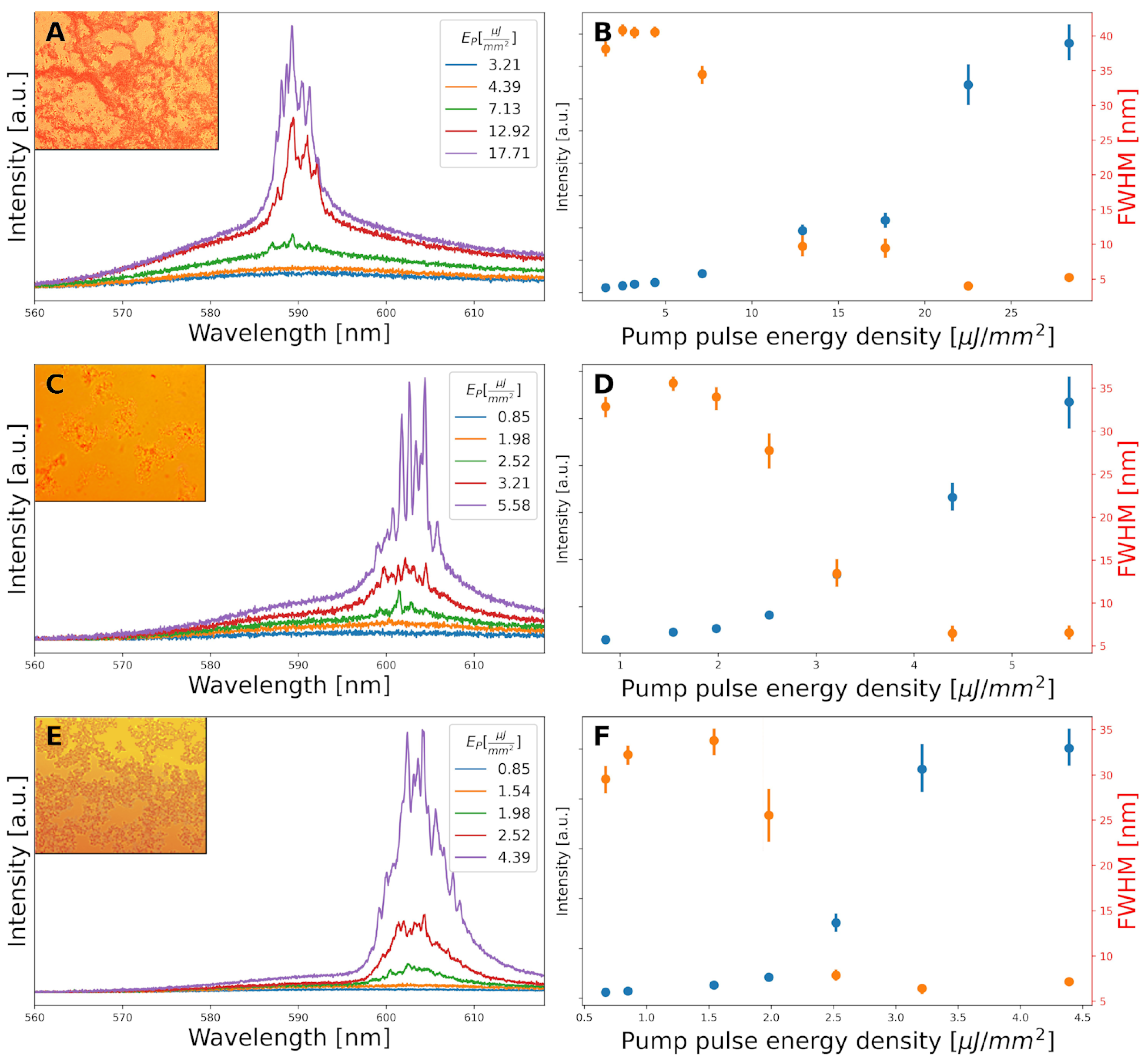
Random lasing (RL) is an optical phenomenon that arises from the combination of light amplification with optical feedback through multiple scattering events. In this paper, we present our investigations of RL generation from human blood samples. We tested mixtures of rhodamine B dye solutions with different blood components, including platelets, lymphocytes, erythrocytes, and whole blood. Intense coherent RL was obtained in all cases at relatively low pump thresholds, except for erythrocytes. We also studied the potential of RL signal analysis for biosensing applications using blood samples from healthy individuals and patients suffering from Chronic Lymphocytic Leukemia (CLL). CLL is a blood disease characterized by a high count of lymphocytes with significant morphological changes. A statistical analysis of the RL spectra based on principal component and linear discriminant analyses was conducted for classification purposes. RL-based sample discrimination was conducted for whole blood, platelet, and lymphocyte samples, being especially successful (86.7%) for the latter. Our results highlight the potential of RL analysis as a sensing tool in blood.
Keywords: random laser; biolasers; optical sensing; whole blood; chronic lymphocytic leukemia random laser; biolasers; optical sensing; whole blood; chronic lymphocytic leukemia