Hierarchical Hybrid Electrodes (HHE) for Enhancing the Performance of Water Electrolysis Systems


Abstract
1. Introduction
2. Experimental
2.1. Chemicals and Equipment
2.2. Synthesis of the Hierarchical Hybrid Rvc-Cnt Structure
2.3. Incorporation of Palladium Nanoparticles (PdNPs)
2.4. Electrochemical Characterization
3. Results and Discussion
3.1. Material Characterization
3.1.1. Electrode Morphology
3.1.2. Electrochemical Characterization
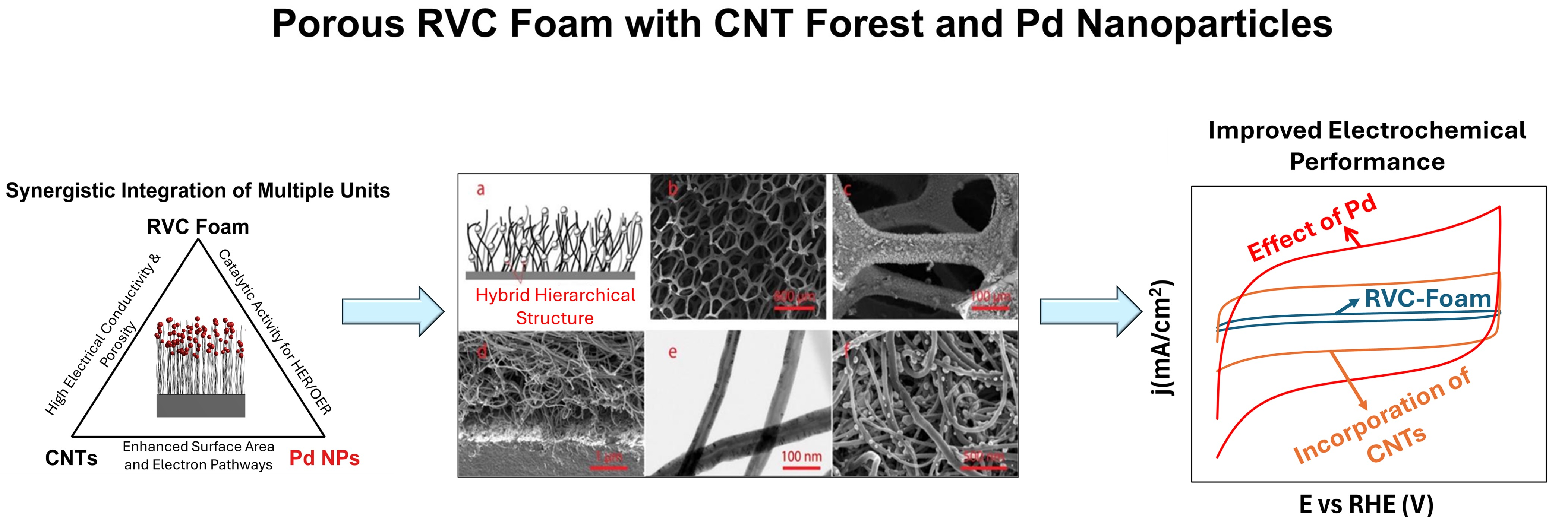
- Cyclic voltammetry (CV): The CV curve in 0.02 M KCL electrolyte is shown in Figure 4a and highlights the impact of surface features on the electrode’s capacity for charge storage, and their effects on the double-layer capacitance.
- b.
- Tafel analysis: As mentioned earlier, Tafel plots are highly valuable for evaluating the electrochemical performance of electrodes, as they provide insights into the reaction energy barriers (which determine how easily a reaction can begin) and the reaction rate (which reflects the kinetic efficiency) [39]. The results from Tafel analysis of our HHE materials are shown in Figure 4b, and the exchange current densities and equilibrium potential are tabulated in Table 1 and discussed below.
3.2. Study of Water Electrolysis
3.2.1. Oxygen Evolution Reaction (OER)
3.2.2. Hydrogen Evolution Reaction (HER)

| Electrode Composition | Tafel Slope (mV/dec) | Electrolyte | Catalyst Loading | Ref |
|---|---|---|---|---|
| PdNP-attached carbon nanotube (Pd-CNT1-RVC) | 42.2 | 0.2 M H2SO4 | 0.14 mg/cm2 | This study. |
| W2C@CNT-S8 | 57.4 | 0.5 M H2SO4 | NA | [52] |
| W2C nanoparticles on MWNT (W2C/MWNT) | 45 | 0.5 M H2SO4 | 0.56 mg/cm2 | [53] |
| Ru/MoO2–CNT (RMC-500) | 45 | 1.0 M KOH | 0.416 mg/cm2 | [55] |
| MoC–Mo2C hybrid | ~43–53 | 0.5 M H2SO4 | 0.14 mg/cm2 | [56] |
| Ru nanoparticles on MWCNT (Ru@MWCNT) | 27 | 0.5 M H2SO4, 1 M KOH | 0.7 mg/cm2 0.16 mg/cm2 | [57] |
3.2.3. Analysis of OER and HER in Acidic and Alkaline Environment
3.2.4. Stability of Electrodes
4. Conclusions
Supplementary Materials
Author Contributions
Funding
Data Availability Statement
Acknowledgments
Conflicts of Interest
References
- Chang, S.H.; Rajuli, M.F. An overview of pure hydrogen production via electrolysis and hydrolysis. Int. J. Hydrogen Energy 2024, 84, 521–538. [Google Scholar] [CrossRef]
- Kumar, S.S.; Lim, H. An overview of water electrolysis technologies for green hydrogen production. Energy Rep. 2022, 8, 13793–13813. [Google Scholar] [CrossRef]
- Takach, M.; Sarajlić, M.; Peters, D.; Kroener, M.; Schuldt, F.; Von Maydell, K. Review of Hydrogen Production Techniques from Water Using Renewable Energy Sources and Its Storage in Salt Caverns. Energies 2022, 15, 1415. [Google Scholar] [CrossRef]
- El-Shafie, M. Hydrogen production by water electrolysis technologies: A review. Results Eng. 2023, 20, 101426. [Google Scholar] [CrossRef]
- Jackson, R.B.; Friedlingstein, P.; Andrew, R.M.; Canadell, J.G.; Quéré, C.L.; Peters, G.P. Persistent fossil fuel growth threatens the Paris Agreement and planetary health. Environ. Res. Lett. 2019, 14, 121001. [Google Scholar] [CrossRef]
- Organisation for Economic Co-Operation and Development. World Energy Outlook 2023; Organisation for Economic Co-Operation and Development: Paris, France, 2023. [Google Scholar] [CrossRef]
- Nasser, M.; Megahed, T.F.; Ookawara, S.; Hassan, H. A review of water electrolysis–based systems for hydrogen production using hybrid/solar/wind energy systems. Environ. Sci. Pollut. Res. 2022, 29, 86994–87018. [Google Scholar] [CrossRef]
- Tonelli, D.; Rosa, L.; Gabrielli, P.; Caldeira, K.; Parente, A.; Contino, F. Global land and water limits to electrolytic hydrogen production using wind and solar resources. Nat. Commun. 2023, 14, 5315. [Google Scholar] [CrossRef]
- Nishiyama, H.; Yamada, T.; Nakabayashi, M.; Maehara, Y.; Yamaguchi, M.; Kuromiya, Y.; Nagatsuma, Y.; Tokudome, H.; Akiyama, S.; Watanabe, T.; et al. Photocatalytic solar hydrogen production from water on a 100-m2 scale. Nature 2021, 598, 304–307. [Google Scholar] [CrossRef]
- Qadeer, M.A.; Zhang, X.; Farid, M.A.; Tanveer, M.; Yan, Y.; Du, S.; Huang, Z.-F.; Tahir, M.; Zou, J.-J. A review on fundamentals for designing hydrogen evolution electrocatalyst. J. Power Sources 2024, 613, 234856. [Google Scholar] [CrossRef]
- Zheng, Y.; Jiao, Y.; Vasileff, A.; Qiao, S. The hydrogen evolution reaction in alkaline solution: From theory, single crystal models, to practical electrocatalysts. Angew. Chem. Int. Ed. 2018, 57, 7568–7579. [Google Scholar] [CrossRef] [PubMed]
- Mathur, A.; Diesendruck, C.E. Advanced device architecture strategies for decoupled water splitting: A review. ACS Mater. Lett. 2024, 6, 2725–2737. [Google Scholar] [CrossRef]
- Zhou, M.; Mei, S.; Li, C.; Liu, M.; Yao, X.; Zhang, X.; Lu, F.; Zeng, X. Precisely tuning the Ni3N/Pt interface to boost the catalytic activity of alkaline hydrogen evolution reaction. Appl. Surf. Sci. 2024, 653, 159391. [Google Scholar] [CrossRef]
- Louie, M.W.; Bell, A.T. An investigation of thin-film Ni–Fe oxide catalysts for the electrochemical evolution of oxygen. J. Am. Chem. Soc. 2013, 135, 12329–12337. [Google Scholar] [CrossRef] [PubMed]
- Ma, T.Y.; Dai, S.; Jaroniec, M.; Qiao, S.Z. Metal–organic framework derived hybrid Co3O4-carbon porous nanowire arrays as reversible oxygen evolution electrodes. J. Am. Chem. Soc. 2014, 136, 13925–13931. [Google Scholar] [CrossRef]
- Chen, Z.; Duan, X.; Wei, W.; Wang, S.; Ni, B.J. Iridium-based nanomaterials for electrochemical water splitting. Nano Energy 2020, 78, 105270. [Google Scholar] [CrossRef]
- Ji, X.; Liu, B.; Ren, X.; Shi, X.; Asiri, A.M.; Sun, X. P-doped Ag nanoparticles embedded in N-doped carbon nanoflake: An efficient electrocatalyst for the hydrogen evolution reaction. ACS Sustain. Chem. Eng. 2018, 6, 4499–4503. [Google Scholar] [CrossRef]
- Norizan, M.N.; Moklis, M.H.; Demon, S.Z.N.; Halim, N.A.; Samsuri, A.; Mohamad, I.S.; Yusoff, M. Carbon nanotubes: Functionalisation and their application in chemical sensors. RSC Adv. 2020, 10, 43704–43732. [Google Scholar] [CrossRef]
- Lu, Y.; Chen, X.; Lan, H.; Nag, A.; Chen, Y.; Gao, J.; Deng, S. A review of multi-walled carbon nanotubes-based electrochemical sensors to detect heavy metals for food packaging applications. J. Alloys Compd. 2025, 1017, 179106. [Google Scholar] [CrossRef]
- Daneshvar, F.; Chen, H.; Noh, K.; Sue, H.J. Critical challenges and advances in the carbon nanotube–metal interface for next-generation electronics. Nanoscale Adv. 2021, 3, 942–962. [Google Scholar] [CrossRef]
- Choi, C.; Yun, T.G.; Hwang, B. Dispersion stability of carbon nanotubes and their impact on energy storage devices. Inorganics 2023, 11, 383. [Google Scholar] [CrossRef]
- Jung, S.; Hauert, R.; Haluska, M.; Roman, C.; Hierold, C. Understanding and improving carbon nanotube-electrode contact in bottom-contacted nanotube gas sensors. Sens. Actuators B Chem. 2020, 331, 129406. [Google Scholar] [CrossRef]
- Pallilavalappil, S.; Jabeen, S.; Rosely, C.V.S.; Animasree, V.P.; Manoj, N.; John, H.; Pillai, S.C. Metal and metal oxide-based electrocatalysts for the hydrogen evolution reaction. In Advances in Photocatalysis, Electrocatalysis and Photoelectrocatalysis for Hydrogen Production; Royal Society of Chemistry: London, UK, 2024; pp. 336–372. [Google Scholar] [CrossRef]
- Li, J.; Naren, G.; Tang, C.; Xing, L.; Meng, L.; Wang, N.; Zhang, R.; Ye, S.; Wang, L.; Du, L. Asymmetric ruthenium-iron dipole enabling fast alkaline water splitting on ruthenium-doped iron-nickel layered double hydroxides. Mater. Rep. Energy 2025, 5, 100359. [Google Scholar] [CrossRef]
- Abdelghafar, F.; Xu, X.; Guan, D.; Lin, Z.; Hu, Z.; Ni, M.; Huang, H.; Bhatelia, T.; Jiang, S.P.; Shao, Z. New Nanocomposites Derived from Cation-Nonstoichiometric Bax(Co, Fe, Zr, Y)O3−δ as Efficient Electrocatalysts for Water Oxidation in Alkaline Solution. ACS Mater. Lett. 2024, 6, 2985–2994. [Google Scholar] [CrossRef]
- Creus, J.; De Tovar, J.; Romero, N.; García-Antón, J.; Philippot, K.; Bofill, R.; Sala, X. Ruthenium nanoparticles for catalytic water splitting. ChemSusChem 2019, 12, 2493–2514. [Google Scholar] [CrossRef] [PubMed]
- Xue, J.Y.; Li, F.L.; Zhao, Z.Y.; Li, C.; Ni, C.Y.; Gu, H.W.; Braunstein, P.; Huang, X.-Q.; Lang, J.-P. A hierarchically-assembled Fe–MoS2/Ni3S2/nickel foam electrocatalyst for efficient water splitting. Dalton Trans. 2019, 48, 12186–12192. [Google Scholar] [CrossRef]
- Lu, X.F.; Yu, L.; Zhang, J.; Lou, X.W. Ultrafine dual-phased carbide nanocrystals confined in porous nitrogen-doped carbon dodecahedrons for efficient hydrogen evolution reaction. Adv. Mater. 2019, 31, 1900699. [Google Scholar] [CrossRef]
- Meskher, H.; Ghernaout, D.; Thakur, A.K.; Jazi, F.S.; Alsalhy, Q.F.; Christopher, S.S.; Sathyamurhty, R.; Saidur, R. Prospects of functionalized carbon nanotubes for supercapacitors applications. Mater. Today Commun. 2024, 38, 108517. [Google Scholar] [CrossRef]
- Tao, F.; Liu, Y.; Ren, X.; Jiang, A.; Wei, H.; Zhai, X.; Wang, F.; Stock, H.-R.; Wen, S.; Ren, F. Carbon nanotube-based nanomaterials for high-performance sodium-ion batteries: Recent advances and perspectives. J. Alloys Compd. 2021, 873, 159742. [Google Scholar] [CrossRef]
- Narayanan, R.; Vijwani, H.; Mukhopadhyay, S.M.; Bandaru, P.R. Electrochemical charge storage in hierarchical carbon manifolds. Carbon 2015, 99, 267–271. [Google Scholar] [CrossRef]
- Vijwani, H.; Nadagouda, M.N.; Namboodiri, V.; Mukhopadhyay, S.M. Hierarchical hybrid carbon nano-structures as robust and reusable adsorbents: Kinetic studies with model dye compound. Chem. Eng. J. 2015, 268, 197–207. [Google Scholar] [CrossRef]
- Wang, W.; Mukhopadhyay, S.M. Hierarchical nanostructured surface design for robust and flexible multifunctional devices. Carbon Trends 2021, 5, 100096. [Google Scholar] [CrossRef]
- Vijwani, H.; Agrawal, A.; Mukhopadhyay, S.M. Dechlorination of environmental contaminants using a hybrid nanocatalyst: Palladium nanoparticles supported on hierarchical carbon nanostructures. J. Nanotechnol. 2012, 2012, 478381. [Google Scholar] [CrossRef]
- Vijwani, H.; Mukhopadhyay, S.M. Palladium nanoparticles on hierarchical carbon surfaces: A new architecture for robust nano-catalysts. Appl. Surf. Sci. 2012, 263, 712–721. [Google Scholar] [CrossRef]
- Vijwani, H.; Nadagouda, M.N.; Mukhopadhyay, S.M. Robust nanocatalyst membranes for degradation of atrazine in water. J. Water Process Eng. 2018, 25, 15–21. [Google Scholar] [CrossRef]
- Querne, C.; Vignal, T.; Pinault, M.; Banet, P.; Mayne-L’Hermite, M.; Aubert, P.-H. A comparative study of high density vertically aligned carbon nanotubes grown onto different grades of aluminum—Application to supercapacitors. J. Power Sources 2023, 553, 232258. [Google Scholar] [CrossRef]
- Li, Y.; Kröger, M. Computational study on entanglement length and pore size of carbon nanotube buckypaper. Appl. Phys. Lett. 2012, 100, 023103. [Google Scholar] [CrossRef]
- van der Heijden, O.; Park, S.; Vos, R.E.; Eggebeen, J.J.J.; Koper, M.T.M. Tafel slope plot as a tool to analyze electrocatalytic reactions. ACS Energy Lett. 2024, 9, 1871–1879. [Google Scholar] [CrossRef] [PubMed]
- Balasubramanian, K.; Burghard, M. Chemically functionalized carbon nanotubes. Small 2004, 1, 180–192. [Google Scholar] [CrossRef]
- Cheng, Y.; Xu, C.; Jia, L.; Gale, J.D.; Zhang, L.; Liu, C.; Shen, P.K.; Jiang, S.P. Pristine carbon nanotubes as non-metal electrocatalysts for oxygen evolution reaction of water splitting. Appl. Catal. B Environ. 2014, 163, 96–104. [Google Scholar] [CrossRef]
- Melle, G.; Feliu, J.M.; Arán-Ais, R.M.; Herrero, E. Electrochemical and electrocatalytic behavior of platinum–palladium bulk alloy single crystal electrodes in alkaline media. J. Phys. Chem. C 2025, 129, 11878–11889. [Google Scholar] [CrossRef]
- Ren, Y.; Guo, Y.; Li, Z.; Hong, S.; Sun, S.; Yang, C.; Ibrahim, F.A.; Hamdy, M.S.; Gong, F.; Lv, Y.; et al. Palladium-chloride ion coordination stabilizes NiFe layered double hydroxides for alkaline seawater oxidation at industrial current densities. J. Colloid Interface Sci. 2025, 700, 138388. [Google Scholar] [CrossRef]
- Ma, Z.; Fu, H.; Gu, C.; Huang, Y.; Hu, S.; Li, Q.; Wang, H. Three-dimensional flower-like NiCo2O4/CNT for efficient catalysis of the oxygen evolution reaction. RSC Adv. 2018, 8, 28209–28215. [Google Scholar] [CrossRef]
- Fatima, A.; Aldosari, H.; Al-Buriahi, M.S.; Huwayz, M.A.; Alrowaili, Z.A.; Alqahtani, M.S.; Ajmal, M.; Nazir, A.; Iqbal, M.; Rasool, R.T.; et al. Cobalt ferrite surface-modified carbon nanotube fibers as an efficient and flexible electrode for overall electrochemical water splitting reactions. ACS Omega 2023, 8, 37927–37935. [Google Scholar] [CrossRef]
- Huang, H.; Zhao, J.; Liu, R. Carbon nanotube boosting electrocatalytic oxygen evolution of NiFe-polyphenol coordination catalyst through donor-acceptor modulation. J. Colloid Interface Sci. 2020, 582, 396–404. [Google Scholar] [CrossRef]
- Sun, J.; Wang, S.; Wang, Y.; Li, H.; Zhou, H.; Chen, B.; Qu, K.; Zhao, J. One simple strategy towards nitrogen and oxygen codoped carbon nanotube for efficient electrocatalytic oxygen reduction and evolution. Catalysts 2019, 9, 159. [Google Scholar] [CrossRef]
- Ali, Z.; Mehmood, M.; Ahmad, J.; Fatima, A.; Ali, M. Fluorine doped CNTs for efficient OER activity outperforming iridium supported carbon electrocatalyst. J. Appl. Electrochem. 2021, 51, 1573–1581. [Google Scholar] [CrossRef]
- Schwarzer, M.; Hertl, N.; Nitz, F.; Borodin, D.; Fingerhut, J.; Kitsopoulos, T.N.; Wodtke, A.M. Adsorption and absorption energies of hydrogen with palladium. J. Phys. Chem. C 2022, 126, 14500–14508. [Google Scholar] [CrossRef] [PubMed]
- Kim, J.G.; Lee, B.; Pham, N.N.T.; Lee, S.G.; Pak, C. Relationship between hydrogen binding energy and activity for hydrogen evolution reaction by palladium supported on sulfur-doped ordered mesoporous carbon. J. Ind. Eng. Chem. 2020, 89, 361–367. [Google Scholar] [CrossRef]
- Pallassana, V.; Neurock, M.; Coulston, G.W. Theoretical density functional analysis of maleic anhydride chemisorption on Pd(111), Re(0001), and bimetallic PdML/Re(0001) and PdML/Mo(110) pseudomorphic overlayers. J. Phys. Chem. B 1999, 103, 8973–8983. [Google Scholar] [CrossRef]
- Hu, Y.; Yu, B.; Li, W.; Ramadoss, M.; Chen, Y. W2C nanodot-decorated CNT networks as a highly efficient and stable electrocatalyst for hydrogen evolution in acidic and alkaline media. Nanoscale 2019, 11, 4876–4884. [Google Scholar] [CrossRef]
- Gong, Q.; Wang, Y.; Hu, Q.; Zhou, J.; Feng, R.; Duchesne, P.N.; Zhang, P.; Chen, F.; Han, N.; Li, Y.; et al. Ultrasmall and phase-pure W2C nanoparticles for efficient electrocatalytic and photoelectrochemical hydrogen evolution. Nat. Commun. 2016, 7, 13216. [Google Scholar] [CrossRef] [PubMed]
- Yang, Y.; Yu, Y.; Li, J.; Chen, Q.; Du, Y.; Rao, P.; Li, R.; Jia, C.; Kang, Z.; Deng, P.; et al. Engineering ruthenium-based electrocatalysts for effective hydrogen evolution reaction. Nano-Micro Lett. 2021, 13, 160. [Google Scholar] [CrossRef]
- Liu, L.; Zhang, X.; Xie, X.; Cai, J.; Ding, J.; Cai, Q.; Liu, Y.; Lu, S. Ru/MoO2 decorated on CNT networks as an efficient electrocatalyst for boosting hydrogen evolution reaction. Int. J. Hydrogen Energy 2022, 47, 26978–26986. [Google Scholar] [CrossRef]
- Lin, H.; Shi, Z.; He, S.; Yu, X.; Wang, S.; Gao, Q.; Tang, Y. Heteronanowires of MoC–Mo2C as efficient electrocatalysts for hydrogen evolution reaction. Chem. Sci. 2016, 7, 3399–3405. [Google Scholar] [CrossRef]
- Kweon, D.H.; Okyay, M.S.; Kim, S.J.; Jeon, J.P.; Noh, H.J.; Park, N.; Mahmood, J.; Baek, J.-B. Ruthenium anchored on carbon nanotube electrocatalyst for hydrogen production with enhanced Faradaic efficiency. Nat. Commun. 2020, 11, 1272. [Google Scholar] [CrossRef] [PubMed]
- Zhang, L.; Xiao, J.; Wang, H.; Shao, M. Carbon-Based Electrocatalysts for Hydrogen and Oxygen Evolution Reactions. ACS Catal. 2017, 7, 7855–7865. [Google Scholar] [CrossRef]

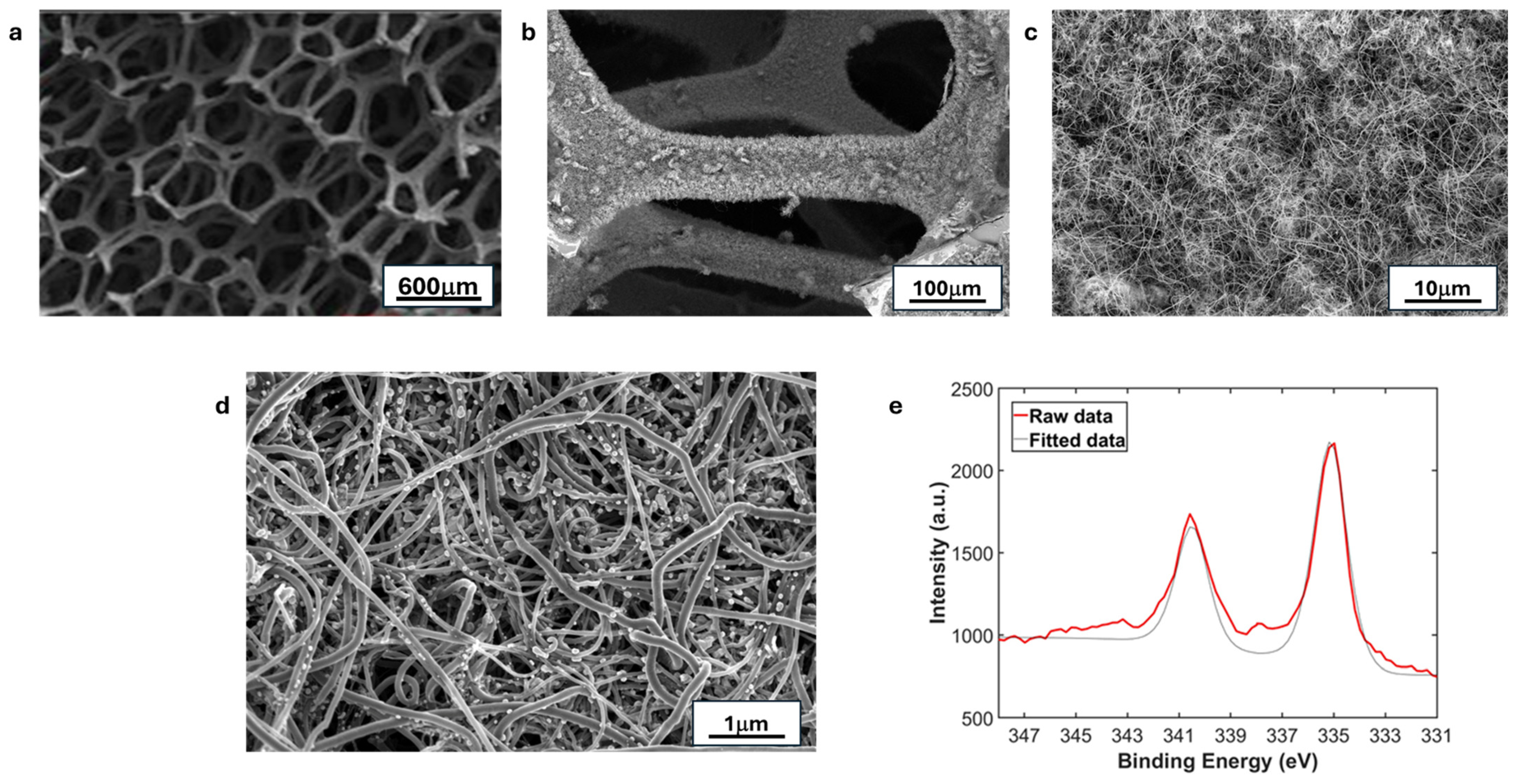
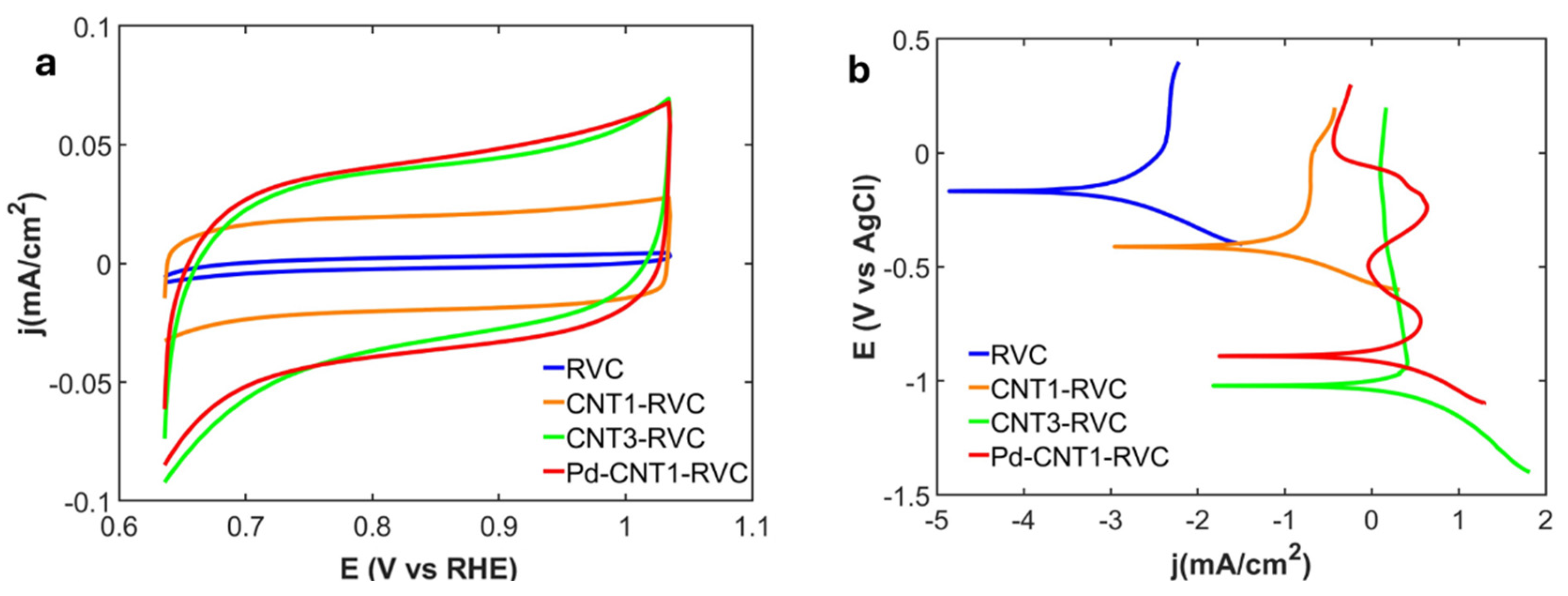



| Electrodes | I0 (uA/mg) | E0 (V) | EDLC (mF/cm2) |
|---|---|---|---|
| RVC | 0.5395 | −0.188 | 107.14 |
| CNT1-RVC | 1.635 | −0.355 | 982.14 |
| CNT3-RVC | 266.75 | −1.021 | 1794.66 |
| Pd-CNT1-RVC | 75.8 | −0.845 | 1946.43 |
| Onset Potential (V) | Tafel Slope (mV/dec) | |||||
|---|---|---|---|---|---|---|
| Sample | Acidic | Neutral | Basic | Acidic | Neutral | Basic |
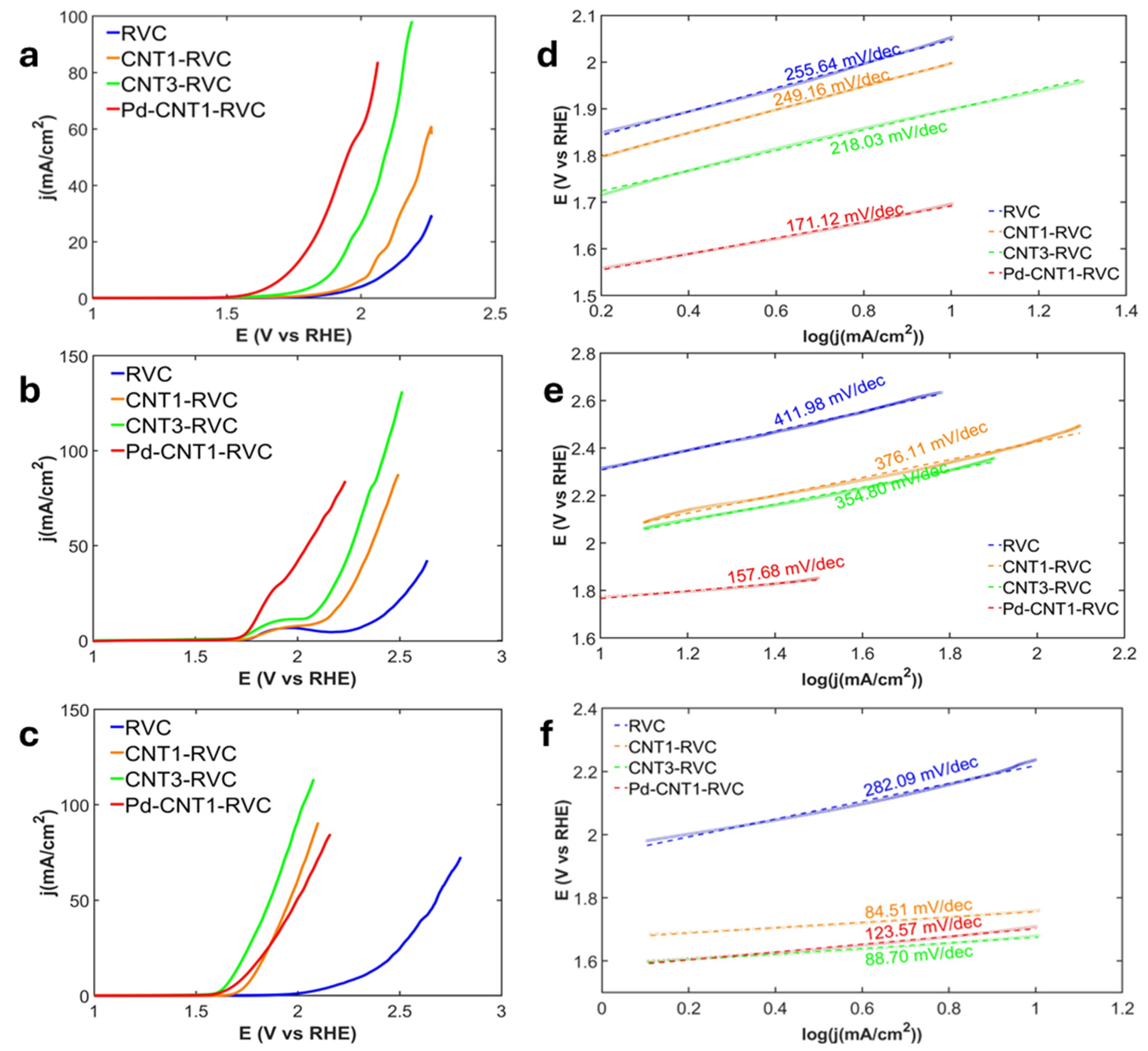
| RVC | 1.872 | 2.429 | 2.024 | 255.6 | 412.0 | 273.3 |
| CNT1-RVC | 1.824 | 2.170 | 1.698 | 249.2 | 526.1 | 84.51 |
| CNT3-RVC | 1.899 | 1.891 | 1.681 | 218.0 | 354.8 | 88.7 |
| Pd-CNT1-RVC | 1.573 | 1.812 | 1.617 | 171.1 | 157.7 | 123.6 |
| Composition | Tafel Slope Values | Electrolyte | Catalyst Loading | Ref |
|---|---|---|---|---|
| RVC CNT1-RVC CNT3-RVC Pd-CNT1-RVC | 273.3 mV/dec, 90.8 mV/dec, 88.7 mV/dec, 123.6 mV/dec. | 0.2 M KOH | N/A N/A N/A 0.14 mg/cm2 | This study. |
| CNT NiCO2O4/CNT RuO2 | 256 mV/dec, 133 mV/dec, 105 mV/dec. | 0.1 M KOH | 0.28 mg/cm2 0.28 mg/cm2 0.2 mg/cm2 | [44] |
| CNT CoFe2O4 @ CNT COFe2O4 | 985 mV/dec, 229 mV/dec, 149 mV/dec. | 1 M KOH | N/A N/A N/A | [45] |
| NieFe/TA@CNT, CNT | 70 mV/dec, 271 mV/dec. | 1 M KOH | 0.396 mg/cm2 0.396 mg/cm2 | [46] |
| CNT NO-CNT | 147 mV/dec, 74 mV/dec. | 0.1 M KOH | N/A N/A | [47] |
| CNT F-doped CNT | 75 mV/dec, 76 mV/dec. | 1 M KOH | 1.9 mg/cm2 1.9 mg/cm2 | [48] |
| Onset Potential (V) | Tafel Slope (mV/dec) | |||||
|---|---|---|---|---|---|---|
| Sample | Acidic | Neutral | Basic | Acidic | Neutral | Basic |
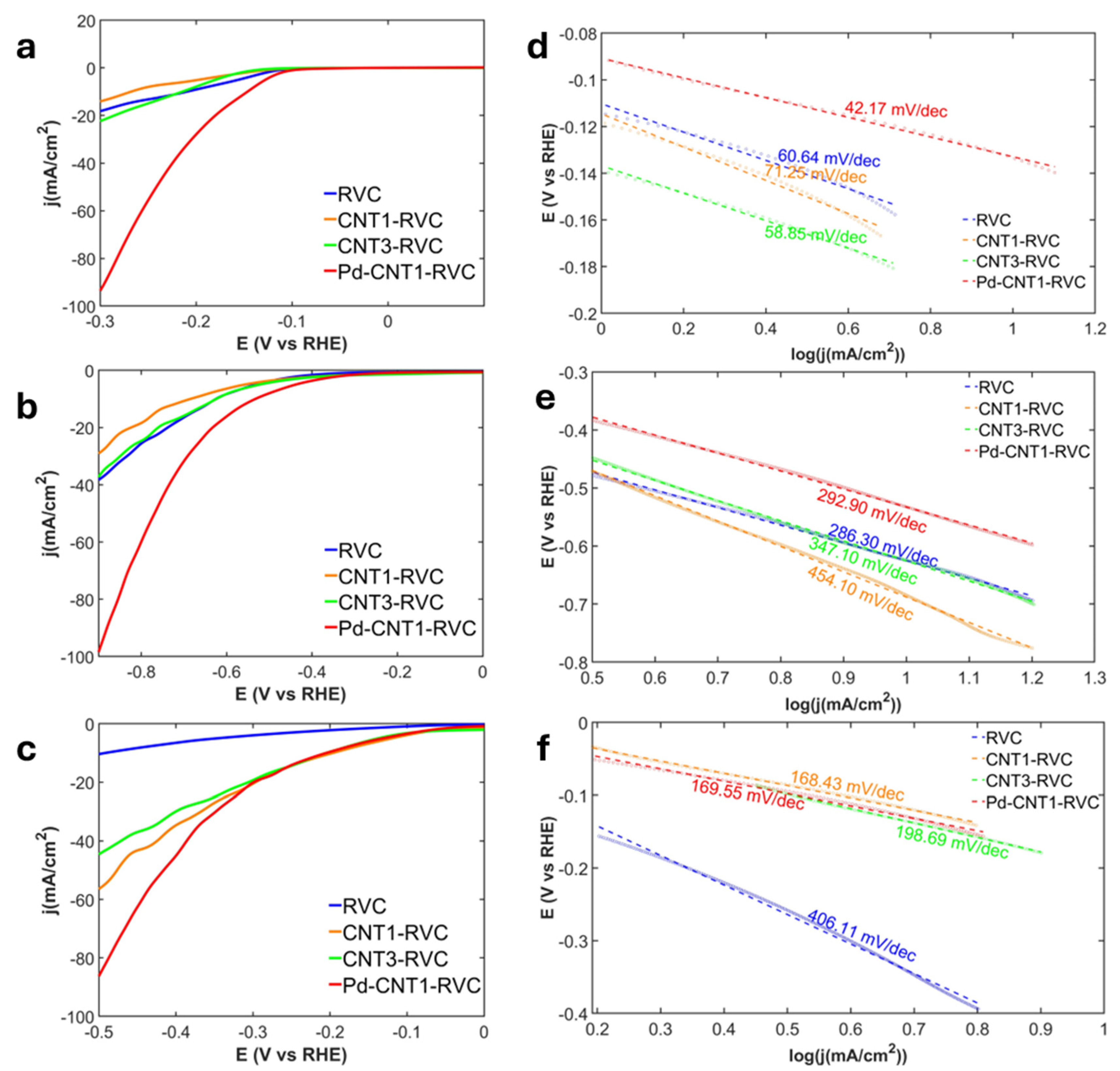
| RVC | −0.128 | −0.626 | −0.492 | 60.6 | 286.3 | 406.1 |
| CNT1-RVC | −0135 | −0.685 | −0.196 | 71.25 | 454.1 | 168.43 |
| CNT3-RVC | −0.215 | −0.625 | −0.205 | 58.9 | 347.1 | 198.7 |
| Pd-CNT1-RVC | −0.104 | −0.533 | −0.205 | 42.2 | 169.6 | 292.9 |
Disclaimer/Publisher’s Note: The statements, opinions and data contained in all publications are solely those of the individual author(s) and contributor(s) and not of MDPI and/or the editor(s). MDPI and/or the editor(s) disclaim responsibility for any injury to people or property resulting from any ideas, methods, instructions or products referred to in the content. |
© 2026 by the authors. Licensee MDPI, Basel, Switzerland. This article is an open access article distributed under the terms and conditions of the Creative Commons Attribution (CC BY) license.
Share and Cite
Shrestha, S.; Peddamalla, S.; Wang, W.; Mukhopadhyay, S.M. Hierarchical Hybrid Electrodes (HHE) for Enhancing the Performance of Water Electrolysis Systems. Nanomaterials 2026, 16, 500. https://doi.org/10.3390/nano16090500
Shrestha S, Peddamalla S, Wang W, Mukhopadhyay SM. Hierarchical Hybrid Electrodes (HHE) for Enhancing the Performance of Water Electrolysis Systems. Nanomaterials. 2026; 16(9):500. https://doi.org/10.3390/nano16090500
Chicago/Turabian StyleShrestha, Sanskar, Sathvik Peddamalla, Wenhu Wang, and Sharmila M. Mukhopadhyay. 2026. "Hierarchical Hybrid Electrodes (HHE) for Enhancing the Performance of Water Electrolysis Systems" Nanomaterials 16, no. 9: 500. https://doi.org/10.3390/nano16090500
APA StyleShrestha, S., Peddamalla, S., Wang, W., & Mukhopadhyay, S. M. (2026). Hierarchical Hybrid Electrodes (HHE) for Enhancing the Performance of Water Electrolysis Systems. Nanomaterials, 16(9), 500. https://doi.org/10.3390/nano16090500