Article

Click Chemistry Functionalization of Harmonic Nanoparticles with Lanthanide Complexes Towards Tunable Platforms for Multimodal Imaging


1
Group for Functionalized Biomaterials, Institute of Chemical Sciences and Engineering, Ecole Polytechnique Fédérale de Lausanne (EPFL), CH-1015 Lausanne, Switzerland
2
Nonlinear BioImaging LAB, Department of Applied Physics, Université de Genève, CH-1205 Genève, Switzerland
3
Department of Quantum Matter Physics, Université de Genève, CH-1211 Genève, Switzerland
4
CIBM Center for Biomedical Imaging, Ecole Polytechnique Fédérale de Lausanne (EPFL), CH-1015 Lausanne, Switzerland
5
CIBM Pre-Clinical Imaging EPFL Metabolic Imaging Section, École Polytechnique Fédérale de Lausanne (EPFL), CH-1015 Lausanne, Switzerland
6
SYMME, Université Savoie Mont-Blanc, F-74000 Annecy, France
7
Laboratory of Supramolecular Chemistry, Institute of Chemical Sciences and Engineering, Ecole Polytechnique Fédérale de Lausanne (EPFL), CH-1015 Lausanne, Switzerland
*
Authors to whom correspondence should be addressed.
Nanomaterials 2026, 16(10), 591; https://doi.org/10.3390/nano16100591 (registering DOI)
Submission received: 23 April 2026 / Revised: 7 May 2026 / Accepted: 8 May 2026 / Published: 12 May 2026
(This article belongs to the Section Biology and Medicines)

Abstract

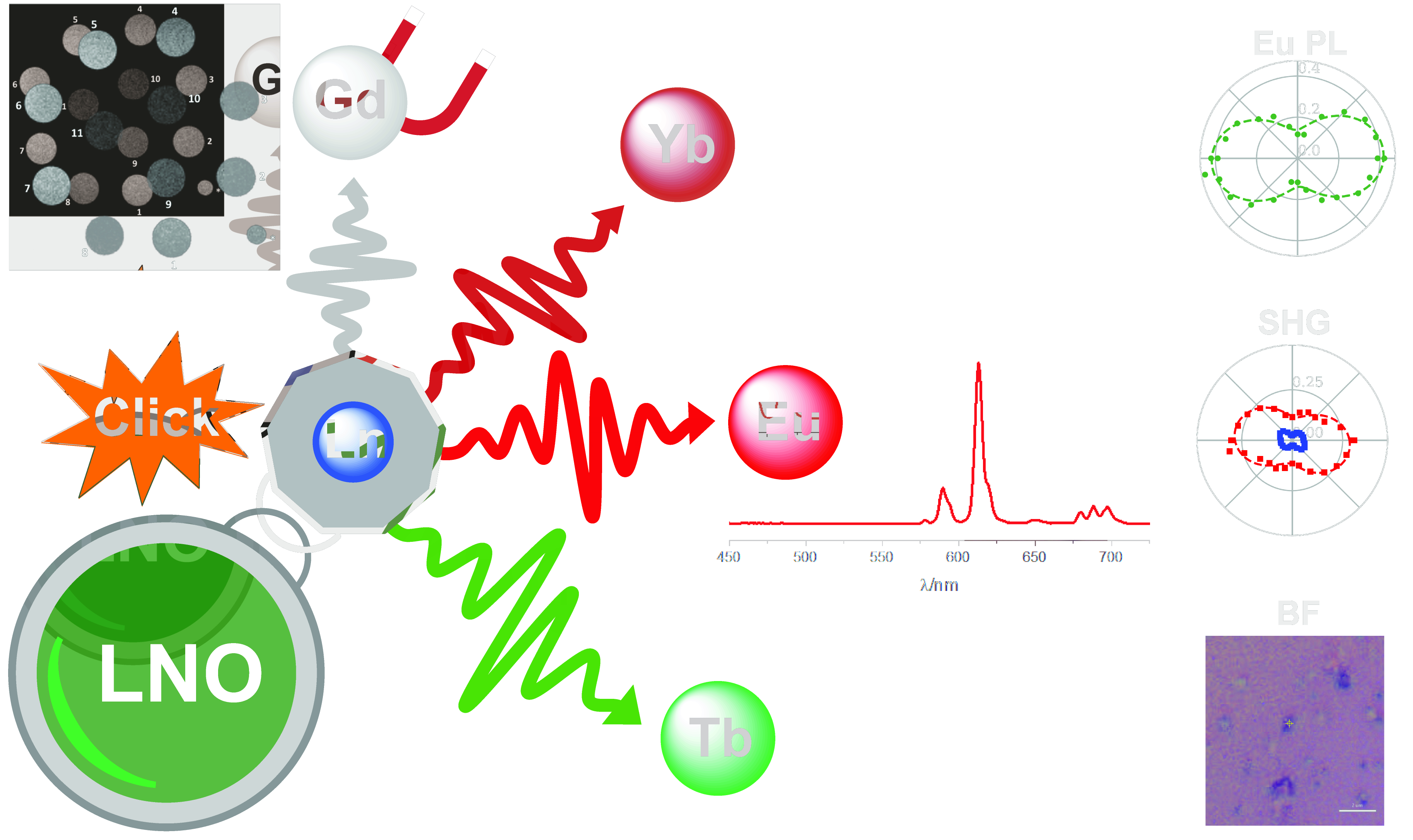
Nanoplatforms combining multiple imaging contrast modalities are gaining interest across life sciences and beyond. Here, we disclose a proof-of-concept series of harmonic nanoparticles (HNPs) conjugated with a variety of lanthanide (Ln) complexes, enabling tunable imaging properties. Building on our previous approach for the conjugation of Gd(III) complexes at the surface of HNPs through copper-catalyzed click chemistry, we first establish a copper-free alternative by benchmarking the signals of the resulting conjugates in magnetic resonance imaging phantoms. We then extend this system to Eu, Tb and Yb conjugates and investigate their photophysical properties, successfully detecting long-lived Ln emissions spanning the visible and near-infrared spectrum. Interestingly, the Ln ion can be efficiently removed and exchanged, allowing reuse of the same HNP with a new optical signature. Most notably, we demonstrate that the Eu luminescence can be indirectly activated via second-harmonic generation from the HNP core upon femtosecond-pulsed irradiation in parallel to direct two-photon excitation. This nonlinear activation scheme paves the way for the preparation of mixtures with multidimensional optical signatures using a single excitation source. Altogether this work provides a versatile framework to further explore HNP-Ln conjugates as multimodal imaging probes.

Graphical Abstract

1. Introduction

Imaging plays a key role in life sciences to investigate biological processes and to provide tools enabling medical diagnostics [1]. While individual imaging techniques have reached a high level of performance, they remain intrinsically limited by parameters like sensitivity, resolution and penetration depth [2,3,4]. Multimodal imaging, based on the acquisition of different contrast mechanisms, has gained interest as it can complement limitations of single techniques and acquire multidimensional data for improved accuracy [4,5]. For example, Baranski et al. reported a prostate-targeted dual probe that allowed to conduct pre-operative positron emission tomography (PET)/computed tomography (CT) and assist tumor resection via fluorescent visualization [6,7]. The combination of magnetic resonance imaging (MRI) with optical signals also holds great potential for increased sensitivity and functional readout across multiple length scale [8,9,10]. It is worth mentioning that multimodal imaging is increasingly used beyond the biomedical field for applications like cultural heritage preservation [11], material manufacturing [12] or anti-counterfeiting [13,14].
One barrier to the widespread use of multimodal imaging is the requirement for contrast agents (CAs) able to perform across different modalities [15,16]. Compared to small-molecule-based probes, nanoparticles (NPs) can be engineered for multiple imaging techniques while maintaining stability via modulation of their composition and surface chemistry. Harmonic nanoparticles (HNPs) represent a particularly interesting substrate for CA development thanks to their well-established nonlinear optical properties and biocompatibility [17,18,19]. For example, their tunable second- and third-harmonic generation (SHG and THG, respectively) have been successfully applied to selective cancer cell imaging [20], and have demonstrated their potential to detect stem cells in tissue imaging [21,22] and in flowing blood samples [23].
Trivalent lanthanide (Ln) ions possess unique electronic configurations giving rise to narrow, long-lived f-f emission bands, making them excellent optical probes with high contrast abilities [24]. In addition to their photoluminescence (PL) properties, Ln can provide strong paramagnetism relevant to MRI (e.g., Gd) [25], high mass attenuation coefficients applicable to X-ray CT (e.g., Yb, Dy, Lu) [26], or stable isotope (e.g., 177Lu, 153Sm) for PET and single-photon emission computed tomography (SPECT) [27]. Ln ions have thus been incorporated into inorganic or hybrid NP designs [24]. This includes functionalized iron oxide NPs [28], mesoporous silica NPs [29] or core–shell mesoporous silica–gadolinium oxide composite NPs [30], as well as core–shell [31] and core–multi-shell [32] upconversion NPs. The optical signal can further be leveraged for multicolor barcoding [33,34] or for in situ sensing of tumor microenvironment markers [35], pH [36] and temperature [37,38]. Ln doping can however lead to undesired luminescence quenching [39] or loss of nonlinear optical response in harmonic nanocrystals [40,41], which requires careful control over synthetic conditions. Surface functionalization with Ln complexes offers an interesting alternative by maintaining crystal structure integrity thanks to robust conjugation chemistries [42]. Design optimization, e.g., efficient Ln sensitization via the ligand (antenna effect) or enhanced emission lifetimes, can therefore be performed separately with high modularity [43]. Moreover, this approach allows to fine-tune the contact with the surrounding environment, which is required to generate a stable contrast in MRI and for sensing applications [44,45]. Though a few examples of such covalent strategies can be found with iron oxide NPs [46,47], gold NPs [48], silica NPs [49] and polymeric NPs [50], the investigation of nanomaterials post-modification with Ln complexes remains elusive.
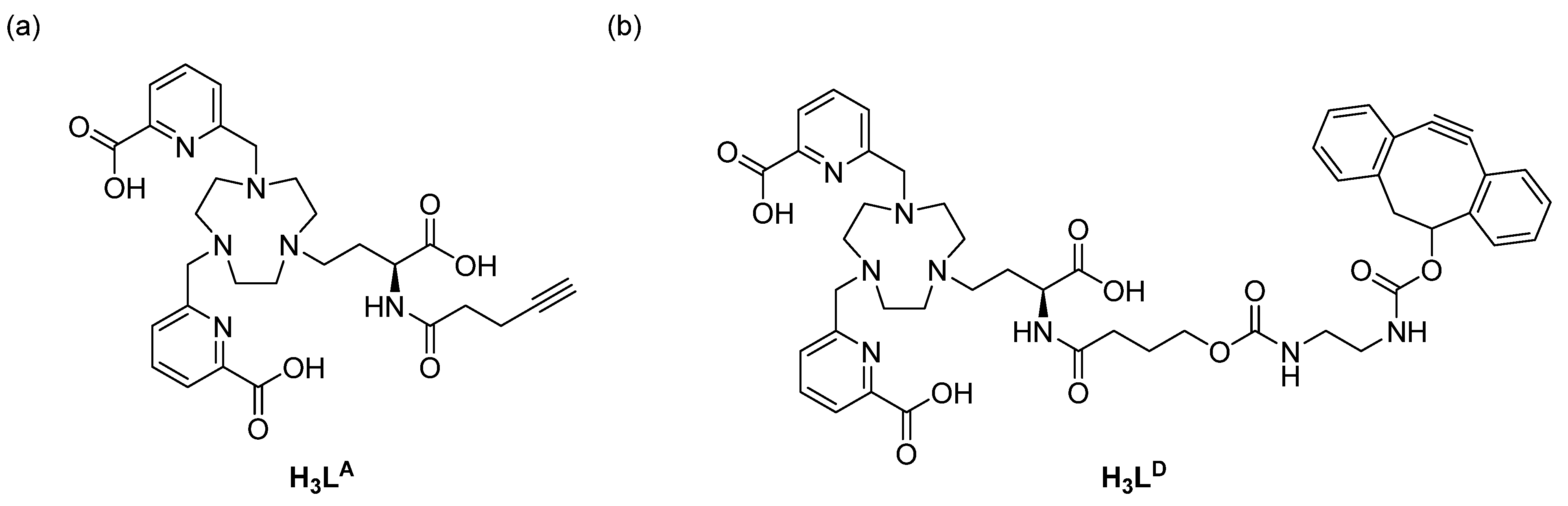
Tripodal 1,4,7-triazacyclononane (TACN) ligands have been widely investigated as efficient and versatile Ln binders, resulting in efficient constructs for PL and MRI applications [51,52,53,54]. In our previous study, an analog to one such ligand allowing fast water exchange (H3ebpatcn) [55] was derivatized with a terminal alkyne (Figure 1a, Alkyne ligand named H3LA), complexed with Gd(III) and conjugated to the surface of LiNbO3 (LNO) HNPs via Cu-catalyzed [3+2] azide–alkyne cycloaddition (CuAAC) [56]. The resulting suspension was successfully applied to bimodal nonlinear microscopy and MRI with both T1 and T2 contrast capabilities. While highly efficient and well-studied, CuAAC can be associated with a number of challenges during conjugation including possible azide side reactions [57] and competitive Cu(I) or Cu(II) complexation against Ln [58,59]. In addition, the presence of Cu residues can generate reactive oxygen species (ROS) that can degrade the ligand and cause cytotoxicity when applied in biological systems [60,61,62]. Conversely, Cu-free click chemistries such as strain-promoted [3+2] azide–alkyne cycloaddition (SPAAC) and inverse-electron-demand Diels–Alder (IEDDA) cycloaddition allow for milder reaction conditions, but require the use of bulkier, synthetically more-demanding substrates [42,63]. In the present work, an analogous ligand containing a strained dibenzocyclooctyne (DIBO) residue was designed (Figure 1b, DIBO ligand named H3LD) to enable SPAAC conjugation, thereby avoiding the use of a copper catalyst. This new ligand was first complexed with Gd(III) ions and benchmarked against the established dual MRI–nonlinear microscopy capacity of the previous platform. Moreover, both H3LA and H3LD ligands were reacted with Gd, Eu, Yb and Tb ions and the resulting complexes were assessed for their PL properties, before and after conjugation to LNO HNPs. Proof-of-concept nanoplatform recycling with Tb, and the combination of Eu and SHG signals demonstrated the potential of LNO@[Ln] conjugates for versatile multidimensional imaging.

2. Materials and Methods

2.1. Synthesis Procedures and Characterizations

The TACNB [56] and DIBO-NH2 [64,65] intermediates were synthesized according to our reported procedures. The 1H-NMR and mass spectra were in accordance with the reported data.

2.1.1. Compound 1

The synthesis of compound 1 was adapted from Li et al. [66]. To a round-bottom flask, γ-butyrolactone (2.02 mL, 26 mmol, 1.0 eq.), PMBBr (9.5 mL, 66 mmol, 2.5 eq.) and KOH (6.8 mg, 106 mmol, 4.0 eq.) were dissolved under Ar in dry toluene (100 mL). The reaction was stirred under reflux for 4 days. The reaction was cooled to r.t. and diluted with AcOEt (250 mL) and washed with H2O (3×). The combined organic layers were dried over MgSO4, filtered and concentrated under reduced pressure to retrieve the product without further purification as a yellow oil (5.6 g, 25 mmol, 95%).
MS (ESI-Quad) m/z: [M − H] calcd for C12H16O4 223.0976; found 223.0975.
1H-NMR (400 MHz, Chloroform-d) δ 7.25 (d, 3H), 6.88 (d, 2H), 4.44 (s, 2H), 3.80 (s, 3H), 3.50 (t, J = 6.1 Hz, 2H), 2.47 (t, J = 7.3 Hz, 2H), 1.93 (p, J = 6.1 Hz, 2H).
The data were in accordance with the literature.

2.1.2. Compound 2

To a round-bottom flask under Ar, 1 (3.227 g, 14.39 mmol, 1.0 eq.) and NHS (1.662 g, 14.44 mmol, 1.0 eq.) were dissolved in dry THF (19.2 mL), and then cooled to 0 °C. To a separate flask under Ar, DCC (2.969 g, 14.39 mmol, 1.0 eq.) was dissolved in dry THF (9.6 mL), and the solution was then added dropwise into the first solution. The reaction was stirred at 0 °C for 1 h, and then at r.t. for 3 h. The reaction was filtered and concentrated under reduced pressure. The residue was redissolved in AcOEt (100 mL), filtered, and the filtrate was washed with NaHCO3 sat. (100 mL) and brine (100 mL). The organic layer was dried over MgSO4, filtered and concentrated under reduced pressure to retrieve the crude product as a yellow oil (4.235 g, 13.18 mmol, 92%).
To a round-bottom flask under Ar, the previous crude (1.652 g, 5.14 mmol, 1.0 eq.) and (S)-2-amino-4-butyrolactone hydrobromide (1.028 g, 5.65 mmol, 1.1 eq.) were dissolved in dry DCM (50 mL). To a separate flask under Ar, TEA (2.15 mL, 15.43 mmol, 3.0 eq.) was dissolved in dry DCM (2.6 mL), and the solution was then added dropwise into the first solution. The reaction was stirred at r.t. for 2 h. The reaction was then washed with NH4Cl sat. (50 mL) and extracted with DCM (50 mL). The combined organic layers were dried over MgSO4, filtered and concentrated under reduced pressure. The crude was purified by FC eluting with a gradient of EtOAc/MeOH (1:0 then 25:1) to retrieve the product as a white powder (1.065 g, 3.46 mmol, 67%).
MS (ESI-Quad) m/z: [M + H]+ calcd for C16H22NO5+ 308.1492; found 307.8016, and [M + Na]+ calcd for C16H21NNaO5+ 330.1312; found 330.1271.
1H-NMR (400 MHz, Chloroform-d) δ 7.28–7.23 (m, 2H, Ar-H), 6.91–6.86 (m, 2H, Ar-H), 6.40 (s, 1H, NH), 4.60–4.15 (m, 5H, C*H-CH2-CH2 and O-CH2-Ar and C*H), 3.80 (s, 3H, O-CH3), 3.51 (t, J = 5.8 Hz, 2H, CH2-CH2-O), 2.76–2.66 (m, 1H, C*H-CH2-CH2), 2.38 (t, J = 7.0 Hz, 2H, CO-CH2-CH2), 1.98–1.90 (m, 2H. CH2-CH2-CH2), 1.90–1.83 (m, 1H, C*H-CH2-CH2).
13C-NMR (101 MHz, Chloroform-d): δ 175.30 (COO-C*H), 173.45 (CONH), 159.30 (C-OCH3), 130.25 (O-CH2-C), 129.57 (2× CH-C-OCH3), 113.87 (2× O-CH2-C-CH), 72.71 (O-CH2-C), 69.00 (CH2-CH2-O), 65.92 (C*H-CH2-CH2), 55.30 (O-CH3), 49.04 (COO-C*H), 33.41 (CH2-CH2-CH2), 30.25 (C*H-CH2-CH2), 25.40 (CH2-CH2-CH2).

2.1.3. Compound 3

To a round-bottom flask, 2 (503.3 mg, 1.64 mmol, 1.0 eq.) and H2SO4 (100 μL) were dissolved in EtOH (10 mL). The reaction was stirred at r.t. for 24 h. The reaction was then neutralized in an ice bath with NaHCO3 (s), and EtOH was added to maintain stirring. The mixture was then filtered and concentrated under reduced pressure at 20 °C. The crude was not purified and was directly used in the next step.
To a round-bottom flask under Ar, (COCl)2 (0.56 mL, 6.55 mmol, 4.0 eq.) was dissolved in dry DCM (10 mL). To a separate round-bottom flask under Ar, DMSO (0.70 mL, 9.82 mmol, 6.0 eq.) was dissolved in dry DCM (1.30 mL), and then added dropwise to the (COCl)2 solution. The mixture was stirred at −78 °C for 10 min. To a separate round-bottom flask under Ar, the crude alcohol intermediate was dissolved in dry DCM (5 mL). The solution was then added dropwise into the reaction mixture and stirred at −78 °C for 30 min. TEA (1.83 mL, 13.10 mmol, 8.0 eq.) was then added dropwise, the reaction was allowed to warm up to 0 °C and was stirred for 2 h. The reaction was further allowed to warm up to r.t. for 1 h. The reaction was quenched with H2O (10 mL) and extracted with DCM (3 × 10 mL). The combined organic layers were dried over MgSO4, filtered and concentrated under reduced pressure. The crude was purified by FC eluting with PE/EtOAc (1:3) to retrieve the product as a yellow oil (253.5 mg, 0.72 mmol, 44%).
MS (ESI-Quad) m/z: [M + H]+ calcd for C18H26NO6+ 352.1755; found 351.9747, and [M + Na]+ calcd for C18H25NNaO6+ 374.1574; found 374.2094.
1H-NMR (400 MHz, Chloroform-d) δ 9.67 (s, 1H, CHO), 7.29–7.22 (m, 2H, Ar-H), 6.91–6.84 (m, 2H, Ar-H), 6.56 (d, J = 7.7 Hz, 1H, NH), 4.85–4.78 (m, 1H, C*-H), 4.42 (s, 2H, O-CH2-Ar), 4.20 (q, J = 7.1 Hz, 2H, O-CH2-CH3), 3.80 (s, 3H, O-CH3), 3.47 (td, J = 6.1, 2.3 Hz, 2H, CH2-CH2-O), 3.10–2.94 (m, 2H, CHO-CH2-C*H), 2.33 (td, J = 7.2, 3.0 Hz, 2H, CO-CH2-CH2), 1.91 (q, 2H, CH2-CH2-CH2), 1.25 (t, J = 7.1 Hz, 3H, O-CH2-CH3).
13C-NMR (101 MHz, Chloroform-d): δ 199.29 (CHO), 172.64 (CONH), 170.67 (COO), 159.22 (C-OCH3), 130.41 (O-CH2-C), 129.38 (2× CH-C-OCH3), 113.81 (2× O-CH2-C-CH), 72.61 (O-CH2-C), 68.92 (CH2-CH2-O), 61.97 (O-CH2-CH3), 55.29 (O-CH3), 47.32 (COO-C*H), 45.69 (C*H-CH2-CHO), 33.29 (CH2-CH2-CH2), 25.50 (CH2-CH2-CH2), 14.06 (O-CH2-CH3).

2.1.4. Compound 4

To a round-bottom flask under Ar, TACNB (153.0 mg, 0.34 mmol, 1.1 eq.) was dissolved in dry DCE (5 mL). To a separate round-bottom flask under Ar, 3 (107.3 mg, 0.31 mmol, 1.0 eq.) and AcOH (17.3 µL, 0.30 mmol, 1.0 eq.) were dissolved in dry DCE (2.5 mL), and the solution was then added dropwise into the first solution. The reaction was stirred at r.t. for 5 h. NaBH(OAc)3 (320.9 mg, 1.51 mmol, 5.0 eq.) was then added, the flask was rinsed with dry DCE (1 mL), and the mixture was briefly ultrasonicated. The reaction was then stirred at r.t. for an additional 16 h. The reaction was quenched with NaHCO3 sat. (10 mL) and extracted with CHCl3 (4 × 5 mL). The organic layers were washed with brine (10 mL), dried over Na2SO4, filtered and concentrated under reduced pressure. The crude was purified by FC (Al2O3 basic III, 4.9% H2O) eluting with a DCM/MeOH gradient (1:0 to 30:1) to retrieve the product as a yellow oil (133.6 mg, 0.17 mmol, 55%).
HRMS (ESI/QTOF) m/z: [M + H]+ Calcd for C42H59N6O9+ 791.4338; found 791.4356.
1H-NMR (400 MHz, Acetonitrile-d3) δ 7.95–7.90 (m, 2H, Py-H), 7.88–7.81 (m, 2H, Py-H), 7.76–7.70 (m, 2H, Py-H), 7.25–7.18 (m, 3H, Ar-H), 6.89–6.83 (m, 2H, Ar-H), 4.48–4.41 (m, 1H, C*-H), 4.41–4.31 (m, 6H, O-CH2-CH3), 4.09 (m, 2H, CH2-CH2-C*H), 3.89 (s, 2H, O-CH2-Ar), 3.83 (s, 4H, Py-CH2-N), 3.75 (s, 3H, O-CH3), 3.42 (t, J = 6.3 Hz, 2H, CH2-CH2-O), 2.92–2.65 (m, 12H, N-CH2-CH2-N), 2.55–2.47 (br, 2H, N-CH2-CH2-C*), 2.22 (t, J = 7.3 Hz, 2H, CO-CH2-CH2), 1.84–1.76 (m, 2H, CH2-CH2-CH2), 1.35 (t, J = 7.1 Hz, 6H, O-CH2-CH3), 1.19 (t, J = 7.1 Hz, 3H, O-CH2-CH3).
13C-NMR (101 MHz, CD3CN) δ 173.47 (CONH), 166.73 (COO), 166.23 (COO), 160.12 (C-O-CH3), 148.53 (C-Py), 138.36 (C-Py), 131.94 (O-CH2-C), 130.20 (2× CH-C-OCH3), 127.59 (C-Py), 127.46 (C-Py), 124.14 (C-Py), 114.58 (2× O-CH2-C-CH), 72.98 (O-CH2-CH3), 70.01 (CH2-CH2-O), 62.29 (O-CH2-CH3), 61.68 (CH2-CH2-C*H), 55.85 (O-CH3), 55.33 (N-CH2-CH2-C*H), 53.01 (O-CH2-Ar), 33.29 (CO-CH2-CH2), 26.55 (CH2-CH2-CH2), 14.59 (O-CH2-CH3), 14.55 (O-CH2-CH3).

2.1.5. Compound 5

To a round-bottom flask, 4 was dissolved in DCM (4 mL). PBS (1 mL) was added and the mixture was cooled to 0 °C. DDQ (109.3 mg, 0.48 mmol, 3.0 eq.) was then added and the reaction was stirred at 0 °C for 1 h. The reaction was then allowed to warm up to r.t. and stirred for an additional 3 h. The reaction was briefly ultrasonicated every 1 h. A second portion of DDQ (19.1 mg, 0.08 mmol, 0.5 eq.) was added if complete conversion was not achieved, and the reaction was stirred at r.t. for an additional 30 min. The reaction was transferred to an extraction funnel. The reaction flask was washed and ultrasonicated with DCM (2×) and then transferred to the extraction funnel. The reaction was quenched directly in the reaction flask with Na2S2O3 sat. (2 × 7.5 mL) and NaHCO3 sat. (2 × 7.5 mL). The mixture was ultrasonicated for 2 min after every addition and transferred to the extraction funnel using a glass Pasteur pipette. The reaction was then extracted with DCM (3 × 15 mL). The combined organic layers were washed with NaHCO3 sat. (15 mL) and brine (15 mL), dried over Na2SO4, filtered and concentrated under reduced pressure. The crude was purified by FC (Al2O3 basic III, 4.9% H2O) eluting with a gradient of DCM/MeOH (1:0 to 20:1) to retrieve the product as a brown oil (50.7 mg, 0.08 mmol, 47%).
HRMS (nanochip-ESI/LTQ-Orbitrap) m/z: [M + H]+ Calcd for C34H51N6O8+ 671.3763; found 671.3746.
1H-NMR (400 MHz, Acetonitrile-d3) δ 7.97–7.91 (m, 2H, Py-H), 7.90–7.83 (m, 2H, Py-H), 7.79–7.67 (m, 2H, Py-H), 7.28–7.13 (br, 1H, NH), 4.50–4.42 (m, 1H, C*-H), 4.36 (q, J = 7.1 Hz, 4H, O-CH2-CH3), 4.16–4.03 (m, 2H, CH2-CH2-C*H), 3.88–3.83 (m, 4H, Py-CH2-N), 3.49 (t, J = 6.2 Hz, 2H, CH2-CH2-O), 2.97–2.68 (m, 12H, N-CH2-CH2-N), 2.69–2.43 (m, 2H, N-CH2-CH2-C*), 2.23 (t, J = 6.8 Hz, 2H, CO-CH2-CH2), 1.72 (p, J = 6.8 Hz, 2H, CH2-CH2-CH2), 1.41–1.31 (m, 6H, O-CH2-CH3), 1.19 (t, J = 7.1 Hz, 3H, O-CH2-CH3).

2.1.6. Compound 6

To a round-bottom flask under Ar, 4-nitrophenyl chloroformate (22.3 mg, 0.111 mmol, 2.0 eq.) was dissolved in dry DCM (1 mL). To a separate round-bottom flask under Ar, 5 (38.0 mg, 0.057 mmol, 1.0 eq.) and dry pyridine (23 µL, 0.286 mmol, 5.0 eq.) were dissolved in dry DCM (2 mL), and the solution was added dropwise into the first solution. The reaction was stirred at r.t. for 16 h. The reaction was concentrated under reduced pressure and redissolved in dry DMAc (1 mL). To a separate round-bottom flask under Ar, DIBO-NH2 (34.7 mg, 0.113 mmol, 2.0 eq.) and DIPEA (50 µL, 0.287 mmol, 5.0 eq.) were dissolved in dry DMAc (2 mL), and then added dropwise into the previous solution. The reaction was stirred at r.t. for 3 h, and then concentrated under reduced pressure. The residue was redissolved in CHCl3 (3 mL), and washed with NH4Cl sat (3 mL) and brine (3 mL). Each aqueous layer was extracted with CHCl3 (3 × 3 mL). The combined organic layers were dried over Na2SO4, filtered and concentrated under reduced pressure. The crude was purified by FC (Al2O3 basic III, 4.9% H2O) eluting with a ternary gradient of Hexane/[DCM/MeOH (20:1)] (1:1 to 1:7) to retrieve the product as a light-orange oil (32.1 mg, 0.032 mmol, 56%).
HRMS (ESI/QTOF) m/z: [M + H]+ Calcd for C54H67N8O11+ 1003.4924; found 1003.4896.
1H-NMR (400 MHz, Acetonitrile-d3) δ 7.94–7.89 (m, 2H, Py-H), 7.88–7.80 (m, 2H, Py-H), 7.74–7.69 (m, 2H, Py-H), 7.60–7.51 (m, 1H, DIBO-ArH), 7.42–7.28 (m, 7H, DIBO-ArH), 6.35–6.25 (m, 2H, NH), 5.86–5.81 (m, 1H, NH), 5.37–5.29 (m, 1H, DIBO-CH), 4.48–4.40 (m, 1H, C*H), 4.35 (q, J = 7.1 Hz, 4H, O-CH2-CH3), 4.14–4.03 (m, 2H, CH2-CH2-C*H), 4.02–3.92 (m, 2H, CH2-CH2-OCON), 3.83 (s, 4H, Py-CH2-N), 3.24–3.08 (m, 5H, NH-CH2-CH2-NH and DIBO-CH2), 2.87–2.63 (m, 13H, N-CH2-CH2-N and DIBO-CH2′), 2.55–2.46 (m, 2H, N-CH2-CH2-C*), 2.14–2.09 (m, 2H, CO-CH2-CH2), 1.88–1.75 (m, 2H, CH2-CH2-CH2), 1.34 (t, J = 7.1 Hz, 6H, O-CH2-CH3), 1.18 (t, J = 7.0 Hz, 3H, O-CH2-CH3).
13C-NMR (101 MHz, CD3CN) δ 165.80, 153.06, 151.98, 148.07, 137.99, 130.75, 128.94, 128.87, 127.86, 127.83, 127.74, 127.07, 126.74, 126.45, 124.59, 123.96, 123.77, 121.42, 113.14, 110.34, 76.65, 64.24, 61.92, 61.35, 54.91, 46.55, 42.32, 41.36, 40.31, 32.51, 25.48, 14.18, 14.13.

2.1.7. H3LD Ligand

To a round-bottom flask, 6 (32.7 mg, 0.033 mmol, 1.0 eq.) was dissolved in EtOH (4 mL) and H2O (0.5 mL). To a separate round-bottom flask, LiOH (2.58 mg, 0.108 mmol, 3.3 eq.) was dissolved in H2O (0.5 mL), and the solution was added dropwise to the first solution. The reaction was stirred at r.t. for 4 h. EtOH was evaporated under reduced pressure and the aqueous layer was acidified with 1M HCl (pH < 2). The solution was then purified by dialysis against H2O/EtOH (9:1) (4× 3 h cycle), and then against H2O (4× 3 h cycle). The solution was lyophilized to retrieve the product as a light-brown solid (27.1 mg, 0.029 mmol, 90%).
HRMS (ESI/QTOF) m/z: [M + H]+ Calcd for C48H55N8O11+ 919.3985; found 919.4017.
IR (ATR with MeOH, cm−1): ν = 3368 (br), 2956 (m), 2921 (m), 2852 (m), 2153 (w), 1697 (m), 1619 (s), 1586 (s), 1548 (m), 1461 (m), 1438 (m), 1388 (m), 1263 (m), 1150 (w), 1115 (w), 1084 (w), 1036 (w), 889 (w), 761 (m), 678 (w).
1H-NMR (400 MHz) (400 MHz, Methanol-d4) δ 8.02–7.95 (m, 2H, H3-3′), 7.91–7.82 (m, 2H, H4-4′), 7.61–7.53 (m, 1H, H-DIBO), 7.50–7.43 (m, 2H, H5-5′), 7.42–7.26 (m, 7H, H-DIBO), 5.44–5.37 (m, 1H, H26), 4.29–4.21 (m, 1H, H16), 4.15–3.93 (m, 6H, H7+H21), 3.26–2.94 (m, 13H, H8-9-10-11-12-13+H27), 2.83–2.75 (m, 1H, H27′), 2.75–2.63 (m, 4H, H23-24), 2.41–2.31 (m, 2H, H14), 1.94–1.79 (m, 4H, H15+H19), 1.36–1.32 (m, 2H, H20).
The remaining signals are attributed to impurities from the FC eluting solvents, i.e., DCM, alkanes and light alcohols, or to traces of non-hydrolyzed starting materials evidenced by ethyl esters signals. HPLC purification of advanced intermediates might help achieve higher purity but was not attempted due to the low product amounts available.
13C-NMR (101 MHz, Methanol-d4) δ 175.03 (C17), 172.17 (C3-3′), 158.34 (C18), 155.59 (C22), 153.60 (C-33 or C41), 152.49 (C25), 139.57 (C4-4′), 131.18 (C-DIBO), 129.35 (C-DIBO), 128.33 (C-DIBO), 128.26 (C-DIBO), 127.14 (C-DIBO), 126.49 (C5), 125.15 (C-DIBO), 124.28 (C3-3′), 122.33 (C28 or C33 or C36 or C41), 113.81 (C28 or C33 or C36 or C41), 110.98 (C28 or C33 or C36 or C41), 77.95 (C26), 73.84 (C34 or C35), 69.37 (C34 or C35), 65.09 (C21), 62.28 (C7), 55.49 (C-TACN), 53.72 (C16), 51.63 (C-TACN), 47.18 (C27), 41.79 (C-TACN), 41.65 (C-TACN), 33.06 (C14), 28.76(C15 or C19), 26.20 (C15 or C19), 23.72 (C20).
The two missing C-TACN, C23 and C24 presumably are hidden by the solvent peaks. The remaining signals’ chemical shifts are in agreement with the hypothesized structures, supporting the aforementioned impurities.

2.1.8. [LnLA] Complexes

The procedure was adapted from our previous method. The analytical result was in accordance with previously reported data [56].
The pH of a solution of H3LA (12.5 mg, 21.5 µmol, 1.0 eq.) in H2O (1 mL) was adjusted between 5 and 6 with 0.1M HCl or 0.1M NH4OH. Separately, LnCl3.6H2O (25.8 µmol, 1.2 eq.) was dissolved in H2O (200 µL), the pH was adjusted similarly, and the solution was then added to the reaction. The reaction was stirred at 37–45 °C for 16 h, and the pH was maintained between 5 and 7 by 0.1 M NH4OH addition. The reaction was transferred to a dialysis tube (MWCO 500–1000 Da) and purified against EtOH/H2O 1:9 (3 cycles) and H2O (3 cycles). The solution was lyophilized to retrieve the complexes as a yellow solid in quantitative yields.
HRMS (ESI/QTOF): m/z calcd for C29H34EuN6O7+ ([M + H]+): 731.1696; found 731.1691.
HRMS (ESI/QTOF): m/z calcd for C29H34GdN6O7+ ([M + H]+): 736.1652; found 736.1657.
HRMS (ESI/QTOF): m/z calcd for C29H34N6O7Yb+ ([M + H]+): 752.1872; found 752.1888.
HRMS (nanochip-ESI/LTQ-Orbitrap): m/z calcd for C29H33N6NaO7Tb+ ([M + Na]+): 759.1556; found 759.1575.

2.1.9. [LnLD] Complexes

The pH of a solution of H3LD (13.5 mg, 14.69 µmol, 1.0 eq.) in H2O (400 µL) was adjusted between 5 and 6 with 0.1M HCl or 0.1M NH4OH. Separately, LnCl3.6H2O (17.7 µmol, 1.2 eq.) was dissolved in H2O (100 µL), the pH was adjusted similarly, and the solution was then added to the reaction. The reaction was stirred at 37–45 °C for 24 h, and the pH was maintained between 5 and 7 by 0.1 M NH4OH addition. The reaction was transferred to a dialysis tube (MWCO 500–1000 Da) and purified against EtOH/H2O 1:9 (3 cycles) and H2O (3 cycles). The solution was lyophilized to retrieve the complexes as a brown solid in quantitative yields.
HRMS (ESI/QTOF) m/z: calcd for C48H52EuN8O11+ ([M + H]+): 1069.2962; found 1069.2986.
HRMS (ESI/QTOF) m/z: calcd for C48H51GdN8NaO11+ ([M + Na]+): 1096.2811; found 1096.2863.
HRMS (ESI/QTOF) m/z: calcd for C48H52N8O11Yb+ ([M + H]+): 1090.3139; found 1090.3117.
HRMS (nanochip-ESI/LTQ-Orbitrap): m/z calcd for C48H51N8NaO11Tb+ ([M + Na]+) 1097.2823; found 1097.2846.

2.2. HNP Surface Modifications

2.2.1. Bare LNO HNP Synthesis

Solvothermal preparation of phase-pure lithium niobate (LiNbO3, LNO) nanocrystals has been performed according to the recently detailed aqueous alkoxide route [67]. Briefly, in a standard procedure, ethoxides of niobium (Nb(OCH2CH3)5, 99.95% trace metal basis, Sigma-Aldrich, Buchs, Switzerland) and lithium (LiOCH2CH3, at 1.0 M in ethanol, Sigma-Aldrich) were first stored under argon in a glove box to avoid any unwanted reaction with air. In a typical synthesis, niobium ethoxide (154 μL, 0.6 mmol) was first diluted under argon in 3.75 mL of absolute ethanol before the addition of lithium ethoxide (600 μL, 0.6 mmol). Homogenization with magnetic stirring for 5 min was then carried out outside of the glove box thus resulting in a transparent yellow solution. In this study, 1,4-butanediol (2.25 mL) was the only co-solvent used to promote ligand exchange with the ethoxy groups. To promote condensation and formation of a homogeneous sol–gel solution, a mixture of 100 μL of distilled water and 900 μL of absolute ethanol was then added dropwise. After 24 h of stirring at room temperature, the reaction medium is solvothermally treated at 235 °C for 1 day within a 23 mL Teflon-lined stainless-steel autoclave (Parr Instruments Co., Moline, IL, USA). After cooling down to room temperature, the as-obtained nanocrystals were isolated from the reaction medium upon centrifugation (13,500 rpm) before being redispersed twice in ethanol for additional washing and centrifugation. After drying at 100 °C for 1–2 h, LNO nanocrystals can be easily redispersed under sonication to prepare colloidal suspensions.
XRD patterns (Figure S16a,b), confirming the absence of any amorphous contribution in the prepared samples, were measured from two PANalytical X’Pert3 powder diffractometers (Malvern Panalytical, Palaiseau, France) either equipped with a Co or a Cu anticathode and with a rotating zero-background silicon sample holder. The apparent nanocrystal size Shkl was estimated from the peak broadening for a given [hkl] direction after extraction of the integrated intensities within FullProf and according to the Le Bail global fitting procedure. A pseudo-Voigt function and a platelet morphology were assumed to fit the anisotropic broadening of the different XRD peaks after a careful assessment of the instrument resolution previously obtained from a Si calibration powder.
Transmission electron microscopy (TEM) images (Figure S16c,e) were acquired from a JEOL 2100 HT apparatus operating at 200 kV (JEOL Europe SAS, Croissy Sur Seine, France) to further estimate the mean nanocrystal size and size distribution. Size histograms (Figure S16d,f) were obtained from the surface analysis of at least 100 nanocrystals.

2.2.2. Coated LNO Intermediate Synthesis

LNO@Si-Talys were prepared following a reported procedure [68]. The size, polydispersity index (PDI) and ZP (Table S1) at each surface modification step were in accordance with reported data. It is important to point out that LNO@Si-Talys batches in this work were prepared from two different bare LNO HNPs batches (LNO S2 and LNO S95), which initially have slight variations in size. Entries 1 to 3 in Table S1 correspond to the preparation of LNO@[GdLD] used in MRI studies, and entries 4 to 5 correspond to the LNO@[LnLA] and LNO@[LnLD] preparations for photoluminescence experiments.

2.2.3. LNO@[LnLA]—CuAAC Conjugation

The procedure was adapted from our previous method using solutions and solvents that were freshly degassed with argon for 30 min, except for the HNP stock suspension. The characterization was in accordance with previously reported data [56].
LNO@Si-Talys from stock in EtOH (1 mg) were added to a glass tube, centrifuged (4255 rcf, 10 min, 20 °C) and the supernatant was discarded. The LNO was washed with freshly degassed EtOH and then resuspended in EtOH (200 μL). A CuSO4.5H2O (0.25 mg, 1 µmol, 0.5 eq.) and THPTA (0.43 mg, 1 µmol, 0.5 eq.) solution in H2O (100 µL), and a [LnLA] (2 µmol, 1 eq.) solution in H2O/DMSO (1:1, 100 µL) were added to the LNO. A NaAsc (0.9 mg, 4.5 µmol, 2.25 eq.) solution in H2O (100 µL) was then added. The reaction was stirred at r.t. for 4 h. The mixture was centrifuged (4255 rcf, 10 min, 20 °C) and the supernatant discarded. The residue was washed with H2O (2×) and EtOH (2×), dried under a N2 flux, and the solid residue was resuspended in EtOH (500 µL, 2 mg/mL) for storage at 4 °C. Aliquots (10 µL, 0.02 mg) were diluted with relevant dispersants (1 mL), sonicated for 1 min and analyzed by DLS. Complementary aliquots were diluted in EtOH for FTIR (0.2 mg in 200 μL) and STEM-EDX (200 μL at 0.5 mg/mL).

2.2.4. LNO@[LnLD]—SPAAC Conjugation

To a glass centrifugation tube containing a suspension of LNO@Si-Talys (1 mg) in EtOH (200 µL), DMAc/H2O (19:1) (200 µL) was added. A suspension of [LnLD] (1.3 µmol) in EtOH/[DMAc/H2O (19:1)] (1:1) (600 µL) was then added, the tube sealed and the reaction stirred at 40 °C for 24 h. The reaction mixture was centrifuged (4255 rcf, 10 min, 20 °C) and the solid residue was washed with EtOH/DMAc (1:1) (4×) and heptane (2×). The LNOs were resuspended in EtOH (500 µL, 2 mg/mL) for storage at 4 °C. Aliquots (10 µL, 0.02 mg) were diluted with relevant dispersants (1 mL), sonicated for 1 min and analyzed by DLS. Complementary aliquots were diluted in EtOH for FTIR (0.2 mg in 200 μL) and STEM-EDX (200 μL at 0.5 mg/mL).

2.2.5. LNO@[GdLD] Recycling into LNO@[TbLD]

To a glass centrifugation tube containing a suspension of LNO@[GdLD] (0.9 mg) in H2O (100 μL), 0.05M HCl (1.4 mL) was added. The suspension was stirred at rt for 2 h, the reaction mixture was centrifuged (4255 rcf, 10 min, 20 °C) and the solid residue was washed with H2O (3×). The HNPs were resuspended in H2O at pH 5.5–6.5 (1 mL). TbCl3.6H2O (1 mg/mg HNP) dissolved in H2O at pH 5.5–6.5 (100 μL) was then added, the tube sealed, and the reaction stirred at 40 °C for 16 h. The reaction mixture was centrifuged (4255 rcf, 10 min, 20 °C) and the solid residue was washed with H2O (3×). An aliquot (0.4 mg) was collected for luminescence analysis and the remaining volume was further washed with EtOH (1×) and heptane (1×), and then resuspended in EtOH (250 μL, 2 mg/mL) for storage at 4 °C. Aliquots (10 µL, 0.02 mg) were diluted with relevant dispersants (1 mL), sonicated for 1 min and analyzed by DLS.

2.3. MRI Phantom Imaging

LNO@[GdLD] (suspended in water, 5 mg/mL) was mixed with a transparent solution of agarose (1.5%) in PBS (pH = 7.4, 144 mg/L KH2PO4, 9000 mg/L NaCl, 795 mg/L Na2HPO4·7H2O) at 11 different concentrations: 0.00, 0.01, 0.05, 0.10, 0.15, 0.20, 0.25, 0.50, 0.75, 1.00, and 1.25 mg/mL (tubes 1 to 11, respectively). The agarose gels were transferred into 5 mm NMR tubes. The T1 and T2 relaxation constants were measured at 37 °C and 14.1 T (600 MHz for 1H) on a Bruker spectrometer equipped with a 5 mm CPPBBOz probe using saturation recovery and CPMG sequences. To avoid relaxation damping during saturation due to high 1H concentration, the probe was slightly detuned. The variable T1 relaxation delays were set to 0.001, 0.010, 0.050, 0.075, 0.100, 0.250, 0.500, 0.750, 2.5, 5, 10, and 25 s. The relaxation times T1 were extracted, fitting the data with a mono-exponential build-up. The T2 echo delay was set to 2 ms, and the variable CPMG loop counters were set to 2, 4, 6, 8, 10, 12, 16, 24, 32, 48, 64, and 128. The relaxation times T2 were extracted, fitting the data with a mono-exponential decay. For MRI, the NMR tubes were then inserted into a homemade Teflon NMR tube holder phantom. The MRI experiments were performed on a 14.1 T magnet (Magnex Scientific, Yarnton, UK) equipped with a 1 T/m peak strength and 5500 T/m/s slew rate shielded gradient set (Resonance Research, Billerica, MA, USA) interfaced to a Bruker console (BioSpec AVANCE Neo system using ParaVision 360 software, Bruker BioSpin, Ettlingen, Germany). A RAPID Biomedical linearly polarized volume coil (RAPID Biomedical GmbH, Rimpar, Germany) was used for transmission and reception (74 mm inner diameter, 75 mm resonator length).
2D T1-weighted contrast images were collected using a gradient-echo sequence/fast low-angle shot (FLASH) with the following parameters: TE/TR = 2.75/500 ms, flip angle = 45°, matrix size = 186 × 186, FOV = 27.9 × 27.9 mm2, 9 axial 1.5 mm slices, and 1 average. An ultra-short TE was chosen to minimize T2 weighting, while a medium TR of 500ms was selected to be sensitive to T1 in the expected relaxation value range.
2D T2-weighted contrast images were collected using a spin-echo TurboRARE sequence with the following parameters: TE/TR = 12/5000 ms, excitation flip angle = 90° and refocusing flip angle = 136.42°, matrix size = 186 × 186, FOV = 27.9 × 27.9 mm2, 9 axial 1.5 mm slices, and 1 average. The repetition time (TR) was chosen to minimize the T1 contrast (fully relaxed signal), while a moderate TE was selected to be sensitive to T2 in the expected relaxation value range.

2.4. Photophysical Property Investigation

The emission and excitation spectra were recorded at room temperature on a Horiba-Jobin Yvon Fluorolog FL-3-22 fluorimeter (Unterhaching, Germany) equipped with CW 450W Xenon source for fluorescence mode and UV xenon flash tube for phosphorescence. Data were collected by using a thermoelectrically cooled R2658P PMT (Hamamatsu, Unterhaching, Germany; range 220–1010 nm) or a NIR PMT (950–1700 nm, thermoelectrically cooled H10330-75 NIR-PMT; Hamamatsu, Unterhaching, Germany). The spectra were corrected by the instrumental correction function. Data processing was performed with the program Origin 8®. Lifetime decays were recorded by using TCSPC Delta time unit, using a xenon flash tube source. The data were analyzed by using DAS software (version 6), by using a mono-, bi- or tri-exponential function, and the best fits were kept. They are the averages of at least three independent measurements. Quantum yield measurements were performed using a G8 GMP integrating sphere [Φ = (Ec − Ea)/(La − Lc), where Ec is the integrated emission spectrum of the sample, Ea is the integrated “blank” emission spectrum, La is the “blank” absorption, and Lc is the sample absorption at the excitation wavelength).
Aerated powders as well as aerated solutions of the samples in DMSO and H2O were analyzed in a quartz capillary. The concentration was 4 mM for ligand and complexes, and 2 mg/mL for all nanoparticles.
For spatially resolved measurements, we used a custom-modified confocal Raman microscope LabRAM HR Evolution equipped with a fs laser source emitting at 800 nm (Coherent Vitesse, 100~ fs, 80~ MHz). The angle ϕ of the linearly polarized light from the laser was tuned by rotating a half-wave plate. The laser beam was transmitted through a nonpolarizing dichroic beamsplitter [69] for precise control of the incident polarization and focused onto the sample by an infinity-corrected objective (Olympus ×100, NA = 0.9). The same objective was employed to collect the emitted signals in epi-detection. After propagation through the nonpolarizing dichroic beamsplitter, second-harmonic generation (SHG) and photoluminescence (PL) were spectrally separated and analyzed in two separate channels. The first one was used for direct detection of the SHG signal by a CCD detector through a 10 nm width bandpass filter centered at 400 nm and an analyzer oriented parallel (ϕ) or orthogonal (ϕ + π/2) to the excitation polarization. This approach allows analyzing the full polarization-resolved response of SHG. On the other hand, the PL spectra were acquired without detection analyzer for greater sensitivity. In this case, the signal was processed by line subtraction of the background followed by spectral integration of the band.
The LNO@[EuLA] suspension in EtOH (0.1 mg/mL) was dropped (5 μL) at an angle on a glass slide to create a density gradient and the solvent was evaporated at rt for 5 min.

3. Results and Discussion

3.1. Synthesis of the H3LD Ligand

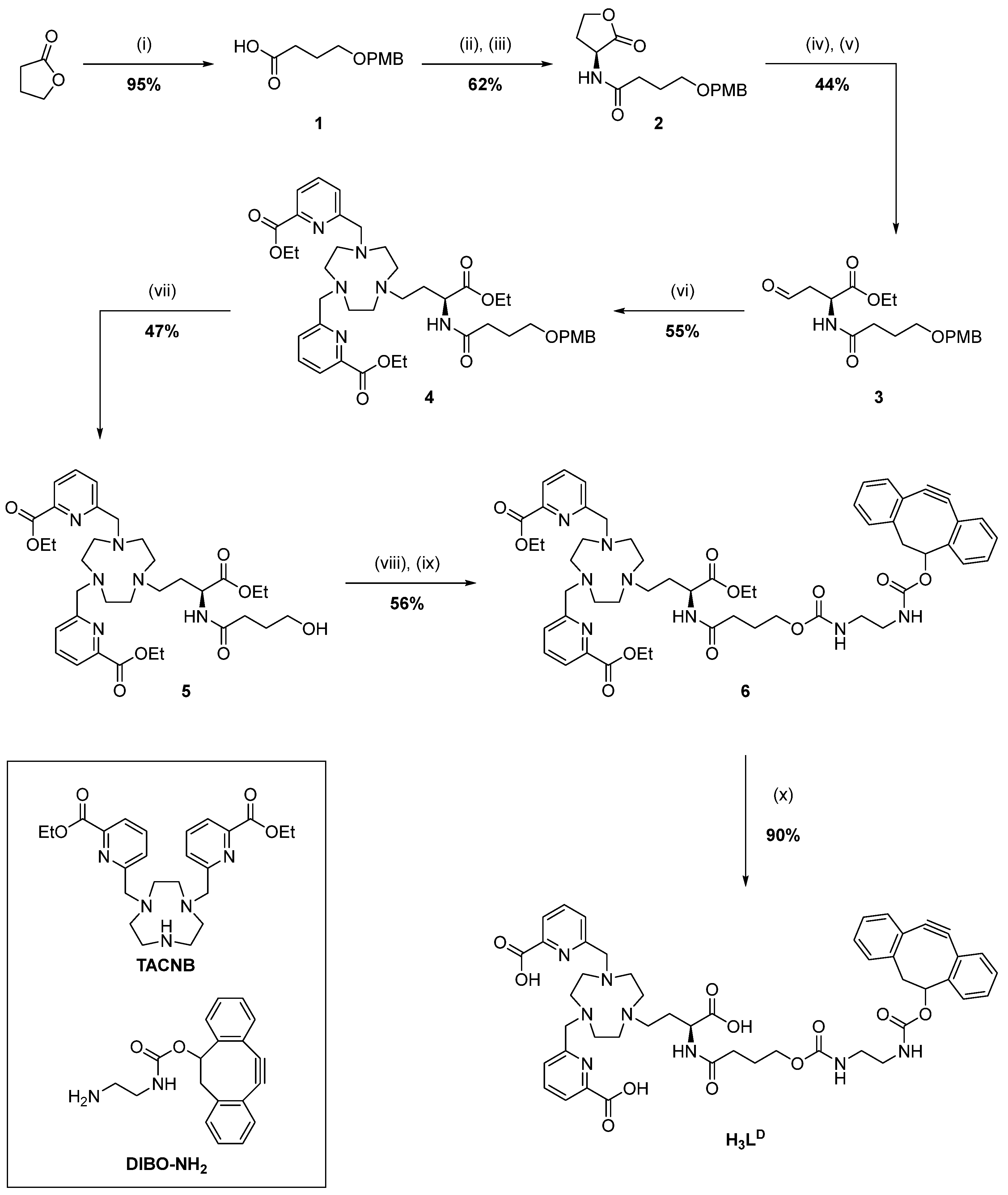
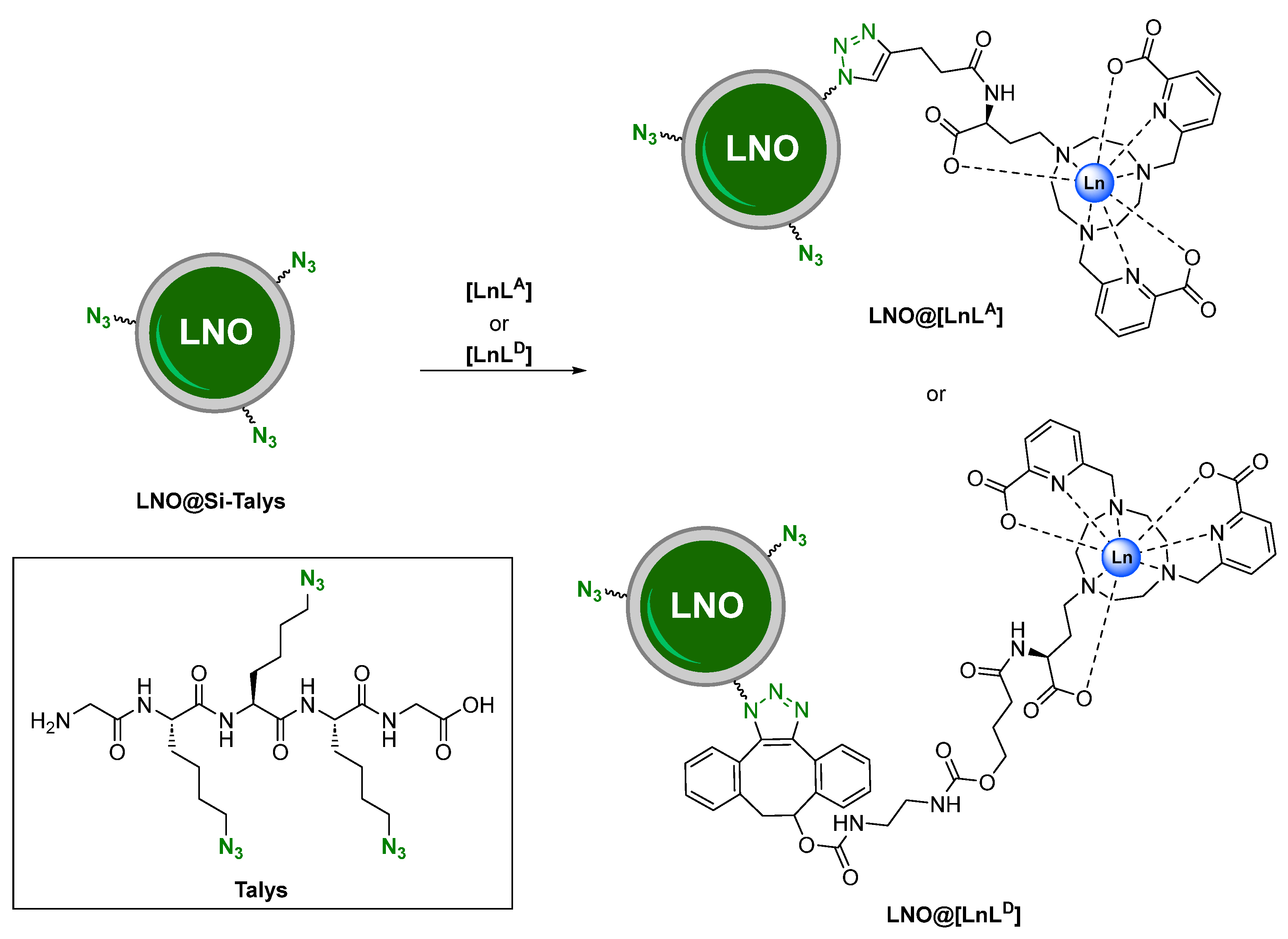
A new synthetic pathway was designed from the previously established H3LA to replace the terminal alkyne with a strained DIBO that enables copper-free click chemistry via SPAAC (Scheme 1). This approach was successfully applied in the past to conjugate a cellular-targeting ligand [64] and different photoresponsive drug delivery systems [65,70,71] to the surface of HNPs. The synthesis starts with the γ-butyrolactone ring opening using a strong base to generate the corresponding hydroxy acid, whose alcohol position was directly protected with p-methoxybenzylbromide (PMBBr) in a one-pot reaction to afford 1 in a nearly quantitative yield. After amide coupling with (S)-(−)-α-amino-γ-butyrolactone hydrobromide, the acid-catalyzed ring opening of 2 and in situ trans-esterification generated an unstable alcohol intermediate, which was successfully oxidized under Swern conditions to the aldehyde 3. This aldehyde was reacted with the secondary amine position of the previously synthesized 1,4-bipicolinate-1,4,7-triazacyclononane (TACNB) via reductive amination in the presence of NaBH(OAc)3 to afford 4 in moderate yield. The primary hydroxyl was then selectively deprotected under radical conditions using 2,3-dichloro-5,6-dicyano-1,4-benzoquinone (DDQ) and the resulting alcohol 5 was activated with 4-nitrophenyl chloroformate (4-NPCF) for subsequent coupling with DIBO-NH2 to afford the ester-protected ligand precursor. The final DIBO ligand H3LD was isolated after saponification with LiOH.

3.2. H3LA and H3LD Complexes Synthesis

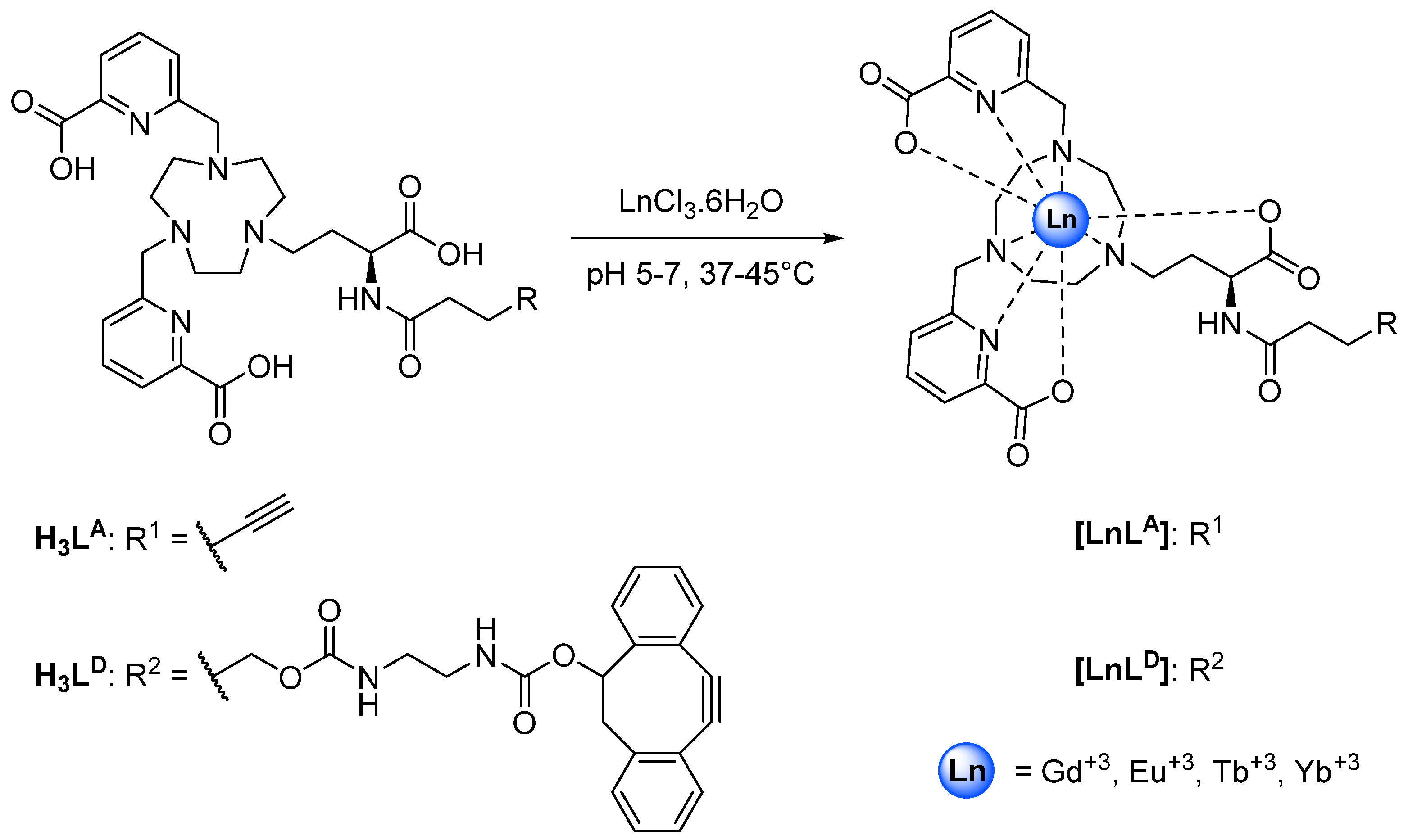
Four trichloride salts based on Gd+3, Eu+3, Tb+3 and Yb+3 were selected to cover several imaging modalities, including MRI, red and green visible as well as NIR PL, respectively. Each Ln chloride salt was reacted with both H3LA and H3LD under mild heating and controlled pH conditions (Scheme 2) to afford the corresponding complexes. The consistent complexes’ formation of all four Ln ions by both ligands under similar conditions reflects their versatility toward diverse click handles while maintaining strong Ln binding, mirroring the characteristics of the analogous H3ebpatcn scaffold despite the presence of an extra methylene group on the third carboxylate [51,55].

3.3. LNO Functionalization with Ln Complexes

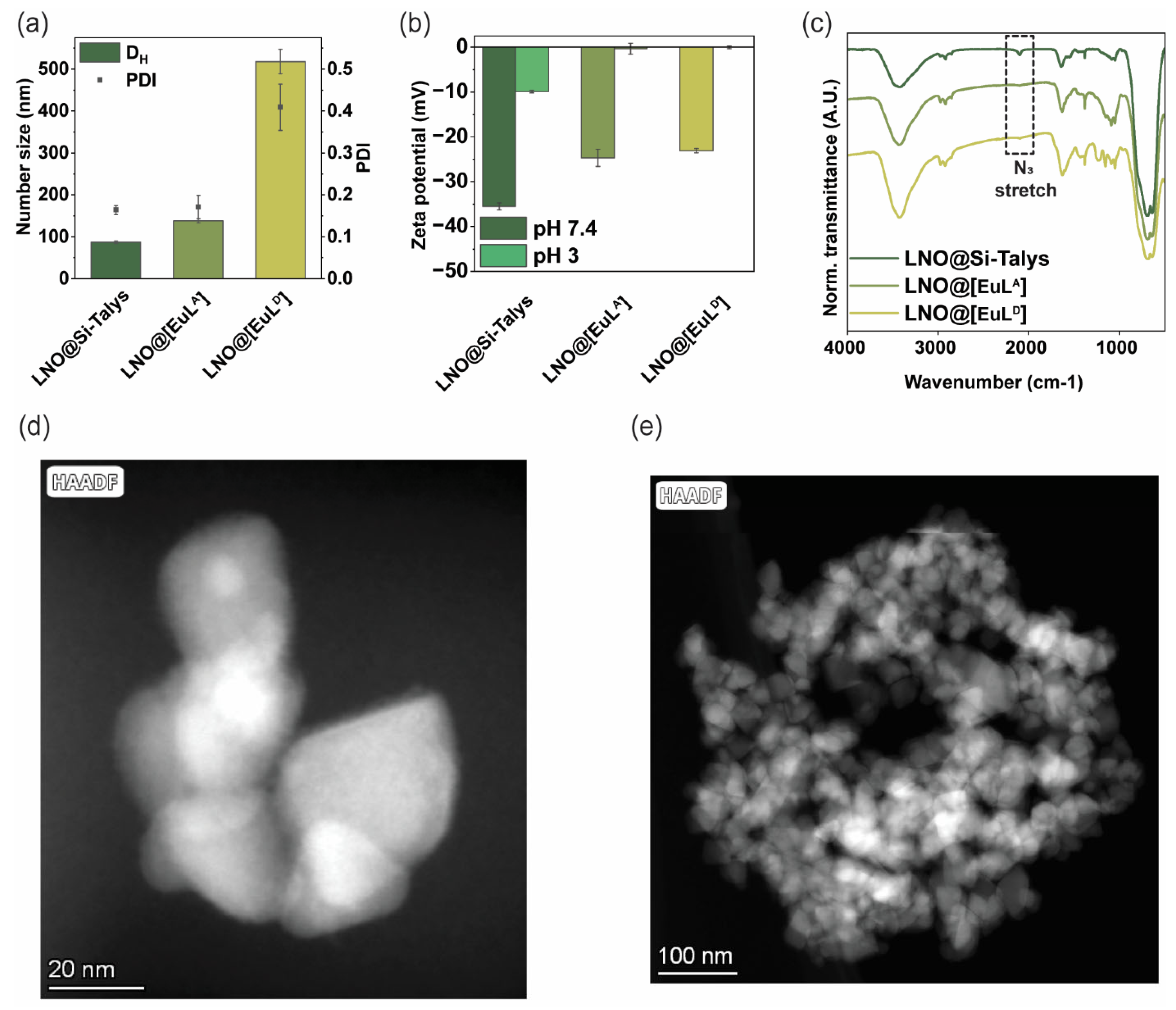
The surface modification of silanized LNO HNPs with a short tri-azidolysine (Talys) pentapeptide was previously reported to allow for the simultaneous introduction of surface azido and carboxyl reactive handles while maintaining good colloidal properties both in aqueous and polar organic media [68]. Talys-modified LNO HNPs (LNO@Si-Talys) were therefore synthesized (precursor characterization in Supplementary Materials, Table S1), and used for further conjugation with [LnLA] and [LnLD] via CuAAC or SPAAC, respectively (Scheme 3). In the case of CuAAC, the aqueous hydrodynamic diameter (DH) increased compared to the LNO@Si-Talys while the zeta potential (ZP) maintained similar pH-dependent values (Table 1, entries 2–4, Figure 2a,b and Figures S17–S20a), suggesting efficient surface modification without altering the carboxylate groups. The simultaneous DH decrease in EtOH and DH increase in PBS further corroborated a modification in solvation due to the introduction of a neutral moiety, i.e., [LnLA]. In the case of SPAAC, while a similar trend was observed in EtOH, the size increase in PBS was larger and in agreement with the introduction of a bulkier hydrophobic complex on the HNP surface (Table 1, entries 5–8, Figure 2a,b and Figures S17–S20a). Importantly, the corresponding correlograms (Figures S17–S20b) indicated no sedimentation during measurement, and only suggested aggregation in the cases where the polydispersity index (PDI) was above 0.2. The pH-dependent ZP was maintained as well, indicating functionalization at the azide position. The disappearance of the azide stretching band in FTIR spectroscopy further confirmed azide–alkyne cycloaddition (Figure 2c and Figures S17–S20c). We anticipate that future efforts to incorporate a hydrophilic spacer within [LnLD] will allow to decrease the aggregation of conjugated LNOs DH in aqueous medium.
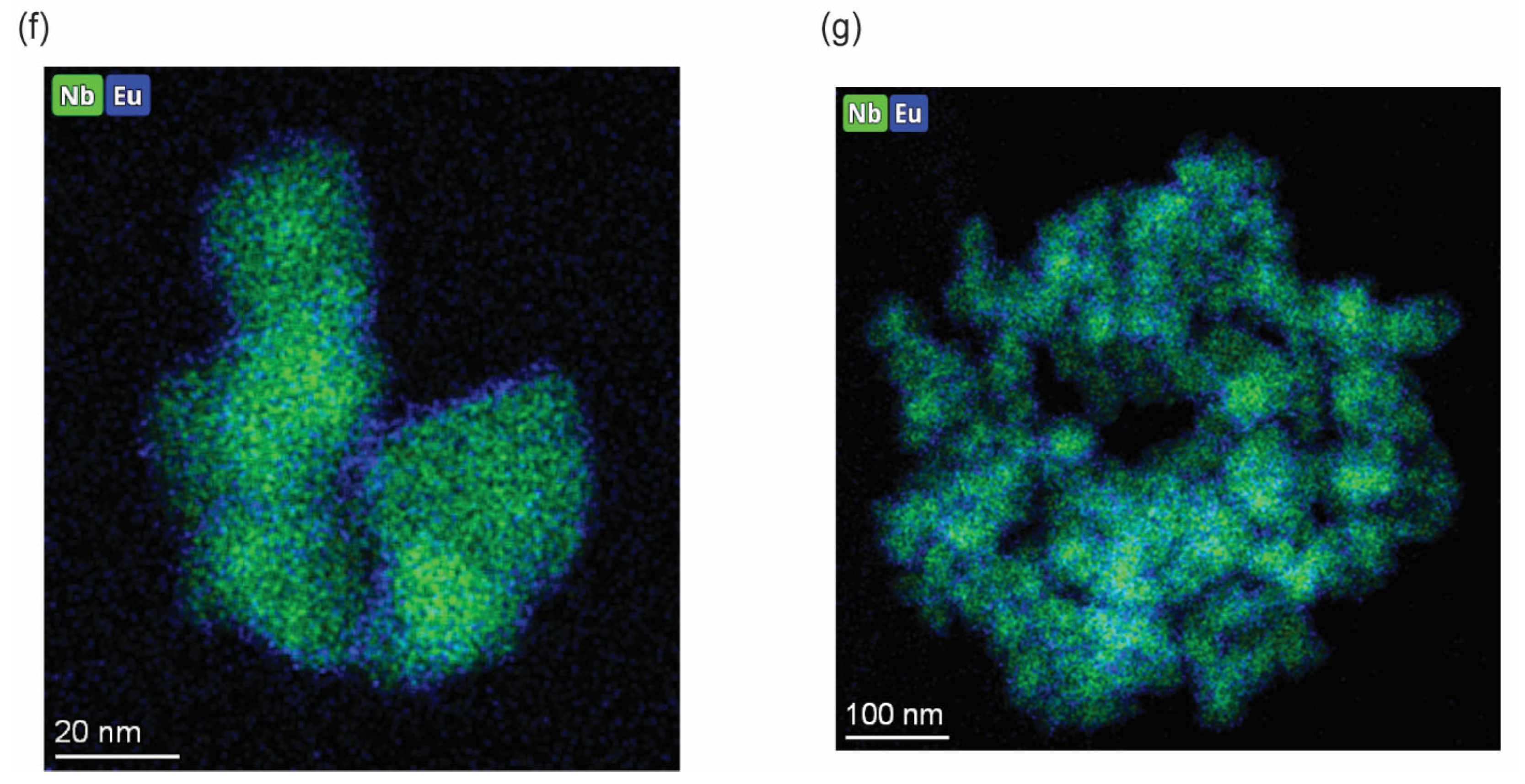
The different LNO HNP conjugates were further analyzed by scanning transmission electron microscopy (STEM) in high-angle annular dark field (HAADF) mode and their elemental composition was mapped by energy-dispersive X-ray spectroscopy (EDX) (Figure 2d–g and Figures S17–S20d–k). The samples exhibited a clear core–shell structure with the Ln atoms homogeneously distributed around the LNO core, therefore giving evidence for successful surface functionalization. The size and shape of functionalized LNO HNPs were in accordance with DLS values and previous literature [67,68]. Overall, these data confirm that Ln complexes can be efficiently conjugated to the surface of silanized LNO HNPs using either CuAAC or SPAAC click chemistry.

3.4. Validation of MR Nonlinear Optical Dual Imaging Using LNO@[GdLD]

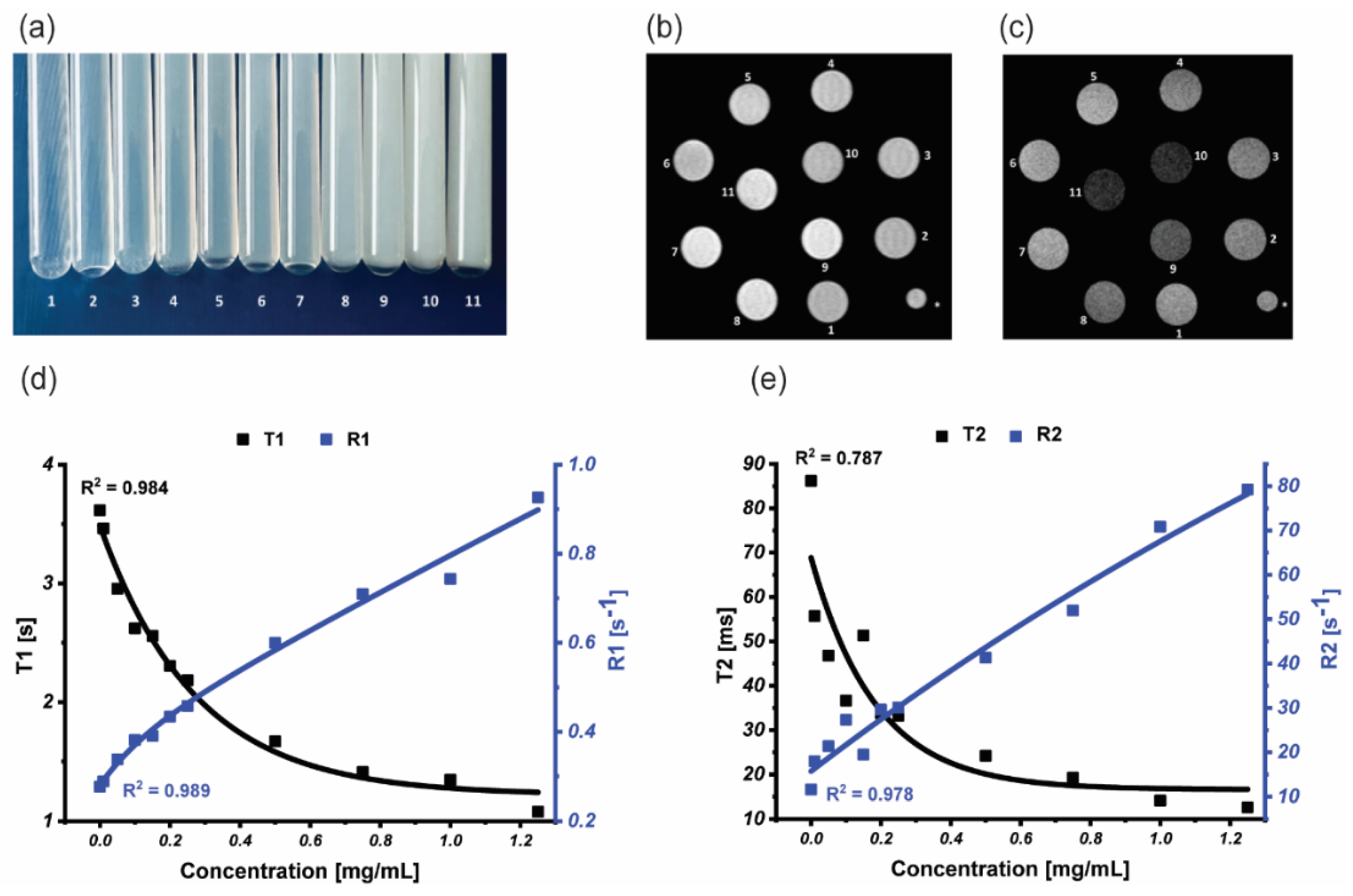
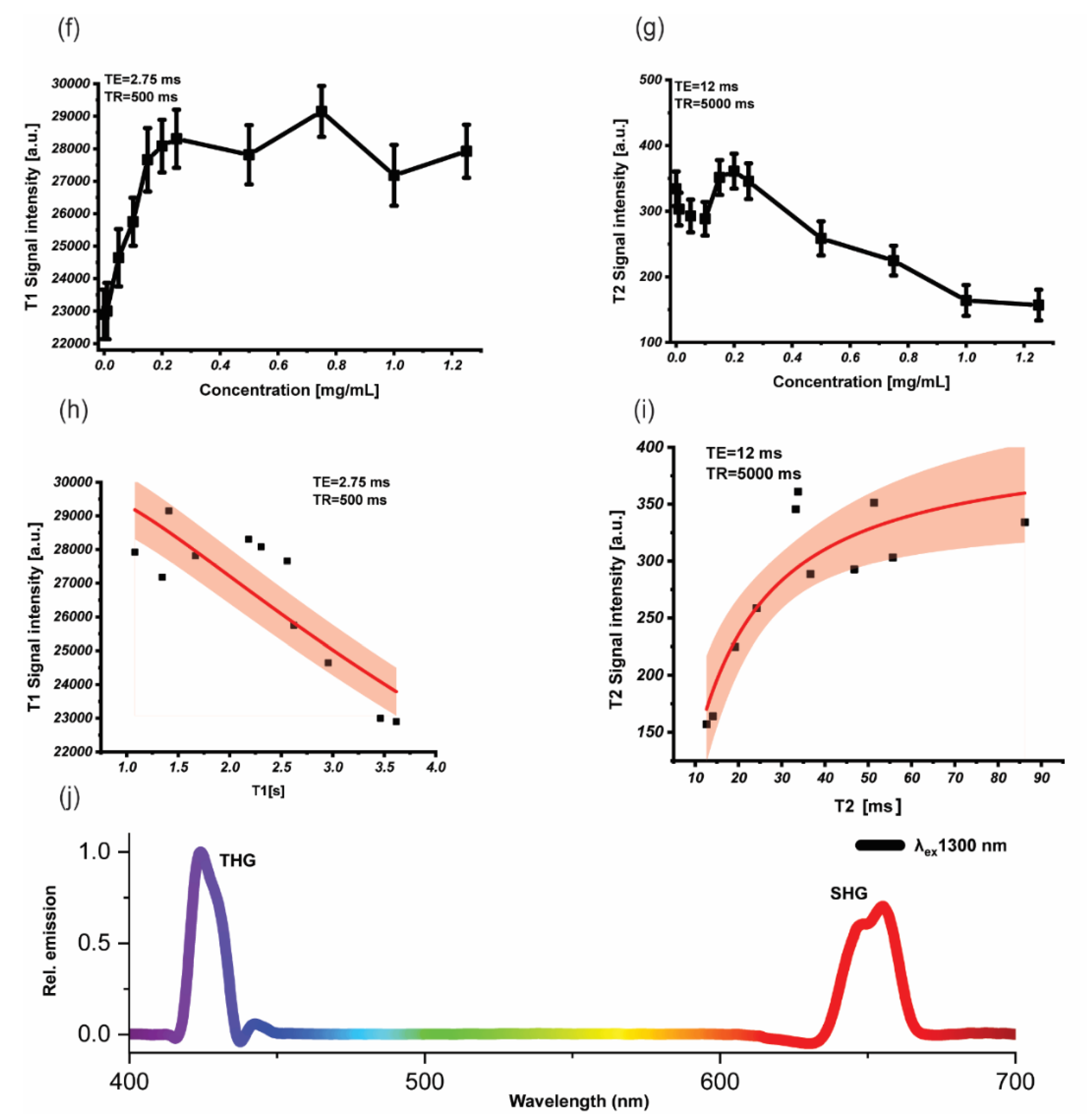
The magnetic resonance (MR) properties of LNO@[GdLD] were first investigated following an MRI phantom approach [56]. Briefly, LNO@[GdLD] were incorporated into an agarose gel phantom at varying concentrations (Figure 3a), and their relaxation properties were measured. These data were compared with the recorded T1- (Figure 3b) or T2-weighted (Figure 3c) phantom images. The samples exhibited an almost linear increase in both R1 (Figure 3d) and R2 (Figure 3e) relaxation rates with increasing NP concentration, which in turn translated into a concentration-dependent increase in T1-weighted MR signal (Figure 3f) and decrease in T2-weighted MR signal (Figure 3g) on the phantom images, respectively. Strikingly, the contrast magnitude nearly doubled in the T1-weighted image compared to the reported system based on CuAAC conjugation, while the T2-weighted image was characterized by a slightly more rapid decrease in signal intensity [56]. The subsequent quantitative phantom mapping of the T1- and T2-weighted MR signal intensity variations exhibited a clear mono-exponential signal dependence over the T2 range (Figure 3i), and a realistic monotonic signal variation over the T1 range (Figure 3h) related to the NP concentration, respectively, in line with the reported data. These results therefore confirm that [GdLD] can be conjugated to LNO HNPs via SPAAC resulting in a promising T1 and T2 MRI CA. The LNO core’s ability to produce multi-harmonic emission was further evaluated upon femtosecond (fs) pulsed irradiation at 1300 nm, in the second NIR (NIR-II) window. The obtained visible spectrum (Figure 3j) displayed a strong nonlinear response, with simultaneous detection of SHG (650 nm) and THG (433 nm), similarly to reported LNO nanomaterials [71,72,73]. The combined LNO@[GdLD] nonlinear imaging and MRI properties therefore demonstrate the effectiveness of the SPAAC conjugation pathway relative to the copper-catalyzed version. It also suggests that this approach may further improve the overall performance in a biological environment by reducing the cytotoxicity associated with copper residues. To further develop this type of MRI CA, it would be interesting to investigate the interplay between the overall system hydrophilicity (i.e., the HNP coating and the complex molecular structure) and the observed MRI properties which strongly rely upon water accessibility [31,45,74].

3.5. Investigation of Photophysical Properties

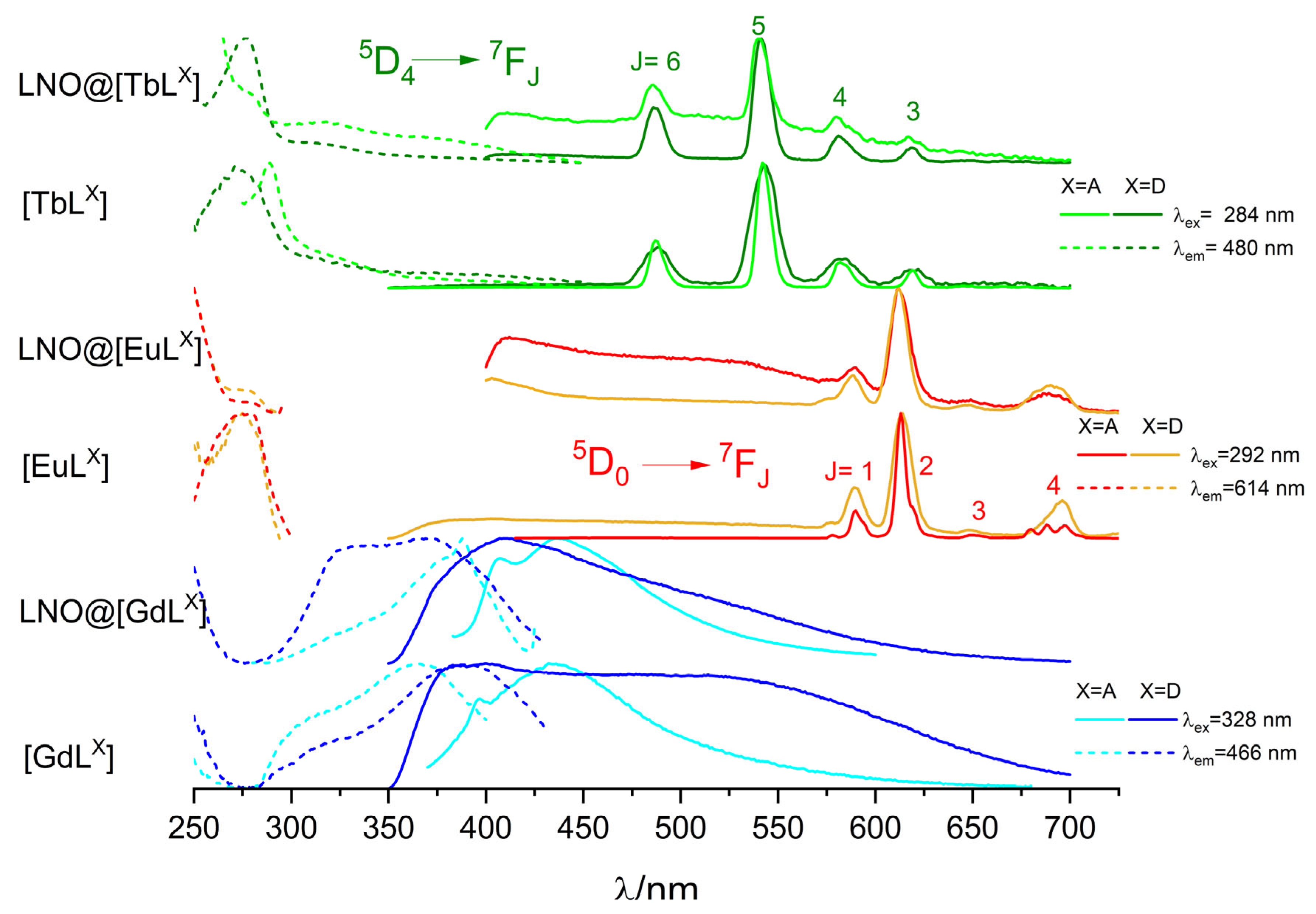
We first investigated the ligand-centered emission of the Gd complexes in the solid state. At room temperature, excitation within the ligand absorption band at 328 nm gives rise to a broad emission envelope originating from both singlet 1ππ* and triplet 3ππ* excited states of the ligand (Figure 4). Under phosphorescence detection conditions, still at room temperature, ligand emission from the singlet state remains observable alongside the triplet-state emission (Figure S23). The latter displays a maximum at ca. 518 nm (19,305 cm−1) together with a well-defined 0–0 transition at 470 nm (21,277 cm−1), accompanied by vibronic fine structure, consistent with a ligand-centered ring-breathing mode. The corresponding triplet-state lifetime is 0.9 ± 0.1 ms. Upon grafting onto the surface of the NPs, a broad ligand-centered emission is still observed, although significantly broadened and extending up to ca. 700 nm.
The ligand also efficiently sensitizes the luminescence of Eu3+ and Tb3+ ions in the visible region at room temperature, as illustrated in Figure 4.
For the Eu3+ complexes, the excitation spectra are blue-shifted, with maxima at 272 nm for [EuLA] and 292 nm for the corresponding NP-supported systems. Upon ligand excitation, the emission spectra are dominated by the characteristic metal-centered 5D07FJ (J = 1–4) transitions of Eu3+. The 5D07F0 transition appears as a very weak band, while the other 5D07FJ transitions exhibit two, two and four main components for J = 1, 2 and 4, respectively. This splitting pattern is indicative of a single dominant Eu3+ species undergoing a low-symmetry crystal field, consistent with a pseudo-D3 local symmetry around the metal center.
Notably, the emission profiles and relative intensities of LNO@[EuLA] match those of the molecular complex [EuLA], indicating that grafting onto the NP surface does not significantly perturb the coordination environment of the Eu3+ ion. This conclusion is further supported by the mono-exponential emission decays observed for both systems (in Table 2 (solid state) and Table S2 (DMSO and water)). The slightly shorter lifetime observed for the NP-supported complex points to additional non-radiative deactivation pathways at the NP surface.
In addition to the narrow metal-centered emission, residual ligand-centered triplet phosphorescence is observed for both [EuLA] and LNO@[EuLA] in the solid state; however, the integrated intensity of the Eu3+-centered emission is significantly higher, evidencing efficient ligand-to-metal energy transfer. In DMSO solution, neither the 1ππ* nor the 3ππ* ligand emission is detected, which can be attributed to reduced aggregation effects in solution and further confirms efficient sensitization of the Eu3+ excited states. In contrast, ligand phosphorescence re-emerges in aqueous solution, and Eu3+ emission is strongly decreased (Figures S24 and S25), reflecting efficient non-radiative deactivation mediated by O–H vibrational oscillators of the water molecules.
For the Tb3+ systems, the characteristic sharp emission lines arising from the 5D47FJ (J = 6–3) transitions are observed for both the molecular complexes and the NP-supported materials. Ligand-centered triplet phosphorescence is also detected for LNO@[TbLA] in the solid state, but not for LNO@[TbLD]. For the latter, it is also negligible in water (Figure S27). The luminescence decay of all Tb3+-emitting species is mono-exponential in the microsecond range, and is shorter for the LNO@[TbLX] compared to the complexes.
Efficient sensitization of Tb3+ and Eu3+ by the ligand depends on the alignment between the ligand triplet energy (3ππ*) and the lanthanide emitting levels. For Tb3+ (5D4 ≈ 20,500 cm−1), the energy gap ΔE(3ππ*-5D4) is ca. 780 cm−1, which lies within the range compatible with efficient energy transfer while minimizing back-transfer, consistent with the intense Tb3+ emission observed. In the case of Eu3+ (5D0 ≈ 17,200 cm−1), the corresponding energy gap ΔE(3ππ*-5D0) is ca. 4100 cm−1. Although this gap is theoretically suitable for sensitization, the Eu3+ emission is noticeably weaker, reflecting the generally lower efficiency of ligand-to-Eu3+ energy transfer relative to Tb3+ in this TACN-containing system.
The photophysical behavior of the lanthanide complexes reported here highlights the intrinsic compromise between ligand design optimized for MRI applications and the requirements for efficient lanthanide-centered luminescence. In particular, the presence of inner-sphere water molecules, which is essential for high relaxivity in Gd3+-based MRI CAs, is well known to be detrimental to Eu3+ emission due to efficient non-radiative deactivation pathways involving O–H vibrational oscillators, as Eu3+ luminescence is extremely sensitive to its first coordination sphere. The presence of one or more coordinated water molecules introduces high-energy vibrational modes that efficiently quench the 5D0 excited state, leading to shortened lifetimes and reduced quantum yields. This behavior is clearly evidenced in the present systems by the pronounced decrease in both lifetime and emission intensity observed in aqueous media. Furthermore, the hydration number q was estimated using established phenomenological equations [75] for [EuLA], based on the observed luminescence lifetimes in H2O and D2O, and a value of the hydration number q ≈ 1.7 was obtained. Ligands such as DOTA or TACN, which are widely employed in Gd3+ MRI CAs, are deliberately designed to leave one coordination site available for water in order to maximize relaxivity, while maintaining high thermodynamic stability and kinetic inertness. Although this design strategy is ideal for MRI, it is intrinsically incompatible with the requirements for efficient Eu3+ luminescence, which implies q ≈ 0. Consequently, Eu3+ complexes derived from such ligand frameworks typically exhibit limited emission efficiencies, as observed in the present study. Interestingly, the reported [GdLA] relaxivity [56] and the measured emission lifetimes for [EuLA] and [TbLA] are still comparable to the corresponding complexes based on the H3ebpatcn ligand [55] as well as Eu-conjugated Au NPs [48], highlighting the efficient design compromise to achieve both MR and lanthanide luminescence detection. This also suggests that the coordination properties of the latter are maintained within the new H3LA and H3LD ligands, even though we cannot exclude an equilibrium with the arm of the linker as it forms a seven-member ring. In addition, even in these detrimental conditions, the quantum yield of [EuLA] amounts to 14.0 ± 0.3% in DMSO, whereas a markedly lower value (<2%) is observed for LNO@[EuLA], reflecting additional quenching processes at the NP interface. Although low, this quantum yield remains significant. The additional decrease observed for the NP-supported systems is attributed to surface-related quenching processes, including enhanced vibrational coupling and possible energy migration towards non-radiative traps.
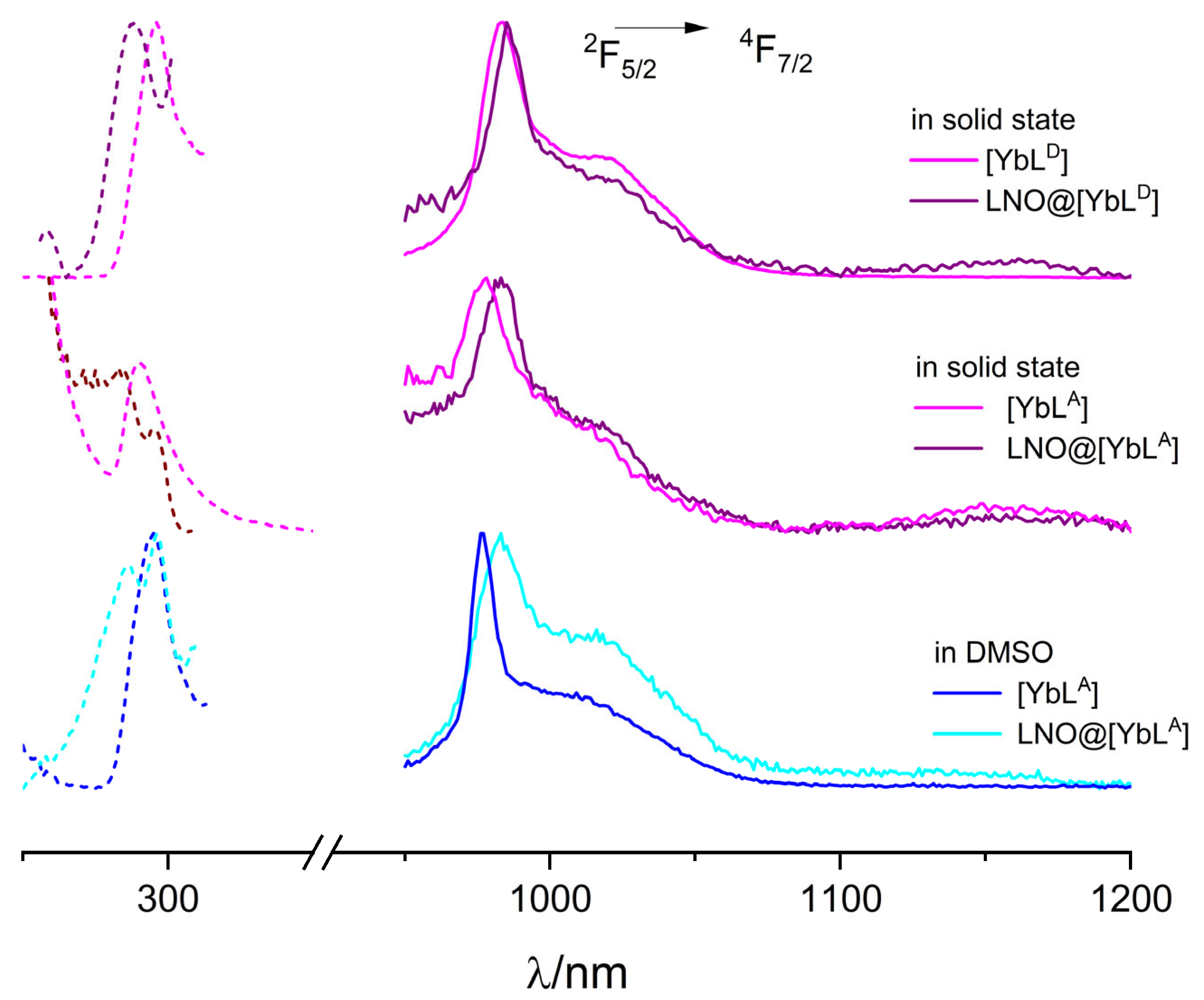
In the case of the Yb complex and functionalized LNOs, the characteristic emission of Yb (III) in the NIR region at 900–1100 nm can be observed, for both [YbLX] and LNO @[YbLX] compounds (X = A, D), in solid state and in solution (Figure 5). The emission is corresponding to the 2F5/22F7/2 transition. Although the intensity of the emission is lower for the NP, it is easily observed at room temperature. This observation also confirms that the complexation and surface conjugation was successful in the case of the Yb, and shows how multiple emission wavelengths can be achieved through variation in the lanthanide species. Another interesting perspective for the LNO@[YbLX] resides in the fact that Yb (III) complexes are reported to behave as efficient X-ray CT CAs, which could pave the way for a supplementary imaging modality for the nanoplatform [26].

3.6. Proof-of-Concept of SHG-Induced Eu Luminescence

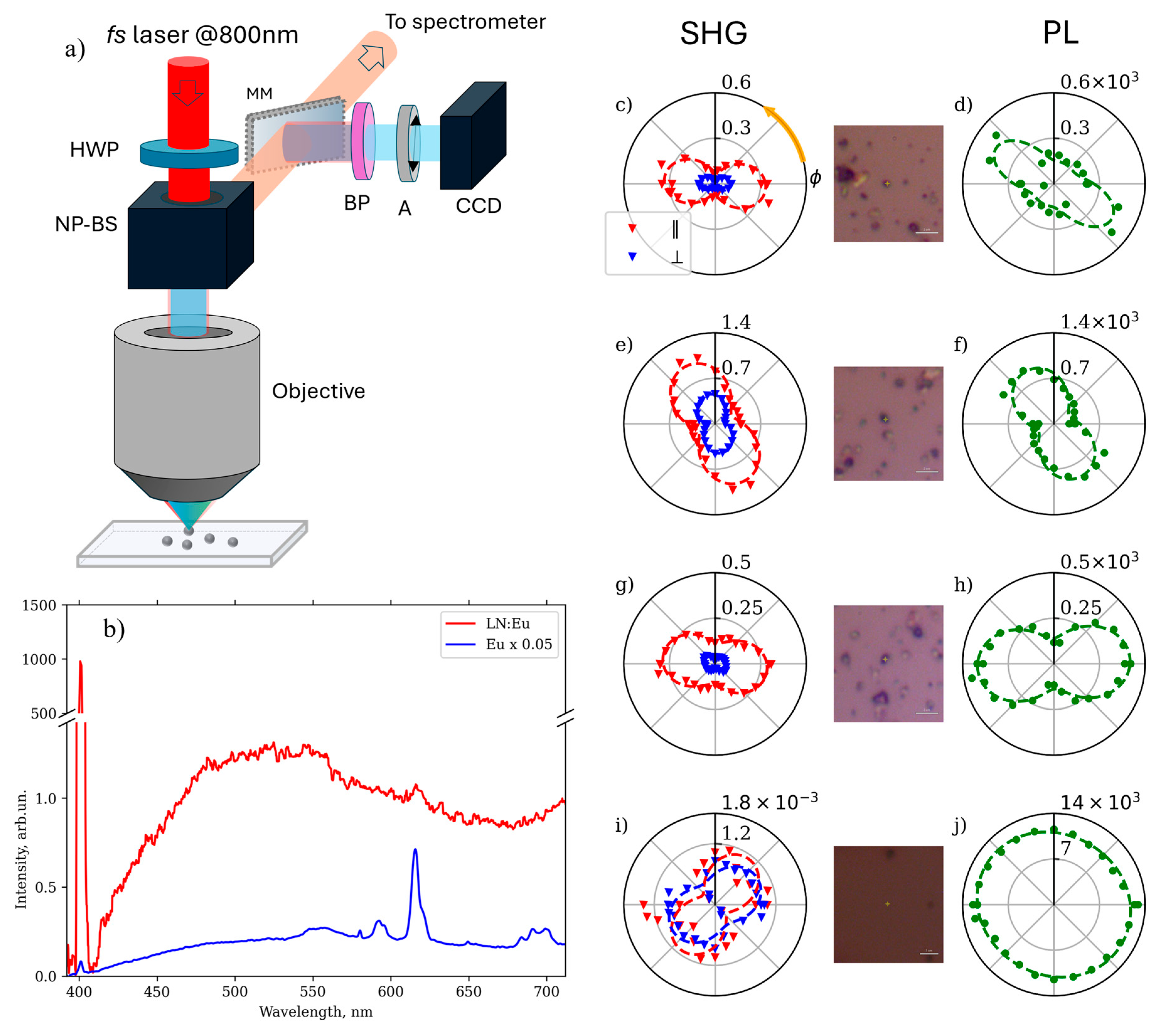
To study the feasibility of truly combining the Ln complex PL with the nonlinear optical properties of the LNO core, we sought to sensitize the Ln center in conjugated LNOs via their SHG. To circumvent the inaccessible ligand excitation maximum (λex = 284–292 nm) with the available laser source, we opted for a direct excitation of the Ln center instead, even though the resulting PL efficiency is intrinsically lower compared to the antenna effect approach employed in the previous section. This approach can be achieved using the 5L6 energy level of Eu. For spatially resolved measurements, we used a custom-modified confocal Raman microscope LabRAM HR Evolution equipped with a fs laser source emitting at 800 nm (Coherent Vitesse, 100~ fs, 80~ MHz). In Figure 6b, we present a comparison of the spectra from a LNO@[EuLA] subdiffraction-limited particle and a reference, LNO-free sample containing [EuLA]. The latter (blue trace) presents a characteristic PL peak at 612 nm over a broad PL background extending over the full detection spectral range and a comparatively very weak SHG peak at 400 nm. A LNO@[EuLA] particle measured under the same conditions shows the opposite trend (red trace), yielding a PL peak at 612 nm about four orders of magnitude weaker than the SHG peak. The difference in intensity can be explained by the low concentration of surface Eu complexes in LNO@[EuLA] and by the intrinsically lower PL efficiency associated with the experimental design. The 5D07F2 signal is indeed similar to the one observed upon continuous, direct excitation of the Eu cation, without any antenna effect, as depicted in Figure S26. The broadband PL in LNO@[EuLA] spectrum can be explained by emission from the organic coating as previously reported [71].
The excitation of Eu PL in LNO@[EuLA] particles can simultaneously occur upon direct two-photon absorption by Eu or one-photon absorption of SHG emitted by the LNO core. To demonstrate that this second excitation channel mediated by LNO emission is also active, we devised an experimental protocol based on polarization-resolved modulation of SHG, as a simple power-dependence measurement would not allow to distinguish the two processes. The selected approach relies on previous works by our and other groups highlighting the strong excitation polarization dependence in the emission of HNPs [76,77,78].
A schematic representation of the experimental setup is presented in Figure 6a. Examples of polarization-resolved SHG and PL intensities, as well as polarization-resolved PL maps, are shown in Figure 6. Different LNO@[EuLA] NPs display clear polarization-dependent SHG (Figure 6c,e,g) and PL (Figure 6d,f,h) responses that broadly correlate with each other, whereas the reference sample of [EuLA] shows polarization-independent PL (Figure 6j) and unresolvable SHG (Figure 6i). The maxima of PL and SHG signals correspond to different orientations of the NP crystal structure. It has to be noted that PL and SHG signals do not vanish at polarization angles orthogonal to the LNO c-axis, which can be explained by the three-dimensional alignment of the particles and by the complex distribution of the pump field on the substrate due to tight focusing of the beam [79]. In addition, PL excitation can be obtained upon direct multiphoton absorption independently of the presence of the LNO core, adding a polarization-independent component to the total response as in the control measurement of Figure 6j. Figure S22 further highlights that PL and SHG are colocalized and associated with the presence of NPs. Overall, these results constitute a demonstration of Ln PL predominantly triggered by SHG, providing foundations for future developments of optical probes based on these signals. We further anticipate that system optimizations to enable antenna sensitization by a better matching of SHG with Ln complex absorption will significantly increase the PL efficiency.

3.7. Recyclability of the LNO@[LnLX] System

We ultimately established a proof-of-concept experiment highlighting the potential to recycle the LNO@[LnLX] nanoplatform by modifying its imaging signature. The Gd ion of LNO@[GdLD] was uncomplexed upon acidic treatment, and the HNPs were then reacted with TbCl3. The obtained LNO@[Gd → TbLD] exhibited spectral properties identical to those of freshly prepared LNO@[TbLD] (Figure S27). This observation provides evidence for surface functionalization robustness, enabling the preservation of efficient Ln binding abilities to iteratively introduce different Ln ions according to the intended application. This feature opens up promising perspectives for the development of tunable bioimaging [80] and anti-counterfeiting [14] probes based on mixed Ln tags.

4. Conclusions

This work describes the synthesis and evaluation of two Ln ligands incorporating either a strained cyclooctyne moiety (H3LD), or a terminal alkyne analog (H3LA), amenable to SPAAC and CuAAC click chemistry, respectively. Thorough NMR analysis confirmed the ligand structure, while HRMS and PL evidenced successful Ln complexation. The photophysical properties of the ligands, their Ln complexes and LNO surface functionalization were indeed explored with particular emphasis towards multimodal imaging. Besides the standard DLS, FTIR and STEM characterizations, an EDX elemental mapping allowed to confirm the homogenous surface distribution of the complexes using both Cu-free and Cu-catalyzed click chemistry. The SPAAC-conjugated Gd system was first studied for nonlinear optical-MR bimodal imaging, demonstrating the ability of these HNP conjugates to act as dual T1/T2 MRI CA while preserving their capacity to produce strong SHG and THG signals upon NIR light irradiation. Furthermore, the photophysical properties of all eight Ln complexes and their conjugates were studied, demonstrating the characteristic green Tb, red Eu and NIR Yb emissions, as well as triplet-state Gd emission. In addition, both freshly conjugated LNO@[LnLX] (X = A, D) samples and recycled batches exhibited luminescence, suggesting high potential for development into a reusable and tunable tagging platform. The Eu signal could further be triggered by using the SHG of the LNO core upon fs-pulsed excitation at 800 nm, providing the first example of a truly multidimensional HNP-Ln conjugate. Considering the wide application range of Ln complexes, this work not only paves the way for multimodal bioimaging combining nonlinear optics, Ln luminescence footprints and/or MRI, but also provides a synthetic framework for future research in areas like sensing [35,40,81], nuclear medicine [82] or anti-counterfeiting [83,84].

Supplementary Materials

The following supporting information can be downloaded at: https://www.mdpi.com/article/10.3390/nano16100591/s1, Synthetic procedures and characterizations: Mass spectra, NMR spectra and IR spectra; Bare LNO characterization (XRD and TEM); DLS characterization of LNO precursors; Comparative characterization of [Ln]-conjugated LNOs via CuAAC and SPAAC; Detailed parameters for T1 and T2 signal intensity fitting; SHG and PL maps overlaid to the bright field optical image of LNO@[EuLA] HNPs; Lifetimes of [LnLA] and LNO@[LnLA] in DMSO or in H2O (conc: 4 mM); Normalized, corrected emission and excitation spectra of [GdLA] and LNO@[GdLA] recorded in the solid state at room temperature; Normalized, corrected emission and excitation spectra of the [LnLA] complexes and the corresponding nanoparticle systems LNO@[LnLA] recorded in DMSO solutions (4 mM) at room temperature; Normalized, corrected emission spectra of the [EuLA] and LNO@[EuLA] recorded in the solid state at room temperature, upon excitation at 395 nm to populate the 5L6 excited level of trivalent europium from the ground 7F0 state; Emission- and excitation-corrected spectra of the LNO@[GdLD] and LNO@[Gd→TbLD] in H2O at room temperature.

Author Contributions

Conceptualization: S.D., V.M., A.G., A.-S.C.; Data curation: S.D., V.M., A.G., A.S., K.P., B.L., A.D.; Funding acquisition: Y.M., J.T., L.B., A.-S.C., S.G.-L.; Investigation: S.D., V.M., A.G., A.S., K.P., B.L.; Methodology: S.D., V.M., A.G., A.S., K.P., B.L., A.D., A.-S.C.; Project administration: Y.M., J.T., L.B., A.-S.C., S.G.-L.; Resources: A.D., Y.M.; Supervision: Y.M., L.B., A.-S.C., S.G.-L.; Validation: S.D., V.M., A.G., A.S., K.P., B.L., A.D.; Writing—original draft: S.D., V.M., L.B., A.-S.C., S.G.-L.; Writing—review and editing: S.D., V.M., A.G., A.S., K.P., B.L., A.D., Y.M., J.T., L.B., A.-S.C., S.G.-L. All authors have read and agreed to the published version of the manuscript.

Funding

This study was funded by the Swiss National Science Foundation (DARE, grant No. 200021E_205745), the French Agence Nationale de la Recherche (DARE, grant No. ANR-21-CE09-0036-01), Swiss National Science Foundation Spark project CRSK-2_227400.

Data Availability Statement

The original data presented in the study are openly available in Zenodo at https://doi.org/10.5281/zenodo.19693995.

Acknowledgments

The authors acknowledge the CIBM Center for Biomedical Imaging for providing expertise and resources to conduct this study. The authors also kindly acknowledge the technical support of Amélie Girardin, Leatitia Freymond, Selena Jungo and Anna Piceni throughout the synthesis of H3LA and H3LD. The authors further acknowledge the EPFL ISIC-MSEAP (Laure Menin, Daniel Ortiz and Marziyeh Komeili) for assistance with HRMS acquisition, ISIC-NMRP (Aurélien Bornet) for the acquisition of relaxation times used in the MRI study, and the CIME (Rita Therisod, David Reyes, Jérémie Bettex) for the preparation, acquisition and guidance in analysis of STEM-EDX data.

Conflicts of Interest

The authors declare no conflicts of interest. The funders had no role in the design of the study; in the collection, analyses, or interpretation of data; in the writing of the manuscript; or in the decision to publish the results.

Abbreviations

The following abbreviations are used in this manuscript:
AcOHAcetic acid
AlysAzidolysine
CAContrast agent
CTComputed tomography
CuAACCopper-catalyzed azide–alkyne [3+2]-cycloaddition
DCCN,N′-Dicyclohexylcarbodiimide
DCEDichloroethane
DCMDichloromethane
DDQ2,3-dichloro-5,6-dicyano-1,4-benzoquinone
DHHydrodynamic diameter
DIBODibenzocyclooctyne
DIBO-NH2Amino-modified dibenzocyclooctyne
DIPEADiisopropylethylamine
DLSDynamic light scattering
DMAcN,N-Dimethylacetamide
DMFN,N-Dimethylformamide
DMSODimethylsulfoxide
EDXEnergy-dispersive X-ray spectroscopy
FCCFlash column chromatography
FHGFourth harmonic generation
FTIR Fourier transform infrared 
IRInfrared
HexHexane
HNPHarmonic nanoparticle
LnLanthanide
LNOLithium niobate
MRMagnetic resonance
MRIMagnetic resonance imaging
MWCOMolecular weight cut-off
NHSN-Hydroxy succinimide
NIRNear-infrared
NPNanoparticle
NPCFNitrophenyl chloroformate
PBSPhosphate buffer saline
PDIPolydispersity index
PEGPoly(ethylene glycol)
PETPositron emission tomography
PLPhotoluminescence
PMBBrp-methoxybenzylbromide
PyPyridine
rtRoom temperature
SHGSecond-harmonic generation
SPAACStrain-promoted azide–alkyne [3+2]-cycloaddition
SPECTSingle-photon emission computed tomography
STEMScanning transmission electron microscopy
TACNB1,4-bipicolinate-1,4,7-triazacyclononane
TalysTri-azidolysine peptide
TEATriethylamine
THFTetrahydrofuran
THGThird-harmonic generation
TLCThin-layer chromatography
TolToluene
UVUltraviolet
VisVisible
ZPZeta potential

References

  1. Hussain, S.; Mubeen, I.; Ullah, N.; Shah, S.S.U.D.; Khan, B.A.; Zahoor, M.; Ullah, R.; Khan, F.A.; Sultan, M.A. Modern Diagnostic Imaging Technique Applications and Risk Factors in the Medical Field: A Review. BioMed Res. Int. 2022, 2022, 5164970. [Google Scholar] [CrossRef]
  2. Leitgeb, R.A.; Baumann, B. Multimodal Optical Medical Imaging Concepts Based on Optical Coherence Tomography. Front. Phys. 2018, 6, 114. [Google Scholar] [CrossRef]
  3. Tichauer, K.M.; Wang, Y.; Pogue, B.W.; Liu, J.T.C. Quantitative in Vivo Cell-Surface Receptor Imaging in Oncology: Kinetic Modeling and Paired-Agent Principles from Nuclear Medicine and Optical Imaging. Phys. Med. Biol. 2015, 60, R239–R269. [Google Scholar] [CrossRef]
  4. Lee, S.Y.; Jeon, S.I.; Jung, S.; Chung, I.J.; Ahn, C.-H. Targeted Multimodal Imaging Modalities. Adv. Drug Deliv. Rev. 2014, 76, 60–78. [Google Scholar] [CrossRef]
  5. Weissleder, R.; Pittet, M.J. Imaging in the Era of Molecular Oncology. Nature 2008, 452, 580–589. [Google Scholar] [CrossRef] [PubMed]
  6. Eder, A.-C.; Omrane, M.A.; Stadlbauer, S.; Roscher, M.; Khoder, W.Y.; Gratzke, C.; Kopka, K.; Eder, M.; Meyer, P.T.; Jilg, C.A.; et al. The PSMA-11-Derived Hybrid Molecule PSMA-914 Specifically Identifies Prostate Cancer by Preoperative PET/CT and Intraoperative Fluorescence Imaging. Eur. J. Nucl. Med. Mol. Imaging 2021, 48, 2057–2058. [Google Scholar] [CrossRef] [PubMed]
  7. Baranski, A.-C.; Schäfer, M.; Bauder-Wüst, U.; Roscher, M.; Schmidt, J.; Stenau, E.; Simpfendörfer, T.; Teber, D.; Maier-Hein, L.; Hadaschik, B.; et al. PSMA-11–Derived Dual-Labeled PSMA Inhibitors for Preoperative PET Imaging and Precise Fluorescence-Guided Surgery of Prostate Cancer. J. Nucl. Med. 2018, 59, 639–645. [Google Scholar] [CrossRef]
  8. Xu, S.; Guo, C.; Pan, K.; Wang, L. Combined Fluorescence and MRI in Bioimaging. In Imaging Tools for Chemical Biology; Royal Society of Chemistry: London, UK, 2024. [Google Scholar] [CrossRef]
  9. Yang, J.; Yan, M.; Wang, Z.; Zhang, C.; Guan, M.; Sun, Z. Optical and MRI Multimodal Tracing of Stem Cells In Vivo. Mol. Imaging 2023, 2023, 4223485. [Google Scholar] [CrossRef]
  10. Hao, J.; Cai, H.; Gu, L.; Ma, Y.; Li, Y.; Liu, B.; Zhu, H.; Zeng, F.; Wu, M. A Transferrin Receptor Targeting Dual-Modal MR/NIR Fluorescent Imaging Probe for Glioblastoma Diagnosis. Regen. Biomater. 2024, 11, rbae015. [Google Scholar] [CrossRef]
  11. Gibson, A.P. Medical Imaging Applied to Heritage. Br. J. Radiol. 2023, 96, 20230611. [Google Scholar] [CrossRef]
  12. Belianinov, A.; Ievlev, A.V.; Lorenz, M.; Borodinov, N.; Doughty, B.; Kalinin, S.V.; Fernández, F.M.; Ovchinnikova, O.S. Correlated Materials Characterization via Multimodal Chemical and Functional Imaging. ACS Nano 2018, 12, 11798–11818. [Google Scholar] [CrossRef] [PubMed]
  13. Armetta, F.; Bianco, A.L.; Boiko, V.; Hreniak, D.; Saladino, M.L. Multimodal Anti-Counterfeiting Inks: Modern Use of an Ancient Pigment in Synergy with a Persistent Phosphor. J. Mater. Chem. C 2025, 13, 1188–1197. [Google Scholar] [CrossRef]
  14. Andres, J.; Hersch, R.D.; Moser, J.-E.; Chauvin, A.-S. A New Anti-Counterfeiting Feature Relying on Invisible Luminescent Full Color Images Printed with Lanthanide-Based Inks. Adv. Funct. Mater. 2014, 24, 5029–5036. [Google Scholar] [CrossRef]
  15. Calle, D.; Ballesteros, P.; Cerdán, S. Advanced Contrast Agents for Multimodal Biomedical Imaging Based on Nanotechnology. In Preclinical MRI: Methods and Protocols; García Martín, M.L., López Larrubia, P., Eds.; Springer: New York, NY, USA, 2018; pp. 441–457. ISBN 978-1-4939-7531-0. [Google Scholar]
  16. Bischof, J.; Fletcher, G.; Verkade, P.; Kuntner, C.; Fernandez-Rodriguez, J.; Chaabane, L.; Rose, L.A.; Walter, A.; Vandenbosch, M.; van Zandvoort, M.A.M.J.; et al. Multimodal Bioimaging across Disciplines and Scales: Challenges, Opportunities and Breaking down Barriers. npj Imaging 2024, 2, 5. [Google Scholar] [CrossRef] [PubMed]
  17. Staedler, D.; Magouroux, T.; Hadji, R.; Joulaud, C.; Extermann, J.; Schwung, S.; Passemard, S.; Kasparian, C.; Clarke, G.; Gerrmann, M.; et al. Harmonic Nanocrystals for Biolabeling: A Survey of Optical Properties and Biocompatibility. ACS Nano 2012, 6, 2542–2549. [Google Scholar] [CrossRef] [PubMed]
  18. Pantazis, P.; Maloney, J.; Wu, D.; Fraser, S.E. Second Harmonic Generating (SHG) Nanoprobes for in Vivo Imaging. Proc. Natl. Acad. Sci. USA 2010, 107, 14535–14540. [Google Scholar] [CrossRef]
  19. Campargue, G.; La Volpe, L.; Giardina, G.; Gaulier, G.; Lucarini, F.; Gautschi, I.; Le Dantec, R.; Staedler, D.; Diviani, D.; Mugnier, Y.; et al. Multiorder Nonlinear Mixing in Metal Oxide Nanoparticles. Nano Lett. 2020, 20, 8725–8732. [Google Scholar] [CrossRef]
  20. Passemard, S.; Staedler, D.; Sonego, G.; Magouroux, T.; Schneiter, G.S.; Juillerat-Jeanneret, L.; Bonacina, L.; Gerber-Lemaire, S. Functionalized Bismuth Ferrite Harmonic Nanoparticles for Cancer Cells Labeling and Imaging. J. Nanopart. Res. 2015, 17, 414. [Google Scholar] [CrossRef]
  21. Dubreil, L.; Leroux, I.; Ledevin, M.; Schleder, C.; Lagalice, L.; Lovo, C.; Fleurisson, R.; Passemard, S.; Kilin, V.; Gerber-Lemaire, S.; et al. Multi-Harmonic Imaging in the Second Near-Infrared Window of Nanoparticle-Labeled Stem Cells as a Monitoring Tool in Tissue Depth. ACS Nano 2017, 11, 6672–6681. [Google Scholar] [CrossRef]
  22. Sugiyama, N.; Sonay, A.Y.; Tussiwand, R.; Cohen, B.E.; Pantazis, P. Effective Labeling of Primary Somatic Stem Cells with BaTiO3 Nanocrystals for Second Harmonic Generation Imaging. Small 2018, 14, 1703386. [Google Scholar] [CrossRef]
  23. Karpf, S.; Glöckner Burmeister, N.; Dubreil, L.; Ghosh, S.; Hollandi, R.; Pichon, J.; Leroux, I.; Henkel, A.; Lutz, V.; Jurkevičius, J.; et al. Harmonic Imaging of Stem Cells in Whole Blood at GHz Pixel Rate. Small 2024, 20, 2401472. [Google Scholar] [CrossRef] [PubMed]
  24. Alexander, C.; Guo, Z.; Glover, P.B.; Faulkner, S.; Pikramenou, Z. Luminescent Lanthanides in Biorelated Applications: From Molecules to Nanoparticles and Diagnostic Probes to Therapeutics. Chem. Rev. 2025, 125, 2269–2370. [Google Scholar] [CrossRef]
  25. Wartenberg, N.; Fries, P.; Raccurt, O.; Guillermo, A.; Imbert, D.; Mazzanti, M. A Gadolinium Complex Confined in Silica Nanoparticles as a Highly Efficient T1/T2 MRI Contrast Agent. Chem. Eur. J. 2013, 19, 6980–6983. [Google Scholar] [CrossRef] [PubMed]
  26. Lee, N.; Choi, S.H.; Hyeon, T. Nano-Sized CT Contrast Agents. Adv. Mater. 2013, 25, 2641–2660. [Google Scholar] [CrossRef]
  27. Amoroso, A.J.; Fallis, I.A.; Pope, S.J.A. Chelating Agents for Radiolanthanides: Applications to Imaging and Therapy. Coord. Chem. Rev. 2017, 340, 198–219. [Google Scholar] [CrossRef]
  28. Huang, Y.; Li, L.; Zhang, D.; Gan, L.; Zhao, P.; Zhang, Y.; Zhang, Q.; Hua, M.; Jia, C. Gadolinium-Doped Carbon Quantum Dots Loaded Magnetite Nanoparticles as a Bimodal Nanoprobe for Both Fluorescence and Magnetic Resonance Imaging. Magn. Reson. Imaging 2020, 68, 113–120. [Google Scholar] [CrossRef]
  29. Eliseeva, S.V.; Song, B.; Vandevyver, C.D.B.; Chauvin, A.-S.; Wacker, J.B.; Bünzli, J.-C.G. Increasing the Efficiency of Lanthanide Luminescent Bioprobes: Bioconjugated Silica Nanoparticles as Markers for Cancerous Cells. New J. Chem. 2010, 34, 2915–2921. [Google Scholar] [CrossRef]
  30. Wang, W.; Song, S.; Liu, W.; Xia, T.; Du, G.; Zhai, X.; Jin, B. Two-Photon Excited Luminescence of Structural Light Enhancement in Subwavelength SiO2 Coating Europium Ion-Doped Paramagnetic Gadolinium Oxide Nanoparticle and Application for Magnetic Resonance Imaging. Discov. Nano 2023, 18, 85. [Google Scholar] [CrossRef]
  31. Kostiv, U.; Natile, M.M.; Jirák, D.; Půlpánová, D.; Jiráková, K.; Vosmanská, M.; Horák, D. PEG-Neridronate-Modified NaYF4:Gd3+,Yb3+,Tm3+/NaGdF4 Core–Shell Upconverting Nanoparticles for Bimodal Magnetic Resonance/Optical Luminescence Imaging. ACS Omega 2021, 6, 14420–14429. [Google Scholar] [CrossRef]
  32. Liu, N.; Homann, C.; Morfin, S.; Kesanakurti, M.S.; Calvert, N.D.; Shuhendler, A.J.; Al, T.; Hemmer, E. Core–Multi-Shell Design: Unlocking Multimodal Capabilities in Lanthanide-Based Nanoparticles as Upconverting, T2-Weighted MRI and CT Probes. Nanoscale 2023, 15, 19546–19556. [Google Scholar] [CrossRef]
  33. Chen, C.; Ao, L.; Wu, Y.-T.; Cifliku, V.; Cardoso Dos Santos, M.; Bourrier, E.; Delbianco, M.; Parker, D.; Zwier, J.M.; Huang, L.; et al. Single-Nanoparticle Cell Barcoding by Tunable FRET from Lanthanides to Quantum Dots. Angew. Chem. Int. Ed. 2018, 57, 13686–13690. [Google Scholar] [CrossRef] [PubMed]
  34. Wang, J.; Suffren, Y.; Daiguebonne, C.; Freslon, S.; Bernot, K.; Calvez, G.; Pollès, L.L.; Roiland, C.; Guillou, O. Multi-Emissive Lanthanide-Based Coordination Polymers for Potential Application as Luminescent Bar-Codes. Inorg. Chem. 2019, 58, 2659–2668. [Google Scholar] [CrossRef] [PubMed]
  35. Zhao, M.; Li, B.; Wu, Y.; He, H.; Zhu, X.; Zhang, H.; Dou, C.; Feng, L.; Fan, Y.; Zhang, F. A Tumor-Microenvironment-Responsive Lanthanide–Cyanine FRET Sensor for NIR-II Luminescence-Lifetime In Situ Imaging of Hepatocellular Carcinoma. Adv. Mater. 2020, 32, 2001172. [Google Scholar] [CrossRef]
  36. Smith, D.G.; McMahon, B.K.; Pal, R.; Parker, D. Live Cell Imaging of Lysosomal pH Changes with pH Responsive Ratiometric Lanthanide Probes. Chem. Commun. 2012, 48, 8520–8522. [Google Scholar] [CrossRef]
  37. Ezerskyte, E.; Morkvenas, A.; Venius, J.; Sakirzanovas, S.; Karabanovas, V.; Katelnikovas, A.; Klimkevicius, V. Biocompatible Upconverting Nanoprobes for Dual-Modal Imaging and Temperature Sensing. ACS Appl. Nano Mater. 2024, 7, 6185–6195. [Google Scholar] [CrossRef]
  38. Cheung, T.L.; Ju, Z.; Zhang, W.; Parker, D.; Deng, R. Mechanistic Investigation of Sensitized Europium Luminescence: Excited State Dynamics and Luminescence Lifetime Thermometry. ACS Appl. Mater. Interfaces 2024, 16, 43933–43941. [Google Scholar] [CrossRef]
  39. Su, Y.; Hao, L.-N.; Liu, K.; Zhang, J.; Dong, L.; Xu, Y.; Lu, Y.; Qian, H.-S. Epitaxial Growth of Ultrathin Layers on the Surface of Sub-10 Nm Nanoparticles: The Case of β-NaGdF4:Yb/Er@NaDyF4 Nanoparticles. RSC Adv. 2018, 8, 12944–12950. [Google Scholar] [CrossRef] [PubMed]
  40. Fuentes, S.; Arancibia, D.; Rojas, M.; Carmona, F.; Ortega, A.; Valenzuela, J.; Hernández-Álvarez, C.; Martín, I.R. Simultaneous Second Harmonic Generation and Multiphoton Excited Photoluminescence in Samarium-Doped BaTiO3 Nanoparticles Functionalized with Poly(Ethylene Glycol). ACS Omega 2024, 9, 28061–28071. [Google Scholar] [CrossRef]
  41. Ivanov, S.A.; Sarkar, T.; Fortalnova, E.A.; Politova, E.D.; Stefanovich, S.Y.; Safronenko, M.G.; Nordblad, P.; Mathieu, R. Composition Dependence of the Multifunctional Properties of Nd-Doped Bi4Ti3O12 Ceramics. J. Mater. Sci. Mater. Electron. 2017, 28, 7692–7707. [Google Scholar] [CrossRef]
  42. Taiariol, L.; Chaix, C.; Farre, C.; Moreau, E. Click and Bioorthogonal Chemistry: The Future of Active Targeting of Nanoparticles for Nanomedicines? Chem. Rev. 2022, 122, 340–384. [Google Scholar] [CrossRef]
  43. Yang, Y.; Hu, X.; Yang, Z.; Huang, W. Insights into Molecular Lanthanide Complexes: Construction, Properties and Bioimaging and Biosensing Applications. Adv. Funct. Mater. 2025, 35, 2412970. [Google Scholar] [CrossRef]
  44. Parker, D.; Fradgley, J.D.; Wong, K.-L. The Design of Responsive Luminescent Lanthanide Probes and Sensors. Chem. Soc. Rev. 2021, 50, 8193–8213. [Google Scholar] [CrossRef]
  45. Caravan, P.; Ellison, J.J.; McMurry, T.J.; Lauffer, R.B. Gadolinium(III) Chelates as MRI Contrast Agents: Structure, Dynamics, and Applications. Chem. Rev. 1999, 99, 2293–2352. [Google Scholar] [CrossRef]
  46. Wang, B.; Hai, J.; Wang, Q.; Li, T.; Yang, Z. Coupling of Luminescent Terbium Complexes to Fe3O4 Nanoparticles for Imaging Applications. Angew. Chem. Int. Ed. 2011, 50, 3063–3066. [Google Scholar] [CrossRef] [PubMed]
  47. Liu, Z.; Li, B.; Wang, B.; Yang, Z.; Wang, Q.; Li, T.; Qin, D.; Li, Y.; Wang, M.; Yan, M. Magnetic Nanoparticles Modified with DTPA-AMC-Rare Earth for Fluorescent and Magnetic Resonance Dual Mode Imaging. Dalton Trans. 2012, 41, 8723–8728. [Google Scholar] [CrossRef] [PubMed]
  48. Bonnet, C.S.; Massue, J.; Quinn, S.J.; Gunnlaugsson, T. Lanthanide Luminescent Gold Nanoparticles: pH-Driven Self-Assembly Formation between Eu(III)-Cyclen Conjugated AuNPs and Sensitising β-Diketonate Antenna in Water. Org. Biomol. Chem. 2009, 7, 3074–3078. [Google Scholar] [CrossRef]
  49. Xu, J.; Sun, Z.; Jia, L.; Li, B.; Zhao, L.; Liu, X.; Ma, Y.; Tian, H.; Wang, Q.; Liu, W.; et al. Visible Light Sensitized Attapulgite-Based Lanthanide Composites: Microstructure, Photophysical Behaviour and Biological Application. Dalton Trans. 2011, 40, 12909–12916. [Google Scholar] [CrossRef]
  50. Wang, Y.; Yang, D.; Hu, Y.; Wang, Y.; Yang, W.J.; Wang, L. Synthesis of Water-Soluble Europium-Containing Nanoprobes via Polymerization-Induced Self-Assembly and Their Cellular Imaging Applications. Talanta 2021, 232, 122182. [Google Scholar] [CrossRef]
  51. Nonat, A.; Gateau, C.; Fries, P.H.; Mazzanti, M. Lanthanide Complexes of a Picolinate Ligand Derived from 1,4,7-Triazacyclononane with Potential Application in Magnetic Resonance Imaging and Time-Resolved Luminescence Imaging. Chem. Eur. J. 2006, 12, 7133–7150. [Google Scholar] [CrossRef]
  52. Walton, J.W.; Carr, R.; Evans, N.H.; Funk, A.M.; Kenwright, A.M.; Parker, D.; Yufit, D.S.; Botta, M.; De Pinto, S.; Wong, K.-L. Isostructural Series of Nine-Coordinate Chiral Lanthanide Complexes Based on Triazacyclononane. Inorg. Chem. 2012, 51, 8042–8056. [Google Scholar] [CrossRef] [PubMed]
  53. Neil, E.R.; Funk, A.M.; Yufit, D.S.; Parker, D. Synthesis, Stereocontrol and Structural Studies of Highly Luminescent Chiral Tris-Amidepyridyl-Triazacyclononane Lanthanide Complexes. Dalton Trans. 2014, 43, 5490–5504. [Google Scholar] [CrossRef] [PubMed]
  54. Soulié, M.; Latzko, F.; Bourrier, E.; Placide, V.; Butler, S.J.; Pal, R.; Walton, J.W.; Baldeck, P.L.; Le Guennic, B.; Andraud, C.; et al. Comparative Analysis of Conjugated Alkynyl Chromophore–Triazacyclononane Ligands for Sensitized Emission of Europium and Terbium. Chem. Eur. J. 2014, 20, 8636–8646. [Google Scholar] [CrossRef]
  55. Nonat, A.; Giraud, M.; Gateau, C.; Fries, P.H.; Helm, L.; Mazzanti, M. Gadolinium(III) Complexes of 1,4,7-Triazacyclononane Based Picolinate Ligands: Simultaneous Optimization of Water Exchange Kinetics and Electronic Relaxation. Dalton Trans. 2009, 8033–8046. [Google Scholar] [CrossRef]
  56. De Matos, R.; Gheata, A.; Campargue, G.; Vuilleumier, J.; Nicolle, L.; Pierzchala, K.; Jelescu, I.; Lucarini, F.; Gautschi, I.; Riporto, F.; et al. Gd3+-Functionalized Lithium Niobate Nanoparticles for Dual Multiphoton and Magnetic Resonance Bioimaging. ACS Appl. Nano Mater. 2022, 5, 2912–2922. [Google Scholar] [CrossRef]
  57. Stasiuk, G.J.; Lowe, M.P. Click Chemistry with Lanthanide Complexes: A Word of Caution. Dalton Trans. 2009, 9725–9727. [Google Scholar] [CrossRef]
  58. Ševčík, R.; Vaněk, J.; Michalicová, R.; Lubal, P.; Hermann, P.; Santos, I.C.; Santos, I.; Campello, M.P.C. Formation and Decomplexation Kinetics of Copper(II) Complexes with Cyclen Derivatives Having Mixed Carboxylate and Phosphonate Pendant Arms. Dalton Trans. 2016, 45, 12723–12733. [Google Scholar] [CrossRef]
  59. Tosato, M.; Dalla Tiezza, M.; May, N.V.; Isse, A.A.; Nardella, S.; Orian, L.; Verona, M.; Vaccarin, C.; Alker, A.; Mäcke, H.; et al. Copper Coordination Chemistry of Sulfur Pendant Cyclen Derivatives: An Attempt to Hinder the Reductive-Induced Demetalation in 64/67Cu Radiopharmaceuticals. Inorg. Chem. 2021, 60, 11530–11547. [Google Scholar] [CrossRef] [PubMed]
  60. Presolski, S.I.; Hong, V.P.; Finn, M.G. Copper-Catalyzed Azide–Alkyne Click Chemistry for Bioconjugation. Curr. Protoc. Chem. Biol. 2011, 3, 153–162. [Google Scholar] [CrossRef]
  61. Kennedy, D.C.; McKay, C.S.; Legault, M.C.B.; Danielson, D.C.; Blake, J.A.; Pegoraro, A.F.; Stolow, A.; Mester, Z.; Pezacki, J.P. Cellular Consequences of Copper Complexes Used To Catalyze Bioorthogonal Click Reactions. J. Am. Chem. Soc. 2011, 133, 17993–18001. [Google Scholar] [CrossRef]
  62. Fawcett, C.; Watson, J.; Richards, S.; Doherty, A.E.; Seki, H.; Love, E.A.; Coles, C.H.; Coe, D.M.; Jamieson, C. Comparative Study of Click Handle Stability in Common Ligation Conditions. Bioconjug. Chem. 2025, 36, 1054–1065. [Google Scholar] [CrossRef]
  63. Luu, T.; Gristwood, K.; Knight, J.C.; Jörg, M. Click Chemistry: Reaction Rates and Their Suitability for Biomedical Applications. Bioconjug. Chem. 2024, 35, 715–731. [Google Scholar] [CrossRef]
  64. De Matos, R.; Vuilleumier, J.; Mas, C.; Constant, S.; Staedler, D.; Gerber-Lemaire, S. Inhibitor-Conjugated Harmonic Nanoparticles Targeting Fibroblast Activation Protein. RSC Adv. 2019, 9, 31659–31669. [Google Scholar] [CrossRef]
  65. Vuilleumier, J.; Gaulier, G.; De Matos, R.; Mugnier, Y.; Campargue, G.; Wolf, J.-P.; Bonacina, L.; Gerber-Lemaire, S. Photocontrolled Release of the Anticancer Drug Chlorambucil with Caged Harmonic Nanoparticles. Helv. Chim. Acta 2020, 103, e1900251. [Google Scholar] [CrossRef]
  66. Li, Y.; Liu, X. Tunable Acid-Sensitive Ester Protecting Groups in Oligosaccharide Synthesis. Chem. Commun. 2014, 50, 3155–3158. [Google Scholar] [CrossRef]
  67. Riporto, F.; Dhouib, A.; Gheata, A.; Beauquis, S.; Molina, E.; Guené-Girard, S.; Galez, C.; Bornet, A.; Gautier-Luneau, I.; Gerber-Lemaire, S.; et al. Nonclassical Nucleation and Crystallization of LiNbO3 Nanoparticles from the Aqueous Solvothermal Alkoxide Route. Small 2024, 20, 2306417. [Google Scholar] [CrossRef]
  68. Gheata, A.; Spada, A.; Wittwer, M.; Dhouib, A.; Molina, E.; Mugnier, Y.; Gerber-Lemaire, S. Modulating the Surface Properties of Lithium Niobate Nanoparticles by Multifunctional Coatings Using Water-in-Oil Microemulsions. Nanomaterials 2023, 13, 522. [Google Scholar] [CrossRef]
  69. Multian, V.; Teyssier, J. Beam Splitting/Mixing Module for an Optical System and an Associated Optical System. U.S. Patent 18/735,863, 12 December 2024. [Google Scholar]
  70. Vuilleumier, J.; Gaulier, G.; De Matos, R.; Ortiz, D.; Menin, L.; Campargue, G.; Mas, C.; Constant, S.; Le Dantec, R.; Mugnier, Y.; et al. Two-Photon-Triggered Photorelease of Caged Compounds from Multifunctional Harmonic Nanoparticles. ACS Appl. Mater. Interfaces 2019, 11, 27443–27452. [Google Scholar] [CrossRef]
  71. Gheata, A.; Gaulier, G.; Campargue, G.; Vuilleumier, J.; Kaiser, S.; Gautschi, I.; Riporto, F.; Beauquis, S.; Staedler, D.; Diviani, D.; et al. Photoresponsive Nanocarriers Based on Lithium Niobate Nanoparticles for Harmonic Imaging and On-Demand Release of Anticancer Chemotherapeutics. ACS Nanosci. Au 2022, 2, 355–366. [Google Scholar] [CrossRef]
  72. Kijatkin, C.; Eggert, J.; Bock, S.; Berben, D.; Oláh, L.; Szaller, Z.; Kis, Z.; Imlau, M. Nonlinear Diffuse Fs-Pulse Reflectometry of Harmonic Upconversion Nanoparticles. Photonics 2017, 4, 11. [Google Scholar] [CrossRef]
  73. Klenen, J.; Sauerwein, F.; Vittadello, L.; Kömpe, K.; Hreb, V.; Sydorchuk, V.; Yakhnevych, U.; Sugak, D.; Vasylechko, L.; Imlau, M. Gap-Free Tuning of Second and Third Harmonic Generation in Mechanochemically Synthesized Nanocrystalline LiNb1−xTaxO3 (0 ≤ x ≤ 1) Studied with Nonlinear Diffuse Femtosecond-Pulse Reflectometry. Nanomaterials 2024, 14, 317. [Google Scholar] [CrossRef]
  74. Zheng, X.-Y.; Zhao, K.; Tang, J.; Wang, X.-Y.; Li, L.-D.; Chen, N.-X.; Wang, Y.-J.; Shi, S.; Zhang, X.; Malaisamy, S.; et al. Gd-Dots with Strong Ligand–Water Interaction for Ultrasensitive Magnetic Resonance Renography. ACS Nano 2017, 11, 3642–3650. [Google Scholar] [CrossRef]
  75. Supkowski, R.M.; Horrocks, W.D., Jr. On the Determination of the Number of Water Molecules, q, Coordinated to Europium(III) Ions in Solution from Luminescence Decay Lifetimes. Inorganica Chim. Acta 2002, 340, 44–48. [Google Scholar] [CrossRef]
  76. Brasselet, S.; Le Floc’h, V.; Treussart, F.; Roch, J.-F.; Zyss, J.; Botzung-Appert, E.; Ibanez, A. In Situ Diagnostics of the Crystalline Nature of Single Organic Nanocrystals by Nonlinear Microscopy. Phys. Rev. Lett. 2004, 92, 207401. [Google Scholar] [CrossRef] [PubMed]
  77. Bonacina, L.; Mugnier, Y.; Courvoisier, F.; Le Dantec, R.; Extermann, J.; Lambert, Y.; Boutou, V.; Galez, C.; Wolf, J.-P. Polar Fe(IO3)3 Nanocrystals as Local Probes for Nonlinear Microscopy. Appl. Phys. B 2007, 87, 399–403. [Google Scholar] [CrossRef]
  78. Hsieh, C.-L.; Pu, Y.; Grange, R.; Psaltis, D. Second Harmonic Generation from Nanocrystals under Linearly and Circularly Polarized Excitations. Opt. Express 2010, 18, 11917–11932. [Google Scholar] [CrossRef]
  79. Worku, N.; Gross, H. Vectorial Field Propagation through High NA Objectives Using Polarized Gaussian Beam Decomposition. In Proceedings of the Optical Trapping and Optical Micromanipulation XIV; SPIE: Bellingham, DC, USA, 2017; Volume 10347, pp. 107–117. [Google Scholar]
  80. Placide, V.; Bui, A.T.; Grichine, A.; Duperray, A.; Pitrat, D.; Andraud, C.; Maury, O. Two-Photon Multiplexing Bio-Imaging Using a Combination of Eu- and Tb-Bioprobes. Dalton Trans. 2015, 44, 4918–4924. [Google Scholar] [CrossRef]
  81. Runowski, M.; Marcinkowski, D.; Soler-Carracedo, K.; Gorczyński, A.; Ewert, E.; Woźny, P.; Martín, I.R. Noncentrosymmetric Lanthanide-Based MOF Materials Exhibiting Strong SHG Activity and NIR Luminescence of Er3+: Application in Nonlinear Optical Thermometry. ACS Appl. Mater. Interfaces 2023, 15, 3244–3252. [Google Scholar] [CrossRef]
  82. Whetter, J.N.; Marlin, A.; Amason, E.K.; Aluicio-Sarduy, E.; Koller, A.J.; Tran, P.N.; Becker, K.V.; Engle, J.W.; Boros, E. Mono-Ethyl-Phosphonates: Functional Group Masking Strategy to Stabilize and Optimize the Pharmacokinetics of Rare Earth Radiochelates. ChemistryEurope 2025, 3, e202500079. [Google Scholar] [CrossRef]
  83. Runowski, M.; Woźny, P.; Martín, I.R.; Soler-Carracedo, K.; Zheng, T.; Hemmerich, H.; Rivera-López, F.; Moszczyński, J.; Kulpiński, P.; Feldmann, S. Multimodal Optically Nonlinear Nanoparticles Exhibiting Simultaneous Higher Harmonics Generation and Upconversion Luminescence for Anticounterfeiting and 8-Bit Optical Coding. Adv. Funct. Mater. 2024, 34, 2307791. [Google Scholar] [CrossRef]
  84. Pointel, Y.; Daiguebonne, C.; Suffren, Y.; Natur, F.L.; Freslon, S.; Calvez, G.; Bernot, K.; Jacob, D.; Guillou, O. Colloidal Suspensions of Highly Luminescent Lanthanide-Based Coordination Polymer Molecular Alloys for Ink-Jet Printing and Tagging of Technical Liquids. Inorg. Chem. Front. 2021, 8, 2125–2135. [Google Scholar] [CrossRef]
Figure 1. Chemical structures of (a) the terminal alkyne-bearing H3LA ligand and (b) its DIBO-bearing H3LD counterpart.
Nanomaterials 16 00591 g001
Figure 2. Comparative characterization of representative LNO@[Eu] conjugates relative to their parent LNO@Si-Talys. (a) Number mean DH and PDI values in PBS 0.1X, and (b) ZP values at pH 7.4 and 3 (PBS 0.1X). (c) FTIR spectra normalized to the Nb-O band (750 cm−1), highlighting a decrease in N3 band (2100 cm−1). STEM HAADF micrographs of (d) LNO@[EuLA] and (e) LNO@[EuLD], and EDX Nb/Eu elemental maps of (f) LNO@[EuLA] and (g) LNO@[EuLD].
Nanomaterials 16 00591 g002aNanomaterials 16 00591 g002b
Figure 3. MRI and nonlinear optical response of LNO@[EuLD]. (a) Agarose gel phantom tubes containing 0 to 1.25 mg/mL NPs (exact composition in Section 2.3) and their corresponding (b) T1-weighted and (c) T2-weighted contrast images of the columnar phantom, FOV = 27.9 × 27.9 mm2, *—water sample. (d) T1 relaxation times and R1 relaxation rate curve and (e) T2 relaxation times and R2 relaxation rate curve. (f) T1 signal intensity quantification curve and (g) T2 signal intensity quantification curve. (h) Realistic monotonic T1 signal intensity variation over the T1 relaxation time range and (i) mono-exponential T2 signal intensity dependence over the T2 relaxation time range related to the LNO@[GdLD] NP concentration increase. The fitting parameters are given in Figure S21. (j) Emission spectrum upon fs-pulsed excitation at 1300 nm showing SHG and THG peaks. The spectrum was corrected by the spectral sensitivity of the system and response of the substrate to remove the contribution of THG emitted from the air/glass interface. Note that the SHG/THG ratio depends on excitation intensity and polarization used in the measurement.
Nanomaterials 16 00591 g003aNanomaterials 16 00591 g003b
Figure 4. Normalized corrected emission and excitation spectra of the [LnLX] complexes and LNO@[LnLX] (X = A or D), at room temperature, in solid state. The wavelengths were chosen at the maximum of emission and excitation spectra, respectively.
Nanomaterials 16 00591 g004
Figure 5. Normalized corrected emission and excitation spectra of the [YbLX] complex and NPs, at room temperature, in solid state and in solution in 4 mM DMSO; λex = 295 nm; λem = 984 nm.
Nanomaterials 16 00591 g005
Figure 6. (a) Experimental setup used for studying SHG and PL responses of LNO@[EuLA] NP. NP-BS—nonpolarizing dichroic beamsplitter, HWP—half-wave plate for control of input polarization angle ϕ, A—analyzer oriented at angle ϕ for parallel (||) and ϕ +π/2 for crossed (⟂) SHG detection mode. BP—bandpass filter (center at 400 nm and 10 nm bandwidth), MM—movable dichroic mirror for switching between SHG and spectroscopic detection channels. Focusing was performed with 100× objective (NA = 0.9). (b) Spectral response of a single LNO@[EuLA] subdiffraction-limited particle (red trace) and of the reference [EuLA] sample (blue trace). The polar plots show a comparison of SHG and PL intensities as a function of polarization angle ϕ for (ch) isolated particles and (i,j) a homogeneous [EuLA] film. The central panels correspond to brightfield 10 μm × 10 μm images with the position of the polarization-resolved acquisition in the center of the frame.
Nanomaterials 16 00591 g006
Scheme 1. H3LD synthesis. (i) PMBBr, KOH, Tol, reflux; (ii) DCC, NHS, THF, r.t.; (iii) (S)-(−)-α-amino-γ-butyrolactone hydrobromide, TEA, DCM, r.t.; (iv) H2SO4, EtOH, r.t.; (v) (COCl)2, DMSO, TEA, DCM, −78 °C; (vi) TACNB, AcOH, NaBH(OAc)3, DCE, r.t.; (vii) DDQ, DCM/PBS, r.t.; (viii) 4-NPCF, Py, DCM, r.t.; (ix) DIBO-NH2, DIPEA, DMAc, r.t.; (x) LiOH, DCM/MeOH, r.t.
Nanomaterials 16 00591 sch001
Scheme 2. Synthesis of Ln+3 complexes in mildly acidic aqueous conditions.
Nanomaterials 16 00591 sch002
Scheme 3. Post-functionalization of LiNbO3 (LNO) HNPs via CuAAC or SPAAC using [LnLA] or [LnLD], respectively.
Nanomaterials 16 00591 sch003
Table 1. DLS characterization of LNO@Si-Talys and LNO@[LnLX] (X = A, D).
EntrySampleEtOHPBS 0.1XZeta Potential (mV)
DH [a] (nm)PDIDH [a] (nm)PDIpH 7.4pH 3
1LNO@Si-Talys364.5 ± 54.10.16 ± 0.0286.9 ± 3.10.16 ± 0.01−35.5 ± 0.8−9.9 ± 0.3
2LNO@[GdLA]191.5 ± 16.80.26 ± 0.01143.6 ± 13.50.24 ± 0.01−35.1 ± 1.10.0 ± 0.0
3LNO@[EuLA]221.9 ± 52.80.30 ± 0.02138.3 ± 4.80.17 ± 0.03−24.7 ± 1.9−0.3 ± 1.2
4LNO@[YbLA]182.3 ± 11.00.19 ± 0.03144.0 ± 17.60.25 ± 0.07−32.3 ± 1.84.3 ± 0.4
5LNO@[GdLD]272.7 ± 2.20.22 ± 0.02509.8 ± 86.00.22 ± 0.02−31.7 ± 1.7−10.1 ± 6.4
6LNO@[EuLD]296.6 ± 3.60.19 ± 0.01518.0 ± 29.00.41 ± 0.06−23.1 ± 0.50.0 ± 0.3
7LNO@[YbLD]359.1 ± 13.20.23 ± 0.02675.6 ± 82.10.50 ± 0.31−22.1 ± 1.23.5 ± 0.2
8LNO@[TbLD]176.3 ± 11.90.16 ± 0.03864.6 ± 29.00.30 ± 0.06−26.9 ± 2.88.1 ± 0.2
N.B. DLS data for LNO@[TbLA] are not reported due to sample background fluorescence which interfered with the measurement (Figure S4b). [a] Number mean value.
Table 2. Lifetimes of [LnLX] and LNO@[LnLX] (X = A, D) in solid state.
EntrySampleτ1/μsτ2/μs
1[EuLA]171.6 ± 2.2-
2LNO@[EuLA]84.3 ± 2.314.4 ± 1.2
3[EuLD]293.5 ± 4.5-
4LNO@[EuLD]119.9 ± 3.451.1 ± 3.3
5[TbLA]243.6 ± 1.256.2 ± 2.3
6LNO@[TbLA]81.9 ± 0.5-
7[TbLD]503.3 ± 10.677.3 ± 6.3
8LNO@[TbLD]257.1 ± 1.456.2 ± 2.2
Disclaimer/Publisher’s Note: The statements, opinions and data contained in all publications are solely those of the individual author(s) and contributor(s) and not of MDPI and/or the editor(s). MDPI and/or the editor(s) disclaim responsibility for any injury to people or property resulting from any ideas, methods, instructions or products referred to in the content.