Review

Electrical Properties of Carbon Nanotubes: From Individual to Assemblies

Shenyang National Laboratory for Materials Science, Institute of Metal Research (IMR), Chinese Academy of Sciences, 72 Wenhua Road, Shenyang 110016, China
*
Authors to whom correspondence should be addressed.
Nanomaterials 2025, 15(15), 1165; https://doi.org/10.3390/nano15151165
Submission received: 30 June 2025 / Revised: 19 July 2025 / Accepted: 26 July 2025 / Published: 28 July 2025

Abstract

Carbon nanotubes (CNTs) have attracted intense research interest owing to their unique one-dimensional structure and exceptional properties. However, when individual CNTs are assembled to macrostructures such as films and fibers, their electrical performance often deteriorates significantly. This review offers a comprehensive look at the recent progress in the electrical properties and measurement techniques of CNTs, ranging from individual nanotubes to their assemblies. Firstly, we explore the methods for measuring the electrical properties of individual CNTs, including scanning tunnelling microscopy, electron microscope-based nanoprobes, and measurements using nanodevices. Secondly, we examine how structural characteristics of CNTs (e.g., chirality, diameter, and defects) influence their electrical behaviors. A critical comparison between individual CNTs and their assemblies reveals the difficulties in transferring the electrical properties from nanoscale to bulk materials. Finally, we put forward strategies to boost the electrical conductivity of CNT assemblies and also sketch out future research and development directions.

1. Introduction

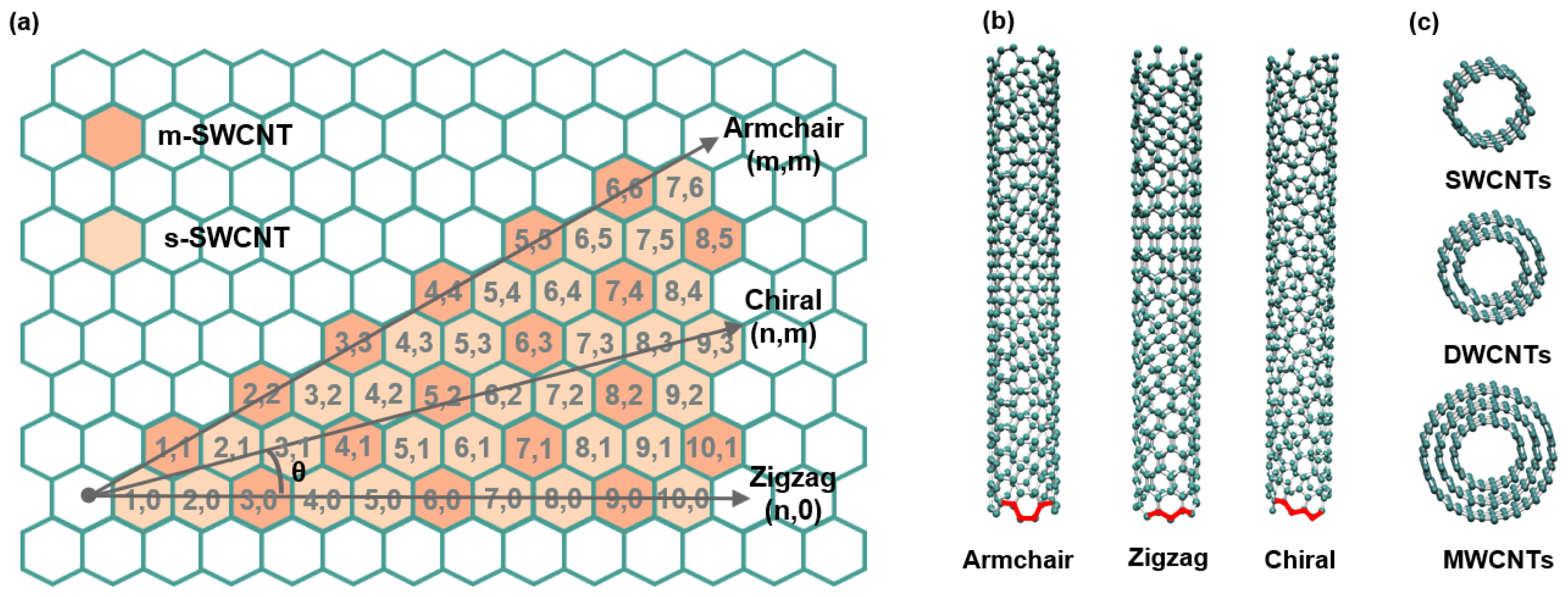
With the progress of science and technology, there is ever-increasing demand for various electronic devices in the fields of information, display, and sensing. These demands include high-performance, miniaturization, and flexible wearable devices, among others. They present substantial challenges to materials and device design. Since the 1980s, scientists have successively discovered a series of low-dimensional materials such as quantum dots, nanotubes, nanowires, graphene, and graphdiyne. These materials have unique structures and extraordinary properties. It is expected that they will meet the requirements of the post-Moore era in terms of multi-functionality and miniaturization. Among them, carbon nanotubes (CNTs), reported by Sumio Iijima in 1991 [1], are a promising material for achieving large-scale practical applications and taking the lead in future competition within the high-tech industry. CNTs are one-dimensional hollow tubular structures made of sp2-hybridized carbon atoms. More specifically, single-walled CNTs (SWCNTs) are uniquely defined by chiral index (n, m), since they can be taken as rolled graphene sheets at different chiral angles θ, corresponding to specific chiral vectors C = n· a 1 + m· a 2 , where a 1   =   a ( 3 , 0 ) and a 2   =   a ( 3 2 , 3 2 ) are the basis vectors in graphene lattice (Figure 1a) [2]. As is shown in Figure 1b, SWCNTs will be referred to as zigzag SWCNTs if m = 0, while armchair type if m = n and chiral SWCNTs if n ≠ m. SWCNTs are then categorized electrically into metallic SWCNTs (m-SWCNTs) when (n − m)/3 = q (an integer); otherwise, they are referred to semiconducting SWCNTs (s-SWCNTs) [3]. Depending on their wall number, CNTs are classified as SWCNTs, double-walled (DWCNTs), or multi-walled (MWCNTs) (Figure 1c).
In general, CNTs possess extraordinary and tunable electrical properties, making them promising candidates for use in transistors, energy storage, transparent conductive films, and other electrical applications [2,4]. A 10 nm long CNT could carry current up to 70 μA [5]. An SWCNT has been demonstrated to withstand a current density of 109 A/cm2 [6], 2–3 orders higher than copper wires. The intrinsic carrier mobility of an intact s-SWCNT can reach 105 cm2 V−1 s−1 [7,8] at room temperature, which is 100 times higher than that of bulk phase silicon with the dopant concentration of 1017 cm−3 [9]. Furthermore, adjusting the gate voltage of a field-effect transistor (FET) enables the concentration and type of the carriers to be regulated, thereby producing either p-type or n-type semiconductors.
CNTs possess extraordinary ballistic transport characteristics. When the length of a CNT is shorter than the mean free path of electrons, which can extend to approximately a micron [9,10], electron scattering becomes negligible. In this case, the CNTs exhibit high current-carrying capability (~25 μA per tube) and the length of the CNT is independent of its resistance, in line with the law of ballistic transport [6,11]. Nevertheless, ballistic transport can only be maintained when a low bias voltage (0.1 V ≤ |Vap| ≤ 6 V) is applied to the CNT device; otherwise, scattering between electrons and phonons is significant. When a low bias voltage is applied to a CNT device with a length of several hundred nanometers, the carrier can exhibit ballistic transport characteristics [12].
Under the ideal condition of ballistic transport, the conductance of an SWCNT with two conduction channels is equal to 4 e 2 h 7 7.5   μ S , i.e., a resistance of 6.45 kΩ [13,14], which is a temperature-independent minimum resistance (this value being about 107 higher that clean Cu/Cu contacts). If an electrode with appropriate work function is selected, the on-state conductance of the s-SWCNT device can also be close to 4 e 2 h [1,2,3]. When the length of SWCNT continues to increase to several microns, reaching the regime of scattering-dominated electrical conduction, the resistance undergoes a persistent decline.
However, the electrical properties of individual CNTs, as measured experimentally, are much lower than predicted due to the existence of defects and impurities. These properties continually diminish significantly in assemblies due to the introduction of more interfaces and the diverse structures of the comprising CNTs. In other words, the electrical properties of CNTs depend on various structural features, such as chirality, length, defects, and the configuration of CNT assemblies. For example, the highest measured carrier mobility of SWCNT film is about 103 cm2/(V·s) [15], and the highest measured conductivity of SWCNT fibers is about 107 S/m [16,17], which are much lower than those of individual SWCNTs. Recent advancements in flexible electronics and wearable sensors have spurred increased efforts to optimize CNT assemblies. However, it remains a big challenge to achieve the excellent performance of CNTs at macroscopic scale.
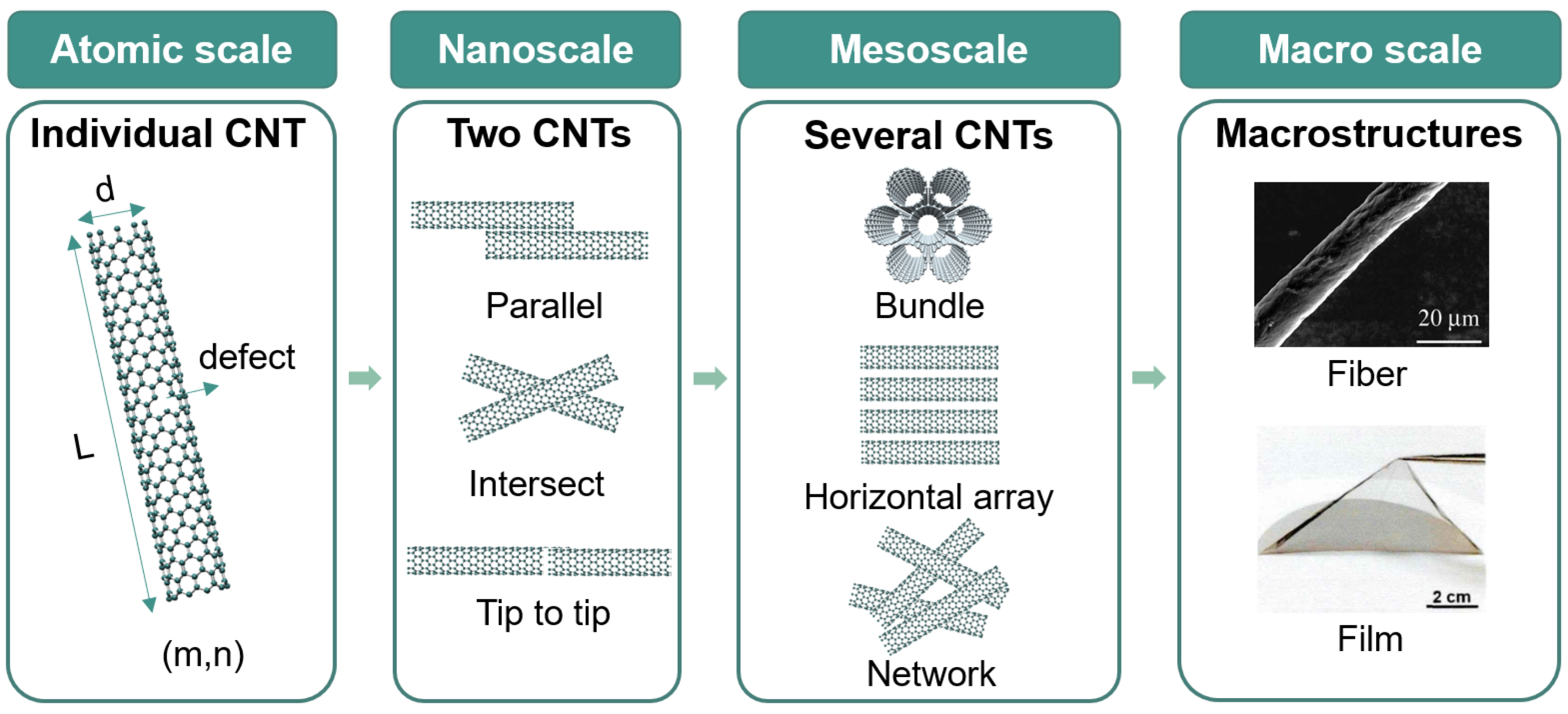
In this review, we present an overview of the electrical properties of CNTs from the individual level to macroscopic assemblies, and how these properties are measured. We begin by examining the methods used to measure the electrical properties of CNTs, including scanning tunnelling microscopy (STM), electron microscope-based nanoprobes, and nanodevice-based measurements. The origins of measurement error will be discussed. Next, we summarize the effects of structural features affecting the electrical properties of individual CNTs, CNT bundles, and macroscopic assemblies (Figure 2). It should be noted that the bundles in this review are those comprising countable CNTs with a diameter of 50 nm or less. The macroscopic assemblies of CNTs refer to vertical arrays, aerogel, soot, films, and fibers. The scope of this review is limited to the most widely used assemblies, namely, films and fibers. Furthermore, attention will be paid to the mechanisms underlying the difference in the electrical properties between individual and assembled SWCNTs. Finally, we discuss possible solutions such as doping to improving the electrical properties of individual CNTs and CNT assemblies. Future trends toward bridging the gap between the electrical properties of individual and assembled CNTs are also outlined.

2. Measurement of the Electrical Properties of CNTs

2.1. Methods for Measuring the Electrical Properties of CNTs

This section summarizes three typical methodologies for measuring the electrical properties of CNTs: (1) STM, (2) electron microscope-based nanoprobes, and (3) nanodevice-based measurements. These methods can provide critical information on various electrical properties, including the density of states and resistance. Additionally, experimental errors and their potential sources are discussed.

2.1.1. STM

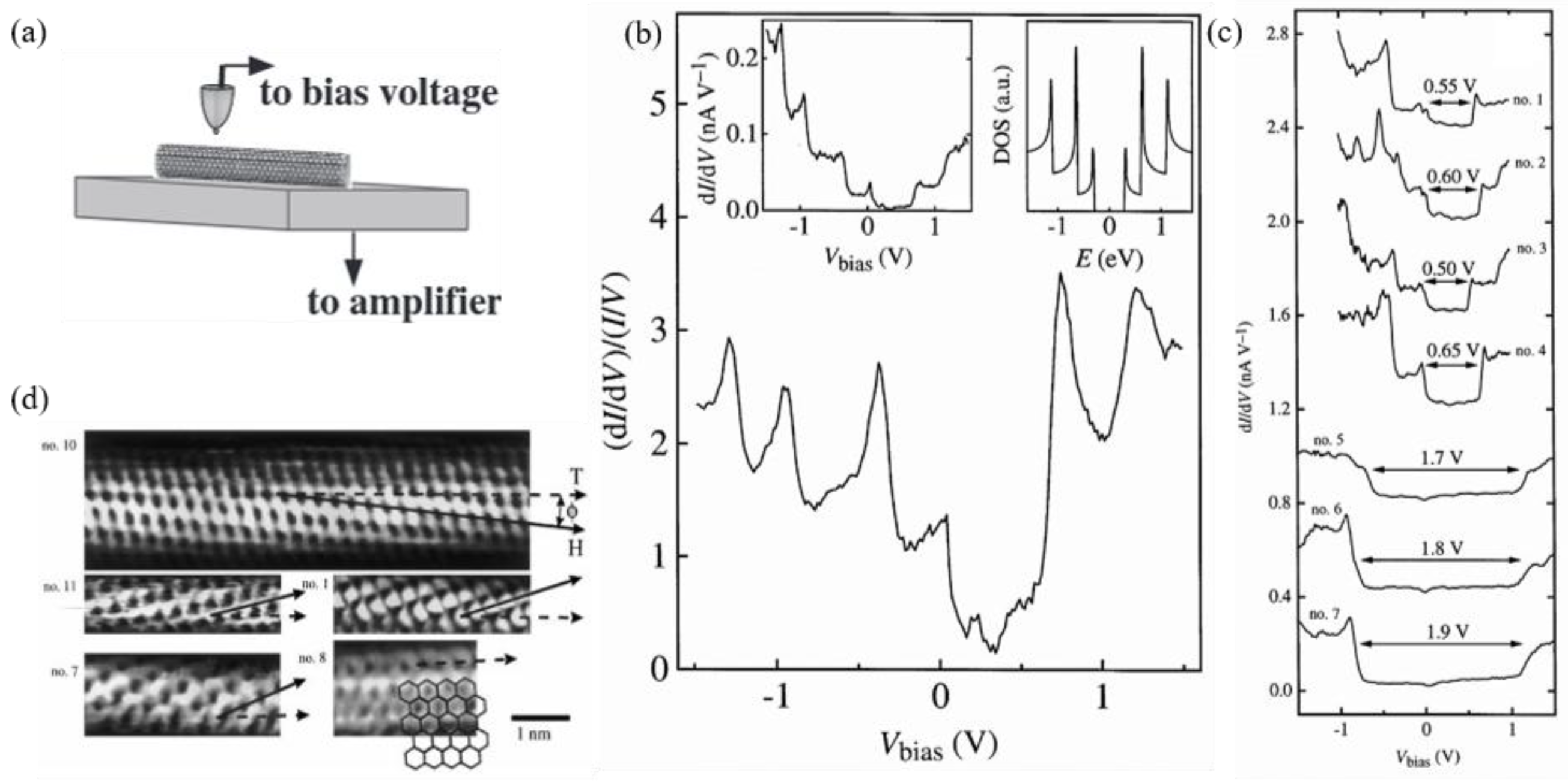
STM is commonly used to characterize the surface structure of CNTs with atomic resolution and to obtain the surface electron state density through scanning tunneling spectroscopy (STS). Figure 3a schematically shows the working mechanism of an STM. A direct current with an additional small alternating voltage is applied between a CNT and a probe. The differential conductance (dI/dV) can then be calculated from tunnelling current versus voltage (I-V) data, which is considered to be proportional to the density of states (DOS) of the examined CNT (Figure 3b) [18]. When the gap value in the differential conductance diagram is 0.5–0.6 V or 1.7–2.0 V, the SWCNT is semiconducting or metallic, respectively [18]. Some differential conductance diagrams of SWCNTs are displayed in Figure 3c.
Atomically resolved STM images of individual SWCNTs can also be obtained using the STM technique (Figure 3d). Only a few carbon atoms at the top of the CNT are discernible. It is sufficient to enable the chirality to be identified unambiguously from the chiral angle θ.

2.1.2. Electron Microscope-Based Nanoprobe Measurement

Using an electron microscope-based nanoprobe, it is possible to manipulate, process, and measure samples in situ in a scanning electron microscope (SEM) or a transmission electron microscope (TEM). Data relating to current voltage, current time, temperature profile, and power time can be obtained in conjunction with a series of SEM/TEM images. This makes it possible to establish a correlation between the microstructures and electrical properties of CNTs.
A nanoprobe can manipulate a sample or a nanoprobe electrode, triggering movement in the X, Y, and Z directions at the nanometer scale. In order to manipulate nanomaterials, the probe that grabs the sample must be sharp enough, with the tip size within 100 nm. Compared with mechanical methods of probe fabrication, such as polishing and shearing, electrochemical etching is the most common method due to its good reproducibility and standardization. By finely tuning the applied electrochemical potential, cutoff voltage, etching mode, electrolyte type and concentration, immersion depth, counter electrode type, and probe material, uniform and sharp probes with fewer impurities can be produced [20,21]. A variety of materials have been used for the nanoprobes. The most commonly used materials include tungsten [22,23,24,25,26,27,28,29,30,31] with high hardness and gold [32,33,34,35,36,37,38,39,40,41] with high chemical stability and good wettability.
Contact resistance between the nanoprobe and CNTs is a key concern in this type of nanoprobe measurement. To minimize its impact on the measured resistance of CNTs, the contact points between the tip and the CNT were irradiated with a focused ion beam (FIB) [42] or heated with a pulsed current [43]. Since CNTs can be welded to the wire to form good physical and electrical contacts, electrical contacts can also be formed by filling the tube with a material that has low vapor pressure, such as a chalcogenide [27], or by depositing nanoparticles that have a low melting point, such as tin [44,45].
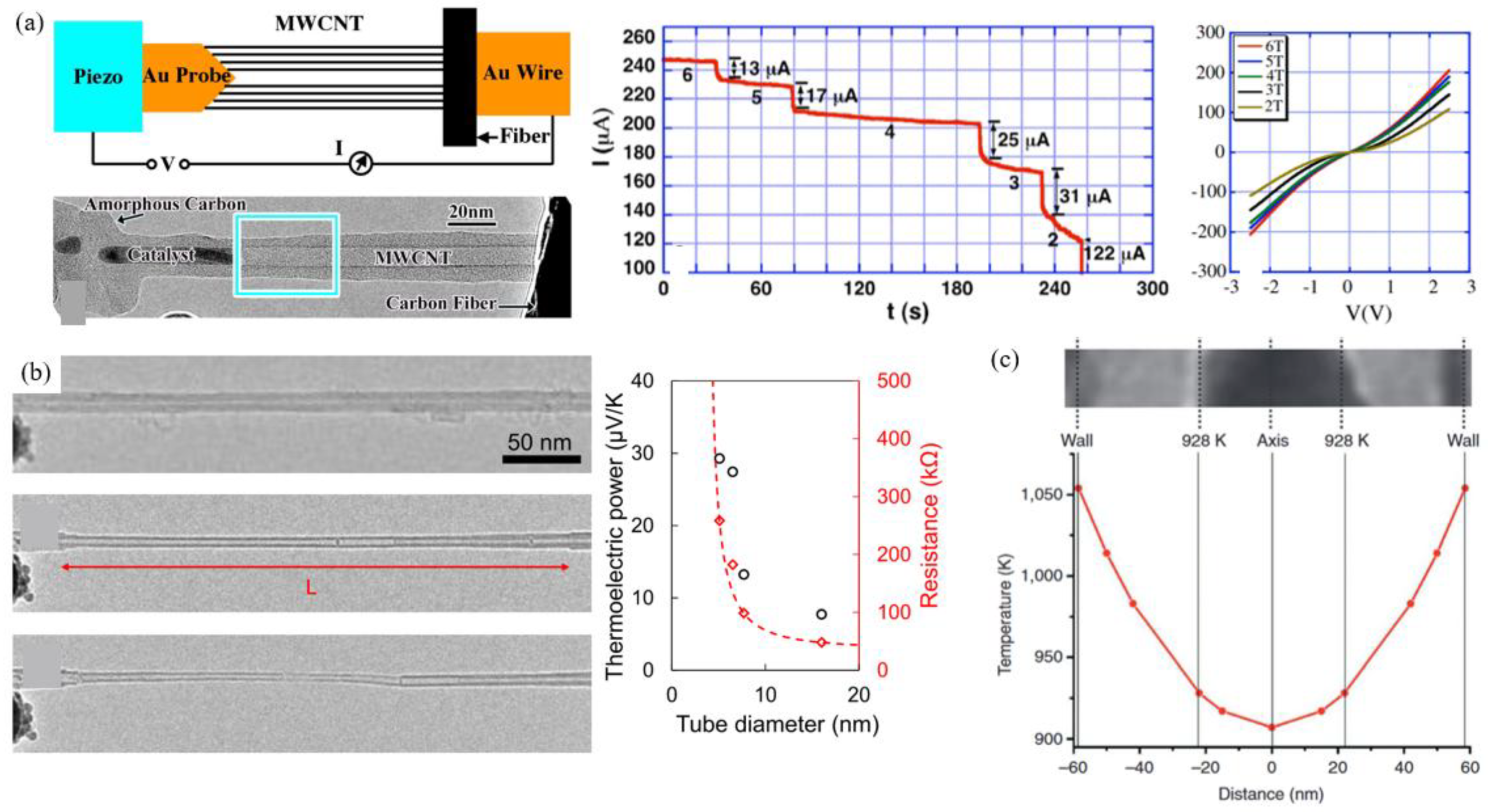
Since SWCNTs have much lower structure stability and are more difficult to manipulate under an electron microscope, the nanoprobe technique has mainly been used to investigate the electrical properties of individual MWCNTs. For instance, Huang et al. [39] reported unexpectedly three distinct breakdown sequences in individual MWCNTs, proving that each wall of an MWCNT conducts at high voltage, since a current drop can be observed when the innermost wall was broken. Moreover, the breakdown of each wall initiated in the middle of the tube, proving the transport property is not ballistic (Figure 4a). Also, the thermoelectric power increased as the tube diameter decreased (Figure 4b). Another crucial phenomenon that can be observed is the structure engineering by Joule heating. On exposure to a high current density, resistive hotspots near the contact points later migrated and expanded along the CNT over time, as indicated by the localized sublimation of the encapsulated material (Figure 4c) [27]. The electrical properties of doping systems can also be investigated by this method. It has been observed by Aslam et al. [28] that a large current could induce structural transformation of N-doped MWCNTs, resulting in the removal of the dopant, and a significant change in electrical behavior.
As a conclusion, using this method with SEM/TEM enables more phenomena relating to the Joule heating behavior of CNTs and the doping system to be observed, particularly with regard to the CNT filling system and electromigration processes.

2.1.3. CNT Electronic Devices

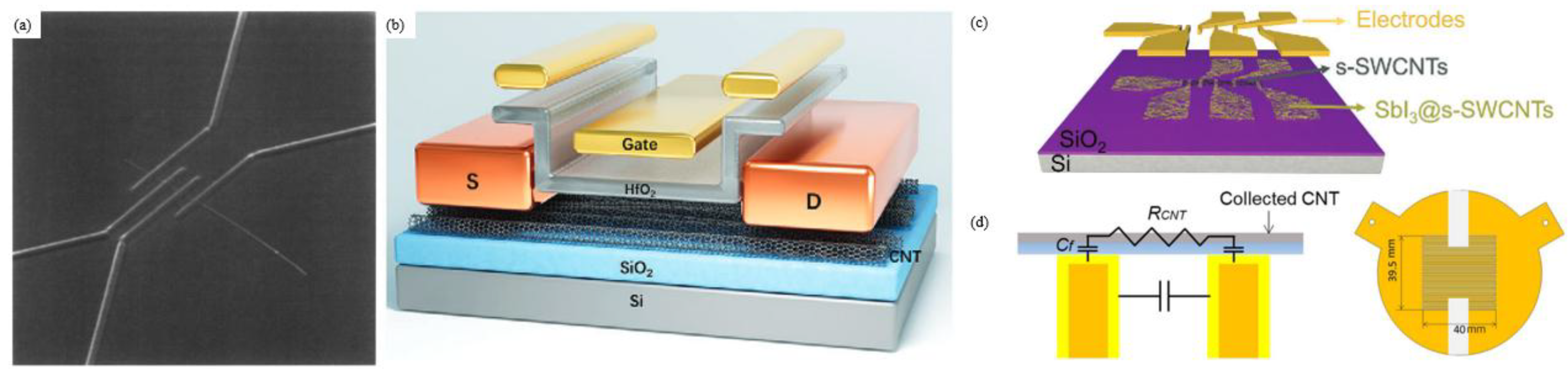
A great deal of work has been carried out on designing electronic devices using individual CNTs, CNT arrays, and CNT films, as they are ideal for use in integrated circuits (ICs). One common device is the four-point probe measurement [24,46,47,48,49]. This device-based method is often used to measure the electrical resistance of individual CNTs [24,46,47,48], CNT fibers [15,16,49,50], and CNT films. This can be achieved by passing a current through the two outer terminals (Iouter) and measuring the voltage using the two inner terminals (ΔVinner). All electrodes must be in contact with the material being measured. This method can mitigate contact resistance errors, and reveal the material’s intrinsic resistance, which can be determined by R = (ΔVinner)/Iouter [51]. Furthermore, numerous methodologies can be employed to reduce contact resistance between the electrodes and CNTs. Ebbesen et al. [46] reported on four-probe measurements of individual SWCNTs produced by the ion-induced deposition of four 80 nm wide tungsten leads. Wang et al. [52] measured the electrical resistance of 5 cm long single CNT fiber by dipping silver adhesives to four contact regions.
Another widespread electronic device is the CNT-based FET. Due to their ultrahigh carrier mobility and satisfactory carrier concentration, CNTs are a promising material for the fabrication of future ICs. A CNT-based FET can inhibit the short-channel effect in a conventional metal–oxide–semiconductor FET (MOSFET) and can be scaled to a contacted gate pitch of 55 nm, corresponding to a sub-10 nm node. The carrier mobility (1500 cm2 V−1 s−1) and Fermi velocity (12 × 106 cm s−1) of this node are higher than those of a 10 nm MOSFET [53]. Also, a CNT-based FET could achieve a remarkable reduction in subthreshold swing (Ss) to ~35 mV/dec, which would significantly reduce power consumption [53,54]. Ultrahigh carrier mobility directly enhances the transconductance (gm) and cutoff frequency (fT), exhibiting favorable high-frequency performance [55]. These parameters are of primary concern in the future development of ICs, and these technological advancements are expected to promote the practical application of carbon-based circuits [56].
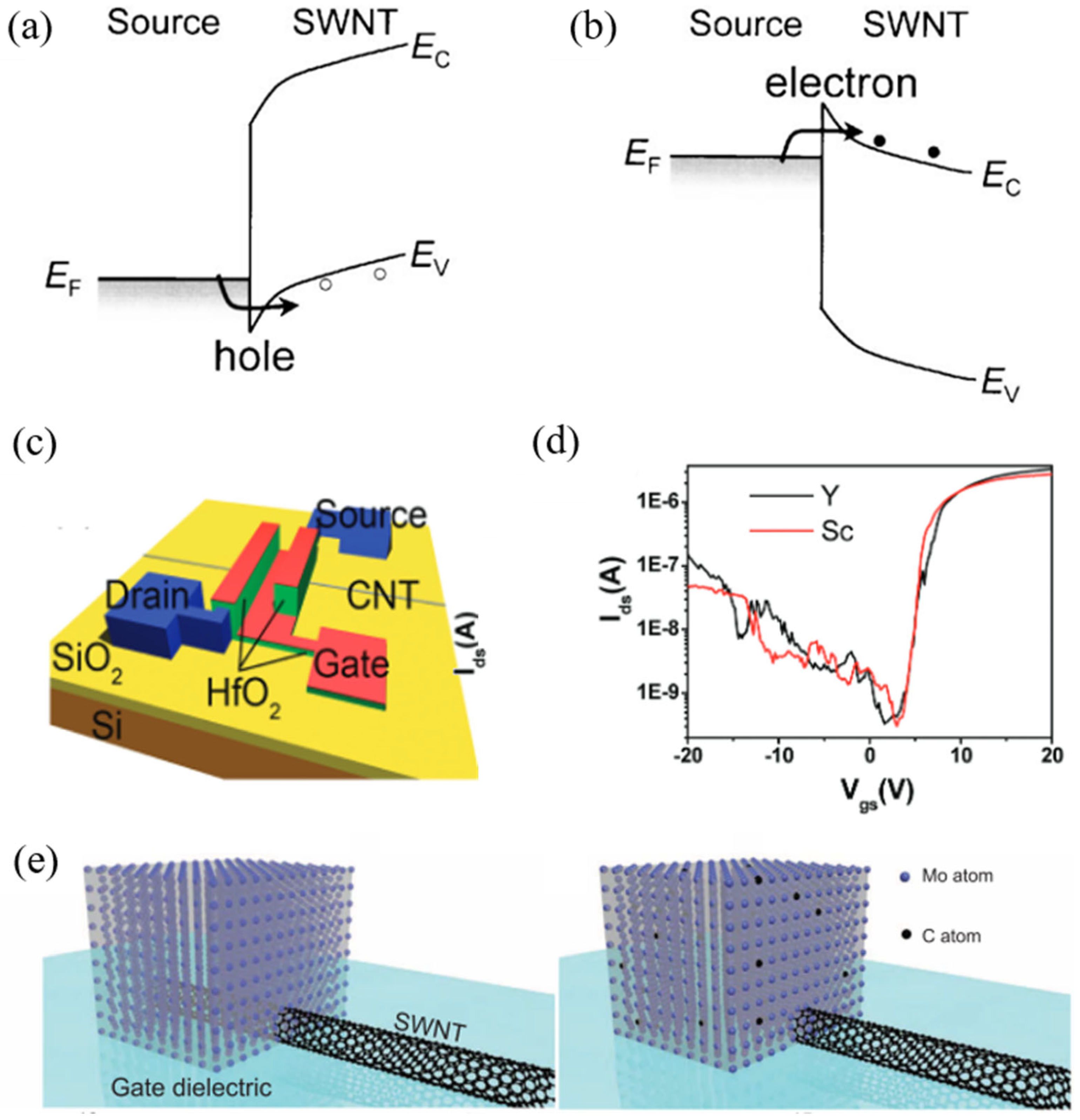
The CNT-FET structure comprises five parts. The channels are made of CNTs, either in the form of individual s-SWCNTs (Figure 5a) [11,57], an aligned s-SWCNT array (Figure 5b) [58,59], or a thin film (Figure 5c) [54,60,61,62]. The source and drain electrodes are made of metals with a high work function, such as palladium [53,63] and platinum [64]. The gate electrode can be either top-gate [65] or back-gate [65,66]. The high-k gate dielectric can be HfO2 [56,65,67,68], Al2O3 [64,69], or ultrathin SiO2 [70]. The insulating substrate can be SiO2/Si, sapphire [71], or hBN [72], or a flexible organic substrate.
Some special electronic design schemes are also presented to facilitate research into the structure–performance relationship. For example, Oshima et al. [73] proposed an in-situ measurement of the electrical impedance during CNT synthesis by floating catalyst chemical vapor deposition (FCCVD) (see Figure 5d) to monitor CNT film thickness and reveal its correlation with the percolation threshold.

2.2. Measurement Errors and Their Sources

The previously mentioned methodologies can provide a variety of electrical information, such as band gap, resistance, and thermoelectric power. These approaches have one thing in common: the necessity of establishing contact between CNT and electrodes. In addition to contact resistance, other factors have also been identified as contributors to the diversity of electrical measurement results in different experimental groups. These include variations in measurement environment (such as gas composition, temperature, and humidity) and substrate. Concurrently, a variety of macrostructures with distinct intrinsic and configuration-specific CNT arrangements manifest diverse array electrical properties. These issues pose a significant challenge when it comes to measuring electrical properties.
The primary challenge lies in minimizing the contact resistance. We then model the resistance of an individual CNT contacted at each end of the metal electrodes as the sum of the three parts (Formula (1)).
RCNT = RQ + RL + RCONTACT
where RQ is called the quantum resistance. For an m-SWCNT with ideal ballistic transport and perfect contacts, RQ ≈ 6.5 kΩ, which is the minimum theoretical resistance per conduction channel in a 1D system and fundamental limit from 1D quantum transport. This is owing to the inevitable mismatch in the number of conduction channels between the nanotube and the macroscopic metal electrode [74]. RL is the scattering resistance due to electron–phonon scattering, impurities, and defects. If the nanotube length is shorter than the mean free path, which is about 300–1000 nm, we can usually neglect RL. RCONTACT is the most variable and often dominant component in experiments, which depends on work function difference between the metal and the CNT (the work function of SWCNT is about 4.8 eV [75]), metal wettability, and the bonding configuration [76] (e.g., Pd makes better contacts than Au) and contact geometry (end-bonded vs. side contact) [77]. RCONTACT is about 5–50 kΩ with Pd [78]. As a result, the choice of metal electrode is crucial for reducing contact resistance. For metal electrodes with high work functions, their Fermi levels are close to the valence band of s-SWCNTs. This means holes are more easily injected into the channel than electrons, behaving as p-type semiconductors (Figure 6). Pt, Au, Pd, and Rh [79] are the electrodes of wide use in this category, among which Pd is the most suitable precious metal with a good wettability [11].
By contrast, achieving n-type ohmic contact encounters more difficulties, as metals with relatively low work functions tend to oxidize first rather than react with carbon. However, it is still possible to realize end-bonded n-type contacts even with high work function metals through electrostatic doping near the source electrode [81,82]. Moreover, the Fermi level of Al, Sc, and Y is close to the conduction band of s-SWCNTs, also behaving as n-type [78,83,84]. Unlike forming p-type ohmic contact between Pd and CNT, Al can only form Schottky contact with a high barrier [78]. Regarding the economic benefit, Y is the most potential electrode in large-scale CNT ICs [84].
Except for the metal electrodes, graphene [85], hybrid graphene–metal [86], and CNT film [15,87] can also be considered as the electrode material. They can achieve significantly lower resistance than conventional metal electrodes, making them highly beneficial for advanced electrode applications. This stems from graphene’s exceptional conductivity, synergistic effects in hybrids or CNTs acting as conductive bridges that enhance charge transfer. These materials also offer superior flexibility, corrosion resistance, thermal stability, and higher surface area—enabling more efficient, durable, and miniaturized devices. Consequently, they outperform metals where low contact resistance, weight savings, or mechanical resilience are critical, though cost and fabrication complexity remain challenges for mass adoption [88].
Reducing contact resistance is essential to achieving desirable performance of FETs, such as high field-effect mobility and on/off ratio. A comparison on the methods for reducing the contact resistance at the individual CNT–electrode interface is shown in Table 1.
In addition to the selection of electrode materials, the strategies like chemisorption involving carbide formation through high-temperature annealing and local Joule heating with end-bonded type have also been demonstrated to reduce contact resistance. This could form contact with size-independent low resistance and high physical stability [28,29,77]. Such an all-shell connection is demonstrated to prevent the field-emission failure at the CNT–metal interface, promising for real-world applications in CNT-based electronic devices [30]. This chemisorption process has been shown to facilitate substantial interfacial charge transfer via the formation of chemical bonds. This, in turn, results in alterations to the electronic structure, enhancement of durability, and the facilitation of charge injection. The contrary process is known as physical adsorption, which is defined as the process of minimal charge redistribution through weak electrostatic forces, thereby preserving bulk properties and being reversible [93].
Although novel approaches such as ultrasonic nanowelding and electron beam-induced deposition are reliable and repeatable to form good electrical contact, they are hindered by scalability concerns. More efficient methods must therefore be developed.
One impact on the precision of electrical measurement is regulating the measurement environment, including the gas composition, temperature, and humidity. The electrical properties of CNTs have been shown to be highly sensitive to the measurement environment, making this a key consideration in the design of any CNT-based measurement systems. Exposure to air reversibly influences the electrical resistance of the individual SWCNTs, like the conversion from s-SWCNT to m-SWCNT and CNT networks by negligible adsorption of O2 gases [94]. This can be attributed to the hole-doped effect in the presence of adsorbed oxygen or work function change of the metal contact [95]. These results, although demonstrating the potentially viable application on sensitive chemical oxygen detectors [96,97,98], likewise indicate that many intrinsic properties measured on as-prepared tubes might be substantially compromised by exposure to the external environment. Temperature is also a significant factor. It has been demonstrated that m-SWCNTs exhibit a near-linear increase in the calculated resistivity with temperature over a wide range due to twiston scattering [99]. For s-SWCNT, the on current decreases slightly with rising temperature due to enhanced phonon scattering, while the off current increases significantly due to thermal emission over Schottky barriers. Meanwhile, threshold voltage shifts negatively with temperature, attributed to changes in carrier injection and trap dynamics [65]. The humidity effect is also an essential factor in electrical measurement, especially for flexible electronics applications. Mostafa et al. [100] demonstrated that an increase in relative humidity from 10% to 80% can result in a reduction of approximately 4% in the electrical conductivity of vertically aligned CNTs.
Another impact on the precision of electrical measurement in CNT devices is the substrate. In general, CNTs in FETs are in direct contact with the substrate, which gives rise to several non-ideal behaviors. The additional carriers will be trapped from the substrate, inducing the electrical noise by changing the surface potential [101]. A rough substrate would decrease the mobility and conductivity of the FET devices. Moreover, due to the attachment of CNT and the substrate, a part of the sensing area is lost [102]. As a result, it seems that FETs with suspended CNTs would exhibit higher electrical and sensitive performance. Some efforts were also made to change the type of substrate. Zhang et al. [72] reported on the direct growth of 2D close-packed SWCNT van der Waals crystals with uniform chirality and good alignment on a hexagonal boron nitride substrate. FETs constructed from these SWCNT arrays exhibited excellent electrical performance at room temperature. It demonstrated that atomically flat substrate could lead to a self-assembly growth of the low-dimensional material through van der Waals attraction and ultralow sliding friction.

3. Electrical Properties of CNTs

In this section, we discuss the electrical properties of individual CNTs, CNT bundles, and CNT assemblies. The structure-dependent electrical properties include quantitative results such as resistance, conductance, mobility, on/off ratio, and the density of state. Furthermore, the reasons why the electrical properties of individual CNTs do not translate into assemblies will be explained. Certain endeavors like doping to enhance the electrical characteristics of assemblies will also be discussed.

3.1. Electrical Properties of Intrinsic Structure of Individual CNTs

Individual CNTs are believed to exhibit superior electrical properties, which are strongly dependent on their intrinsic structures, including chirality, diameter, number of walls, defects, length, and doping levels.

3.1.1. Chirality and Diameter

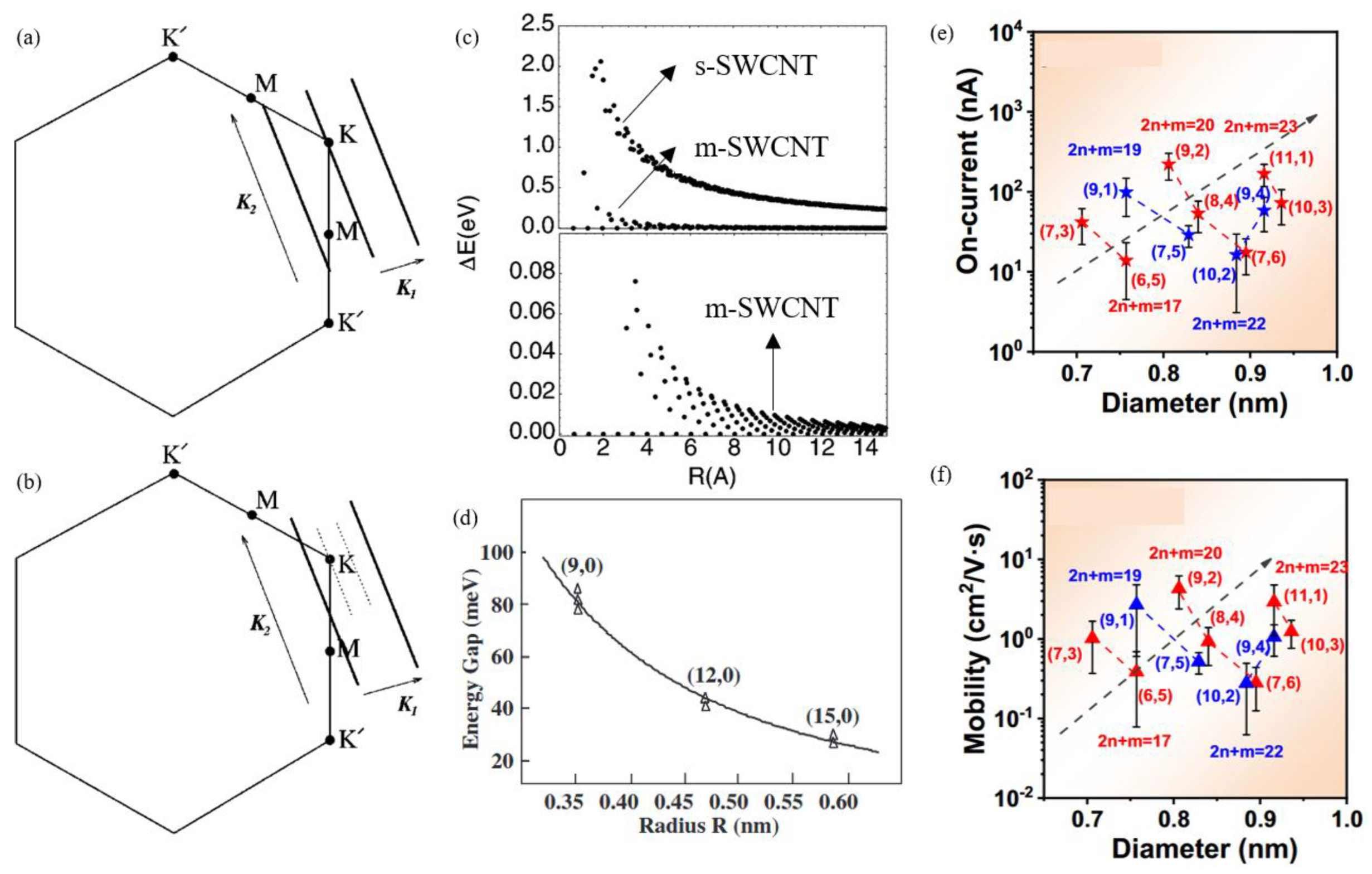
The diameter and chirality of CNTs have been identified as the most crucial factors affecting its electrical properties. The one-dimensional dispersion relationship of electron bands in a SWCNT is calculated on the basis of the first principles of graphene band structure and local-density-functional approach. The results indicate that SWCNTs can be categorized into two distinct groups. When the rolling index n − m = 3q (q is an integer), the electron state wave vector k intersects at the primary Brillouin zone boundary. As demonstrated in Figure 7a, the conduction and valence bands intersect at the Fermi level, indicating that the SWCNT exhibits metallic characteristics with a zero-band gap. However, when (n − m)/3 ≠ q (q is an integer), the SWCNT behaves as a semiconductor (Figure 7b), and the band gap is inversely proportional to the tube diameter, as outlined in Formula (2) [103]. Consequently, the ratio of m-SWCNT to s-SWCNT is approximately 1:2 [104]. The occurrence of metallic behavior has been observed in armchair and select zigzag tubes, while semiconducting tubes have been shown to exhibit diameter-dependent band gaps (Eg ∝ 1/d).
E gap = 2 γ 0 a c c d
where γ 0 stands for the overlap energy of C-C bound with the value of about 347 kJ/mol, a c c denotes the nearest C-C bond length with the value of 0.142 nm, and d is the tube diameter [105].
However, it should be noted that there are exceptions to this rule in chiral and zigzag SWCNTs with very small diameters (d < 0.6 nm) due to curvature effects. It has been established that a portion of SWCNTs, predicted to be metallic, exhibits semiconducting properties [106]. The finite curvature reduces the overlap between adjacent p orbitals and shifts the band intersections away from the K point, resulting in a curvature-induced band gap in the metallic tube. Furthermore, the width of this band gap is inversely proportional to the square of the tube’s diameter [107] as shown in Figure 7c, which has been confirmed experimentally by Ouyang et al. (Figure 7d) [108]. Nonetheless, armchair SWCNTs are still metallic because kF remains in the sub-band, with both the initial band gap and the curvature-induced band gap being zero [109].
Moreover, s-SWCNTs with small diameters can be divided into two types as shown in Figure 7e,f. For Type I (mod (2n + m, 3) = 1), both the on-state current and the carrier mobility exhibit an increase with an increasing chiral angle within the same family (2n + m = the same integer), whereas the results are the opposite for Type II (mod (2n + m, 3) = 2) [60].
Increases in diameter invariably result in greater numbers of walls being incorporated into current synthesis techniques. There are also a lot of electrical experiment results in MWCNTs [110]. The electrical properties of MWCNTs are inferior to those of SWCNTs, as theoretical explanations posit the occurrence of electronic distortions in MWCNTs, depending on how the lattices are interrelated [111]. In addition, experimental evidence was presented indicating that only the outermost shells contribute to the overall conduction at low bias. However, at high bias voltage, all of the shells contribute to carrier transport [104,105]. This leakage was frozen at a low temperature and low bias limit, indicating that the intershell coupling was thermally activated and tunnel-type [112]. As Liu et al. [113] also concluded in the context of DWCNTs, the only exception is the s/m-DWCNT (where the outer and inner layers are s-SWCNT and m-SWCNT, respectively), which only exhibits semiconducting-like properties and a much lower on/off ratio.
Figure 7. The wave vector k is shown as bold lines for (a) m-SWCNTs and (b) s-SWCNTs in the Brillouin zone of graphite (hexagon) [103]. (c) Gaps calculated for SWCNTs with a radius of less than 15 Å. Those with zero primary gap but nonzero curvature induced gaps which scale as 1/R2 are shown in the lower curve on top panel, whose expanded scale is shown in the lower panel [107]. (d) Curvature-induced gaps in “metallic” zigzag SWCNTs [108]. (e,f) Statistical distribution of the on-state current and the mobility of the two types. Blue and red symbols represent Type I and Type II, respectively.
Nanomaterials 15 01165 g007

3.1.2. Defect

Defects in CNTs, such as vacancies and non-hexagonal rings, which may be induced by irradiation or strain, can drastically change their transport properties. This section will discuss how and why the defects influence the electrical properties.
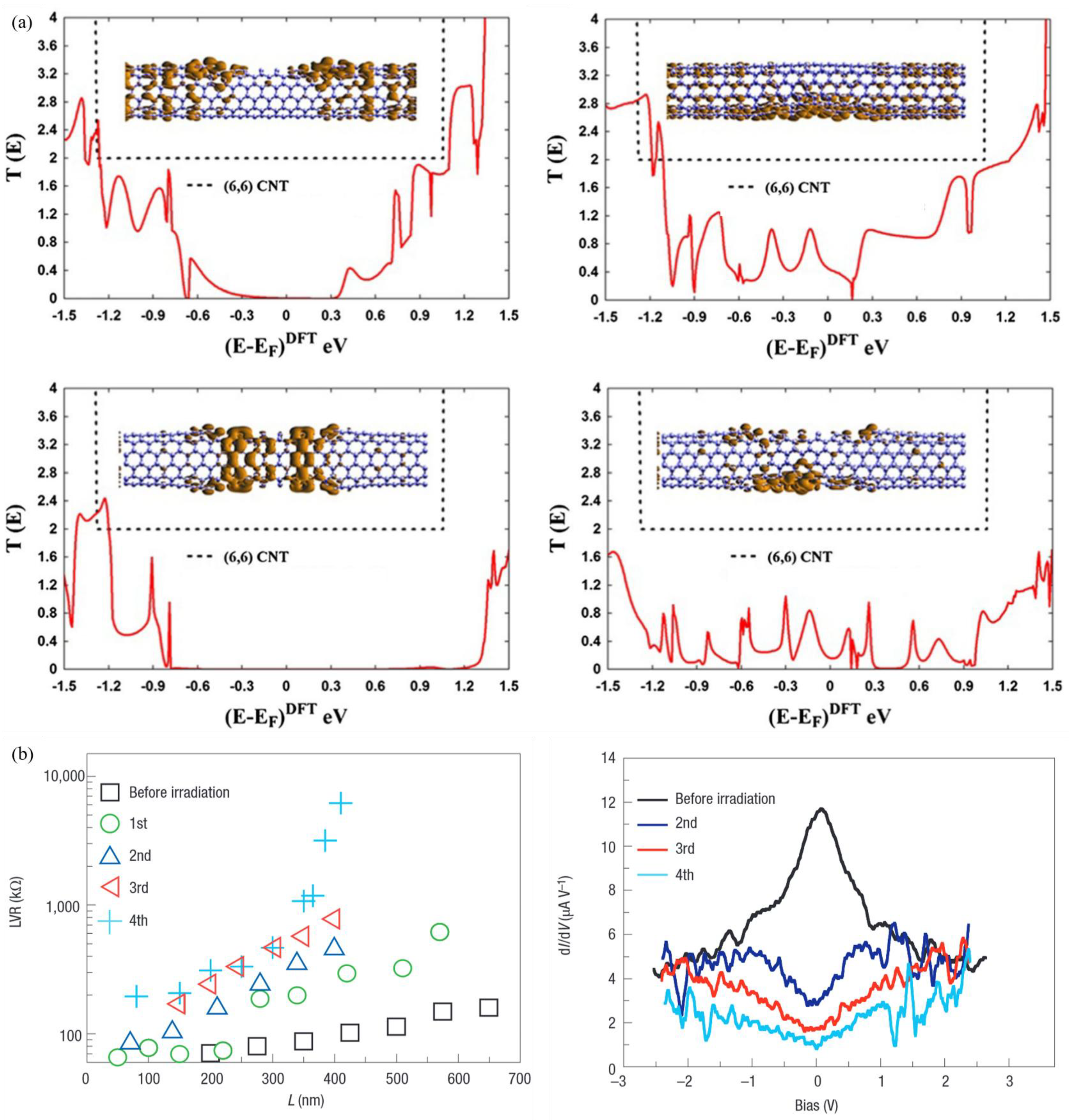
The application of density functional theory in conjunction with Green’s function scattering approach facilitates the elucidation of defects’ impact on electronic transport properties. The conductance of defective carbon nanotubes (CNTs) has been shown to typically exhibit non-trivial behavior, which has been observed to decrease and affect the band gap. In more precise terms, elevated levels of disorder have been shown to induce a greater degree of localization of DOS (Figure 8a) [114].
Furthermore, experimental results can be obtained. Navarro et al. [115] applied consecutive Ar+ irradiation doses to SWCNTs in order to produce a uniform density of defects. The data demonstrate an exponential dependence of resistance on SWCNT length, thus indicating that the system is within the strong Anderson localization regime (Figure 8b).
A number of strategies have been developed for the purpose of defect healing to restore the conductivity, such as thermal annealing. Khanbolouki et al. [116] applied current-induced annealing (5–60 MA/m2 in high vacuum) at 685–1445 °C to remove impurities, which results in the reduction of sheet resistance by 35–40%. Altuntas et al. [117] found that annealing at 120 °C for 1 h in air led to a reduction in interface traps and contact resistance, from 1.9 MΩ to 12.3 kΩ.

3.2. Electrical Properties of Several CNTs

It has been demonstrated that due to van der Waals interactions, individual SWCNTs, which are nearly uniform in diameter, readily self-organize into “ropes” [118]. A more common statement is CNT bundles, which also represent the intermediate transitional form from individual tubes to macroscopic CNT assemblies. Consequently, considerable research has been devoted to understanding how the interaction in bundles affects the electrical properties of the CNT assemblies. In this section, an exploration of the primary limitations on electrical properties in multi-tube systems, comprising two CNTs and CNT bundles, will be conducted.

3.2.1. Electrical Properties of Two CNTs
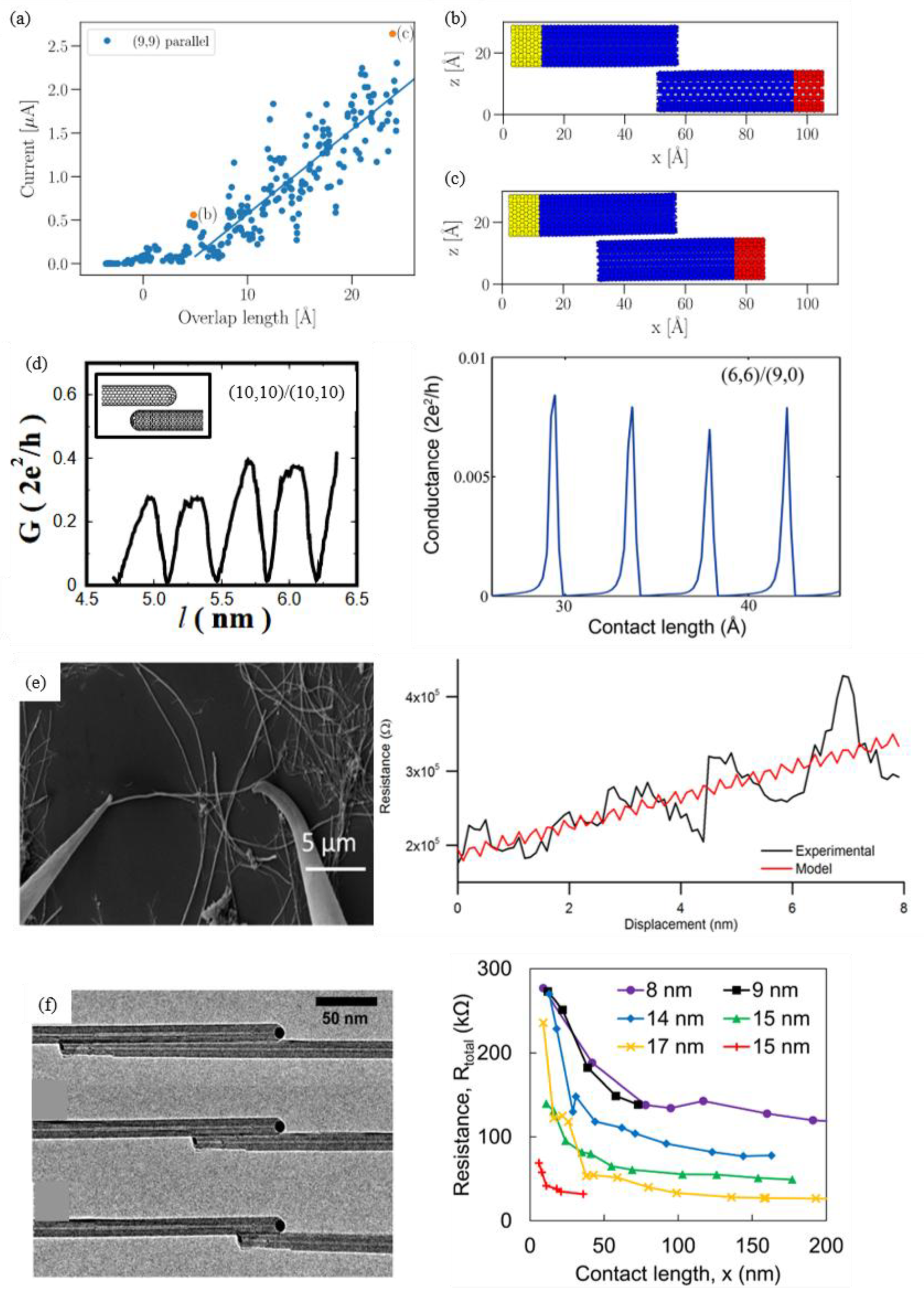
The density functional tight (DFT) binding theory and the nonequilibrium Green’s functions are frequently utilized to calculate the electrical properties of pairs of CNTs. The template structures utilized in the calculation for two CNTs can be categorized into three distinct types: tip-to-tip, parallel, and perpendicular. Among these studies, two parallel armchair SWCNTs with equal chirality indices are always considered first, as they are the simplest model. However, experimental measurements across pairs of CNTs are much more difficult due to the nanomanipulation involved in SEM or TEM. To date, experimental measurement of junction resistance has been possible only for two MWCNTs.
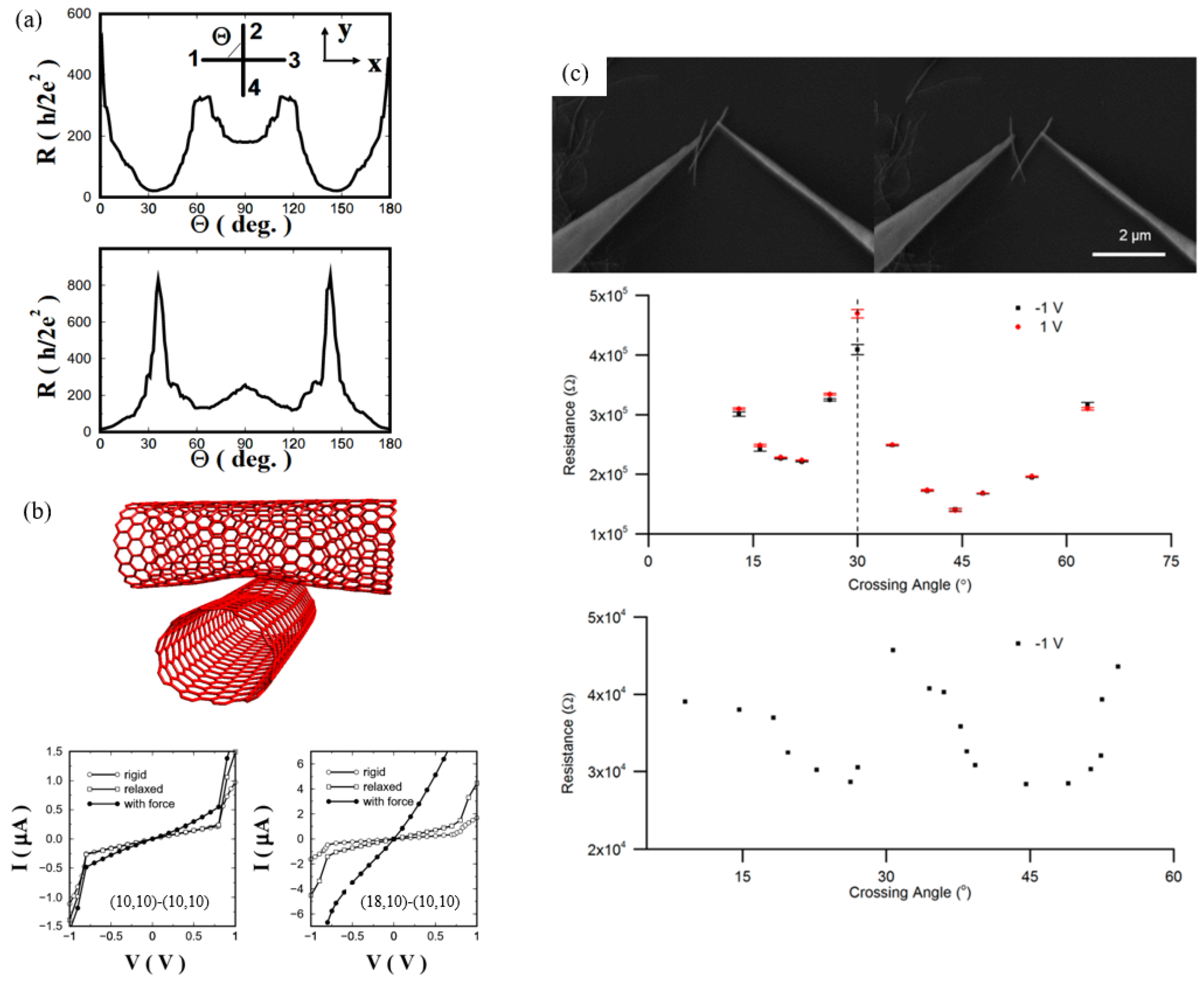
The following discussion will commence with a consideration of two CNTs arranged in parallel. It has been demonstrated that there is a positive correlation between the overlap length and the electrical current (Figure 9). As demonstrated in Figure 9a, the scatter plot of the calculation results indicates that an overlap length of two armchair SWCNTs in parallel greater than 25 Å can induce a larger current [119]. A more detailed analysis of the results is presented in Figure 9d, where nanotube junctions are formed by two (10,10) SWNCTs and (6,6)/(9,0) SWCNTs. A noteworthy observation is the occurrence of a nonlinear and quasi-periodic relationship between conductance and contact length. These quasi-periods were found to be heavily dependent on the chirality of SWCNTs. For instance, armchair SWCNT and zigzag SWCNT are about 3a0 and a0, respectively. This is due to the fact that the Fermi wavelength for armchair tubes is a0, where a0 is the unit cell parameter [111,120]. When contact lengths are compared, the conductance of the armchair/zigzag contact is found to be significantly lower than that of the armchair/armchair contact, by approximately one order of magnitude. The reason for this phenomenon is that two SWCNTs with different chirality are incommensurate and possess mismatched Fermi momenta [121]. It can be concluded that the optimal conductance at a parallel contact can only be achieved when two metallic tubes possess the same chirality. Examples of such chirality include metallic zigzag/zigzag and armchair/armchair types. It is evident that the metallic zigzag tubes possess a gap around the Fermi energy due to the curvature effect. This observation indicates that armchair/armchair tubes in parallel are the most promising geometry for connecting multiple tubes in device applications [111,120].
This similar periodical trend was experimentally observed by Barnett et al., in which two halves of the same MWCNTs were manipulated in a SEM (Figure 9e) [122]. There is an apparent periodicity of 2–3 Å, consistent with the unit cell of armchair SWCNT (2.45 Å). In addition, Hamasaki et al. also reported the in situ measurement of the parallel-contacted resistance between two halves of the same MWCNT in TEM [45]. The hypothesis was that the contact resistance would decrease with increasing contact length within the measurement range of a few hundred nanometers. It is theorized that, under certain conditions, the effect of the interface may become negligible, provided that the contact length is sufficiently long.
Figure 9. (a) Relationship between overlap length and current for pairs of parallel (9,9) SWCNTs [119]. (b,c) Geometries of two highlighted points in orange [119]. (d) The calculation results for the variation in conductance at the Fermi energy as a function of overlap length for two (10,10) SWCNTs [123] and a (6,6)/(9,0) contact [124]. (e) The SEM image and the schematic of manipulating two halves of a same MWCNT in a parallel manner. The bottom plot is the measured resistance at 1V as a function of the overlap length, where the red line is a simple model result [122]. (f) In situ TEM image of two parallel MWCNTs with various contact lengths. The right plot is the electrical resistance as a function of contact length for different MWCNTs. Legend indicates the outer diameter of each MWCNT [45].
Nanomaterials 15 01165 g009
Due to the occurrence of angular overlap conduction, the conductive rule is analogous. When one SWCNT is placed on top of another, the conductance between the in-registry tubes is increased. In this instance, the contact region is commensurate, with the carbon atoms arranged in an A-B stacking configuration of graphite [123]. The plot in Figure 10a predicts the resistance variation concerning the rotation angle along the tube axes by calculation. The tubes in the first (18,0)–(10,10) junction are found to be in registry at θ = 30, 90, 150°. The tubes in the second (10,10)–(10,10) junction are arranged in registry at θ = 0, 60, 120, 180°. Lower resistances have been observed in these in-registry orientations. However, even when the tubes are in registry, the low resistance can vary at different rotation angles. The lowest possible resistance is achieved when the carbon atoms in contact area are stacked like A-A stacking of graphite. This variation in electrical properties bears a resemblance to the dependence of mechanical or frictional properties on atomic registry [125,126]. The variation in resistance as a function of the crossing angle between two unparallel tubes is also investigated. As the crossing angle is reduced, the contact resistance decreases because the contact area is reduced; however, for MWCNTs with large diameter and low weight, the change in contact area will be negligible. Barnett et al. conducted a study on the angular dependence of contact resistance of two halves of a single MWCNT in in situ SEM (Figure 10c). The findings demonstrate that the two tubes manifest as “in-registry” at 22° and 44°, exhibiting reduced resistance. This observation signifies that the concept of “in-registry” for MWCNTs is less stringent than the ideal SWCNT. It is conceivable that the minima occur when the overlap of the π-orbital or electrostatic forces is minimal, leading to reduced repulsion [122].
Furthermore, irrespective of the commensurate status of the contact area, the electronic contact can undergo significant enhancement through the application of forces and relaxation (Figure 10b). However, the mechanism of the transport properties of two CNTs remains unclear because of the lower precision for atomic manipulation and characterization. Further study is required to gain a more profound comprehension of the mechanisms.

3.2.2. Electrical Properties of CNT Bundles

As Thess et al. [118] initially demonstrated, SWCNTs have the capacity to self-assemble with remarkable uniformity into crystalline ropes, which are more commonly referred to as bundles. The electrical properties of CNT bundles are governed by their mixed fine structures, weak inter-tube coupling, and low-dimensional quantum effects.
Bockrath et al. [127] revealed the profound impact of this heterogeneity at low temperatures. Measurements on individual bundles demonstrated a suppression of conductance at low bias (<10 K) and sharp peaks in conductance as a function of gate voltage. These features were interpreted as single-electron charging and resonant tunneling through quantized energy levels within the bundle. Collins et al. [120] addressed the challenge of exploiting s-SWNTs within mixed bundles by introducing “electrical breakdown”. The exploitation of high current stress in air, which selectively destroys only the m-SWCNTs within the bundle, results in the conversion of the entire bundle into an effective FET based solely on the remaining s-SWCNTs.
The core limitation for CNT bundle conductivity is inefficient electron transfer at inter-tube junctions. This phenomenon was clearly illustrated through the use of quadrupole STM on herringbone-type CNTs [128]. The junctions were found to adopt a V-, T- and Y-shaped configuration, thereby functioning as ohmic scattering centers. However, they exhibited no gating effect, a phenomenon that can be attributed to the strong inter-layer coupling effect, which effectively suppresses electrostatic modulation.
A number of strategies have been proposed to improve inter-tube coupling. Ha et al. [129] employed laser-induced shockwaves (~3.2 GPa) to densify CNT networks. This process physically transformed CNT bundles into flattened, multi-layered graphene nanoribbons. The combination of pre-stretching for alignment and the other factors under investigation resulted in an approximate fivefold increase in electrical conductivity. This is due to the elimination of voids and the creation of seamless pathways for electron transport via graphitized interfaces. Gong et al. [130] utilized in-situ TEM to form covalent graphitic bonds through Joule-heating-induced welding, thereby augmenting bundle conductivity from approximately 102 S/m to 105 S/m. Qiu et al. [131] employed a two-step strategy, namely interfacial functionalization and densification, to increase the inter-bundle electrical properties. Infiltration with high polarity solvents such as ethylene glycol induced local electrostatic cohesion between bundles via surface dipoles, increasing interfacial electrical conductance by approximately 2.8 times. Acid treatment (HNO3) introduced oxygen-containing functional groups acting as electron relays. This resulted in an additional 95% increase in inter-bundle electrical conductance.

3.3. Electrical Properties of Macroscopic Assemblies of CNTs

The assembly of CNTs into various macroscopic structures, such as fibers, arrays, and cottons, is contingent upon the specific synthesis process employed. Under these conditions, individual CNTs and CNT bundles agglomerate due to van der Waals interactions. Consequently, introducing inter-tube interfaces and non-uniformity of CNTs has resulted in a challenging task for preserving the unique electrical properties of individual CNTs in CNT macrostructures. In this section, the issue of dependence on the electrical properties of the assemblies of CNTs, such as fibers and films, will be explored in depth. The existing methods for improving their electrical properties will also be employed.

3.3.1. Electrical Properties of CNT Fibers

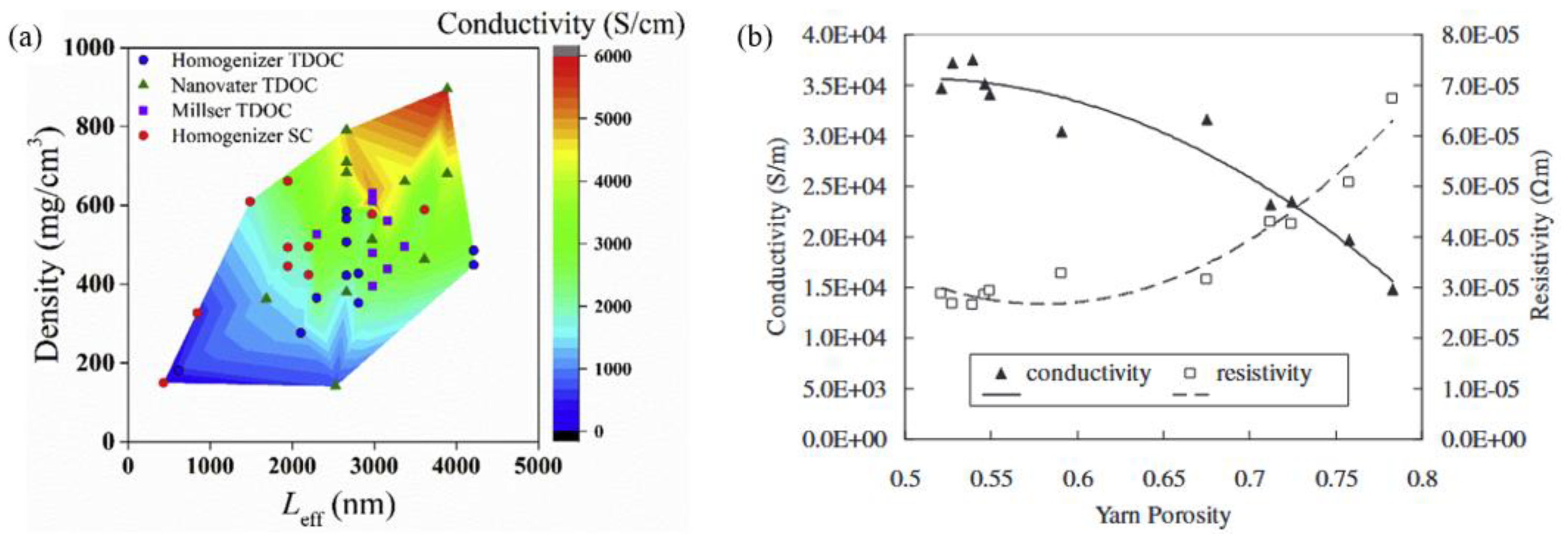
The electrical properties of CNT fibers are contingent on the intrinsic structure of CNTs present within the macrostructure, including chirality, diameter, and length. Additionally, the extrinsic configuration, such as porosity and the alignment of CNT fibers, must be also considered (Figure 11).
In order to achieve an optimal electrical conductivity, the CNT fibers must consist exclusively of defect-free armchair SWCNTs, characterized by their small diameter, long length, and single chirality. As Sundaram et al. [132] reported, the electrical conductivity of fibers spun from metallic CNTs is expected to be high. The quantity of shells has been demonstrated to influence the conductivity of individual CNTs, as well as the collective conductivity of the fiber. The conductivity of SWCNTs is greater than that of MWCNTs because the mean free path decreases with an increase in the number of walls [133]. It can be posited that even in the context of purely armchair MWCNT fiber, the formation of physical contact between the internal shells and other nanotubes is improbable. Therefore, perfect electronic coupling between the inner and outer shells may prove challenging to achieve [134]. Tajima et al. [135] demonstrated that the specific conductivities of the fibers are almost proportional to the effective length of CNT. It is imperative to note that the increased length of the carbon nanotubes (CNTs) within the fiber will ensure a sufficient number of inter-tube contacts during the passage of a charge along the fiber [134].
It is noteworthy that extrinsic configuration substantially influences the electrical conductivity of CNT fibers. It is hypothesized that if the CNTs in a fiber are well condensed and perfectly axially aligned, it will ensure a long contact area with good physical stability and the shortest pathway for the flow of charge. This will result in a decrease in the overall resistance of the fibers. Miao et al. [136] systematically studied the relationship between the conductivity and the porosity of the CNT fibers. The study’s results demonstrated a decreasing conductivity trend with increasing porosity. Francis et al. [137] theoretically suggested that the peak electrical sensitivity is attained within 40% to 60% porosity range. Furthermore, it has been demonstrated that enhancing the degree of alignment represents an effective strategy for enhancing the electrical conductivity and capacity of CNT fibers. The increase in alignment can be achieved through the application of outfield, stretching [138], twisting [139], or a combination of gravity and drawing [52], amongst other methods.
Figure 11. (a) Contour plot of electrical conductivity as functions of the effective length and fiber density [135]. (b) Variation in conductivity and resistivity as a function of the yarn porosity [136].
Nanomaterials 15 01165 g011

3.3.2. Electrical Properties of CNT Film

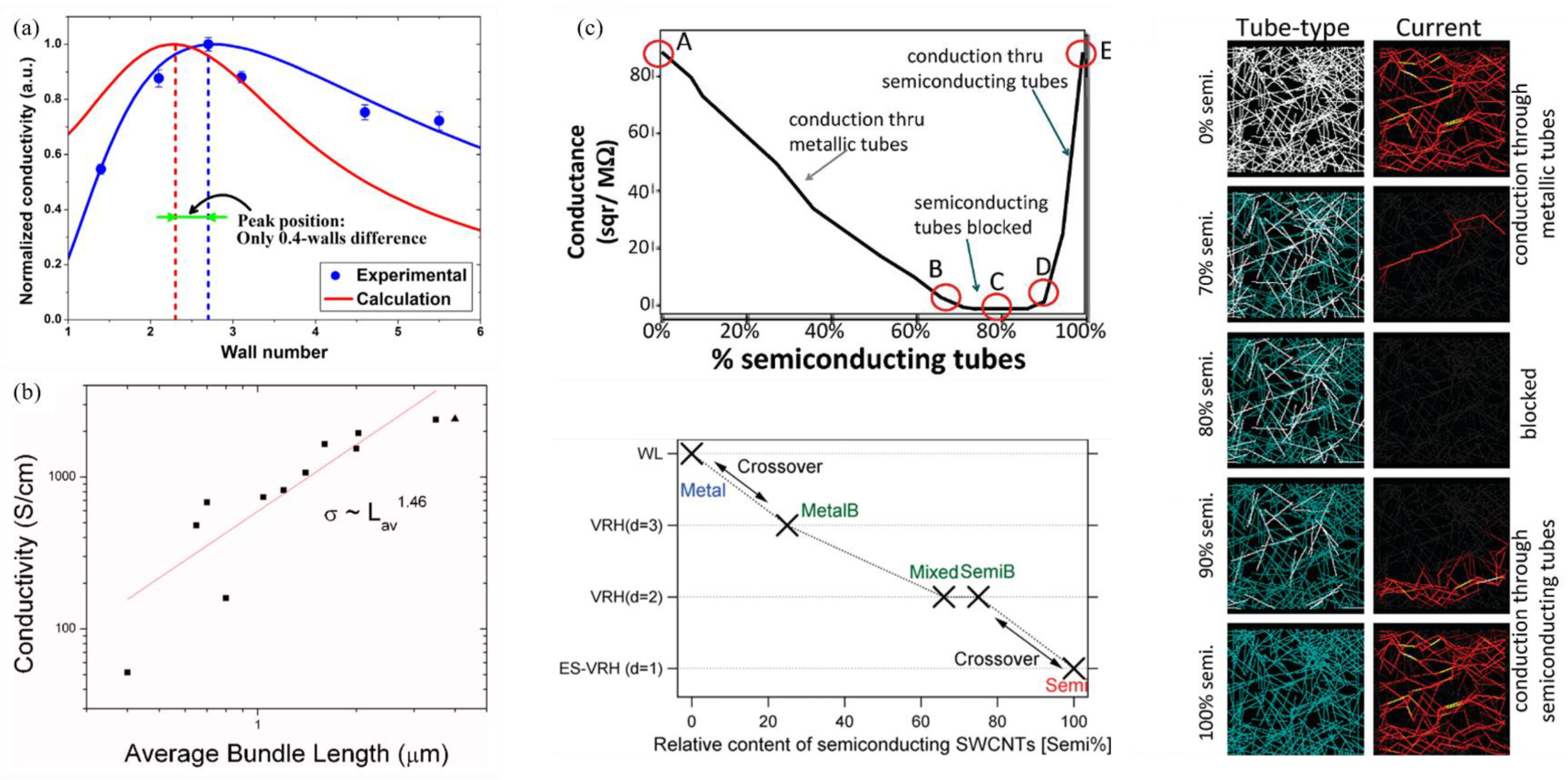
The primary factor influencing the electrical performance of CNT transparent conductive film (TCF) is the microstructure of CNTs. It has been demonstrated that long CNTs (about 10–20 μm) [140] with a large diameter (the diameter of the SWCNT and DWCNT is about 1.4 nm and 4nm, respectively) [141,142] and high crystallinity [143] are preferable for the construction of high-performance TCFs. The wall number is also crucial for the performance of TCF. It is evident that SWCNT film is the most desirable material for electronic and optoelectronic devices, given that it contains numerous semiconductive tubes and MWCNT absorbs more photons (Figure 12a) [110,142,144]. Furthermore, the incorporation of DWCNTs with a large diameter (about 4 nm) has been demonstrated to result in a substantial enhancement of the yield threshold of bundling, thereby expanding the contact area at the junctions [142]. The electrical type is also a crucial factor in this regard [145,146,147,148]. In a typical SWCNT film, the existence of Schottky barriers between metallic and semiconducting tubes invariably results in the presence of hopping barriers, thereby preventing high conductivity. As revealed by Yanagi et al. [148], quantum transport can be observed and hopping barriers are not present in SWCNT networks formed by high-purity metallic tubes, while a Coulomb-gap-type conduction mode is observed in semiconductive SWCNT networks. Topinka et al. and Yanagi et al. [146,148] provided a summary of the conduction mechanism in SWCNT networks as a function of the metallic/semiconducting ratio (Figure 12c). As the relative content of semiconducting SWCNTs increased, the conduction mechanism underwent a transition from quantum transport to variable range hopping (VRH) and then from VRH to ES-VRH. The VRH model postulated strong localization of electrons, indicating strong disorder in the contact area between bundles. The ES-VRH model indicated the presence of Coulomb interactions between localized electrons, inducing a Coulomb gap in the DOS. It was observed that both m-SWCNT and s-SWCNT networks exhibited the highest conductivity.
It is also imperative to optimize the configuration of CNT networks to enhance the electrical performance of TCFs. Many experiments have revealed that TCF consisting of isolated CNTs exhibits superior conductive properties compared to bundles [149,150,151,152]. Moreover, to avoid the introduction of surfactants and defects, it is preferable to synthesize an isolated CNT network by FCCVD directly [132,135] instead of utilizing solution-based techniques [61,153,154,155]. For instance, Kauppinen et al. [156] obtained SWCNT networks with over 60% isolated tubes by FCCVD method. After a HNO3 doping process, the TCFs demonstrated a comparatively low sheet resistance (Rs) of approximately 63 Ω/sq at a transmittance of 90% for 550 nm light. The synthesis of carbon-welded SWCNT film composed of approximately 85% isolated tubes was achieved by Liu et al. using the injection FCCVD method [149]. For pristine and HNO3-doped TCFs, the Rs values were recorded as 41 Ω/sq and 25 Ω/sq, respectively. The high concentration of isolated CNTs in TCF is crucial to its ultrahigh performance. This is due to the provision of sufficient carrier transport paths without the absorption of additional light [145].
The percolation theory is widely used to examine the transport behavior of TCFs [157,158,159], which is employed to delineate the insulator-to-conductor transition. The percolation threshold N C is the minimum CNT concentration at which a conductive pathway can be formed, as illustrated in Formula (3).
N C = 4.236 2 π L s 2 1 L
Ls and L represent an individual CNT length and aspect ratio, respectively. This indicates that the percolation threshold for SWCNT films with large aspect ratios is low, indicating that a minimal surface coverage is required to establish carrier transport pathways. Concurrently, the film resistance undergoes a precipitous decline above the threshold at elevated CNT densities. In this case, CNT hybrid architectures have been shown to synergize aligned domains (providing directional strength, conductivity, and deformation resistance) with random networks (delivering isotropic resilience, stress absorption, and environmental buffering) to mitigate anisotropy limitations. This balance optimizes mechanical stability, enhances charge transport via directional pathways and percolation networks, and improves environmental adaptability—particularly against humidity or temperature shifts. Hu et al. [160] derived a power exponential relationship between film conductance and thickness by controlling the volume of CNT suspension to form the TCF by vacuum filtration. Furthermore, a reduction in the size of the tube bundle results in a decrease in its square resistance [161]. It has been demonstrated by experimental and theoretical works that the network conductivity of CNTs is approximately linearly related to the mean bundle length and the network thickness, and approximately related to the 0.5 power of the mean bundle diameter (Figure 12b) [162].
Figure 12. (a) The variation in calculated electrical conductivity in red line and normalized experimental conductivity in blue line as a function of wall number [110]. (b) The relationship between the average bundle length and electrical conductivity of CNT network [162]. (c) Electronic phase diagram of conduction mechanisms as a function of semiconducting tube ratio [146,148].
Nanomaterials 15 01165 g012
The degree of alignment is another factor that affects the conductivity of TCFs, and the cutoff angle (θμ) is often used to quantify the degree of alignment. If the degree of alignment is excessive or insufficient, the formation of a conductive percolation path is impeded due to anisotropy or inadequate coverage, respectively. In contradistinction, the conductivity of CNT films is elevated by random distribution, a phenomenon attributable to diminished percolation thresholds [163,164]. Furthermore, the presence of amorphous carbon and sp3 bonds within the network leads to carrier scattering, demonstrating that films with a high G/D ratio exhibit enhanced conductivity [165].
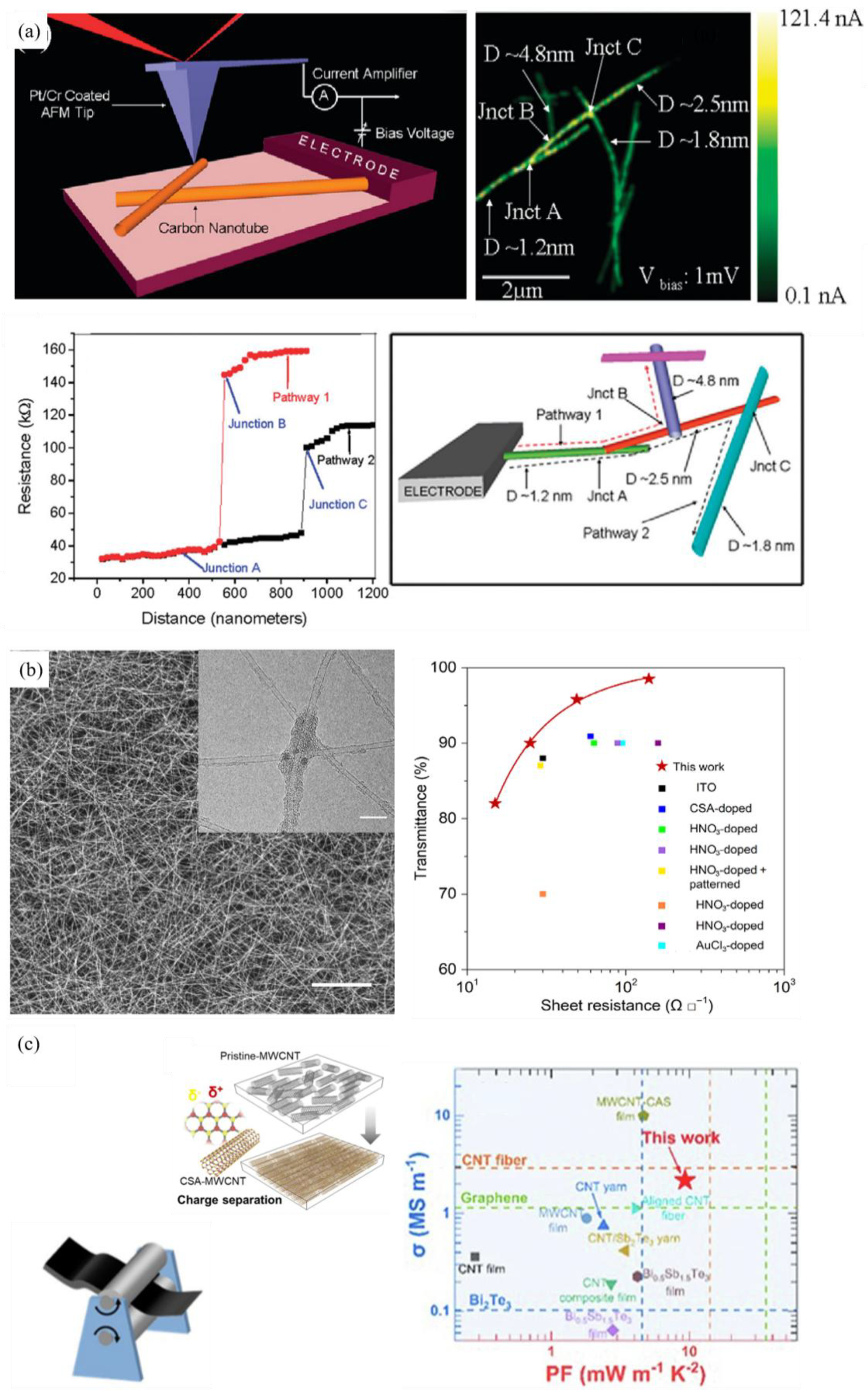
It is widely accepted that the junction resistance (Figure 13a) [147] is the primary contributor to the Rs of a TCF, suggesting that enhancing the performance of TCFs is more effectively achieved by focusing on the control of inter-tube connections rather than the structure of composing CNTs. A considerable amount of effort has been invested into the enhancement of junction resistance. The integration of graphitic carbon within the junctions has been demonstrated to facilitate a transformation of the Schottky contacts between s-SWCNT and m-SWCNT, converting these contacts into near-ohmic configurations (Figure 13b) [149]. Also, controlling the unique morphology of the network, characterized by a preponderance of Y-junctions over X-junctions, which possess larger contact areas, has the potential to yield reduced junction resistances [61]. Moreover, densification through the application of acid treatments, such as HNO3 [166] and chlorosulfonic acid (CSA) [167] or employing simple compression [166,167,168] could also enhance the conductivity of TCFs. It enhances the zipping effect between tubes, leading to highly packed and oriented CNTs in the film, with a concomitant decrease in voids (Figure 13c).

3.4. Discrepancy in the Electrical Property of Individual CNTs and Their Assemblies

It has been demonstrated that individual CNTs, especially individual SWCNTs, exhibit excellent electrical properties. The conductivities of SWCNTs can be comparable to, or even superior to those of highly conductive metals. In an ideal condition, the carrier mobility and current-carrying capacity of a SWCNT with a defect-free structure can be extremely high. However, when assembled into macrostructures, the distinct transport properties of the individual tubes do not translate into the assemblies. Table 2 summarizes experimental results of the electrical properties of individual CNTs and their assemblies.
The significant difference in the electrical properties of individual CNTs and their assemblies can be attributed to the following factors: First and foremost, is the cross junctions exhibited in assemblies. Since the inter-tube contact at cross junctions is achieved by van der Waals interaction, it may be difficult to achieve an ohmic contact. The second factor is a mixture of nanotubes that vary in chirality, diameter, number of walls, and length in the assemblies. It is still challenging to prepare pure SWCNTs with identical structures. Thirdly, some overall structural factors like tube alignment, densification, and porosity also significantly influence the properties. If the arrangement is highly disordered, the electron transport paths become zigzag, which leads to a decrease in the conductivity.
As a result, a large number of strategies for optimizing the electrical performance of assemblies have been proposed. On orientation control, CNTs are arranged by drawing [52,169], applying electric field [170,171], or using template method [172] to reduce the interface resistance. Substitutional or surface charge transfer doping was also performed to improve the electrical conductivity (Section 3.5). Additionally, in order to obtain reliable conductivity measurements, it is necessary to undertake pre-treatments like acid treatment to remove residual impurities and post-treatments like high-temperature annealing to reduce defects. It should also be noted that trade-offs between mechanical and electrical properties invariably occur in CNT assemblies. Increasing the density and alignment of CNTs improves the electrical properties and also promotes the mechanical properties by improving the interfacial resistance. However, certain methods, such as high-temperature treatment, have been observed to enhance electrical properties at the expense of toughness due to reduced inter-tube overlap [173].

3.5. Electrical Property of Doped CNTs

As mentioned above, the electrical properties of individual CNTs are strongly dependent on their atomic structures, such as chirality and defects. In contrast, the electrical properties of assemblies are also influenced by inter-tube junctions, extrinsic configurations such as porosity, and alignment. A number of strategies are proposed to enhance the conductivity in both Section 3.2 and Section 3.3. However, it is worth noting that the atomically controlled growth of CNTs and charge transfers in CNT assemblies have yet to be fully achieved. Doping is a critical strategy for tailoring the electrical properties of CNTs and has broad application prospects in electronic devices. There are mainly two primary doping methods: substitutional doping and surface charge transfer doping.

3.5.1. Substitutional Doping

Substitutional doping in CNTs incorporates foreign atoms into the carbon lattice. This is similar to the bulk doping process used in conventional semiconductors. Owing to their similar atomic radii to carbon (C) atoms, nitrogen (N) [174,175,176,177,178] and boron (B) [179,180,181] are the most commonly used doping elements, which release excess electrons to CNTs and create holes in the valence band in CNTs, respectively.
There are basically two approaches to prepare the substitutionally doped CNT: in situ doping during synthesis and post-synthesis doping. For the former, precursors containing the dopant atoms are used during CNT growth, by arc discharge [182,183], laser ablation [184,185,186], chemical vapor deposition (CVD) [187,188], spray-pyrolysis [177,189], or plasma-assisted CVD [190]. For the later, post-synthesis chemical reaction was performed to replace carbon atoms in CNTs with doping atoms, which can be realized by heat treatment [191,192], plasma treatment [193,194], or ball-milling [195,196].
B-doped and N-doped CNTs exhibit unique electronic and transport properties. At low concentrations of B or N, the dopants are uniformly distributed within the CNT and the impurity states appear in the band gap, which can be detected by STM. The donor state induced by N doping appears near the conduction band minimum, while the acceptor state in the case of B is close to the valence band maximum. Moreover, some calculation results suggested that the localization of the extra charge associated with the impurity differs considerably between s-CNTs and m-CNTs. Compared to an s-CNT, the defect state is spatially more localized for a metallic one, resulting in a significant difference in electrical and chemical properties [197].
With a high concentration of B or N, several studies have revealed that N-doped and B-doped CNTs exhibit metal-like behavior [198] because of the presence of dopant-rich islands like BC3 nanodomains [199] and CNx tubes [200].
Owing to their excellent conductivity and chemical stability along with unique electronic structure and high electron density, N-doped and B-doped CNTs have been widely used in flexible micro-supercapacitors, batteries, and catalysis.

3.5.2. Surface Charge Transfer Doping

Surface charge transfer doping is an unconventional way to achieve doping through surface engineering, which is commonly used in the doping of CNT assemblies. Take p-type doping as an example, acceptors are known to possess unoccupied molecular orbitals for electrons (UMOs). In the event of the energetically lowest of these orbitals (LUMO) being in proximity to the valence band maximum of the CNT, an electron will be transferred from the CNT. Consequently, holes will form in the CNTs, and negative charge will be localized on the surface acceptors. The process of charge separation is accompanied by the establishment of an electrostatic potential that confines the holes in a perpendicular direction. However, the holes are still able to move in a parallel direction to the surface [201].
Ionic dopants form a heterogeneous interface between CNT and dopants after CNT synthesis. N-type dopants like alkali metals (Li [202], K [95,203,204,205,206,207,208]) and p-type dopants like halogen elements (Br2 [208], I2 [209,210,211,212,213]), strong acid (CSA [167,209]), and transition metal halides (CuI [214], Ibr [209,215], Icl [215], AuCl3 [216,217], FeCl3 [203,218], PbI2 [219]) are the most commonly used dopants. Regarding the location of the dopants, the doping type can be classified as exohedral (intercalation and deposition) and endohedral (filling) [220].
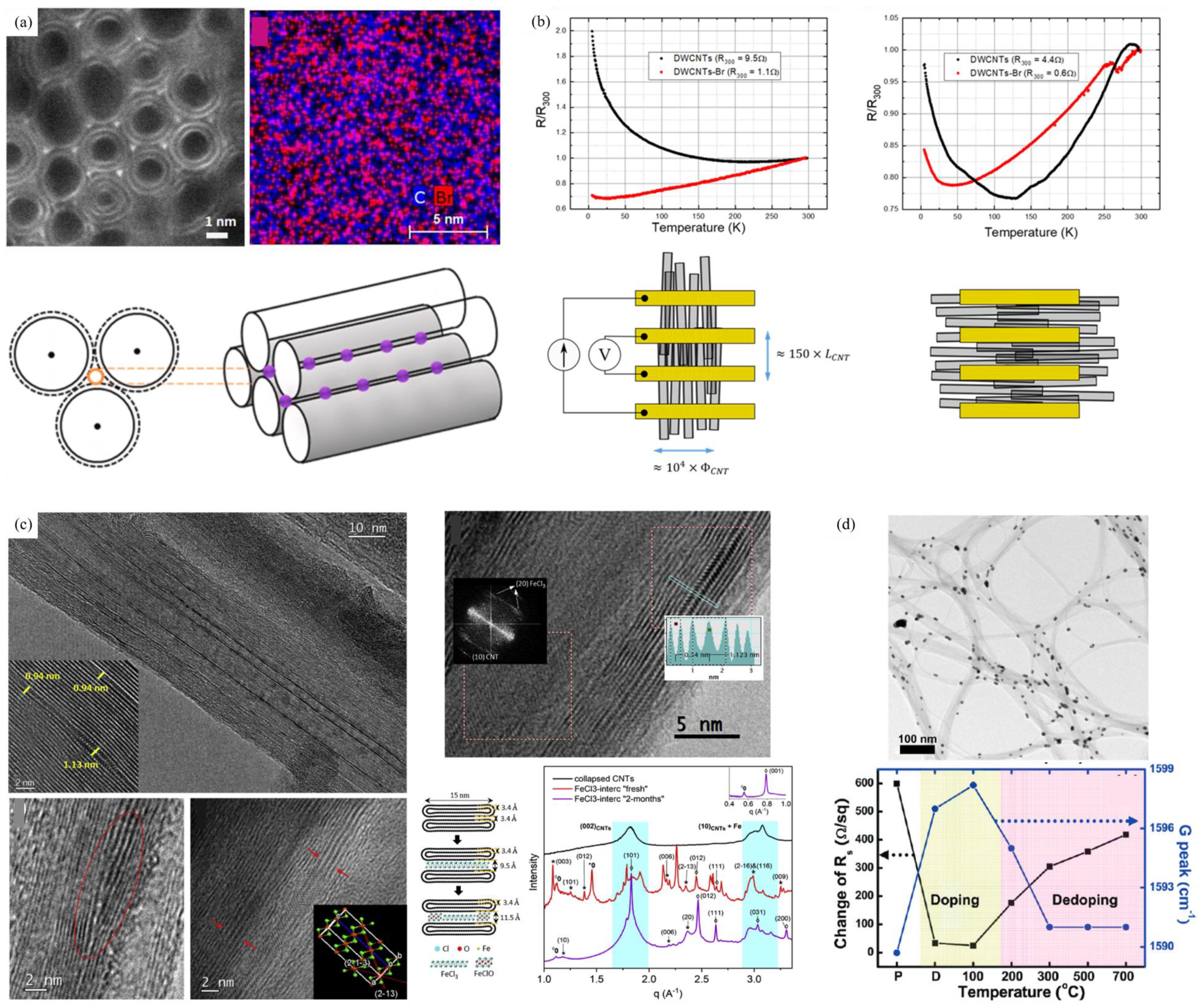
A substantial body of research remains on exohedral doping (Figure 14). Madrona et al. [221] demonstrated that the intercalation of long-range ordered Br into DWCNT fibers reduces the inter-tube resistance, and increases the conductance of individual DWCNTs. Madrona et al. [222] introduced FeCl3 intercalation into fibers consisted of collapsed CNTs, which leads to a stable increase in conductivity measured at a factor of six. Qiu et al. [223] deposited Au nanoparticles in CNT fibers to enhance the interfacial electrical transport, inducing an equivalent p-type doping.
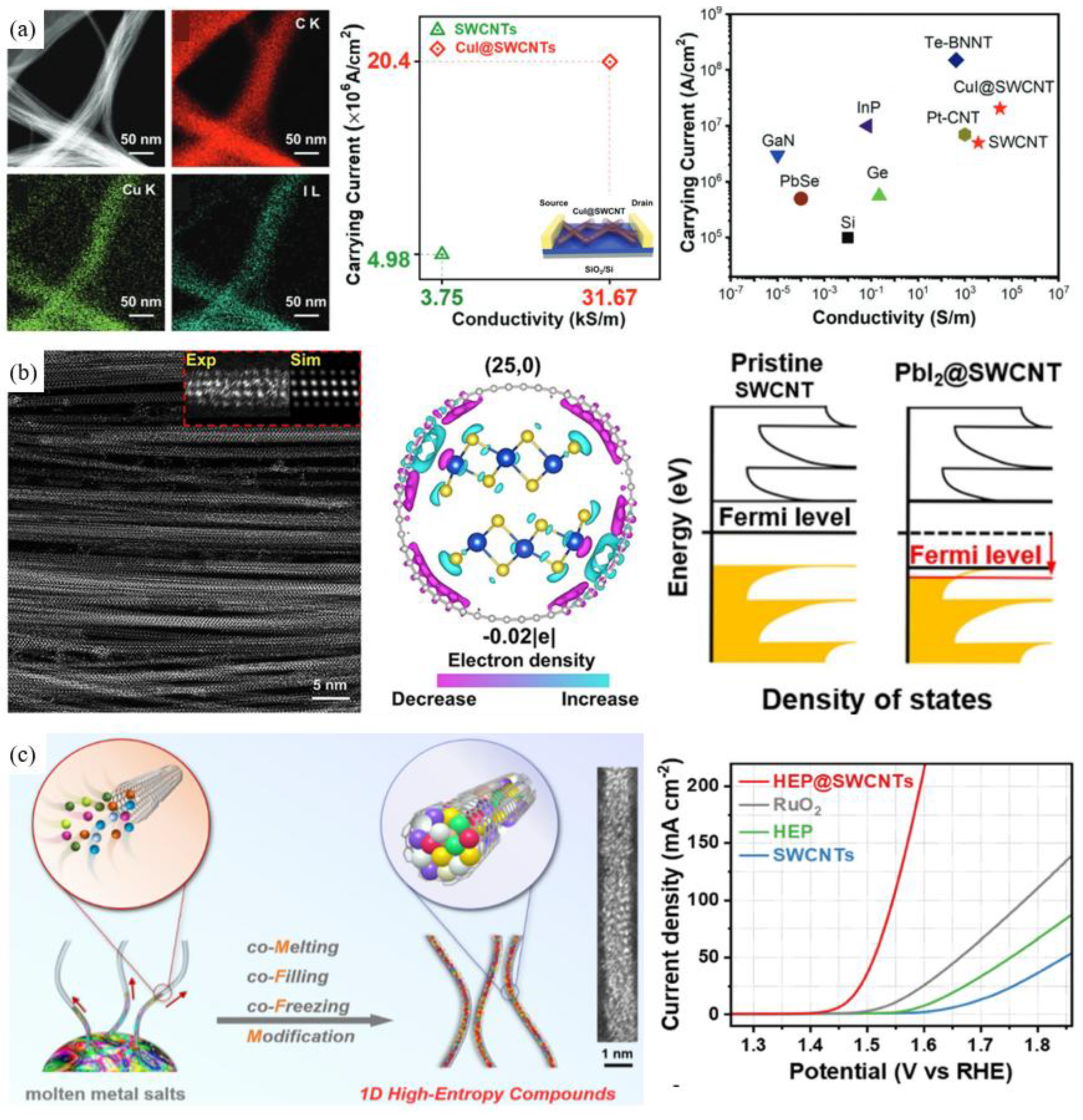
Recently, considerable attention has been paid to the construction of one-dimensional van der Waals heterostructures by endohedral doping for the purpose of enhancing the electrical properties. Due to the confinement protection of CNTs, they exhibit good stability. Zhang et al. [224] prepared CuI@SWCNT networks with an electrical conductivity of 32 kS m−1 and a current carrying capacity of 2 × 10⁷ A cm−2 (Figure 15a). Teng et al. [219] prepared a PbI2@SWCNTs hybrid and fabricated self-powered photodetectors that exhibit exceptional photocurrent and a switching ratio of three orders of magnitude (Figure 15b). Du et al. [225] developed a synthesizing method named comelting–filling–freezing–modification for simultaneously encapsulating various high-entropy metal phosphide (HEP) into SWCNTs. The SWCNT could protect the 1D HEP and donate π electrons to the HEP for enhanced electron delocalization, thus promoting high electrocatalytic activity and stability (Figure 15c).
It is important to note that the substitutional doping always demonstrates superior thermal and chemical stability compared to the surface charge transfer doping because the substitutional dopants exhibit superior thermal resilience via strong chemical bonds. The dopants employed in surface charge transfer doping, instead, are susceptible to de-doping in high temperature or humid/ionic environments. This limitation restricts the applicability of this method to high-temperature applications like cables.

4. Conclusions and Outlook

In summary, CNTs are a promising candidate for use in electronics, energy storage, transparent conductive films, and other electrical applications due to their exceptional electrical properties. This review briefly introduces the methods explored for measuring the electrical properties of CNTs, such as STM, electron microscope-based nanoprobes, CNT electronic devices. These methodologies can be used to obtain a variety of electrical information, such as electronic band structure, resistance, conductance, and thermoelectric power. Most approaches require contact between CNTs and electrodes, inevitably leading to measurement errors. In addition to contact resistance, other factors such as measurement environment and substrate have also been identified as contributors to the diversity of electrical measurement results in different experimental groups. Moreover, the effects of intrinsic structures of CNTs such as chirality, diameter, defects, and length on the electrical properties of individual CNTs at the atomic scale are discussed. More importantly, the primary limitations on electrical properties in multi-tube systems have been explored by considering two CNTs, CNT bundles, fibers, and films. The core limitations for charge transfer are clarified as inter-tube junctions and extrinsic configurations of CNT assemblies, such as porosity, alignment, etc. Several strategies such as acid treatment, application of outfields and doping have been developed to modify the alignment, van der Waals interactions, and contact resistance of CNTs in macroscopic assemblies.
Despite the development made in improving the electrical properties of individual CNTs and CNT assemblies, many challenges still remain. Firstly, the electrical transfer mechanism from individuals to assemblies remains unclear. Although a general understanding is that the inter-tube interfaces is the main origin of the degraded electrical properties, there has been no general theory, principle, and method to solve this problem. Secondly, bridging the gap between theory and experiment is still challenging. The structure of CNTs cannot be precisely controlled and measurement errors do exist.
Based on the current research status and the aforementioned challenges, we propose the following strategies to address these issues: First of all, defects are inevitably introduced during CNT synthesis and subsequent processing, and these defects act as scattering centers of electron transport. It is important to develop defect engineering techniques, such as laser annealing and chemical functionalization, which enables vacancy healing in a gentler and more controllable way. Secondly, the transport properties of CNTs are strongly dependent on their structures, especially their chirality. Consequently, realizing chirality-specific synthesis is an important way to boost the electrical properties of individual and assembled SWCNTs. Thirdly, advanced doping methods need developed to achieve more stable n/p-type CNT assemblies. Fourthly, modifying the interface structure between CNTs in their macroscopic assemblies is highly important. It is expected that efficient electrical conduction will be realized through the optimization of the assembly configuration and the interaction between the comprising CNTs. The application of machine learning to guide assembly design [226] and conduct high-throughput synthesis screening for CNT assembly optimization [227,228] is also a viable option.

Author Contributions

Writing—original draft preparation, Y.X.; writing—review and editing, L.Z. and C.L. All authors have read and agreed to the published version of the manuscript.

Funding

This project was supported by National Natural Science Foundation of China (Nos. 52130209, 51927803, 52188101, 52372054, and 22003074), National Key R&D Program of China (No. 2022YFA1203302), Guangdong Provincial Key Laboratory Program of the Guangdong Science and Technology Department (No. 2021B1212040001), Youth Innovation Promotion Association CAS (No. 2022366), and the Shenzhen Science and Technology Program (No. JCYJ20240813154813018).

Conflicts of Interest

The authors declare no conflict of interest.

Abbreviations

The following abbreviations are used in this manuscript:
CNTsCarbon nanotubes
SWCNTsSingle-walled carbon nanotubes
m-SWCNTsMetallic single-walled carbon nanotubes
s-SWCNTsSemiconducting single-walled carbon nanotubes
DWCNTsDouble-walled carbon nanotubes
MWCNTsMulti-walled carbon nanotubes
FETField-effect transistor
STMScanning tunnelling microscopy
STSScanning tunneling spectroscopy
DOSDensity of states
SEMScanning electron microscope
TEMTransmission electron microscope
FIBFocused ion beam
ICsIntegrated circuits
MOSFETMetal–oxide–semiconductor field-effect transistor
FCCVDFloating catalyst chemical vapor deposition
TCFTransparent conductive film
VRHVariable range hopping
CSAChlorosulfonic acid
1DOne-dimensional
HAADFHigh-angle annular dark-field
STEMScanning transmission electron microscopy
HEPHigh-entropy metal phosphide
DFTDensity functional tight

References

  1. Iijima, S. Helical Microtubules of Graphitic Carbon. Nature 1991, 354, 56–58. [Google Scholar] [CrossRef]
  2. Venkataraman, A.; Amadi, E.V.; Chen, Y.; Papadopoulos, C. Carbon Nanotube Assembly and Integration for Applications. Nanoscale Res. Lett. 2019, 14, 220. [Google Scholar] [CrossRef]
  3. Rathinavel, S.; Priyadharshini, K.; Panda, D. A Review on Carbon Nanotube: An Overview of Synthesis, Properties, Functionalization, Characterization, and the Application. Mater. Sci. Eng. B 2021, 268, 115095. [Google Scholar] [CrossRef]
  4. Shooshtari, M. Ammonia Gas Sensors Based on Multi-Wall Carbon Nanofiber Field Effect Transistors by Using Gate Modulation. Colloids Surf. Physicochem. Eng. Asp. 2025, 704, 135563. [Google Scholar] [CrossRef]
  5. Javey, A.; Guo, J.; Paulsson, M.; Wang, Q.; Mann, D.; Lundstrom, M.; Dai, H. High-Field Quasiballistic Transport in Short Carbon Nanotubes. Phys. Rev. Lett. 2004, 92, 106804. [Google Scholar] [CrossRef] [PubMed]
  6. Liang, W.J.; Bockrath, M.; Bozovic, D.; Hafner, J.H.; Tinkham, M.; Park, H. Fabry-Perot Interference in a Nanotube Electron Waveguide. Nature 2001, 411, 665–669. [Google Scholar] [CrossRef] [PubMed]
  7. Perebeinos, V.; Tersoff, J.; Avouris, P. Mobility in Semiconducting Carbon Nanotubes at Finite Carrier Density. Nano Lett. 2006, 6, 205–208. [Google Scholar] [CrossRef] [PubMed]
  8. Durkop, T.; Getty, S.A.; Cobas, E.; Fuhrer, M.S. Extraordinary Mobility in Semiconducting Carbon Nanotubes. Nano Lett. 2004, 4, 35–39. [Google Scholar] [CrossRef]
  9. Arora, N.D.; Hauser, J.R.; Roulston, D.J. Electron and Hole Mobilities in Silicon as a Function of Concentration and Temperature. IEEE Trans. Electron Devices 1982, 29, 292–295. [Google Scholar] [CrossRef]
  10. McEuen, P.L.; Bockrath, M.; Cobden, D.H.; Yoon, Y.-G.; Louie, S.G. Disorder, Pseudospins, and Backscattering in Carbon Nanotubes. Phys. Rev. Lett. 1999, 83, 5098–5101. [Google Scholar] [CrossRef]
  11. Javey, A.; Guo, J.; Wang, Q.; Lundstrom, M.; Dai, H. Ballistic Carbon Nanotube Field-Effect Transistors. Nature 2003, 424, 654–657. [Google Scholar] [CrossRef]
  12. Frank, S.; Poncharal, P.; Wang, Z.L.; de Heer, W.A. Carbon Nanotube Quantum Resistors. Science 1998, 280, 1744–1746. [Google Scholar] [CrossRef]
  13. Kong, J.; Yenilmez, E.; Tombler, T.W.; Kim, W.; Dai, H.; Laughlin, R.B.; Liu, L.; Jayanthi, C.S.; Wu, S.Y. Quantum Interference and Ballistic Transmission in Nanotube Electron Waveguides. Phys. Rev. Lett. 2001, 87, 106801. [Google Scholar] [CrossRef]
  14. White, C.T.; Todorov, T.N. Carbon Nanotubes as Long Ballistic Conductors. Nature 1998, 393, 240–242. [Google Scholar] [CrossRef]
  15. Sun, D.-M.; Timmermans, M.Y.; Kaskela, A.; Nasibulin, A.G.; Kishimoto, S.; Mizutani, T.; Kauppinen, E.I.; Ohno, Y. Mouldable All-Carbon Integrated Circuits. Nat. Commun. 2013, 4, 2302. [Google Scholar] [CrossRef] [PubMed]
  16. Jiao, X.; Shi, C.; Zhao, Y.; Xu, L.; Liu, S.; Hou, P.-X.; Liu, C.; Cheng, H.-M. Efficient Fabrication of High-Quality Single-Walled Carbon Nanotubes and Their Macroscopic Conductive Fibers. ACS Nano 2022, 16, 20263–20271. [Google Scholar] [CrossRef] [PubMed]
  17. Xu, L.; Jiao, X.; Shi, C.; Wu, A.-P.; Hou, P.-X.; Liu, C.; Cheng, H.-M. Single-Walled Carbon Nanotube/Copper Core–Shell Fibers with a High Specific Electrical Conductivity. ACS Nano 2023, 17, 9245–9254. [Google Scholar] [CrossRef]
  18. Wilder, J.W.G.; Venema, L.C.; Rinzler, A.G.; Smalley, R.E.; Dekker, C. Electronic Structure of Atomically Resolved Carbon Nanotubes. Nature 1998, 391, 59–62. [Google Scholar] [CrossRef]
  19. Odom, T.W.; Huang, J.-L.; Lieber, C.M. STM Studies of Single-Walled Carbon Nanotubes. J. Phys. Condens. Matter 2002, 14, R145. [Google Scholar] [CrossRef]
  20. Jobbins, M.M.; Raigoza, A.F.; Kandel, S.A. Note: Circuit Design for Direct Current and Alternating Current Electrochemical Etching of Scanning Probe Microscopy Tips. Rev. Sci. Instrum. 2012, 83, 1115. [Google Scholar] [CrossRef]
  21. Zhang, J.; Wang, P.; Zhang, X.; Ji, H.; Luo, J.; Wang, H.; Wang, J. Systematic Electrochemical Etching of Various Metal Tips for Tunneling Spectroscopy and Scanning Probe Microscopy. Rev. Sci. Instrum. 2021, 92, 015124. [Google Scholar] [CrossRef] [PubMed]
  22. Liu, Z.; Zhang, Y.; Zhao, P.; Ye, Y.; Chen, J.; Xu, N.; Deng, S. In Situ Study of Field Emission Vacuum Breakdown of Individual Multi-wall Carbon Nanotube. Micro Nano Lett. 2019, 14, 206–210. [Google Scholar] [CrossRef]
  23. Wei, X.; Chen, Q.; Peng, L.; Cui, R.; Li, Y. In Situ Measurements on Individual Thin Carbon Nanotubes Using Nanomanipulators inside a Scanning Electron Microscope. Ultramicroscopy 2010, 110, 182–189. [Google Scholar] [CrossRef] [PubMed]
  24. Feng, W.; Hayama, K.; Akinaga, H. Investigations of Electrical Transport Properties of Individual Carbon Nanotubes with Nanoprober. Jpn. J. Appl. Phys. 2016, 55, 06JH01. [Google Scholar] [CrossRef]
  25. Jeong, S.; Higashitani, K.; Kaneko, T.; Yamada, T.; Li, Z.; Fujimori, T.; Tejima, S.; Fujita, J. Elucidating Slipping Behaviors Between Carbon Nanotubes: Using Nitrogen Doping and Electron Irradiation to Suppress Slippage. Carbon 2024, 231, 119693. [Google Scholar] [CrossRef]
  26. Tang, D.-M.; Kvashnin, D.G.; Najmaei, S.; Bando, Y.; Kimoto, K.; Koskinen, P.; Ajayan, P.M.; Yakobson, B.I.; Sorokin, P.B.; Lou, J.; et al. Nanomechanical Cleavage of Molybdenum Disulphide Atomic Layers. Nat. Commun. 2014, 5, 3631. [Google Scholar] [CrossRef]
  27. Costa, P.M.F.J.; Gautam, U.K.; Bando, Y.; Golberg, D. Direct Imaging of Joule Heating Dynamics and Temperature Profiling inside a Carbon Nanotube Interconnect. Nat. Commun. 2011, 2, 421. [Google Scholar] [CrossRef]
  28. Aslam, Z.; Nicholls, R.; Koós, A.; Nicolosi, V.; Grobert, N. Current-Induced Restructuring and Chemical Modification of N-Doped Multi-Walled Carbon Nanotubes. Adv. Funct. Mater. 2011, 21, 3933–3937. [Google Scholar] [CrossRef]
  29. Wang, M.-S.; Golberg, D.; Bando, Y. Interface Dynamic Behavior Between a Carbon Nanotube and Metal Electrode. Adv. Mater. 2010, 22, 93–98. [Google Scholar] [CrossRef]
  30. Wang, M.; Golberg, D.; Bando, Y. Superstrong Low-Resistant Carbon Nanotube-Carbide-Metal Nanocontacts. Adv. Mater. 2010, 22, 5350–5355. [Google Scholar] [CrossRef]
  31. Barnett, C.J.; Gowenlock, C.E.; Welsby, K.; Orbaek White, A.; Barron, A.R. Spatial and Contamination-Dependent Electrical Properties of Carbon Nanotubes. Nano Lett. 2018, 18, 695–700. [Google Scholar] [CrossRef]
  32. Tuchband, M.; He, J.; Huang, S.; Lindsay, S. Insulated Gold Scanning Tunneling Microscopy Probes for Recognition Tunneling in an Aqueous Environment. Rev. Sci. Instrum. 2012, 83, 15102. [Google Scholar] [CrossRef]
  33. Gingery, D.; Bühlmann, P. Single-Step Electrochemical Method for Producing Very Sharp Au Scanning Tunneling Microscopy Tips. Rev. Sci. Instrum. 2007, 78, 113703. [Google Scholar] [CrossRef]
  34. Libioulle, L.; Houbion, Y.; Gilles, J.-M. Very Sharp Gold and Platinum Tips to Modify Gold Surfaces in Scanning Tunneling Microscopy. J. Vac. Sci. Technol. B Microelectron. Nanometer Struct. Process. Meas. Phenom. 1995, 13, 1325–1331. [Google Scholar] [CrossRef]
  35. Lopes, M.; Toury, T.; De La Chapelle, M.L.; Bonaccorso, F.; Giuseppe Gucciardi, P. Fast and Reliable Fabrication of Gold Tips with Sub-50 Nm Radius of Curvature for Tip-Enhanced Raman Spectroscopy. Rev. Sci. Instrum. 2013, 84, 73702. [Google Scholar] [CrossRef]
  36. Xu, G.; Liu, Z.; Xu, K.; Zhang, Y.; Zhong, H.; Fan, Y.; Huang, Z. Constant Current Etching of Gold Tips Suitable for Tip-Enhanced Raman Spectroscopy. Rev. Sci. Instrum. 2012, 83, 103708. [Google Scholar] [CrossRef] [PubMed]
  37. Lee, C.; Kim, S.T.; Jeong, B.G.; Yun, S.J.; Song, Y.J.; Lee, Y.H.; Park, D.J.; Jeong, M.S. Tip-Enhanced Raman Scattering Imaging of Two-Dimensional Tungsten Disulfide with Optimized Tip Fabrication Process. Sci. Rep. 2017, 7, 40810. [Google Scholar] [CrossRef] [PubMed]
  38. Narasiwodeyar, S.; Dwyer, M.; Liu, M.; Park, W.K.; Greene, L.H. Two-Step Fabrication Technique of Gold Tips for Use in Point-Contact Spectroscopy. Rev. Sci. Instrum. 2015, 86, 33903. [Google Scholar] [CrossRef] [PubMed]
  39. Huang, J.Y.; Chen, S.; Jo, S.H.; Wang, Z.; Han, D.X.; Chen, G.; Dresselhaus, M.S.; Ren, Z.F. Atomic-Scale Imaging of Wall-by-Wall Breakdown and Concurrent Transport Measurements in Multiwall Carbon Nanotubes. Phys. Rev. Lett. 2005, 94, 236802. [Google Scholar] [CrossRef]
  40. Bajpai, A.; Aslam, Z.; Hampel, S.; Klingeler, R.; Grobert, N. A Carbon-Nanotube Based Nano-Furnace for in-Situ Restructuring of a Magnetoelectric Oxide. Carbon 2017, 114, 291–300. [Google Scholar] [CrossRef]
  41. Lord, A.M.; Ramasse, Q.M.; Kepaptsoglou, D.M.; Periwal, P.; Ross, F.M.; Wilks, S.P. Stability of Schottky and Ohmic Au Nanocatalysts to ZnO Nanowires. Nano Lett. 2017, 17, 6626–6636. [Google Scholar] [CrossRef]
  42. Bachtold, A.; Henny, M.; Terrier, C.; Strunk, C.; Schönenberger, C.; Salvetat, J.-P.; Bonard, J.-M.; Forró, L. Contacting Carbon Nanotubes Selectively with Low-Ohmic Contacts for Four-Probe Electric Measurements. Appl. Phys. Lett. 1998, 73, 274–276. [Google Scholar] [CrossRef]
  43. Dong, L.; Youkey, S.; Bush, J.; Jiao, J.; Dubin, V.M.; Chebiam, R.V. Effects of Local Joule Heating on the Reduction of Contact Resistance between Carbon Nanotubes and Metal Electrodes. J. Appl. Phys. 2007, 101, 024320. [Google Scholar] [CrossRef]
  44. Hamasaki, H.; Li, Y.; Ohnishi, M.; Shiomi, J.; Yanagi, K.; Hirahara, K. Thermoelectric Power of a Single van Der Waals Interface between Carbon Nanotubes. ACS Nano 2024, 18, 612–617. [Google Scholar] [CrossRef] [PubMed]
  45. Hamasaki, H.; Nagahama, S.; Hirahara, K. Electrical Conductivity of a Single Parallel Contact between Carbon Nanotubes. Nanoscale 2022, 14, 11529–11534. [Google Scholar] [CrossRef]
  46. Ebbesen, T.W.; Lezec, H.J.; Hiura, H.; Bennett, J.W.; Ghaemi, H.F.; Thio, T. Electrical Conductivity of Individual Carbon Nanotubes. Nature 1996, 382, 54–56. [Google Scholar] [CrossRef]
  47. Collins, P.G.; Hersam, M.; Arnold, M.; Martel, R.; Avouris, P. Current Saturation and Electrical Breakdown in Multiwalled Carbon Nanotubes. Phys. Rev. Lett. 2001, 86, 3128–3131. [Google Scholar] [CrossRef]
  48. de Picciotto, R.; Stormer, H.L.; Pfeiffer, L.N.; Baldwin, K.W.; West, K.W. Four-Terminal Resistance of a Ballistic Quantum Wire. Nature 2001, 411, 51–54. [Google Scholar] [CrossRef]
  49. Lüpke, F.; Cuma, D.; Korte, S.; Cherepanov, V.; Voigtländer, B. Four-Point Probe Measurements Using Current Probes with Voltage Feedback to Measure Electric Potentials. J. Phys. Condens. Matter 2018, 30, 54004. [Google Scholar] [CrossRef]
  50. Zhaoqing, G.; Xu, L.; No, J.; Li, X.; He, C.; Hao-ZiKe, W.; Sun, C.; Hou, P.-X.; Liu, C.; Cheng, H.-M. Strong Connection of Single-Wall Carbon Nanotube Fibers with a Copper Substrate Using an Intermediate Nickel Layer. ACS Nano 2023, 17, 18290–18298. [Google Scholar] [CrossRef]
  51. Park, J.Y.; Cho, J.; Jun, S.C. Review of Contact-Resistance Analysis in Nano-Material. J. Mech. Sci. Technol. 2018, 32, 539–547. [Google Scholar] [CrossRef]
  52. Wang, H.-Z.; Jiao, X.-Y.; Gao, Z.-Q.; Hou, P.-X.; Xu, L.-L.; Shi, C.; Liang, Y.; Wang, Y.-P.; Liu, C. Highly Conductive Double-Wall Carbon Nanotube Fibers Produced by Dry-Jet Wet Spinning. Adv. Funct. Mater. 2024, 34, 2404538. [Google Scholar] [CrossRef]
  53. Lin, Y.; Cao, Y.; Ding, S.; Zhang, P.; Xu, L.; Liu, C.; Hu, Q.; Jin, C.; Peng, L.-M.; Zhang, Z. Scaling Aligned Carbon Nanotube Transistors to a Sub-10 Nm Node. Nat. Electron. 2023, 6, 506–515. [Google Scholar] [CrossRef]
  54. Guo, Q.; Wang, X.; Zhao, P.; Zhang, Z.; Geng, L.; Liu, Y.; Teng, Y.; Zhong, Y.; Kang, L. Performance Enhancement of Carbon Nanotube Network Transistors via SbI3 Inner-Doping in Selected Regions. Adv. Mater. 2025, 37, 2415442. [Google Scholar] [CrossRef]
  55. Gwyther, R.E.A.; Côté, S.; Lee, C.-S.; Miao, H.; Ramakrishnan, K.; Palma, M.; Dafydd Jones, D. Optimising CNT-FET Biosensor Design through Modelling of Biomolecular Electrostatic Gating and Its Application to β-Lactamase Detection. Nat. Commun. 2024, 15, 7482. [Google Scholar] [CrossRef]
  56. Ze, Y.; Liu, Y.; Wang, B.; Yin, H.; Jin, C.; Zhang, Z. Carbon Nanotube Materials for Future Integrated Circuit Applications. Mater. Today 2024, 79, 97–111. [Google Scholar] [CrossRef]
  57. Shim, M.; Javey, A.; Shi Kam, N.W.; Dai, H. Polymer Functionalization for Air-Stable n-Type Carbon Nanotube Field-Effect Transistors. J. Am. Chem. Soc. 2001, 123, 11512–11513. [Google Scholar] [CrossRef]
  58. Lin, S.; Ye, T.; Zhang, X.; Zuo, H.; Zhu, L.; Wang, X.; Li, C.; Yang, Z.; Du, R.; Lin, D.; et al. Arrays of Horizontal Semiconducting Carbon Nanotubes Grown from Non-Metal Catalysts Prepared by a “Thermophoresis-Anchoring” Synergistic Strategy. Nano Today 2025, 61, 102562. [Google Scholar] [CrossRef]
  59. Franklin, A.D. Creating High-Performance Transistors by Coating Carbon Nanotube Arrays. Nat. Electron. 2024, 7, 1068–1069. [Google Scholar] [CrossRef]
  60. Su, W.; Li, X.; Li, L.; Yang, D.; Wang, F.; Wei, X.; Zhou, W.; Kataura, H.; Xie, S.; Liu, H. Chirality-Dependent Electrical Transport Properties of Carbon Nanotubes Obtained by Experimental Measurement. Nat. Commun. 2023, 14, 1672. [Google Scholar] [CrossRef]
  61. Sun, D.; Timmermans, M.Y.; Tian, Y.; Nasibulin, A.G.; Kauppinen, E.I.; Kishimoto, S.; Mizutani, T.; Ohno, Y. Flexible High-Performance Carbon Nanotube Integrated Circuits. Nat. Nanotechnol. 2011, 6, 156–161. [Google Scholar] [CrossRef]
  62. LeMieux, M.C.; Roberts, M.; Barman, S.; Jin, Y.W.; Kim, J.M.; Bao, Z. Self-Sorted, Aligned Nanotube Networks for Thin-Film Transistors. Science 2008, 321, 101–104. [Google Scholar] [CrossRef] [PubMed]
  63. Foradori, S.M.; Prussack, B.; Berson, A.; Arnold, M.S. Assembly and Alignment of High Packing Density Carbon Nanotube Arrays Using Lithographically Defined Microscopic Water Features. ACS Nano 2024, 18, 8259–8269. [Google Scholar] [CrossRef] [PubMed]
  64. Hills, G.; Lau, C.; Wright, A.; Fuller, S.; Bishop, M.D.; Srimani, T.; Kanhaiya, P.; Ho, R.; Amer, A.; Stein, Y.; et al. Modern Microprocessor Built from Complementary Carbon Nanotube Transistors. Nature 2019, 572, 595–602. [Google Scholar] [CrossRef] [PubMed]
  65. Sun, Y.; Lu, P.; Zhang, L.; Cao, Y.; Bai, L.; Ding, L.; Han, J.; Zhang, C.; Zhu, M.; Zhang, Z. Investigation and Improvement of the Bias Temperature Instability in Carbon Nanotube Transistors. Adv. Electron. Mater. 2024, 11, 2400464. [Google Scholar] [CrossRef]
  66. Zamzami, M.A.; Rabbani, G.; Ahmad, A.; Basalah, A.A.; Al-Sabban, W.H.; Ahn, S.N.; Choudhry, H. Fabrication and Characterization of Field Effect Transistor Based on Single Walled Carbon Nanotubes. J. King Saud Univ. Sci. 2022, 34, 102137. [Google Scholar] [CrossRef]
  67. Zhu, M.; Yin, H.; Cao, J.; Xu, L.; Lu, P.; Liu, Y.; Ding, L.; Fan, C.; Liu, H.; Zhang, Y.; et al. Inner Doping of Carbon Nanotubes with Perovskites for Ultralow Power Transistors. Adv. Mater. 2024, 36, 2403743. [Google Scholar] [CrossRef]
  68. Han, J.; Xu, X.; Zhang, Z. Removing Conjugated Polymers from Aligned Carbon Nanotube Arrays. Small 2024, 20, 2309654. [Google Scholar] [CrossRef]
  69. Cao, Q.; Tersoff, J.; Farmer, D.B.; Zhu, Y.; Han, S.-J. Carbon Nanotube Transistors Scaled to a 40-Nanometer Footprint. Science 2017, 356, 1369–1372. [Google Scholar] [CrossRef]
  70. Zhu, Z.; Wei, N.; Cheng, W.; Shen, B.; Sun, S.; Gao, J.; Wen, Q.; Zhang, R.; Xu, J.; Wang, Y.; et al. Rate-Selected Growth of Ultrapure Semiconducting Carbon Nanotube Arrays. Nat. Commun. 2019, 10, 4467. [Google Scholar] [CrossRef]
  71. Hu, Y.; Kang, L.; Zhao, Q.; Zhong, H.; Zhang, S.; Yang, L.; Wang, Z.; Lin, J.; Li, Q.; Zhang, Z.; et al. Growth of High-Density Horizontally Aligned SWNT Arrays Using Trojan Catalysts. Nat. Commun. 2015, 6, 6099. [Google Scholar] [CrossRef]
  72. Zhang, Z.; Chen, Y.; Shen, P.; Chen, J.; Wang, S.; Wang, B.; Ma, S.; Lyu, B.; Zhou, X.; Lou, S.; et al. Homochiral Carbon Nanotube van Der Waals Crystals. Science 2025, 387, 1310–1316. [Google Scholar] [CrossRef] [PubMed]
  73. Oshima, H.; Iwase, K.; Ohno, Y. In Situ Monitoring of the Electrical Property of Carbon Nanotube Thin Film in Floating Catalyst Chemical Vapor Deposition. Jpn. J. Appl. Phys. 2022, 61, 38002. [Google Scholar] [CrossRef]
  74. Nessim, G.D. Properties, Synthesis, and Growth Mechanisms of Carbon Nanotubes with Special Focus on Thermal Chemical Vapor Deposition. Nanoscale 2010, 2, 1306. [Google Scholar] [CrossRef] [PubMed]
  75. Suzuki, S.; Bower, C.; Watanabe, Y.; Zhou, O. Work Functions and Valence Band States of Pristine and Cs-Intercalated Single-Walled Carbon Nanotube Bundles. Appl. Phys. Lett. 2000, 76, 4007–4009. [Google Scholar] [CrossRef]
  76. Mei, H.; Cui, J.; Cheng, Y.; He, X.; Mei, X. Heterogeneous Connection of Carbon Nanotubes with Metal Electrodes and Its Electrical Properties. Chin. J. Lasers 2021, 48, 802023. [Google Scholar] [CrossRef]
  77. Cao, Q.; Han, S.; Tersoff, J.; Franklin, A.; Zhu, Y.; Zhang, Z.; Tulevski, G.; Tang, J.; Haensch, W. End-Bonded Contacts for Carbon Nanotube Transistors with Low, Size-Independent Resistance. Science 2015, 350, 68–72. [Google Scholar] [CrossRef]
  78. Javey, A.; Wang, Q.; Kim, W.; Dai, H.J. Advancements in Complementary Carbon Nanotube Field-Effect Transistors. In Proceedings of the 2003 IEEE International Electron Devices Meeting, Technical Digest, Washington, DC, USA, 8–10 December 2003; IEEE: New York, NY, USA, 2003; pp. 741–744. [Google Scholar]
  79. Kim, W.; Javey, A.; Tu, R.; Cao, J.; Wang, Q.; Dai, H.J. Electrical Contacts to Carbon Nanotubes down to 1 Nm in Diameter. Appl. Phys. Lett. 2005, 87, 173101. [Google Scholar] [CrossRef]
  80. Nosho, Y.; Ohno, Y.; Kishimoto, S.; Mizutani, T. N-Type Carbon Nanotube Field-Effect Transistors Fabricated by Using Ca Contact Electrodes. Appl. Phys. Lett. 2005, 86, 073105. [Google Scholar] [CrossRef]
  81. Zhang, J.; Wang, C.; Fu, Y.; Che, Y.; Zhou, C. Air-Stable Conversion of Separated Carbon Nanotube Thin-Film Transistors from p-Type to n-Type Using Atomic Layer Deposition of High-κ Oxide and Its Application in CMOS Logic Circuits. ACS Nano 2011, 5, 3284–3292. [Google Scholar] [CrossRef]
  82. Franklin, A.D.; Koswatta, S.O.; Farmer, D.B.; Smith, J.T.; Gignac, L.; Breslin, C.M.; Han, S.-J.; Tulevski, G.S.; Miyazoe, H.; Haensch, W.; et al. Carbon Nanotube Complementary Wrap-Gate Transistors. Nano Lett. 2013, 13, 2490–2495. [Google Scholar] [CrossRef] [PubMed]
  83. Zhang, Z.; Liang, X.; Wang, S.; Yao, K.; Hu, Y.; Zhu, Y.; Chen, Q.; Zhou, W.; Li, Y.; Yao, Y.; et al. Doping-Free Fabrication of Carbon Nanotube Based Ballistic CMOS Devices and Circuits. Nano Lett. 2007, 7, 3603–3607. [Google Scholar] [CrossRef]
  84. Ding, L.; Wang, S.; Zhang, Z.; Zeng, Q.; Wang, Z.; Pei, T.; Yang, L.; Liang, X.; Shen, J.; Chen, Q.; et al. Y-Contacted High-Performance n-Type Single-Walled Carbon Nanotube Field-Effect Transistors: Scaling and Comparison with Sc-Contacted Devices. NANO Lett. 2009, 9, 4209–4214. [Google Scholar] [CrossRef] [PubMed]
  85. Liu, N.; Chortos, A.; Lei, T.; Jin, L.; Kim, T.R.; Bae, W.-G.; Zhu, C.; Wang, S.; Pfattner, R.; Chen, X.; et al. Ultratransparent and Stretchable Graphene Electrodes. Sci. Adv. 2017, 3, e1700159. [Google Scholar] [CrossRef]
  86. Lee, D.; Lee, H.; Ahn, Y.; Jeong, Y.; Lee, D.-Y.; Lee, Y. Highly Stable and Flexible Silver Nanowire–Graphene Hybrid Transparent Conducting Electrodes for Emerging Optoelectronic Devices. Nanoscale 2013, 5, 7750–7755. [Google Scholar] [CrossRef]
  87. Zhang, L.; Sun, D.-M.; Hou, P.-X.; Liu, C.; Liu, T.; Wen, J.; Tang, N.; Luan, J.; Shi, C.; Li, J.-C.; et al. Selective Growth of Metal-Free Metallic and Semiconducting Single-Wall Carbon Nanotubes. Adv. Mater. 2017, 29, 1605719. [Google Scholar] [CrossRef]
  88. Chen, Y.; Yue, Y.-Y.; Wang, S.-R.; Zhang, N.; Feng, J.; Sun, H.-B. Graphene as a Transparent and Conductive Electrode for Organic Optoelectronic Devices. Adv. Electron. Mater. 2019, 5, 1900247. [Google Scholar] [CrossRef]
  89. Zhang, Y.; Ichihashi, T.; Landree, E.; Nihey, F.; Iijima, S. Heterostructures of Single-Walled Carbon Nanotubes and Carbide Nanorods. Science 1999, 285, 1719–1722. [Google Scholar] [CrossRef]
  90. Asaka, K.; Karita, M.; Saito, Y. Modification of Interface Structure and Contact Resistance between a Carbon Nanotube and a Gold Electrode by Local Melting. Appl. Surf. Sci. 2011, 257, 2850–2853. [Google Scholar] [CrossRef]
  91. Madsen, D.N.; Mølhave, K.; Mateiu, R.; Rasmussen, A.M.; Brorson, M.; Jacobsen, C.J.H.; Bøggild, P. Soldering of Nanotubes onto Microelectrodes. Nano Lett. 2003, 3, 47–49. [Google Scholar] [CrossRef]
  92. Chen, C.X.; Yan, L.J.; Kong, E.S.W.; Zhang, Y.F. Ultrasonic Nanowelding of Carbon Nanotubes to Metal Electrodes. Nanotechnology 2006, 17, 2192–2197. [Google Scholar] [CrossRef]
  93. Long, R. Understanding the Electronic Structures of Graphene Quantum Dot Physisorption and Chemisorption onto the TiO2 (110) Surface: A First-Principles Calculation. Chemphyschem Eur. J. Chem. Phys. Phys. Chem. 2013, 14, 579–582. [Google Scholar] [CrossRef]
  94. Collins, P.G.; Bradley, K.; Ishigami, M.; Zettl, A. Extreme Oxygen Sensitivity of Electronic Properties of Carbon Nanotubes. Science 2000, 287, 1801–1804. [Google Scholar] [CrossRef]
  95. Heinze, S.; Tersoff, J.; Martel, R.; Derycke, V.; Appenzeller, J.; Avouris, P. Carbon Nanotubes as Schottky Barrier Transistors. Phys. Rev. Lett. 2002, 89, 106801. [Google Scholar] [CrossRef] [PubMed]
  96. Wettstein, L.; Specht, J.; Kesselring, V.; Sieben, L.; Pan, Y.; Käch, D.; Baster, D.; Krumeich, F.; El Kazzi, M.; Bezdek, M.J. A Dye-Sensitized Sensor for Oxygen Detection under Visible Light. Adv. Sci. 2024, 11, 2405694. [Google Scholar] [CrossRef] [PubMed]
  97. Kauffman, D.R.; Shade, C.M.; Uh, H.; Petoud, S.; Star, A. Decorated Carbon Nanotubes with Unique Oxygen Sensitivity. Nat. Chem. 2009, 1, 500–506. [Google Scholar] [CrossRef] [PubMed]
  98. Rajavel, K.; Lalitha, M.; Radhakrishnan, J.K.; Senthilkumar, L.; Rajendra Kumar, R.T. Multiwalled Carbon Nanotube Oxygen Sensor: Enhanced Oxygen Sensitivity at Room Temperature and Mechanism of Sensing. ACS Appl. Mater. Interfaces 2015, 7, 23857–23865. [Google Scholar] [CrossRef]
  99. Kane, C.L.; Mele, E.J.; Lee, R.S.; Fischer, J.E.; Petit, P.; Dai, H.; Thess, A.; Smalley, R.E.; Verschueren, A.R.M.; Tans, S.J.; et al. Temperature-Dependent Resistivity of Single-Wall Carbon Nanotubes. Europhys. Lett. 1998, 41, 683–688. [Google Scholar] [CrossRef]
  100. Shooshtari, M.; Salehi, A.; Vollebregt, S. Effect of Humidity on Gas Sensing Performance of Carbon Nanotube Gas Sensors Operated at Room Temperature. IEEE Sens. J. 2021, 21, 5763–5770. [Google Scholar] [CrossRef]
  101. Lin, Y.-M.; Tsang, J.C.; Freitag, M.; Avouris, P. Impact of Oxide Substrate on Electrical and Optical Properties of Carbon Nanotube Devices. Nanotechnology 2007, 18, 295202. [Google Scholar] [CrossRef]
  102. Sun, Y.; Peng, Z.; Li, H.; Wang, Z.; Mu, Y.; Zhang, G.; Chen, S.; Liu, S.; Wang, G.; Liu, C.; et al. Suspended CNT-Based FET Sensor for Ultrasensitive and Label-Free Detection of DNA Hybridization. Biosens. Bioelectron. 2019, 137, 255–262. [Google Scholar] [CrossRef] [PubMed]
  103. Saito, R.; Dresselhaus, G.; Dresselhaus, M.S. Trigonal Warping Effect of Carbon Nanotubes. Phys. Rev. B 2000, 61, 2981–2990. [Google Scholar] [CrossRef]
  104. Saito, R.; Fujita, M.; Dresselhaus, G.; Dresselhaus, M.S. Electronic Structure of Chiral Graphene Tubules. Appl. Phys. Lett. 1992, 60, 2204–2206. [Google Scholar] [CrossRef]
  105. Dresselhaus, M.S.; Dresselhaus, G.; Eklund, P.C. Science of Fullerenes and Carbon Nanotubes; Elsevier: Amsterdam, The Netherlands, 1996. [Google Scholar]
  106. Dresselhaus, M.S.; Eklund, P.C. Phonons in Carbon Nanotubes. Adv. Phys. 2000, 49, 705–814. [Google Scholar] [CrossRef]
  107. Kane, C.L.; Mele, E.J. Size, Shape, and Low Energy Electronic Structure of Carbon Nanotubes. Phys. Rev. Lett. 1997, 78, 1932–1935. [Google Scholar] [CrossRef]
  108. Ouyang, M.; Huang, J.-L.; Cheung, C.L.; Lieber, C.M. Energy Gaps in “Metallic” Single-Walled Carbon Nanotubes. Science 2001, 292, 702–705. [Google Scholar] [CrossRef]
  109. Crespi, V.H.; Cohen, M.L.; Rubio, A. In Situ Band Gap Engineering of Carbon Nanotubes. Phys. Rev. Lett. 1997, 79, 2093–2096. [Google Scholar] [CrossRef]
  110. Chen, G.; Futaba, D.N.; Sakurai, S.; Yumura, M.; Hata, K. Interplay of Wall Number and Diameter on the Electrical Conductivity of Carbon Nanotube Thin Films. Carbon 2014, 67, 318–325. [Google Scholar] [CrossRef]
  111. Kwon, Y.-K.; Tománek, D. Electronic and Structural Properties of Multiwall Carbon Nanotubes. Phys. Rev. B 1998, 58, R16001–R16004. [Google Scholar] [CrossRef]
  112. Bourlon, B.; Miko, C.; Forró, L.; Glattli, D.C.; Bachtold, A. Determination of the Intershell Conductance in Multiwalled Carbon Nanotubes. Phys. Rev. Lett. 2004, 93, 176806. [Google Scholar] [CrossRef]
  113. Liu, K.; Wang, W.; Xu, Z.; Bai, X.; Wang, E.; Yao, Y.; Zhang, J.; Liu, Z. Chirality-Dependent Transport Properties of Double-Walled Nanotubes Measured in Situ on Their Field-Effect Transistors. J. Am. Chem. Soc. 2009, 131, 62–63. [Google Scholar] [CrossRef] [PubMed]
  114. Algharagholy, L.A. Defects in Carbon Nanotubes and Their Impact on the Electronic Transport Properties. J. Electron. Mater. 2019, 48, 2301–2306. [Google Scholar] [CrossRef]
  115. Gómez-Navarro, C.; Pablo, P.J.D.; Gómez-Herrero, J.; Biel, B.; Garcia-Vidal, F.J.; Rubio, A.; Flores, F. Tuning the Conductance of Single-Walled Carbon Nanotubes by Ion Irradiation in the Anderson Localization Regime. Nat. Mater. 2005, 4, 534–539. [Google Scholar] [CrossRef]
  116. Khanbolouki, P.; Tehrani, M. Purification, Structural Evolutions, and Electrical Properties of Carbon Nanotube Yarns Processed via Incandescent Annealing. Carbon 2020, 168, 710–718. [Google Scholar] [CrossRef]
  117. Altuntas, H.; Oke-Altuntas, F.; Silva, S.R.P. The Effect of Low-Temperature Annealing on the Electrical Characteristics of Carbon Nanotube Network Field-Effect Transistors. J. Electron. Mater. 2024, 53, 2104–2114. [Google Scholar] [CrossRef]
  118. Thess, A.; Lee, R.; Nikolaev, P.; Dai, H.; Petit, P.; Robert, J.; Xu, C.; Lee, Y.H.; Kim, S.G.; Rinzler, A.G.; et al. Crystalline Ropes of Metallic Carbon Nanotubes. Science 1996, 273, 483–487. [Google Scholar] [CrossRef]
  119. Durrant, T.R.; El-Sayed, A.-M.; Gao, D.Z.; Rueckes, T.; Bersuker, G.; Shluger, A.L. Atomistic Modeling of the Electrical Conductivity of Single-Walled Carbon Nanotube Junctions. Phys. Status Solidi RRL Rapid Res. Lett. 2022, 16, 2200118. [Google Scholar] [CrossRef]
  120. Collins, P.G.; Arnold, M.S.; Avouris, P. Engineering Carbon Nanotubes and Nanotube Circuits Using Electrical Breakdown. Science 2001, 292, 706–709. [Google Scholar] [CrossRef]
  121. Tunney, M.A.; Cooper, N.R. Effects of Disorder and Momentum Relaxation on the Intertube Transport of Incommensurate Carbon Nanotube Ropes and Multiwall Nanotubes. Phys. Rev. B 2006, 74, 075406. [Google Scholar] [CrossRef]
  122. Barnett, C.J.; Evans, C.; McCormack, J.E.; Gowenlock, C.E.; Dunstan, P.; Adams, W.; Orbaek White, A.; Barron, A.R. Experimental Measurement of Angular and Overlap Dependence of Conduction between Carbon Nanotubes of Identical Chirality and Diameter. Nano Lett. 2019, 19, 4861–4865. [Google Scholar] [CrossRef] [PubMed]
  123. Buldum, A.; Lu, J.P. Contact Resistance between Carbon Nanotubes. Phys. Rev. B 2001, 63, 161403. [Google Scholar] [CrossRef]
  124. Xu, F.; Sadrzadeh, A.; Xu, Z.; Yakobson, B.I. Can Carbon Nanotube Fibers Achieve the Ultimate Conductivity?—Coupled-Mode Analysis for Electron Transport through the Carbon Nanotube Contact. J. Appl. Phys. 2013, 114, 063714. [Google Scholar] [CrossRef]
  125. Imamog¯lu, A.; Awschalom, D.D.; Burkard, G.; DiVincenzo, D.P.; Loss, D.; Sherwin, M.; Small, A. Quantum Information Processing Using Quantum Dot Spins and Cavity QED. Phys. Rev. Lett. 1999, 83, 4204–4207. [Google Scholar] [CrossRef]
  126. Falvo, M.R.; Taylor, R.M., II; Helser, A.; Chi, V.; Brooks, F.P., Jr.; Washburn, S.; Superfine, R. Nanometre-Scale Rolling and Sliding of Carbon Nanotubes. Nature 1999, 397, 236–238. [Google Scholar] [CrossRef]
  127. Bockrath, M.; Cobden, D.H.; McEuen, P.L.; Chopra, N.G.; Zettl, A.; Thess, A.; Smalley, R.E. Single-Electron Transport in Ropes of Carbon Nanotubes. Science 1997, 275, 1922–1925. [Google Scholar] [CrossRef]
  128. Kim, T.-H.; Wendelken, J.F.; Li, A.-P.; Du, G.; Li, W. Probing Electrical Transport in Individual Carbon Nanotubes and Junctions. Nanotechnology 2008, 19, 485201. [Google Scholar] [CrossRef]
  129. Ha, J.; Noh, J.; Jung, Y.J.; Liang, W.; Choi, T.-Y.; Kim, J.; Kim, D. High Compaction and Physical Graphitization of CNT Bundles and Network via Extreme-Load Compression Using Laser-Induced Shockwave. Carbon 2023, 213, 118219. [Google Scholar] [CrossRef]
  130. Gong, X.; Zhang, H.; Sun, Z.; Zhang, X.; Xu, J.; Chu, F.; Sun, L.; Ramakrishna, S. A Viable Method to Enhance the Electrical Conductivity of CNT Bundles: Direct in Situ TEM Evaluation. Nanoscale 2020, 12, 13095–13102. [Google Scholar] [CrossRef]
  131. Qiu, L.; Wang, X.; Tang, D.; Zheng, X.; Norris, P.M.; Wen, D.; Zhao, J.; Zhang, X.; Li, Q. Functionalization and Densification of Inter-Bundle Interfaces for Improvement in Electrical and Thermal Transport of Carbon Nanotube Fibers. Carbon 2016, 105, 248–259. [Google Scholar] [CrossRef]
  132. Sundaram, R.M.; Koziol, K.K.K.; Windle, A.H. Continuous Direct Spinning of Fibers of Single-walled Carbon Nanotubes with Metallic Chirality. Adv. Mater. 2011, 23, 5064–5068. [Google Scholar] [CrossRef]
  133. Dariyal, P.; Arya, A.K.; Singh, B.P.; Dhakate, S.R. A Review on Conducting Carbon Nanotube Fibers Spun via Direct Spinning Technique. J. Mater. Sci. 2021, 56, 1087–1115. [Google Scholar] [CrossRef]
  134. Lekawa-Raus, A.; Patmore, J.; Kurzepa, L.; Bulmer, J.; Koziol, K. Electrical Properties of Carbon Nanotube Based Fibers and Their Future Use in Electrical Wiring. Adv. Funct. Mater. 2014, 24, 3661–3682. [Google Scholar] [CrossRef]
  135. Tajima, N.; Watanabe, T.; Morimoto, T.; Kobashi, K.; Mukai, K.; Asaka, K.; Okazaki, T. Nanotube Length and Density Dependences of Electrical and Mechanical Properties of Carbon Nanotube Fibres Made by Wet Spinning. Carbon 2019, 152, 1–6. [Google Scholar] [CrossRef]
  136. Miao, M. Electrical Conductivity of Pure Carbon Nanotube Yarns. Carbon 2011, 49, 3755–3761. [Google Scholar] [CrossRef]
  137. Avilés, F.; Cabañas-Valdovinos, S.; Oliva-Avilés, A.I. Finite Element Investigation of the Influence of Porosity and Resin Infiltration on the Electrical Conductivity of Carbon Nanotube Yarns. Adv. Eng. Mater. 2025, 27, 2402714. [Google Scholar] [CrossRef]
  138. Mukai, K.; Asaka, K.; Wu, X.; Morimoto, T.; Okazaki, T.; Saito, T.; Yumura, M. Wet Spinning of Continuous Polymer-Free Carbon-Nanotube Fibers with High Electrical Conductivity and Strength. Appl. Phys. Express 2016, 9, 55101. [Google Scholar] [CrossRef]
  139. Headrick, R.J.; Tsentalovich, D.E.; Berdegue, J.; Bengio, E.A.; Liberman, L.; Kleinerman, O.; Lucas, M.S.; Talmon, Y.; Pasquali, M. Structure-Property Relations in Carbon Nanotube Fibers by Downscaling Solution Processing. Adv. Mater. 2018, 30, 1704482. [Google Scholar] [CrossRef]
  140. Wang, Y.; Fugetsu, B. Mono-Dispersed Ultra-Long Single-Walled Carbon Nanotubes as Enabling Components in Transparent and Electrically Conductive Thin Films. Carbon 2015, 82, 152–160. [Google Scholar] [CrossRef]
  141. Battie, Y.; Broch, L.; En Naciri, A.; Lauret, J.-S.; Guézo, M.; Loiseau, A. Diameter Dependence of the Optoelectronic Properties of Single Walled Carbon Nanotubes Determined by Ellipsometry. Carbon 2015, 83, 32–39. [Google Scholar] [CrossRef]
  142. Zhang, Q.; Nam, J.-S.; Han, J.; Datta, S.; Wei, N.; Ding, E.-X.; Hussain, A.; Ahmad, S.; Skakalova, V.; Khan, A.T.; et al. Large-Diameter Carbon Nanotube Transparent Conductor Overcoming Performance–Yield Tradeoff. Adv. Funct. Mater. 2022, 32, 2103397. [Google Scholar] [CrossRef]
  143. Ansón-Casaos, A.; Mis-Fernández, R.; López-Alled, C.M.; Almendro-López, E.; Hernández-Ferrer, J.; González-Domínguez, J.M.; Martínez, M.T. Transparent Conducting Films Made of Different Carbon Nanotubes, Processed Carbon Nanotubes, and Graphene Nanoribbons. Chem. Eng. Sci. 2015, 138, 566–574. [Google Scholar] [CrossRef]
  144. Li, Z.; Kandel, H.R.; Dervishi, E.; Saini, V.; Biris, A.S.; Biris, A.R.; Lupu, D. Does the Wall Number of Carbon Nanotubes Matter as Conductive Transparent Material? Appl. Phys. Lett. 2007, 91, 053115. [Google Scholar] [CrossRef]
  145. Jiang, S.; Hou, P.-X.; Liu, C.; Cheng, H.-M. High-Performance Single-Wall Carbon Nanotube Transparent Conductive Films. J. Mater. Sci. Technol. 2019, 35, 2447–2462. [Google Scholar] [CrossRef]
  146. Topinka, M.A.; Rowell, M.W.; Goldhaber-Gordon, D.; McGehee, M.D.; Hecht, D.S.; Gruner, G. Charge Transport in Interpenetrating Networks of Semiconducting and Metallic Carbon Nanotubes. Nano Lett. 2009, 9, 1866–1871. [Google Scholar] [CrossRef] [PubMed]
  147. Nirmalraj, P.N.; Lyons, P.E.; De, S.; Coleman, J.N.; Boland, J.J. Electrical Connectivity in Single-Walled Carbon Nanotube Networks. Nano Lett. 2009, 9, 3890–3895. [Google Scholar] [CrossRef] [PubMed]
  148. Yanagi, K.; Udoguchi, H.; Sagitani, S.; Oshima, Y.; Takenobu, T.; Kataura, H.; Ishida, T.; Matsuda, K.; Maniwa, Y. Transport Mechanisms in Metallic and Semiconducting Single-Wall Carbon Nanotube Networks. ACS Nano 2010, 4, 4027–4032. [Google Scholar] [CrossRef] [PubMed]
  149. Jiang, S.; Hou, P.-X.; Chen, M.-L.; Wang, B.-W.; Sun, D.-M.; Tang, D.-M.; Jin, Q.; Guo, Q.-X.; Zhang, D.-D.; Du, J.-H.; et al. Ultrahigh-Performance Transparent Conductive Films of Carbon-Welded Isolated Single-Wall Carbon Nanotubes. Sci. Adv. 2018, 4, eaap9264. [Google Scholar] [CrossRef]
  150. Song, Y.I.; Lee, J.W.; Kim, T.Y.; Jung, H.J.; Jung, Y.C.; Suh, S.J.; Yang, C.-M. Performance-Determining Factors in Flexible Transparent Conducting Single-Wall Carbon Nanotube Film. Carbon Lett. 2013, 14, 255–258. [Google Scholar] [CrossRef]
  151. Kaskela, A.; Nasibulin, A.G.; Timmermans, M.Y.; Aitchison, B.; Papadimitratos, A.; Tian, Y.; Zhu, Z.; Jiang, H.; Brown, D.P.; Zakhidov, A.; et al. Aerosol-Synthesized SWCNT Networks with Tunable Conductivity and Transparency by a Dry Transfer Technique. Nano Lett. 2010, 10, 4349–4355. [Google Scholar] [CrossRef]
  152. Chen, Z.-K.; Hu, X.-G.; Guo, S.-Y.; Hou, P.-X.; Liu, C. Air-Stable Room-Temperature Photodetector Based on Large-Diameter Small-Bundle Single-Wall Carbon Nanotube Films. J. Mater. Sci. Technol. 2021, 73, 205. [Google Scholar] [CrossRef]
  153. Tenent, R.C.; Barnes, T.M.; Bergeson, J.D.; Ferguson, A.J.; To, B.; Gedvilas, L.M.; Heben, M.J.; Blackburn, J.L. Ultrasmooth, Large-Area, High-Uniformity, Conductive Transparent Single-Walled-Carbon-Nanotube Films for Photovoltaics Produced by Ultrasonic Spraying. Adv. Mater. 2009, 21, 3210–3216. [Google Scholar] [CrossRef]
  154. Du, J.; Pei, S.; Ma, L.; Cheng, H.-M. 25th Anniversary Article: Carbon Nanotube- and Graphene-Based Transparent Conductive Films for Optoelectronic Devices. Adv. Mater. 2014, 26, 1958–1991. [Google Scholar] [CrossRef] [PubMed]
  155. Tung, V.C.; Chen, L.-M.; Allen, M.J.; Wassei, J.K.; Nelson, K.; Kaner, R.B.; Yang, Y. Low-Temperature Solution Processing of Graphene−carbon Nanotube Hybrid Materials for High-Performance Transparent Conductors. Nano Lett. 2009, 9, 1949–1955. [Google Scholar] [CrossRef] [PubMed]
  156. Mustonen, K.; Laiho, P.; Kaskela, A.; Zhu, Z.; Reynaud, O.; Houbenov, N.; Tian, Y.; Susi, T.; Jiang, H.; Nasibulin, A.G.; et al. Gas Phase Synthesis of Non-Bundled, Small Diameter Single-Walled Carbon Nanotubes with near-Armchair Chiralities. Appl. Phys. Lett. 2015, 107, 13106. [Google Scholar] [CrossRef]
  157. Wang, Y.; Weng, G.J.; Meguid, S.A.; Hamouda, A.M. A Continuum Model with a Percolation Threshold and Tunneling-Assisted Interfacial Conductivity for Carbon Nanotube-Based Nanocomposites. J. Appl. Phys. 2014, 115, 193706. [Google Scholar] [CrossRef]
  158. Huang, J.; Mao, C.; Zhu, Y.; Jiang, W.; Yang, X. Control of Carbon Nanotubes at the Interface of a Co-Continuous Immiscible Polymer Blend to Fabricate Conductive Composites with Ultralow Percolation Thresholds. Carbon 2014, 73, 267–274. [Google Scholar] [CrossRef]
  159. Tian, X.; Moser, M.L.; Pekker, A.; Sarkar, S.; Ramirez, J.; Bekyarova, E.; Itkis, M.E.; Haddon, R.C. Effect of Atomic Interconnects on Percolation in Single-Walled Carbon Nanotube Thin Film Networks. Nano Lett. 2014, 14, 3930–3937. [Google Scholar] [CrossRef]
  160. Hu, L.; Hecht, D.S.; Grüner, G. Percolation in Transparent and Conducting Carbon Nanotube Networks. Nano Lett. 2004, 4, 2513–2517. [Google Scholar] [CrossRef]
  161. Shin, D.H.; Shim, H.C.; Song, J.-W.; Kim, S.; Han, C.-S. Conductivity of Films Made from Single-Walled Carbon Nanotubes in Terms of Bundle Diameter. Scr. Mater. 2009, 60, 607–610. [Google Scholar] [CrossRef]
  162. Ho, X.; Wei, J. Films of Carbon Nanomaterials for Transparent Conductors. Materials 2013, 6, 2155–2181. [Google Scholar] [CrossRef]
  163. Du, F.; Fischer, J.E.; Winey, K.I. Effect of Nanotube Alignment on Percolation Conductivity in Carbon Nanotube/Polymer Composites. Phys. Rev. B 2005, 72, 121404. [Google Scholar] [CrossRef]
  164. Prikhod’ko, A.V.; Kon’kov, O.I. Modification of the Structure and Percolation of Current in an Array of Single-Walled Carbon Nanotubes. Phys. Solid State 2014, 56, 1463–1466. [Google Scholar] [CrossRef]
  165. Geng, H.-Z.; Kim, K.K.; Lee, K.; Kim, G.Y.; Choi, H.K.; Lee, D.S.; An, K.H.; Lee, Y.H.; Chang, Y.; Lee, Y.S.; et al. Dependence of Material Quality on Performance of Flexible Transparent Conducting Films with Single-Walled Carbon Nanotubes. Nano 2007, 2, 157–167. [Google Scholar] [CrossRef]
  166. Geng, H.-Z.; Kim, K.K.; So, K.P.; Lee, Y.S.; Chang, Y.; Lee, Y.H. Effect of Acid Treatment on Carbon Nanotube-Based Flexible Transparent Conducting Films. J. Am. Chem. Soc. 2007, 129, 7758–7759. [Google Scholar] [CrossRef]
  167. Wang, H.; Sun, X.; Wang, Y.; Li, K.; Wang, J.; Dai, X.; Chen, B.; Chong, D.; Zhang, L.; Yan, J. Acid Enhanced Zipping Effect to Densify MWCNT Packing for Multifunctional MWCNT Films with Ultra-High Electrical Conductivity. Nat. Commun. 2023, 14, 380. [Google Scholar] [CrossRef]
  168. Wang, H.; Li, K.; Hao, X.; Pan, J.; Zhuang, T.; Dai, X.; Wang, J.; Chen, B.; Chong, D. Capillary Compression Induced Outstanding N-Type Thermoelectric Power Factor in CNT Films towards Intelligent Temperature Controller. Nat. Commun. 2024, 15, 5617. [Google Scholar] [CrossRef]
  169. Guo, Y.; Shi, E.; Zhu, J.; Shen, P.-C.; Wang, J.; Lin, Y.; Mao, Y.; Deng, S.; Li, B.; Park, J.-H.; et al. Soft-Lock Drawing of Super-Aligned Carbon Nanotube Bundles for Nanometre Electrical Contacts. Nat. Nanotechnol. 2022, 17, 278–284. [Google Scholar] [CrossRef]
  170. Chen, Z.; Yang, Y.; Wu, Z.; Luo, G.; Xie, L.; Liu, Z.; Ma, S.; Guo, W. Electric-Field-Enhanced Assembly of Single-Walled Carbon Nanotubes on a Solid Surface. J. Phys. Chem. B 2005, 109, 5473–5477. [Google Scholar] [CrossRef]
  171. Karimzad Ghavidel, A.; Zadshakoyan, M.; Arjmand, M. Mechanical Analysis of Aligned Carbon Nanotube Bundles under Electric Field. Int. J. Mech. Sci. 2021, 196, 106289. [Google Scholar] [CrossRef]
  172. Xu, J.; Zhang, X.; Chen, F.; Li, T.; Li, Y.; Tao, X.; Wang, Y.; Wu, X. Preparation and Modification of Well-Aligned CNTs Grown on AAO Template. Appl. Surf. Sci. 2005, 239, 320–326. [Google Scholar] [CrossRef]
  173. Zhang, X.; Volder, M.D.; Zhou, W.; Issman, L.; Wei, X.; Kaniyoor, A.; Portas, J.T.; Smail, F.; Wang, Z.; Wang, Y.; et al. Simultaneously Enhanced Tenacity, Rupture Work, and Thermal Conductivity of Carbon Nanotube Fibers by Raising Effective Tube Portion. Sci. Adv. 2022, 8, eabq3515. [Google Scholar] [CrossRef]
  174. Suslova, E.V.; Arkhipova, E.A.; Kalashnik, A.V.; Ivanov, A.S.; Savilov, S.V.; Xia, H.; Lunin, V.V. Effect of the Functionalization of Nitrogen-Doped Carbon Nanotubes on Electrical Conductivity. Russ. J. Phys. Chem. A 2019, 93, 1952–1956. [Google Scholar] [CrossRef]
  175. Lee, W.J.; Maiti, U.N.; Lee, J.M.; Lim, J.; Han, T.H.; Kim, S.O. Nitrogen-Doped Carbon Nanotubes and Graphene Composite Structures for Energy and Catalytic Applications. Chem. Commun. 2014, 50, 6818–6830. [Google Scholar] [CrossRef]
  176. Gong, K.; Du, F.; Xia, Z.; Durstock, M.; Dai, L. Nitrogen-Doped Carbon Nanotube Arrays with High Electrocatalytic Activity for Oxygen Reduction. Science 2009, 323, 760–764. [Google Scholar] [CrossRef]
  177. Cruz-Silva, E.; Cullen, D.A.; Gu, L.; Romo-Herrera, J.M.; Muñoz-Sandoval, E.; López-Urías, F.; Sumpter, B.G.; Meunier, V.; Charlier, J.-C.; Smith, D.J.; et al. Heterodoped Nanotubes: Theory, Synthesis, and Characterization of Phosphorus−Nitrogen Doped Multiwalled Carbon Nanotubes. ACS Nano 2008, 2, 441–448. [Google Scholar] [CrossRef]
  178. Lee, J.M.; Park, J.S.; Lee, S.H.; Kim, H.; Yoo, S.; Kim, S.O. Selective Electron- or Hole-Transport Enhancement in Bulk-Heterojunction Organic Solar Cells with N- or B-Doped Carbon Nanotubes. Adv. Mater. 2011, 23, 629–633. [Google Scholar] [CrossRef] [PubMed]
  179. Sawant, S.V.; Patwardhan, A.W.; Joshi, J.B.; Dasgupta, K. Boron Doped Carbon Nanotubes: Synthesis, Characterization and Emerging Applications—A Review. Chem. Eng. J. 2022, 427, 131616. [Google Scholar] [CrossRef]
  180. Fujisawa, K.; Hayashi, T.; Endo, M.; Terrones, M.; Kim, J.H.; Kim, Y.A. Effect of Boron Doing on the Electrical Conductivity of Metallicity-Separated Single Walled Carbon Nanotubes. Nanoscale 2018, 10, 12723–12733. [Google Scholar] [CrossRef] [PubMed]
  181. Wei, B.; Spolenak, R.; Kohler-Redlich, P.; Rühle, M.; Arzt, E. Electrical Transport in Pure and Boron-Doped Carbon Nanotubes. Appl. Phys. Lett. 1999, 74, 3149–3151. [Google Scholar] [CrossRef]
  182. Glerup, M.; Steinmetz, J.; Samaille, D.; Stéphan, O.; Enouz, S.; Loiseau, A.; Roth, S.; Bernier, P. Synthesis of N-Doped SWNT Using the Arc-Discharge Procedure. Chem. Phys. Lett. 2004, 387, 193–197. [Google Scholar] [CrossRef]
  183. Stephan, O.; Ajayan, P.M.; Colliex, C.; Redlich, P.; Lambert, J.M.; Bernier, P.; Lefin, P. Doping Graphitic and Carbon Nanotube Structures with Boron and Nitrogen. Science 1994, 266, 1683–1685. [Google Scholar] [CrossRef] [PubMed]
  184. Gai, P.L.; Stephan, O.; McGuire, K.; Rao, A.M.; Dresselhaus, M.S.; Dresselhaus, G.; Colliex, C. Structural Systematics in Boron-Doped Single Wall Carbon Nanotubes. J. Mater. Chem. 2004, 14, 669–675. [Google Scholar] [CrossRef]
  185. Zhang, Y.; Gu, H.; Suenaga, K.; Iijima, S. Heterogeneous Growth of B-C-N Nanotubes by Laser Ablation. Chem. Phys. Lett. 1997, 279, 264–269. [Google Scholar] [CrossRef]
  186. Ayala, P.; Reppert, J.; Grobosch, M.; Knupfer, M.; Pichler, T.; Rao, A.M. Evidence for Substitutional Boron in Doped Single-Walled Carbon Nanotubes. Appl. Phys. Lett. 2010, 96, 183110. [Google Scholar] [CrossRef]
  187. Terrones, M.; Redlich, P.; Grobert, N.; Trasobares, S.; Hsu, W.K.; Terrones, H.; Zhu, Y.Q.; Hare, J.P.; Reeves, C.L.; Cheetham, A.K.; et al. Carbon Nitride Nanocomposites: Formation of Aligned CxNy Nanofibers. Adv. Mater. 1999, 11, 655–658. [Google Scholar] [CrossRef]
  188. Terrones, M.; Grobert, N.; Olivares, J.; Zhang, J.P.; Terrones, H.; Kordatos, K.; Hsu, W.K.; Hare, J.P.; Townsend, P.D.; Prassides, K.; et al. Controlled Production of Aligned-Nanotube Bundles. Nature 1997, 388, 52–55. [Google Scholar] [CrossRef]
  189. Pinault, M.; Mayne-L’Hermite, M.; Reynaud, C.; Pichot, V.; Launois, P.; Ballutaud, D. Growth of Multiwalled Carbon Nanotubes during the Initial Stages of Aerosol-Assisted CCVD. Carbon 2005, 43, 2968–2976. [Google Scholar] [CrossRef]
  190. Teo, K.B.K.; Hash, D.B.; Lacerda, R.G.; Rupesinghe, N.L.; Bell, M.S.; Dalal, S.H.; Bose, D.; Govindan, T.R.; Cruden, B.A.; Chhowalla, M.; et al. The Significance of Plasma Heating in Carbon Nanotube and Nanofiber Growth. Nano Lett. 2004, 4, 921–926. [Google Scholar] [CrossRef]
  191. Golberg, D.; Bando, Y.; Bourgeois, L.; Kurashima, K.; Sato, T. Large-Scale Synthesis and HRTEM Analysis of Single-Walled B- and N-Doped Carbon Nanotube Bundles. Carbon 2000, 38, 2017–2027. [Google Scholar] [CrossRef]
  192. Endo, M.; Muramatsu, H.; Hayashi, T.; Kim, Y.-A.; Lier, G.V.; Charlier, J.-C.; Terrones, H.; Terrones, M.; Dresselhaus, M.S. Atomic Nanotube Welders:  Boron Interstitials Triggering Connections in Double-Walled Carbon Nanotubes. Nano Lett. 2005, 5, 1099–1105. [Google Scholar] [CrossRef]
  193. Jeong, H.M.; Lee, J.W.; Shin, W.H.; Choi, Y.J.; Shin, H.J.; Kang, J.K.; Choi, J.W. Nitrogen-Doped Graphene for High-Performance Ultracapacitors and the Importance of Nitrogen-Doped Sites at Basal Planes. Nano Lett. 2011, 11, 2472–2477. [Google Scholar] [CrossRef]
  194. Evlashin, S.A.; Maksimov, Y.M.; Dyakonov, P.V.; Pilevsky, A.A.; Maslakov, K.I.; Mankelevich, Y.A.; Voronina, E.N.; Vavilov, S.V.; Pavlov, A.A.; Zenova, E.V.; et al. N-Doped Carbon NanoWalls for Power Sources. Sci. Rep. 2019, 9, 6716. [Google Scholar] [CrossRef]
  195. Soares, O.S.G.P.; Rocha, R.P.; Gonçalves, A.G.; Figueiredo, J.L.; Órfão, J.J.M.; Pereira, M.F.R. Easy Method to Prepare N-Doped Carbon Nanotubes by Ball Milling. Carbon 2015, 91, 114–121. [Google Scholar] [CrossRef]
  196. Jeon, I.-Y.; Bae, S.-Y.; Seo, J.-M.; Baek, J.-B. Scalable Production of Edge-Functionalized Graphene Nanoplatelets via Mechanochemical Ball-Milling. Adv. Funct. Mater. 2015, 25, 6961–6975. [Google Scholar] [CrossRef]
  197. Nevidomskyy, A.H.; Csányi, G.; Payne, M.C. Chemically Active Substitutional Nitrogen Impurity in Carbon Nanotubes. Phys. Rev. Lett. 2003, 91, 105502. [Google Scholar] [CrossRef] [PubMed]
  198. Pan, Z.; Ren, J.; Guan, G.; Fang, X.; Wang, B.; Doo, S.-G.; Son, I.H.; Huang, X.; Peng, H. Synthesizing Nitrogen-Doped Core–Sheath Carbon Nanotube Films for Flexible Lithium Ion Batteries. Adv. Energy Mater. 2016, 6, 1600271. [Google Scholar] [CrossRef]
  199. Carroll, D.L.; Redlich, P.; Blase, X.; Charlier, J.-C.; Curran, S.; Ajayan, P.M.; Roth, S.; Rühle, M. Effects of Nanodomain Formation on the Electronic Structure of Doped Carbon Nanotubes. Phys. Rev. Lett. 1998, 81, 2332–2335. [Google Scholar] [CrossRef]
  200. Czerw, R.; Terrones, M.; Charlier, J.-C.; Blase, X.; Foley, B.; Kamalakaran, R.; Grobert, N.; Terrones, H.; Tekleab, D.; Ajayan, P.M.; et al. Identification of Electron Donor States in N-Doped Carbon Nanotubes. Nano Lett. 2001, 1, 457–460. [Google Scholar] [CrossRef]
  201. Ristein, J. Surface Transfer Doping of Semiconductors. Science 2006, 313, 1057–1058. [Google Scholar] [CrossRef]
  202. Shimoda, H.; Gao, B.; Tang, X.P.; Kleinhammes, A.; Fleming, L.; Wu, Y.; Zhou, O. Lithium Intercalation into Opened Single-Wall Carbon Nanotubes: Storage Capacity and Electronic Properties. Phys. Rev. Lett. 2001, 88, 015502. [Google Scholar] [CrossRef]
  203. Mordkovich, V.Z.; Baxendale, M.; Chang, R.P.H.; Yoshimura, S. Intercalation into Carbon Nanotubes without Breaking the Tubular Structure. Synth. Met. 1997, 86, 2049–2050. [Google Scholar] [CrossRef]
  204. Zhou, C.; Kong, J.; Yenilmez, E.; Dai, H. Modulated Chemical Doping of Individual Carbon Nanotubes. Science 2000, 290, 1552–1555. [Google Scholar] [CrossRef] [PubMed]
  205. Lee, R.S.; Kim, H.J.; Fischer, J.E.; Lefebvre, J.; Radosavljević, M.; Hone, J.; Johnson, A.T. Transport Properties of a Potassium-Doped Single-Wall Carbon Nanotube Rope. Phys. Rev. B 2000, 61, 4526–4529. [Google Scholar] [CrossRef]
  206. Kong, J.; Zhou, C.; Yenilmez, E.; Dai, H. Alkaline Metal-Doped n -Type Semiconducting Nanotubes as Quantum Dots. Appl. Phys. Lett. 2000, 77, 3977–3979. [Google Scholar] [CrossRef]
  207. Bockrath, M.; Hone, J.; Zettl, A.; McEuen, P.L.; Rinzler, A.G.; Smalley, R.E. Chemical Doping of Individual Semiconducting Carbon-Nanotube Ropes. Phys. Rev. B 2000, 61, R10606–R10608. [Google Scholar] [CrossRef]
  208. Lee, R.S.; Kim, H.J.; Fischer, J.E.; Thess, A.; Smalley, R.E. Conductivity Enhancement in Single-Walled Carbon Nanotube Bundles Doped with K and Br. Nature 1997, 388, 255–257. [Google Scholar] [CrossRef]
  209. Puchades, I.; Lawlor, C.C.; Schauerman, C.M.; Bucossi, A.R.; Rossi, J.E.; Cox, N.D.; Landi, B.J. Mechanism of Chemical Doping in Electronic-Type-Separated Single Wall Carbon Nanotubes towards High Electrical Conductivity. J. Mater. Chem. C 2015, 3, 10256–10266. [Google Scholar] [CrossRef]
  210. Fan, L.; Xu, X. A Stable Iodine-Doped Multi-Walled Carbon Nanotube-Polypyrrole Composite with Improved Electrical Property. Compos. Sci. Technol. 2015, 118, 264–268. [Google Scholar] [CrossRef]
  211. Zhao, Y.; Wei, J.; Vajtai, R.; Ajayan, P.M.; Barrera, E.V. Iodine Doped Carbon Nanotube Cables Exceeding Specific Electrical Conductivity of Metals. Sci. Rep. 2011, 1, 83. [Google Scholar] [CrossRef]
  212. Sankapal, B.R.; Setyowati, K.; Chen, J.; Liu, H. Electrical Properties of Air-Stable, Iodine-Doped Carbon-Nanotube–Polymer Composites. Appl. Phys. Lett. 2007, 91, 173103. [Google Scholar] [CrossRef]
  213. Grigorian, L.; Williams, K.A.; Fang, S.; Sumanasekera, G.U.; Loper, A.L.; Dickey, E.C.; Pennycook, S.J.; Eklund, P.C. Reversible Intercalation of Charged Iodine Chains into Carbon Nanotube Ropes. Phys. Rev. Lett. 1998, 80, 5560–5563. [Google Scholar] [CrossRef]
  214. Zhou, Y.; Shimada, S.; Saito, T.; Azumi, R. Understanding the Doping Effects on the Structural and Electrical Properties of Ultrathin Carbon Nanotube Networks. J. Appl. Phys. 2015, 118, 215305. [Google Scholar] [CrossRef]
  215. Janas, D.; Milowska, K.Z.; Bristowe, P.D.; Koziol, K.K. Improving the Electrical Properties of Carbon Nanotubes with Interhalogen Compounds. Nanoscale 2017, 9, 3212–3221. [Google Scholar] [CrossRef]
  216. Yoon, S.-M.; Kim, U.J.; Benayad, A.; Lee, I.H.; Son, H.; Shin, H.-J.; Choi, W.M.; Lee, Y.H.; Jin, Y.W.; Lee, E.-H.; et al. Thermal Conversion of Electronic and Electrical Properties of AuCl3-Doped Single-Walled Carbon Nanotubes. ACS Nano 2011, 5, 1353–1359. [Google Scholar] [CrossRef]
  217. Kim, S.M.; Kim, K.K.; Jo, Y.W.; Park, M.H.; Chae, S.J.; Duong, D.L.; Yang, C.W.; Kong, J.; Lee, Y.H. Role of Anions in the AuCl3-Doping of Carbon Nanotubes. ACS Nano 2011, 5, 1236–1242. [Google Scholar] [CrossRef] [PubMed]
  218. Naruse, J.; Yokoi, T.; Ishino, K.; Hikita, Y.; Iwase, K. High-Temperature Electrical Conductivity and Thermal Stability of FeCl3 Doping in Carbon Nanotube Tapes. Appl. Phys. Express 2021, 14, 095002. [Google Scholar] [CrossRef]
  219. Teng, Y.; Zhang, Y.; Xie, X.; Yao, J.; Zhang, Z.; Geng, L.; Zhao, P.; Yang, C.; Gong, W.; Wang, X.; et al. Interfacial Electron Transfer in PbI2@Single-Walled Carbon Nanotube van Der Waals Heterostructures for High-Stability Self-Powered Photodetectors. J. Am. Chem. Soc. 2024, 146, 6231–6239. [Google Scholar] [CrossRef] [PubMed]
  220. Souza Filho, A.G.; Terrones, M. Properties and Applications of Doped Carbon Nanotubes. In B-C-N Nanotubes and Related Nanostructures; Springer: New York, NY, USA, 2009; pp. 223–269. ISBN 978-1-4419-0086-9. [Google Scholar]
  221. Madrona, C. Continuous Intercalation Compound Fibers of Bromine Wires and Aligned CNTs for High-Performance Conductors. Carbon 2023, 204, 211–218. [Google Scholar] [CrossRef]
  222. Madrona, C.; Vila, M.; Oropeza, F.E.; De La Peña O’Shea, V.A.; Vilatela, J.J. Macroscopic Yarns of FeCl3-Intercalated Collapsed Carbon Nanotubes with High Doping and Stability. Carbon 2021, 173, 311–321. [Google Scholar] [CrossRef]
  223. Qiu, L.; Zou, H.; Wang, X.; Feng, Y.; Zhang, X.; Zhao, J.; Zhang, X.; Li, Q. Enhancing the Interfacial Interaction of Carbon Nanotubes Fibers by Au Nanoparticles with Improved Performance of the Electrical and Thermal Conductivity. Carbon 2019, 141, 497–505. [Google Scholar] [CrossRef]
  224. Zhang, R.; Wang, X.; Zhang, Z.; Zhang, W.; Lai, J.; Zhu, S.; Li, Y.; Zhang, Y.; Cao, K.; Qiu, S.; et al. CuI Encapsulated within Single-Walled Carbon Nanotube Networks with High Current Carrying Capacity and Excellent Conductivity. Adv. Funct. Mater. 2023, 33, 2301864. [Google Scholar] [CrossRef]
  225. Du, J.; Liu, S.; Liu, Y.; Wu, G.; Liu, X.; Zhang, W.; Zhang, Y.; Li, Q.; Kang, L. One-Dimensional High-Entropy Compounds. J. Am. Chem. Soc. 2024, 146, 8464–8471. [Google Scholar] [CrossRef]
  226. Ji, Z.-H.; Zhang, L.; Tang, D.-M.; Chen, C.-M.; Nordling, T.E.M.; Zhang, Z.-D.; Ren, C.-L.; Da, B.; Li, X.; Guo, S.-Y.; et al. High-Throughput Screening and Machine Learning for the Efficient Growth of High-Quality Single-Wall Carbon Nanotubes. Nano Res. 2021, 14, 4610–4615. [Google Scholar] [CrossRef]
  227. Gao, Z.-D.; Ji, Z.-H.; Zhang, L.; Tang, D.-M.; Zou, M.-K.; Xie, R.-H.; Liu, S.-K.; Liu, C. Optimizing the Growth of Vertically Aligned Carbon Nanotubes by Literature Mining and High-Throughput Experiments. New Carbon Mater. 2023, 38, 887–897. [Google Scholar] [CrossRef]
  228. Ji, Z.-H.; Zhang, L.; Tang, D.-M.; Zhao, Y.-M.; Zou, M.-K.; Xie, R.-H.; Liu, C.; Cheng, H.-M. Statistical Patterns in High-Throughput Growth of Single-Wall Carbon Nanotubes from Co/Pt/Mo Ternary Catalysts. Carbon 2023, 210, 118073. [Google Scholar] [CrossRef]
Figure 1. (a) Schematic diagram of an unrolled SWCNT with chiral vectors and two basis vectors. (b) “Ball and stick” models of (5,5) armchair SWCNT, (8,0) zigzag SWCNT, and (8,5) chiral SWCNT (from left to right). (c) “Ball and stick” models of SWCNT, DWCNT, and MWCNT.
Nanomaterials 15 01165 g001
Figure 2. Schematic showing the structures of individual CNTs and their assemblies at different scales.
Nanomaterials 15 01165 g002
Figure 3. (a) Schematic diagram of the electrical measurement of individual SWCNTs using STM [19]; (b) STS diagram (local DOS at surface via tunneling) and DOS diagram [18]; (c) differential conductance (dI/dV) diagram [18]; (d) STM image of a SWCNT with atomic resolution [18].
Nanomaterials 15 01165 g003
Figure 4. (a) Schematic of the nanoprobe measurement platform, TEM image of the connection, I-t curve of the breakdown of an MWCNT, and I-V plots with a different number of walls [39]. (b) Thermoelectric power and resistance measured during the step-by-step breakdown of an MWCNT wall [44]. (c) Estimation of the radial temperature profile in an electrically heated CNT channel [27].
Nanomaterials 15 01165 g004
Figure 5. (a) FIB image of the four-probe measurement on an individual CNT [46]; (b) schematic diagram of a top-gate CNT-based FET [65]; (c) schematic diagrams of a thin film transistor device [54]; (d) cross-sectional diagrams and partial view of the in situ measurement device placed under a collection filter during CNT collection [73].
Nanomaterials 15 01165 g005
Figure 6. Band structure of the contact interface between s-SWCNT and metal electrodes with a (a) high work function and (b) low work function [80]; (c) Y-contacted top-gate CNT-FET device and (d) its performance compared to Sc-contacted device; (e) schematics showing the conversion from side-bonded contact to end-bonded contact with Mo in SWCNT transistors, and the transfer characteristics of typical Mo end-contacted SWCNT transistors [77].
Nanomaterials 15 01165 g006
Figure 8. (a) The zero bias transmission probabilities with different defect types [114]; (b) effect of consecutive irradiations on the electrical resistance [115].
Nanomaterials 15 01165 g008
Figure 10. (a) The variation in contact resistance as a function of the rotation angle [123]. (b) The schematic of the cross-junction where the two SWCNTs are perpendicular to each other. I-V characteristics of a (10,10)–(10,10) (out-of-registry) and (18,10)–(10,10) (in-registry) cross-junctions [123]. (c) SEM images of manipulating the two halves of an individual MWCNT with different crossing angles. Plots of resistance at ±1 V as a function of junction angle with two different MWCNTs [122].
Nanomaterials 15 01165 g010
Figure 13. (a) Schematic of conductive mode in atomic force microscope, and one of the current maps and resistance analysis of interconnected tubes [147]. (b) The left are the SEM and TEM images of SWCNTs with carbon-welded joints. The right is the transmittance (550 nm light) versus Rs of doped SWCNT TCFs and other reported doping results [149]. (c) Schematic of compression and acid treatment for densification, SEM images of pristine and compressed CNT films, and the thermal and electrical performance compared to various materials [157,158].
Nanomaterials 15 01165 g013
Figure 14. (a) High-angle annular dark-field (HAADF)–scanning transmission electron microscopy (STEM) image, energy dispersive X-ray chemical map, and illustrations of the interstitial doping of the cross section of a Br-intercalated DWCNT fiber [221]. (b) Low-temperature transport properties before and after Br-intercalation with different transport directions [221]. (c) High-resolution TEM image of FeCl3-intercalated collapsed CNT fiber and evidence of the existence of FeClO and FeCl3 [222]. (d) TEM image of AuCl3-doping SWCNT film and the variation of Rs and G peak position as a function of temperature [217].
Nanomaterials 15 01165 g014
Figure 15. (a) Elemental mapping images and electrical performance of CuI@SWCNT networks [224]. (b) HAADF STEM image, structural models, DFT calculations showing the electron density difference and Scheme showing the downshift of the Fermi level of PbI2@SWCNT [219]. (c) Schematic illustration for the synthesis and the electrochemical characterization of HEP@SWCNTs [225].
Nanomaterials 15 01165 g015
Table 1. A comparison of the methods for reducing the contact resistance at individual CNT–electrode interface.
MethodAdvantageDisadvantage
High-temperature annealing [89]Batch processing
Forming stable low resistance carbides
Large high-temperature zone
Local Joule heating [90]Easy to operate
Highly targeted treatment
Poor repeatability
Electron beam-induced deposition [91]Reliable and good electrical contactHarsh condition
Low efficiency
Electron beam irradiation [42]Effective improvement in electrical contactSmall processing area
Damage to CNTs
Ultrasonic nanowelding [92]Fast and reliable, normal temperature operation, wide range of adaptationDifficulty in precise control
Table 2. Experimental result of the electrical properties of individual CNTs and their assemblies.
Individual CNTsAssemblies of CNTs
Conductivity106–107 S/m (m-SWCNT)
102–103 S/m (s-SWCNT)
103–105 S/m
Carrier mobility105 cm2/(V·s) (m-SWCNT)
104 cm2/(V·s) (s-SWCNT)
~103 cm2/(V·s)
Current carrying capacity~109 A/cm2~106–107 A/cm2
AnisotropyOne-dimensional(1D) conductor
Extremely anisotropic
Alignment CNT: anisotropic
Disordered CNT: ~isotropy
Stability and environmental sensitivitySusceptible to surface adsorbents (such as oxygen, water), resulting in electrical performance fluctuationsHigher structural stability, but the interface oxidation or mechanical deformation may occur for a long time.
ApplicationNanoelectronic devices (transistors, sensors), quantum wires, scanning probes, etc.Flexible conductors, electromagnetic shielding materials, battery electrodes, composite reinforcement phase
Disclaimer/Publisher’s Note: The statements, opinions and data contained in all publications are solely those of the individual author(s) and contributor(s) and not of MDPI and/or the editor(s). MDPI and/or the editor(s) disclaim responsibility for any injury to people or property resulting from any ideas, methods, instructions or products referred to in the content.