Study of Piezoresistive Behavior of Smart Cement Filled with Graphene Oxide


Abstract
1. Introduction
2. Materials and Methods
2.1. Raw Materials
2.2. Preparation of Cement Paste
2.3. Test for Electrical Resistivities
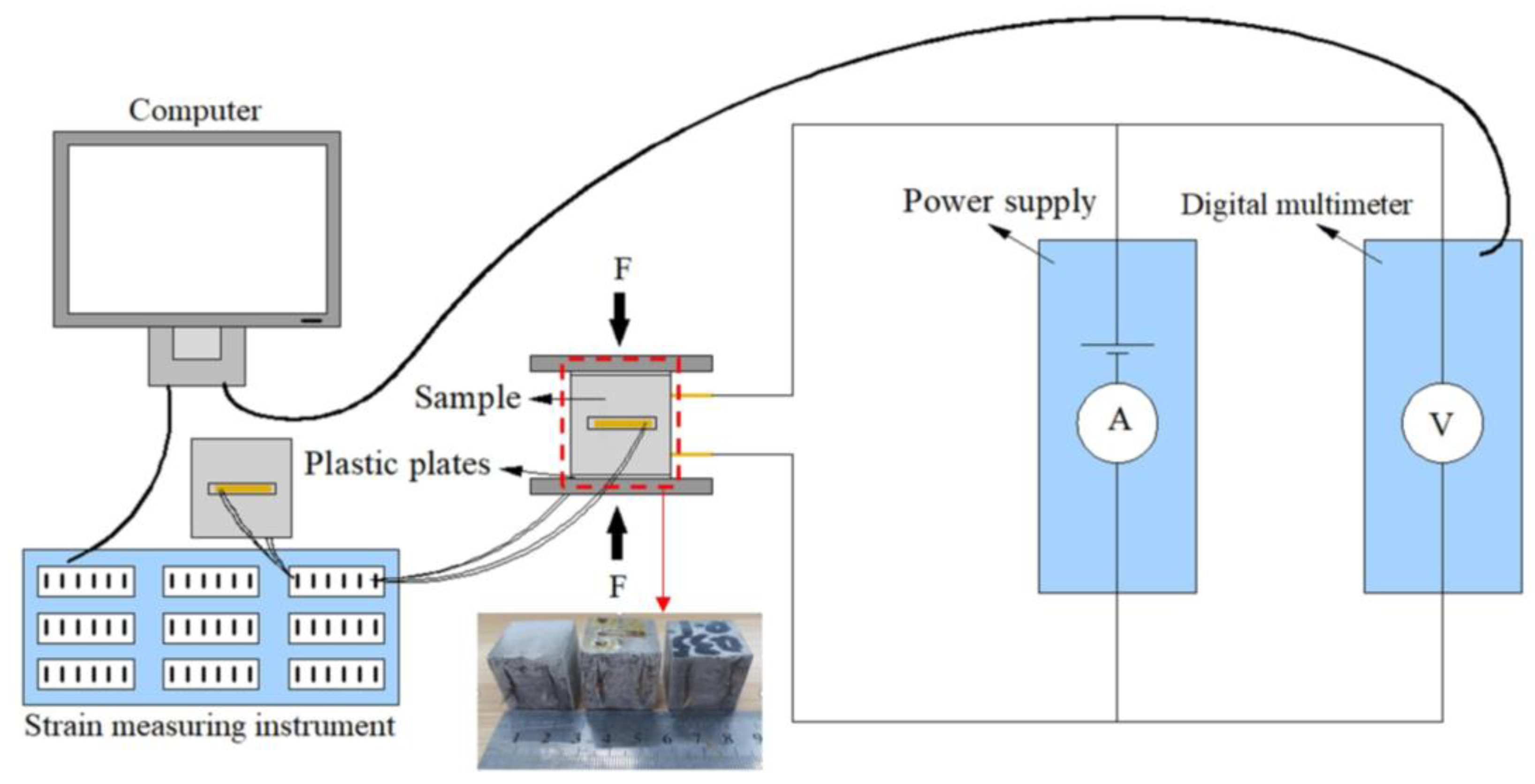
2.4. Test for Piezoresistive Capabilities
3. Results
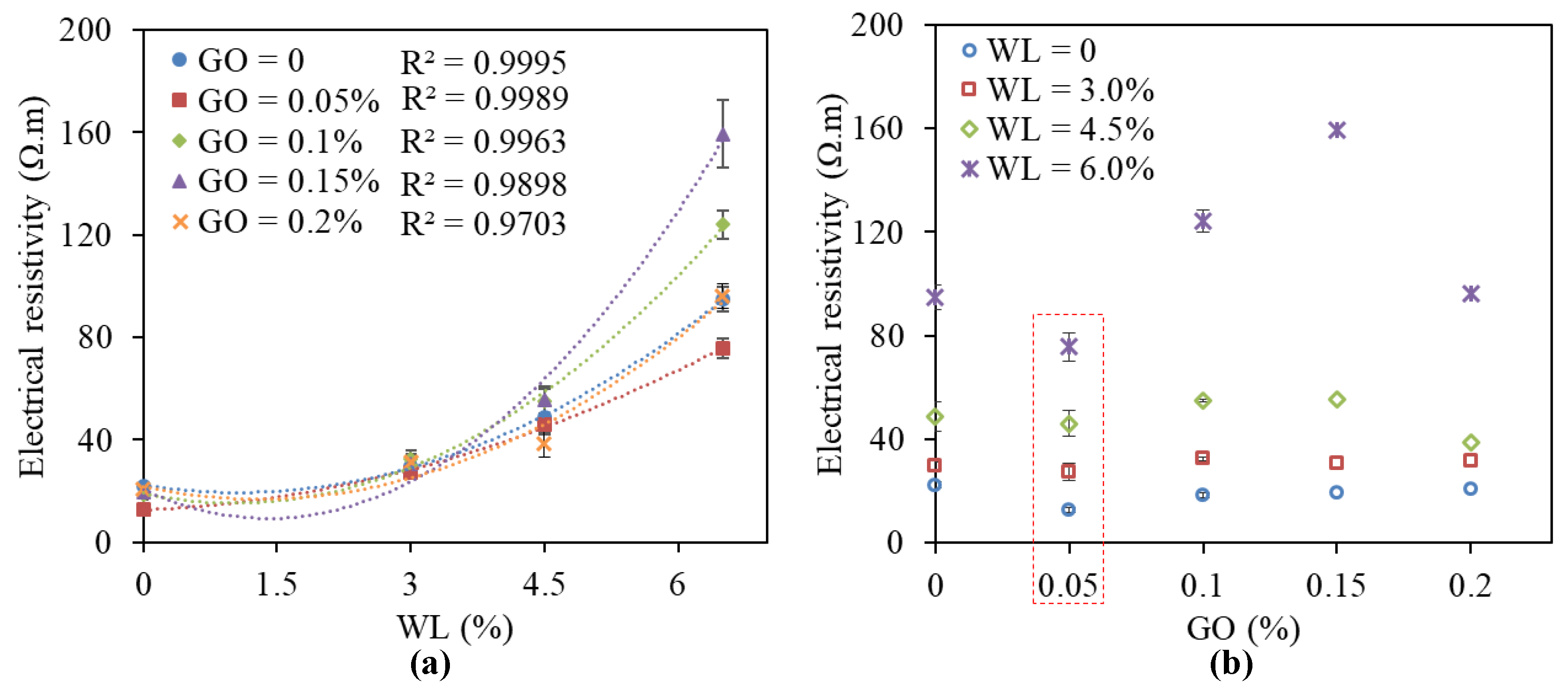
3.1. Effect of GO Concentration on the Electrical Resistivities of GO/CC with Different Moisture Contents
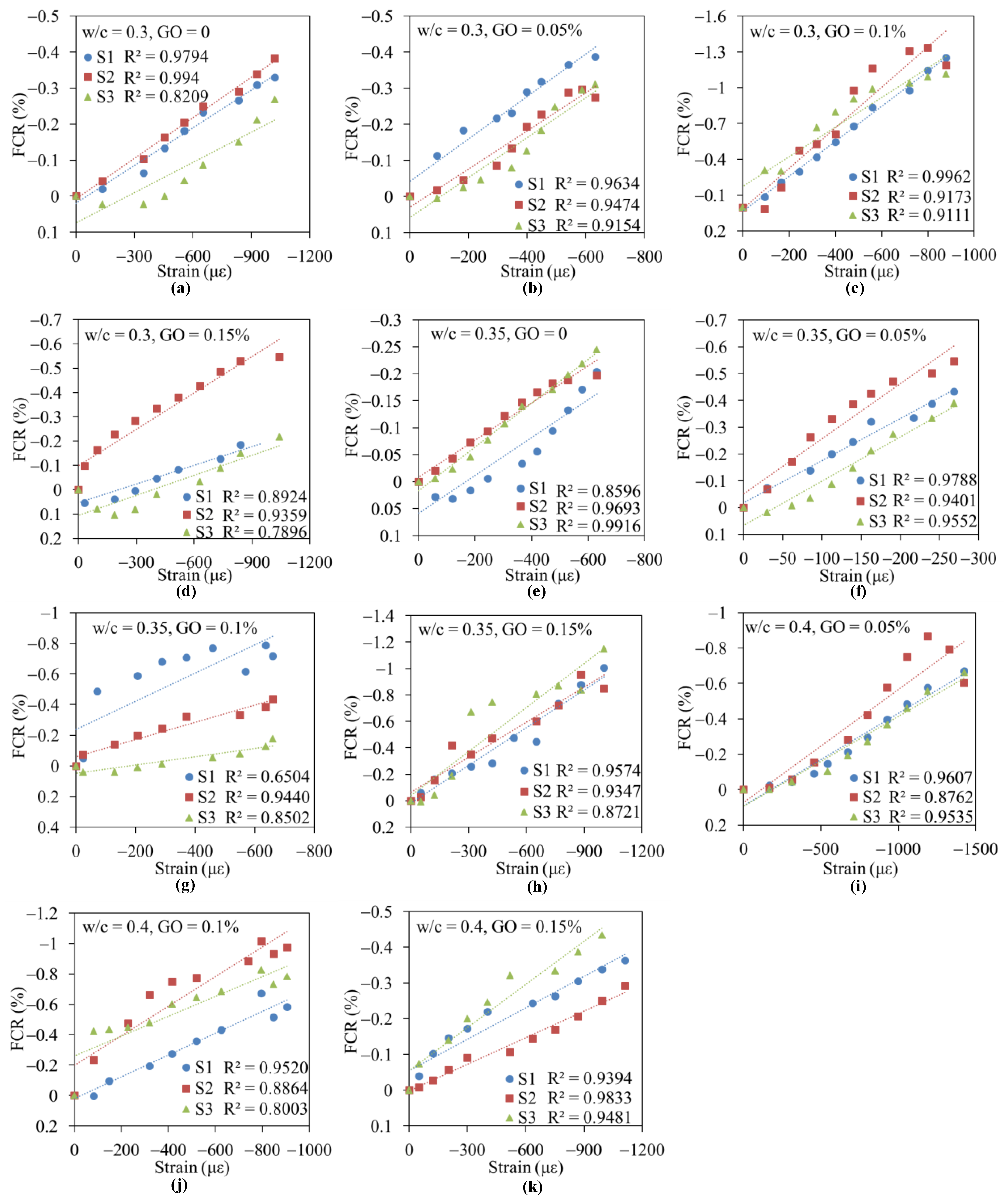
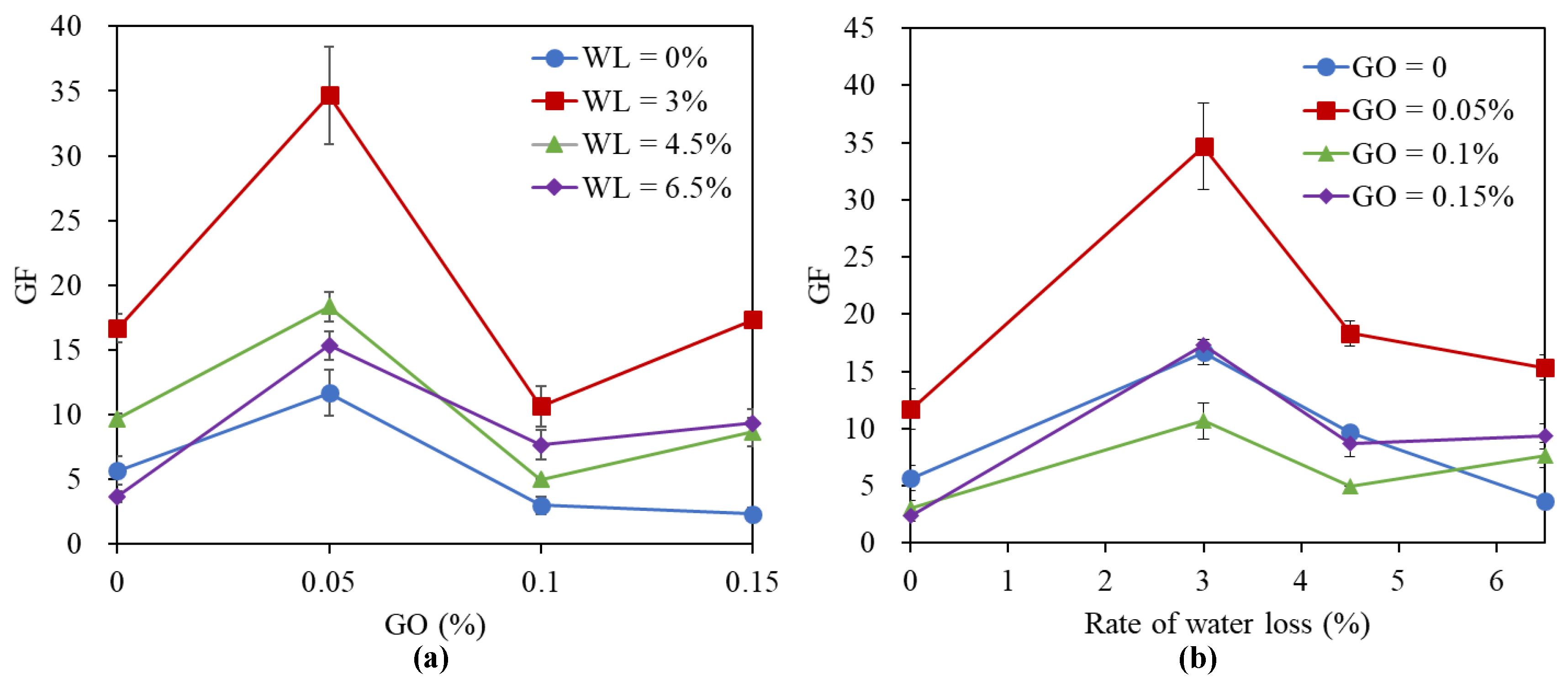
3.2. Effect of GO Concentration on the Piezoresistive Capacities of Cement Paste
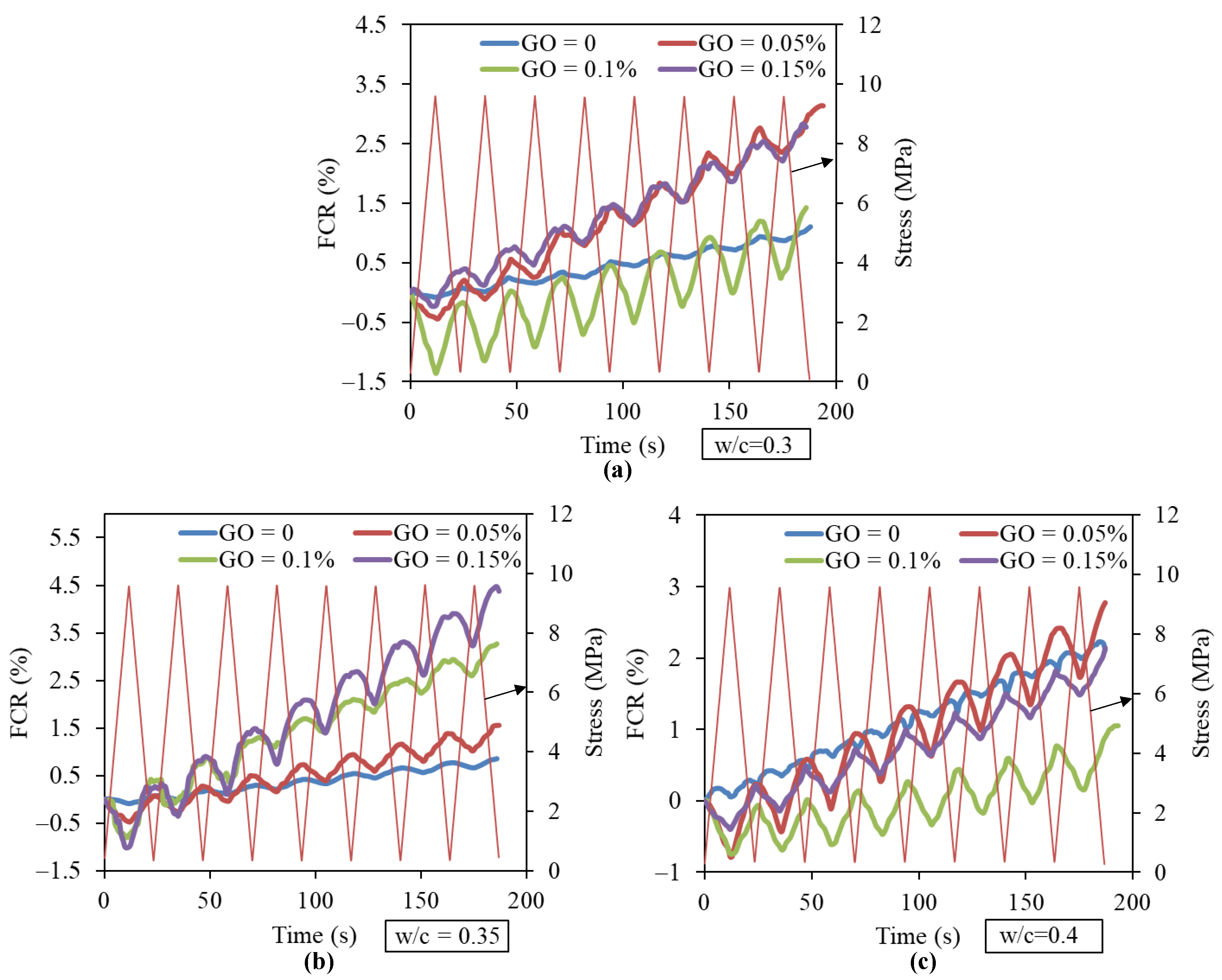
3.3. Effect of GO Concentration on the Dynamic Piezoresistive Response of Cement Paste
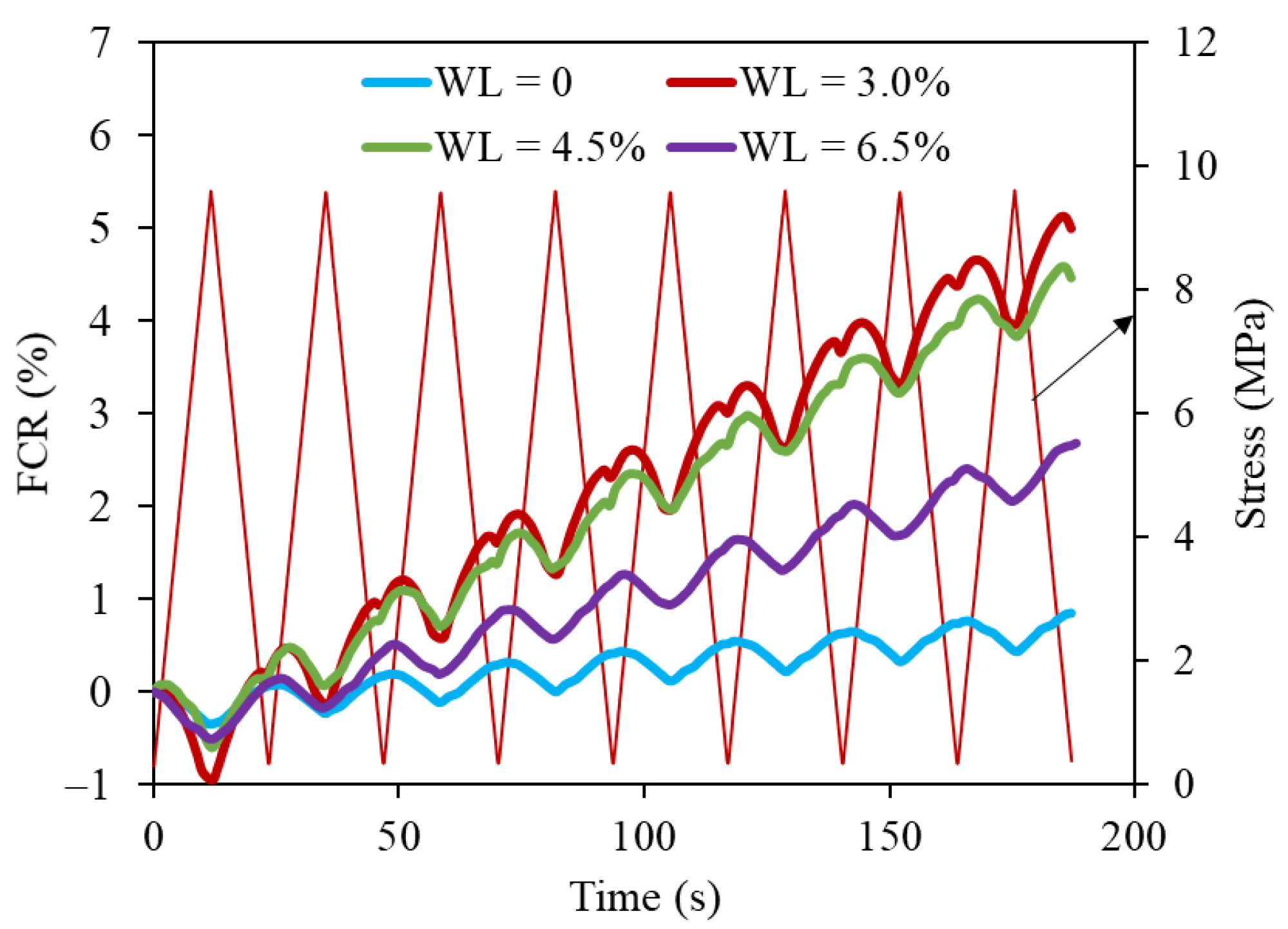
3.4. Effect of Moisture Content on the Piezoresistive Capacity of Cement Paste
4. Discussion
5. Conclusions
- (1)
- A conductive network with tunneling effect and contacting conduction is effectively formed by GO sheets in the cement matrix. Under cyclic loading, the distances between adjacent GO sheets change together with the variations of strain load and thus lead to synchronous piezoresistive responses.
- (2)
- Adding GO to cement paste enhances conductive and piezoresistive properties, reaching the minimum electrical resistivity (ρ = 76 Ω·m at WL = 6.5%) and the maximum piezoresistive sensitivity (GF = 16) when GO content is 0.05 wt.% and w/c = 0.35.
- (3)
- Compared with other carbon nanomaterials, GO is more efficient at improving the piezoresistive sensitivity of the composite since the GF value of GO/CC is similar with those of other carbon nano/cement composites when the content of GO is only 0.05 wt.%.
- (4)
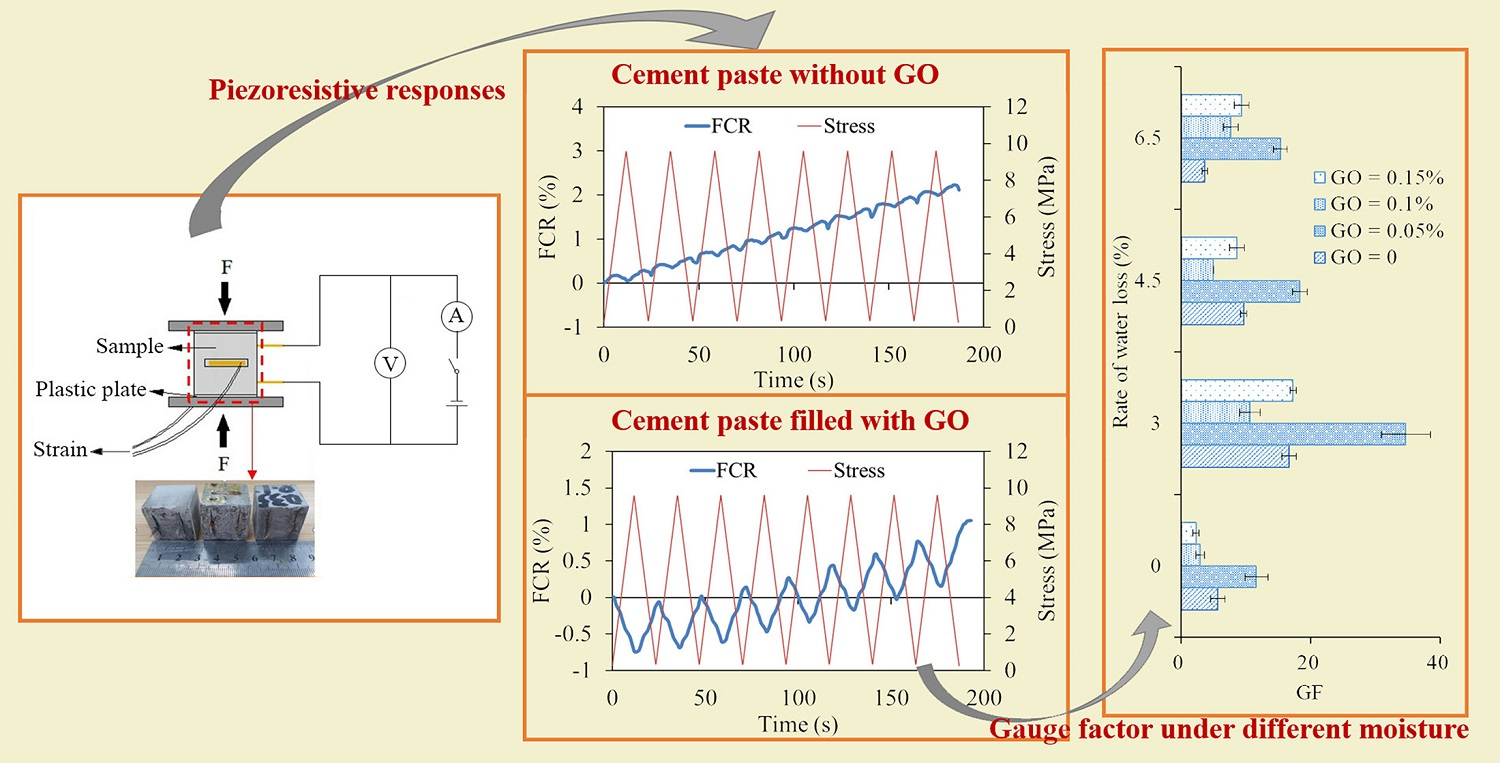
- When the water loss rate was 3%, the specimens filled with 0.05 wt.% GO at w/c = 0.35 showed highest piezoresistive sensitivity (GF = 35), since this appropriate water content in GO/CC promotes the formation of a conductive network with a tunneling effect the most and leads to high piezoresistivity, when more and less water content reduce the piezoresistive sensitivity.
Author Contributions
Funding
Data Availability Statement
Acknowledgments
Conflicts of Interest
References
- Wang, Y.; Wang, Y.; Han, B.; Wan, B.; Cai, G.; Li, Z. Strain monitoring of concrete components using embedded carbon nanofibers/epoxy sensors. Constr. Build. Mater. 2018, 186, 367–378. [Google Scholar] [CrossRef]
- Neves, A.C.; Leander, J.; González, I.; Karoumi, R. An approach to decision-making analysis for implementation of structural health Mechanical performance, pore structure monitoring in bridges. Struct. Control Health Monit. 2019, 26, e2352. [Google Scholar] [CrossRef]
- Madbouly, A.I.; Mokhtar, M.M.; Morsy, M.S. Evaluating the performance of rGO/cement composites for SHM applications. Constr. Build. Mater. 2020, 250, 118841. [Google Scholar]
- Dong, W.; Li, W.; Tao, Z.; Wang, K. Piezoresistive properties of cement-based sensors: Review and perspective. Constr. Build. Mater. 2019, 203, 146–163. [Google Scholar] [CrossRef]
- Taheri, S. A review on five key sensors for monitoring of concrete structures. Constr. Build. Mater. 2019, 204, 492–509. [Google Scholar] [CrossRef]
- Lee, H.; Yu, W.; Loh, K.J.; Chung, W. Self-heating and electrical performance of carbon nanotube-enhanced cement composites. Constr. Build. Mater. 2020, 250, 118838. [Google Scholar] [CrossRef]
- Silva, R.A.; Guetti, P.C.; Luz, M.S.; Rouxinol, F.; Gelamo, R.V. Enhanced properties of cement mortars with multilayer graphene nanoparticles. Constr. Build. Mater. 2017, 149, 378–385. [Google Scholar] [CrossRef]
- Chen, P.W.; Chung, D.D.L. Carbon fiber reinforced concrete for smart structures capable of non-destructive flaw detection. Smart Mater. Struct. 1993, 2, 22–30. [Google Scholar] [CrossRef]
- Yoo, D.-Y.; You, I.; Zi, G.; Lee, S.-J. Effects of carbon nanomaterial type and amount on self-sensing capacity of cement paste. Measurement 2019, 134, 750–761. [Google Scholar] [CrossRef]
- Rehman, S.K.U.; Ibrahim, Z.; Memon, S.A.; Javed, M.F.; Khushnood, R.A. A Sustainable Graphene Based Cement Composite. Sustainability 2017, 9, 1229. [Google Scholar]
- Tao, J.; Wang, X.; Wang, Z.; Zeng, Q. Graphene nanoplatelets as an effective additive to tune the microstructures and piezoresistive properties of cement-based composites. Constr. Build. Mater. 2019, 209, 665–678. [Google Scholar] [CrossRef]
- Yang, H.; Yao, X.F.; Zheng, Z.; Gong, L.; Yuan, L.; Yuan, Y.N.; Liu, Y.H. Highly sensitive and stretchable graphene-silicone rubber composites for strain sensing. Compos. Sci. Technol. 2018, 167, 371–378. [Google Scholar] [CrossRef]
- Yang, H.; Yao, X.F.; Yuan, L.; Gong, L.H.; Liu, Y.H. Strain-sensitive electrical conductivity of carbon nanotube-graphene-filled rubber composites under cyclic loading. Nanoscale 2019, 11, 578–586. [Google Scholar] [CrossRef]
- Xu, J.; Zhang, D. Pressure-sensitive properties of emulsion modified graphene nanoplatelets/cement composites. Cem. Concr. Compos. 2017, 84, 74–82. [Google Scholar]
- Metaxa, Z.S.; Kourkoulis, S.K. Dispersion of graphene nanoplatelets reinforcing type II cement paste. Procedia Struct. Integr. 2018, 13, 2011–2016. [Google Scholar] [CrossRef]
- Xu, G.; Du, S.; He, J.; Shi, X. The role of admixed graphene oxide in a cement hydration system. Carbon 2019, 148, 141–150. [Google Scholar]
- Suk, J.W.; Richard, D.P.; An, J.; Rodney, S.R. Mechanical properties of monolayer graphene oxide. ACS Nano 2010, 4, 6557–6564. [Google Scholar]
- Compton, O.C.; Nguyen, S.B.T. Graphene oxide, highly reduced graphene oxide, and graphene: Versatile building blocks for carbon-based materials. Small 2010, 6, 711–723. [Google Scholar] [CrossRef]
- Xu, Y.; Zeng, J.; Chen, W.; Jin, R.; Li, B.; Pan, Z. A holistic review of cement composites reinforced with graphene oxide. Constr. Build. Mater. 2018, 171, 291–302. [Google Scholar]
- Yang, H.; Cui, H.; Tang, W.; Li, Z.; Han, N.; Xing, F. A critical review on research progress of graphene/cement based composites. Compos. Part A 2017, 102, 273–296. [Google Scholar]
- Lu, Z.; Li, X.; Hanif, A.; Chen, B.; Parthasarathy, P.; Yu, J.; Li, Z. Early-age interaction mechanism between the graphene oxide and cement hydrates. Constr. Build. Mater. 2017, 152, 232–239. [Google Scholar] [CrossRef]
- Liu, Q.; Xu, Q.; Yu, Q.; Gao, R.; Tong, T. Experimental investigation on mechanical and piezoresistive properties of cementitious materials containing graphene and graphene oxide nanoplatelets. Constr. Build. Mater. 2016, 127, 565–576. [Google Scholar] [CrossRef]
- Song, C.; Choi, S. Moisture-dependent piezoresistive responses of CNT-embedded cementitious composites. Compos. Struct. 2017, 170, 103–110. [Google Scholar] [CrossRef]
- Chung, D.D.L. Damage in cement-based materials, studied by electrical resistance measurement. Mater. Sci. Eng. R 2003, 42, 1–40. [Google Scholar] [CrossRef]
- Li, X.; Wang, L.; Liu, Y.; Li, W.; Dong, B.; Duan, W.H. Dispersion of graphene oxide agglomerates in cement paste and its effects on electrical resistivity and flexural strength. Cem. Concr. Compos. 2018, 92, 145–154. [Google Scholar] [CrossRef]
- Lv, S.; Liu, J.; Sun, T.; Ma, Y.; Zhou, Q. Effect of GO nanosheets on shapes of cement hydration crystals and their formation process. Constr. Build. Mater. 2014, 64, 231–239. [Google Scholar] [CrossRef]
- Suo, Y.; Guo, R.; Xia, H.; Yang, Y.; Yan, F.; Ma, Q. Study on modification mechanism of workability and mechanical properties for graphene oxide-reinforced cement composite. Nanomater. Nanotechnol. 2020, 10. [Google Scholar] [CrossRef]
- Monteiro, A.O.; Loredo, A.; Costa, P.M.F.J.; Oeser, M.; Cachim, P.B. A pressure-sensitive carbon black cement composite for traffic monitoring. Constr. Build. Mater. 2017, 154, 1079–1086. [Google Scholar] [CrossRef]
- Jang, S.-H.; Hochstein, D.P.; Kawashima, S.; Yin, H. Experiments and micromechanical modeling of electrical conductivity of carbon nanotube/cement composites with moisture. Cem. Concr. Compos. 2017, 77, 49–59. [Google Scholar] [CrossRef]
- García-Macíasa, E.; Downey, A.; D’Alessandro, A.; Castro-Triguero, R.; Laflamme, S.; Ubertini, F. Enhanced lumped circuit model for smart nanocomposite cement-based sensors under dynamic compressive loading conditions. Sens. Actuators A Phys. 2017, 260, 45–57. [Google Scholar] [CrossRef]
- Galao, O.; Baeza, F.J.; Zornoza, E.; Garcés, P. Strain and damage sensing properties on multifunctional cement composites with CNF admixture. Cem. Concr. Compos. 2014, 46, 90–98. [Google Scholar]
- Han, B.; Ding, S.; Yu, X. Intrinsic self-sensing concrete and structures: A review. Measurement 2015, 59, 110–128. [Google Scholar]
- Siad, H.; Lachemi, M.; Sahmaran, M.; Mesbah, H.A.; Hossain, K.A. Advanced engineered cementitious composites with combined self-sensing and self-healing functionalities. Constr. Build. Mater. 2018, 176, 313–322. [Google Scholar]
- Al-Dahawi, A.; Yıldırım, G.; Öztürk, O.; Sahmaran, M. Assessment of self-sensing capability of Engineered Cementitious Composites within the elastic and plastic ranges of cyclic flexural loading. Constr. Build. Mater. 2017, 145, 1–10. [Google Scholar] [CrossRef]
- Wen, S.; Chung, D.D.L. The role of electronic and ionic conduction in the electrical conductivity of carbon fiber reinforced cement. Carbon 2006, 44, 2130–2138. [Google Scholar]
- Dong, W.; Li, W.; Lu, N.; Qu, F.; Vessalas, K.; Sheng, D. Piezoresistive behaviours of cement-based sensor with carbon black subjected to various temperature and water content. Compos. Part B 2019, 178, 107488. [Google Scholar]
- Fu, X.; Lu, W.; Chung, D.D.L. Ozone treatment of carbon fiber for reinforcing cement. Carbon 1998, 36, 1337–1345. [Google Scholar]
- Liu, Y.L.; Hu, N. Numerical simulations on piezoresistivity of CNT/polymer based nanocomposites. Comput. Mater. Contin. 2010, 20, 101–117. [Google Scholar]
- Rovnaník, P.; Kusák, I.; Bayer, P.; Schmid, P.; Fiala, L. Comparison of electrical and self-sensing properties of Portland cement and alkali-activated slag mortars. Cem. Concr. Res. 2019, 118, 84–91. [Google Scholar]
- Sun, S.; Han, B.; Jiang, S.; Yu, X.; Wang, Y.; Li, H.; Ou, J. Nano graphite platelets-enabled piezoresistive cementitious composites for structural health monitoring. Constr. Build. Mater. 2017, 136, 314–328. [Google Scholar]
- Li, C.; Thostenson, E.T.; Chou, T.-W. Dominant role of tunneling resistance in the electrical conductivity of carbon nanotube–based composites. Appl. Phys. Lett. 2007, 91, 223114. [Google Scholar] [CrossRef]
- Han, B.; Yu, X.; Ou, J. Effect of water content on the piezoresistivity of MWNT/cement composites. J. Mater. Sci. 2010, 45, 3714–3719. [Google Scholar] [CrossRef]



| Component | wt.% |
|---|---|
| Calcium oxide (CaO) | 52.61 |
| Silicon dioxide (SiO2) | 22.04 |
| Aluminium oxide (Al2O3) | 7.97 |
| Ferric oxide (Fe2O3) | 4.17 |
| Sulfur trioxide (SO3) | 3.29 |
| Magnesium oxide (MgO) | 2.41 |
| Potassium oxide (K2O) | 0.90 |
| Sodium oxide (Na2O) | 0.16 |
| Property | Value |
|---|---|
| Diameter (μm) | 0.5–3 |
| Thickness (nm) | 0.55–1.2 |
| Layers | <3 |
| Purity (%) | >99 |
| Color | Brown |
| Carbon (%) | 68.44 |
| Oxygen (%) | 30.92 |
| Sulfur (%) | 0.63 |
| GO (wt. %) | GF | ||
|---|---|---|---|
| w/c = 0.3 | w/c = 0.35 | w/c = 0.4 | |
| 0 | 4 (±0.44) | 4 (±0.44) | 0 |
| 0.05 | 6 (±0.89) | 16 (±1.11) | 5 (±0.44) |
| 0.1 | 15 (±1.78) | 6 (±2.00) | 8 (±1.33) |
| 0.15 | 4 (±0.89) | 9 (±1.11) | 3 (±0.67) |
| Cement Composites | Content of Carbon Nanomaterials (wt.%) | GF | Increment of Compressive Strength When Compared to Control |
|---|---|---|---|
| GO/CC | 0.05 | 16 | Increase by 24% |
| CNTs/CC [33] | 0.25 | 16 | Increase by 7% |
| CNF/CC [31] | 1 | 10 | No significant variations. |
| GNP/CC [14] | 2 | 8 | Weak by 20% |
Publisher’s Note: MDPI stays neutral with regard to jurisdictional claims in published maps and institutional affiliations. |
© 2021 by the authors. Licensee MDPI, Basel, Switzerland. This article is an open access article distributed under the terms and conditions of the Creative Commons Attribution (CC BY) license (http://creativecommons.org/licenses/by/4.0/).
Share and Cite
Guo, R.; Suo, Y.; Xia, H.; Yang, Y.; Ma, Q.; Yan, F. Study of Piezoresistive Behavior of Smart Cement Filled with Graphene Oxide. Nanomaterials 2021, 11, 206. https://doi.org/10.3390/nano11010206
Guo R, Suo Y, Xia H, Yang Y, Ma Q, Yan F. Study of Piezoresistive Behavior of Smart Cement Filled with Graphene Oxide. Nanomaterials. 2021; 11(1):206. https://doi.org/10.3390/nano11010206
Chicago/Turabian StyleGuo, Rongxin, Yuxia Suo, Haiting Xia, Yang Yang, Qianmin Ma, and Feng Yan. 2021. "Study of Piezoresistive Behavior of Smart Cement Filled with Graphene Oxide" Nanomaterials 11, no. 1: 206. https://doi.org/10.3390/nano11010206
APA StyleGuo, R., Suo, Y., Xia, H., Yang, Y., Ma, Q., & Yan, F. (2021). Study of Piezoresistive Behavior of Smart Cement Filled with Graphene Oxide. Nanomaterials, 11(1), 206. https://doi.org/10.3390/nano11010206