Machine Learning-Assisted High-Throughput Molecular Dynamics Simulation of High-Mechanical Performance Carbon Nanotube Structure



Abstract
1. Introduction
2. Molecular Dynamics Models and Computational Methods
3. Results
4. Discussion
5. Conclusions
Author Contributions
Funding
Acknowledgments
Conflicts of Interest
References
- Iijima, S. Helical microtubules of graphitic carbon. Nature 1991, 354, 56–58. [Google Scholar] [CrossRef] [Scilit]
- Bakshi, S.R.; Lahiri, D.; Agarwal, A. Carbon nanotube reinforced metal matrix composites—A review. Int. Mater. Rev. 2010, 55, 41–64. [Google Scholar] [CrossRef] [Scilit]
- Ozaki, T.; Iwasa, Y.; Mitani, T. Stiffness of single-walled carbon nanotubes under large strain. Phys. Rev. Lett. 2000, 84, 1712. [Google Scholar] [CrossRef] [Scilit]
- Ogata, S.; Shibutani, Y. Ideal tensile strength and band gap of single-walled carbon nanotubes. Phys. Rev. B 2003, 68, 165409. [Google Scholar] [CrossRef] [Scilit]
- Troya, D.; Mielke, S.L.; Schatz, G.C. Carbon nanotube fracture–differences between quantum mechanical mechanisms and those of empirical potentials. Chem. Phys. Lett. 2003, 382, 133–141. [Google Scholar] [CrossRef] [Scilit]
- Zhang, Y.; Iijima, S.; Shi, Z.; Gu, Z. Defects in arc-discharge-produced single-walled carbon nanotubes. Philos. Mag. Lett. 1999, 79, 473–479. [Google Scholar] [CrossRef] [Scilit]
- Zhang, S.; Mielke, S.L.; Khare, R.; Troya, D.; Ruoff, R.S.; Schatz, G.C.; Belytschko, T. Mechanics of defects in carbon nanotubes: Atomistic and multiscale simulations. Phys. Rev. B 2005, 71, 115403. [Google Scholar] [CrossRef] [Scilit]
- Tserpes, K.I.; Papanikos, P. The effect of Stone-Wales defect on the tensile behavior and fracture of single-walled carbon nanotubes. Compos. Struct. 2007, 79, 581–589. [Google Scholar] [CrossRef] [Scilit]
- Suenaga, K.; Wakabayashi, H.; Koshino, M.; Sato, Y.; Urita, K.; Iijima, S. Imaging active topological defects in carbon nanotubes. Nat. Nanotechnol. 2007, 2, 358–360. [Google Scholar] [CrossRef] [Scilit]
- Xia, Z.; Riester, L.; Curtin, W.A.; Li, H.; Sheldon, B.W.; Liang, J.; Chang, B.; Xu, J.M. Direct observation of toughening mechanisms in carbon nanotube ceramic matrix composites. Acta Mater. 2004, 52, 931–944. [Google Scholar] [CrossRef] [Scilit]
- Zhou, Z.; Wang, S.; Lu, L.; Zhang, Y.; Zhang, Y. Functionalization of multi-wall carbon nanotubes with silane and its reinforcement on polypropylene composites. Compos. Sci. Technol. 2008, 68, 1727–1733. [Google Scholar] [CrossRef] [Scilit]
- Pantano, A.; Modica, G.; Cappello, F. Multiwalled carbon nanotube reinforced polymer composites. Mater. Sci. Eng. A 2008, 486, 222–227. [Google Scholar] [CrossRef] [Scilit]
- Yamamoto, G.; Shirasu, K.; Nozaka, Y.; Wang, W.; Hashida, T. Microstructure–property relationships in pressureless-sintered carbon nanotube/alumina composites. Mater. Sci. Eng. A 2014, 617, 179–186. [Google Scholar] [CrossRef] [Scilit]
- Nozaka, Y.; Wang, W.; Shirasu, K.; Yamamoto, G.; Hashida, T. Inclined slit-based pullout method for determining interfacial strength of multi-walled carbon nanotube-alumina composites. Carbon 2014, 78, 439–445. [Google Scholar] [CrossRef] [Scilit]
- Peng, B.; Locascio, M.; Zapol, P.; Li, S.; Mielke, S.L.; Schatz, G.C.; Espinosa, H.D. Measurements of near-ultimate strength for multiwalled carbon nanotubes and irradiation-induced crosslinking improvements. Nat. Nanotechnol. 2008, 3, 626–631. [Google Scholar] [CrossRef] [Scilit] [PubMed]
- Yamamoto, G.; Shirasu, K.; Hashida, T.; Takagi, T.; Suk, J.W.; An, J.; Piner, R.D.; Ruoff, R.S. Nanotube fracture during the failure of carbon nanotube/alumina composites. Carbon 2011, 49, 3709–3716. [Google Scholar] [CrossRef] [Scilit]
- Yamamoto, G.; Suk, J.W.; An, J.; Piner, R.D.; Hashida, T.; Takagi, T.; Ruoff, R.S. The influence of nanoscale defects on the fracture of multi-walled carbon nanotubes under tensile loading. Diam. Relat. Mater. 2010, 19, 748–751. [Google Scholar] [CrossRef] [Scilit]
- Shirasu, K.; Yamamoto, G.; Hashida, T. How do the mechanical properties of carbon nanotubes increase? An experimental evaluation and modeling of the engineering tensile strength of individual carbon nanotubes. Mater. Res. Express 2019, 6, 055047. [Google Scholar] [CrossRef] [Scilit]
- Xia, Z.H.; Guduru, P.R.; Curtin, W.A. Enhancing mechanical properties of multiwall carbon nanotubes via sp3 interwall bridging. Phys. Rev. Lett. 2007, 98, 245501. [Google Scholar] [CrossRef] [Scilit]
- Byrne, E.M.; McCarthy, M.A.; Xia, Z.; Curtin, W.A. Multiwall nanotubes can be stronger than single wall nanotubes and implications for nanocomposite design. Phys. Rev. Lett. 2009, 103, 045502. [Google Scholar] [CrossRef] [Scilit]
- Plimpton, S. Fast parallel algorithms for short-range molecular dynamics. J. Comput. Phys. 1995, 117, 1–19. [Google Scholar] [CrossRef] [Scilit]
- Stuart, S.J.; Tutein, A.B.; Harrison, J.A. A reactive potential for hydrocarbons with intermolecular interactions. J. Chem. Phys. 2000, 112, 6472–6486. [Google Scholar] [CrossRef] [Scilit]
- Zhao, H.; Min, K.; Aluru, N.R. Size and chirality dependent elastic properties of graphene nanoribbons under uniaxial tension. Nano Lett. 2009, 9, 3012–3015. [Google Scholar] [CrossRef] [Scilit]
- Choi, B.K.; Yoon, G.H.; Lee, S. Molecular dynamics studies of CNT-reinforced aluminum composites under uniaxial tensile loading. Compos. B Eng. 2016, 91, 119–125. [Google Scholar] [CrossRef] [Scilit]
- Deb Nath, S.K.; Kim, S.G. Study of the nanomechanics of CNTs under tension by molecular dynamics simulation using different potentials. ISRN Condens. Matter Phys. 2014, 2014, 606017. [Google Scholar] [CrossRef] [Scilit]
- Yamamoto, G.; Shirasu, K.; Nozaka, Y.; Sato, Y.; Takagi, T.; Hashida, T. Structure-property relationships in thermally-annealed multi-walled carbon nanotubes. Carbon 2014, 66, 219–226. [Google Scholar] [CrossRef] [Scilit]
- Shenderova, O.A.; Brenner, D.W.; Omeltchenko, A.; Su, X.; Yang, L.H. Atomistic modeling of the fracture of polycrystalline diamond. Phys. Rev. B 2000, 61, 3877. [Google Scholar] [CrossRef] [Scilit]
- Thamaraikannan, S.; Pradhan, S.C. Atomistic study of carbon nanotubes: Effect of cut-off distance. In Proceedings of the TMS 2016 145th Annual Meeting & Exhibition, Music City Center, Nashville, TN, USA, 15–17 February 2016; Springer: Cham, Switzerland, 2016; pp. 293–300. [Google Scholar] [CrossRef] [Scilit]
- Jhon, Y.I.; Jhon, Y.M.; Yeom, G.Y.; Jhon, M.S. Orientation dependence of the fracture behavior of graphene. Carbon 2014, 66, 619–628. [Google Scholar] [CrossRef] [Scilit]
- Currin, C.; Mitchell, T.; Morris, M.; Ylvisaker, D. A Bayesian Approach to the Design and Analysis of Computer Experiments; Oak Ridge National Laboratory: Oak Ridge, TN, USA, 1988. [Google Scholar]
- Shahriari, B.; Swersky, K.; Wang, Z.; Adams, R.P.; De Freitas, N. Taking the human out of the loop: A review of Bayesian optimization. Proc. IEEE 2015, 104, 148–175. [Google Scholar] [CrossRef] [Scilit]
- Sacks, J.; Welch, W.J.; Mitchell, T.J.; Wynn, H.P. Design and analysis of computer experiments. Stat. Sci. 1989, 4, 409–423. [Google Scholar] [CrossRef] [Scilit]
- Jones, D.R.; Schonlau, M.; Welch, W.J. Efficient global optimization of expensive black-box functions. J. Glob. Optim. 1998, 13, 455–492. [Google Scholar] [CrossRef] [Scilit]
- Holland, J.H. Adaptation in Natural and Artificial Systems: An Introductory Analysis with Applications to Biology, Control, and Artificial Intelligence; MIT Press: Cambridge, MA, USA, 1992. [Google Scholar] [CrossRef] [Scilit]
- Goldberg, D.E. Genetic algorithms in search. In Optimization, and Machine Learning; Addison Wesley Publishing Company: Boston, MA, USA, 1989. [Google Scholar]
- Deb, K. Multi-Objective Optimization Using Evolutionary Algorithms; John Wiley & Sons: Hoboken, NJ, USA, 2001. [Google Scholar]
- Michalewicz, Z. Genetic Algorithms + Data Structures = Evolution Programs; Springer Science & Business Media: Berlin, Germany, 2013. [Google Scholar]
- Fonseca, C.M.; Fleming, P.J. Genetic algorithms for multiobjective optimization: Formulation, discussion and generalization. In Proceedings of the Fifth International Conference on Genetic Algorithms, Urbana-Champaign, IL, USA, 17–21 July 1993; pp. 416–423. [Google Scholar]
- Baker, J.E. Adaptive selection methods for genetic algorithms. In Proceedings of the International Conference on Genetic Algorithms and their Applications, Pittsburg, PA, USA, 24–26 July 1985; pp. 101–111. [Google Scholar] [CrossRef] [Scilit]
- Eshelman, L.J.; Schaffer, J.D. Real-coded genetic algorithms and interval-schemata. FOGA 1993, 2, 187–202. [Google Scholar] [CrossRef] [Scilit]
- Qian, J.; Nguyen, N.P.; Oya, Y.; Kikugawa, G.; Okabe, T.; Huang, Y.; Ohuchi, F.S. Introducing self-organized maps (SOM) as a visualization tool for materials research and education. Results Mater. 2019, 4, 100020. [Google Scholar] [CrossRef] [Scilit]
- Kohonen, T. The self-organizing map. Proc. IEEE 1990, 78, 1464–1480. [Google Scholar] [CrossRef] [Scilit]
- Viscovery. Available online: https://www.viscovery.net/somine/ (accessed on 1 October 2020).
- Kohonen, T.; Kaski, S.; Lagus, K.; Salojarvi, J.; Honkela, J.; Paatero, V.; Saarela, A. Self organization of a massive document collection. IEEE Trans. Neural Netw. 2000, 11, 574–585. [Google Scholar] [CrossRef] [Scilit] [PubMed]
- Natsuki, T.; Tantrakarn, K.; Endo, M. Effects of carbon nanotube structures on mechanical properties. Appl. Phys. A 2004, 79, 117–124. [Google Scholar] [CrossRef] [Scilit]
- Liu, F.; Ming, P.; Li, J. Ab initio calculation of ideal strength and phonon instability of graphene under tension. Phys. Rev. B 2007, 76, 064120. [Google Scholar] [CrossRef] [Scilit]
- Pregler, S.K.; Sinnott, S.B. Molecular dynamics simulations of electron and ion beam irradiation of multiwalled carbon nanotubes: The effects on failure by inner tube sliding. Phys. Rev. B 2006, 73, 224106. [Google Scholar] [CrossRef] [Scilit]

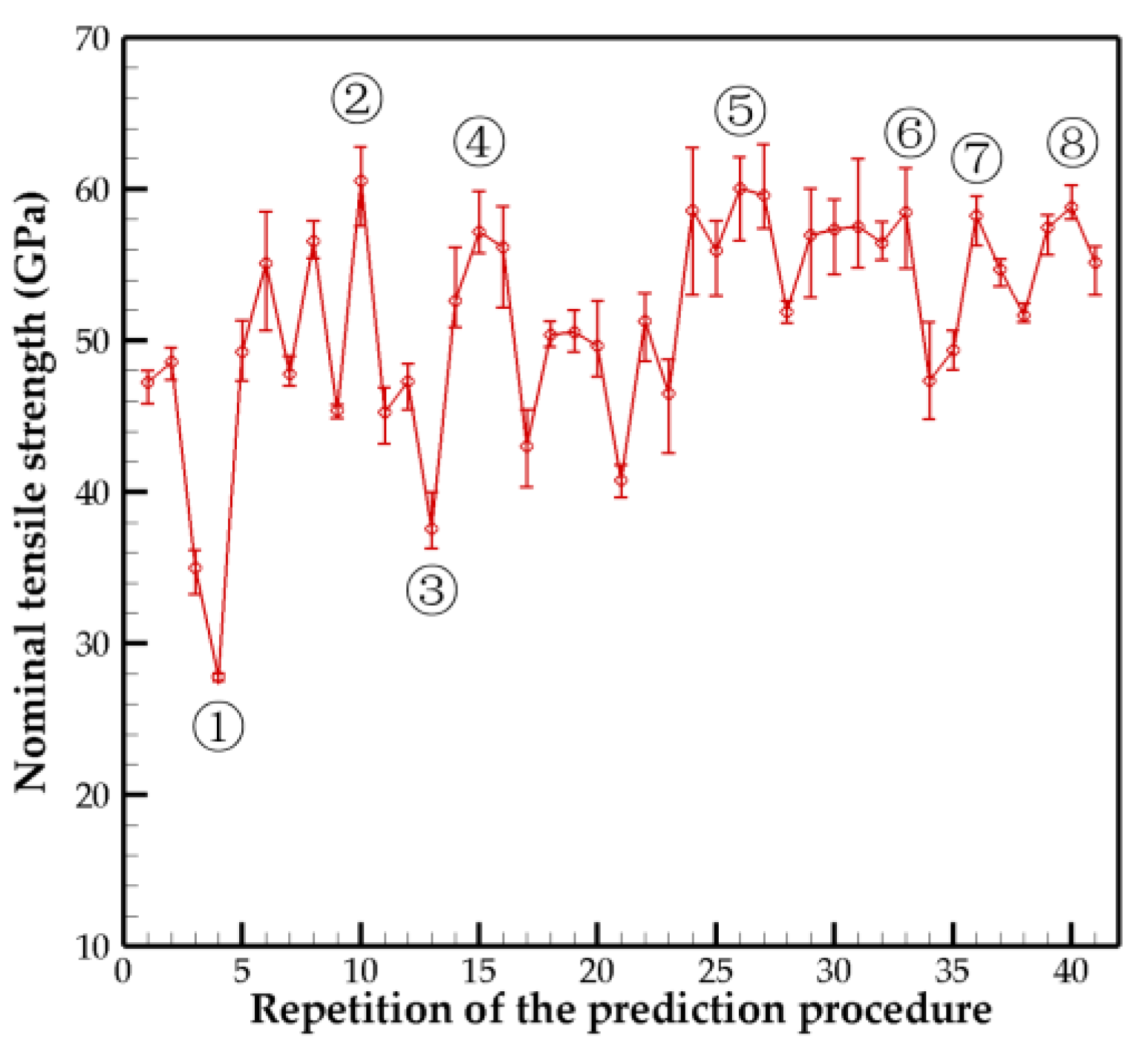
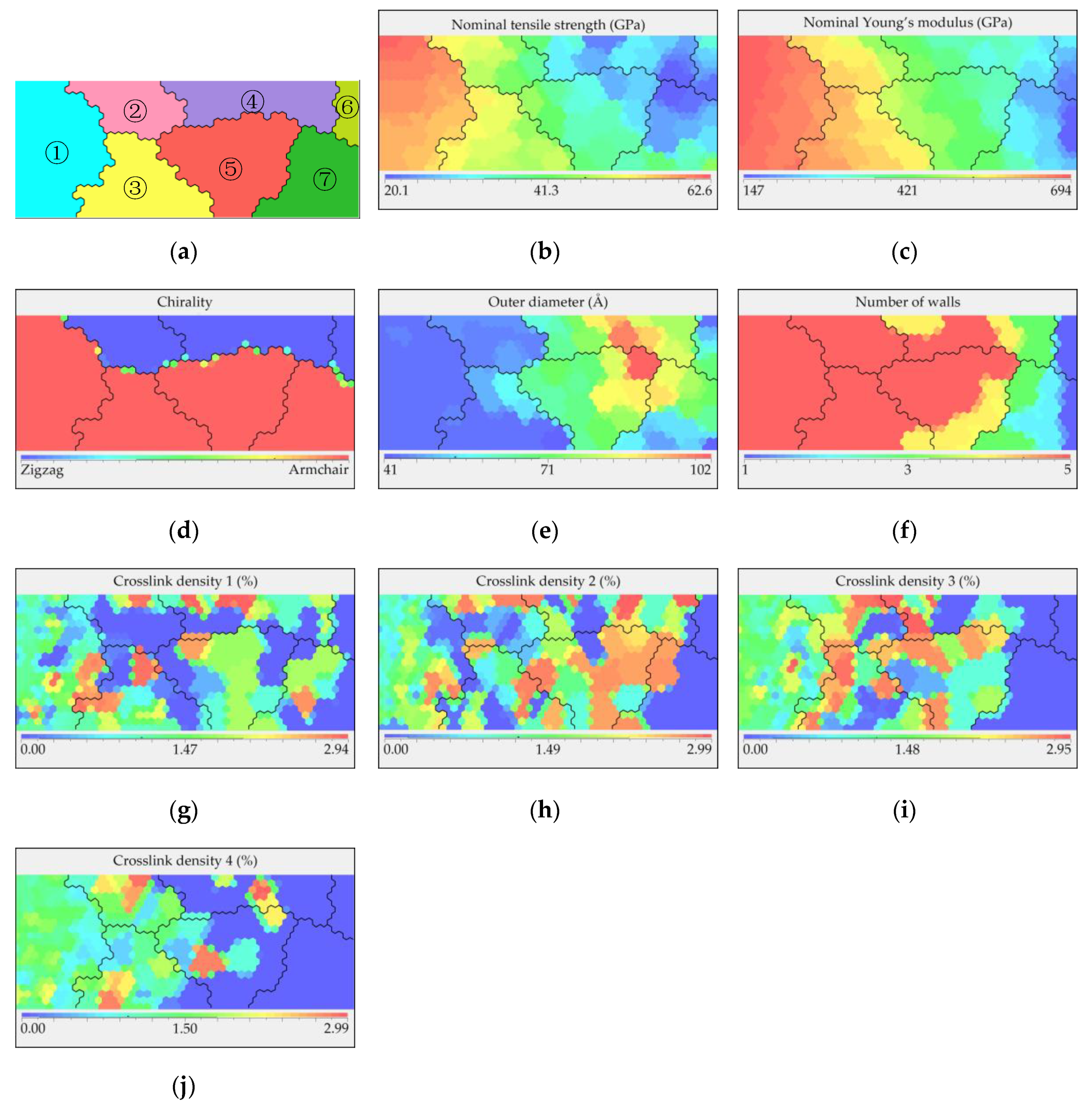
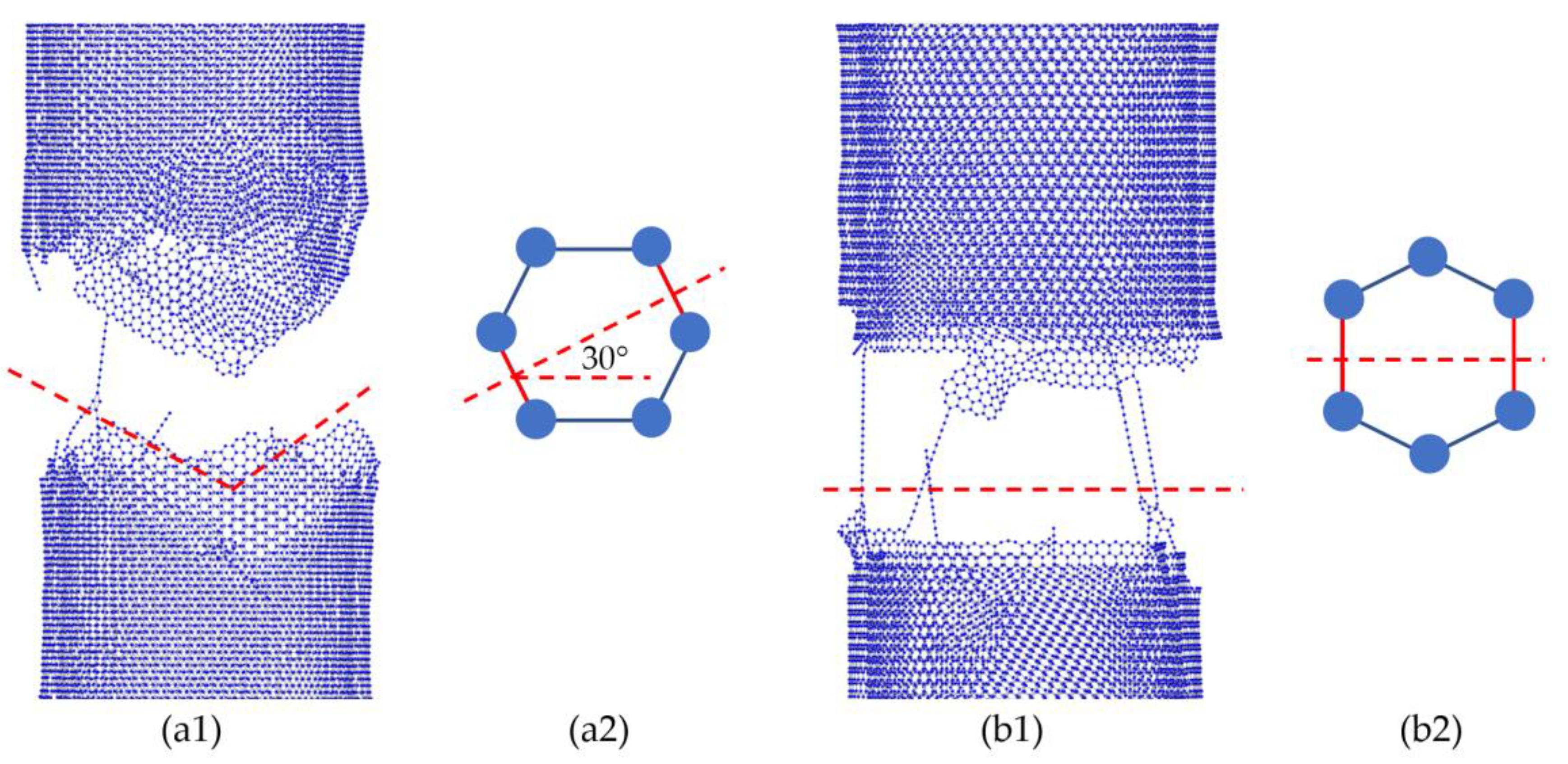

| Model | Outer Diameter (Å) | Number of Walls | Chirality | Crosslink Density 1 (%) | Crosslink Density 2 (%) | Crosslink Density 3 (%) | Crosslink Density 4 (%) | Nominal Tensile Strength (GPa) |
|---|---|---|---|---|---|---|---|---|
| ① | 101.70 | 5 | Armchair | 0.01 (0.01–0.01) | 2.32 (2.31–2.32) | 2.36 (2.35–2.37) | 2.26 (2.25–2.28) | 27.79 (27.53–28.04) |
| ② | 44.75 | 5 | Armchair | 0.91 (0.89–0.92) | 0.75 (0.74–0.77) | 0.97 (0.95–0.97) | 1.38 (1.35–1.41) | 60.53 (57.60–62.81) |
| ③ | 44.62 | 5 | Zigzag | 0.02 (0.02–0.02) | 0.83 (0.81–0.85) | 0.05 (0.04–0.05) | 1.70 (1.69–1.71) | 37.58 (36.28–40.02) |
| ④ | 43.39 | 5 | Armchair | 2.85 (2.81–2.90) | 1.19 (1.18–1.21) | 1.47 (1.45–1.48) | 1.83 (1.81–1.84) | 57.19 (55.80–59.88) |
| ⑤ | 43.39 | 5 | Armchair | 0.22 (0.20–0.23) | 0.44 (0.44–0.45) | 2.11 (2.10–2.12) | 1.20 (1.20–1.21) | 60.03 (56.62–62.12) |
| ⑥ | 43.39 | 5 | Armchair | 0.05 (0.04–0.05) | 2.03 (2.01–2.05) | 1.32 (1.30–1.35) | 1.32 (1.31–1.33) | 58.50 (54.77–61.42) |
| ⑦ | 43.39 | 5 | Armchair | 1.98 (1.97–2.00) | 0.84 (0.82–0.86) | 0.59 (0.57–0.60) | 1.01 (1.00–1.03) | 58.26 (56.25–59.52) |
| ⑧ | 43.39 | 5 | Armchair | 0.90 (0.89–0.92) | 1.39 (1.36–1.41) | 1.40 (1.40–1.41) | 1.25 (1.23–1.28) | 58.83 (58.02–60.26) |
Publisher’s Note: MDPI stays neutral with regard to jurisdictional claims in published maps and institutional affiliations. |
© 2020 by the authors. Licensee MDPI, Basel, Switzerland. This article is an open access article distributed under the terms and conditions of the Creative Commons Attribution (CC BY) license (http://creativecommons.org/licenses/by/4.0/).
Share and Cite
Xiang, Y.; Shimoyama, K.; Shirasu, K.; Yamamoto, G. Machine Learning-Assisted High-Throughput Molecular Dynamics Simulation of High-Mechanical Performance Carbon Nanotube Structure. Nanomaterials 2020, 10, 2459. https://doi.org/10.3390/nano10122459
Xiang Y, Shimoyama K, Shirasu K, Yamamoto G. Machine Learning-Assisted High-Throughput Molecular Dynamics Simulation of High-Mechanical Performance Carbon Nanotube Structure. Nanomaterials. 2020; 10(12):2459. https://doi.org/10.3390/nano10122459
Chicago/Turabian StyleXiang, Yi, Koji Shimoyama, Keiichi Shirasu, and Go Yamamoto. 2020. "Machine Learning-Assisted High-Throughput Molecular Dynamics Simulation of High-Mechanical Performance Carbon Nanotube Structure" Nanomaterials 10, no. 12: 2459. https://doi.org/10.3390/nano10122459
APA StyleXiang, Y., Shimoyama, K., Shirasu, K., & Yamamoto, G. (2020). Machine Learning-Assisted High-Throughput Molecular Dynamics Simulation of High-Mechanical Performance Carbon Nanotube Structure. Nanomaterials, 10(12), 2459. https://doi.org/10.3390/nano10122459