1. Introduction
Historical manuscripts do more than preserve text; they document cultural identity, language development, and shared memory. Preserving these works increasingly relies on digital repositories. These platforms provide long-term storage, remote access, and opportunities for computational analysis. Digitization alone does not make manuscripts fully accessible. Many historical documents remain difficult to read automatically, search, transcribe, or analyze computationally. It should be noted that while Chagatai is a culturally significant tradition, direct computational research is currently limited. Consequently, this manuscript frames the synthesis of existing methods from neighboring low-resource domains as a strategic roadmap for future Chagatai manuscript digitization, rather than a survey of a mature Chagatai-specific research body.
Global cultural heritage now depends on digital archives. This transition represents a significant advancement in digital preservation paradigms [
1]. Optical Character Recognition (OCR) performs well on printed texts in major languages. Handwritten historical manuscripts still resist accurate transcription [
2,
3]. The gap widens with linguistic complexity and document damage. It is strongest for low-resource languages and scripts that differ from modern digital standards [
4,
5].
Chagatai, a Turkic literary language used across Central Asia from the 14th to 20th centuries, preserves a substantial body of historical, scientific, religious, administrative, and literary texts [
6]. Scholars usually divide its development into several historical periods that shaped its role as one of the main written languages of the region. Similar to Ottoman Turkish, Chagatai has a rich manuscript tradition; however, a large part of this heritage remains outside modern computational analysis. Central to this tradition is the Gunnar Jarring Collection at Lund University, which represents one of the world’s most significant repositories of late Chagatai and Eastern Turki manuscripts. These records are vital for understanding the 18th to 20th century linguistic landscape of Central Asia and present significant challenges for digitization due to severe ink bleed-through and orthographic variability, which are directly addressed in the methodological framework of this study. Transforming these materials into searchable and machine-readable digital collections is a necessary prerequisite for recovering regional knowledge and reintegrating Central Asian intellectual traditions into the global digital record [
7,
8].
Despite rapid progress in deep learning, a significant gap remains between high-resource languages, such as English, French, and Spanish, and historical or minority languages with limited annotated data [
9]. The main reason is data scarcity. Modern sequence-to-sequence models, convolutional-recurrent architectures, and Vision Transformer-based approaches require sufficiently large and representative datasets for effective training and evaluation [
10]. Well-known datasets such as IAM and RIMES provide extensive samples for Latin-based handwriting recognition, whereas comparable corpora for Chagatai and related historical Turkic scripts remain scarce, fragmented, and insufficiently standardized. In addition, few pretrained models are specifically designed for ancient or historical scripts. As a result, researchers often adapt models trained on modern Arabic or Persian data, although such models may fail to capture important palaeographic features, orthographic variability, and morphological patterns of historical Turkic texts [
11].
Optical Character Recognition (OCR) has achieved high accuracy for machine-printed texts under controlled conditions. However, Handwritten Text Recognition (HTR) remains a more complex task because it must process the natural variability of human writing [
12]. While conventional OCR systems are often designed for clean documents with relatively fixed layouts and standardized character forms, HTR must recognize variation in character shape, position, spacing, stroke thickness, and writing style [
13]. Since handwriting lacks the regularity of printed text, standard OCR techniques often perform poorly on irregular, degraded, or stylistically diverse manuscript materials [
12,
13].
The recognition of Chagatai manuscripts is further complicated by the Arabic-based writing system used in many historical sources. Such scripts are cursive, context-dependent, and visually dense [
12,
13]. A single letter may take different forms depending on its position in a word: isolated, initial, medial, or final. This strong cursiveness creates segmentation ambiguity and may cause vertical overlap between neighboring characters, words, or diacritical marks [
13]. Dots and diacritics add another layer of complexity, since a limited set of base letter shapes can represent a larger set of phonemic distinctions. Moreover, variation in calligraphic styles, including Naskh and Thuluth, increases visual diversity and reduces recognition accuracy [
12].
Historical manuscript digitization also faces challenges beyond writing style variation [
12,
14,
15]. Aging, environmental exposure, and physical damage often produce stains, faded ink, cracks, paper deformation, and ink bleed-through from the reverse side of a page [
15]. These effects obscure baselines, blur character contours, and reduce the contrast between text and background [
14]. Therefore, recognition alone is not sufficient. Restoration and preprocessing become integral parts of the overall task. HTR systems for historical manuscripts usually require adaptive binarization, noise removal, skew correction, contrast enhancement, and background normalization [
14,
15]. These steps help separate text from degraded backgrounds and improve the long-term preservation and computational accessibility of handwritten cultural materials.
This study presents a systematic literature review of artificial intelligence methods for the recognition and restoration of handwritten texts in low-resource languages, with a specific focus on the Chagatai script. The main contributions of the study are as follows:
A comprehensive taxonomy of current HTR and manuscript restoration methods is proposed, including segmentation-based approaches, neural sequence models, transformer-based architectures, and image restoration techniques.
Low-resource learning strategies are analyzed, including transfer learning, data augmentation, synthetic data generation, few-shot learning, and human-in-the-loop annotation.
Reported evaluation metrics, including Character Error Rate (CER), Word Error Rate (WER), recognition accuracy, and restoration quality indicators, are summarized across relevant studies on Arabic-based and Perso-Arabic Turkic scripts.
Key research gaps are identified, including the lack of standardized Chagatai datasets, limited pretrained models, insufficient benchmark protocols, and the absence of integrated recognition–restoration pipelines.
A strategic research roadmap is proposed for future work, emphasizing open-source corpora, expert-assisted annotation, few-shot transformer models, and integrated AI pipelines for manuscript restoration and recognition.
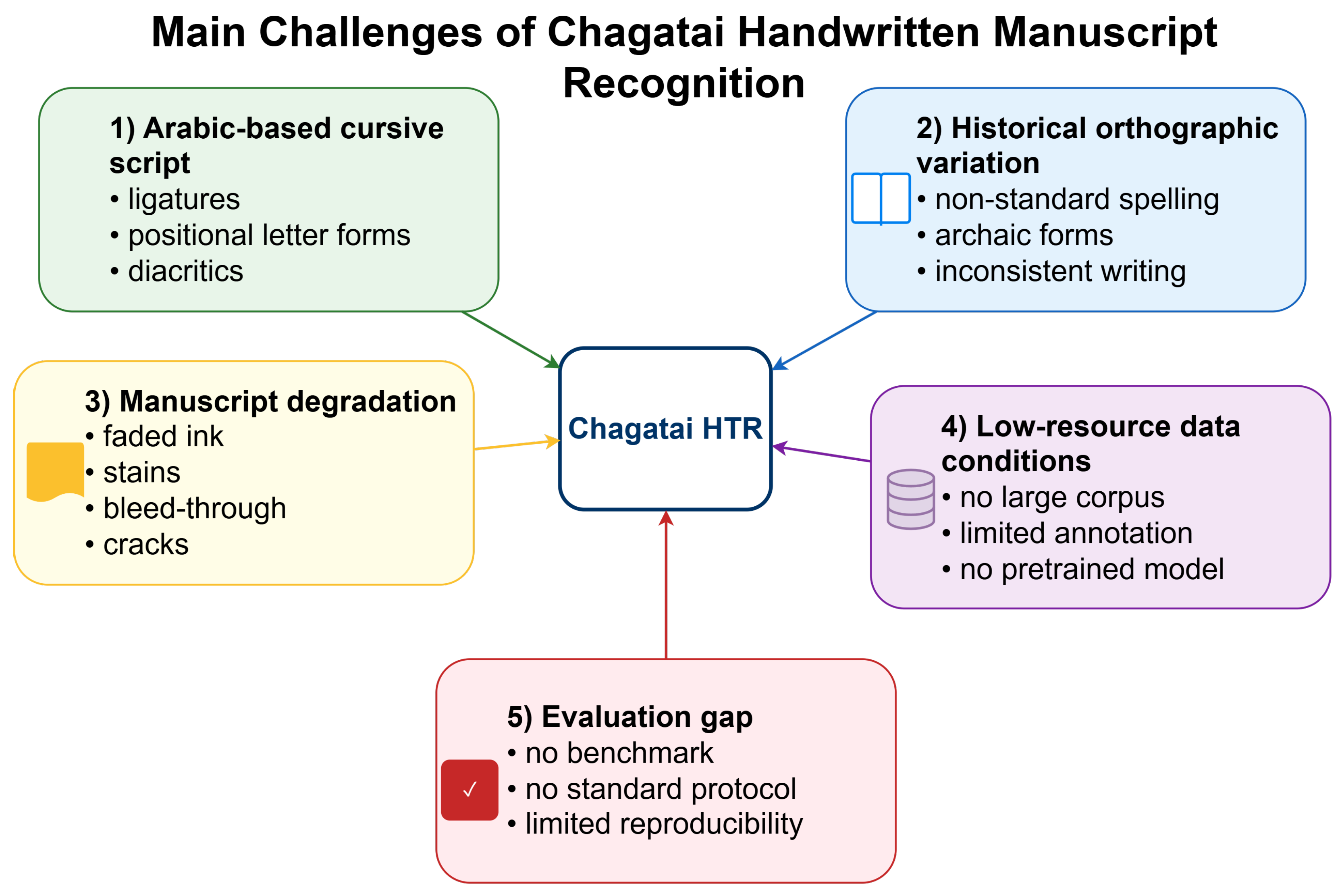
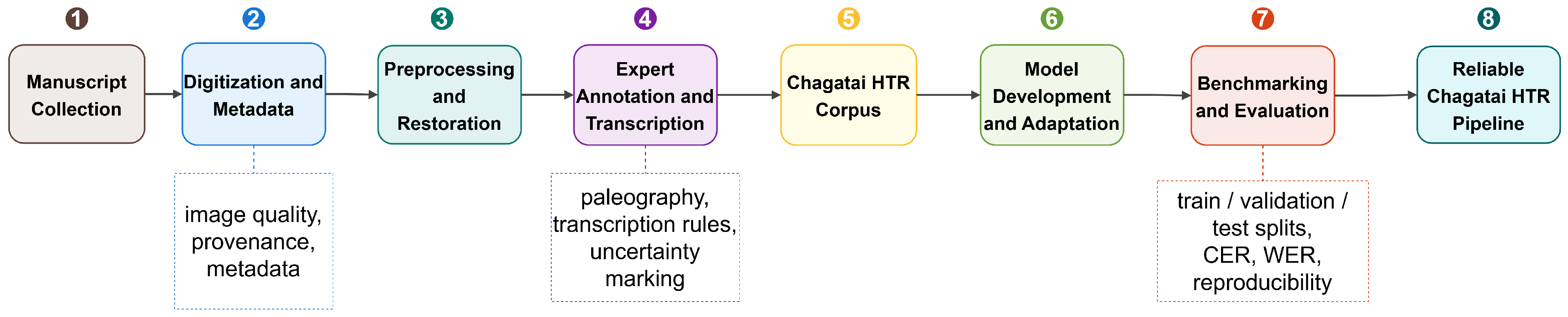
Evidence indicates that the recognition of Chagatai manuscripts is constrained by a multi-dimensional intersection of linguistic, visual, and paleographic variables. These include the Arabic-based cursive writing system, positional letter forms, diacritics, orthographic variation, physical manuscript degradation, limited annotated data, and the absence of standardized evaluation benchmarks. The main challenges that define Chagatai HTR are summarized in
Figure 1.
These challenges indicate that Chagatai HTR cannot be addressed only as a conventional OCR task. It requires a broader analysis of recognition methods, restoration techniques, data creation strategies, evaluation protocols, and adaptation approaches for low-resource historical scripts. To address this scholarly fragmentation, this SLR systematically investigates: (RQ1) the efficacy of current HTR/restoration paradigms in historical contexts; (RQ2) the availability of standardized benchmarks for Perso-Arabic scripts; (RQ3) script-specific methodological barriers for Chagatai; and (RQ4) the requirements for a reproducible research roadmap.
RQ1. What artificial intelligence methods are currently used for handwritten text recognition and restoration in low-resource and historical scripts?
RQ2. What datasets, benchmarks, and evaluation metrics are used to assess HTR systems for Arabic-based and Perso-Arabic Turkic scripts?
RQ3. What methodological limitations remain in the recognition and restoration of Chagatai handwritten manuscripts?
RQ4. What future research directions can support the development of reliable AI-based HTR systems for Chagatai and related low-resource scripts?
The remainder of this article is organized as follows:
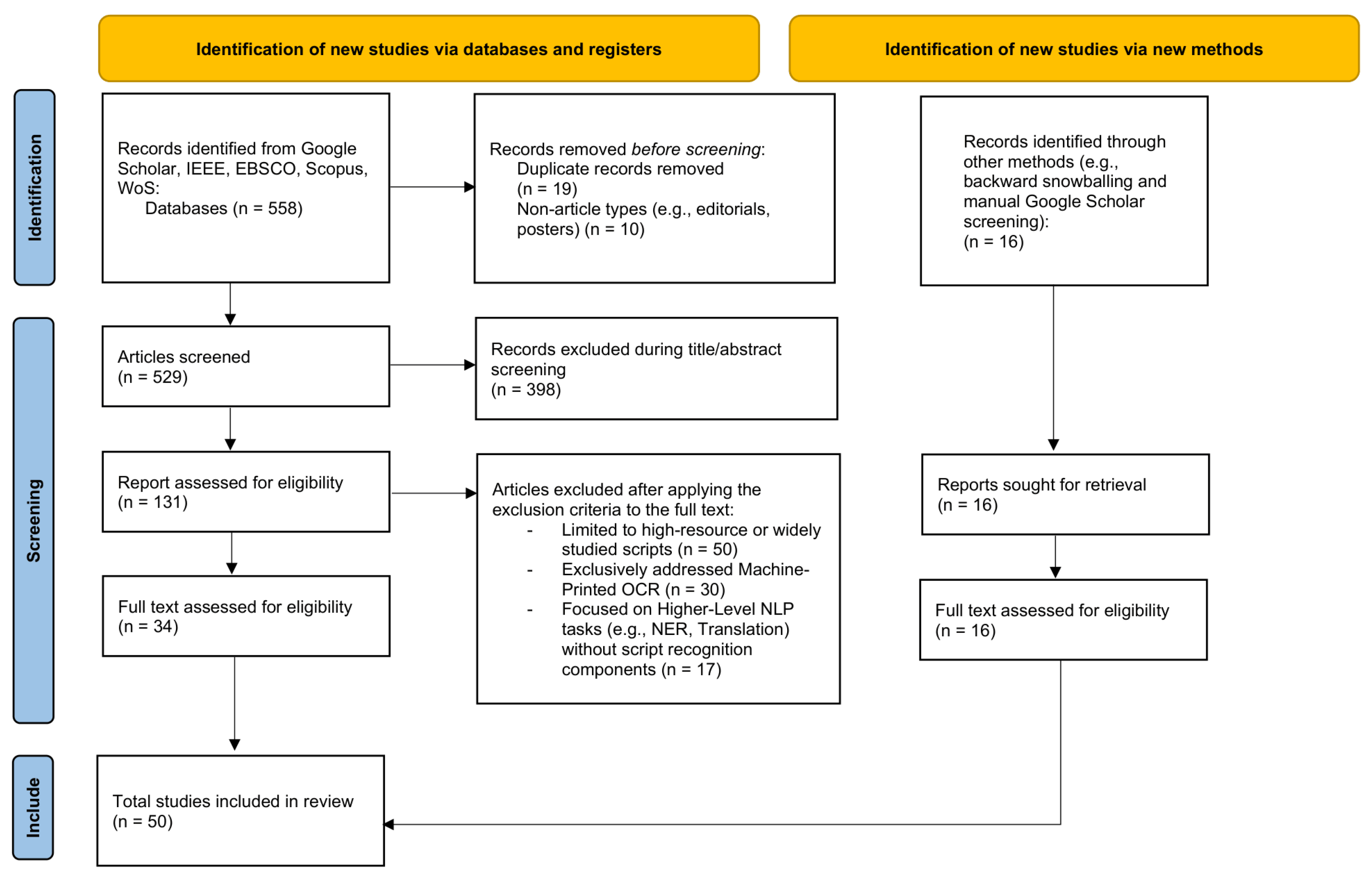
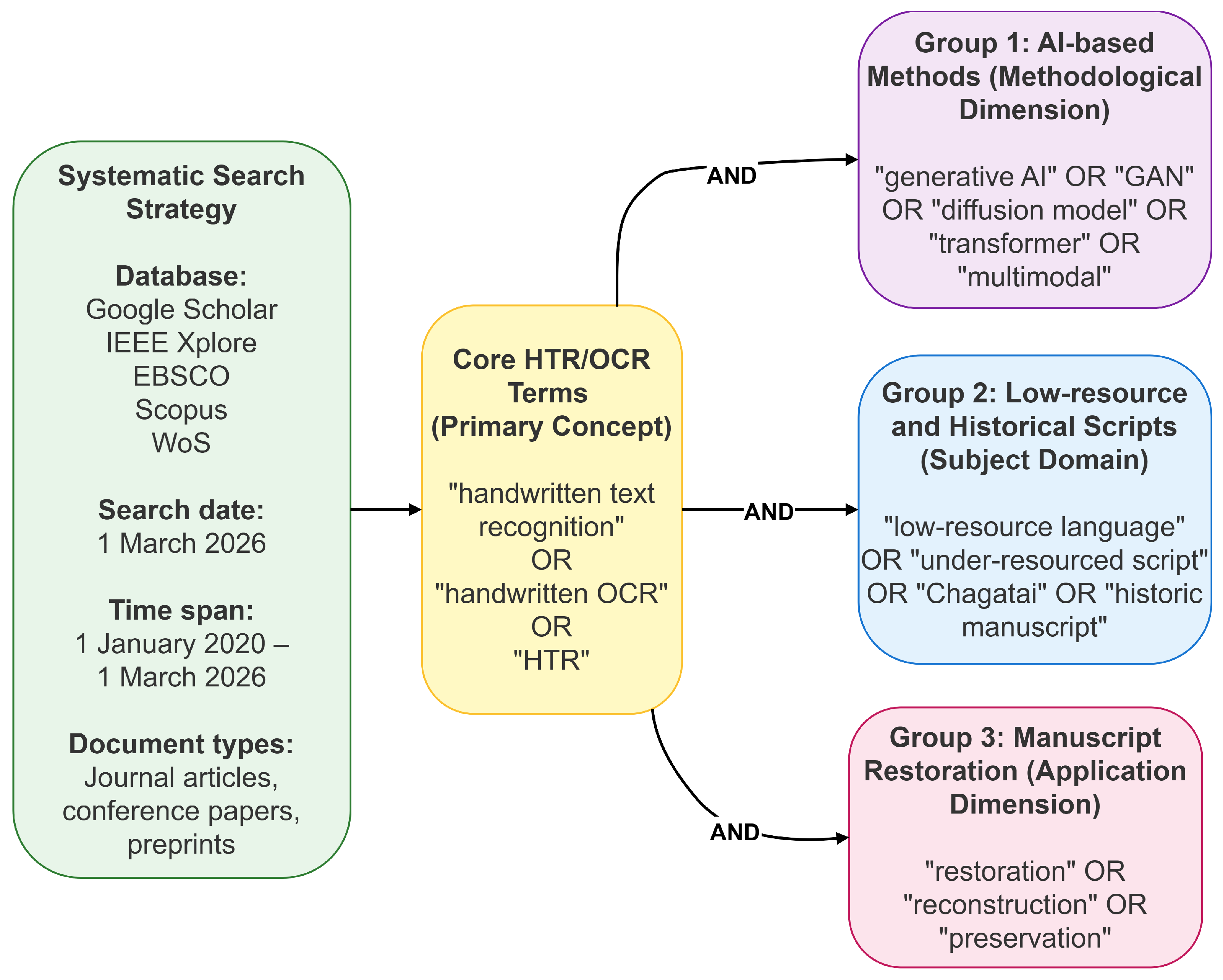
Section 2 details the review methodology, including the PRISMA-based selection process, search strategy, and eligibility criteria.
Section 3 presents the core results and taxonomy of AI methods for HTR, character classification, and text restoration, while also synthesizing the available datasets and benchmarking metrics for low-resource scripts.
Section 4 presents a critical discussion of the findings, highlights major research gaps, and outlines a research roadmap for Chagatai HTR.
Section 5 discusses the study’s limitations.
Section 6 presents the final conclusions.
4. Discussion
Evidence suggests that while the HTR task family has progressed toward unified sequence-aware architectures [
17,
30], the restoration task family is increasingly defined by generative super-resolution frameworks focused on pixel-level fidelity [
20,
59]. Consequently, field-level progress must be disaggregated by task to account for the divergent requirements of sequence-level CER versus visual reconstruction quality.
The architectural evolution identified in this review is synthesized in
Table 13, which provides a comparative analysis of model families across key performance and efficiency dimensions relevant to low-resource historical scripts.
The results also show that CNN-based models remain the most frequent category in the reviewed corpus. This indicates that convolutional architectures are still useful as stable and computationally efficient baselines, especially in low-resource settings. The integration of multimodal vision–language information serves functionally distinct roles across task families:
HTR and OCR: Multimodal alignment is used to provide linguistic inductive bias, reducing sequence-level CER in unconstrained cursive scripts [
21,
32].
Document Restoration: Multimodal fusion aligns visual residues with semantic context to reconstruct missing or faded graphemic structures [
19,
59].
Script Classification: Integration targets the resolution of morphological ambiguity between visually similar positional allomorphs via structural descriptors [
30,
47].
Reviewed studies also show that multimodal learning does not always improve results. Its performance depends on strong alignment across modalities, enough training data, and stable links between visual features and language representations.
Chagatai manuscript recognition depends on these findings. Chagatai is a historical Turkic literary language. It uses an Arabic-based cursive script. Its manuscripts often show damaged pages and faded ink. Spelling varies across texts. Letters change shape depending on position. Ligatures and diacritics appear in many forms. Annotated digital data is limited. Models trained on English, modern Arabic, or Persian often fail on this material. They need changes that fit Chagatai script and its writing patterns.
The review demonstrates that Chagatai handwritten text recognition is not merely a problem of model selection; rather, the system requires a comprehensive research infrastructure. This setup includes digitized manuscript collections and expert checked transcriptions. It also needs clear annotation rules and standard preprocessing steps. Shared benchmark datasets support fair testing across studies. Without these parts, even strong Transformer or multimodal models struggle in practice. Their results become hard to reproduce, compare, or extend to real manuscript data.
Adaptation methods include transfer learning, few-shot learning, cross-lingual transfer, test-time adaptation, and synthetic data generation. These methods may support future Chagatai handwritten text recognition systems. Each method needs careful use. Synthetic data and GAN-generated samples can expand training data. They do not replace real manuscript images. Language models can improve text consistency. They can also produce text that looks correct but lacks support in the image. This issue matters in historical manuscripts. Spelling variation and unclear letters require expert review.
The optimal trajectory for Chagatai HTR is a staged hybrid paradigm, prioritizing data foundations before integrating advanced multimodal architectures. To provide a structured evaluation of the methodological transferability,
Table 14 synthesizes the identified model families based on their suitability for the Chagatai script, accounting for dimensions such as script similarity, data requirements, and tolerance to historical degradation.
First, a representative digitized corpus and benchmark should be created. Second, stable baseline models such as CNN or CNN–RNN architectures should be tested. Third, more advanced Transformer, Vision Transformer, and multimodal models should be evaluated under controlled and reproducible conditions. Finally, restoration, synthetic augmentation, and language-assisted recognition should be integrated only after their contribution is validated on real manuscript samples.
Research Roadmap for Chagatai HTR
The review shows that Chagatai handwritten text recognition needs a staged research plan that draws on multiple fields. High resource HTR systems often build on existing datasets and shared benchmarks. Chagatai work does not have this base. It lacks standard corpora, expert checked transcriptions, and shared annotation rules. It also lacks stable evaluation methods. Future work should not focus only on model testing. It should follow a shared plan that connects manuscript studies, data building, machine learning, and evaluation design.Based on the systematic synthesis of indirect evidence from related Perso–Arabic and Turkic domains, this article establishes a theoretically grounded research roadmap for the development of Chagatai HTR infrastructure. This pathway provides a concrete framework for implementation, derived directly from the synthesized methodological trends and identified research gaps.
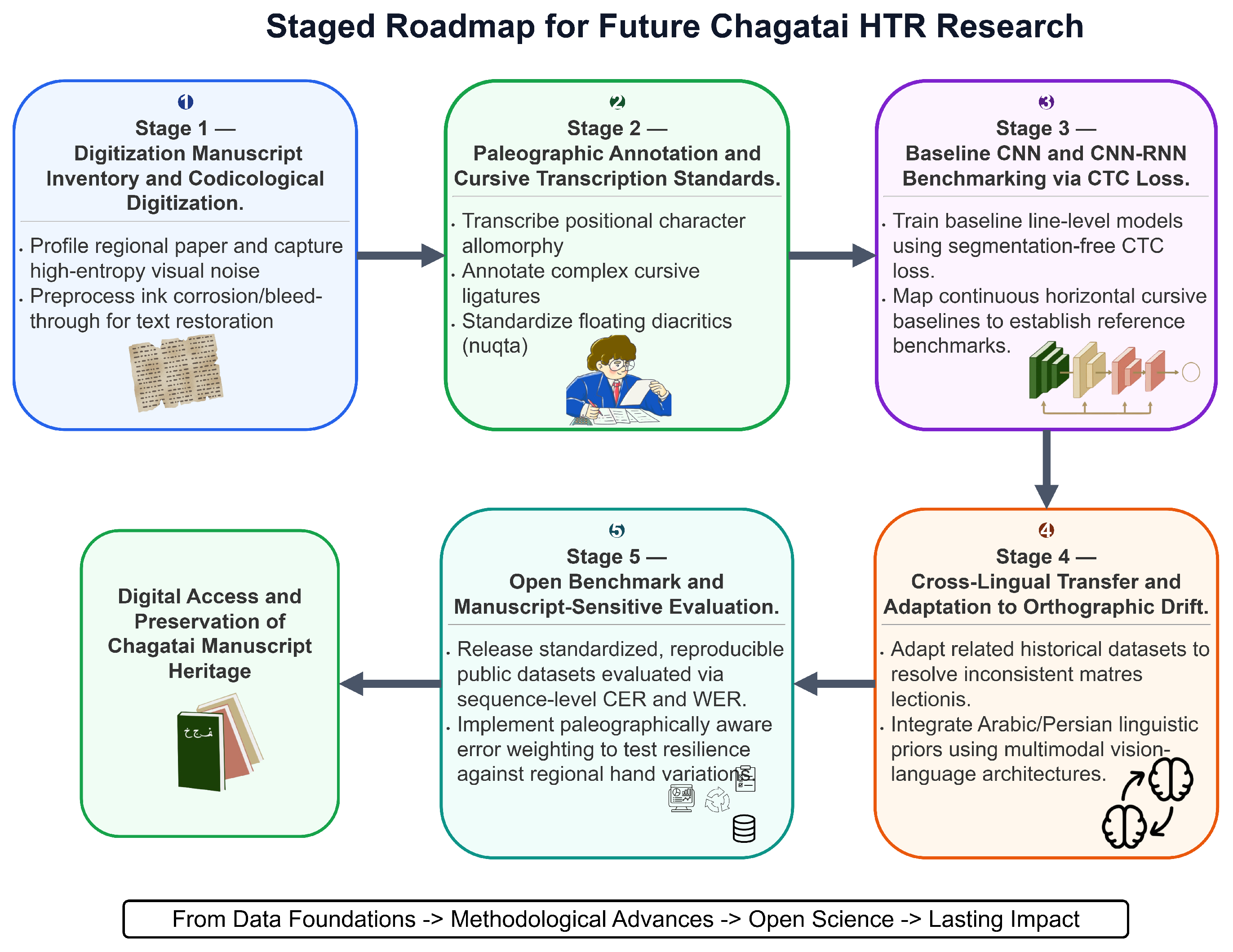
Stage 1: Manuscript Inventory and Codicological Digitization. The initial phase focuses on the systematic digitization of Chagatai materials, prioritizing an understanding of the physical degradation common in Central Asian archives. Unlike modern documents, Chagatai manuscripts are often written on regional paper types (such as Samarkand rag paper or various localized Central Asian variants) that exhibit distinct aging patterns. A primary technical hurdle at this stage is the severe acidic ink bleed-through and “show-through” typical of historical Islamic manuscripts, where the corrosive nature of the ink causes text from the verso side to merge visually with the recto side. Digitization protocols must therefore move beyond simple resolution standards to capture the high-entropy visual noise of archival degradation, ensuring a stable image base that accounts for paper deformation, complex stains, and faded ink before any recognition is attempted.
Stage 2: Paleographic Annotation and Cursive Transcription Standards. The second stage establishes expert-driven annotation guidelines that address the specific paleographic complexities of the Chagatai Arabic-based script. Expert paleographers must define standards for handling high positional allomorphy, where characters such as ’alif or sīn drastically shift their graphemic structures across isolated, initial, medial, and final positions. Annotation must explicitly account for complex horizontal and vertical ligatures, particularly those involving letters such as kāf, lām, or mīm, which often merge seamlessly into neighboring glyphs and defy discrete segmentation. Furthermore, the guidelines must provide a logic for ambiguous or floating diacritics (nuqta). In styles such as Nasta’liq, which are common in Chagatai literary works, these marks often drift far from their base characters or overlap with neighboring strokes, requiring a transcription hierarchy that distinguishes between scribal omission and physical fading.
Stage 3: Baseline CNN and CNN-RNN Benchmarking via CTC Loss. Before deploying complex architectures, it is necessary to establish stable baselines using Convolutional Neural Networks (CNN) and CNN-Recurrent Neural Network (CNN-RNN) hybrids. In the context of Chagatai paleography, these models serve a specific purpose: mapping the continuous horizontal baseline of the cursive script. By utilizing Connectionist Temporal Classification (CTC) loss, the system can learn to align the visual signal with the textual sequence without the need for individual character segmentation. This “segmentation-free” approach is vital for Chagatai, as it allows the model to internalize the fluid, connected nature of the writing system before more advanced attention-driven models are introduced to resolve fine-grained morphological and ligaturial details.
Stage 4: Cross-Lingual Transfer and Adaptation to Orthographic Drift. Stage 4 addresses the profound linguistic hybridity and orthographic drift inherent in Chagatai. To provide a rigorous theoretical grounding for this stage, future architectures must leverage the evolving landscape of Large Language Model (LLM) platforms, specifically utilizing training paradigms, instruction tuning, and alignment methods optimized for historical contexts [
67]. Technically, the models must be fine-tuned to handle the inconsistent use of long vowels (matres lectionis such as wāw and yā) and the heavy intermixing of Turkic roots with Arabic and Persian vocabulary, ensuring that the system understands the historical spelling variations defining different scribal periods. However, relying heavily on large-scale vision–language models introduces a severe risk of language-prior dominance [
67]. Because these deep decoders heavily prioritize statistical linguistic patterns learned during pretraining, they are prone to hallucinations, where linguistic probability overrides the actual visual evidence in the manuscript. To resolve this tension and enforce strict visual grounding, future Chagatai HTR pipelines should move beyond black-box image-to-text generation toward an interpretable framework based on structured prompt composition and cross-attention attribution [
68]. By decomposing the transcription task into structured semantic dimensions, such as scribal style, period-specific orthography, and morphological constraints, researchers can utilize structured prompting to guide the multimodal layers more precisely [
68]. Furthermore, by calculating token-level spatial relevance scores through mechanisms such as Diffusion Attentive Attribution Maps (DAAM), the system can explicitly map and verify the correspondence between generated text and the original manuscript strokes [
68]. This architecture functions as an automated fidelity check by flagging text predictions that lack direct pixel-level support in the image, thereby encouraging the model to capture genuine paleographic variations rather than infer characters solely from modern statistical language priors [
67,
68].
Stage 5: Open Benchmark and Manuscript-Sensitive Evaluation. The final stage culminates in a reproducible open benchmark that moves beyond isolated experimental setups to standardize evaluation across the field. While standard sequence metrics such as Character Error Rate (CER) and Word Error Rate (WER) remain essential for cross-study comparison, this benchmark introduces manuscript-sensitive protocols for their deployment. Specifically, the evaluation framework establishes error-weighting guidelines where historically acceptable orthographic variations or missing diacritics (nuqta) are tracked separately from catastrophic optical misrecognitions. This prevents minor scribal drift or regional spelling variations from artificially inflating WER penalties. By establishing these standardized, paleographically aware evaluation protocols, the benchmark moves Chagatai HTR toward a cumulative research field that prioritizes the structural and topological invariants of Central Asian intellectual heritage.
Overall, the proposed roadmap suggests that reliable Chagatai HTR cannot emerge from model adaptation alone. It requires a complete research infrastructure in which manuscript digitization, annotation, baseline benchmarking, advanced adaptation, and reproducible evaluation are developed in a coordinated sequence. This staged pathway is summarized in
Figure 7.
As shown in
Figure 7, the proposed roadmap begins with data foundations and gradually moves toward advanced model adaptation, open benchmarking, and long-term digital access to Chagatai manuscript heritage. Such a staged approach would provide a realistic path toward preserving and computationally accessing Chagatai manuscript heritage while also contributing to broader research on low-resource historical scripts.
5. Limitations of the Study
The current synthesis is subject to several methodological limitations. The review utilized papers identified through selected databases and a predefined search strategy. The search followed PRISMA based steps and covered major academic sources. A significant methodological limitation of this systematic review is the inherent publication bias introduced by the exclusion of non-English regional scholarship. While the search strategy adhered to PRISMA guidelines by targeting major global databases such as Scopus and Web of Science, this approach inevitably overlooks a substantial body of technical and paleographical research published in Kazakh, Uzbek, and Russian. In the specific context of Central Asian digital heritage, critical primary research and specialized algorithmic adaptations are frequently disseminated through regional academic journals and institutional archival reports that remain unindexed in Western-centric platforms. Consequently, the validity of the Proposed Roadmap (
Section 4) may be constrained by the omission of localized paleographical expertise, including specific codicological insights into Samarkand rag paper aging, regional scribal variations, and alternative computational frameworks developed within Central Asian technical universities. This linguistic and digital barrier represents a recognized systemic challenge in digital humanities; by relying on English-indexed literature, the synthesis potentially prioritizes global architectural trends over indigenous engineering solutions tailored to the unique orthographic nuances of the Eastern Turki tradition. Acknowledging this bias is essential for maintaining research validity, as it highlights that the current state of the art, while robust in the global sphere, remains partially decoupled from the deep-seated regional scholarship necessary for a truly comprehensive Chagatai HTR infrastructure.
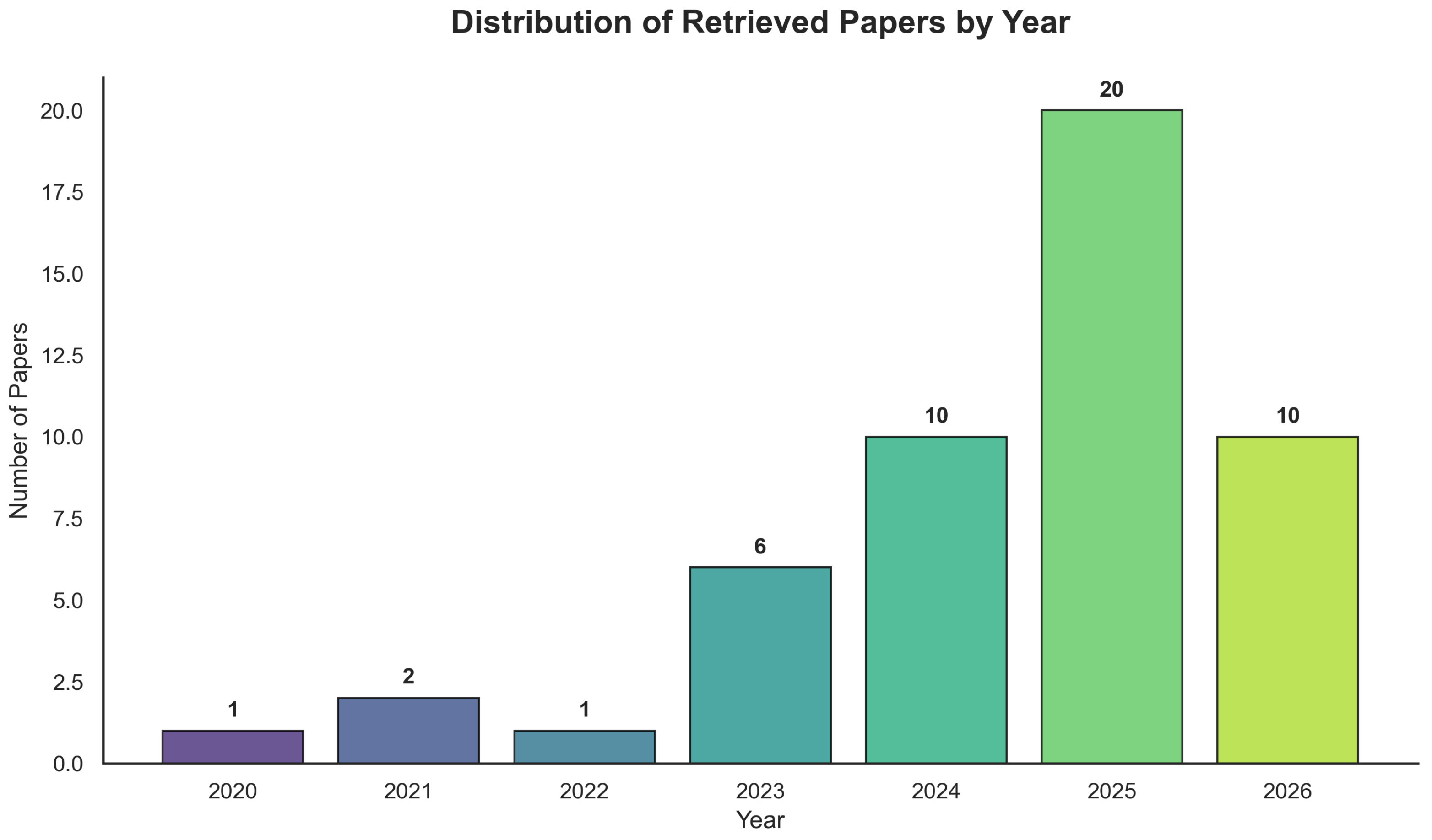
The review examined studies published between 1 January 2020 and 1 March 2026. This period reflects recent progress in deep learning, Transformer architectures, multimodal learning, and document analysis. The selected publication window places particular attention on recent AI-driven recognition methods. As a result, earlier contributions in classical OCR, paleography, and manuscript digitization receive less attention within the review.
Building on these constraints, the paucity of primary Chagatai-specific HTR literature necessitated a reliance on methodological proxies from related Perso–Arabic and Turkic-script domains. While analysis of Ottoman Turkish, Persian, and Kazakh traditions offers valuable methodological patterns, their findings remain contingent upon further script-specific validation to account for Chagatai’s unique orthographic nuances.
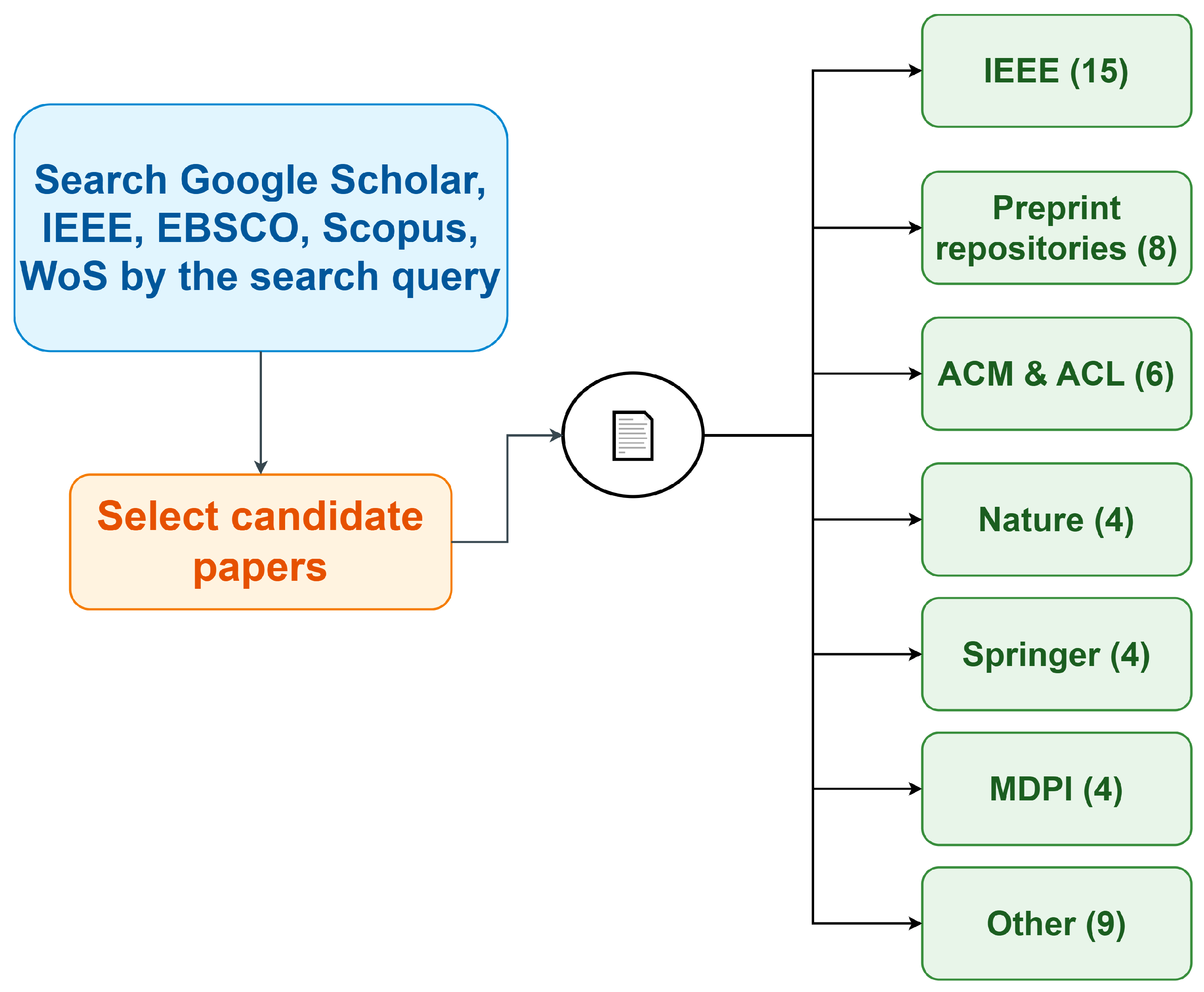
A secondary limitation concerns the heterogeneous degree of peer-review rigor across the included studies. Approximately 16% of the reviewed corpus consists of preprints (N = 8), which, while technically robust, have not undergone formal academic validation. This introduces a variable level of confidence in certain reported performance metrics. To mitigate this risk, the synthesis prioritizes architectural trends and methodological innovations from preprints rather than treating their empirical results as absolute field-level benchmarks, ensuring that the study’s conclusions remain grounded in a balanced evidence base.
Methodological variation across the reviewed studies limits direct comparison of reported results. The studies included in the review rely on diverse evaluation metrics, such as Character Error Rate (CER) and mean Average Precision (mAP). This methodological variation restricts direct comparison of results and hinders the objective assessment of competing architectures. Data availability and dataset quality present another challenge. Many studies rely on private collections, synthetic datasets, or small archival samples. Public benchmark datasets remain scarce. This situation restricts reproducibility and limits independent validation of published recognition performance.
This study is implemented as a systematic literature review and indirect evidence synthesis. The scope focuses on the synthesis of existing research, the identification of research gaps, and the definition of strategic research directions. The primary contribution lies in mapping the research landscape and establishing a foundational development pathway for Chagatai handwritten text recognition, serving as a conceptual framework to guide subsequent empirical validation.




 ,
,