Review

A Comprehensive Survey of LLMs for Sustainable and Renewable Energy Systems

1
Computer Science and Applied Mathematics Laboratory (LIMA), Faculty of Science and Technology, Chadli Bendjedid University, P.O. Box 73, El Tarf 36000, Algeria
2
College of Information Technology, United Arab Emirates University, Al Ain P.O. Box 15551, United Arab Emirates
3
Mathematical Modeling and Numerical Simulation Laboratory (LAM2SIN), Faculty of Technology, Badji Mokhtar University, P.O. Box 12, Annaba 23000, Algeria
4
School of Computer Science and Informatics, De Montfort University, Leicester LE1 9BH, UK
*
Author to whom correspondence should be addressed.
Information 2026, 17(3), 271; https://doi.org/10.3390/info17030271
Submission received: 26 January 2026 / Revised: 28 February 2026 / Accepted: 5 March 2026 / Published: 9 March 2026
(This article belongs to the Section Artificial Intelligence)

Abstract

Large Language Models (LLMs) are emerging as a new class of intelligent systems capable of reasoning over heterogeneous knowledge and interacting with human operators, yet their role in renewable energy systems remains insufficiently synthesized. This review provides a dedicated, systematic examination of LLMs as knowledge-centric, human-oriented decision-support tools for renewable energy infrastructure. In contrast to existing surveys that primarily emphasize numerical optimization, forecasting, or conventional machine learning methods, this work focuses on how LLMs enable textual reasoning, regulatory interpretation, operational intelligence, and interactive support across energy system lifecycles. We present a structured overview of recent literature, categorizing LLM applications by their functional roles in analysis, control, operation, and policy support. Furthermore, we analyze the contributions of LLMs to key decision-support tasks, including information retrieval, incident analysis, operational coordination, and strategic planning in smart grids and microgrids. The review also critically examines current limitations and risks associated with deploying LLMs in energy systems, including hallucination, reliability, domain adaptation, explainability, and real-time operational constraints. Finally, we identify emerging research directions, including energy-efficient LLM deployment, sustainability-aware AI design, and the alignment of LLM-based solutions with the goals of resilient, low-carbon, and environmentally sustainable energy systems.

1. Introduction

Global energy systems are undergoing rapid transformation to meet decarbonization and climate objectives. The large-scale integration of renewable energy sources, such as solar photovoltaics and wind, has emerged as one of the most critical and complex challenges in modern power systems. Smart grids, microgrids, and decentralized energy networks increasingly rely on renewable technologies such as solar photovoltaics and wind power, which now constitute key pillars of the global energy transition.
Despite their environmental benefits, these resources exhibit inherent variability, intermittency, and uncertainty, which significantly complicate generation planning, grid operation, real-time control, and long-term system reliability [1,2,3,4]. As a result, ensuring stable, efficient, and resilient energy delivery under high renewable penetration remains an open and actively investigated problem.
To address these challenges, extensive research has focused on developing intelligent decision-support systems to enhance operational efficiency, adaptability, and robustness in renewable energy environments [5,6,7,8,9]. Modern energy infrastructures generate not only large volumes of numerical data but also vast amounts of unstructured and semi-structured textual information, including technical standards, maintenance reports, incident logs, and operational guidelines. The ability to interpret, reason over, and synthesize is becoming increasingly essential for engineers, system operators, and policymakers seeking to preserve grid resilience, ensure regulatory compliance, and support secure energy delivery [10,11,12].
However, traditional optimization and machine learning models remain limited in their ability to effectively exploit rich textual knowledge. Recent advances in AI, particularly in the development of large language models (LLMs), have opened new perspectives for supporting renewable energy management and decision-making processes [13,14,15]. Owing to their strong capabilities in natural language understanding, reasoning, and generation, LLMs can process complex textual content at scale, making them particularly well-suited for extracting insights from technical documentation, interpreting regulatory constraints, and summarizing system states.
By leveraging diverse textual sources such as fault reports, policy documents, and historical records, LLMs can significantly enhance situational awareness, accelerate information retrieval, and facilitate more efficient coordination across distributed and heterogeneous energy assets [16,17,18]. Collectively, these capabilities contribute to improved operational efficiency and support a more seamless integration and management of renewable energy resources [19,20,21,22,23,24,25,26].
Contemporary renewable energy systems typically combine variable generation technologies such as solar PV arrays and wind turbines with energy storage solutions, including lithium-ion batteries and hybrid storage architectures [27]. While such configurations enable temporal balancing between supply and demand, they also introduce additional layers of complexity, particularly under uncertain forecasts, dynamic load profiles, and rapidly changing grid conditions [28,29,30,31].
In this context, LLM-based decision-support tools may play a complementary role by synthesizing knowledge from textual sources, supporting real-time reasoning, and assisting operators in maintaining system stability and reliability [32,33]. When integrated into smart grid control architectures or microgrid energy management systems, LLM-driven tools can improve decision quality, streamline coordination among distributed components, and reduce both operational and cognitive burdens placed on human decision-makers [34,35,36,37].
Despite their promising potential, the adoption of LLMs in energy systems also raises critical challenges that must be carefully addressed. These include reliability, robustness, domain adaptation, explainability, and real-time reasoning under uncertainty.
Moreover, the computational cost and energy consumption associated with large-scale LLMs have recently become a topic of growing concern, particularly in sustainability-critical domains such as renewable energy systems. Understanding and managing the trade-offs between the decision-support benefits offered by LLMs and their computational and environmental footprints is therefore essential to ensure alignment with the overarching objectives of energy efficiency and low-carbon system design [10].
Rather than proposing a novel algorithmic solution, this review aims to provide a comprehensive and structured examination of how LLM-based approaches can support analysis, planning, control, and decision-making across renewable energy systems domains; analyze their strengths and limitations; and identify open research challenges related to trustworthiness, scalability, sustainability, and human–AI collaboration in operational energy contexts.

1.1. Literature Search and Methodology

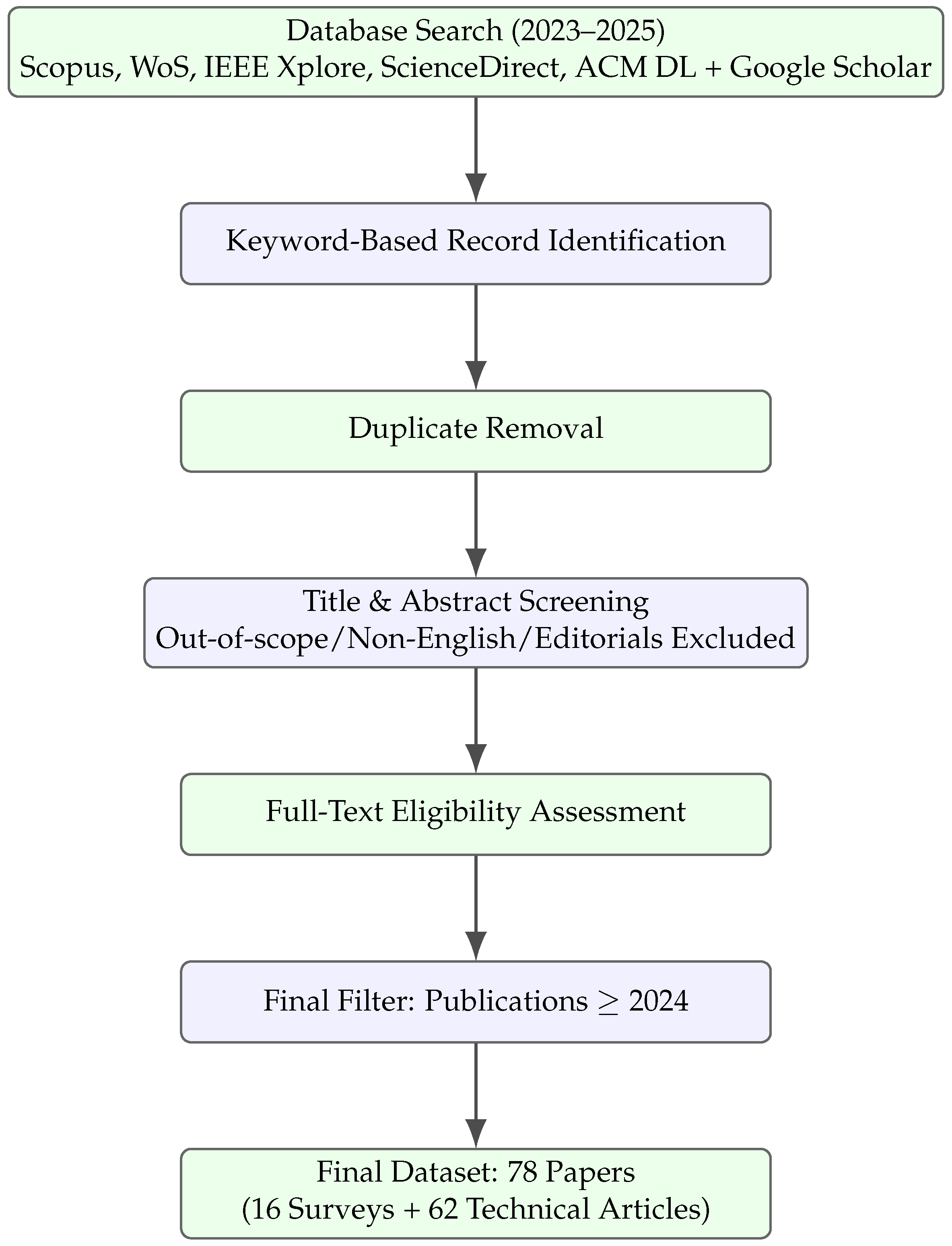
To ensure a comprehensive and systematic review of the literature on LLMs, GenAI, and their applications in sustainable energy systems, a structured and multi-stage methodology was employed. The literature search was conducted across several reputable academic databases, including Scopus, Web of Science, IEEE Xplore, ScienceDirect, and the ACM Digital Library, in order to capture a broad range of peer-reviewed journal articles, conference proceedings, and book chapters relevant to AI-driven decision-making in renewable energy, hydrogen systems, and sustainability-oriented applications. In addition, Google Scholar was used as a supplementary source to identify highly cited or seminal studies that may not have been indexed in the primary databases. The search strategy relied on carefully constructed keyword combinations and Boolean operators. Examples include:
  • “Large Language Model” AND “renewable energy”
  • “Generative AI” AND “sustainable energy”
  • “autonomous energy agents” OR “AI energy optimization”
  • “domain-specific LLM” AND “hydrogen energy”
combined with “renewable energy,” “Generative AI” with “sustainable energy,” terms related to autonomous energy agents and AI-based optimization, and domain-specific LLMs applied to hydrogen energy systems. To emphasize recent developments and emerging trends, the search was initially restricted to publications released between 2023 and 2025.
The inclusion criteria focused on peer-reviewed journal articles, conference papers, and high-quality preprints that addressed the development or application of LLMs, GenAI, or autonomous AI agents within the contexts of energy management, renewable energy systems, or hydrogen technologies, and that provided substantive methodological, analytical, or empirical contributions relevant to optimization, decision-making, or sustainability. Studies were excluded if they fell outside the scope of AI applications in energy and sustainability, were not written in English, or consisted of duplicates, editorials, or opinion-based articles lacking scientific validation.
To further ensure the currency and relevance of the reviewed literature, only articles published from 2024 onwards were retained in the final dataset. After applying this additional filter, 78 papers were selected, comprising 16 survey articles and 62 technical research papers. Figure 1 presents a compact overview of the literature identification, screening, exclusion, and final selection stages adopted in this study. This systematic methodology ensures that the review is both comprehensive and focused on high-quality, up-to-date contributions, thereby providing a robust foundation for subsequent analysis and discussion.

1.2. Contribution of This Review

Despite the promising capabilities of LLMs, there is currently a lack of systematic reviews focusing on their application for decision-support in renewable energy systems. Existing surveys primarily emphasize numerical optimization techniques, forecasting models, or conventional machine learning approaches, leaving a gap in understanding how LLMs can support human-centric decision-making. This review aims to fill this gap by providing a structured analysis of LLM applications across planning, control, and operational tasks in renewable energy infrastructures.
The novelty of this review lies in its dedicated focus on LLMs as knowledge-centric, human-oriented decision-support tools. Unlike previous work, it explicitly examines how LLMs enable reasoning over textual knowledge, regulatory interpretation, operational intelligence, and interactive support for human operators. By synthesizing recent research and identifying challenges related to reliability, explainability, and sustainability, this work provides actionable insights for both researchers and practitioners seeking to integrate LLMs into operational energy systems.
The main contributions of this review are summarized as follows:
  • We provide a structured, comprehensive overview of LLM applications in renewable energy systems, organizing the literature by functional roles, including analysis, control, operation, and policy support.
  • We analyze how LLMs contribute to decision support tasks, including information retrieval, incident analysis, operational coordination, and strategic planning in smart grids and microgrids.
  • We critically discuss the limitations and risks associated with LLM deployment in energy systems, including hallucination, reliability, domain adaptation, explainability, and real-time constraints.
  • We highlight emerging research directions related to energy-efficient LLM deployment, sustainability-aware AI design, and the alignment of LLM-based solutions with the objectives of green, resilient, and low-carbon energy systems.
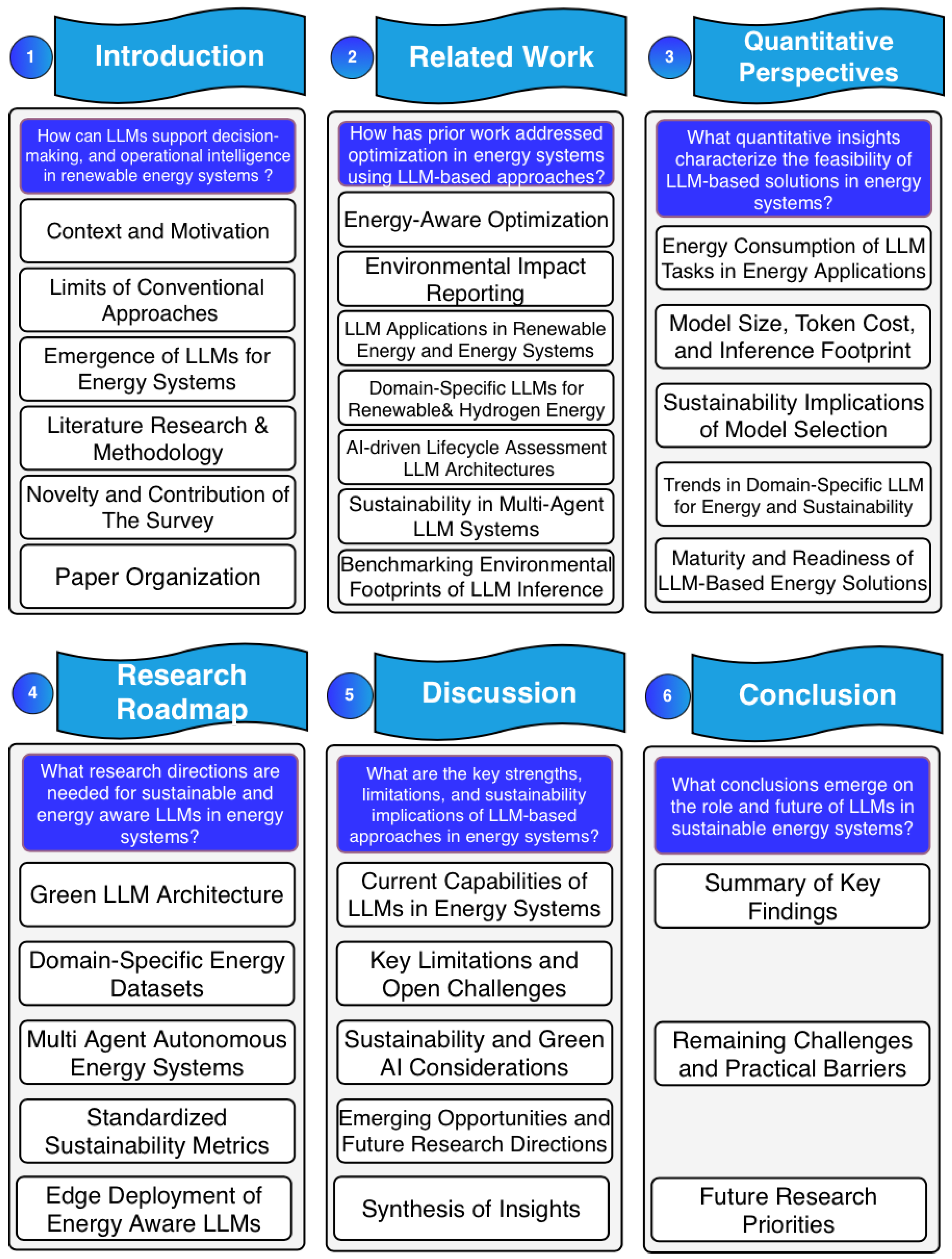
The remainder of this paper is organized as follows (Figure 2): Section 2 discusses related work, highlighting key advancements and gaps in the field. Section 3 provides quantitative perspectives on energy consumption, benchmarking, and domain-specific trends of LLMs. Section 4 discusses the findings and their implications for sustainable AI deployment in energy applications. Section 6 concludes the paper, summarizing the contributions and outlining potential directions for future research. Finally, to enhance readability, Abbreviations section in the back matter provides a comprehensive list of acronyms and abbreviations used throughout the paper.
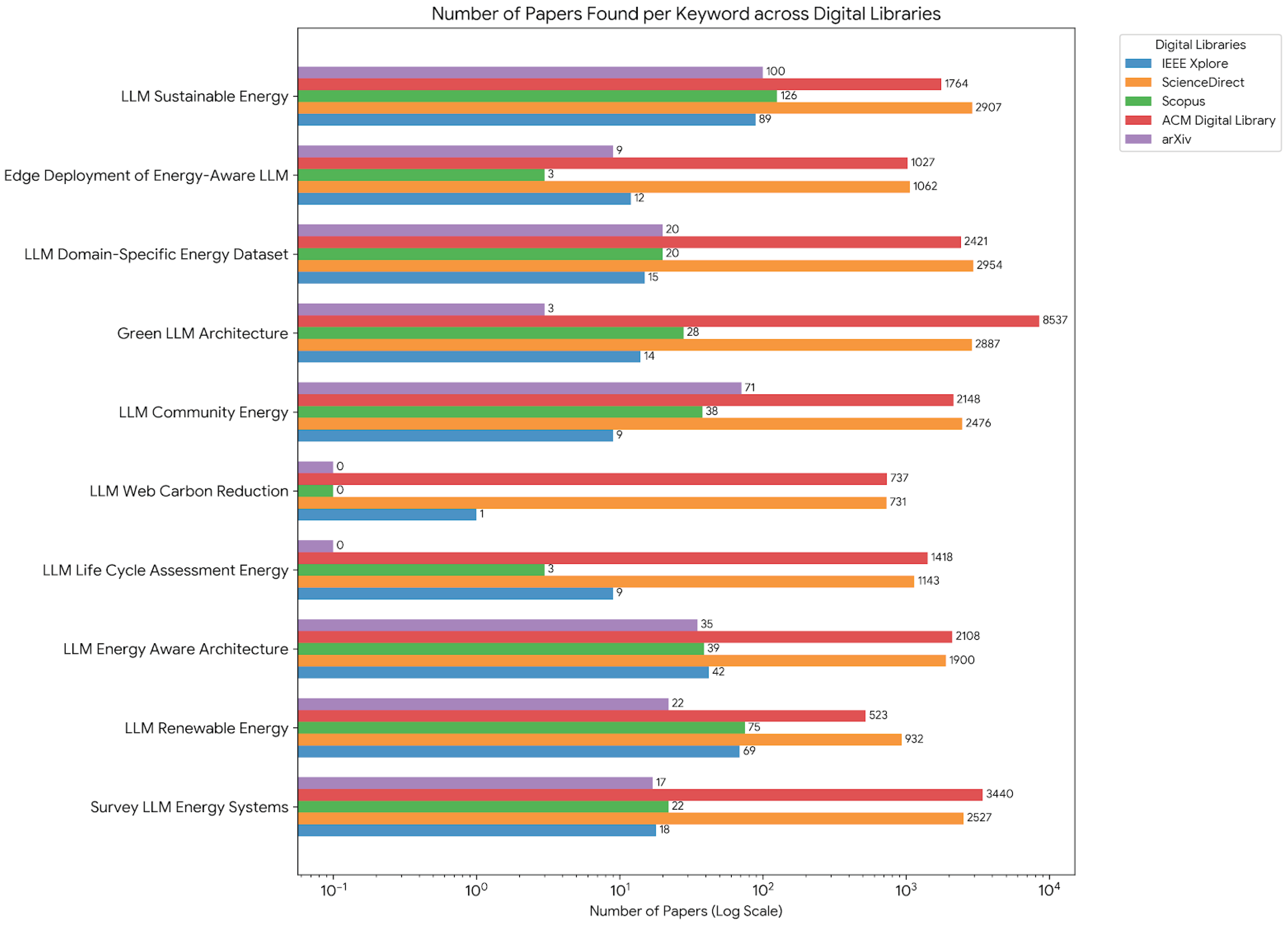
The distribution of publications identified for each keyword across the different digital libraries is illustrated in Figure 3.

2. Related Work

This section provides a descriptive and integrative overview of recent advancements at the intersection of LLMs, sustainability, and energy systems, consistent with the aims of a survey article. The focus here is not on proposing new algorithms or conducting novel experiments; instead, it synthesizes existing research across multiple complementary subdomains, highlighting how LLMs are increasingly leveraged to address complex challenges in sustainable energy, while also critically examining their limitations, operational constraints, and future potential.
Specifically, we examine LLM sustainability considerations, the emergence of domain-specific energy-focused LLMs, LLM-enabled optimization and decision-making frameworks, autonomous energy agent architectures, and applications in renewable energy generation, hydrogen systems, and supply chain traceability in energy networks. By presenting these themes in an integrative manner, we aim to provide both breadth and depth for readers seeking a comprehensive understanding of LLM applications in the energy sector.
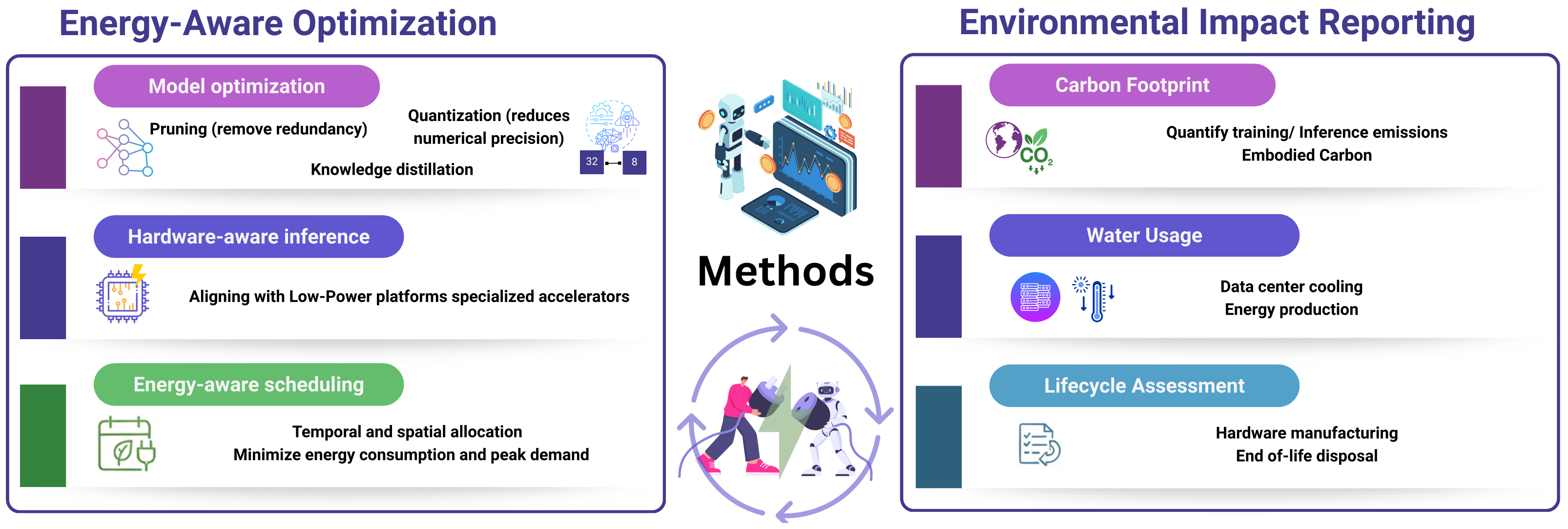
In particular, while previous surveys have extensively covered general AI and ML applications in renewable energy, smart grids, and building energy management, few have addressed the emerging roles of LLMs in decision-support, real-time operational reasoning, domain adaptation, and energy-efficient deployment. This table thus motivates the unique contribution of the present review, which systematically organizes and evaluates LLM-based methodologies, their deployment challenges, and sustainability considerations within renewable energy systems. Figure 4 provides an overview of key methods to improve the sustainability of LLMs, encompassing energy-aware optimization techniques and environmental impact reporting throughout the model lifecycle.
  • Energy-Aware Optimization
This branch focuses on reducing energy consumption during both model training and inference by integrating algorithmic, hardware-level, and execution-time optimizations. Model optimization techniques, including pruning, quantization, and knowledge distillation, are employed to reduce computational complexity while preserving performance. In parallel, hardware-aware inference aligns model architectures and execution strategies with energy-efficient computing platforms, enabling more sustainable deployment across diverse infrastructures. Complementarily, energy-aware scheduling optimizes the temporal and spatial allocation of model execution, ensuring that workloads are performed under conditions that minimize energy consumption and peak demand.
  • Environmental Impact Reporting
This branch focuses on measuring, reporting, and analyzing the environmental footprint of LLM development and deployment. It encompasses several key aspects. Carbon footprint involves quantifying the greenhouse gas emissions generated during both the training and inference phases of LLMs. Water usage assesses the amount of water consumed, particularly in relation to data center cooling and the energy production that supports LLM operations. Finally, lifecycle assessment evaluates the environmental impacts across the entire lifecycle of LLMs, covering everything from hardware manufacturing to end-of-life disposal.
It is important to recognize that energy-aware optimization techniques directly influence the environmental footprint of LLMs. By reducing the computational energy required during training and inference, these optimizations contribute to lower carbon emissions, reduced water usage, and improved overall lifecycle sustainability. Consequently, energy-aware strategies and environmental impact reporting are complementary: optimization reduces resource consumption, while systematic reporting quantifies and monitors the resulting environmental benefits, providing a feedback loop to guide future model design and deployment.
Table 1 provides a concise summary of this LLM sustainability taxonomy.
Table 2 presents a comparative overview of recent surveys and review papers (2024–2025) related to AI, machine learning, and LLMs in energy systems. Each entry summarizes the domain focus, key contributions, and primary limitations of the surveyed works, highlighting the specific gaps that remain in the literature.
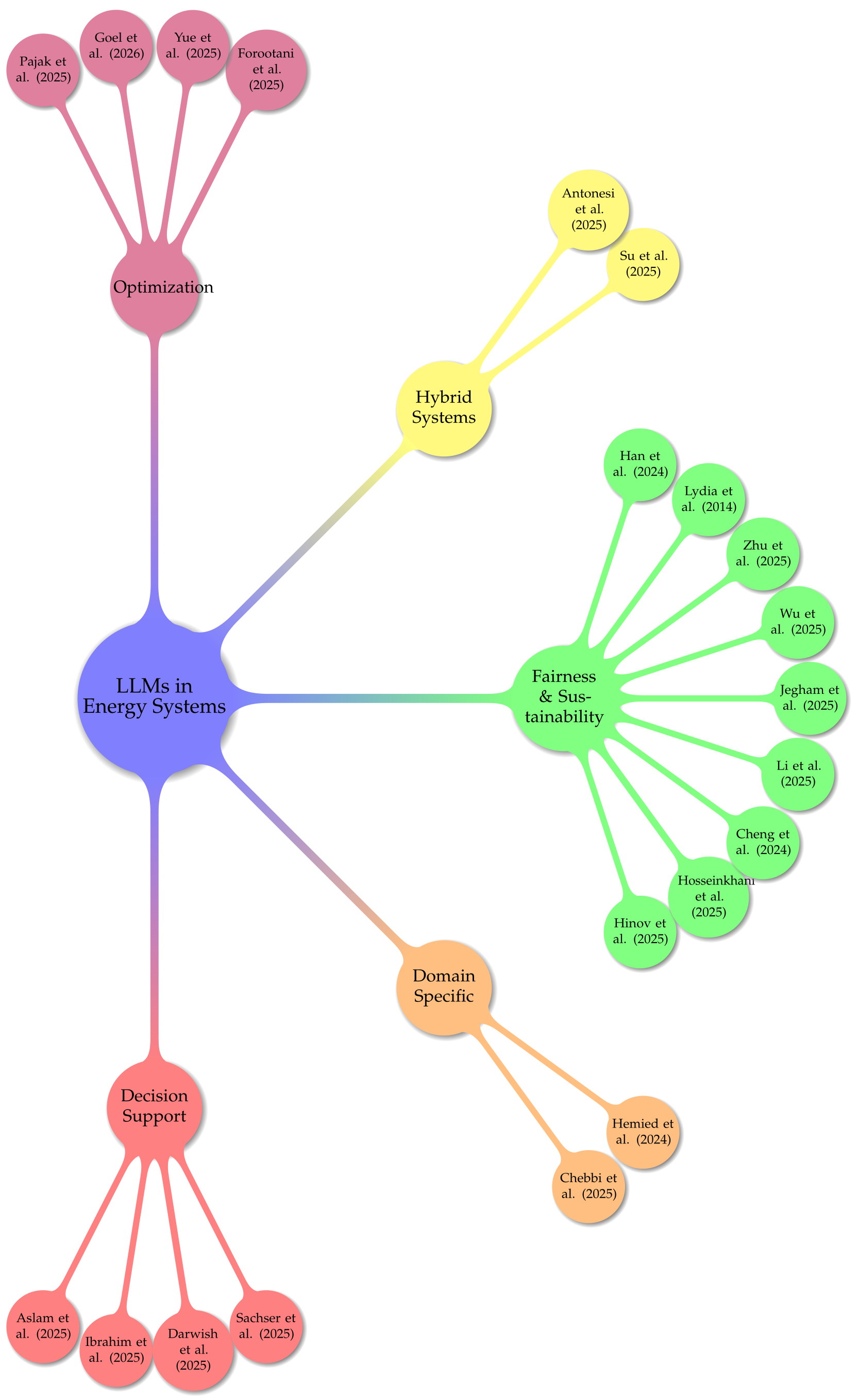
Figure 5 presents a classification of LLM applications in renewable energy and energy systems.
Table 2. Comparison of Recent Surveys/Reviews Related to AI, Machine Learning, and LLMs in Energy Systems.
SurveyYearDomainKey FocusPrimary Limitation
Arslan et al. [38]2026Building Energy ApplicationsFocused on buildings; excludes wider multi-energy system integrationNeed for cross-sector generalization and sustainability-aware deployment metrics.
Shahin et al. [39]2025Hydrogen Energy SystemsLLM-driven analysis for hydrogen production, forecasting, policy evaluation, and maintenanceApplication-oriented; lacks unified LLM architecture and scalability analysis across energy sectors.
Shi et al. [40]2024Green AI/Software EngineeringSurvey and vision on efficient and environmentally sustainable LLMs for software engineeringFocuses on SE; does not analyze energy-system decision workflows or operational deployment.
Shi et al. [41]2024Smart GridsReview of LLM opportunities for data integration, system interaction, security, and large-scale smart grid deploymentLacks quantitative benchmarks and real-time operational validation of LLM-based control.
Liu et al. [42]2025Building Energy SystemsOpportunities and challenges of LLMs for energy modeling, management, and fault diagnosisPerspective-focused; limited empirical validation and cross-domain generalization.
Chen et al. [43]2025Sustainable Energy SystemsAI/ML perspectives for modeling, control, cybersecurity, and future energy systemsBroad AI scope; limited emphasis on LLM-specific reasoning and generative workflows.
Yao et al. [44]2025Power SystemsSurvey of large foundation models for perception, planning, and control in power systemsEarly-stage focus; lacks deployment benchmarks and real-time operational validation.
Zhang et al. [45]2025Building Energy ModelingAgentic LLM workflow for automated EnergyPlus model generation and debuggingDomain-specific; focuses on BEM without addressing wider energy system integration.
Ejiyi et al. [46]2025AI in Renewable Energy SystemsOverview of AI methods (ML/DL/AI) in renewable energy (forecasting, optimization, maintenance)Broad AI focus; no specific LLM/LLM-centric taxonomy or reasoning tasks.
Aslam et al. [47]2025ML/AI in Energy SystemsTrends, challenges, and research directions for ML/AIML-dominated; no structured review of LLM roles or decision-support taxonomy.
Razak et al. [48]2025AI for Solar, Wind, Smart GridDomain trends in AI applications for solar, wind, grid sectorsFocus on classical AI; limited review of LLM/transformer-based reasoning.
Fathollahi et al. [49]2025AI/ML in Smart Grid StabilityAI/ML methods for stability, control, and fault detectionNarrow focus on stability analyses; does not address LLM contextual reasoning.
Gunasinghalge et al. [50]2025AI in Smart BuildingsSystematic review and meta-analysis of AI energy optimization methodsDomain-specific, not focused on broader energy systems or LLMs.
Zhang et al. [51]2025LLMs in Energy SystemsRoles, advantages, and future perspectives of LLM applications in energy systemsGeneral overview of LLM roles; lacks structured deployment/sustainability analysis.
Shadi et al. [52]2025XAI in Energy MaintenanceReview of XAI for energy systems maintenance tasksFocused on explainability; does not examine broader LLM decision-support roles.
Safari et al. [53]2024AI in Energy Management SystemsComprehensive bibliometric review on AI/ML in energy systemsFocuses on general AI/ML, limited depth on LLM roles or modern generative models.
This Review2026LLMs for Renewable Energy Decision-SupportStructured taxonomy of LLM roles across planning, control, operation, policy, and real-time reasoningAddresses gaps by focusing on LLM-specific methodologies, deployment constraints, energy costs, and decision-support evaluation.

2.1. LLM Applications in Renewable Energy and Energy Systems

The application of LLMs to renewable energy and broader energy system challenges has emerged as a rapidly evolving research frontier [54,55,56]. Arslan et al. [38] introduced a multi-source RAG LLM system specifically designed to assist SMEs in implementing sustainable energy initiatives. Their system aggregates heterogeneous textual and structured data sources, including policy documents, technical reports, and case studies, and provides contextualized recommendations to facilitate energy efficiency measures and technology adoption.
Figure 5. Classification of LLM Applications in Renewable Energy and Energy Systems [47,55,56,57,58,59,60,61,62,63,64,65,66,67,68,69,70,71,72,73,74].
Information 17 00271 g005
While this approach demonstrated significant potential for helping SMEs navigate complex information landscapes, the authors also highlighted intrinsic limitations, notably challenges with domain adaptation, model generalization, and the scarcity of high-quality, domain-specific datasets.
Similarly, Wu et al. [65] examined the sustainability trilemma in LLM-based agents, a conceptual framework that captures the inherent trade-offs between equity, energy efficiency, and computational performance. Their study emphasizes that the deployment of LLMs in energy systems cannot be evaluated solely on predictive accuracy or task performance; energy consumption and the equitable distribution of benefits are equally critical. By analyzing different agent configurations and resource allocation strategies, Wu et al. provide foundational insights into the design of greener LLMs that can operate efficiently without compromising fairness or accessibility, insights that are especially relevant for low-resource or community-driven energy projects.
In parallel, Bai et al. [75] introduced HouYi, one of the earliest domain-specific LLMs trained exclusively on renewable energy literature, referred to as the REAP corpus. HouYi represents a significant advancement in domain specialization, enabling deep semantic understanding of energy-related concepts, technical methodologies, and emerging technologies. This model demonstrates that carefully curated corpora can dramatically improve LLM performance in technical reasoning, policy interpretation, and scenario analysis within the renewable energy sector.
Choudhary and Mondal [76] provided a comprehensive review of AI and LLM applications across solar, wind, tidal, and grid systems, highlighting how natural language models are increasingly employed for system design, predictive maintenance, demand forecasting, and decision support. They underscore the growing trend of integrating LLM outputs with simulation models, optimization frameworks, and IoT data streams to generate actionable insights for renewable energy operations [67].
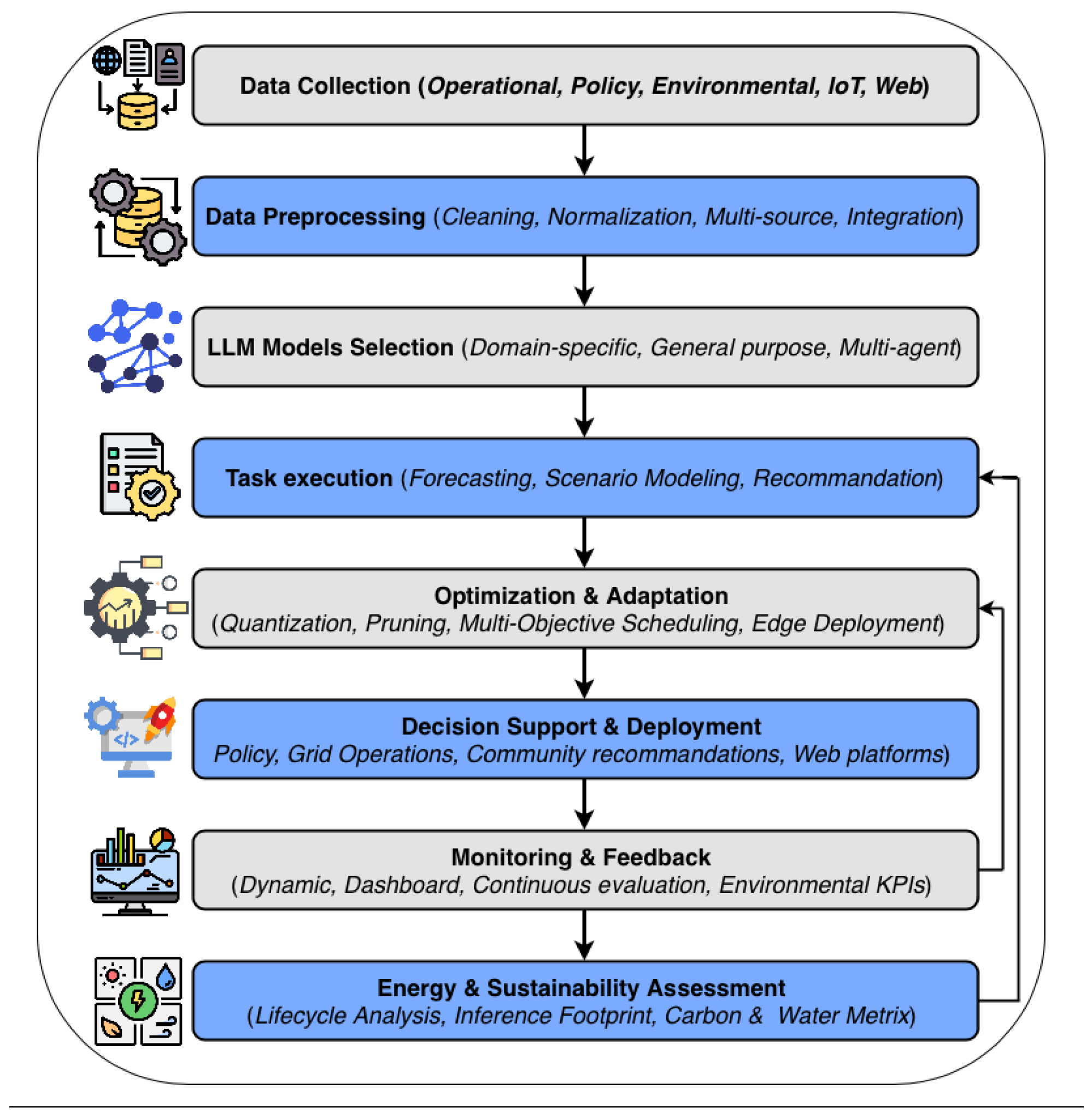
These studies collectively illustrate a rapidly maturing landscape in which LLMs are increasingly applied to renewable energy and energy systems [70]. They highlight critical opportunities in domain-specific adaptation, fairness-aware deployment, hybrid knowledge integration, and automated optimization, while simultaneously acknowledging ongoing challenges such as energy-intensive training, data scarcity, and the need for robust evaluation metrics tailored to sustainable energy contexts. Figure 6 illustrates the end-to-end pipeline from multi-source data collection, preprocessing, and domain-specific LLM modeling, to energy-aware optimization, deployment, and continuous monitoring, highlighting the integration of sustainability considerations at each stage.
A growing body of literature increasingly addresses the sustainability, economic implications, and environmental footprint of LLMs, reflecting broader concerns about the ecological and societal impacts of AI technologies [77,78,79]. Singh et al. [80] conducted one of the most comprehensive surveys in this area under the IEEE framework, systematically examining multiple dimensions of LLM sustainability, including energy consumption during training and inference, carbon emissions, overall compute cost, and lifecycle assessment of model deployment. Their study underscores that the environmental cost of modern LLMs extends beyond mere electricity use: it encompasses the embodied carbon in hardware manufacturing, the resource-intensive maintenance of data centers, and the broader supply-chain impacts of deploying high-performance AI systems.
The survey also provides a detailed discussion of strategies for greener AI deployment, ranging from hardware-level improvements such as energy-efficient GPUs and TPUs, to software-level solutions including model pruning, quantization, and knowledge distillation. Moreover, Singh et al. emphasize the potential of renewable-powered data centers, adaptive training schedules, and resource-aware algorithms as practical approaches to mitigate the environmental impact of LLMs, highlighting both near-term actionable solutions and long-term research directions for sustainable AI.
In addition to these foundational works, recent research increasingly investigates lifecycle and supply chain implications of LLM deployment. For instance, studies highlight that the cumulative carbon footprint of training a single large-scale model can be comparable to the lifetime emissions of several passenger vehicles, emphasizing the need for systemic planning and accounting in AI sustainability efforts. Researchers are also exploring energy-proportional computing paradigms, in which computational resources scale dynamically with task complexity, reducing idle energy consumption and improving overall efficiency. Furthermore, adopting green AI practices, such as reporting standardized energy and emissions metrics, encourages transparency and accountability in model development and benchmarking.
Another emerging theme concerns the intersection of LLM sustainability with domain-specific applications. Energy-focused LLM deployments, such as those used for renewable energy forecasting, grid optimization, and energy management, must consider the net environmental benefit of the AI system itself. This includes analyzing whether the predictive or optimization gains achieved by an LLM outweigh the energy costs of its training and inference, and whether alternative lightweight models could provide comparable utility at a fraction of the environmental impact. These considerations are especially salient for SMEs and community energy initiatives, where resource constraints and operational budgets are closely linked to sustainability goals.
The literature indicates that sustainability in LLMs is a multifaceted challenge encompassing hardware, software, operational practices, and broader societal implications. By integrating insights from lifecycle assessments, green AI methodologies, and domain-specific environmental impact studies, researchers are gradually building a comprehensive framework for designing, deploying, and evaluating LLMs that are both high-performing and ecologically responsible. This body of work not only provides practical guidance for reducing the environmental footprint of AI systems but also sets the stage for future innovations in energy-aware, resource-efficient, and socially equitable AI technologies.
The increasing adoption of GenAI and LLMs in energy systems has led to a rapidly growing body of literature that surveys, synthesizes, and critically evaluates their applications, capabilities, and limitations. A notable contribution in this domain is the ICUE survey conducted by Surathunmanun et al. [81], which systematically reviews the role of generative AI in energy systems using a PRISMA-based methodology. This review highlights that GenAI models excel in several key areas, including synthetic data generation for training machine learning models, short term and long-term energy forecasting, optimization of energy resources, and grid management operations.
In particular, the ability of GenAI models to generate high-fidelity synthetic datasets is emphasized as a crucial tool for addressing data scarcity in renewable energy forecasting, microgrid operation, and scenario planning. However, the authors also identify significant challenges and risks associated with these technologies, including model hallucinations, privacy and data protection concerns, and vulnerabilities to cyberattacks, which are critical considerations when deploying AI in mission-critical energy infrastructure.
Expanding on the application of LLMs in energy efficiency, Zhang and Chen [82] examined the role of these models in building energy efficiency and decarbonization efforts. Their review covers a diverse set of applications, ranging from intelligent control systems that optimize HVAC and lighting operations to automated code generation for energy management software and knowledge discovery from technical standards, research papers, and operational logs.
Zhang and Chen identify notable gaps in current research, particularly regarding the high computational cost of large models, robustness under real-world uncertainties, and integration with multimodal data streams such as IoT sensor data, satellite imagery, and weather forecasts. Their work underscores the need for hybrid modeling approaches that combine the reasoning capabilities of LLMs with physics-based and statistical models to achieve reliable, interpretable, and energy-efficient solutions.
Two additional reviews in IEEE Access further consolidate understanding of LLM applications in energy systems. Amjad et al. [83] provide a systematic overview of LLMs in electrical power systems, detailing applications in load forecasting, demand-response scheduling, renewable energy integration, fault diagnosis, and predictive maintenance. Similarly, Mirshekali et al. [84] extend the survey to cross-domain energy applications, including the integration of energy modeling with transportation, industrial processes, and smart city infrastructure. These surveys collectively emphasize the versatility of LLMs in handling large-scale, heterogeneous, and time-varying data, while also highlighting ongoing challenges in model interpretability, scalability, and environmental footprint.
Finally, Ferrag et al. [85] delivered one of the most comprehensive surveys on LLM reasoning and autonomous AI agents, providing foundational insights into multi-agent coordination, planning, and reasoning paradigms. Their work is particularly relevant for future autonomous energy systems, where multiple intelligent agents, potentially powered by LLMs, may need to coordinate actions across distributed energy resources, microgrids, and demand side management platforms.
The survey discusses architectures for agent communication, negotiation strategies, hierarchical planning, and decision making under uncertainty, emphasizing the role of LLMs in enabling high-level reasoning, scenario simulation, and policy evaluation. The review also highlights the importance of ethical and safety considerations when deploying autonomous AI agents in energy-critical contexts, including mitigating cascading failures, ensuring transparency in decision-making, and complying with regulatory standards.
These literature reviews collectively paint a comprehensive picture of the state of the art in GenAI and LLM applications for energy systems. They demonstrate not only the transformative potential of these models for forecasting, optimization, and autonomous management, but also the need to carefully consider model robustness, ethical deployment, environmental sustainability, and integration with domain-specific knowledge. By synthesizing these insights, researchers and practitioners are better positioned to design next-generation AI-driven energy systems that are efficient, resilient, and aligned with sustainability objectives.

2.2. Domain-Specific LLMs for Renewable and Hydrogen Energy

A major trend in the application of LLMs to energy systems is the development of domain-specific models finely tuned to specialized corpora, enabling sophisticated reasoning and decision support in renewable and hydrogen energy contexts. A significant advancement in this domain is RE-LLaMA, introduced by Hemied [86]. RE-LLaMA is a domain-specific LLM trained on comprehensive renewable and hydrogen energy datasets, designed to integrate seamlessly within a hybrid renewable energy and hydrogen optimization platform known as MG-OPT. By leveraging the model’s deep understanding of domain-specific terminology, technical reports, policy documents, and empirical case studies, RE-LLaMA can provide high-quality scenario analysis, predictive insights, and decision-support recommendations for the design and operation of zero-emission energy systems.
The evaluation of RE-LLaMA has been conducted using a combination of human assessment and LLM-as-judge methodologies, which collectively assess the accuracy, coherence, and relevance of model outputs. This evaluation framework demonstrates the model’s ability to reason about complex trade-offs in energy system design, including capacity planning, integration of variable renewable energy sources, hydrogen storage optimization, and cost efficiency considerations. The model’s maturity and specialization make it one of the most advanced domain-specific LLMs currently available for renewable and hydrogen energy applications.
Building on these capabilities, RE-LLM, developed by Forootani et al. [73], represents an evolution towards hybrid frameworks that combine natural language interfaces with optimization engines. This allows for interactive problem-solving while reducing computational overhead, illustrating the complementary strengths of natural language guidance and backend optimization.
Together, RE-LLaMA and RE-LLM exemplify the trade-offs between deep specialization and interactive hybrid design: RE-LLaMA excels in high-fidelity scenario reasoning, while RE-LLM prioritizes user-guided, accessible decision support.
Beyond these specific models, the broader field of domain-specific LLMs is exploring multiple directions. These include the incorporation of real-time operational data from smart grids, wind farms, and solar installations to improve model accuracy in dynamic environments; integration with probabilistic and scenario-based planning tools to quantify uncertainties in renewable generation and hydrogen production; and embedding technical constraints and regulatory compliance rules into model reasoning to ensure actionable and feasible recommendations.
By combining domain expertise with the generative and reasoning capabilities of LLMs, these systems offer significant potential to accelerate the transition to low-carbon, zero-emission energy infrastructure. Importantly, these emerging directions illustrate an evolutionary trajectory where LLMs move from static, high-fidelity reasoning models to dynamic, context-aware systems capable of integrating operational data and regulatory constraints.
Another important aspect is model interpretability and trustworthiness, particularly in high-stakes energy applications. Domain-specific LLMs such as RE-LLaMA and RE-LLM often incorporate explainability mechanisms, including stepwise reasoning traces, confidence scores, and counterfactual scenario analysis, to provide transparent, auditable recommendations. This is critical for gaining acceptance among engineers, regulators, and community stakeholders.
Domain-specific LLMs for renewable and hydrogen energy represent a pivotal advancement in the intersection of AI and sustainable energy. They not only enhance the capability to perform complex reasoning, scenario analysis, and decision support but also set a new benchmark for integrating natural-language intelligence into energy system optimization. The combination of specialized training, hybrid frameworks, and interpretability features positions these models as indispensable tools for achieving efficient, low-carbon, and resilient energy systems in the near future.
Extending beyond operational optimization, another emerging application of domain-specific LLMs is enhancing traceability and transparency in renewable energy supply chains. As energy systems transition toward decarbonization, ensuring accurate accounting of renewable energy usage across industrial processes and manufacturing chains becomes critical for both regulatory compliance and sustainability reporting. Su et al. [69] proposed a novel framework that leverages LLMs for renewable energy traceability, integrating graph-based supply chain modeling, RAG techniques, and logic programming to systematically evaluate and track renewable energy flows.
The framework operates by first representing the supply chain as a graph, where nodes correspond to suppliers, manufacturers, distributors, and end-users, and edges represent material, energy, or information flows.
Table 3 presents a comprehensive summary of the latest LLM applications in renewable and decarbonized energy systems. It highlights the approaches, key advantages, limitations, and datasets used in each study, providing a clear overview of the current state of the art in this domain.

2.3. AI-Driven Lifecycle Assessment and Energy-Aware LLM Architectures

Recent advances at the intersection of AI, sustainability science, and energy systems have intensified efforts to systematically characterize, measure, and optimize the environmental impacts of LLMs. While early discussions on AI sustainability focused primarily on the carbon footprint of model training, recent research has shifted to a more holistic perspective that accounts for the entire model lifecycle, from dataset collection and model design to large-scale deployment and end-of-life decommissioning.
Within this context, LCA frameworks have emerged as indispensable analytical tools for quantifying upstream and downstream environmental impacts, including energy consumption, greenhouse gas emissions, embodied carbon in hardware, cooling requirements, and operational efficiency. The growing body of work surveyed in this subsection illustrates a transition from high-level debates to concrete, engineering-oriented methodologies and system-level design principles. Collectively, these contributions reveal how LLMs can not only be analyzed through a sustainability lens but can also actively participate in the assessment and optimization of energy systems themselves.
Tran et al. [89] conduct one of the most comprehensive empirical studies to date on the performance–energy trade-off in LLMs. Rather than focusing solely on general-purpose NLP benchmarks, they evaluate models in domain-specific operational tasks such as root-cause analysis in communication networks, tasks that closely resemble anomaly detection, fault diagnosis, and predictive maintenance scenarios common in energy systems. The authors explore three major efficiency-enhancing techniques: quantization, pruning, and knowledge distillation.
Table 4 presents the main contributions of LLMs in lifecycle sustainability assessment, multi-agent coordination, and energy-aware architectures. This table emphasizes how LLMs are leveraged to optimize energy efficiency, reduce environmental impact, and support policy and operational decision-making.
Through systematic ablation studies, they show how different quantization schemes affect not only energy consumption but also reasoning fidelity and output stability. Their pruning strategies target both structural and activation sparsity, enabling a flexible trade-off between computational reduction and representational richness.
A key finding is that, when carefully calibrated, these techniques can significantly reduce inference energy, sometimes by more than 50%, while maintaining or even improving task-specific performance. For instance, quantization-aware training often yields compressed models that remain robust to domain-specific noise in operational datasets.
Tran et al. further provide practical guidelines for engineers: choose a compression strategy based on the temporal profile of the application load, prioritize quantization-aware methods in high-throughput environments, and adopt distillation when latency constraints dominate. These findings are highly applicable to energy-system monitoring platforms, especially those that must embed LLM reasoning within edge devices or resource-constrained local controllers.
Li et al. [63] introduce SustainLLM, a comprehensive framework that seeks to operationalize sustainability assessment workflows using the reasoning, extraction, and generalization capabilities of LLMs. At its core, SustainLLM connects LLMs to multi-stage LCA pipelines, enabling automated ingestion and interpretation of heterogeneous data sources, including regulatory documents, peer-reviewed literature, operational sensor logs, and techno-economic datasets. The authors propose three core innovations.
First, they develop advanced automated extraction routines in which LLMs identify, classify, and normalize sustainability-relevant indicators across unstructured and semi-structured sources. These include emissions factors, time series of grid carbon intensity, land-use profiles, energy conversion efficiencies, and techno-economic constraints. Such automatic extraction significantly reduces the manual labor typically required in LCA studies and improves reproducibility.
Second, SustainLLM utilizes LLMs to complete, validate, and explain LCA inventories, addressing missing data, inconsistent definitions, and ambiguous system boundaries. The LLM is prompted to reason about causal dependencies and domain constraints, thereby improving both the completeness and the interpretability of the LCA results.
Third, SustainLLM integrates multi-objective optimization tools that jointly reason over environmental, financial, and technical indicators. These optimization routines highlight trade-offs between different energy-transition pathways—for example, how variations in wind–solar–hydrogen deployment ratios affect overall lifecycle impacts, system reliability, and cost. The authors demonstrate the approach using real-world datasets of electrical loads and renewable generation outputs, showing significant improvements in predictive robustness and decision-support quality relative to traditional LCA methods.
For energy-system research and planning, SustainLLM illustrates a paradigm in which LLMs act as intelligent intermediaries bridging expert knowledge, operational measurements, and optimization algorithms. The system not only automates data harmonization but also provides interpretable rationales for policymakers, enabling them to evaluate long-term deployment strategies with transparent lifecycle justification. Husom et al. [92] deliver a highly influential and hardware-grounded study on sustainable LLM inference in edge environments.
Their analysis departs from typical datacenter-focused sustainability research by evaluating 28 quantized LLMs deployed on a Raspberry Pi 4, one of the most widely used low-cost edge computing platforms. By pairing high-resolution hardware-based energy profiling with a broad set of benchmarking tasks, the study provides unprecedented insight into how quantization strategies influence real-world energy efficiency.
The authors evaluate multiple PTQ techniques from the Ollama library, including integer quantization, mixed-bit quantization, weight-only compression, and hybrid precision schemes. They compare these quantized models across five standardized benchmark datasets (CommonsenseQA, BIG-Bench Hard, TruthfulQA, GSM8K, and HumanEval) that cover reasoning, commonsense, arithmetic, factual consistency, and code synthesis.
Crucially, Husom et al. integrate direct hardware-level power measurements, allowing them to distinguish between theoretical efficiency (measured in FLOPs or model size) and realized efficiency under real thermal, voltage, and CPU/GPU oscillation conditions. This distinction is essential for edge AI deployments, where thermal throttling and memory bandwidth limitations significantly affect the actual energy draw. Their results identify clear trade-offs between accuracy degradation, inference speed, and energy consumption. Some quantization schemes offer substantial reductions in latency and power consumption but introduce unacceptable reasoning errors in tasks that require multi-step logic. Other schemes strike a balance, enabling sustainable deployment without significantly compromising task quality.
The authors further provide deployment recommendations, including choosing 4-bit quantization for cost-sensitive IoT controllers, employing hybrid precision for latency-critical industrial edge nodes, and avoiding aggressive quantization for arithmetic-intensive tasks unless supported by quantization-aware fine-tuning. By combining hardware instrumentation with LLM benchmarking, this work fills a crucial methodological gap in sustainable LLM deployment for edge AI, a domain where energy constraints are acute and operational reliability is non-negotiable.

2.4. Sustainability in Multi-Agent LLM Systems

In their influential study, Goel et al. [71] depart from the conventional single-model paradigm and propose a coordinated ecosystem of multiple LLM agents that interact according to energy-aware policies. Their central insight is that, in many real-world deployments, particularly those in smart energy systems, requests vary in urgency, complexity, and required accuracy. Consequently, an optimal system need not always invoke the largest or most energy-intensive model.
Goel et al. design a multi-agent collaboration framework in which agents dynamically allocate tasks based on real-time energy availability, including fluctuations in renewable energy supply and load constraints. For example, during periods of abundant solar generation or low user load, more computationally demanding LLMs may be activated to perform detailed reasoning or generate high-fidelity predictions. Conversely, during peak-demand or low-renewable conditions, lightweight models or distilled variants may handle lower-priority requests.
Their simulations demonstrate 30–40% reductions in overall energy consumption while maintaining competitive decision quality. This is achieved through adaptive scheduling strategies that account for task criticality, predicted utility, computational requirements, and the instantaneous carbon intensity of the available energy. Importantly, the framework includes negotiation mechanisms among agents to avoid redundant work and ensure consistent outputs across distributed nodes.
For distributed energy management architectures, such as microgrids, energy communities, virtual power plants, and transactive energy systems, this work is particularly relevant. It suggests that future control and optimization infrastructures can incorporate LLM-based agents that internally reason about energy availability, reliability constraints, and environmental objectives. Multi-agent LLM ecosystems thus represent a natural extension of decentralized control paradigms, enabling more sustainable and adaptive AI-driven decision support.
Ding and Shi [93] emphasize a major yet often overlooked challenge: in many industrial contexts, the environmental cost of inference (the serving phase) surpasses that of training. This shift is driven by 24/7 production workloads, high request volumes, replication across data centers, and latency requirements that limit the extent of model compression or batching. Their invited article highlights four categories of sustainability challenges.
First, they analyze persistent inference workloads, showing how constant request streams, from user queries, monitoring pipelines, and automated agents, lead to substantial energy draw even when individual requests seem lightweight.
Second, Ding and Shi detail the challenges of latency, replication, and redundancy. Modern LLM deployments often require geographically distributed replicas to ensure low response times, which multiplies the hardware footprint and associated carbon emissions.
Third, the authors advocate for standardized metrics for inference energy consumption, including joules per token, carbon per 1k completions, and real-time power draw monitoring. The lack of consistent benchmarks currently makes it difficult to compare “green” techniques across providers or hardware architectures. Fourth, they propose several mitigation strategies: dynamic model compression (applied at inference time), renewable-powered opportunistic serving, energy-aware load balancing, and adaptive scheduling based on carbon intensity forecasts. These insights are critical for energy-system practitioners who depend on LLMs for real-time decision support and must quantify the service’s carbon cost.
The authors therefore call for stronger cross-disciplinary collaboration to develop inference-energy benchmarks and monitoring tools that align with sustainability commitments.
Wu et al. [65] articulate the Sustainable AI Trilemma, a conceptual framework that formalizes the inherent tension between three fundamental objectives: (i) maximizing AI capability, (ii) ensuring digital equity and accessibility, and (iii) minimizing environmental impact. While previous discussions on AI sustainability often focused on training energy or hardware supply chains, Wu et al. shift the lens to LLM agents and RAG systems, two paradigms that increasingly dominate production-level AI.
Their study examines the energy implications embedded in the architecture of memory-augmented LLM systems. These architectures typically rely on large-scale vector databases, multi-step retrieval pipelines, memory controllers, query expansion modules, and cross-encoder re-ranking layers. Each of these components introduces non-trivial computational overhead. Through an extensive case study combining synthetic-agent workflows and real-world RAG deployments, the authors quantify how memory-module complexity influences latency, energy consumption per query, and cumulative carbon emissions over time.
The core insight is that, though powerful, memory-augmented LLM agents exhibit significant inefficiencies when deployed at scale. For resource-limited users (e.g., in regions with constrained access to high-performance cloud resources), these inefficiencies translate into disproportionately high energy–latency penalties. In other words, the benefits of advanced agentic AI are unevenly distributed: users with low-cost access to efficient cloud infrastructure incur minor environmental costs, whereas users relying on older or on-device hardware face up to an order of magnitude greater energy requirements for equivalent tasks [94].
To address these inequities, Wu et al. [65] introduce new sustainability-aware metrics, including memory-energy elasticity, retrieval overhead per token, and carbon-normalized task quality. Their empirical findings show that improving LLM agent capabilities via memory expansion often scales environmental cost superlinearly, challenging the current trend of aggressively memory-heavy agent architectures. This study, therefore, motivates a rethink of agent design, incorporating sustainable retrieval strategies, adaptive memory pruning, context-window minimization, and more efficient indexing mechanisms. It also highlights the importance of policy interventions and accessibility programs to ensure that AI-driven systems do not exacerbate global digital inequalities.

2.5. Benchmarking Environmental Footprints of LLM Inference

Jegham et al. [64] present one of the most comprehensive empirical benchmarking frameworks to date for quantifying the environmental footprint of LLM inference across heterogeneous commercial datacenters. Unlike earlier studies that focused primarily on single-model case analyses or proprietary carbon-accounting disclosures, their work systematically evaluates 30 state-of-the-art LLMs across open-source and API-accessible commercial systems. Their methodology integrates three analytical layers, performance logging, infrastructure-aware footprint estimation, and multi-criteria efficiency evaluation, producing a benchmark that is both technically rigorous and operationally relevant.
First, the authors collect extensive performance traces from public API endpoints, including latency, throughput, request density, token generation rate, hallucination frequency, and model-specific context-window behaviors. These logs serve as the backbone for reconstructing realistic inference workloads observed under varied traffic patterns. To approximate the environmental footprint of these workloads, they introduce a detailed infrastructure-specific multiplier model incorporating PUE, water usage effectiveness WUE, carbon intensity of local energy grids, cooling efficiency, and embodied energy of the supporting GPU hardware.
Second, Jegham et al. propose a cross-infrastructure reconciliation layer that maps provider-level performance logs to normalized footprint metrics. This allows the benchmark to distinguish between inherently efficient models and those whose apparent efficiency is merely an artifact of high-quality datacenter infrastructure or favorable energy mixes (e.g., high renewable penetration, efficient cooling systems). This distinction is critical for policymakers, researchers, and enterprises seeking transparent sustainability reporting independent of hosting providers.
Third, the authors employ cross-efficiency DEA to rank LLMs based on their contribution (task performance) to environmental costs (energy, water, carbon). DEA is a method well-suited to multi-output/multi-input optimization scenarios, making it ideal for comparing LLMs that differ widely in architecture, size, training corpora, serving hardware, and developer optimization practices. Their analysis reveals extreme disparities in environmental efficiency (up to 65× between the best- and worst-performing models), demonstrating that raw model capability alone is a poor predictor of sustainability.
Moreover, the framework includes a dynamic monitoring dashboard that enables real-time footprint estimation as model performance or datacenter energy conditions change. This is particularly relevant for organizations deploying LLM-driven decision systems in energy-critical infrastructures (e.g., utilities, smart grids, demand-response systems), where sustainability constraints must be continuously evaluated.
Overall, this work provides a foundational and infrastructure-aware methodology for sustainability benchmarking and accountability in LLM deployment. It illustrates a crucial paradox: even as individual LLM inferences become cheaper and faster due to advances in hardware and software, global demand growth amplifies total energy and water consumption, underscoring the need for systemic monitoring and policy-aligned regulation.
Zhu [66] proposes the New Website Carbon Evaluation (NWCE) model, a next-generation framework for estimating and reducing the carbon footprint of modern web platforms. Traditional carbon calculation models primarily rely on data-volume metrics (e.g., total transferred bytes, resource size, caching efficiency). However, these approaches fail to capture two critical factors: the duration of user interaction on the website and the device-specific power consumption during browsing. The NWCE model introduces interaction-duration-aware energy estimation, linking user dwell time with end-user device power usage (CPU cycles, screen brightness, network polling, background JavaScript execution). This results in significantly more accurate carbon estimates, especially for interactive or script-heavy websites.
In addition to measurement improvements, Zhu investigates AI-driven optimization workflows that leverage LLMs and machine learning to reduce digital carbon footprints. These include CompressAI neural image compression for reducing media weight, lightweight LLMs for automated sustainability recommendations (e.g., CSS/JS minimization, layout simplification, resource prioritization), and the DeepSeek-Coder system for detecting and removing redundant or unused code segments across web repositories.
Experiments conducted on 30 static websites demonstrate substantial reductions in carbon emissions, up to 51.48% in some cases, alongside improved webpage performance scores (e.g., faster rendering, smoother interactivity). These results highlight the potential of LLM-assisted auditing and optimization for scalable digital sustainability. Zhu’s findings underscore a broader implication: sustainability interventions in digital systems need not be limited to datacenter or cloud infrastructure; front-end architectures, interaction patterns, and content-delivery workflows offer equally impactful opportunities for carbon reduction. This perspective significantly broadens the scope of sustainable AI research.
Table 5 presents LLM-based solutions for web carbon reduction, community energy engagement, and social inclusion. The table details approaches, benefits, limitations, and datasets, illustrating how LLMs can support sustainability and carbon reduction in digital and social energy platforms.

3. Quantitative Perspectives

Although this work is a survey rather than an experimental contribution, recent literature allows the extraction of approximate quantitative insights that are essential for assessing the feasibility, sustainability, and maturity of LLM-based solutions in energy systems. This subsection consolidates reported evidence on (i) energy consumption of typical LLM tasks, (ii) benchmark-level comparisons across models, and (iii) observable development trends of domain-specific LLMs for energy and sustainability.

3.1. Approximate Energy Consumption of LLM Tasks in Energy Applications

Recent benchmarking and sustainability-focused studies consistently report that inference—rather than training—is the dominant operational cost in deployed energy applications such as forecasting assistance, optimization guidance, policy interpretation, and scenario summarization. According to large-scale inference footprint analyses and Green AI surveys, a single inference request for a medium-sized LLM (7–13B parameters) typically consumes between 10 3 and 10 2 kWh, while complex multi-step reasoning or RAG-based pipelines using larger models may reach 10 2 to 10 1 kWh per interaction [64,65,92].
In practical energy-system deployments, such as hourly grid operation support, daily energy planning, or community-level advisory systems, these costs accumulate over time. While such values remain small compared to physical energy flows, they become relevant when LLMs are integrated into continuous decision-support loops. This observation has motivated increasing interest in selective invocation strategies, caching, and hybrid architectures that combine LLM reasoning with lightweight optimization or rule-based modules [81,83].

3.2. Benchmark-Level Comparisons: Model Size, Token Cost, and Inference Footprint

A recurring limitation identified across recent surveys is the absence of standardized benchmarks tailored to energy-domain tasks. Nevertheless, cross-study comparisons reveal consistent trends in computational efficiency. General-purpose LLMs exceeding 30B parameters exhibit significantly higher inference energy and latency compared to compact or domain-adapted models, despite often achieving similar task-level performance in energy-related reasoning [65,92].
Table 6 summarizes approximate ranges reported in recent benchmarking and review studies. These values should be interpreted as indicative rather than absolute, as they depend on hardware, deployment context, and prompt complexity.
These findings reinforce the argument that domain specialization and model compression are not only performance-driven choices but also sustainability-enabling strategies for energy systems.

3.3. Trends in Domain-Specific LLM Development for Energy and Sustainability

A significant trend emerging from 2024–2025 literature is the rapid growth of domain-specific LLMs focused on energy, sustainability, and climate applications. Surveys indicate a clear temporal shift from generic LLM adoption toward specialized models trained or fine-tuned on curated energy corpora [81,83,84].
Early energy-focused language models relied on relatively small datasets (often below 1 million tokens), primarily composed of scientific abstracts and technical reports. In contrast, more recent efforts integrate multi-million to billion-token corpora combining grid operation manuals, lifecycle assessment databases, policy documents, and industrial standards. This expansion has accelerated markedly since 2023, reflecting growing concerns over reliability, hallucination mitigation, and sustainability-aware reasoning.

Implications for Sustainable and Trustworthy Deployment

Taken together, these quantitative perspectives highlight a structural transition in LLM-based energy research: from scale-centric experimentation toward efficiency-, reliability-, and sustainability-aware design. The literature increasingly converges on the view that domain-specific LLMs, combined with benchmarking frameworks that jointly evaluate accuracy, inference energy, latency, and environmental impact, represent the most viable pathway for real-world deployment.
Future surveys and experimental studies would benefit from systematically reporting token usage, inference energy ranges, and deployment constraints, thereby enabling reproducible and policy-relevant comparisons. Such practices are essential to ensure that LLMs contribute meaningfully to the sustainability goals they are intended to support.

3.4. Comparison Between LLM-Based and Non-LLM AI Systems

LLMs, such as transformer-based architectures developed by organizations like OpenAI [101,102], have demonstrated strong generalization and contextual reasoning abilities [103]. However, their design philosophy differs significantly from conventional task-specific AI systems. Table 7 summarizes the main differences across key operational dimensions.
While LLMs provide flexibility and cross-domain adaptability, they require substantial computational resources and offer limited interpretability [104]. In contrast, non-LLM AI systems are typically optimized for well-defined objectives, computational efficiency, and practical deployment constraints [105].

3.5. Risk Mitigation Mapping for Safety-Critical Energy Applications

In safety-critical energy systems such as grid operation and hydrogen storage [106,107,108], it is essential to systematically map identified risks to mitigation strategies and evaluate their maturity levels. Table 8 summarizes key risks associated with the deployment of LLMs in renewable and sustainable energy systems, proposed mitigation strategies, and their current technological maturity.
This systematic mapping provides a structured perspective for researchers and practitioners to anticipate potential risks, implement mitigation measures, and assess the maturity of LLM-enabled solutions in operational energy contexts. It highlights areas where further research is required, particularly in explainability, real-time deployment, and domain adaptation.

3.6. Recommended Evaluation Key Performance Indicators (KPIs)

To systematically assess the performance and practical relevance of LLM-based solutions in energy systems, we define a small set of recommended evaluation KPIs [109,110]. These indicators capture environmental, operational, and computational efficiency aspects:
  • Carbon Cost per Decision: Estimates the CO2 emissions associated with each model-driven decision, considering energy consumption of inference and supporting infrastructure.
  • Decision Latency vs Operational Impact: Measures the time taken to generate actionable recommendations relative to the consequences of delayed or suboptimal decisions on system reliability and safety.
  • Accuracy–Energy Pareto Efficiency: Quantifies the trade-off between decision accuracy and energy expenditure, identifying configurations that optimize both performance and sustainability.
These KPIs provide a concise, actionable framework for benchmarking LLM-based decision-support systems in renewable energy, hydrogen storage, and smart grid applications, and ensure alignment with sustainability and operational objectives.

4. Research Roadmap

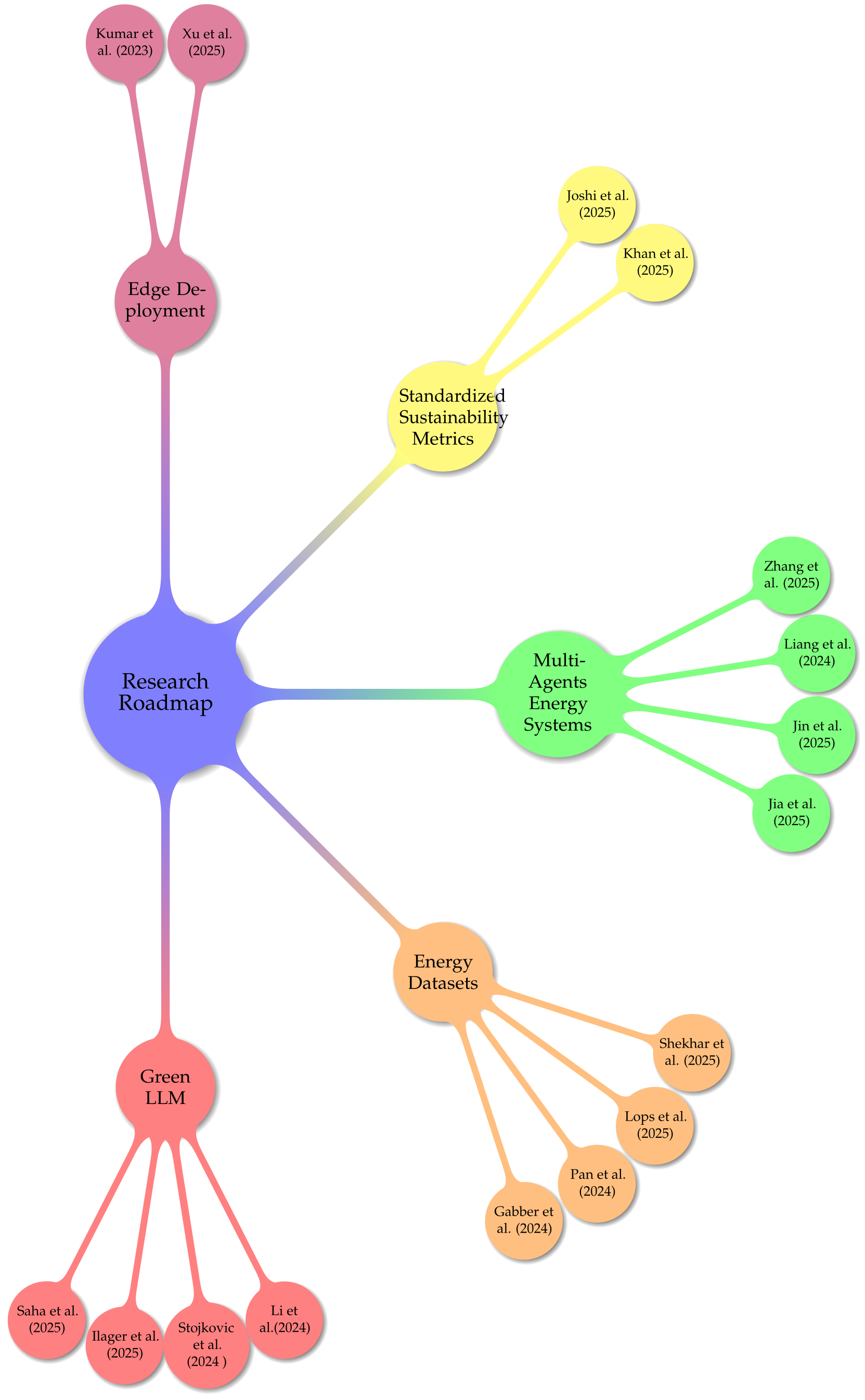
Beyond current applications, the long-term impact of LLMs in energy systems depends on coordinated advances in model design, data infrastructure, evaluation protocols, and deployment strategies. To strengthen the forward-looking contribution of this work, this section proposes a structured research roadmap highlighting key technological and methodological directions for sustainable, energy-aware LLMs. Figure 7 presents a classification of research roadmap key directions for sustainable and energy-aware LLMs in energy systems.

4.1. Green LLM Architectures

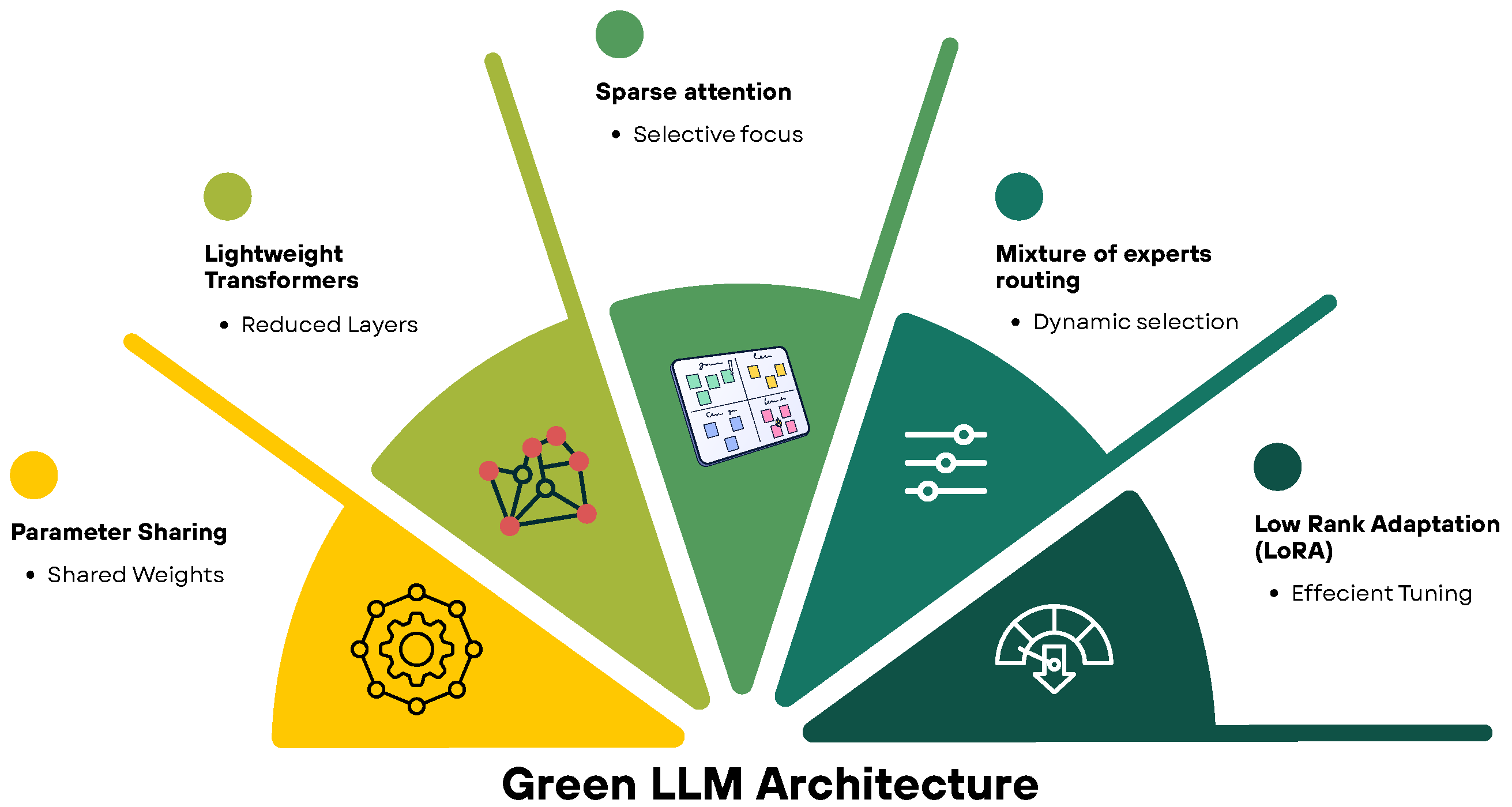
Future research must prioritize green-by-design LLM architectures that explicitly optimize the trade-off between performance and environmental cost. As illustrated in Figure 8, this paradigm centers on a Green LLM Core, augmented by a set of sustainability-oriented architectural mechanisms to improve efficiency. These include lightweight transformer variants with reduced depth, sparse attention mechanisms that enable selective computation, and parameter sharing across layers to minimize redundancy. In addition, mixture-of-experts (MoE) routing allows conditional activation of specialized sub-networks, while low-rank adaptation (LoRA) supports parameter-efficient fine-tuning. Such architectures are particularly relevant for energy systems, where inference efficiency and carbon footprint are as critical as predictive accuracy.
The intrinsic trade-off between model performance and sustainability in LLMs. As model accuracy increases, energy consumption [111,112], and carbon footprint tend to grow, making naive scaling strategies environmentally inefficient.
In 2025, Saha et al. introduced CCWise, a carbon cost-aware regional orchestration framework for LLM inference [113]. This work proposes a joint optimization strategy that simultaneously minimizes carbon emissions, energy consumption, and monetary cost by dynamically routing LLM inference requests across geographically distributed regions with heterogeneous electricity grids. The authors further introduce sustainability-oriented metrics, namely the CCTI and the GCE, to quantify environmental impact. While CCWise demonstrates strong potential for sustainable LLM deployment, it relies heavily on accurate regional carbon-intensity data and does not fully address real-time adaptability to fluctuating renewable energy availability and dynamic workloads.
Figure 7. Classification of Research Roadmap Key Directions for Sustainable and Energy-Aware LLMs in Energy Systems [113,114,115,116,117,118,119,120,121,122,123,124,125,126,127,128].
Information 17 00271 g007
Also in 2025, Ilager et al. [114] proposed GREEN-CODE, an energy-aware LLM-based code-generation framework that dynamically leverages reinforcement learning to trigger early exits during inference. By selectively reducing computational depth without degrading output quality, GREEN-CODE achieves significant energy savings while preserving accuracy. The approach is evaluated on programming-oriented datasets such as JavaCorpus and PY150 using medium-scale models, including LLaMA 3.2 (3B) and OPT (2.7B). However, its applicability remains limited to code generation tasks, and extending the framework to general-purpose LLM workloads and carbon-aware inference scenarios remains an open research challenge.
In 2024, Stojković et al. [115] investigated energy-efficient LLM inference under performance SLOs. Their study focuses on system-level optimizations within data centers, analyzing trade-offs between latency, throughput, and energy consumption under realistic production workloads. The work provides valuable insights for large-scale deployment but primarily addresses infrastructure-level tuning. Explicit modeling of carbon intensity signals and geographically distributed inference scheduling are not considered, limiting its alignment with broader sustainability goals.
Similarly, Li et al. introduced Sprout in 2024, a carbon-efficient generative inference framework for LLMs that integrates generation directives with grid-aware optimization strategies [116]. Sprout demonstrates up to a 40% reduction in carbon footprint during LLaMA inference by aligning generation behavior with electricity grid characteristics. Despite its effectiveness, the optimization is performed offline, limiting its responsiveness to real-time grid fluctuations. Future work is needed to enable runtime adaptive carbon-aware generation and to incorporate user-level sustainability preferences into the inference process.
Figure 8. Green LLM Architecture Optimized for Energy-Efficient Inference.
Information 17 00271 g008

4.2. Domain-Specific Energy Datasets

The effectiveness of LLMs in energy applications is strongly conditioned on the availability of high-quality, domain-specific datasets. There is a clear need for curated, open, and standardized corpora covering renewable generation, grid operations, hydrogen systems, energy markets, lifecycle assessments, and policy documents. Future datasets should emphasize temporal consistency, explainability annotations, and sustainability indicators, enabling LLMs to reason beyond generic language patterns and toward physically grounded energy knowledge.
In 2024, Gabbar et al. proposed a domain-specific LLM, RE-LLaMA, tailored for renewable and hydrogen energy applications [117]. The model is trained on curated energy-domain corpora to support decision-making for renewable deployment strategies and hydrogen system planning. While RE-LLaMA demonstrates improved contextual understanding compared to generic LLMs, the study remains model-specific. It offers limited comparative evaluation against large-scale general-purpose LLMs or system-level integration scenarios.
Also in 2024, Pan et al. introduced SECOND, a semi-automatic ontology development framework designed to address the growing heterogeneity of energy datasets [118]. The framework integrates LLMs into the ontology engineering pipeline by combining domain-specific language models, such as EnergyBERT, with ontology-oriented LLM tools, including NeOnGPT and OntoChat. Through a case study in the building energy domain, SECOND demonstrates that LLM-assisted ontology creation can significantly reduce manual effort while improving alignment quality. However, its scalability to large, multi-domain energy knowledge graphs and real-time data ingestion remains an open challenge.
In 2025, Lops and Sassi presented LUMEN, a structured methodology for constructing dynamic ontologies in the wind energy domain using LLMs and semantic embeddings [119]. LUMEN employs a three-stage pipeline comprising domain-specific corpus construction, semantic label extraction via LLM analysis, and hierarchical concept organization via embedding-based similarity measures. Experimental results show that the approach effectively captures fine-grained semantic structures within wind energy terminology. Nevertheless, the authors report occasional misclassification issues and highlight the need for systematic benchmarking against established ontology engineering tools and multilingual extensions.
More recently, Shekhar and McCafferty proposed an LLM-based semantic middleware for EAaaS in 2025 [120]. Their approach integrates a RAG pipeline with LLM-driven semantic reasoning to automatically generate digital twins of heterogeneous energy assets. By leveraging standards such as IEEE 2030.5 and the WoT, the proposed middleware enables interoperable asset discovery and management across brownfield and greenfield environments. While the framework significantly reduces manual configuration effort, further validation at scale and long-term operational robustness remain to be investigated.

4.3. Multi Agent Autonomous Energy Systems

An emerging direction is the integration of LLMs into multi-agent systems capable of autonomous coordination across complex energy infrastructures. In this paradigm, multiple LLM-driven agents can collaboratively manage forecasting, optimization, demand response, and fault detection while respecting physical and regulatory constraints. Research challenges include safe coordination, robustness under uncertainty, conflict resolution, and the prevention of cascading failures in safety critical energy environments.
In 2025, Jia et al. proposed a feedback-driven multi-agent framework to enhance the use of LLMs for power system simulations [121]. The framework combines an enhanced retrieval augmented generation module, an improved reasoning component, and a dynamic environmental acting mechanism with error feedback. Validated on 69 simulation tasks using Daline and MATPOWER, the approach achieves success rates exceeding 93 percent and significantly outperforms general-purpose LLM baselines. This work demonstrates the feasibility of LLM-driven agents as reliable assistants for power system simulation, although its focus remains on simulation environments rather than closed-loop operational control.
Also in 2025, Jin et al. introduced GridMind, a multi-agent LLM-powered system designed for power system analysis and grid operations [122]. GridMind integrates conversational LLM agents with deterministic engineering solvers to support tasks such as AC optimal power flow and contingency analysis while preserving numerical rigor through function calls. Evaluations on IEEE benchmark systems show that smaller language models can achieve comparable analytical accuracy with reduced latency. While GridMind improves accessibility and workflow integration, extending the framework to real-time autonomous grid control and safety assurance remains an open challenge.
In 2024, Liang proposed SimuCopilot, a multi-agent framework that leverages LLMs to assist power system modeling and control within Simulink environments [123]. The system follows a plan and executes architecture where a planning agent generates modeling strategies and execution agents implement them using specialized tools for power flow analysis, parameter tuning, and diagnostics. The framework also integrates optimal power flow-based automatic tuning and reinforcement learning based adaptive controller optimization. Although SimuCopilot significantly reduces modeling effort and improves efficiency, its validation is primarily academic, and further studies are needed to assess scalability and industrial deployment readiness.
More recently, in 2025, Zhang et al. proposed a structured agent schema and open source library to standardize the development of LLM-based agents for building energy analysis and modeling [124]. The work introduces a JSON-based schema that enables reproducible, shareable agent descriptions and provides a public repository of building energy agents that conform to this schema. Case studies demonstrate that heterogeneous agent implementations can be consistently described and executed across platforms. While the proposed schema improves accessibility and reuse, long-term governance validation and integration with large-scale building management systems remain open research directions.

4.4. Standardized Sustainability Metrics

Despite growing interest in Green AI, the literature lacks standardized metrics for evaluating the sustainability of LLMs in energy contexts. Future work should establish standard benchmarks that jointly assess task performance, inference energy consumption, carbon emissions, water usage, and hardware efficiency. Such metrics are essential for fair comparisons across models and for guiding policymakers and practitioners toward environmentally responsible AI deployments.
In 2025, Khan et al. investigated sustainability-oriented evaluation strategies for LLMs by jointly analyzing performance metrics, energy efficiency, and environmental impact [125]. The study proposes a practical framework supported by a detailed case study showing how quantization and local inference techniques can significantly reduce energy consumption and carbon emissions without degrading model accuracy. Experimental results demonstrate reductions of up to 45 percent in energy usage after quantization, highlighting the importance of energy-aware evaluation metrics beyond conventional accuracy-based benchmarks. While the work provides actionable insights for sustainable deployment, it does not yet establish a unified metric framework tailored to domain-specific energy system applications.
Also in 2025, Joshi presented a comprehensive survey of evaluation metrics, methodologies, and benchmarks for LLMs across multiple application domains [126]. The study reviews quantitative and qualitative evaluation approaches, including measures of accuracy, coherence, relevance, safety, and stability, and addresses persistent challenges such as hallucination frequency, output inconsistency, and geographic bias. Based on an analysis of more than 70 recent studies, the work advocates for standardized benchmarks and hybrid human AI evaluation pipelines. Although the survey provides a broad methodological foundation for LLM evaluation, sustainability-specific indicators such as carbon emissions, water consumption, and hardware efficiency remain insufficiently integrated into existing evaluation protocols, particularly for high-impact energy-sector applications.

4.5. Edge Deployment of Energy Aware LLMs

Finally, deploying LLMs at the edge close to sensors, smart meters, and control devices offers significant opportunities to reduce latency, bandwidth usage, and centralized computation costs. Energy-aware edge LLMs must balance model compression, on-device learning, privacy preservation, and resilience to intermittent connectivity. This direction is particularly relevant for smart grids, microgrids, and community energy systems operating under constrained computational and energy budgets.
In 2025, Xu et al. introduced Camel, an energy-aware inference framework for deploying LLMs on resource-constrained edge devices [127]. The proposed system dynamically optimizes GPU frequency and batch size to jointly balance inference latency and energy consumption while managing the exploration-exploitation trade-off during configuration search. On the NVIDIA Jetson AGX Orin platform, Camel achieves energy-delay product reductions of 12.4–29.9% compared to default inference configurations. This work highlights the importance of system-level energy management for edge-deployed LLMs, though it primarily focuses on inference optimization rather than continual learning or grid-integrated deployment.
Earlier in 2023, a comprehensive study investigated energy-efficient optimization strategies for deploying LLMs in low-power edge environments [128]. The work analyzes key constraints, including memory limitations, thermal budgets, battery capacity, and strict latency requirements.
To address these challenges, the authors propose a unified optimization framework combining model compression, lightweight architectural redesign, energy-aware scheduling, and hardware-software co-optimization. Techniques such as structured pruning, quantization, and knowledge distillation are shown to significantly reduce power consumption while preserving linguistic performance. While the framework provides a broad methodological foundation for edge deployment, its evaluation remains generic and does not explicitly address domain-specific energy system workloads such as smart grids or microgrids.
To provide clearer guidance for future research, the key directions in this roadmap are prioritized based on their expected impact on sustainable, energy-aware LLM deployment and their feasibility in practical energy systems (Table 9). High-priority directions should be addressed first to accelerate immediate benefits, whereas medium- and low-priority directions represent complementary or exploratory avenues for longer-term investigation.

5. Discussion

The preceding review sections have highlighted the rapidly expanding role of LLMs and GenAI in sustainable energy systems. This discussion synthesizes these findings by clearly distinguishing between (i) current capabilities, (ii) fundamental limitations, and (iii) future research opportunities. In doing so, we provide a critical assessment of the maturity of LLM-based approaches for energy systems, with particular emphasis on benchmarking, real-world deployment, reliability in safety-critical contexts, and sustainability performance trade-offs.

5.1. Current Capabilities of LLMs in Energy Systems

LLMs have demonstrated notable capabilities in renewable energy modeling, forecasting, decision support, and system-level reasoning across solar, wind, hybrid, and emerging hydrogen-based infrastructures. Their ability to process heterogeneous data sources, including operational logs, sensor data, regulatory documents, and technical reports, enables advanced contextual understanding that surpasses traditional data-driven models. The reviewed studies show that LLMs can support energy management tasks such as demand forecasting, scenario analysis, policy interpretation, and optimization guidance, particularly when combined with RAG or hybrid AI pipelines.
Moreover, LLMs improve interpretability and human–AI interaction by generating natural-language explanations that facilitate communication between technical systems and human operators. This capability is especially valuable in complex environments such as smart grids and microgrids, where decision-making involves both technical constraints and regulatory considerations. Domain-specific LLMs further enhance these strengths by embedding energy-specific knowledge, resulting in more consistent, context-aware outputs.

5.2. Human–AI Interaction Considerations

While the technical capabilities of LLMs in energy systems are substantial, human factors remain underexplored. Effective deployment requires understanding how operators interact with LLM-generated recommendations, including trust calibration, cognitive load, and decision-making behavior. Operators must accurately gauge the reliability of LLM outputs, avoiding both overreliance, which can lead to complacency, and underutilization, which may negate potential benefits. Confidence scoring, uncertainty quantification, and explainable reasoning traces can support calibrated trust. Simultaneously, LLMs should aim to reduce cognitive burden by summarizing complex textual and numerical information, highlighting critical constraints, and providing actionable recommendations without overwhelming operators. Interactive feedback loops that incorporate human input in real time can further refine model outputs, align recommendations with operational context, and foster accountability in decision-making. Structured training programs and simulation-based exercises can also enhance operator competence in leveraging LLM tools effectively, particularly in high-stakes or safety-critical scenarios. Integrating these human-centered design considerations is crucial to realize the full potential of LLM-based decision support in energy systems, ensuring that they not only optimize technical performance but also enhance operator situational awareness, confidence, and overall operational safety. Future research should systematically evaluate human–AI collaboration, measuring trust, interpretability, response latency, and decision quality under realistic operational conditions.

5.3. Key Limitations and Open Challenges

Despite these promising capabilities, the literature reveals several critical limitations that currently hinder large-scale and reliable adoption of LLMs in energy systems.

5.3.1. Lack of Energy-Specific Benchmarks

A major gap identified across studies is the absence of standardized benchmarks tailored to energy-domain tasks. Most evaluations rely on generic NLP benchmarks or small, ad hoc datasets, which fail to capture the complexity, temporal dynamics, and physical constraints inherent to energy systems. Without domain-specific benchmarks for tasks such as grid operation support, energy forecasting under uncertainty, or sustainability-aware decision-making, it’s hard to compare models or assess progress objectively and reproducibly.

5.3.2. Limited Evidence from Real-World Deployments

Another significant limitation is the scarcity of real-world deployment studies. The majority of existing works remain confined to simulations, retrospective analyses, or controlled laboratory environments. While these studies demonstrate feasibility, they provide limited insight into how LLMs behave under operational constraints such as latency requirements, data noise, system failures, and regulatory compliance. This lack of field validation raises questions about scalability, robustness, and long-term reliability in practical energy infrastructures.

5.3.3. Hallucination Risks in Safety-Critical Infrastructure

Hallucination, the generation of plausible but incorrect information, poses a particularly serious concern in safety-critical energy applications. In contexts such as grid control, energy dispatch, or emergency response, erroneous recommendations may lead to operational instability or financial and safety risks. The literature indicates that current mitigation strategies, including prompt engineering and RAG, reduce but do not eliminate hallucinations. Robust verification mechanisms and fail-safe designs remain largely unexplored in energy-specific LLM deployments.

5.3.4. Sustainability–Performance Trade-Offs

A fundamental tension emerges between the performance gains offered by large-scale LLMs and their environmental footprint. Training and inference of state-of-the-art models are energy-intensive, potentially offsetting the sustainability benefits they aim to support. While recent work explores quantization, pruning, and edge deployment, these optimizations often come at the cost of reduced accuracy or reasoning capability. The lack of systematic frameworks to evaluate sustainability–performance trade-offs in energy-domain applications remains a critical shortcoming.

5.4. Sustainability and Green AI Considerations

From a sustainability perspective, current research only partially addresses the environmental impact of LLMs in energy systems. Most studies focus on isolated metrics such as inference energy or carbon emissions, without considering full lifecycle assessments or context-aware trade-offs. Additionally, standardized sustainability metrics tailored to energy applications are largely absent, which complicates cross-study comparisons and policy alignment. This highlights the need for holistic Green AI frameworks that integrate environmental impact directly into model design, evaluation, and deployment.

5.5. Emerging Opportunities and Future Research Directions

Despite these limitations, the reviewed literature identifies several promising avenues for advancing LLM-based energy systems.
First, developing energy-specific benchmarks and open evaluation frameworks would significantly improve methodological rigor and reproducibility. Second, tighter integration between LLMs and physics-based or optimization-driven models offers a viable path to reduce hallucination risk while preserving reasoning flexibility. Third, energy-aware model design, where sustainability constraints are embedded directly into training and inference, can help reconcile performance with environmental responsibility.
Finally, longitudinal real-world pilots in smart grids, microgrids, and community energy systems are essential to validate the operational value of LLMs. Such deployments would provide critical insights into robustness, user trust, regulatory compliance, and long-term sustainability.

5.6. Synthesis of Insights

Overall, this review reveals that LLMs hold substantial promise for enhancing decision support, coordination, and intelligence in renewable energy systems. However, their transition from experimental tools to trustworthy infrastructure components requires addressing unresolved challenges related to benchmarking, deployment realism, reliability, and sustainability. Bridging these gaps will be key to ensuring that future LLM-driven energy solutions are not only intelligent and efficient but also safe, interpretable, and environmentally responsible.

6. Conclusions

In this paper, we presented a comprehensive review of Large Language Models (LLMs) as knowledge-centric, human-oriented decision-support tools for renewable energy systems. Unlike existing surveys that primarily emphasize numerical optimization, forecasting, and conventional machine learning, this review focuses on the unique capabilities of LLMs to reason over textual knowledge, interpret regulatory and operational information, and support human decision-making in complex energy infrastructures. Therefore, we structured the reviewed literature by the functional roles of LLMs in analysis, control, operation, and policy support, providing a unified perspective on how these models are applied across different layers of renewable energy systems. Through this organization, we analyzed the contributions of LLMs to key decision-support tasks, including information retrieval, incident analysis, operational coordination, and strategic planning, in smart grids and microgrids. The results of this analysis suggest that LLMs can effectively complement traditional physics-based models and optimization techniques by enhancing situational awareness, interpretability, and human–machine interaction.
In addition, we also critically discussed the limitations and risks associated with deploying LLMs in energy systems. Challenges related to hallucination, reliability, domain adaptation, explainability, and real-time operational constraints remain significant barriers to adoption in safety- and mission-critical environments. These challenges highlight the importance of rigorous validation, domain grounding, and human-in-the-loop mechanisms to ensure trustworthy and accountable LLM-assisted decision-making.
Finally, we outlined emerging research directions to align LLM-based solutions with the objectives of green, resilient, and low-carbon energy systems. These directions include energy-efficient LLM deployment, sustainability-aware AI design, and the development of hybrid approaches that integrate LLMs with domain knowledge and energy system models. Importantly, these insights have practical implications for multiple stakeholders: energy system operators can leverage LLMs to improve real-time decision-making; policymakers can use LLM-assisted analyses to inform regulatory and investment decisions; and researchers can identify high-impact areas for methodological advancement. By synthesizing current research and identifying open challenges, this paper provides guidance for future investigations and supports the responsible integration of LLMs into next-generation renewable energy systems.

Author Contributions

Conceptualization, A.B., M.A.F. and A.O.; methodology, A.B., M.A.F. and A.O.; investigation, A.B., M.A.F. and A.O.; resources, M.A.F., N.J. and L.M.; writing—original draft preparation, A.B. and A.D.E.B.; writing—review and editing, M.A.F., N.J., L.M.; visualization, A.B. and A.D.E.B.; supervision, M.A.F.; project administration, M.A.F. All authors have read and agreed to the published version of the manuscript.

Funding

This research received no external funding.

Data Availability Statement

No new data were created or analyzed in this study. Data sharing is not applicable to this article.

Conflicts of Interest

The authors declare no conflicts of interest.

Abbreviations

The following abbreviations are used in this manuscript:
AIArtificial Intelligence
BBHBIG-Bench Hard
Bench-ESEnergy-Specific Benchmarks
CCTICarbon–Cost Tradeoff Index
Compact-LLMSmall domain-specific model
Coord-LLMMulti-Agent Coordination in Energy Systems
CPUCentral Processing Unit
CSSCascading Style Sheets
DEAData Envelopment Analysis
DLDeep Learning
EAaaSEnergy Asset as a Service
EdgeDeployEdge Deployment of Energy Aware LLMs
Edge-LLMQuantized or edge-deployed LLM
EnergyDSDomain-Specific Energy Datasets
EnergyInfApproximate Energy per Inference
FLOPsFloating Point Operations per Second
GCEGrid Carbon Efficiency
GenAIGenerative AI
GHGGreenhouse Gas
GPTGenerative Pretrained Transformer
GPUGraphics Processing Unit
Green-LLMEnergy efficient or green by design LLM
HallucRiskRisk of hallucination in energy applications
HVACHeating, Ventilation, and Air Conditioning
IoTInternet of Things
JSJavaScript
LCALifecycle Assessment
Large-LLMLarge general-purpose model
LLMLarge Language Model
LoRALow-Rank Adaptation
MEMMemory-Energy Metric
MESMulti-Agent Energy System
MG-OPTMicroGrid Optimization Platform
Mid-LLMMid-scale general-purpose model
MoEMixture-of-Experts
NWCENew Website Carbon Evaluation Model
PerfTradeOffSustainability–Performance Trade-offs
PRISMAPreferred Reporting Items for Reviews
PTQPost-Training Quantization
PUEPower Usage Effectiveness
RAGRetrieval-Augmented Generation
RE-LLaMARenewable Energy LLaMA
RE-LLMRenewable Energy LLM
RealDeployReal-world Deployment Studies
SLOsService-Level Objectives
SMESmall and Medium-sized Enterprise
SparseAttnSparse Attention Mechanism
SustMetricsStandardized Sustainability Metrics
T5Text-to-Text Transfer Transformer
TokenCostEnergy or computational cost
TPUTensor Processing Unit
VPPVirtual Power Plant
WoTWeb of Things
WUEWater Usage Effectiveness
XAIExplainable Artificial Intelligence

References

  1. Mao, Q.; Hu, X.; Li, T. Study on heat storage performance of a novel vertical shell and multi-finned tube tank. Renew. Energy 2022, 193, 76–88. [Google Scholar] [CrossRef] [Scilit]
  2. Mao, Q.; Li, Y.; Li, G.; Badiei, A. Study on the influence of tank structure and fin configuration on heat transfer performance of phase change thermal storage system. Energy 2021, 235, 121382. [Google Scholar] [CrossRef] [Scilit]
  3. Cao, S.; Wang, G.; Yang, H.; Zhao, L.; Guo, H. R245fa flow boiling heat transfer in a sintering and electroplating modulated tube. Appl. Therm. Eng. 2023, 219, 119459. [Google Scholar] [CrossRef] [Scilit]
  4. Wang, Y.; Liao, X.; Xu, H.; He, W.; Li, H.; Xing, L.; Wang, X. Lattice Boltzmann simulation of cathode catalyst layer degradation on transport reaction process within a proton exchange membrane fuel cell. Green Energy Res. 2023, 2023, 100022. [Google Scholar] [CrossRef] [Scilit]
  5. Wang, Y.; Wang, H.; Wang, C.; He, W.; Zhao, Y.; Wang, X. Droplet flow characteristics on experimentally measured gas diffusion layer surfaces of polymer electrolyte membrane fuel cells. J. Power Sources 2024, 590, 233801. [Google Scholar] [CrossRef] [Scilit]
  6. Hichem, M.; Tahar, B. Fuzzy monitoring of stator and rotor winding faults for DFIG used in wind energy conversion system. Int. J. Model. Identif. Control 2017, 27, 49–57. [Google Scholar] [CrossRef] [Scilit]
  7. Raimondi, G.; Spazzafumo, G. Exploring renewable energy communities integration through a hydrogen power-to-power system in Italy. Renew. Energy 2023, 206, 710–721. [Google Scholar] [CrossRef] [Scilit]
  8. Soufi, Y.; Bahi, T.; Lekhchine, S.; Dib, D. Performance analysis of DFIM fed by matrix converter and multilevel inverter. Energy Convers. Manag. 2013, 72, 187–193. [Google Scholar] [CrossRef] [Scilit]
  9. Dostál, Z.; Ladányi, L. Demands on energy storage for renewable power sources. J. Energy Storage 2018, 18, 250–255. [Google Scholar] [CrossRef] [Scilit]
  10. Guo, Z.; Wei, W.; Chen, L.; Dong, Z.; Mei, S. Impact of energy storage on renewable energy utilization: A geometric description. IEEE Trans. Sustain. Energy 2021, 12, 874–885. [Google Scholar] [CrossRef] [Scilit]
  11. Hamada, Y.; Takeda, K.; Goto, R.; Kubota, H. Hybrid utilization of renewable energy and fuel cells for residential energy systems. Energ. Build. 2011, 43, 3680–3684. [Google Scholar] [CrossRef] [Scilit]
  12. Hamouda, D.; Ferrag, M.A.; Benhamida, N.; Seridi, H. PPSS: A privacy-preserving secure framework using blockchain-enabled federated deep learning for Industrial IoTs. Pervasive Mob. Comput. 2023, 88, 101738. [Google Scholar] [CrossRef] [Scilit]
  13. Heydari, A.; Nezhad, M.; Keynia, F.; Fekih, A.; ShahsavariPour, N.; Garcia, D.; Piras, G. A combined multi-objective intelligent optimization approach considering techno-economic and reliability factors for hybrid-renewable microgrid systems. J. Clean. Prod. 2023, 383, 135249. [Google Scholar] [CrossRef] [Scilit]
  14. Ramesh, M.; Saini, R. Dispatch strategies based performance analysis of a hybrid renewable energy system for a remote rural area in India. J. Clean. Prod. 2020, 259, 120697. [Google Scholar] [CrossRef] [Scilit]
  15. Sudabattula, S.; Kowsalya, M. Distributed energy resources allocation using flower pollination algorithm in radial distribution systems. Energy Proc. 2016, 103, 76–81. [Google Scholar] [CrossRef] [Scilit]
  16. Velasquez, M.; Barreiro-Gomez, J.; Quijano, N.; Cadena, A.; Shahidehpour, M. Distributed model predictive control for economic dispatch of power systems with high penetration of renewable energy resources. Int. J. Elec. Power 2019, 113, 607–617. [Google Scholar] [CrossRef] [Scilit]
  17. Nishi, T.; Sekiya, E.; Yin, S. Distributed optimization of energy portfolio and production planning for multiple companies under resource constraints. Procedia CIRP 2012, 3, 275–280. [Google Scholar] [CrossRef] [Scilit]
  18. Dong, Y.; Han, Z.; Li, X.; Ma, S.; Gao, F.; Li, W. Joint optimal scheduling of renewable energy regional power grid with energy storage system and concentrated solar power plant. Front. Energy Res. 2022, 10, 1–11. [Google Scholar] [CrossRef] [Scilit]
  19. Qu, L.; Zhang, S.; Lin, H.C.; Chen, N.; Li, L. Multiobjective reactive power optimization of renewable energy power plants based on time-and-space grouping method. Energies 2020, 13, 3556. [Google Scholar] [CrossRef] [Scilit]
  20. Zhao, Y.; Lu, M.; Li, Y.; Wang, Y.; Ge, M. Numerical investigation of an exhaust thermoelectric generator with a perforated plate. Energy 2023, 263, 125776. [Google Scholar] [CrossRef] [Scilit]
  21. Luo, D.; Yan, Y.; Chen, W.H.; Yang, X.; Chen, H.; Cao, B.; Zhao, Y. A comprehensive hybrid transient CFD-thermal resistance model for automobile thermoelectric generators. Int. J. Heat Mass Tran. 2023, 211, 124203. [Google Scholar] [CrossRef] [Scilit]
  22. Mao, Q. Recent developments in geometrical configurations of thermal energy storage for concentrating solar power plant. Renew. Sustain. Energy Rev. 2016, 59, 320–327. [Google Scholar] [CrossRef] [Scilit]
  23. Mao, Q.; Zhang, Y. Thermal energy storage performance of a three-PCM cascade tank in a high-temperature packed bed system. Renew. Energy 2020, 152, 110–119. [Google Scholar] [CrossRef] [Scilit]
  24. Mao, Q.; Zhu, Y.; Li, T. Study on heat storage performance of a novel bifurcated finned shell-tube heat storage tank. Energy 2023, 263, 125636. [Google Scholar] [CrossRef] [Scilit]
  25. He, W.; Zhang, J.; Guo, R.; Pei, C.; Li, H.; Liu, S.; Wei, J.; Wang, Y. Performance analysis and structural optimization of a finned liquid-cooling radiator for chip heat dissipation. Appl. Energy 2022, 327, 120048. [Google Scholar] [CrossRef] [Scilit]
  26. Benleulmi, M.; Gasmi, I.; Azizi, N.; Dey, N. Explainable AI and deep learning models for recommender systems: State of the art and challenges. J. Univers. Comput. Sci. 2025, 31, 383. [Google Scholar] [CrossRef] [Scilit]
  27. Gasmi, I.; Merouani, H.; Souici-Meslati, L. Combinaison de classifieurs. In Proceedings of the 3rd International Conference on Sciences of Electronic Technologies of Information and Telecommunication, Susa, Tunisia, 17–21 March 2005. [Google Scholar]
  28. Abadlia, I.; Bahi, T.; Lekhchine, S.; Bouzeria, H. Active and reactive power neurocontroller for grid-connected photovoltaic generation system. J. Electr. Syst. 2016, 12, 146–157. [Google Scholar]
  29. Bahi, A.; Gasmi, I.; Bentrad, S.; Khantouchi, R. Enhancing recommendation diversity in e-commerce using siamese network and cluster-based technique. Bull. Electr. Eng. Inform. 2025, 14, 1223–1230. [Google Scholar] [CrossRef] [Scilit]
  30. Iverson, Z.; Achuthan, A.; Marzocca, P.; Aidun, D. Optimal design of hybrid renewable energy systems (HRES) using hydrogen storage technology for data center applications. Renew. Energy 2013, 52, 79–87. [Google Scholar] [CrossRef] [Scilit]
  31. Guizzi, G.; Manno, M. Fuel cell-based cogeneration system covering data centers’ energy needs. Energy 2012, 41, 56–64. [Google Scholar] [CrossRef] [Scilit]
  32. Deymi-Dashtebayaz, M.; Valipour-Namanlo, S. Thermoeconomic and environmental feasibility of waste heat recovery of a data center using air source heat pump. J. Clean. Prod. 2019, 219, 117–126. [Google Scholar] [CrossRef] [Scilit]
  33. Bahi, A.; Gasmi, I.; Bentrad, S. Study the Impact of Homomorphic Encryption on the Accuracy of Recommendation Systems in E-commerce. In Proceedings of the International Conference on Advanced Engineering in Process Intelligence (ICAEPI’23), Skikda, Algeria, 28–30 November 2023. [Google Scholar]
  34. Wahlroos, M.; Prssinen, M.; Manner, J.; Syri, S. Utilizing data center waste heat in district heating-Impacts on energy efficiency and prospects for low-temperature district heating networks. Energy 2017, 140, 1228–1238. [Google Scholar] [CrossRef] [Scilit]
  35. Bahi, A.; Gasmi, I.; Bentrad, S.; Azizi, M.W.; Khantouchi, R.; Uzun-Per, M. SFNN: A secure and diverse recommender system through graph neural network and regularized variational autoencoder. Knowl.-Based Syst. 2025, 332, 114983. [Google Scholar] [CrossRef] [Scilit]
  36. Huang, Q.; Shi, Y.; Wang, Y.; Lu, L.; Cui, Y. Multi-turbine wind-solar hybrid system. Renew. Energy 2015, 76, 401–407. [Google Scholar] [CrossRef] [Scilit]
  37. Guo, X.; Yang, X. The development of wind power under the low-carbon constraints of thermal power in the Beijing-Tianjin-Hebei region. IEEE Access 2020, 8, 44783–44797. [Google Scholar] [CrossRef] [Scilit]
  38. Arslan, M.; Munawar, S. Large language models in building energy applications: A survey. Energy Build. 2026, 352, 116800. [Google Scholar] [CrossRef] [Scilit]
  39. Shahin, M.; Simjoo, M. Potential applications of innovative AI-based tools in hydrogen energy development: Leveraging large language model technologies. Int. J. Hydrogen Energy 2025, 102, 918–936. [Google Scholar] [CrossRef] [Scilit]
  40. Shi, J.; Yang, Z.; Lo, D. Efficient and green large language models for software engineering: Literature review, vision, and the road ahead. arXiv 2024, arXiv:2404.04566. [Google Scholar] [CrossRef] [Scilit]
  41. Shi, H.; Fang, L.; Chen, X.; Gu, C.; Ma, K.; Zhang, X.; Zhang, Z.; Gu, J.; Lim, E.G. Review of the opportunities and challenges to accelerate mass-scale application of smart grids with large-language models. IET Smart Grid 2024, 7, 737–759. [Google Scholar] [CrossRef] [Scilit]
  42. Liu, M.; Zhang, L.; Chen, J.; Chen, W.-A.; Yang, Z.; Lo, L.J.; Wen, J.; O’Neill, Z. Large language models for building energy applications: Opportunities and challenges. Build. Simul. 2025, 18, 225–234. [Google Scholar] [CrossRef] [Scilit]
  43. Chen, D.; Lin, X.; Qiao, Y. Perspectives for artificial intelligence in sustainable energy systems. Energy 2025, 318, 134711. [Google Scholar] [CrossRef] [Scilit]
  44. Yao, Q.; Fang, F.; Chen, Y.; Liu, J.; Mo, H.; Ao, Y. AI Large Models for Power System: A Survey and Outlook. IET Smart Energy Syst. 2025, 1, 3–21. [Google Scholar] [CrossRef] [Scilit]
  45. Zhang, L.; Ford, V.; Chen, Z.; Chen, J. Automatic building energy model development and debugging using large language models agentic workflow. Energy Build. 2025, 327, 115116. [Google Scholar] [CrossRef] [Scilit]
  46. Ejiyi, C.; Cai, D.; Thomas, D.; Obiora, S.; Osei-Mensah, E.; Acen, C.; Eze, F.O.; Sam, F.; Zhang, Q.; Bamisile, O.O. Comprehensive review of artificial intelligence applications in renewable energy systems: Current implementations and emerging trends. J. Big Data 2025, 12, 169. [Google Scholar] [CrossRef] [Scilit]
  47. Aslam, S.; Aung, P.; Rafsanjani, A. Machine learning applications in energy systems: Current trends, challenges, and research directions. Energy Inform. 2025, 8, 62. [Google Scholar] [CrossRef] [Scilit]
  48. Razak, T.; Ismail, M.; Darus, M.; Jarimi, H.; Su, Y. Artificial Intelligence in Renewable Energy: A Systematic Review of Trends in Solar, Wind, and Smart Grid Applications. Res. Rev. Sustain. 2025, 1, 1–22. [Google Scholar] [CrossRef] [Scilit]
  49. Fathollahi, A. Machine Learning and Artificial Intelligence Techniques in Smart Grids Stability Analysis: A Review. Energies 2025, 18, 3431. [Google Scholar] [CrossRef] [Scilit]
  50. Ekanayaka Gunasinghalge, L.U.G.; Alazab, A.; Talukder, M. Artificial intelligence for energy optimization in smart buildings: A systematic review and meta-analysis. Energy Inform. 2025, 8, 135. [Google Scholar] [CrossRef] [Scilit]
  51. Zhang, C.; Zhang, J. Large Language Models Meet Energy Systems: Opportunities, Challenges, and Future Perspectives. Appl. Energy 2025, 403, 127076. [Google Scholar] [CrossRef] [Scilit]
  52. Shadi, M.; Mirshekali, H.; Shaker, H. Explainable artificial intelligence for energy systems maintenance: Concepts, techniques, challenges, and prospects. Renew. Sustain. Energy Rev. 2025, 216, 115668. [Google Scholar] [CrossRef] [Scilit]
  53. Safari, A. Energy Intelligence: A Systematic Review of AI and Machine Learning in Energy Management Systems. Appl. Sci. 2024, 14, 11112. [Google Scholar] [CrossRef] [Scilit]
  54. Zhang, J.; Zheng, Y. The flexibility pathways for integrating renewable energy into China’s coal dominated power system: The case of Beijing-Tianjin-Hebei Region. J. Clean. Prod. 2020, 245, 118925. [Google Scholar] [CrossRef] [Scilit]
  55. Darwish, D. Integration of LLMs in Smart Cities for Sustainable Energy Solutions. In Revolutionizing Urban Development and Governance with Emerging Technologies; Al Maqousi, A., Almomani, A., Aldweesh, A., Alauthman, M., Eds.; IGI Global Scientific Publishing: Hershey, PA, USA, 2025; pp. 405–430. [Google Scholar] [CrossRef] [Scilit]
  56. Sachser, L.; Isaza-Giraldo, A.; Jiskrová, A.; Cesário, V.; Campos, P.F.; Pereira, L.; Bala, P. En-join: Speculative LLM Play for Energy Community Engagement and Sustainability Awareness. In Companion Publication of the 2025 ACM Designing Interactive Systems Conference; Association for Computing Machinery: New York, NY, USA, 2025; pp. 289–293. [Google Scholar] [CrossRef] [Scilit]
  57. Ibrahim, M.S.; Aljaaf, A.J.; Al-Khafajiy, M.; Nafea, A.A.; Sani, N.S. Systematic Evaluation of ChatGPT Performance in Providing Renewable Energy Information. PeerJ Comput. Sci. 2025, 11, e3295. [Google Scholar] [CrossRef] [Scilit]
  58. Chebbi, A.; Kolade, B. Towards EnergyGPT: A Large Language Model Specialized for the Energy Sector. arXiv 2025, arXiv:2509.07177. [Google Scholar] [CrossRef] [Scilit]
  59. Hemied, O.S.; Gabbar, H.A. RE-LLaMA: Large Language Models for Hydrogen Deployment: A Domain-Specific Approach in Renewable Energy. In Proceedings of the 8th International Symposium on Innovative Approaches in Smart Technologies (ISAS), Istanbul, Turkey, 6–7 December 2024; pp. 1–4. [Google Scholar] [CrossRef] [Scilit]
  60. Hinov, N. The Energy Hunger of AI: Large Language Models as Challenges and Enablers for Sustainable Energy. Energies 2025, 18, 4701. [Google Scholar] [CrossRef] [Scilit]
  61. Taheri Hosseinkhani, N. Artificial Intelligence and Large Language Models in Energy Systems and Climate Strategies: Economic Pathways to Cost-Effective Emissions Reduction and Sustainable Growth. SSRN Electron. J. 2025, Preprint. [Google Scholar] [CrossRef] [Scilit]
  62. Cheng, Y.; Zhou, X.; Zhao, H.; Gu, J.; Wang, X.; Zhao, J. Large Language Model for Low-Carbon Energy Transition: Roles and Challenges. In Proceedings of the 4th Power System and Green Energy Conference (PSGEC), Shanghai, China, 22–24 August 2024; pp. 810–816. [Google Scholar] [CrossRef] [Scilit]
  63. Li, T.T.; Liang, R.; Shang, Y.; Ding, C.X.; Hua, Y.; Wang, Z.; Alhazmi, M. SustainLLM: AI-driven lifecycle sustainability assessment and energy transition optimization. Sustain. Energy Technol. Assess. 2025, 82, 104475. [Google Scholar] [CrossRef] [Scilit]
  64. Jegham, N.; Abdelatti, M.; Koh, C.Y.; Elmoubarki, L.; Hendawi, A. How Hungry is AI? Benchmarking Energy, Water, and Carbon Footprint of LLM Inference. arXiv 2025, arXiv:2505.09598. [Google Scholar] [CrossRef] [Scilit]
  65. Wu, H.; Wang, X.; Fan, Z. Addressing the Sustainable AI Trilemma: A Case Study on LLM Agents and RAG. arXiv 2025, arXiv:2501.08262. [Google Scholar] [CrossRef] [Scilit]
  66. Zhu, Z. Enhancing Web Sustainability: Carbon Emission Evaluation and LLM-Powered Reduction Techniques. Master’s Thesis, Unitec, Te Pūkenga—New Zealand Institute of Skills and Technology, Auckland, New Zealand, 2025. [Google Scholar]
  67. Lydia, M.; Kumar, S.; Selvakumar, A.; Kumar, G.P. A comprehensive review on wind turbine power curve modeling techniques. Renew. Sustain. Energy Rev. 2014, 30, 452–460. [Google Scholar] [CrossRef] [Scilit]
  68. Han, T.; Cong, R.G.; Yu, B.; Tang, B.; Wei, Y.M. Integrating Local Knowledge with ChatGPT-like Large-Scale Language Models for Enhanced Societal Comprehension of Carbon Neutrality. Energy AI 2024, 18, 100440. [Google Scholar] [CrossRef] [Scilit]
  69. Su, P.; Xu, R.; Wu, W.; Chen, D. Integrating Large Language Models and Logic Programming for Tracing Renewable Energy Use Across Supply Chain Networks. Appl. Syst. Innov. 2025, 8, 160. [Google Scholar] [CrossRef] [Scilit]
  70. Antonesi, G.; Cioara, T.; Anghel, I.; Michalakopoulos, V.; Sarmas, E.; Toderean, L. From Transformers to Large Language Models: A Systematic Review of AI Applications in the Energy Sector Towards Agentic Digital Twins. arXiv 2025, arXiv:2506.06359. [Google Scholar] [CrossRef] [Scilit]
  71. Goel, P.K.; Yadav, S.P.; Upadhyay, P. Sustainability in Multi-Agent LLM System: Energy Efficiency and Green AI Initiatives. In Advancements in Multi-Agent Large Language Model Systems for Next-Generation AI; Yadav, S., Song, H., Eds.; IGI Global Scientific Publishing: Palmdale, PA, USA, 2026; pp. 189–208. [Google Scholar] [CrossRef] [Scilit]
  72. Pajak, E.; Bahamdan, A.; Hellgardt, K.; Río-Chanona, A. Multi-Agent LLMs for Automating Sustainable Operational Decision-Making. Syst. Control Trans. 2025, 4, 1824–1829. [Google Scholar] [CrossRef] [Scilit]
  73. Forootani, A.; Sadr, M.; Esmaeili Aliabadi, D.; Thraen, D. RE-LLM: Integrating Large Language Models into Renewable Energy Systems. arXiv 2025, arXiv:2512.01392. [Google Scholar] [CrossRef] [Scilit]
  74. Yue, Y.; Yue, H.; Wu, B.; Zhou, S.; Gao, J.; Wei, C.; Chen, Z.; Wu, Z. AI-Driven Power System Planning Under the Low-Carbon Transition. Curr. Sustain. Energy Rep. 2025, 12, 27. [Google Scholar] [CrossRef] [Scilit]
  75. Bai, M.; Zhou, Z.; Wang, R.; Yang, Y.; Qin, Z.; Chen, Y.; Mu, C.; Liu, J.; Yu, D. HouYi: An open-source large language model specially designed for renewable energy and carbon neutrality field. arXiv 2023, arXiv:2308.01414. [Google Scholar] [CrossRef] [Scilit]
  76. Choudhary, S.K.; Mondal, A. Impact of Large Language Models (LLMs) and Artificial Intelligence (AI) on Renewable and Sustainable Energy. In Large Language Models for Sustainable Urban Development; Rane, N.L., Mallick, S.K., Rane, J., Pande, C.B., Eds.; Springer Series in Applied Machine Learning; Springer: Cham, Switzerland, 2025. [Google Scholar] [CrossRef] [Scilit]
  77. OptiCE. 2022. Available online: https://www.optice.net/ (accessed on 6 September 2022).
  78. Kwon, S. Ensuring renewable energy utilization with quality of service guarantee for energy-efficient data center operations. Appl. Energy 2020, 276, 115424. [Google Scholar] [CrossRef] [Scilit]
  79. Duffie, J.; Beckman, W.; Blair, N. Solar Engineering of Thermal Processes, Photovoltaics and Wind; Wiley: Hoboken, NJ, USA, 2020. [Google Scholar] [CrossRef] [Scilit]
  80. Singh, A.; Patel, N.P.; Ehtesham, A.; Kumar, S.; Khoei, T.T. A Survey of Sustainability in Large Language Models: Applications, Economics, and Challenges. In Proceedings of the 2025 IEEE 15th Annual Computing and Communication Workshop and Conference (CCWC); IEEE: Piscataway, NJ, USA, 2025. [Google Scholar] [CrossRef] [Scilit]
  81. Surathunmanun, S.; Ongsakul, W.; Singh, J.G. Exploring the Role of Generative Artificial Intelligence in the Energy Sector: A Comprehensive Literature Review. In Proceedings of the 2024 International Conference on Sustainable Energy (ICUE); IEEE: Piscataway, NJ, USA, 2024. [Google Scholar] [CrossRef] [Scilit]
  82. Zhang, L.; Chen, Z. Opportunities and Challenges of Applying Large Language Models in Building Energy Efficiency and Decarbonization Studies. arXiv 2023, arXiv:2312.11701. [Google Scholar] [CrossRef] [Scilit]
  83. Amjad, F.; Korotko, T.; Rosin, A. Review of LLMs Applications in Electrical Power and Energy Systems. IEEE Access 2025, 13, 150951–150969. [Google Scholar] [CrossRef] [Scilit]
  84. Mirshekali, H.; Shadi, M.R.; Ladani, F.G.; Shaker, H.R. A Review of Large Language Models for Energy Systems: Applications, Challenges, and Future Prospects. IEEE Access 2025, 13, 163162–163188. [Google Scholar] [CrossRef] [Scilit]
  85. Ferrag, M.A.; Tihanyi, N.; Debbah, M. From LLM Reasoning to Autonomous AI Agents: A Comprehensive Review. arXiv 2025, arXiv:2504.19678. [Google Scholar] [CrossRef] [Scilit]
  86. Hemied, O.S. AI-Driven Optimization Framework with Domain-Specific Large Language Models for Renewable Energy and Hydrogen Deployment. Ph.D. Thesis, Ontario Tech University, Oshawa, ON, Canada, 2025. [Google Scholar]
  87. Kyriakarakos, G. Artificial Intelligence and the Energy Transition. Sustainability 2025, 17, 1140. [Google Scholar] [CrossRef] [Scilit]
  88. Zinoviev, V.Y.; Koeva, D.Y.; Tsankov, P.T.; Kutkarska, R.D. Review of Artificial Intelligence Applications in the Digital Energy Infrastructures. Preprints 2025, 2025121759. [Google Scholar] [CrossRef] [Scilit]
  89. Tran, N.P.; Jaumard, B.; Delgado, O. Energy-Aware LLMs: A step towards sustainable AI for downstream applications. arXiv 2025, arXiv:2503.17783. [Google Scholar] [CrossRef] [Scilit]
  90. Tran, K.T.; Dao, D.; Nguyen, M.D.; Pham, Q.V.; O’Sullivan, B.; Nguyen, H.D. Multi-Agent Collaboration Mechanisms: A Survey of LLMs. arXiv 2025, arXiv:2501.06322. [Google Scholar] [CrossRef] [Scilit]
  91. Yang, Y.; Chai, H.; Shao, S.; Song, Y.; Qi, S.; Rui, R.; Zhang, W. AgentNet: Decentralized Evolutionary Coordination for LLM-based Multi-Agent Systems. arXiv 2025, arXiv:2504.00587. [Google Scholar] [CrossRef] [Scilit]
  92. Husom, E.J.; Goknil, A.; Astekin, M.; Shar, L.K.; Kåsen, A.; Sen, S.; Mithassel, B.A.; Soylu, A. Sustainable LLM Inference for Edge AI: Evaluating Quantized LLMs for Energy Efficiency, Output Accuracy, and Inference Latency. ACM Trans. Internet Things 2025, 6, 28:1–28:35. [Google Scholar] [CrossRef] [Scilit]
  93. Ding, Y.; Shi, T. Sustainable LLM Serving: Environmental Implications, Challenges, and Opportunities. In Proceedings of the 2024 IEEE 15th International Green and Sustainable Computing Conference (IGSC), Austin, TX, USA, 2–3 November 2024. [Google Scholar] [CrossRef] [Scilit]
  94. Geens, R.; Shi, M.; Symons, A.; Fang, C.; Verhelst, M. Energy Cost Modelling for Optimizing Large Language Model Inference on Hardware Accelerators. In Proceedings of the 2024 IEEE 37th International System-on-Chip Conference (SOCC), Dresden, Germany, 16–19 September 2024; pp. 1–6. [Google Scholar] [CrossRef] [Scilit]
  95. de Curtò, J.; de Zarzà, I. LLM-Driven Social Influence for Cooperative Behavior in Multi-Agent Systems. IEEE Access 2025, 13, 44330–44342. [Google Scholar] [CrossRef] [Scilit]
  96. Castellanos-Nieves, D.; García-Forte, L. Human-Centered AI for Migrant Integration Through LLM and RAG Optimization. Appl. Sci. 2025, 15, 325. [Google Scholar] [CrossRef] [Scilit]
  97. Zhang, X.; Lin, J.; Mou, X.; Yang, S.; Liu, X.; Sun, L.; Lyu, H.; Yang, Y.; Qi, W.; Chen, Y.; et al. SocioVerse: A World Model for Social Simulation Powered by LLM Agents and A Pool of 10 Million Real-World Users. arXiv 2025, arXiv:2504.10157. [Google Scholar] [CrossRef] [Scilit]
  98. Rossetti, G.; Stella, M.; Cazabet, R.; Abramski, K.; Cau, E.; Citraro, S.; Failla, A.; Improta, R.; Morini, V.; Pansanella, V. Y Social: An LLM-powered Social Media Digital Twin. arXiv 2024, arXiv:2408.00818. [Google Scholar] [CrossRef] [Scilit]
  99. Cooper, N.; Clark, A.T.; Lecomte, N.; Qiao, H.; Ellison, A.M. Harnessing large language models for coding, teaching and inclusion to empower research in ecology and evolution. Methods Ecol. Evol. 2024, 15, 1757–1763. [Google Scholar] [CrossRef] [Scilit]
  100. Imteyaz, K.; Flores-Saviaga, C.; Savage, S. GigSense: An LLM-Infused Tool for Workers Collective Intelligence. arXiv 2024, arXiv:2405.02528. [Google Scholar] [CrossRef] [Scilit]
  101. Rahali, A.; Akhloufi, M.A. End-to-end transformer-based models in textual-based NLP. AI 2023, 4, 54–110. [Google Scholar] [CrossRef] [Scilit]
  102. Transformer, C.G.P.T.; Zhavoronkov, A. Rapamycin in the context of Pascal’s Wager: Generative pre-trained transformer perspective. Oncoscience 2022, 9, 82. [Google Scholar] [CrossRef] [Scilit]
  103. Yang, T.; Huang, Y.; Liang, Y.; Chi, Y. In-context learning with representations: Contextual generalization of trained transformers. Adv. Neural Inf. Process. Syst. 2024, 37, 85867–85898. [Google Scholar]
  104. Chkirbene, Z.; Hamila, R.; Gouissem, A.; Devrim, U. Large Language Models (LLM) in Industry: A Survey of Applications, Challenges, and Trends. In Proceedings of the 2024 IEEE 21st International Conference on Smart Communities: Improving Quality of Life Using AI, Robotics and IoT (HONET); IEEE: Piscataway, NJ, USA, 2024; pp. 229–234. [Google Scholar]
  105. Bandi, A.; Kongari, B.; Naguru, R.; Pasnoor, S.; Vilipala, S.V. The Rise of Agentic AI: A Review of Definitions, Frameworks, Architectures, Applications, Evaluation Metrics, and Challenges. Future Internet 2025, 17, 404. [Google Scholar] [CrossRef] [Scilit]
  106. Li, H.; Cao, X.; Liu, Y.; Shao, Y.; Nan, Z.; Teng, L.; Bian, J. Safety of hydrogen storage and transportation: An overview on mechanisms, techniques, and challenges. Energy Rep. 2022, 8, 6258–6269. [Google Scholar] [CrossRef] [Scilit]
  107. Magliano, A.; Perez Carrera, C.; Pappalardo, C.M.; Guida, D.; Berardi, V.P. A Comprehensive Literature Review on Hydrogen Tanks: Storage, Safety, and Structural Integrity. Appl. Sci. 2024, 14, 9348. [Google Scholar] [CrossRef] [Scilit]
  108. Ma, F.; Liu, Y.; Wang, B.; Jia, R.; Ma, H. Research on intelligent identification method of distribution grid operation safety risk based on semantic feature parsing. Int. J. Electr. Power Energy Syst. 2024, 160, 110139. [Google Scholar] [CrossRef] [Scilit]
  109. Ghafari, M.; Sami, A.; Rezapour, H.; Ghayour, S.S.; Lin, F.; Basaran, K.; Siano, P. A Comprehensive Review on the Application of Large Language Models (LLMs) in Power Systems. IEEE Access 2025, 13, 209450–209486. [Google Scholar] [CrossRef] [Scilit]
  110. Faccia, A. Prompting Autonomous Agents and LLMs in Energy Operations: Efficiency Gains or Hidden Liabilities? In Proceedings of the Abu Dhabi International Petroleum Exhibition and Conference, Abu Dhabi, United Arab Emirates, 3–6 November 2025; p. D021S081R006. [Google Scholar]
  111. Wang, Z.; Hong, Y.; Huang, L.; Zheng, M.; Yuan, H.; Zeng, R. A Comprehensive Review and Future Research Directions of Ensemble Learning Models for Predicting Building Energy Consumption. Energy Build. 2025, 335, 115589. [Google Scholar] [CrossRef] [Scilit]
  112. Aquino-Brítez, S.; García-Sánchez, P.; Ortiz, A.; Aquino-Brítez, D. Towards an Energy Consumption Index for Deep Learning Models: A Comparative Analysis of Architectures, GPUs, and Measurement Tools. Sensors 2025, 25, 846. [Google Scholar] [CrossRef] [Scilit]
  113. Saha, R.K.; Chahal, D.; Singhal, R.; Nambiar, M. CCWise: Carbon–Cost Aware Regional LLM Orchestration for Next-Gen Sustainable AI. In Proceedings of the NeurIPS 2025 Workshop on Evaluating the Evolving LLM Lifecycle: Benchmarks, Emergent Abilities, and Scaling, San Diego, CA, USA, 2–7 December 2025. [Google Scholar]
  114. Ilager, S.; Briem, L.F.; Brandic, I. Green-Code: Learning to Optimize Energy Efficiency in LLM-Based Code Generation. In Proceedings of the 25th IEEE International Symposium on Cluster, Cloud and Internet Computing (CCGrid), Tromsø, Norway, 19–22 May 2025; pp. 559–569. [Google Scholar] [CrossRef] [Scilit]
  115. Stojkovic, J.; Choukse, E.; Zhang, C.; Goiri, I.; Torrellas, J. Towards Greener LLMs: Bringing Energy-Efficiency to the Forefront of LLM Inference. arXiv 2024, arXiv:2403.20306. [Google Scholar] [CrossRef] [Scilit]
  116. Li, B.; Jiang, Y.; Gadepally, V.; Tiwari, D. Sprout: Green Generative AI with Carbon-Efficient LLM Inference. In Proceedings of the 2024 Conference on Empirical Methods in Natural Language Processing, Miami, FL, USA, 12–16 November 2024; pp. 21799–21813. [Google Scholar] [CrossRef] [Scilit]
  117. Gabber, H.A.; Hemied, O.S. Domain-Specific Large Language Model for Renewable Energy and Hydrogen Deployment Strategies. Energies 2024, 17, 6063. [Google Scholar] [CrossRef] [Scilit]
  118. Pan, Z.; Gao, Y.; Tun, S.M.; Ponci, F.; Monti, A. LLM-Based Ontology Development Framework for Energy Data Management. SSRN Electron. J. 2024. [Google Scholar] [CrossRef] [Scilit]
  119. Lops, A.; Sassi, S. LUMEN: Leveraging Large Language Models for Dynamic Ontologies in Wind Energy Domain Analysis. In Proceedings of the 4th International Conference on Multilingual Digital Terminology Today (MDTT), Thessaloniki, Greece, 19–20 June 2025. [Google Scholar]
  120. Shekhar, S.; McCafferty, W. An LLM-based Semantic Middleware for Energy Asset as a Service (EAaaS). In Proceedings of the International Workshop on Middleware for IT/OT Integration; Association for Computing Machinery: New York, NY, USA, 2025; pp. 1–4. [Google Scholar] [CrossRef] [Scilit]
  121. Jia, M.; Cui, Z.; Hug, G. Enhancing Large Language Models for Power System Simulations A Feedback Driven Multi Agent Framework. IEEE Trans. Smart Grid 2025, 16, 5556–5572. [Google Scholar] [CrossRef] [Scilit]
  122. Jin, H.; Kim, K.; Kwon, J. GridMind LLM Powered Agents for Power System Analysis and Operations. In Proceedings of the SC Workshops of the International Conference for High Performance Computing Networking Storage and Analysis; Association for Computing Machinery: New York, NY, USA, 2025; pp. 560–568. [Google Scholar] [CrossRef] [Scilit]
  123. Liang, Y. Efficient Power System Modeling and Control Leveraging Large Language Models and Multi Agent Systems. Ph.D. Thesis, University of Warwick, Coventry, UK, 2024. [Google Scholar]
  124. Zhang, L.; Fu, X.; Li, Y.; Chen, J. Large Language Model Based Agent Schema and Library for Automated Building Energy Analysis and Modeling. Autom. Constr. 2025, 176, 106244. [Google Scholar] [CrossRef] [Scilit]
  125. Khan, T.; Motie, S.; Kocak, S.A.; Raza, S. Optimizing Large Language Models Metrics Energy Efficiency and Case Study Insights. arXiv 2025, arXiv:2504.06307. [Google Scholar] [CrossRef] [Scilit]
  126. Joshi, S. Evaluation of Large Language Models Review of Metrics Applications and Methodologies. Preprints 2025. [Google Scholar] [CrossRef] [Scilit]
  127. Xu, H.; Peng, L.; Song, S.; Liu, X.; Jun, M.; Li, S.; Yu, J.; Mao, X. Camel Energy Aware LLM Inference on Resource Constrained Devices. arXiv 2025, arXiv:2508.09173. [Google Scholar] [CrossRef] [Scilit]
  128. Kumar, M. Energy-Efficient AI Optimizing Large Language Models for Low-Power Edge Computing. Int. J. Res. Publ. Eng. Technol. Manag. (IJRPETM) 2023, 6, 9692–9698. [Google Scholar]
Figure 1. Compact flow diagram of the literature screening and exclusion process.
Information 17 00271 g001
Figure 2. Survey structure.
Information 17 00271 g002
Figure 3. Number of papers found for each keyword across different digital libraries.
Information 17 00271 g003
Figure 4. Taxonomy of LLM sustainability methods.
Information 17 00271 g004
Figure 6. LLM Workflow for Energy Systems and Sustainability.
Information 17 00271 g006
Table 1. Summary of LLM Sustainability Taxonomy.
Main CategorySubcategoryDescription
Energy-Aware OptimizationModel OptimizationReduces model size and computation using techniques such as pruning and quantization.
Hardware-Aware InferenceAligns model execution with energy-efficient hardware architectures.
Energy-Aware SchedulingSchedules workloads to minimize energy consumption and peak demand.
Environmental Impact ReportingCarbon FootprintMeasures CO2 emissions generated during training and inference.
Water UsageEstimates water consumption related to energy generation and cooling.
Lifecycle AssessmentEvaluates environmental impact across the full lifecycle of LLM systems.
Table 3. Key References on LLM Applications in Renewable and Decarbonized Energy Systems.
RefYearApproachAdvantagesLimitationsDatasetResearch Gap Identified
Hinov et al. [60]2025LLM energy footprintTraining energy up to 1287 MWh; DC share 1 1.5 % ; efficiency gains + 10 15 % No deployment KPIs or edge validationGlobal energy datasetsLack of standardized energy-aware deployment metrics
Hosseinkhan et al. [61]2025AI for energy/climate strategyOperational cost reduction 5–20%; MRV admin cost reduced by 30%; faster ROILimited empirical validation; high upfront costMulti-sector energy/policy datasetsNo standardized benchmarks linking AI to emissions reduction and ROI
Kyriakarakos et al. [87]2025AI-driven energy transitionAI enables operational cost savings up to 15%; corporate renewable procurement >
45 GW; nuclear used for baseload to meet AI demand
Limited LLM-specific operational data; high investment costsLiterature-based datasetsNo LLM-centric evaluation frameworks or energy-aware control strategies
Su et al. [69]2025LLM + Logic Programming for Energy Supply ChainsTraceability of 7000+ entities, 112k relationships; 20 test queries; RAG + Prolog; high recall, improved precision
via CoT
Scalability and RAG quality are dependentPublic supply chain datasetsNo real-time or uncertainty-aware integration
Amjad et al. [83]2025LLMs in Power Systems45-case study dataset; multi-agent LLMs (MAS) achieve ∼93% task success vs. <30% baseline; supports load-forecastHeavy computation; retraining needed for SCADA/logsPublic power system datasetsNo structured evaluation for domain-specific adaptation, reliability, or deployment constraints
Forootani et al. [73]2025RE-LLM FrameworkScenario-based LLM reasoning for multi-objective optimization; FM scenario matrix 112 × 25 , Agri 96 × 21 ; Pearson r 0.999 1.0 between scenariosComplex integration with heterogeneous datasets; high collinearity in scenario inputsMixed optimizationLimited evaluation of energy use, real-time reasoning, and sustainability-aware deployment
Ibrahim et al. [57]2025ChatGPT for Renewable Energy KnowledgeHigh accuracy vs. human experts; Gemini 2.5 responses scored 3.9–4.5/5Limited to non-technical, informational tasksPrompt-based evaluation datasetNo assessment of operational decision-making or system-level integration
Zinoviev et al. [88]2025AI for Digital Energy InfrastructureAI-driven digitalization; LLM reasoningBroad AI focus; limited LLM reasoning emphasisDeepSeek-R1 $0.96/M tokensNo LLM-centric frameworks or real-time energy system validation
Yue et al. [74]2025AI-Driven Power System PlanningImproves large-scale planning via deep learning, reinforcement learning, and explainable AILimited multi-agent validationLiterature-based planning scenariosNeed for physically feasible, explainable, and trustworthy AI frameworks for low-carbon power system planning.
Chebbi et al. [58]2025Domain-Specific LLM (EnergyGPT)Domain fine-tuning improves energy reasoning accuracy (MCQ: 88% vs. 86% for LLaMA-3.1-8B; T/F: 79% vs. 82%) with lightweight deploymentLimited operational validation; text-only evaluation without physical or real-time constraintsCurated energy-specific QA corpus (333 questions)Missing integration with real-time energy data, system constraints, and sustainability-aware KPIs
Cheng et al. [62]2024LLM Roles for Low-Carbon TransitionDefines LLM roles as simulator, decision-maker, and expert across energy transition tasksConceptual focus; lacks quantitative benchmarks and real-time deployment validationConceptual scenariosAbsence of sustainability-aware evaluation metrics and operational cost assessment.
Hemied et al. [59]2024Domain-Specific LLM (RE-LLaMA) for HydrogenHuman evaluation on ∼100 test cases: 100% valid responses vs. ∼50% failures for LLaMA 3.1-8BNo scalability or energy-cost analysisCurated renewable and hydrogen QA corpusMissing lifecycle energy consumption analysis and validation in operational hydrogen and energy systems
Table 4. Key References on LLM Contributions in Lifecycle Assessment, Multi-Agent, and Energy-Aware Architectures.
RefYearApproachAdvantagesLimitationsDatasetResearch Gap Identified
Goel et al. [71]2026Multi-Agent LLM Sustainability FrameworkEnergy-aware multi-agent scheduling achieves 30–40% energy reduction with comparable accuracy and latency vs. baseline systemslimited large-scale and real-world validationMulti-agent sustainability benchmarksMissing deployment at scale and quantitative validation in decentralized, real-world energy networks
Li et al. [63]2025SustainLLM: LLM-Integrated Sustainability FrameworkMean forecasting accuracy up to 0.988 (ETTh1); consistently outperforms ARIMA, LSTM, Informer, Reformer, MTGNN, and CrossformerReliance on large LLM reasoning; no real-time deployment analysisETTh1/2, ETTm1/2, ISONE, ECLLack of real-time adaptation, and energy-aware inference cost evaluation
Jegham et al. [64]2025LLM Inference Footprint BenchmarkingInfrastructure-aware evaluation of energy, water, carbon for 30 LLMs; DEA-based rankingRelies on proprietary APIs; hardware assumptions may bias resultsAPI metrics + DEA dashboardNo direct link to operational energy systems; energy-efficiency strategies for domain-specific LLMs not studied.
Wu et al. [65]2025Sustainable AI Trilemma for LLM Agents and RAGEnergy–token model fits with R 2 = 0.989 ; GEOR only 1.01–1.46%Memory-heavy RAG pipelines; significant retrieval and latency overheadsLoCoMo, HotpotQA, MuSiQue; 100 queries/datasetNeed scalable, memory-efficient RAG/agent designs.
Tran et al. [90]2025Energy-Efficient LLM Pipeline for Communication Networks16-bit quantization up to 80% energy efficiency with near-32-bit performance; inference energy reduced by 40.5%; pruning yields up to 38–40.4% energy savings with ≤8.6% performance lossHardware-dependent efficiencyRCA, SAF; LLaMA-3 8B, Gemma 7Need hardware-aware LLM optimization standards.
Pajak et al. [72]2025Multi-Agent LLM Framework for Sustainable Operational Decision-MakingAdaptive decision shift under RAG economic constraint; average runtime 79.2 s on RTX 3060Scalability and real-time guarantees not evaluatedGOSP simulation dataExtension to large-scale energy systems and explicit energy-aware optimization required
Yang et al. [91]2025AgentNet: Decentralized RAG-Based Multi-Agent CoordinationTraining score from 80.38 to 81.18 when scaling from 3 to 9 agents; testing peak ≈86 with 40 executorsEnergy and resource overhead not explicitly measuredSynthetic multi-agent benchmarks (BBH)Integration of energy-aware coordination and resource–energy trade-off analysis
Husom et al. [92]2025Quantized LLMs for Edge AIQwen2.5-0.5B achieves lowest energy cost (2.61 J/token; 58.83 J/response), up to 3–3.5× more efficient than larger models; quantization reduces energy by 52–54%High variability across tasks and models (e.g., LLaMA3.2-1B ±5.36 J/token)CommonsenseQA, BBH, TruthfulQA, GSM8K, HumanEvalDomain-specific sustainability impact remains unexplored
Table 5. Key References on LLM Contributions in Web Carbon Reduction, Community Energy, and Social Inclusion.
RefYearApproachAdvantagesLimitationsDatasetResearch Gap Identified
Zhu et al. [66]2025LLM-Assisted Web Carbon Reduction (NWCE Model)Up to 51% carbon reductionLimited to static websites; framework in early stage30 static websites (NWCE dataset)Missing evaluation in dynamic websites and large-scale web infrastructures; lacks integration with real-time user interaction data
de Curtò et al. [95]2025LLM-Driven Social Influence in MAS r = 0.969 , 93.9% variance explained; correlation 0.955 , success rate 0.400 Limited real-world deploymentSynthetic MAS simulationsNeeds testing in real socio-technical energy systems and smart communities
Castellanos-Nieves et al. [96]2025Human-Centered LLM + RAG Optimization for Social InclusionStereotype 0.938 0.960 , Anti-stereotype 0.868 0.908 , Neutral 0.757 0.829 , Non_Hate 0.927 0.933 , Hate 0.0 0.510 (temperature 0.1 0.3 )Limited energy-sector generalizationEU legal and assistance corporaScalability to large energy infrastructures and multi-agent governance remains unexplored
Zhang et al. [97]2025LLM-Agent-Based World Model for Social SimulationAccuracies: LLaMA3-70B 0.843 , Qwen2.5-72B 0.922 , DeepSeek-V3 0.922 , GPT-4o 0.668 ; RMSE 0.037 0.199 ; KL-Div 0.016 0.383 High computational cost; limited real-world energy coupling10M real-world user profilesEnergy-aware social simulations and carbon-impact modeling remain unexplored
Rossetti et al. [98]2024LLM-Powered Social Media Digital Twin80% of agents generate
>30 posts, 15 comments per agent, 60% use >30 unique hashtags
Platform-specific assumptions; limited energy-awarenessSynthetic social media simulationsLacks integration of energy consumption metrics and sustainability constraints
Cooper et al. [99]2024LLM-Assisted Coding, Teaching, and Inclusive ResearchImproves accessibility, productivity, and inclusion in scientific workflowsCode correctness and reproducibility not guaranteed; ethical concernsEducational and research coding tasksApplication to energy systems modeling and carbon-aware software engineering remains underexplored
Imteyaz et al. [100]2024LLM-Infused Collective Intelligence for Worker CommunitiesTask completion times: GigSense mean 264.08   s , median 170   s ; Control mean 862.5   s , median 779   s ; p = 0.002 Validated on limited-scale user studiesUser study data (gig workers)Potential for community energy coordination and collective carbon-aware decision-making not studied
Han et al. [68]2024Local Knowledge–Enhanced LLM Framework for Carbon NeutralityImproves regional relevance, societal comprehension, and stakeholder engagementRelies on curated local knowledge; scalability across regions not validatedPolicy, regional, and societal datasetsLimited integration with real-time energy system data and operational decision processes
Table 6. Approximate Benchmark Ranges for LLM Inference in Energy Applications (Synthesized from Recent Surveys).
Model CategoryTypical SizeInference Energy
(kWh/Request)
Latency TrendReported Use in Energy Studies
Compact domain-specific LLMs3–7B 10 3 5 × 10 3 LowForecasting, policy QA, optimization support
Mid-scale general LLMs7–13B 10 3 10 2 MediumDecision support, scenario analysis
Large general-purpose LLMs>30B 10 2 10 1 HighComplex reasoning, multi-agent coordination
Quantized/edge-deployed LLMs3–8B < 10 3 Very lowEdge energy management, IoT integration
Table 7. Summary comparison between LLM-based and non-LLM AI systems.
CriterionLLM-Based SystemsNon-LLM Systems
Decision QualityStrong general reasoningHigh task-specific accuracy
InterpretabilityLow transparencyModerate to high
Energy CostVery high (training & inference)Moderate to low
DeploymentMostly cloud-basedEdge/embedded feasible
Table 8. Risk–Mitigation–Maturity mapping for LLM deployment in energy applications.
RiskMitigation StrategyMaturity Level
Model HallucinationDomain-specific fine-tuning;Medium
ReliabilityEnsemble predictions; redundancy checksMedium-High
Domain AdaptationTransfer learning; online adaptationMedium
ExplainabilityInterpretable frameworksLow-Medium
Real-Time ConstraintsEdge deployment; model compressionMedium
CybersecurityAccess control; anomaly detectionMedium-High
Table 9. Prioritization of Research Roadmap Directions for Sustainable and Energy-Aware LLMs.
Research DirectionPriorityImpact
Green LLM ArchitecturesHighHigh
Domain-Specific Energy DatasetsHighHigh
Multi-Agent Autonomous Energy SystemsMediumMedium
Standardized Sustainability MetricsMediumHigh
Edge Deployment of Energy-Aware LLMsLow-MediumMedium
Disclaimer/Publisher’s Note: The statements, opinions and data contained in all publications are solely those of the individual author(s) and contributor(s) and not of MDPI and/or the editor(s). MDPI and/or the editor(s) disclaim responsibility for any injury to people or property resulting from any ideas, methods, instructions or products referred to in the content.