
Blockchain-Enabled FAHP-Based Platform for Third-Party Logistics Evaluation and Selection in Cold Vaccine Supply Chains

Abstract
1. Introduction
- (1)
- High cost of in-house logistics: The cost of establishing, as well as maintaining, an independent or partially dependent cold chain logistics system is often prohibitively expensive for small- and medium-sized pharmaceutical enterprises, especially during crises such as the COVID-19 pandemic. Many SMEs faced limited financial resources and infrastructure to support self-built logistics networks, making them highly dependent on third-party logistics (3PL) providers for vaccine storage and distribution [12,13]. Therefore, pharmaceutical enterprises typically outsource transportation and storage to 3PL; however, selecting a suitable provider requires extensive research and communication, making the process both time-consuming and labor-intensive [10,14]. Furthermore, newly established pharmaceutical manufacturers often have partial awareness of the logistics market, which increases their vulnerability to challenges such as vaccine damage, loss, and inefficiencies in cold chain logistics [15].
- (2)
- Low space truck utilization, which increased logistics costs: Large pharmaceutical companies, such as GlaxoSmithKline, mostly prefer to operate their own logistics networks to manage vaccine distribution. However, a significant portion of the vaccines they produce must still be transported to various locations using their in-house logistics systems. This often results in low space truck utilization on both trips, particularly due to vaccine returns and small-batch orders, directing increased logistics costs and inefficiencies of in-house logistics system [16]. Such inefficiencies not only raise operational expenses but also hinder the long-term sustainability and cost-effectiveness of vaccine distribution, making it imperative to explore optimized logistics solutions [17].
- (3)
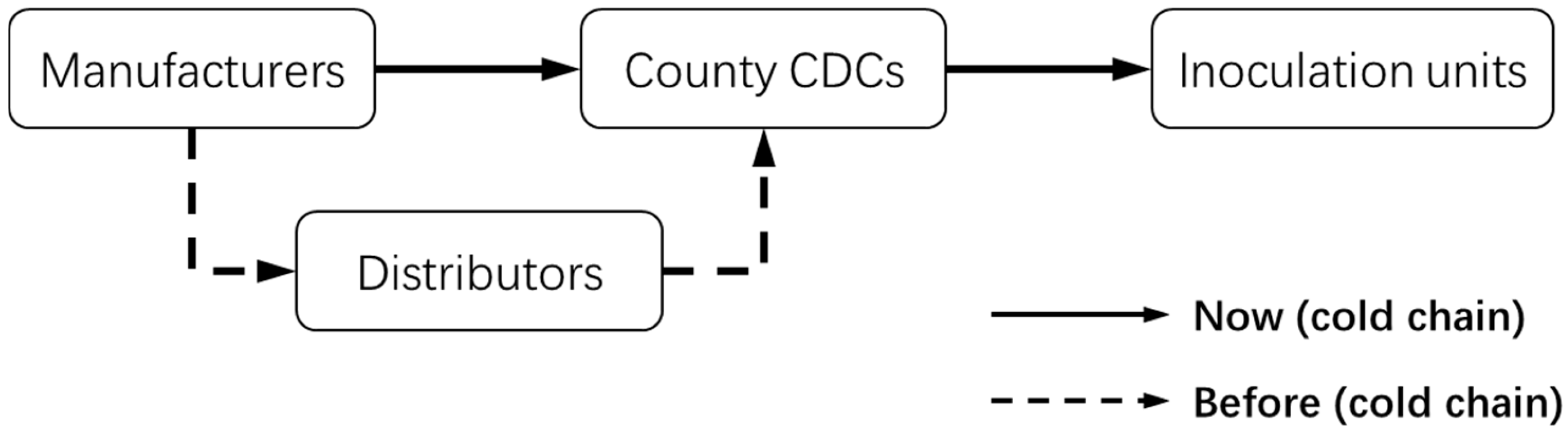
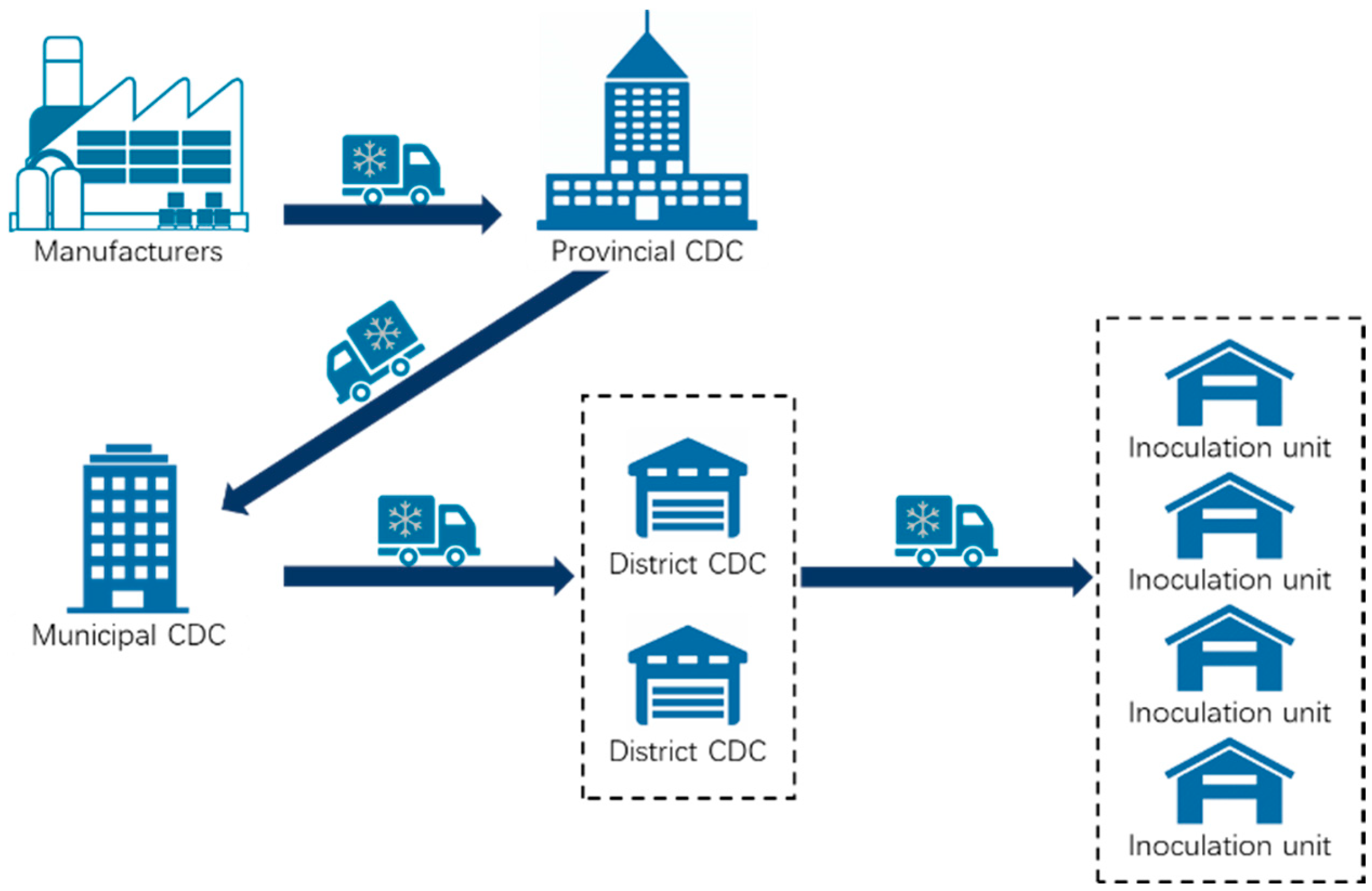
- Lack of monitoring through the policy challenges in vaccine logistics: Regulatory policies can significantly impact the demand for 3PL services in the pharmaceutical sector. For example, following the “vaccine event” in 2016, the Chinese government implemented stricter regulations on vaccine circulation. These regulations require all enterprises producing second-type vaccines, regardless of their size, to distribute vaccines directly to prefecture and county-level Centers for Disease Control and Prevention (CDC) [18]. Due to the vast scale of the distribution endpoints, even large pharmaceutical companies often faced monitoring and tracking of vaccines throughout the delivery process [19,20].
- A novel FAHP–blockchain integrated decision framework for 3PL evaluation and selection, moving beyond traceability-focused blockchain applications toward executable logistics decision support.
- An on-chain FAHP mechanism that captures uncertainty in logistics performance evaluation while ensuring transparency, immutability, and auditability of selection outcomes.
- A regulatory-aligned consortium blockchain architecture that enables real-time supervision of cold vaccine logistics without centralized control.
- A validated case study using one-year industrial data demonstrating the effectiveness, robustness, and practical feasibility of the proposed platform.
2. Literature Review
2.1. Vaccine Supply Chain
2.2. Logistics Collaboration
2.3. Blockchain in Supply Chain
3. Proposed Platform
3.1. The Conceptual Framework of the Platform
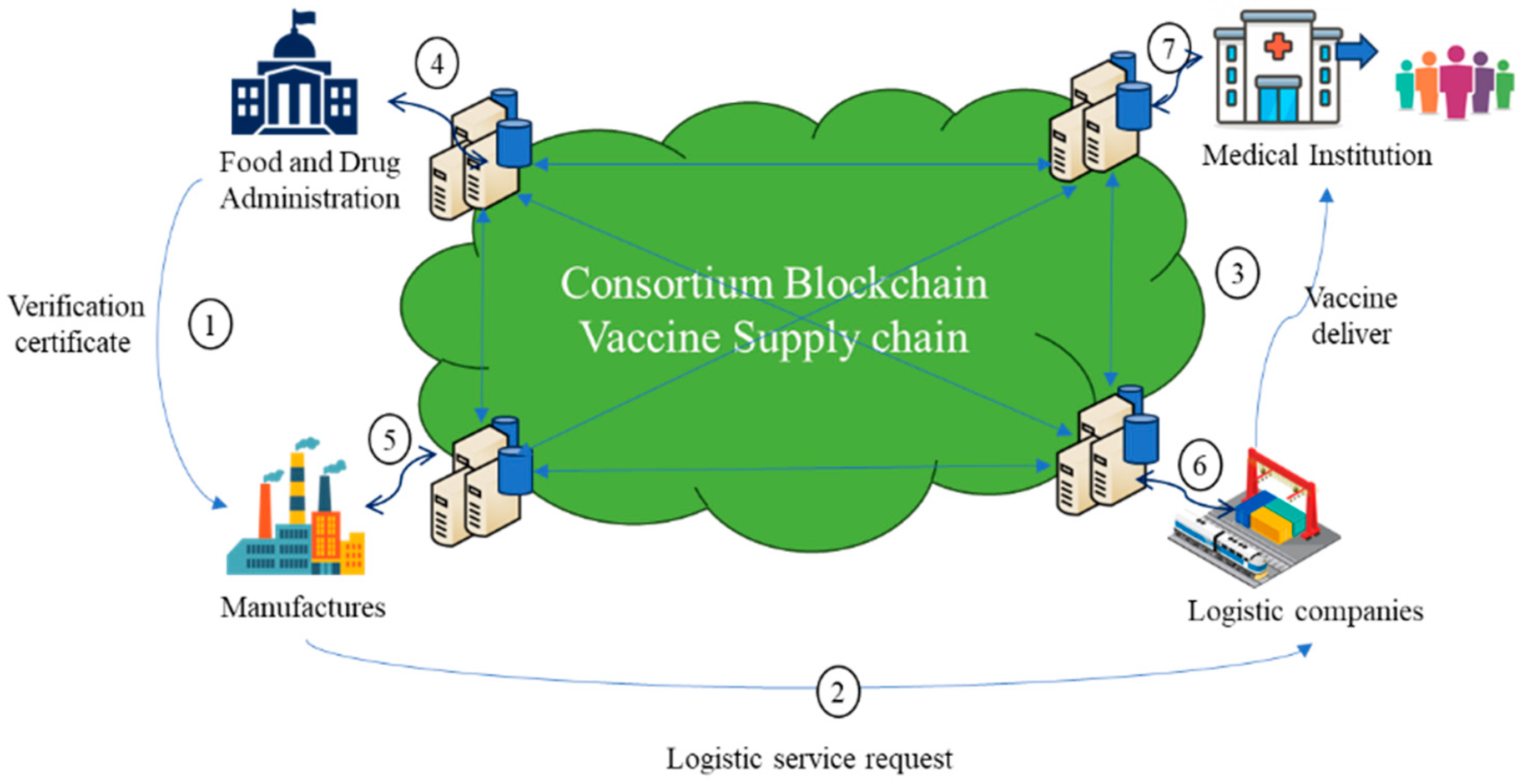
- Food and Drug Administration (FDA): The FDA oversees the platform by providing governance, supervising compliance, and issuing vaccine qualification certificates.
- Pharmaceutical manufacturers (PM): Responsible for producing vaccines according to established standards, recording vaccine-related data, and coordinating with logistics providers and FDA.
- 3PL: Handle cold chain transportation, ensuring vaccines are maintained within prescribed temperature and humidity levels and coordinate with PM as well as medical institution directly.
- Medical institutions: Receive and store vaccines, verify their authenticity upon arrival, and assess logistics providers’ performance.
- (1)
- Regulatory Inspection and Certification:
- Before vaccines are approved for distribution by the PM, the FDA conducts strict inspections to verify compliance with safety and quality standards.
- If a vaccine meets all required criteria, the FDA issues a digital certification recorded on the CBV.
- (2)
- Logistics Service Request and Vaccine Dispatch:
- Medical institutions submit orders to the PM.
- Upon receiving an order, PMs request logistics services from 3PL providers within the network.
- Only vaccines with FDA-issued certificates are approved for distribution.
- (3)
- Cold Chain Logistics and Vaccine Acceptance:
- The assigned 3PL provider takes custody of the vaccines and ensures compliance with regulations, including temperature and humidity control.
- Before storage, medical institutions conduct an acceptance check to ensure temperature stability and package integrity.
- (4)
- Blockchain Integration and Regulatory Oversight:
- The FDA continuously monitors vaccine distribution through smart contracts, which track vaccine movements and record all transactions.
- If a logistics provider or manufacturer fails to comply with regulations, the CBV system automatically flags the issue for regulatory review.
- (5)
- Data Upload and Verification:
- PMs upload key data, including vaccine batch details, production dates, and destination information.
- The CBV verifies manufacturer qualification certificates before permitting vaccines to leave production facilities.
- (6)
- Real-Time Logistics Monitoring:
- IoT-enabled sensors track temperature, humidity, and location in real time, ensuring compliance with cold chain protocols.
- All real-time data is automatically uploaded to the CBV for secure and immutable record-keeping.
- (7)
- Final Acceptance and Performance Evaluation:
- Upon arrival, medical institutions conduct final inspections to verify vaccine integrity.
- They then assess and evaluate logistics providers’ performance based on key indicators such as delivery timeliness, temperature maintenance, and service quality.
- This feedback is stored on the CBV, contributing to future 3PL selection decisions.
3.2. Layer Based Architecture of the Proposed Consortium Blockchain Vaccine Supply Chain Platform
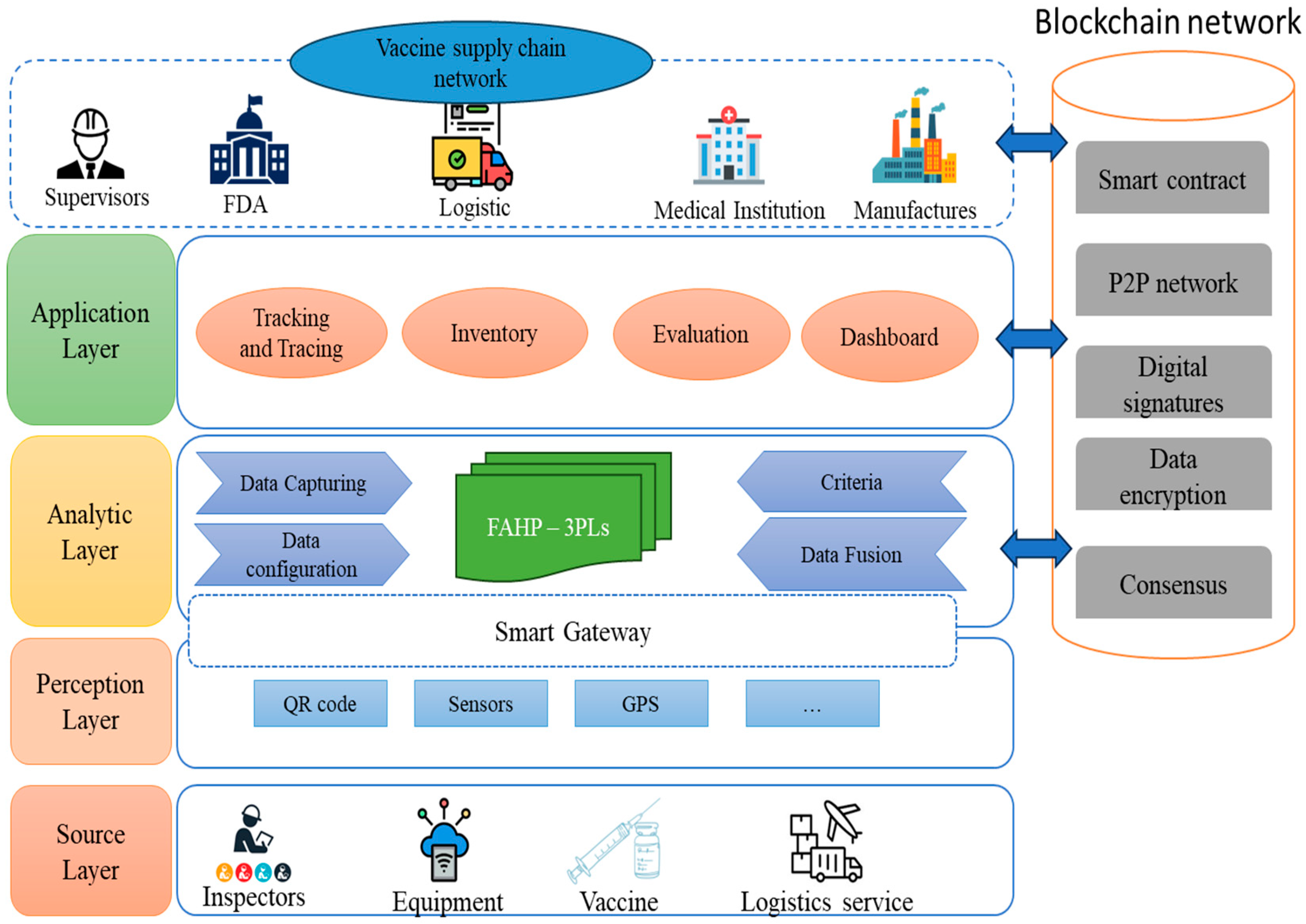
- Source layer
- 2.
- Perception Layer
- 3.
- Analytic layer
- 4.
- Application layer
- 5.
- Blockchain network
4. FAHP Engine in Analytic Layer
4.1. Data Capturing and Process of FAHP Engine
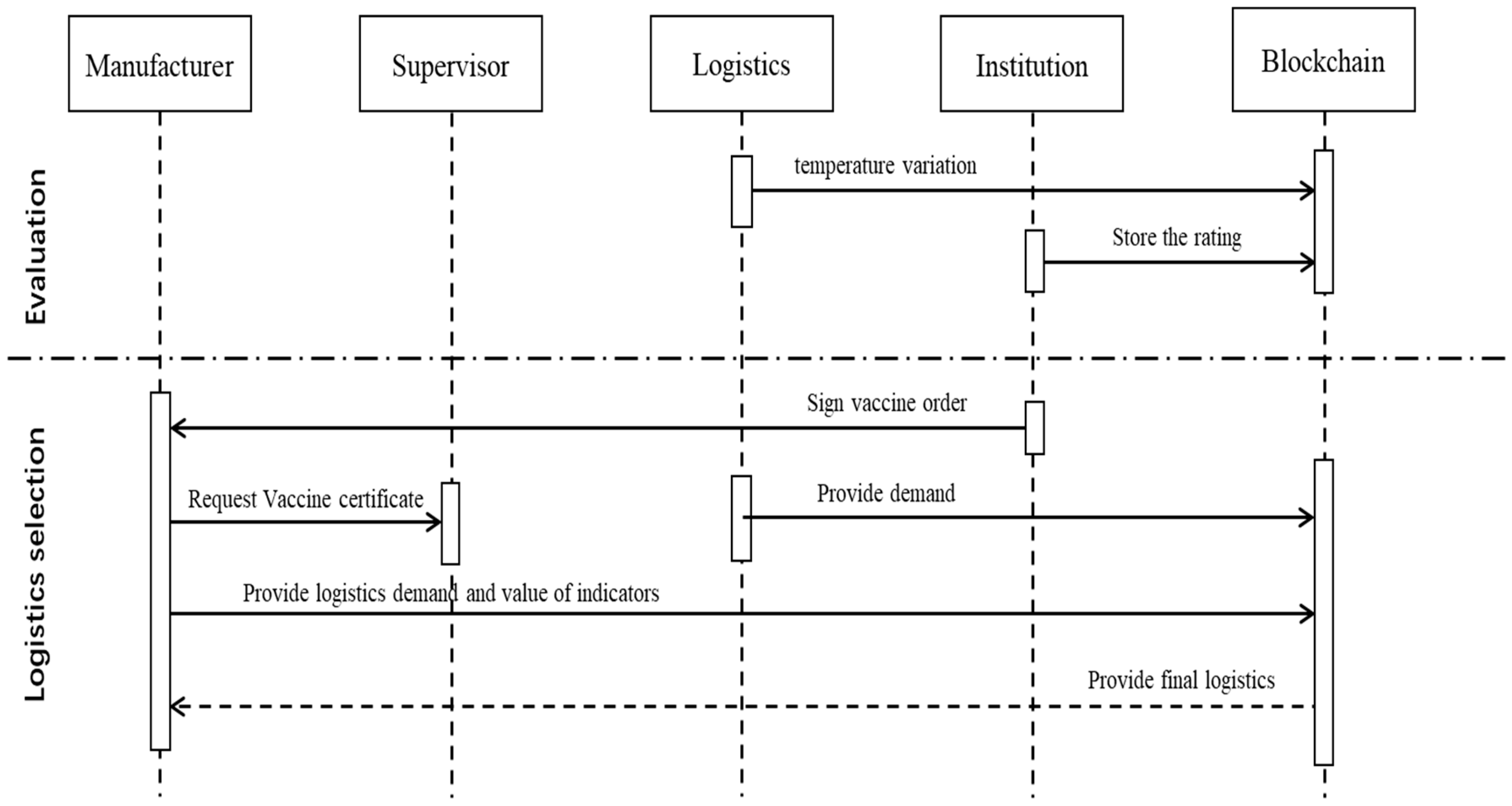
- 3PL selection: In this phase, PMs identify and select suitable 3PL based on their historical data and performances. The selection process relies on data collected from indicators S1, S2, S3, and S4 during both the logistics supervision and warehousing quality inspection stages. This structured approach ensures that selected 3PL providers align with the vaccine supply chain’s stringent quality and reliability requirements.
- Logistics supervision: This phase entails continuous monitoring of vaccine transport as they transit from PMs to medical institutions. Critical logistics data, including temperature fluctuations, humidity levels, and adherence to delivery schedules, are recorded to ensure compliance with vaccine storage and transportation regulations. The collected data provides an objective assessment of 3PL performance, particularly concerning S1 and S2.
- Warehousing quality inspection: Upon arrival at medical institutions, vaccines undergo a comprehensive quality inspection before being accepted into storage. This step evaluates the packaging integrity (S3) and the professionalism and service attitude of logistics personnel (S4). Quality inspectors assess whether vaccines have been transported under appropriate conditions, ensuring compliance with predefined safety and quality standards.
4.2. FAHP-Based 3PL Selection Mechanism
4.2.1. Preliminary Sorting
| Algorithm 1 Preliminary Sorting of Logistics Companies |
| Purpose: To screen out mismatched logistics companies in a simple way. |
| START PreliminarySorting(3PL_List, Pharmaceutical_Requirements) |
| FOR each 3PL in 3PL_List DO // Step 1: Exclude 3PL starting from different provinces |
| IF 3PL.startingProvince != Pharmaceutical_Requirements.startingProvince THEN |
| REMOVE 3PL FROM 3PL_List |
| END IF |
| END FOR |
| FOR each 3PL in 3PL_List DO // Step 2: Exclude 3PL with different provinces as the destination |
| IF 3PL.destinationProvince != Pharmaceutical_Requirements.destinationProvince THEN |
| REMOVE 3PL FROM 3PL_List |
| END IF |
| END FOR |
| FOR each 3PL in 3PL_List DO // Step 3: Eliminate 3PL whose demand delivery time exceeds that provided |
| IF Pharmaceutical_Requirements.deliveryTime > 3PL.providedDeliveryTime THEN |
| REMOVE 3PL FROM 3PL_List |
| END IF |
| END FOR |
| FOR each 3PL in 3PL_List DO // Step 4: Eliminate 3PL with insufficient remaining tray space |
| IF Pharmaceutical_Requirements.traySpaceDemand > 3PL.remainingTraySpace THEN |
| REMOVE 3PL FROM 3PL_List |
| END IF |
| END FOR |
| FOR each 3PL in 3PL_List DO // Step 5: Exclude 3PL with inadequate temperature range |
| IF Pharmaceutical_Requirements.temperatureRange > 3PL.providedTemperatureRange THEN |
| REMOVE 3PL FROM 3PL_List |
| END IF |
| END FOR |
| RETURN 3PL_List |
| END PreliminaryScreening |
4.2.2. FAHP-Based Selection of 3PL
- Si represents the final FAHP score for the ith logistics provider.
- W is the normalized weight vector from Step 1.
- Pi is the historical performance data of the ith 3PL provider.
5. Smart Contract and Its Mechanism
- Vaccine ordering smart contract (VOSC): This smart contract is instantiated between medical institutions and PMs, it handles the secure creation of ordering and tracking of vaccines provided by medical institutions to the PMs. VOSC supervisory control by FDA, for traceability purposes.
- PM managing smart contract (PMM): This smart contract is instantiated between the PM and FDA to manage vaccine traceability during manufacturing and inventory, ensuring regulatory compliance and traceability.
- Logistic process managing smart contract (LPM): This smart contract is instantiated between selected 3PL and medical institutes to ensure the tracking and tracing of vaccine condition during transportation.
- 3PL Evaluation smart contract: Implements the FAHP-based selection and evaluation process for logistics providers.
| M defined as a set of manufacturers. |
| Im defined as a manufacturer inventory. |
| V defined as a set of vaccines. |
| O defined as a set of vaccine orders |
| T defined as a set of transfer orders. |
| N defined as a set of natural numbers. |
| Ot ∈ N is the order ID. |
| Vo represents the vaccine order details. |
| S is the starting location. |
| E is the ending location. |
| TS is the timestamp. |
| SP is the required storage space. |
| LT is the lower temperature limit. |
| UT is the upper temperature limit. |
| M2 is a Boolean indicator (TRUE if the order is processed). |
| B2 is a Boolean indicator (TRUE if the order is completed). |
5.1. Vaccine Ordering Smart Contract
| Algorithm 2 VOSC Between medical institute and PM supervised by FDA |
| 1. Initialize order_id = 0 2. Receive (Nv, Bv, S, E, TS, SP, LT, UT) 3. Increment order_id 4. Store Order in W(order_id) 5. If (order is processed) then set M2 = TRUE 6. If (order is completed) then set B2 = TRUE 7. Return order_id |
5.2. PM Management Smart Contract
5.3. Logistic Process Managing Smart Contract
| Algorithm 3 LPM Between selected 3PL and medical institute as well as visible for global |
|
6. Implementation and Results
6.1. Definition of Performance Metrics for 3PL Selection
- True Positive (TP): The platform correctly selects the optimal 3PL provider.
- False Positive (FP): The platform selects a 3PL provider that is not the optimal choice.
- False Negative (FN): The platform fails to select the optimal 3PL provider.
- True Negative (TN): A non-optimal 3PL provider is correctly not selected.
6.2. Case Study
- Vaccine A ordered by Medical Institution K in Jiangsu Province, scheduled for December 30 at 11:00 AM, with 3 m2 of required tray space and a 2–8 °C temperature control requirement.
- Vaccine C ordered for 29 December at 10:00 AM in Guangdong Province, with the same 3 m2 tray space and 2–8 °C temperature control requirement.
6.3. Step-by-Step Process of FAHP Engine in the Platform
6.4. Smart Contract Cost and Time Consumption
7. Discussion
8. Managerial Implications and Practical Insights
- Structured and objective 3PL selection: The FAHP-based evaluation framework transforms subjective logistics assessments into a quantifiable and transparent decision process.
- Reduced selection risk: Historical performance scores recorded on-chain minimize the likelihood of choosing underperforming logistics providers.
- Cost optimization: Preliminary smart contract screening eliminates infeasible providers before detailed evaluation, reducing negotiation and evaluation overhead.
- Performance-based contracting: Immutable on-chain performance records enable long-term performance benchmarking and incentive-based contracts.
9. Conclusions and Future Work
Author Contributions
Funding
Institutional Review Board Statement
Informed Consent Statement
Data Availability Statement
Acknowledgments
Conflicts of Interest
Appendix A. Vaccine Order Management Smart Contract
| pragma Solidity >= 0.5.12 < 0.6.0; contract enterprise_inventory { struct vaccine { string _name; string _inspection_num; string _lot_num; string _type; string _size; uint _Expiration_ts; uint _batch; } address _owner; string _enterprise_name; mapping(string => vaccine) _vaccine_info; event Insert_new_vaccine(address sender, string enterprise_name, string name, uint batch); event Draw_vaccine(string name, uint draw_num, uint rest_num); constructor(string memory enterprise_name, address owner) public { _enterprise_name = enterprise_name; _owner = owner; } modifier check_sender() { require(msg.sender == _owner, “Only the enterprise can modify the info”); } function insert_new_vaccine( string memory name, string memory inspection_num, string memory lot_num, string memory Type, string memory size, uint Expiration_ts, uint batch ) public check_sender { _vaccine_info [name] = vaccine(name, inspection_num, lot_num, Type, size, Expiration_ts, batch); emit Insert_new_vaccine(msg.sender, _enterprise_name, name, batch); } function get_vaccine_info(string memory name) public view returns (string memory lot_num, string memory Type, string memory size, uint Expiration_ts) { lot_num = _vaccine_info [name]._lot_num; Type = _vaccine_info [name]._type; size = _vaccine_info [name]._size; Expiration_ts = _vaccine_info [name]._Expiration_ts; } function get_rest_batch(string memory name) public view returns (uint batch) { batch = _vaccine_info [name]._batch; } function draw_vaccine(string memory name, uint draw_num) public check_sender returns (uint rest_num) { require(draw_num <= _vaccine_info [name]._batch, “There is not enough vaccine for drawing”); rest_num = _vaccine_info [name]._batch-draw_num; _vaccine_info [name]._batch = rest_num; emit Draw_vaccine(name, draw_num, rest_num); } } |
References
- WHO. Vaccines and Immunization. Available online: https://www.who.int/health-topics/vaccines-and-immunization#tab=tab_1 (accessed on 31 December 2024).
- Patil, S.; Singh, I.; Verma, I.K.; Kumar, A.; Sharma, J.; Ratn, A.; Dhakad, M.S.; Sharma, D. Vaccines as Potential Frontliners Against Antimicrobial Resistance (AMR): A Focused Review. Infect. Drug Resist. 2025, 18, 5023–5041. [Google Scholar] [CrossRef]
- Cénat, J.M.; Farahi, S.M.M.M.; Dalexis, R.D.; Muray, M.; Xu, Y.; Beogo, I. COVID-19 Vaccine Uptake Rates and Associated Factors in Racially Diverse Parents in Canada: The Threat From Conspiracy Beliefs and Racial Discrimination. J. Med. Virol. 2025, 97, e70376. [Google Scholar] [CrossRef] [PubMed]
- Sweet, M. Australia suspends seasonal flu vaccination of young children. BMJ 2010, 340, c2419. [Google Scholar] [CrossRef] [PubMed]
- Sharma, K.L. Healing the Pharmacy of the World: An Inside Story of Medical Products Manufacturing and Regulation in India; Notion Press: Tamil Nadu, India, 2021. [Google Scholar]
- Liao, Y.; Lei, Y.; Ren, Z.; Chen, H.; Li, D. Predicting the potential risk area of illegal vaccine trade in China. Sci. Rep. 2017, 7, 3883. [Google Scholar] [CrossRef] [PubMed]
- Karmini, N.; Mason, M. Vaccine Scandal Highlights Indonesian Health System Woes; US News: Washington, DC, USA, 2016. [Google Scholar]
- Fajar, J.K.; Sallam, M.; Soegiarto, G.; Sugiri, Y.J.; Anshory, M.; Wulandari, L.; Kosasih, S.A.P.; Ilmawan, M.; Kusnaeni, K.; Fikri, M.; et al. Global Prevalence and Potential Influencing Factors of COVID-19 Vaccination Hesitancy: A Meta-Analysis. Vaccines 2022, 10, 1356. [Google Scholar] [CrossRef]
- Fasce, A.; Schmid, P.; Holford, D.L.; Bates, L.; Gurevych, I.; Lewandowsky, S. A taxonomy of anti-vaccination arguments from a systematic literature review and text modelling. Nat. Hum. Behav. 2023, 7, 1462–1480. [Google Scholar] [CrossRef]
- Duijzer, L.E.; van Jaarsveld, W.; Dekker, R. Literature review: The vaccine supply chain. Eur. J. Oper. Res. 2018, 268, 174–192. [Google Scholar] [CrossRef]
- Chowdhury, N.R.; Ahmed, M.; Mahmud, P.; Paul, S.K.; Liza, S.A. Modeling a sustainable vaccine supply chain for a healthcare system. J. Clean. Prod. 2022, 370, 133423. [Google Scholar] [CrossRef]
- Plotkin, S.; Robinson, J.M.; Cunningham, G.; Iqbal, R.; Larsen, S. The complexity and cost of vaccine manufacturing—An overview. Vaccine 2017, 35, 4064–4071. [Google Scholar] [CrossRef]
- Zhang, J.; Cao, W.; Park, M. Reliability Analysis and Optimization of Cold Chain Distribution System for Fresh Agricultural Products. Sustainability 2019, 11, 3618. [Google Scholar] [CrossRef]
- Lin, Q.; Zhao, Q.; Lev, B. Cold chain transportation decision in the vaccine supply chain. Eur. J. Oper. Res. 2020, 283, 182–195. [Google Scholar] [CrossRef]
- Sieckmann, F.; Ngoc, H.N.; Helm, R.; Kohl, H. Implementation of lean production systems in small and medium-sized pharmaceutical enterprises. Procedia Manuf. 2018, 21, 814–821. [Google Scholar] [CrossRef]
- Mezquita, Y.; Casado-Vara, R.; Briones, A.G.; Prieto, J.; Corchado, J.M. Blockchain-based architecture for the control of logistics activities: Pharmaceutical utilities case study. Log. J. IGPL 2021, 29, 974–985. [Google Scholar] [CrossRef]
- Zaffran, M.; Vandelaer, J.; Kristensen, D.; Melgaard, B.; Yadav, P.; Antwi-Agyei, K.; Lasher, H. The imperative for stronger vaccine supply and logistics systems. Vaccine 2013, 31, B73–B80. [Google Scholar] [CrossRef]
- Rey-Jurado, E.; Tapia, F.; Muñoz-Durango, N.; Lay, M.K.; Carreño, L.J.; Riedel, C.A.; Bueno, S.M.; Genzel, Y.; Kalergis, A.M. Assessing the importance of domestic vaccine manufacturing centers: An overview of immunization programs, vaccine manufacture, and distribution. Front. Immunol. 2018, 9, 26. [Google Scholar] [CrossRef]
- Liu, X.; Barenji, A.V.; Li, Z.; Montreuil, B.; Huang, G.Q. Blockchain-based smart tracking and tracing platform for drug supply chain. Comput. Ind. Eng. 2021, 161, 107669. [Google Scholar] [CrossRef]
- Torshizi, E.; Bozorgi-Amiri, A.; Sabouhi, F. Resilient and sustainable global COVID-19 vaccine supply chain design considering reverse logistics. Appl. Soft Comput. 2024, 151, 111041. [Google Scholar] [CrossRef]
- Li, Z.; Barenji, A.V.; Huang, G.Q. Toward a blockchain cloud manufacturing system as a peer to peer distributed network platform. Robot. Comput. Integr. Manuf. 2018, 54, 133–144. [Google Scholar] [CrossRef]
- Liu, X.; Wang, W.; Guo, H.; Barenji, A.V.; Li, Z.; Huang, G.Q. Industrial blockchain based framework for product lifecycle management in industry 4.0. Robot. Comput. Integr. Manuf. 2020, 63, 101897. [Google Scholar] [CrossRef]
- D’Cruz, M.; Banerjee, D. ‘An invisible human rights crisis’: The marginalization of older adults during the COVID-19 pandemic—An advocacy review. Psychiatry Res. 2020, 292, 113369. [Google Scholar] [CrossRef]
- Brooks, A.; Habimana, D.; Huckerby, G. Making the leap into the next generation: A commentary on how Gavi, the Vaccine Alliance is supporting countries’ supply chain transformations in 2016–2020. Vaccine 2017, 35, 2110–2114. [Google Scholar] [CrossRef]
- Sarley, D.; Mahmud, M.; Idris, J.; Osunkiyesi, M.; Dibosa-Osadolor, O.; Okebukola, P.; Wiwa, O. Transforming vaccines supply chains in Nigeria. Vaccine 2017, 35, 2167–2174. [Google Scholar] [CrossRef] [PubMed]
- Al-sadat Salari, S.; Sazvar, Z. Designing a sustainable vaccine supply chain by considering demand substitution and value-added function during a pandemic outbreak. Comput. Ind. Eng. 2024, 187, 109826. [Google Scholar] [CrossRef]
- Tang, L.; Zhang, L. Reforms in China’s Vaccine Administration—From the Perspective of New Governance Approach. Int. J. Environ. Res. Public Health 2023, 20, 3450. [Google Scholar] [CrossRef] [PubMed]
- Barenji, A.V.; Montreuil, B. Open Logistics: Blockchain-Enabled Trusted Hyperconnected Logistics Platform. Sensors 2022, 22, 4699. [Google Scholar] [CrossRef]
- Barratt, M. Understanding the meaning of collaboration in the supply chain. Supply Chain Manag. 2004, 9, 30–42. [Google Scholar] [CrossRef]
- Sudusinghe, J.I.; Seuring, S. Supply chain collaboration and sustainability performance in circular economy: A systematic literature review. Int. J. Prod. Econ. 2022, 245, 108402. [Google Scholar] [CrossRef]
- Mason, R.; Lalwani, C.; Boughton, R. Combining vertical and horizontal collaboration for transport optimisation. Supply Chain Manag. 2007, 12, 187–199. [Google Scholar] [CrossRef]
- Ferrell, W.; Ellis, K.; Kaminsky, P.; Rainwater, C. Horizontal collaboration: Opportunities for improved logistics planning. Int. J. Prod. Res. 2020, 58, 4267–4284. [Google Scholar] [CrossRef]
- Rodrigues, V.S.; Harris, I.; Mason, R. Horizontal logistics collaboration for enhanced supply chain performance: An international retail perspective. Supply Chain Manag. 2015, 20, 631–647. [Google Scholar] [CrossRef]
- Li, Z.; Guo, H.; Wang, W.M.; Guan, Y.; Barenji, A.V.; Huang, G.Q.; McFall, K.S.; Chen, X. A blockchain and automl approach for open and automated customer service. IEEE Trans. Industr. Ind. 2019, 15, 3642–3651. [Google Scholar] [CrossRef]
- Gao, Y.; Gao, H.; Xiao, H.; Yao, F. Vaccine supply chain coordination using blockchain and artificial intelligence technologies. Comput. Ind. Eng. 2023, 175, 108885. [Google Scholar] [CrossRef]
- Trautmann, L.; Hübner, T.; Lasch, R. Blockchain concept to combat drug counterfeiting by increasing supply chain visibility. Int. J. Logist. Res. Appl. 2024, 27, 959–985. [Google Scholar] [CrossRef]
- Li, Z.; Zhong, R.Y.; Tian, Z.; Dai, H.-N.; Barenji, A.V.; Huang, G.Q. Industrial Blockchain: A state-of-the-art Survey. Robot. Comput. Manuf. 2021, 70, 102124. [Google Scholar] [CrossRef]
- Li, Z.; Kang, J.; Yu, R.; Ye, D.; Deng, Q.; Zhang, Y. Consortium blockchain for secure energy trading in industrial internet of things. IEEE Trans. Ind. Inf. 2018, 14, 3690–3700. [Google Scholar] [CrossRef]
- Valencia-Payan, C.; Griol, D.; Corrales, J.C. Blockchain self-update smart contract for supply chain traceability with data validation. Log. J. IGPL 2025, 33, jzae047. [Google Scholar] [CrossRef]
- Wang, C.-N.; Cao, T.B.O.; Dang, T.-T.; Nguyen, N.-A. Third-Party Logistics Provider Selection in the Industry 4.0 Era by Using a Fuzzy AHP and Fuzzy MARCOS Methodology. IEEE Access 2024, 12, 67291–67313. [Google Scholar] [CrossRef]
- Nguyen, N.-A.; Wang, C.-N.; Dang, L.-T.; Dang, L.-T.; Dang, T.-T. Selection of Cold Chain Logistics Service Providers Based on a Grey AHP and Grey COPRAS Framework: A Case Study in Vietnam. Axioms 2022, 11, 154. [Google Scholar] [CrossRef]
- World Health Organization; UNICEF; World Bank. State of the World’s Vaccines and Immunization, 3rd ed.; World Health Organization: Geneva, Switzerland, 2009. [Google Scholar]
- Lorite, G.S.; Selkälä, T.; Sipola, T.; Palenzuela, J.; Jubete, E.; Viñuales, A.; Cabañero, G.; Grande, H.J.; Tuominen, J.; Uusitalo, S.; et al. Novel, smart and RFID assisted critical temperature indicator for supply chain monitoring. J. Food Eng. 2017, 193, 20–28. [Google Scholar] [CrossRef]
- Zhang, J.; Lam, W.H.; Chen, B.Y. On-time delivery probabilistic models for the vehicle routing problem with stochastic demands and time windows. Eur. J. Oper. Res. 2016, 249, 144–154. [Google Scholar] [CrossRef]
- Chan, F.; Chan, H.; Choy, K. A systematic approach to manufacturing packaging logistics. Int. J. Adv. Manuf. Technol. 2006, 29, 1088–1101. [Google Scholar] [CrossRef]
- Stank, T.P.; Goldsby, T.J.; Vickery, S.K.; Savitskie, K. Logistics Service Performance: Estimating its Influence on Market Share. J. Bus. Logist. 2003, 24, 27–55. [Google Scholar] [CrossRef]
- Jiang, X.-J.; Liu, X.F. CryptoKitties Transaction Network Analysis: The Rise and Fall of the First Blockchain Game Mania. Front. Phys. 2021, 9, 631665. [Google Scholar] [CrossRef]
- Abideen, A.Z.; Sorooshian, S.; Sundram, V.P.K.; Mohammed, A. Collaborative insights on horizontal logistics to integrate supply chain planning and transportation logistics planning—A systematic review and thematic mapping. J. Open Innov. Technol. Mark. Complex. 2023, 9, 100066. [Google Scholar] [CrossRef]
- Ayan, B.; Abacıoğlu, S.; Basilio, M.P. A Comprehensive Review of the Novel Weighting Methods for Multi-Criteria Decision-Making. Information 2023, 14, 285. [Google Scholar] [CrossRef]
- Chen, H.; Wang, H. Research on Green Supplier Selection Method Based on Improved AHP-FMEA. Sustainability 2025, 17, 3018. [Google Scholar] [CrossRef]



| Reference | Methodology | Blockchain Used | MCDM Method | Regulatory Role | Key Limitations |
|---|---|---|---|---|---|
| [19] | Blockchain-based traceability framework | Yes | No | Implicit | Focuses on tracking and lifecycle data; no logistics provider evaluation or selection |
| [16,42] | Blockchain architecture for pharmaceutical logistics | Yes | No | Limited | Emphasizes logistics monitoring, not decision-making or 3PL ranking |
| [43] | 3PL provider selection for Industry 4.0 | No | Fuzzy AHP + Fuzzy MARCOS | No | Strong MCDM; still centralized and not integrated with real-time IoT/blockchain governance |
| [44] | Medicine cold chain logistics provider selection (group decision framework) | No | Pythagorean fuzzy DEMATEL–CoCoSo | No | Advanced MCDM but still offline/centralized; lacks blockchain-based trust and traceability |
| Indicators | Description |
|---|---|
| Temperature control ability S1 | Ratio of overtemperature time to total logistics time, reflecting the refrigeration and insulation capacity of cold chain vehicles. |
| On-time delivery rate S2 | Evaluated subjectively by quality inspectors, measuring the lead-time punctuality of logistics enterprises. |
| Package integrity S3 | Reflects the stability of vaccine packaging during transportation, assessed subjectively by warehouse quality inspectors. |
| Service attitude S4 | Reflects the attitude of logistics service personnel, evaluated subjectively by medical institution quality inspectors. |
| Information | Company XX | Company YY |
|---|---|---|
| Start | xxx City, xxx Province | xxx City, xxx Province |
| End | No. xxx, xxx Road, xxx District, xxx City, xxx Province | No. xxx, xxx Road, xxx District, xxx City, xxx Province |
| Delivery time | Month day, time | Month day, time |
| Free tray space | xx m2 | xx m2 |
| Temperature range | x–y ℃ | x–y ℃ |
| Scale | Implication |
|---|---|
| 1 | Equally important |
| 3 | Slightly important |
| 5 | Important |
| 7 | Obviously important |
| 9 | Very important |
| 2, 4, 6, and 8 are of intermediate importance, which is the scale value corresponding to the intermediate state | |
| Decision Variables | |
|---|---|
| ∀v ∈ V To = (Ot, Vo, S, E, TS, SP, LT, UT, M2, B2) | |
| Objective Function (if applicable) | min |
| Constraints | |
| Ocount = Ocount + 1 LT ≤ Tv ≤ UT ∀v ∈ V |
| Manufacturer Structure and Mapping Function |
| Mm = (Nm, Am, Im) Fm : Nm→Mm |
| Constraint |
| ∀mi, mj ∈ M, Nmi ≠ Nmj |
| Functional Representation |
| Insert_Manufacture(Nm, Am)→Mm Get_Manufacture_Inventory(Nm)→Im |
| Information | Vaccine A | Vaccine C |
|---|---|---|
| Start | Chaoyang District, Beijing City | Xinxiang City, Henan Province |
| End | No. 305, Middle mountain Eastern Road, Xuanwu District, Nanjing City, Jiangsu Province | No. 55, Waihuanxi Road, Panyu District, Guangzhou City, Guangdong Province |
| Delivery time | 30 December, 11 am | 29 December, 10 am |
| Free tray space | 3 m2 | 3 m2 |
| Temperature range | 2–8 °C | 2–8 °C |
| Information | Company D | Company E | Company F | Company G |
|---|---|---|---|---|
| Start | Haidian District, Beijing City | Fangshan District, Beijing City | Zhengzhou City, Henan Province | Luohe City, Henan Province |
| End | No. 155, Hanzhong Road, Qinhuai District, Nanjing City, Jiangsu Province | No. 19, Zhongshanbei Road, Quanshan District, Xuzhou City, Jiangsu Province | No. 1698, Guangzhoudadaonan Road, Haizhu District, Guangzhou City, Guangdong Province | No. 53, Jidajingle Road, Zhuhai District, Guangzhou City, Guangdong Province |
| Delivery time | 30 December, 15 pm | 30 December, 16 pm | 29 December, 16 pm | 29 December, 15 pm |
| Free tray space | 5 m2 | 4 m2 | 6 m2 | 3 m2 |
| Temperature range | 3–6°C | 2–7°C | 3–5°C | 2–5°C |
| Month | Total Orders | Correct Selections | Incorrect Selections | Accuracy (%) | Precision (%) | Recalling (%) | F1-Score (%) |
|---|---|---|---|---|---|---|---|
| January | 80 | 74 | 6 | 92.50% | 90.2% | 94.8% | 92.4% |
| February | 75 | 70 | 5 | 93.33% | 89.7% | 95.9% | 92.7% |
| March | 90 | 84 | 6 | 93.33% | 90.5% | 94.4% | 92.4% |
| April | 85 | 79 | 6 | 92.94% | 89.4% | 94.0% | 91.7% |
| May | 82 | 76 | 6 | 92.68% | 89.1% | 93.8% | 91.4% |
| June | 88 | 82 | 6 | 93.18% | 89.7% | 94.3% | 92.0% |
| July | 93 | 87 | 6 | 93.55% | 91.2% | 94.6% | 92.9% |
| August | 89 | 83 | 6 | 93.26% | 90.5% | 94.3% | 92.4% |
| September | 92 | 86 | 6 | 93.48% | 90.7% | 94.6% | 92.6% |
| October | 87 | 81 | 6 | 93.10% | 89.6% | 94.2% | 91.9% |
| November | 91 | 85 | 6 | 93.41% | 90.8% | 94.4% | 92.6% |
| December | 94 | 88 | 6 | 93.62% | 91.4% | 94.8% | 93.1% |
| Overall | 1046 | 975 | 71 | 93.21% | 90.23% | 94.50% | 92.32% |
| Operation | Gas | Description |
|---|---|---|
| insert_new_vac | 166,010 | Upload the vaccine certificate information to the contract |
| draw_vac | 31,104 | Take the certain quantity of vaccine from the stock and modify the batch information |
| create_order | 260,252 | Create a new vaccine shipment order and upload it to the contract |
| create_transfer_order | 184,081 | Create a new capacity order and upload it to the contract |
| check_avaliable_transfer_order | 68,441 | According to the information of the vaccine to be shipped order and the transportation capacity order, the transportation capacity order that meets the requirements is selected |
| match_orders | 102,271 | Add the vaccine to be shipped order to the shipment capacity order, which means that the shipment order is carried by the enterprise that issues the shipment capacity order |
| set_order_status | 42,799 | After the medical institution’s warehousing inspection, change the order status to indicate that it has passed the inspection |
| evaluate | 110,853 | Medical institutions evaluate the logistics companies according to the four indicators proposed, and upload the scores to the contract for storage |
Disclaimer/Publisher’s Note: The statements, opinions and data contained in all publications are solely those of the individual author(s) and contributor(s) and not of MDPI and/or the editor(s). MDPI and/or the editor(s) disclaim responsibility for any injury to people or property resulting from any ideas, methods, instructions or products referred to in the content. |
© 2026 by the authors. Licensee MDPI, Basel, Switzerland. This article is an open access article distributed under the terms and conditions of the Creative Commons Attribution (CC BY) license.
Share and Cite
Barenji, A.; Li, Z. Blockchain-Enabled FAHP-Based Platform for Third-Party Logistics Evaluation and Selection in Cold Vaccine Supply Chains. Information 2026, 17, 272. https://doi.org/10.3390/info17030272
Barenji A, Li Z. Blockchain-Enabled FAHP-Based Platform for Third-Party Logistics Evaluation and Selection in Cold Vaccine Supply Chains. Information. 2026; 17(3):272. https://doi.org/10.3390/info17030272
Chicago/Turabian StyleBarenji, Ali, and Zhi Li. 2026. "Blockchain-Enabled FAHP-Based Platform for Third-Party Logistics Evaluation and Selection in Cold Vaccine Supply Chains" Information 17, no. 3: 272. https://doi.org/10.3390/info17030272
APA StyleBarenji, A., & Li, Z. (2026). Blockchain-Enabled FAHP-Based Platform for Third-Party Logistics Evaluation and Selection in Cold Vaccine Supply Chains. Information, 17(3), 272. https://doi.org/10.3390/info17030272