Augmented, Virtual, and Mixed Reality Assessment and Training for Executive Functions in Children with ADHD: A Scoping Review




Abstract
1. Introduction
2. Methods
2.1. Inclusion Criteria
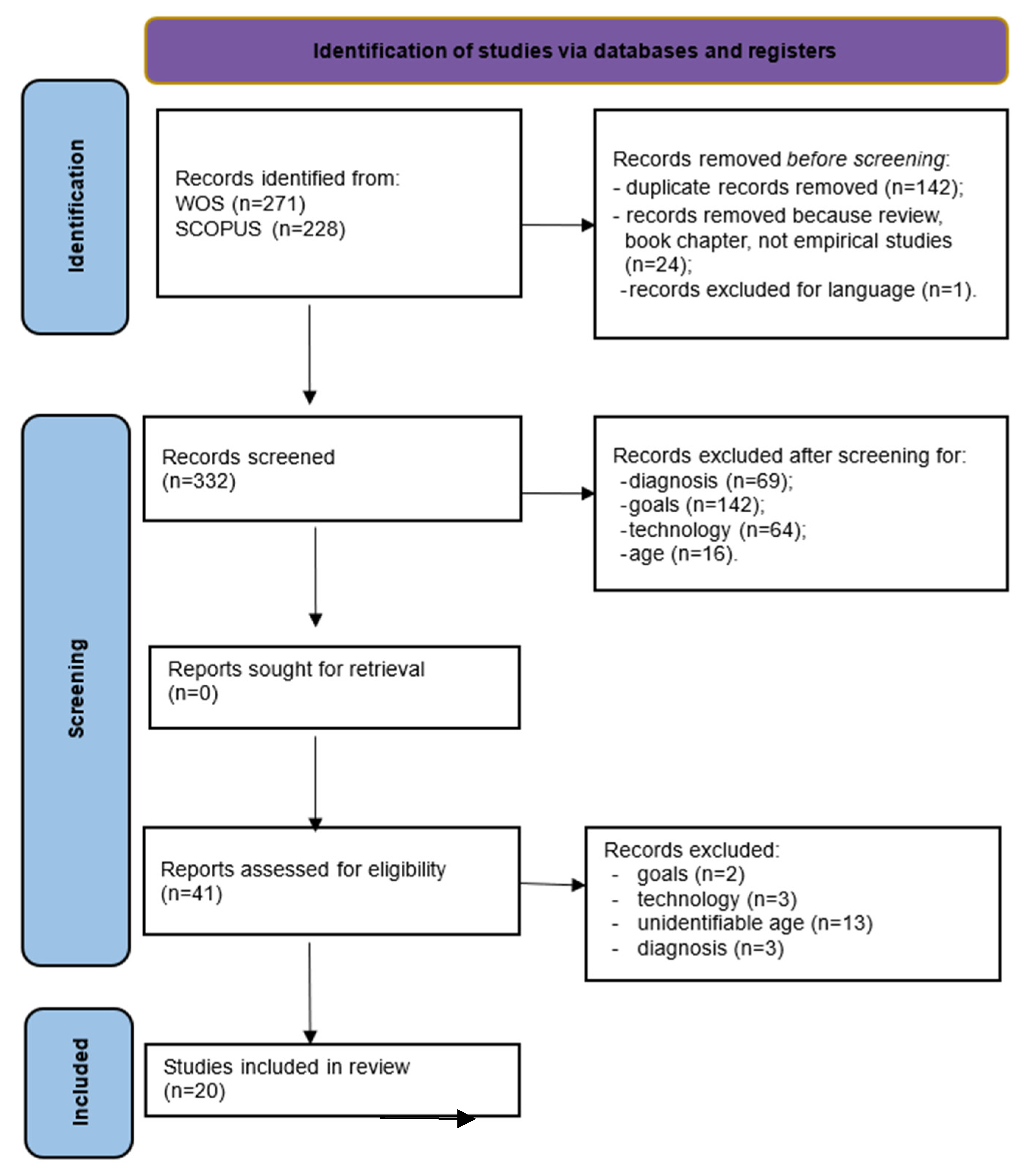
- studies published between 2015 and 2025;
- studies in English;
- empirical studies;
- participants aged <13 years;
- participants with a confirmed diagnosis of ADHD according to DSM-5 (2013) orDSM-5-TR (2022) or ICD-11 (2019) criteria;
- use of VR, AR, or MR to assess or improve EFs in individuals with ADHD.
2.2. Exclusion Criteria
- participants ≥ 13 years of age;
- participants with suspected ADHD or undergoing diagnostic evaluation;
- review articles, commentaries, books, editorials, or letters;
- studies published in languages other than English;
- papers not relevant to the research objective;
- studies involving AI, biofeedback techniques, and applied neurophysiology;
- studies focused only on technological aspects and not on the effects of the assessment or intervention on participants.
2.3. Risk of Bias Assessment
3. Results
3.1. Assessment
3.2. Training
4. Discussion
5. Limitations and Future Research Perspectives
- -
- greater uniformity among protocols regarding measures (frequency, duration, contexts, pre- and post-intervention tests), types of VR technology, presence or absence of distractors, and the use of control groups;
- -
- longitudinal studies with large samples to generalize and consolidate the results over time;
- -
- greater individualized treatment of emotional skills, as virtual environments may not faithfully replicate the wide range of real-world contexts and situations to which children are exposed [87].
6. Conclusions
Supplementary Materials
Author Contributions
Funding
Institutional Review Board Statement
Informed Consent Statement
Data Availability Statement
Conflicts of Interest
References
- Salari, N.; Ghasemi, H.; Abdoli, N.; Rahmani, A.; Shiri, M.H.; Hashemian, A.H.; Akbari, H.; Mohammadi, M. The Global Prevalence of ADHD in Children and Adolescents: A Systematic Review and Meta-Analysis. Ital. J. Pediatr. 2023, 49, 48. [Google Scholar] [CrossRef] [Scilit] [PubMed]
- Núñez-Jaramillo, L.; Herrera-Solís, A.; Herrera-Morales, W.V. ADHD: Reviewing the Causes and Evaluating Solutions. J. Pers. Med. 2021, 11, 166. [Google Scholar] [CrossRef] [Scilit] [PubMed]
- Diagnostic and Statistical Manual of Mental Disorders|Psychiatry Online. Available online: https://psychiatryonline.org/doi/book/10.1176/appi.books.9780890425596 (accessed on 5 January 2026).
- Barkley, R.A. Behavioral Inhibition, Sustained Attention, and Executive Functions: Constructing a Unifying Theory of ADHD. Psychol. Bull. 1997, 121, 65–94. [Google Scholar] [CrossRef] [Scilit]
- Castellanos, F.X.; Sonuga-Barke, E.J.S.; Milham, M.P.; Tannock, R. Characterizing Cognition in ADHD: Beyond Executive Dysfunction. Trends Cogn. Sci. 2006, 10, 117–123. [Google Scholar] [CrossRef] [Scilit]
- Martinussen, R.; Hayden, J.; Hogg-Johnson, S.; Tannock, R. A Meta-Analysis of Working Memory Impairments in Children with Attention-Deficit/Hyperactivity Disorder. J. Am. Acad. Child Adolesc. Psychiatry 2005, 44, 377–384. [Google Scholar] [CrossRef] [Scilit]
- Nigg, J.T. What Causes ADHD?: Understanding What Goes Wrong and Why; Guilford Press: New York, NY, USA, 2006. [Google Scholar]
- Anderson, P. Assessment and Development of Executive Function (EF) during Childhood. Child Neuropsychol. 2002, 8, 71–82. [Google Scholar] [CrossRef] [Scilit]
- Suchy, Y. Executive Functioning: Overview, Assessment, and Research Issues for Non-Neuropsychologists. Ann. Behav. Med. 2009, 37, 106–116. [Google Scholar] [CrossRef] [Scilit]
- Diamond, A. Executive Functions. Annu. Rev. Psychol. 2013, 64, 135–168. [Google Scholar] [CrossRef] [Scilit] [PubMed]
- Miyake, A.; Friedman, N.P.; Emerson, M.J.; Witzki, A.H.; Howerter, A.; Wager, T.D. The Unity and Diversity of Executive Functions and Their Contributions to Complex “Frontal Lobe” Tasks: A Latent Variable Analysis. Cogn. Psychol. 2000, 41, 49–100. [Google Scholar] [CrossRef] [Scilit]
- Zelazo, P.D.; Cunningham, W. Executive Function: Mechanisms Underlying Emotion Regulation. In Handbook of Emotion Regulation; Gross, J., Ed.; Guilford: New York, NY, USA, 2007; pp. 135–158. [Google Scholar]
- Sambol, S.; Suleyman, E.; Ball, M. The Interplay of Hot and Cool Executive Functions: Implications for a Unified Executive Framework. Cogn. Syst. Res. 2025, 91, 101360. [Google Scholar] [CrossRef] [Scilit]
- Tyburski, E.; Mak, M.; Sokołowski, A.; Starkowska, A.; Karabanowicz, E.; Kerestey, M.; Lebiecka, Z.; Preś, J.; Sagan, L.; Samochowiec, J.; et al. Executive Dysfunctions in Schizophrenia: A Critical Review of Traditional, Ecological, and Virtual Reality Assessments. J. Clin. Med. 2021, 10, 2782. [Google Scholar] [CrossRef] [Scilit] [PubMed]
- Hirose, S.; Chikazoe, J.; Watanabe, T.; Jimura, K.; Kunimatsu, A.; Abe, O.; Ohtomo, K.; Miyashita, Y.; Konishi, S. Efficiency of Go/No-Go Task Performance Implemented in the Left Hemisphere. J. Neurosci. 2012, 32, 9059–9065. [Google Scholar] [CrossRef] [Scilit]
- Jonides, J.; Smith, E.E. The Architecture of Working Memory. In Cognitive Neuroscience; Studies in Cognition; The MIT Press: Cambridge, MA, USA, 1997; pp. 243–276. [Google Scholar]
- Kalbfleisch, L. Neurodevelopment of the Executive Functions. In Executive Functions in Health and Disease; Elsevier Academic Press: San Diego, CA, USA, 2017; pp. 143–168. [Google Scholar]
- Chevignard, M.; Pillon, B.; Pradat-Diehl, P.; Taillefer, C.; Rousseau, S.; Le Bras, C.; Dubois, B. An Ecological Approach to Planning Dysfunction: Script Execution. Cortex 2000, 36, 649–669. [Google Scholar] [CrossRef] [Scilit]
- Fortin, S.; Godbout, L.; Braun, C.M.J. Cognitive Structure of Executive Deficits in Frontally Lesioned Head Trauma Patients Performing Activities of Daily Living. Cortex 2003, 39, 273–291. [Google Scholar] [CrossRef] [Scilit]
- Vaughan, L.; Giovanello, K. Executive Function in Daily Life: Age-Related Influences of Executive Processes on Instrumental Activities of Daily Living. Psychol. Aging 2010, 25, 343–355. [Google Scholar] [CrossRef] [Scilit]
- Qiu, H.; Liang, X.; Wang, P.; Zhang, H.; Shum, D.H.K. Efficacy of Non-Pharmacological Interventions on Executive Functions in Children and Adolescents with ADHD: A Systematic Review and Meta-Analysis. Asian J. Psychiatry 2023, 87, 103692. [Google Scholar] [CrossRef] [Scilit] [PubMed]
- Corrigan, N.; Păsărelu, C.-R.; Voinescu, A. Immersive Virtual Reality for Improving Cognitive Deficits in Children with ADHD: A Systematic Review and Meta-Analysis. Virtual Real. 2023, 27, 3545–3564. [Google Scholar] [CrossRef] [Scilit]
- Kaplan, A.D.; Cruit, J.; Endsley, M.; Beers, S.M.; Sawyer, B.D.; Hancock, P.A. The Effects of Virtual Reality, Augmented Reality, and Mixed Reality as Training Enhancement Methods: A Meta-Analysis. Hum. Factors 2021, 63, 706–726. [Google Scholar] [CrossRef] [Scilit] [PubMed]
- Muñoz-Saavedra, L.; Miró-Amarante, L.; Domínguez-Morales, M. Augmented and Virtual Reality Evolution and Future Tendency. Appl. Sci. 2020, 10, 322. [Google Scholar] [CrossRef] [Scilit]
- Mann, S.; Furness, T.; Yuan, Y.; Iorio, J.; Wang, Z. All Reality: Virtual, Augmented, Mixed (X), Mediated (X,Y), and Multimediated Reality. arXiv 2018. [Google Scholar] [CrossRef] [Scilit]
- Apochi, O.O.; Olusanya, M.D.; Wesley, M.; Musa, S.I.; Ayomide Peter, O.; Adebayo, A.A.; OlaitanKomolafe, D. Virtual, Mixed, and Augmented Realities: A Commentary on Their Significance in Cognitive Neuroscience and Neuropsychology. Appl. Neuropsychol. Adult 2024, 1–4. [Google Scholar] [CrossRef] [Scilit]
- Mühlberger, A.; Jekel, K.; Probst, T.; Schecklmann, M.; Conzelmann, A.; Andreatta, M.; Rizzo, A.A.; Pauli, P.; Romanos, M. The Influence of Methylphenidate on Hyperactivity and Attention Deficits in Children with ADHD: A Virtual Classroom Test. J. Atten. Disord. 2020, 24, 277–289. [Google Scholar] [CrossRef] [Scilit]
- Romero-Ayuso, D.; del Pino-González, A.; Torres-Jiménez, A.; Juan-González, J.; Celdrán, F.J.; Franchella, M.C.; Ortega-López, N.; Triviño-Juárez, J.M.; Garach-Gómez, A.; Arrabal-Fernández, L.; et al. Enhancing Ecological Validity: Virtual Reality Assessment of Executive Functioning in Children and Adolescents with ADHD. Children 2024, 11, 986. [Google Scholar] [CrossRef] [Scilit]
- Gounari, K.A.; Giatzoglou, E.; Kemm, R.; Beratis, I.N.; Nega, C.; Kourtesis, P. The Trail Making Test in Virtual Reality (TMT-VR): Examination of the Ecological Validity, Usability, Acceptability, and User Experience in Adults with ADHD. Psychiatry Int. 2025, 6, 31. [Google Scholar] [CrossRef] [Scilit]
- Lee, S.-A.; Kim, J.-Y.; Park, J.-H. Concurrent Validity of Virtual Reality-Based Assessment of Executive Function: A Systematic Review and Meta-Analysis. J. Intell. 2024, 12, 108. [Google Scholar] [CrossRef] [Scilit]
- Holleman, G.A.; Hooge, I.T.C.; Kemner, C.; Hessels, R.S. The ‘Real-World Approach’ and Its Problems: A Critique of the Term Ecological Validity. Front. Psychol. 2020, 11, 721. [Google Scholar] [CrossRef] [Scilit]
- Fang, H.; Fang, C.; Che, Y.; Peng, X.; Zhang, X.; Lin, D. Reward Feedback Mechanism in Virtual Reality Serious Games in Interventions for Children with Attention Deficits: Pre- and Posttest Experimental Control Group Study. JMIR Serious Games 2025, 13, e67338. [Google Scholar] [CrossRef] [Scilit] [PubMed]
- Yen, J.M.; Lim, J.H. A Clinical Perspective on Bespoke Sensing Mechanisms for Remote Monitoring and Rehabilitation of Neurological Diseases: Scoping Review. Sensors 2023, 23, 536. [Google Scholar] [CrossRef] [Scilit] [PubMed]
- Tajik-Parvinchi, D.; Wright, L.; Schachar, R. Cognitive Rehabilitation for Attention Deficit/Hyperactivity Disorder (ADHD): Promises and Problems. J. Can. Acad. Child Adolesc. Psychiatry/J. L’académie Can. Psychiatr. L’enfantL’adolescent 2014, 23, 207–217. [Google Scholar]
- Cho, B.-H.; Ku, J.; Jang, D.P.; Kim, S.; Lee, Y.H.; Kim, I.Y.; Lee, J.H.; Kim, S.I. The effect of virtual reality cognitive training for attention enhancement. Cyberpsychol. Behav. 2002, 5, 129–137. [Google Scholar] [CrossRef] [Scilit] [PubMed]
- Borgnis, F.; Baglio, F.; Pedroli, E.; Rossetto, F.; Uccellatore, L.; Oliveira, J.A.G.; Riva, G.; Cipresso, P. Available Virtual Reality-Based Tools for Executive Functions: A Systematic Review. Front. Psychol. 2022, 13, 833136, Correction in Front. Psychol. 2022, 13, 995038. https://doi.org/10.3389/fpsyg.2022.995038. [Google Scholar] [CrossRef] [Scilit]
- Parsons, T.D.; Gaggioli, A.; Riva, G. Virtual Reality for Research in Social Neuroscience. Brain Sci. 2017, 7, 42. [Google Scholar] [CrossRef] [Scilit]
- Güler, E.C.; Köse, B.; Temeltürk, R.D.; Aynigül, K.D.; Pekçetin, S.; Öztop, D.B. Investigation of the Effect of Second-Generation Virtual Reality Interventions on Hot and Cold Executive Functions in Children with Attention-Deficit/Hyperactivity Disorder: Single-Blind Randomized Controlled Study. Games Health J. 2025, 14, 1–10. [Google Scholar] [CrossRef] [Scilit]
- Rmus, M.; McDougle, S.D.; Collins, A.G. The Role of Executive Function in Shaping Reinforcement Learning. Curr. Opin. Behav. Sci. 2021, 38, 66–73. [Google Scholar] [CrossRef] [Scilit]
- Tripathy, J.; Balasubramani, M.; Rajan, V.A.; Vimalathithan, S.; Aeron, A.; Arora, M. Reinforcement Learning for Optimizing Real-Time Interventions and Personalized Feedback Using Wearable Sensors. Meas. Sens. 2024, 33, 101151. [Google Scholar] [CrossRef] [Scilit]
- Gu, Q.; Mao, J.; Sun, J.; Teo, W.-P. Exercise Intensity of Virtual Reality Exergaming Modulates the Responses to Executive Function and Affective Response in Sedentary Young Adults: A Randomized, Controlled Crossover Feasibility Study. Physiol. Behav. 2025, 288, 114719. [Google Scholar] [CrossRef] [Scilit]
- Sun, J.-L.; Chaw, X.-J.; Fresnoza, S.; Kuo, H.-I. Effects of Virtual Reality-Based Exercise Intervention in Young People with Attention-Deficit/Hyperactivity Disorder: A Systematic Review. J. Neuroeng. Rehabil. 2025, 22, 139. [Google Scholar] [CrossRef] [Scilit]
- Benzing, V.; Schmidt, M. The Effect of Exergaming on Executive Functions in Children with ADHD: A Randomized Clinical Trial. Scand. J. Med. Sci. Sports 2019, 29, 1243–1253. [Google Scholar] [CrossRef] [Scilit] [PubMed]
- Goharinejad, S.; Goharinejad, S.; Hajesmaeel-Gohari, S.; Bahaadinbeigy, K. The Usefulness of Virtual, Augmented, and Mixed Reality Technologies in the Diagnosis and Treatment of Attention Deficit Hyperactivity Disorder in Children: An Overview of Relevant Studies. BMC Psychiatry 2022, 22, 4. [Google Scholar] [CrossRef] [Scilit] [PubMed]
- Poon, K. Hot and Cool Executive Functions in Adolescence: Development and Contributions to Important Developmental Outcomes. Front. Psychol. 2017, 8, 2311. [Google Scholar] [CrossRef] [Scilit]
- Rapoport, J.L.; Giedd, J.N.; Blumenthal, J.; Hamburger, S.; Jeffries, N.; Fernandez, T.; Nicolson, R.; Bedwell, J.; Lenane, M.; Zijdenbos, A.; et al. Progressive Cortical Change during Adolescence in Childhood-Onset Schizophrenia. A Longitudinal Magnetic Resonance Imaging Study. Arch. Gen. Psychiatry 1999, 56, 649–654. [Google Scholar] [CrossRef] [Scilit]
- Tricco, A.C.; Lillie, E.; Zarin, W.; O’Brien, K.K.; Colquhoun, H.; Levac, D.; Moher, D.; Peters, M.D.J.; Horsley, T.; Weeks, L.; et al. PRISMA Extension for Scoping Reviews (PRISMA-ScR): Checklist and Explanation. Ann. Intern. Med. 2018, 169, 467–473. [Google Scholar] [CrossRef] [Scilit] [PubMed]
- Peters, M.D.J.; Marnie, C.; Tricco, A.C.; Pollock, D.; Munn, Z.; Alexander, L.; McInerney, P.; Godfrey, C.M.; Khalil, H. Updated Methodological Guidance for the Conduct of Scoping Reviews. JBI Evid. Synth. 2020, 18, 2119–2126. [Google Scholar] [CrossRef] [Scilit] [PubMed]
- Hong, Q.N.; Fàbregues, S.; Bartlett, G.; Boardman, F.; Cargo, M.; Dagenais, P.; Gagnon, M.-P.; Griffiths, F.; Nicolau, B.; O’Cathain, A.; et al. The Mixed Methods Appraisal Tool (MMAT) Version 2018 for Information Professionals and Researchers. Educ. Inf. 2018, 34, 285–291. [Google Scholar] [CrossRef] [Scilit]
- Bioulac, S.; Micoulaud-Franchi, J.-A.; Maire, J.; Bouvard, M.P.; Rizzo, A.A.; Sagaspe, P.; Philip, P. Virtual Remediation Versus Methylphenidate to Improve Distractibility in Children with ADHD: A Controlled Randomized Clinical Trial Study. J. Atten. Disord. 2020, 24, 326–335. [Google Scholar] [CrossRef] [Scilit]
- Wong, K.P.; Zhang, B.; Lai, C.Y.Y.; Xie, Y.J.; Li, Y.; Li, C.; Qin, J. Empowering Social Growth Through Virtual Reality–Based Intervention for Children with Attention-Deficit/Hyperactivity Disorder: 3-Arm Randomized Controlled Trial. JMIR Serious Games 2024, 12, e58963. [Google Scholar] [CrossRef] [Scilit]
- Cho, Y.J.; Yum, J.Y.; Kim, K.; Shin, B.; Eom, H.; Hong, Y.; Heo, J.; Kim, J.; Lee, H.S.; Kim, E. Evaluating Attention Deficit Hyperactivity Disorder Symptoms in Children and Adolescents through Tracked Head Movements in a Virtual Reality Classroom: The Effect of Social Cues with Different Sensory Modalities. Front. Hum. Neurosci. 2022, 16, 943478. [Google Scholar] [CrossRef] [Scilit]
- Coleman, B.; Marion, S.; Rizzo, A.; Turnbull, J.; Nolty, A. Virtual Reality Assessment of Classroom—Related Attention: An Ecologically Relevant Approach to Evaluating the Effectiveness of Working Memory Training. Front. Psychol. 2019, 10, 1851. [Google Scholar] [CrossRef] [Scilit]
- Fang, Y.; Han, D.; Luo, H. A Virtual Reality Application for Assessment for Attention Deficit Hyperactivity Disorder in School-Aged Children. Neuropsychiatr. Dis. Treat. 2019, 15, 1517–1523. [Google Scholar] [CrossRef] [Scilit]
- Eom, H.; Kim, K.; Lee, S.; Hong, Y.-J.; Heo, J.; Kim, J.-J.; Kim, E. Development of Virtual Reality Continuous Performance Test Utilizing Social Cues for Children and Adolescents with Attention-Deficit/Hyperactivity Disorder. CyberpsychologyBehav. Soc. Netw. 2019, 22, 198–204. [Google Scholar] [CrossRef] [Scilit]
- Hong, N.; Kim, J.; Kwon, J.-H.; Eom, H.; Kim, E. Effect of Distractors on Sustained Attention and Hyperactivity in Youth with Attention Deficit Hyperactivity Disorder Using a Mobile Virtual Reality School Program. J. Atten. Disord. 2022, 26, 358–369. [Google Scholar] [CrossRef] [Scilit]
- Ju, Y.; Kang, S.; Kim, J.; Ryu, J.-K.; Jeong, E.-H. Clinical Utility of Virtual Kitchen Errand Task for Children (VKET-C) as a Functional Cognition Evaluation for Children with Developmental Disabilities. Children 2024, 11, 1291. [Google Scholar] [CrossRef] [Scilit]
- Kim, J.; Hong, S.; Song, M.; Kim, K. Visual Attention and Pulmonary VR Training System for Children with Attention Deficit Hyperactivity Disorder. IEEE Access 2024, 12, 53739–53751. [Google Scholar] [CrossRef] [Scilit]
- Kim, S.; Ryu, J.; Choi, Y.; Kang, Y.; Li, H.; Kim, K. Eye-Contact Game Using Mixed Reality for the Treatment of Children with Attention Deficit Hyperactivity Disorder. IEEE Access 2020, 8, 45996–46006. [Google Scholar] [CrossRef] [Scilit]
- Merzon, L.; Pettersson, K.; Aronen, E.T.; Huhdanpää, H.; Seesjärvi, E.; Henriksson, L.; MacInnes, W.J.; Mannerkoski, M.; Macaluso, E.; Salmi, J. Eye Movement Behavior in a Real-World Virtual Reality Task Reveals ADHD in Children. Sci. Rep. 2022, 12, 20308. [Google Scholar] [CrossRef] [Scilit] [PubMed]
- Neguț, A.; Jurma, A.M.; David, D. Virtual-Reality-Based Attention Assessment of ADHD: ClinicaVR: Classroom-CPT versus a Traditional Continuous Performance Test. Child Neuropsychol. 2017, 23, 692–712. [Google Scholar] [CrossRef] [Scilit] [PubMed]
- Pasarín-Lavín, T.; García, T.; Abín, A.; Rodríguez, C. Neurodivergent Students. A Continuum of Skills with an Emphasis on Creativity and Executive Functions. Appl. Neuropsychol. Child 2024, 1–13. [Google Scholar] [CrossRef] [Scilit] [PubMed]
- Schena, A.; Garotti, R.; D’Alise, D.; Giugliano, S.; Polizzi, M.; Trabucco, V.; Riccio, M.P.; Bravaccio, C. IAmHero: Preliminary Findings of an Experimental Study to Evaluate the Statistical Significance of an Intervention for ADHD Conducted through the Use of Serious Games in Virtual Reality. Int. J. Environ. Res. Public Health 2023, 20, 3414. [Google Scholar] [CrossRef] [Scilit]
- Seesjärvi, E.; Puhakka, J.; Aronen, E.T.; Lipsanen, J.; Mannerkoski, M.; Hering, A.; Zuber, S.; Kliegel, M.; Laine, M.; Salmi, J. Quantifying ADHD Symptoms in Open-Ended Everyday Life Contexts with a New Virtual Reality Task. J. Atten. Disord. 2022, 26, 1394–1411. [Google Scholar] [CrossRef] [Scilit]
- Shema-Shiratzky, S.; Brozgol, M.; Cornejo-Thumm, P.; Geva-Dayan, K.; Rotstein, M.; Leitner, Y.; Hausdorff, J.M.; Mirelman, A. Virtual Reality Training to Enhance Behavior and Cognitive Function among Children with Attention-Deficit/Hyperactivity Disorder: Brief Report. Dev. Neurorehabilit. 2019, 22, 431–436. [Google Scholar] [CrossRef] [Scilit]
- Stokes, J.D.; Rizzo, A.; Geng, J.J.; Schweitzer, J.B. Measuring Attentional Distraction in Children with ADHD Using Virtual Reality Technology with Eye-Tracking. Front. Virtual Real. 2022, 3, 855895. [Google Scholar] [CrossRef] [Scilit] [PubMed]
- Tabrizi, M.; Manshaee, G.; Ghamarani, A.; Rasti, J. Comparison of the Effectiveness of Virtual Reality with Medication on the Memory of Attention Deficit Hyperactivity Disorder Students. Int. Arch. Health Sci. 2020, 7, 37–42. [Google Scholar] [CrossRef] [Scilit]
- Ou, Y.-K.; Wang, Y.-L.; Chang, H.-C.; Yen, S.-Y.; Zheng, Y.-H.; Lee, B.-O. Development of Virtual Reality Rehabilitation Games for Children with Attention-Deficit Hyperactivity Disorder. J. Ambient. Intell. Humaniz. Comput. 2020, 11, 5713–5720. [Google Scholar] [CrossRef] [Scilit]
- Gol, D.; Jarus, T. Effect of a Social Skills Training Group on Everyday Activities of Children with Attention-Deficit-Hyperactivity Disorder. Dev. Med. Child Neurol. 2005, 47, 539–545. [Google Scholar] [CrossRef] [Scilit]
- Sadozai, A.K.; Sun, C.; Demetriou, E.A.; Lampit, A.; Munro, M.; Perry, N.; Boulton, K.A.; Guastella, A.J. Executive Function in Children with Neurodevelopmental Conditions: A Systematic Review and Meta-Analysis. Nat. Hum. Behav. 2024, 8, 2357–2366. [Google Scholar] [CrossRef] [Scilit] [PubMed]
- El Wafa, H.E.A.; Ghobashy, S.A.E.L.; Hamza, A.M. A Comparative Study of Executive Functions among Children with Attention Deficit and Hyperactivity Disorder and Those with Learning Disabilities. Middle East Curr. Psychiatry 2020, 27, 64. [Google Scholar] [CrossRef] [Scilit]
- He, F.; Qi, Y.; Zhou, Y.; Cao, A.; Yue, X.; Fang, S.; Zheng, Y. Meta-Analysis of the Efficacy of Digital Therapies in Children with Attention-Deficit Hyperactivity Disorder. Front. Psychiatry 2023, 14, 1054831. [Google Scholar] [CrossRef] [Scilit] [PubMed]
- Capobianco, M.; Puzzo, C.; Di Matteo, C.; Costa, A.; Adriani, W. Current Virtual Reality-Based Rehabilitation Interventions in Neuro-Developmental Disorders at Developmental Ages. Front. Behav. Neurosci. 2025, 18, 1441615. [Google Scholar] [CrossRef] [Scilit]
- van Mourik, R.; Oosterlaan, J.; Heslenfeld, D.J.; Konig, C.E.; Sergeant, J.A. When Distraction Is Not Distracting: A Behavioral and ERP Study on Distraction in ADHD. Clin. Neurophysiol. 2007, 118, 1855–1865. [Google Scholar] [CrossRef] [Scilit]
- Tang, Q.; Wang, Y.; Liu, H.; Liu, Q.; Jiang, S. Experiencing an Art Education Program through Immersive Virtual Reality or iPad: Examining the Mediating Effects of Sense of Presence and Extraneous Cognitive Load on Enjoyment, Attention, and Retention. Front. Psychol. 2022, 13, 957037. [Google Scholar] [CrossRef] [Scilit]
- Sikström, S.; Söderlund, G. Stimulus-Dependent Dopamine Release in Attention-Deficit/Hyperactivity Disorder. Psychol. Rev. 2007, 114, 1047–1075. [Google Scholar] [CrossRef] [Scilit] [PubMed]
- Li, L.; Hew, K.F.; Du, J. Gamification Enhances Student Intrinsic Motivation, Perceptions of Autonomy and Relatedness, but Minimal Impact on Competency: A Meta-Analysis and Systematic Review. Educ. Technol. Res. Dev. 2024, 72, 765–796. [Google Scholar] [CrossRef] [Scilit]
- Clancy, T.A.; Rucklidge, J.J.; Owen, D. Road-Crossing Safety in Virtual Reality: A Comparison of Adolescents with and without ADHD. J. Clin. Child Adolesc. Psychol. 2006, 35, 203–215. [Google Scholar] [CrossRef] [Scilit]
- Babu, A.; Joseph, A.P. Integrating Virtual Reality into ADHD Therapy: Advancing Clinical Evidence and Implementation Strategies. Front. Psychiatry 2025, 16, 1591504. [Google Scholar] [CrossRef] [Scilit]
- Simón-Vicente, L.; Rodríguez-Cano, S.; Delgado-Benito, V.; Ausín-Villaverde, V.; Cubo Delgado, E. Cybersickness. A systematic literature review of adverse effects related to virtual reality. Neurologia 2024, 39, 701–709. [Google Scholar] [CrossRef] [Scilit] [PubMed]
- Savaş, E.H.; Coşkun, A.B.; Elmaoğlu, E.; Semerci, R.; Şahiner, N.C. Investigating the Effects of Augmented Reality-Based Interventions on Pediatric Patient Outcomes in the Clinical Setting: A Systematic Review. J. Pediatr. Nurs. 2025, 85, 39–47. [Google Scholar] [CrossRef] [Scilit]
- Tait, A.R.; Connally, L.; Doshi, A.; Johnson, A.; Skrzpek, A.; Grimes, M.; Becher, A.; Choi, J.E.; Weber, M. Development and Evaluation of an Augmented Reality Education Program for Pediatric Research. J. Clin. Transl. Res. 2020, 5, 96–101. [Google Scholar]
- Tychsen, L.; Foeller, P. Effects of Immersive Virtual Reality Headset Viewing on Young Children: Visuomotor Function, Postural Stability, and Motion Sickness. Am. J. Ophthalmol. 2020, 209, 151–159. [Google Scholar] [CrossRef] [Scilit]
- Chaytor, N.; Schmitter-Edgecombe, M. The Ecological Validity of Neuropsychological Tests: A Review of the Literature on Everyday Cognitive Skills. Neuropsychol. Rev. 2003, 13, 181–197. [Google Scholar] [CrossRef] [Scilit] [PubMed]
- Parsons, T.D. Virtual Reality for Enhanced Ecological Validity and Experimental Control in the Clinical, Affective and Social Neurosciences. Front. Hum. Neurosci. 2015, 9, 660. [Google Scholar] [CrossRef] [Scilit]
- Pinto, J.O.; Dores, A.R.; Peixoto, B.; Barbosa, F. Ecological Validity in Neurocognitive Assessment: Systematized Review, Content Analysis, and Proposal of an Instrument. Appl. Neuropsychol. Adult 2025, 32, 577–594. [Google Scholar] [CrossRef] [Scilit]
- Schöne, B.; Kisker, J.; Lange, L.; Gruber, T.; Sylvester, S.; Osinsky, R. The Reality of Virtual Reality. Front. Psychol. 2023, 14, 1093014. [Google Scholar] [CrossRef] [Scilit] [PubMed]
- De la Charie, A.; Delteil, F.; Labrell, F.; Colas, P.; Vigneras, J.; Câmara-Costa, H.; Mikaeloff, Y. Time Knowledge Impairments in Children with ADHD. Arch. Pediatr. 2021, 28, 129–135. [Google Scholar] [CrossRef] [Scilit] [PubMed]
- Noreika, V.; Falter, C.M.; Rubia, K. Timing Deficits in Attention-Deficit/Hyperactivity Disorder (ADHD): Evidence from Neurocognitive and Neuroimaging Studies. Neuropsychologia 2013, 51, 235–266. [Google Scholar] [CrossRef] [Scilit]
- Ptacek, R.; Weissenberger, S.; Braaten, E.; Klicperova-Baker, M.; Goetz, M.; Raboch, J.; Vnukova, M.; Stefano, G.B. Clinical Implications of the Perception of Time in Attention Deficit Hyperactivity Disorder (ADHD): A Review. Med. Sci. Monit. 2019, 25, 3918–3924. [Google Scholar] [CrossRef] [Scilit]
- Quintero, J.; Baldiris, S.; Rubira, R.; Cerón, J.; Velez, G. Augmented Reality in Educational Inclusion. A Systematic Review on the Last Decade. Front. Psychol. 2019, 10, 1835. [Google Scholar] [CrossRef] [Scilit]
- Nekar, D.M.; Lee, D.-Y.; Hong, J.-H.; Kim, J.-S.; Kim, S.-G.; Seo, Y.-G.; Yu, J.-H. Effects of Augmented Reality Game-Based Cognitive–Motor Training on Restricted and Repetitive Behaviors and Executive Function in Patients with Autism Spectrum Disorder. Healthcare 2022, 10, 1981. [Google Scholar] [CrossRef] [Scilit]
- Di Giusto, V.; Purpura, G.; Zorzi, C.F.; Blonda, R.; Brazzoli, E.; Meriggi, P.; Reina, T.; Rezzonico, S.; Sala, R.; Olivieri, I.; et al. Virtual Reality Rehabilitation Program on Executive Functions of Children with Specific Learning Disorders: A Pilot Study. Front. Psychol. 2023, 14, 1241860. [Google Scholar] [CrossRef] [Scilit] [PubMed]
- Mittmann, G.; Zehetner, V.; Hoehl, S.; Schrank, B.; Barnard, A.; Woodcock, K. Using Augmented Reality Toward Improving Social Skills: Scoping Review. JMIR Serious Games 2023, 11, e42117. [Google Scholar] [CrossRef] [Scilit]


| First Author, Year | Screening | Type of Study | MMAT Score | % Quality |
|---|---|---|---|---|
| Bioulac, 2020 [50] | ✓ | Randomized Controlled Trials | 4/5 | 100% |
| Wong, 2024 [51] | ✓ | Randomized Controlled Trials | 5/5 | 100% |
| Cho, 2022 [52] | ✓ | Non-Randomize Studies | 4/5 | 100% |
| Coleman, 2019 [53] | ✓ | Non-Randomize Studies | 2/5 | 50% |
| Fang, 2019 [54] | ✓ | Non-Randomize Studies | 4/5 | 100% |
| Eom, 2019 [55] | ✓ | Non-Randomize Studies | 3/5 | 75% |
| Hong, 2022 [56] | ✓ | Non-Randomize Studies | 2/5 | 50% |
| Ju YM, 2024 [57] | ✓ | Non-Randomize Studies | 3/5 | 75% |
| Kim, 2024 [58] | ✓ | Non-Randomize Studies | 3/5 | 75% |
| Kim, 2020 [59] | ✓ | Non-Randomize Studies | 5/5 | 100% |
| Merzon, 2022 [60] | ✓ | Non-Randomize Studies | 5/5 | 100% |
| Muhlberger, 2020 [27] | ✓ | Non-Randomize Studies | 5/5 | 100% |
| Negut, 2017 [61] | ✓ | Non-Randomize Studies | 5/5 | 100% |
| Pasarín-Lavín, 2024 [62] | ✓ | Non-Randomize Studies | 4/5 | 100% |
| Schena, 2023 [63] | ✓ | Non-Randomize Studies | 3/5 | 75% |
| Seesjärv, 2022 [64] | ✓ | Non-Randomize Studies | 4/5 | 100% |
| Shema-Shiratzk, 2018 [65] | ✓ | Non-Randomize Studies | 2/5 | 50% |
| Stokes, 2022 [66] | ✓ | Non-Randomize Studies | 2/5 | 50% |
| Tabrizi, 2020 [67] | ✓ | Non-Randomize Studies | 3/5 | 75% |
| Ou, 2020 [68] | ✓ | Quantitative descriptive studies | 3/5 | 75% |
| Screening questions | Are there clear research questions? Do the collected data allow to address the research questions? | |||
| Randomized Controlled Trial | Is randomization appropriately performed? Are the groups comparable at baseline? Are there complete outcome data? Are outcome assessors blinded to the intervention provided? Did the participants adhere to the assigned intervention? | |||
| Non-Randomize Studies | Are the participants representative of the target population? Are measurements appropriate regarding both the outcome and intervention (or exposure)? Are there complete outcome data? Are the confounders accounted for in the design and analysis? During the study period, is the intervention administered (or exposure occurred) as intended | |||
| Quantitative descriptive | Is the sampling strategy relevant to address the research question? Is the sample representative of the target population? Are the measurements appropriate? Is the risk of nonresponse bias low? Is the statistical analysis appropriate to answer the research question | |||
| Authors | Country | Design | Sample | Aims | Technology | EFs Domain | Findings | Type of Intervention |
|---|---|---|---|---|---|---|---|---|
| Bioulac et al. (2020) [50] | France | Randomized Controlled Trial | 51 children with ADHD (age = 7–11) | To develop and evaluate the effectiveness of a virtual classroom-based cognitive rehabilitation program to improve cognitive distractibility in children with ADHD. | The virtual classroom with HMD | Sustained visual attention; inhibition | The VR group showed significant improvements in attention and inhibition of correct responses in both the virtual classroom task and the CPT; effects comparable to those of methylphenidate | Training |
| Cho et al. (2022) [52] | Republic of Korea | Controlled experimental study within-subjects | 37 children: 20 ADHD (mean age = 11.85) + 17 control group | To investigate the correlation between head movements and signals of inattention and hyperactivity, and whether influenced by different social stimuli | VR-CPT | Attention; inhibition | In subjects with ADHD, increased “out-of-context” head movement was associated with greater symptom severity. In both conditions, as the social cue increased, irrelevant head movements tended to decrease. | Assessment |
| Coleman et al. (2019) [53] | USA | Single-group pre and post design | 15 children (ages = 6–13; mean age = 10.5) | Detect classroom improvements in sustained attention and behavioural control after working memory training using a VR-based ecological performance measure. | VR with a headset | Sustained attention; impulsivity; working memory | Post-training improvements in sustained and selective attention were observed in both standard neuropsychological tests and classroom VR tasks. Working memory training transfers to ecologically valid attention performance | Training |
| Fang et al. (2019) [54] | China | Between-groups design | 140 children: 63 control group (mean age = 8.17) + 77 ADHD group (Mean age = 8.34) | Explore the feasibility and availability of VR for evaluating symptoms of ADHD | VR with a headset | Auditory and visual attention; impulsion/hyperactivity | The VR application significantly differentiated children with ADHD from the control group in terms of correct responses, incorrect responses, and total time (sustained attention, inhibition, attentional control, and processing speed). The study’s VR test is more sensitive to visual than auditory attention. Performance on the VR test was significantly correlated with scores on conventional clinical tests. | Assessment |
| Eom et al. (2019) [55] | Republic of Korea | Mixed design | 38 children: 20 ADHD + 18 TDC (age: 6–17; mean age = 11.85) including n = 13 ADHD (65%) 12 years | Analyse differences in attentional performance using a VR neuropsychological | VR-CPT | Visual sustained attention; inhibition | VR-CPT performance correlated significantly with ADHD symptom severity, ADHD group exhibited comparable performance with TDC in the VR-CPT. The presence of a virtual teacher/social cues improved the attention performance of ADHD children. | Assessment |
| Hong et al. (2022) [56] | Republic of Korea | Between-groups design | 20 children: 11 control group + 9 ADHD group (mean age = 12) | Examine the impact of distractors on the sustained attention of children and adolescents with ADHD in VR. | VR-RVP with an HMD | Sustained attention; inhibition | Children with ADHD performed comparable to controls in the distraction condition, but had poorer VR-RVP performance in the no-distraction condition. The presence of distractors in the VR-RVP task improved performance in participants with ADHD. | Assessment |
| Ju et al. (2024) [57] | Republic of Korea | Cross-sectional between-subjects design | 38 children: 23 typically developing + 18 developmental disabilities including 2 ADHD (ages = 7–12 years; mean age = 8.91) | Evaluate the clinical utility of a virtual reality-based kitchen error task to assess functional cognition in children. | VKET-C | Working memory; visual attention; inhibition; planification | Children with ADHD committed more errors of omission (inattention) and commission (impulsivity). Although they showed fewer successful trials, they showed longer initial reflection times on some items. A positive relationship was found between task difficulty and the occurrence of commission errors. | Assessment |
| Kim et al. (2024) [58] | Republic of Korea | A between subjects design | 24 children ADHD: 12 experimental group + 12 control group (ages = 8–13; mean age = 10.7) | Verify of us in VR to treat visual attention in ADHD subjects | VR games based on breathing training | Visual attention | The visual attention of theParticipants improved significantly in omission error, commissionerror better in theexperimental group than in the control group | Training |
| Kim et al. (2020) [59] | Republic of Korea | Pre-post experimental design | 40 children with ADHD: 20 experimental group+ 20 control group (age = 8–10; mean age = 8.7) | Develop and evaluate an MR HMD-based eye-contact training game as a treatment tool for children with ADHD | Serious game with MR HMD | Visual sustained attention; impulsivity | Attention improved significantly, impulsivity partially decreased, and mean response times decreased in the ADHD group. | Training |
| Merzon et al. (2022) [60] | Finland | Cross sectional | 73 children (age = 9–13): 37 ADHD group (mean age = 10.5) + 36 control group (mean age = 10.9 years) | Develop a naturalistic VR task (EPELI) combined with eye tracking to detect attention deficits in children with ADHD. | VR with eye tracking | Visual attention | Group differences in all EPELI parameters. The ADHD group showed poorer performance with a greater number of eye movements, longer fixations, and shorter saccades with smaller amplitudes. | Assessment |
| Muhlberger et al. (2020) [27] | Germany | Experimental study between-subjects design | 128 children: 34 control group (mean age = 12.17) + 68 unmedicated ADHD (mean age = 11.43) +26 medicated ADHD = (mean age = 11.89) | To examine differences in CPT performance in a VRC scenario and correlations with standard questionnaires | CPT-VRC | Impulsivity; attention | Unmedicated children with ADHD showed greater inattention than both healthy controls and the methylphenidate-medicated group | Assessment |
| Negut et al. (2017) [61] | Romania | Mixed design | 75 children (age = 7–13; mean age = 9.5): 33 ADHD (mean age = 10.24) + 42 control group (mean age = 8.9) | Investigating the discriminant validity of a virtual reality-based measure for assessing attention compared to the CPT | Clinica VR Classroom—CPT | Sustained and selective visual attention | Clinica VR Classroom CPT discriminated between participants with ADHD and healthy controls. Children with ADHD made more errors and had slower reaction times. Reaction times in VR were slower for both groups. | Assessment |
| Ou et al. (2020) [68] | Taiwan | Case study | 3 children with ADHD (ages = 8–12; mean age = 9.6) | Evaluate the use of immersive VR exercise games as a rehabilitation intervention in children with ADHD. | Immersive VR game | Attention; inhibition | Participants showed improvements in attention, especially focused, sustained, and alternating attention. Reduction in impulsive and oppositional symptoms. | Training |
| Pasarín-Lavín et al. (2024) [62] | Spain | Experimental study | 181 children: 159neurotypical + 22 neurodivergent including 7 ADHD (mean age = 13.5) | Toanalyse differences in creativity and EFscomponents | VR: Nesplora Executive Functions—Ice Cream | Working memory; planning; Flexibility | Students with ADHD performed similarly to controls on working memory and planning, but scored higher on Flexibility | Assessment |
| Schena et al. (2023) [63] | Italy | Quasi-experimental study | 60 children ADHD (age = 5–12; mean age = 8): 30 experimental group + 30 control group | To evaluate the efficacy of IAmHero (VR) in improving symptoms and EFsin children with ADHD. | Serius games (IAmHero) with VR | Selective auditory attention; sustained visual attention; planning; inhibition; problem solving | Reduction in core ADHD symptoms assessed with standardized instruments | Training |
| Seesjärvi et al. (2022) [64] | Finland | Experimental design between subject | 76 children (ages = 9–12): 38 ADHD (mean age = 10.4) +38 control group (mean age = 10.9) | Validate the EPELI VR task to quantify goal-directed behaviour and executive symptoms of ADHD in realistic daily life contexts. | EPELI VR task with headset | Selective attentioninhibition | Children with ADHD performed worse on the EPELI than controls. VR performance was correlated with ADHD symptomatology. The EPELI had good discriminant validity and performed better than conventional neuropsychological tests. | Assessment |
| Shema-Shiratzky et al. (2019) [65] | Israel | Pilot study, single-group | 14 children with ADHD (ages = 8–12; mean age = 9.3) | Examine the efficacy of a combined motor-cognitive training using VR in non-medicated children with ADHD | Dual-task treadmill training with a virtual obstacle course. Measurements were collected using the Zeno Walkway and PKMAS systems (ProtoKinetics, Havertown, PA, USA) and Opal 3D accelerometer (APDM, Inc., Portland, OR, USA). The VR system was developed at the Tel Aviv Sourasky Medical Center (Tel Aviv, Israel). | Inhibition; working memory; flexibility; planification; attention | There were significant improvements in EFsand memory, even at the six-week follow-up. There was an improvement in dual-task abilities. There was no significant change in sustained attention or vigilance index. | Training |
| Stokes et al. (2022) [66] | USA | Cross-sectional, proof-of-principle observational study | 20 children with ADHD (ages = 8–12; mean age = 10) | Evaluate the temporal dynamics of distraction via eye-tracking measures in a VR classroom setting | VR system connected to a headset with integrated eye tracking. | Sustained and selective attention | Distractors reduced the tendency to look at the board over time, even when the distractor itself was no longer actively present (up to 10 s later). Distractors interfered with performance regardless of the task being performed. The greater the distraction, the lower the response to the task. | Assessment |
| Tabrizi et al. (2020) [67] | Iran | Quasi-experimental study | 48 ADHD children (age = 7–12): 16 VR group + 16 medication group + 16; control group | Compare the effectiveness of VR with medication on the memory of ADHD students. | VR therapy software | Working memory | There was a significant difference in memory variables between the control and VR groups and the control and medication groups. Both interventions led to significant improvements in the memory, but VR therapy showed longer-lasting effects than medication | Training |
| Wong et al. (2024) [51] | China | Randomized Controlled Trial | 90 children (ages = 6–12; mean age = 8): 30 VR group + 30 Social VR group + 30 control group | Examine the flexibility and effectiveness of VR-based social skills training | Social VR intervention | Social Skills; inhibition; emotion regulation | The VR group performed better in social skills, self-control, initiative, and emotional control than the traditional group | Training |
| Type of Intervention | EFs Domain | VR Approach | Overall Trend |
|---|---|---|---|
| Assessment | Attention | VR-CPT, classroom | Strong evidence |
| Planning/Flexibility | EPELI, multitasking VR | Emerging | |
| Training | Inhibition | Immersive VR, serious games | Moderate–strong |
| Working memory | VR + cognitive training | Moderate | |
| Emotional regulation | Social VR scenarios | Emerging |
Disclaimer/Publisher’s Note: The statements, opinions and data contained in all publications are solely those of the individual author(s) and contributor(s) and not of MDPI and/or the editor(s). MDPI and/or the editor(s) disclaim responsibility for any injury to people or property resulting from any ideas, methods, instructions or products referred to in the content. |
© 2026 by the authors. Licensee MDPI, Basel, Switzerland. This article is an open access article distributed under the terms and conditions of the Creative Commons Attribution (CC BY) license.
Share and Cite
Vinci, L.A.; Passaro, A.; Stasolla, F. Augmented, Virtual, and Mixed Reality Assessment and Training for Executive Functions in Children with ADHD: A Scoping Review. Information 2026, 17, 186. https://doi.org/10.3390/info17020186
Vinci LA, Passaro A, Stasolla F. Augmented, Virtual, and Mixed Reality Assessment and Training for Executive Functions in Children with ADHD: A Scoping Review. Information. 2026; 17(2):186. https://doi.org/10.3390/info17020186
Chicago/Turabian StyleVinci, Leonarda Anna, Anna Passaro, and Fabrizio Stasolla. 2026. "Augmented, Virtual, and Mixed Reality Assessment and Training for Executive Functions in Children with ADHD: A Scoping Review" Information 17, no. 2: 186. https://doi.org/10.3390/info17020186
APA StyleVinci, L. A., Passaro, A., & Stasolla, F. (2026). Augmented, Virtual, and Mixed Reality Assessment and Training for Executive Functions in Children with ADHD: A Scoping Review. Information, 17(2), 186. https://doi.org/10.3390/info17020186